CONCEPT OF HEALTH
•Definitions:
•“Absenceof disease”
• In some cultures, health and harmony are
considered equivalent,
• Harmony: "being at peace with the self, the
community, god and cosmos". (Indian Ayurveda and
Greek)
6.
Modern medicine: Studiesdisease,
and neglects of the study of health.
In 1977, the 30th World Health
Assembly decided that the main social
target of governments and WHO :
"the attainment by all citizens of the world
by the year 2000
of a level of health
that will permit them to lead
a socially and economically productive life”,
"Health for All"
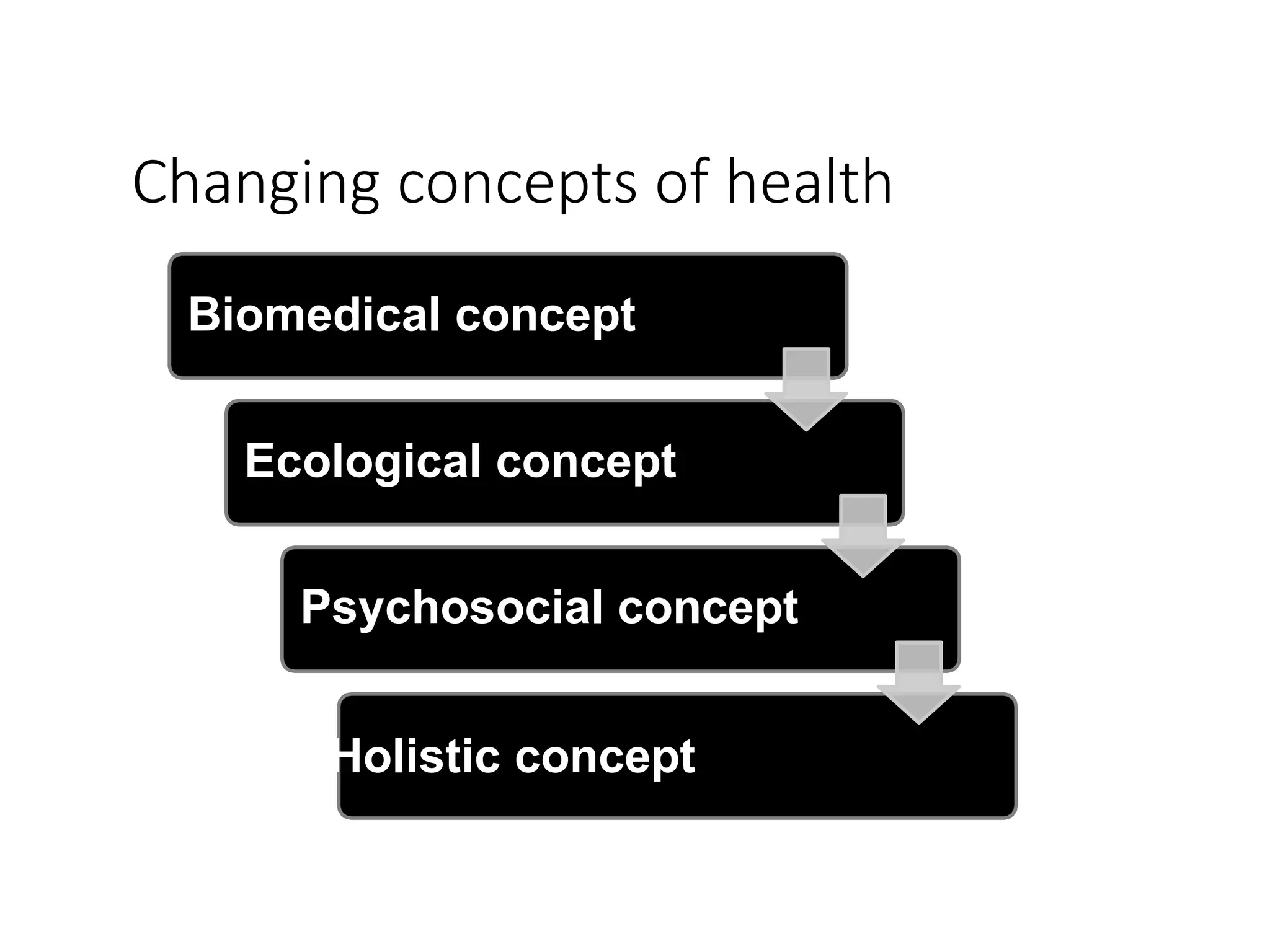
Changing concepts (1/4):
Biomedicalconcept:
"Absence of disease" based on "germ theory of
disease“
Drawback: minimized the role of the
environmental, social, psychological and
cultural determinants of health.
9.
Changing concepts (2/4):
Ecologicalconcept:
According to ecologists:
Health is a dynamic equilibrium
between man and his environment, and
Disease is a maladjustment of the
human organism to environment.
10.
Changing concepts (3/4):
Psychosocialconcept:
Health is not only a biomedical
phenomenon, but one which is influenced by
social,
psychological,
cultural,
economic and
political factors of the people concerned.
11.
Changing concepts (4/4)…
Holisticconcept :
It recognizes the strength of social, economic,
political and environmental influences on health.
Implies that all sectors of society have
an effect on health
Ancient view: Sound mind, in a sound body,
in a sound family, in sound environment.
Emphasis is on promotion and protection
of health
12.
DEFINITION OF HEALTH:
Healthis a state of
Complete physical,
Mental and
Social wellbeing and
Not merely an absence of disease
or infirmity
To be able to lead a "socially
and economically productive life"
13.
"Operational definition" ofhealth:
(a)No obvious evidence of disease, and
that a person is functioning normally, i.e.,
within normal limits of variation
(b)the several organs of the body are
functioning adequately in themselves and in
relation to one another
14.
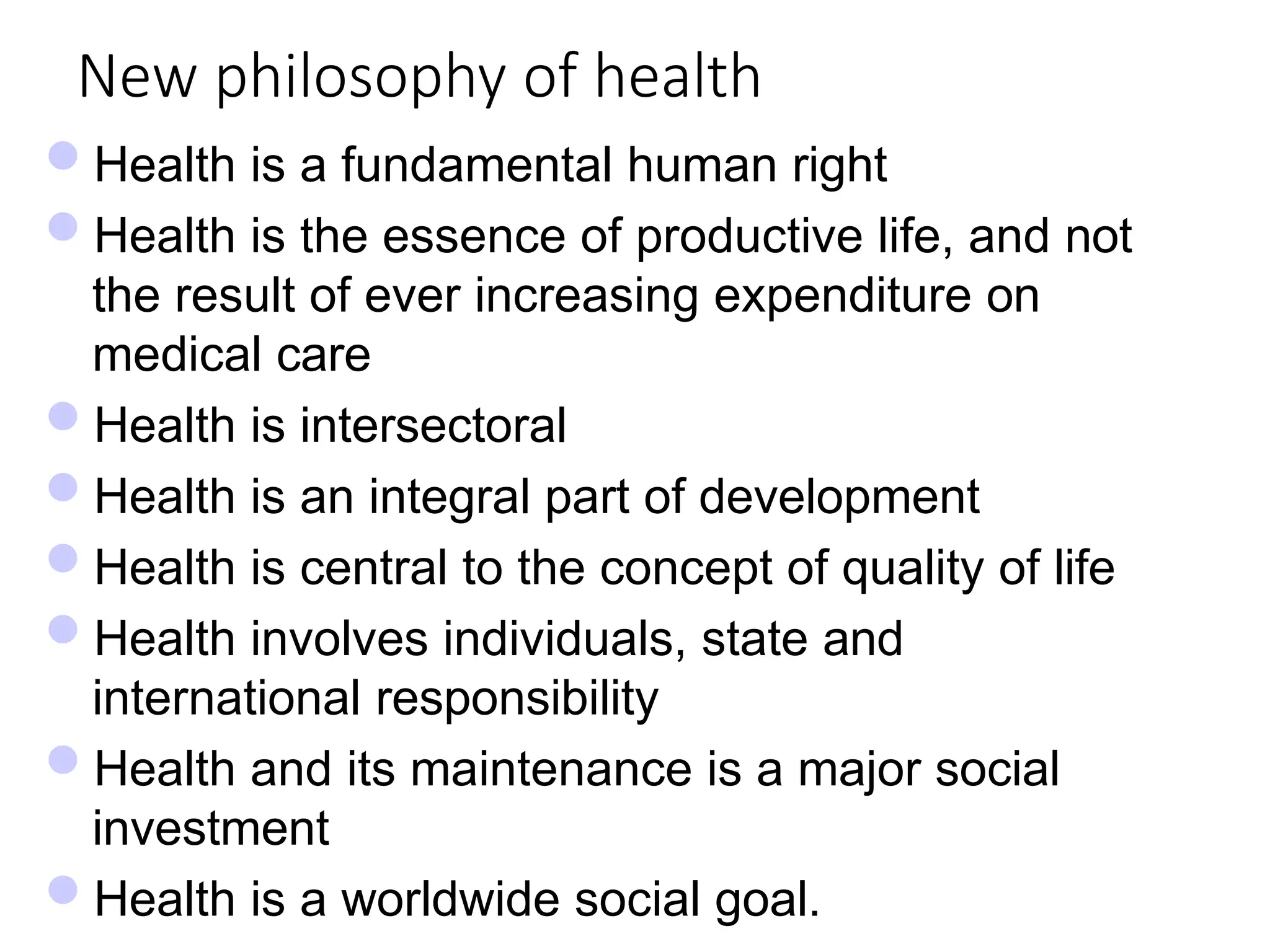
New philosophy ofhealth
Health is a fundamental human right
Health is the essence of productive life, and not
the result of ever increasing expenditure on
medical care
Health is intersectoral
Health is an integral part of development
Health is central to the concept of quality of life
Health involves individuals, state and
international responsibility
Health and its maintenance is a major social
investment
Health is a worldwide social goal.
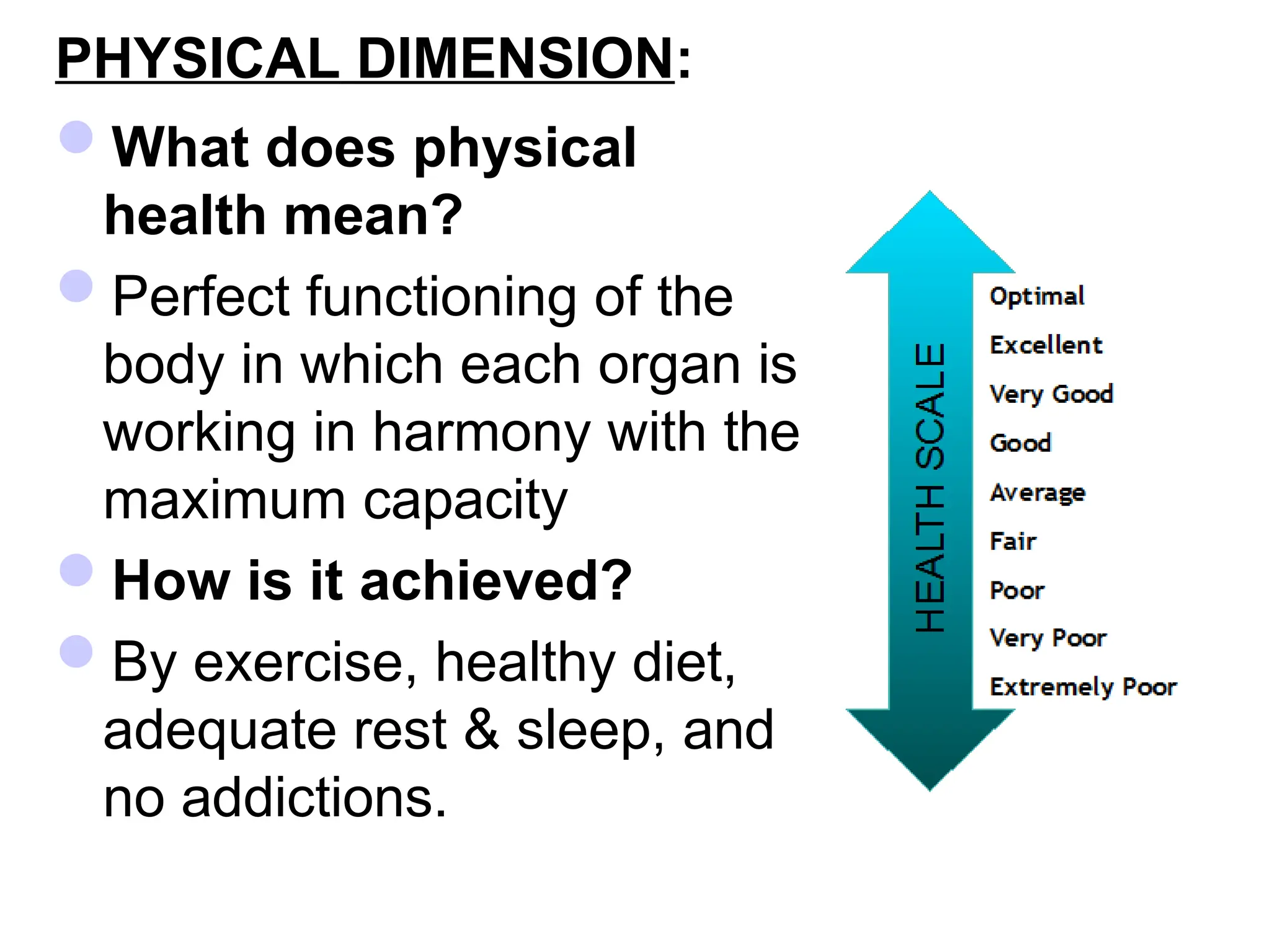
PHYSICAL DIMENSION:
What doesphysical
health mean?
Perfect functioning of the
body in which each organ is
working in harmony with the
maximum capacity
How is it achieved?
By exercise, healthy diet,
adequate rest & sleep, and
no addictions.
18.
Physical Dimension:
What arethe signs of good
physical health?
A healthy skin texture
Bright eyes
Not too thin or fat
A good appetite
Regular bowel and bladder activities
Smooth and easy coordinated movements
The resting pulse rate, blood pressure and exercise
tolerance are all within the range of "normality"
for the individual's age and sex.
Steady gain in weight till 25 years and constant
thereafter
19.
Physical Dimension:
How canproper physical health
be maintained?
By various preventive measures and
regular follow up with health care providers
20.
Evaluation of physicalhealth
self assessment of overall health
inquiry into symptoms of ill-health and
risk factors
inquiry into medications
inquiry into levels of activity
inquiry into use of medical services
standardized questionnaires for
cardiovascular diseases
standardized questionnaires for
respiratory diseases
clinical examination
nutrition and dietary assessment, and
biochemical and laboratory investigations.
21.
MENTAL DIMENSION:
What isgood mental health?
the ability to respond to the many
varied experiences of life with flexibility
and a sense of purpose
Definition:
"A state of balance between the individual and
the surrounding world,
a state of harmony between oneself and
others,
a coexistence between the realities of the self and
that of other people and that of the
environment"
22.
Attributes of amentally healthy person:
free from internal conflicts; he is not at "war" with
himself.
he is well-adjusted, i.e., he is able to get along well
with others. He accepts criticism and is not easily
upset.
he searches for identity.
he has a strong sense of self-esteem.
he knows himself: his needs, problems and goals
(this is known as self-actualization).
he has good self-control-balances rationality and
emotionality.
he faces problems and tries to solve them
intelligently, i.e., coping with stress and anxiety.
23.
SOCIAL DIMENSION:
harmony andintegration within
the individual,
between each individual and
other members of society and
between individuals and the world in
which they live
Definition:
"Quantity and quality of an
individual's interpersonal ties and the
extent of involvement with the
community"
24.
SPIRITUAL DIMENSION:
It includesintegrity, principles and ethics,
the purpose in life, commitment to some
higher being and belief in concepts that are
not subject to "state of the art" explanation
EMOTIONAL DIMENSION
Mental health can be seen as "knowing"
or "cognition" while emotional health
relates to "feeling"
25.
VOCATIONAL DIMENSION
When workis fully adapted to human
goals, capacities and limitations, work
often plays a role in promoting both
physical and mental health.
the culmination of the efforts of other
dimensions as they function together to
produce what the individual considers life
"success"
CONCEPT OF WELL-BEING
WHOdefinition of health
What is well being?
“the state of being comfortable, healthy,
or happy”
Has Subjective and Objective
components
28.
Objective components ofwell being
1. Standard of living: Measures of socio-
economic status:
Income and occupation,
Standards of housing, sanitation and nutrition,
The level of provision of health, educational,
recreational and other services
Collectively used as an index of the "standard
of living”
The extent of differences in SOL are usually
measured through the comparison of per capita
GNP on which the standard of living primarily
depends
29.
Concept of wellbeing:Objective component
2. Level of living: Nine components:
Level
of
living
Health
Food
consumption
Housing
Social
security
Clothing
Recreation
Leisure and
human rights
Education
Occupation and
working
conditions
30.
Concept of wellbeing:Subjective component
Quality of life :
A composite measure of physical, mental and social
wellbeing as perceived by each individual
Evaluated by:
Assessing a person's subjective feelings
of happiness or unhappiness about the various
life concerns
Improvement of quality of life means increased
emphasis on social policy and on reformulation of
societal goals to make life more liveable for all.
Concept of wellbeing:
Physicalquality of life index consolidates
three indicators,
Infant mortality,
Life expectancy at age one
Literacy
33.
Physical quality oflife index
Each indicator is given equal weight from 0-100
PQLI is the average of all indicators.
Ranges from 0-100.
Does NOT take per capita GNP into consideration.
Aim: To attain a PQLI of 100.
India – 43, Kerala – 67 (highest)
Measures: Social, economic & political policies
PQLI does not measure economic growth.
It is intended to complement, not replace GNP.
34.
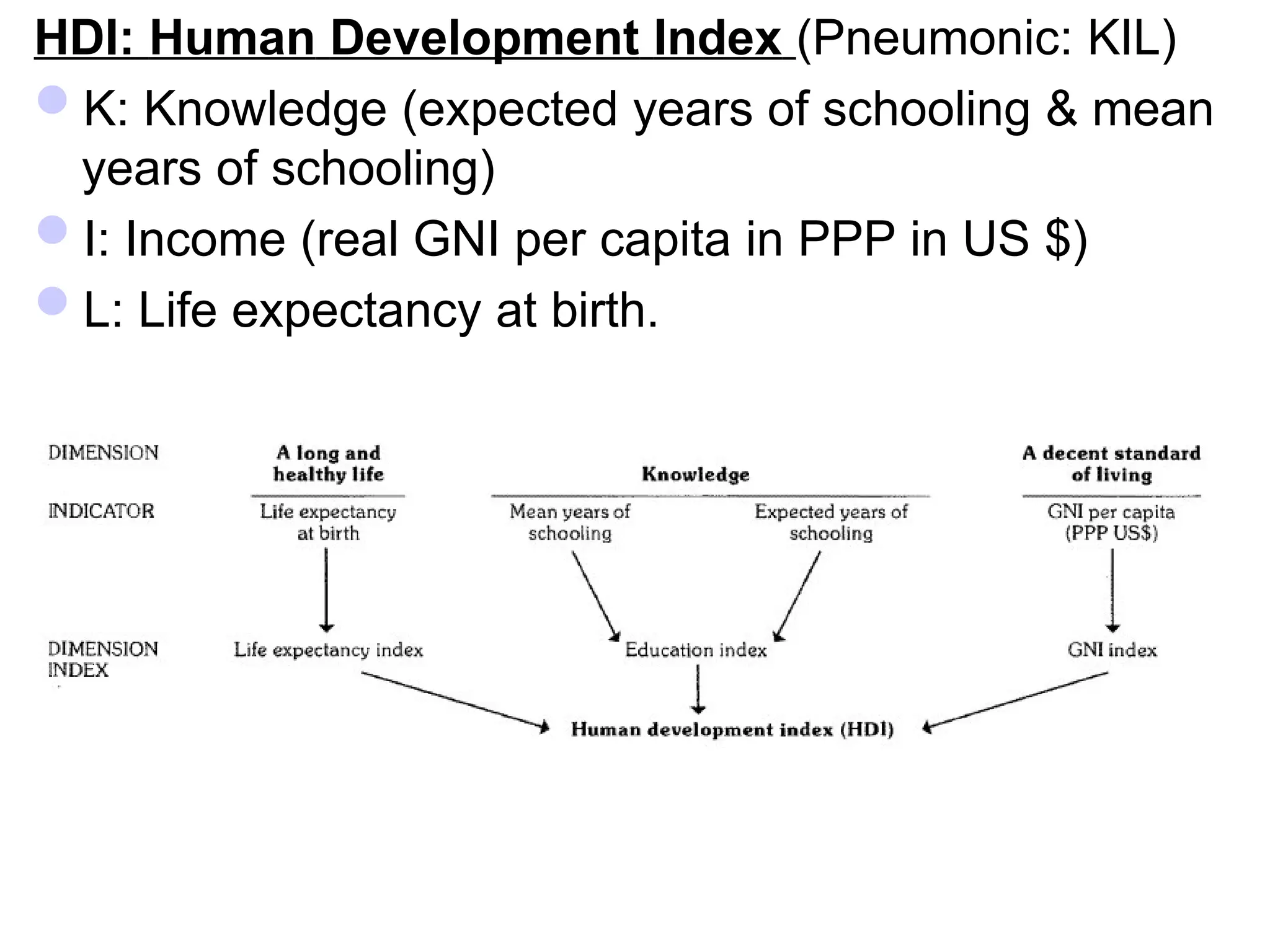
HDI: Human DevelopmentIndex (Pneumonic: KIL)
K: Knowledge (expected years of schooling & mean
years of schooling)
I: Income (real GNI per capita in PPP in US $)
L: Life expectancy at birth.
35.
HDI: Human DevelopmentIndex
HDI values range from 0-1.
(http://hdr.undp.org/en/composite/HDI)
Very High: ≥0.800: 51 countries
(Norway : 0.949)
High: 0.700- 0.799: 54 countries
Medium: 0.550- 0.699: 42 countries-
India 131 no.
(0.624)
Low: <0.550: 41 countries
Measures average achievements in the basic
36.
Minimum and Maximumvalues for each indicators:
Expected years of schooling: 0 and 18.0
Mean years of schooling: 0 & 13.1 (Czech Republic)
Combined education index: 0 & 0.978 (New Zealand)
GNI per capita (PPP$): 100$ & 107721$ (Qatar) -
Log values are taken
Life expectancy at birth: 20 yrs & 83.4 yrs
(Japan) Formula for calculating Individual indices:
Index = {(Actual value) – (Minimum value)}
{(Maximum value) – (Minimum value)}
The HDI is the geometric mean of the three dimension
indices:
( I Life
1/3 X I Education
l/3 X I Income
1/3)
HPI 1 HPI2
Used for Developing countries Developed countries
Dimensions used 3 4
Probability at birth of
not surviving to age
40 60
Knowledge exclusion Adult illiteracy rate % of adults (16-65)
lacking functional
literacy skills
SOL deprivation Unweighted average of:
-% of population not
using an improved water
source
-% of children
under weight- for-
age
% of people living
below the income
poverty line
Social exclusion NA Proportion of long term
unemployment (≥ 12
months)
Formula [1/3 (P α + P α + P α )] 1/ α [1/4 (P α + P α + P α +
Human poverty index: Measures deprivation in basic
dimensions of human development.
39.
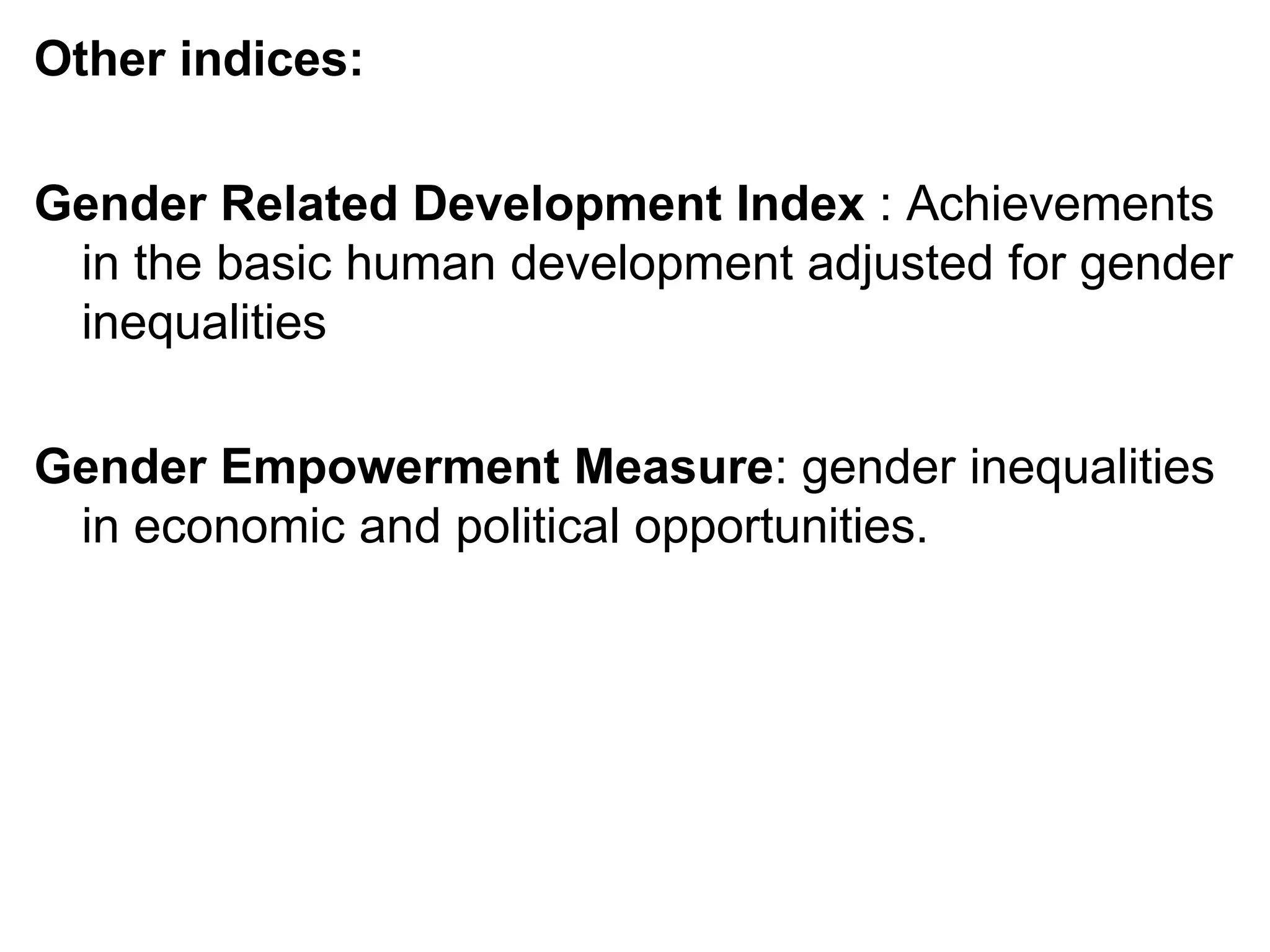
Other indices:
Gender RelatedDevelopment Index : Achievements
in the basic human development adjusted for gender
inequalities
Gender Empowerment Measure: gender inequalities
in economic and political opportunities.
40.
Summary
Health isa neglected topic UNTIL it is LOST
There have been changing concepts of health: Biomedical-
ecological- psychosocial- holistic
Dimensions of health: Physical, Mental, Social, Emotional,
spiritual, Vocational etc..
Well Being: Subjective & Objective components
Determinants of Health– Definition
•Determinants of health are factors that influence an
individual's or population’s health.
•Main categories:
•1. Biological
•2. Environmental
•3. Behavioral/Lifestyle
•4. Socioeconomic
•5. Health System–related
43.
WHO Conceptual Framework
•Accordingto WHO, health is influenced by:
- Individual lifestyle factors
- Social and community networks
- Living and working conditions
- Socioeconomic, cultural, and environmental conditions
(Ref: Dahlgren & Whitehead model, 1991)
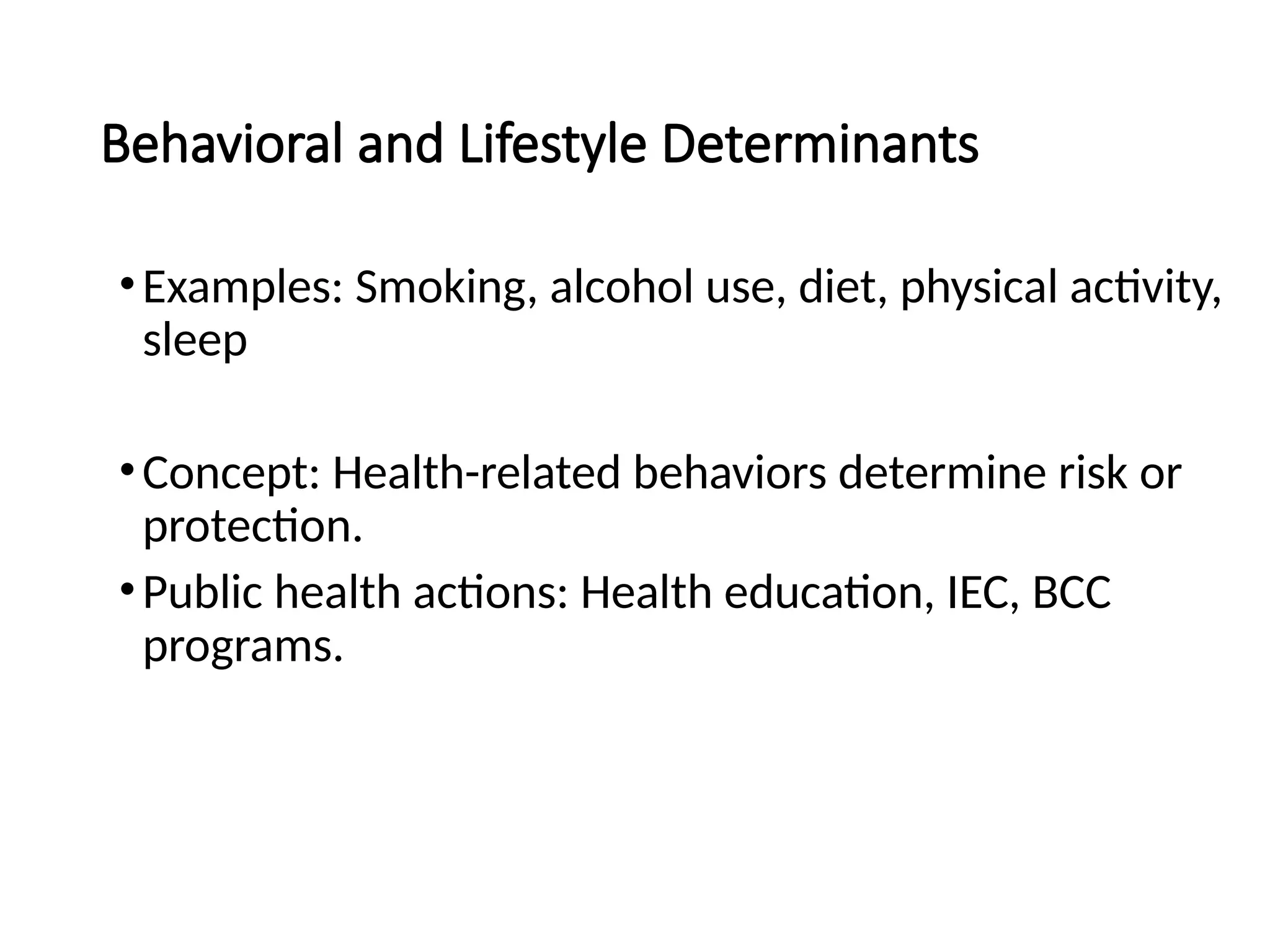
Behavioral and LifestyleDeterminants
•Examples: Smoking, alcohol use, diet, physical activity,
sleep
•Concept: Health-related behaviors determine risk or
protection.
•Public health actions: Health education, IEC, BCC
programs.
47.
Socioeconomic Determinants
•Examples: Income,education, occupation, social
class, gender, caste
•Concept: Social gradient in health – 'The poorer, the
worse the health.'
•Relevance: Basis for equity-based interventions.
48.
Health System–Related Determinants
•Factors:
-Accessibility
- Affordability
- Quality of care
•Example: Rural-urban gap in health infrastructure
•Public health implication: Universal Health Coverage
(UHC)
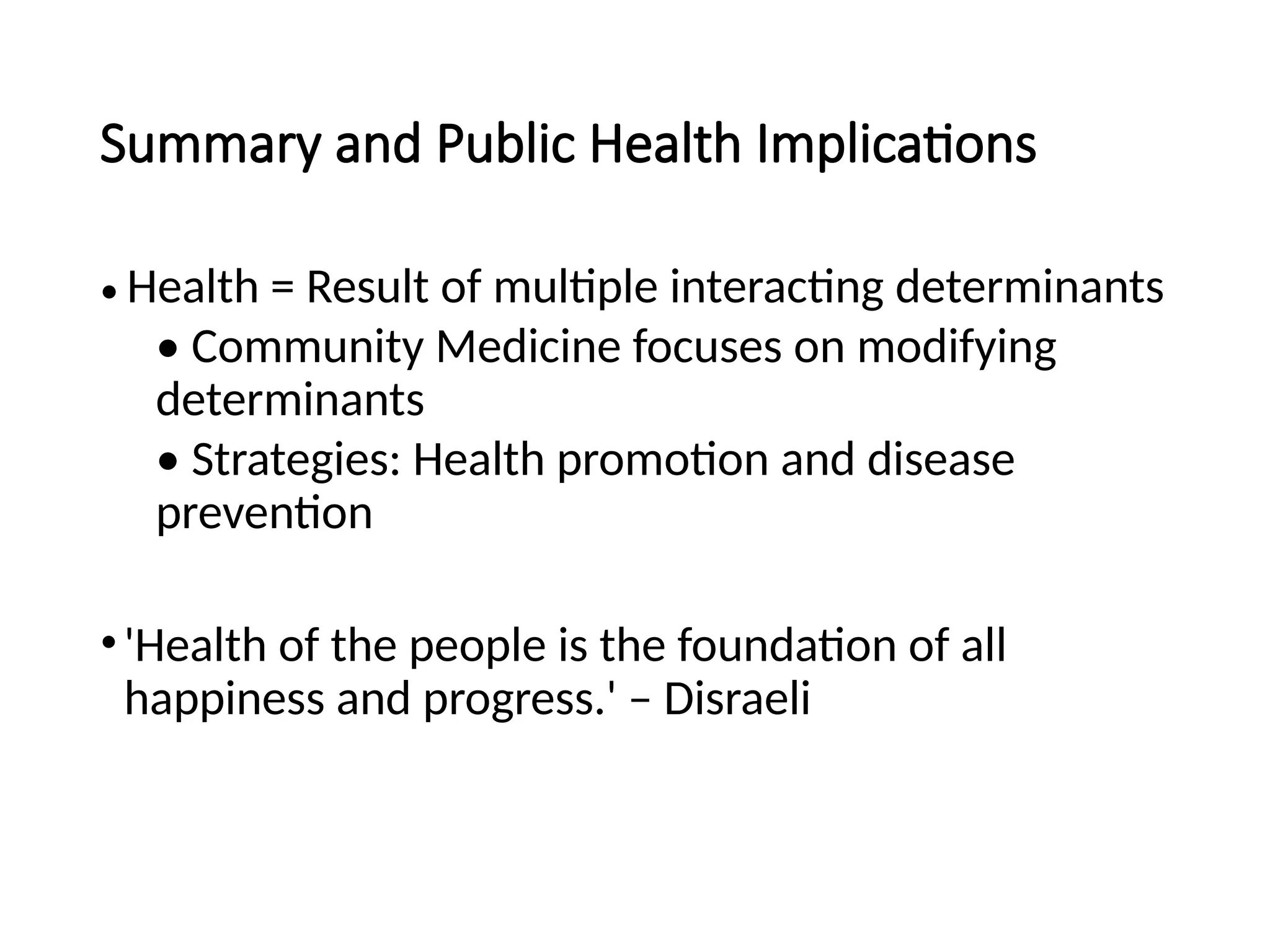
Summary and PublicHealth Implications
• Health = Result of multiple interacting determinants
• Community Medicine focuses on modifying
determinants
• Strategies: Health promotion and disease
prevention
•'Health of the people is the foundation of all
happiness and progress.' – Disraeli
52.
Concept of CommunityMedicine
Definition: Branch of medicine concerned with the
health of populations and communities.
• Goal: Promotion of health, prevention of
disease, and prolongation of life through
organized community efforts.
• Scope: Health education, sanitation, disease
surveillance, MCH, communicable & NCD control.
• Key Principle: Health for all via preventive,
promotive, curative & rehabilitative care.
53.
Objectives of CommunityMedicine
• Study of health and disease in populations.
• Identify health needs and priorities.
• Plan and implement health programs.
• Promote health education and community
participation.
• Evaluate health services and outcomes.
54.
Concept of InternalMedicine
Definition: Clinical medicine branch dealing with
prevention, diagnosis, and treatment of diseases.
• Goal: Comprehensive medical care to individual
patients.
• Approach: Hospital/clinic-based with patient-specific
focus.
• Specialties: Cardiology, Gastroenterology,
Endocrinology, Pulmonology, etc.
55.
Difference Between CommunityMedicine
and Internal Medicine
• Focus: Community/Population vs Individual Patient
• Approach: Preventive & Promotive vs Curative & Diagnostic
• Setting: Community, field, PHC vs Hospitals, clinics
• Methods: Epidemiology, biostatistics, health programs vs
Clinical examination, investigations
• Outcome: Improved community health vs Recovery and
management of disease
56.
Integration and Importance
•Community Medicine prevents disease and Promote Health;
Internal Medicine treats it.
• Both are complementary for holistic health care.
• Community Medicine aids in policy, planning, and
population health.
• Final Message: Community Medicine = Medicine for
populations; Internal Medicine = Medicine for individuals.
Concept of Health
•WHO(1948): 'A state of complete physical, mental and
social well-being, and not merely the absence of
disease or infirmity.'
•Health is multidimensional:
•- Physical
•- Mental
•- Social
•- Spiritual
•- Occupational















![HPI 1 HPI 2
Used for Developing countries Developed countries
Dimensions used 3 4
Probability at birth of
not surviving to age
40 60
Knowledge exclusion Adult illiteracy rate % of adults (16-65)
lacking functional
literacy skills
SOL deprivation Unweighted average of:
-% of population not
using an improved water
source
-% of children
under weight- for-
age
% of people living
below the income
poverty line
Social exclusion NA Proportion of long term
unemployment (≥ 12
months)
Formula [1/3 (P α + P α + P α )] 1/ α [1/4 (P α + P α + P α +
Human poverty index: Measures deprivation in basic
dimensions of human development.](https://image.slidesharecdn.com/conceptofhealthanddisease-251121151814-5e08cdbd/75/Concept_of_health_and_disease-with-perspective-of-public-health-38-2048.jpg)