COMPUTER WAREHOUSE GROUP PLC
LAGOS, NIGERIA
REPORT OF THE DIRECTORS
AND
CONSOLIDATED AND SEPARATE AUDITED FINANCIAL STATEMENTS
FOR THE YEAR ENDED 31 DECEMBER 2015
COMPUTER WAREHOUSE GROUP PLC
REPORT OF THE DIRECTORS, CONSOLIDTED AND SEPARATE AUDITED FINANCIAL STATEMENTS
FOR THE YEAR ENDED 31 DECEMBER 2015
CONTENTS PAGE
Corporate Information 3
Report of the Directors 4
Corporate governance report 7
Statement of Directors’ Responsibilities 9
Independent Auditors’ Report 10
Consolidated and Separate Statement of Profit or Loss and Other Comprehensive Income 12
Consolidated and Separate Statement of Financial Position 13
Consolidated and Separate Statement of Changes in Equity 14
Consolidated and Separate Statement of Cash Flows 15
Notes to the Financial Statements 16
Value Added Statement 54
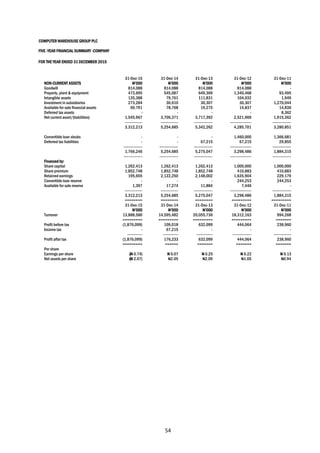
Five- year financial Summary - Company 55
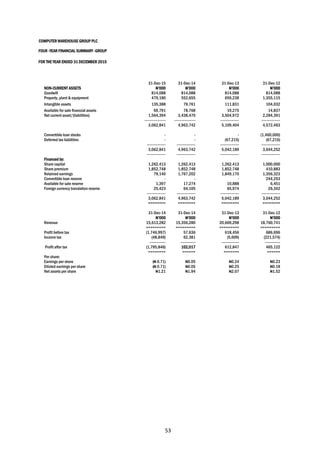
Four-year financial Summary - Group 56
COMPUTER WAREHOUSE GROUP PLC
REPORT OF THE DIRECTORS, CONSOLIDATED AUDITED FINANCIAL STATEMENTS
FOR THE YEAR ENDED 31 DECEMBER 2015
3
CORPORATE INFORMATION
DIRECTORS
Abiodun Fawunmi Chairman
Chief Willie Belonwu (Deceased, 2015)
Austin Okere Vice Chairman
James Agada Managing Director/Chief Executive Officer
Kunle Ayodeji Chief Operating Officer
Philip Obioha Non-Executive
Ravi Sharma Non-executive (British)
Emmanuel Ijewere Non-executive
REGISTERED OFFICE Block 54A, Plot 10,
Adebayo Doherty Road,
Off Admiralty Way
Lekki Phase 1
Lagos
Tel: 01-7406817, 01-8936502
www.cwg-plc.com
AUDITORS Ernst & Young
(Chartered Accountants)
13th Floor, UBA House
57, Marina, Lagos
Nigeria
E-mail: services@ng.ey.com
SOLICITORS Ikeyi Arifayan
1st Floor, 21, Boyle Street
Onikan, Lagos
BANKERS First Bank of Nigeria Limited Stanbic IBTC Bank Plc
Guaranty Trust Bank Plc Standard Chartered Bank Plc
Access Bank Plc United Bank for Africa Plc
Diamond Bank Plc First City Monument Bank Plc
Zenith Bank Plc
REGISTRAR Africa Prudential Registrars Plc
220B, Ikorodu Road
Palmgroove
Lagos
4
COMPUTER WAREHOUSE GROUP PLC
REPORT OF THE DIRECTORS - Continued
FOR THE YEAR ENDED 31 DECEMBER 2015
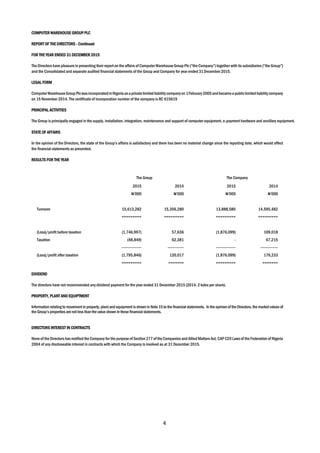
The Directors have pleasure in presenting their report on the affairs of Computer Warehouse Group Plc (“the Company”) together with its subsidiaries (“the Group”)
and the Consolidated and separate audited financial statements of the Group and Company for year ended 31 December 2015.
LEGAL FORM
ComputerWarehouseGroupPlcwasincorporatedinNigeria asaprivatelimitedliabilitycompanyon 1February2005andbecamea publiclimitedliabilitycompany
on 15 November 2014. The certificate of incorporation number of the company is RC 615619
PRINCIPAL ACTIVITIES
The Group is principally engaged in the supply, installation, integration, maintenance and support of computer equipment, e-payment hardware and ancillary equipment.
STATE OF AFFAIRS
In the opinion of the Directors, the state of the Group’s affairs is satisfactory and there has been no material change since the reporting date, which would affect
the financial statements as presented.
RESULTS FOR THE YEAR
The Group The Company
2015 2014 2015 2014
N’000 N’000 N’000 N’000
Turnover 15,613,282 15,356,280 13,888,580 14,595,482
========= ========= ========= =========
(Loss)/profit before taxation (1,746,997) 57,636 (1,876,099) 109,018
Taxation (48,849) 62,381 - 67,215
---------------- ------------- ---------------- --------------
(Loss)/profit after taxation (1,795,846) 120,017 (1,876,099) 176,233
========= ======= ========= =======
DIVIDEND
The directors have not recommended any dividend payment for the year ended 31 December 2015 (2014: 2 kobo per share).
PROPERTY, PLANT AND EQUIPTMENT
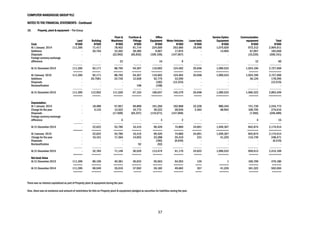
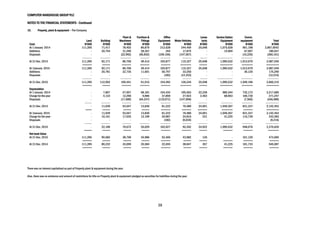
Information relating to movement in property, plant and equipment is shown in Note 15to the financial statements. In the opinion of the Directors, the market values of
the Group’s properties are not less than the value shown in these financial statements.
DIRECTORS INTEREST IN CONTRACTS
None of the Directors has notified the Company for the purpose of Section 277 of the Companies and Allied Matters Act, CAP C20 Lawsof the Federation of Nigeria
2004 of any discloseable interest in contracts with which the Company is involved as at 31 December 2015.
5
COMPUTER WAREHOUSE GROUP PLC
REPORT OF THE DIRECTORS – Continued
FOR THE YEAR ENDED 31 DECEMBER 2015
DONATIONS
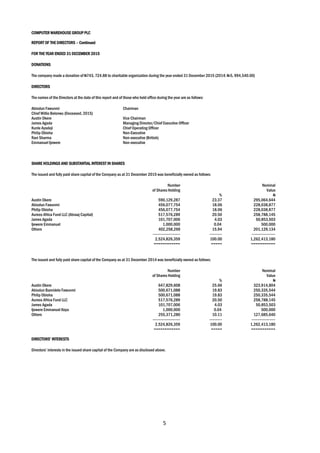
The company made a donation of N743, 724.88 to charitable organization during the year ended 31 December 2015 (2014: N 5, 994,540.00)
DIRECTORS
The names of the Directors at the date of this report and of those who held office during the year are as follows:
Abiodun Fawunmi Chairman
Chief Willie Belonwu (Deceased, 2015)
Austin Okere Vice Chairman
James Agada Managing Director/Chief Executive Officer
Kunle Ayodeji Chief Operating Officer
Philip Obioha Non-Executive
Ravi Sharma Non-executive (British)
Emmanuel Ijewere Non-executive
SHARE HOLDINGS AND SUBSTANTIAL INTEREST IN SHARES
The issued and fully paid share capital of the Company as at 31 December 2015 was beneficially owned as follows:
Number Nominal
of Shares Holding Value
% N
Austin Okere 590,129,287 23.37 295,064,644
Abiodun Fawunmi 456,077,754 18.06 228,038,877
Philip Obioha 456,077,754 18.06 228,038,877
Aureos Africa Fund LLC (Abraaj Capital) 517,576,289 20.50 258,788,145
James Agada 101,707,006 4.03 50,853,503
Ijewere Emmanuel 1,000,000 0.04 500,000
Others 402,258,269 15.94 201,129,134
---------------------- ---------- -------------------
2,524,826,359 100.00 1,262,413,180
============ ===== ===========
The issued and fully paid share capital of the Company as at 31 December 2014 was beneficially owned as follows:
Number Nominal
of Shares Holding Value
% N
Austin Okere 647,829,608 25.66 323,914,804
Abiodun Bamidele Fawunmi 500,671,088 19.83 250,335,544
Philip Obioha 500,671,088 19.83 250,335,544
Aureos Africa Fund LLC 517,576,289 20.50 258,788,145
James Agada 101,707,006 4.03 50,853,503
Ijewere Emmanuel Itoya 1,000,000 0.04 500,000
Others 255,371,280 10.11 127,685,640
---------------------- ---------- -------------------
2,524,826,359 100.00 1,262,413,180
============ ===== ===========
DIRECTORS’ INTERESTS
Directors’ interests in the issued share capital of the Company are as disclosed above.
6
COMPUTER WAREHOUSE GROUP PLC
REPORT OF THE DIRECTORS – Continued
FOR THE YEAR ENDED 31 DECEMBER 2015
EMPLOYMENT AND EMPLOYEES
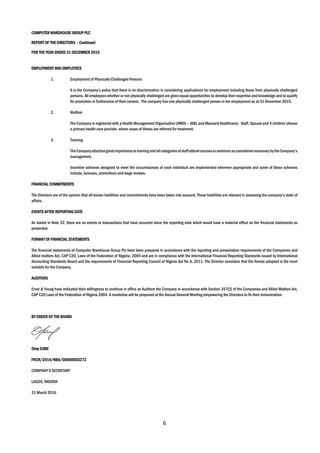
1. Employment of Physically Challenged Persons
It is the Company’s policy that there is no discrimination in considering applications for employment including those from physically challenged
persons. All employees whether or not physically challenged are given equal opportunities to develop their expertise and knowledge and to qualify
for promotion in furtherance of their careers. The company has one physically challenged person in her employment as at 31 December 2015.
2. Welfare
The Company is registered with a Health Management Organisation (HMO) – (KBL and Mansard Healthcare). Staff, Spouse and 4 children choose
a primary health care provider, where cases of illness are referred for treatment.
3. Training
The Companyattachesgreatimportanceto training andallcategoriesofstaffattendcourses orseminarsasconsiderednecessarybytheCompany’s
management.
Incentive schemes designed to meet the circumstances of each individual are implemented wherever appropriate and some of these schemes
include, bonuses, promotions and wage reviews.
FINANCIAL COMMITMENTS
The Directors are of the opinion that all known liabilities and commitments have been taken into account. These liabilities are relevant in assessing the company’s state of
affairs.
EVENTS AFTER REPORTING DATE
As stated in Note 32, there are no events or transactions that have occurred since the reporting date which would have a material effect on the financial statements as
presented.
FORMAT OF FINANCIAL STATEMENTS
The financial statements of Computer Warehouse Group Plc have been prepared in accordance with the reporting and presentation requirements of the Companies and
Allied matters Act, CAP C20, Laws of the Federation of Nigeria, 2004 and are in compliance with the International Financial Reporting Standards issued by International
Accounting Standards Board and the requirements of Financial Reporting Council of Nigeria Act No 6, 2011. The Director considers that the format adopted is the most
suitable for the Company.
AUDITORS
Ernst & Young have indicated their willingness to continue in office as Auditors the Company in accordance with Section 357(2) of the Companies and Allied Matters Act,
CAP C20 Laws of the Federation of Nigeria 2004. A resolution will be proposed at the Annual General Meeting empowering the Directors to fix their remuneration.
BY ORDER OF THE BOARD
Okey EJIBE
FRCN/2014/NBA/00000003272
COMPANY’S SECRETARY
LAGOS, NIGERIA
31 March 2016
7
COMPUTER WAREHOUSE GROUP PLC
CORPORATE GOVERNANCE REPORT
FOR THE YEAR ENDED 31 DECEMBER 2015
Computer Warehouse Group Plc is committed to the highest standards of Corporate Governance to ensure proper oversight of the group operations and to create long term
sustainable value for all shareholders and stakeholders. In line with best practices, there is a separation of power between the Chairman and the Group CEO, as well as a
unique blend of Executive andNon-Executive Directors. The individual and collective academic qualifications and wealth of diverse skills and experience of the Board ensure
independent thought and exceptional decision making.
The Board of Directors in driving the strategic direction of the Company ensures continual building of strong and stable relationships with shareholders, stakeholders and
the community at large.
The Company is now publicly quoted on the Nigerian Stock Exchange and affirms its commitment to increasing shareholder value through open and transparent Corporate
Governance Practices.
THE BOARD
The Board is committed to best practices of Corporate Governance in carrying out its responsibility of determining the strategic objectives and policies of the Company. The
Board is accountable to the shareholders and is responsible for creating and delivering sustainable value through proper management of the Company’s affairs. The Board
also provides oversight of senior management of the Company.
COMPOSITION OF THE BOARD
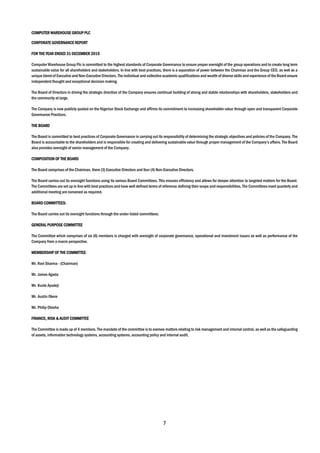
The Board comprises of the Chairman, there (3) Executive Directors and four (4) Non-Executive Directors.
The Board carries out its oversight functions using its various Board Committees. This ensures efficiency and allows for deeper attention to targeted matters for the Board.
The Committees are set up in line with best practices and have well defined terms of reference defining their scope and responsibilities. The Committees meet quarterly and
additional meeting are convened as required.
BOARD COMMITTEES:
The Board carries out its oversight functions through the under-listed committees:
GENERAL PURPOSE COMMITTEE
The Committee which comprises of six (6) members is charged with oversight of corporate governance, operational and investment issues as well as performance of the
Company from a macro perspective.
MEMBERSHIP OF THE COMMITTEE:
Mr. Ravi Sharma - (Chairman)
Mr. James Agada
Mr. Kunle Ayodeji
Mr. Austin Okere
Mr. Philip Obioha
FINANCE, RISK & AUDIT COMMITTEE
The Committee is made up of 4 members. The mandate of the committee is to oversee matters relating to risk management and internal control, as well as the safeguarding
of assets, information technology systems, accounting systems, accounting policy and internal audit.
8
COMPUTER WAREHOUSE GROUP PLC
CORPORATE GOVERNANCE REPORT - Continued
FOR THE YEAR ENDED 31 DECEMBER 2015
MEMBERSHIP OF THE COMMITTEE:
Mr. Emmanuel Ijewere - (Chairman)
Mr. Austin Okere
Mr. Philip Obioha
Mr. Kunle Ayodeji
AUDIT COMMITTEE:
The Audit Committee in line with Section 359 (5) of the Companies and Allied Matters Act is mandated to examine the auditor’s report and make recommendations thereon
to the General Meeting. The Committee consists of 6 members.
MEMBERSHIP OF THE AUDIT COMMITTEE:
Mr. Patrick Amaechi - (Chairman)
Mr. Robert Ibekwe
Alhaji Wahab Ajani
Mr. Emmanuel Ijewere
Mr. Philip Obioha
Mr. Kunle Ayodeji
TRADING POLICY
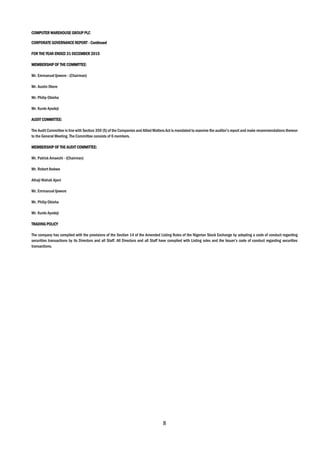
The company has complied with the provisions of the Section 14 of the Amended Listing Rules of the Nigerian Stock Exchange by adopting a code of conduct regarding
securities transactions by its Directors and all Staff. All Directors and all Staff have complied with Listing rules and the Issuer’s code of conduct regarding securities
transactions.
9
COMPUTER WAREHOUSE GROUP PLC
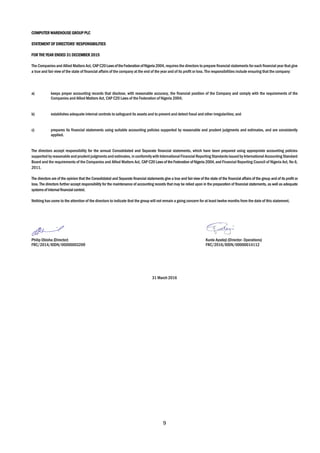
STATEMENT OF DIRECTORS’ RESPONSIBILITIES
FOR THE YEAR ENDED 31 DECEMBER 2015
The Companies and Allied Matters Act, CAPC20LawsoftheFederationofNigeria2004, requires the directors to prepare financial statements for each financial year that give
a true and fair view of the state of financial affairs of the company at the end of the year and of its profit or loss. The responsibilities include ensuring that the company:
a) keeps proper accounting records that disclose, with reasonable accuracy, the financial position of the Company and comply with the requirements of the
Companies and Allied Matters Act, CAP C20 Laws of the Federation of Nigeria 2004;
b) establishes adequate internal controls to safeguard its assets and to prevent and detect fraud and other irregularities; and
c) prepares its financial statements using suitable accounting policies supported by reasonable and prudent judgments and estimates, and are consistently
applied.
The directors accept responsibility for the annual Consolidated and Separate financial statements, which have been prepared using appropriate accounting policies
supportedbyreasonable andprudentjudgmentsand estimates,in conformitywith International Financial Reporting Standardsissuedby International Accounting Standard
Board and the requirements of the Companies and Allied Matters Act, CAP C20 Lawsof the Federation ofNigeria 2004,and Financial Reporting Council of Nigeria Act, No 6,
2011.
The directors are of the opinion that the Consolidated and Separate financial statements give a true and fair view of the state of the financial affairs of the group and of its profit or
loss. The directors further accept responsibility for the maintenance of accounting records that may be relied upon in the preparation of financial statements, as well as adequate
systemsofinternal financial control.
Nothing has come to the attention of the directors to indicate that the group will not remain a going concern for at least twelve months from the date of this statement.
Philip Obioha (Director) Kunle Ayodeji (Director- Operations)
FRC/2014/IODN/00000003269 FRC/2016/IODN/00000014112
31 March 2016
10
11
12
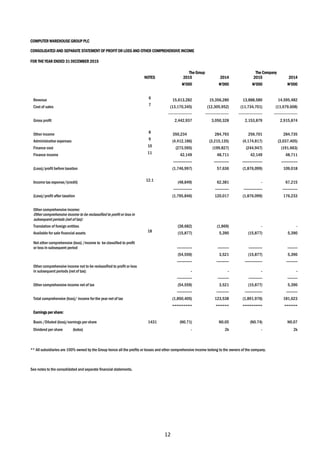
COMPUTER WAREHOUSE GROUP PLC
CONSOLIDATED AND SEPARATE STATEMENT OF PROFIT OR LOSS AND OTHER COMPREHENSIVE INCOME
FOR THE YEAR ENDED 31 DECEMBER 2015
The Group The Company
NOTES 2015 2014 2015 2014
N’000 N’000 N’000 N’000
Revenue 6 15,613,282 15,356,280 13,888,580 14,595,482
Cost of sales 7 (13,170,345) (12,305,952) (11,734,701) (11,679,608)
------------------- ------------------- ------------------- -------------------
Gross profit 2,442,937 3,050,328 2,153,879 2,915,874
Other income 8 350,234 284,793 256,701 284,735
Administrative expenses 9 (4,412,186) (3,215,135) (4,174,817) (3,037,405)
Finance cost 10 (273,595) (199,827) (244,947) (191,663)
Finance income 11 42,149 48,711 42,149 48,711
--------------- ------------ ---------------- -------------
(Loss)/profit before taxation (1,746,997) 57,636 (1,876,099) 109,018
Income tax expense/(credit) 12.1 (48,849) 62,381 - 67,215
--------------- ----------- --------------- ------------
(Loss)/profit after taxation (1,795,846) 120,017 (1,876,099) 176,233
Other comprehensive income:
Other comprehensive income to be reclassified to profit or loss in
subsequent periods (net of tax):
Translation of foreign entities (38,682) (1,869) - -
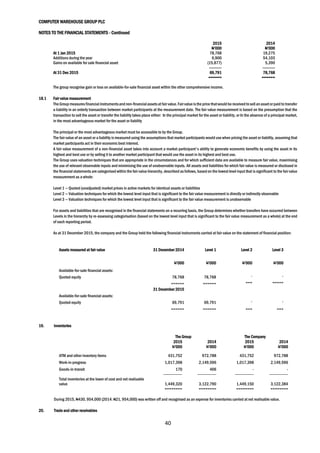
Available for sale financial assets 18 (15,877) 5,390 (15,877) 5,390
Net other comprehensive (loss) /income to be classified to profit
or loss in subsequent period ------------ --------- ----------- --------
(54,559) 3,521 (15,877) 5,390
------------ ---------- -------------- ---------
Other comprehensive income not to be reclassified to profit or loss
in subsequent periods (net of tax): - - - -
------------ --------- ----------- --------
Other comprehensive income net of tax (54,559) 3,521 (15,877) 5,390
------------ ---------- -------------- ---------
Total comprehensive (loss)/ income for the year net of tax (1,850,405) 123,538 (1,891,976) 181,623
========= ====== ========= ======
Earnings per share:
Basic /Diluted (loss)/earnings per share 1431 (N0.71) N0.05 (N0.74) N0.07
Dividend per share (kobo) - 2k - 2k
** All subsidiaries are 100% owned by the Group hence all the profits or losses and other comprehensive income belong to the owners of the company.
See notes to the consolidated and separate financial statements.
COMPUTER WAREHOUSE GROUP PLC
CONSOLIDATED AND SEPARATE STATEMENT OF FINANCIAL POSITION
AS AT 31 DECEMBER 2015
13
Signature Name FRC. No.
…………………………………………………… Philip Obioha (Director) FRC/2014/IODN/00000003269
…………………………………………………… Kunle Ayodeji (Director Operations) FRC/2016/IODN/00000014112
…………………………………………………… Obianuju Ejeh (Chief Financial Officer) FRC/2014/ICAN/00000007858
See notes to the consolidated and separate financial statements.
Notes The Group The Company
31-Dec-15 31-Dec-14 31-Dec-15 31-Dec-14
NON-CURRENT ASSETS N’000 N’000 N’000 N’000
Goodwill and other intangibles. 14.2 814,088 814,088 814,088 814,088
Property, plant & equipment 15 479,180 552,655 473,695 545,087
Intangible assets 16 135,388 79,761 135,388 79,761
Investment in subsidiaries 17 - - 273,284 30,610
Available for sale financial assets 18 69,791 78,768 69,791 78,768
-------------- -------------- --------------- ---------------
1,498,447 1,525,272 1,766,246 1,548,314
CURRENT ASSETS
Inventories 19 1,449,320 3,122,790 1,449,150 3,122,384
Trade and other receivables 20 6,169,796 6,847,598 5,844,951 6,828,766
Prepayments 21 586,968 317,227 577,175 286,005
Cash & cash equivalents 22 821,589 1,833,382 755,416 1,631,093
---------------- ----------------- ----------------- -----------------
9,027,673 12,120,997 8,626,692 11,868,248
----------------- ----------------- ----------------- -----------------
TOTAL ASSET 10,526,120 13,646,269 10,392,938 13,416,562
EQUITY ========= ========= ========= =========
Share capital 23 1,262,413 1,262,413 1,262,413 1,262,413
Share premium 23.1 1,852,748 1,852,748 1,852,748 1,852,748
Retained earnings 23.1 (79,140) 1,767,202 195,655 2,122,250
Available for sale reserve 23.1 1,397 17,274 1,397 17,274
Foreign currency translation reserve 23.1 25,423 64,105 - -
---------------- ---------------- ---------------- ----------------
3,062,841 4,963,742 3,312,213 5,254,685
---------------- ---------------- ---------------- ----------------
NON CURRENT LIABILITIES
Deferred tax liabilities 12.3 - - - -
------ ------ ------ ------
- - -
------ ------ ------ ------
CURRENT LIABILITIES
Trade & other payables 24 6,501,165 5,783,801 6,191,608 5,322,947
Short term loans & borrowings 25 251,115 1,045,539 178,118 977,773
Income tax payable 12.2 561,584 553,614 561,584 561,584
Deferred revenue 26 149,415 1,299,573 149,415 1,299,573
--------------- --------------- ---------------- ----------------
7,463,279 8,682,527 7,080,725 8,161,877
---------------- ---------------- ---------------- ----------------
Total liabilities 7,463,279 8,682,527 7,080,725 8,161,877
----------------- ----------------- ----------------- -----------------
Total equity & liabilities 10,526,120 13,646,269 10,392,938 13,416,562
========= ========= ========= =========
14
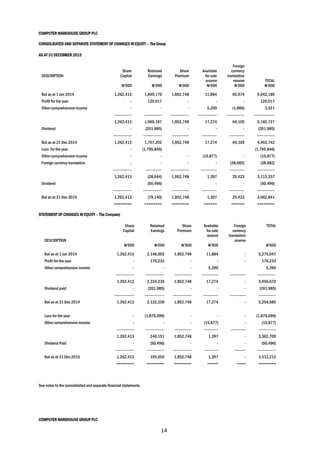
COMPUTER WAREHOUSE GROUP PLC
CONSOLIDATED AND SEPARATE STATEMENT OF CHANGES IN EQUITY – The Group
AS AT 31 DECEMBER 2015
STATEMENT OF CHANGES IN EQUITY – The Company
DESCRIPTION
Share
Capital
Retained
Earnings
Share
Premium
Available
for sale
reserve
Foreign
currency
translation
reserve
TOTAL
N’000 N’000 N’000 N’000 N’000
Bal as at 1 Jan 2014 1,262,413 2,148,002 1,852,748 11,884 - 5,275,047
Profit for the year - 176,233 - - - 176,233
Other comprehensive income - - - 5,390 5,390
--------------- --------------- -------------- ------------- ------------- ---------------
1,262,413 2,324,235 1,852,748 17,274 - 5,456,670
Dividend paid - (201,985) - - - (201,985)
---------------- ---------------- --------------- ------------ ------------- --------------
Bal as at 31 Dec 2014 1,262,413 2,122,250 1,852,748 17,274 - 5,254,685
Loss for the year - (1,876,099) - - - (1,876,099)
Other comprehensive income - - - (15,877) - (15,877)
-------------- --------------- -------------- ------------ ------------ --------------
1,262,413 246,151 1,852,748 1,397 - 3,362,709
Dividend Paid - (50,496) - - - (50,496)
--------------- -------------- --------------- ----------- --------- ---------------
Bal as at 31 Dec 2015 1,262,413 195,655 1,852,748 1,397 - 3,312,213
======== ======== ======== ===== ==== ========
See notes to the consolidated and separate financial statements.
COMPUTER WAREHOUSE GROUP PLC
DESCRIPTION
Share
Capital
Retained
Earnings
Share
Premium
Available
for sale
reserve
Foreign
currency
translation
reserve TOTAL
N’000 N’000 N’000 N’000 N’000 N’000
Bal as at 1 Jan 2014 1,262,413 1,849,170 1,852,748 11,884 65,974 5,042,189
Profit for the year - 120,017 - - - 120,017
Other comprehensive income - - - 5,390 (1,869) 3,521
-------------- -------------- --------------- --------------- -------------- -----------------
1,262,413 1,969,187 1,852,748 17,274 64,105 5,165,727
Dividend - (201,985) - - - (201,985)
--------------- --------------- -------------- ------------ ------------ --------------
Bal as at 31 Dec 2014 1,262,413 1,767,202 1,852,748 17,274 64,105 4,963,742
Loss for the year - (1,795,846) (1,795,846)
Other comprehensive income - - - (15,877) - (15,877)
Foreign currency translation - - - - (38,682) (38,682)
--------------- ------------- --------------- ------------- ------------ --------------
1,262,413 (28,644) 1,852,748 1,397 25,423 3,113,337
Dividend - (50,496) - - - (50,496)
--------------- --------------- -------------- ------------ ------------ --------------
Bal as at 31 Dec 2015 1,262,413 (79,140) 1,852,748 1,397 25,423 3,062,841
======== ======== ======== ====== ====== ========
15
CONSOLIDATED AND SEPARATE STATEMENT OF CASH FLOWS
FOR THE YEAR ENDED 31 DECEMBER 2015
The Group The Company
Note 31-Dec-15 31-Dec-14 31-Dec-15 31-Dec-14
N’000 N’000 N’000 N’000
Cash flows from operating activities
Cash received from customers 15,069,623 16,252,752 13,599,018 15,590,174
Cash paid to suppliers & employees (14,524,824) (15,756,978) (12,759,980) (15,224,432)
Tax paid (40,879) - - -
-------------- -------------- ------------- -------------
Net cash provided by operating activities 22.2 503,920 495,774 839,038 365,742
-------------- -------------- -------------- --------------
Cash flows from investing activities
Purchase of Property, plant & equipment 15 (178,295) (183,659) (175,290) (180,647)
Acquisition of intangible asset 16 (112,093) (16,330) (112,093) (16,330)
Purchase of financial assets 18 (6,900) (54,103) (6,900) (54,103)
Proceeds from sale of equipment 3,367 17,722 3,367 17,722
------------- ------------- ------------- -------------
Net cash (utilised)/generated in investing activities (293,921) (236,370) (290,916) (233,358)
------------- ------------- ------------- -------------
Cash flows from financing activities
Loan paid/(received) (794,424) 606,861 (799,655) 526,591
Lease obligation (12,504) (680) (12,504) (680)
Interest paid (273,595) (199,827) (244,947) (191,663)
Additional investment in subsidiary 17 - - (242,674) (303)
Dividend paid (50,496) (201,985) (50,496) (201,985)
--------------- --------------- --------------- ---------------
Net cash (utilised)/provided by (1,131,019) 204,369 (1,350,276) 131,960
financing activities -------------- -------------- --------------- ---------------
Net( Decrease) Increase in cash & cash equivalent (921,020) 463,773 (802,154) 264,344
Net foreign exchange difference (26,660) (44,611) (9,410) (42,757)
Cash & cash equivalents at 01/01/2015 22.1 1,591,151 1,171,989 1,388,862 1,167,275
--------------- --------------- ---------------- ----------------
Cash and cash equivalents at 31/12/2015 22.1 634,471 1,591,151 577,298 1,388,862
======== ======== ======== ========
See notes to the consolidated and separate financial statements.
COMPUTER WAREHOUSE GROUP PLC
NOTES TO THE FINANCIAL STATEMENTS
16
1. Corporate information
The consolidated and separate financial statements of Computer Warehouse Group Plc and its subsidiaries (collectively, the Group) for the year ended
31 December 2015 were authorised for issue in accordance with the approval of the board of directors. Computer Warehouse Group Plc (the Company)
is a limited liability company incorporated and domiciled in Nigeria and became public by listing on 15 November 2013. The registered office is located
at Block 54A, Plot10, Adebayo Doherty Road, off Admiralty Road, Lekki Phase 1, Lagos State in Nigeria.
The Group is principally engaged in the supply, installation, integration, maintenance and support of computer equipment, e-payment hardware and
ancillary equipment.
2.1 Basis of preparation
The consolidated and separate financial statements of the Group have been prepared in accordance with International Financial Reporting Standards
(IFRS) as issued by the International Accounting Standards Board (IASB) as approved by the Financial Reporting Council of Nigeria and in accordance
with the provisions of the Companies and Allied Matters Act, CAP C20 Laws of the Federation of Nigeria 2004.
Functional and presentation currency
The consolidated and separate financial statements have been prepared on a historical cost basis, except for available-for-sale financial instruments
that have been measured at fair value. The consolidated and separate financial statements are also presented in Naira and all values are rounded to the
nearest thousand (N000), except when otherwise indicated.
Composition of financial statements
The financial statements comprise:
• Consolidated and separate statement of profit or loss and other comprehensive income
• Consolidated and separate statement of financial position
• Consolidated and separate statement of changes in equity
• Consolidated and separate statement of cash flows
• Notes to the Consolidated and separate financial statements
Current versus non-current classification
The group presents assets and liabilities in the Consolidated and separate statement of financial position based on current/non-current classification.
An asset is current when it is:
• Expected to be realised or intended to be sold or consumed in the normal operating cycle
• Held primarily for the purpose of trading
• Expected to be realised within twelve months after the reporting period
Or
• Cash or cash equivalent unless restricted from being exchanged or used to settle a liability for at least twelve months after the reporting period
All other assets are classified as non-current.
A liability is current when:
• It is expected to be settled in the normal operating cycle
• It is held primarily for the purpose of trading
• It is due to be settled within twelve months after the reporting period
Or
• There is no unconditional right to defer the settlement of the liability for at least twelve months after the reporting period
Deferred tax assets and liabilities are classified as non-current assets and liabilities.
2.2 Basis of consolidation
The consolidated financial statements comprise the financial statements of the Group and its subsidiaries as at 31 December 2015. Subsidiaries are
entities controlled by the Group.
Subsidiaries are consolidated from the date of acquisition, being the date on which the Group obtains control, and continue to be consolidated until the
date when such control ceases. The financial statements of the subsidiaries are prepared for the same reporting period as the parent company, using
consistent accounting policies. All intra-group balances, transactions, unrealised gains and losses resulting from intra-group transactions and dividends
are eliminated in full.
The financial statements of the subsidiaries have been prepared on a historical cost basis. The company accounts for its investment in subsidiaries at
cost.
Control is achieved when the Group is exposed, or has rights, to variable returns from its involvement with the investee and has the ability to affect those
returns through its power over the investee.
Generally, there is a presumption that a majority of voting rights results in control. To support this presumption and when the Group has less than a
majority of the voting or similar rights of an investee, the Group considers all relevant facts and circumstances in assessing whether it has power over an
investee, including:
• The contractual arrangement(s) with the other vote holders of the investee
• Rights arising from other contractual arrangements
COMPUTER WAREHOUSE GROUP PLC
NOTES TO THE FINANCIAL STATEMENTS
17
• The Group’s voting rights and potential voting rights
The Group re-assesses whether or not it controls an investee if facts and circumstances indicate that there are changes to one or more of the three
elements of control. Consolidation of a subsidiary begins when the Group obtains control over the subsidiary and ceases when the Group loses control of
the subsidiary. Assets, liabilities, income and expenses of a subsidiary acquired or disposed of during the year are included in the consolidated financial
statements from the date the Group gains control until the date the Group ceases to control the subsidiary.
Profit or loss and each component of OCI are attributed to the equity holders of the parent of the Group and to the non-controlling interests, even if this
results in the non-controlling interests having a deficit balance. When necessary, adjustments are made to the financial statements of subsidiaries to
bring their accounting policies into line with the Group’s accounting policies. All intra-group assets and liabilities, equity, income, expenses and cash
flows relating to transactions between members of the Group are eliminated in full on consolidation.
A change in the ownership interest of a subsidiary, without a loss of control, is accounted for as an equity transaction. If the Group loses control over a
subsidiary,it derecognisesthe relatedassets (including goodwill),liabilities,non-controlling interestand other components ofequity,while any resultant
gain or loss is recognised in profit or loss. Any investment retained is recognised at fair value.
In the Company the investment in its subsidiaries are accounted for using the cost method.
2.3 Summary of significant accounting policies
The following are the significant accounting policies applied by the Group in preparing its financial statements:
2.3.1 Business combinations and goodwill
Business combinations are accounted for using the acquisition method. The cost of an acquisition is measured as the aggregate of the consideration
transferred,measured at the fair value on the date of acquisition. All the Group’s subsidiariesare wholly owned and therefore the issue of Non-controlling
interest does not arise.
When theGroupacquiresa business,itassesses the financial assetsand liabilitiesassumed forappropriate classificationand designationin accordance
with the contractual terms, economic circumstances and pertinent conditions as at the acquisition date.
Goodwill is initially measured at cost, being the excess of the aggregate of the consideration transferred over the fair value of net identifiable assets
acquiredand liabilitiesassumed. If the fair value of the net assets acquired is in excess of the aggregate consideration transferred, the gain is recognised
in profit and loss immediately.
After initial recognition, goodwill is measured at cost less any accumulated impairment losses. For the purpose of impairment testing, goodwill acquired
in a business combination is, from the acquisition date, allocated to each of the Group’s Cash Generating Units (CGU) that are expected to benefit from
the combination, irrespective of whether other assets or liabilities of the acquiree are assigned to those units.
Where goodwill has been allocated to a cash-generating unit and part of the operation within that unit is disposed of, the goodwill associated with the
operation disposed of is included in the carrying amount of the operation when determining the gain or loss on disposal of the operation. Goodwill
disposed of in this circumstance is measured based on the relative values of the operation disposed of and the portion of the cash-generating unit
retained.
COMPUTER WAREHOUSE GROUP PLC
NOTES TO THE FINANCIAL STATEMENTS - Continued
18
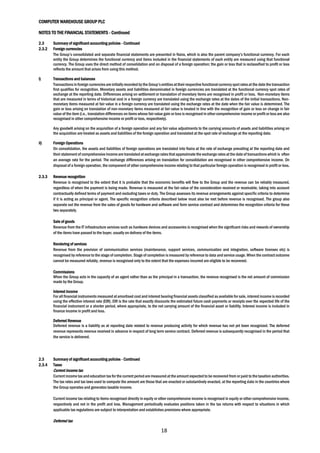
2.3 Summary of significant accounting policies - Continued
2.3.2 Foreign currencies
The Group’s consolidated and separate financial statements are presented in Naira, which is also the parent company’s functional currency. For each
entity the Group determines the functional currency and items included in the financial statements of each entity are measured using that functional
currency. The Group uses the direct method of consolidation and on disposal of a foreign operation; the gain or loss that is reclassified to profit or loss
reflects the amount that arises from using this method.
i) Transactions and balances
Transactionsin foreign currenciesare initially recordedby the Group’sentitiesattheir respective functional currencyspotratesat the date the transaction
first qualifies for recognition. Monetary assets and liabilities denominated in foreign currencies are translated at the functional currency spot rates of
exchange at the reporting date. Differences arising on settlement or translation of monetary items are recognised in profit or loss. Non-monetary items
that are measured in terms of historical cost in a foreign currency are translated using the exchange rates at the dates of the initial transactions. Non-
monetary items measured at fair value in a foreign currency are translated using the exchange rates at the date when the fair value is determined. The
gain or loss arising on translation of non-monetary items measured at fair value is treated in line with the recognition of gain or loss on change in fair
value of the item (i.e., translation differences on items whose fair value gain or loss is recognised in other comprehensive income or profit or loss are also
recognised in other comprehensive income or profit or loss, respectively).
Any goodwill arising on the acquisition of a foreign operation and any fair value adjustments to the carrying amounts of assets and liabilities arising on
the acquisition are treated as assets and liabilities of the foreign operation and translated at the spot rate of exchange at the reporting date.
ii) Foreign Operations
On consolidation, the assets and liabilities of foreign operations are translated into Naira at the rate of exchange prevailing at the reporting date and
their statement ofcomprehensive incomeare translated atexchange rates thatapproximate the exchange ratesat the date of transactions which is often
an average rate for the period. The exchange differences arising on translation for consolidation are recognised in other comprehensive income. On
disposal of a foreign operation, the component of other comprehensive income relating to that particular foreign operation is recognised in profit or loss.
2.3.3 Revenue recognition
Revenue is recognised to the extent that it is probable that the economic benefits will flow to the Group and the revenue can be reliably measured,
regardless of when the payment is being made. Revenue is measured at the fair value of the consideration received or receivable, taking into account
contractually defined terms of payment and excluding taxes or duty. The Group assesses its revenue arrangements against specific criteria to determine
if it is acting as principal or agent. The specific recognition criteria described below must also be met before revenue is recognised. The group also
separate out the revenue from the sales of goods for hardware and software and form service contract and determines the recognition criteria for these
two separately.
Sale of goods
Revenue from the IT infrastructure services such as hardware devices and accessories is recognised when the significant risks and rewards of ownership
of the items have passed to the buyer, usually on delivery of the items.
Rendering of services
Revenue from the provision of communication services (maintenance, support services, communication and integration, software licenses etc) is
recognised by reference to the stage of completion. Stage of completion is measured by reference to data and service usage.When the contract outcome
cannot be measured reliably, revenue is recognised only to the extent that the expenses incurred are eligible to be recovered.
Commissions
When the Group acts in the capacity of an agent rather than as the principal in a transaction, the revenue recognised is the net amount of commission
made by the Group.
Interest income
For all financial instruments measured atamortised cost and interest bearing financial assets classified as available for sale, interest income is recorded
using the effective interest rate (EIR). EIR is the rate that exactly discounts the estimated future cash payments or receipts over the expected life of the
financial instrument or a shorter period, where appropriate, to the net carrying amount of the financial asset or liability. Interest income is included in
finance income in profit and loss.
Deferred Revenue
Deferred revenue is a liability as at reporting date related to revenue producing activity for which revenue has not yet been recognized. The deferred
revenue represents revenue received in advance in respect of long term service contract. Deferred revenue is subsequently recognised in the period that
the service is delivered.
2.3 Summary of significant accounting policies - Continued
2.3.4 Taxes
Current income tax
Current income tax andeducation tax for the current period are measured at the amount expected to be recovered from orpaid to the taxation authorities.
The tax rates and tax laws used to compute the amount are those that are enacted or substantively enacted, at the reporting date in the countries where
the Group operates and generates taxable income.
Current income tax relating to items recognised directly in equity or other comprehensive income is recognised in equity or other comprehensive income,
respectively and not in the profit and loss. Management periodically evaluates positions taken in the tax returns with respect to situations in which
applicable tax regulations are subject to interpretation and establishes provisions where appropriate.
Deferred tax
COMPUTER WAREHOUSE GROUP PLC
NOTES TO THE FINANCIAL STATEMENTS - Continued
19
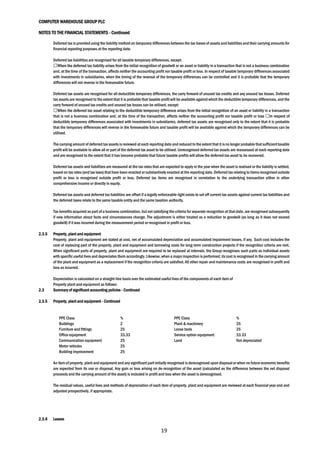
Deferred tax is provided using the liability method on temporary differences between the tax bases of assets and liabilities and their carrying amounts for
financial reporting purposes at the reporting date.
Deferred tax liabilities are recognised for all taxable temporary differences, except:
itial recognition of goodwill or an asset or liability in a transaction that is not a business combination
and, at the time of the transaction, affects neither the accounting profit nor taxable profit or loss. In respect of taxable temporary differences associated
with investments in subsidiaries, when the timing of the reversal of the temporary differences can be controlled and it is probable that the temporary
differences will not reverse in the foreseeable future.
Deferred tax assets are recognised for all deductible temporary differences, the carry forward of unused tax credits and any unused tax losses. Deferred
tax assets are recognised to the extent that it is probable that taxable profit will be available against which the deductible temporary differences, and the
carry forward of unused tax credits and unused tax losses can be utilised, except:
or liability in a transaction
that is not a business combination and, at the time of the transaction, affects neither the accounting profit nor taxable profi
deductible temporary differences associated with investments in subsidiaries, deferred tax assets are recognised only to the extent that it is probable
that the temporary differences will reverse in the foreseeable future and taxable profit will be available against which the temporary differences can be
utilised.
The carrying amount of deferred tax assetsis reviewed ateach reporting date and reduced to the extent that it isno longer probable that sufficient taxable
profit will be available to allow all or part of the deferred tax asset to be utilised. Unrecognised deferred tax assets are reassessed at each reporting date
and are recognised to the extent that it has become probable that future taxable profits will allow the deferred tax asset to be recovered.
Deferred tax assets and liabilities are measured at the tax rates that are expected to apply in the year when the asset is realised or the liability is settled,
based on tax rates (and tax laws) that have been enacted or substantively enacted at the reporting date. Deferred tax relating to items recognised outside
profit or loss is recognised outside profit or loss. Deferred tax items are recognised in correlation to the underlying transaction either in other
comprehensive income or directly in equity.
Deferred tax assets and deferred tax liabilities are offset if a legally enforceable right exists to set off current tax assets against current tax liabilities and
the deferred taxes relate to the same taxable entity and the same taxation authority.
Tax benefits acquired as part of a business combination, but not satisfying the criteria for separate recognition at that date, are recognised subsequently
if new information about facts and circumstances change. The adjustment is either treated as a reduction to goodwill (as long as it does not exceed
goodwill) if it was incurred during the measurement period or recognised in profit or loss.
2.3.5 Property, plant and equipment
Property, plant and equipment are stated at cost, net of accumulated depreciation and accumulated impairment losses, if any. Such cost includes the
cost of replacing part of the property, plant and equipment and borrowing costs for long-term construction projects if the recognition criteria are met.
When significant parts of property, plant and equipment are required to be replaced at intervals, the Group recognises such parts as individual assets
with specific useful lives and depreciates them accordingly. Likewise, when a major inspection is performed, its cost is recognised in the carrying amount
of the plant and equipment as a replacement if the recognition criteria are satisfied. All other repair and maintenance costs are recognised in profit and
loss as incurred.
Depreciation is calculated on a straight-line basis over the estimated useful lives of the components of each item of
Property plant and equipment as follows:
2.3 Summary of significant accounting policies - Continued
2.3.5 Property, plant and equipment - Continued
PPE Class % PPE Class %
Buildings 2 Plant & machinery 25
Furniture and fittings 25 Loose tools 25
Office equipment 33.33 Service option equipment 33.33
Communication equipment 25 Land Not depreciated
Motor vehicles 25
Building improvement 25
An item of property, plant and equipmentand any significant part initially recognised is derecognised upon disposal or when no future economic benefits
are expected from its use or disposal. Any gain or loss arising on de-recognition of the asset (calculated as the difference between the net disposal
proceeds and the carrying amount of the asset) is included in profit and loss when the asset is derecognised.
The residual values, useful lives and methods of depreciation of each item of property, plant and equipment are reviewed at each financial year end and
adjusted prospectively, if appropriate.
2.3.6 Leases
COMPUTER WAREHOUSE GROUP PLC
NOTES TO THE FINANCIAL STATEMENTS - Continued
20
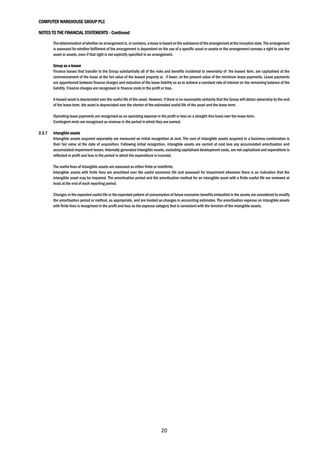
Thedeterminationofwhetheranarrangementis,orcontains,a lease isbasedonthesubstanceofthearrangementattheinception date.The arrangement
is assessed for whether fulfilment of the arrangement is dependent on the use of a specific asset or assets or the arrangement conveys a right to use the
asset or assets, even if that right is not explicitly specified in an arrangement.
Group as a lessee
Finance leases that transfer to the Group substantially all of the risks and benefits incidental to ownership of the leased item, are capitalised at the
commencement of the lease at the fair value of the leased property or, if lower, at the present value of the minimum lease payments. Lease payments
are apportioned between finance charges and reduction of the lease liability so as to achieve a constant rate of interest on the remaining balance of the
liability. Finance charges are recognised in finance costs in the profit or loss.
A leased asset is depreciated over the useful life of the asset. However, if there is no reasonable certainty that the Group will obtain ownership by the end
of the lease term, the asset is depreciated over the shorter of the estimated useful life of the asset and the lease term.
Operating lease payments are recognised as an operating expense in the profit or loss on a straight-line basis over the lease term.
Contingent rents are recognised as revenue in the period in which they are earned.
2.3.7 Intangible assets
Intangible assets acquired separately are measured on initial recognition at cost. The cost of intangible assets acquired in a business combination is
their fair value at the date of acquisition. Following initial recognition, intangible assets are carried at cost less any accumulated amortisation and
accumulated impairment losses. Internally generated intangible assets, excluding capitalised development costs, are not capitalised and expenditure is
reflected in profit and loss in the period in which the expenditure is incurred.
The useful lives of intangible assets are assessed as either finite or indefinite.
Intangible assets with finite lives are amortised over the useful economic life and assessed for impairment whenever there is an indication that the
intangible asset may be impaired. The amortisation period and the amortisation method for an intangible asset with a finite useful life are reviewed at
least at the end of each reporting period.
Changes in the expected useful life or the expected pattern of consumption of future economic benefits embodied in the assets are considered to modify
the amortisation period or method, as appropriate, and are treated as changes in accounting estimates. The amortisation expense on intangible assets
with finite lives is recognised in the profit and loss as the expense category that is consistent with the function of the intangible assets.
COMPUTER WAREHOUSE GROUP PLC
NOTES TO THE FINANCIAL STATEMENTS - Continued
21
2.3 Summary of significant accounting policies - Continued
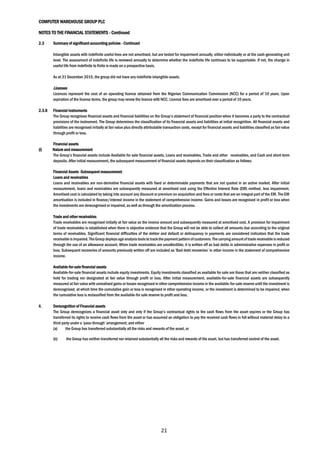
Intangible assets with indefinite useful lives are not amortised, but are tested for impairment annually, either individually or at the cash-generating unit
level. The assessment of indefinite life is reviewed annually to determine whether the indefinite life continues to be supportable. If not, the change in
useful life from indefinite to finite is made on a prospective basis.
As at 31 December 2015, the group did not have any indefinite intangible assets.
Licenses
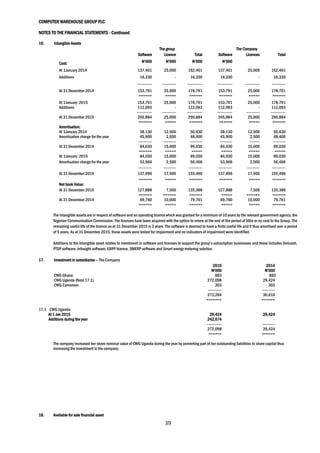
Licences represent the cost of an operating licence obtained from the Nigerian Communication Commission (NCC) for a period of 10 years. Upon
expiration of the license terms, the group may renew the licence with NCC. Licence fees are amortised over a period of 10 years.
2.3.8 Financial instruments
The Group recognises financial assets and financial liabilities on the Group’s statement of financial position when it becomes a party to the contractual
provisions of the instrument. The Group determines the classification of its financial assets and liabilities at initial recognition. All financial assets and
liabilities are recognised initially at fair value plus directly attributable transaction costs, except for financial assets and liabilities classified as fair value
through profit or loss.
Financial assets
(i) Nature and measurement
The Group’s financial assets include Available for sale financial assets, Loans and receivables, Trade and other receivables, and Cash and short-term
deposits. After initial measurement, the subsequent measurement of financial assets depends on their classification as follows:
Financial Assets -Subsequent measurement
Loans and receivables
Loans and receivables are non-derivative financial assets with fixed or determinable payments that are not quoted in an active market. After initial
measurement, loans and receivables are subsequently measured at amortised cost using the Effective Interest Rate (EIR) method, less impairment.
Amortised cost is calculated by taking into account any discount or premium on acquisition and fees or costs that are an integral part of the EIR. The EIR
amortisation is included in finance/interest income in the statement of comprehensive income. Gains and losses are recognised in profit or loss when
the investments are derecognised or impaired, as well as through the amortisation process.
Trade and other receivables
Trade receivables are recognised initially at fair value as the invoice amount and subsequently measured at amortised cost. A provision for impairment
of trade receivables is established when there is objective evidence that the Group will not be able to collect all amounts due according to the original
terms of receivables. Significant financial difficulties of the debtor and default or delinquency in payments are considered indicators that the trade
receivableisimpaired.TheGroup deploysageanalysistoolsto trackthepaymentpattern ofcustomers.The carryingamountoftrade receivableisreduced
through the use of an allowance account. When trade receivables are uncollectible, it is written off as bad debts in administrative expenses in profit or
loss. Subsequent recoveries of amounts previously written off are included as ‘Bad debt recoveries’ in other income in the statement of comprehensive
income.
Available-for-sale financial assets
Available-for-sale financial assets include equity investments. Equity investments classified as available for sale are those that are neither classified as
held for trading nor designated at fair value through profit or loss. After initial measurement, available-for-sale financial assets are subsequently
measured at fair value with unrealised gains or losses recognised in other comprehensive income in the available-for-sale reserve until the investment is
derecognised, at which time the cumulative gain or loss is recognised in other operating income, or the investment is determined to be impaired, when
the cumulative loss is reclassified from the available-for sale reserve to profit and loss.
ii. Derecognition of Financial assets
The Group derecognizes a financial asset only and only if the Group’s contractual rights to the cash flows from the asset expires or the Group has
transferred its rights to receive cash flows from the asset or has assumed an obligation to pay the received cash flows in full without material delay to a
third party under a ‘pass-through’ arrangement; and either
(a) the Group has transferred substantially all the risks and rewards of the asset, or
(b) the Group has neither transferred nor retained substantially all the risks and rewards of the asset, but has transferred control of the asset.
COMPUTER WAREHOUSE GROUP PLC
NOTES TO THE FINANCIAL STATEMENTS - Continued
22
2.3 Summary of significant accounting policies - Continued
2.3.8 Financial instruments - Continued
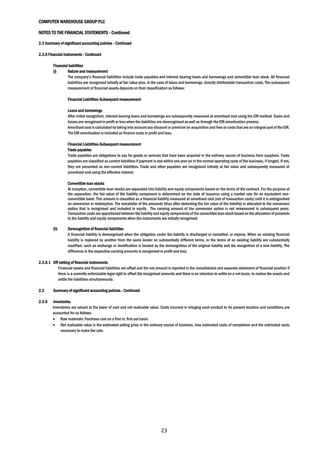
When the Group has transferred its rights to receive cash flows from an asset, it evaluates if and to what extent it has retained the risks and rewards of
ownership. When it has neither transferred nor retained substantially all of the risks and rewards of the asset, nor transferred control of the asset, the
asset is recognised to the extent of the Group’s continuing involvement in the asset. In that case, the Group also recognises an associated liability. The
transferred asset and the associated liability are measured on a basis that reflects the rights and obligations that the Group has retained.
Continuing involvement that takes the form of a guarantee over the transferred asset is measured at the lower of the original carrying amount of the asset
and the maximum amount of consideration that the Group could be required to repay.
Impairment of financial assets
The Group assesses,ateach reporting date,whetherthere isobjective evidence thata financial assetoragroupof financial assets isimpaired.Afinancial
asset or a group of financial assets is deemed to be impaired if there is objective evidence of impairment as a result of one or more events that has
occurred since the initial recognition of the asset and that loss event has an impact on the estimated future cash flows of the financial asset or the group
of financial assets that can be reliably estimated. Evidence of impairment may include indications that the debtors or a group of debtors is experiencing
significant financial difficulty, default or delinquency in interest or principal payments, the probability that they will enter bankruptcy or other financial
reorganisation and observable data indicating that there is a measurable decrease in the estimated future cash flows, such as changes in arrears or
economic conditions that correlate with defaults.
Financial assets carried at amortised cost
For financial assets carried at amortised cost, the Group first assesses whether objective evidence of impairment exists individually for financial assets
that are individually significant, or collectively for financial assets that are not individually significant.
If the Group determines thatno objective evidence of impairmentexists for an individuallyassessed financial asset,whether significant or not, it includes
the asset in a group of financial assets with similar credit risk characteristics and collectively assesses them for impairment. Assets that are individually
assessed for impairment and for which an impairment loss is, or continues to be, recognised are not included in a collective assessment of impairment.
If there isobjective evidence thatan impairmentlosshasbeen incurred,the amountof the lossismeasured asthe difference between theasset’s carrying
amount and the present value of estimated future cash flows (excluding future expected credit losses that have not yet been incurred). The present value
of the estimated future cash flowsis discountedat the financial asset’soriginal effective interestrate.Loansand receivablestogether with the associated
allowance are written off when there is no realistic prospect of future recovery. If in a subsequent year, the amount of the estimated impairment loss
increases or decreases because of an event occurring after the impairment was recognised, the previously recognised impairment loss is increased or
reduced by adjusting the allowance account. If a write-off is later recovered, the recovery is recognised as other income in the profit or loss.
Available for sale financial assets
Foravailable-for-sale financial assets,the Groupassessesateach reporting datewhetherthere isobjective evidence thatan assets ora group offinancial
assets is impaired. In the case of equity instruments classified as available-for-sale, objective evidence would include a significant or prolonged decline
in the fair value of the investment below its cost. ‘Significant’ is evaluated against the original cost of the investment and ‘prolonged’ against the period
in which the fair value has been below its original cost.
When there is evidence of impairment, the cumulative loss – measured as the difference between the acquisition cost and the current fair value, less any
impairment loss on that investment previously recognised in profit and loss – is removed from other comprehensive income and recognised in profit and
loss. Impairment losses on equity instruments are not reversed through profit or loss; increases in their fair value after impairment are recognised directly
in other comprehensive income.
COMPUTER WAREHOUSE GROUP PLC
NOTES TO THE FINANCIAL STATEMENTS - Continued
23
2.3 Summary of significant accounting policies - Continued
2.3.8 Financial instruments - Continued
Financial liabilities
(i) Nature and measurement
The company’s financial liabilities include trade payables and interest bearing loans and borrowings and convertible loan stock. All financial
liabilities are recognized initially at fair value plus, in the case of loans and borrowings, directly attributable transaction costs. The subsequent
measurement of financial assets depends on their classification as follows:
Financial Liabilities-Subsequent measurement
Loans and borrowings
After initial recognition, interest bearing loans and borrowings are subsequently measured at amortised cost using the EIR method. Gains and
losses are recognised in profit or loss when the liabilities are derecognised as well as through the EIR amortisation process.
Amortised cost is calculated by taking into account any discount or premium on acquisition and fees or costs that are an integral part of the EIR.
The EIR amortisation is included as finance costs in profit and loss.
Financial Liabilities-Subsequent measurement
Trade payables
Trade payables are obligations to pay for goods or services that have been acquired in the ordinary course of business from suppliers. Trade
payables are classified as current liabilities if payment is due within one year (or in the normal operating cycle of the business, if longer). If not,
they are presented as non-current liabilities. Trade and other payables are recognised initially at fair value and subsequently measured at
amortised cost using the effective interest.
Convertible loan stocks
At inception, convertible loan stocks are separated into liability and equity components based on the terms of the contract. For the purpose of
the separation, the fair value of the liability component is determined on the date of issuance using a market rate for an equivalent non-
convertible bond. This amount is classified as a financial liability measured at amortised cost (net of transaction costs) until it is extinguished
on conversion or redemption. The remainder of the proceeds (thus after deducting the fair value of the liability) is allocated to the conversion
option that is recognised and included in equity. The carrying amount of the conversion option is not remeasured in subsequent years.
Transaction costsare apportionedbetween the liabilityand equitycomponentsof the convertible loan stock based on the allocation of proceeds
to the liability and equity components when the instruments are initially recognised.
(ii) Derecognition of financial liabilities
A financial liability is derecognised when the obligation under the liability is discharged or cancelled, or expires. When an existing financial
liability is replaced by another from the same lender on substantially different terms, or the terms of an existing liability are substantially
modified, such an exchange or modification is treated as the derecognition of the original liability and the recognition of a new liability. The
difference in the respective carrying amounts is recognised in profit and loss.
2.3.8.1 Off-setting of financial instruments
Financial assets and financial liabilities are offset and the net amount is reported in the consolidated and separate statement of financial position if
there is a currently enforceable legal right to offset the recognised amounts and there is an intention to settle on a net basis, to realise the assets and
settle the liabilities simultaneously.
2.3 Summary of significant accounting policies - Continued
2.3.9 Inventories
Inventories are valued at the lower of cost and net realisable value. Costs incurred in bringing each product to its present location and conditions are
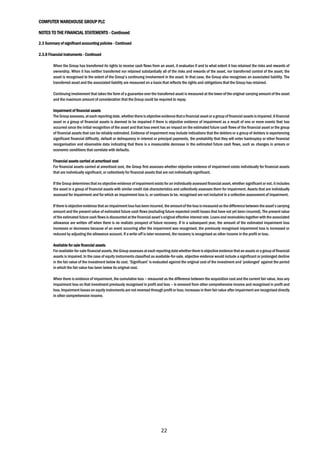
accounted for as follows:
 Raw materials: Purchase cost on a first in, first out basis.
 Net realisable value is the estimated selling price in the ordinary course of business, less estimated costs of completion and the estimated costs
necessary to make the sale.
COMPUTER WAREHOUSE GROUP PLC
NOTES TO THE FINANCIAL STATEMENTS - Continued
24
2.3 Summary of significant accounting policies - Continued
2.3.9 Impairment of non-financial assets
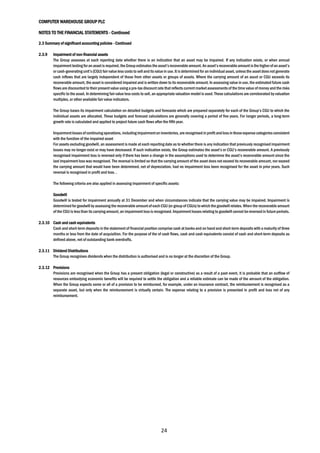
The Group assesses at each reporting date whether there is an indication that an asset may be impaired. If any indication exists, or when annual
impairment testing foran assetis required, the Group estimates the asset’srecoverable amount.An asset’srecoverableamount isthe higherofan asset’s
or cash-generating unit’s (CGU) fair value less costs to sell andits value in use. It is determined for an individual asset, unless the assetdoesnotgenerate
cash inflows that are largely independent of those from other assets or groups of assets. Where the carrying amount of an asset or CGU exceeds its
recoverable amount, the asset is considered impaired and is written down to its recoverable amount. In assessing value in use, the estimated future cash
flows are discounted to their present value using a pre-tax discount rate that reflects current market assessments of the time value of money and the risks
specific to the asset. In determining fair value less costs to sell, an appropriate valuation model is used. These calculations are corroborated by valuation
multiples, or other available fair value indicators.
The Group bases its impairment calculation on detailed budgets and forecasts which are prepared separately for each of the Group’s CGU to which the
individual assets are allocated. These budgets and forecast calculations are generally covering a period of five years. For longer periods, a long-term
growth rate is calculated and applied to project future cash flows after the fifth year.
Impairmentlossesofcontinuing operations, including impairmenton inventories,are recognised in profitand lossin thoseexpense categoriesconsistent
with the function of the impaired asset
For assets excluding goodwill, an assessment is made at each reporting date as to whether there is any indication that previously recognised impairment
losses may no longer exist or may have decreased. If such indication exists, the Group estimates the asset’s or CGU’s recoverable amount. A previously
recognised impairment loss is reversed only if there has been a change in the assumptions used to determine the asset’s recoverable amount since the
last impairment loss was recognised. The reversal is limited so that the carrying amount of the asset does not exceed its recoverable amount, nor exceed
the carrying amount that would have been determined, net of depreciation, had no impairment loss been recognised for the asset in prior years. Such
reversal is recognised in profit and loss. .
The following criteria are also applied in assessing impairment of specific assets:
Goodwill
Goodwill is tested for impairment annually at 31 December and when circumstances indicate that the carrying value may be impaired. Impairment is
determinedforgoodwill byassessing the recoverable amountof each CGU (or groupof CGUs) to which the goodwill relates.When the recoverable amount
of the CGU is less than its carrying amount, an impairment lossis recognised. Impairmentlosses relating to goodwill cannot bereversed in future periods.
2.3.10 Cash and cash equivalents
Cash and short-term deposits in the statement of financial position comprise cash at banks and on hand and short-term deposits with a maturity of three
months or less from the date of acquisition. For the purpose of the of cash flows, cash and cash equivalents consist of cash and short-term deposits as
defined above, net of outstanding bank overdrafts.
2.3.11 Dividend Distributions
The Group recognises dividends when the distribution is authorised and is no longer at the discretion of the Group.
2.3.12 Provisions
Provisions are recognised when the Group has a present obligation (legal or constructive) as a result of a past event, it is probable that an outflow of
resources embodying economic benefits will be required to settle the obligation and a reliable estimate can be made of the amount of the obligation.
When the Group expects some or all of a provision to be reimbursed, for example, under an insurance contract, the reimbursement is recognised as a
separate asset, but only when the reimbursement is virtually certain. The expense relating to a provision is presented in profit and loss net of any
reimbursement.
COMPUTER WAREHOUSE GROUP PLC
NOTES TO THE FINANCIAL STATEMENTS - Continued
25
2.3 Summary of significant accounting policies - Continued
2.3.13 Employee Benefits
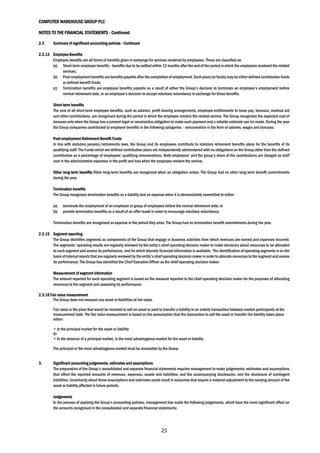
Employee benefits are all forms of benefits given in exchange for services rendered by employees. These are classified as:
(a) Short-term employee benefits - benefits due to be settled within 12 months after the end of the period in which the employees rendered the related
services;
(b) Post-employmentbenefitsare benefitspayableafterthe completionof employment.Such plans(orfunds)may be eitherdefinedcontribution funds
or defined benefit funds.
(c) Termination benefits are employee benefits payable as a result of either the Group’s decision to terminate an employee’s employment before
normal retirement date, or an employee’s decision to accept voluntary redundancy in exchange for those benefits.
Short-term benefits
The cost of all short-term employee benefits, such as salaries, profit sharing arrangements, employee entitlements to leave pay, bonuses, medical aid
and other contributions, are recognised during the period in which the employee renders the related service. The Group recognises the expected cost of
bonuses only when the Group has a present legal or constructive obligation to make such payment and a reliable estimate can be made. During the year
the Group companies contributed to employee benefits in the following categories: - remuneration in the form of salaries, wages and bonuses.
Post-employment Retirement Benefit Funds
In line with statutory pension/retirements laws, the Group and its employees contribute to statutory retirement benefits plans for the benefits of its
qualifying staff. The Funds which are defined contribution plans are independently administered with no obligations on the Group other than the defined
contribution as a percentage of employees’ qualifying remunerations. Both employees’ and the group’s share of the contributions are charged as staff
cost in the administrative expenses in the profit and loss when the employee renders the service.
Other long-term benefits Other long-term benefits are recognised when an obligation arises. The Group had no other long-term benefit commitments
during the year.
Termination benefits
The Group recognises termination benefits as a liability and an expense when it is demonstrably committed to either:
(a) terminate the employment of an employee or group of employees before the normal retirement date; or
(b) provide termination benefits as a result of an offer made in order to encourage voluntary redundancy.
Termination benefits are recognised as expense in the period they arise. The Group had no termination benefit commitments during the year.
2.3.15 Segment reporting
The Group identifies segments as components of the Group that engage in business activities from which revenues are earned and expenses incurred.
The segments’ operating results are regularly reviewed by the entity’s chief operating decision maker to make decisions about resources to be allocated
to each segment and assess its performance, and for which discrete financial information is available. The identification of operating segments is on the
basis ofinternal reports thatare regularly reviewed bythe entity’schiefoperating decision makerin order to allocate resources to the segmentandassess
its performance. The Group has identified the Chief Executive Officer as the chief operating decision maker.
Measurement of segment information
The amount reported for each operating segment is based on the measure reported to the chief operating decision maker for the purposes of allocating
resources to the segment and assessing its performance.
2.3.16 Fair value measurement
The Group does not measure any asset or liabilities at fair value.
Fair value is the price that would be received to sell an asset or paid to transfer a liability in an orderly transaction between market participants at the
measurement date. The fair value measurement is based on the presumption that the transaction to sell the asset or transfer the liability takes place
either:
• In the principal market for the asset or liability
Or
• In the absence of a principal market, in the most advantageous market for the asset or liability
The principal or the most advantageous market must be accessible by the Group.
3. Significant accounting judgements, estimates and assumptions
The preparation of the Group’s consolidated and separate financial statements requires management to make judgements, estimates and assumptions
that affect the reported amounts of revenues, expenses, assets and liabilities, and the accompanying disclosures, and the disclosure of contingent
liabilities. Uncertainty about these assumptions and estimates could result in outcomes that require a material adjustment to the carrying amount of the
asset or liability affected in future periods.
Judgements
In the process of applying the Group’s accounting policies, management has made the following judgements, which have the most significant effect on
the amounts recognised in the consolidated and separate financial statements:
COMPUTER WAREHOUSE GROUP PLC
NOTES TO THE FINANCIAL STATEMENTS - Continued
26
Taxes
Deferred tax assets are recognised for unused tax losses to the extent that it is probable that taxable profit will be available against which the losses can
be utilised. Significant management judgement is required to determine the amount of deferred tax assets that can be recognised, based upon the likely
timing and the level of future taxable profits together with future tax planning strategies.
Going concern
The Group’s management has made an assessment of its ability to continue as a going concern and is satisfied that it has the resources to continue in
businessfor theforeseeablefuture.Furthermore,managementisnotaware ofanymaterialuncertaintiesthatmay castsignificantdoubtupon the Group’s
ability to continue as a going concern. Therefore, the financial statements continue to be prepared on the going concern basis.
Estimates and assumptions
The key assumptions concerning the future and other key sources of estimation uncertainty at the reporting date, that have a significant risk of causing a
material adjustment to the carrying amounts of assetsand liabilitieswithin the next financial year, are described below. The Group basedits assumptions
and estimates on parameters available when the consolidated and separate financial statements were prepared. Existing circumstances and
assumptions about future developments, however, may change due to market changes or circumstances arising beyond the control of the Group. Such
changes are reflected in the assumptions when they occur.
Impairment of non-financial assets
Impairment exists when the carrying value of an asset or cash generating unit exceeds its recoverable amount, which is the higher of its fair value less
costs to sell and its value in use. The fair value less costs to sell calculation is based on available data from binding sales transactions, conducted at
arm’s length for similar assets or observable market prices less incremental costs for disposing of the asset. The value in use calculation is based on a
discounted cash flow model. The cash flows are derived from the budget for the next five years and do not include restructuring activities that the Group
is not yet committed to or significant future investments that will enhance the asset’s performance of the CGU being tested. The recoverable amount is
most sensitive to the discount rate used for the discounted cash flow model as well as the expected future cash inflows and the growth rate used for
extrapolation purposes. The key assumptions used to determine the recoverable amount for the different CGUs are disclosed and further explained in
Note 13.
Re-assessment of useful lives and residual values
The Group carries its fixed assets at cost in the statement of financial position. The annual review of the useful lives and residual value of PPE result in the
use of significant management judgements.
COMPUTER WAREHOUSE GROUP PLC
NOTES TO THE FINANCIAL STATEMENTS - Continued
27
4. Standards issued but not yet effective and Amendments
Standardsandinterpretations issuedbutnot yet effective up to the date of issuance of the Group’sfinancial statements are disclosedbelow.The Group is currently
assessing the impact that these standards will have on the financial position and performance.
The Group intends to adopt these standards, if applicable, when they become effective.
IFRS 9 Financial Instruments
In July 2014, the IASB issued the final version of IFRS 9 Financial Instruments that replaces IAS 39 Financial Instruments: Recognition and Measurement and all
previous versions of IFRS 9. IFRS 9 brings together all three aspects of the accounting for financial instruments project: classification and measurement,
impairment and hedge accounting. IFRS 9 is effective for annual periods beginning on or after 1 January 2018, with early application permitted. Except for hedge
accounting, retrospective application is required but providing comparative information is not compulsory. For hedge accounting, the requirements are generally
applied prospectively, with some limited exceptions.
The company is in the process of assessing the impact adoption of IFRS 9 will have on the classification, measurement and impairment of the Group’s financial
assets: however, there would be no impact on the classification.
IFRS 14 Regulatory Deferral Accounts
IFRS 14 is an optional standard that allows an entity, whose activities are subject to rate-regulation, to continue applying most of its existing accounting policies
for regulatory deferral account balances upon its first-time adoption of IFRS. Entities that adopt IFRS 14 must present the regulatory deferral accounts as separate
line items on the statement of financial position and present movements in these account balances as separate line items in the statement of profit or loss and
other comprehensive income.The standard requires disclosures on the nature of, and risks associatedwith, the entity’s rate-regulation and the effects of that rate-
regulation on its financial statements.
IFRS 14 is effective for annual periods beginning on or after 1 January 2016. This standard is not expected to affect the company.
IFRS 15 Revenue from Contracts with Customers
IFRS 15 was issued in May 2014 and establishes a five-step model to account for revenue arising from contracts with customers. Under IFRS 15, revenue is
recognised at an amount that reflects the consideration to which an entity expects to be entitled in exchange for transferring goods or services to a customer.
The new revenue standardwill supersede all currentrevenue recognition requirements underIFRS.Eithera full retrospectiveapplicationora modified retrospective
application is required for annual periods beginning on or after 1 January 2018. Early adoption is permitted. The Group is currently assessing the impact of IFRS
15 and plans to adopt the new standard on the required effective date
IFRS 16 - Leases
Effective for annual periods beginning on or after 1January 2019. Early application is permitted, but not before an entity applies IFRS 15. The key features of the
amendment are:
• The new standard requires lessees to account for all leases under a single on-statement of financial position model (subject to certain exemptions) in a
similar way to finance leases under IAS 17.
• Lessees recognise a liability to pay rentals with a corresponding asset, and recognise interest expense and depreciation separately.
• The new standard includes two recognition exemptions for lessees – leases of ’low-value’ assets (e.g., personal computer) and short-term leases (i.e.,
leases with a lease term of 12 months or less).
• Reassessment of certain key considerations (e.g., lease term, variable rents based on an index or rate, discount rate) by the lessee is required upon
certain events.
• Lessor accounting is substantially the same as today’s lessor accounting, using IAS 17’s dual classification approach.
The Group is still assessing the impact of this amendment.
COMPUTER WAREHOUSE GROUP PLC
NOTES TO THE FINANCIAL STATEMENTS - Continued
28
Standards issued but not yet effective and Amendments - Continued
Amendments issued but not yet effective
These amendments to some standards have been issued but not yet effective. The Group intends to adopt these standards, if applicable, when they become
effective.
Amendments to IAS 16 and IAS 38: Clarification of Acceptable Methods of Depreciation and Amortisation
The amendments clarify the principle in IAS 16 and IAS 38 that revenue reflects a pattern of economic benefits that are generated from operating a business (of
which the asset is part) rather than the economic benefits that are consumed through use of the asset. As a result, a revenue-based method cannot be used to
depreciate property, plant and equipment and may only be used in very limited circumstances to amortise intangible assets. The amendments are effective
prospectively for annual periods beginning on or after 1 January 2016, with early adoption permitted. These amendments are not expected to have any impact to
the Company given that the Company has not used a revenue-based method to depreciate its non-current assets.
Annual Improvements 2012 – 2014 Cycle
These improvements are effective for annual periods beginning on or after 1 January 2016. They include:
IFRS 5 Non-current Assets Held for Sale and Discontinued Operations
Assets (or disposal groups) are generally disposed of either through sale or distribution to owners. The amendment clarifies that changing from one of these
disposal methods to the other would not be considered a new plan of disposal, rather it is a continuation of the original plan. There is, therefore, no interruption of
the application of the requirements in IFRS 5. This amendment must be applied prospectively.
IAS 19 Employee Benefits
The amendment clarifies that market depth of high quality corporate bonds is assessed based on the currency in which the obligation is denominated, rather than
the country where the obligation is located. When there is no deep market for high quality corporate bonds in that currency, government bond rates must be used.
This amendment must be applied prospectively.
IFRS 7 Financial Instruments: Disclosures
(i) Servicing contracts
The amendment clarifies that a servicing contract that includes a fee can constitute continuing involvement in a financial asset. An entity must assess the nature
of the fee and the arrangement against the guidance for continuing involvement in IFRS 7 in order to assess whether the disclosures are required. The assessment
of which servicing contracts constitute continuing involvement must be done retrospectively. However, the required disclosures would not need to be provided for
any period beginning before the annual period in which the entity first applies the amendments.
(ii) Applicability of the amendments to IFRS 7 to condensed interim financial statements
The amendment clarifies that the offsetting disclosure requirements do not apply to condensed interim financial statements, unless such disclosures provide a
significant update to the information reported in the most recent annual report. This amendment must be applied retrospectively.
Amendments to IAS 1-IAS 1Disclosures Initiative
Effective for annual periods beginning on or after 1January 2016. Early application is permitted and entities do not need to disclose that fact because the Board
considers these amendments to be clarification that do not affect an entity’s accounting policies or accounting estimates.
The amendments to IAS 1 Presentation of Financial Statements clarify, rather than significantly change, existing IAS 1 requirements. The amendments clarify:
• The materiality requirements in IAS 1
• That specific line items in the statement(s) of profit or loss and OCU and the statement of financial position may be disaggregated
• That entities have flexibility as to the order in which they present the notes to financial statements
• That the share of OCI of associated and Joint ventures accounted for using the equity method must be presented in aggregate as a single line item, and
classified between these items that will or will not be subsequently reclassified to profit or loss.
Furthermore, the amendments clarify the requirements that apply when additional subtotals are presented in the statement of financial position and the
statement(s) of profit or loss and other comprehensive income.
These amendments will impact the Company’s financial statements presentation and disclosure requirements in IFRS, and do not affect recognition and
measurements.
IAS 12 – Taxes: Recognition of Deferred Tax Assets for Unrealised Losses
The amendment clarifies the accounting for deferred tax assets for unrealised losses on debt instruments measured at fair value. The amendments clarify:
• The requirements relating to recovery of an asset for more than its carrying amount in a way that enhances understanding and reduces the risk of an
arbitrary estimate of probable future taxable profit was revised
• The standard clarify that taxable profit excluding tax deductions used for assessing the utilization of deductible temporary differences is different from
taxable profit on which income taxes are payable
The amendment is effective for annual periods beginning on or after 1 January 2017.
COMPUTER WAREHOUSE GROUP PLC
NOTES TO THE FINANCIAL STATEMENTS - Continued
29
The Group is still assessing the impact of this amendment.
IFRS 10, IFRS 12 and IAS 28 Investment Entities: Applying the Consolidation Exception - Amendments to IFRS 10, IFRS 12 and IAS 28
Effective for annual periods beginning on or after 1January 2016. The amendments must be applied retrospectively. Early application is permitted and must be
disclosed
The amendments address three issues that have arisen in applying the investment entities exception under IFRS 10.The amendments to IFRS 10 clarify that the
exemption in paragraph 4 of IFRS 10 from presenting consolidated and separate and separate financial statements applies to a parent entity that is a subsidiary
of an investment entity, when the investment entity measures its subsidiaries at fair value. Furthermore, the amendments to IFRS 10 clarify that only a subsidiary
of an investment entity that is not an investment entity itself and that provides support services to the investment entity is consolidated and separate. All other
subsidiaries of an investment entity are measured at fair value. The amendments to IAS 28 allow the investor, when applying the equity method, to retain the fair
value measurement applied by the investment entity associate or joint venture to its interests in subsidiaries.
These amendments will not impact the Group’s financial statements presentation.
IAS 27 Equity Method in Separate Financial Statements – Amendments to IAS 27
Effective for annual periods beginning on or after 1 January 2016 and it must be applied retrospectively, early application is permitted and must be disclosed.
The amendments to IAS 27 Separate Financial Statements allow an entity to use the equity method as described in IAS 28 to account for its investments in
subsidiaries, joint ventures and associates in its separate financial statements. Therefore, an entity must account for these investments either:
• At cost
• In accordance with IFRS 9 (or IAS 39)
Or
• Using the equity method
The entity must apply the same accounting for each category of investment.
A consequential amendment was also made to IFRS 1 First-time Adoption of International Financial Reporting Standards. The amendment to IFRS 1 allows a first-
time adopter accounting for investments in the separate financial statements using the equity method, to apply the IFRS 1 exemption for past business
combinations to the acquisition of the investment.
Standards (new or amended) which became effective during the year.
Although these new standards and amendments applied for the first time in 2015, they did not have a material impact on the annual consolidated financial
statements of the Group. The nature and the impact of each new standard or amendment is described below:
Amendments to IAS 19 Defined Benefit Plans: Employee Contributions
IAS 19 requires an entity to consider contributions from employees or third parties when accounting for defined benefit plans. Where the contributions are linked
to service, they should be attributed to periods of service as a
negative benefit. These amendments clarify that, if the amount of the contributions is independent of the number of years of service, an entity is permitted to
recognise such contributions as a reduction in the service cost in the period in which the service is rendered, instead of allocating the contributions to the periods
of service.Thisamendmentis effective forannual periodsbeginning on or after 1July2014. This amendment isnot relevant to the Group,since none of the entities
within the Group has defined benefit plans with contributions from employees or third parties.
Annual Improvements 2010-2012 Cycle
These standard became effective in July 2014 but did not affect the company
IFRS 2 Share-based Payment
Thisimprovementisappliedprospectivelyandclarifiesvariousissuesrelatingtothedefinitionsofperformanceandservice conditionswhicharevestingconditions.
The clarifications are consistent with how the Group has identified any performance and service conditions which are vesting conditions in previous periods. In
addition, the Group had not granted any awards during the second half of 2014 and 2015. Thus, these amendments did not impact the Group’s financial
statements or accounting policies.
IFRS 3 Business Combinations
The amendment is applied prospectively and clarifies that all contingent consideration arrangements classified as liabilities (or assets) arising from a business
combination should be subsequently measured at fair value through profit or loss whether or not they fall within the scope of IAS 39. This is consistent with the
Group’s current accounting policy and, thus, this amendment did not impact the Group’s accounting policy.
IFRS 8 Operating Segments
The amendments are applied retrospectively and clarify that:
• An entity must disclose the judgments made by management in applying the aggregation criteria in paragraph 12 of IFRS 8, including a brief description of
operating segments that have been aggregatedandthe economic characteristics (e.g., sales and gross margins)used to assess whether the segments are ‘similar’
• The reconciliation of segment assets to total assets is only required to be disclosed if the reconciliation is reported to the chief operating decision maker, similar
to the required disclosure for segment liabilities
The Group has not applied the aggregation criteria in IFRS 8.12. The Group has presented the reconciliation of segment assets to total assets in previous periods
and continues to disclose the same in Note 5 in this period’s financial statements as the reconciliation is reported to the chief operating decision maker for the
purpose of her decision making.
COMPUTER WAREHOUSE GROUP PLC
NOTES TO THE FINANCIAL STATEMENTS - Continued
30
IAS 16 Property, Plant and Equipment and IAS 38 Intangible Assets
The amendment is applied retrospectively and clarifies in IAS 16 and IAS 38 that the asset may be revalued by reference to observable data by either adjusting the
gross carrying amountofthe assetto market value orbydetermining the marketvalue of the carrying value andadjusting the gross carrying amountproportionately
so that the resulting carrying amount equals the market value. In addition, the accumulated depreciation or amortisation is the difference between the gross and
carrying amounts of the asset. This amendment did not have any impact to the revaluation adjustments recorded by the Group during the current period.
IAS 24 Related Party Disclosures
The amendment is applied retrospectively and clarifies that a management entity (an entity that provides key management personnel services) is a related party
subjectto the relatedpartydisclosures.Inaddition, anentitythatusesamanagemententityisrequiredto disclose theexpensesincurredformanagementservices.
This amendment is not relevant for the Group as it does not receive any management services from other entities
IFRS 13 Fair Value Measurement
The amendment is applied prospectively and clarifies that the portfolio exception in IFRS 13 can be applied not only to financial assets and financial liabilities,
but also to other contracts within the scope of IAS 39. The Group does not apply the portfolio exception in IFRS 13.
IAS 40 Investment Property
The description of ancillary services in IAS 40 differentiates between investment property and owner-occupied Property (i.e., property, plant and equipment). The
amendment is applied prospectively and clarifies that IFRS 3, and not the description of ancillary services in IAS 40, is used to determine if the transaction is the
purchase of an asset or a business combination. In previous periods, the Group has relied on IFRS 3, not IAS 40, in determining whether an acquisition is of an
asset or is a business acquisition. Thus, this amendment did not impact the accounting policy of the Group
5. Segment information
For management purposes, the Group is organised into business units based on their products and services. The strategic business units offer different
products and services, and are managed separately because they require different technology and marketing strategies. For each of the strategic business
units, the Group’s CEO reviews internal management reports on at least a quarterly basis. The following summary describes the operations in each of the
Group’s reportable segments:
 The IT infrastructure segment, which supplies, installs and supports Computer hardware, operating and middle ware systems, Automated Teller
Machines “ATM” etc.
 The Software segment, which provides services in software deployment, implementation and supports, systems analysis, design and
implementation and smartcard applications. The segment also provides training to their clients on the systems offered and other off-the-shelf
packages.
 Communication and integrated equipment segment, which specializes in VSAT and Fibre Connectivity, Metropolitan Area Networks, Wide Area
Networks, Local Area Networks, and Systems Integration and provides provision of network communications support to clients.
 The Managed and support service segment provides internal and external clients managed /outsourcing services and provides related
accessories for equipment and service maintenance.
Segment gross profit is used to measure performance as management believes that such information is the most relevant in evaluating the results of
certain segments relative to other entities that operate within these industries. However, financing (including finance costs and finance income) income
taxes and assets and liabilities are managed on a group basis and are not allocated to operating segments. There are no transfers between the operating
segments hence there are no transfer prices set for any transactions that may arise. The segments managers are assessed based on the performance on
sales and cost of sales. They do not have control over the assets and liabilities. Segments results are as shown below:
Segment results
IT Infrastructure
Services
Managed & Support
services
Communications &
Integrated Software
Total
N’000 N’000 N’000 N’000 N’000
2015
Revenue 7,514,518 5,181,913 858,105 2,058,746 15,613,282
Cost of sales (6,680,922) (4,177,321) (794,371) (1,517,731) (13,170345)
---------------- ----------------- -------------- ---------------- ------------------
Gross Profit 833,596 1,004,592 63,734 541,015 2,442,937
======= ======== ====== ======= =========
2014
Revenue 7,262,213 4,827,467 793,318 2,473,282 15,356,280
Cost of sales (6,144,004) (3,745,170) (671,783) (1,744,995) (12,305,952)
--------------- --------------- --------------- --------------- -----------------
Gross Profit 1,118,209 1,082,297 121,535 728,287 3,050,328
======== ======== ======= ======= ========
Operating assets and liabilities are controlled at group level and information on this is not readily available as they are not considered by the chief
operating decision maker in resource allocation decisions.
Geographical Information
COMPUTER WAREHOUSE GROUP PLC
NOTES TO THE FINANCIAL STATEMENTS - Continued
31
Revenue 2015 2014
N’000 N’000
Nigeria 13,888,580 14,595,482
Ghana 1,250,621 489,026
Uganda 415,584 235,933
Cameroon 58,497 35,839
----------------- -----------------
Total 15,613,282 15,356,280
========= =========
5. Segment information - Continued
Information about major customers
The Group
2015 2014
MTN UBA MTN UBA
N’000 N’000 N’000 N’000
IT INFRASTRUCTURE 2,341,439 342,627 2,499,781 349,258
COMMUNICATIONS & INTEGRATED 295,525 178 514,367 205
SOFTWARE 237,699 146,964 232,001 388,025
MANAGE & SUPPORT SERVICE 3,181,064 702,469 2,192,826 184,651
------------- ------------- ------------- -------------
6,055,725 1,192,238 5,438,974 922,139
======== ======== ======== =======
The Company
MTN UBA MTN UBA
N’000 N’000 N’000 N’000
IT INFRASTRUCTURE 2,000,696 342,627 2,499,781 349,258
COMMUNICATIONS & INTEGRATED 295,525 178 514,367 205
SOFTWARE 133,017 146,965 232,001 388,025
MANAGE & SUPPORT SERVICE 3,181,064 702,469 2,192,826 184,651
-----=-------- -------------- --------------- -------------
5,610,302 1,192,238 5,438,974 922,139
======== ======== ======== =======
As at 31 December 2015 the receivables from MTN and UBA are N 252 million (2014: N 568million) and N million (2014: N 200 million) respectively
6. Revenue
Revenue is made up of:
The Group The Company
2015 2014 2015 2014
N’000 N’000 N’000 N’000
IT infrastructure services 7,514,518 7,262,213 6,170,653 6,657,875
Communications & integrated 858,105 793,318 741,002 793,318
Managed & support services 5,181,913 4,827,467 5,053,476 4,721,490
Software 2,058,746 2,473,282 1,923,447 2,422,799
----------------- ----------------- ----------------- -----------------
15,613,282 15,356,280 13,888,578 14,595,482
========= ========= ========= =========
7. Cost of sales
The Group
The Company
2015 2014 2015 2014
N’000 N’000 N’000 N’000
OEM and Other Cost 13,170,345 12,305,953 11,734,701 11,697,608
----------------- ----------------- ----------------- -----------------
13,170,345 12,305,953 11,734,701 11,697,608
========= ========= ========= =========
COMPUTER WAREHOUSE GROUP PLC
NOTES TO THE FINANCIAL STATEMENTS - Continued
32
The above represent the details of the cost, which is original equipment manufacturer and other direct cost, employee benefit expenses, depreciation and
amortisation does not form part of the company's cost of sales.
8. Other income
The Group The Company
2015 2014 2015 2014
N’000 N’000 N’000 N’000
Sundry incomes 50,510 85,704 37,205 85,646
Profit on disposal of Property 68 4,050 68 4,050
Exchange gain 299,656 195,039 219,428 195,039
---------- ------------ ----------- -----------
350,234 284,793 256,701 284,735
====== ====== ====== ======
The sundry incomes are mostly scrap sales and refunds received by the company during the year.
9. Administrative expenses
The Group The Company .
2015 2014 2015 2014
N’000 N’000 N’000 N’000
Audit fee 23,641 20,615 17,760 17,760
Amortisation 56,466 48,400 56,466 48,400
Depreciation 248,471 276,616 243,383 271,257
Salaries and allowances 1,266,009 1,385,289 1,155,003 1,282,290
Pension 47,224 61,890 35,015 61,616
Donations and gifts 8,010 8,817 8,010 8,817
Printing postage & telephone 234,069 43,985 231,837 41,156
Internet Subscriptions 52,234 23,330 52,019 23,330
Transport and travelling 119,783 137,073 114,451 124,986
Accommodations and entertainment 28,651 50,576 28,651 50,523
Exchange loss 600,426 387,329 600,426 387,192
Welfare and professional fees 297,752 201,966 294,467 198,058
Provision for doubtful debts 80,826 70,023 78,748 70,023
Bad debts 315,083 315,190
Insurance 31,844 38,705 31,025 38,255
Bank charges 103,464 88,766 90,936 88,766
Rents 114,769 101,190 92,182 85,725
Repairs and maintenance 35,120 35,517 33,105 27,610
Advert and Sales Commission 85,508 62,760 79,951 61,146
Research and development 55,102 50,407 55,102 50,407
Inventory write off 430,954 21,954 430,954 21,954
Others 176,781 99,926 130,137 80,634
--------------- --------------- --------------- ---------------
4,412,186 3,215,135 4,174,817 3,037,405
======== ======== ======== ========
Other expenses relates to security services, office cleaning expenses, ITF and NSITF, pre bid contract expenses, awards and conferences expenses
incurred during the year.
Given the decline in crude oil prices during the year, the impact of capital flight out of Nigeria due to stronger economies in the West as well as the
scheduled upcoming presidential elections, the naira was under immense pressure which led to the devaluation of the currency. As part of CBN’s
measures to reduce the pressure on naira, a circular was issued which excluded ICT companies from participating in RDAS. This policy led to re-
measurement of CWG’s Dollar transactions during the year, thereby resulting in a loss of about N600 million (2014:N387 million) on the company’s
performance. Management is exploring options to ameliorate the current pressures.
10. Finance cost
The Group The Company
2015 2014 2015 2014
N’000 N’000 N’000 N’000
Bank charges 103,464 88,766 90,936 88,766
Interest on loan 170,131 111,061 154,011 102,897
------------- -------------- -------------- -------------
273,595 199,827 244,947 191,663
======= ======= ======= =======
COMPUTER WAREHOUSE GROUP PLC
NOTES TO THE FINANCIAL STATEMENTS - Continued
33
11. Finance income
Interest income 42,149 48,711 42,149 48,711
====== ====== ====== ======
12. Income tax
The Group offsets tax assets and liabilities if and only if it has a legally enforceable right to set off current tax assets and current tax liabilities and the deferred tax
assets and deferred tax liabilities relate to income taxes levied by the same tax authority.
The Group The Company
2015 2014 2015 2014
12.1. Taxation: Consolidated profit or loss N’000 N’000 N’000 N’000
Current income tax:
Current Income tax charge 48,849 4,834 - -
Education tax - - - -
--------- --------- ----- -----
48,849 4,834 - -
Deferred tax - (67,215) - (67,215)
----------- ----------- ------ -----------
Income tax expense reported in profit and loss 48,849 (62,381) - (67,215)
Consolidated statement of other comprehensive income - - - -
Net exchange gain/(loss) on translation of foreign operations - - - -
Income tax charged directly to other comprehensive income - - - -
The company was granted a tax exemption (tax holiday) certificate by the Nigeria Investment Promotion Commission (NIPC) for a period of 5 years commencing in
2011 hence there is no taxation in the current period. Reconciliation between tax expense and the product of accounting profit multiplied by Nigeria’s domestic
tax rate for the years ended 31 December 2015 and 2014 is as follows:
The Group The Company
Reconciliation of tax charge 2015 2014 2015 2014
N’000 N’000 N’000 N’000
(Loss)/Profit before tax charge (1,746,997) 57,636 (1,876,099) 109,018
========= ===== ========= ======
Tax at Nigeria statutory income tax of 30% on subsidiary profit of
N144,698,00 43,409 17,290 - 32,705
Expense /(Income) exempt from tax 5,440 (12,456) - (32,705)
Assessed losses relating to prior year - (67,215) - (67,215)
---------- ----------- ------------ ------------
Effective tax charge 48,849 (62,381) - (67,215)
====== ====== ====== ======
12.2. Income tax: Statement of financial position
The Group The Company
2015 2014 2015 2014
N’000 N’000 N’000 N’000
At 1 Jan 553,614 548,780 561,584 561,584
Income tax 48,849 4,834 - -
Education tax - - - -
Tax paid (40,879) - - -
Withholding tax utilised - - - -
------------- ------------- ------------- -------------
At 31 December 561,584 553,614 561,584 561,584
======= ======= ======= =======
COMPUTER WAREHOUSE GROUP PLC
NOTES TO THE FINANCIAL STATEMENTS - Continued
34
12.3. Deferred tax
Deferred tax relates to the following:
The Group The Company
2015 2014 2015 2014
N’000 N’000 N’000 N’000
At 1 January - 67,215 - 67,215
Write back during the year - (67,215) - (67,215)
--------- ---------- ----------- -----------
- - - -
===== ====== ====== ======
The deferred tax asset from the company was not recognised during the year, the balance not recognised in the book of the company and the group was
N211.49 million. (2014:N541.56million). Also some of the subsidiariesare not paying tax and theydo not have assessed losses during the year, (2014:
Nil).
13. Earnings per share
Basicearnings pershare amountsare calculatedbydividing the netprofitforthe yearattributable to ordinary equityholders of the parentby the weighted
average number of ordinary shares outstanding during the year.
Diluted earnings per share amounts are calculated by dividing the net profit attributable to ordinary equity holders of the parent (after adjusting for
interest on the convertible preference shares) by the weighted average number of ordinary shares outstanding during the year plus the weighted average
number of ordinary shares that would be issued on conversion of all the dilutive potential ordinary shares into ordinary shares.
The Group The Company
2015 2014 2015 2014
N’000 N’000 N’000 N’000
Net (Loss)/profit attributable to ordinary equity holders of the parent
for basic earnings (1,795,846) 120,017 (1,876,099) 176,233
-------------- ------------ -------------- ------------
Net profit attributable for ordinary shareholders of the parent
adjusted for the effect of dilution (1,795,846) 120,017 (1,876,099) 176,233
======== ====== ======== ======
13.1. Earnings per share
The Group The Company
2015 2014 2015 2014
Thousands Thousands Thousands Thousands
Weighted average number of ordinary shares for basic and diluted earnings
per share
2,524,826
2,524,826
2,524,826
2,524,826
Additional share issued - -
- -
-------------- --------------- ---------------- ---------------
2,524,826 2,524,826 2,524,826 2,524,826
======== ======== ======== ========
Weighted average number of ordinary shares 2,524,826
2,524,826
2,524,826
2,524,826
======== ======== ======== ========
Basic /Diluted earnings per share (0.71)
0.05
(0.74) 0.07
COMPUTER WAREHOUSE GROUP PLC
NOTES TO THE FINANCIAL STATEMENTS - Continued
35
14. Business Combination
14.1. Interest in subsidiaries: The summarised financial information of CWG Limited Ghana, CWG Limited Uganda and CWG Limited Cameroon are provided
below. This information is based on amounts before inter-company eliminations.
Summarized profit or loss
CWG Ghana CWG Uganda CWG Cameroon
31 Dec.
2015
31 Dec.
2014
31 Dec.
2015
31 Dec.
2014
31 Dec.
2015
31 Dec.
2014
N 000 N 000 N 000 N 000 N 000 N 000
Revenue 1,250,621 489,026 415,584 235,933 58,497 35,839
Operating expenses (1,021,098) (378,847) (361,672) (202,365) (52,874) (45,132)
Administrative expenses (114,094) (91,203) (89,390) (78,964) (21,357) (7,563)
Other operating income 88,954 58 4,579 - - -
Finance cost (10,906) - (17,022) (8,164) (720) -
---------- ---------- ----------------- ------------- ------------- -------------
Profit before tax 193,477 19,034 (47,921) (53,560) (16,454) (16,856)
Income tax expense (48,779) (4,834) - - (70) -
---------- ---------- ----------- ----------- ---------- ----------
Profit for the year 144,698 14,200 (47,921) (53,560) (16,524) (16,856)
====== ====== ====== ====== ====== ======
Total comprehensive income 144,698 14,200 (47,921) (53,560) (16,524) (16,856)
Attributable to:
Equity holders of parent 144,698 14,200 (47,921) (53,560) (16,524) (16,856)
Non-controlling interests - - - - -
144,698 14,200 (47,921) (53,560) (16,524) (16,856)
====== ====== ====== ====== ====== =======
Summarised statements of financial position
Inventories and cash and bank balances
(current) 62,820 127,343 830 37,866 2,693 37,486
Tradeandotherreceivables,Duefromrelated
parties and Prepayments 213,081 131,272 221,086 159,915 7,488 60,224
Property, plant and equipment and other
non-current financial assets (non-current) 3,546 3,071 56 3,128 1,396 920
Income tax receivable - 7,970 - - - -
Trade and other payables (current) (163,317) (294,607) (166,096) (343,554) (53,010) (124,302)
Interest-bearing loans and borrowing
(Current) - - (72,997) (67,766) - -
116,130 (24,951) (17,121) (210,411) - (25,672)
----------- ----------- ------------ ------------ -------------- --------------
Total equity 116,130 (24,951) (17,121) (210,411) (41,433) (25,672)
Attributable to:
Equity holders of parent 116,130 (24,951) (17,121) (210,411) (41,433) (25,672)
Non-controlling interests - - - - - -
----------- ----------- ----------- ----------- ----------- -----------
116,130 (24,951) (17,121) (210,411) (41,433) (25,672)
======= ======= ======== ======= ====== ======
COMPUTER WAREHOUSE GROUP PLC
NOTES TO THE FINANCIAL STATEMENTS - Continued
36
14.2. Goodwill
Goodwill acquired through business combinations has been allocated to two CGUs, which are also operating and reportable segments, for impairment
testing as follows:
1] Software CGU 2] Hardware CGU
Carrying amount of goodwill allocated to each of the CGUs:
2015 2014
N’000 N’000
Software CGU 76,717 76,717
Hardware CGU** 737,371 737,371
------------- -------------
814,088 814,088
======= =======
** The hardware CGU is included in the IT Infrastructure segment.
Software CGU
The recoverable amount of software cash generating unit was based on its value in use and was determined by discounting the future cash flow projections from
the financial budgets approved by senior management covering a 5 years period. Unless indicated the value in use in December 2015 was determined in similar
was as 31 December 2014.
The calculation of value in use was based on the following keys assumptions:
Cash flow was projected based on past experience, actual operating result and a 5 – year operating cash-flow in both 2014 and 2015.
Revenue growth rate
The revenue growth rate was based on 4%(2016), 5%(2017), 5%(2018), 5%(2019) and 5%(2010). The revenue growth included in the cash flow projections for
the years 2016-2020 has been on the trend of foreseeable growth in the business segments.
Pre-tax discount rate
The pre-tax discount rate of 13.3% was applied in determining the recoverable amount of the unit. The discount rate was estimated based on past experience and
industry weighted average cost of capital which was based on the incremental borrowing rate.
Gross/Cost margin
The gross margin has been projected as 30% (2016), 32% (2017), 32 %( 2018), 30% (2019) and 28% (2020) while the relevant cost margin was estimated as
70% (2016), 68% (2017), 68% (2018), 70% (2019) and 72 %( 2020)
Hardware CGU
The recoverable amount of hardware CGU generating unit was based on its value in use and was determined by discounting the future cash flow projections from
financial budget approved by senior management covering a 4 years period. Unless indicated the value in use in December 2015 was determined similarly to as
in 31 December 2014.
Hardware CGU
The calculation of value in use was based on the following keys assumptions:
Cash flow was projected based on past experience, actual operating result and a 5 year operating plan in both 2014 and 2015.
Revenue growth rate
The revenue growth rate was based on 4%(2016), 5%(2017), 5%(2018), 5%(2019) and 5%(2010). The revenue growth included in the cash flow projections for
the years 2016-2020 has been on the trend of foreseeable growth in the business segments.
Pre-tax discount rate
The pre-tax discount rate 13.3% was applied in determining the recoverable amount of the unit. The discount rate was estimated based on past experience and
industry weighted average cost of capital which was based on the incremental borrowing rate.
Gross/Cost Margins
The gross margin was projected as 15% (2015), 21% (2016), 21% (2017), 20% (2018), and 19% (2016), while the relevant cost margin was estimated as 85%
(2016), 79% (2017), 79% (2018) ,80% (2019) and 81%(2020)
A result of this analysis, there was no impairment charged for Hardware CGU and software CGU in 2014 and 2015.
COMPUTER WAREHOUSE GROUP PLC
NOTES TO THE FINANCIAL STATEMENTS - Continued
37
15. Property, plant & equipment – The Group
Land Building
Plant &
Machinery
Furniture &
Fittings
Office
Equipment Motor Vehicles Loose tools
Service Option
Equipment
Communication
equipment Total
Cost: N’000 N’000 N’000 N’000 N’000 N’000 N’000 N’000 N’000 N’000
At 1 January 2014 111,395 71,417 78,402 91,714 224,509 253,585 25,048 1,075,629 972,312 2,904,011
Additions - 20,754 33,362 28,485 9,607 17,875 - 14,904 67,097 183,659
Disposals - - (22,992) (65,832) (109,105) (147,007) - - (15,225) (360,161)
Foreign currency exchange
difference - - 23 - 16 9 - - 12 60
----------- ---------- ---------- --------- ----------- ----------- --------- -------------- ------------ -------------
At 31 December 2014 111,395 92,171 88,795 54,367 116,602 124,462 25,048 1,090,533 1,024,196 2,727,569
====== =====- ====== ====== ======= ====== ===== ======== ====== ========
At 1January 2015 111,395 92,171 88,795 54,367 116,602 124,462 25,048 1,090,533 1,024,196 2,727,569
Additions - 20,7581 22,735 12,628 52,775 33,250 - - 36,126 178,295
Disposals - - - - (182) (12,333) - - - (12,515)
Reclassification - - - 158 (158) - - - - -
----------- ---------- ---------- --------- ----------- ----------- --------- -------------- ------------ -------------
At 31 December 2015 111,395 112,952 111,530 67,153 169,037 145,379 25,048 1,090,533 1,060,322 2,893,349
====== =====- ====== ====== ======= ====== ===== ======== ====== ========
Depreciation:
At 1 January 2014 - 18,489 57,957 69,890 161,266 192,868 22,228 980,344 741,730 2,244,773
Charge for the year - 4,133 13,422 10,772 39,222 28,936 2,463 68,963 108,705 276,616
Disposals - - (17,600) (64,247) (110,071) (147,006) - - (7,565) (346,489)
Foreign currency exchange
difference - - 6 - 3 2 - - 4 15
---------- ---------- ---------- ---------- ----------- ------------ --------- -------------- ------------ -------------
At 31 December 2014 - 22,622 53,785 16,415 90,420 74,800 24,691 1,049,307 842,874 2,174,914
====== ====== ====== ====== ====== ====== ====== ======== ======= ========
At 1January 2015 - 22,622 53,785 16,415 90,420 74,800 24,691 1,049,307 842,874 2,174,914
Charge for the year - 10,161 17,364 14,053 23,288 25,410 231 41,225 116,739 248,471
Disposals - - - - (182) (9,034) - - - (9,216)
Reclassification - - - 52 (52) - - - - -
---------- ---------- ---------- ---------- ----------- ------------ --------- -------------- ------------ -------------
At 31 December 2015 - 32,783 71,149 30,520 113,474 91,176 24,922 1,090,532 959,613 2,414,169
====== ====== ====== ====== ====== ====== ===== ======= ====== ========
Net book Value
At 31 December 2015 111,395 80,169 40,381 36,633 55,563 54,203 126 1 100,709 479,180
====== ====== ====== ====== ====== ====== ==== ====== ====== ======
At 31 December 2014 111,395 69,549 35,010 37,952 26,182 49,662 357 41,226 181,322 552,655
====== ====== ====== ===== ====== ====== ==== ====== ====== ======
There was no interest capitalised as part of Property plant & equipment during the year.
Also, there was no existence and amount of restrictions for title on Property plant & equipment pledged as securities for liabilities during the year.
COMPUTER WAREHOUSE GROUP PLC
NOTES TO THE FINANCIAL STATEMENTS - Continued
38
15. Property, plant & equipment – The Company
There was no interest capitalised as part of Property plant & equipment during the year.
Also, there was no existence and amount of restrictions for title on Property plant & equipment pledged as securities for liabilities during the year.
Land Building
Plant &
Machinery
Furniture &
Fittings
Office
Equipment Motor Vehicles
Loose
tools
Service Option
Equipment
Comm.
equipment Total
Cost: N’000 N’000 N’000 N’000 N’000 N’000 N’000 N’000 N’000 N’000
At 1 January 2014 111,395 71,417 78,402 86,879 212,628 244,459 25,048 1,075,628 961,198 2,867,0542
Additions - 20,754 31,296 28,367 354 17,875 - 14,904 67,097 180,647
Disposals - - (22,992) (65,832) (109,105) (147,007) - - (15,225) (360,161)
----------- ----------- ------------ ---------- ----------- ---------- -------- ----------------- ------------- -------------
At 31 Dec. 2014 111,395 92,171 86,706 49,414 103,877 115,327 25,048 1,090,532 1,013,070 2,687,540
====== ===== ====== ====== ====== ======= ===== ======== ======= ========
At 1January 2015 111,395 92,171 86,706 49,414 103,877 115,327 25,048 1,090,532 1,013,070 2,687,540
Additions - 20,781 22,735 11,601 50,797 33,250 - - 36,126 175,290
Disposals - - - - (182) (12,333) - - - (12,515)
----------- ----------- ------------ ---------- ----------- ---------- -------- ----------------- ------------- -------------
At 31 Dec. 2015 111,395 112,952 109,441 61,015 154,492 136,244 25,048 1,090,532 1,049,196 2,850,315
====== ===== ====== ====== ====== ======= ===== ======== ======= ========
Depreciation
At 1 January 2014 - 7,807 57,957 68,181 154,434 195,563 22,228 980,344 732,172 2,217,685
Charge for the year - 4,133 13,290 9,896 37,859 27,923 2,463 68,963 106,730 271,257
Disposals - - (17,600) (64,247) (110,071) (147,006) - - (7,565) (346,489)
-------- ---------- ---------- ----------- ----------- ---------- ---------- ------------- ------------ ---------------
At 31 Dec. 2014 - 11,939 53,647 13,830 81,222 76,480 24,691 1,049,307 831,337 2,142,453
==== ===== ===== ===== ====== ====== ====== ======= ====== ========
At 1January 2015 - 11,939 53,647 13,830 81,222 76,480 24,691 1,049,307 831,337 2,142,453
Charge for the year - 10,161 17,025 12,199 20,987 24,816 231 41,225 116,739 243,383
Disposals - - - - (182) (9,034) - - - (9,216)
-------- ---------- ---------- ----------- ----------- ---------- ---------- ------------- ------------ ---------------
At 31 Dec. 2015 - 22,100 70,672 26,029 102,027 92,262 24,922 1,090,532 948,076 2,376,620
===== ===== ===== ===== ====== ====== ===== ====== ====== =======
Net book Value
At 31 Dec. 2015 111,395 90,582 38,769 34,986 52,465 43,982 126 - 101,120 473,695
====== ===== ===== ===== ====== ===== ===== ====== ====== ======
At 31 Dec. 2014 111,395 80,232 33,059 35,584 22,655 38,847 357 41,225 181,733 545,087
====== ===== ===== ===== ====== ===== ===== ====== ====== ======
COMPUTER WAREHOUSE GROUP PLC
NOTES TO THE FINANCIAL STATEMENTS - Continued
39
16. Intangible Assets
The group The Company
Software Licence Total Software Licences Total
Cost: N’000 N’000 N’000 N’000
At 1January 2014 137,461 25,000 162,461 137,461 25,000 162,461
Additions 16,330 - 16,330 16,330 - 16,330
------------ ----------- ------------ ------------ ----------- -----------
At 31 December 2014 153,791 25,000 178,791 153,791 25,000 178,791
====== ===== ====== ====== ===== ======
At 1January 2015 153,791 25,000 178,791 153,791 25,000 178,791
Additions 112,093 - 112,093 112,093 - 112,093
------------ ----------- ------------ ------------ ----------- ------------
At 31 December 2015 265,884 25,000 290,884 265,884 25,000 290,884
====== ===== ====== ====== ===== ======
Amortisation:
At 1January 2014 38,130 12,500 50,630 38,130 12,500 50,630
Amortisation charge for the year 45,900 2,500 48,400 45,900 2,500 48,400
----------- ---------- ---------- ---------- -------- ----------
At 31 December 2014 84,030 15,000 99,030 84,030 15,000 99,030
====== ===== ===== ===== ===== =====
At 1January 2015 84,030 15,000 99,030 84,030 15,000 99,030
Amortisation charge for the year 53,966 2,500 56,466 53,966 2,500 56,466
----------- ---------- ----------- ----------- ---------- -----------
At 31 December 2015 137,996 17,500 155,496 137,996 17,500 155,496
====== ===== ====== ====== ===== ======
Net book Value:
At 31 December 2015 127,888 7,500 135,388 127,888 7,500 135,388
====== ====== ====== ===== ====== ======
At 31 December 2014 69,760 10,000 79,761 69,760 10,000 79,761
====== ===== ====== ===== ===== ======
The intangible assets are in respect of software and an operating licence which was granted for a minimum of 10 years by the relevant government agency, the
Nigerian Communication Commission. The licences have been acquired with the option to renew at the end of the period at little or no cost to the Group. The
remaining useful life of the licence as at 31 December 2015 is 3 years. The software is deemed to have a finite useful life and it thus amortised over a period
of 5 years. As at 31 December 2015, these assets were tested for impairment and no indicators of impairment were identified.
Additions to the intangible asset relates to investment in software and licenses to support the group’s subscription businesses and these includes Vericash,
PTSP software, Infosight software, EBPP licence, SMERP software and Smart energy metering solution.
17. Investment in subsidiaries – The Company
2015 2014
N’000 N’000
CWG Ghana 883 883
CWG Uganda (Note 17.1) 272,098 29,424
CWG Cameroun 303 303
----------- ----------
273,284 30,610
======= ======
17.1 CWG Uganda
At 1 Jan 2015 29,424 29,424
Additions during the year 242,674 -
------------ ----------
272,098 29,424
====== ======
The company increased her share nominal value of CWG Uganda during the year by converting part of her outstanding liabilities to share capital thus
increasing the investment in the company.
18. Available for sale financial asset
COMPUTER WAREHOUSE GROUP PLC
NOTES TO THE FINANCIAL STATEMENTS - Continued
40
2015 2014
N’000 N’000
At 1 Jan 2015 78,768 19,275
Additions during the year 6,900 54,103
Gains on available for sale financial asset (15,877) 5,390
---------- ----------
At 31 Dec 2015 69,791 78,768
====== ======
The group recognise gain or loss on available-for-sale financial asset within the other comprehensive income.
18.1 Fair value measurement
The Group measuresfinancial instrumentsandnon-financialassetsatfairvalue.Fairvalueisthe price thatwould be received tosell anassetorpaid to transfer
a liability in an orderly transaction between market participants at the measurement date. The fair value measurement is based on the presumption that the
transaction to sell the asset or transfer the liability takes place either: In the principal market for the asset or liability, or In the absence of a principal market,
in the most advantageous market for the asset or liability
The principal or the most advantageous market must be accessible to by the Group.
The fair value of an asset or a liability is measured using the assumptions that market participants would use when pricing the asset or liability, assuming that
market participants act in their economic best interest.
A fair value measurement of a non-financial asset takes into account a market participant's ability to generate economic benefits by using the asset in its
highest and best use or by selling it to another market participant that would use the asset in its highest and best use.
The Group uses valuation techniques that are appropriate in the circumstances and for which sufficient data are available to measure fair value, maximising
the use of relevant observable inputs and minimising the use of unobservable inputs. All assets and liabilities for which fair value is measured or disclosed in
the financial statements are categorised within the fair value hierarchy, described asfollows, based on the lowest level input that is significant to the fair value
measurement as a whole:
Level 1 — Quoted (unadjusted) market prices in active markets for identical assets or liabilities
Level 2 — Valuation techniques for which the lowest level input that is significant to the fair value measurement is directly or indirectly observable
Level 3 — Valuation techniques for which the lowest level input that is significant to the fair value measurement is unobservable
For assets and liabilities that are recognised in the financial statements on a recurring basis, the Group determines whether transfers have occurred between
Levels in the hierarchy by re-assessing categorisation (based on the lowest level input that is significant to the fair value measurement as a whole) at the end
of each reporting period.
As at 31 December 2015, the company and the Group held the following financial instruments carried at fair value on the statement of financial position:
Assets measured at fair value 31 December 2014 Level 1 Level 2 Level 3
N’000 N’000 N’000 N’000
Available-for-sale financial assets:
Quoted equity 78,768 78,768 - -
====== ====== === =====
31 December 2015
Available-for-sale financial assets:
Quoted equity 69,791 69,791 - -
====== ====== === ===
19. Inventories
The Group The Company
2015 2014 2015 2014
N’000 N’000 N’000 N’000
ATM and other inventory items 431,752 972,788 431,752 972,788
Work-in-progress 1,017,398 2,149,596 1,017,398 2,149,596
Goods-in-transit 170 406 - -
--------------- --------------- --------------- ---------------
Total inventories at the lower of cost and net realisable
value 1,449,320 3,122,790 1,449,150 3,122,384
======== ======== ======== ========
During 2015, N430, 954,000 (2014: N21, 954,000) was written off and recognised as an expense for inventories carried at net realisable value.
20. Trade and other receivables
COMPUTER WAREHOUSE GROUP PLC
NOTES TO THE FINANCIAL STATEMENTS - Continued
41
Group Company
2015 2014 2015 2014
N’000 N’000 N’000 N’000
Trade receivable 2,304,172 3,109,781 2,057,107 2,933,458
Impairment allowance [20.1] (151,253) (70,427) (149,175) (70,427)
-------------- ------------- ------------- -------------
2,152,919 3,039,354 1,907,932 2,863,031
Other receivables 165,603 314,789 37,575 179,723
Due from related parties - - 107,017 301,312
WHT receivables 3,851,274 3,493,455 3,792,427 3,484,700
--------------- --------------- ---------------- ----------------
6,169,796 6,847,598 5,844,951 6,828,766
======== ======== ======== ========
Trade receivables are non-interest bearing and are generally on terms of 30 to 90 days. The carrying value of these items approximates their fair value.
As at 31 December 2015, Group trade receivables of an initial value of N 151,253,000 (2014: N 70,427,175) were impaired and fully provided for while Company
trade receivables of an initial value of N 149,175,000 (2014: N 70,427,175) were impaired and fully provided for. See Note 20.1 below for the movements in the
provision for impairment of receivables for the company and the group
20.1 Allowances for Impairment Account – Group Individually impaired Total
N’000 N’000
At 1 January 2014 127,816 127,816
Unused amounts reversed (57,389) (57,389)
------------ -------------
At 1 January 2015 70,427 70,427
Charge for the year 80,826 80,826
------------- -------------
At 31 December 2015 151,253 151,253
======= =======
20.1 Allowances for Impairment Account – Company Individually impaired Total
N’000 N’000
At 1 January 2014 127,816 127,816
Unused amounts reversed (57,389) (57,389)
------------ -------------
At 1 January 2015 70,427 70,427
Charge for the year 78,748 78,748
------------- -------------
At 31 December 2015 149,175 149,175
======= =======
20.2 Ageing analysis
As at 31 December, the ageing analysis of trade receivables for group and the company are as follows:
Group Total Current >30 days >60 days >90 days
N’000 N’000 N’000 N’000 N’000
31 December 2015 2,304,172 822,749 303,885 453,367 724,172
COMPUTER WAREHOUSE GROUP PLC
NOTES TO THE FINANCIAL STATEMENTS - Continued
42
31 December 2014 3,109,781 1,772,932 139,315 284,873 912,661
Company
31 December 2015 2,057,107 674,509 254,471 416,307 711,819
31 December 2014 2,933,458 1,669,757 92,495 264,354 906,852
21. Prepayments
The Group The Company
2015 2014 2015 2014
N’000 N’000 N’000 N’000
Prepaid project cost 481,095 165,377 481,095 165,422
Staff advances 10,103 9,876 10,103 8,366
Other prepayments 95,770 141,974 85,977 112,217
------------ ------------ ------------ ------------
586,968 317,227 577,175 286,005
======= ======= ======= =======
The otherpayments are mainly attributable to rentsandinsurance during the year. This rent prepaid relates to an operating lease in respect of a staff apartment. Rentals
are paid annually in advance if the Group elects to renew the lease.
The staff advances are in respect of short-term advances granted to employees of the group at no interest. The advances are expected to be received within one year.
The carrying value of these items approximates their fair values.
22.1. Cash and cash equivalents
The Group The Company
2015 2014 2015 2014
N’000 N’000 N’000 N’000
Bank 820,580 1,832,419 754,534 1,630,556
Cash 1,009 963 882 537
-------------- --------------- --------------- ---------------
821,589 1,883,382 755,416 1,631,093
Bank overdrafts (178,118) (242,231) (178,118) (242,231)
-------------- -------------- ------------- -------------
Net cash and cash equivalents used in the
Statement of Cash Flows 643,471 1,591,151 577,298 1,388,862
======== ======== ======== ========
Cash at banks earn interest at floating rates on daily bank deposit rates. The bank overdrafts are unsecured and accrue interest at the prevailing market interest rate
from time to time.
22.2.
Reconciliation of Net Profit after taxation to Net cash provided by
Operating activities
The Group The Company
COMPUTER WAREHOUSE GROUP PLC
NOTES TO THE FINANCIAL STATEMENTS - Continued
43
2015 2014 2015 2014
(Loss)/Profit before tax (1,746,997) 57,636 (1,876,099) 109,018
---------------- ----------- ----------------- -------------
Adjustment to reconcile net cash provided
Depreciation and amortisation 9 302,436 325,016 297,348 319,657
Finance costs 11 273,595 199,827 244,947 191,663
Net foreign exchange differences 155,818 121,219 88,528 119,665
Gain disposal of property plant and equipment (68) (4,050) (68) (4,050)
Changes in assets and liabilities:
(Decrease)/Increase in Inventory 1,673,470 (401,583) 1,673,234 (401,882)
Decrease in trade and other receivables 548,201 221,086 983,815 292,741
(Increase)/decrease in prepayments (269,741) 174,774 (291,170 203,251
Increase/(decrease) in trade and other payables 743,403 (405,005) 894,700 (670,876)
(Decrease)/Increase in Deferred Income (1,150,158) 240,928 (1,150,158) 240,928
Decrease in Employee benefit (26,039) (34,074) (26,039) (34,074)
--------------- ------------- ------------- -------------
Net Adjustments 2,250,917 438,138 2,715,137 256,724
-------------- ------------- -------------- --------------
Cash provided by operating activities 503,920 495,774 839,038 365,742
======= ======= ======= =======
23. Share capital
2015 2014
N000 N000
Authorised shares:
3,500,000,000 ordinary shares of 50kobo each. 1,750,000 1,750,000
Issued and fully paid shares
2,524,826,359 ordinary shares of 50kobo each.
At 31 December 2015 1,262,413 1,262,413
======== ========
23.1. Nature and Purpose of Reserves.
23.1.1. Retained Earnings
The Group’s retained earnings reserve comprises Group’s retained earnings, net of distribution made to equity holders.
23.1.2. Share Premium
The share premium is excess amount received over and above the par value of the shares. They form part of the non-distributable reserves of the company
which can be used only for the purposes specified under Companies and Allied Matters Act, CAP C20, LFN 2004.
24.1.3. Available for Sale Reserve.
The available for sale reserve comprises the cumulative net change in the fair value of the Groups available for sale investments.
24.1.4. Foreign Currency Translation Reserve
The translation reserve comprises all currency exchange differences arising from the translation of the financial statements of non-Naira denominated
operations into the presentation currency of the Group.
COMPUTER WAREHOUSE GROUP PLC
NOTES TO THE FINANCIAL STATEMENTS - Continued
44
24. Trade and other payables
The Group The Company
2015 2014 2015 2014
N’000 N’000 N’000 N’000
Trade payables 2,104,702 1,608,450 1,881,859 1,204,706
Other payables (Note 25.1) 3,862,633 3,266,042 3,784,842 3,240,418
Employee benefits – Pension 30,809 56,848 30,809 56,848
Development Levy 13,941 15,028 13,941 15,028
Accruals 489,080 837,433 480,157 805,947
--------------- --------------- --------------- ---------------
6,501,165 5,783,801 6,191,608 5,322,947
======== ======== ======== ========
The accruals relate to provision for Pay As You Earned, Industrial Training Funds and accrued sales commissions.
24.1. Other payables
The Group The Company
2015 2014 2015 2014
N’000 N’000 N’000 N’000
Value Added tax 3,240,073 3,010,402 3,228,106 3,003,340
Withholding tax 525,621 221,977 525,621 221,977
Unclaimed dividend 3,562 - 3,562 -
Sundry creditors 93,377 33,663 27,602 15,101
--------------- --------------- --------------- ---------------
3,862,633 3,266,042 3,784,842 3,240,418
======== ======== ======== ========
Sundry creditors are made up of small or infrequent outstanding’s owed to suppliers that are not assigned individual ledger account
Terms and conditions of the above financial liabilities:
 Trade payables are non-interest bearing and are normally settled on 45-day terms
 Other payables are non-interest bearing and have an average term of six months
For explanations on the Group’s credit risk management processes, refer to Note 32.
25. Short-term interest bearing loans and borrowings
The Group The Company
2015 2014 2015 2014
N’000 N’000 N’000 N’000
Interest-bearing loans and borrowings ( Note 25.1) 72,997 803,308 - 735,542
Bank overdraft 178,118 242,231 178,118 242,231
------------- ------------- ------------- -------------
251,115 1,045,539 178,118 977,773
======= ======= ======= =======
26.1 Interest-bearing loans and borrowings
The Group The Company
31 Dec 2015 31 Dec 2014
31 Dec
2015 31 Dec 2014
₦’000 ₦’000 ₦’000 ₦’000
United bank for Africa Short term loan (Sub-limit of
SBLC/ITF/LC) I - 70,164 - 70,164
Zenith Bank Short term import facility (STIF) II - 403,749 - 403,749
First Bank LPO/IFF/ULC/SBLC/USANE/B&C Facility. III - 161,292 - 161,292
Fidelity Bank LPO/IFF/Confirmation Line
IV
- 71,700 - 71,700
Cisco Systems Finance International Loan - 28,637 - 28,637
Eco bank Uganda Limited & Stanbic Bank Uganda V 72,997 67,766 - -
----------- ------------ ---------- ------------
Total 72,997 803,308 - 735,542
====== ======= ===== =======
COMPUTER WAREHOUSE GROUP PLC
NOTES TO THE FINANCIAL STATEMENTS - Continued
45
25.2 Terms and Conditions
I. United bank for Africa Short term loan (Sub-limit of SBLC/ITF/LC)
This is a term loan facility to meet short term obligation and to facilitate importation and purchase of computer hardware, IT software, Servers plus other telecoms and
electrical equipment accessories via establishments of LCs/Bills for collection. The tenor of the loan is 240days. The interest rate is Naira UBA LCY PLR Currently 20%
p.a, subject to a floor of 8% p.a
The loan is secured on debenture over the Company’s Fixed and Floating Assets currently valued at N1.561 B OMV and N878.5m FSV, Currently to be shared pari-pasu
with other lenders with UBA interest stamped for N50m, Domiciliation of the payments and personal Guarantee of the MD. Austin Okere supported with his notarized
statements of personal Net worth.
II. Zenith Bank Short term import facility (STIF)
This isa term loan facility obtained to finance local purchasesand importation of Computer hardware,Software,ATMsand other ITinfrastructure equipment. The facility
is available for the establishment of Stand-By Letters of Credit (SBLC), Unconfirmed LC, Confirmed LC, Deferred Payment LC Usage Line and regular STF. The tenor of
the loan is 12 months with interest of 19% per annum, which is subject to upward or downward review in line with money market realities. The loan is secured on
Domiciliation of contract proceeds from the clue chip companies to Zenith, irrevocable Standing payments Order (ISPO) of contract proceeds from CWG to Stanbic IBTC
Chartered Bank Plc (Stanbic IBTC) committing to transfer MTN payments for contracts financed by Zenith.
III. First Bank LPO/IFF/ULC/SBLC/USANE/B&C Facility
This is a term loan facility to finance importation of local purchase of IT software and hardware materials, equipment and machinery required for execution of LPOs
awarded by approved principals. The tenor of the loan is 12months. The interest rate is 20% per annum subject to future review in line with changes in money market
conditions. The loan is secured on charge over Company’s assets (being managed by First Trustee Limited) and domiciliation of contract proceed into customer’s
account with First bank.
IV. Fidelity Bank LPO/IFF/Confirmation Line
This is a term loan to finance importation (or Local Purchase) of IT software equipment. The tenor of the loan is 365 days from the day of set up with interest of 18% per
annum, which shall be subject to review from time to time in line with the prevailing money market condition. The facility shall be secured on irrevocable Letter of
Undertaking for domiciliation of entire contract /LPO proceeds to Fidelity bank. Shipping Document consigned to the order of Fidelity Bank. Comprehensive marine
insurance on all items of import with Fidelity Bank noted as first loss payee and Personal Guarantee of MD Mr. Austin Okere supported by his statement of net worth.
25.2 Terms and Conditions - Continued
V. Ecobank Uganda Limited & Stanbic Bank Uganda
"In July2015,the company wasgranteda local purchase orderfinancing facilityby Stanbic Bank Limited.The facilityamountgranted wasa maximum of USD 500,000.
The facilitywasgrantedto finance workingcapital requirementsof the company. The facilityisa drawdownon the company’s accountasa shorttermloan fora maximum
of 120 days with a 30 days roll-over option. The facility is co-available in both Ushs and United States Dollars (USD). The interest on the facility is charged at 12% per
annum. As at 31 December 2015, UGX 1,269million ($365,952USD) had been drawn down by the company. The loan is repayable not later than 120 days from the
date of availment with a 30 days roll-over option"
26. Deferred revenue
The Group The Company
2015 2015 2015 2015
N’000 N’000 N’000 N’000
At 1 January 1,299,573 1,058,645 1,299,573 1,058,645
Deferred during the year 149,415 1,299,573 149,415 1,299,573
Released to profit and loss (1,299,573) (1,058,645) (1,299,573) (1,058,645)
--------------- --------------- --------------- ---------------
At 31 December 149,415 1,299,573 149,415 1,299,573
======= ======== ======== ========
The deferred revenue represents revenue received in advance in respect of long term service contract. Deferred revenue is subsequently recognised in the period that
the service is delivered.
27. Related party disclosures - Company
The consolidated and separate financial statements include the financial statements of the Group and the subsidiaries listed in the following table:
% equity interest
Name Country of incorporation 2015 2014
CWG Ghana Limited Ghana 100 100
CWG (Uganda) Limited Uganda 100 100
CWG Cameroon Limited Cameroon 100 100
The following table provides the total amount of transactions that have been entered into with related parties for the relevant financial year (for information regarding
outstanding balances at 31 December 2015 and 2014, refer to note).
COMPUTER WAREHOUSE GROUP PLC
NOTES TO THE FINANCIAL STATEMENTS - Continued
46
Related party Relationship Nature of transaction
Balance receivable/
Balance
receivable/
(payable) (payable)
31 Dec 2015 31 Dec 2014
₦’000 ₦’000
CWG Uganda Fellow subsidiary Advances and payment of salaries 24,496 254,593
CWG Ghana Fellow subsidiary Advances and payment of salaries 6,424 13,620
CWG Cameroon Fellow subsidiary Advances and payment of salaries 41,946 33,402
------------ ------------
TOTAL: 72,866 301,615
====== ======
Terms and conditions of transactions with related parties
Transactions to and from related parties are made at terms equivalent to those that prevail in arm’s length transactions. There have been no guarantees provided or
received for any related party receivables or payables. For the year ended 31 December 2015, the Company has not recorded any impairment of receivables relating to
amounts owed by related parties (2014: Nil).
27. Related party disclosures – Company continued
This assessment is undertaken each financial year by examining the financial position of the related party and the market in which the related party operates.
The Group has no related party transactions other than director’s fees.
The average number of persons employed by the group during the year, including Directors, was as follows:
The Group The Company
2015 2014 2015 2014
Technical 422 397 422 387
Non-technical 141 173 141 155
------ ------ ------ ------
563 570 563 542
=== === === ===
Directors’ emoluments comprise:
The Group The Company
2015 2014 2015 2014
N’000 N’000 N’000 N’000
Fees 6,350 7,701 6,350 7,701
Other remuneration 209,827 196,151 209,827 196,151
Highest paid director 46,772 49,018 46,772 49,018
The numbers of directors whose gross emoluments are within the bands stated below were:-
The Group The Company
2015 2014 2015 2014
Number Number Number Number
N N
Up to - 1,000,000 - - -
1,000,001 - 2,000,000 - - - -
1,000,001 - 3,000,000 - - - -
3,000,001 and above 3 3 3 3
--- ---- ---- ---
3 3 3 3
== == == ==
Staff Costs - Salaries and allowances: The Group The Company
2015 2014 2015 2014
N’000 N’000 N’000 N’000
Wages, Salaries, allowances and
other benefits 1,266,009 1,385,289 1,155,003 1,282,290
Pension costs 47,224 61,890 35,015 61,616
---------------- ---------------- --------------- ---------------
1,313,233 1,447,179 1,190,018 1,343,906
======== ======== ======== ========
COMPUTER WAREHOUSE GROUP PLC
NOTES TO THE FINANCIAL STATEMENTS - Continued
47
The numbers of employees with gross emoluments within the bands stated below were:
The Group The Company
2015 2014 2015 2014
Number Number Number Number
N N
Up to - 1,000,000 209 152 205 148
1,000,001- 2,000,000 154 164 147 157
1,000,001- 3,000,000 69 65 60 61
3,000,001 and above 131 188 121 176
------ ----- ----- -----
563 570 533 542
=== === === ===
27. Related party disclosures – Company - Continued
Transactions with key management personnel
Compensation of key management personnel of the Company and the Group
2015 2014
N’000 N’000
Short term employment benefits 209,827 196,151
Post-employment pension and medical benefits 6,350 7,701
Fees paid for meetings attended - -
------------ ------------
Total compensation paid to key management personnel 216,177 297,782
====== ======
28. Commitments and contingencies
The company as at 31 December 2015 had commitments in respect of unsettled letter of credit with Zenith Bank Plc of USD $ 1,168,311.24 (2014:
$207,223.12)
29. Financial risk management objectives and policies
The Group’s principal financial liabilities, other than derivatives, comprise loans and borrowings, and trade and other payables. The main purpose of these
financial liabilities is to finance the Group’s operations and to provide guarantees to support its operations. The Group has loan and other receivables, trade
and other receivables, and cash and short-term deposits that arise directly from its operations. The Group also holds available-for-sale investments.
The Group is exposed to market risk, credit risk and liquidity risk. The Group’s senior management oversees the management of these risks. The Group’s risk
management is governed by the Board, through the Board Financial, Risk and Audit committee (FARCOM).
The Board of Directors reviews and agrees policies for managing each of these risks, which are summarised below.
29.1 Market risk
Marketriskisthe riskthatthe fairvalue offuture cashflowsofa financial instrumentwillfluctuate becauseof changes in marketprices.Marketpricescomprise
four types of risk: interest rate risk, currency risk, commodity price risk and other price risk, such as equity price risk. Financial instruments affected by market
risk include: current loans and borrowings, deposits, available-for-sale investments.
The company as at 31 December 2015 had a commitment in respect of unsettled letter of credit with Zenith Bank Plc of USD $ 1,168,311.24
(2014:$207,223.12)
29.1.1 Interest rate risk
Interest rate risk is the risk that the fair value or future cash flows of a financial instrument will fluctuate because of changes in market interest rates. The
Group’s exposure to the risk of changes in market interest rates relates primarily to the Group’s short-term debt obligations with floating interest rates. The
Group manages its interest rate risk by having a predominant portfolio of fixed rate loans and borrowings. The Group’s policy is to keep take floating rate
borrowings only under exceptional circumstances, where the risks are thoroughly considered and approved. The following table demonstrates the sensitivity
to a reasonably possible change in interest rates on the Group’s only loan stock. With all other variables held constant, the Group’s profit before tax will be
affected as follows:
Increase / decrease in basis
points
Effect on profit before tax
N’000
2015 +1.50 (12,000)
-1.50 12,000
2014 +1.50 (15,000)
-1.50 15,000
COMPUTER WAREHOUSE GROUP PLC
NOTES TO THE FINANCIAL STATEMENTS - Continued
48
29. Financial risk management objectives and policies - Continued
29.1.2 Foreign currency risk
Foreign currency risk is the risk that the fair value or future cash flows of a financial instrument will fluctuate because of changes in foreign exchange rates.
The Group’s exposure to the risk of changes in foreign exchange rates relates primarily to the Group’s operating activities (when revenue or expense is
denominated in a different currency from the Group’s functional currency) and the Group’s net investments in foreign subsidiaries. Management has set up
a policy requiring the Group to manage their foreign currency risk against their functional currency. The Group is required to manage its entire foreign
currency risk exposure with the Group finance. To manage their foreign currency risk arising from future commercial transactions and recognized assets
and liabilities, companies in the Group ensure that significant transaction are contracted in the Group's functional currency. Foreign currency risk arises
when future commercial transactionsor recognised assetsor liabilitiesare denominated in a currency that isnot the group’s functional currency. The Group
is mostly affected by changes in USD rate than any other foreign currency. The table below shows the sensitivity analysis of the Group’s profit before tax
based on changes in USD rate:
Change in USD rate Effect on profit before tax
N’000
2015 +5% (65,580)
-5% 65,580
2014 +5% (85,293)
-5% 85,293
29.2 Credit risk
Credit risk is the risk that counterparty will not meet its obligations under a financial instrument or customer contract, leading to a financial loss. The Group is
exposed to credit risk from its operating activities (primarily for trade receivables) and from its financing activities, including deposits with banks and financial
institutions,foreign exchange transactions andotherfinancial instruments. The group and the company’smaximum exposure to credit risk taking into account
the guarantees granted and letters of credit as at year end are shown as follow:
Group Company
2015 2014 2015 2014
N’000 N’000 N’000 N’000
Trade receivables 2,304,172 3,109,781 2,057,107 2,933,458
Due from related parties - - 107,017 301,615
Cash and cash equivalents 643,471 1,591,151 577,298 1,388,862
--------------- -------------- --------------- ---------------
2,947,643 4,700,932 2,741,422 4,623,935
-------------- --------------- --------------- ----------------
29.2.1 Trade receivables
Customer credit risk is managed by each business unit subject to the Group’s established policy, procedures and control relating to customer credit risk
management. Credit quality of the customer is assessed based on an extensive credit rating scorecard and individual credit limits are defined in accordance
with this assessment. Customer’s credit ratings determine the proportion of sales invoice that is required in advance of delivery.
The requirement for impairment is analysed at each reporting date on an individual basis for major clients. Additionally, a large number of minor receivables
are grouped into homogenous groups and assessed for impairment collectively. The calculation is based on actual incurred historical data. The Group does
not hold collateral as security. The Group evaluates the concentration of risk with respect to trade receivables as low, as its customers are located in several
sectors and industries and operate in largely independent markets.
29.2.2 Financial instruments and cash deposits
Credit risk from balances with banks and financial institutions is managed by the Group’s treasury department in accordance with the Group’s policy.
Investments of surplus funds are made only with approved counterparties and within credit limits assigned to each counter party. Counterparty credit limits
are reviewed by the Group’s Board of Directors on an annual basis, and may be updated throughout the year subject to approval of the Group’s Finance
Committee. The limits are set to minimise the concentration of risks and therefore mitigate financial loss through potential counterparty’s failure to make
payments.
COMPUTER WAREHOUSE GROUP PLC
NOTES TO THE FINANCIAL STATEMENTS - Continued
49
29. Financial risk management objectives and policies - Continued
29.2.3 Due from related parties
Credit risks from related parties’ transaction are considered very low. This is because they are settled or offset against other transactions that can occur in the
future.
29.3 Liquidity risk
The Group’s objective is to maintain a balance between continuity of funding and flexibility through the use of bank overdrafts, bank loans and finance leases.
The Group assessed the concentration of risk with respect to refinancing its debt and concluded it to be low. Access to sources of funding is sufficiently
availableanddebtmaturing within 12months can be rolledoverwith existinglenders. Liquidityriskis the risk thatthegroupwill encounterdifficultyin meeting
the obligationsassociatedwith its financial liabilities that are settled bydelivering cash oranother financial asset. The group’sapproach to managing liquidity
is to ensure, as far as possible, that it will always have sufficient liquidity to meet its liabilities when due, under both normal and stressed conditions, without
incurring unacceptable losses or risking damage to the Company’s reputation. Recent times have proven the credit markets situation could be such that it is
difficult to generate capital to finance long-term growth of the Company. The group has a clear focus on financing long-term growth and to re-finance maturing
debt obligation. Financing strategies are under continuous evaluation.
The table below shows the maturity analysis and has been prepared on an undiscounted cash flow.
The Company
As at 31 December 2015 On demand Less than 3 months 3-12 months 1-5 Years Total
N’000 N’000 N’000 N’000 N’000
Short-term borrowings - - 72,861 - 72,861
Bank overdraft 178,118 - - - 178,118
Letters of credit - 232,611 - - 232,611
Trade payables - - 1,881,859 - 1,881,859
------------ ------------- ---------------- ------------- ---------------
178,118 232,611 1,954,724 - 2,365,449
====== ======= ======== ======= ========
As at 31 December 2014 On demand Less than 3 months 3-12 months 1-5 Years Total
N’000 N’000 N’000 N’000 N’000
Short-term borrowings - 62,765 86,642 - 149,407
Bank overdraft 261,609 - - - 261,609
Letters of credit - 523,804 - - 523,804
Trade and other payables - - 1,204,706 - 1,204,706
------------ ------------- ---------------- ------------- ---------------
261,609 755,767 1,899,014 - 2,916,690
======= ======= ======== ======= ========
The Group
As at 31 December 2015 On demand Less than 3 months 3-12 months 1-5 Years Total
N’000 N’000 N’000 N’000 N’000
Short-term borrowings - - 72,861 - 72,861
Bank overdraft 178,118 - - - 178,118
Letters of credit - 232,611 - - 232,611
Trade and other payables - - 2,104,702 2,104,702
------------- ------------- ---------------- ------------ ---------------
178,118 232,611 2,177,563 - 2,588,292
======= ======= ======== ======= ========
As at 31 December 2014 On demand Less than 3 months 3-12 months 1-5 Years Total
N’000 N’000 N’000 N’000 N’000
Short-term borrowings - 253,394 758,542 - 1,011,936
Bank overdraft 261,609 - - - 261,609
Letters of credit - 523,804 - - 523,804
Trade and other payables - - 1,608,450 - 1,608,450
------------- ------------- ----------------- ------------ ---------------
261,609 777,198 2,366,992 - 3,405,799
======= ======= ======== ======= ========
COMPUTER WAREHOUSE GROUP PLC
NOTES TO THE FINANCIAL STATEMENTS - Continued
50
29. Financial risk management objectives and policies - Continued
29.4. Financial Instruments by measurement bases
The table below show financial instruments by their measurement bases:
The Group The Company
As at 31 December 2015
Loans and
Receivables /
Liabilities at
Amortised
cost
non-financial
instruments
Available for
sale financial
assets Carrying value
Loans and
Receivables /
Liabilities at
Amortised cost
non-financial
instruments Available
for sale
financial
assets Carrying value
N’000 N’000 N’000 N’000
Trade receivables 2,152,919 - 2,152,919 1,907,932 - 1,907,932
Other receivables - 165,603 - 165,603 - 37,575 - 37,575
Due from related parties - - - - - 107,017 - 107,017
WHT receivables - 3,851,274 - 3,851,274 - 3,792,427 - 3,792,427
Cash and cash equivalents 821,589
-
- 821,589 755,416 - - 755,416
Available for sale - 69,791 69,791 - - 69,791 69,791
Prepayments - 586,968 - 586,968 - 577,175 - 577,175
--------------- --------------- ---------- --------------- --------------- --------------- --------- ---------------
Total financial assets 2,974,508 4,603,845 69,791 7,648,144 2,663,348 4,514,194 69,791 7,247,333
======== ======== ===== ======== ======= ====== ===== =======
Trade payables 2,104,702 - 2,104,702 1,881,859 - 1,881,859
Other payables - 3,862,633 - 3,862,633 - 3,784,842 - 3,784,842
Short-term borrowings 72,997 - 72,997 - - - -
--------------- --------------- ------ --------------- --------------- --------------- ------- ---------------
Total financial liabilities 2,177,699 3,862,633 - 6,040,332 1,881,859 3,784,842 - 6,666,701
======== ======= === ======== ======= ======== ==== ========
The Group The Company
As at 31 December 2014
Loans and
Receivables /
Liabilities at
Amortised cost
non-financial
instruments
Available
for sale
financial
assets Carrying value
Loans and
Receivables /
Liabilities at
Amortised cost
non-financial
instruments
Available
for sale
financial
assets Carrying value
N’000 N’000 N’000 N’000
Trade receivables 3,039,354 - - 3,039,354 2,863,031 - - 2,863,031
Other receivables - 314,789 - 314,789 - 179,723 - 179,723
Due from related parties -
-
- - - 301,615 - 301,615
WHT receivables - 3,501,425 - 3,501,425 - 3,484,700 - 3,484,700
Cash and cash equivalents 1,833,382 - - 1,833,382 1,631,093 - - 1,631,093
Available for sale - - 78,768 78,768 - - 78,768 78,768
Prepayments - 317,227 - 317,227 - 286,005 - 286,005
--------------- ------------- ---------- --------------- --------------- ------------- ------------ ---------------
Total financial assets 4,872,736 4,133,441 78,768 9,084,945 4,494,124 4,252,053 78,768 8,824,945
========= ======= ===== ========= ======= ======== ===== ========
Trade payables 1,608,450 - 1,608,450 1,204,706 - 1,204,706
Other payables - 4,118,503 - 4,118,503 - 4,061,393 - 4,061,393
Short-term borrowings 803,308 - - 803,308 735,542 - 735,542
--------------- -------------- -------- --------------- --------------- ------------- -------- ---------------
Total financial liabilities 2,411,758 4,118,503 - 6,530,261 1,940,248 3,737,249 - 6,069,997
========= ======== ==== ======== ======== ======== ===== ========
COMPUTER WAREHOUSE GROUP PLC
NOTES TO THE FINANCIAL STATEMENTS - Continued
51
29.4. Financial Instruments by measurement bases - Continued
The fair values of the financial assets and liabilities are included at the amount at which the instrument could be exchanged in a current transaction between
willing parties, other than in a forced or liquidation sale. The following methods and assumptions were used to estimate the fair values:
Cash and short-term deposits, trade receivables, trade payables and other current liabilities are states at their carrying amounts largely due to the short-term
maturities of these instruments.
Long-term fixed-rate borrowings are evaluated by the Group based on parameters such as interest rates, individual creditworthiness of the customer and the
risk characteristics of the financed project. The fair value of the loans and borrowing are determined based on the market related rate at the reporting date.
The fair values of the Group’s interest-bearing borrowings and loans are determined by using the DCF method using discount rate that reflects the issuer’s
borrowing rate as at the end of the reporting period
30. Capital management
Capital includes equity attributable to the equity holders of the parent. The primary objective of the Group’s capital management is to ensure that it maintains
a strong credit rating and healthy capital ratios in order to support its business and maximise shareholder value. The Group manages its capital structure and
makes adjustments to it in light of changes in economic conditions. To maintain or adjust the capital structure, the Group may adjust the dividend payment to
shareholders, or issue new shares.
No changes were made in the objectives, policies or processes for managing capital during the years ended 31 December 2015 and 2014.
The Group monitors capital using a gearing ratio, which is net debt divided by total capital plus net debt. The Group includes within net debt, interest bearing
loans and borrowings, trade and other payables, less cash and cash equivalents. The Group’s capital structure and debt-equity ratio is shown below:
Group Company
2015 2014 2015 2014
N’000 N’000 N’000 N’000
Trade and other payables 6,501,165 5,783,801 6,191,608 5,322,947
Short-term loans and borrowings 251,115 1,045,539 178,118 977,773
Less: cash and cash equivalents (821,589) (1,833,382) (755,416) (1,631,093)
----------------- ----------------- ----------------- -----------------
Net debt 5,899,882 4,939,110 5,614,310 4,669,627
======== ========
Equity 3,037,418 4,896,527 3,312,213 5,257,479
---------------- ---------------- ---------------- ----------------
Total capital 3,037,418 4,896,527 3,312,213 5,257,479
======== ======== ======== ========
Debt to equity ratio 194.2% 100.9% 169.0% 88.8%
31. Events after the reporting period
No event or transaction has occurred since the reporting date which would have a material effect upon these financial statements at that date or which would need
to be mentionedin the financial statementsin ordertomake them notmisleading.
52
COMPUTER WAREHOUSE GROUP PLC
VALUE ADDED STATEMENT
FOR THE YEAR ENDED 31 DECEMBER 2015
The Group The Company
2015 2014 2015 2014
N’000 N’000 N’000 N’000
Turnover 15,613,282 15,356,280 13,888,580 14,595,482
Cost of services- Local (15,611,572) (13,526,977) (14,146,804) (12,831,260)
------------------- ------------------- ------------------ ------------------
1,710 1,829,303 (258,224) 1,764,222
Other income 92,727 138,465 79,422 138,407
----------------- ----------------- ---------------- ----------------
Value added 94,437 1,967,768 (178,802) 1,902,629
========= ========= ======== ========
Applied as follows: % % % %
To employees:
-Wages, salaries and other
benefits 1,266,009 1341 1,385,289 70 1,155,003 (646) 1,282,290 67
To providers of capital:
-Interest 273,595 52 199,827 10 - 0 191,663 10
To pay government: as company
taxes 48,849 290 4,834 0 244,947 (137) - -
To provide for replacement of
assets and expansion of business:
Depreciation & amortization 301,830 320 325,016 17 297,347 (166) 319,658 17
Deferred taxation - 0 (67,215) (3) - 0 (67,215) (4)
Retained profit (1,795,846) (1902) 120,017 6 (1,876,099) 1049 176,233 10
--------------- ----- --------------- ----- --------------- ----- --------------- -----
94,437 1,967,768 100 (178,802) 100 1,902,629
10
0
======== === ======== === ======== === ========
==
=
The value added representsthewealth createdthrough theuse ofthe Company'sassetsbyitsown anditsemployees’efforts.This statementshowsthe allocation ofwealth
amongstemployees,capital providers,governmentandthatretainedforfuture creationofwealth.
53
COMPUTER WAREHOUSE GROUP PLC
FOUR -YEAR FINANCIAL SUMMARY -GROUP
FOR THE YEAR ENDED 31 DECEMBER 2015
31-Dec-15 31-Dec-14 31-Dec-13 31-Dec-12
NON-CURRENT ASSETS N’000 N’000 N’000 N’000
Goodwill 814,088 814,088 814,088 814,088
Property, plant & equipment 479,180 552,655 659,238 1,355,115
Intangible assets 135,388 79,761 111,831 104,032
Available for sale financial assets 69,791 78,768 19,275 14,837
Net current asset/(liabilities) 1,564,394 3,438,470 3,504,972 2,284,391
----------------- ----------------- --------------- ---------------
3,062,841 4,963,742 5,109,404 4,572,463
Convertible loan stocks - - - (1,460,000)
Deferred tax liabilities - - (67,215) (67,215)
--------------- --------------- --------------- ---------------
3,062,841 4,963,742 5,042,189 3,044,252
--------------- --------------- --------------- ---------------
Financed by:
Share capital 1,262,413 1,262,413 1,262,413 1,000,000
Share premium 1,852,748 1,852,748 1,852,748 410,883
Retained earnings 79,140 1,767,202 1,849,170 1,356,323
Convertible loan reserve - - - 244,253
Available for sale reserve 1,397 17,274 10,888 6,451
Foreign currency translation reserve 25,423 64,105 65,974 26,342
--------------- --------------- --------------- ---------------
3,062,841 4,963,742 5,042,189 3,044,252
======== ======== ======== ========
31-Dec-14 31-Dec-14 31-Dec-13 31-Dec-12
N’000 N’000 N’000 N’000
Revenue 15,613,282 15,356,280 20,669,298 18,760,741
========= ========= ========= =========
Profit before tax (1,746,997) 57,636 618,456 686,696
Income tax (48,849) 62,381 (5,609) (221,574)
------------- ------------ -------------- ------------
Profit after tax (1,795,846) 102,017 612,847 465,122
======== ====== ======= ======
Per share:
Earnings per share (N 0.71) N0.05 N0.24 N0.23
Diluted earnings per share (N 0.71) N0.05 N0.25 N0.18
Net assets per share N1.21 N1.94 N2.07 N1.52
54
COMPUTER WAREHOUSE GROUP PLC
FIVE -YEAR FINANCIAL SUMMARY -COMPANY
FOR THE YEAR ENDED 31 DECEMBER 2015
31-Dec-15 31-Dec-14 31-Dec-13 31-Dec-12 31-Dec-11
NON-CURRENT ASSETS N’000 N’000 N’000 N’000 N’000
Goodwill 814,088 814,088 814,088 814,088 -
Property, plant & equipment 473,695 545,087 649,369 1,340,468 93,495
Intangible assets 135,388 79,761 111,831 104,032 1,949
Investment in subsidiaries 273,284 30,610 30,307 30,307 1,270,044
Available for sale financial assets 69,791 78,768 19,275 14,837 14,836
Deferred tax assets - - - - 8,362
Net current asset/(liabilities) 1,545,967 3,706,371 3,717,392 2,521,969 1,915,362
-------------- -------------- --------------- ----------------- ---------------
3,312,213 5,254,685 5,342,262 4,285,701 3,280,851
Convertible loan stocks - - - 1,460,000 1,366,681
Deferred tax liabilities - - 67,215 67,215 29,855
--------------- --------------- --------------- ----------------- ---------------
1,766,246 5,254,685 5,275,047 3,298,486 1,884,315
--------------- --------------- --------------- ----------------- ---------------
Financed by:
Share capital 1,262,413 1,262,413 1,262,413 1,000,000 1,000,000
Share premium 1,852,748 1,852,748 1,852,748 410,883 410,883
Retained earnings 195,655 2,122,250 2,148,002 1,635,904 229,179
Convertible loan reserve - - - 244,253 244,253
Available for sale reserve 1,397 17,274 11,884 7,446 -
-------------- -------------- --------------- ----------------- ---------------
3,312,213 5,254,685 5,275,047 3,298,486 1,884,315
======== ======== ======== ========= =========
31-Dec-15 31-Dec-14 31-Dec-13 31-Dec-12 31-Dec-11
N’000 N’000 N’000 N’000 N’000
Turnover 13,888,580 14,595,482 20,055,736 18,312,163 994,268
========= ========= ========= ========= =======
Profit before tax (1,876,099) 109,018 632,099 444,064 238,960
Income tax - 67,215 - - -
------------ ------------ ------------- --------------- --------------
Profit after tax (1,876,099) 176,233 632,099 444,064 238,960
========= ====== ======= ======= =======
Per share
Earnings per share (N 0.74) N 0.07 N 0.25 N 0.22 N 0.13
Net assets per share (N 2.07) N2.05 N2.09 N1.65 N0.94

Computer warehouse group annual report 2015

  • 1.
    COMPUTER WAREHOUSE GROUPPLC LAGOS, NIGERIA REPORT OF THE DIRECTORS AND CONSOLIDATED AND SEPARATE AUDITED FINANCIAL STATEMENTS FOR THE YEAR ENDED 31 DECEMBER 2015
  • 2.
    COMPUTER WAREHOUSE GROUPPLC REPORT OF THE DIRECTORS, CONSOLIDTED AND SEPARATE AUDITED FINANCIAL STATEMENTS FOR THE YEAR ENDED 31 DECEMBER 2015 CONTENTS PAGE Corporate Information 3 Report of the Directors 4 Corporate governance report 7 Statement of Directors’ Responsibilities 9 Independent Auditors’ Report 10 Consolidated and Separate Statement of Profit or Loss and Other Comprehensive Income 12 Consolidated and Separate Statement of Financial Position 13 Consolidated and Separate Statement of Changes in Equity 14 Consolidated and Separate Statement of Cash Flows 15 Notes to the Financial Statements 16 Value Added Statement 54 Five- year financial Summary - Company 55 Four-year financial Summary - Group 56
  • 3.
    COMPUTER WAREHOUSE GROUPPLC REPORT OF THE DIRECTORS, CONSOLIDATED AUDITED FINANCIAL STATEMENTS FOR THE YEAR ENDED 31 DECEMBER 2015 3 CORPORATE INFORMATION DIRECTORS Abiodun Fawunmi Chairman Chief Willie Belonwu (Deceased, 2015) Austin Okere Vice Chairman James Agada Managing Director/Chief Executive Officer Kunle Ayodeji Chief Operating Officer Philip Obioha Non-Executive Ravi Sharma Non-executive (British) Emmanuel Ijewere Non-executive REGISTERED OFFICE Block 54A, Plot 10, Adebayo Doherty Road, Off Admiralty Way Lekki Phase 1 Lagos Tel: 01-7406817, 01-8936502 www.cwg-plc.com AUDITORS Ernst & Young (Chartered Accountants) 13th Floor, UBA House 57, Marina, Lagos Nigeria E-mail: services@ng.ey.com SOLICITORS Ikeyi Arifayan 1st Floor, 21, Boyle Street Onikan, Lagos BANKERS First Bank of Nigeria Limited Stanbic IBTC Bank Plc Guaranty Trust Bank Plc Standard Chartered Bank Plc Access Bank Plc United Bank for Africa Plc Diamond Bank Plc First City Monument Bank Plc Zenith Bank Plc REGISTRAR Africa Prudential Registrars Plc 220B, Ikorodu Road Palmgroove Lagos
  • 4.
    4 COMPUTER WAREHOUSE GROUPPLC REPORT OF THE DIRECTORS - Continued FOR THE YEAR ENDED 31 DECEMBER 2015 The Directors have pleasure in presenting their report on the affairs of Computer Warehouse Group Plc (“the Company”) together with its subsidiaries (“the Group”) and the Consolidated and separate audited financial statements of the Group and Company for year ended 31 December 2015. LEGAL FORM ComputerWarehouseGroupPlcwasincorporatedinNigeria asaprivatelimitedliabilitycompanyon 1February2005andbecamea publiclimitedliabilitycompany on 15 November 2014. The certificate of incorporation number of the company is RC 615619 PRINCIPAL ACTIVITIES The Group is principally engaged in the supply, installation, integration, maintenance and support of computer equipment, e-payment hardware and ancillary equipment. STATE OF AFFAIRS In the opinion of the Directors, the state of the Group’s affairs is satisfactory and there has been no material change since the reporting date, which would affect the financial statements as presented. RESULTS FOR THE YEAR The Group The Company 2015 2014 2015 2014 N’000 N’000 N’000 N’000 Turnover 15,613,282 15,356,280 13,888,580 14,595,482 ========= ========= ========= ========= (Loss)/profit before taxation (1,746,997) 57,636 (1,876,099) 109,018 Taxation (48,849) 62,381 - 67,215 ---------------- ------------- ---------------- -------------- (Loss)/profit after taxation (1,795,846) 120,017 (1,876,099) 176,233 ========= ======= ========= ======= DIVIDEND The directors have not recommended any dividend payment for the year ended 31 December 2015 (2014: 2 kobo per share). PROPERTY, PLANT AND EQUIPTMENT Information relating to movement in property, plant and equipment is shown in Note 15to the financial statements. In the opinion of the Directors, the market values of the Group’s properties are not less than the value shown in these financial statements. DIRECTORS INTEREST IN CONTRACTS None of the Directors has notified the Company for the purpose of Section 277 of the Companies and Allied Matters Act, CAP C20 Lawsof the Federation of Nigeria 2004 of any discloseable interest in contracts with which the Company is involved as at 31 December 2015.
  • 5.
    5 COMPUTER WAREHOUSE GROUPPLC REPORT OF THE DIRECTORS – Continued FOR THE YEAR ENDED 31 DECEMBER 2015 DONATIONS The company made a donation of N743, 724.88 to charitable organization during the year ended 31 December 2015 (2014: N 5, 994,540.00) DIRECTORS The names of the Directors at the date of this report and of those who held office during the year are as follows: Abiodun Fawunmi Chairman Chief Willie Belonwu (Deceased, 2015) Austin Okere Vice Chairman James Agada Managing Director/Chief Executive Officer Kunle Ayodeji Chief Operating Officer Philip Obioha Non-Executive Ravi Sharma Non-executive (British) Emmanuel Ijewere Non-executive SHARE HOLDINGS AND SUBSTANTIAL INTEREST IN SHARES The issued and fully paid share capital of the Company as at 31 December 2015 was beneficially owned as follows: Number Nominal of Shares Holding Value % N Austin Okere 590,129,287 23.37 295,064,644 Abiodun Fawunmi 456,077,754 18.06 228,038,877 Philip Obioha 456,077,754 18.06 228,038,877 Aureos Africa Fund LLC (Abraaj Capital) 517,576,289 20.50 258,788,145 James Agada 101,707,006 4.03 50,853,503 Ijewere Emmanuel 1,000,000 0.04 500,000 Others 402,258,269 15.94 201,129,134 ---------------------- ---------- ------------------- 2,524,826,359 100.00 1,262,413,180 ============ ===== =========== The issued and fully paid share capital of the Company as at 31 December 2014 was beneficially owned as follows: Number Nominal of Shares Holding Value % N Austin Okere 647,829,608 25.66 323,914,804 Abiodun Bamidele Fawunmi 500,671,088 19.83 250,335,544 Philip Obioha 500,671,088 19.83 250,335,544 Aureos Africa Fund LLC 517,576,289 20.50 258,788,145 James Agada 101,707,006 4.03 50,853,503 Ijewere Emmanuel Itoya 1,000,000 0.04 500,000 Others 255,371,280 10.11 127,685,640 ---------------------- ---------- ------------------- 2,524,826,359 100.00 1,262,413,180 ============ ===== =========== DIRECTORS’ INTERESTS Directors’ interests in the issued share capital of the Company are as disclosed above.
  • 6.
    6 COMPUTER WAREHOUSE GROUPPLC REPORT OF THE DIRECTORS – Continued FOR THE YEAR ENDED 31 DECEMBER 2015 EMPLOYMENT AND EMPLOYEES 1. Employment of Physically Challenged Persons It is the Company’s policy that there is no discrimination in considering applications for employment including those from physically challenged persons. All employees whether or not physically challenged are given equal opportunities to develop their expertise and knowledge and to qualify for promotion in furtherance of their careers. The company has one physically challenged person in her employment as at 31 December 2015. 2. Welfare The Company is registered with a Health Management Organisation (HMO) – (KBL and Mansard Healthcare). Staff, Spouse and 4 children choose a primary health care provider, where cases of illness are referred for treatment. 3. Training The Companyattachesgreatimportanceto training andallcategoriesofstaffattendcourses orseminarsasconsiderednecessarybytheCompany’s management. Incentive schemes designed to meet the circumstances of each individual are implemented wherever appropriate and some of these schemes include, bonuses, promotions and wage reviews. FINANCIAL COMMITMENTS The Directors are of the opinion that all known liabilities and commitments have been taken into account. These liabilities are relevant in assessing the company’s state of affairs. EVENTS AFTER REPORTING DATE As stated in Note 32, there are no events or transactions that have occurred since the reporting date which would have a material effect on the financial statements as presented. FORMAT OF FINANCIAL STATEMENTS The financial statements of Computer Warehouse Group Plc have been prepared in accordance with the reporting and presentation requirements of the Companies and Allied matters Act, CAP C20, Laws of the Federation of Nigeria, 2004 and are in compliance with the International Financial Reporting Standards issued by International Accounting Standards Board and the requirements of Financial Reporting Council of Nigeria Act No 6, 2011. The Director considers that the format adopted is the most suitable for the Company. AUDITORS Ernst & Young have indicated their willingness to continue in office as Auditors the Company in accordance with Section 357(2) of the Companies and Allied Matters Act, CAP C20 Laws of the Federation of Nigeria 2004. A resolution will be proposed at the Annual General Meeting empowering the Directors to fix their remuneration. BY ORDER OF THE BOARD Okey EJIBE FRCN/2014/NBA/00000003272 COMPANY’S SECRETARY LAGOS, NIGERIA 31 March 2016
  • 7.
    7 COMPUTER WAREHOUSE GROUPPLC CORPORATE GOVERNANCE REPORT FOR THE YEAR ENDED 31 DECEMBER 2015 Computer Warehouse Group Plc is committed to the highest standards of Corporate Governance to ensure proper oversight of the group operations and to create long term sustainable value for all shareholders and stakeholders. In line with best practices, there is a separation of power between the Chairman and the Group CEO, as well as a unique blend of Executive andNon-Executive Directors. The individual and collective academic qualifications and wealth of diverse skills and experience of the Board ensure independent thought and exceptional decision making. The Board of Directors in driving the strategic direction of the Company ensures continual building of strong and stable relationships with shareholders, stakeholders and the community at large. The Company is now publicly quoted on the Nigerian Stock Exchange and affirms its commitment to increasing shareholder value through open and transparent Corporate Governance Practices. THE BOARD The Board is committed to best practices of Corporate Governance in carrying out its responsibility of determining the strategic objectives and policies of the Company. The Board is accountable to the shareholders and is responsible for creating and delivering sustainable value through proper management of the Company’s affairs. The Board also provides oversight of senior management of the Company. COMPOSITION OF THE BOARD The Board comprises of the Chairman, there (3) Executive Directors and four (4) Non-Executive Directors. The Board carries out its oversight functions using its various Board Committees. This ensures efficiency and allows for deeper attention to targeted matters for the Board. The Committees are set up in line with best practices and have well defined terms of reference defining their scope and responsibilities. The Committees meet quarterly and additional meeting are convened as required. BOARD COMMITTEES: The Board carries out its oversight functions through the under-listed committees: GENERAL PURPOSE COMMITTEE The Committee which comprises of six (6) members is charged with oversight of corporate governance, operational and investment issues as well as performance of the Company from a macro perspective. MEMBERSHIP OF THE COMMITTEE: Mr. Ravi Sharma - (Chairman) Mr. James Agada Mr. Kunle Ayodeji Mr. Austin Okere Mr. Philip Obioha FINANCE, RISK & AUDIT COMMITTEE The Committee is made up of 4 members. The mandate of the committee is to oversee matters relating to risk management and internal control, as well as the safeguarding of assets, information technology systems, accounting systems, accounting policy and internal audit.
  • 8.
    8 COMPUTER WAREHOUSE GROUPPLC CORPORATE GOVERNANCE REPORT - Continued FOR THE YEAR ENDED 31 DECEMBER 2015 MEMBERSHIP OF THE COMMITTEE: Mr. Emmanuel Ijewere - (Chairman) Mr. Austin Okere Mr. Philip Obioha Mr. Kunle Ayodeji AUDIT COMMITTEE: The Audit Committee in line with Section 359 (5) of the Companies and Allied Matters Act is mandated to examine the auditor’s report and make recommendations thereon to the General Meeting. The Committee consists of 6 members. MEMBERSHIP OF THE AUDIT COMMITTEE: Mr. Patrick Amaechi - (Chairman) Mr. Robert Ibekwe Alhaji Wahab Ajani Mr. Emmanuel Ijewere Mr. Philip Obioha Mr. Kunle Ayodeji TRADING POLICY The company has complied with the provisions of the Section 14 of the Amended Listing Rules of the Nigerian Stock Exchange by adopting a code of conduct regarding securities transactions by its Directors and all Staff. All Directors and all Staff have complied with Listing rules and the Issuer’s code of conduct regarding securities transactions.
  • 9.
    9 COMPUTER WAREHOUSE GROUPPLC STATEMENT OF DIRECTORS’ RESPONSIBILITIES FOR THE YEAR ENDED 31 DECEMBER 2015 The Companies and Allied Matters Act, CAPC20LawsoftheFederationofNigeria2004, requires the directors to prepare financial statements for each financial year that give a true and fair view of the state of financial affairs of the company at the end of the year and of its profit or loss. The responsibilities include ensuring that the company: a) keeps proper accounting records that disclose, with reasonable accuracy, the financial position of the Company and comply with the requirements of the Companies and Allied Matters Act, CAP C20 Laws of the Federation of Nigeria 2004; b) establishes adequate internal controls to safeguard its assets and to prevent and detect fraud and other irregularities; and c) prepares its financial statements using suitable accounting policies supported by reasonable and prudent judgments and estimates, and are consistently applied. The directors accept responsibility for the annual Consolidated and Separate financial statements, which have been prepared using appropriate accounting policies supportedbyreasonable andprudentjudgmentsand estimates,in conformitywith International Financial Reporting Standardsissuedby International Accounting Standard Board and the requirements of the Companies and Allied Matters Act, CAP C20 Lawsof the Federation ofNigeria 2004,and Financial Reporting Council of Nigeria Act, No 6, 2011. The directors are of the opinion that the Consolidated and Separate financial statements give a true and fair view of the state of the financial affairs of the group and of its profit or loss. The directors further accept responsibility for the maintenance of accounting records that may be relied upon in the preparation of financial statements, as well as adequate systemsofinternal financial control. Nothing has come to the attention of the directors to indicate that the group will not remain a going concern for at least twelve months from the date of this statement. Philip Obioha (Director) Kunle Ayodeji (Director- Operations) FRC/2014/IODN/00000003269 FRC/2016/IODN/00000014112 31 March 2016
  • 10.
  • 11.
  • 12.
    12 COMPUTER WAREHOUSE GROUPPLC CONSOLIDATED AND SEPARATE STATEMENT OF PROFIT OR LOSS AND OTHER COMPREHENSIVE INCOME FOR THE YEAR ENDED 31 DECEMBER 2015 The Group The Company NOTES 2015 2014 2015 2014 N’000 N’000 N’000 N’000 Revenue 6 15,613,282 15,356,280 13,888,580 14,595,482 Cost of sales 7 (13,170,345) (12,305,952) (11,734,701) (11,679,608) ------------------- ------------------- ------------------- ------------------- Gross profit 2,442,937 3,050,328 2,153,879 2,915,874 Other income 8 350,234 284,793 256,701 284,735 Administrative expenses 9 (4,412,186) (3,215,135) (4,174,817) (3,037,405) Finance cost 10 (273,595) (199,827) (244,947) (191,663) Finance income 11 42,149 48,711 42,149 48,711 --------------- ------------ ---------------- ------------- (Loss)/profit before taxation (1,746,997) 57,636 (1,876,099) 109,018 Income tax expense/(credit) 12.1 (48,849) 62,381 - 67,215 --------------- ----------- --------------- ------------ (Loss)/profit after taxation (1,795,846) 120,017 (1,876,099) 176,233 Other comprehensive income: Other comprehensive income to be reclassified to profit or loss in subsequent periods (net of tax): Translation of foreign entities (38,682) (1,869) - - Available for sale financial assets 18 (15,877) 5,390 (15,877) 5,390 Net other comprehensive (loss) /income to be classified to profit or loss in subsequent period ------------ --------- ----------- -------- (54,559) 3,521 (15,877) 5,390 ------------ ---------- -------------- --------- Other comprehensive income not to be reclassified to profit or loss in subsequent periods (net of tax): - - - - ------------ --------- ----------- -------- Other comprehensive income net of tax (54,559) 3,521 (15,877) 5,390 ------------ ---------- -------------- --------- Total comprehensive (loss)/ income for the year net of tax (1,850,405) 123,538 (1,891,976) 181,623 ========= ====== ========= ====== Earnings per share: Basic /Diluted (loss)/earnings per share 1431 (N0.71) N0.05 (N0.74) N0.07 Dividend per share (kobo) - 2k - 2k ** All subsidiaries are 100% owned by the Group hence all the profits or losses and other comprehensive income belong to the owners of the company. See notes to the consolidated and separate financial statements.
  • 13.
    COMPUTER WAREHOUSE GROUPPLC CONSOLIDATED AND SEPARATE STATEMENT OF FINANCIAL POSITION AS AT 31 DECEMBER 2015 13 Signature Name FRC. No. …………………………………………………… Philip Obioha (Director) FRC/2014/IODN/00000003269 …………………………………………………… Kunle Ayodeji (Director Operations) FRC/2016/IODN/00000014112 …………………………………………………… Obianuju Ejeh (Chief Financial Officer) FRC/2014/ICAN/00000007858 See notes to the consolidated and separate financial statements. Notes The Group The Company 31-Dec-15 31-Dec-14 31-Dec-15 31-Dec-14 NON-CURRENT ASSETS N’000 N’000 N’000 N’000 Goodwill and other intangibles. 14.2 814,088 814,088 814,088 814,088 Property, plant & equipment 15 479,180 552,655 473,695 545,087 Intangible assets 16 135,388 79,761 135,388 79,761 Investment in subsidiaries 17 - - 273,284 30,610 Available for sale financial assets 18 69,791 78,768 69,791 78,768 -------------- -------------- --------------- --------------- 1,498,447 1,525,272 1,766,246 1,548,314 CURRENT ASSETS Inventories 19 1,449,320 3,122,790 1,449,150 3,122,384 Trade and other receivables 20 6,169,796 6,847,598 5,844,951 6,828,766 Prepayments 21 586,968 317,227 577,175 286,005 Cash & cash equivalents 22 821,589 1,833,382 755,416 1,631,093 ---------------- ----------------- ----------------- ----------------- 9,027,673 12,120,997 8,626,692 11,868,248 ----------------- ----------------- ----------------- ----------------- TOTAL ASSET 10,526,120 13,646,269 10,392,938 13,416,562 EQUITY ========= ========= ========= ========= Share capital 23 1,262,413 1,262,413 1,262,413 1,262,413 Share premium 23.1 1,852,748 1,852,748 1,852,748 1,852,748 Retained earnings 23.1 (79,140) 1,767,202 195,655 2,122,250 Available for sale reserve 23.1 1,397 17,274 1,397 17,274 Foreign currency translation reserve 23.1 25,423 64,105 - - ---------------- ---------------- ---------------- ---------------- 3,062,841 4,963,742 3,312,213 5,254,685 ---------------- ---------------- ---------------- ---------------- NON CURRENT LIABILITIES Deferred tax liabilities 12.3 - - - - ------ ------ ------ ------ - - - ------ ------ ------ ------ CURRENT LIABILITIES Trade & other payables 24 6,501,165 5,783,801 6,191,608 5,322,947 Short term loans & borrowings 25 251,115 1,045,539 178,118 977,773 Income tax payable 12.2 561,584 553,614 561,584 561,584 Deferred revenue 26 149,415 1,299,573 149,415 1,299,573 --------------- --------------- ---------------- ---------------- 7,463,279 8,682,527 7,080,725 8,161,877 ---------------- ---------------- ---------------- ---------------- Total liabilities 7,463,279 8,682,527 7,080,725 8,161,877 ----------------- ----------------- ----------------- ----------------- Total equity & liabilities 10,526,120 13,646,269 10,392,938 13,416,562 ========= ========= ========= =========
  • 14.
    14 COMPUTER WAREHOUSE GROUPPLC CONSOLIDATED AND SEPARATE STATEMENT OF CHANGES IN EQUITY – The Group AS AT 31 DECEMBER 2015 STATEMENT OF CHANGES IN EQUITY – The Company DESCRIPTION Share Capital Retained Earnings Share Premium Available for sale reserve Foreign currency translation reserve TOTAL N’000 N’000 N’000 N’000 N’000 Bal as at 1 Jan 2014 1,262,413 2,148,002 1,852,748 11,884 - 5,275,047 Profit for the year - 176,233 - - - 176,233 Other comprehensive income - - - 5,390 5,390 --------------- --------------- -------------- ------------- ------------- --------------- 1,262,413 2,324,235 1,852,748 17,274 - 5,456,670 Dividend paid - (201,985) - - - (201,985) ---------------- ---------------- --------------- ------------ ------------- -------------- Bal as at 31 Dec 2014 1,262,413 2,122,250 1,852,748 17,274 - 5,254,685 Loss for the year - (1,876,099) - - - (1,876,099) Other comprehensive income - - - (15,877) - (15,877) -------------- --------------- -------------- ------------ ------------ -------------- 1,262,413 246,151 1,852,748 1,397 - 3,362,709 Dividend Paid - (50,496) - - - (50,496) --------------- -------------- --------------- ----------- --------- --------------- Bal as at 31 Dec 2015 1,262,413 195,655 1,852,748 1,397 - 3,312,213 ======== ======== ======== ===== ==== ======== See notes to the consolidated and separate financial statements. COMPUTER WAREHOUSE GROUP PLC DESCRIPTION Share Capital Retained Earnings Share Premium Available for sale reserve Foreign currency translation reserve TOTAL N’000 N’000 N’000 N’000 N’000 N’000 Bal as at 1 Jan 2014 1,262,413 1,849,170 1,852,748 11,884 65,974 5,042,189 Profit for the year - 120,017 - - - 120,017 Other comprehensive income - - - 5,390 (1,869) 3,521 -------------- -------------- --------------- --------------- -------------- ----------------- 1,262,413 1,969,187 1,852,748 17,274 64,105 5,165,727 Dividend - (201,985) - - - (201,985) --------------- --------------- -------------- ------------ ------------ -------------- Bal as at 31 Dec 2014 1,262,413 1,767,202 1,852,748 17,274 64,105 4,963,742 Loss for the year - (1,795,846) (1,795,846) Other comprehensive income - - - (15,877) - (15,877) Foreign currency translation - - - - (38,682) (38,682) --------------- ------------- --------------- ------------- ------------ -------------- 1,262,413 (28,644) 1,852,748 1,397 25,423 3,113,337 Dividend - (50,496) - - - (50,496) --------------- --------------- -------------- ------------ ------------ -------------- Bal as at 31 Dec 2015 1,262,413 (79,140) 1,852,748 1,397 25,423 3,062,841 ======== ======== ======== ====== ====== ========
  • 15.
    15 CONSOLIDATED AND SEPARATESTATEMENT OF CASH FLOWS FOR THE YEAR ENDED 31 DECEMBER 2015 The Group The Company Note 31-Dec-15 31-Dec-14 31-Dec-15 31-Dec-14 N’000 N’000 N’000 N’000 Cash flows from operating activities Cash received from customers 15,069,623 16,252,752 13,599,018 15,590,174 Cash paid to suppliers & employees (14,524,824) (15,756,978) (12,759,980) (15,224,432) Tax paid (40,879) - - - -------------- -------------- ------------- ------------- Net cash provided by operating activities 22.2 503,920 495,774 839,038 365,742 -------------- -------------- -------------- -------------- Cash flows from investing activities Purchase of Property, plant & equipment 15 (178,295) (183,659) (175,290) (180,647) Acquisition of intangible asset 16 (112,093) (16,330) (112,093) (16,330) Purchase of financial assets 18 (6,900) (54,103) (6,900) (54,103) Proceeds from sale of equipment 3,367 17,722 3,367 17,722 ------------- ------------- ------------- ------------- Net cash (utilised)/generated in investing activities (293,921) (236,370) (290,916) (233,358) ------------- ------------- ------------- ------------- Cash flows from financing activities Loan paid/(received) (794,424) 606,861 (799,655) 526,591 Lease obligation (12,504) (680) (12,504) (680) Interest paid (273,595) (199,827) (244,947) (191,663) Additional investment in subsidiary 17 - - (242,674) (303) Dividend paid (50,496) (201,985) (50,496) (201,985) --------------- --------------- --------------- --------------- Net cash (utilised)/provided by (1,131,019) 204,369 (1,350,276) 131,960 financing activities -------------- -------------- --------------- --------------- Net( Decrease) Increase in cash & cash equivalent (921,020) 463,773 (802,154) 264,344 Net foreign exchange difference (26,660) (44,611) (9,410) (42,757) Cash & cash equivalents at 01/01/2015 22.1 1,591,151 1,171,989 1,388,862 1,167,275 --------------- --------------- ---------------- ---------------- Cash and cash equivalents at 31/12/2015 22.1 634,471 1,591,151 577,298 1,388,862 ======== ======== ======== ======== See notes to the consolidated and separate financial statements.
  • 16.
    COMPUTER WAREHOUSE GROUPPLC NOTES TO THE FINANCIAL STATEMENTS 16 1. Corporate information The consolidated and separate financial statements of Computer Warehouse Group Plc and its subsidiaries (collectively, the Group) for the year ended 31 December 2015 were authorised for issue in accordance with the approval of the board of directors. Computer Warehouse Group Plc (the Company) is a limited liability company incorporated and domiciled in Nigeria and became public by listing on 15 November 2013. The registered office is located at Block 54A, Plot10, Adebayo Doherty Road, off Admiralty Road, Lekki Phase 1, Lagos State in Nigeria. The Group is principally engaged in the supply, installation, integration, maintenance and support of computer equipment, e-payment hardware and ancillary equipment. 2.1 Basis of preparation The consolidated and separate financial statements of the Group have been prepared in accordance with International Financial Reporting Standards (IFRS) as issued by the International Accounting Standards Board (IASB) as approved by the Financial Reporting Council of Nigeria and in accordance with the provisions of the Companies and Allied Matters Act, CAP C20 Laws of the Federation of Nigeria 2004. Functional and presentation currency The consolidated and separate financial statements have been prepared on a historical cost basis, except for available-for-sale financial instruments that have been measured at fair value. The consolidated and separate financial statements are also presented in Naira and all values are rounded to the nearest thousand (N000), except when otherwise indicated. Composition of financial statements The financial statements comprise: • Consolidated and separate statement of profit or loss and other comprehensive income • Consolidated and separate statement of financial position • Consolidated and separate statement of changes in equity • Consolidated and separate statement of cash flows • Notes to the Consolidated and separate financial statements Current versus non-current classification The group presents assets and liabilities in the Consolidated and separate statement of financial position based on current/non-current classification. An asset is current when it is: • Expected to be realised or intended to be sold or consumed in the normal operating cycle • Held primarily for the purpose of trading • Expected to be realised within twelve months after the reporting period Or • Cash or cash equivalent unless restricted from being exchanged or used to settle a liability for at least twelve months after the reporting period All other assets are classified as non-current. A liability is current when: • It is expected to be settled in the normal operating cycle • It is held primarily for the purpose of trading • It is due to be settled within twelve months after the reporting period Or • There is no unconditional right to defer the settlement of the liability for at least twelve months after the reporting period Deferred tax assets and liabilities are classified as non-current assets and liabilities. 2.2 Basis of consolidation The consolidated financial statements comprise the financial statements of the Group and its subsidiaries as at 31 December 2015. Subsidiaries are entities controlled by the Group. Subsidiaries are consolidated from the date of acquisition, being the date on which the Group obtains control, and continue to be consolidated until the date when such control ceases. The financial statements of the subsidiaries are prepared for the same reporting period as the parent company, using consistent accounting policies. All intra-group balances, transactions, unrealised gains and losses resulting from intra-group transactions and dividends are eliminated in full. The financial statements of the subsidiaries have been prepared on a historical cost basis. The company accounts for its investment in subsidiaries at cost. Control is achieved when the Group is exposed, or has rights, to variable returns from its involvement with the investee and has the ability to affect those returns through its power over the investee. Generally, there is a presumption that a majority of voting rights results in control. To support this presumption and when the Group has less than a majority of the voting or similar rights of an investee, the Group considers all relevant facts and circumstances in assessing whether it has power over an investee, including: • The contractual arrangement(s) with the other vote holders of the investee • Rights arising from other contractual arrangements
  • 17.
    COMPUTER WAREHOUSE GROUPPLC NOTES TO THE FINANCIAL STATEMENTS 17 • The Group’s voting rights and potential voting rights The Group re-assesses whether or not it controls an investee if facts and circumstances indicate that there are changes to one or more of the three elements of control. Consolidation of a subsidiary begins when the Group obtains control over the subsidiary and ceases when the Group loses control of the subsidiary. Assets, liabilities, income and expenses of a subsidiary acquired or disposed of during the year are included in the consolidated financial statements from the date the Group gains control until the date the Group ceases to control the subsidiary. Profit or loss and each component of OCI are attributed to the equity holders of the parent of the Group and to the non-controlling interests, even if this results in the non-controlling interests having a deficit balance. When necessary, adjustments are made to the financial statements of subsidiaries to bring their accounting policies into line with the Group’s accounting policies. All intra-group assets and liabilities, equity, income, expenses and cash flows relating to transactions between members of the Group are eliminated in full on consolidation. A change in the ownership interest of a subsidiary, without a loss of control, is accounted for as an equity transaction. If the Group loses control over a subsidiary,it derecognisesthe relatedassets (including goodwill),liabilities,non-controlling interestand other components ofequity,while any resultant gain or loss is recognised in profit or loss. Any investment retained is recognised at fair value. In the Company the investment in its subsidiaries are accounted for using the cost method. 2.3 Summary of significant accounting policies The following are the significant accounting policies applied by the Group in preparing its financial statements: 2.3.1 Business combinations and goodwill Business combinations are accounted for using the acquisition method. The cost of an acquisition is measured as the aggregate of the consideration transferred,measured at the fair value on the date of acquisition. All the Group’s subsidiariesare wholly owned and therefore the issue of Non-controlling interest does not arise. When theGroupacquiresa business,itassesses the financial assetsand liabilitiesassumed forappropriate classificationand designationin accordance with the contractual terms, economic circumstances and pertinent conditions as at the acquisition date. Goodwill is initially measured at cost, being the excess of the aggregate of the consideration transferred over the fair value of net identifiable assets acquiredand liabilitiesassumed. If the fair value of the net assets acquired is in excess of the aggregate consideration transferred, the gain is recognised in profit and loss immediately. After initial recognition, goodwill is measured at cost less any accumulated impairment losses. For the purpose of impairment testing, goodwill acquired in a business combination is, from the acquisition date, allocated to each of the Group’s Cash Generating Units (CGU) that are expected to benefit from the combination, irrespective of whether other assets or liabilities of the acquiree are assigned to those units. Where goodwill has been allocated to a cash-generating unit and part of the operation within that unit is disposed of, the goodwill associated with the operation disposed of is included in the carrying amount of the operation when determining the gain or loss on disposal of the operation. Goodwill disposed of in this circumstance is measured based on the relative values of the operation disposed of and the portion of the cash-generating unit retained.
  • 18.
    COMPUTER WAREHOUSE GROUPPLC NOTES TO THE FINANCIAL STATEMENTS - Continued 18 2.3 Summary of significant accounting policies - Continued 2.3.2 Foreign currencies The Group’s consolidated and separate financial statements are presented in Naira, which is also the parent company’s functional currency. For each entity the Group determines the functional currency and items included in the financial statements of each entity are measured using that functional currency. The Group uses the direct method of consolidation and on disposal of a foreign operation; the gain or loss that is reclassified to profit or loss reflects the amount that arises from using this method. i) Transactions and balances Transactionsin foreign currenciesare initially recordedby the Group’sentitiesattheir respective functional currencyspotratesat the date the transaction first qualifies for recognition. Monetary assets and liabilities denominated in foreign currencies are translated at the functional currency spot rates of exchange at the reporting date. Differences arising on settlement or translation of monetary items are recognised in profit or loss. Non-monetary items that are measured in terms of historical cost in a foreign currency are translated using the exchange rates at the dates of the initial transactions. Non- monetary items measured at fair value in a foreign currency are translated using the exchange rates at the date when the fair value is determined. The gain or loss arising on translation of non-monetary items measured at fair value is treated in line with the recognition of gain or loss on change in fair value of the item (i.e., translation differences on items whose fair value gain or loss is recognised in other comprehensive income or profit or loss are also recognised in other comprehensive income or profit or loss, respectively). Any goodwill arising on the acquisition of a foreign operation and any fair value adjustments to the carrying amounts of assets and liabilities arising on the acquisition are treated as assets and liabilities of the foreign operation and translated at the spot rate of exchange at the reporting date. ii) Foreign Operations On consolidation, the assets and liabilities of foreign operations are translated into Naira at the rate of exchange prevailing at the reporting date and their statement ofcomprehensive incomeare translated atexchange rates thatapproximate the exchange ratesat the date of transactions which is often an average rate for the period. The exchange differences arising on translation for consolidation are recognised in other comprehensive income. On disposal of a foreign operation, the component of other comprehensive income relating to that particular foreign operation is recognised in profit or loss. 2.3.3 Revenue recognition Revenue is recognised to the extent that it is probable that the economic benefits will flow to the Group and the revenue can be reliably measured, regardless of when the payment is being made. Revenue is measured at the fair value of the consideration received or receivable, taking into account contractually defined terms of payment and excluding taxes or duty. The Group assesses its revenue arrangements against specific criteria to determine if it is acting as principal or agent. The specific recognition criteria described below must also be met before revenue is recognised. The group also separate out the revenue from the sales of goods for hardware and software and form service contract and determines the recognition criteria for these two separately. Sale of goods Revenue from the IT infrastructure services such as hardware devices and accessories is recognised when the significant risks and rewards of ownership of the items have passed to the buyer, usually on delivery of the items. Rendering of services Revenue from the provision of communication services (maintenance, support services, communication and integration, software licenses etc) is recognised by reference to the stage of completion. Stage of completion is measured by reference to data and service usage.When the contract outcome cannot be measured reliably, revenue is recognised only to the extent that the expenses incurred are eligible to be recovered. Commissions When the Group acts in the capacity of an agent rather than as the principal in a transaction, the revenue recognised is the net amount of commission made by the Group. Interest income For all financial instruments measured atamortised cost and interest bearing financial assets classified as available for sale, interest income is recorded using the effective interest rate (EIR). EIR is the rate that exactly discounts the estimated future cash payments or receipts over the expected life of the financial instrument or a shorter period, where appropriate, to the net carrying amount of the financial asset or liability. Interest income is included in finance income in profit and loss. Deferred Revenue Deferred revenue is a liability as at reporting date related to revenue producing activity for which revenue has not yet been recognized. The deferred revenue represents revenue received in advance in respect of long term service contract. Deferred revenue is subsequently recognised in the period that the service is delivered. 2.3 Summary of significant accounting policies - Continued 2.3.4 Taxes Current income tax Current income tax andeducation tax for the current period are measured at the amount expected to be recovered from orpaid to the taxation authorities. The tax rates and tax laws used to compute the amount are those that are enacted or substantively enacted, at the reporting date in the countries where the Group operates and generates taxable income. Current income tax relating to items recognised directly in equity or other comprehensive income is recognised in equity or other comprehensive income, respectively and not in the profit and loss. Management periodically evaluates positions taken in the tax returns with respect to situations in which applicable tax regulations are subject to interpretation and establishes provisions where appropriate. Deferred tax
  • 19.
    COMPUTER WAREHOUSE GROUPPLC NOTES TO THE FINANCIAL STATEMENTS - Continued 19 Deferred tax is provided using the liability method on temporary differences between the tax bases of assets and liabilities and their carrying amounts for financial reporting purposes at the reporting date. Deferred tax liabilities are recognised for all taxable temporary differences, except: itial recognition of goodwill or an asset or liability in a transaction that is not a business combination and, at the time of the transaction, affects neither the accounting profit nor taxable profit or loss. In respect of taxable temporary differences associated with investments in subsidiaries, when the timing of the reversal of the temporary differences can be controlled and it is probable that the temporary differences will not reverse in the foreseeable future. Deferred tax assets are recognised for all deductible temporary differences, the carry forward of unused tax credits and any unused tax losses. Deferred tax assets are recognised to the extent that it is probable that taxable profit will be available against which the deductible temporary differences, and the carry forward of unused tax credits and unused tax losses can be utilised, except: or liability in a transaction that is not a business combination and, at the time of the transaction, affects neither the accounting profit nor taxable profi deductible temporary differences associated with investments in subsidiaries, deferred tax assets are recognised only to the extent that it is probable that the temporary differences will reverse in the foreseeable future and taxable profit will be available against which the temporary differences can be utilised. The carrying amount of deferred tax assetsis reviewed ateach reporting date and reduced to the extent that it isno longer probable that sufficient taxable profit will be available to allow all or part of the deferred tax asset to be utilised. Unrecognised deferred tax assets are reassessed at each reporting date and are recognised to the extent that it has become probable that future taxable profits will allow the deferred tax asset to be recovered. Deferred tax assets and liabilities are measured at the tax rates that are expected to apply in the year when the asset is realised or the liability is settled, based on tax rates (and tax laws) that have been enacted or substantively enacted at the reporting date. Deferred tax relating to items recognised outside profit or loss is recognised outside profit or loss. Deferred tax items are recognised in correlation to the underlying transaction either in other comprehensive income or directly in equity. Deferred tax assets and deferred tax liabilities are offset if a legally enforceable right exists to set off current tax assets against current tax liabilities and the deferred taxes relate to the same taxable entity and the same taxation authority. Tax benefits acquired as part of a business combination, but not satisfying the criteria for separate recognition at that date, are recognised subsequently if new information about facts and circumstances change. The adjustment is either treated as a reduction to goodwill (as long as it does not exceed goodwill) if it was incurred during the measurement period or recognised in profit or loss. 2.3.5 Property, plant and equipment Property, plant and equipment are stated at cost, net of accumulated depreciation and accumulated impairment losses, if any. Such cost includes the cost of replacing part of the property, plant and equipment and borrowing costs for long-term construction projects if the recognition criteria are met. When significant parts of property, plant and equipment are required to be replaced at intervals, the Group recognises such parts as individual assets with specific useful lives and depreciates them accordingly. Likewise, when a major inspection is performed, its cost is recognised in the carrying amount of the plant and equipment as a replacement if the recognition criteria are satisfied. All other repair and maintenance costs are recognised in profit and loss as incurred. Depreciation is calculated on a straight-line basis over the estimated useful lives of the components of each item of Property plant and equipment as follows: 2.3 Summary of significant accounting policies - Continued 2.3.5 Property, plant and equipment - Continued PPE Class % PPE Class % Buildings 2 Plant & machinery 25 Furniture and fittings 25 Loose tools 25 Office equipment 33.33 Service option equipment 33.33 Communication equipment 25 Land Not depreciated Motor vehicles 25 Building improvement 25 An item of property, plant and equipmentand any significant part initially recognised is derecognised upon disposal or when no future economic benefits are expected from its use or disposal. Any gain or loss arising on de-recognition of the asset (calculated as the difference between the net disposal proceeds and the carrying amount of the asset) is included in profit and loss when the asset is derecognised. The residual values, useful lives and methods of depreciation of each item of property, plant and equipment are reviewed at each financial year end and adjusted prospectively, if appropriate. 2.3.6 Leases
  • 20.
    COMPUTER WAREHOUSE GROUPPLC NOTES TO THE FINANCIAL STATEMENTS - Continued 20 Thedeterminationofwhetheranarrangementis,orcontains,a lease isbasedonthesubstanceofthearrangementattheinception date.The arrangement is assessed for whether fulfilment of the arrangement is dependent on the use of a specific asset or assets or the arrangement conveys a right to use the asset or assets, even if that right is not explicitly specified in an arrangement. Group as a lessee Finance leases that transfer to the Group substantially all of the risks and benefits incidental to ownership of the leased item, are capitalised at the commencement of the lease at the fair value of the leased property or, if lower, at the present value of the minimum lease payments. Lease payments are apportioned between finance charges and reduction of the lease liability so as to achieve a constant rate of interest on the remaining balance of the liability. Finance charges are recognised in finance costs in the profit or loss. A leased asset is depreciated over the useful life of the asset. However, if there is no reasonable certainty that the Group will obtain ownership by the end of the lease term, the asset is depreciated over the shorter of the estimated useful life of the asset and the lease term. Operating lease payments are recognised as an operating expense in the profit or loss on a straight-line basis over the lease term. Contingent rents are recognised as revenue in the period in which they are earned. 2.3.7 Intangible assets Intangible assets acquired separately are measured on initial recognition at cost. The cost of intangible assets acquired in a business combination is their fair value at the date of acquisition. Following initial recognition, intangible assets are carried at cost less any accumulated amortisation and accumulated impairment losses. Internally generated intangible assets, excluding capitalised development costs, are not capitalised and expenditure is reflected in profit and loss in the period in which the expenditure is incurred. The useful lives of intangible assets are assessed as either finite or indefinite. Intangible assets with finite lives are amortised over the useful economic life and assessed for impairment whenever there is an indication that the intangible asset may be impaired. The amortisation period and the amortisation method for an intangible asset with a finite useful life are reviewed at least at the end of each reporting period. Changes in the expected useful life or the expected pattern of consumption of future economic benefits embodied in the assets are considered to modify the amortisation period or method, as appropriate, and are treated as changes in accounting estimates. The amortisation expense on intangible assets with finite lives is recognised in the profit and loss as the expense category that is consistent with the function of the intangible assets.
  • 21.
    COMPUTER WAREHOUSE GROUPPLC NOTES TO THE FINANCIAL STATEMENTS - Continued 21 2.3 Summary of significant accounting policies - Continued Intangible assets with indefinite useful lives are not amortised, but are tested for impairment annually, either individually or at the cash-generating unit level. The assessment of indefinite life is reviewed annually to determine whether the indefinite life continues to be supportable. If not, the change in useful life from indefinite to finite is made on a prospective basis. As at 31 December 2015, the group did not have any indefinite intangible assets. Licenses Licences represent the cost of an operating licence obtained from the Nigerian Communication Commission (NCC) for a period of 10 years. Upon expiration of the license terms, the group may renew the licence with NCC. Licence fees are amortised over a period of 10 years. 2.3.8 Financial instruments The Group recognises financial assets and financial liabilities on the Group’s statement of financial position when it becomes a party to the contractual provisions of the instrument. The Group determines the classification of its financial assets and liabilities at initial recognition. All financial assets and liabilities are recognised initially at fair value plus directly attributable transaction costs, except for financial assets and liabilities classified as fair value through profit or loss. Financial assets (i) Nature and measurement The Group’s financial assets include Available for sale financial assets, Loans and receivables, Trade and other receivables, and Cash and short-term deposits. After initial measurement, the subsequent measurement of financial assets depends on their classification as follows: Financial Assets -Subsequent measurement Loans and receivables Loans and receivables are non-derivative financial assets with fixed or determinable payments that are not quoted in an active market. After initial measurement, loans and receivables are subsequently measured at amortised cost using the Effective Interest Rate (EIR) method, less impairment. Amortised cost is calculated by taking into account any discount or premium on acquisition and fees or costs that are an integral part of the EIR. The EIR amortisation is included in finance/interest income in the statement of comprehensive income. Gains and losses are recognised in profit or loss when the investments are derecognised or impaired, as well as through the amortisation process. Trade and other receivables Trade receivables are recognised initially at fair value as the invoice amount and subsequently measured at amortised cost. A provision for impairment of trade receivables is established when there is objective evidence that the Group will not be able to collect all amounts due according to the original terms of receivables. Significant financial difficulties of the debtor and default or delinquency in payments are considered indicators that the trade receivableisimpaired.TheGroup deploysageanalysistoolsto trackthepaymentpattern ofcustomers.The carryingamountoftrade receivableisreduced through the use of an allowance account. When trade receivables are uncollectible, it is written off as bad debts in administrative expenses in profit or loss. Subsequent recoveries of amounts previously written off are included as ‘Bad debt recoveries’ in other income in the statement of comprehensive income. Available-for-sale financial assets Available-for-sale financial assets include equity investments. Equity investments classified as available for sale are those that are neither classified as held for trading nor designated at fair value through profit or loss. After initial measurement, available-for-sale financial assets are subsequently measured at fair value with unrealised gains or losses recognised in other comprehensive income in the available-for-sale reserve until the investment is derecognised, at which time the cumulative gain or loss is recognised in other operating income, or the investment is determined to be impaired, when the cumulative loss is reclassified from the available-for sale reserve to profit and loss. ii. Derecognition of Financial assets The Group derecognizes a financial asset only and only if the Group’s contractual rights to the cash flows from the asset expires or the Group has transferred its rights to receive cash flows from the asset or has assumed an obligation to pay the received cash flows in full without material delay to a third party under a ‘pass-through’ arrangement; and either (a) the Group has transferred substantially all the risks and rewards of the asset, or (b) the Group has neither transferred nor retained substantially all the risks and rewards of the asset, but has transferred control of the asset.
  • 22.
    COMPUTER WAREHOUSE GROUPPLC NOTES TO THE FINANCIAL STATEMENTS - Continued 22 2.3 Summary of significant accounting policies - Continued 2.3.8 Financial instruments - Continued When the Group has transferred its rights to receive cash flows from an asset, it evaluates if and to what extent it has retained the risks and rewards of ownership. When it has neither transferred nor retained substantially all of the risks and rewards of the asset, nor transferred control of the asset, the asset is recognised to the extent of the Group’s continuing involvement in the asset. In that case, the Group also recognises an associated liability. The transferred asset and the associated liability are measured on a basis that reflects the rights and obligations that the Group has retained. Continuing involvement that takes the form of a guarantee over the transferred asset is measured at the lower of the original carrying amount of the asset and the maximum amount of consideration that the Group could be required to repay. Impairment of financial assets The Group assesses,ateach reporting date,whetherthere isobjective evidence thata financial assetoragroupof financial assets isimpaired.Afinancial asset or a group of financial assets is deemed to be impaired if there is objective evidence of impairment as a result of one or more events that has occurred since the initial recognition of the asset and that loss event has an impact on the estimated future cash flows of the financial asset or the group of financial assets that can be reliably estimated. Evidence of impairment may include indications that the debtors or a group of debtors is experiencing significant financial difficulty, default or delinquency in interest or principal payments, the probability that they will enter bankruptcy or other financial reorganisation and observable data indicating that there is a measurable decrease in the estimated future cash flows, such as changes in arrears or economic conditions that correlate with defaults. Financial assets carried at amortised cost For financial assets carried at amortised cost, the Group first assesses whether objective evidence of impairment exists individually for financial assets that are individually significant, or collectively for financial assets that are not individually significant. If the Group determines thatno objective evidence of impairmentexists for an individuallyassessed financial asset,whether significant or not, it includes the asset in a group of financial assets with similar credit risk characteristics and collectively assesses them for impairment. Assets that are individually assessed for impairment and for which an impairment loss is, or continues to be, recognised are not included in a collective assessment of impairment. If there isobjective evidence thatan impairmentlosshasbeen incurred,the amountof the lossismeasured asthe difference between theasset’s carrying amount and the present value of estimated future cash flows (excluding future expected credit losses that have not yet been incurred). The present value of the estimated future cash flowsis discountedat the financial asset’soriginal effective interestrate.Loansand receivablestogether with the associated allowance are written off when there is no realistic prospect of future recovery. If in a subsequent year, the amount of the estimated impairment loss increases or decreases because of an event occurring after the impairment was recognised, the previously recognised impairment loss is increased or reduced by adjusting the allowance account. If a write-off is later recovered, the recovery is recognised as other income in the profit or loss. Available for sale financial assets Foravailable-for-sale financial assets,the Groupassessesateach reporting datewhetherthere isobjective evidence thatan assets ora group offinancial assets is impaired. In the case of equity instruments classified as available-for-sale, objective evidence would include a significant or prolonged decline in the fair value of the investment below its cost. ‘Significant’ is evaluated against the original cost of the investment and ‘prolonged’ against the period in which the fair value has been below its original cost. When there is evidence of impairment, the cumulative loss – measured as the difference between the acquisition cost and the current fair value, less any impairment loss on that investment previously recognised in profit and loss – is removed from other comprehensive income and recognised in profit and loss. Impairment losses on equity instruments are not reversed through profit or loss; increases in their fair value after impairment are recognised directly in other comprehensive income.
  • 23.
    COMPUTER WAREHOUSE GROUPPLC NOTES TO THE FINANCIAL STATEMENTS - Continued 23 2.3 Summary of significant accounting policies - Continued 2.3.8 Financial instruments - Continued Financial liabilities (i) Nature and measurement The company’s financial liabilities include trade payables and interest bearing loans and borrowings and convertible loan stock. All financial liabilities are recognized initially at fair value plus, in the case of loans and borrowings, directly attributable transaction costs. The subsequent measurement of financial assets depends on their classification as follows: Financial Liabilities-Subsequent measurement Loans and borrowings After initial recognition, interest bearing loans and borrowings are subsequently measured at amortised cost using the EIR method. Gains and losses are recognised in profit or loss when the liabilities are derecognised as well as through the EIR amortisation process. Amortised cost is calculated by taking into account any discount or premium on acquisition and fees or costs that are an integral part of the EIR. The EIR amortisation is included as finance costs in profit and loss. Financial Liabilities-Subsequent measurement Trade payables Trade payables are obligations to pay for goods or services that have been acquired in the ordinary course of business from suppliers. Trade payables are classified as current liabilities if payment is due within one year (or in the normal operating cycle of the business, if longer). If not, they are presented as non-current liabilities. Trade and other payables are recognised initially at fair value and subsequently measured at amortised cost using the effective interest. Convertible loan stocks At inception, convertible loan stocks are separated into liability and equity components based on the terms of the contract. For the purpose of the separation, the fair value of the liability component is determined on the date of issuance using a market rate for an equivalent non- convertible bond. This amount is classified as a financial liability measured at amortised cost (net of transaction costs) until it is extinguished on conversion or redemption. The remainder of the proceeds (thus after deducting the fair value of the liability) is allocated to the conversion option that is recognised and included in equity. The carrying amount of the conversion option is not remeasured in subsequent years. Transaction costsare apportionedbetween the liabilityand equitycomponentsof the convertible loan stock based on the allocation of proceeds to the liability and equity components when the instruments are initially recognised. (ii) Derecognition of financial liabilities A financial liability is derecognised when the obligation under the liability is discharged or cancelled, or expires. When an existing financial liability is replaced by another from the same lender on substantially different terms, or the terms of an existing liability are substantially modified, such an exchange or modification is treated as the derecognition of the original liability and the recognition of a new liability. The difference in the respective carrying amounts is recognised in profit and loss. 2.3.8.1 Off-setting of financial instruments Financial assets and financial liabilities are offset and the net amount is reported in the consolidated and separate statement of financial position if there is a currently enforceable legal right to offset the recognised amounts and there is an intention to settle on a net basis, to realise the assets and settle the liabilities simultaneously. 2.3 Summary of significant accounting policies - Continued 2.3.9 Inventories Inventories are valued at the lower of cost and net realisable value. Costs incurred in bringing each product to its present location and conditions are accounted for as follows:  Raw materials: Purchase cost on a first in, first out basis.  Net realisable value is the estimated selling price in the ordinary course of business, less estimated costs of completion and the estimated costs necessary to make the sale.
  • 24.
    COMPUTER WAREHOUSE GROUPPLC NOTES TO THE FINANCIAL STATEMENTS - Continued 24 2.3 Summary of significant accounting policies - Continued 2.3.9 Impairment of non-financial assets The Group assesses at each reporting date whether there is an indication that an asset may be impaired. If any indication exists, or when annual impairment testing foran assetis required, the Group estimates the asset’srecoverable amount.An asset’srecoverableamount isthe higherofan asset’s or cash-generating unit’s (CGU) fair value less costs to sell andits value in use. It is determined for an individual asset, unless the assetdoesnotgenerate cash inflows that are largely independent of those from other assets or groups of assets. Where the carrying amount of an asset or CGU exceeds its recoverable amount, the asset is considered impaired and is written down to its recoverable amount. In assessing value in use, the estimated future cash flows are discounted to their present value using a pre-tax discount rate that reflects current market assessments of the time value of money and the risks specific to the asset. In determining fair value less costs to sell, an appropriate valuation model is used. These calculations are corroborated by valuation multiples, or other available fair value indicators. The Group bases its impairment calculation on detailed budgets and forecasts which are prepared separately for each of the Group’s CGU to which the individual assets are allocated. These budgets and forecast calculations are generally covering a period of five years. For longer periods, a long-term growth rate is calculated and applied to project future cash flows after the fifth year. Impairmentlossesofcontinuing operations, including impairmenton inventories,are recognised in profitand lossin thoseexpense categoriesconsistent with the function of the impaired asset For assets excluding goodwill, an assessment is made at each reporting date as to whether there is any indication that previously recognised impairment losses may no longer exist or may have decreased. If such indication exists, the Group estimates the asset’s or CGU’s recoverable amount. A previously recognised impairment loss is reversed only if there has been a change in the assumptions used to determine the asset’s recoverable amount since the last impairment loss was recognised. The reversal is limited so that the carrying amount of the asset does not exceed its recoverable amount, nor exceed the carrying amount that would have been determined, net of depreciation, had no impairment loss been recognised for the asset in prior years. Such reversal is recognised in profit and loss. . The following criteria are also applied in assessing impairment of specific assets: Goodwill Goodwill is tested for impairment annually at 31 December and when circumstances indicate that the carrying value may be impaired. Impairment is determinedforgoodwill byassessing the recoverable amountof each CGU (or groupof CGUs) to which the goodwill relates.When the recoverable amount of the CGU is less than its carrying amount, an impairment lossis recognised. Impairmentlosses relating to goodwill cannot bereversed in future periods. 2.3.10 Cash and cash equivalents Cash and short-term deposits in the statement of financial position comprise cash at banks and on hand and short-term deposits with a maturity of three months or less from the date of acquisition. For the purpose of the of cash flows, cash and cash equivalents consist of cash and short-term deposits as defined above, net of outstanding bank overdrafts. 2.3.11 Dividend Distributions The Group recognises dividends when the distribution is authorised and is no longer at the discretion of the Group. 2.3.12 Provisions Provisions are recognised when the Group has a present obligation (legal or constructive) as a result of a past event, it is probable that an outflow of resources embodying economic benefits will be required to settle the obligation and a reliable estimate can be made of the amount of the obligation. When the Group expects some or all of a provision to be reimbursed, for example, under an insurance contract, the reimbursement is recognised as a separate asset, but only when the reimbursement is virtually certain. The expense relating to a provision is presented in profit and loss net of any reimbursement.
  • 25.
    COMPUTER WAREHOUSE GROUPPLC NOTES TO THE FINANCIAL STATEMENTS - Continued 25 2.3 Summary of significant accounting policies - Continued 2.3.13 Employee Benefits Employee benefits are all forms of benefits given in exchange for services rendered by employees. These are classified as: (a) Short-term employee benefits - benefits due to be settled within 12 months after the end of the period in which the employees rendered the related services; (b) Post-employmentbenefitsare benefitspayableafterthe completionof employment.Such plans(orfunds)may be eitherdefinedcontribution funds or defined benefit funds. (c) Termination benefits are employee benefits payable as a result of either the Group’s decision to terminate an employee’s employment before normal retirement date, or an employee’s decision to accept voluntary redundancy in exchange for those benefits. Short-term benefits The cost of all short-term employee benefits, such as salaries, profit sharing arrangements, employee entitlements to leave pay, bonuses, medical aid and other contributions, are recognised during the period in which the employee renders the related service. The Group recognises the expected cost of bonuses only when the Group has a present legal or constructive obligation to make such payment and a reliable estimate can be made. During the year the Group companies contributed to employee benefits in the following categories: - remuneration in the form of salaries, wages and bonuses. Post-employment Retirement Benefit Funds In line with statutory pension/retirements laws, the Group and its employees contribute to statutory retirement benefits plans for the benefits of its qualifying staff. The Funds which are defined contribution plans are independently administered with no obligations on the Group other than the defined contribution as a percentage of employees’ qualifying remunerations. Both employees’ and the group’s share of the contributions are charged as staff cost in the administrative expenses in the profit and loss when the employee renders the service. Other long-term benefits Other long-term benefits are recognised when an obligation arises. The Group had no other long-term benefit commitments during the year. Termination benefits The Group recognises termination benefits as a liability and an expense when it is demonstrably committed to either: (a) terminate the employment of an employee or group of employees before the normal retirement date; or (b) provide termination benefits as a result of an offer made in order to encourage voluntary redundancy. Termination benefits are recognised as expense in the period they arise. The Group had no termination benefit commitments during the year. 2.3.15 Segment reporting The Group identifies segments as components of the Group that engage in business activities from which revenues are earned and expenses incurred. The segments’ operating results are regularly reviewed by the entity’s chief operating decision maker to make decisions about resources to be allocated to each segment and assess its performance, and for which discrete financial information is available. The identification of operating segments is on the basis ofinternal reports thatare regularly reviewed bythe entity’schiefoperating decision makerin order to allocate resources to the segmentandassess its performance. The Group has identified the Chief Executive Officer as the chief operating decision maker. Measurement of segment information The amount reported for each operating segment is based on the measure reported to the chief operating decision maker for the purposes of allocating resources to the segment and assessing its performance. 2.3.16 Fair value measurement The Group does not measure any asset or liabilities at fair value. Fair value is the price that would be received to sell an asset or paid to transfer a liability in an orderly transaction between market participants at the measurement date. The fair value measurement is based on the presumption that the transaction to sell the asset or transfer the liability takes place either: • In the principal market for the asset or liability Or • In the absence of a principal market, in the most advantageous market for the asset or liability The principal or the most advantageous market must be accessible by the Group. 3. Significant accounting judgements, estimates and assumptions The preparation of the Group’s consolidated and separate financial statements requires management to make judgements, estimates and assumptions that affect the reported amounts of revenues, expenses, assets and liabilities, and the accompanying disclosures, and the disclosure of contingent liabilities. Uncertainty about these assumptions and estimates could result in outcomes that require a material adjustment to the carrying amount of the asset or liability affected in future periods. Judgements In the process of applying the Group’s accounting policies, management has made the following judgements, which have the most significant effect on the amounts recognised in the consolidated and separate financial statements:
  • 26.
    COMPUTER WAREHOUSE GROUPPLC NOTES TO THE FINANCIAL STATEMENTS - Continued 26 Taxes Deferred tax assets are recognised for unused tax losses to the extent that it is probable that taxable profit will be available against which the losses can be utilised. Significant management judgement is required to determine the amount of deferred tax assets that can be recognised, based upon the likely timing and the level of future taxable profits together with future tax planning strategies. Going concern The Group’s management has made an assessment of its ability to continue as a going concern and is satisfied that it has the resources to continue in businessfor theforeseeablefuture.Furthermore,managementisnotaware ofanymaterialuncertaintiesthatmay castsignificantdoubtupon the Group’s ability to continue as a going concern. Therefore, the financial statements continue to be prepared on the going concern basis. Estimates and assumptions The key assumptions concerning the future and other key sources of estimation uncertainty at the reporting date, that have a significant risk of causing a material adjustment to the carrying amounts of assetsand liabilitieswithin the next financial year, are described below. The Group basedits assumptions and estimates on parameters available when the consolidated and separate financial statements were prepared. Existing circumstances and assumptions about future developments, however, may change due to market changes or circumstances arising beyond the control of the Group. Such changes are reflected in the assumptions when they occur. Impairment of non-financial assets Impairment exists when the carrying value of an asset or cash generating unit exceeds its recoverable amount, which is the higher of its fair value less costs to sell and its value in use. The fair value less costs to sell calculation is based on available data from binding sales transactions, conducted at arm’s length for similar assets or observable market prices less incremental costs for disposing of the asset. The value in use calculation is based on a discounted cash flow model. The cash flows are derived from the budget for the next five years and do not include restructuring activities that the Group is not yet committed to or significant future investments that will enhance the asset’s performance of the CGU being tested. The recoverable amount is most sensitive to the discount rate used for the discounted cash flow model as well as the expected future cash inflows and the growth rate used for extrapolation purposes. The key assumptions used to determine the recoverable amount for the different CGUs are disclosed and further explained in Note 13. Re-assessment of useful lives and residual values The Group carries its fixed assets at cost in the statement of financial position. The annual review of the useful lives and residual value of PPE result in the use of significant management judgements.
  • 27.
    COMPUTER WAREHOUSE GROUPPLC NOTES TO THE FINANCIAL STATEMENTS - Continued 27 4. Standards issued but not yet effective and Amendments Standardsandinterpretations issuedbutnot yet effective up to the date of issuance of the Group’sfinancial statements are disclosedbelow.The Group is currently assessing the impact that these standards will have on the financial position and performance. The Group intends to adopt these standards, if applicable, when they become effective. IFRS 9 Financial Instruments In July 2014, the IASB issued the final version of IFRS 9 Financial Instruments that replaces IAS 39 Financial Instruments: Recognition and Measurement and all previous versions of IFRS 9. IFRS 9 brings together all three aspects of the accounting for financial instruments project: classification and measurement, impairment and hedge accounting. IFRS 9 is effective for annual periods beginning on or after 1 January 2018, with early application permitted. Except for hedge accounting, retrospective application is required but providing comparative information is not compulsory. For hedge accounting, the requirements are generally applied prospectively, with some limited exceptions. The company is in the process of assessing the impact adoption of IFRS 9 will have on the classification, measurement and impairment of the Group’s financial assets: however, there would be no impact on the classification. IFRS 14 Regulatory Deferral Accounts IFRS 14 is an optional standard that allows an entity, whose activities are subject to rate-regulation, to continue applying most of its existing accounting policies for regulatory deferral account balances upon its first-time adoption of IFRS. Entities that adopt IFRS 14 must present the regulatory deferral accounts as separate line items on the statement of financial position and present movements in these account balances as separate line items in the statement of profit or loss and other comprehensive income.The standard requires disclosures on the nature of, and risks associatedwith, the entity’s rate-regulation and the effects of that rate- regulation on its financial statements. IFRS 14 is effective for annual periods beginning on or after 1 January 2016. This standard is not expected to affect the company. IFRS 15 Revenue from Contracts with Customers IFRS 15 was issued in May 2014 and establishes a five-step model to account for revenue arising from contracts with customers. Under IFRS 15, revenue is recognised at an amount that reflects the consideration to which an entity expects to be entitled in exchange for transferring goods or services to a customer. The new revenue standardwill supersede all currentrevenue recognition requirements underIFRS.Eithera full retrospectiveapplicationora modified retrospective application is required for annual periods beginning on or after 1 January 2018. Early adoption is permitted. The Group is currently assessing the impact of IFRS 15 and plans to adopt the new standard on the required effective date IFRS 16 - Leases Effective for annual periods beginning on or after 1January 2019. Early application is permitted, but not before an entity applies IFRS 15. The key features of the amendment are: • The new standard requires lessees to account for all leases under a single on-statement of financial position model (subject to certain exemptions) in a similar way to finance leases under IAS 17. • Lessees recognise a liability to pay rentals with a corresponding asset, and recognise interest expense and depreciation separately. • The new standard includes two recognition exemptions for lessees – leases of ’low-value’ assets (e.g., personal computer) and short-term leases (i.e., leases with a lease term of 12 months or less). • Reassessment of certain key considerations (e.g., lease term, variable rents based on an index or rate, discount rate) by the lessee is required upon certain events. • Lessor accounting is substantially the same as today’s lessor accounting, using IAS 17’s dual classification approach. The Group is still assessing the impact of this amendment.
  • 28.
    COMPUTER WAREHOUSE GROUPPLC NOTES TO THE FINANCIAL STATEMENTS - Continued 28 Standards issued but not yet effective and Amendments - Continued Amendments issued but not yet effective These amendments to some standards have been issued but not yet effective. The Group intends to adopt these standards, if applicable, when they become effective. Amendments to IAS 16 and IAS 38: Clarification of Acceptable Methods of Depreciation and Amortisation The amendments clarify the principle in IAS 16 and IAS 38 that revenue reflects a pattern of economic benefits that are generated from operating a business (of which the asset is part) rather than the economic benefits that are consumed through use of the asset. As a result, a revenue-based method cannot be used to depreciate property, plant and equipment and may only be used in very limited circumstances to amortise intangible assets. The amendments are effective prospectively for annual periods beginning on or after 1 January 2016, with early adoption permitted. These amendments are not expected to have any impact to the Company given that the Company has not used a revenue-based method to depreciate its non-current assets. Annual Improvements 2012 – 2014 Cycle These improvements are effective for annual periods beginning on or after 1 January 2016. They include: IFRS 5 Non-current Assets Held for Sale and Discontinued Operations Assets (or disposal groups) are generally disposed of either through sale or distribution to owners. The amendment clarifies that changing from one of these disposal methods to the other would not be considered a new plan of disposal, rather it is a continuation of the original plan. There is, therefore, no interruption of the application of the requirements in IFRS 5. This amendment must be applied prospectively. IAS 19 Employee Benefits The amendment clarifies that market depth of high quality corporate bonds is assessed based on the currency in which the obligation is denominated, rather than the country where the obligation is located. When there is no deep market for high quality corporate bonds in that currency, government bond rates must be used. This amendment must be applied prospectively. IFRS 7 Financial Instruments: Disclosures (i) Servicing contracts The amendment clarifies that a servicing contract that includes a fee can constitute continuing involvement in a financial asset. An entity must assess the nature of the fee and the arrangement against the guidance for continuing involvement in IFRS 7 in order to assess whether the disclosures are required. The assessment of which servicing contracts constitute continuing involvement must be done retrospectively. However, the required disclosures would not need to be provided for any period beginning before the annual period in which the entity first applies the amendments. (ii) Applicability of the amendments to IFRS 7 to condensed interim financial statements The amendment clarifies that the offsetting disclosure requirements do not apply to condensed interim financial statements, unless such disclosures provide a significant update to the information reported in the most recent annual report. This amendment must be applied retrospectively. Amendments to IAS 1-IAS 1Disclosures Initiative Effective for annual periods beginning on or after 1January 2016. Early application is permitted and entities do not need to disclose that fact because the Board considers these amendments to be clarification that do not affect an entity’s accounting policies or accounting estimates. The amendments to IAS 1 Presentation of Financial Statements clarify, rather than significantly change, existing IAS 1 requirements. The amendments clarify: • The materiality requirements in IAS 1 • That specific line items in the statement(s) of profit or loss and OCU and the statement of financial position may be disaggregated • That entities have flexibility as to the order in which they present the notes to financial statements • That the share of OCI of associated and Joint ventures accounted for using the equity method must be presented in aggregate as a single line item, and classified between these items that will or will not be subsequently reclassified to profit or loss. Furthermore, the amendments clarify the requirements that apply when additional subtotals are presented in the statement of financial position and the statement(s) of profit or loss and other comprehensive income. These amendments will impact the Company’s financial statements presentation and disclosure requirements in IFRS, and do not affect recognition and measurements. IAS 12 – Taxes: Recognition of Deferred Tax Assets for Unrealised Losses The amendment clarifies the accounting for deferred tax assets for unrealised losses on debt instruments measured at fair value. The amendments clarify: • The requirements relating to recovery of an asset for more than its carrying amount in a way that enhances understanding and reduces the risk of an arbitrary estimate of probable future taxable profit was revised • The standard clarify that taxable profit excluding tax deductions used for assessing the utilization of deductible temporary differences is different from taxable profit on which income taxes are payable The amendment is effective for annual periods beginning on or after 1 January 2017.
  • 29.
    COMPUTER WAREHOUSE GROUPPLC NOTES TO THE FINANCIAL STATEMENTS - Continued 29 The Group is still assessing the impact of this amendment. IFRS 10, IFRS 12 and IAS 28 Investment Entities: Applying the Consolidation Exception - Amendments to IFRS 10, IFRS 12 and IAS 28 Effective for annual periods beginning on or after 1January 2016. The amendments must be applied retrospectively. Early application is permitted and must be disclosed The amendments address three issues that have arisen in applying the investment entities exception under IFRS 10.The amendments to IFRS 10 clarify that the exemption in paragraph 4 of IFRS 10 from presenting consolidated and separate and separate financial statements applies to a parent entity that is a subsidiary of an investment entity, when the investment entity measures its subsidiaries at fair value. Furthermore, the amendments to IFRS 10 clarify that only a subsidiary of an investment entity that is not an investment entity itself and that provides support services to the investment entity is consolidated and separate. All other subsidiaries of an investment entity are measured at fair value. The amendments to IAS 28 allow the investor, when applying the equity method, to retain the fair value measurement applied by the investment entity associate or joint venture to its interests in subsidiaries. These amendments will not impact the Group’s financial statements presentation. IAS 27 Equity Method in Separate Financial Statements – Amendments to IAS 27 Effective for annual periods beginning on or after 1 January 2016 and it must be applied retrospectively, early application is permitted and must be disclosed. The amendments to IAS 27 Separate Financial Statements allow an entity to use the equity method as described in IAS 28 to account for its investments in subsidiaries, joint ventures and associates in its separate financial statements. Therefore, an entity must account for these investments either: • At cost • In accordance with IFRS 9 (or IAS 39) Or • Using the equity method The entity must apply the same accounting for each category of investment. A consequential amendment was also made to IFRS 1 First-time Adoption of International Financial Reporting Standards. The amendment to IFRS 1 allows a first- time adopter accounting for investments in the separate financial statements using the equity method, to apply the IFRS 1 exemption for past business combinations to the acquisition of the investment. Standards (new or amended) which became effective during the year. Although these new standards and amendments applied for the first time in 2015, they did not have a material impact on the annual consolidated financial statements of the Group. The nature and the impact of each new standard or amendment is described below: Amendments to IAS 19 Defined Benefit Plans: Employee Contributions IAS 19 requires an entity to consider contributions from employees or third parties when accounting for defined benefit plans. Where the contributions are linked to service, they should be attributed to periods of service as a negative benefit. These amendments clarify that, if the amount of the contributions is independent of the number of years of service, an entity is permitted to recognise such contributions as a reduction in the service cost in the period in which the service is rendered, instead of allocating the contributions to the periods of service.Thisamendmentis effective forannual periodsbeginning on or after 1July2014. This amendment isnot relevant to the Group,since none of the entities within the Group has defined benefit plans with contributions from employees or third parties. Annual Improvements 2010-2012 Cycle These standard became effective in July 2014 but did not affect the company IFRS 2 Share-based Payment Thisimprovementisappliedprospectivelyandclarifiesvariousissuesrelatingtothedefinitionsofperformanceandservice conditionswhicharevestingconditions. The clarifications are consistent with how the Group has identified any performance and service conditions which are vesting conditions in previous periods. In addition, the Group had not granted any awards during the second half of 2014 and 2015. Thus, these amendments did not impact the Group’s financial statements or accounting policies. IFRS 3 Business Combinations The amendment is applied prospectively and clarifies that all contingent consideration arrangements classified as liabilities (or assets) arising from a business combination should be subsequently measured at fair value through profit or loss whether or not they fall within the scope of IAS 39. This is consistent with the Group’s current accounting policy and, thus, this amendment did not impact the Group’s accounting policy. IFRS 8 Operating Segments The amendments are applied retrospectively and clarify that: • An entity must disclose the judgments made by management in applying the aggregation criteria in paragraph 12 of IFRS 8, including a brief description of operating segments that have been aggregatedandthe economic characteristics (e.g., sales and gross margins)used to assess whether the segments are ‘similar’ • The reconciliation of segment assets to total assets is only required to be disclosed if the reconciliation is reported to the chief operating decision maker, similar to the required disclosure for segment liabilities The Group has not applied the aggregation criteria in IFRS 8.12. The Group has presented the reconciliation of segment assets to total assets in previous periods and continues to disclose the same in Note 5 in this period’s financial statements as the reconciliation is reported to the chief operating decision maker for the purpose of her decision making.
  • 30.
    COMPUTER WAREHOUSE GROUPPLC NOTES TO THE FINANCIAL STATEMENTS - Continued 30 IAS 16 Property, Plant and Equipment and IAS 38 Intangible Assets The amendment is applied retrospectively and clarifies in IAS 16 and IAS 38 that the asset may be revalued by reference to observable data by either adjusting the gross carrying amountofthe assetto market value orbydetermining the marketvalue of the carrying value andadjusting the gross carrying amountproportionately so that the resulting carrying amount equals the market value. In addition, the accumulated depreciation or amortisation is the difference between the gross and carrying amounts of the asset. This amendment did not have any impact to the revaluation adjustments recorded by the Group during the current period. IAS 24 Related Party Disclosures The amendment is applied retrospectively and clarifies that a management entity (an entity that provides key management personnel services) is a related party subjectto the relatedpartydisclosures.Inaddition, anentitythatusesamanagemententityisrequiredto disclose theexpensesincurredformanagementservices. This amendment is not relevant for the Group as it does not receive any management services from other entities IFRS 13 Fair Value Measurement The amendment is applied prospectively and clarifies that the portfolio exception in IFRS 13 can be applied not only to financial assets and financial liabilities, but also to other contracts within the scope of IAS 39. The Group does not apply the portfolio exception in IFRS 13. IAS 40 Investment Property The description of ancillary services in IAS 40 differentiates between investment property and owner-occupied Property (i.e., property, plant and equipment). The amendment is applied prospectively and clarifies that IFRS 3, and not the description of ancillary services in IAS 40, is used to determine if the transaction is the purchase of an asset or a business combination. In previous periods, the Group has relied on IFRS 3, not IAS 40, in determining whether an acquisition is of an asset or is a business acquisition. Thus, this amendment did not impact the accounting policy of the Group 5. Segment information For management purposes, the Group is organised into business units based on their products and services. The strategic business units offer different products and services, and are managed separately because they require different technology and marketing strategies. For each of the strategic business units, the Group’s CEO reviews internal management reports on at least a quarterly basis. The following summary describes the operations in each of the Group’s reportable segments:  The IT infrastructure segment, which supplies, installs and supports Computer hardware, operating and middle ware systems, Automated Teller Machines “ATM” etc.  The Software segment, which provides services in software deployment, implementation and supports, systems analysis, design and implementation and smartcard applications. The segment also provides training to their clients on the systems offered and other off-the-shelf packages.  Communication and integrated equipment segment, which specializes in VSAT and Fibre Connectivity, Metropolitan Area Networks, Wide Area Networks, Local Area Networks, and Systems Integration and provides provision of network communications support to clients.  The Managed and support service segment provides internal and external clients managed /outsourcing services and provides related accessories for equipment and service maintenance. Segment gross profit is used to measure performance as management believes that such information is the most relevant in evaluating the results of certain segments relative to other entities that operate within these industries. However, financing (including finance costs and finance income) income taxes and assets and liabilities are managed on a group basis and are not allocated to operating segments. There are no transfers between the operating segments hence there are no transfer prices set for any transactions that may arise. The segments managers are assessed based on the performance on sales and cost of sales. They do not have control over the assets and liabilities. Segments results are as shown below: Segment results IT Infrastructure Services Managed & Support services Communications & Integrated Software Total N’000 N’000 N’000 N’000 N’000 2015 Revenue 7,514,518 5,181,913 858,105 2,058,746 15,613,282 Cost of sales (6,680,922) (4,177,321) (794,371) (1,517,731) (13,170345) ---------------- ----------------- -------------- ---------------- ------------------ Gross Profit 833,596 1,004,592 63,734 541,015 2,442,937 ======= ======== ====== ======= ========= 2014 Revenue 7,262,213 4,827,467 793,318 2,473,282 15,356,280 Cost of sales (6,144,004) (3,745,170) (671,783) (1,744,995) (12,305,952) --------------- --------------- --------------- --------------- ----------------- Gross Profit 1,118,209 1,082,297 121,535 728,287 3,050,328 ======== ======== ======= ======= ======== Operating assets and liabilities are controlled at group level and information on this is not readily available as they are not considered by the chief operating decision maker in resource allocation decisions. Geographical Information
  • 31.
    COMPUTER WAREHOUSE GROUPPLC NOTES TO THE FINANCIAL STATEMENTS - Continued 31 Revenue 2015 2014 N’000 N’000 Nigeria 13,888,580 14,595,482 Ghana 1,250,621 489,026 Uganda 415,584 235,933 Cameroon 58,497 35,839 ----------------- ----------------- Total 15,613,282 15,356,280 ========= ========= 5. Segment information - Continued Information about major customers The Group 2015 2014 MTN UBA MTN UBA N’000 N’000 N’000 N’000 IT INFRASTRUCTURE 2,341,439 342,627 2,499,781 349,258 COMMUNICATIONS & INTEGRATED 295,525 178 514,367 205 SOFTWARE 237,699 146,964 232,001 388,025 MANAGE & SUPPORT SERVICE 3,181,064 702,469 2,192,826 184,651 ------------- ------------- ------------- ------------- 6,055,725 1,192,238 5,438,974 922,139 ======== ======== ======== ======= The Company MTN UBA MTN UBA N’000 N’000 N’000 N’000 IT INFRASTRUCTURE 2,000,696 342,627 2,499,781 349,258 COMMUNICATIONS & INTEGRATED 295,525 178 514,367 205 SOFTWARE 133,017 146,965 232,001 388,025 MANAGE & SUPPORT SERVICE 3,181,064 702,469 2,192,826 184,651 -----=-------- -------------- --------------- ------------- 5,610,302 1,192,238 5,438,974 922,139 ======== ======== ======== ======= As at 31 December 2015 the receivables from MTN and UBA are N 252 million (2014: N 568million) and N million (2014: N 200 million) respectively 6. Revenue Revenue is made up of: The Group The Company 2015 2014 2015 2014 N’000 N’000 N’000 N’000 IT infrastructure services 7,514,518 7,262,213 6,170,653 6,657,875 Communications & integrated 858,105 793,318 741,002 793,318 Managed & support services 5,181,913 4,827,467 5,053,476 4,721,490 Software 2,058,746 2,473,282 1,923,447 2,422,799 ----------------- ----------------- ----------------- ----------------- 15,613,282 15,356,280 13,888,578 14,595,482 ========= ========= ========= ========= 7. Cost of sales The Group The Company 2015 2014 2015 2014 N’000 N’000 N’000 N’000 OEM and Other Cost 13,170,345 12,305,953 11,734,701 11,697,608 ----------------- ----------------- ----------------- ----------------- 13,170,345 12,305,953 11,734,701 11,697,608 ========= ========= ========= =========
  • 32.
    COMPUTER WAREHOUSE GROUPPLC NOTES TO THE FINANCIAL STATEMENTS - Continued 32 The above represent the details of the cost, which is original equipment manufacturer and other direct cost, employee benefit expenses, depreciation and amortisation does not form part of the company's cost of sales. 8. Other income The Group The Company 2015 2014 2015 2014 N’000 N’000 N’000 N’000 Sundry incomes 50,510 85,704 37,205 85,646 Profit on disposal of Property 68 4,050 68 4,050 Exchange gain 299,656 195,039 219,428 195,039 ---------- ------------ ----------- ----------- 350,234 284,793 256,701 284,735 ====== ====== ====== ====== The sundry incomes are mostly scrap sales and refunds received by the company during the year. 9. Administrative expenses The Group The Company . 2015 2014 2015 2014 N’000 N’000 N’000 N’000 Audit fee 23,641 20,615 17,760 17,760 Amortisation 56,466 48,400 56,466 48,400 Depreciation 248,471 276,616 243,383 271,257 Salaries and allowances 1,266,009 1,385,289 1,155,003 1,282,290 Pension 47,224 61,890 35,015 61,616 Donations and gifts 8,010 8,817 8,010 8,817 Printing postage & telephone 234,069 43,985 231,837 41,156 Internet Subscriptions 52,234 23,330 52,019 23,330 Transport and travelling 119,783 137,073 114,451 124,986 Accommodations and entertainment 28,651 50,576 28,651 50,523 Exchange loss 600,426 387,329 600,426 387,192 Welfare and professional fees 297,752 201,966 294,467 198,058 Provision for doubtful debts 80,826 70,023 78,748 70,023 Bad debts 315,083 315,190 Insurance 31,844 38,705 31,025 38,255 Bank charges 103,464 88,766 90,936 88,766 Rents 114,769 101,190 92,182 85,725 Repairs and maintenance 35,120 35,517 33,105 27,610 Advert and Sales Commission 85,508 62,760 79,951 61,146 Research and development 55,102 50,407 55,102 50,407 Inventory write off 430,954 21,954 430,954 21,954 Others 176,781 99,926 130,137 80,634 --------------- --------------- --------------- --------------- 4,412,186 3,215,135 4,174,817 3,037,405 ======== ======== ======== ======== Other expenses relates to security services, office cleaning expenses, ITF and NSITF, pre bid contract expenses, awards and conferences expenses incurred during the year. Given the decline in crude oil prices during the year, the impact of capital flight out of Nigeria due to stronger economies in the West as well as the scheduled upcoming presidential elections, the naira was under immense pressure which led to the devaluation of the currency. As part of CBN’s measures to reduce the pressure on naira, a circular was issued which excluded ICT companies from participating in RDAS. This policy led to re- measurement of CWG’s Dollar transactions during the year, thereby resulting in a loss of about N600 million (2014:N387 million) on the company’s performance. Management is exploring options to ameliorate the current pressures. 10. Finance cost The Group The Company 2015 2014 2015 2014 N’000 N’000 N’000 N’000 Bank charges 103,464 88,766 90,936 88,766 Interest on loan 170,131 111,061 154,011 102,897 ------------- -------------- -------------- ------------- 273,595 199,827 244,947 191,663 ======= ======= ======= =======
  • 33.
    COMPUTER WAREHOUSE GROUPPLC NOTES TO THE FINANCIAL STATEMENTS - Continued 33 11. Finance income Interest income 42,149 48,711 42,149 48,711 ====== ====== ====== ====== 12. Income tax The Group offsets tax assets and liabilities if and only if it has a legally enforceable right to set off current tax assets and current tax liabilities and the deferred tax assets and deferred tax liabilities relate to income taxes levied by the same tax authority. The Group The Company 2015 2014 2015 2014 12.1. Taxation: Consolidated profit or loss N’000 N’000 N’000 N’000 Current income tax: Current Income tax charge 48,849 4,834 - - Education tax - - - - --------- --------- ----- ----- 48,849 4,834 - - Deferred tax - (67,215) - (67,215) ----------- ----------- ------ ----------- Income tax expense reported in profit and loss 48,849 (62,381) - (67,215) Consolidated statement of other comprehensive income - - - - Net exchange gain/(loss) on translation of foreign operations - - - - Income tax charged directly to other comprehensive income - - - - The company was granted a tax exemption (tax holiday) certificate by the Nigeria Investment Promotion Commission (NIPC) for a period of 5 years commencing in 2011 hence there is no taxation in the current period. Reconciliation between tax expense and the product of accounting profit multiplied by Nigeria’s domestic tax rate for the years ended 31 December 2015 and 2014 is as follows: The Group The Company Reconciliation of tax charge 2015 2014 2015 2014 N’000 N’000 N’000 N’000 (Loss)/Profit before tax charge (1,746,997) 57,636 (1,876,099) 109,018 ========= ===== ========= ====== Tax at Nigeria statutory income tax of 30% on subsidiary profit of N144,698,00 43,409 17,290 - 32,705 Expense /(Income) exempt from tax 5,440 (12,456) - (32,705) Assessed losses relating to prior year - (67,215) - (67,215) ---------- ----------- ------------ ------------ Effective tax charge 48,849 (62,381) - (67,215) ====== ====== ====== ====== 12.2. Income tax: Statement of financial position The Group The Company 2015 2014 2015 2014 N’000 N’000 N’000 N’000 At 1 Jan 553,614 548,780 561,584 561,584 Income tax 48,849 4,834 - - Education tax - - - - Tax paid (40,879) - - - Withholding tax utilised - - - - ------------- ------------- ------------- ------------- At 31 December 561,584 553,614 561,584 561,584 ======= ======= ======= =======
  • 34.
    COMPUTER WAREHOUSE GROUPPLC NOTES TO THE FINANCIAL STATEMENTS - Continued 34 12.3. Deferred tax Deferred tax relates to the following: The Group The Company 2015 2014 2015 2014 N’000 N’000 N’000 N’000 At 1 January - 67,215 - 67,215 Write back during the year - (67,215) - (67,215) --------- ---------- ----------- ----------- - - - - ===== ====== ====== ====== The deferred tax asset from the company was not recognised during the year, the balance not recognised in the book of the company and the group was N211.49 million. (2014:N541.56million). Also some of the subsidiariesare not paying tax and theydo not have assessed losses during the year, (2014: Nil). 13. Earnings per share Basicearnings pershare amountsare calculatedbydividing the netprofitforthe yearattributable to ordinary equityholders of the parentby the weighted average number of ordinary shares outstanding during the year. Diluted earnings per share amounts are calculated by dividing the net profit attributable to ordinary equity holders of the parent (after adjusting for interest on the convertible preference shares) by the weighted average number of ordinary shares outstanding during the year plus the weighted average number of ordinary shares that would be issued on conversion of all the dilutive potential ordinary shares into ordinary shares. The Group The Company 2015 2014 2015 2014 N’000 N’000 N’000 N’000 Net (Loss)/profit attributable to ordinary equity holders of the parent for basic earnings (1,795,846) 120,017 (1,876,099) 176,233 -------------- ------------ -------------- ------------ Net profit attributable for ordinary shareholders of the parent adjusted for the effect of dilution (1,795,846) 120,017 (1,876,099) 176,233 ======== ====== ======== ====== 13.1. Earnings per share The Group The Company 2015 2014 2015 2014 Thousands Thousands Thousands Thousands Weighted average number of ordinary shares for basic and diluted earnings per share 2,524,826 2,524,826 2,524,826 2,524,826 Additional share issued - - - - -------------- --------------- ---------------- --------------- 2,524,826 2,524,826 2,524,826 2,524,826 ======== ======== ======== ======== Weighted average number of ordinary shares 2,524,826 2,524,826 2,524,826 2,524,826 ======== ======== ======== ======== Basic /Diluted earnings per share (0.71) 0.05 (0.74) 0.07
  • 35.
    COMPUTER WAREHOUSE GROUPPLC NOTES TO THE FINANCIAL STATEMENTS - Continued 35 14. Business Combination 14.1. Interest in subsidiaries: The summarised financial information of CWG Limited Ghana, CWG Limited Uganda and CWG Limited Cameroon are provided below. This information is based on amounts before inter-company eliminations. Summarized profit or loss CWG Ghana CWG Uganda CWG Cameroon 31 Dec. 2015 31 Dec. 2014 31 Dec. 2015 31 Dec. 2014 31 Dec. 2015 31 Dec. 2014 N 000 N 000 N 000 N 000 N 000 N 000 Revenue 1,250,621 489,026 415,584 235,933 58,497 35,839 Operating expenses (1,021,098) (378,847) (361,672) (202,365) (52,874) (45,132) Administrative expenses (114,094) (91,203) (89,390) (78,964) (21,357) (7,563) Other operating income 88,954 58 4,579 - - - Finance cost (10,906) - (17,022) (8,164) (720) - ---------- ---------- ----------------- ------------- ------------- ------------- Profit before tax 193,477 19,034 (47,921) (53,560) (16,454) (16,856) Income tax expense (48,779) (4,834) - - (70) - ---------- ---------- ----------- ----------- ---------- ---------- Profit for the year 144,698 14,200 (47,921) (53,560) (16,524) (16,856) ====== ====== ====== ====== ====== ====== Total comprehensive income 144,698 14,200 (47,921) (53,560) (16,524) (16,856) Attributable to: Equity holders of parent 144,698 14,200 (47,921) (53,560) (16,524) (16,856) Non-controlling interests - - - - - 144,698 14,200 (47,921) (53,560) (16,524) (16,856) ====== ====== ====== ====== ====== ======= Summarised statements of financial position Inventories and cash and bank balances (current) 62,820 127,343 830 37,866 2,693 37,486 Tradeandotherreceivables,Duefromrelated parties and Prepayments 213,081 131,272 221,086 159,915 7,488 60,224 Property, plant and equipment and other non-current financial assets (non-current) 3,546 3,071 56 3,128 1,396 920 Income tax receivable - 7,970 - - - - Trade and other payables (current) (163,317) (294,607) (166,096) (343,554) (53,010) (124,302) Interest-bearing loans and borrowing (Current) - - (72,997) (67,766) - - 116,130 (24,951) (17,121) (210,411) - (25,672) ----------- ----------- ------------ ------------ -------------- -------------- Total equity 116,130 (24,951) (17,121) (210,411) (41,433) (25,672) Attributable to: Equity holders of parent 116,130 (24,951) (17,121) (210,411) (41,433) (25,672) Non-controlling interests - - - - - - ----------- ----------- ----------- ----------- ----------- ----------- 116,130 (24,951) (17,121) (210,411) (41,433) (25,672) ======= ======= ======== ======= ====== ======
  • 36.
    COMPUTER WAREHOUSE GROUPPLC NOTES TO THE FINANCIAL STATEMENTS - Continued 36 14.2. Goodwill Goodwill acquired through business combinations has been allocated to two CGUs, which are also operating and reportable segments, for impairment testing as follows: 1] Software CGU 2] Hardware CGU Carrying amount of goodwill allocated to each of the CGUs: 2015 2014 N’000 N’000 Software CGU 76,717 76,717 Hardware CGU** 737,371 737,371 ------------- ------------- 814,088 814,088 ======= ======= ** The hardware CGU is included in the IT Infrastructure segment. Software CGU The recoverable amount of software cash generating unit was based on its value in use and was determined by discounting the future cash flow projections from the financial budgets approved by senior management covering a 5 years period. Unless indicated the value in use in December 2015 was determined in similar was as 31 December 2014. The calculation of value in use was based on the following keys assumptions: Cash flow was projected based on past experience, actual operating result and a 5 – year operating cash-flow in both 2014 and 2015. Revenue growth rate The revenue growth rate was based on 4%(2016), 5%(2017), 5%(2018), 5%(2019) and 5%(2010). The revenue growth included in the cash flow projections for the years 2016-2020 has been on the trend of foreseeable growth in the business segments. Pre-tax discount rate The pre-tax discount rate of 13.3% was applied in determining the recoverable amount of the unit. The discount rate was estimated based on past experience and industry weighted average cost of capital which was based on the incremental borrowing rate. Gross/Cost margin The gross margin has been projected as 30% (2016), 32% (2017), 32 %( 2018), 30% (2019) and 28% (2020) while the relevant cost margin was estimated as 70% (2016), 68% (2017), 68% (2018), 70% (2019) and 72 %( 2020) Hardware CGU The recoverable amount of hardware CGU generating unit was based on its value in use and was determined by discounting the future cash flow projections from financial budget approved by senior management covering a 4 years period. Unless indicated the value in use in December 2015 was determined similarly to as in 31 December 2014. Hardware CGU The calculation of value in use was based on the following keys assumptions: Cash flow was projected based on past experience, actual operating result and a 5 year operating plan in both 2014 and 2015. Revenue growth rate The revenue growth rate was based on 4%(2016), 5%(2017), 5%(2018), 5%(2019) and 5%(2010). The revenue growth included in the cash flow projections for the years 2016-2020 has been on the trend of foreseeable growth in the business segments. Pre-tax discount rate The pre-tax discount rate 13.3% was applied in determining the recoverable amount of the unit. The discount rate was estimated based on past experience and industry weighted average cost of capital which was based on the incremental borrowing rate. Gross/Cost Margins The gross margin was projected as 15% (2015), 21% (2016), 21% (2017), 20% (2018), and 19% (2016), while the relevant cost margin was estimated as 85% (2016), 79% (2017), 79% (2018) ,80% (2019) and 81%(2020) A result of this analysis, there was no impairment charged for Hardware CGU and software CGU in 2014 and 2015.
  • 37.
    COMPUTER WAREHOUSE GROUPPLC NOTES TO THE FINANCIAL STATEMENTS - Continued 37 15. Property, plant & equipment – The Group Land Building Plant & Machinery Furniture & Fittings Office Equipment Motor Vehicles Loose tools Service Option Equipment Communication equipment Total Cost: N’000 N’000 N’000 N’000 N’000 N’000 N’000 N’000 N’000 N’000 At 1 January 2014 111,395 71,417 78,402 91,714 224,509 253,585 25,048 1,075,629 972,312 2,904,011 Additions - 20,754 33,362 28,485 9,607 17,875 - 14,904 67,097 183,659 Disposals - - (22,992) (65,832) (109,105) (147,007) - - (15,225) (360,161) Foreign currency exchange difference - - 23 - 16 9 - - 12 60 ----------- ---------- ---------- --------- ----------- ----------- --------- -------------- ------------ ------------- At 31 December 2014 111,395 92,171 88,795 54,367 116,602 124,462 25,048 1,090,533 1,024,196 2,727,569 ====== =====- ====== ====== ======= ====== ===== ======== ====== ======== At 1January 2015 111,395 92,171 88,795 54,367 116,602 124,462 25,048 1,090,533 1,024,196 2,727,569 Additions - 20,7581 22,735 12,628 52,775 33,250 - - 36,126 178,295 Disposals - - - - (182) (12,333) - - - (12,515) Reclassification - - - 158 (158) - - - - - ----------- ---------- ---------- --------- ----------- ----------- --------- -------------- ------------ ------------- At 31 December 2015 111,395 112,952 111,530 67,153 169,037 145,379 25,048 1,090,533 1,060,322 2,893,349 ====== =====- ====== ====== ======= ====== ===== ======== ====== ======== Depreciation: At 1 January 2014 - 18,489 57,957 69,890 161,266 192,868 22,228 980,344 741,730 2,244,773 Charge for the year - 4,133 13,422 10,772 39,222 28,936 2,463 68,963 108,705 276,616 Disposals - - (17,600) (64,247) (110,071) (147,006) - - (7,565) (346,489) Foreign currency exchange difference - - 6 - 3 2 - - 4 15 ---------- ---------- ---------- ---------- ----------- ------------ --------- -------------- ------------ ------------- At 31 December 2014 - 22,622 53,785 16,415 90,420 74,800 24,691 1,049,307 842,874 2,174,914 ====== ====== ====== ====== ====== ====== ====== ======== ======= ======== At 1January 2015 - 22,622 53,785 16,415 90,420 74,800 24,691 1,049,307 842,874 2,174,914 Charge for the year - 10,161 17,364 14,053 23,288 25,410 231 41,225 116,739 248,471 Disposals - - - - (182) (9,034) - - - (9,216) Reclassification - - - 52 (52) - - - - - ---------- ---------- ---------- ---------- ----------- ------------ --------- -------------- ------------ ------------- At 31 December 2015 - 32,783 71,149 30,520 113,474 91,176 24,922 1,090,532 959,613 2,414,169 ====== ====== ====== ====== ====== ====== ===== ======= ====== ======== Net book Value At 31 December 2015 111,395 80,169 40,381 36,633 55,563 54,203 126 1 100,709 479,180 ====== ====== ====== ====== ====== ====== ==== ====== ====== ====== At 31 December 2014 111,395 69,549 35,010 37,952 26,182 49,662 357 41,226 181,322 552,655 ====== ====== ====== ===== ====== ====== ==== ====== ====== ====== There was no interest capitalised as part of Property plant & equipment during the year. Also, there was no existence and amount of restrictions for title on Property plant & equipment pledged as securities for liabilities during the year.
  • 38.
    COMPUTER WAREHOUSE GROUPPLC NOTES TO THE FINANCIAL STATEMENTS - Continued 38 15. Property, plant & equipment – The Company There was no interest capitalised as part of Property plant & equipment during the year. Also, there was no existence and amount of restrictions for title on Property plant & equipment pledged as securities for liabilities during the year. Land Building Plant & Machinery Furniture & Fittings Office Equipment Motor Vehicles Loose tools Service Option Equipment Comm. equipment Total Cost: N’000 N’000 N’000 N’000 N’000 N’000 N’000 N’000 N’000 N’000 At 1 January 2014 111,395 71,417 78,402 86,879 212,628 244,459 25,048 1,075,628 961,198 2,867,0542 Additions - 20,754 31,296 28,367 354 17,875 - 14,904 67,097 180,647 Disposals - - (22,992) (65,832) (109,105) (147,007) - - (15,225) (360,161) ----------- ----------- ------------ ---------- ----------- ---------- -------- ----------------- ------------- ------------- At 31 Dec. 2014 111,395 92,171 86,706 49,414 103,877 115,327 25,048 1,090,532 1,013,070 2,687,540 ====== ===== ====== ====== ====== ======= ===== ======== ======= ======== At 1January 2015 111,395 92,171 86,706 49,414 103,877 115,327 25,048 1,090,532 1,013,070 2,687,540 Additions - 20,781 22,735 11,601 50,797 33,250 - - 36,126 175,290 Disposals - - - - (182) (12,333) - - - (12,515) ----------- ----------- ------------ ---------- ----------- ---------- -------- ----------------- ------------- ------------- At 31 Dec. 2015 111,395 112,952 109,441 61,015 154,492 136,244 25,048 1,090,532 1,049,196 2,850,315 ====== ===== ====== ====== ====== ======= ===== ======== ======= ======== Depreciation At 1 January 2014 - 7,807 57,957 68,181 154,434 195,563 22,228 980,344 732,172 2,217,685 Charge for the year - 4,133 13,290 9,896 37,859 27,923 2,463 68,963 106,730 271,257 Disposals - - (17,600) (64,247) (110,071) (147,006) - - (7,565) (346,489) -------- ---------- ---------- ----------- ----------- ---------- ---------- ------------- ------------ --------------- At 31 Dec. 2014 - 11,939 53,647 13,830 81,222 76,480 24,691 1,049,307 831,337 2,142,453 ==== ===== ===== ===== ====== ====== ====== ======= ====== ======== At 1January 2015 - 11,939 53,647 13,830 81,222 76,480 24,691 1,049,307 831,337 2,142,453 Charge for the year - 10,161 17,025 12,199 20,987 24,816 231 41,225 116,739 243,383 Disposals - - - - (182) (9,034) - - - (9,216) -------- ---------- ---------- ----------- ----------- ---------- ---------- ------------- ------------ --------------- At 31 Dec. 2015 - 22,100 70,672 26,029 102,027 92,262 24,922 1,090,532 948,076 2,376,620 ===== ===== ===== ===== ====== ====== ===== ====== ====== ======= Net book Value At 31 Dec. 2015 111,395 90,582 38,769 34,986 52,465 43,982 126 - 101,120 473,695 ====== ===== ===== ===== ====== ===== ===== ====== ====== ====== At 31 Dec. 2014 111,395 80,232 33,059 35,584 22,655 38,847 357 41,225 181,733 545,087 ====== ===== ===== ===== ====== ===== ===== ====== ====== ======
  • 39.
    COMPUTER WAREHOUSE GROUPPLC NOTES TO THE FINANCIAL STATEMENTS - Continued 39 16. Intangible Assets The group The Company Software Licence Total Software Licences Total Cost: N’000 N’000 N’000 N’000 At 1January 2014 137,461 25,000 162,461 137,461 25,000 162,461 Additions 16,330 - 16,330 16,330 - 16,330 ------------ ----------- ------------ ------------ ----------- ----------- At 31 December 2014 153,791 25,000 178,791 153,791 25,000 178,791 ====== ===== ====== ====== ===== ====== At 1January 2015 153,791 25,000 178,791 153,791 25,000 178,791 Additions 112,093 - 112,093 112,093 - 112,093 ------------ ----------- ------------ ------------ ----------- ------------ At 31 December 2015 265,884 25,000 290,884 265,884 25,000 290,884 ====== ===== ====== ====== ===== ====== Amortisation: At 1January 2014 38,130 12,500 50,630 38,130 12,500 50,630 Amortisation charge for the year 45,900 2,500 48,400 45,900 2,500 48,400 ----------- ---------- ---------- ---------- -------- ---------- At 31 December 2014 84,030 15,000 99,030 84,030 15,000 99,030 ====== ===== ===== ===== ===== ===== At 1January 2015 84,030 15,000 99,030 84,030 15,000 99,030 Amortisation charge for the year 53,966 2,500 56,466 53,966 2,500 56,466 ----------- ---------- ----------- ----------- ---------- ----------- At 31 December 2015 137,996 17,500 155,496 137,996 17,500 155,496 ====== ===== ====== ====== ===== ====== Net book Value: At 31 December 2015 127,888 7,500 135,388 127,888 7,500 135,388 ====== ====== ====== ===== ====== ====== At 31 December 2014 69,760 10,000 79,761 69,760 10,000 79,761 ====== ===== ====== ===== ===== ====== The intangible assets are in respect of software and an operating licence which was granted for a minimum of 10 years by the relevant government agency, the Nigerian Communication Commission. The licences have been acquired with the option to renew at the end of the period at little or no cost to the Group. The remaining useful life of the licence as at 31 December 2015 is 3 years. The software is deemed to have a finite useful life and it thus amortised over a period of 5 years. As at 31 December 2015, these assets were tested for impairment and no indicators of impairment were identified. Additions to the intangible asset relates to investment in software and licenses to support the group’s subscription businesses and these includes Vericash, PTSP software, Infosight software, EBPP licence, SMERP software and Smart energy metering solution. 17. Investment in subsidiaries – The Company 2015 2014 N’000 N’000 CWG Ghana 883 883 CWG Uganda (Note 17.1) 272,098 29,424 CWG Cameroun 303 303 ----------- ---------- 273,284 30,610 ======= ====== 17.1 CWG Uganda At 1 Jan 2015 29,424 29,424 Additions during the year 242,674 - ------------ ---------- 272,098 29,424 ====== ====== The company increased her share nominal value of CWG Uganda during the year by converting part of her outstanding liabilities to share capital thus increasing the investment in the company. 18. Available for sale financial asset
  • 40.
    COMPUTER WAREHOUSE GROUPPLC NOTES TO THE FINANCIAL STATEMENTS - Continued 40 2015 2014 N’000 N’000 At 1 Jan 2015 78,768 19,275 Additions during the year 6,900 54,103 Gains on available for sale financial asset (15,877) 5,390 ---------- ---------- At 31 Dec 2015 69,791 78,768 ====== ====== The group recognise gain or loss on available-for-sale financial asset within the other comprehensive income. 18.1 Fair value measurement The Group measuresfinancial instrumentsandnon-financialassetsatfairvalue.Fairvalueisthe price thatwould be received tosell anassetorpaid to transfer a liability in an orderly transaction between market participants at the measurement date. The fair value measurement is based on the presumption that the transaction to sell the asset or transfer the liability takes place either: In the principal market for the asset or liability, or In the absence of a principal market, in the most advantageous market for the asset or liability The principal or the most advantageous market must be accessible to by the Group. The fair value of an asset or a liability is measured using the assumptions that market participants would use when pricing the asset or liability, assuming that market participants act in their economic best interest. A fair value measurement of a non-financial asset takes into account a market participant's ability to generate economic benefits by using the asset in its highest and best use or by selling it to another market participant that would use the asset in its highest and best use. The Group uses valuation techniques that are appropriate in the circumstances and for which sufficient data are available to measure fair value, maximising the use of relevant observable inputs and minimising the use of unobservable inputs. All assets and liabilities for which fair value is measured or disclosed in the financial statements are categorised within the fair value hierarchy, described asfollows, based on the lowest level input that is significant to the fair value measurement as a whole: Level 1 — Quoted (unadjusted) market prices in active markets for identical assets or liabilities Level 2 — Valuation techniques for which the lowest level input that is significant to the fair value measurement is directly or indirectly observable Level 3 — Valuation techniques for which the lowest level input that is significant to the fair value measurement is unobservable For assets and liabilities that are recognised in the financial statements on a recurring basis, the Group determines whether transfers have occurred between Levels in the hierarchy by re-assessing categorisation (based on the lowest level input that is significant to the fair value measurement as a whole) at the end of each reporting period. As at 31 December 2015, the company and the Group held the following financial instruments carried at fair value on the statement of financial position: Assets measured at fair value 31 December 2014 Level 1 Level 2 Level 3 N’000 N’000 N’000 N’000 Available-for-sale financial assets: Quoted equity 78,768 78,768 - - ====== ====== === ===== 31 December 2015 Available-for-sale financial assets: Quoted equity 69,791 69,791 - - ====== ====== === === 19. Inventories The Group The Company 2015 2014 2015 2014 N’000 N’000 N’000 N’000 ATM and other inventory items 431,752 972,788 431,752 972,788 Work-in-progress 1,017,398 2,149,596 1,017,398 2,149,596 Goods-in-transit 170 406 - - --------------- --------------- --------------- --------------- Total inventories at the lower of cost and net realisable value 1,449,320 3,122,790 1,449,150 3,122,384 ======== ======== ======== ======== During 2015, N430, 954,000 (2014: N21, 954,000) was written off and recognised as an expense for inventories carried at net realisable value. 20. Trade and other receivables
  • 41.
    COMPUTER WAREHOUSE GROUPPLC NOTES TO THE FINANCIAL STATEMENTS - Continued 41 Group Company 2015 2014 2015 2014 N’000 N’000 N’000 N’000 Trade receivable 2,304,172 3,109,781 2,057,107 2,933,458 Impairment allowance [20.1] (151,253) (70,427) (149,175) (70,427) -------------- ------------- ------------- ------------- 2,152,919 3,039,354 1,907,932 2,863,031 Other receivables 165,603 314,789 37,575 179,723 Due from related parties - - 107,017 301,312 WHT receivables 3,851,274 3,493,455 3,792,427 3,484,700 --------------- --------------- ---------------- ---------------- 6,169,796 6,847,598 5,844,951 6,828,766 ======== ======== ======== ======== Trade receivables are non-interest bearing and are generally on terms of 30 to 90 days. The carrying value of these items approximates their fair value. As at 31 December 2015, Group trade receivables of an initial value of N 151,253,000 (2014: N 70,427,175) were impaired and fully provided for while Company trade receivables of an initial value of N 149,175,000 (2014: N 70,427,175) were impaired and fully provided for. See Note 20.1 below for the movements in the provision for impairment of receivables for the company and the group 20.1 Allowances for Impairment Account – Group Individually impaired Total N’000 N’000 At 1 January 2014 127,816 127,816 Unused amounts reversed (57,389) (57,389) ------------ ------------- At 1 January 2015 70,427 70,427 Charge for the year 80,826 80,826 ------------- ------------- At 31 December 2015 151,253 151,253 ======= ======= 20.1 Allowances for Impairment Account – Company Individually impaired Total N’000 N’000 At 1 January 2014 127,816 127,816 Unused amounts reversed (57,389) (57,389) ------------ ------------- At 1 January 2015 70,427 70,427 Charge for the year 78,748 78,748 ------------- ------------- At 31 December 2015 149,175 149,175 ======= ======= 20.2 Ageing analysis As at 31 December, the ageing analysis of trade receivables for group and the company are as follows: Group Total Current >30 days >60 days >90 days N’000 N’000 N’000 N’000 N’000 31 December 2015 2,304,172 822,749 303,885 453,367 724,172
  • 42.
    COMPUTER WAREHOUSE GROUPPLC NOTES TO THE FINANCIAL STATEMENTS - Continued 42 31 December 2014 3,109,781 1,772,932 139,315 284,873 912,661 Company 31 December 2015 2,057,107 674,509 254,471 416,307 711,819 31 December 2014 2,933,458 1,669,757 92,495 264,354 906,852 21. Prepayments The Group The Company 2015 2014 2015 2014 N’000 N’000 N’000 N’000 Prepaid project cost 481,095 165,377 481,095 165,422 Staff advances 10,103 9,876 10,103 8,366 Other prepayments 95,770 141,974 85,977 112,217 ------------ ------------ ------------ ------------ 586,968 317,227 577,175 286,005 ======= ======= ======= ======= The otherpayments are mainly attributable to rentsandinsurance during the year. This rent prepaid relates to an operating lease in respect of a staff apartment. Rentals are paid annually in advance if the Group elects to renew the lease. The staff advances are in respect of short-term advances granted to employees of the group at no interest. The advances are expected to be received within one year. The carrying value of these items approximates their fair values. 22.1. Cash and cash equivalents The Group The Company 2015 2014 2015 2014 N’000 N’000 N’000 N’000 Bank 820,580 1,832,419 754,534 1,630,556 Cash 1,009 963 882 537 -------------- --------------- --------------- --------------- 821,589 1,883,382 755,416 1,631,093 Bank overdrafts (178,118) (242,231) (178,118) (242,231) -------------- -------------- ------------- ------------- Net cash and cash equivalents used in the Statement of Cash Flows 643,471 1,591,151 577,298 1,388,862 ======== ======== ======== ======== Cash at banks earn interest at floating rates on daily bank deposit rates. The bank overdrafts are unsecured and accrue interest at the prevailing market interest rate from time to time. 22.2. Reconciliation of Net Profit after taxation to Net cash provided by Operating activities The Group The Company
  • 43.
    COMPUTER WAREHOUSE GROUPPLC NOTES TO THE FINANCIAL STATEMENTS - Continued 43 2015 2014 2015 2014 (Loss)/Profit before tax (1,746,997) 57,636 (1,876,099) 109,018 ---------------- ----------- ----------------- ------------- Adjustment to reconcile net cash provided Depreciation and amortisation 9 302,436 325,016 297,348 319,657 Finance costs 11 273,595 199,827 244,947 191,663 Net foreign exchange differences 155,818 121,219 88,528 119,665 Gain disposal of property plant and equipment (68) (4,050) (68) (4,050) Changes in assets and liabilities: (Decrease)/Increase in Inventory 1,673,470 (401,583) 1,673,234 (401,882) Decrease in trade and other receivables 548,201 221,086 983,815 292,741 (Increase)/decrease in prepayments (269,741) 174,774 (291,170 203,251 Increase/(decrease) in trade and other payables 743,403 (405,005) 894,700 (670,876) (Decrease)/Increase in Deferred Income (1,150,158) 240,928 (1,150,158) 240,928 Decrease in Employee benefit (26,039) (34,074) (26,039) (34,074) --------------- ------------- ------------- ------------- Net Adjustments 2,250,917 438,138 2,715,137 256,724 -------------- ------------- -------------- -------------- Cash provided by operating activities 503,920 495,774 839,038 365,742 ======= ======= ======= ======= 23. Share capital 2015 2014 N000 N000 Authorised shares: 3,500,000,000 ordinary shares of 50kobo each. 1,750,000 1,750,000 Issued and fully paid shares 2,524,826,359 ordinary shares of 50kobo each. At 31 December 2015 1,262,413 1,262,413 ======== ======== 23.1. Nature and Purpose of Reserves. 23.1.1. Retained Earnings The Group’s retained earnings reserve comprises Group’s retained earnings, net of distribution made to equity holders. 23.1.2. Share Premium The share premium is excess amount received over and above the par value of the shares. They form part of the non-distributable reserves of the company which can be used only for the purposes specified under Companies and Allied Matters Act, CAP C20, LFN 2004. 24.1.3. Available for Sale Reserve. The available for sale reserve comprises the cumulative net change in the fair value of the Groups available for sale investments. 24.1.4. Foreign Currency Translation Reserve The translation reserve comprises all currency exchange differences arising from the translation of the financial statements of non-Naira denominated operations into the presentation currency of the Group.
  • 44.
    COMPUTER WAREHOUSE GROUPPLC NOTES TO THE FINANCIAL STATEMENTS - Continued 44 24. Trade and other payables The Group The Company 2015 2014 2015 2014 N’000 N’000 N’000 N’000 Trade payables 2,104,702 1,608,450 1,881,859 1,204,706 Other payables (Note 25.1) 3,862,633 3,266,042 3,784,842 3,240,418 Employee benefits – Pension 30,809 56,848 30,809 56,848 Development Levy 13,941 15,028 13,941 15,028 Accruals 489,080 837,433 480,157 805,947 --------------- --------------- --------------- --------------- 6,501,165 5,783,801 6,191,608 5,322,947 ======== ======== ======== ======== The accruals relate to provision for Pay As You Earned, Industrial Training Funds and accrued sales commissions. 24.1. Other payables The Group The Company 2015 2014 2015 2014 N’000 N’000 N’000 N’000 Value Added tax 3,240,073 3,010,402 3,228,106 3,003,340 Withholding tax 525,621 221,977 525,621 221,977 Unclaimed dividend 3,562 - 3,562 - Sundry creditors 93,377 33,663 27,602 15,101 --------------- --------------- --------------- --------------- 3,862,633 3,266,042 3,784,842 3,240,418 ======== ======== ======== ======== Sundry creditors are made up of small or infrequent outstanding’s owed to suppliers that are not assigned individual ledger account Terms and conditions of the above financial liabilities:  Trade payables are non-interest bearing and are normally settled on 45-day terms  Other payables are non-interest bearing and have an average term of six months For explanations on the Group’s credit risk management processes, refer to Note 32. 25. Short-term interest bearing loans and borrowings The Group The Company 2015 2014 2015 2014 N’000 N’000 N’000 N’000 Interest-bearing loans and borrowings ( Note 25.1) 72,997 803,308 - 735,542 Bank overdraft 178,118 242,231 178,118 242,231 ------------- ------------- ------------- ------------- 251,115 1,045,539 178,118 977,773 ======= ======= ======= ======= 26.1 Interest-bearing loans and borrowings The Group The Company 31 Dec 2015 31 Dec 2014 31 Dec 2015 31 Dec 2014 ₦’000 ₦’000 ₦’000 ₦’000 United bank for Africa Short term loan (Sub-limit of SBLC/ITF/LC) I - 70,164 - 70,164 Zenith Bank Short term import facility (STIF) II - 403,749 - 403,749 First Bank LPO/IFF/ULC/SBLC/USANE/B&C Facility. III - 161,292 - 161,292 Fidelity Bank LPO/IFF/Confirmation Line IV - 71,700 - 71,700 Cisco Systems Finance International Loan - 28,637 - 28,637 Eco bank Uganda Limited & Stanbic Bank Uganda V 72,997 67,766 - - ----------- ------------ ---------- ------------ Total 72,997 803,308 - 735,542 ====== ======= ===== =======
  • 45.
    COMPUTER WAREHOUSE GROUPPLC NOTES TO THE FINANCIAL STATEMENTS - Continued 45 25.2 Terms and Conditions I. United bank for Africa Short term loan (Sub-limit of SBLC/ITF/LC) This is a term loan facility to meet short term obligation and to facilitate importation and purchase of computer hardware, IT software, Servers plus other telecoms and electrical equipment accessories via establishments of LCs/Bills for collection. The tenor of the loan is 240days. The interest rate is Naira UBA LCY PLR Currently 20% p.a, subject to a floor of 8% p.a The loan is secured on debenture over the Company’s Fixed and Floating Assets currently valued at N1.561 B OMV and N878.5m FSV, Currently to be shared pari-pasu with other lenders with UBA interest stamped for N50m, Domiciliation of the payments and personal Guarantee of the MD. Austin Okere supported with his notarized statements of personal Net worth. II. Zenith Bank Short term import facility (STIF) This isa term loan facility obtained to finance local purchasesand importation of Computer hardware,Software,ATMsand other ITinfrastructure equipment. The facility is available for the establishment of Stand-By Letters of Credit (SBLC), Unconfirmed LC, Confirmed LC, Deferred Payment LC Usage Line and regular STF. The tenor of the loan is 12 months with interest of 19% per annum, which is subject to upward or downward review in line with money market realities. The loan is secured on Domiciliation of contract proceeds from the clue chip companies to Zenith, irrevocable Standing payments Order (ISPO) of contract proceeds from CWG to Stanbic IBTC Chartered Bank Plc (Stanbic IBTC) committing to transfer MTN payments for contracts financed by Zenith. III. First Bank LPO/IFF/ULC/SBLC/USANE/B&C Facility This is a term loan facility to finance importation of local purchase of IT software and hardware materials, equipment and machinery required for execution of LPOs awarded by approved principals. The tenor of the loan is 12months. The interest rate is 20% per annum subject to future review in line with changes in money market conditions. The loan is secured on charge over Company’s assets (being managed by First Trustee Limited) and domiciliation of contract proceed into customer’s account with First bank. IV. Fidelity Bank LPO/IFF/Confirmation Line This is a term loan to finance importation (or Local Purchase) of IT software equipment. The tenor of the loan is 365 days from the day of set up with interest of 18% per annum, which shall be subject to review from time to time in line with the prevailing money market condition. The facility shall be secured on irrevocable Letter of Undertaking for domiciliation of entire contract /LPO proceeds to Fidelity bank. Shipping Document consigned to the order of Fidelity Bank. Comprehensive marine insurance on all items of import with Fidelity Bank noted as first loss payee and Personal Guarantee of MD Mr. Austin Okere supported by his statement of net worth. 25.2 Terms and Conditions - Continued V. Ecobank Uganda Limited & Stanbic Bank Uganda "In July2015,the company wasgranteda local purchase orderfinancing facilityby Stanbic Bank Limited.The facilityamountgranted wasa maximum of USD 500,000. The facilitywasgrantedto finance workingcapital requirementsof the company. The facilityisa drawdownon the company’s accountasa shorttermloan fora maximum of 120 days with a 30 days roll-over option. The facility is co-available in both Ushs and United States Dollars (USD). The interest on the facility is charged at 12% per annum. As at 31 December 2015, UGX 1,269million ($365,952USD) had been drawn down by the company. The loan is repayable not later than 120 days from the date of availment with a 30 days roll-over option" 26. Deferred revenue The Group The Company 2015 2015 2015 2015 N’000 N’000 N’000 N’000 At 1 January 1,299,573 1,058,645 1,299,573 1,058,645 Deferred during the year 149,415 1,299,573 149,415 1,299,573 Released to profit and loss (1,299,573) (1,058,645) (1,299,573) (1,058,645) --------------- --------------- --------------- --------------- At 31 December 149,415 1,299,573 149,415 1,299,573 ======= ======== ======== ======== The deferred revenue represents revenue received in advance in respect of long term service contract. Deferred revenue is subsequently recognised in the period that the service is delivered. 27. Related party disclosures - Company The consolidated and separate financial statements include the financial statements of the Group and the subsidiaries listed in the following table: % equity interest Name Country of incorporation 2015 2014 CWG Ghana Limited Ghana 100 100 CWG (Uganda) Limited Uganda 100 100 CWG Cameroon Limited Cameroon 100 100 The following table provides the total amount of transactions that have been entered into with related parties for the relevant financial year (for information regarding outstanding balances at 31 December 2015 and 2014, refer to note).
  • 46.
    COMPUTER WAREHOUSE GROUPPLC NOTES TO THE FINANCIAL STATEMENTS - Continued 46 Related party Relationship Nature of transaction Balance receivable/ Balance receivable/ (payable) (payable) 31 Dec 2015 31 Dec 2014 ₦’000 ₦’000 CWG Uganda Fellow subsidiary Advances and payment of salaries 24,496 254,593 CWG Ghana Fellow subsidiary Advances and payment of salaries 6,424 13,620 CWG Cameroon Fellow subsidiary Advances and payment of salaries 41,946 33,402 ------------ ------------ TOTAL: 72,866 301,615 ====== ====== Terms and conditions of transactions with related parties Transactions to and from related parties are made at terms equivalent to those that prevail in arm’s length transactions. There have been no guarantees provided or received for any related party receivables or payables. For the year ended 31 December 2015, the Company has not recorded any impairment of receivables relating to amounts owed by related parties (2014: Nil). 27. Related party disclosures – Company continued This assessment is undertaken each financial year by examining the financial position of the related party and the market in which the related party operates. The Group has no related party transactions other than director’s fees. The average number of persons employed by the group during the year, including Directors, was as follows: The Group The Company 2015 2014 2015 2014 Technical 422 397 422 387 Non-technical 141 173 141 155 ------ ------ ------ ------ 563 570 563 542 === === === === Directors’ emoluments comprise: The Group The Company 2015 2014 2015 2014 N’000 N’000 N’000 N’000 Fees 6,350 7,701 6,350 7,701 Other remuneration 209,827 196,151 209,827 196,151 Highest paid director 46,772 49,018 46,772 49,018 The numbers of directors whose gross emoluments are within the bands stated below were:- The Group The Company 2015 2014 2015 2014 Number Number Number Number N N Up to - 1,000,000 - - - 1,000,001 - 2,000,000 - - - - 1,000,001 - 3,000,000 - - - - 3,000,001 and above 3 3 3 3 --- ---- ---- --- 3 3 3 3 == == == == Staff Costs - Salaries and allowances: The Group The Company 2015 2014 2015 2014 N’000 N’000 N’000 N’000 Wages, Salaries, allowances and other benefits 1,266,009 1,385,289 1,155,003 1,282,290 Pension costs 47,224 61,890 35,015 61,616 ---------------- ---------------- --------------- --------------- 1,313,233 1,447,179 1,190,018 1,343,906 ======== ======== ======== ========
  • 47.
    COMPUTER WAREHOUSE GROUPPLC NOTES TO THE FINANCIAL STATEMENTS - Continued 47 The numbers of employees with gross emoluments within the bands stated below were: The Group The Company 2015 2014 2015 2014 Number Number Number Number N N Up to - 1,000,000 209 152 205 148 1,000,001- 2,000,000 154 164 147 157 1,000,001- 3,000,000 69 65 60 61 3,000,001 and above 131 188 121 176 ------ ----- ----- ----- 563 570 533 542 === === === === 27. Related party disclosures – Company - Continued Transactions with key management personnel Compensation of key management personnel of the Company and the Group 2015 2014 N’000 N’000 Short term employment benefits 209,827 196,151 Post-employment pension and medical benefits 6,350 7,701 Fees paid for meetings attended - - ------------ ------------ Total compensation paid to key management personnel 216,177 297,782 ====== ====== 28. Commitments and contingencies The company as at 31 December 2015 had commitments in respect of unsettled letter of credit with Zenith Bank Plc of USD $ 1,168,311.24 (2014: $207,223.12) 29. Financial risk management objectives and policies The Group’s principal financial liabilities, other than derivatives, comprise loans and borrowings, and trade and other payables. The main purpose of these financial liabilities is to finance the Group’s operations and to provide guarantees to support its operations. The Group has loan and other receivables, trade and other receivables, and cash and short-term deposits that arise directly from its operations. The Group also holds available-for-sale investments. The Group is exposed to market risk, credit risk and liquidity risk. The Group’s senior management oversees the management of these risks. The Group’s risk management is governed by the Board, through the Board Financial, Risk and Audit committee (FARCOM). The Board of Directors reviews and agrees policies for managing each of these risks, which are summarised below. 29.1 Market risk Marketriskisthe riskthatthe fairvalue offuture cashflowsofa financial instrumentwillfluctuate becauseof changes in marketprices.Marketpricescomprise four types of risk: interest rate risk, currency risk, commodity price risk and other price risk, such as equity price risk. Financial instruments affected by market risk include: current loans and borrowings, deposits, available-for-sale investments. The company as at 31 December 2015 had a commitment in respect of unsettled letter of credit with Zenith Bank Plc of USD $ 1,168,311.24 (2014:$207,223.12) 29.1.1 Interest rate risk Interest rate risk is the risk that the fair value or future cash flows of a financial instrument will fluctuate because of changes in market interest rates. The Group’s exposure to the risk of changes in market interest rates relates primarily to the Group’s short-term debt obligations with floating interest rates. The Group manages its interest rate risk by having a predominant portfolio of fixed rate loans and borrowings. The Group’s policy is to keep take floating rate borrowings only under exceptional circumstances, where the risks are thoroughly considered and approved. The following table demonstrates the sensitivity to a reasonably possible change in interest rates on the Group’s only loan stock. With all other variables held constant, the Group’s profit before tax will be affected as follows: Increase / decrease in basis points Effect on profit before tax N’000 2015 +1.50 (12,000) -1.50 12,000 2014 +1.50 (15,000) -1.50 15,000
  • 48.
    COMPUTER WAREHOUSE GROUPPLC NOTES TO THE FINANCIAL STATEMENTS - Continued 48 29. Financial risk management objectives and policies - Continued 29.1.2 Foreign currency risk Foreign currency risk is the risk that the fair value or future cash flows of a financial instrument will fluctuate because of changes in foreign exchange rates. The Group’s exposure to the risk of changes in foreign exchange rates relates primarily to the Group’s operating activities (when revenue or expense is denominated in a different currency from the Group’s functional currency) and the Group’s net investments in foreign subsidiaries. Management has set up a policy requiring the Group to manage their foreign currency risk against their functional currency. The Group is required to manage its entire foreign currency risk exposure with the Group finance. To manage their foreign currency risk arising from future commercial transactions and recognized assets and liabilities, companies in the Group ensure that significant transaction are contracted in the Group's functional currency. Foreign currency risk arises when future commercial transactionsor recognised assetsor liabilitiesare denominated in a currency that isnot the group’s functional currency. The Group is mostly affected by changes in USD rate than any other foreign currency. The table below shows the sensitivity analysis of the Group’s profit before tax based on changes in USD rate: Change in USD rate Effect on profit before tax N’000 2015 +5% (65,580) -5% 65,580 2014 +5% (85,293) -5% 85,293 29.2 Credit risk Credit risk is the risk that counterparty will not meet its obligations under a financial instrument or customer contract, leading to a financial loss. The Group is exposed to credit risk from its operating activities (primarily for trade receivables) and from its financing activities, including deposits with banks and financial institutions,foreign exchange transactions andotherfinancial instruments. The group and the company’smaximum exposure to credit risk taking into account the guarantees granted and letters of credit as at year end are shown as follow: Group Company 2015 2014 2015 2014 N’000 N’000 N’000 N’000 Trade receivables 2,304,172 3,109,781 2,057,107 2,933,458 Due from related parties - - 107,017 301,615 Cash and cash equivalents 643,471 1,591,151 577,298 1,388,862 --------------- -------------- --------------- --------------- 2,947,643 4,700,932 2,741,422 4,623,935 -------------- --------------- --------------- ---------------- 29.2.1 Trade receivables Customer credit risk is managed by each business unit subject to the Group’s established policy, procedures and control relating to customer credit risk management. Credit quality of the customer is assessed based on an extensive credit rating scorecard and individual credit limits are defined in accordance with this assessment. Customer’s credit ratings determine the proportion of sales invoice that is required in advance of delivery. The requirement for impairment is analysed at each reporting date on an individual basis for major clients. Additionally, a large number of minor receivables are grouped into homogenous groups and assessed for impairment collectively. The calculation is based on actual incurred historical data. The Group does not hold collateral as security. The Group evaluates the concentration of risk with respect to trade receivables as low, as its customers are located in several sectors and industries and operate in largely independent markets. 29.2.2 Financial instruments and cash deposits Credit risk from balances with banks and financial institutions is managed by the Group’s treasury department in accordance with the Group’s policy. Investments of surplus funds are made only with approved counterparties and within credit limits assigned to each counter party. Counterparty credit limits are reviewed by the Group’s Board of Directors on an annual basis, and may be updated throughout the year subject to approval of the Group’s Finance Committee. The limits are set to minimise the concentration of risks and therefore mitigate financial loss through potential counterparty’s failure to make payments.
  • 49.
    COMPUTER WAREHOUSE GROUPPLC NOTES TO THE FINANCIAL STATEMENTS - Continued 49 29. Financial risk management objectives and policies - Continued 29.2.3 Due from related parties Credit risks from related parties’ transaction are considered very low. This is because they are settled or offset against other transactions that can occur in the future. 29.3 Liquidity risk The Group’s objective is to maintain a balance between continuity of funding and flexibility through the use of bank overdrafts, bank loans and finance leases. The Group assessed the concentration of risk with respect to refinancing its debt and concluded it to be low. Access to sources of funding is sufficiently availableanddebtmaturing within 12months can be rolledoverwith existinglenders. Liquidityriskis the risk thatthegroupwill encounterdifficultyin meeting the obligationsassociatedwith its financial liabilities that are settled bydelivering cash oranother financial asset. The group’sapproach to managing liquidity is to ensure, as far as possible, that it will always have sufficient liquidity to meet its liabilities when due, under both normal and stressed conditions, without incurring unacceptable losses or risking damage to the Company’s reputation. Recent times have proven the credit markets situation could be such that it is difficult to generate capital to finance long-term growth of the Company. The group has a clear focus on financing long-term growth and to re-finance maturing debt obligation. Financing strategies are under continuous evaluation. The table below shows the maturity analysis and has been prepared on an undiscounted cash flow. The Company As at 31 December 2015 On demand Less than 3 months 3-12 months 1-5 Years Total N’000 N’000 N’000 N’000 N’000 Short-term borrowings - - 72,861 - 72,861 Bank overdraft 178,118 - - - 178,118 Letters of credit - 232,611 - - 232,611 Trade payables - - 1,881,859 - 1,881,859 ------------ ------------- ---------------- ------------- --------------- 178,118 232,611 1,954,724 - 2,365,449 ====== ======= ======== ======= ======== As at 31 December 2014 On demand Less than 3 months 3-12 months 1-5 Years Total N’000 N’000 N’000 N’000 N’000 Short-term borrowings - 62,765 86,642 - 149,407 Bank overdraft 261,609 - - - 261,609 Letters of credit - 523,804 - - 523,804 Trade and other payables - - 1,204,706 - 1,204,706 ------------ ------------- ---------------- ------------- --------------- 261,609 755,767 1,899,014 - 2,916,690 ======= ======= ======== ======= ======== The Group As at 31 December 2015 On demand Less than 3 months 3-12 months 1-5 Years Total N’000 N’000 N’000 N’000 N’000 Short-term borrowings - - 72,861 - 72,861 Bank overdraft 178,118 - - - 178,118 Letters of credit - 232,611 - - 232,611 Trade and other payables - - 2,104,702 2,104,702 ------------- ------------- ---------------- ------------ --------------- 178,118 232,611 2,177,563 - 2,588,292 ======= ======= ======== ======= ======== As at 31 December 2014 On demand Less than 3 months 3-12 months 1-5 Years Total N’000 N’000 N’000 N’000 N’000 Short-term borrowings - 253,394 758,542 - 1,011,936 Bank overdraft 261,609 - - - 261,609 Letters of credit - 523,804 - - 523,804 Trade and other payables - - 1,608,450 - 1,608,450 ------------- ------------- ----------------- ------------ --------------- 261,609 777,198 2,366,992 - 3,405,799 ======= ======= ======== ======= ========
  • 50.
    COMPUTER WAREHOUSE GROUPPLC NOTES TO THE FINANCIAL STATEMENTS - Continued 50 29. Financial risk management objectives and policies - Continued 29.4. Financial Instruments by measurement bases The table below show financial instruments by their measurement bases: The Group The Company As at 31 December 2015 Loans and Receivables / Liabilities at Amortised cost non-financial instruments Available for sale financial assets Carrying value Loans and Receivables / Liabilities at Amortised cost non-financial instruments Available for sale financial assets Carrying value N’000 N’000 N’000 N’000 Trade receivables 2,152,919 - 2,152,919 1,907,932 - 1,907,932 Other receivables - 165,603 - 165,603 - 37,575 - 37,575 Due from related parties - - - - - 107,017 - 107,017 WHT receivables - 3,851,274 - 3,851,274 - 3,792,427 - 3,792,427 Cash and cash equivalents 821,589 - - 821,589 755,416 - - 755,416 Available for sale - 69,791 69,791 - - 69,791 69,791 Prepayments - 586,968 - 586,968 - 577,175 - 577,175 --------------- --------------- ---------- --------------- --------------- --------------- --------- --------------- Total financial assets 2,974,508 4,603,845 69,791 7,648,144 2,663,348 4,514,194 69,791 7,247,333 ======== ======== ===== ======== ======= ====== ===== ======= Trade payables 2,104,702 - 2,104,702 1,881,859 - 1,881,859 Other payables - 3,862,633 - 3,862,633 - 3,784,842 - 3,784,842 Short-term borrowings 72,997 - 72,997 - - - - --------------- --------------- ------ --------------- --------------- --------------- ------- --------------- Total financial liabilities 2,177,699 3,862,633 - 6,040,332 1,881,859 3,784,842 - 6,666,701 ======== ======= === ======== ======= ======== ==== ======== The Group The Company As at 31 December 2014 Loans and Receivables / Liabilities at Amortised cost non-financial instruments Available for sale financial assets Carrying value Loans and Receivables / Liabilities at Amortised cost non-financial instruments Available for sale financial assets Carrying value N’000 N’000 N’000 N’000 Trade receivables 3,039,354 - - 3,039,354 2,863,031 - - 2,863,031 Other receivables - 314,789 - 314,789 - 179,723 - 179,723 Due from related parties - - - - - 301,615 - 301,615 WHT receivables - 3,501,425 - 3,501,425 - 3,484,700 - 3,484,700 Cash and cash equivalents 1,833,382 - - 1,833,382 1,631,093 - - 1,631,093 Available for sale - - 78,768 78,768 - - 78,768 78,768 Prepayments - 317,227 - 317,227 - 286,005 - 286,005 --------------- ------------- ---------- --------------- --------------- ------------- ------------ --------------- Total financial assets 4,872,736 4,133,441 78,768 9,084,945 4,494,124 4,252,053 78,768 8,824,945 ========= ======= ===== ========= ======= ======== ===== ======== Trade payables 1,608,450 - 1,608,450 1,204,706 - 1,204,706 Other payables - 4,118,503 - 4,118,503 - 4,061,393 - 4,061,393 Short-term borrowings 803,308 - - 803,308 735,542 - 735,542 --------------- -------------- -------- --------------- --------------- ------------- -------- --------------- Total financial liabilities 2,411,758 4,118,503 - 6,530,261 1,940,248 3,737,249 - 6,069,997 ========= ======== ==== ======== ======== ======== ===== ========
  • 51.
    COMPUTER WAREHOUSE GROUPPLC NOTES TO THE FINANCIAL STATEMENTS - Continued 51 29.4. Financial Instruments by measurement bases - Continued The fair values of the financial assets and liabilities are included at the amount at which the instrument could be exchanged in a current transaction between willing parties, other than in a forced or liquidation sale. The following methods and assumptions were used to estimate the fair values: Cash and short-term deposits, trade receivables, trade payables and other current liabilities are states at their carrying amounts largely due to the short-term maturities of these instruments. Long-term fixed-rate borrowings are evaluated by the Group based on parameters such as interest rates, individual creditworthiness of the customer and the risk characteristics of the financed project. The fair value of the loans and borrowing are determined based on the market related rate at the reporting date. The fair values of the Group’s interest-bearing borrowings and loans are determined by using the DCF method using discount rate that reflects the issuer’s borrowing rate as at the end of the reporting period 30. Capital management Capital includes equity attributable to the equity holders of the parent. The primary objective of the Group’s capital management is to ensure that it maintains a strong credit rating and healthy capital ratios in order to support its business and maximise shareholder value. The Group manages its capital structure and makes adjustments to it in light of changes in economic conditions. To maintain or adjust the capital structure, the Group may adjust the dividend payment to shareholders, or issue new shares. No changes were made in the objectives, policies or processes for managing capital during the years ended 31 December 2015 and 2014. The Group monitors capital using a gearing ratio, which is net debt divided by total capital plus net debt. The Group includes within net debt, interest bearing loans and borrowings, trade and other payables, less cash and cash equivalents. The Group’s capital structure and debt-equity ratio is shown below: Group Company 2015 2014 2015 2014 N’000 N’000 N’000 N’000 Trade and other payables 6,501,165 5,783,801 6,191,608 5,322,947 Short-term loans and borrowings 251,115 1,045,539 178,118 977,773 Less: cash and cash equivalents (821,589) (1,833,382) (755,416) (1,631,093) ----------------- ----------------- ----------------- ----------------- Net debt 5,899,882 4,939,110 5,614,310 4,669,627 ======== ======== Equity 3,037,418 4,896,527 3,312,213 5,257,479 ---------------- ---------------- ---------------- ---------------- Total capital 3,037,418 4,896,527 3,312,213 5,257,479 ======== ======== ======== ======== Debt to equity ratio 194.2% 100.9% 169.0% 88.8% 31. Events after the reporting period No event or transaction has occurred since the reporting date which would have a material effect upon these financial statements at that date or which would need to be mentionedin the financial statementsin ordertomake them notmisleading.
  • 52.
    52 COMPUTER WAREHOUSE GROUPPLC VALUE ADDED STATEMENT FOR THE YEAR ENDED 31 DECEMBER 2015 The Group The Company 2015 2014 2015 2014 N’000 N’000 N’000 N’000 Turnover 15,613,282 15,356,280 13,888,580 14,595,482 Cost of services- Local (15,611,572) (13,526,977) (14,146,804) (12,831,260) ------------------- ------------------- ------------------ ------------------ 1,710 1,829,303 (258,224) 1,764,222 Other income 92,727 138,465 79,422 138,407 ----------------- ----------------- ---------------- ---------------- Value added 94,437 1,967,768 (178,802) 1,902,629 ========= ========= ======== ======== Applied as follows: % % % % To employees: -Wages, salaries and other benefits 1,266,009 1341 1,385,289 70 1,155,003 (646) 1,282,290 67 To providers of capital: -Interest 273,595 52 199,827 10 - 0 191,663 10 To pay government: as company taxes 48,849 290 4,834 0 244,947 (137) - - To provide for replacement of assets and expansion of business: Depreciation & amortization 301,830 320 325,016 17 297,347 (166) 319,658 17 Deferred taxation - 0 (67,215) (3) - 0 (67,215) (4) Retained profit (1,795,846) (1902) 120,017 6 (1,876,099) 1049 176,233 10 --------------- ----- --------------- ----- --------------- ----- --------------- ----- 94,437 1,967,768 100 (178,802) 100 1,902,629 10 0 ======== === ======== === ======== === ======== == = The value added representsthewealth createdthrough theuse ofthe Company'sassetsbyitsown anditsemployees’efforts.This statementshowsthe allocation ofwealth amongstemployees,capital providers,governmentandthatretainedforfuture creationofwealth.
  • 53.
    53 COMPUTER WAREHOUSE GROUPPLC FOUR -YEAR FINANCIAL SUMMARY -GROUP FOR THE YEAR ENDED 31 DECEMBER 2015 31-Dec-15 31-Dec-14 31-Dec-13 31-Dec-12 NON-CURRENT ASSETS N’000 N’000 N’000 N’000 Goodwill 814,088 814,088 814,088 814,088 Property, plant & equipment 479,180 552,655 659,238 1,355,115 Intangible assets 135,388 79,761 111,831 104,032 Available for sale financial assets 69,791 78,768 19,275 14,837 Net current asset/(liabilities) 1,564,394 3,438,470 3,504,972 2,284,391 ----------------- ----------------- --------------- --------------- 3,062,841 4,963,742 5,109,404 4,572,463 Convertible loan stocks - - - (1,460,000) Deferred tax liabilities - - (67,215) (67,215) --------------- --------------- --------------- --------------- 3,062,841 4,963,742 5,042,189 3,044,252 --------------- --------------- --------------- --------------- Financed by: Share capital 1,262,413 1,262,413 1,262,413 1,000,000 Share premium 1,852,748 1,852,748 1,852,748 410,883 Retained earnings 79,140 1,767,202 1,849,170 1,356,323 Convertible loan reserve - - - 244,253 Available for sale reserve 1,397 17,274 10,888 6,451 Foreign currency translation reserve 25,423 64,105 65,974 26,342 --------------- --------------- --------------- --------------- 3,062,841 4,963,742 5,042,189 3,044,252 ======== ======== ======== ======== 31-Dec-14 31-Dec-14 31-Dec-13 31-Dec-12 N’000 N’000 N’000 N’000 Revenue 15,613,282 15,356,280 20,669,298 18,760,741 ========= ========= ========= ========= Profit before tax (1,746,997) 57,636 618,456 686,696 Income tax (48,849) 62,381 (5,609) (221,574) ------------- ------------ -------------- ------------ Profit after tax (1,795,846) 102,017 612,847 465,122 ======== ====== ======= ====== Per share: Earnings per share (N 0.71) N0.05 N0.24 N0.23 Diluted earnings per share (N 0.71) N0.05 N0.25 N0.18 Net assets per share N1.21 N1.94 N2.07 N1.52
  • 54.
    54 COMPUTER WAREHOUSE GROUPPLC FIVE -YEAR FINANCIAL SUMMARY -COMPANY FOR THE YEAR ENDED 31 DECEMBER 2015 31-Dec-15 31-Dec-14 31-Dec-13 31-Dec-12 31-Dec-11 NON-CURRENT ASSETS N’000 N’000 N’000 N’000 N’000 Goodwill 814,088 814,088 814,088 814,088 - Property, plant & equipment 473,695 545,087 649,369 1,340,468 93,495 Intangible assets 135,388 79,761 111,831 104,032 1,949 Investment in subsidiaries 273,284 30,610 30,307 30,307 1,270,044 Available for sale financial assets 69,791 78,768 19,275 14,837 14,836 Deferred tax assets - - - - 8,362 Net current asset/(liabilities) 1,545,967 3,706,371 3,717,392 2,521,969 1,915,362 -------------- -------------- --------------- ----------------- --------------- 3,312,213 5,254,685 5,342,262 4,285,701 3,280,851 Convertible loan stocks - - - 1,460,000 1,366,681 Deferred tax liabilities - - 67,215 67,215 29,855 --------------- --------------- --------------- ----------------- --------------- 1,766,246 5,254,685 5,275,047 3,298,486 1,884,315 --------------- --------------- --------------- ----------------- --------------- Financed by: Share capital 1,262,413 1,262,413 1,262,413 1,000,000 1,000,000 Share premium 1,852,748 1,852,748 1,852,748 410,883 410,883 Retained earnings 195,655 2,122,250 2,148,002 1,635,904 229,179 Convertible loan reserve - - - 244,253 244,253 Available for sale reserve 1,397 17,274 11,884 7,446 - -------------- -------------- --------------- ----------------- --------------- 3,312,213 5,254,685 5,275,047 3,298,486 1,884,315 ======== ======== ======== ========= ========= 31-Dec-15 31-Dec-14 31-Dec-13 31-Dec-12 31-Dec-11 N’000 N’000 N’000 N’000 N’000 Turnover 13,888,580 14,595,482 20,055,736 18,312,163 994,268 ========= ========= ========= ========= ======= Profit before tax (1,876,099) 109,018 632,099 444,064 238,960 Income tax - 67,215 - - - ------------ ------------ ------------- --------------- -------------- Profit after tax (1,876,099) 176,233 632,099 444,064 238,960 ========= ====== ======= ======= ======= Per share Earnings per share (N 0.74) N 0.07 N 0.25 N 0.22 N 0.13 Net assets per share (N 2.07) N2.05 N2.09 N1.65 N0.94