COVID-19 Control by Computer Vision Approaches
DIPANSHU PATEL
Department of Electrical Engineering, IIT Patna
EE591: SEMINAR
Outline Of
Presentation
COVID-19 Control by Computer Vision Approaches: DIPANSHU PATEL 2
Introduction
Computer Vision for COVID-19 Diagonsis
Computer Vision for Preventation and Control
Computer Vision for Clinical Management and Treatment
Summary
Refrence
3
Introduction
• What is Computer Vision ?
• COVID-19 Caused by
SARS-CoV-2.
• How DL help in COVID-19
control ?
COVID-19 Control by Computer Vision Approaches: DIPANSHU PATEL​
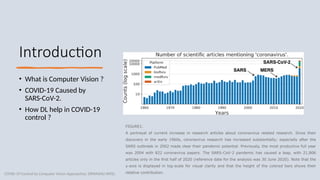
FIGURE1.
A portrayal of current increase in research articles about coronavirus related research. Since their
discovery in the early 1960s, coronavirus research has increased substantially; especially after the
SARS outbreak in 2002 made clear their pandemic potential. Previously, the most productive full year
was 2004 with 822 coronavirus papers. The SARS-CoV-2 pandemic has caused a leap, with 21,806
articles only in the first half of 2020 (reference date for the analysis was 30 June 2020). Note that the
y-axis is displayed in log-scale for visual clarity and that the height of the colored bars shows their
relative contribution.
Computer Vision for COVID-19 Diagnosis
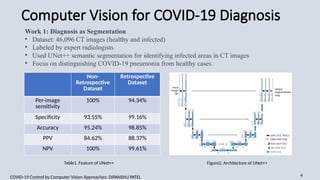
Work 1: Diagnosis as Segmentation
• Dataset: 46,096 CT images (healthy and infected)
• Labeled by expert radiologists
• Used UNet++ semantic segmentation for identifying infected areas in CT images
• Focus on distinguishing COVID-19 pneumonia from healthy cases.
Non-
Retrospective
Dataset
Retrospective
Dataset
Per-image
sensitivity
100% 94.34%
Specificity 93.55% 99.16%
Accuracy 95.24% 98.85%
PPV 84.62% 88.37%
NPV 100% 99.61%
Figure2. Architecture of UNet++
Table1. Feature of UNet++
COVID-19 Control by Computer Vision Approaches: DIPANSHU PATEL​ 4
Computer Vision for COVID-19 Diagnosis
COVID-19 Control by Computer Vision Approaches: DIPANSHU PATEL​ 5
Work 2: COVID-19 Binary Classification
• COVNet for COVID-19 binary classification
• Used RESNET50 and U-Net for lung segmentation
• Achieved 90% sensitivity and 96% specificity
• Model available online: COVNet GitHub
Work 3: 3-Category Classification
•DRE-Net for distinguishing healthy, bacterial pneumonia,
and COVID-19
•Integrated ResNet50 with FPN and Attention module
•Online server for diagnoses: DRE-Net Server
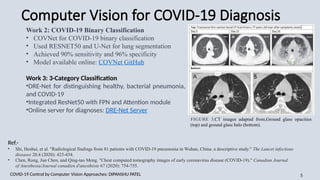
FIGURE 3.CT images adapted from,Ground glass opacities
(top) and ground glass halo (bottom).
Ref.-
• Shi, Heshui, et al. "Radiological findings from 81 patients with COVID-19 pneumonia in Wuhan, China: a descriptive study." The Lancet infectious
diseases 20.4 (2020): 425-434.
• Chen, Rong, Jun Chen, and Qing-tao Meng. "Chest computed tomography images of early coronavirus disease (COVID-19)." Canadian Journal
of Anesthesia/Journal canadien d'anesthésie 67 (2020): 754-755.
Computer Vision for COVID-19 Diagnosis
COVID-19 Control by Computer Vision Approaches: DIPANSHU PATEL​ 6
Various DL Model for X-Ray COVID-19 Detection:-
Model 1: COVID-Net
• Developed by Darwin AI, Canada
• Human-driven principled network design combined with
machine-driven exploration
• Achieved 92.4% accuracy and 80% sensitivity
• Dataset: COVIDx with 16,756 chest X-Ray images
Model 2: COVIDX-Net and DeTraC
• COVIDX-Net: Utilized seven DCNN architectures,
achieved F1-scores of 0.89 and 0.91
• DeTraC: Classified COVID-19 chest X-Ray images with
95.12% accuracy
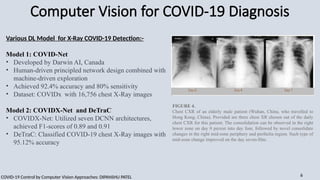
FIGURE 4.
Chest CXR of an elderly male patient (Wuhan, China, who travelled to
Hong Kong, China). Provided are three chest XR chosen out of the daily
chest CXR for this patient. The consolidation can be observed in the right
lower zone on day 0 persist into day four, followed by novel consolidate
changes in the right mid-zone periphery and perihelia region. Such type of
mid-zone change improved on the day seven-film.
Computer Vision for COVID-19 Diagnosis
COVID-19 Control by Computer Vision Approaches: DIPANSHU PATEL​ 7
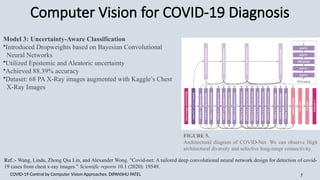
FIGURE 5.
Architectural diagram of COVID-Net We can observe High
architectural diversity and selective long-range connectivity.
Model 3: Uncertainty-Aware Classification
•Introduced Dropweights based on Bayesian Convolutional
Neural Networks
•Utilized Epistemic and Aleatoric uncertainty
•Achieved 88.39% accuracy
•Dataset: 68 PA X-Ray images augmented with Kaggle’s Chest
X-Ray Images
Ref.:- Wang, Linda, Zhong Qiu Lin, and Alexander Wong. "Covid-net: A tailored deep convolutional neural network design for detection of covid-
19 cases from chest x-ray images." Scientific reports 10.1 (2020): 19549..
Computer Vision for COVID-19 Diagnosis
COVID-19 Control by Computer Vision Approaches: DIPANSHU PATEL​ 8
FIGURE 6.
Detection of COVID-19 from ultrasound images
Ref.:- Soldati, Gino, et al. "Is there a role for lung ultrasound during the COVID 19 pandemic?."
‐ Journal of Ultrasound in
Medicine 39.7 (2020): 1459.
LUS in COVID-19 Diagnosis :-
• Less clinical data available for Lung Ultrasound (LUS)
• Fewer computer vision projects focus on LUS
• Representative Works: POCOVID-Net and Bayesian
Deep Learning
• Challenges: Limited dataset access and annotations
Representative Works and Future
Directions:-
• POCOVID-Net: Initial dataset accuracy 92%, sensitivity
96%
• Improved Performance with Bayesian Deep Learning:
Accuracy 94%, sensitivity 98%
• Segmentation and Feature Detection Approaches:
Ensemble models for biomarker extraction
• Future Directions: Enhance mobile-friendly CNNs for
on-device processing
Computer Vision for COVID-19 Prevention And Control
COVID-19 Control by Computer Vision Approaches: DIPANSHU PATEL​ 9
• Face Mask Recogination
• Thermography
• Pendamic Drone
• Germ Screening
FIGURE 7. Face mask Recogination
FIGURE 8. Infrared Thermogrphy
10
Computer Vision in COVID-
19 Treatment and Clinical Management
Clinical Management:
• "Corona Score" from CT scans identifies critical patients.
• Developed BI-AT-GRU neural network for respiratory
pattern classification.
• Radiological evidence & deep learning enhance large-scale
screening.
Vaccine Development:
• CoV spike glycoprotein crucial for vaccines & therapeutics.
• MARCO initiative [114] uses deep learning for protein
crystal recognition.
• Uesawa [116] proposes QSAR analysis with deep learning
for drug discovery.
COVID-19 Control by Computer Vision Approaches: DIPANSHU PATEL
Summary
• Extensive survey of computer vision methods for COVID-19 presented.
• Methods categorized into CT scans, X-Ray Imagery, Ultrasound, and Prevention.
• Summaries of representative work provided, with available resources.
• Encouragement for further research in this area.
• Acknowledgment of ongoing developments and early nature of the review.
• Expectation of positive impact during and after the pandemic.
Refrence
A. Ulhaq, J. Born, A. Khan, D. P. S. Gomes, S. Chakraborty and M. Paul, "COVID-19
Control by Computer Vision Approaches: A Survey," in IEEE Access, vol. 8, pp.
179437-179456, 2020, doi: 10.1109/ACCESS.2020.3027685.
THANKU

computer vision seminar presentation for computer science computer vision.pptx

  • 1.
    COVID-19 Control byComputer Vision Approaches DIPANSHU PATEL Department of Electrical Engineering, IIT Patna EE591: SEMINAR
  • 2.
    Outline Of Presentation COVID-19 Controlby Computer Vision Approaches: DIPANSHU PATEL 2 Introduction Computer Vision for COVID-19 Diagonsis Computer Vision for Preventation and Control Computer Vision for Clinical Management and Treatment Summary Refrence
  • 3.
    3 Introduction • What isComputer Vision ? • COVID-19 Caused by SARS-CoV-2. • How DL help in COVID-19 control ? COVID-19 Control by Computer Vision Approaches: DIPANSHU PATEL​ FIGURE1. A portrayal of current increase in research articles about coronavirus related research. Since their discovery in the early 1960s, coronavirus research has increased substantially; especially after the SARS outbreak in 2002 made clear their pandemic potential. Previously, the most productive full year was 2004 with 822 coronavirus papers. The SARS-CoV-2 pandemic has caused a leap, with 21,806 articles only in the first half of 2020 (reference date for the analysis was 30 June 2020). Note that the y-axis is displayed in log-scale for visual clarity and that the height of the colored bars shows their relative contribution.
  • 4.
    Computer Vision forCOVID-19 Diagnosis Work 1: Diagnosis as Segmentation • Dataset: 46,096 CT images (healthy and infected) • Labeled by expert radiologists • Used UNet++ semantic segmentation for identifying infected areas in CT images • Focus on distinguishing COVID-19 pneumonia from healthy cases. Non- Retrospective Dataset Retrospective Dataset Per-image sensitivity 100% 94.34% Specificity 93.55% 99.16% Accuracy 95.24% 98.85% PPV 84.62% 88.37% NPV 100% 99.61% Figure2. Architecture of UNet++ Table1. Feature of UNet++ COVID-19 Control by Computer Vision Approaches: DIPANSHU PATEL​ 4
  • 5.
    Computer Vision forCOVID-19 Diagnosis COVID-19 Control by Computer Vision Approaches: DIPANSHU PATEL​ 5 Work 2: COVID-19 Binary Classification • COVNet for COVID-19 binary classification • Used RESNET50 and U-Net for lung segmentation • Achieved 90% sensitivity and 96% specificity • Model available online: COVNet GitHub Work 3: 3-Category Classification •DRE-Net for distinguishing healthy, bacterial pneumonia, and COVID-19 •Integrated ResNet50 with FPN and Attention module •Online server for diagnoses: DRE-Net Server FIGURE 3.CT images adapted from,Ground glass opacities (top) and ground glass halo (bottom). Ref.- • Shi, Heshui, et al. "Radiological findings from 81 patients with COVID-19 pneumonia in Wuhan, China: a descriptive study." The Lancet infectious diseases 20.4 (2020): 425-434. • Chen, Rong, Jun Chen, and Qing-tao Meng. "Chest computed tomography images of early coronavirus disease (COVID-19)." Canadian Journal of Anesthesia/Journal canadien d'anesthésie 67 (2020): 754-755.
  • 6.
    Computer Vision forCOVID-19 Diagnosis COVID-19 Control by Computer Vision Approaches: DIPANSHU PATEL​ 6 Various DL Model for X-Ray COVID-19 Detection:- Model 1: COVID-Net • Developed by Darwin AI, Canada • Human-driven principled network design combined with machine-driven exploration • Achieved 92.4% accuracy and 80% sensitivity • Dataset: COVIDx with 16,756 chest X-Ray images Model 2: COVIDX-Net and DeTraC • COVIDX-Net: Utilized seven DCNN architectures, achieved F1-scores of 0.89 and 0.91 • DeTraC: Classified COVID-19 chest X-Ray images with 95.12% accuracy FIGURE 4. Chest CXR of an elderly male patient (Wuhan, China, who travelled to Hong Kong, China). Provided are three chest XR chosen out of the daily chest CXR for this patient. The consolidation can be observed in the right lower zone on day 0 persist into day four, followed by novel consolidate changes in the right mid-zone periphery and perihelia region. Such type of mid-zone change improved on the day seven-film.
  • 7.
    Computer Vision forCOVID-19 Diagnosis COVID-19 Control by Computer Vision Approaches: DIPANSHU PATEL​ 7 FIGURE 5. Architectural diagram of COVID-Net We can observe High architectural diversity and selective long-range connectivity. Model 3: Uncertainty-Aware Classification •Introduced Dropweights based on Bayesian Convolutional Neural Networks •Utilized Epistemic and Aleatoric uncertainty •Achieved 88.39% accuracy •Dataset: 68 PA X-Ray images augmented with Kaggle’s Chest X-Ray Images Ref.:- Wang, Linda, Zhong Qiu Lin, and Alexander Wong. "Covid-net: A tailored deep convolutional neural network design for detection of covid- 19 cases from chest x-ray images." Scientific reports 10.1 (2020): 19549..
  • 8.
    Computer Vision forCOVID-19 Diagnosis COVID-19 Control by Computer Vision Approaches: DIPANSHU PATEL​ 8 FIGURE 6. Detection of COVID-19 from ultrasound images Ref.:- Soldati, Gino, et al. "Is there a role for lung ultrasound during the COVID 19 pandemic?." ‐ Journal of Ultrasound in Medicine 39.7 (2020): 1459. LUS in COVID-19 Diagnosis :- • Less clinical data available for Lung Ultrasound (LUS) • Fewer computer vision projects focus on LUS • Representative Works: POCOVID-Net and Bayesian Deep Learning • Challenges: Limited dataset access and annotations Representative Works and Future Directions:- • POCOVID-Net: Initial dataset accuracy 92%, sensitivity 96% • Improved Performance with Bayesian Deep Learning: Accuracy 94%, sensitivity 98% • Segmentation and Feature Detection Approaches: Ensemble models for biomarker extraction • Future Directions: Enhance mobile-friendly CNNs for on-device processing
  • 9.
    Computer Vision forCOVID-19 Prevention And Control COVID-19 Control by Computer Vision Approaches: DIPANSHU PATEL​ 9 • Face Mask Recogination • Thermography • Pendamic Drone • Germ Screening FIGURE 7. Face mask Recogination FIGURE 8. Infrared Thermogrphy
  • 10.
    10 Computer Vision inCOVID- 19 Treatment and Clinical Management Clinical Management: • "Corona Score" from CT scans identifies critical patients. • Developed BI-AT-GRU neural network for respiratory pattern classification. • Radiological evidence & deep learning enhance large-scale screening. Vaccine Development: • CoV spike glycoprotein crucial for vaccines & therapeutics. • MARCO initiative [114] uses deep learning for protein crystal recognition. • Uesawa [116] proposes QSAR analysis with deep learning for drug discovery. COVID-19 Control by Computer Vision Approaches: DIPANSHU PATEL
  • 11.
    Summary • Extensive surveyof computer vision methods for COVID-19 presented. • Methods categorized into CT scans, X-Ray Imagery, Ultrasound, and Prevention. • Summaries of representative work provided, with available resources. • Encouragement for further research in this area. • Acknowledgment of ongoing developments and early nature of the review. • Expectation of positive impact during and after the pandemic.
  • 12.
    Refrence A. Ulhaq, J.Born, A. Khan, D. P. S. Gomes, S. Chakraborty and M. Paul, "COVID-19 Control by Computer Vision Approaches: A Survey," in IEEE Access, vol. 8, pp. 179437-179456, 2020, doi: 10.1109/ACCESS.2020.3027685.
  • 13.