COMPUTER TO PLATE
(CTP)
Thrd mdl
CTP
 The word CTP defines master of image
transferring techniques.
 It is the imaging technology used in modern
printing process.
 It use laser beams to directly write images on
to the printing plate rather than , first exposing
a film then transferring the image to the plate.
 The digital direct plate imaging method
eliminate trouble some film process.
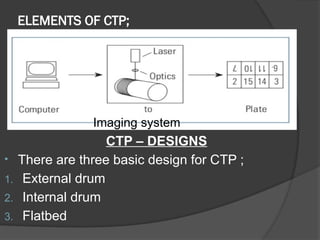
ELEMENTS OF CTP;
CTP – DESIGNS
• There are three basic design for CTP ;
1. External drum
2. Internal drum
3. Flatbed
Imaging system
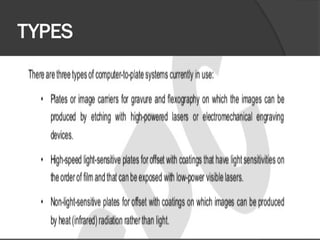
TYPES
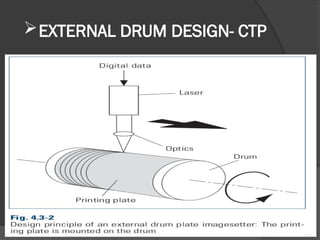
EXTERNAL DRUM DESIGN- CTP
EXTERNAL DRUM DESIGN ;
 In an external drum plate setter , the plate is
mounted on the outside of the drum .
 As the drum rotate on its axis , a multiple laser
beam head moves parallel to the drum and
burns the image on to the plate .
 Mostly , using for the imaging of the
flexographic plate .
ADVANTAGES ;
 Shorter imaging time
 Easy plate handling
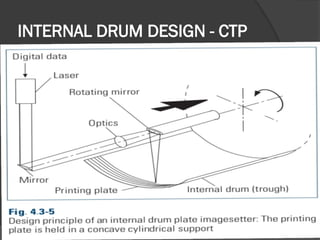
INTERNAL DRUM DESIGN - CTP
INTERNAL DRUM DESIGN ;
 In an internal drum plate setter , the plate is put in
to a cylinder .
 As the imaging head moves along the axis of the
cylinder to expose the plate .
 A single laser beam writes the digital image on to
the fixed plate .
 The laser beam is projected on to a spinning
mirror that rotates at a very high speed .
 It has longer imaging time than external drum CTP
ADVANTAGES ;
 Uniform beam intensity
 Stationary printing plate
 Greater accuracy
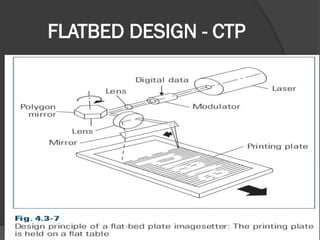
FLATBED DESIGN - CTP
FLATBED DESIGN CTP
 In the flatbed plate setter , the image is reproduced
line by line on a fixed flat printing plate by a laser
beam the is deflected by a rotating polygon mirror
and then on to the printing plate .
 Mostly , using for the offset printing plate
(newspaper printing).
ADVANTAGES;
 Easy handling of plate
 Used by quality devices
 Shorter imaging time

Computer to plate teen work and their working offset printing

  • 1.
  • 2.
    CTP  The wordCTP defines master of image transferring techniques.  It is the imaging technology used in modern printing process.  It use laser beams to directly write images on to the printing plate rather than , first exposing a film then transferring the image to the plate.  The digital direct plate imaging method eliminate trouble some film process.
  • 3.
    ELEMENTS OF CTP; CTP– DESIGNS • There are three basic design for CTP ; 1. External drum 2. Internal drum 3. Flatbed Imaging system
  • 4.
  • 5.
  • 6.
    EXTERNAL DRUM DESIGN;  In an external drum plate setter , the plate is mounted on the outside of the drum .  As the drum rotate on its axis , a multiple laser beam head moves parallel to the drum and burns the image on to the plate .  Mostly , using for the imaging of the flexographic plate . ADVANTAGES ;  Shorter imaging time  Easy plate handling
  • 7.
  • 8.
    INTERNAL DRUM DESIGN;  In an internal drum plate setter , the plate is put in to a cylinder .  As the imaging head moves along the axis of the cylinder to expose the plate .  A single laser beam writes the digital image on to the fixed plate .  The laser beam is projected on to a spinning mirror that rotates at a very high speed .  It has longer imaging time than external drum CTP
  • 9.
    ADVANTAGES ;  Uniformbeam intensity  Stationary printing plate  Greater accuracy
  • 10.
  • 11.
    FLATBED DESIGN CTP In the flatbed plate setter , the image is reproduced line by line on a fixed flat printing plate by a laser beam the is deflected by a rotating polygon mirror and then on to the printing plate .  Mostly , using for the offset printing plate (newspaper printing). ADVANTAGES;  Easy handling of plate  Used by quality devices  Shorter imaging time