
Aishwarya
Integral University
Bachelor’s of Technology
Computer Science & Engineering
Computer
Generated
Poetry
CAN
COMPUTER
GENERATE
POETRY?
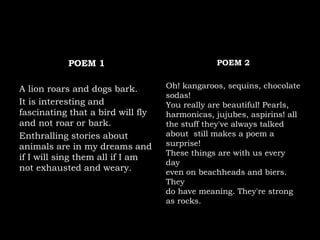
POEM 1
A lion roars and dogs bark.
It is interesting and
fascinating that a bird will fly
and not roar or bark.
Enthralling stories about
animals are in my dreams and
if I will sing them all if I am
not exhausted and weary.
POEM 2
Oh! kangaroos, sequins, chocolate
sodas!
You really are beautiful! Pearls,
harmonicas, jujubes, aspirins! all
the stuff they've always talked
about still makes a poem a
surprise!
These things are with us every
day
even on beachheads and biers.
They
do have meaning. They're strong
as rocks.
POEM 1
RACTER(William
Chamberlain)
POEM 2
FRANK O’ HARRA
An electronic device
which is capable of
Receiving information
(data) in a particular form
Perform a sequence of
operations in accordance
with a predetermined but
variable set of procedural
instructions (program)
And produce a result in
the form of information
or signals.
DATA
(INPUT)
OUTPUT
COMPUTER?
PROCESSING
POETRY
Poetry is the creation of sense of imagination
experience and life.
It is a written and oral tradition composed of
rhythmical words and describing one’s
experience or one’s imagination in a way that
is deemed beautiful than ordinary speech.
COMPUTER GENERATED POETRY
Computer Generated poetry, that
is generated through an
algorithm, which is executed by
a digital, electronic computer,
which is intended, by whoever it
may be, to be read as poetry.
The Longman Dictionary and
Handbook of Poetry Myers and
Simms define computer
poetry as "a recently developed
form of poetic composition in
which data-processing machines
are used to generate new
sequences of words”
Why Do we need this?
Computer generated poetry is a step where we generate
poetry like that of a human. It is a form of artificial
intelligence.
It is a step of artificial intelligence to generate an
intelligent device which has human like skills.
It is somewhere a *Hand-shake* between norms of art
and philosophy and technology.
As said by Oscar Schwartz, “There are no boundaries
set for humans. Every writer is a poet and every
poet can also be a singer or painter or whatever it
feels like! ”
TURING TEST
A proposed test of a computer's ability to think, requiring that the
covert substitution of the
computer for one of the participants in a
keyboard and screen dialogue should be undetectable by the remaining
human participant.
Bot or not.com
Oscar
Schwartz Benjamin Laird
RACTER
Racter is an artificial intelligence computer program that generates English
language prose at random.
Racter, short for raconteur, was written by William Chamberlain and Thomas Etter.
The existence of the program was revealed in 1983 in a book called The Policeman's
Beard Is Half Constructed, which was described as being composed entirely by the
program. According to Chamberlain's introduction to the book, the program apparently
ran on a CP/M machine; it was written in "compiled BASIC on a Z80 micro with 64K
of RAM." This version, the program that allegedly wrote the book, was not released to
the general public. The sophistication claimed for the program was likely exaggerated,
as could be seen by investigation of the template system of text generation. However,
in 1984 Mindscape, Inc. released an interactive version of Racter, developed by Inrac
Corporation, for DOS, Amiga and Apple II computers. The published Racter was
similar to a chatterbox. The BASIC program that was released by Mindscape was far
less sophisticated than anything that could have written the fairly sophisticated prose
of The Policeman's Beard.
The commercial version of Racter could be likened to a computerized version of Mad
Libs, the game in which you fill in the blanks in advance and then plug them into a
text template to produce a surrealistic tale.
The commercial program attempted to parse text inputs, identifying
significant nouns and verbs, which it would then regurgitate to create "conversations,"
plugging the input from the user into phrase templates which it then combined, along
with modules that conjugated English verbs.
RKCP
Ray Kurzweil's Cybernetic Poet was written
by Ray Kurzweil in the mid 1980s (in "C")and
is described in Ray Kurzweil's book The Age of
Intelligent Machines (MIT Press 1990)in a
section entitled A (Kind of) Turing Test.
RKCP reads a selection of poems by a
particular author or authors and then creates
a "language model" of that author’s work. The
language model incorporates computer-based
language analysis and mathematical modeling
techniques. RKCP can then write original
poems from that model. The poems have
a similar style to the author(s) originally analyzed,
but are completely original new poetry.
RKCP can combine authors by creating language
models using more than one author file. In
addition, RKCP allows the user to create "poet
personalities," each of which specifies a specific
language model and a set of parameters which
control certain aspects of the poetry generation
process.
RKCP uses the following aspects of the original
authors that were analyzed to create original
poems: (i) words,
(ii) word structures and sequence patterns based on
RKCP’s language modeling techniques,
iii) rhythm patterns
(iv) overall poem structure.
There are also algorithms to maintain thematic
consistency through the poem.
RKCP uses a unique recursive poetry generation
algorithm to achieve the language style, rhythm
patterns and poem structure of the original authors
that were analyzed, without actually copying the
original authors’ writings.
RKCP includes a plagiarism avoidance algorithm
which attempts to avoid plagiarism of the original
author(s) analyzed, where plagiarism is defined as
more than 3 words in a row that appear anywhere
in the original author(s)’ writings.
POEM 1
I think I'll crash.
Just for myself with God
peace on a curious sound
for myself in my heart?
And life is weeping
From a bleeding heart
of boughs bending
such paths of them,
of boughs bending
such paths of breeze
knows we've been there
POEM 2
He gives his harness bells a shake
To ask if there is some mistake.
The only other sound’s the sweep
Of easy wind and downy flake.
The woods are lovely, dark and
deep,
But I have promises to keep,
And miles to go before I sleep,
And miles to go before I sleep.
POEM 1
A poem “I Think I'll Crash”
written by Ray Kurzweil's
Cybernetic Poet
after reading poems by Ray
Kurzweil, Robert Frost and Wendy
Dennis
POEM 2
Robert Frost
Stopping by the woods on a
Snowy Evening
How do We Judge this?
We use a reverse Turing
test where a poetry
written by Human poets
fools majority of judges
that it was written by a
computer.
Feeling confused!
HUMAN
COMPUTERS
HUMAN
So Is A Human More
Computer?
Or
A Computer More
HUMAN?
But what we have are a
bunch of insights:
1. For some reason we
associate poetry with being
human.
But what does it needs to
be a human?
How do we put boundaries
around this category?
How do we say who or what
can be under this category.
2. When we do a
Turing test for
poetry, we are not
really judging an
algorithm or
Computer but we
are judging the
human-ness of this
form.
INSIGHTS
Conclusion
A computer is a mirror of human mind. Whatever we show it, it
returns it to us.
Recently artificial intelligence has taken a toll. Much of the
conversation lies around the spectrum that can we build it?
Can we create a system that is creative?
Can we build an intelligent computer?
Oscar Schwartz research paper reads, “Human is not a scientific
fact but it is an ever shifting and concatenating fact.
I believe it to revolve around the spectrum like Can we build a
human like computer?”
Computer poetry

Computer poetry

  • 1.
    Aishwarya Integral University Bachelor’s ofTechnology Computer Science & Engineering
  • 2.
  • 3.
  • 4.
    POEM 1 A lionroars and dogs bark. It is interesting and fascinating that a bird will fly and not roar or bark. Enthralling stories about animals are in my dreams and if I will sing them all if I am not exhausted and weary. POEM 2 Oh! kangaroos, sequins, chocolate sodas! You really are beautiful! Pearls, harmonicas, jujubes, aspirins! all the stuff they've always talked about still makes a poem a surprise! These things are with us every day even on beachheads and biers. They do have meaning. They're strong as rocks.
  • 5.
  • 6.
    An electronic device whichis capable of Receiving information (data) in a particular form Perform a sequence of operations in accordance with a predetermined but variable set of procedural instructions (program) And produce a result in the form of information or signals. DATA (INPUT) OUTPUT COMPUTER? PROCESSING
  • 7.
    POETRY Poetry is thecreation of sense of imagination experience and life. It is a written and oral tradition composed of rhythmical words and describing one’s experience or one’s imagination in a way that is deemed beautiful than ordinary speech.
  • 8.
    COMPUTER GENERATED POETRY ComputerGenerated poetry, that is generated through an algorithm, which is executed by a digital, electronic computer, which is intended, by whoever it may be, to be read as poetry. The Longman Dictionary and Handbook of Poetry Myers and Simms define computer poetry as "a recently developed form of poetic composition in which data-processing machines are used to generate new sequences of words”
  • 9.
    Why Do weneed this? Computer generated poetry is a step where we generate poetry like that of a human. It is a form of artificial intelligence. It is a step of artificial intelligence to generate an intelligent device which has human like skills. It is somewhere a *Hand-shake* between norms of art and philosophy and technology. As said by Oscar Schwartz, “There are no boundaries set for humans. Every writer is a poet and every poet can also be a singer or painter or whatever it feels like! ”
  • 10.
    TURING TEST A proposedtest of a computer's ability to think, requiring that the covert substitution of the computer for one of the participants in a keyboard and screen dialogue should be undetectable by the remaining human participant.
  • 11.
  • 12.
    RACTER Racter is anartificial intelligence computer program that generates English language prose at random. Racter, short for raconteur, was written by William Chamberlain and Thomas Etter. The existence of the program was revealed in 1983 in a book called The Policeman's Beard Is Half Constructed, which was described as being composed entirely by the program. According to Chamberlain's introduction to the book, the program apparently ran on a CP/M machine; it was written in "compiled BASIC on a Z80 micro with 64K of RAM." This version, the program that allegedly wrote the book, was not released to the general public. The sophistication claimed for the program was likely exaggerated, as could be seen by investigation of the template system of text generation. However, in 1984 Mindscape, Inc. released an interactive version of Racter, developed by Inrac Corporation, for DOS, Amiga and Apple II computers. The published Racter was similar to a chatterbox. The BASIC program that was released by Mindscape was far less sophisticated than anything that could have written the fairly sophisticated prose of The Policeman's Beard. The commercial version of Racter could be likened to a computerized version of Mad Libs, the game in which you fill in the blanks in advance and then plug them into a text template to produce a surrealistic tale. The commercial program attempted to parse text inputs, identifying significant nouns and verbs, which it would then regurgitate to create "conversations," plugging the input from the user into phrase templates which it then combined, along with modules that conjugated English verbs.
  • 13.
    RKCP Ray Kurzweil's CyberneticPoet was written by Ray Kurzweil in the mid 1980s (in "C")and is described in Ray Kurzweil's book The Age of Intelligent Machines (MIT Press 1990)in a section entitled A (Kind of) Turing Test. RKCP reads a selection of poems by a particular author or authors and then creates a "language model" of that author’s work. The language model incorporates computer-based language analysis and mathematical modeling techniques. RKCP can then write original poems from that model. The poems have a similar style to the author(s) originally analyzed, but are completely original new poetry. RKCP can combine authors by creating language models using more than one author file. In addition, RKCP allows the user to create "poet personalities," each of which specifies a specific language model and a set of parameters which control certain aspects of the poetry generation process.
  • 14.
    RKCP uses thefollowing aspects of the original authors that were analyzed to create original poems: (i) words, (ii) word structures and sequence patterns based on RKCP’s language modeling techniques, iii) rhythm patterns (iv) overall poem structure. There are also algorithms to maintain thematic consistency through the poem. RKCP uses a unique recursive poetry generation algorithm to achieve the language style, rhythm patterns and poem structure of the original authors that were analyzed, without actually copying the original authors’ writings. RKCP includes a plagiarism avoidance algorithm which attempts to avoid plagiarism of the original author(s) analyzed, where plagiarism is defined as more than 3 words in a row that appear anywhere in the original author(s)’ writings.
  • 15.
    POEM 1 I thinkI'll crash. Just for myself with God peace on a curious sound for myself in my heart? And life is weeping From a bleeding heart of boughs bending such paths of them, of boughs bending such paths of breeze knows we've been there POEM 2 He gives his harness bells a shake To ask if there is some mistake. The only other sound’s the sweep Of easy wind and downy flake. The woods are lovely, dark and deep, But I have promises to keep, And miles to go before I sleep, And miles to go before I sleep.
  • 16.
    POEM 1 A poem“I Think I'll Crash” written by Ray Kurzweil's Cybernetic Poet after reading poems by Ray Kurzweil, Robert Frost and Wendy Dennis POEM 2 Robert Frost Stopping by the woods on a Snowy Evening
  • 17.
    How do WeJudge this? We use a reverse Turing test where a poetry written by Human poets fools majority of judges that it was written by a computer.
  • 18.
  • 19.
    So Is AHuman More Computer? Or A Computer More HUMAN?
  • 20.
    But what wehave are a bunch of insights: 1. For some reason we associate poetry with being human. But what does it needs to be a human? How do we put boundaries around this category? How do we say who or what can be under this category. 2. When we do a Turing test for poetry, we are not really judging an algorithm or Computer but we are judging the human-ness of this form. INSIGHTS
  • 21.
    Conclusion A computer isa mirror of human mind. Whatever we show it, it returns it to us. Recently artificial intelligence has taken a toll. Much of the conversation lies around the spectrum that can we build it? Can we create a system that is creative? Can we build an intelligent computer? Oscar Schwartz research paper reads, “Human is not a scientific fact but it is an ever shifting and concatenating fact. I believe it to revolve around the spectrum like Can we build a human like computer?”