Computer
Computer Knowledge Questions
1. RAM stands for :
(A) Read Access Memory
(B) RandomAccess Memory
(C) RandomAssigned Memory
(D) All of these
(E) None of these
2. Data in RAM are :
(A) Volatile in nature
(B) Non-volatile in nature
(C) Both (A) & (B)
(D) All of these
(E) None of these
3. BIOS stands for :
(A) Basic InputOutputSystem
(B) Basic Instruction OutputSystem
(C) Basic InterfaceOutputSystem
(D) All of these
(E) None of these
4. RAM in its commercial forms areavailable as :
(A) SIMM
(B) DIMM
(C) Both (A) & (B)
(D) CPSB
(E) None of these
5. Which of the following requires refreshing during retaining the data?
(A) DRAM
(B) SRAM
(C) VirtualMemory
(D) FDD
(E) None of these
6. Refresh Rate of monitor is measured in :
(A) Hz
(B) Meter
(C) Volts
(D) Amp.
(E) None of these
7. Which of the following meaning is used between CPU & RAM to speed up
the processing power of a CPU?
(A) Virtual Memory
(B) DRAM
(C) Flash Memory
(D) Cache Memory
(E) None of these
8. Which of the following is lowest in memory hierarchy?
(A) Cache memory
(B) Secondary memory
(C) Registers
(D) RAM
(E) None of these
9. Which of the following is an input device?
(A) Keyboard
(B) VDU
(C) Both (A) & (B)
(D) Dvu
(E) None of these
10. CRT stands for :
(A) Character Ray Tube
(B) Cathode Ray Tube
(C) Colour Ray Tube
(D) All of the above
(E) None of these
11. Which of the following is a GUI device :
(A) Keyboard
(B) Mouse
(C) OMR
(D) All of these
(E) None of these
12. LCD stands for :
(A) Liquid CrystalDisplay
(B) Laser CrystalDisplay
(C) Light CrystalDisplay
(D) All of these
(E) None of these
13. Such types of printers, in which the printing head contacts with the paper
in printing process, arecalled as :
(A) ImpactPrinter
(B) Non-ImpactPrinter
(C) Laser Printer
(D) All of these
(E) None of these
14. Which of the following is a type of optical media?
(A) FDD
(B) HDD
(C) CD
(D) Magnetic Tape
(E) None of these
15. DVD stands for :
(A) Digital Video Disk
(B) Digital Versatile Disk
(C) Both (A) & (B)
(D) All of these
(E) None of these
16. Which of the following is an input device?
(A) VDU
(B) Printer
(C) Plotter
(D) MICR
(E) None of these
17. Identify the odd one :
(A) Storage tape memory
(B) Magnetic disc memory
(C) Optical disc memory
(D) Read only memory
(E) None of these
18. Nibble describes a bits combination of :
(A) 5 bits
(B) 6 bits
(C) 7 bits
(D) 4 bits
(E) None of these
19. A Byte constitutes of :
(A) 9 bits
(B) 8 bits
(C) 7 bits
(D) 4 bits
(E) None of these
20. Memory in a PCis addressablethrough :
(A) Bits
(B) Byte
(C) Nibble
(D) All of these
(E) None of these
21. One Kilo Byte represents :
(A) 1024 bytes
(B) 1000 bytes
(C) 100 bytes
(D) 1064 bytes
(E) None of these
22. Basic building block for a digital circuit is :
(A) Word
(B) Logic Gate
(C) Processor
(D) BUS
(E) None of these
23. Which of the following is a logic gate?
(A) AND
(B) OR
(C) CPU
(D) Both (A) & (B)
(E) None of these
24. The base of binary number is :
(A) 2
(B) 16
(C) 8
(D) 10
(E) None of these
25. ASCII stands for :
(A) American Standard Code for Institute Interchange
(B) American Standard Code for Information Interchange
(C) American Standard Code for Information Institute
(D) All of these
(E) None of these
Answers :
1. (B) 2. (A) 3. (A) 4. (C) 5. (A) 6. (A) 7. (D) 8. (B) 9. (A) 10. (B)
11. (B) 12. (A) 13. (A) 14. (C) 15. (B) 16. (D) 17. (D) 18. (D) 19. (B) 20. (B)
21. (A) 22. (B) 23. (D) 24. (A) 25. (B)
1. You can keep your personal files/folders in—
(A) My folder
(B) My Documents
(C) My Files
(D) My Text
(E) None of these
Answer: My Documents
2. The primary purpose ofsoftware is to turn data into—
(A) Web sites
(B) Information
(C) Programs
(D) Objects
(E) None of these
Answer: Information
3. A directory within a directory is called—
(A) Mini Directory
(B) Junior Directory
(C) Part Directory
(D) Sub Directory
(E) None of these
Answer: Sub Directory
4. A compiler translates a program written in a high-level language into—
(A) Machine language
(B) An algorithm
(C) A debugged program
(D) Java
(E) None of these
Answer: Machine language
5. When you turn on the computer,the boot routine will perform this test—
(A) RAM test
(B) Disk drive test
(C) Memory test
(D) Power-on self-test
(E) None of these
Answer: Disk drive test
6. A ……is a unique name thatyou give to a file of information.
(A) device letter
(B) folder
(C) filename
(D) filename extension
(E) None of these
Answer: filename extension
7. Hardware includes—
(A) all devices used to input data into a computer
(B) sets of instructions thata computer runs or executes
(C) the computer and all the devices connected to it that are used to input and output data
(D) all devices involved in processing information including the central processing unit,memoryand storage
(E) None of these
Answer: (D)
8. A ……… contains specific rules and words thatexpress the logical steps ofan algorithm.
(A) programming language
(B) syntax
(C) programming structure
(D) logic chart
(E) None of these
Answer: programming language
9. All the deleted files go to—
(A) Recycle Bin
(B) Task Bar
(C) Tool Bar
(D) My Computer
(E) None of these
Answer: Recycle Bin
10. The simultaneous processing oftwo or more programs bymultiple processors is —
(A) Multiprogramming
(B) Multitasking
(C) Time-sharing
(D) Multiprocessing
(E) None of these
Answer: Multiprocessing
11. The secretcode that restricts entry to some programs—
(A) Password
(B) Passport
(C) Entry-code
(D) Access-code
(E) None of these
Answer: Password
12. Computers use the ……… number system to store data and perform calculations.
(A) binary
(B) octal
(C) decimal
(D) hexadecimal
(E) None of these
Answer: binary
13. The main function of the ALU is to—
(A) Perform arithmetic and logical operations
(B) Store data and information for future use
(C) Control computer output,such as printing
(D) Monitor all computer activities
(E) None of these
Answer: Perform arithmetic and logical operations
14. ……is the process ofcarrying out commands.
(A) Fetching
(B) Storing
(C) Executing
(D) Decoding
(E) None of these
Answer: Executing
15. Softcopy is the intangible output,so then whatis hardcopy ?
(A) The physical parts of the computer
(B) The printed parts of the computer
(C) The printed output
(D) The physical outputdevices
(E) None of these
Answer: The printed output
16. A(n) ……… is a program that makes the computer easier to use.
(A) utility
(B) application
(C) operating system
(D) network
(E) None of these
Answer: utility
17. A complete electronic circuitwith transistors and other electronic components on a small silicon chip is called
a(n)—
(A) Workstation
(B) CPU
(C) Magnetic disk
(D) Integrated circuit
(E) None of these
Answer: Integrated circuit
18. Computer systems are comprised of—
(A) Hardware,programs,processors,procedures and people
(B) Hardware,programs,information,people and procedures
(C) Hardware,programs,information,people and networks
(D) Hardware,software,procedures,networks and people
(E) None of these
Answer: Hardware,software,procedures,networks and people
19. An error in a computer program—
(A) Crash
(B) Power Failure
(C) Bug
(D) Virus
(E) None of these
Answer: Bug
20. What is output ?
(A) What the processor takes from the user
(B) What the user gives to the processor
(C) What the processor gets from the user
(D) What the processor gives to the user
(E) None of these
Answer: What the processor gives to the user
1. Which of the following's absence the computer systemcan still be functional
A. Operating system
B. Hard Drive
C. RAM
D. Sound Card
2.The name for the way that computers manipulate data into information is
called:
A. programming
B. processing
C. storing
D. organizing
3.When you are working on a document on a PC where is the document
temporarily stored ?
A. Hard Disk
B. ROM
C. RAM
D. CD-ROM
4. A set of instructions telling the computer what to do is called:
A. Program
B. Compiler
C. Debugger
D. Mentor
5. The term "hypertext" means:
A. Text with heavy formatting
B. Blinking text
C. Hyper media
D. None of the above
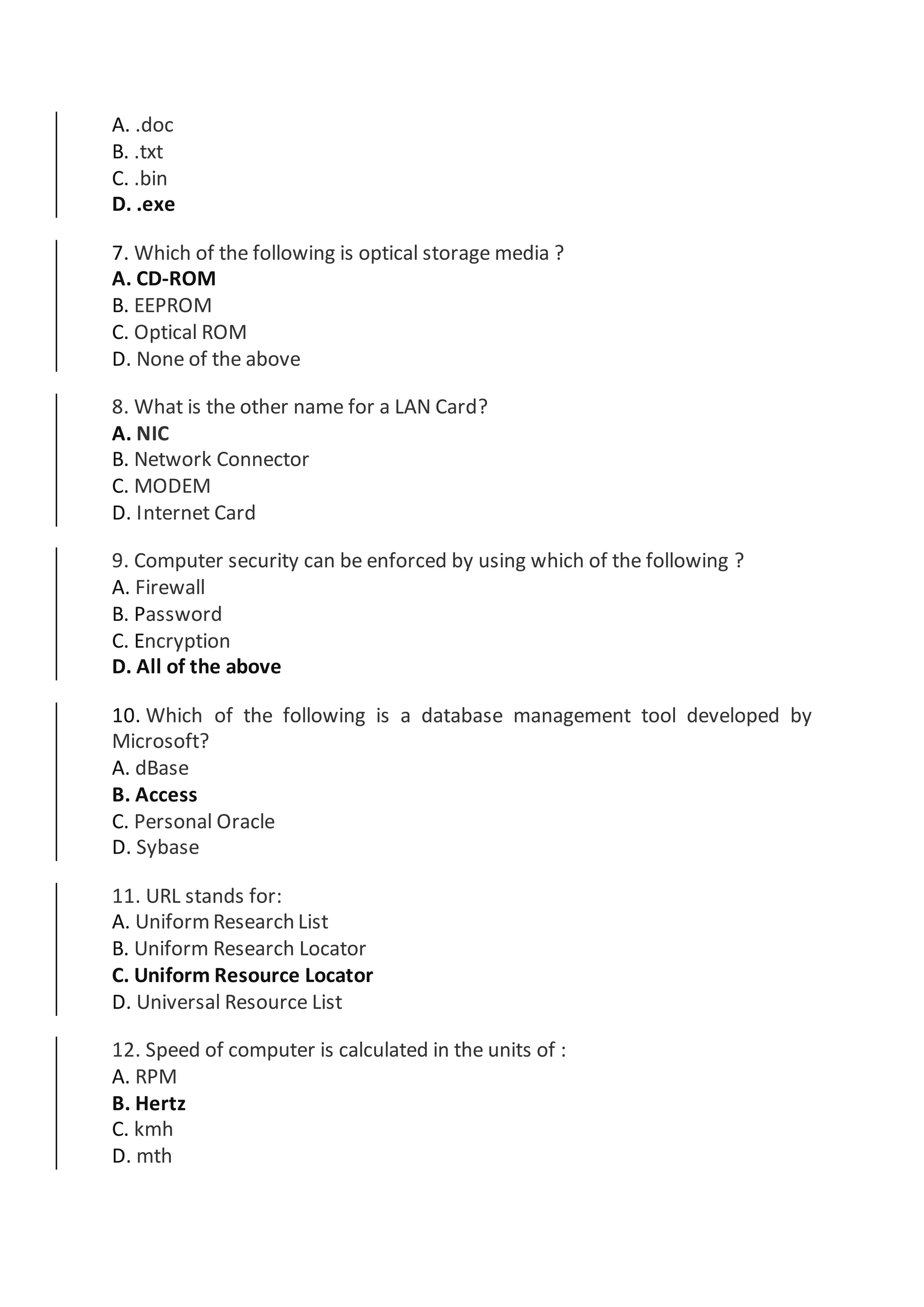
6. What is the extension of executable program under windows ?
A. .doc
B. .txt
C. .bin
D. .exe
7. Which of the following is optical storage media ?
A. CD-ROM
B. EEPROM
C. Optical ROM
D. None of the above
8. What is the other name for a LAN Card?
A. NIC
B. Network Connector
C. MODEM
D. Internet Card
9. Computer security can be enforced by using which of the following ?
A. Firewall
B. Password
C. Encryption
D. All of the above
10. Which of the following is a database management tool developed by
Microsoft?
A. dBase
B. Access
C. Personal Oracle
D. Sybase
11. URL stands for:
A. UniformResearch List
B. Uniform Research Locator
C. Uniform Resource Locator
D. Universal Resource List
12. Speed of computer is calculated in the units of :
A. RPM
B. Hertz
C. kmh
D. mth
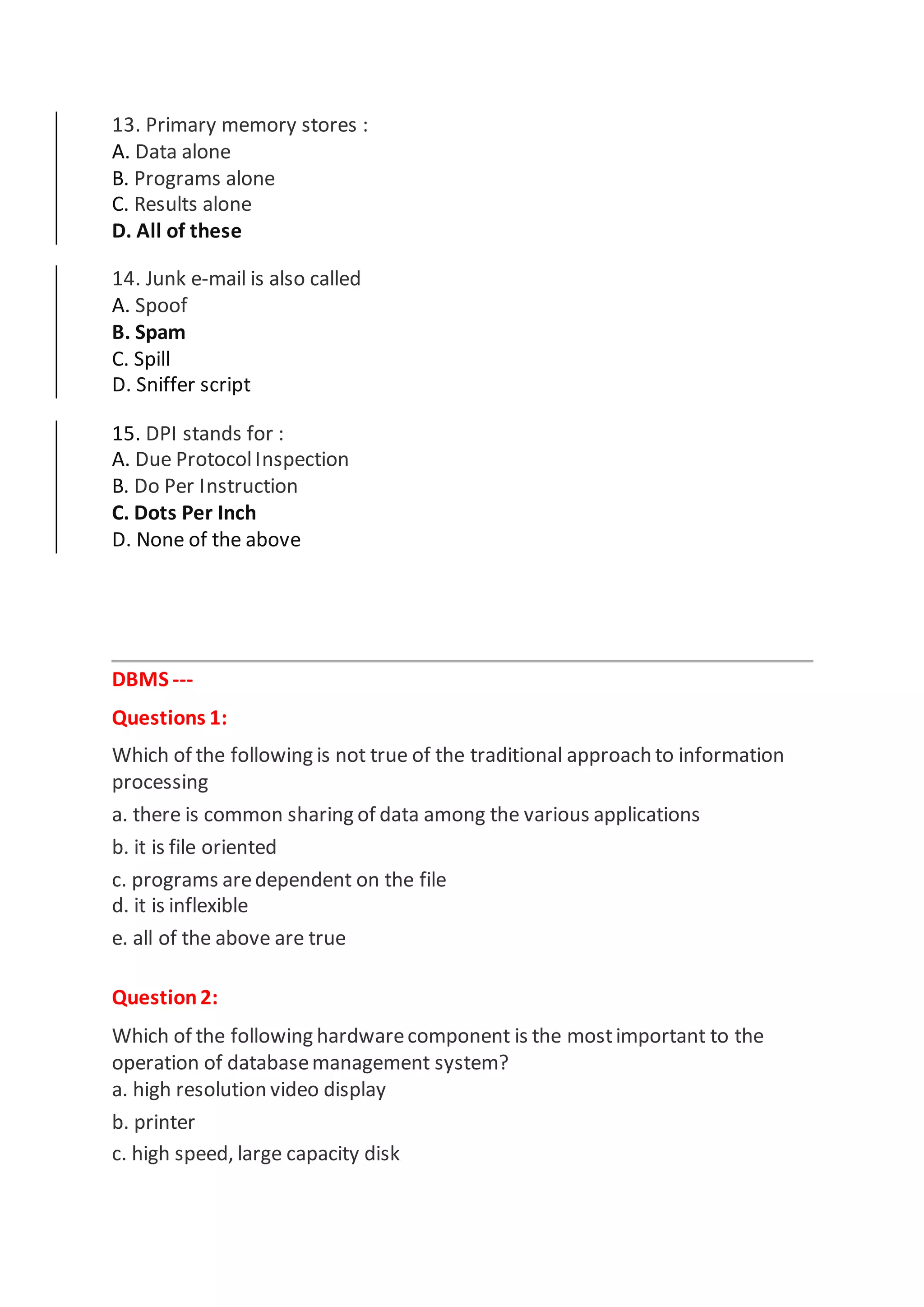
13. Primary memory stores :
A. Data alone
B. Programs alone
C. Results alone
D. All of these
14. Junk e-mail is also called
A. Spoof
B. Spam
C. Spill
D. Sniffer script
15. DPI stands for :
A. Due ProtocolInspection
B. Do Per Instruction
C. Dots Per Inch
D. None of the above
DBMS ---
Questions 1:
Which of the following is not true of the traditional approach to information
processing
a. there is common sharing of data among the various applications
b. it is file oriented
c. programs aredependent on the file
d. it is inflexible
e. all of the above are true
Question2:
Which of the following hardwarecomponent is the mostimportant to the
operation of databasemanagement system?
a. high resolution video display
b. printer
c. high speed, large capacity disk
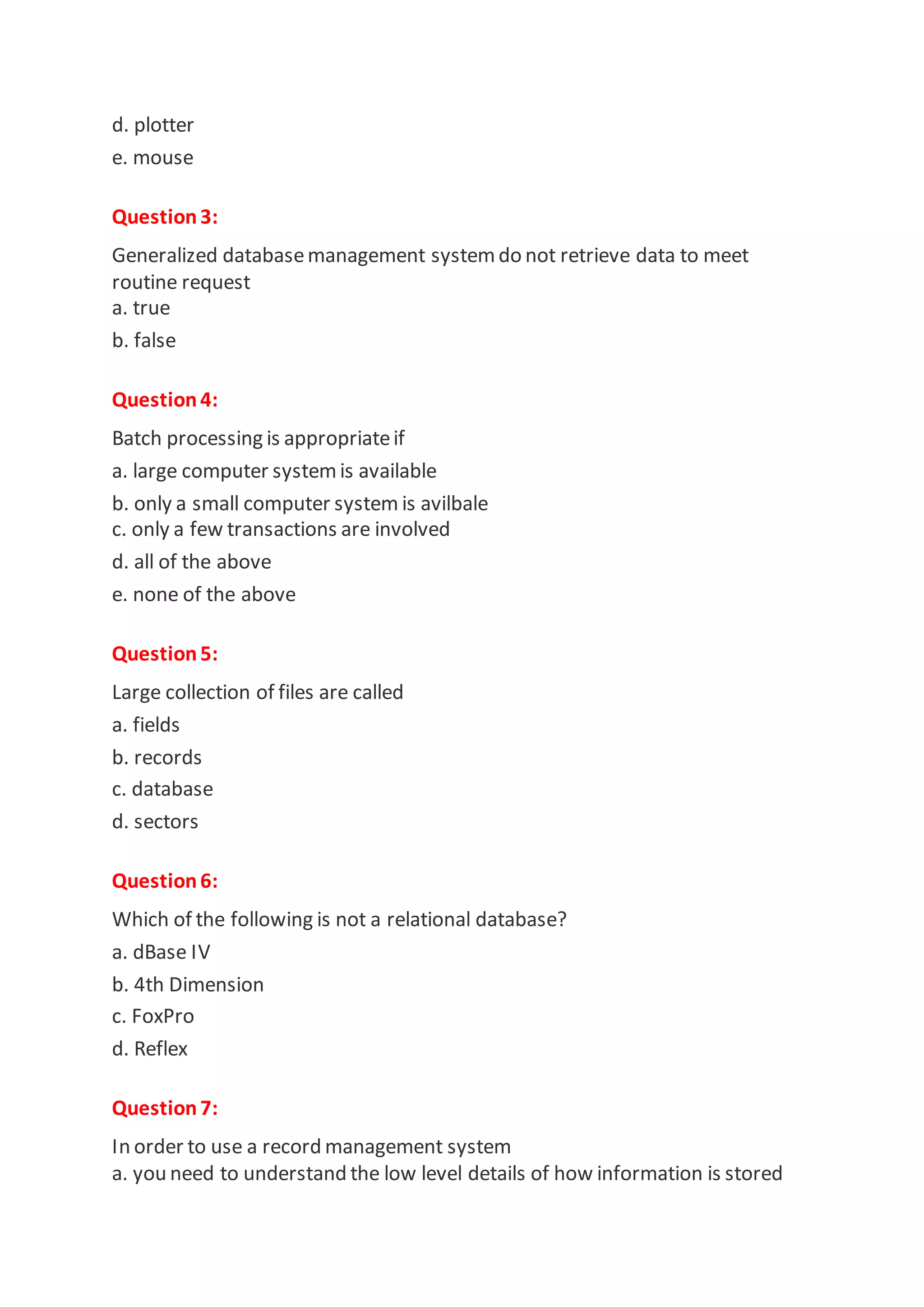
d. plotter
e. mouse
Question3:
Generalized databasemanagement systemdo not retrieve data to meet
routine request
a. true
b. false
Question4:
Batch processing is appropriateif
a. large computer systemis available
b. only a small computer system is avilbale
c. only a few transactions are involved
d. all of the above
e. none of the above
Question5:
Large collection of files are called
a. fields
b. records
c. database
d. sectors
Question6:
Which of the following is not a relational database?
a. dBase IV
b. 4th Dimension
c. FoxPro
d. Reflex
Question7:
In order to use a record management system
a. you need to understand the low level details of how information is stored
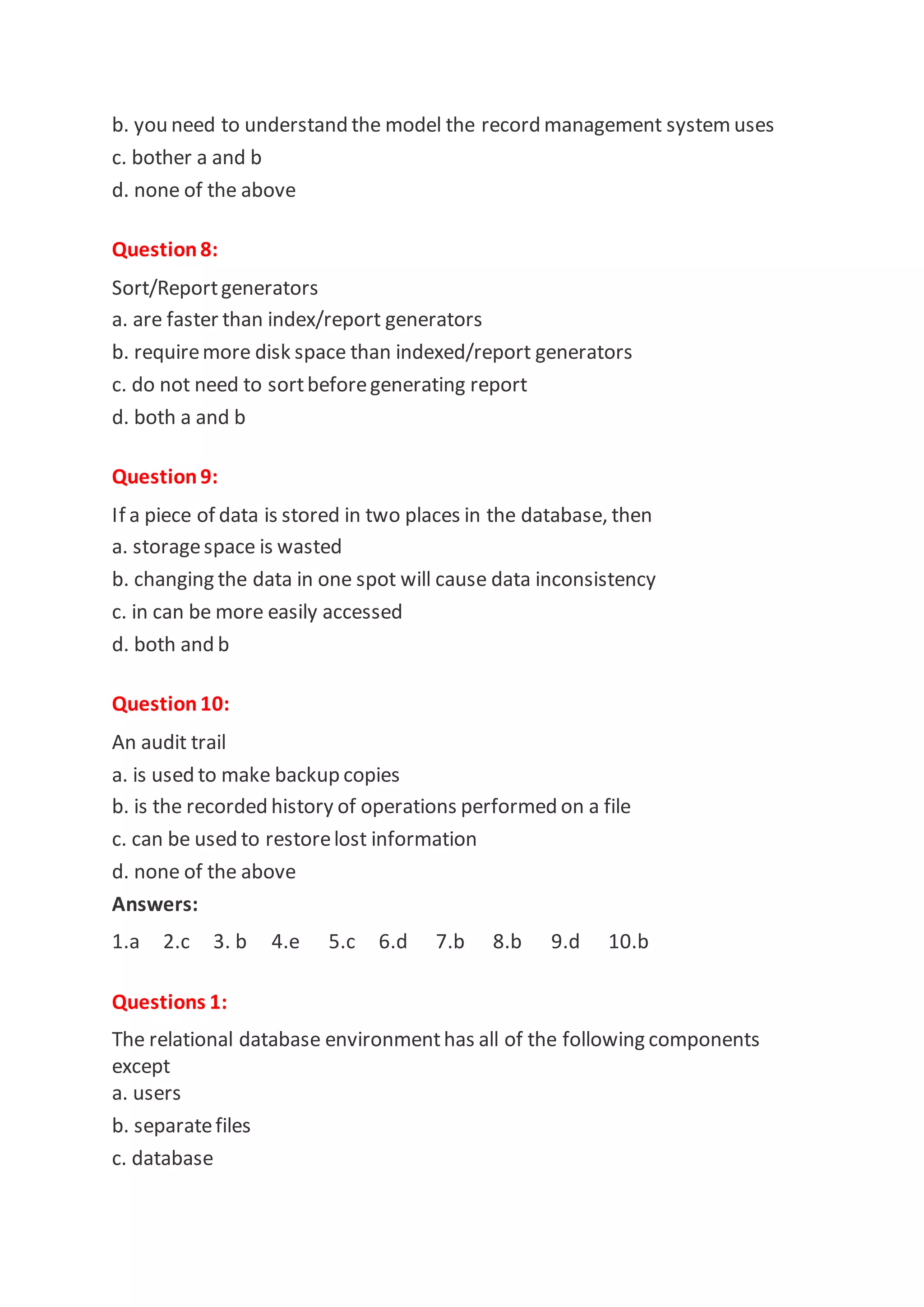
b. you need to understand the model the record management system uses
c. bother a and b
d. none of the above
Question8:
Sort/Reportgenerators
a. are faster than index/report generators
b. requiremore disk space than indexed/report generators
c. do not need to sortbeforegenerating report
d. both a and b
Question9:
If a piece of data is stored in two places in the database, then
a. storagespace is wasted
b. changing the data in one spot will cause data inconsistency
c. in can be more easily accessed
d. both and b
Question10:
An audit trail
a. is used to make backup copies
b. is the recorded history of operations performed on a file
c. can be used to restorelost information
d. none of the above
Answers:
1.a 2.c 3. b 4.e 5.c 6.d 7.b 8.b 9.d 10.b
Questions 1:
The relational database environmenthas all of the following components
except
a. users
b. separatefiles
c. database
d. query languages
e. database
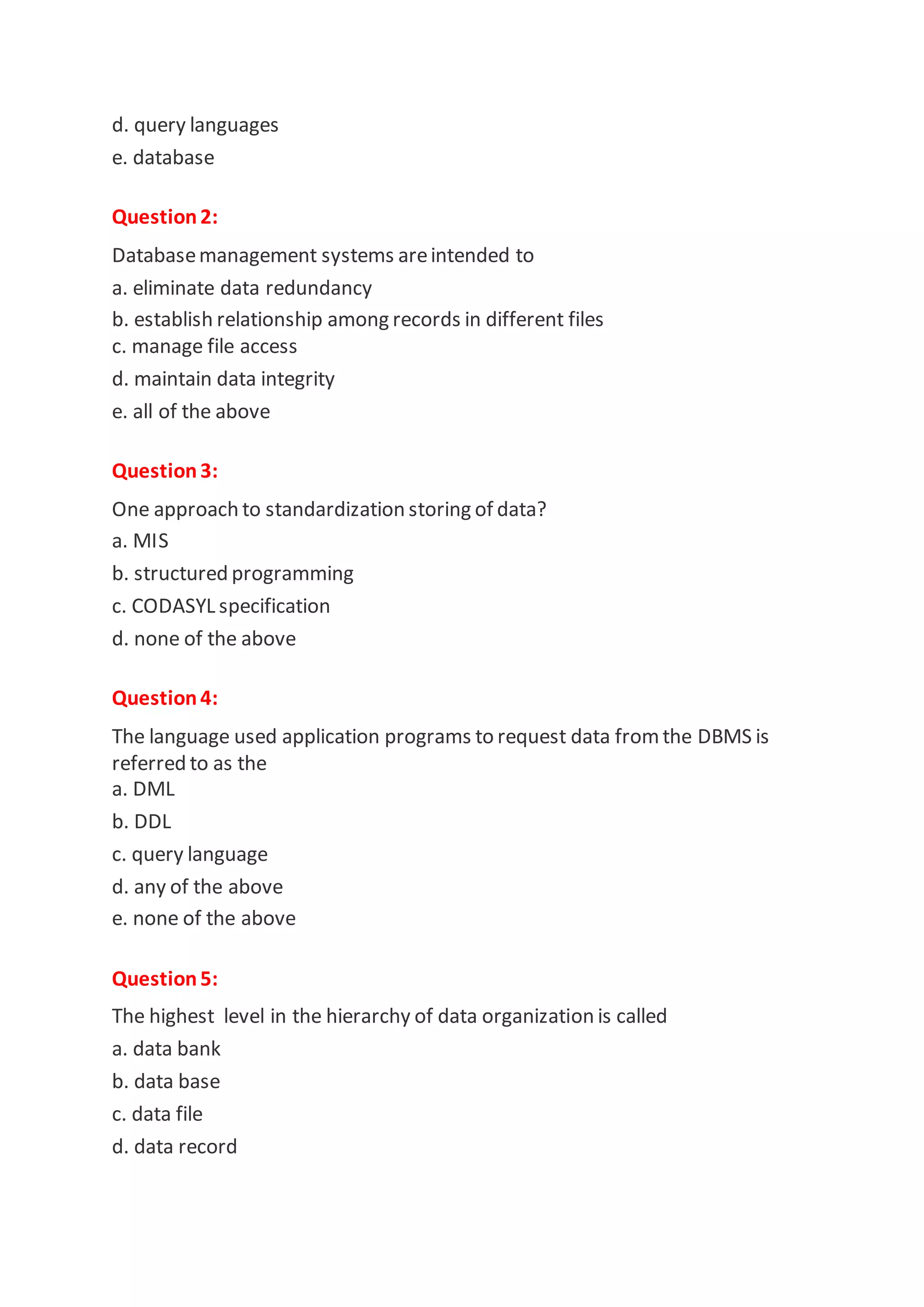
Question2:
Databasemanagement systems areintended to
a. eliminate data redundancy
b. establish relationship among records in different files
c. manage file access
d. maintain data integrity
e. all of the above
Question3:
One approach to standardization storing of data?
a. MIS
b. structured programming
c. CODASYL specification
d. none of the above
Question4:
The language used application programs to request data fromthe DBMS is
referred to as the
a. DML
b. DDL
c. query language
d. any of the above
e. none of the above
Question5:
The highest level in the hierarchy of data organization is called
a. data bank
b. data base
c. data file
d. data record
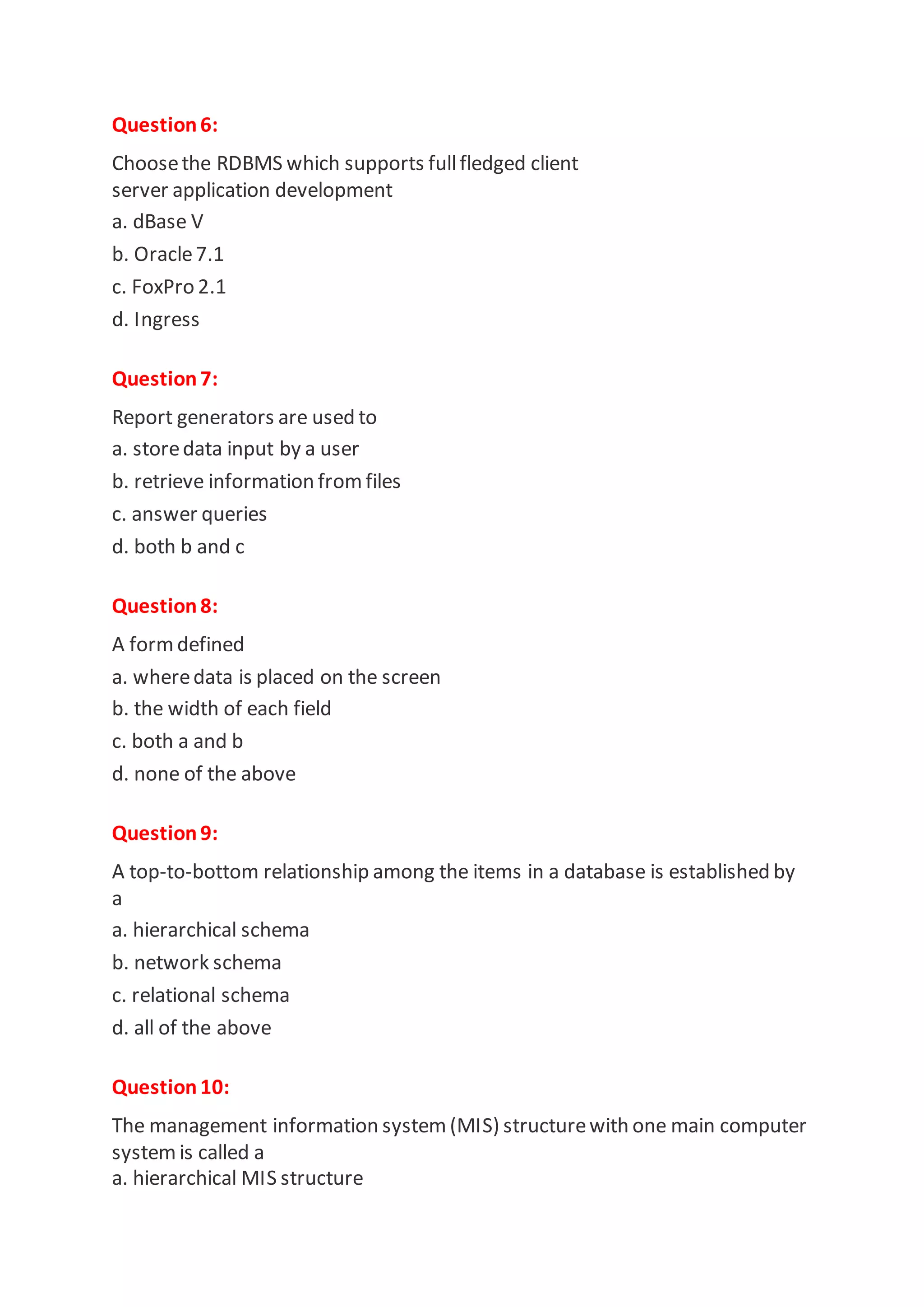
Question6:
Choosethe RDBMS which supports fullfledged client
server application development
a. dBase V
b. Oracle7.1
c. FoxPro 2.1
d. Ingress
Question7:
Report generators are used to
a. storedata input by a user
b. retrieve information fromfiles
c. answer queries
d. both b and c
Question8:
A formdefined
a. wheredata is placed on the screen
b. the width of each field
c. both a and b
d. none of the above
Question9:
A top-to-bottom relationship among the items in a database is established by
a
a. hierarchical schema
b. network schema
c. relational schema
d. all of the above
Question10:
The management information system (MIS) structurewith one main computer
system is called a
a. hierarchical MIS structure
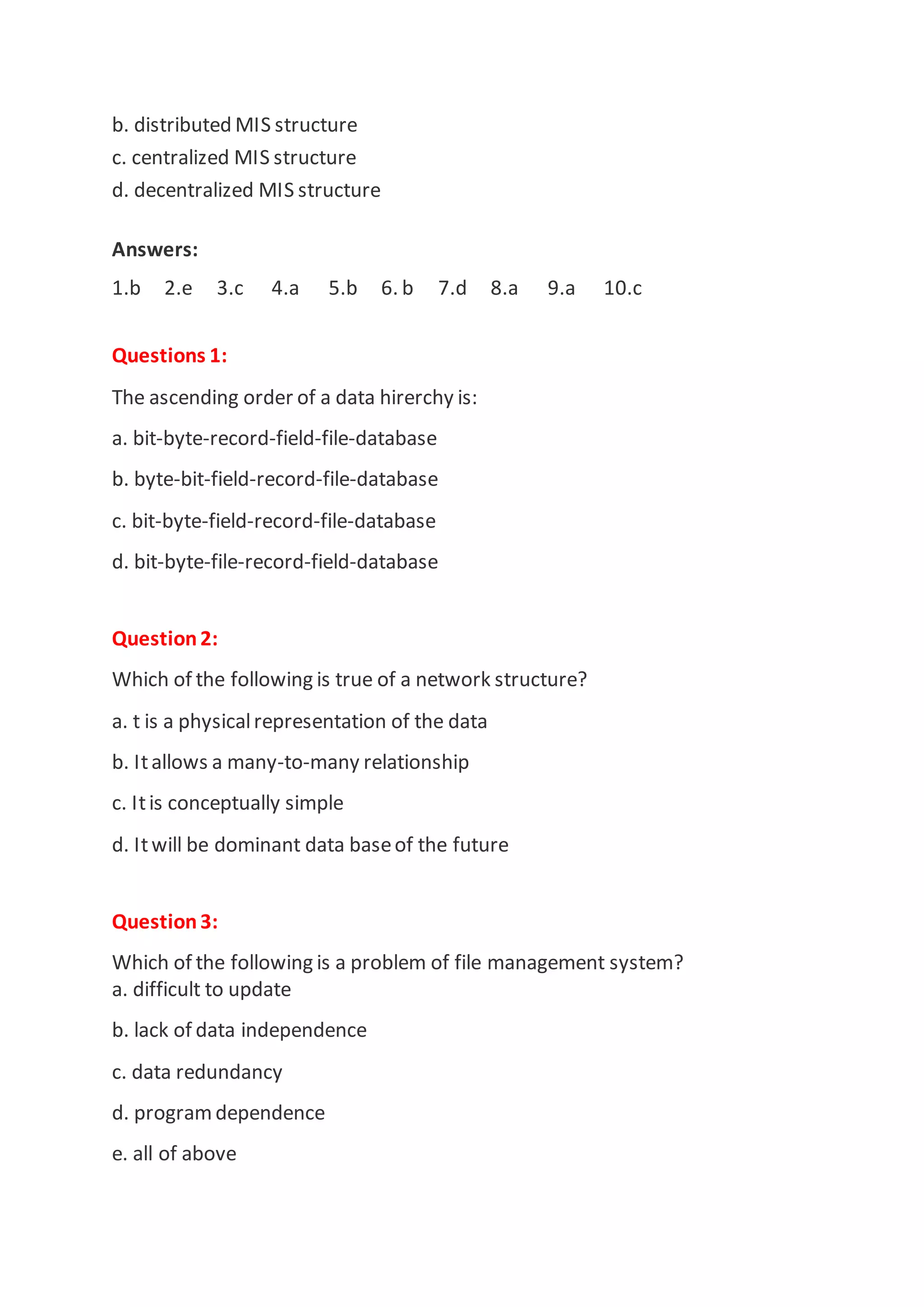
b. distributed MIS structure
c. centralized MIS structure
d. decentralized MIS structure
Answers:
1.b 2.e 3.c 4.a 5.b 6. b 7.d 8.a 9.a 10.c
Questions 1:
The ascending order of a data hirerchy is:
a. bit-byte-record-field-file-database
b. byte-bit-field-record-file-database
c. bit-byte-field-record-file-database
d. bit-byte-file-record-field-database
Question2:
Which of the following is true of a network structure?
a. t is a physicalrepresentation of the data
b. Itallows a many-to-many relationship
c. Itis conceptually simple
d. Itwill be dominant data baseof the future
Question3:
Which of the following is a problem of file management system?
a. difficult to update
b. lack of data independence
c. data redundancy
d. programdependence
e. all of above
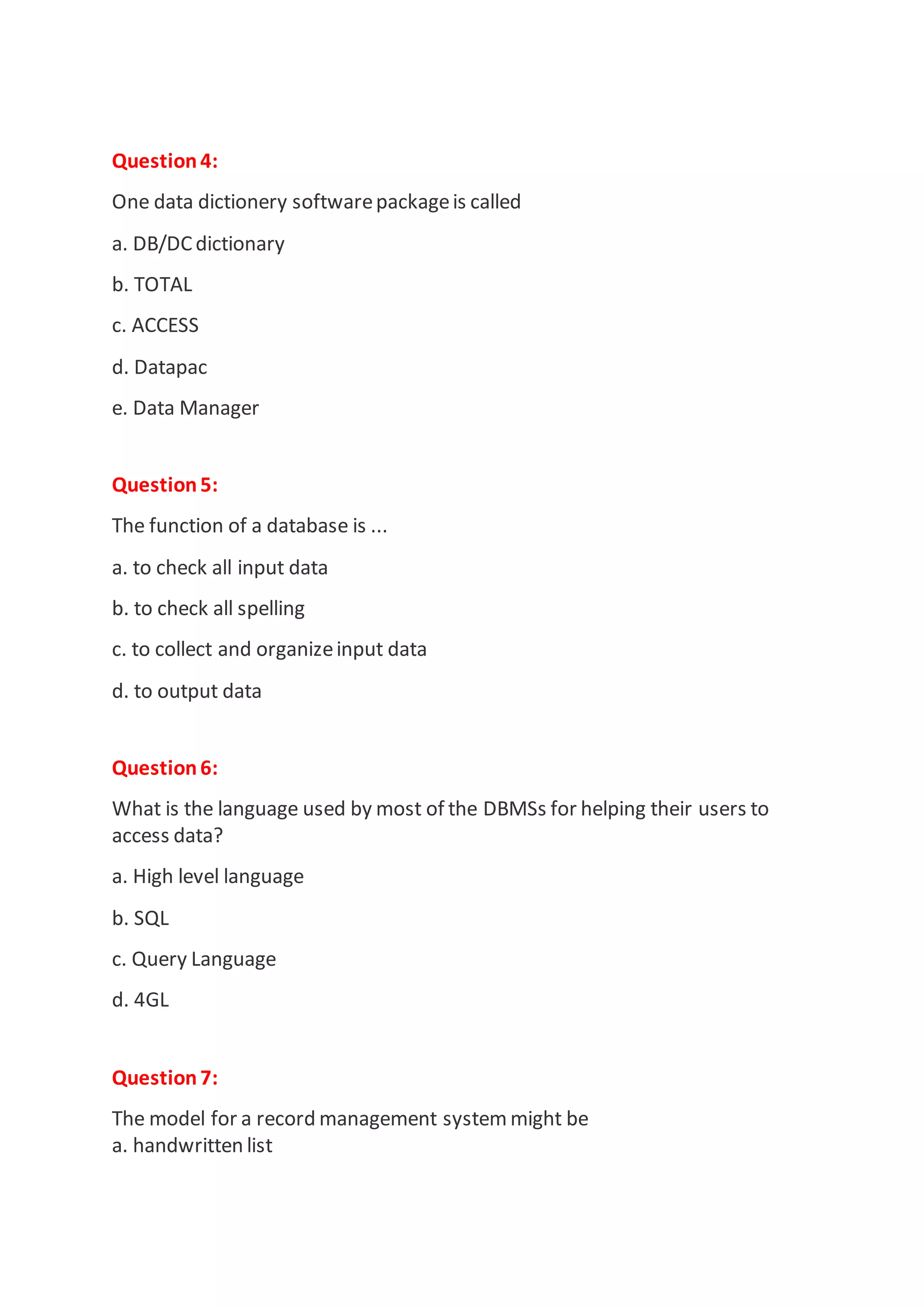
Question4:
One data dictionery softwarepackageis called
a. DB/DC dictionary
b. TOTAL
c. ACCESS
d. Datapac
e. Data Manager
Question5:
The function of a database is ...
a. to check all input data
b. to check all spelling
c. to collect and organizeinput data
d. to output data
Question6:
What is the language used by most of the DBMSs for helping their users to
access data?
a. High level language
b. SQL
c. Query Language
d. 4GL
Question7:
The model for a record management system might be
a. handwritten list
b. a Rolodex card file
c. a business form
d. all of above
Question8:
Primitive operations common to all record management system include
a. print
b. sort
c. look-up
d. all of above
Question9:
In a large DBMS
a. each user can "see" only a small part of the entire database
b. each subschema contains every field in the logical schema
c. each user can access every subschema
Question10:
Information can be transferred between the DBMS and a
a. spreadsheetprogram
b. word processor program
c. graphics program
d. all of the above
Answers:
1. c 2. b 3. e 4. a 5. c 6. c 7. d 8. c 9. a 10.
1. These systems typically contain the system's electronic components and
selected secondary storagedevices, butno input devices.
A. Desktop systems
B. Personaldigital assistants
C. Palm computers
D. Laptop computers
2. A byte is formed by a group of
A. four bits.
B. eight bits.
C. 12 bits.
D. 16 bits.
3. Which of the following is not a binary code?
A. EBCDIC
B. ASCII
C. CISC
D. Unicode
4. This coding systemis designed to supportinternational languages like Chinese
and Japanese.
A. ASCII
B. Unicode
C. EBCDIC
D. ANSIC
5. On the motherboard, the connection points for chips are referred to as
A. slots.
B. sockets.
C. ports.
D. lines.
6. Tiny circuit-boards etched onto squares of sand-likematerial called silicon are
called
A. buses.
B. slots.
C. sockets.
D. chips.
7. Integrated circuits mustbe mounted on _____ which are then plugged into
the motherboard.
A. slots
B. pins
C. ports
D. carrier packages
8. Which of the following is a function of the control unit?
A. Itprovides pathways thatsupportcommunication among the various
electronic components.
B. Itdirects the control signals between the CPU and input and output devices.
C. Itperforms fundamentalmath operations like addition, subtraction, etc.
D. Ituses the logic to comparetwo pieces of data.
9. Pathways thatsupportcommunication among the various electronic
components on the systemboard are called
A. bus lines.
B. network lines.
C. logic paths.
D. gateways.
10. In a microcomputer system, the CPU is contained on a single chip called the
A. semiconductor.
B. ALU.
C. microprocessor.
D. Control Unit.
11. This term is used to describethe number of bits that a CPU can access at one
time.
A. Bitrate
B. Word
C. Pulsewidth
D. Character
12. A 32-bitword computer can access
A. 2 bytes at a time.
B. 16 bytes at a time.
C. 4 bytes at a time.
D. 8 bytes at a time.
13. Which of the following allow a computer to run two programs
simultaneously?
A. Coprocessors
B. Multiplexing
C. Dual corechip
D. Binary system
14. These chips use special softwareto take a large program, break it down into
parts, and assign the parts to separate processors.
A. Arithmetic-logic units
B. Multiplexers
C. Parallel processors
D. Graphics coprocessors
15. Visa, MasterCard, and American Express have all introduced this new type of
card, which has an embedded chip.
A. Data card
B. Micro card
C. Smartcard
D. Embedded card
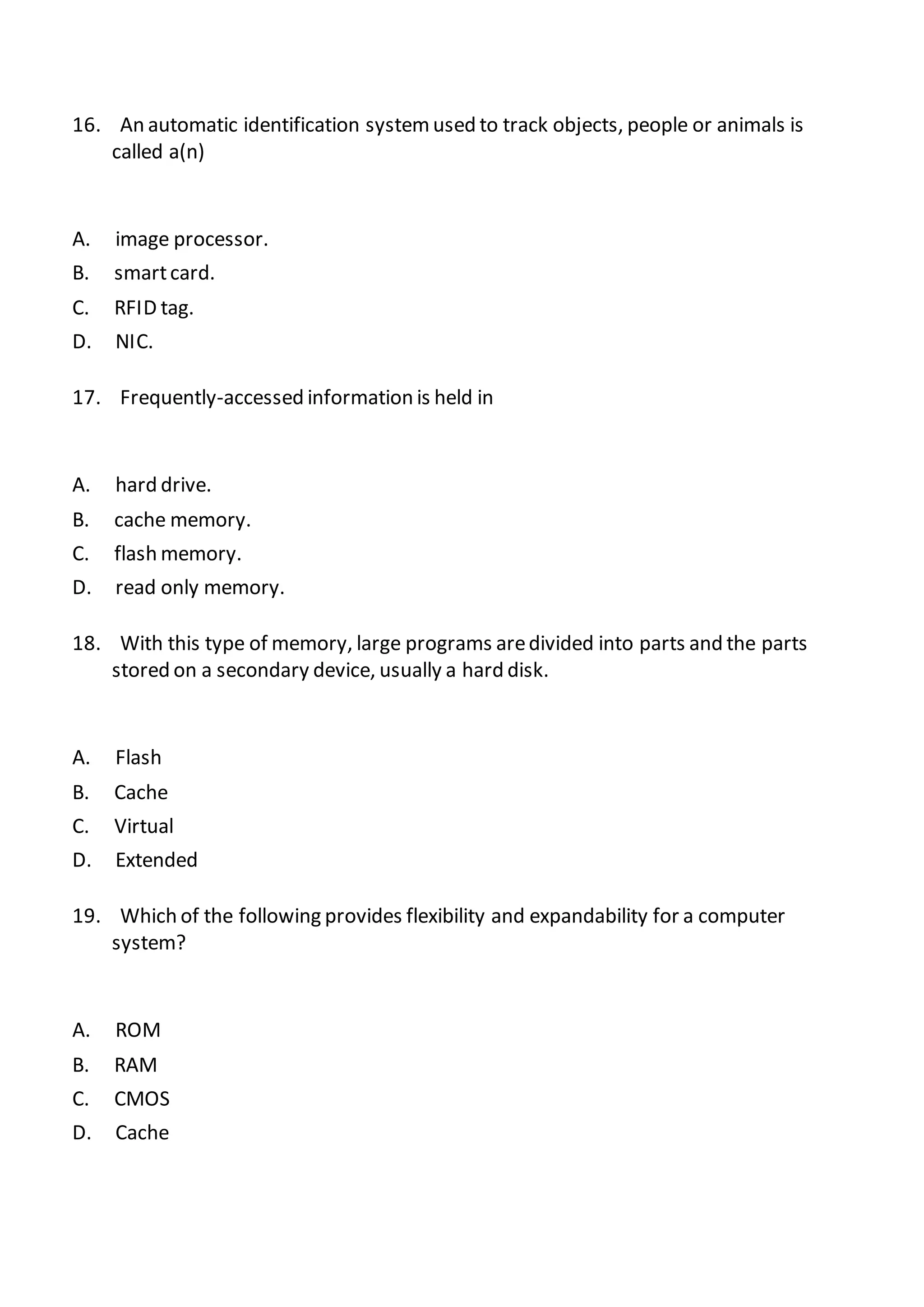
16. An automatic identification systemused to track objects, people or animals is
called a(n)
A. image processor.
B. smartcard.
C. RFID tag.
D. NIC.
17. Frequently-accessed information is held in
A. hard drive.
B. cache memory.
C. flash memory.
D. read only memory.
18. With this type of memory, large programs aredivided into parts and the parts
stored on a secondary device, usually a hard disk.
A. Flash
B. Cache
C. Virtual
D. Extended
19. Which of the following provides flexibility and expandability for a computer
system?
A. ROM
B. RAM
C. CMOS
D. Cache
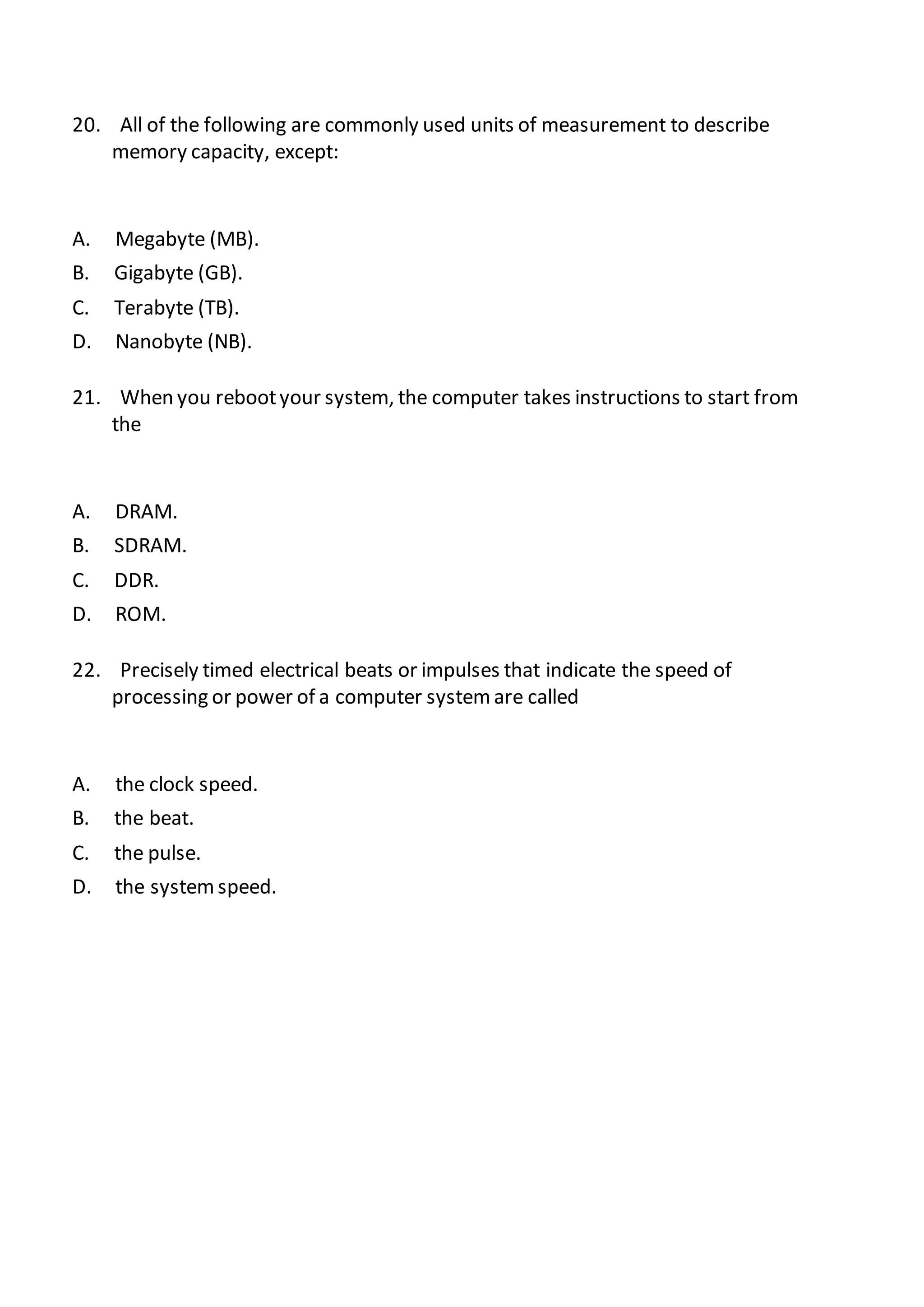
20. All of the following are commonly used units of measurement to describe
memory capacity, except:
A. Megabyte (MB).
B. Gigabyte (GB).
C. Terabyte (TB).
D. Nanobyte (NB).
21. When you rebootyour system, the computer takes instructions to start from
the
A. DRAM.
B. SDRAM.
C. DDR.
D. ROM.
22. Precisely timed electrical beats or impulses that indicate the speed of
processing or power of a computer systemare called
A. the clock speed.
B. the beat.
C. the pulse.
D. the systemspeed.
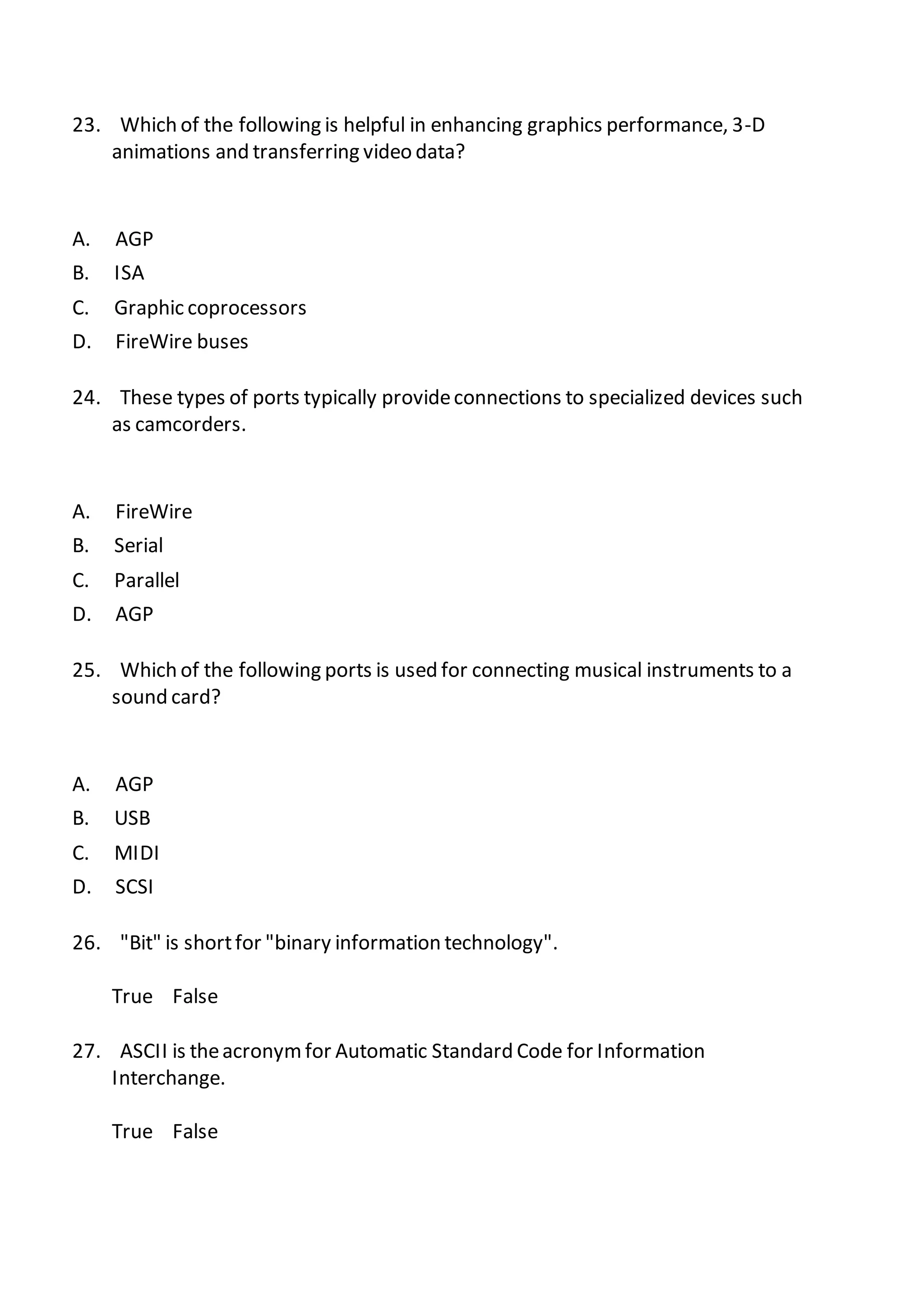
23. Which of the following is helpful in enhancing graphics performance, 3-D
animations and transferring video data?
A. AGP
B. ISA
C. Graphic coprocessors
D. FireWire buses
24. These types of ports typically provideconnections to specialized devices such
as camcorders.
A. FireWire
B. Serial
C. Parallel
D. AGP
25. Which of the following ports is used for connecting musical instruments to a
sound card?
A. AGP
B. USB
C. MIDI
D. SCSI
26. "Bit" is shortfor "binary information technology".
True False
27. ASCII is theacronymfor Automatic Standard Code for Information
Interchange.
True False
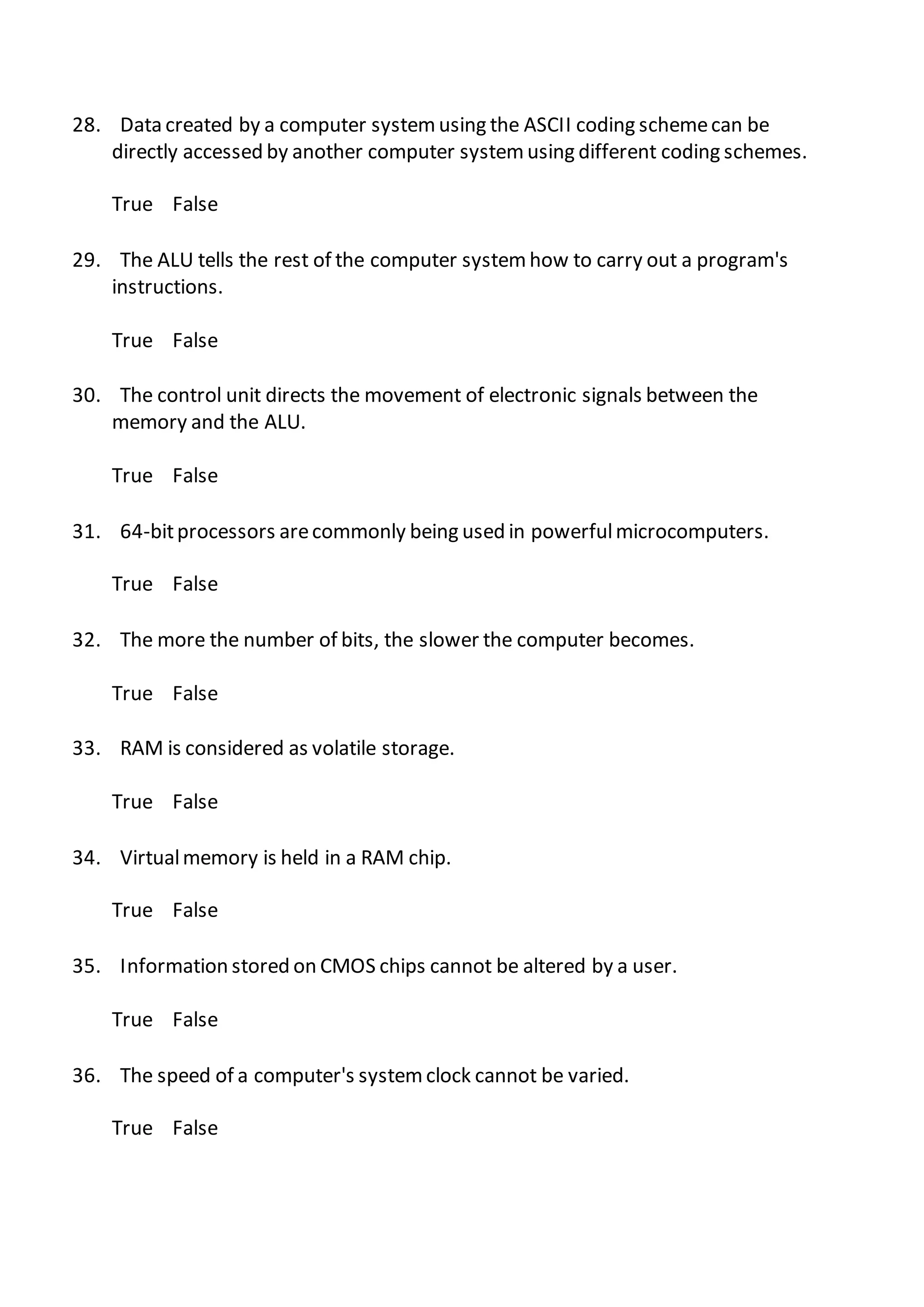
28. Data created by a computer systemusing the ASCII coding schemecan be
directly accessed by another computer systemusing different coding schemes.
True False
29. The ALU tells the rest of the computer systemhow to carry out a program's
instructions.
True False
30. The control unit directs the movement of electronic signals between the
memory and the ALU.
True False
31. 64-bitprocessors arecommonly being used in powerfulmicrocomputers.
True False
32. The more the number of bits, the slower the computer becomes.
True False
33. RAM is considered as volatile storage.
True False
34. Virtualmemory is held in a RAM chip.
True False
35. Information stored on CMOS chips cannot be altered by a user.
True False
36. The speed of a computer's systemclock cannot be varied.
True False
37. PC cards were developed in order to meet the size constraints of notebook
and handheld computers.
True False
38. The number of bits that can travel simultaneously down a bus is known as the
word size.
True False
39. Accelerated graphics port(AGP) is over twice as fastas the ISA.
True False
40. Serial ports send data one bit at a time and are very good for sending
information over long distances.
True False
41. Parallel ports are mostly used to connect printers to the systemunit.
True False
42. Serial ports are gradually replacing USBports.
True False
43. The FireWire portused to connect a camcorder to a laptop would be as fastas
a USB 2.0 port.
True False
44. FireWireis mainly used to connect digital camcorders and video editing
software.
True False
45. A notebook computer would commonly use an IrDA portto transfer data to a
desktop computer.
True False
46. Two of the most popular binary coding schemes are ASCII and _____.
________________________________________
47. IBMdeveloped the _____ binary coding schemeand it is used primarily for
large computers.
________________________________________
48. The _____ acts as the communication center for a computer system.
________________________________________
49. _____ are often expressed in word sizes.
________________________________________
50. _____ operations consistof making comparisons.
________________________________________
51. A _____ bit word computer can access eight bytes of information at a time.
________________________________________
52. _____ are special-purposeprocessing units that assistthe CPU in performing
certain types of operations.
________________________________________
53. _____ memory is non-volatile RAM and is considered quite expensive.

computer basics from bismark

  • 1.
    Computer Computer Knowledge Questions 1.RAM stands for : (A) Read Access Memory (B) RandomAccess Memory (C) RandomAssigned Memory (D) All of these (E) None of these 2. Data in RAM are : (A) Volatile in nature (B) Non-volatile in nature (C) Both (A) & (B) (D) All of these (E) None of these 3. BIOS stands for : (A) Basic InputOutputSystem (B) Basic Instruction OutputSystem (C) Basic InterfaceOutputSystem (D) All of these (E) None of these 4. RAM in its commercial forms areavailable as : (A) SIMM (B) DIMM (C) Both (A) & (B) (D) CPSB (E) None of these 5. Which of the following requires refreshing during retaining the data? (A) DRAM (B) SRAM (C) VirtualMemory (D) FDD (E) None of these 6. Refresh Rate of monitor is measured in : (A) Hz (B) Meter
  • 2.
    (C) Volts (D) Amp. (E)None of these 7. Which of the following meaning is used between CPU & RAM to speed up the processing power of a CPU? (A) Virtual Memory (B) DRAM (C) Flash Memory (D) Cache Memory (E) None of these 8. Which of the following is lowest in memory hierarchy? (A) Cache memory (B) Secondary memory (C) Registers (D) RAM (E) None of these 9. Which of the following is an input device? (A) Keyboard (B) VDU (C) Both (A) & (B) (D) Dvu (E) None of these 10. CRT stands for : (A) Character Ray Tube (B) Cathode Ray Tube (C) Colour Ray Tube (D) All of the above (E) None of these 11. Which of the following is a GUI device : (A) Keyboard (B) Mouse (C) OMR (D) All of these (E) None of these
  • 3.
    12. LCD standsfor : (A) Liquid CrystalDisplay (B) Laser CrystalDisplay (C) Light CrystalDisplay (D) All of these (E) None of these 13. Such types of printers, in which the printing head contacts with the paper in printing process, arecalled as : (A) ImpactPrinter (B) Non-ImpactPrinter (C) Laser Printer (D) All of these (E) None of these 14. Which of the following is a type of optical media? (A) FDD (B) HDD (C) CD (D) Magnetic Tape (E) None of these 15. DVD stands for : (A) Digital Video Disk (B) Digital Versatile Disk (C) Both (A) & (B) (D) All of these (E) None of these 16. Which of the following is an input device? (A) VDU (B) Printer (C) Plotter (D) MICR (E) None of these 17. Identify the odd one : (A) Storage tape memory (B) Magnetic disc memory (C) Optical disc memory
  • 4.
    (D) Read onlymemory (E) None of these 18. Nibble describes a bits combination of : (A) 5 bits (B) 6 bits (C) 7 bits (D) 4 bits (E) None of these 19. A Byte constitutes of : (A) 9 bits (B) 8 bits (C) 7 bits (D) 4 bits (E) None of these 20. Memory in a PCis addressablethrough : (A) Bits (B) Byte (C) Nibble (D) All of these (E) None of these 21. One Kilo Byte represents : (A) 1024 bytes (B) 1000 bytes (C) 100 bytes (D) 1064 bytes (E) None of these 22. Basic building block for a digital circuit is : (A) Word (B) Logic Gate (C) Processor (D) BUS (E) None of these 23. Which of the following is a logic gate? (A) AND
  • 5.
    (B) OR (C) CPU (D)Both (A) & (B) (E) None of these 24. The base of binary number is : (A) 2 (B) 16 (C) 8 (D) 10 (E) None of these 25. ASCII stands for : (A) American Standard Code for Institute Interchange (B) American Standard Code for Information Interchange (C) American Standard Code for Information Institute (D) All of these (E) None of these Answers : 1. (B) 2. (A) 3. (A) 4. (C) 5. (A) 6. (A) 7. (D) 8. (B) 9. (A) 10. (B) 11. (B) 12. (A) 13. (A) 14. (C) 15. (B) 16. (D) 17. (D) 18. (D) 19. (B) 20. (B) 21. (A) 22. (B) 23. (D) 24. (A) 25. (B) 1. You can keep your personal files/folders in— (A) My folder (B) My Documents (C) My Files (D) My Text (E) None of these Answer: My Documents 2. The primary purpose ofsoftware is to turn data into— (A) Web sites (B) Information (C) Programs (D) Objects (E) None of these Answer: Information 3. A directory within a directory is called— (A) Mini Directory (B) Junior Directory (C) Part Directory (D) Sub Directory
  • 6.
    (E) None ofthese Answer: Sub Directory 4. A compiler translates a program written in a high-level language into— (A) Machine language (B) An algorithm (C) A debugged program (D) Java (E) None of these Answer: Machine language 5. When you turn on the computer,the boot routine will perform this test— (A) RAM test (B) Disk drive test (C) Memory test (D) Power-on self-test (E) None of these Answer: Disk drive test 6. A ……is a unique name thatyou give to a file of information. (A) device letter (B) folder (C) filename (D) filename extension (E) None of these Answer: filename extension 7. Hardware includes— (A) all devices used to input data into a computer (B) sets of instructions thata computer runs or executes (C) the computer and all the devices connected to it that are used to input and output data (D) all devices involved in processing information including the central processing unit,memoryand storage (E) None of these Answer: (D) 8. A ……… contains specific rules and words thatexpress the logical steps ofan algorithm. (A) programming language (B) syntax (C) programming structure (D) logic chart (E) None of these Answer: programming language 9. All the deleted files go to— (A) Recycle Bin (B) Task Bar (C) Tool Bar (D) My Computer (E) None of these Answer: Recycle Bin 10. The simultaneous processing oftwo or more programs bymultiple processors is — (A) Multiprogramming (B) Multitasking (C) Time-sharing (D) Multiprocessing (E) None of these Answer: Multiprocessing 11. The secretcode that restricts entry to some programs— (A) Password (B) Passport (C) Entry-code (D) Access-code (E) None of these
  • 7.
    Answer: Password 12. Computersuse the ……… number system to store data and perform calculations. (A) binary (B) octal (C) decimal (D) hexadecimal (E) None of these Answer: binary 13. The main function of the ALU is to— (A) Perform arithmetic and logical operations (B) Store data and information for future use (C) Control computer output,such as printing (D) Monitor all computer activities (E) None of these Answer: Perform arithmetic and logical operations 14. ……is the process ofcarrying out commands. (A) Fetching (B) Storing (C) Executing (D) Decoding (E) None of these Answer: Executing 15. Softcopy is the intangible output,so then whatis hardcopy ? (A) The physical parts of the computer (B) The printed parts of the computer (C) The printed output (D) The physical outputdevices (E) None of these Answer: The printed output 16. A(n) ……… is a program that makes the computer easier to use. (A) utility (B) application (C) operating system (D) network (E) None of these Answer: utility 17. A complete electronic circuitwith transistors and other electronic components on a small silicon chip is called a(n)— (A) Workstation (B) CPU (C) Magnetic disk (D) Integrated circuit (E) None of these Answer: Integrated circuit 18. Computer systems are comprised of— (A) Hardware,programs,processors,procedures and people (B) Hardware,programs,information,people and procedures (C) Hardware,programs,information,people and networks (D) Hardware,software,procedures,networks and people (E) None of these Answer: Hardware,software,procedures,networks and people 19. An error in a computer program— (A) Crash (B) Power Failure (C) Bug (D) Virus (E) None of these Answer: Bug
  • 8.
    20. What isoutput ? (A) What the processor takes from the user (B) What the user gives to the processor (C) What the processor gets from the user (D) What the processor gives to the user (E) None of these Answer: What the processor gives to the user 1. Which of the following's absence the computer systemcan still be functional A. Operating system B. Hard Drive C. RAM D. Sound Card 2.The name for the way that computers manipulate data into information is called: A. programming B. processing C. storing D. organizing 3.When you are working on a document on a PC where is the document temporarily stored ? A. Hard Disk B. ROM C. RAM D. CD-ROM 4. A set of instructions telling the computer what to do is called: A. Program B. Compiler C. Debugger D. Mentor 5. The term "hypertext" means: A. Text with heavy formatting B. Blinking text C. Hyper media D. None of the above 6. What is the extension of executable program under windows ?
  • 9.
    A. .doc B. .txt C..bin D. .exe 7. Which of the following is optical storage media ? A. CD-ROM B. EEPROM C. Optical ROM D. None of the above 8. What is the other name for a LAN Card? A. NIC B. Network Connector C. MODEM D. Internet Card 9. Computer security can be enforced by using which of the following ? A. Firewall B. Password C. Encryption D. All of the above 10. Which of the following is a database management tool developed by Microsoft? A. dBase B. Access C. Personal Oracle D. Sybase 11. URL stands for: A. UniformResearch List B. Uniform Research Locator C. Uniform Resource Locator D. Universal Resource List 12. Speed of computer is calculated in the units of : A. RPM B. Hertz C. kmh D. mth
  • 10.
    13. Primary memorystores : A. Data alone B. Programs alone C. Results alone D. All of these 14. Junk e-mail is also called A. Spoof B. Spam C. Spill D. Sniffer script 15. DPI stands for : A. Due ProtocolInspection B. Do Per Instruction C. Dots Per Inch D. None of the above DBMS --- Questions 1: Which of the following is not true of the traditional approach to information processing a. there is common sharing of data among the various applications b. it is file oriented c. programs aredependent on the file d. it is inflexible e. all of the above are true Question2: Which of the following hardwarecomponent is the mostimportant to the operation of databasemanagement system? a. high resolution video display b. printer c. high speed, large capacity disk
  • 11.
    d. plotter e. mouse Question3: Generalizeddatabasemanagement systemdo not retrieve data to meet routine request a. true b. false Question4: Batch processing is appropriateif a. large computer systemis available b. only a small computer system is avilbale c. only a few transactions are involved d. all of the above e. none of the above Question5: Large collection of files are called a. fields b. records c. database d. sectors Question6: Which of the following is not a relational database? a. dBase IV b. 4th Dimension c. FoxPro d. Reflex Question7: In order to use a record management system a. you need to understand the low level details of how information is stored
  • 12.
    b. you needto understand the model the record management system uses c. bother a and b d. none of the above Question8: Sort/Reportgenerators a. are faster than index/report generators b. requiremore disk space than indexed/report generators c. do not need to sortbeforegenerating report d. both a and b Question9: If a piece of data is stored in two places in the database, then a. storagespace is wasted b. changing the data in one spot will cause data inconsistency c. in can be more easily accessed d. both and b Question10: An audit trail a. is used to make backup copies b. is the recorded history of operations performed on a file c. can be used to restorelost information d. none of the above Answers: 1.a 2.c 3. b 4.e 5.c 6.d 7.b 8.b 9.d 10.b Questions 1: The relational database environmenthas all of the following components except a. users b. separatefiles c. database
  • 13.
    d. query languages e.database Question2: Databasemanagement systems areintended to a. eliminate data redundancy b. establish relationship among records in different files c. manage file access d. maintain data integrity e. all of the above Question3: One approach to standardization storing of data? a. MIS b. structured programming c. CODASYL specification d. none of the above Question4: The language used application programs to request data fromthe DBMS is referred to as the a. DML b. DDL c. query language d. any of the above e. none of the above Question5: The highest level in the hierarchy of data organization is called a. data bank b. data base c. data file d. data record
  • 14.
    Question6: Choosethe RDBMS whichsupports fullfledged client server application development a. dBase V b. Oracle7.1 c. FoxPro 2.1 d. Ingress Question7: Report generators are used to a. storedata input by a user b. retrieve information fromfiles c. answer queries d. both b and c Question8: A formdefined a. wheredata is placed on the screen b. the width of each field c. both a and b d. none of the above Question9: A top-to-bottom relationship among the items in a database is established by a a. hierarchical schema b. network schema c. relational schema d. all of the above Question10: The management information system (MIS) structurewith one main computer system is called a a. hierarchical MIS structure
  • 15.
    b. distributed MISstructure c. centralized MIS structure d. decentralized MIS structure Answers: 1.b 2.e 3.c 4.a 5.b 6. b 7.d 8.a 9.a 10.c Questions 1: The ascending order of a data hirerchy is: a. bit-byte-record-field-file-database b. byte-bit-field-record-file-database c. bit-byte-field-record-file-database d. bit-byte-file-record-field-database Question2: Which of the following is true of a network structure? a. t is a physicalrepresentation of the data b. Itallows a many-to-many relationship c. Itis conceptually simple d. Itwill be dominant data baseof the future Question3: Which of the following is a problem of file management system? a. difficult to update b. lack of data independence c. data redundancy d. programdependence e. all of above
  • 16.
    Question4: One data dictionerysoftwarepackageis called a. DB/DC dictionary b. TOTAL c. ACCESS d. Datapac e. Data Manager Question5: The function of a database is ... a. to check all input data b. to check all spelling c. to collect and organizeinput data d. to output data Question6: What is the language used by most of the DBMSs for helping their users to access data? a. High level language b. SQL c. Query Language d. 4GL Question7: The model for a record management system might be a. handwritten list
  • 17.
    b. a Rolodexcard file c. a business form d. all of above Question8: Primitive operations common to all record management system include a. print b. sort c. look-up d. all of above Question9: In a large DBMS a. each user can "see" only a small part of the entire database b. each subschema contains every field in the logical schema c. each user can access every subschema Question10: Information can be transferred between the DBMS and a a. spreadsheetprogram b. word processor program c. graphics program d. all of the above Answers: 1. c 2. b 3. e 4. a 5. c 6. c 7. d 8. c 9. a 10.
  • 18.
    1. These systemstypically contain the system's electronic components and selected secondary storagedevices, butno input devices. A. Desktop systems B. Personaldigital assistants C. Palm computers D. Laptop computers 2. A byte is formed by a group of A. four bits. B. eight bits. C. 12 bits. D. 16 bits. 3. Which of the following is not a binary code? A. EBCDIC B. ASCII C. CISC D. Unicode
  • 19.
    4. This codingsystemis designed to supportinternational languages like Chinese and Japanese. A. ASCII B. Unicode C. EBCDIC D. ANSIC 5. On the motherboard, the connection points for chips are referred to as A. slots. B. sockets. C. ports. D. lines. 6. Tiny circuit-boards etched onto squares of sand-likematerial called silicon are called A. buses. B. slots. C. sockets. D. chips. 7. Integrated circuits mustbe mounted on _____ which are then plugged into the motherboard. A. slots B. pins C. ports D. carrier packages
  • 20.
    8. Which ofthe following is a function of the control unit? A. Itprovides pathways thatsupportcommunication among the various electronic components. B. Itdirects the control signals between the CPU and input and output devices. C. Itperforms fundamentalmath operations like addition, subtraction, etc. D. Ituses the logic to comparetwo pieces of data. 9. Pathways thatsupportcommunication among the various electronic components on the systemboard are called A. bus lines. B. network lines. C. logic paths. D. gateways. 10. In a microcomputer system, the CPU is contained on a single chip called the A. semiconductor. B. ALU. C. microprocessor. D. Control Unit. 11. This term is used to describethe number of bits that a CPU can access at one time. A. Bitrate B. Word C. Pulsewidth D. Character
  • 21.
    12. A 32-bitwordcomputer can access A. 2 bytes at a time. B. 16 bytes at a time. C. 4 bytes at a time. D. 8 bytes at a time. 13. Which of the following allow a computer to run two programs simultaneously? A. Coprocessors B. Multiplexing C. Dual corechip D. Binary system 14. These chips use special softwareto take a large program, break it down into parts, and assign the parts to separate processors. A. Arithmetic-logic units B. Multiplexers C. Parallel processors D. Graphics coprocessors 15. Visa, MasterCard, and American Express have all introduced this new type of card, which has an embedded chip. A. Data card B. Micro card C. Smartcard D. Embedded card
  • 22.
    16. An automaticidentification systemused to track objects, people or animals is called a(n) A. image processor. B. smartcard. C. RFID tag. D. NIC. 17. Frequently-accessed information is held in A. hard drive. B. cache memory. C. flash memory. D. read only memory. 18. With this type of memory, large programs aredivided into parts and the parts stored on a secondary device, usually a hard disk. A. Flash B. Cache C. Virtual D. Extended 19. Which of the following provides flexibility and expandability for a computer system? A. ROM B. RAM C. CMOS D. Cache
  • 23.
    20. All ofthe following are commonly used units of measurement to describe memory capacity, except: A. Megabyte (MB). B. Gigabyte (GB). C. Terabyte (TB). D. Nanobyte (NB). 21. When you rebootyour system, the computer takes instructions to start from the A. DRAM. B. SDRAM. C. DDR. D. ROM. 22. Precisely timed electrical beats or impulses that indicate the speed of processing or power of a computer systemare called A. the clock speed. B. the beat. C. the pulse. D. the systemspeed.
  • 24.
    23. Which ofthe following is helpful in enhancing graphics performance, 3-D animations and transferring video data? A. AGP B. ISA C. Graphic coprocessors D. FireWire buses 24. These types of ports typically provideconnections to specialized devices such as camcorders. A. FireWire B. Serial C. Parallel D. AGP 25. Which of the following ports is used for connecting musical instruments to a sound card? A. AGP B. USB C. MIDI D. SCSI 26. "Bit" is shortfor "binary information technology". True False 27. ASCII is theacronymfor Automatic Standard Code for Information Interchange. True False
  • 25.
    28. Data createdby a computer systemusing the ASCII coding schemecan be directly accessed by another computer systemusing different coding schemes. True False 29. The ALU tells the rest of the computer systemhow to carry out a program's instructions. True False 30. The control unit directs the movement of electronic signals between the memory and the ALU. True False 31. 64-bitprocessors arecommonly being used in powerfulmicrocomputers. True False 32. The more the number of bits, the slower the computer becomes. True False 33. RAM is considered as volatile storage. True False 34. Virtualmemory is held in a RAM chip. True False 35. Information stored on CMOS chips cannot be altered by a user. True False 36. The speed of a computer's systemclock cannot be varied. True False
  • 26.
    37. PC cardswere developed in order to meet the size constraints of notebook and handheld computers. True False 38. The number of bits that can travel simultaneously down a bus is known as the word size. True False 39. Accelerated graphics port(AGP) is over twice as fastas the ISA. True False 40. Serial ports send data one bit at a time and are very good for sending information over long distances. True False 41. Parallel ports are mostly used to connect printers to the systemunit. True False 42. Serial ports are gradually replacing USBports. True False 43. The FireWire portused to connect a camcorder to a laptop would be as fastas a USB 2.0 port. True False 44. FireWireis mainly used to connect digital camcorders and video editing software. True False 45. A notebook computer would commonly use an IrDA portto transfer data to a desktop computer.
  • 27.
    True False 46. Twoof the most popular binary coding schemes are ASCII and _____. ________________________________________ 47. IBMdeveloped the _____ binary coding schemeand it is used primarily for large computers. ________________________________________ 48. The _____ acts as the communication center for a computer system. ________________________________________ 49. _____ are often expressed in word sizes. ________________________________________ 50. _____ operations consistof making comparisons. ________________________________________ 51. A _____ bit word computer can access eight bytes of information at a time. ________________________________________ 52. _____ are special-purposeprocessing units that assistthe CPU in performing certain types of operations. ________________________________________ 53. _____ memory is non-volatile RAM and is considered quite expensive.