Computer Architecture and
Organisation
(CSC 303)
Lecture 1 - Introduction
Department of Computer Science
Caleb University, Lagos Nigeria
Dr. Emmanuel Ajulo
Ph.D., M.Tech., (Comp. Sci.),
M.Tech., B.Tech., (Elect. & Comm. Engrg.),
R.Eng., MBA, MNSE, MNSC.
Rachael Okeyemi
M.Sc., B.Sc., (Comp. Sci.), MNSC.
&
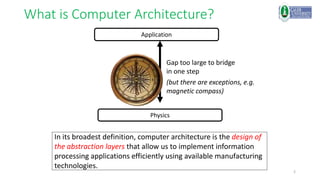
What is Computer Architecture?
2
Application
Physics
Gap too large to bridge
in one step
In its broadest definition, computer architecture is the design of
the abstraction layers that allow us to implement information
processing applications efficiently using available manufacturing
technologies.
(but there are exceptions, e.g.
magnetic compass)
3
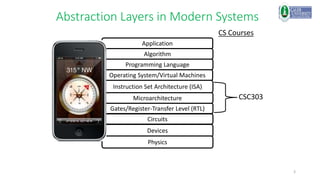
Abstraction Layers in Modern Systems
Algorithm
Gates/Register-Transfer Level (RTL)
Application
Instruction Set Architecture (ISA)
Operating System/Virtual Machines
Microarchitecture
Devices
Programming Language
Circuits
Physics
CSC303
CS Courses
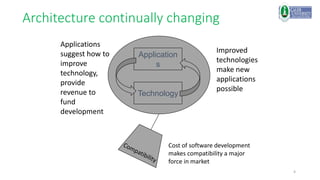
Cost of software development
makes compatibility a major
force in market
Architecture continually changing
4
Application
s
Technology
Applications
suggest how to
improve
technology,
provide
revenue to
fund
development
Improved
technologies
make new
applications
possible
5
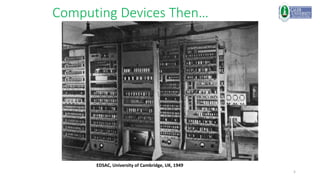
Computing Devices Then…
EDSAC, University of Cambridge, UK, 1949
6
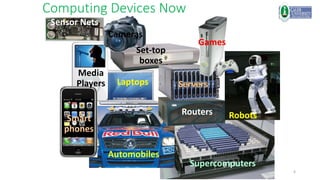
Computing Devices Now
Robots
Supercomputers
Automobiles
Laptops
Set-top
boxes
Smart
phones
Servers
Media
Players
Sensor Nets
Routers
Cameras
Games
7
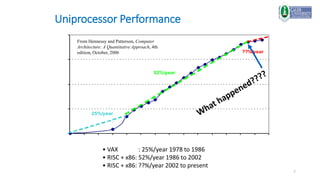
1
10
100
1000
10000
1978 1980 1982 1984 1986 1988 1990 1992 1994 1996 1998 2000 2002 2004 2006
Performance
(vs.
VAX-11/780)
25%/year
52%/year
??%/year
Uniprocessor Performance
• VAX : 25%/year 1978 to 1986
• RISC + x86: 52%/year 1986 to 2002
• RISC + x86: ??%/year 2002 to present
From Hennessy and Patterson, Computer
Architecture: A Quantitative Approach, 4th
edition, October, 2006
8
The End of the Uniprocessor Era
Single biggest change in the history of
computing systems
9
[from Kurzweil]
Major
Technology
Generations Bipolar
nMOS
CMOS
pMOS
Relays
Vacuum
Tubes
Electromechanical
?
10
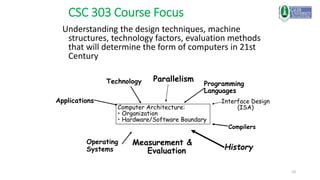
CSC 303 Course Focus
Understanding the design techniques, machine
structures, technology factors, evaluation methods
that will determine the form of computers in 21st
Century
Technology Programming
Languages
Operating
Systems History
Applications Interface Design
(ISA)
Measurement &
Evaluation
Parallelism
Computer Architecture:
• Organization
• Hardware/Software Boundary
Compilers
11
The “New” CSC 303
• Class contains labs based on various different machine
designs
• Experiment with how architectural mechanisms work in
practice on real software.
12
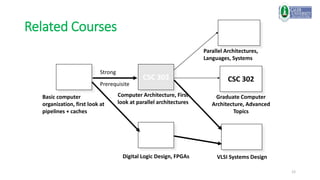
Related Courses
CSC 303
Basic computer
organization, first look at
pipelines + caches
Computer Architecture, First
look at parallel architectures
Parallel Architectures,
Languages, Systems
Digital Logic Design, FPGAs
Strong
Prerequisite
VLSI Systems Design
CSC 302
Graduate Computer
Architecture, Advanced
Topics
13
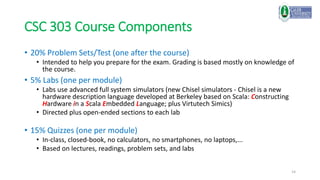
CSC 303 Structure and Syllabus
Five modules
1. Fundamental building blocks and logic expressive immunization.
2. Sum of product forms, Register transfer notation, and physical
consideration.
3. Data representation, and number bases.
4. Fixed and Floating point systems.
5. Representation memory systems organization and architecture.
14
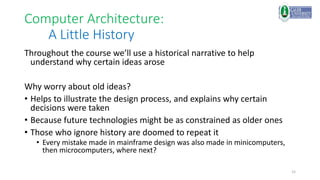
CSC 303 Course Components
• 20% Problem Sets/Test (one after the course)
• Intended to help you prepare for the exam. Grading is based mostly on knowledge of
the course.
• 5% Labs (one per module)
• Labs use advanced full system simulators (new Chisel simulators - Chisel is a new
hardware description language developed at Berkeley based on Scala: Constructing
Hardware in a Scala Embedded Language; plus Virtutech Simics)
• Directed plus open-ended sections to each lab
• 15% Quizzes (one per module)
• In-class, closed-book, no calculators, no smartphones, no laptops,...
• Based on lectures, readings, problem sets, and labs
15
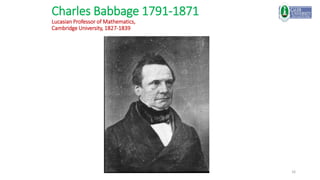
Computer Architecture:
A Little History
Throughout the course we’ll use a historical narrative to help
understand why certain ideas arose
Why worry about old ideas?
• Helps to illustrate the design process, and explains why certain
decisions were taken
• Because future technologies might be as constrained as older ones
• Those who ignore history are doomed to repeat it
• Every mistake made in mainframe design was also made in minicomputers,
then microcomputers, where next?
16
Charles Babbage 1791-1871
Lucasian Professor of Mathematics,
Cambridge University, 1827-1839
17
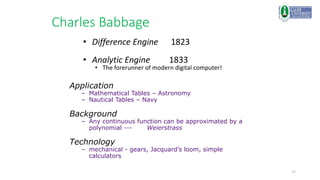
Charles Babbage
• Difference Engine 1823
• Analytic Engine 1833
• The forerunner of modern digital computer!
Application
– Mathematical Tables – Astronomy
– Nautical Tables – Navy
Background
– Any continuous function can be approximated by a
polynomial --- Weierstrass
Technology
– mechanical - gears, Jacquard’s loom, simple
calculators
18
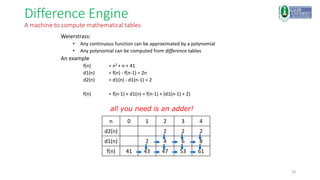
Difference Engine
A machine to compute mathematical tables
Weierstrass:
• Any continuous function can be approximated by a polynomial
• Any polynomial can be computed from difference tables
An example
f(n) = n2 + n + 41
d1(n) = f(n) - f(n-1) = 2n
d2(n) = d1(n) - d1(n-1) = 2
f(n) = f(n-1) + d1(n) = f(n-1) + (d1(n-1) + 2)
all you need is an adder!
n
d2(n)
d1(n)
f(n)
0
41
1
2
2
2
3
2
4
2
4 6 8
43 47 53 61
19
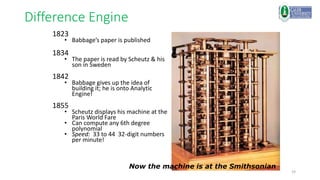
Difference Engine
1823
• Babbage’s paper is published
1834
• The paper is read by Scheutz & his
son in Sweden
1842
• Babbage gives up the idea of
building it; he is onto Analytic
Engine!
1855
• Scheutz displays his machine at the
Paris World Fare
• Can compute any 6th degree
polynomial
• Speed: 33 to 44 32-digit numbers
per minute!
Now the machine is at the Smithsonian
20
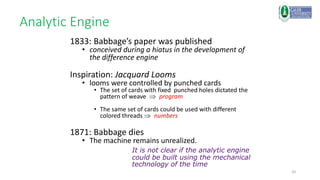
Analytic Engine
1833: Babbage’s paper was published
• conceived during a hiatus in the development of
the difference engine
Inspiration: Jacquard Looms
• looms were controlled by punched cards
• The set of cards with fixed punched holes dictated the
pattern of weave  program
• The same set of cards could be used with different
colored threads  numbers
1871: Babbage dies
• The machine remains unrealized.
It is not clear if the analytic engine
could be built using the mechanical
technology of the time
21
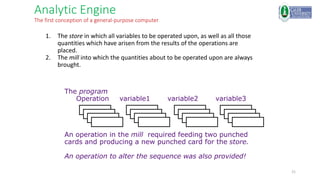
Analytic Engine
The first conception of a general-purpose computer
1. The store in which all variables to be operated upon, as well as all those
quantities which have arisen from the results of the operations are
placed.
2. The mill into which the quantities about to be operated upon are always
brought.
The program
Operation variable1 variable2 variable3
An operation in the mill required feeding two punched
cards and producing a new punched card for the store.
An operation to alter the sequence was also provided!
22
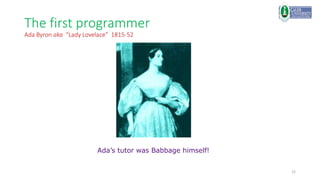
The first programmer
Ada Byron aka “Lady Lovelace” 1815-52
Ada’s tutor was Babbage himself!
23
Babbage’s Influence
• Babbage’s ideas had great influence later primarily
because of
• Luigi Menabrea, who published notes of Babbage’s lectures in Italy
• Lady Lovelace, who translated Menabrea’s notes in English and thoroughly
expanded them.
“... Analytic Engine weaves algebraic patterns....”
• In the early twentieth century - the focus shifted to
analog computers but
• Harvard Mark I built in 1944 is very close in spirit to the Analytic Engine.
24
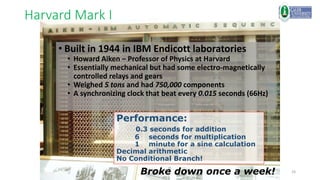
Harvard Mark I
• Built in 1944 in IBM Endicott laboratories
• Howard Aiken – Professor of Physics at Harvard
• Essentially mechanical but had some electro-magnetically
controlled relays and gears
• Weighed 5 tons and had 750,000 components
• A synchronizing clock that beat every 0.015 seconds (66Hz)
Performance:
0.3 seconds for addition
6 seconds for multiplication
1 minute for a sine calculation
Decimal arithmetic
No Conditional Branch!
Broke down once a week!
25
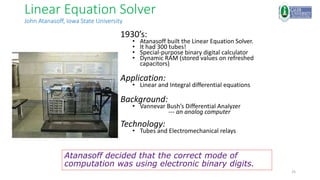
Linear Equation Solver
John Atanasoff, Iowa State University
1930’s:
• Atanasoff built the Linear Equation Solver.
• It had 300 tubes!
• Special-purpose binary digital calculator
• Dynamic RAM (stored values on refreshed
capacitors)
Application:
• Linear and Integral differential equations
Background:
• Vannevar Bush’s Differential Analyzer
--- an analog computer
Technology:
• Tubes and Electromechanical relays
Atanasoff decided that the correct mode of
computation was using electronic binary digits.
26
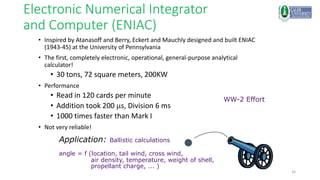
Electronic Numerical Integrator
and Computer (ENIAC)
• Inspired by Atanasoff and Berry, Eckert and Mauchly designed and built ENIAC
(1943-45) at the University of Pennsylvania
• The first, completely electronic, operational, general-purpose analytical
calculator!
• 30 tons, 72 square meters, 200KW
• Performance
• Read in 120 cards per minute
• Addition took 200 ms, Division 6 ms
• 1000 times faster than Mark I
• Not very reliable!
Application: Ballistic calculations
angle = f (location, tail wind, cross wind,
air density, temperature, weight of shell,
propellant charge, ... )
WW-2 Effort
27
Electronic Discrete Variable Automatic
Computer (EDVAC)
• ENIAC’s programming system was external
• Sequences of instructions were executed independently of the results of the calculation
• Human intervention required to take instructions “out of order”
• Eckert, Mauchly, John von Neumann and others designed EDVAC
(1944) to solve this problem
• Solution was the stored program computer
 “program can be manipulated as data”
• First Draft of a report on EDVAC was published in 1945, but just
had von Neumann’s signature!
• In 1973 the court of Minneapolis attributed the honor of inventing the computer to John
Atanasoff
28
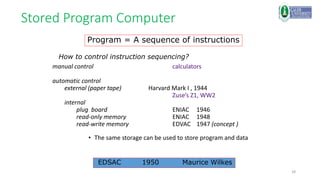
Stored Program Computer
manual control calculators
automatic control
external (paper tape) Harvard Mark I , 1944
Zuse’s Z1, WW2
internal
plug board ENIAC 1946
read-only memory ENIAC 1948
read-write memory EDVAC 1947 (concept )
• The same storage can be used to store program and data
Program = A sequence of instructions
How to control instruction sequencing?
EDSAC 1950 Maurice Wilkes
29
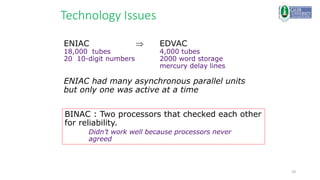
Technology Issues
ENIAC  EDVAC
18,000 tubes 4,000 tubes
20 10-digit numbers 2000 word storage
mercury delay lines
ENIAC had many asynchronous parallel units
but only one was active at a time
BINAC : Two processors that checked each other
for reliability.
Didn’t work well because processors never
agreed
30
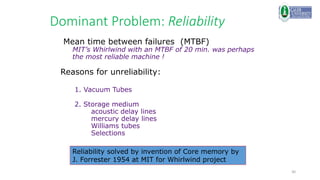
Dominant Problem: Reliability
Mean time between failures (MTBF)
MIT’s Whirlwind with an MTBF of 20 min. was perhaps
the most reliable machine !
Reasons for unreliability:
1. Vacuum Tubes
2. Storage medium
acoustic delay lines
mercury delay lines
Williams tubes
Selections
Reliability solved by invention of Core memory by
J. Forrester 1954 at MIT for Whirlwind project
31
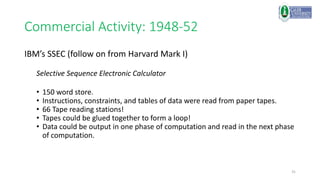
Commercial Activity: 1948-52
IBM’s SSEC (follow on from Harvard Mark I)
Selective Sequence Electronic Calculator
• 150 word store.
• Instructions, constraints, and tables of data were read from paper tapes.
• 66 Tape reading stations!
• Tapes could be glued together to form a loop!
• Data could be output in one phase of computation and read in the next phase
of computation.
32
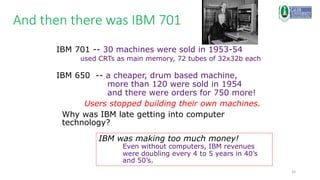
And then there was IBM 701
IBM 701 -- 30 machines were sold in 1953-54
used CRTs as main memory, 72 tubes of 32x32b each
IBM 650 -- a cheaper, drum based machine,
more than 120 were sold in 1954
and there were orders for 750 more!
Users stopped building their own machines.
Why was IBM late getting into computer
technology?
IBM was making too much money!
Even without computers, IBM revenues
were doubling every 4 to 5 years in 40’s
and 50’s.
33
Computers in mid 50’s
• Hardware was expensive
• Stores were small (1000 words)
 No resident system software!
• Memory access time was 10 to 50 times slower than the
processor cycle
 Instruction execution time was totally dominated by the memory reference time.
• The ability to design complex control circuits to execute an
instruction was the central design concern as opposed to the
speed of decoding or an ALU operation
• Programmer’s view of the machine was inseparable from the
actual hardware implementation
34
The IBM 650 (1953-4)
[From 650 Manual, © IBM]
Magnetic Drum (1,000
or 2,000
10-digit decimal
words)
20-digit
accumulator
Active instruction
(including next
program counter)
Digit-serial
ALU
35
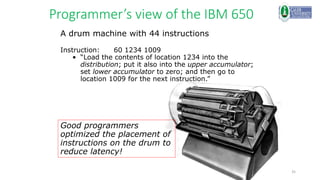
Programmer’s view of the IBM 650
A drum machine with 44 instructions
Instruction: 60 1234 1009
• “Load the contents of location 1234 into the
distribution; put it also into the upper accumulator;
set lower accumulator to zero; and then go to
location 1009 for the next instruction.”
Good programmers
optimized the placement of
instructions on the drum to
reduce latency!
36
The Earliest Instruction Sets
Single Accumulator - A carry-over from the calculators.
LOAD x AC  M[x]
STORE x M[x]  (AC)
ADD x AC  (AC) + M[x]
SUB x
MUL x Involved a quotient register
DIV x
SHIFT LEFT AC  2  (AC)
SHIFT RIGHT
JUMP x PC  x
JGE x if (AC) 0 then PC  x
LOAD ADR x AC  Extract address field(M[x])
STORE ADR x
Typically less than 2 dozen instructions!
37
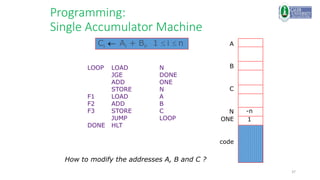
Programming:
Single Accumulator Machine
LOOP LOAD N
JGE DONE
ADD ONE
STORE N
F1 LOAD A
F2 ADD B
F3 STORE C
JUMP LOOP
DONE HLT
Ci Ai + Bi, 1  i  n
How to modify the addresses A, B and C ?
A
B
C
N
ONE
code
-n
1
38
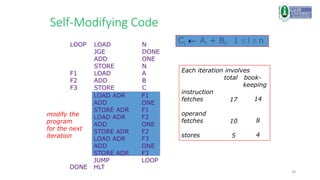
Self-Modifying Code
LOOP LOAD N
JGE DONE
ADD ONE
STORE N
F1 LOAD A
F2 ADD B
F3 STORE C
JUMP LOOP
DONE HLT
modify the
program
for the next
iteration
Each iteration involves
total book-
keeping
instruction
fetches
operand
fetches
stores
Ci Ai + Bi, 1  i  n
LOAD ADR F1
ADD ONE
STORE ADR F1
LOAD ADR F2
ADD ONE
STORE ADR F2
LOAD ADR F3
ADD ONE
STORE ADR F3
JUMP LOOP
DONE HLT
17
10
5
14
8
4
39
Modify existing instructions
LOAD x, IX AC  M[x + (IX)]
ADD x, IX AC  (AC) + M[x + (IX)]
...
Add new instructions to manipulate index registers
JZi x, IX if (IX)=0 then PC  x
else IX  (IX) + 1
LOADi x, IX IX  M[x] (truncated to fit IX)
...
Index Registers
Tom Kilburn, Manchester University, mid 50’s
One or more specialized registers to simplify
address calculation
Index registers have accumulator-like
characteristics
40
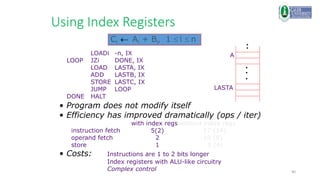
Using Index Registers
LOADi -n, IX
LOOP JZi DONE, IX
LOAD LASTA, IX
ADD LASTB, IX
STORE LASTC, IX
JUMP LOOP
DONE HALT
• Program does not modify itself
• Efficiency has improved dramatically (ops / iter)
with index regs without index regs
instruction fetch 17 (14)
operand fetch 10 (8)
store 5 (4)
• Costs: Instructions are 1 to 2 bits longer
Index registers with ALU-like circuitry
Complex control
A
LASTA
Ci Ai + Bi, 1  i  n
5(2)
2
1
41
Operations on Index Registers
To increment index register by k
AC  (IX) new instruction
AC  (AC) + k
IX  (AC) new instruction
also the AC must be saved and restored.
It may be better to increment IX directly
INCi k, IX IX  (IX) + k
More instructions to manipulate index register
STOREi x, IX M[x]  (IX) (extended to fit a word)
...
IX begins to look like an accumulator
several index registers
several accumulators
General Purpose Registers
42
Evolution of Addressing Modes
1. Single accumulator, absolute address
LOAD x
2. Single accumulator, index registers
LOAD x, IX
3. Indirection
LOAD (x)
4. Multiple accumulators, index registers, indirection
LOAD R, IX, x
or LOAD R, IX, (x) the meaning?
R  M[M[x] + (IX)]
or R  M[M[x + (IX)]]
5. Indirect through registers
LOAD RI, (RJ)
6. The works
LOAD RI, RJ, (RK) RJ = index, RK = base addr
43
Variety of Instruction Formats
• One address formats: Accumulator machines
• Accumulator is always other source and destination operand
• Two address formats: the destination is same as one of the
operand sources
(Reg  Reg) to Reg RI  (RI) + (RJ)
(Reg  Mem) to Reg RI  (RI) + M[x]
• x can be specified directly or via a register
• effective address calculation for x could include indexing,
indirection, ...
• Three address formats: One destination and up to two
operand sources per instruction
(Reg x Reg) to Reg RI  (RJ) + (RK)
(Reg x Mem) to Reg RI  (RJ) + M[x]
44
Zero Address Formats
• Operands on a stack
add M[sp-1]  M[sp] + M[sp-1]
load M[sp]  M[M[sp]]
• Stack can be in registers or in memory (usually top of stack cached
in registers)
C
B
A
SP
Register
45
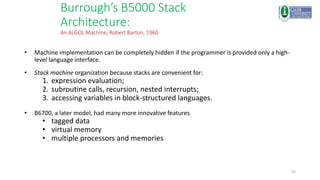
Burrough’s B5000 Stack
Architecture:
An ALGOL Machine, Robert Barton, 1960
• Machine implementation can be completely hidden if the programmer is provided only a high-
level language interface.
• Stack machine organization because stacks are convenient for:
1. expression evaluation;
2. subroutine calls, recursion, nested interrupts;
3. accessing variables in block-structured languages.
• B6700, a later model, had many more innovative features
• tagged data
• virtual memory
• multiple processors and memories
46
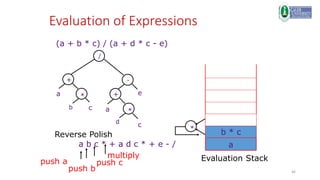
a
b
c
Evaluation of Expressions
(a + b * c) / (a + d * c - e)
/
+
* +
a e
-
a
c
d
c
*
b
Reverse Polish
a b c * + a d c * + e - /
push a
push b
push c
multiply
*
Evaluation Stack
b * c
47
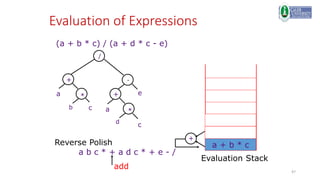
a
Evaluation of Expressions
(a + b * c) / (a + d * c - e)
/
+
* +
a e
-
a
c
d
c
*
b
Reverse Polish
a b c * + a d c * + e - /
add
+
Evaluation Stack
b * c
a + b * c
48
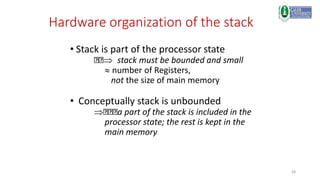
Hardware organization of the stack
• Stack is part of the processor state
stack must be bounded and small
number of Registers,
not the size of main memory
• Conceptually stack is unbounded
 a part of the stack is included in the
processor state; the rest is kept in the
main memory
49
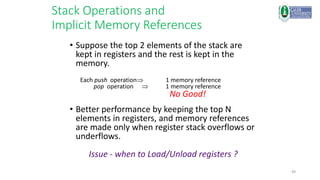
Stack Operations and
Implicit Memory References
• Suppose the top 2 elements of the stack are
kept in registers and the rest is kept in the
memory.
Each push operation 1 memory reference
pop operation  1 memory reference
No Good!
• Better performance by keeping the top N
elements in registers, and memory references
are made only when register stack overflows or
underflows.
Issue - when to Load/Unload registers ?
50
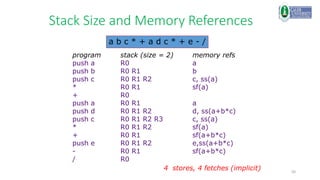
Stack Size and Memory References
program stack (size = 2) memory refs
push a R0 a
push b R0 R1 b
push c R0 R1 R2 c, ss(a)
* R0 R1 sf(a)
+ R0
push a R0 R1 a
push d R0 R1 R2 d, ss(a+b*c)
push c R0 R1 R2 R3 c, ss(a)
* R0 R1 R2 sf(a)
+ R0 R1 sf(a+b*c)
push e R0 R1 R2 e,ss(a+b*c)
- R0 R1 sf(a+b*c)
/ R0
a b c * + a d c * + e - /
4 stores, 4 fetches (implicit)
51
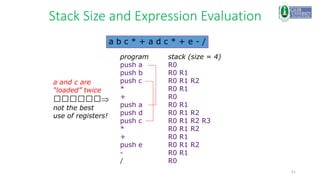
Stack Size and Expression Evaluation
program stack (size = 4)
push a R0
push b R0 R1
push c R0 R1 R2
* R0 R1
+ R0
push a R0 R1
push d R0 R1 R2
push c R0 R1 R2 R3
* R0 R1 R2
+ R0 R1
push e R0 R1 R2
- R0 R1
/ R0
a b c * + a d c * + e - /
a and c are
“loaded” twice

not the best
use of registers!
52
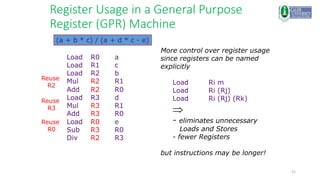
Register Usage in a General Purpose
Register (GPR) Machine
More control over register usage
since registers can be named
explicitly
Load Ri m
Load Ri (Rj)
Load Ri (Rj) (Rk)

- eliminates unnecessary
Loads and Stores
- fewer Registers
but instructions may be longer!
Load R0 a
Load R1 c
Load R2 b
Mul R2 R1
(a + b * c) / (a + d * c - e)
Reuse
R2
Add R2 R0
Load R3 d
Mul R3 R1
Add R3 R0
Reuse
R3
Load R0 e
Sub R3 R0
Div R2 R3
Reuse
R0
53
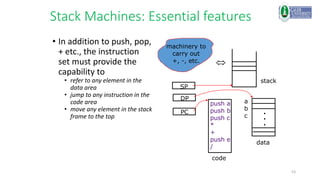
Stack Machines: Essential features
• In addition to push, pop,
+ etc., the instruction
set must provide the
capability to
• refer to any element in the
data area
• jump to any instruction in the
code area
• move any element in the stack
frame to the top
machinery to
carry out
+, -, etc.
stack
SP
DP
PC
data
.
.
.
a
b
c

push a
push b
push c
*
+
push e
/
code
54
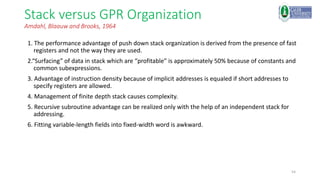
Stack versus GPR Organization
Amdahl, Blaauw and Brooks, 1964
1. The performance advantage of push down stack organization is derived from the presence of fast
registers and not the way they are used.
2.“Surfacing” of data in stack which are “profitable” is approximately 50% because of constants and
common subexpressions.
3. Advantage of instruction density because of implicit addresses is equaled if short addresses to
specify registers are allowed.
4. Management of finite depth stack causes complexity.
5. Recursive subroutine advantage can be realized only with the help of an independent stack for
addressing.
6. Fitting variable-length fields into fixed-width word is awkward.
55
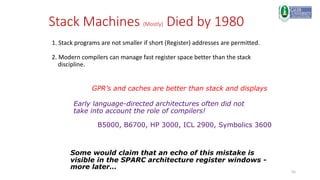
1. Stack programs are not smaller if short (Register) addresses are permitted.
2. Modern compilers can manage fast register space better than the stack
discipline.
Stack Machines (Mostly) Died by 1980
GPR’s and caches are better than stack and displays
Early language-directed architectures often did not
take into account the role of compilers!
B5000, B6700, HP 3000, ICL 2900, Symbolics 3600
Some would claim that an echo of this mistake is
visible in the SPARC architecture register windows -
more later…
56
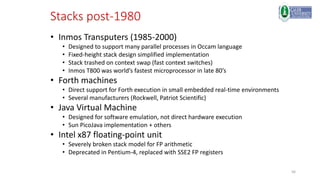
Stacks post-1980
• Inmos Transputers (1985-2000)
• Designed to support many parallel processes in Occam language
• Fixed-height stack design simplified implementation
• Stack trashed on context swap (fast context switches)
• Inmos T800 was world’s fastest microprocessor in late 80’s
• Forth machines
• Direct support for Forth execution in small embedded real-time environments
• Several manufacturers (Rockwell, Patriot Scientific)
• Java Virtual Machine
• Designed for software emulation, not direct hardware execution
• Sun PicoJava implementation + others
• Intel x87 floating-point unit
• Severely broken stack model for FP arithmetic
• Deprecated in Pentium-4, replaced with SSE2 FP registers
57
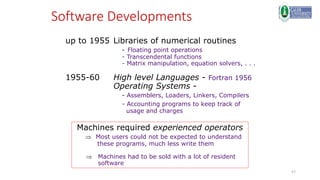
Software Developments
up to 1955 Libraries of numerical routines
- Floating point operations
- Transcendental functions
- Matrix manipulation, equation solvers, . . .
1955-60 High level Languages - Fortran 1956
Operating Systems -
- Assemblers, Loaders, Linkers, Compilers
- Accounting programs to keep track of
usage and charges
Machines required experienced operators
 Most users could not be expected to understand
these programs, much less write them
 Machines had to be sold with a lot of resident
software
58
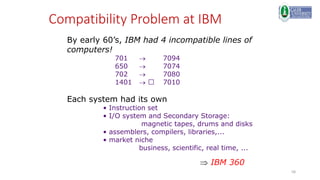
Compatibility Problem at IBM
By early 60’s, IBM had 4 incompatible lines of
computers!
701  7094
650  7074
702  7080
1401  7010
Each system had its own
• Instruction set
• I/O system and Secondary Storage:
magnetic tapes, drums and disks
• assemblers, compilers, libraries,...
• market niche
business, scientific, real time, ...
 IBM 360
59
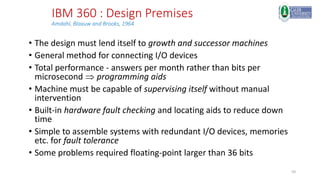
IBM 360 : Design Premises
Amdahl, Blaauw and Brooks, 1964
• The design must lend itself to growth and successor machines
• General method for connecting I/O devices
• Total performance - answers per month rather than bits per
microsecond  programming aids
• Machine must be capable of supervising itself without manual
intervention
• Built-in hardware fault checking and locating aids to reduce down
time
• Simple to assemble systems with redundant I/O devices, memories
etc. for fault tolerance
• Some problems required floating-point larger than 36 bits
60
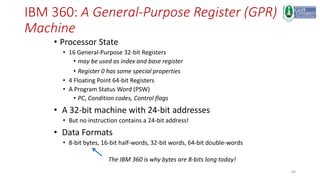
IBM 360: A General-Purpose Register (GPR)
Machine
• Processor State
• 16 General-Purpose 32-bit Registers
• may be used as index and base register
• Register 0 has some special properties
• 4 Floating Point 64-bit Registers
• A Program Status Word (PSW)
• PC, Condition codes, Control flags
• A 32-bit machine with 24-bit addresses
• But no instruction contains a 24-bit address!
• Data Formats
• 8-bit bytes, 16-bit half-words, 32-bit words, 64-bit double-words
The IBM 360 is why bytes are 8-bits long today!
61
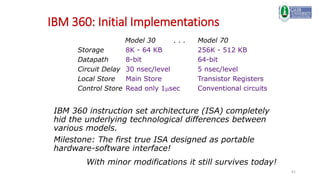
IBM 360: Initial Implementations
Model 30 . . . Model 70
Storage 8K - 64 KB 256K - 512 KB
Datapath 8-bit 64-bit
Circuit Delay 30 nsec/level 5 nsec/level
Local Store Main Store Transistor Registers
Control Store Read only 1msec Conventional circuits
IBM 360 instruction set architecture (ISA) completely
hid the underlying technological differences between
various models.
Milestone: The first true ISA designed as portable
hardware-software interface!
With minor modifications it still survives today!
62
IBM 360: 47 years later…
The zSeries z11 Microprocessor
• 5.2 GHz in IBM 45nm PD-SOI CMOS technology
• 1.4 billion transistors in 512 mm2
• 64-bit virtual addressing
• original S/360 was 24-bit, and S/370 was 31-bit extension
• Quad-core design
• Three-issue out-of-order superscalar pipeline
• Out-of-order memory accesses
• Redundant datapaths
• every instruction performed in two parallel datapaths and results
compared
• 64KB L1 I-cache, 128KB L1 D-cache on-chip
• 1.5MB private L2 unified cache per core, on-chip
• On-Chip 24MB eDRAM L3 cache
• Scales to 96-core multiprocessor with 768MB of
shared L4 eDRAM
[ IBM, HotChips, 2010]
63
And in conclusion …
• Computer Architecture
• We discuss about interaction of hardware and software, and
design of appropriate abstraction layers
• Computer architecture is shaped by technology and
applications
• History provides lessons for the future
• Computer Science at the crossroads from sequential to
parallel computing
• See you next time!
64
Acknowledgements
• All sources are duly acknowledged
• Arvind (MIT)
• Krste Asanovic (MIT/UCB)
• Joel Emer (Intel/MIT)
• James Hoe (CMU)
• John Kubiatowicz (UCB)
• David Patterson (UCB)

computer architecture.pptx

  • 1.
    Computer Architecture and Organisation (CSC303) Lecture 1 - Introduction Department of Computer Science Caleb University, Lagos Nigeria Dr. Emmanuel Ajulo Ph.D., M.Tech., (Comp. Sci.), M.Tech., B.Tech., (Elect. & Comm. Engrg.), R.Eng., MBA, MNSE, MNSC. Rachael Okeyemi M.Sc., B.Sc., (Comp. Sci.), MNSC. &
  • 2.
    What is ComputerArchitecture? 2 Application Physics Gap too large to bridge in one step In its broadest definition, computer architecture is the design of the abstraction layers that allow us to implement information processing applications efficiently using available manufacturing technologies. (but there are exceptions, e.g. magnetic compass)
  • 3.
    3 Abstraction Layers inModern Systems Algorithm Gates/Register-Transfer Level (RTL) Application Instruction Set Architecture (ISA) Operating System/Virtual Machines Microarchitecture Devices Programming Language Circuits Physics CSC303 CS Courses
  • 4.
    Cost of softwaredevelopment makes compatibility a major force in market Architecture continually changing 4 Application s Technology Applications suggest how to improve technology, provide revenue to fund development Improved technologies make new applications possible
  • 5.
    5 Computing Devices Then… EDSAC,University of Cambridge, UK, 1949
  • 6.
  • 7.
    7 1 10 100 1000 10000 1978 1980 19821984 1986 1988 1990 1992 1994 1996 1998 2000 2002 2004 2006 Performance (vs. VAX-11/780) 25%/year 52%/year ??%/year Uniprocessor Performance • VAX : 25%/year 1978 to 1986 • RISC + x86: 52%/year 1986 to 2002 • RISC + x86: ??%/year 2002 to present From Hennessy and Patterson, Computer Architecture: A Quantitative Approach, 4th edition, October, 2006
  • 8.
    8 The End ofthe Uniprocessor Era Single biggest change in the history of computing systems
  • 9.
  • 10.
    10 CSC 303 CourseFocus Understanding the design techniques, machine structures, technology factors, evaluation methods that will determine the form of computers in 21st Century Technology Programming Languages Operating Systems History Applications Interface Design (ISA) Measurement & Evaluation Parallelism Computer Architecture: • Organization • Hardware/Software Boundary Compilers
  • 11.
    11 The “New” CSC303 • Class contains labs based on various different machine designs • Experiment with how architectural mechanisms work in practice on real software.
  • 12.
    12 Related Courses CSC 303 Basiccomputer organization, first look at pipelines + caches Computer Architecture, First look at parallel architectures Parallel Architectures, Languages, Systems Digital Logic Design, FPGAs Strong Prerequisite VLSI Systems Design CSC 302 Graduate Computer Architecture, Advanced Topics
  • 13.
    13 CSC 303 Structureand Syllabus Five modules 1. Fundamental building blocks and logic expressive immunization. 2. Sum of product forms, Register transfer notation, and physical consideration. 3. Data representation, and number bases. 4. Fixed and Floating point systems. 5. Representation memory systems organization and architecture.
  • 14.
    14 CSC 303 CourseComponents • 20% Problem Sets/Test (one after the course) • Intended to help you prepare for the exam. Grading is based mostly on knowledge of the course. • 5% Labs (one per module) • Labs use advanced full system simulators (new Chisel simulators - Chisel is a new hardware description language developed at Berkeley based on Scala: Constructing Hardware in a Scala Embedded Language; plus Virtutech Simics) • Directed plus open-ended sections to each lab • 15% Quizzes (one per module) • In-class, closed-book, no calculators, no smartphones, no laptops,... • Based on lectures, readings, problem sets, and labs
  • 15.
    15 Computer Architecture: A LittleHistory Throughout the course we’ll use a historical narrative to help understand why certain ideas arose Why worry about old ideas? • Helps to illustrate the design process, and explains why certain decisions were taken • Because future technologies might be as constrained as older ones • Those who ignore history are doomed to repeat it • Every mistake made in mainframe design was also made in minicomputers, then microcomputers, where next?
  • 16.
    16 Charles Babbage 1791-1871 LucasianProfessor of Mathematics, Cambridge University, 1827-1839
  • 17.
    17 Charles Babbage • DifferenceEngine 1823 • Analytic Engine 1833 • The forerunner of modern digital computer! Application – Mathematical Tables – Astronomy – Nautical Tables – Navy Background – Any continuous function can be approximated by a polynomial --- Weierstrass Technology – mechanical - gears, Jacquard’s loom, simple calculators
  • 18.
    18 Difference Engine A machineto compute mathematical tables Weierstrass: • Any continuous function can be approximated by a polynomial • Any polynomial can be computed from difference tables An example f(n) = n2 + n + 41 d1(n) = f(n) - f(n-1) = 2n d2(n) = d1(n) - d1(n-1) = 2 f(n) = f(n-1) + d1(n) = f(n-1) + (d1(n-1) + 2) all you need is an adder! n d2(n) d1(n) f(n) 0 41 1 2 2 2 3 2 4 2 4 6 8 43 47 53 61
  • 19.
    19 Difference Engine 1823 • Babbage’spaper is published 1834 • The paper is read by Scheutz & his son in Sweden 1842 • Babbage gives up the idea of building it; he is onto Analytic Engine! 1855 • Scheutz displays his machine at the Paris World Fare • Can compute any 6th degree polynomial • Speed: 33 to 44 32-digit numbers per minute! Now the machine is at the Smithsonian
  • 20.
    20 Analytic Engine 1833: Babbage’spaper was published • conceived during a hiatus in the development of the difference engine Inspiration: Jacquard Looms • looms were controlled by punched cards • The set of cards with fixed punched holes dictated the pattern of weave  program • The same set of cards could be used with different colored threads  numbers 1871: Babbage dies • The machine remains unrealized. It is not clear if the analytic engine could be built using the mechanical technology of the time
  • 21.
    21 Analytic Engine The firstconception of a general-purpose computer 1. The store in which all variables to be operated upon, as well as all those quantities which have arisen from the results of the operations are placed. 2. The mill into which the quantities about to be operated upon are always brought. The program Operation variable1 variable2 variable3 An operation in the mill required feeding two punched cards and producing a new punched card for the store. An operation to alter the sequence was also provided!
  • 22.
    22 The first programmer AdaByron aka “Lady Lovelace” 1815-52 Ada’s tutor was Babbage himself!
  • 23.
    23 Babbage’s Influence • Babbage’sideas had great influence later primarily because of • Luigi Menabrea, who published notes of Babbage’s lectures in Italy • Lady Lovelace, who translated Menabrea’s notes in English and thoroughly expanded them. “... Analytic Engine weaves algebraic patterns....” • In the early twentieth century - the focus shifted to analog computers but • Harvard Mark I built in 1944 is very close in spirit to the Analytic Engine.
  • 24.
    24 Harvard Mark I •Built in 1944 in IBM Endicott laboratories • Howard Aiken – Professor of Physics at Harvard • Essentially mechanical but had some electro-magnetically controlled relays and gears • Weighed 5 tons and had 750,000 components • A synchronizing clock that beat every 0.015 seconds (66Hz) Performance: 0.3 seconds for addition 6 seconds for multiplication 1 minute for a sine calculation Decimal arithmetic No Conditional Branch! Broke down once a week!
  • 25.
    25 Linear Equation Solver JohnAtanasoff, Iowa State University 1930’s: • Atanasoff built the Linear Equation Solver. • It had 300 tubes! • Special-purpose binary digital calculator • Dynamic RAM (stored values on refreshed capacitors) Application: • Linear and Integral differential equations Background: • Vannevar Bush’s Differential Analyzer --- an analog computer Technology: • Tubes and Electromechanical relays Atanasoff decided that the correct mode of computation was using electronic binary digits.
  • 26.
    26 Electronic Numerical Integrator andComputer (ENIAC) • Inspired by Atanasoff and Berry, Eckert and Mauchly designed and built ENIAC (1943-45) at the University of Pennsylvania • The first, completely electronic, operational, general-purpose analytical calculator! • 30 tons, 72 square meters, 200KW • Performance • Read in 120 cards per minute • Addition took 200 ms, Division 6 ms • 1000 times faster than Mark I • Not very reliable! Application: Ballistic calculations angle = f (location, tail wind, cross wind, air density, temperature, weight of shell, propellant charge, ... ) WW-2 Effort
  • 27.
    27 Electronic Discrete VariableAutomatic Computer (EDVAC) • ENIAC’s programming system was external • Sequences of instructions were executed independently of the results of the calculation • Human intervention required to take instructions “out of order” • Eckert, Mauchly, John von Neumann and others designed EDVAC (1944) to solve this problem • Solution was the stored program computer  “program can be manipulated as data” • First Draft of a report on EDVAC was published in 1945, but just had von Neumann’s signature! • In 1973 the court of Minneapolis attributed the honor of inventing the computer to John Atanasoff
  • 28.
    28 Stored Program Computer manualcontrol calculators automatic control external (paper tape) Harvard Mark I , 1944 Zuse’s Z1, WW2 internal plug board ENIAC 1946 read-only memory ENIAC 1948 read-write memory EDVAC 1947 (concept ) • The same storage can be used to store program and data Program = A sequence of instructions How to control instruction sequencing? EDSAC 1950 Maurice Wilkes
  • 29.
    29 Technology Issues ENIAC EDVAC 18,000 tubes 4,000 tubes 20 10-digit numbers 2000 word storage mercury delay lines ENIAC had many asynchronous parallel units but only one was active at a time BINAC : Two processors that checked each other for reliability. Didn’t work well because processors never agreed
  • 30.
    30 Dominant Problem: Reliability Meantime between failures (MTBF) MIT’s Whirlwind with an MTBF of 20 min. was perhaps the most reliable machine ! Reasons for unreliability: 1. Vacuum Tubes 2. Storage medium acoustic delay lines mercury delay lines Williams tubes Selections Reliability solved by invention of Core memory by J. Forrester 1954 at MIT for Whirlwind project
  • 31.
    31 Commercial Activity: 1948-52 IBM’sSSEC (follow on from Harvard Mark I) Selective Sequence Electronic Calculator • 150 word store. • Instructions, constraints, and tables of data were read from paper tapes. • 66 Tape reading stations! • Tapes could be glued together to form a loop! • Data could be output in one phase of computation and read in the next phase of computation.
  • 32.
    32 And then therewas IBM 701 IBM 701 -- 30 machines were sold in 1953-54 used CRTs as main memory, 72 tubes of 32x32b each IBM 650 -- a cheaper, drum based machine, more than 120 were sold in 1954 and there were orders for 750 more! Users stopped building their own machines. Why was IBM late getting into computer technology? IBM was making too much money! Even without computers, IBM revenues were doubling every 4 to 5 years in 40’s and 50’s.
  • 33.
    33 Computers in mid50’s • Hardware was expensive • Stores were small (1000 words)  No resident system software! • Memory access time was 10 to 50 times slower than the processor cycle  Instruction execution time was totally dominated by the memory reference time. • The ability to design complex control circuits to execute an instruction was the central design concern as opposed to the speed of decoding or an ALU operation • Programmer’s view of the machine was inseparable from the actual hardware implementation
  • 34.
    34 The IBM 650(1953-4) [From 650 Manual, © IBM] Magnetic Drum (1,000 or 2,000 10-digit decimal words) 20-digit accumulator Active instruction (including next program counter) Digit-serial ALU
  • 35.
    35 Programmer’s view ofthe IBM 650 A drum machine with 44 instructions Instruction: 60 1234 1009 • “Load the contents of location 1234 into the distribution; put it also into the upper accumulator; set lower accumulator to zero; and then go to location 1009 for the next instruction.” Good programmers optimized the placement of instructions on the drum to reduce latency!
  • 36.
    36 The Earliest InstructionSets Single Accumulator - A carry-over from the calculators. LOAD x AC  M[x] STORE x M[x]  (AC) ADD x AC  (AC) + M[x] SUB x MUL x Involved a quotient register DIV x SHIFT LEFT AC  2  (AC) SHIFT RIGHT JUMP x PC  x JGE x if (AC) 0 then PC  x LOAD ADR x AC  Extract address field(M[x]) STORE ADR x Typically less than 2 dozen instructions!
  • 37.
    37 Programming: Single Accumulator Machine LOOPLOAD N JGE DONE ADD ONE STORE N F1 LOAD A F2 ADD B F3 STORE C JUMP LOOP DONE HLT Ci Ai + Bi, 1  i  n How to modify the addresses A, B and C ? A B C N ONE code -n 1
  • 38.
    38 Self-Modifying Code LOOP LOADN JGE DONE ADD ONE STORE N F1 LOAD A F2 ADD B F3 STORE C JUMP LOOP DONE HLT modify the program for the next iteration Each iteration involves total book- keeping instruction fetches operand fetches stores Ci Ai + Bi, 1  i  n LOAD ADR F1 ADD ONE STORE ADR F1 LOAD ADR F2 ADD ONE STORE ADR F2 LOAD ADR F3 ADD ONE STORE ADR F3 JUMP LOOP DONE HLT 17 10 5 14 8 4
  • 39.
    39 Modify existing instructions LOADx, IX AC  M[x + (IX)] ADD x, IX AC  (AC) + M[x + (IX)] ... Add new instructions to manipulate index registers JZi x, IX if (IX)=0 then PC  x else IX  (IX) + 1 LOADi x, IX IX  M[x] (truncated to fit IX) ... Index Registers Tom Kilburn, Manchester University, mid 50’s One or more specialized registers to simplify address calculation Index registers have accumulator-like characteristics
  • 40.
    40 Using Index Registers LOADi-n, IX LOOP JZi DONE, IX LOAD LASTA, IX ADD LASTB, IX STORE LASTC, IX JUMP LOOP DONE HALT • Program does not modify itself • Efficiency has improved dramatically (ops / iter) with index regs without index regs instruction fetch 17 (14) operand fetch 10 (8) store 5 (4) • Costs: Instructions are 1 to 2 bits longer Index registers with ALU-like circuitry Complex control A LASTA Ci Ai + Bi, 1  i  n 5(2) 2 1
  • 41.
    41 Operations on IndexRegisters To increment index register by k AC  (IX) new instruction AC  (AC) + k IX  (AC) new instruction also the AC must be saved and restored. It may be better to increment IX directly INCi k, IX IX  (IX) + k More instructions to manipulate index register STOREi x, IX M[x]  (IX) (extended to fit a word) ... IX begins to look like an accumulator several index registers several accumulators General Purpose Registers
  • 42.
    42 Evolution of AddressingModes 1. Single accumulator, absolute address LOAD x 2. Single accumulator, index registers LOAD x, IX 3. Indirection LOAD (x) 4. Multiple accumulators, index registers, indirection LOAD R, IX, x or LOAD R, IX, (x) the meaning? R  M[M[x] + (IX)] or R  M[M[x + (IX)]] 5. Indirect through registers LOAD RI, (RJ) 6. The works LOAD RI, RJ, (RK) RJ = index, RK = base addr
  • 43.
    43 Variety of InstructionFormats • One address formats: Accumulator machines • Accumulator is always other source and destination operand • Two address formats: the destination is same as one of the operand sources (Reg  Reg) to Reg RI  (RI) + (RJ) (Reg  Mem) to Reg RI  (RI) + M[x] • x can be specified directly or via a register • effective address calculation for x could include indexing, indirection, ... • Three address formats: One destination and up to two operand sources per instruction (Reg x Reg) to Reg RI  (RJ) + (RK) (Reg x Mem) to Reg RI  (RJ) + M[x]
  • 44.
    44 Zero Address Formats •Operands on a stack add M[sp-1]  M[sp] + M[sp-1] load M[sp]  M[M[sp]] • Stack can be in registers or in memory (usually top of stack cached in registers) C B A SP Register
  • 45.
    45 Burrough’s B5000 Stack Architecture: AnALGOL Machine, Robert Barton, 1960 • Machine implementation can be completely hidden if the programmer is provided only a high- level language interface. • Stack machine organization because stacks are convenient for: 1. expression evaluation; 2. subroutine calls, recursion, nested interrupts; 3. accessing variables in block-structured languages. • B6700, a later model, had many more innovative features • tagged data • virtual memory • multiple processors and memories
  • 46.
    46 a b c Evaluation of Expressions (a+ b * c) / (a + d * c - e) / + * + a e - a c d c * b Reverse Polish a b c * + a d c * + e - / push a push b push c multiply * Evaluation Stack b * c
  • 47.
    47 a Evaluation of Expressions (a+ b * c) / (a + d * c - e) / + * + a e - a c d c * b Reverse Polish a b c * + a d c * + e - / add + Evaluation Stack b * c a + b * c
  • 48.
    48 Hardware organization ofthe stack • Stack is part of the processor state stack must be bounded and small number of Registers, not the size of main memory • Conceptually stack is unbounded  a part of the stack is included in the processor state; the rest is kept in the main memory
  • 49.
    49 Stack Operations and ImplicitMemory References • Suppose the top 2 elements of the stack are kept in registers and the rest is kept in the memory. Each push operation 1 memory reference pop operation  1 memory reference No Good! • Better performance by keeping the top N elements in registers, and memory references are made only when register stack overflows or underflows. Issue - when to Load/Unload registers ?
  • 50.
    50 Stack Size andMemory References program stack (size = 2) memory refs push a R0 a push b R0 R1 b push c R0 R1 R2 c, ss(a) * R0 R1 sf(a) + R0 push a R0 R1 a push d R0 R1 R2 d, ss(a+b*c) push c R0 R1 R2 R3 c, ss(a) * R0 R1 R2 sf(a) + R0 R1 sf(a+b*c) push e R0 R1 R2 e,ss(a+b*c) - R0 R1 sf(a+b*c) / R0 a b c * + a d c * + e - / 4 stores, 4 fetches (implicit)
  • 51.
    51 Stack Size andExpression Evaluation program stack (size = 4) push a R0 push b R0 R1 push c R0 R1 R2 * R0 R1 + R0 push a R0 R1 push d R0 R1 R2 push c R0 R1 R2 R3 * R0 R1 R2 + R0 R1 push e R0 R1 R2 - R0 R1 / R0 a b c * + a d c * + e - / a and c are “loaded” twice  not the best use of registers!
  • 52.
    52 Register Usage ina General Purpose Register (GPR) Machine More control over register usage since registers can be named explicitly Load Ri m Load Ri (Rj) Load Ri (Rj) (Rk)  - eliminates unnecessary Loads and Stores - fewer Registers but instructions may be longer! Load R0 a Load R1 c Load R2 b Mul R2 R1 (a + b * c) / (a + d * c - e) Reuse R2 Add R2 R0 Load R3 d Mul R3 R1 Add R3 R0 Reuse R3 Load R0 e Sub R3 R0 Div R2 R3 Reuse R0
  • 53.
    53 Stack Machines: Essentialfeatures • In addition to push, pop, + etc., the instruction set must provide the capability to • refer to any element in the data area • jump to any instruction in the code area • move any element in the stack frame to the top machinery to carry out +, -, etc. stack SP DP PC data . . . a b c  push a push b push c * + push e / code
  • 54.
    54 Stack versus GPROrganization Amdahl, Blaauw and Brooks, 1964 1. The performance advantage of push down stack organization is derived from the presence of fast registers and not the way they are used. 2.“Surfacing” of data in stack which are “profitable” is approximately 50% because of constants and common subexpressions. 3. Advantage of instruction density because of implicit addresses is equaled if short addresses to specify registers are allowed. 4. Management of finite depth stack causes complexity. 5. Recursive subroutine advantage can be realized only with the help of an independent stack for addressing. 6. Fitting variable-length fields into fixed-width word is awkward.
  • 55.
    55 1. Stack programsare not smaller if short (Register) addresses are permitted. 2. Modern compilers can manage fast register space better than the stack discipline. Stack Machines (Mostly) Died by 1980 GPR’s and caches are better than stack and displays Early language-directed architectures often did not take into account the role of compilers! B5000, B6700, HP 3000, ICL 2900, Symbolics 3600 Some would claim that an echo of this mistake is visible in the SPARC architecture register windows - more later…
  • 56.
    56 Stacks post-1980 • InmosTransputers (1985-2000) • Designed to support many parallel processes in Occam language • Fixed-height stack design simplified implementation • Stack trashed on context swap (fast context switches) • Inmos T800 was world’s fastest microprocessor in late 80’s • Forth machines • Direct support for Forth execution in small embedded real-time environments • Several manufacturers (Rockwell, Patriot Scientific) • Java Virtual Machine • Designed for software emulation, not direct hardware execution • Sun PicoJava implementation + others • Intel x87 floating-point unit • Severely broken stack model for FP arithmetic • Deprecated in Pentium-4, replaced with SSE2 FP registers
  • 57.
    57 Software Developments up to1955 Libraries of numerical routines - Floating point operations - Transcendental functions - Matrix manipulation, equation solvers, . . . 1955-60 High level Languages - Fortran 1956 Operating Systems - - Assemblers, Loaders, Linkers, Compilers - Accounting programs to keep track of usage and charges Machines required experienced operators  Most users could not be expected to understand these programs, much less write them  Machines had to be sold with a lot of resident software
  • 58.
    58 Compatibility Problem atIBM By early 60’s, IBM had 4 incompatible lines of computers! 701  7094 650  7074 702  7080 1401  7010 Each system had its own • Instruction set • I/O system and Secondary Storage: magnetic tapes, drums and disks • assemblers, compilers, libraries,... • market niche business, scientific, real time, ...  IBM 360
  • 59.
    59 IBM 360 :Design Premises Amdahl, Blaauw and Brooks, 1964 • The design must lend itself to growth and successor machines • General method for connecting I/O devices • Total performance - answers per month rather than bits per microsecond  programming aids • Machine must be capable of supervising itself without manual intervention • Built-in hardware fault checking and locating aids to reduce down time • Simple to assemble systems with redundant I/O devices, memories etc. for fault tolerance • Some problems required floating-point larger than 36 bits
  • 60.
    60 IBM 360: AGeneral-Purpose Register (GPR) Machine • Processor State • 16 General-Purpose 32-bit Registers • may be used as index and base register • Register 0 has some special properties • 4 Floating Point 64-bit Registers • A Program Status Word (PSW) • PC, Condition codes, Control flags • A 32-bit machine with 24-bit addresses • But no instruction contains a 24-bit address! • Data Formats • 8-bit bytes, 16-bit half-words, 32-bit words, 64-bit double-words The IBM 360 is why bytes are 8-bits long today!
  • 61.
    61 IBM 360: InitialImplementations Model 30 . . . Model 70 Storage 8K - 64 KB 256K - 512 KB Datapath 8-bit 64-bit Circuit Delay 30 nsec/level 5 nsec/level Local Store Main Store Transistor Registers Control Store Read only 1msec Conventional circuits IBM 360 instruction set architecture (ISA) completely hid the underlying technological differences between various models. Milestone: The first true ISA designed as portable hardware-software interface! With minor modifications it still survives today!
  • 62.
    62 IBM 360: 47years later… The zSeries z11 Microprocessor • 5.2 GHz in IBM 45nm PD-SOI CMOS technology • 1.4 billion transistors in 512 mm2 • 64-bit virtual addressing • original S/360 was 24-bit, and S/370 was 31-bit extension • Quad-core design • Three-issue out-of-order superscalar pipeline • Out-of-order memory accesses • Redundant datapaths • every instruction performed in two parallel datapaths and results compared • 64KB L1 I-cache, 128KB L1 D-cache on-chip • 1.5MB private L2 unified cache per core, on-chip • On-Chip 24MB eDRAM L3 cache • Scales to 96-core multiprocessor with 768MB of shared L4 eDRAM [ IBM, HotChips, 2010]
  • 63.
    63 And in conclusion… • Computer Architecture • We discuss about interaction of hardware and software, and design of appropriate abstraction layers • Computer architecture is shaped by technology and applications • History provides lessons for the future • Computer Science at the crossroads from sequential to parallel computing • See you next time!
  • 64.
    64 Acknowledgements • All sourcesare duly acknowledged • Arvind (MIT) • Krste Asanovic (MIT/UCB) • Joel Emer (Intel/MIT) • James Hoe (CMU) • John Kubiatowicz (UCB) • David Patterson (UCB)