Compound preposition
NBF pg 65-67
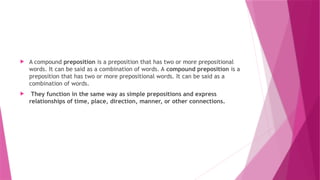
 A compound preposition is a preposition that has two or more prepositional
words. It can be said as a combination of words. A compound preposition is a
preposition that has two or more prepositional words. It can be said as a
combination of words.
 They function in the same way as simple prepositions and express
relationships of time, place, direction, manner, or other connections.
HOW ARE COMPOUND PREPOSITIONS
FORMED?
 Compound prepositions are formed by joining two or three words. The first
word is generally an adverb, adjective or conjunction. The second word is a
simple preposition.
 It is prepared through the joining of a prepositional or a non-prepositional
word to a simple preposition used with a noun, adverb, adjective, and
pronoun.
Examples
 Examples include
 "in front of,“
 "on top of,“
 "out of,“
 "due to,“
 "instead of,“
 "next to," "according to,“
 "in spite of,“
 and "along with."
Usage:
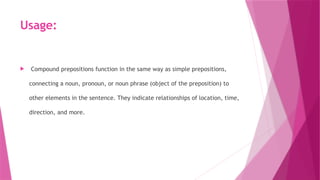
 Compound prepositions function in the same way as simple prepositions,
connecting a noun, pronoun, or noun phrase (object of the preposition) to
other elements in the sentence. They indicate relationships of location, time,
direction, and more.
Location and Place:
 Compound prepositions can indicate specific locations or positions.
 For example:
 "in front of the house,"
 "on top of the mountain,"
 "next to the river."
Time:
 Compound prepositions are also used to express time relationships.
 For example:
 "due to the weather,"
 "before the deadline,"
 "in spite of the circumstances."
Direction:
 Compound prepositions indicate movement or direction.
 For example:
 "along with the crowd,"
 "towards the city,"
 "away from home."
Other Relationships:
 Compound prepositions can express other relationships such as manner,
cause, purpose, and more.
 For example:
 "in accordance with the rules,"
 "out of curiosity,"
 "instead of complaining."
compound prepositions in Englishlanguage.pptx

compound prepositions in Englishlanguage.pptx

  • 1.
  • 2.
     A compoundpreposition is a preposition that has two or more prepositional words. It can be said as a combination of words. A compound preposition is a preposition that has two or more prepositional words. It can be said as a combination of words.  They function in the same way as simple prepositions and express relationships of time, place, direction, manner, or other connections.
  • 3.
    HOW ARE COMPOUNDPREPOSITIONS FORMED?  Compound prepositions are formed by joining two or three words. The first word is generally an adverb, adjective or conjunction. The second word is a simple preposition.  It is prepared through the joining of a prepositional or a non-prepositional word to a simple preposition used with a noun, adverb, adjective, and pronoun.
  • 4.
    Examples  Examples include "in front of,“  "on top of,“  "out of,“  "due to,“  "instead of,“  "next to," "according to,“  "in spite of,“  and "along with."
  • 5.
    Usage:  Compound prepositionsfunction in the same way as simple prepositions, connecting a noun, pronoun, or noun phrase (object of the preposition) to other elements in the sentence. They indicate relationships of location, time, direction, and more.
  • 6.
    Location and Place: Compound prepositions can indicate specific locations or positions.  For example:  "in front of the house,"  "on top of the mountain,"  "next to the river."
  • 7.
    Time:  Compound prepositionsare also used to express time relationships.  For example:  "due to the weather,"  "before the deadline,"  "in spite of the circumstances."
  • 8.
    Direction:  Compound prepositionsindicate movement or direction.  For example:  "along with the crowd,"  "towards the city,"  "away from home."
  • 9.
    Other Relationships:  Compoundprepositions can express other relationships such as manner, cause, purpose, and more.  For example:  "in accordance with the rules,"  "out of curiosity,"  "instead of complaining."