INTRODUCTION
Circulating body fluidsinclude blood and lymph that flow through a
closed system of vessels. Hematology is the study of blood and lymph.
Blood is a fluid connective tissue which is red colored, and alkaline in
reaction. Arterial blood is bright red due to the presence of
oxyhemoglobin and venous blood is dark red due to the presence of
reduced hemoglobin (Hb). Body contains about 5 L of blood in an
adult which comes to about 8% of body weight.
5.
COMPOSITION OF BLOOD
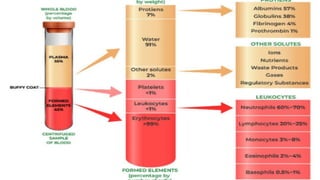
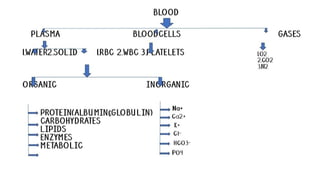
Bloodis composed of plasma and blood cells. Gases are present in blood are O2 , Co₂
and nitrogen (N ).
₂
Blood cells or formed elements are (45%)
• RBCs (or) erythrocytes (5million /mm² or μL of blood)
.WBCs (or) leukocytes (4,000- 11.000/mm²³ of blood)
.platelets (or) thrombolytes (150.000-400,000/mm²³ of blood)
.plasma (55%) .
Water (91%)
• Solids (9%)
inorganic (1%)and organic (8%).
6.
-Inorganic constituents ofplasma are
electrolytes like Na+, Ca2+, cl. HCO , - and
₃
mg 2+, etc..
-Organic constituents are proteins,
Carbohydrates, lipids, enzymes and
metaboli –tes like bilirubin, urea, uric acid,
Creatinine etc
8.
Oxygen (O2):-
When thered blood cells reach tissues that need oxygen, the oxygen is
released from the haemoglobin and diffuses into the cells where it is used to
make energy.
All the systems in our body rely on oxygen to make energy
Carbondioxide(CO2)
CO2 is transported in the bloodstream to the lungs where it is ultimately
removed from the body through exhalation. CO2 plays various roles in the
human body including regulation of blood pH, respiratory drive, and affinity of
hemoglobin for oxygen (O2)..
9.
Nitrogen (N2):-
The nitrogencombines with other elements, such as carbon, hydrogen and
oxygen, to form urea, which is a chemical waste product.
The urea travels from your liver to your kidneys through your bloodstream.
Healthy kidneys filter urea and remove other waste products from your blood.
10.
Plasma
plasma is aclear, slightly yellow liquid, Containing a large
number of organic and inorganic substances disolved in
water, plasma contains approximately 91% of water and
9% of solids of the solids about 7% are the plasma proteins
which consists of serum album in and fibrinogen. Serum
globulin.
Normal plasma volume is about 5% of total body weight
[3.500ml] plasma clots on standing. It remains in fluid state
if on anticoagulant is added.
11.
Plasma Protein
Plasma proteinare the main constituents of plasma. Their normal level is 6-
8g/100ml. There are three major class of plasma proteins
-Albumin (3.5-5g/100ml)
-Globulin (2-3.5g/100ml)
-Fibrinogen (0.2-0.3g/100ml)
12.
Carbohydrates:-
Carbohydrates play animportant role in the human body. They act as an
energy source, help control blood glucose and insulin metabolism, participate
in cholesterol and triglyceride metabolism, and help with fermentation.
Enzymes:-
Enzymes are proteins that help speed up chemical reactions in our bodies.
Enzymes are essential for digestion, liver function and much more. Too much or
too little of a certain enzyme can cause health problems. Enzymes in our blood
can also help healthcare providers check for injuries and diseases.
13.
Metabolic :-
Theblood transports oxygen from the lungs to the cells of the body, where it
is needed for metabolism. The carbon dioxide produced during metabolism
is carried back to the lungs by the blood, where it is then exhaled
(breathed out).
14.
Albumin
Albumin is synthesisedin the liver. The 80% of osmotic pressure of blood is excreted by
albumin since it has the highest concentration100ml
Globulin
-Globulin fractions is subdivided into
- Alpha-Globulin (α- globulin )
- Beta-globulin (β-globulin)
- Gamma globulin (γ globulin)
Fibrinogen
Fibrinogen is synthesised in the liver and it helps in the coagulation of blood.
15.
Erythrocyte (Red bloodcells)
Human RBCS e non-nucleated circular disk-like cells presents in the blood
with a mean diameter of 7.5µm. The red colour is due to the presence of
the pigment hemoglobin (Hb). The hb is interwoven in the stoma of RBC, so
that even if an RBC is cut, there is no extrusion of Hb. The volume of a single
RBC is about 90µm 3 and surface area 120 µm²
Normal shape
Normally the RBCs are disc shaped and bio concave (dumbbell shaped)
Composition
•water-60-63%
•solids-37-40%
Thirty four percent of solid is hemoglobin and the rest 3-6% is constituted by
other proteins, potassium, phospholipid, cholesterol, triphosphate (ATP)
many oxidative enzymes and coenzymes etc…
16.
Structure-
RBC is boundby a membrane made up of double layers of lipids and proteins layer in between Lipids
layerconsist of phospho –lipids, Cholesterol and small amounts of glycolipids. The glycolipids contain oligosacchari
de sequences on the outer surface which form ABO blood. Group substances
Normal value
4-5-5.5 million/mm³ in males 4-5 million mm³ in females RBCS are counted on a special chamber called Neubauer’s
Counting chamber.
Life span of RBC
Average life span of RBC in about 120 days. After the life time the senile (old) RBCs are destroyed in
reticuloendothelial system (RES) of spleen
17.
Hemoglobin
Hemoglobin (or) thered pigment is the most important constituent of RBCs. It gives the blood, its characteristic
red colour. Beside serving as a plays Carrier of co2 Hb plays an important role in a Carrier of CO2.
Normal level
males – 14-189/100m
females-12-16 91100ml
Infants-Imf-18-23 g/100mL
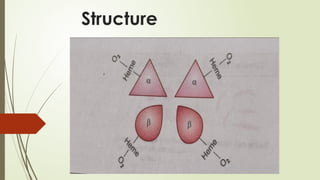
Hemoglobin belongs ofConjugated proteins with a molecuber weight of 68.000
it consists of an iron containing herme portion and a colories protem part called globin
Type of Normal hemoglobin Hb mainly of two types
• Adult Hb (HbA)
•Fetal Hb (HbF)
fin adult Hb, the globin Contain 2α chain and 2βchain . In fetal Hb, there are 2γchains and 23
chains instead of βchain.
20.
Leukocytes (white bloodcells)
The WBC are the body solids that provides defence and immunity from inverting
organisms
Type of leukocytes
On the basis of morphology the WBCs and broadly classified into 2 type
— Granulocytes
— Aranulocytes
Total WBC count:
In adult -4000–1100/mm3, it is more at birth
Different leukocytes count:
The different leukocytes count (DLC) means the relative members of the different
— Neutrophils (N)-50–70%
— Eosinophils (E)1-4%
—Basophils(B)0-1%
—Lymphocytes(L)20-40%
21.
Leukaemia:
The leukaemia isa condition which is characterized by abnormal
an uncontrolled increase in WBC count more than 1000000/mm3 . It is
also called labour cancer
Life span of WBCs:
—Neutrophils–2-5 days
— Eosinophils 7-12days
— Basophils 12-15 days
—Monocytes 2–5 days
—Lymphocytes ½ to 1 day
22.
Nautrophils:
It consists about50-70% of the total WBCs they have a diameter of 10-
12”µm
Eosinophils:
Eosinophils from about 1-4%of the total WBCs they are slightly larger than
nautrophils with a diameter of 10-14”µm
Basophils:
There are the rarest leukocytes which consists 0-1%of the total WBCs .
They have a diameter of 10-12”µm
Monocytes:
It consists about 2-8%of the total WBCs. They are the largest of 10-12”µm
Lymphocytes:
They consists 20-40%of the total WBCs in. But in the infant their more
23.
Thrombocytes (platelets)
plateletsare small, spherical, non- nucleated man of protoplasm with a
diameter of 2-4 um. The protoplasm Contains mitochondria, granules etc.
The granules contamn glycogen, platelet derived growth factors,
adenosine triphosphate (ATP) histamine, serotonin etc. The contractile
elements contain actin and myonin which help in amoeboid movements of
platelets. Tubules are for the storage of Calcium platelets do not have
deoxyribonucleic acid (DNA) and ribonucleic acid (RNA), Therefore there
can be no protein synthesis
24.
Function of Blood
Transportof Respiratory Gases
Hemoglobin in the red blood cells (RBCs) carries oxygen (O ) from the lungs to the
₂
tissues for the oxidation of food and production of energy. From the tissues, carbon
dioxide (CO ) is carried to the lungs, where it is exhaled.
₂
Excretory Function
Various waste products of the tissue metabolism are carried by blood to the
excretory channels-kidneys, skin and lungs.
Nutritional Function
The end products of digestion (glucose, amino acids, lipids, etc.) are absorbed
from the digestive tract and transported by blood to various tissues for growth
and supplying energy
25.
water balance
Blood maintainand regulates the fluid contents in various by the
compartments Transport of harmonis : Harmones are reaction of
endocrine (es) ductless glands, which are directly poured into the blood.
Blood Carriers them to the target organs
Osmotic pressure:
Blood Contain plasma proteins, which excrete the osmotic pressure. This is
responsible for the balance of fluid in the vascular system.
26.
Acid-Base Balance
NormalpH of blood is 7.4. The enzymes of our body can act only with in a
narrow range of this pH. Large amounts of acids are produced daily as a
result of metabolism. Blood contains various buffers, which can check the
rise in hydrogen ion (H*) concentration.
![Plasma
plasma is a clear, slightly yellow liquid, Containing a large
number of organic and inorganic substances disolved in
water, plasma contains approximately 91% of water and
9% of solids of the solids about 7% are the plasma proteins
which consists of serum album in and fibrinogen. Serum
globulin.
Normal plasma volume is about 5% of total body weight
[3.500ml] plasma clots on standing. It remains in fluid state
if on anticoagulant is added.](https://image.slidesharecdn.com/compositionandfunctionofblood2-250923194353-32d6f2e7/85/Composition-and-Function-of-Blood-2-pptx-pptx-10-320.jpg)