Complexity and Freedom Lessons from nature about human networks and life on the edge
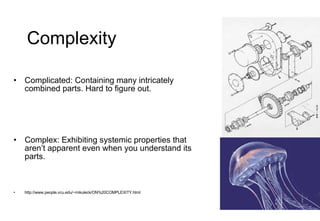
Complexity Complicated: Containing many intricately combined parts. Hard to figure out. Complex: Exhibiting systemic properties that aren’t apparent even when you understand its parts. http://www.people.vcu.edu/~mikuleck/ON%20COMPLEXITY.html
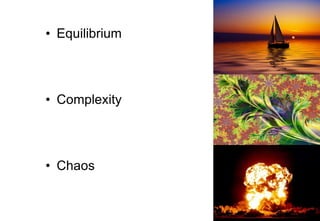
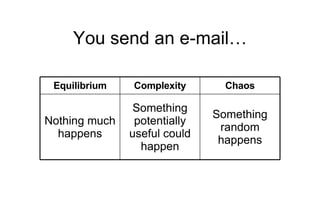
Equilibrium Complexity Chaos
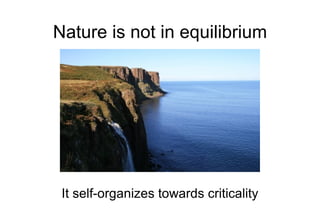
Nature is not in equilibrium It self-organizes towards criticality
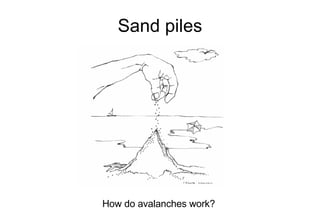
Sand piles How do avalanches work?
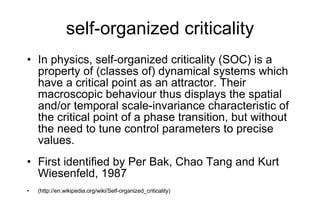
self-organized criticality In physics, self-organized criticality (SOC) is a property of (classes of) dynamical systems which have a critical point as an attractor. Their macroscopic behaviour thus displays the spatial and/or temporal scale-invariance characteristic of the critical point of a phase transition, but without the need to tune control parameters to precise values. First identified by Per Bak, Chao Tang and Kurt Wiesenfeld, 1987 (http://en.wikipedia.org/wiki/Self-organized_criticality)
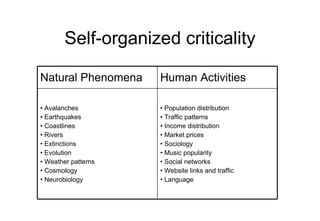
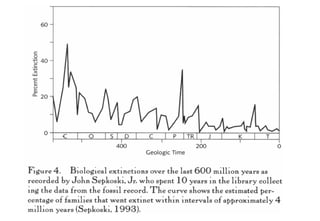
Self-organized criticality Population distribution Traffic patterns Income distribution Market prices Sociology Music popularity Social networks Website links and traffic Language Avalanches Earthquakes Coastlines Rivers Extinctions Evolution Weather patterns Cosmology Neurobiology Human Activities Natural Phenomena
 
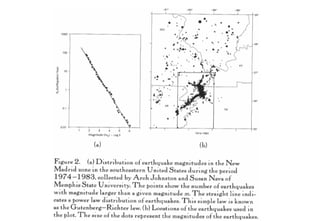
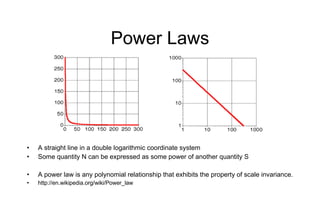
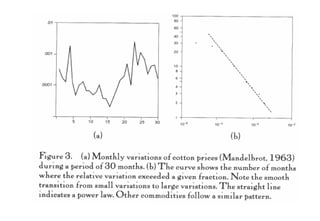
Power Laws A straight line in a double logarithmic coordinate system Some quantity N can be expressed as some power of another quantity S A power law is any polynomial relationship that exhibits the property of scale invariance. http://en.wikipedia.org/wiki/Power_law
 
 
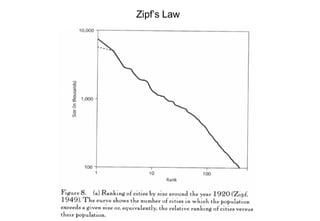
Zipf’s Law
 
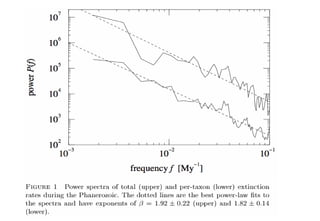
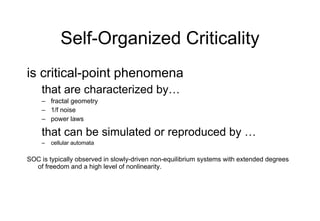
Self-Organized Criticality is critical-point phenomena that are characterized by… fractal geometry 1/f noise power laws that can be simulated or reproduced by … cellular automata SOC is typically observed in slowly-driven non-equilibrium systems with extended degrees of freedom and a high level of nonlinearity.
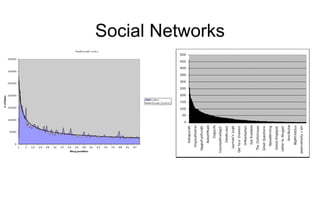
Social Networks
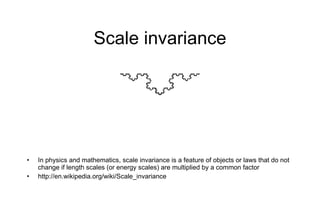
Scale invariance In physics and mathematics, scale invariance is a feature of objects or laws that do not change if length scales (or energy scales) are multiplied by a common factor http://en.wikipedia.org/wiki/Scale_invariance
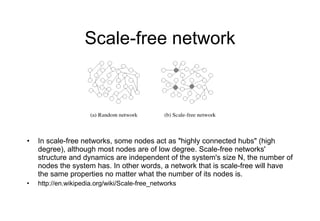
Scale-free network In scale-free networks, some nodes act as "highly connected hubs" (high degree), although most nodes are of low degree. Scale-free networks' structure and dynamics are independent of the system's size N, the number of nodes the system has. In other words, a network that is scale-free will have the same properties no matter what the number of its nodes is. http://en.wikipedia.org/wiki/Scale-free_networks
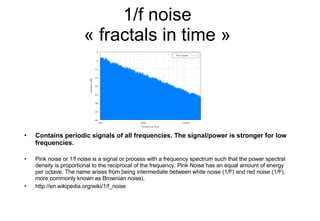
1/f noise « fractals in time » Contains periodic signals of all frequencies. The signal/power is stronger for low frequencies. Pink noise or 1/f noise is a signal or process with a frequency spectrum such that the power spectral density is proportional to the reciprocal of the frequency. Pink Noise has an equal amount of energy per octave. The name arises from being intermediate between white noise (1/f 0 ) and red noise (1/f 2 ), more commonly known as Brownian noise). http://en.wikipedia.org/wiki/1/f_noise
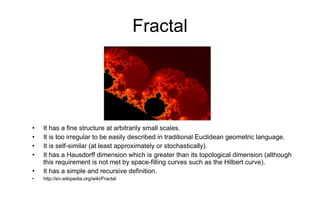
Fractal It has a fine structure at arbitrarily small scales. It is too irregular to be easily described in traditional Euclidean geometric language. It is self-similar (at least approximately or stochastically). It has a Hausdorff dimension which is greater than its topological dimension (although this requirement is not met by space-filling curves such as the Hilbert curve). It has a simple and recursive definition. http://en.wikipedia.org/wiki/Fractal
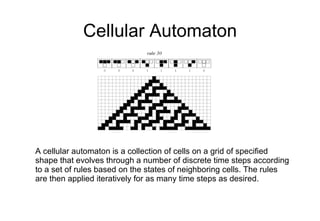
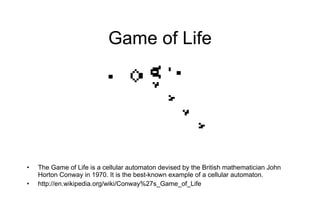
Cellular Automaton A cellular automaton is a collection of cells on a grid of specified shape that evolves through a number of discrete time steps according to a set of rules based on the states of neighboring cells. The rules are then applied iteratively for as many time steps as desired.
Game of Life The Game of Life is a cellular automaton devised by the British mathematician John Horton Conway in 1970. It is the best-known example of a cellular automaton. http://en.wikipedia.org/wiki/Conway%27s_Game_of_Life
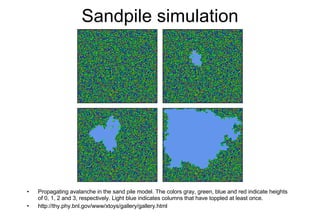
Sandpile simulation Propagating avalanche in the sand pile model. The colors gray, green, blue and red indicate heights of 0, 1, 2 and 3, respectively. Light blue indicates columns that have toppled at least once. http://thy.phy.bnl.gov/www/xtoys/gallery/gallery.html
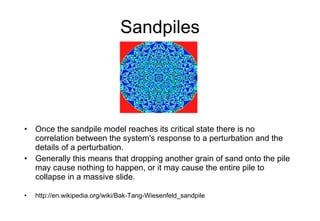
Sandpiles Once the sandpile model reaches its critical state there is no correlation between the system's response to a perturbation and the details of a perturbation.  Generally this means that dropping another grain of sand onto the pile may cause nothing to happen, or it may cause the entire pile to collapse in a massive slide. http://en.wikipedia.org/wiki/Bak-Tang-Wiesenfeld_sandpile
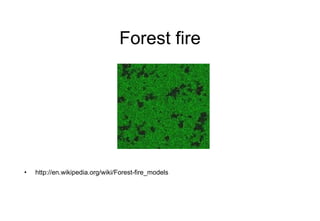
Forest fire http://en.wikipedia.org/wiki/Forest-fire_models
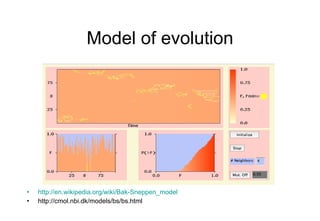
Model of evolution http://en.wikipedia.org/wiki/Bak-Sneppen_model http://cmol.nbi.dk/models/bs/bs.html
Dynamic Efficiency « The critical state is the most efficient state that can actually be reached dynamically. » - Per Bak
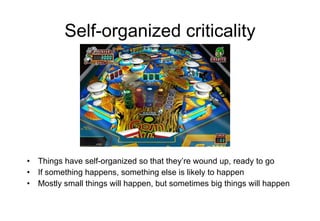
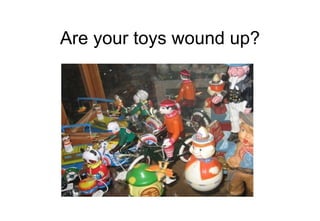
Self-organized criticality Things have self-organized so that they’re wound up, ready to go If something happens, something else is likely to happen Mostly small things will happen, but sometimes big things will happen
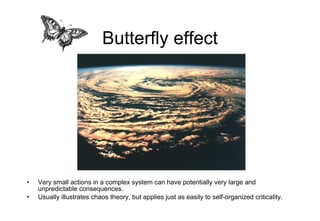
Butterfly effect Very small actions in a complex system can have potentially very large and unpredictable consequences. Usually illustrates chaos theory, but applies just as easily to self-organized criticality.
You send an e-mail… Something random happens Something potentially useful could happen Nothing much happens Chaos Complexity Equilibrium
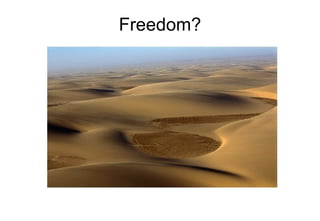
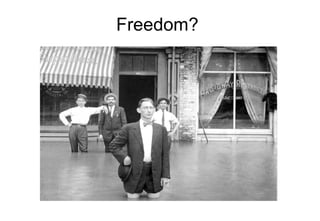
What does that have to do with freedom?
Freedom the ability to act in accordance with the dictates of reason; the ability to act in accordance with one's own true self or values; the ability to act in accordance with universal values (such as the True and the Good); and the ability to act independently of both the dictates of reason and the urges of desires, i.e. arbitrarily (autonomously). http://en.wikipedia.org/wiki/Freedom_(philosophy)
Degrees of Freedom Degrees of freedom is a general term used in explaining dependence on parameters, and implying the possibility of counting the number of those parameters. In mathematical terms, the degrees of freedom are the dimensions of a phase space.
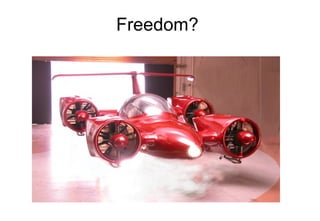
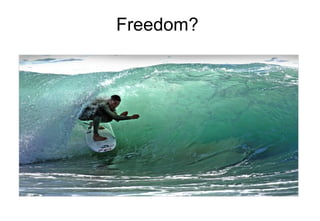
Freedom The potential to do small actions that make a big (positive) difference Degree of leverage (amplification) in your choices Degree to which you’re in the right place at the right time, and the right things happen
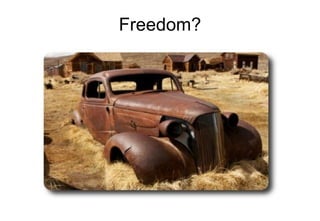
Freedom?
Freedom?
Freedom?
Freedom?
Freedom?
Are your toys wound up?
My Theory You have more freedom within a complex network Your freedom is potentially more useful if the network is in a critical state The value of a network is proportional to its complexity
Sarnoff’s Law The value of a (broadcast) network is proportional to the number of members (listeners, viewers) David Sarnoff, ~1930 http://en.wikipedia.org/wiki/Sarnoff%27s_law
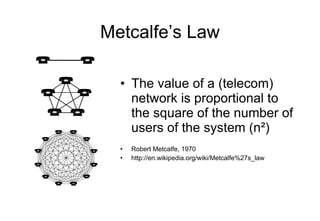
Metcalfe’s Law The value of a (telecom) network is proportional to the square of the number of users of the system (n²) Robert Metcalfe, 1970 http://en.wikipedia.org/wiki/Metcalfe%27s_law
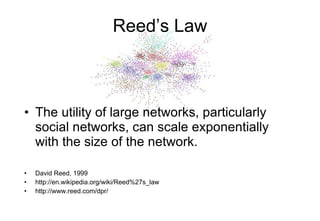
Reed’s Law The utility of large networks, particularly social networks, can scale exponentially with the size of the network. David Reed, 1999 http://en.wikipedia.org/wiki/Reed%27s_law http://www.reed.com/dpr/
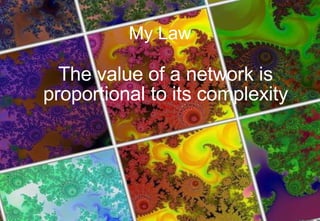
My Law The value of a network is proportional to its complexity
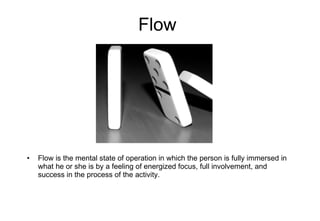
Flow Flow is the mental state of operation in which the person is fully immersed in what he or she is by a feeling of energized focus, full involvement, and success in the process of the activity.
The Edge Freedom is on the edge - the edge between equilibrium and chaos The edge is potentially dangerous, but it is stable, although constantly evolving
Freedom Not all freedom is worth having The freedom you want is where you have the most options, and you get the most bang for your buck The usefulness of freedom depends on the complexity of the system around you
 
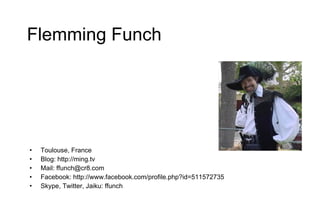
Flemming Funch Toulouse, France Blog: http://ming.tv Mail: ffunch@cr8.com Facebook: http://www.facebook.com/profile.php?id=511572735 Skype, Twitter, Jaiku: ffunch

Complexity and Freedom

  • 1.
    Complexity and FreedomLessons from nature about human networks and life on the edge
  • 2.
    Complexity Complicated: Containingmany intricately combined parts. Hard to figure out. Complex: Exhibiting systemic properties that aren’t apparent even when you understand its parts. http://www.people.vcu.edu/~mikuleck/ON%20COMPLEXITY.html
  • 3.
  • 4.
    Nature is notin equilibrium It self-organizes towards criticality
  • 5.
    Sand piles Howdo avalanches work?
  • 6.
    self-organized criticality Inphysics, self-organized criticality (SOC) is a property of (classes of) dynamical systems which have a critical point as an attractor. Their macroscopic behaviour thus displays the spatial and/or temporal scale-invariance characteristic of the critical point of a phase transition, but without the need to tune control parameters to precise values. First identified by Per Bak, Chao Tang and Kurt Wiesenfeld, 1987 (http://en.wikipedia.org/wiki/Self-organized_criticality)
  • 7.
    Self-organized criticality Populationdistribution Traffic patterns Income distribution Market prices Sociology Music popularity Social networks Website links and traffic Language Avalanches Earthquakes Coastlines Rivers Extinctions Evolution Weather patterns Cosmology Neurobiology Human Activities Natural Phenomena
  • 8.
  • 9.
    Power Laws Astraight line in a double logarithmic coordinate system Some quantity N can be expressed as some power of another quantity S A power law is any polynomial relationship that exhibits the property of scale invariance. http://en.wikipedia.org/wiki/Power_law
  • 10.
  • 11.
  • 12.
  • 13.
  • 14.
    Self-Organized Criticality iscritical-point phenomena that are characterized by… fractal geometry 1/f noise power laws that can be simulated or reproduced by … cellular automata SOC is typically observed in slowly-driven non-equilibrium systems with extended degrees of freedom and a high level of nonlinearity.
  • 15.
  • 16.
    Scale invariance Inphysics and mathematics, scale invariance is a feature of objects or laws that do not change if length scales (or energy scales) are multiplied by a common factor http://en.wikipedia.org/wiki/Scale_invariance
  • 17.
    Scale-free network Inscale-free networks, some nodes act as "highly connected hubs" (high degree), although most nodes are of low degree. Scale-free networks' structure and dynamics are independent of the system's size N, the number of nodes the system has. In other words, a network that is scale-free will have the same properties no matter what the number of its nodes is. http://en.wikipedia.org/wiki/Scale-free_networks
  • 18.
    1/f noise « fractalsin time » Contains periodic signals of all frequencies. The signal/power is stronger for low frequencies. Pink noise or 1/f noise is a signal or process with a frequency spectrum such that the power spectral density is proportional to the reciprocal of the frequency. Pink Noise has an equal amount of energy per octave. The name arises from being intermediate between white noise (1/f 0 ) and red noise (1/f 2 ), more commonly known as Brownian noise). http://en.wikipedia.org/wiki/1/f_noise
  • 19.
    Fractal It hasa fine structure at arbitrarily small scales. It is too irregular to be easily described in traditional Euclidean geometric language. It is self-similar (at least approximately or stochastically). It has a Hausdorff dimension which is greater than its topological dimension (although this requirement is not met by space-filling curves such as the Hilbert curve). It has a simple and recursive definition. http://en.wikipedia.org/wiki/Fractal
  • 20.
    Cellular Automaton Acellular automaton is a collection of cells on a grid of specified shape that evolves through a number of discrete time steps according to a set of rules based on the states of neighboring cells. The rules are then applied iteratively for as many time steps as desired.
  • 21.
    Game of LifeThe Game of Life is a cellular automaton devised by the British mathematician John Horton Conway in 1970. It is the best-known example of a cellular automaton. http://en.wikipedia.org/wiki/Conway%27s_Game_of_Life
  • 22.
    Sandpile simulation Propagatingavalanche in the sand pile model. The colors gray, green, blue and red indicate heights of 0, 1, 2 and 3, respectively. Light blue indicates columns that have toppled at least once. http://thy.phy.bnl.gov/www/xtoys/gallery/gallery.html
  • 23.
    Sandpiles Once thesandpile model reaches its critical state there is no correlation between the system's response to a perturbation and the details of a perturbation. Generally this means that dropping another grain of sand onto the pile may cause nothing to happen, or it may cause the entire pile to collapse in a massive slide. http://en.wikipedia.org/wiki/Bak-Tang-Wiesenfeld_sandpile
  • 24.
  • 25.
    Model of evolutionhttp://en.wikipedia.org/wiki/Bak-Sneppen_model http://cmol.nbi.dk/models/bs/bs.html
  • 26.
    Dynamic Efficiency « Thecritical state is the most efficient state that can actually be reached dynamically. » - Per Bak
  • 27.
    Self-organized criticality Thingshave self-organized so that they’re wound up, ready to go If something happens, something else is likely to happen Mostly small things will happen, but sometimes big things will happen
  • 28.
    Butterfly effect Verysmall actions in a complex system can have potentially very large and unpredictable consequences. Usually illustrates chaos theory, but applies just as easily to self-organized criticality.
  • 29.
    You send ane-mail… Something random happens Something potentially useful could happen Nothing much happens Chaos Complexity Equilibrium
  • 30.
    What does thathave to do with freedom?
  • 31.
    Freedom the abilityto act in accordance with the dictates of reason; the ability to act in accordance with one's own true self or values; the ability to act in accordance with universal values (such as the True and the Good); and the ability to act independently of both the dictates of reason and the urges of desires, i.e. arbitrarily (autonomously). http://en.wikipedia.org/wiki/Freedom_(philosophy)
  • 32.
    Degrees of FreedomDegrees of freedom is a general term used in explaining dependence on parameters, and implying the possibility of counting the number of those parameters. In mathematical terms, the degrees of freedom are the dimensions of a phase space.
  • 33.
    Freedom The potentialto do small actions that make a big (positive) difference Degree of leverage (amplification) in your choices Degree to which you’re in the right place at the right time, and the right things happen
  • 34.
  • 35.
  • 36.
  • 37.
  • 38.
  • 39.
    Are your toyswound up?
  • 40.
    My Theory Youhave more freedom within a complex network Your freedom is potentially more useful if the network is in a critical state The value of a network is proportional to its complexity
  • 41.
    Sarnoff’s Law Thevalue of a (broadcast) network is proportional to the number of members (listeners, viewers) David Sarnoff, ~1930 http://en.wikipedia.org/wiki/Sarnoff%27s_law
  • 42.
    Metcalfe’s Law Thevalue of a (telecom) network is proportional to the square of the number of users of the system (n²) Robert Metcalfe, 1970 http://en.wikipedia.org/wiki/Metcalfe%27s_law
  • 43.
    Reed’s Law Theutility of large networks, particularly social networks, can scale exponentially with the size of the network. David Reed, 1999 http://en.wikipedia.org/wiki/Reed%27s_law http://www.reed.com/dpr/
  • 44.
    My Law Thevalue of a network is proportional to its complexity
  • 45.
    Flow Flow isthe mental state of operation in which the person is fully immersed in what he or she is by a feeling of energized focus, full involvement, and success in the process of the activity.
  • 46.
    The Edge Freedomis on the edge - the edge between equilibrium and chaos The edge is potentially dangerous, but it is stable, although constantly evolving
  • 47.
    Freedom Not allfreedom is worth having The freedom you want is where you have the most options, and you get the most bang for your buck The usefulness of freedom depends on the complexity of the system around you
  • 48.
  • 49.
    Flemming Funch Toulouse,France Blog: http://ming.tv Mail: ffunch@cr8.com Facebook: http://www.facebook.com/profile.php?id=511572735 Skype, Twitter, Jaiku: ffunch