More Related Content

PPTX
Complement system and its synthesis + activation 
PPTX
Complement pathways microbiology .pptx 
PPTX
Complement pathways for MBBS AHS NURSING students. 
PPTX
Complement presentation immunity mi.pptx 
PPTX

PPTX
complementsystemsssssssssssssssssss.pptx 
PPTX

PPTX
Complement System: Pathways, Regulations and biological effects.pptx Similar to Complement system in microbiology -by dr sadhana

PPTX

PPTX
Complement System.pptx by Dr. Rakesh Prasad Sah 
PPTX
Complement System and clinical aspects . 
PPTX
complement system types and pathway pptx 
PPTX
complement system and characteristics of CS 
PPT
Complement System microbiologyyy…………………. 
PPT

PPTX
MBBS CLASS Antigen and antibody imp.pptx 
PPTX

PPTX

PDF
Ranu. Ppt.pdf of physiology topic 
PDF
Complement system and cytokines 
PPTX

PPTX

PPTX

PPTX

PDF
Compliment system, Cellular immunity and Humoral immunity, Immune mechanism... 
PDF
M 5 complement system by Dr vimal prakash 
PPTX
Ch 6 the_complement_system 
PPTX
2 . COMPLEMEfbfhghgrghgrrgthtrh5tgrNT.pptx Recently uploaded

PDF
Advanced Prostate Cancer: Symptoms, Progression & Treatment Options 
PDF
Gastrointestinal Infection PCR Panel Diagnostic Screen 
PDF
GLP-1 Optimization Protocol to Prevent Muscle Loss 
PDF
Autoimmune diseases in children and anesthesia. Dalamagka, Maria 
PPTX
Neonatal Perioperative Care Pediatric Surgeons Perspective.pptx 
PDF
Neuro and Radiant oncology and anaesthesia considerations 
PPTX
Clinical Clerkship Case Presentation on Patient Care and Management (Pharm D) 
PDF
4_5857478915135641976.pdf physiology of menstruation 
PPTX
Malignant focal liver lesions: A Radiologist's Perspective 
PPTX
Human Excretory System (RIT): Kidney Functions & Urine Formation Made Easy 
PPTX
BILIARY TREE RADIOLOGY ADVANCE IMAGING (USG, CT SCAN, MRI AND ERCP) OF ITS AN... 
PPTX
Drug use evaluation and WHO drug use Indicators.pptx 
PDF
From Classification to Collaboration: Applying the International Classificati... 
PPTX
Anaesthesia in Hypertension (anaesthesia in intercurrent diseases) 
PPTX
anatomy and physiology of brain and its parts 
PPTX
metabolic syndrome and fasting ( Dr Mohammed bamashmos , sana'a University) .... 
PPTX
Human Digestive System (RIT): Physiology, Digestion & Absorption Explained 
PDF
Retinoscopy & It's Principle - static vs dynamic retinoscopy in detail 
PPTX
Biostatistics- Data types and presentation 
PPTX
Easy Peasy Gut: Complete Digestive Support Complement system in microbiology -by dr sadhana
- 1.
- 2.
Essentials of MedicalMicrobiology by Apurba S Sastry © Jaypee Brothers Medical Publishers
COMPLEMENT
Represents a group of proteins normally found in serum in inactive
form, but when activated they augment the immune responses.
Complements constitute about 5% of normal serum proteins.
Their level does not increase following either infection or
vaccination.
2
- 3.
Essentials of MedicalMicrobiology by Apurba S Sastry © Jaypee Brothers Medical Publishers
General properties
Bind to Fc region of antibody
Role of antigen
Species nonspecific
Heat labile
3
- 4.
Essentials of MedicalMicrobiology by Apurba S Sastry © Jaypee Brothers Medical Publishers
Complement Components
Complement system comprises of about 30 serum proteins grouped
into complement components, the properdin system and the
regulatory proteins.
Complement components are named by numerals. There are nine
components; C1 to C9. C1 has three subunits- C1q, C1r and C1s.
Properdin system and the regulatory proteins are named by letter
symbols, e.g., factor-B
4
- 5.
Essentials of MedicalMicrobiology by Apurba S Sastry © Jaypee Brothers Medical Publishers
Synthesis
Liver is the major site of synthesis of complement proteins.
Minor sites include blood monocytes, tissue macrophages, and
epithelial cells of GIT and genitourinary tract.
5
- 6.
Essentials of MedicalMicrobiology by Apurba S Sastry © Jaypee Brothers Medical Publishers
Complement Activation
All the complement proteins are synthesized in inactive form (e.g.
zymogens) and are activated by proteolysis.
Complements have two unequal fragments (large and small
fragment).
The larger fragments are usually designated as ‘b’ (e.g. C3b) and the
smaller fragments are designated as ‘a’ (e.g. C3a). An exception is
C2a which is larger fragment. 6
- 7.
Essentials of MedicalMicrobiology by Apurba S Sastry © Jaypee Brothers Medical Publishers
Complement Activation (Cont..)
During proteolysis, the smaller fragment is removed exposing the
active site of the larger fragment.
The larger fragment participates in the cascade reaction of
complement pathway and the smaller fragment diffuses away to
mediate other functions.
7
- 8.
Essentials of MedicalMicrobiology by Apurba S Sastry © Jaypee Brothers Medical Publishers
Complement Activation (Cont..)
Cascade reaction- Fragments of complements interact in a definite
sequential manner with a cascade like effect, which leads to
formation of complex. Such complex having enzymatic activity is
designated by putting a bar over the number or symbol
(e.g. C 3bBb).
8
- 9.
- 10.
Essentials of MedicalMicrobiology by Apurba S Sastry © Jaypee Brothers Medical Publishers
COMPLEMENT PATHWAYS
Classical pathway- Antibody dependent pathway. Pathway is
triggered by the antigen antibody complex formation.
Alternative pathway- Antibody independent pathway, triggered by
the antigen directly.
Lectin pathway - recently described pathway. It resembles classical
pathway but it is antibody independent.
10
- 11.
Essentials of MedicalMicrobiology by Apurba S Sastry © Jaypee Brothers Medical Publishers
Stages of complement activation
There are four main stages in the activation of any of the
complement pathways.
Initiation of the pathway
Formation of C3 convertase
Formation of C5 convertase
Formation of membrane attack complex (MAC)
11
- 12.
Essentials of MedicalMicrobiology by Apurba S Sastry © Jaypee Brothers Medical Publishers
Stages of complement activation
(Cont..)
All the three pathways differ from each other in their initiation till
formation of C3 convertase. Then, the remaining stages are identical
in all the pathways.
12
- 13.
Essentials of MedicalMicrobiology by Apurba S Sastry © Jaypee Brothers Medical Publishers
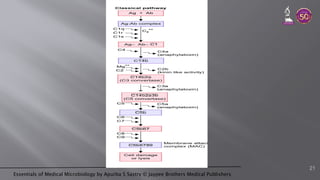
Classical Pathway
Antibody dependent
Not all antibodies can bind to complements of classical pathway.
Decreasing order of ability of antibodies to fix complement is- IgM
(most potent) > IgG3> IgG 1> IgG2.
The other classes of antibodies do not fix complements. CH2 domain
on IgG, CH4 on IgM participate in complement binding.
The classical pathway begins with activation of C1 and binding to
antigen-antibody complex.
13
- 14.
Essentials of MedicalMicrobiology by Apurba S Sastry © Jaypee Brothers Medical Publishers
Initiation
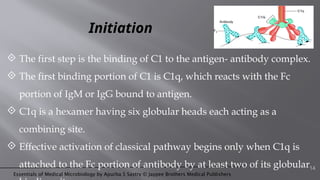
The first step is the binding of C1 to the antigen- antibody complex.
The first binding portion of C1 is C1q, which reacts with the Fc
portion of IgM or IgG bound to antigen.
C1q is a hexamer having six globular heads each acting as a
combining site.
Effective activation of classical pathway begins only when C1q is
attached to the Fc portion of antibody by at least two of its globular14
- 15.
Essentials of MedicalMicrobiology by Apurba S Sastry © Jaypee Brothers Medical Publishers
Initiation (Cont..)
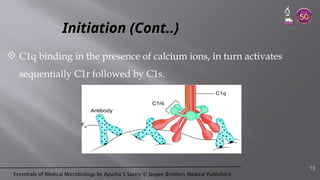
C1q binding in the presence of calcium ions, in turn activates
sequentially C1r followed by C1s.
15
- 16.
Essentials of MedicalMicrobiology by Apurba S Sastry © Jaypee Brothers Medical Publishers
Formation of C3 Convertase
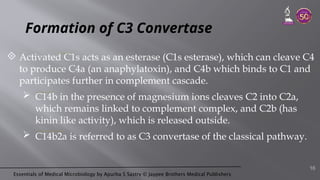
Activated C1s acts as an esterase (C1s esterase), which can cleave C4
to produce C4a (an anaphylatoxin), and C4b which binds to C1 and
participates further in complement cascade.
C14b in the presence of magnesium ions cleaves C2 into C2a,
which remains linked to complement complex, and C2b (has
kinin like activity), which is released outside.
C14b2a is referred to as C3 convertase of the classical pathway.
16
- 17.
Essentials of MedicalMicrobiology by Apurba S Sastry © Jaypee Brothers Medical Publishers
Formation of C5 Convertase
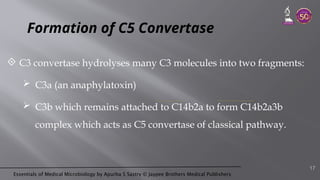
C3 convertase hydrolyses many C3 molecules into two fragments:
C3a (an anaphylatoxin)
C3b which remains attached to C14b2a to form C14b2a3b
complex which acts as C5 convertase of classical pathway.
17
- 18.
Essentials of MedicalMicrobiology by Apurba S Sastry © Jaypee Brothers Medical Publishers
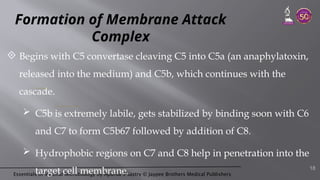
Formation of Membrane Attack
Complex
Begins with C5 convertase cleaving C5 into C5a (an anaphylatoxin,
released into the medium) and C5b, which continues with the
cascade.
C5b is extremely labile, gets stabilized by binding soon with C6
and C7 to form C5b67 followed by addition of C8.
Hydrophobic regions on C7 and C8 help in penetration into the
target cell membrane. 18
- 19.
Essentials of MedicalMicrobiology by Apurba S Sastry © Jaypee Brothers Medical Publishers
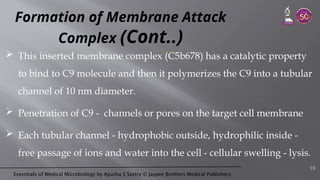
Formation of Membrane Attack
Complex (Cont..)
This inserted membrane complex (C5b678) has a catalytic property
to bind to C9 molecule and then it polymerizes the C9 into a tubular
channel of 10 nm diameter.
Penetration of C9 - channels or pores on the target cell membrane
Each tubular channel - hydrophobic outside, hydrophilic inside -
free passage of ions and water into the cell - cellular swelling - lysis.
19
- 20.
Essentials of MedicalMicrobiology by Apurba S Sastry © Jaypee Brothers Medical Publishers
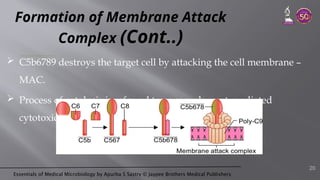
Formation of Membrane Attack
Complex (Cont..)
C5b6789 destroys the target cell by attacking the cell membrane –
MAC.
Process of cytolysis is referred to as complement-mediated
cytotoxicity.
20
- 21.
- 22.
Essentials of MedicalMicrobiology by Apurba S Sastry © Jaypee Brothers Medical Publishers
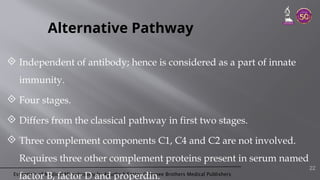
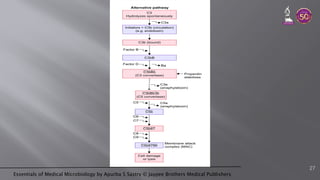
Alternative Pathway
Independent of antibody; hence is considered as a part of innate
immunity.
Four stages.
Differs from the classical pathway in first two stages.
Three complement components C1, C4 and C2 are not involved.
Requires three other complement proteins present in serum named
factor B, factor D and properdin.
22
- 23.
Essentials of MedicalMicrobiology by Apurba S Sastry © Jaypee Brothers Medical Publishers
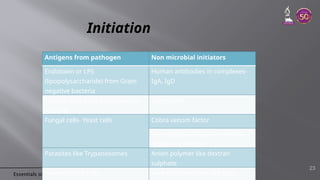
Initiation
23
Antigens from pathogen Non microbial initiators
Endotoxin or LPS
(lipopolysaccharide) from Gram
negative bacteria
Human antibodies in complexes-
IgA, IgD
Teichoic acid from Gram positive
bacteria
Tumor cells
Fungal cells- Yeast cells Cobra venom factor
Heterologous RBCs from mouse,
rabbit and chicken
Parasites like Trypanosomes Anion polymer like dextran
sulphate
Virus infected cells Pure carbohydrates like agar,
- 24.
Essentials of MedicalMicrobiology by Apurba S Sastry © Jaypee Brothers Medical Publishers
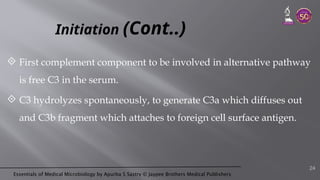
Initiation (Cont..)
First complement component to be involved in alternative pathway
is free C3 in the serum.
C3 hydrolyzes spontaneously, to generate C3a which diffuses out
and C3b fragment which attaches to foreign cell surface antigen.
24
- 25.
Essentials of MedicalMicrobiology by Apurba S Sastry © Jaypee Brothers Medical Publishers
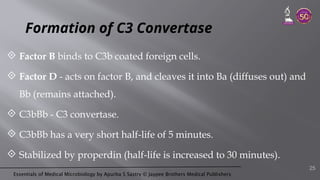
Formation of C3 Convertase
Factor B binds to C3b coated foreign cells.
Factor D - acts on factor B, and cleaves it into Ba (diffuses out) and
Bb (remains attached).
C3bBb - C3 convertase.
C3bBb has a very short half-life of 5 minutes.
Stabilized by properdin (half-life is increased to 30 minutes).
25
- 26.
Essentials of MedicalMicrobiology by Apurba S Sastry © Jaypee Brothers Medical Publishers
Alternative Pathway (Cont..)
Formation of C5 convertase and formation of membrane attack
complex - identical to that of classical pathway.
26
- 27.
- 28.
Essentials of MedicalMicrobiology by Apurba S Sastry © Jaypee Brothers Medical Publishers
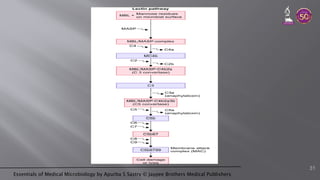
Lectin Pathway
Complement pathway of innate immunity -works independent of
antibody.
Mediated through lectin proteins of the host that interact with
mannose residues present on microbial surface.
Lectin pathway involves all complement components used for
classical pathways except C1.
Instead of C1, host lectin protein called mannose binding lectins
mediate the first ‘initiation’ stage.
28
- 29.
Essentials of MedicalMicrobiology by Apurba S Sastry © Jaypee Brothers Medical Publishers
Initiation
Activation - Mannose carbohydrate residues of glycoproteins
present on microbial surfaces.
Mannsoe binding lectins (MBL) bind to mannose residues on
microbial surface.
MBL is an acute phase reactant protein, similar to C1q in structure.
29
- 30.
Essentials of MedicalMicrobiology by Apurba S Sastry © Jaypee Brothers Medical Publishers
Initiation (Cont..)
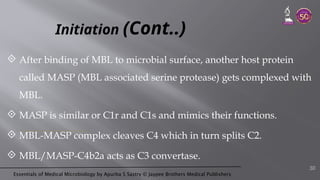
After binding of MBL to microbial surface, another host protein
called MASP (MBL associated serine protease) gets complexed with
MBL.
MASP is similar or C1r and C1s and mimics their functions.
MBL-MASP complex cleaves C4 which in turn splits C2.
MBL/MASP-C4b2a acts as C3 convertase.
30
- 31.
- 32.
Essentials of MedicalMicrobiology by Apurba S Sastry © Jaypee Brothers Medical Publishers
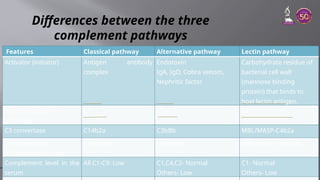
Differences between the three
complement pathways
32
Features Classical pathway Alternative pathway Lectin pathway
Activator (initiator) Antigen antibody
complex
Endotoxin
IgA, IgD, Cobra venom,
Nephritic factor
Carbohydrate residue of
bacterial cell wall
(mannose binding
protein) that binds to
host lectin antigen.
Firstcomplement
activated
C1 C3b C4
C3 convertase C14b2a C3bBb MBL/MASP-C4b2a
C5 convertase
(C3 convertase + 3b)
C14b2a3b C3bBb3b MBL/MASP-C4b2a3b
Complement level in the
serum
All C1-C9: Low C1,C4,C2- Normal
Others- Low
C1- Normal
Others- Low
- 33.
- 34.
Essentials of MedicalMicrobiology by Apurba S Sastry © Jaypee Brothers Medical Publishers
EFFECTOR FUNCTIONS OF
COMPLEMENT
MAC and other complement by-products produced during the
activation augment the immune response in many ways.
Target cell lysis by MAC
Inflammatory response
Opsonization
Removing the immune complexes from blood-
Viral neutralization
34
- 35.
Essentials of MedicalMicrobiology by Apurba S Sastry © Jaypee Brothers Medical Publishers
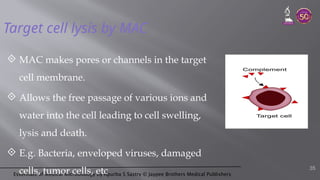
Target cell lysis by MAC
MAC makes pores or channels in the target
cell membrane.
Allows the free passage of various ions and
water into the cell leading to cell swelling,
lysis and death.
E.g. Bacteria, enveloped viruses, damaged
cells, tumor cells, etc 35
- 36.
Essentials of MedicalMicrobiology by Apurba S Sastry © Jaypee Brothers Medical Publishers
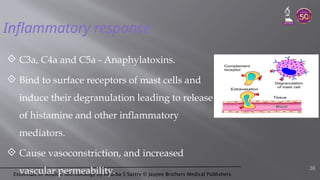
Inflammatory response
C3a, C4a and C5a - Anaphylatoxins.
Bind to surface receptors of mast cells and
induce their degranulation leading to release
of histamine and other inflammatory
mediators.
Cause vasoconstriction, and increased
vascular permeability. 36
- 37.
Essentials of MedicalMicrobiology by Apurba S Sastry © Jaypee Brothers Medical Publishers
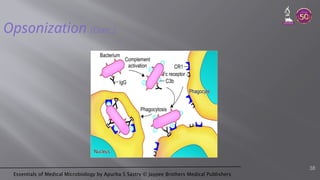
Opsonization
C3b and C4b - major opsonins - coat the immune complexes and
particulate antigens.
Phagocytic cells express complement receptors (CR1, CR3 and CR4)
for complement components (C3b, C4b).
Bind to complement coated antigens and enhance phagocytosis.
C5a - enhances the CR1 expression on phagocytes by 10 folds.
37
- 38.
Essentials of MedicalMicrobiology by Apurba S Sastry © Jaypee Brothers Medical Publishers
Opsonization (Cont..)
38
- 39.
Essentials of MedicalMicrobiology by Apurba S Sastry © Jaypee Brothers Medical Publishers
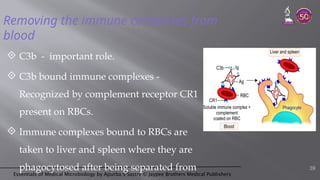
Removing the immune complexes from
blood
C3b - important role.
C3b bound immune complexes -
Recognized by complement receptor CR1
present on RBCs.
Immune complexes bound to RBCs are
taken to liver and spleen where they are
phagocytosed after being separated from 39
- 40.
Essentials of MedicalMicrobiology by Apurba S Sastry © Jaypee Brothers Medical Publishers
Viral neutralization
Complements coated on virus surfaces neutralize the viral
infectivity by blocking their attachment sites.
C3b mediated opsonization of viral particles
Lysis of the enveloped viruses by:
Activation of classical pathway (most viruses)
Alternative or lectin pathways (viruses like Epstein Barr virus,
rubella etc)
40
- 41.
- 42.
Essentials of MedicalMicrobiology by Apurba S Sastry © Jaypee Brothers Medical Publishers
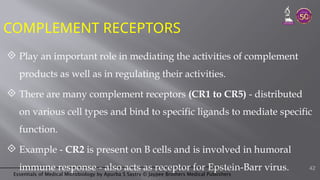
COMPLEMENT RECEPTORS
Play an important role in mediating the activities of complement
products as well as in regulating their activities.
There are many complement receptors (CR1 to CR5) - distributed
on various cell types and bind to specific ligands to mediate specific
function.
Example - CR2 is present on B cells and is involved in humoral
immune response - also acts as receptor for Epstein-Barr virus. 42
- 43.
- 44.
Essentials of MedicalMicrobiology by Apurba S Sastry © Jaypee Brothers Medical Publishers
EVASION OF COMPLEMENT SYSTEM
BY MICROORGANISMS
44
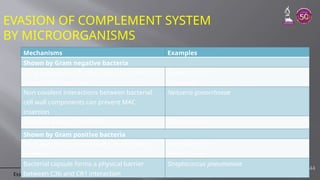
Mechanisms Examples
Shown by Gram negative bacteria
Long polysaccharide side chain of bacteria can
prevent MAC insertion
Escherichia coli
Salmonella
Non covalent interactions between bacterial
cell wall components can prevent MAC
insertion
Neisseria gonorrhoeae
Elastases destroy C3a & C5a Pseudomonas
Shown by Gram positive bacteria
Thick peptidoglycan cell wall prevents MAC
insertion
Staphylococcus
Streptococcus
Bacterial capsule forms a physical barrier
between C3b and CR1 interaction
Streptococcus pneumoniae
- 45.
Essentials of MedicalMicrobiology by Apurba S Sastry © Jaypee Brothers Medical Publishers
EVASION OF COMPLEMENT SYSTEM
BY MICROORGANISMS (Cont..)
45
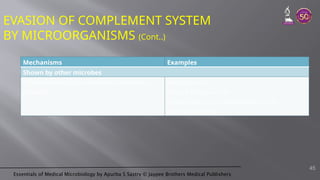
Mechanisms Examples
Shown by other microbes
Proteins mimicking complement regulatory
proteins
Vaccinia virus,
Herpes simplex virus,
Epstein-Barr virus, Trypanosoma cruzi,
Candida albicans
- 46.
- 47.
Essentials of MedicalMicrobiology by Apurba S Sastry © Jaypee Brothers Medical Publishers
REGULATION OF COMPLEMENT
PATHWAYS
Antigen non-specific.
Capable of attacking microorganisms as well as host cells.
Several regulatory mechanisms have evolved to restrict complement
activity only to the designated target cells.
There are a series of regulatory proteins, which inactivate various
complement components at different stages.
47
- 48.
Essentials of MedicalMicrobiology by Apurba S Sastry © Jaypee Brothers Medical Publishers
REGULATION OF COMPLEMENT
PATHWAYS (Cont..)
Examples:
C1 inhibitor (or C1 esterase inhibitor): soluble glycoprotein,
inhibits the action of C1q by splitting C1qrs into C1rs and C1q -
whole classical pathway is inhibited.
DAF (Decay accelerating factor):CD55 molecule present on cell
membrane, accelerates dissociation of C3 convertase - inhibiting all
three pathways. 48
- 49.
- 50.
Essentials of MedicalMicrobiology by Apurba S Sastry © Jaypee Brothers Medical Publishers
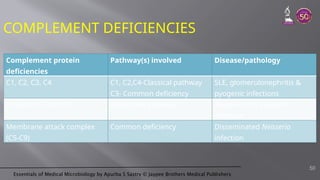
COMPLEMENT DEFICIENCIES
50
Complement protein
deficiencies
Pathway(s) involved Disease/pathology
C1, C2, C3, C4 C1, C2,C4-Classical pathway
C3- Common deficiency
SLE, glomerulonephritis &
pyogenic infections
Properdin, Factor D Alternative pathway Neisseria and pyogenic
infection
Membrane attack complex
(C5-C9)
Common deficiency Disseminated Neisseria
infection
- 51.
Essentials of MedicalMicrobiology by Apurba S Sastry © Jaypee Brothers Medical Publishers
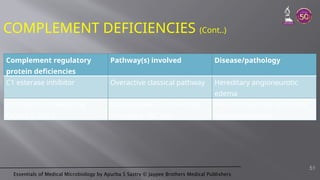
COMPLEMENT DEFICIENCIES (Cont..)
51
Complement regulatory
protein deficiencies
Pathway(s) involved Disease/pathology
C1 esterase inhibitor Overactive classical pathway Hereditary angioneurotic
edema
DAF (Decay accelerating
factor) & CD59
Deregulated C3 convertase
Increased RBC lysis
PNH (Paroxysmal nocturnal
hemoglobinurea)
- 52.