Comparative analysis of
  Target VS. Costco
            By:
      Francisco Lopez
        Victor Fung
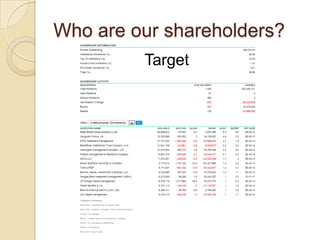
Who are our shareholders?
         Target
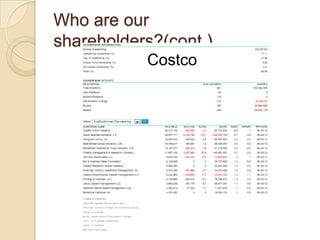
Who are our
shareholders?(cont.)
           Costco
Why do investors care about
      capital structure?
           Advantages of debt
 Tax deductions - Principal and interest
  payments can be classified as
  business expenses and therefore be
  used as a deduction on income taxes.
 Maintained ownership - Business is
  only obligated to pay payments to
  lender. Lender has no say on business
  direction or practices
Why do investors care about
   capital structure?(cont.)
         Disadvantages of debt
 Repayment - Even if company goes
  bankrupt, still obligated to pay the
  debt.
 Decreased bond ratings
 Liquidity - If the loan is being used to
  invest in a non-liquid asset, the
  company must ensure it has sufficient
  cash flows when the loan repayment
  period begins.
Why do investors care about
   capital structure?(cont.)
          Advantages of equity
 No service costs for bank loans or
  debt finance
 Investors share interest in business
  success, helps explore & execute
  growth ideas
 Investors often prepared to provide
  follow-up funding as business grows
Why do investors care about
   capital structure?(cont.)
        Disadvantages of equity
 Costly, time consuming, and may take
  management focus away from core
  strategies
 Lose some control of business
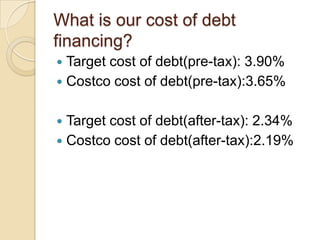
What is our cost of debt
financing?
 Target cost of debt(pre-tax): 3.90%
 Costco cost of debt(pre-tax):3.65%


 Target cost of debt(after-tax): 2.34%
 Costco cost of debt(after-tax):2.19%
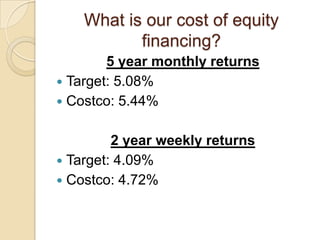
What is our cost of equity
           financing?
        5 year monthly returns
 Target: 5.08%
 Costco: 5.44%


         2 year weekly returns
 Target: 4.09%
 Costco: 4.72%
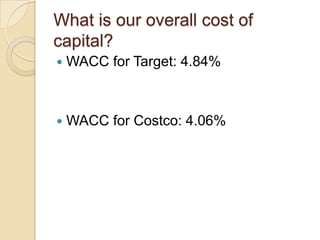
What is our overall cost of
capital?
   WACC for Target: 4.84%


   WACC for Costco: 4.06%
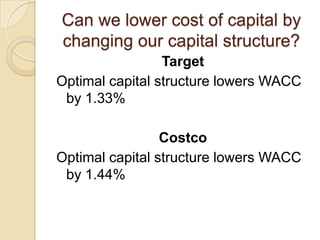
Can we lower cost of capital by
changing our capital structure?
                 Target
Optimal capital structure lowers WACC
 by 1.33%

                 Costco
Optimal capital structure lowers WACC
 by 1.44%
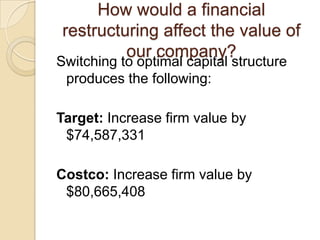
How would a financial
 restructuring affect the value of
          our company?
Switching to optimal capital structure
 produces the following:

Target: Increase firm value by
 $74,587,331

Costco: Increase firm value by
 $80,665,408
Would more debt create an
   unnecessary risk?
What do other companies do?
Is our stock price fairly
valued?
Which company is preferred?

Comparative analysis of costco target

  • 1.
    Comparative analysis of Target VS. Costco By: Francisco Lopez Victor Fung
  • 2.
    Who are ourshareholders? Target
  • 3.
  • 4.
    Why do investorscare about capital structure? Advantages of debt  Tax deductions - Principal and interest payments can be classified as business expenses and therefore be used as a deduction on income taxes.  Maintained ownership - Business is only obligated to pay payments to lender. Lender has no say on business direction or practices
  • 5.
    Why do investorscare about capital structure?(cont.) Disadvantages of debt  Repayment - Even if company goes bankrupt, still obligated to pay the debt.  Decreased bond ratings  Liquidity - If the loan is being used to invest in a non-liquid asset, the company must ensure it has sufficient cash flows when the loan repayment period begins.
  • 6.
    Why do investorscare about capital structure?(cont.) Advantages of equity  No service costs for bank loans or debt finance  Investors share interest in business success, helps explore & execute growth ideas  Investors often prepared to provide follow-up funding as business grows
  • 7.
    Why do investorscare about capital structure?(cont.) Disadvantages of equity  Costly, time consuming, and may take management focus away from core strategies  Lose some control of business
  • 8.
    What is ourcost of debt financing?  Target cost of debt(pre-tax): 3.90%  Costco cost of debt(pre-tax):3.65%  Target cost of debt(after-tax): 2.34%  Costco cost of debt(after-tax):2.19%
  • 9.
    What is ourcost of equity financing? 5 year monthly returns  Target: 5.08%  Costco: 5.44% 2 year weekly returns  Target: 4.09%  Costco: 4.72%
  • 10.
    What is ouroverall cost of capital?  WACC for Target: 4.84%  WACC for Costco: 4.06%
  • 11.
    Can we lowercost of capital by changing our capital structure? Target Optimal capital structure lowers WACC by 1.33% Costco Optimal capital structure lowers WACC by 1.44%
  • 12.
    How would afinancial restructuring affect the value of our company? Switching to optimal capital structure produces the following: Target: Increase firm value by $74,587,331 Costco: Increase firm value by $80,665,408
  • 13.
    Would more debtcreate an unnecessary risk?
  • 14.
    What do othercompanies do?
  • 15.
    Is our stockprice fairly valued?
  • 16.
    Which company ispreferred?

Editor's Notes

  • #3 The first question was asked, Who are the shareholders of our two companies? Target currently has over 655 million shares outstanding with 82.82% owned by institutions and 33% owned by top 10 institutions such as vanguard, fidelity, and JP Morgan.
  • #4 Costco on the other hand has only 432 million shares outstanding with around the same percentage of institutional ownership. A smaller amount of shares outstanding means that Costco’s stock price will fluctuate more. Nearly a third of Costco’s stocks are owned by top 10 institutions such as Berkshire Hathaway, Invesco, and Blackrock.
  • #5 So why do investors care about capital structure? A company’s capital structure is important because it can increase or decrease a firm’s value. The advantages of debt financing are that a company can reduce the amount of taxes necessary and that a firm can also maintain ownership by its management team.
  • #6 Debt financing also has its disadvantages. If a firm is highly leveraged it is almost always going to have a decreased bond rating. Liquidity is also a factor due to the fact that a firm may not have enough cash flows for an emergency or investment opportunity.
  • #7 If a company does not want to finance with debt, they may also use equity. Equity financing has the advantage of not having a service cost like a loan does. It is also much easier to get extra funding from investors that have already put money into your firm.
  • #8 Just like debt financing, equity financing also has its disadvantages. Equity financing is usually more expensive than debt financing. When a firm uses equity financing they must always be aware of investor perception. It is also important for a firm to keep the interests of their constituents in mind when making decisions.
  • #9 These are the numbers we have calculated for Target and Costco’s cost of debt. A company’s cost of debt is the effective interest rate a company pays on its debt. Costco currently pays less for debt financing compared to Target.
  • #10 These are the numbers we have calculated for Target and Costco’s cost of equity. Cost of equity is the return investors expect to receive for taking the risk of investing. As you can see, Target has a better cost of equity.
  • #11 The next question asked is, what is the overall cost of capital for our two companies? Target currently has a weighted average cost of capital of 4.84% whereas Costco has a weighted average cost of capital of 4.06%. Cost of capital is a measure of the return necessary to make a company a worthwhile investment.
  • #12 Both target and costco could benefit from a change in their capital structure. If Target were to switch to the optimal capital structure, they would lower their weighted average cost of capital by 1.33%, whereas Costco would be able to reduce their weighted average cost of capital by 1.44%.
  • #13 Both companies would benefit from a capital structure change. Target would increase their value by over 74 million and Costco would increase their company value by over 80 million.
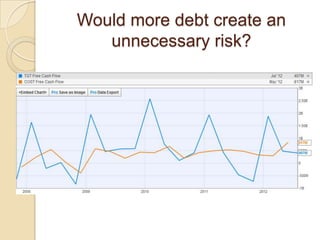
  • #14 Although debt financing usually offers a lower overall cost for financing, there is a certain amount of risk involved in financing with too much debt. As you can see from the graph, both companies have enough free cash flows to finance at least partially with equity. Increasing their capital structure with more debt may cause an unnecessary risk.
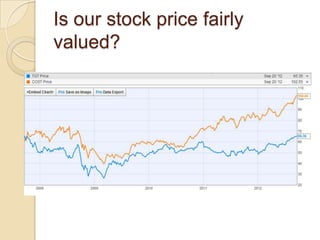
  • #16 As you can see from the graph,Costco’s stock has been increasing steadily in value over the last year and a half. We believe due to Costco’s high price earnings and excellent management strategy their stock price will continue to rise over the next year. Target’s stock on the other hand has remained steadily at the 55-65 range. We believe that Target will see an increase in stock price during the holiday season but will drop off due to the fact that Target has no catalyst to sustain their growth.
  • #17 The overall conclusion is that Costco is the preferred company. It is believed that Costco will not only see organic growth in their company, but will also benefit from increased stock prices over the next few years.