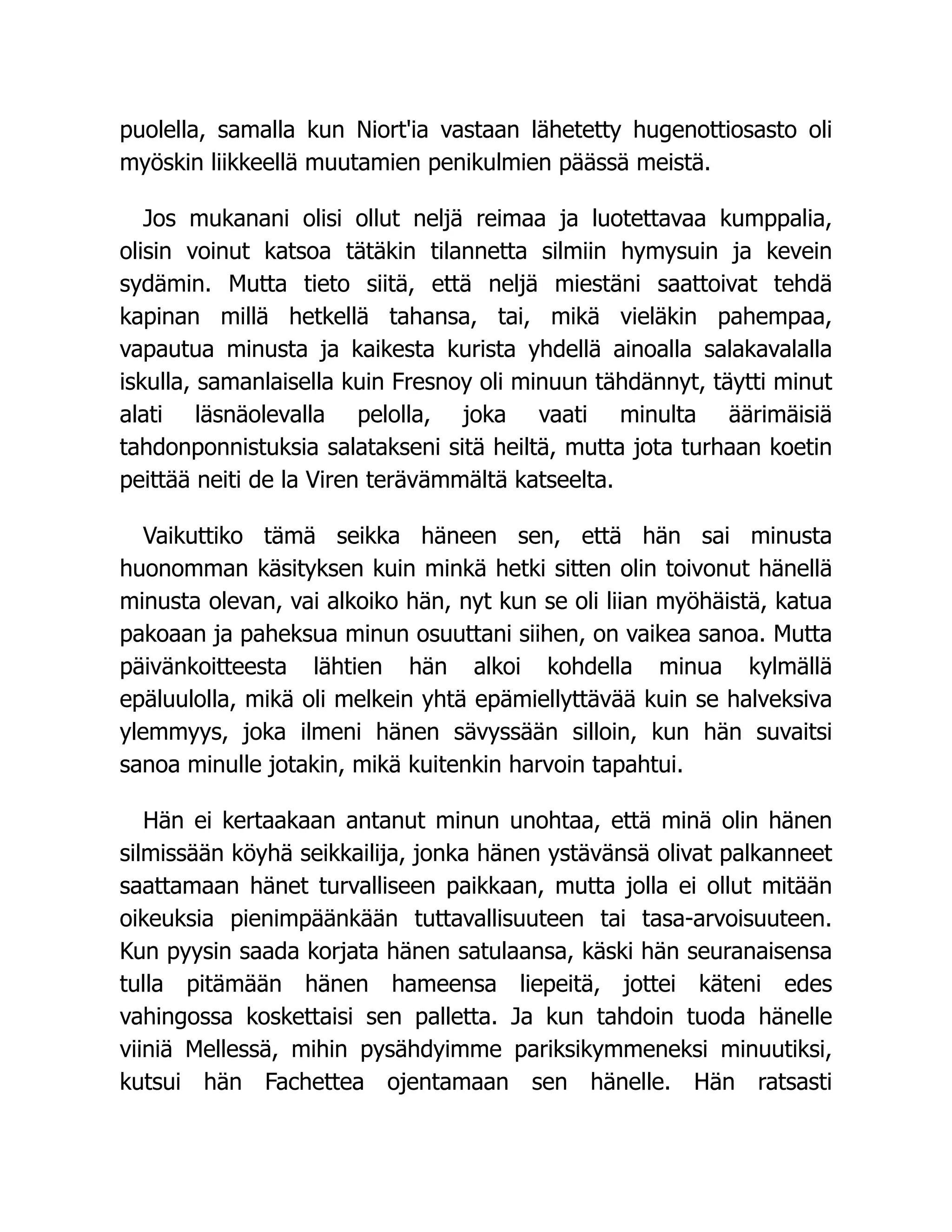
Commutation Relations Normal Ordering And Stirling Numbers Toufik Mansour
Commutation Relations Normal Ordering And Stirling Numbers Toufik Mansour
Commutation Relations Normal Ordering And Stirling Numbers Toufik Mansour
Commutation Relations Normal Ordering And Stirling Numbers Toufik Mansour
Commutation Relations Normal Ordering And Stirling Numbers Toufik Mansour
1.
Commutation Relations NormalOrdering And
Stirling Numbers Toufik Mansour download
https://ebookbell.com/product/commutation-relations-normal-
ordering-and-stirling-numbers-toufik-mansour-5242138
Explore and download more ebooks at ebookbell.com
2.
Here are somerecommended products that we believe you will be
interested in. You can click the link to download.
Commutation Relations Normal Ordering And Stirling Numbers Toufik
Mansour Matthias Schork
https://ebookbell.com/product/commutation-relations-normal-ordering-
and-stirling-numbers-toufik-mansour-matthias-schork-46757716
Inequivalent Representations Of Canonical Commutation And
Anticommutation Relations Arai A
https://ebookbell.com/product/inequivalent-representations-of-
canonical-commutation-and-anticommutation-relations-arai-a-12083008
At The Edge Of Ai Human Computation Systems And Their Intraverting
Relations Libuse Hannah Veprek
https://ebookbell.com/product/at-the-edge-of-ai-human-computation-
systems-and-their-intraverting-relations-libuse-hannah-veprek-59136054
At The Edge Of Ai Human Computation Systems And Their Intraverting
Relations Libuse Hannah Veprek
https://ebookbell.com/product/at-the-edge-of-ai-human-computation-
systems-and-their-intraverting-relations-libuse-hannah-veprek-61432248
3.
3d Rotations ParameterComputation And Lie Algebra Based Optimization
1st Edition Kenichi Kanatani
https://ebookbell.com/product/3d-rotations-parameter-computation-and-
lie-algebra-based-optimization-1st-edition-kenichi-kanatani-11388910
Statistical Relational Artificial Intelligence Logic Probability And
Computation Luc De Raedt
https://ebookbell.com/product/statistical-relational-artificial-
intelligence-logic-probability-and-computation-luc-de-raedt-5862114
Orientations And Rotations Computations In Crystallographic Textures
1st Edition Dr Adam Morawiec Auth
https://ebookbell.com/product/orientations-and-rotations-computations-
in-crystallographic-textures-1st-edition-dr-adam-morawiec-auth-4204690
Soft Commutation Isolated Dcdc Converters 1st Ed Ivo Barbi
https://ebookbell.com/product/soft-commutation-isolated-dcdc-
converters-1st-ed-ivo-barbi-7323994
Human Brain Theory Informationcommutation Device Of The Brain And
Principles Of Its Work And Modeling Uk Ed Andrey S Bryukhovetskiy
https://ebookbell.com/product/human-brain-theory-
informationcommutation-device-of-the-brain-and-principles-of-its-work-
and-modeling-uk-ed-andrey-s-bryukhovetskiy-7008998
5.
Commutation
Relations,
Normal
Ordering,
and
Stirling
Numbers
Toufik Mansour •Matthias Schork
Mansour
•
Schork
A CHAPMAN & HALL BOOK
Commutation Relations,
Normal Ordering, and
Stirling Numbers
K16870
w w w . c r c p r e s s . c o m
DISCRETE MATHEMATICS AND ITS APPLICATIONS
DISCRETE MATHEMATICS AND ITS APPLICATIONS
Commutation Relations, Normal Ordering, and Stirling Numbers provides an intro-
duction to the combinatorial aspects of normal ordering in the Weyl algebra and
some of its close relatives. The Weyl algebra is the algebra generated by two letters U
and V subject to the commutation relation UV − VU = I. It is a classical result that
normal ordering powers of VU involve the Stirling numbers.
The book is a one-stop reference on the research activities and known results of nor-
mal ordering and Stirling numbers. It discusses the Stirling numbers, closely related
generalizations, and their role as normal ordering coefficients in the Weyl algebra.
The book also considers several relatives of this algebra, all of which are special cases
of the algebra in which UV − qVU = hVs
holds true. The authors describe combinato-
rial aspects of these algebras and the normal ordering process in them. In particular,
they define associated generalized Stirling numbers as normal ordering coefficients in
analogy to the classical Stirling numbers. In addition to the combinatorial aspects,
the book presents the relation to operational calculus, describes the physical motiva-
tion for ordering words in the Weyl algebra arising from quantum theory, and covers
some physical applications.
Features
• Presents an accessible introduction to the history and current research in this
area
• Discusses several links among commutation relations, normal ordering, Stirling
numbers, and additional areas of mathematics and physics
• Describes a variety of tools and approaches that are also useful to other areas of
enumerative combinatorics
• Illustrates methods and definitions with examples
• Includes exercises and research problems in each chapter
• Contains an extensive bibliography with many references to original publications
Mathematics
K16870_cover.indd 1 7/17/15 10:40 AM
DISCRETE
MATHEMATICS
ITS APPLICATIONS
R. B.J. T. Allenby and Alan Slomson, How to Count: An Introduction to Combinatorics,
Third Edition
Craig P. Bauer, Secret History: The Story of Cryptology
Juergen Bierbrauer, Introduction to Coding Theory
Katalin Bimbó, Combinatory Logic: Pure, Applied and Typed
Katalin Bimbó, Proof Theory: Sequent Calculi and Related Formalisms
Donald Bindner and Martin Erickson, A Student’s Guide to the Study, Practice, and Tools of
Modern Mathematics
Francine Blanchet-Sadri, Algorithmic Combinatorics on Partial Words
Miklós Bóna, Combinatorics of Permutations, Second Edition
Miklós Bóna, Handbook of Enumerative Combinatorics
Jason I. Brown, Discrete Structures and Their Interactions
Richard A. Brualdi and Dragos̆ Cvetković, A Combinatorial Approach to Matrix Theory and Its
Applications
Kun-Mao Chao and Bang Ye Wu, Spanning Trees and Optimization Problems
Charalambos A. Charalambides, Enumerative Combinatorics
Gary Chartrand and Ping Zhang, Chromatic Graph Theory
Henri Cohen, Gerhard Frey, et al., Handbook of Elliptic and Hyperelliptic Curve Cryptography
Charles J. Colbourn and Jeffrey H. Dinitz, Handbook of Combinatorial Designs, Second Edition
Abhijit Das, Computational Number Theory
Matthias Dehmer and Frank Emmert-Streib, Quantitative Graph Theory:
Mathematical Foundations and Applications
Martin Erickson, Pearls of Discrete Mathematics
Martin Erickson and Anthony Vazzana, Introduction to Number Theory
8.
Titles (continued)
Steven Furino,Ying Miao, and Jianxing Yin, Frames and Resolvable Designs: Uses,
Constructions, and Existence
Mark S. Gockenbach, Finite-Dimensional Linear Algebra
Randy Goldberg and Lance Riek, A Practical Handbook of Speech Coders
Jacob E. Goodman and Joseph O’Rourke, Handbook of Discrete and Computational Geometry,
Second Edition
Jonathan L. Gross, Combinatorial Methods with Computer Applications
Jonathan L. Gross and Jay Yellen, Graph Theory and Its Applications, Second Edition
Jonathan L. Gross, Jay Yellen, and Ping Zhang Handbook of Graph Theory, Second Edition
David S. Gunderson, Handbook of Mathematical Induction: Theory and Applications
Richard Hammack, Wilfried Imrich, and Sandi Klavžar, Handbook of Product Graphs,
Second Edition
Darrel R. Hankerson, Greg A. Harris, and Peter D. Johnson, Introduction to Information Theory
and Data Compression, Second Edition
Darel W. Hardy, Fred Richman, and Carol L. Walker, Applied Algebra: Codes, Ciphers, and
Discrete Algorithms, Second Edition
Daryl D. Harms, Miroslav Kraetzl, Charles J. Colbourn, and John S. Devitt, Network Reliability:
Experiments with a Symbolic Algebra Environment
Silvia Heubach and Toufik Mansour, Combinatorics of Compositions and Words
Leslie Hogben, Handbook of Linear Algebra, Second Edition
Derek F. Holt with Bettina Eick and Eamonn A. O’Brien, Handbook of Computational Group Theory
David M. Jackson and Terry I. Visentin, An Atlas of Smaller Maps in Orientable and
Nonorientable Surfaces
Richard E. Klima, Neil P. Sigmon, and Ernest L. Stitzinger, Applications of Abstract Algebra
with Maple™ and MATLAB®
, Second Edition
Richard E. Klima and Neil P. Sigmon, Cryptology: Classical and Modern with Maplets
Patrick Knupp and Kambiz Salari, Verification of Computer Codes in Computational Science
and Engineering
William Kocay and Donald L. Kreher, Graphs, Algorithms, and Optimization
Donald L. Kreher and Douglas R. Stinson, Combinatorial Algorithms: Generation Enumeration
and Search
Hang T. Lau, A Java Library of Graph Algorithms and Optimization
C. C. Lindner and C. A. Rodger, Design Theory, Second Edition
San Ling, Huaxiong Wang, and Chaoping Xing, Algebraic Curves in Cryptography
Nicholas A. Loehr, Bijective Combinatorics
Toufik Mansour, Combinatorics of Set Partitions
Toufik Mansour and Matthias Schork, Commutation Relations, Normal Ordering, and Stirling
Numbers
9.
Titles (continued)
Alasdair McAndrew,Introduction to Cryptography with Open-Source Software
Elliott Mendelson, Introduction to Mathematical Logic, Fifth Edition
Alfred J. Menezes, Paul C. van Oorschot, and Scott A. Vanstone, Handbook of Applied
Cryptography
Stig F. Mjølsnes, A Multidisciplinary Introduction to Information Security
Jason J. Molitierno, Applications of Combinatorial Matrix Theory to Laplacian Matrices of Graphs
Richard A. Mollin, Advanced Number Theory with Applications
Richard A. Mollin, Algebraic Number Theory, Second Edition
Richard A. Mollin, Codes: The Guide to Secrecy from Ancient to Modern Times
Richard A. Mollin, Fundamental Number Theory with Applications, Second Edition
Richard A. Mollin, An Introduction to Cryptography, Second Edition
Richard A. Mollin, Quadratics
Richard A. Mollin, RSA and Public-Key Cryptography
Carlos J. Moreno and Samuel S. Wagstaff, Jr., Sums of Squares of Integers
Gary L. Mullen and Daniel Panario, Handbook of Finite Fields
Goutam Paul and Subhamoy Maitra, RC4 Stream Cipher and Its Variants
Dingyi Pei, Authentication Codes and Combinatorial Designs
Kenneth H. Rosen, Handbook of Discrete and Combinatorial Mathematics
Douglas R. Shier and K.T. Wallenius, Applied Mathematical Modeling: A Multidisciplinary
Approach
Alexander Stanoyevitch, Introduction to Cryptography with Mathematical Foundations and
Computer Implementations
Jörn Steuding, Diophantine Analysis
Douglas R. Stinson, Cryptography: Theory and Practice, Third Edition
Roberto Tamassia, Handbook of Graph Drawing and Visualization
Roberto Togneri and Christopher J. deSilva, Fundamentals of Information Theory and Coding
Design
W. D. Wallis, Introduction to Combinatorial Designs, Second Edition
W. D. Wallis and J. C. George, Introduction to Combinatorics
Jiacun Wang, Handbook of Finite State Based Models and Applications
Lawrence C. Washington, Elliptic Curves: Number Theory and Cryptography, Second Edition
10.
DISCRETE MATHEMATICS ANDITS APPLICATIONS
Toufik Mansour
University of Haifa, Israel
Matthias Schork
Commutation Relations,
Normal Ordering, and
Stirling Numbers
List of Figures
1.1Diagrams used to represent set partitions in 16th century Japan. . . . . . 2
1.2 Stirling numbers of the second kind from Stirling’s Methodus Differentialis. 6
2.1 A labeled tree. . . . . . . . . . . . . . . . . . . . . . . . . . . . . . . . . . . 35
2.2 A Dyck path, a Motzkin path, and an arbitrary lattice path. . . . . . . . . 36
2.3 The board B(3, 4, 6, 0, 2) and the Ferrers board B(1, 1, 3, 3, 5). . . . . . . . 39
2.4 A rook placement of 3 rooks on the staircase board J9,1. . . . . . . . . . . 39
2.5 The rook placement representation of 1367/25/4/89 and inversion-type
statistic. . . . . . . . . . . . . . . . . . . . . . . . . . . . . . . . . . . . . . 40
2.6 The rook placement representation of 1367/25/4/89. . . . . . . . . . . . . 42
2.7 Rook placement on B(1, 1, 3, 3, 5) with 1-creation rule. . . . . . . . . . . . 43
2.8 Rook placement on B(1, 1, 3, 3, 5) with 2-creation rule. . . . . . . . . . . . 43
4.1 A colony of type (3, 2, 2, 3; 2, 2, 2, 2). . . . . . . . . . . . . . . . . . . . . . . 90
4.2 A colony of type (2, 2, 1; 2, 3, 3), 4 free legs and weight q3
. . . . . . . . . . 94
6.1 The boards B(6, 5, 4, 4, 2) (left) and B̃(1, 2, 4, 4, 5, 5) (right). . . . . . . . . 190
6.2 Linear representations of the contractions of the word âââ†
â†
. . . . . . . . 201
6.3 2-Motzkin paths of length 3. . . . . . . . . . . . . . . . . . . . . . . . . . . 216
6.4 The board Cω associated to ω. . . . . . . . . . . . . . . . . . . . . . . . . . 222
7.1 Linear representation of the Feynman diagram γ. . . . . . . . . . . . . . . 248
9.1 A rook placement on the board associated to V 2
U3
V 3
U3
. . . . . . . . . . 365
C.1 An undirected graph (left) and a directed graph (right). . . . . . . . . . . 403
C.2 The complete graph K5 (left) and the cycle graph C5 (right). . . . . . . . 404
xiii
20.
List of Tables
2.1The set An. . . . . . . . . . . . . . . . . . . . . . . . . . . . . . . . . . . . 24
2.2 Words in An with exactly k letters of 1. . . . . . . . . . . . . . . . . . . . 25
9.1 The first few polynomials Hn;j(X, h). . . . . . . . . . . . . . . . . . . . . . 355
9.2 The first few polynomials H
(s)
n;j(X, h; 1). . . . . . . . . . . . . . . . . . . . . 356
9.3 The special choices of parameters s and h considered explicitly. . . . . . . 371
xv
22.
Preface
Very early inmy study of physics, Weyl be-
came one of my gods. I use the word “god”
rather than, say, “outstanding teacher” for the
ways of gods are mysterious, inscrutable, and
beyond the comprehension of ordinary mor-
tals.
Julian Schwinger
This book gives an introduction to combinatorial aspects of normal ordering in the Weyl
algebra and some of its close relatives. For our considerations, the Weyl algebra is the
complex algebra generated by two letters U and V (with unit I) satisfying the commutation
relation
UV − V U = I.
A concrete representation is given by the operators D = d
dx
and X, where (Xf)(x) = xf(x)
for any function f. In this representation, the noncommutative nature of D and X was
recognized by the pioneers of calculus. Normal ordering a word in D and X means to bring
it, using the commutation relation, into a form where all operators D stand to the right.
For example, (XD)2
= X2
D2
+ XD. Presumably, Scherk in 1823 was the first to explicitly
normal order (XD)n
(and a few other words). The coefficients which appear upon normal
ordering are the Stirling numbers of the second kind. However, Scherk did not recognize the
coefficients he determined as the numbers Stirling had considered in a different context.
In the middle of the 19th century, many – mostly formal – results were derived in the
operational or symbolical calculus, often in connection with special polynomials (this line of
research was revived in the 1970s, in particular after Rota’s work on finite operator calculus,
a modern incarnation of umbral calculus). Later, noncommutative structures – first in the
form of Lie algebras and Lie groups as well as in the emerging abstract algebra – rose to a
central place in mathematics, where they have stayed ever since.
In the physical discourse of this time, noncommutative structures per se played no role.
This changed suddenly when Heisenberg postulated in 1925 the fundamental commutation
relation
pq − qp = −i1
for the physical observables representing momentum and location, and where denotes
Planck’s constant. (In fact, the postulate in this form was written in a follow-up publication
by Born, Heisenberg, and Jordan.) Thus, the basic structure of this “matrix version” of
quantum mechanics is the Weyl algebra. Since then, noncommutative structures pervade
theoretical physics. One particularly important toy model is the harmonic oscillator. To
describe it, one makes use of the creation operator â†
and the annihilation operator â.
These two operators also satisfy the commutation relation of the Weyl algebra. Since the
harmonic oscillator describes the first-order deviation from equilibrium it is an important
model, and its properties can be applied in many different situations. From the practical
xvii
23.
xviii Preface
point ofview, where one has to determine expectation values of operator functions in â†
and â, it is advantageous to write them in normal ordered form where all operators â stand
to the right. One way to achieve this is to use Wick’s theorem, which expresses the normal
ordered form of an operator function as a sum over all its possible “contractions”. In this
context, Katriel discovered in 1974 that by normal ordering powers of the number operator
n̂ = â†
â, the Stirling numbers appear as normal ordering coefficients, thereby rediscovering
Scherk’s result in a physical context. Until this seminal work, individual research papers on
various aspects of normal ordering appeared, but there was no focused research interest. This
changed when several groups of authors developed new research directions. They studied
normal and antinormal ordering and its connections to combinatorics, for example, set
partitions, lattice paths, and rooks. Other focuses were on the coefficients that appear in
normal ordered forms and on their applications. More generally, the new academic discipline
“combinatorial physics” (even “physical combinatorics” is used) has emerged, devoted to
the interplay of combinatorics and physics. One particular aspect has been the study of
“q-deformed” structures, which began in the mid 1990s. Roughly speaking, a structure gets
q-deformed by introducing a parameter q into its defining relation (such that for q → 1 the
defining relation of the undeformed structure is recovered). For example, the relation
UV − qV U = I
defines the q-deformed Weyl algebra. In the physical context, the creation and annihilation
operator of a q-boson satisfy this commutation relation, and normal ordering these operators
is beneficial in diverse physical applications. However, the extension of normal ordering
results to the q-deformed situation is not always straightforward.
In this book we give an introduction to the topics mentioned above. The Stirling num-
bers, some closely related generalizations, and their role in normal and antinormal ordering
are discussed. We also consider several variants of the Weyl algebra, all of which are special
cases of the algebra generated by letters U and V satisfying the commutation relation
UV − qV U = hV s
.
We describe combinatorial aspects of these algebras and of normal ordering words in the
letters U and V . In addition to the combinatorial aspects, we describe the relation to op-
erational calculus. Also, the physical motivation as well as some physical applications are
sketched. To give a comprehensive account of this field of research and some of its ramifi-
cations, many additional topics are treated in remarks (or problems). Even if the subject
looks rather focused, many connections to different mathematical objects are mentioned. A
similar study of algebras generated by three generators would be much more ambitious.
Although it is impossible to give an exhaustive or complete bibliography, we strive to
provide a comprehensive bibliography with many references to original publications (but,
alas, neither of us is a historian). We also indicate some of the early historical development
of Stirling and Bell numbers.
The later chapters of this book are based on our own research and on that of our
collaborators and other researchers in the field. We present these results with consistent
notation and we have modified some proofs to relate them to other results in the book. As
a general rule, results listed without specific references either are well-known and presented
in standard references mentioned, or give results from articles by the authors and their
collaborators, while results from other authors are given with specific references.
24.
Preface xix
Audience
The bookis intended for advanced undergraduate and graduate students in discrete
mathematics as well as for graduate students or researchers in physics interested in combi-
natorial aspects of normal ordering operators. Additionally, the book serves as a one-stop
reference for a bibliography of research activities on the subject, known results, and research
directions for any researcher who is interested in studying this topic.
Outline
In Chapter 1 we present a historical perspective of the research on normal ordering and
Stirling numbers and give an overview of the major themes of the book: Stirling and Bell
numbers as well as generalizations thereof; the Weyl algebra, quantum theory, and normal
ordering; the q-deformed Weyl algebra and the meromorphic Weyl algebra; the q-deformed
generalized Weyl algebra.
In Chapter 2 we introduce techniques to solve recurrence relations, which arise naturally
when dealing with normal ordering and Stirling numbers, and illustrate them with several
examples. We also provide definitions and combinatorial techniques that are used later
on, such as lattice paths, partitions, Ferrers boards, rooks, Riordan arrays, and Sheffer
sequences.
In Chapter 3 we recall the definition and basic properties of the classical Stirling and
Bell numbers. Furthermore, we discuss the Dobiński formula as well as Spivey’s Bell number
relation. Also, a q-deformation of Stirling and Bell numbers is introduced and several of its
properties are discussed.
In Chapter 4 we consider several generalizations of Stirling and Bell numbers. The start-
ing point for generalizations are the operational interpretation of Stirling numbers and their
interpretation as connection coefficients. We survey many properties of these generalizations.
Connections between different versions of generalized Stirling numbers are mentioned.
In Chapter 5 we define the Weyl algebra and mention some of its early history. The main
focus of the chapter is on elementary quantum theory and some of its consequences. We show
why the Weyl algebra is of interest to physicists and discuss the operator ordering problem
of “quantization”. The harmonic oscillator is discussed and the creation and annihilation
operators are introduced. Several examples for normal ordering are presented.
In Chapter 6 we continue the study of normal ordering in the Weyl algebra and collect
many results. In addition, we discuss Viskov’s identity, the connection of normal ordering to
rook numbers, an identity of Bender, Mead, and Pinsky, and Wick’s theorem. Connections
between normal ordering and further combinatorial structures are mentioned and a survey
of other operator ordering schemes is given.
In Chapter 7 we consider normal ordering in three variants of the Weyl algebra: the q-
deformed Weyl algebra (UV −qV U = h), the meromorphic Weyl algebra (UV −V U = hV 2
),
and the q-deformed meromorphic Weyl algebra (UV − qV U = hV 2
). To warm up, we begin
with a brief discussion of the quantum plane (UV = qV U).
In Chapter 8 we introduce a generalization of the Weyl algebra where one has UV −V U =
hV s
. After discussing some general aspects of normal ordering, we introduce generalized
25.
xx Preface
Stirling numbersSs;h(n, k) as normal ordering coefficients of (V U)n
. The properties of these
numbers – and of the corresponding generalized Bell numbers Bs;h(n) – are investigated in
detail.
In Chapter 9 we extend the results of the previous chapter to variables U and V satisfying
UV − qV U = hV s
. We discuss the binomial formula for (U + V )n
, and we describe other
“noncommutative binomial formulas” and “noncommutative Bell polynomials”. Also, we
define associated q-deformed generalized Stirling numbers Ss;h|q(n, k) as normal ordering
coefficients of (V U)n
and present several properties of these numbers.
In Chapter 10 we study a generalization of the Touchard polynomials which is motivated
by its connection to normal ordering and the generalized Stirling numbers Ss;h(n, k) and
Bell numbers Bs;h(n).
The Appendices provide basic background from different areas of mathematics, namely,
q-calculus, symmetric functions, graph theory, Lie algebras, and Hilbert spaces.
Most chapters start with a section describing the history of the particular topic and its
relation to previous chapters. New methods and definitions are illustrated with examples.
At the end of each chapter we present some exercises and research problems.
26.
Acknowledgment
Every book hasa story of how it came into being and the people who supported the
author(s) along the way. This book is no exception. The origin of this project might be
located several years ago when Simone Severini suggested Toufik and Matthias join forces
and study combinatorial aspects of normal ordering as a team, bringing, in particular, Toufik
and Matthias into contact with each other. Matthias had been working in mathematical
physics and was turning to questions of normal ordering, while Simone and Toufik had been
cooperating on projects having a more combinatorial flavor and were turning to concrete
applications in normal ordering. A fruitful collaboration resulted, and the outcomes can be
found in the present book. To pursue the idea of introducing generalized Stirling numbers
via normal ordering, Toufik and Matthias had the good luck to win Mark Shattuck as a
collaborator. This collaboration also proved to be very fertile, and Mark’s influence can be
felt in many places in this book. These developments prepared the ground, and when Nenad
Cakić encouraged Toufik to write a book on Stirling numbers and applications, the idea for
the present book was born.
In the first place, we thank our collaborators Simone Severini and Mark Shattuck. Large
parts of the material covered in this book are based on joint work with them. A special
thanks to Nenad Cakić for giving us the essential nudge to write this book. We wish to
express our heartfelt gratitude to Christian Nassau for reading a previous version of this
book and his several remarks and suggestions. Arnold Knopfmacher, Armend Sh. Shabani,
and David G.L. Wang also read parts of a previous version of this book – thank you! Many
thanks to Simone Severini and Jonathan L. Gross for providing us with copies of essential
references.
And then there are the people in our lives who supported us on a daily basis by giving
us the time and the space to write this book. Their moral support has been very important.
Toufik thanks his wife Ronit and his daughters Itar, Atil, and Hadel for their support and
understanding when the work on the book took him away from spending time with them.
Matthias thanks his entire family for their constant support and understanding.
xxi
28.
About the Authors
ToufikMansour obtained his PhD degree in mathematics from the University of Haifa in
2001. He spent one year as a postdoctoral researcher at the University of Bordeaux (France)
supported by a Bourse Chateaubriand scholarship, and a second year at the Chalmers
Institute in Gothenburg (Sweden) supported by a European Research Training Network
grant. Between 2003–2006, he received a prestigious MAOF grant from the Israeli Council
for Education. Toufik has been a permanent faculty member at the University of Haifa
since 2003 and was promoted to associate professor in 2008, and to full professor in 2014.
He spends his summers as a visitor at institutions around the globe, for example, at the
Center for Combinatorics at Nankai University (China) where he was a faculty member
from 2004 to 2007, and at The John Knopfmacher Center for Applicable Analysis and
Number Theory, University of the Witwatersrand (South Africa). Toufik’s area of specialty
is enumerative combinatorics and more generally, discrete mathematics and its applications.
Originally focusing on pattern avoidance in permutations, he has extended his interest to
colored permutations, set partitions, words, compositions, and normal ordering. Toufik has
authored or co-authored more than 250 papers in this area, many of them concerning the
enumeration of normal ordering. He has given talks at national and international conferences
and is very active as a reviewer for several journals.
Matthias Schork obtained his PhD degree in mathematics from the Johann Wolfgang
Goethe University of Frankfurt (Germany) in 2001 for work done in mathematical physics.
He joined the IT department of Deutsche Bahn – the largest German railway company –
in 2002 and still works there. In his spare time he studies recent developments in mathe-
matical physics as well as discrete mathematics and its applications to physics. Originally
focusing on topics motivated directly by physical application, he has extended his interest to
include more conventional mathematical topics, for example, special differential equations
and q-calculus. Matthias has authored or coauthored more than 40 papers in this area,
many of them together with Toufik concerning Stirling numbers, normal ordering, and its
ramifications. Matthias is also active as a reviewer for several journals.
xxiii
30.
Chapter 1
Introduction
In thischapter we introduce the main objects of study and describe their early history
as well as some later developments. In Section 1.1 the most classical of these objects –
set partitions – are introduced and first properties of the corresponding Stirling and Bell
numbers are discussed. Several further results are mentioned which will be discussed in later
chapters in detail (and from different angles). In Section 1.2 the early history of the formal
theory of operational or symbolical calculus is described and several results mentioned.
Furthermore, the connection to the physical theory of quantum mechanics is elucidated,
thereby motivating the same structure from a physical point of view. In Section 1.3 the
“abstract” Weyl algebra and some close relatives are introduced and some of the more
recent developments mentioned. Finally, in Section 1.4, the content of the book is described
in more detail.
1.1 Set Partitions, Stirling, and Bell Numbers
The first known application of set partitions arose in the context of tea ceremonies and
incense games in Japanese upper-class society around 1500. Guests at a Kado ceremony
would be smelling cups with burned incense with the goal to either identify the incense or
to identify which cups contained identical incense. There are many variations of the game,
even today. One particular game is named genji-ko, and it is the one that originated the
interest in n-set partitions. Five different incense sticks were cut into five pieces, each piece
put into a separate bag, and then five of these bags were chosen to be burned. Guests
had to identify which of the five were the same. The Kado ceremony masters developed
symbols for the different possibilities, so-called genji-mon. Each such symbol consists of
vertical bars, some of which are connected by horizontal bars. For example, the symbol
indicates that incense 1, 2, and 3 are the same, while incense 4 and 5 are different from
the first three and also from each other (recall that the Japanese write from right to left).
Fifty-two symbols were created, and for easier memorization, each symbol was identified
with one of the chapters of the famous Tale of Genji by Lady Murasaki. Figure 1.1 shows
the diagrams1
used in the tea ceremony game. In time, these genji-mon and two additional
symbols started to be displayed at the beginning of each chapter of the Tale of Genji and in
turn became part of numerous Japanese paintings. They continued to be popular symbols
for family crests and Japanese kimono patterns in the early 20th century, and can be found
on T-shirts sold today.
How does the tea ceremony game relate to set partitions? Before making the connection,
let us define what we mean by a set partition in general.
1www.viewingjapaneseprints.net/texts/topictexts/artist varia topics/genjimon7.html
1
31.
2 Commutation Relations,Normal Ordering, and Stirling Numbers
FIGURE 1.1: Diagrams used to represent set partitions in 16th century Japan.
1.1.1 Definition of Stirling and Bell Numbers
In the following S will be a set of natural numbers where 0 is included, that is, S ⊆
N0 = N ∪ {0}. For the particular set of the first n natural numbers we use the convenient
notation
[n] = {1, 2, 3, . . ., n}.
Definition 1.1 A set partition π of a set S is a collection B1, B2, . . . , Bk of nonempty
disjoint subsets of S such that ∪k
i=1Bi = S. The elements of a set partition are called blocks,
and the size of a block B is given by |B|, the number of elements in B. We assume that
B1, B2, . . . , Bk are listed in increasing order of their minimal elements, that is, min B1
min B2 · · · min Bk. The set of all set partitions of S is denoted by Π(S).
Note that an equivalent way of representing a set partition is to order the blocks by
their maximal element, that is, max B1 max B2 · · · max Bk. Unless otherwise noted,
we will use the ordering according to the minimal element of the blocks.
Example 1.2 The set partitions of the set {1, 3, 5} are given by
{1, 3, 5}; {1, 3}, {5}; {1, 5}, {3}; {1}, {3, 5} and {1}, {3}, {5}.
Definition 1.3 The set of all set partitions of [n] is denoted by Πn = Π([n]), and the
number of all set partitions of [n] by n = |Πn|, with 0 = 1 (as there is only one set
partition of the empty set).
Example 1.4 For [1], there exists exactly one set partition. Thus, 1 = 1. For [2], the
set partitions are {1}, {2} and {1, 2}, implying 2 = 2. The set partitions of [3] are given
by {1, 2, 3}; {1, 2}, {3}; {1, 3}, {2}; {1}, {2, 3} and {1}, {2}, {3}, giving 3 = 5. In the same
way one determines 4 = 15 as well as 5 = 52. Thus, the sequence of n starts with
1, 1, 2, 5, 15, 52, . . ..
Definition 1.5 Let π be any set partition of [n]. We represent π in either sequential or
canonical form. In the sequential form, each block is represented as sequence of increasing
numbers and different blocks are separated by the symbol /. In the canonical representation,
we indicate for each integer the block in which it occurs, that is, π = π1π2 · · · πn such that
j ∈ Bπj , 1 ≤ j ≤ n.
Example 1.6 The set partitions of [3] in sequential form are 123, 12/3, 13/2, 1/23, and
1/2/3, while the set partitions of [3] in canonical representation are 111, 112, 121, 122, and
123, respectively.
32.
Introduction 3
Example 1.7The set partition 14/257/3/6 has canonical form 1231242.
The two representations can be distinguished easily due to the symbol /, except in the
single case when all elements of [n] are in a single block. In this case, π = 12345 · · ·n, and
its corresponding canonical form is 11 · · ·1. On the other hand, the set partition 12345 · · ·n
in canonical form represents the set partition 1/2/ · · ·/n in sequential form. The canonical
representations can be formulated in terms of words satisfying certain conditions. At first,
we explain what we mean by the concept of a word, and then we characterize which kind
of words correspond to a canonical representation of a set partition.
Definition 1.8 Let a finite set A = {a1, a2, . . . , an} of objects be given. We call each ak
(for k = 1, . . . , n) a letter and A the alphabet. An element of AN
will be called a word
in the alphabet A (of length N). A word ω = (ai1 , ai2 , . . . , aiN ) will be written in the
form ω = ai1 ai2 · · · aiN , that is, as concatenation of its letters. For convenience, we also
introduce the empty word ∅ ∈ A0
. If ω is a word, we denote the concatenation ωω · · · ω (k
times) briefly by ωk
. In the case A = [k], an element of An
is called k-ary word of size n.
Words with letters from the set {0, 1} are called binary words or binary strings, and words
with letters from the set {0, 1, 2} are called ternary words or ternary strings.
Example 1.9 The 2-ary words of size three are 111, 112, 121, 122, 211, 212, 221, and 222,
the binary strings of size two are given by 00, 01, 10, and 11, while the ternary strings of
size two are given by 00, 01, 02, 10, 11, 12, 20, 21, and 22.
Example 1.10 Let A = {a, b} be an alphabet with two letters. Then ω1 = abba, ω2 = baba
and ω3 = aabb are words of length 4 which in general are not related. Note that we can write
briefly ω1 = ab2
a, ω2 = (ba)2
and ω3 = a2
b2
.
In the following we are interested in expressions which are sums of words. Two words
can be added if they are equal and we then write ω + ω = 2ω (since in our applications the
letters are not numbers, no confusion can arise).
After having clarified what we mean by a word, we can characterize which words arise
as the canonical representation of a set partition of [n].
Fact 1.11 A (canonical representation of a) set partition π = π1π2 · · · πn of [n] is a word
π such that π1 = 1, and the first occurrence of the letter i ≥ 1 precedes that of j if i j.
Now we draw the connection between genji-ko and set partitions: each of the possible
incense selections corresponds to a set partition of [5], where the partition is according
to flavor of the incense. Thus, can be written as the set partition 123/4/5 of [5]. As
5 = 52, there are 52 genji-mon, as mentioned at the beginning of Section 1.1 and drawn
in Figure 1.1. According to Knuth [675], a systematic investigation to find the number of
set partitions of [n] for any n, was first undertaken by Takakazu Seki and his students in
the early 1700s. One of his pupils, Yoshisuke Matsunaga, found a recurrence relation for
the number of set partitions of [n], as well as a formula for the number of set partitions of
[n] with exactly k blocks of sizes n1, n2, . . . , nk with n1 + · · · + nk = n.
Theorem 1.12 (Matsunaga) Let n be the number of set partitions of [n]. Then n
satisfies the recurrence relation
n =
n−1
j=0
n − 1
j
j (1.1)
with initial condition 0 = 1.
33.
4 Commutation Relations,Normal Ordering, and Stirling Numbers
Proof Assume that the first block contains j + 1 elements from the set [n], where 0 ≤ j ≤
n − 1. Since the first block contains the minimal element of the set, namely 1, we need to
choose j elements from the set {2, 3, . . ., n} to complete the first block. Thus, the number of
set partitions of [n] with exactly j + 1 elements in the first block is given by
n−1
j
n−1−j.
Summing over all possible values of j, we obtain that
n =
n−1
j=0
n − 1
j
n−1−j =
n−1
j=0
n − 1
n − 1 − j
n−1−j =
n−1
j=0
n − 1
j
j,
with 0 = 1.
Theorem 1.13 (Matsunaga) The number of set partitions of [n] with exactly k blocks of
sizes n1, . . . , nk with n1 + · · · + nk = n is given by
k
j=1
n − 1 − n1 − · · · − nj−1
nj − 1
.
Proof The proof is similar to the one for Theorem 1.12. For the first block, we choose
n1 − 1 elements from the set {2, 3, . . ., n}. From the n − n1 available elements, we place the
minimal element into the second block and then choose n2 − 1 elements from the n − n1 − 1
remaining elements, and so on, until we have placed all elements. Thus, the number of set
partitions of [n] with exactly k blocks of sizes n1, n2, . . . , nk with n1 + n2 + · · · + nk = n is
given by
n − 1
n1 − 1
n − 1 − n1
n2 − 1
· · ·
n − 1 − n1 − · · · − ns−1
ns − 1
,
which completes the proof.
A more general formula for the number of set partitions of [n] into kj blocks of sizes nj
with k1n1 + · · · + kmnm = n can be obtained directly from Theorem 1.13. These results
were not published by Matsunaga himself, but were mentioned (with proper credit given)
in Yoriyuki Arima’s book Shūki Sanpō, which was published in 1769. One of the questions
posed in this text was to find the value of n for which the number of set partitions of [n]
is equal to 678.570 (the answer is n = 11). Additional results were derived by Masanobu
Saka in 1782 in his work Sanpō-Gakkai. Saka established a recurrence for the number of
set partitions of [n] into k subsets, and using this recurrence, he computed the values for
n ≤ 11.
Definition 1.14 The set of all set partitions of [n] with exactly k blocks is denoted by Πn,k.
The number |Πn,k| of set partitions of [n] into k blocks is denoted by S(n, k) and is called
Stirling number of the second kind (Sequence A008277 in [1019]).
Example 1.15 From Example 1.4 one reads off that the set [3] has exactly one partition
with one block (123), three partitions into two blocks (1/23, 12/3 and 13/2), and one parti-
tion into three blocks (1/2/3). Thus, S(3, 1) = 1, S(3, 2) = 3 and S(3, 3) = 1. In particular,
3 = S(3, 1) + S(3, 2) + S(3, 3).
Remark 1.16 Note that, by definition,
n =
n
k=0
S(n, k). (1.2)
The numbers n are also known as Bell numbers (in honor of Eric Temple Bell) and
denoted by Bn (Sequence A000110 in [1019]).
34.
Introduction 5
Theorem 1.17(Saka) The number S(n, k) of set partitions of [n] into exactly k blocks
satisfies the recurrence relation
S(n + 1, k) = S(n, k − 1) + kS(n, k),
with S(1, 1) = 1, S(n, 0) = 0 for n ≥ 1, and S(n, k) = 0 for n k.
Proof For any partition of [n + 1] into k blocks, there are two possibilities: either n + 1
forms a single block, or the block containing n + 1 has more than one element. In the first
case, there are S(n, k − 1) such set partitions, while in the second case, the element n + 1
can be placed into one of the k blocks of a partition of [n] into k blocks, that is, there are
kS(n, k) such partitions.
Saka was not the first one to discover the numbers S(n, k). James Stirling, on the
other side of the globe in England, had found these numbers in a purely algebraic setting
in his book Methodus Differentialis [1040] in 1730. Stirling’s interest was in speeding up
convergence of series, and the S(n, k) arise as connection coefficients between monomials
and falling polynomials.
Definition 1.18 Polynomials of the form z(z − 1) · · · (z − n + 1) are called falling polyno-
mials and are denoted by (z)n.
Example 1.19 The first three monomials can be expressed in terms of falling polynomials
as
z1
= z = (z)1,
z2
= z + z(z − 1) = (z)1 + (z)2,
z3
= z + 3z(z − 1) + z(z − 1)(z − 2) = (z)1 + 3(z)2 + (z)3.
The values of the coefficients in the falling polynomials were given in the introduction of
Methodus Differentialis, reproduced as Figure 1.2, where columns correspond to n, and rows
correspond to k. For example, S(7, 3) = 301. The relation (1.2) shows that n is given as
the sum of the entries in the nth column of Figure 1.2. Thus, the sequence n of Bell
numbers starts with 1, 1, 2, 5, 15, 52, 203, 877, 4.140, 21.146, . . ..
The description given by Stirling on how to compute these values makes it clear that
he did not use the recurrence given by Saka (Theorem 1.17). To read more about how
Stirling used the falling polynomials for series convergence, see the English translation of
Methodus Differentialis with annotations by Tweddle [1091] (or [1090]). Despite Stirling’s
earlier discovery of the numbers S(n, k), Saka receives credit for being the first one to
associate a combinatorial meaning to these numbers, which are now named after James
Stirling.
Theorem 1.20 (Stirling) For all n ≥ 1, one has that
zn
=
n
k=1
S(n, k)(z)k. (1.3)
Proof We proceed the proof by induction on n. The first few cases can be checked by
comparing Example 1.19 and Figure 1.2. Assume that the claim holds for n and let us prove
it for n+ 1. By the induction hypothesis, we have that zn+1
=
n
k=1 S(n, k)(z)k(z − k + k).
Using that (z)k(z − k) = (z)k+1 and shifting the index from k to k − 1, this yields
zn+1
=
n+1
k=1
S(n, k − 1)(z)k +
n+1
k=1
kS(n, k)(z)k.
35.
6 Commutation Relations,Normal Ordering, and Stirling Numbers
FIGURE 1.2: Stirling numbers of the second kind from Stirling’s Methodus Differentialis.
Writing this in one sum and using the recurrence given in Theorem 1.17, one obtains that
zn+1
=
n+1
k=1 S(n + 1, k)(z)k, as was to be shown.
We introduce Stirling numbers of the first kind in analogy to (1.3) as connection coeffi-
cients.
Definition 1.21 The Stirling numbers of the first kind s(n, k) are defined as connection
coefficients between falling polynomials and monomials,
(z)n =
n
k=1
s(n, k)zk
. (1.4)
Combining (1.3) and (1.4), this gives the orthogonality relations
n
k=1
s(n, k)S(k, l) =
n
k=1
S(n, k)s(k, l) = δn,l, (1.5)
where δn,l is the Kronecker symbol (δn,l = 1 if n = l and δn,l = 0 if n = l).
Let us mention that another notation is also used for Stirling numbers, see, for example,
[508] and the discussion in [674]. One writes
n
k
= S(n, k),
n
k
= (−1)n−k
s(n, k).
1.1.2 Early History of Stirling and Bell Numbers
While set partitions were studied by several Japanese authors and Toshiaki Honda de-
vised algorithms to generate a list of all set partitions of [n], the problem did not receive
equal interest in Europe. There were isolated incidences of research, but no systematic study.
The first known occurrence of set partitions in Europe also occurred outside of mathemat-
ics, in the context of the structure of poetry. In the second book of The Arte of English
36.
Introduction 7
Poesie [921],George Puttenham in 1589 compared the metrical form of verses to arithmeti-
cal, geometrical, and musical patterns. Several diagrams, which are in essence the same as
the genji-mon, were given in [921].
The first mathematical investigation of set partitions was conducted by Gottfried Wil-
helm Leibniz in the late 1600s (the manuscript was written probably in 1676). The un-
published manuscript shows that he tried to enumerate the number of ways to write an
as a product of k factors, which is equivalent to the question of partitioning a set of n
elements into k blocks. He enumerated the cases for n ≤ 5, and, unfortunately, double-
counted the case for n = 4 into two blocks of size 2 and the case for n = 5 into three
blocks of sizes one, two, and two. These two mistakes prevented him from discovering that
S(n, 2) = 2n−1
− 1 and also the recurrence given in Theorem 1.17. Further details can
be found in the commentary by Knobloch [668, Pages 229–233], [669] and the reprint of
Leibniz’s original manuscript [670, Pages 316–321].
The second investigation was made by John Wallis, who asked a more general question
in the third chapter of his Discourse of Combinations, Alternations, and Aliquot Parts
in 1685 [1125]. (For example, see Jordan [610], Riordan [935], Goldberg et al. [484], or
Knuth [672].) He was interested in questions relating to proper divisors (=aliquot parts)
of numbers in general and integers in particular. The question of finding all the ways to
factor an integer is equivalent to finding all partitions of the multiset consisting of the prime
factors of the integer (with multiplicities). He devised an algorithm to list all factorizations
of a given integer, but did not investigate special cases.
Back in Japan, a modification of Theorem 1.12 was given by Saka in 1782, when he
showed that the number of set partitions of [n] with exactly k blocks is given by S(n, k),
the Stirling number of the second kind. After 1782, the Bell numbers n received more
attention. It seems that the first occurrence in print of the Bell numbers has never been
traced, but these numbers have been attributed to Euler (see Bell [73], but there is no
reference for this statement). Following Bell [73,74], they are also called exponential numbers.
Touchard [1077,1079] used the notation an to celebrate the birth of his daughter Anne, and
later Becker and Riordan [67] used the notation Bn in honor of Bell. Throughout this book,
we will use the notation Bn or n.
The first appearance of the numbers Bn seems to be in a paper by Christian Kramp [686]
from 1796, who considered an expansion of the function eex
−1
(which we now know is the
exponential generating function of the Bn). Tate [1058] gave in 1845 formula (1.26), which
is equivalent to the Dobiński formula (1.25). This formula was discussed by Dobiński [358]
in 1877 and he gave an explicit formula for the nth Bell number. One year later, in 1878,
Ligowski [729] gave a more general formula involving the exponential generating function
eex
−1
. These results were preceded by the work of Grunert [521], who in 1843 had considered
expressions which contain the Dobiński formula. The Dobiński formula also appeared as
a problem in Mathematicheskii Sbornik in 1868 with solution provided in the following
year [1,2]. Whitworth [1139] discussed in the classical book Choice and Chance from 1870
problems of set partitions and derived explicit formulas for the Stirling and Bell numbers
using the generating function eex
−1
. In 1880, Peirce [900] gave explicit expressions for the
Bell numbers. In the context of difference equations, Cesàro [214] also considered the Bell
numbers and rederived the Dobiński formula in 1885. D’Ocagne [360] studied in 1887 the
generating function for the sequence {n}n≥0. In 1901, Anderegg [32] showed that
2e =
k≥1
k2
k!
, 5e =
k≥1
k3
k!
, 15e =
k≥1
k4
k!
,
and also obtained the general Dobiński’s formula. In the 1920s, Ramanujan studied the Bell
and Stirling numbers in his unpublished notebooks. His work is presented and discussed in
37.
8 Commutation Relations,Normal Ordering, and Stirling Numbers
[93]. In the 1930s, Becker and Riordan [67] studied several arithmetic properties of Bell and
Stirling numbers, and Bell [73,74] recovered the Bell numbers. Later, Epstein [399] studied
the exponential generating function for the Bell numbers (see also Williams [1146] and
Touchard [1077,1079]). Rota [946] presented in 1964 a modern approach to Bell numbers and
set partitions. Concerning Bell numbers, we refer the reader to the bibliography compiled
by Gould [502], which contains over 200 entries.
The Stirling numbers of the first and second kind were considered in different contexts,
for example, as connection coefficients, in the calculus of finite differences, in the theory
of factorials, in connection with Bernoulli and Euler numbers, and evaluation of partic-
ular series (and, of course, in connection with the Bell numbers). Apart from Stirling’s
work mentioned above, they were considered – explicitly or implicitly – by many famous
mathematicians, for instance, Euler (1755 [404]), Emerson (1763 [397]), Kramp (1799 [687]),
Lacroix (1800 [702]), Ivory (1806 [580]), Brinkley (1807 [154]), Laplace (1812 [714]), Herschel
(1816 [552], 1820 [553]), Scherk (1823 [959], 1834 [960]), Ettingshausen (1826 [403]), Grunert
(1827 [520], 1843 [521]), Gudermann (1830 [523]), Oettinger (1831 [880]), Schlömilch (1846
[966–968], 1852 [969], 1858 [970], 1859 [971]), Schläfli (1852 [964], 1867 [965]), Catalan
(1856 [204]), Jeffery (1861 [600]), Blissard (1867 [119], 1868 [120]), Whitworth (1870 [1139]),
Worpitzky (1883 [1158]), and Cayley (1888, [208]). The Stirling numbers were so named by
Nielsen [872–874] in 1904 in honor of James Stirling. From the beginning of the 20th century
we single out Tweedie (1918 [1092]), Ramanujan (1920s, see [93]), Ginsburg (1928 [475]),
Carlitz (1930 [183], 1932 [184]), Aitken (1933 [15]), Jordan (1933 [609]), Touchard (1933
[1077]), Becker and Riordan (1934 [67]), Bell (1934 [73,74]), Goldstein (1934 [487]), Toscano
(1936 [1068]), Epstein (1939 [399]) and Williams (1945 [1146]).
The Stirling numbers of the first kind were also discussed by Stirling [1040] in 1730. In
fact, in roughly the same context Thomas Harriot had come across these numbers already
in 1618 in his unpublished manuscript Magisteria Magna [531] (reprinted and annotated
in [68]). Some remarks concerning the history of Stirling numbers can be found in [140,230,
232,609,610,674,675].
1.2 Commutation Relations and Operator Ordering
A commutation relation describes the discrepancy between different orders of operation
of two operations U and V . To describe it, we use the commutator [U, V ] ≡ UV − V U. If U
and V commute, then the commutator vanishes. Nowadays, many examples for noncommut-
ing structures are well-known, for example, matrices, Grassmann algebras, quaternions, Lie
algebras, but the formal recognition of the algebraic properties like commutativity or asso-
ciativity emerged rather slowly and at first in concrete examples. How far a given structure
deviates from the commutative case is described by the right-hand side of the commutation
relation. For example, in a complex Lie algebra g one has a set of generators {Xα}α∈I with
the Lie bracket [XαXβ] =
γ∈I fγ
αβXγ, where the coefficients fγ
αβ ∈ C are called struc-
ture constants. The associated universal enveloping algebra U(g) is an associative algebra
generated by {Xα}α∈I, and the above bracket becomes the commutation relation
[Xα, Xβ] =
γ∈I
fγ
αβXγ.
One of the earliest instances of a noncommutative structure was recognized in the context of
operational calculus (also called symbolical calculus). Recall that one of the basic properties
38.
Introduction 9
of calculusis the product rule, which implies that D(x · f(x)) = D(x) · f(x) + x · Df(x).
Interpreting the multiplication with the variable as an application of the multiplication
operator X, this can be written in the form (D ◦ X − X ◦ D)f = f, or, suppressing “◦” and
the operand f, as commutation relation between the operators X and D,
DX − XD = I. (1.6)
1.2.1 Operational (or Symbolical) Calculus
In this section we present some of the early development of operational calculus, following
mainly the account given by Koppelman [681] (and, in addition, the remarks given in [331,
Chapter 1]). In both accounts many references to the original literature can be found.
Furthermore, the classical book [201] of Carmichael from 1855 and [127] of Boole from 1859
are recommended.
The first steps in the formal theory of linear operators can be traced back to a letter
from Leibniz to Johann Bernoulli in 1695; a published account appeared in 1710 [718]. In
it Leibniz discussed the formula for higher derivatives of a product of functions (what we
call today the Leibniz rule) and stressed the analogy to the binomial formula. Furthermore,
he discussed a beautiful combinatorial argument for the coefficients appearing. If we denote
the derivative with respect to x by D and let Dm
f ≡ f(m)
, then Leibniz showed that
Dn
(ψu)(x) =
n
k=0
n
k
ψ(n−k)
(x)u(k)
(x). (1.7)
In 1772 Lagrange [703] discussed many operational formulas which would later be inter-
preted as the first steps in the calculus of finite differences. Let us introduce in addition to
D the shift operator
Eu(x) = u(x + 1) (1.8)
and the operator of finite difference
Δu(x) = u(x + 1) − u(x). (1.9)
Clearly, one has Eu(x) = (1 + Δ)u(x). In this notation, Taylor’s theorem can be formally
denoted by f(x + h) = ehD
f(x), where the right-hand side has to be expanded using
the conventional exponential series. Thus, Eu(x) = eD
u(x). Introducing a constant ξ and
denoting Δξu(x) = u(x + ξ) − u(x), Lagrange derived the operational relation
Δλ
ξ u = eξ du
dx − 1
λ
. (1.10)
A proof of (1.10) was given by Laplace [713] in 1776. The next big step was taken by
Arbogast in his book Du Calcul Des Dérivations [40] from 1800 (following ideas of Lorgna).
His idea was to separate the “symbols” (that is, operators) from the subject on which they
act and to consider the rules the symbols satisfy algebraically. For example, he wrote (1.10)
for λ = 1 as
1 + Δξ = eξD
,
that is, as equation between the symbols itself. By considering the symbols apart from the
subjects on which they act and manipulating them as if they were algebraic quantities, he
was clearly working in the realm of operational calculus. In 1814, Servois published two
notable papers [987,988], in which he showed that the reason for the analogy between op-
erational and algebraical symbols was that both types of symbols satisfy the distributive,
39.
10 Commutation Relations,Normal Ordering, and Stirling Numbers
associative and commutative law. Servois introduced the names “distributive” and “com-
mutative”, but the name “associative” seems to be due to Hamilton. Cauchy [205] discussed
operational calculus in 1827 (mentioning, in particular, the work of Brisson) and showed,
among many other results, that
F(D)[erx
f(x)] = erx
F(r + D)f(x), (1.11)
where F is a polynomial. Cauchy used these results to solve particular differential equa-
tions, and he inquired into the convergence of the series obtained by formal processes and
considered methods for establishing the validity of results of operational methods.
However, the operational methods did not become popular on the continent. The accep-
tance of the methods and notation of the continentals was surprisingly quick in England,
and it was here that the calculus of operations was extended in scope and its applica-
tions. The first mathematicians in England who were responsible for this development were
Babbage, Herschel, Peacock, and Woodhouse; see [681] for a discussion. In the next 30–40
years, from the late 1830s to the 1870s, many important results were achieved. In 1837
Murphy published a paper [855] in which a very clear and general account of the theory of
linear operations was given, and in which he also noticed explicitly the difference between
commuting and noncommuting operations. The next mathematician whom we single out
is Gregory, who in the late 1830s and early 1840s published several papers in which the
operational calculus was applied to differential and difference equations. He also discussed
more general questions concerning operational calculus and its algebraic contents, see, for
example, [516,517]. Some information about Gregory, who died at the early age of 30, can
be found in [29,342,681]. The work of Murphy and Gregory influenced Boole and his most
important work concerned with operational calculus appeared in 1844 [126] (and can also
be found in his book [127]). For example, in [126] he considered symbols π and ρ which
are assumed to be associative and distributive and which satisfy for any function f, which
can be developed into a power series in x, that ρf(π) = λf(π)ρ, where λ acts on π so that
λf(π) = f(φ(π)). He showed that one can write
f(π + ρ) =
m≥0
fm(π)ρm
,
where f0(π) = f(π) and fm(π) = λ−1
(λm−1)π fm−1(π). Furthermore, he showed that f(π)ρm
u =
ρm
f(π + m)u. Choosing π = d
dθ = D and x = ρ = eθ
, this implied that
f(D)emθ
u = emθ
f(D + m)u, (1.12)
reproducing (1.11). As a second application, Boole derived for D = d
dx that
xD(xD − 1)(xD − 2) · · · (xD − n + 1)u = xn
Dn
u, (1.13)
which he called “known relation”. In the late 1840s and early 1850s many attempts to extend
and generalize Boole’s results appeared. One of the most prolific adherents was the Reverend
Bronwin, who devoted several papers to the symbolic method; see, for example, [157,158].
Another follower was Hargreave, whose most important contribution appeared in 1848 [530].
His generalization of the Leibniz rule (1.7) can be written as
φ(D)[ψ(x) · u(x)] = ψ(x)φ(D)u(x) + φ
(x)ψ
(D)u(x) +
1
2!
ψ
(x)φ
(D)u(x) + · · · ,
where φ and ψ were assumed to be functions which can be developed in ascending or
descending integral powers of the variable. Shortly after that, the Reverend Graves [510]
40.
Introduction 11
discussed thesymbolical content of Hargreaves’s results and introduced for that purpose
symbols π and ρ satisfying
πρ − ρπ = α, (1.14)
where α was assumed to commute with π and ρ. Graves discussed that a particular represen-
tation for this commutation relation is given (for α = 1) by π → D = d
dx and ρ → X, where
X denotes again the operator of multiplication with the independent variable x. He also
showed that this commutation relation implies an abstract version of Hargreaves’ results.
In fact, a few years earlier, in 1850, Donkin [362] had considered a more general situation
in which symbols ω, ρ1, . . . , ρn+1 are involved which satisfy
ωρ − ρω = ρ1
ωρ1 − ρ1ω = ρ2
.
.
.
ωρn − ρnω = ρn+1.
Clearly, if ρk = 0 for k ≥ 2, this reduces to the situation considered by Graves. Assuming
that f(x) can be expanded in integral powers of x, Donkin showed, for example, that
f(ω)ρ = ρf(ω)+ρ1f
(ω)+ ρ2
2! f
(ω)+· · · , and applied this to several questions in differential
and difference calculus. In another interesting paper [509], Graves considered the action of
eg(x)D
on functions u(x). He discovered that if eg(x)D
u(x) = f(x), then f can be described
as
f(x) = u{G−1
[G(x) + 1]}, (1.15)
where G(x) =
x dt
g(t)
and G−1
is the inverse function of G. For example, if g(x) = xm
with
m ∈ N {1}, then
eλxm
D
u(x) = u
x
m−1
1 − (m − 1)λxm−1
. (1.16)
In the particular case m = 1, one obtains for the exponential of the Euler operator xD due
to G(x) = ln(x) for λ ∈ R the well-known result
eλxD
u(x) = u(eλ
x). (1.17)
In the early 1860s a series of papers of Russel [951–953] appeared in which he con-
sidered noncommutative symbols along the lines of Boole (but satisfying slightly different
commutation relations), and in 1882 Cazzaniga [209, 210] gave a systematic exposition of
symbolical calculus. Around this time, Crofton [308–311] and Glaisher [476–479] published
several interesting papers. From 1881 on, Heaviside worked out his operational calculus (the
so-called Heaviside calculus) in a long series of publications; see the discussion in [331,903].
The importance of this work was recognized in 1910–1920, and several mathematicians tried
to give it a rigorous foundation (for a well-known early work; see Wiener [1141] and the
references therein). Let us also mention the work of Carmichael, Cockle, Greatheed, DeMor-
gan, Roberts, and Spottiswoode (see the discussion in [681]). As Davis [331] remarked, the
period of formal development of operational methods may be regarded as having ended by
1900. At this time, the theory of integral equations began fascinating mathematicians, and
from these beginnings the modern theory of functional analysis emerged. Since the 1970s,
Gian-Carlo Rota and collaborators revived many of these classical topics in finite operator
calculus – or also under the classical name umbral calculus; see, for example, [939–941,947].
41.
12 Commutation Relations,Normal Ordering, and Stirling Numbers
1.2.2 Early Results for Normal Ordering Operators
The problem of bringing operators into a convenient order arose with the appearance
of noncommutative objects (“symbols”). Clearly, if the operators under consideration com-
mute, one can write them in any order one wishes. Recall the terminology considering words
introduced in Definition 1.8. Let us turn to the concrete situation where the alphabet con-
sists of the two operators X and D. An arbitrary word ω in these letters can be written
as
ω = Xrn
Dsn
· · · Xr2
Ds2
Xr1
Ds1
(1.18)
for some rk, sk ∈ N0. In our context (1.6) holds true, that is, two adjacent letters X and D
in a word can be interchanged according to this relation. Each time one uses it in a word
ω, two new words result. If we write the original word as ω = ω1DXω2 (where each ωk can
be the empty word), then applying (1.6) yields that ω = ω1XDω2 + ω1ω2.
Example 1.22 The simplest example results when ω1 = ω2 = ∅, and ω = DX can be
written as DX = XD + 1. The more complex word D2
XD can be written as DDXD =
DXDD + DD = DXD2
+ D2
.
Using successively (1.6), one can transform each word in X and D into a sum of words,
where each of these words has all the powers of D to the right.
Definition 1.23 A word ω in the letters X and D is in normal ordered form if ω =
ar,sXr
Ds
for r, s ∈ N0 (and arbitrary coefficients ar,s ∈ C). An expression consisting of
a sum of words is called normal ordered if each of the summands is normal ordered. The
process of bringing a word (or a sum of words) into its normal ordered form is called normal
ordering. Writing the word ω in its normal ordered form,
ω =
r,s∈N0
Ar,s(ω)Xr
Ds
,
the – uniquely determined – coefficients Ar,s(ω) are called normal ordering coefficients of ω
(the sum is only finite). In a similar fashion, ω = br,sDr
Xs
is called antinormal ordered.
As shown above, the normal ordered form of DX is XD + 1. As the next example, we
show that it is possible to interpret the Leibniz rule (1.7) as a formula concerning normal
ordering. Indeed, if we consider the left-hand side Dn
(ψu)(x) as the successive application
of the multiplication operator ψ(X) followed by Dn
on u, we can write this relation as
(Dn
◦ ψ(X)) u(x) =
n
k=0
n
k
ψ(n−k)
(X) ◦ Dk
u(x),
which we interpret as the following normal ordering relation
Dn
ψ(X) =
n
k=0
n
k
ψ(n−k)
(X)Dk
.
Choosing ψ(X) = X, one gets back (1.6) for n = 1. Choosing ψ(X) = Xm
with m ≥ n, one
can use that Dl
(xm
) = l!
m
l
xm−l
to find
Dn
Xm
=
n
k=0
n
k
m
k
k!Xm−k
Dn−k
. (1.19)
Let us point out that this interpretation of the Leibniz rule (1.7) is an unhistorical one.
Maybe the first explicit results concerning normal ordering were derived by Scherk [959] in
his dissertation from 1823.
42.
Introduction 13
Theorem 1.24(Scherk) Let X and D satisfy (1.6).
1. The powers (XD)n
have for n ∈ N the normal ordered form
(XD)n
=
n
k=1
ak
nXk
Dk
, (1.20)
where the coefficients ak
n satisfy the recurrence relation
ak
n = ak−1
n−1 + kak
n−1. (1.21)
2. The powers (eX
D)n
have for n ∈ N the normal ordered form
(eX
D)n
= enX
n
k=1
ck
nDk
, (1.22)
where the coefficients ck
n satisfy the recurrence relation
ck
n = ck−1
n−1 + (n − 1)ck
n−1.
Note that eX
is an infinite series and is treated formally. Scherk also gave combinatorial in-
terpretations and explicit expressions for the expansion coefficients ak
n and ck
n. He considered
in his dissertation also briefly the expansion of (Xp
D)n
with p ∈ N and wrote
(Xp
D)n
= Xnp−n
n
k=1
bk
nXk
Dk
, (1.23)
where the coefficients bk
n are described combinatorially as a sum over certain partitions.
Scherk [960] mentioned in 1834 the following recurrence for them,
bk
n = bk−1
n−1 + ((n − 1)p − n + k + 1) bk
n−1.
Murphy derived in the already mentioned paper [855] from 1837 several remarkable formulas.
If v denotes an arbitrary function, he found the expansion
(vD)n
= vn
Dn
+
n
2
v
vn−1
Dn−1
+
n
3
3n − 5
4
(v
)2
+ v
v
vn−2
Dn−2
+ · · · , (1.24)
but gave no explicit expression for the general term; in fact, Scherk [959] had also considered
this expansion. Relation (1.13) mentioned by Boole [126] was used frequently as a starting
point to obtain generalizations. Grunert [521] considered in 1843 the expansion (1.20) and
found the recurrence (1.21). Cesàro [214] considered in 1885 (1.20) and derived for the
coefficients the expression ak
n = Δk
0n
k!
, where a symbolic notation of the calculus of finite
differences is used. Applying (1.20) to ex
and using on the left-hand side ex
=
k≥0
xk
k!
as
well as (XD)n
xk
= kn
xk
, the left-hand side gives
k≥1
kn
xk
k!
. On the right-hand side, one
obtains
n
k=1 ak
nxk
ex
. Comparing both sides for x = 1, one obtains that (here we use that
ak
n = S(n, k))
1
e
k≥1
kn
k!
= n, (1.25)
43.
14 Commutation Relations,Normal Ordering, and Stirling Numbers
where n are the Bell numbers (Cesàro did not recognize these numbers as partition num-
bers). Thus, Cesàro derived the Dobiński formula (1.25), and he also derived the exponential
generating function eex
−1
of the numbers n. Note that we can write (1.25) also as
1n
1!
+
2n
2!
+
3n
3!
+ · · · = e
Δ0n
1!
+
Δ2
0n
2!
+
Δ3
0n
3!
+ · · · . (1.26)
In this form, (1.26) was already shown by Tate [1058] in 1845, and he considered the
case n = 3 explicitly (where 3 = 5). In the beautiful paper [360] from 1887 d’Ocagne
obtained several results for the “remarkable numbers” Kk
n, which he defined by (1.21), that
is, Kk
n = Kk−1
n−1 + kKk
n−1 (since the initial values coincide, one has Kk
n = ak
n). D’Ocagne
derived (1.20) and also
(DX)n
=
n
k=0
Kk+1
n+1Xk
Dk
.
In addition, denoting φm+1(x) =
m
k=0 Kk+1
m+1xk
, he derived the expression
(X + DX)n
=
n
k=0
φ
(k)
m+1(X)
k!
Xk
Dk
.
Several other expansions were treated, in particular in connection with higher derivatives
of “functions of functions”. In this context, we should mention the work of Meyer [812,813],
Schlömilch [966–971], and Schläfli [964, 965]. These authors noticed the appearance of in-
teresting coefficients and studied their properties. Nielsen [872,873] introduced in 1904 the
name “Stirling numbers” for the coefficients ak
n, and Tweedie [1092] wrote a first compre-
hensive paper in 1918. Shortly after that, Schwatt [984] noticed in 1924 that the coefficients
in (1.20) are given by the Stirling numbers (of the second kind), that is, we can write
(XD)n
=
n
k=1
S(n, k)Xk
Dk
. (1.27)
In the early 1930s, Carlitz [183, 184], seemingly unaware of the work of Scherk, defined
in analogy to (1.20) and (1.23) generalized Stirling numbers Sr,s(n, k) as normal ordering
coefficients for r ≥ s by
(Xr
Ds
)n
= Xn(r−s)
k≥0
Sr,s(n, k)Xk
Dk
. (1.28)
Clearly, S1,1(n, k) = S(n, k) = ak
n and Sp,1(n, k) = bk
n. Independently, Toscano followed the
same idea and, beginning in 1935, treated the generalized Stirling numbers in a long series
of papers [1067–1075]. McCoy [791] considered in 1934 arbitrary words (1.18) in X and D,
Xrn
Dsn
· · · Xr2
Ds2
Xr1
Ds1
= X|r|−|s|
k≥0
Sr,s(k)Xk
Dk
, (1.29)
where r = (r1, . . . , rn) and |r| = r1 + · · · + rn (and, similarly, for s). The coefficients
Sr,s(k) generalize the Stirling numbers of Carlitz: If rk = r and sk = s for k = 1, . . . , n,
then Sr,s(k) = Sr,s(n, k) and (1.29) reduces to (1.28). Since many classical polynomials –
for example, the Bell, Bessel, Hermite, and Laguerre polynomials – allow an operational
treatment, many other researchers followed this line of research and discovered many in-
teresting relations involving Stirling numbers or their generalizations; see, for example,
44.
Introduction 15
Cakić [175–178,392, 393, 826], Chak [216–219], Comtet [279], Gould [496–499, 501, 503],
Lang [710–712], Mitrinović [834–836], Al-Salam [17,18], and Al-Salam [19–21].
Let us point out another way to generalize Stirling numbers. Introducing the generalized
factorial (z|γ)n = z(z−γ) · · · (z−(n−1)γ), Hsu and Shiue [568] defined generalized Stirling
numbers S(n, k; α, β, r) as connection coefficients,
(z|α)n =
n
k=0
S(n, k; α, β, r)(z − r|β)k. (1.30)
Clearly, (1.3) and (1.4) are particular instances of (1.30), and many previous generalizations
of Stirling numbers are special cases of S(n, k; α, β, r).
1.2.3 Operator Ordering in Quantum Theory
Recall from the preceding section that Graves discovered in the 1850s that the main
property to derive many of the algebraic consequences of operational calculus is the com-
mutation relation (1.14) (with α ∈ C), which is an abstract version of (1.6). Unfortunately,
he was roughly 70 years ahead of his time. In 1925, Werner Heisenberg [545] discovered
that to understand the physics of the atom one should depart from classical notions, im-
plying in particular that the mathematical objects representing physical properties need
not commute. The relations he postulated for the momentum and location were recognized
immediately by Born and Jordan [131] as the commutation relation
pq − qp = −i1 (1.31)
for the infinite matrices p (resp. q) which represent the momentum (resp. location) and
where = h/2π denotes Planck’s constant. Independently, Dirac [349–351] considered ab-
stract q-numbers satisfying (1.31) and developed a quantum algebra for them. Thus, this
noncommutative structure – coinciding with (1.14) considered by Graves – lies at the heart
of quantum theory. Very shortly after the discovery of this matrix mechanics, a different
version of quantum theory was found by Erwin Schrödinger in the form of wave mechanics
– the famous Schrödinger equation. However, it was soon established that both versions of
the theory are equivalent.
Born and Jordan [131] recognized that one needs to consider particularly ordered forms
of expressions in the noncommuting objects p and q. Calling an expression in these two
variables normal ordered (resp. antinormal ordered), if all powers of p stand to the right
(resp. left) of the powers of q, they gave the following normal ordering formula
pn
q = qpn
+ n(−i)pn−1
,
as well as the analogous antinormal ordering formula
qn
p = pqn
− n(−i)qn−1
.
More generally, they also mentioned that
pn
qm
=
min(n,m)
k=0
k!
n
k
m
k
(−i)k
qm−k
pn−k
, (1.32)
and gave the analogous antinormal ordering formula. Note that (1.32) has the same structure
as (1.19) due to the common algebraic structure. In the subsequent paper [130] together
45.
16 Commutation Relations,Normal Ordering, and Stirling Numbers
with Heisenberg , they derived for any function f(q, p), which can be formally expressed as
power series in p and q, the rule
pf − fp = (−i)
∂f
∂q
,
as well as
qf − fq = (−i)
∂f
∂p
. (1.33)
Dirac, who independently found (1.31) in [349], considered in his subsequent work [351]
algebraic consequences of (1.31) and also derived (1.33). Furthermore, Dirac showed that
f(q, p)eiαq
= eiαq
f(q, p + α),
which one recognizes as (1.12) already discussed by Boole – or, even earlier, by Cauchy
(1.11). Dirac [350] considered many other interesting consequences of (1.31). Coutinho [304]
gave a beautiful account of the early history of the underlying Weyl algebra. From a more
mathematical point of view, several consequences of relation (1.31) were discussed in the
early 1930s by McCoy [786–791] as well as Kermack and McCrea [649,650,792]. An instruc-
tive discussion of their work from a modern perspective can be found in [306]. Motivated by
the example of “quantum algebra”, Littlewood [733] started in 1933 a thorough examination
of this algebra.
Let us turn back to quantum theory. In its applications, it is often convenient to switch
to Fock space and consider two adjoint operators in it satisfying the bosonic commutation
relation
ââ†
− â†
â = 1. (1.34)
Note that this is again an instance of (1.14)! The creation operator â†
(resp. annihilation
operator â) has the interpretation of creating (resp. annihilating) one quantum in the system
considered (for example, a photon). In the simplest example a physical state just denotes
the number of quanta present in the system, and a state representing n quanta is denoted
by |n . Fock space F is the linear span {|1 , |2 , . . ., |n , . . .} of these states, and one has
that
â†
|n =
√
n + 1|n + 1 , â|n =
√
n|n − 1 .
Destroying the last quantum, only the vacuum remains, that is, â|1 = 0. The number
operator n̂ = â†
â has the property n̂|n = n|n , hence its name. To calculate expectation
values of interesting operators in â and â†
, it is advantageous to write them in normal
ordered form, meaning that the powers of â†
stand to the left of the powers of â. The
reason for this is that destroying more quanta than are present, the vacuum results, that
is, (â†
)m
âk
|n = 0 if k n.
For the states one has that n||m = δn,m. A simple calculation gives n|â†
|m =
√
m + 1n||m + 1 =
√
m + 1δn,m+1. One easily finds that m|n̂k
|m = mk
for any k ∈ N.
As an example, consider k = 2, where n̂2
= â†
ââ†
â. Using (1.34), one obtains that
n̂2
= (â†
)2
â2
+ â†
â, hence,
m|n̂2
|m = m|(â†
)2
â2
|m + m|â†
â|m = m(m − 1) + m = m2
,
as it should. Higher powers of the number operator can be written as
n̂n
=
n
k=1
Tn,k (â†
)k
âk
(1.35)
for some coefficients Tn,k. Normal ordered expressions for powers of n̂ were derived by
46.
Introduction 17
Agarwal andWolf [8] in 1970. In the same context, similar relations had been discussed a
few years earlier by Schwinger [985,986], Mandel [755], Louisell and Walker [741], Marburger
[775,776], Wilcox [1102,1142,1143]), Peřina [904,905]), and Cahill and Glauber [170]. Gluck
[482] considered in 1972 closely related operators. For our considerations, two important
papers appeared in the mid 1970s: Navon [861] considered in 1973 the anticommutation
relation
ˆ
f ˆ
f†
+ ˆ
f† ˆ
f = 1 (1.36)
for fermionic creation and annihilation operators – compare with (1.34) – and showed that
the normal ordering coefficients for arbitrary words in the multi-mode case can be expressed
as rook numbers. Katriel [634] recognized in 1974 that the coefficients in (1.35) are Stirling
numbers of the second kind, that is,
n̂n
=
n
k=1
S(n, k)(â†
)k
âk
. (1.37)
The work of Katriel was generalized from the 1980s up to the present, beginning by himself
[635–638] and Mikhaı̆lov [822,823], to more general expressions. Katriel [637] discovered in
2000 (see also [638]) that the Bell numbers appear as expectation values of n̂n
with respect
to coherent states. Since normal ordered expressions are useful in applications, this more
combinatorial approach gained speed after 2000 and more and more authors contributed to
an understanding of normal ordered expressions. By considering instead of n̂n
= (â†
â)n
the
expressions ((â†
)r
âs
)n
, generalized Stirling numbers Sr,s(n, k) were introduced by Blasiak,
Penson, and Solomon [114–116] in 2003 for r ≥ s by
((â†
)r
âs
)n
= (â†
)n(r−s)
n
k=0
Sr,s(n, k)(â†
)k
ak
, (1.38)
and many of their properties were studied. Since â → D and â†
→ X (hence, n̂ = â†
â →
XD) furnishes a representation of the commutation relation, the generalized Stirling num-
bers Sr,s(n, k) from (1.38) equal the generalized Stirling numbers Sr,s(n, k) introduced by
Carlitz (1.28).
In the above physical situation, Arik and Coon [41] considered a q-analog of (1.34), that
is, they introduced the q-deformed commutation relation
âqâ†
q − qâ†
qâq = 1 (1.39)
of a q-boson (where q ∈ C). Considering q → 1 gives the bosonic commutation relation
(1.34), while considering q → −1 gives the fermionic commutation relation (1.36). Here
the same problems as in the undeformed case appear and normal ordering powers of the
corresponding number operator involves the q-deformed Stirling numbers of the second kind,
as was shown in 1992 by Katriel and Kibler [642]. Many properties of this algebra have been
considered, and an extensive bibliography up to 2000 can be found in [549].
Since Katriel’s seminal work [634], the combinatorial aspects of boson normal ordering
have received a lot of attention; see, for example, [101,113,114,116,117,181,356,357,417,
419, 453, 494, 637, 639, 711, 764, 768–770, 807, 822, 974, 976, 989, 991, 1099, 1100, 1149] (more
references are given in later chapters). Wick’s theorem is the physicist’s way to determine
the normal ordered form of an arbitrary operator function in â and â†
. A closer look reveals
that the contractions used in it can be described in terms of set partitions, providing a
conceptual reason for the appearance of S(n, k) in (1.37).
Concerning introductions to normal ordering, we recommend the beautiful survey of
Blasiak and Flajolet [106], where many combinatorial aspects are discussed. An older ref-
erence is [740], while [113] provides an elementary first introduction. Also, [761] contains a
discussion on normal ordering.
47.
18 Commutation Relations,Normal Ordering, and Stirling Numbers
1.3 Normal Ordering in the Weyl Algebra and Relatives
For us, the Weyl algebra Ah (where h ∈ C) is the complex algebra generated by the
letters U and V satisfying UV − V U = hI, where the identity I on the right-hand side will
usually be suppressed. This relation is exactly (1.14) considered by Graves, and a concrete
representation is given for h = 1 by V → X and U → D, see (1.6) (or, V → â†
and U → â,
see (1.34)). The normal ordering results mentioned above only depend on the commutation
relation between the “symbols”, so also hold in A1. For example, normal ordering (V U)n
gives rise to the S(n, k) as normal ordering coefficients. In 2005, Varvak [1100] showed that
the normal ordering coefficients of an arbitrary word in U and V can be expressed as rook
numbers (Fomin [448] had shown the same in a different context in 1994). More precisely,
to a word ω in U and V one can associate a Ferrers board Bω, and it is then possible to
write for a word ω having m appearances of V (resp. n of U) the normal ordered expression
ω =
min(m,n)
k=0
rk(Bω)V m−k
Un−k
, (1.40)
where rk(Bω) denotes the kth rook number of the board Bω. For example, if ω = (V U)n
,
then the corresponding Ferrers board is given by the staircase board Jn,1, for which one
knows rn−k(Jn,1) = S(n, k). Thus, (1.40) gives
(V U)n
=
n
k=0
rn−k(Jn,1)V k
Uk
=
n
k=0
S(n, k)V k
Uk
, (1.41)
that is, the well-known result (1.27).
The q-deformed Weyl algebra Ah|q is defined – in analogy to Ah – to be the complex
algebra generated by the letters U and V satisfying
UV − qV U = h, (1.42)
where q ∈ C is assumed to be generic. A physical representation is given for h = 1 by
U → âq and V → â†
q; see (1.39). An operational representation of (1.42) is given for h = 1
by V → X and U → Dq, where Dq denotes the Jackson derivative. The action of the
Jackson derivative on a function f is defined by
(Dqf)(x) =
f(x) − f(qx)
(1 − q)x
.
Diaz and Pariguan [345] considered in 2005 the meromorphic Weyl algebra which results
by considering X−1
and D (instead of X and D, as in the Weyl algebra). One finds that
DX−1
− X−1
D = −(X−1
)2
, that is, abstractly,
UV − V U = −V 2
. (1.43)
One can consider different combinatorial aspects in this algebra, for example define associ-
ated Stirling numbers as normal ordering coefficients of (V U)n
. In the context of algebraic
geometry this algebra is known as Jordan plane and appeared occasionally in the litera-
ture. In more recent times, Shirikov [1005–1008] studied it thoroughly; see also [581]. From
a different point of view, Benaoum [77] had considered in 1998 the binomial formula for
48.
Introduction 19
variables Uand V satisfying (1.43) in the form UV − V U = hV 2
. For these variables, he
introduced h-binomial coefficients and derived a normal ordered expansion
(U + V )n
=
n
k=0
n
k
h
V k
Un−k
,
in close analogy to the conventional case (recovered for h = 0). In 1999 Benaoum [78]
considered a q-deformation of this situation, where
UV − qV U = hV 2
, (1.44)
and introduced (q, h)-binomial coefficients, which reduce for q = 1 to the h-binomial coef-
ficients. Note in particular that the degenerate case h = 0 of (1.44) leads to q-commuting
variables, that is, UV = qV U, and the corresponding binomial formula is the classical
q-binomial theorem [917,983],
(U + V )n
=
n
k=0
n
k q
V k
Un−k
, (1.45)
where q-binomial coefficients are used. Variables U and V satisfying (1.44) have been con-
sidered also by other authors, for example, [255,346,544,945,1184]. In a completely different
context, Burde [162] considered in 2005 finite dimensional matrices U and V satisfying the
commutation relation
UV − V U = V p
(1.46)
for p ∈ N, and also considered the coefficients resulting from normal ordering (UV )n
. In the
same year, Varvak [1100] suggested to consider normal ordering expressions in variables U
and V satisfying (1.46) and drew a connection to p-rook numbers introduced by Goldman
and Haglund [485] in 2000. Comparing the different algebras considered above, a common
generalization emerges.
Definition 1.25 The q-deformed generalized Weyl algebra As;h|q is defined for s ∈ N0, h ∈
C {0} and q ∈ C as the complex algebra generated by U and V satisfying
UV − qV U = hV s
. (1.47)
Relation (1.47) can be specialized in different ways, thereby reducing to relations con-
sidered above. For example, the Weyl algebra Ah corresponds to A0;h|1, and A2;−1|1 is the
meromorphic Weyl algebra; see (1.43). Recall from (1.41) that the Stirling numbers S(n, k)
can be defined as normal ordering coefficients of (V U)n
in Ah. This motivates the following
definition [765].
Definition 1.26 The q-deformed generalized Stirling numbers Ss;h|q(n, k) are defined as
normal ordering coefficients of (V U)n
in As;h|q, that is,
(V U)n
=
n
k=1
Ss;h|q(n, k)V s(n−k)+k
Uk
. (1.48)
The generalized Stirling numbers Ss;h(n, k) = Ss;h|q=1(n, k) are a subfamiliy of the gener-
alized Stirling numbers S(n, k; α, β, r) from (1.30), and one has that S0;1(n, k) = S(n, k).
Particularly interesting is the case s = 2 (corresponding to the meromorphic Weyl algebra),
where the generalized Stirling numbers are given by Bessel numbers. These generalized
Stirling numbers were studied in several papers [289,290,763,765–767,771–773].
49.
20 Commutation Relations,Normal Ordering, and Stirling Numbers
Now that we have defined the chief characters of the book, we can succintly describe
its focus as follows: We discuss different aspects of normal ordering in As;h|q and in several
interesting specializations, like A2;−1|1. Apart from general results, we are particularly in-
terested in the word (V U)n
, giving rise to the generalized Stirling and Bell numbers, and
in (U + V )n
. Along the way we also present rewarding ramifications.
1.4 Content of the Book
In Chapter 2 we introduce techniques to solve recurrence relations which occur naturally
when enumerating set partitions. This chapter also contains many examples of important
integer sequences, such as the Fibonacci and Catalan numbers, to illustrate the techniques
of setting up and of solving recurrence relations. Methods for solving recurrence relations in-
clude guess and check, iteration, characteristic polynomial, and generating function. Lattice
paths and trees as basic combinatorial structures are treated, including Dyck and Motzkin
paths, rooted trees and k-ary trees. We also discuss other combinatorial objects (rooks,
Sheffer sequences, etc.) in this chapter for easy reference in later chapters.
In Chapter 3 we discuss the classical Stirling and Bell numbers. After presenting some
basic properties, such as recurrence relations and generating functions, several combinatorial
interpretations are given. We then treat Touchard (or exponential) polynomials and discuss
some more specialized topics which will be generalized in later chapters, for example, a
differential equation for the generating function of the Bell numbers, the Dobiński formula,
and Spivey’s Bell number relation. Also, a q-deformation as well as a (p, q)-deformation of
the Stirling and Bell numbers are reviewed.
In Chapter 4 several generalizations of the Stirling and Bell numbers are considered. The
first starting point for generalization is the operational interpretation of Stirling numbers;
see (1.27). Considering instead of (XD)n
other words in X and D gives rise to different
generalizations of Stirling numbers; see, for example, (1.28) and (1.29). We present Comtet’s
result about normal ordering
v(x) d
dx
n
, and give an explicit expression for the general term
in (1.24). The second starting point for generalization is the interpretation of the Stirling
numbers as connection coefficients; see (1.3). We present the generalization (1.30) due to Hsu
and Shiue, which unified many of the previous generalizations of the Stirling numbers. After
surveying many of their properties, a q-deformation and a (p, q)-deformation are treated.
At the end of the chapter we briefly mention a selection of further recent generalizations of
the Stirling numbers.
In Chapter 5 we focus on the Weyl algebra, which is the complex algebra generated
by U and V satisfying UV − V U = h for some h ∈ C. After presenting some elementary
properties and a few remarks on its history, we give an introduction to elementary aspects of
quantum mechanics (stressing its connection to the Weyl algebra). The “operator ordering
problem” in quantization is discussed and several approaches to handle it are mentioned.
As a particularly important toy example the harmonic oscillator is treated in detail, and the
creation and annihilation operators are introduced. Several examples for normal ordering
words in these operators are considered, and the connection to (generalized) Stirling and
Bell numbers is elucidated.
In Chapter 6 we continue the study of normal ordering in the Weyl algebra. We discuss
some special relations, for example, Viskov’s identity and the identity of Bender, Mead,
and Pinsky, and also the connection to rook numbers. Also, Wick’s theorem is discussed
from a combinatorial as well as a physical point of view. Considering the normal ordering of
50.
Introduction 21
particular expressionsgives connections to a variety of combinatorial problems, for example,
counting trees with particular properties. In addition to the operator ordering schemes
discussed in more detail (normal ordering, antinormal ordering, Weyl ordering), we mention
a collection of other such schemes. At the end of the chapter we briefly discuss a few aspects
of the multi-mode case and provide some literature.
In Chapter 7 normal ordering in several variants of the Weyl algebra is treated. We
begin with a brief discussion of the quantum plane, where the generating variables satisfy
UV = qV U, and derive the q-binomial formula (1.45). Then we turn to the q-deformed Weyl
algebra characterized by (1.42) and show how the q-deformed Stirling and Bell numbers arise
upon normal ordering. Several examples are treated and the q-deformed Wick’s theorem
derived. A connection to rooks is presented and a binomial formula given. Then, we consider
normal ordering in the meromorphic Weyl algebra characterized by (1.43) and derive a
binomial formula. The associated Stirling and Bell numbers are defined as normal ordering
coefficients and some of their properties are studied. Most of these results are then extended
to the q-meromorphic Weyl algebra.
In Chapter 8 the generalized Weyl algebra As;h = As;h|1 is introduced; see Definition 1.25.
We first survey the literature and point out close relatives of this algebra. Since it is an
example of an Ore extension, we mention a few properties of Ore extensions and also describe
some elementary normal ordering results for them. Then we discuss basic properties of As;h
and also derive normal ordering results. In the main part of the chapter we introduce
generalized Stirling numbers as in Definition 1.26 and study their properties (and those of
the associated Bell numbers) in detail. Since it turns out that they are a particular subfamily
of the generalized Stirling numbers of Hsu and Shiue, many properties follow from those
reviewed in Chapter 4. We single out the particularly nice case s = 2, where the generalized
Stirling numbers are given by Bessel numbers.
In Chapter 9 we treat the algebra As;h|q, see Definition 1.25. After deriving some basic
normal ordering results, we turn to the binomial formula for (U + V )n
and give operational
interpretations for several special cases. We present “noncommutative Bell polynomials”
and a “noncommutative binomial formula” in two different versions. Then we introduce the
q-deformed generalized Stirling numbers as in Definition 1.26 and study their properties.
An interpretation in terms of rook numbers is given and special cases are related to other
q-deformed numbers.
In Chapter 10 we introduce a generalization of Touchard polynomials related to normal
ordering
xm d
dx
n
. By definition, there exists a close connection to the generalized Stirling
and Bell numbers considered in Chapter 8. Due to the operational treatment one can obtain
binomial formulas for particular values of parameters, giving new examples for the results
of Chapter 9. Generalizing from operators of the form
xm d
dx
n
to
v(x) d
dx
n
, one can use
Comtet’s result discussed in Chapter 4 to introduce and study so-called Comtet–Touchard
functions. Finally, a q-deformation of the generalized Touchard polynomials is introduced
and several properties are studied, in particular, a Spivey-like relation.
52.
Chapter 2
Basic Tools
Today,combinatorics is an important branch of mathematics and has many applications
in computer science, physics, chemistry, and biology. Usually, one is interested in counting
objects of a set that depend on a parameter or several parameters, for example, the number
of partitions of the set [n] (here the parameter is n), or the number of set partitions of the set
[n] with exactly k blocks (here the parameters are n and k). It is not hard to enumerate the
number of such partitions for small values of n and k by exhibiting all possibilities, but as n
(k) increases, the number of such partitions grows very fast, and so we need to be smarter
about enumeration. In this chapter, we will give an overview of some basic techniques and
ideas of combinatorics. The main goal of this chapter is to provide and to overview some
basic facts and ideas of counting without proofs, where we will illustrate several techniques
such as the use of recurrence relations, generating functions, and combinatorial bijections
with very elementary examples. The proofs of these facts and ideas can be found in any
book on combinatorics; for example, see [230,506,935,1036].
2.1 Sequences
When we are interested in counting the number of objects in a set that depend on a
parameter n, we obtain a sequence (in this case of nonnegative integers).
Definition 2.1 A sequence with values in B is a function a : I → B, denoted by {an}n∈I,
where I ⊆ N0, the set of nonnegative integers. The set I is called the index set, and the set
B consists of the values of the sequence. If I = [m], then a is called a finite sequence of
length m.
Example 2.2 Let us count the number of objects in the set of partitions of the set [n] with
exactly two blocks and where the first block has exactly two elements. Denote the number of
such set partitions by an. Clearly, an = 0 for n = 1, 2. Let n ≥ 3. Since each such partition
has the form 1a/[n]{1, a}, where a = 2, 3, . . . , n, we obtain an = n − 1, in other words, the
number of partitions of the set [n] with exactly two blocks, where the first block has exactly
two elements equal to n − 1, where n ≥ 3.
Example 2.3 (Permutations) A permutation of [n] of length n is a one-to-one function
from [n] to itself; that is, it is a bijection from [n] to itself. There are n choices for the first
element in the arrangement, n − 1 choices for the next element, n − 2 choices for the third
element, . . ., and one choice for the last element. Therefore, the number of permutations of
[n] of length n is given by n · (n − 1) · · · 1 = n!. Note that n! reads “n factorial” and 0! = 1
by definition. With this explicit formula it is easy to compute the number of permutations of
length 10 as 10! = 3628800. The set (in fact, group) of permutations of [n] will be denoted
by Sn. Thus, |Sn| = n!.
23
53.
24 Commutation Relations,Normal Ordering, and Stirling Numbers
Example 2.4 (Words) A word of length n over the alphabet A is a word such that its
symbols belong to the set A (see Definition 1.8). For instance, 123123 is a word of length 6
over the alphabet [3] (and over any alphabet [k] with k = 3, 4, 5, . . .). The set of all words of
length n over the alphabet [k] will be denoted by [k]n
. We want to count the number of ways
to write a word of [k]n
, which equals the number of functions from [n] to A = [k]. There are
k choices for each symbol in the word, therefore, |[k]n
| = kn
. With this explicit formula it
is easy to compute the number of words of size n = 6 over the alphabet [3] as 36
= 729.
Sometimes it is not easy to find an explicit formula for the number of objects in a set
parameterized by one parameter (or by several parameters). In such a case, one can try to
write a recurrence relation. A recurrence relation defines the value of the general term of
the sequence in terms of the preceding value(s) of the sequence, together with an initial
condition or a set of initial conditions. The initial conditions are necessary to ensure a
uniquely defined sequence.
Example 2.5 (Set partitions) By Theorem 1.12, the sequence {n}n≥0 of Bell numbers
satisfies the recurrence relation
n =
n−1
j=0
n − 1
j
j =
n−1
j=0
(n − 1)!
j!(n − 1 − j)!
j
with the initial condition 0 = 1. From the initial condition, we can easily compute 1 =
0 = 1 and 2 = 1 +0 = 2. The first fifteen terms of the sequence are 1, 1, 2, 5, 15, 52,
203, 877, 4140, 21147, 115975, 678570, 4213597, 27644437, and 190899322 (see Sequence
A000110 in [1019]).
Example 2.6 (Fibonacci and Lucas sequence) The Fibonacci sequence is given by the
recurrence relation Fn = Fn−1 + Fn−2 with the initial conditions F0 = 0 and F1 = 1. From
the initial conditions we can easily compute F2 = F1 + F0 = 1, F3 = 2, . . . The first fifteen
terms of the sequence are given by 0, 1, 1, 2, 3, 5, 8, 13, 21, 34, 55, 89, 144, 233, and 377
(see [683] and Sequence A000045 in [1019]). The Lucas numbers Ln are defined by the same
recurrence relation Ln = Ln−1 + Ln−2, but with the initial conditions L0 = 2 and L1 = 1.
The first fifteen terms of the sequence are given by 2, 1, 3, 4, 7, 11, 18, 29, 47, 76, 123,
199, 322, 521, and 843 (see Sequence A000032 in [1019]).
Fibonacci numbers appear in many different contexts in many branches of science in
general and mathematics in particular. Here we give two examples.
Example 2.7 Let An be the set of words of length n over the alphabet [2] such that there
are no two consecutive letters of 1s. For the first few values of n, we can easily make a list
of such words, as shown in Table 2.1, and count their numbers directly.
TABLE 2.1: The set An.
n Elements of An
1 1, 2
2 12, 21, 22
3 121, 122, 212, 221, 222
4 1212, 1221, 1222, 2121, 2122, 2212, 2221, 2222
The sequence {|An|}n≥0 looks very much like the Fibonacci sequence. We have to check
whether this Fibonacci pattern continues beyond the first few values. Let’s think about a
54.
Basic Tools 25
systematicway to create the words in An recursively. For each such word its first letters are
either 12 or 2. It is customary to define the number of words of length 0 to be 1 (for the
empty word). If we denote the number of words in An by an, then we obtain the recurrence
relation an = an−1 + an−2 with the initial conditions a0 = a1 = 1, which, by induction,
shows that an = Fn+1 for all n; see Example 2.6.
Example 2.8 Let’s determine an, the number of words over the alphabet {0, 1} of length n
which do not contain the substring 00 unless the word does not contain the letter 1. Similarly
as in Example 2.7, we obtain a0 = 1, a1 = 2, and an = an−1 + an−2 + 1. It is not hard to
verify by induction that an = Fn+3 − 1; see Example 2.6.
Sometimes the recurrence relations can be obtained easily whereas explicit formulas are
very difficult to derive directly. Recurrence relations can be obtained naturally and describe
how the objects under consideration can be obtained from other (simpler) objects. The aim
of the counting is to divide the set of objects into disjoint subsets (classes), each of which
is counted separately. In Example 2.7, we considered the first letters of the word. In that
case, we could have just as easily focused on the first letter, as each first letter is either 1
or 2. Focusing on the first letter (the last letter, the maximal letter, or the minimal letter)
are common methods for obtaining small classes.
The recurrence relation can be used to find the value of a specific term of the sequence,
say 20, where all preceding values j for j = 0, 1, . . . , 19 have to be determined (see
Example 2.5), unless an explicit formula can be derived. Later, we will discuss several
methods for obtaining an explicit formula from a recurrence relation.
Sometimes we are interested in more than one parameter, for instance, in addition to
the number of partitions of [n] we may want to keep track of the number of blocks. In this
case, we obtain a sequence with several indices.
Definition 2.9 Fix d ≥ 1. A sequence with d indices is a function a : Id
→ A, denoted
by {an1,...,nd
}n1,...,nd∈I or {a−
→
n }−
→
n ∈Id , where I ⊆ N0. The element a−
→
n of the sequence a is
called the −
→
n th term, and the vector −
→
n of nonnegative integers is the sequence vector of
indices.
Example 2.10 How many possible arrangements exist to partition [n] into k nonempty
subsets? We already know the answer, which is S(n, k), the Stirling number of the second
kind, as described in Theorem 1.17. These numbers satisfy the recurrence relation S(n +
1, k) = S(n, k − 1) + kS(n, k) with the initial conditions S(1, 1) = S(n, 0) = 1 for all n ≥ 1,
and S(n, k) = 0 for all n k. Therefore, we present the values as a triangular array in
Figure 1.2.
Example 2.11 (Continuation of Example 2.7) We denote the number of words in An which
contain exactly k letters 1 by an,k. From Table 2.1, we read off that a1,0 = 1, a1,1 = 1,
TABLE 2.2: Words in An with exactly k letters of 1.
nk
0 1 2 3 4
0 a0,0 = 1
1 a1,0 = 1 a1,1 = 1
2 a2,0 = 1 a2,1 = 2 a2,2 = 0
3 a3,0 = 1 a3,1 = 3 a3,2 = 1 a3,3 = 0
4 a4,0 = 1 a4,1 = 4 a4,2 = 3 a4,3 = 0 a4,4 = 0
a2,0 = 1, a2,1 = 2, and a2,2 = 0. In order to obtain the recurrence relation for this sequence,
siinä Fresnoyn rinnallaratsastaessani ollut täysin tietoinen tilastani
samoinkuin siitäkin, kuinka noloa osaa näyttelin kaksinaisessa
asemassani, ollen samalla miesteni johtajana ja heidän narrinaan.
Ajatellessani, että minun näin vaarallisessa asemassa ollen oli
pantava alttiiksi toisen turvallisuus omani lisäksi, tunsin niin tuiki
tarpeelliseksi saada miettiä häiritsemättä joitakin hetkiä, että päätin
tehdä sen silläkin uhalla että mieheni silläaikaa saisivat tilaisuuden
punoa uusia konnanjuonia. Kun Chizén linnan tornit melkein heti sen
jälkeen tulivat näkyviin, sanoin Fresnnylle, että jäisimme yöksi
kylään, ja pyysin häntä menemään edelleen miesten kanssa ja
hankkimaan yösijat majatalossa. Epäluulo ja uteliaisuus iskivät heti
häneen ja hän kieltäytyi itsepäisesti jättämästä minua, ja olisi voinut
pysyäkin päätöksessään, jollen minä olisi pysäyttänyt hevostani ja
antanut hänen tietää selvin sanoin, että tässä asiassa minä tahdoin
tehdä niinkuin itse halusin, tahi muuten olisi välimme lopussa. Tätä
jälkimäistä vaihtopuolta hän säikähti, niinkuin olin odottanutkin, ja
lausuttuaan minulle nureat jäähyväiset ratsasti tiehensä joukkoineen.
Odotin, kunnes he olivat hävinneet näkyvistä, ja kääntäen sitten
hevoseni menin pienen puron yli, joka oli tien ja linnan
metsästyspuiston välillä, ja aloin ratsastaa polkua pitkin, joka näytti
vievän metsän läpi linnaa kohti, tähyellen valppaasti kummallekin
puolelleni.
Silloin, ajatusteni kääntyessä tuohon naiseen, joka nyt oli niin
likellä ja joka, ollen ylhäinen, rikas ja tuntematon, nosti, sikäli kuin
häntä lähestyin, mieleeni aavistuksia yhä pelottavammista
vaikeuksista — silloin tein huomion, joka pani kylmät väreet
kulkemaan selkäpiitäni pitkin ja yhdessä tuokiossa pyyhkäisi
mielestäni pois muistonkin vaivaisista kymmenestä kruunustani.
Kymmenen kruunua! Voi, minä olin kadottanut sen, mikä oli
arvokkaampi kuin kaikki kruununi yhteensä — olin kadottanut
57.
taitetun rahan, jonkaNavarran kuningas oli uskonut minulle ja joka
oli ainoa tunnusmerkkini, ainoa keino, millä saatoin vakuuttaa neiti
de la Virelle olevani hänen lähettämänsä. Olin pannut sen
kukkarooni, ja se oli tietysti, vaikka sen nyt vasta huomasin, hävinnyt
muitten rahojen mukana.
Pysäytin ratsuni ja istuin jonkun aikaa liikkumattomana, epätoivon
valtaamana. Tuuli, joka huojutti alastomia oksia pääni päällä ja
lennätti lakastuneita lehtiä parvittain jalkojeni editse ja kuoli viimein
kuiskivien sananjalkojen keskelle, ei tavannut luullakseni missään
kurjempaa olentoa kuin minä olin sillä hetkellä.
IV. Neiti de la Vire.
Ensimäinen epätoivoinen ajatukseni tuon menetykseni suuruuden
huomattuani oli ratsastan roistojen jälkeen ja vaatia heiltä tuota
tunnusmerkkiä miekan voimalla. Mutta kun olin varma siitä, että he
pitäisivät yhtä puolla ja kun en voinut tietää kenellä heistä tuo
haluamani kapine oli, niin tyvenemmin ajateltuani hylkäsin tämän
aikeeni. Ja kun tässäkään pulassa ei edes mieleeni juolahtanut jättää
yritystä sikseen, näytti ainoa mahdollinen menettelytapa olevan se,
että toimisin ikäänkuin minulla vielä olisi tuo rahanpuolikas ja
koettaisin mitä voisin vaikuttaa rehellisesti selittämällä asian sitten,
kun aika tulisi.
Jonkun aikaa näitä alakuloisia mietteitä haudottuani päätin seurata
tätä menettelytapaa. Ja kun arvelin voivani ottaa hiukan selvää
ympäristöstä niin kauan kuin vielä oli valoisaa, ratsastin hiljakseen
eteenpäin puitten lomitse, ja vajaan viiden minuutin perästä tuli eräs
58.
linnan kulma näkyviini.Linna näkyi olevan nykyaikainen rakennus
Henrik II:n ajoilta, ja se oli rakennettu ajan tapaan enemmän
huvitus- kuin puolustustarkotuksia silmällä pitäen ja koristettu
monilla somilla ikkunalaitteilla ja pienoistorneilla. Sellaisena kuin
minä sen näin, teki se kuitenkin harmaan ja ikävän vaikutuksen,
mikä johtui osaksi paikan yksinäisyydestä ja myöhäisestä
iltahetkestä, osaksi sen asukasten vähyydestä, mihin ajatukseen tulin
siitä, ettei yhtään ihmistä näkynyt penkereellä eikä ikkunoissa.
Sadepisaroita tippui puista, jotka kahdella puolella olivat niin lähellä
taloa, että ne miltei pimittivät huonetta, ja kaikki, mitä näin, rohkaisi
minua toivomaan, että neidin oma halukin lisäisi sanaini tehoa ja
tekisi hänet taipuvaksi suopeasti kuuntelemaan kertomustani.
Talon ulkonäkö oli todellakin voimakas kehotus minulle jatkamaan
yritystäni, sillä oli mahdotonta uskoa, että nuori nainen, joka oli
iloinen ja vilkkaan Turenneen sukulainen ja oli jo saanut maistaa
hovin hauskuuksia, valitsi omasta tahdostaan talviasunnokseen niin
kolkon ja yksinäisen paikan.
Käyttäen hyväkseni viimeistä häipyvää valoa ratsastin varovasti
talon ympäri, ja puitten varjossa pysytellen minun oli helppo löytää
talon luoteiskulmasta parveke, josta minulle oli mainittu. Se oli
puoliympyrän muotoinen, kivisellä rintasuojuksella varustettu ja noin
viidentoista jalan korkeudella alla kulkevasta pengerkäytävästä,
jonka matala upotettu aita erotti metsästyspuistosta.
Kummastuksekseni huomasin, että sateesta ja iltailman koleudesta
huolimatta parvekkeelle antava ikkuna oli auki. Eikä siinä kaikki. Onni
oli vihdoinkin minulle suosiollinen. Olin tähystellyt ikkunaa tuskin
minuutin ajan, arvostellen sen korkeutta ja muita yksityiskohtia, kun
parvekkeelle astui suureksi ilokseni naisolento, pää huolellisesti
verhottuna, jääden seisomaan ja katsomaan taivaalle. Olin liian
59.
kaukana voidakseni erottaahämärässä, oliko se neiti de la Vire vai
hänen seuranaisensa. Mutta koko olento ilmaisi niin selvää
alakuloisuutta ja toivottomuutta, että olin varma siitä, että se oli
heistä jompikumpi. Päättäen, etten jättäisi tilaisuutta käyttämättä,
laskeusin kiiruusti alas hevosen selästä ja jättäen Cidin irralleen
astuin lähemmäksi, kunnes olin vain muutamien askelien päässä
ikkunasta.
Silloin katselija huomasi minut. Hän säpsähti, mutta ei peräytynyt
huoneeseen. Kurkistaen yhä alas minuun hän kutsui hiljaa jotakin
huoneessa olijaa, ja heti ilmestyi parvekkeelle toinen, suurempi ja
tanakampi olento. Olin jo ottanut hatun päästäni ja pyysin nyt
matalalla äänellä saada tietää, oliko minulla kunnia puhutella neiti de
la Vireä. Yhä tihenevässä hämärässä oli mahdoton erottaa
kasvonpiirteitä.
Hst! suhahti tanakampi olento varovasti. Puhukaa hiljemmin.
Kuka te olette ja mitä teette täällä?
Minut on lähettänyt, vastasin kunnioittavasti, eräs mainitsemani
naisen ystävä, jotta toimittaisin hänet turvalliseen paikkaan.
Hyvä Jumala! oli kiihkoisa vastaus. Nytkö? Se on mahdotonta.
Ei, kuiskasin minä, ei nyt, vaan yöllä. Kuu nousee kello puoli
kolme. Hevosteni tarvitsee levätä ja syödä. Kello kolme olen tämän
ikkunan alla, mukanani pakoon vaadittavat välineet, jos neiti tahtoo
niitä käyttää.
Tunsin, että he tuijottivat minuun pimeän läpi ikäänkuin tahtoisivat
lukea sisimpäni. Nimenne, herra? kuiskasi viimein lyhyempi naisista
jännittävän vaitiolon jälkeen,
60.
Mielestäni ei nimelläniole tässä paljon merkitystä, neiti, vastasin
minä, ollen haluton ilmaisemaan hänelle ventovieraisuuttani. Kun…
Nimenne, nimenne! kertasi hän käskevästi, ja minä kuulin hänen
pienen kengänkantansa kopauttavan parvekkeen kivilattiaan.
Gaston de Marsac, vastasin vastahakoisesti.
Molemmat säpsähtivät, äännähtäen hämmästyksestä.
Mahdotonta! huudahti viimeinen puhuja hämmästyksen ja
suuttumuksen sekaisella äänellä. Tämä on ilvettä, herra. Tämä…
Mitä muuta hän vielä aikoi sanoa, jäi minun arvattavakseni, sillä
samassa hänen seuranaisensa — minulla ei nyt ollut epäilystäkään,
kumpi oli neiti ja kumpi Fanchette — laski äkkiä kätensä emäntänsä
suulle ja viittasi taaksensa huoneeseen. Hetkinen levotonta
epäröimistä, ja sitten he molemmat tehden varottavan eleen
kääntyivät ja hävisivät ikkunasta huoneeseen.
Viivyttelemättä kiiruhdin jälleen puitten suojaan. Ja tullen siihen
päätökseen, että, vaikkakaan tuo kohtaus ei ollut minusta
likimainkaan tyydyttävä, en voisi kuitenkaan tällä kertaa enempää
toimittaa, vaan oleksimiseni linnan lähistöllä saattaisi pikemminkin
herättää epäluuloa, nousin jälleen ratsaille ja ajoin valtatielle ja sitä
myöten kylään, missä tapasin mieheni meluavina istumasta
majatalossa, joka oli ränstynyt hökkeli lasittomine ikkunoineen ja
keskellä savilattiaa seisovine liesineen, missä roihuvalkea paloi. Ensi
toimekseni vein Cidin suojaan talon takana olevaan vajaan,
huolehtien sen tarpeista parhaani mukaan puolialastoman pojan
auttamana, joka näytti olevan siellä piilossa.
61.
Tämän suoritettuani palasintalon etupuolelle. Olin mielessäni
tehnyt selväksi, millä tavoin järjestäisin edessäni olevan tehtävän.
Kulkiessani erään ikkunan ohi, jonka osaksi peitti vanhoista silkeistä
tehty karkea verho, pysähdyin katsomaan sisään. Fresnoy ja hänen
neljä roistoaan istuivat puupölkyillä tulen ympärillä pitäen rajua,
kovaäänistä puhetta ja kohennellen sitä, ikäänkuin sekä tuli että
koko talo olisivat olleet heidän omansa. Muuan rihkamakauppias istui
nurkassa tavaramyttynsä päällä silmäillen heitä ilmeisen pelokkaana
ja epäluuloisena. Toisessa nurkassa oli kaksi lasta mennyt suojaan
aasin alle, jonka selän kanat olivat valinneet yöpuukseen. Kapakan
isäntä, iso, roteva mies, istui kiukkuisena ullakolle vievien tikapuitten
juurella suuri nuija kädessään, ja vaimo-luntus kulki edestakaisin
illallis-puuhissa, näyttäen pelkäävän yhtä paljon miestään kuin
vieraitaankin.
Näkemäni sai minut yhä varmemmin vakuutetuksi siitä, että nuo
heittiöt olivat valmiit mihin konnantyöhön tahansa ja että, jollen
heitä masentanut, olisin pian kadottanut kaiken valtani heihin
nähden. Vahvistuen päätöksessäni tempasin meluavasti oven auki ja
astuin sisään. Fresnoy katsahti silloin ylös ja virnisti, ja muuan
miehistä nauroi. Toiset tulivat äänettömiksi, mutta ei kukaan
liikahtanut eikä tervehtinyt minua. Hetkeäkään epäröimättä astuin
lähimmän miehen luo ja rivakalla potkaisulla lennätin pölkyn pois
hänen altaan. Nouse ylös, lurjus, kun minä astun sisään! huusin
samalla päästäen kauan tuntemani kiukun purkautumaan. Ja sinä
myös! ja toisella potkulla lähetin hänen vierustoverinsa istuimen
samaa tietä, sivaltaen häntä ratsastusraipallani pari kertaa hartioille.
Eikö teillä ole ihmisten tapoja? Toiselle puolen siitä, ja jättäkää tämä
puoli paremmillenne.
62.
Molemmat nousivat ylösäristen ja aseitaan hapuillen ja seisoivat
tuokion edessäni katsoen vuoroin minuun ja vuoroin syrjäsilmällä
Fresnoy'han. Mutta kun ei tämä antanut heille mitään merkkiä ja
heidän toverinsa vain nauroivat, niin heidän rohkeutensa petti, ja he
luikkivat noloina toiselle puolen tulta ja istuivat siellä vihaisesti
mulkoillen.
Istahdin heidän johtajansa viereen. Tämä herra ja minä syömme
tässä, huusin tikapuitten juurella istuvalle miehelle. Pyytäkää
vaimonne kattamaan meille, ja parasta mitä teillä on. Noille heittiöille
pankaa heidän osansa sellaiseen paikkaan, mistä heidän rasvaisten
mekkojensa haju ei pääse meidän ja ruokiemme väliin.
Mies astui esiin, silminnähtävästi sangen iloisena, kun huomasi
jollakin olevan käskijäarvoa, ja alkoi hyvin kohteliaasti laskea viiniä ja
asettaa pöytää eteemme, Silläaikaa kuin hänen vaimonsa täytti
lautasemme tulella riippuvasta mustasta padasta. Fresnoyn kasvoilla
oli omiminen huvitettu hymy, josta ilmeni, että hän ymmärsi
tarkotukseni, mutta ei ollut riittävän varma asemastaan ja
vaikutusvallastaan seuralaisiinsa nähden ollakseen piittaamatta
minun toimenpiteistäni. Annoin hänen kuitenkin pian tietää, ettei hän
ollut vielä minusta selviytynyt. Määräykseni mukaan asetettiin
pöytämme niin etäälle miehistä, etteivät he voineet kuulla
puhettamme, ja hetken perästä kumarruin hänen puoleensa.
Fresnoy, sanoin minä, te taidatte olla vaarassa unohtaa erään
asian, joka teidän olisi hyvä muistaa,
Minkä? mutisi hän, viitsien tuskin katsahtaa minuun.
Sen, että olette tekemisissä Gaston de Marsacin kanssa, vastasin
minä levollisesti. Kuten aamulla sanoin, olen päättänyt tehdä vielä
63.
viime yrityksen parantaakseniasioitani, enkä salli kenenkään —
ymmärrättekö, Fresnoy, en kenenkään — kumota aikomuksiani
rankaisematta.
Kukas tässä haluaa kumota teidän aikomuksianne? kysyi hän
röyhkeästi.
Te, vastasin järkähtämättä, leikaten puhuessani viipaleen
leipäsämpylästä. Te ryöväsitte minut iltapäivällä; minä annoin sen
olla. Te yllytitte noita miehiä röyhkeyteen; minä annoin sen olla.
Mutta minä sanon teille: jos ette tänä yönä tee niinkuin minä vaadin,
Fresnoy, niin kautta aateliskunniani lävistän teidät miekallani kuin
pyyn paistinvartaaseen.
Vai lävistätte? Mutta siinä leikissä onkin mukana kaksi, huusi hän
nousten äkkiä tuoliltaan, tai vielä paremmin kuusi! Ettekö luule,
herra de Marsac, että teidän olisi ollut parempi odottaa…
Luulen, että teidän olisi parempi kuulla vielä joku sana, vastasin
kylmäverisesti pysyen istuallani, ennenkuin kutsutte avuksenne
tovereitanne.
No, sanoi hän yhä seisoen, mikä se olisi?
No niin, vastasin, viitattuani häntä vieläkin turhaan istumaan,
jos te mieluummin kuuntelette määräyksiäni seisoaltanne, niin
samantekevää minulle.
Määräyksiännekö? tiuskaisi hän, kiihtyen äkkiä.
Niin juuri, määräyksiäni! vastasin minä, nousten yhtä joutuin
jaloilleni ja nykäisten miekkani etupuolelleni. Määräyksiäni, hyvä
herra, toistin kiivaasti, tai jos väitätte ettei minulla ole käskyvaltaa
64.
tässä joukkueessa, jokaon minun palkkaamani, niin ratkaiskaamme
se kysymys tässä ja nyt heti, te ja minä, mies miestä vastaan.
Riita leimahti ilmi niin äkkiä, vaikka minä olin koko ajan sitä
valmistanut, ettei kukaan hievahtanut. Vaimo tosin syöksähti
lapsiensa luokse, mutta muut ällistelivät suu auki. Jos he olisivat
liikahtaneet tai jos hetkenkään sekamelska olisi kiihottanut hänen
vertansa, olisi Fresnoy epäilemättä ottanut vastaan haasteeni, sillä
hän ei suinkaan ollut pelkuri. Mutta kun hän siinä seisoi silmä silmää
vasten minun kanssani eikä ympäriltä kuulunut hiiskahdustakaan,
niin hänen rohkeutensa petti. Hän pysähtyi tuijottaen minuun
epävarmana, eikä puhunut mitään.
No, sanoin minä, ettekö arvele, että kun minä kerran maksan,
niin on minulla oikeus antaa määräyksiä?
Fresnoy istui jonkun aikaa hyvin äreänä, hypistellen tuoppiaan ja
muljottaen pöytään. Hän oli kyllin kunniantuntoinen kärsiäkseen
nöyryytyksestään ja kyllin älykäs oivaltaakseen, että hetkellinen
epäröinti oli maksanut hänelle toveriensa kannatuksen. Kiiruhdin
senvuoksi lepyttämään häntä selittämällä hänelle tämänöiset
suunnitelmani, ja se onnistuikin yli odotusteni. Sillä kun hän kuuli,
kuka tuo poiskuljetettava nainen oli ja että hän oli tällä hetkellä
Chizén linnassa, pyyhkäisi hämmästys tyyten pois hänen
loukkaantumisensa. Hän tuijotti minuun kuin mielipuoleen.
Herra Jumala! huudahti hän. Tiedättekö, mitä aiotte tehdä?
Luulenpa tietäväni, vastasin minä.
Tiedättekö kenen tuo linna on?
65.
Turennen kreivin.
Ja ettäneiti de la Vire on hänen sukulaisensa?
Tiedän, sanoin minä.
Herra Jumala! huudahti hän jälleen. Ja hän katsoi minuun suu
auki.
No, mikä on hätänä? kysyin minä, vaikka minulla oli
epämieluinen tunne, että kyllä tiesin — tiesin varsin hyvin.
Ihminen, hän lyö teidät mäsäksi, niinkuin minä lyön tämän
hatun! vastasi hän kovasti kiihdyksissään. Yhtä helposti. Kenen
luulette suojelevan teitä häneltä tällaisessa mieskohtaisessa riidassa?
Navarranko? Ranskanko? Arpinaamanko? Ei yksikään niistä suojele
teitä. Voisitte pikemminkin varastaa jalokivet kuninkaan kruunusta —
hän on heikko; taikka Guisen viimeisen salajuonen — hän on
jalomielinen toisinaan; taikka Navarran viimeisen lemmityisen — hän
on lauhkea kuin vanha saapas. Teidän olisi parempi olla tekemisissä
kaikkien noiden kanssa yhdessä, sen sanon, kuin kajota Turennen
uuhikaritsoihin, jollette halua että luunne murskataan teilauspyörilllä!
Jumal'avita, se on totta!
Kiitän kohteliaimmin neuvostanne, virkoin minä jäykästi, mutta
arpa on heitetty. Minä en enää peräydy. Mutta toisekseen, jos te
pelkäätte, Fresnoy…
Minä pelkään, pelkään kovasti, vastasi hän suoraan.
Teidän nimenne ei tarvitse kuitenkaan joutua asiaan sekotetuksi,
sanoin minä. Otan itse vastatakseni kaikesta. Ilmotan nimeni tänne
majataloon, missä arvatenkin tullaan tekemään tiedusteluja.
66.
Tosiaan, se onjotakin, vastasi hän miettiväisenä, No niin, se on
ruma juttu, mutta minä suostun siihen. Te siis tahdotte, että minä
tulen kanssanne, vähän yli kahden, eikö niin? Ja että toiset ovat
satulassa kello kolme? Niinhän se oli?
Vastasin myöntävästi, hyvilläni siitä, että olin saanut hänet
mukautumaan näinkin pitkälle. Keskustelimme sitten vielä tarkoin ja
moneen kertaan suunnitelmamme yksityiskohdista, päättäen ohjata
pakomatkamme Poitiers'n ja Tours'in kautta. Luonnollisesti en
ilmaissut hänelle, minkä takia valitsin juuri Blois'n turvapaikaksemme
tai mitä tarkotuksia minulla siellä oli, vaikka hän uteli sitä useammin
kuin kerran ja kävi miettiväksi ja hiukan nyreäksikin, kun kartoin sitä
hänelle selittämästä. Vähän jälkeen kello kahdeksan nousimme
ullakolle nukkumaan. Miehemme jäivät alas lieden ympärille,
kuorsaten niin hartaasti, että vanhan huonerähjän seinät miltei
tärisivät. Isännän oli määrä istua valveilla ja herättää meidät heti
kuun noustessa, mutta tämän tehtävän olisin yhtä hyvin voinut
uskoa itsellenikin, sillä jännityksen ja epäilysten vallassa ollen nukuin
tuskin ollenkaan ja olin aivan hereilläni, kun kuulin isännän askeleet
tikapuilla ja tiesin, että oli aika nousta ylös.
Siekailematta hyppäsin pystyyn, eikä Fresnoy ollut paljoa hitaampi.
Emme tuhlanneet aikaa puheisiin, vaan nousimme ratsujemme
selkään ja läksimme matkaan, taluttaen kumpikin varahevosta
rinnallamme, ennenkuin kuu oli kunnolla kohonnut puitten latvojen
yläpuolelle. Tultuamme linnan metsästyspuistoon huomasimme
välttämättömäksi jatkaa kulkuamme jalan, mutta kun matkaa ei ollut
pitkältä, saavuimme ilman vastuksia linnan edustalle, jonka yläosa
loisti kylmänä ja valkoisena kuutamossa.
67.
Yö oli kaunisja taivas ihan pilvetön, ja koko seudun täytti niin
omituinen juhlallisuus, että seisoin tuokion sen valtaamana, tuntien
voimakkaana mielessäni sen vastuunalaisuuden, jonka nyt aioin
ottaa päälleni. Tuona lyhyenä hetkenä johtuivat mieleeni kaikki
edessäni olevat vaarat, niinhyvin itse matkan yleiset vaikeudet kuin
Turennen kreivin kosto ja omien miesteni hillittömyys, kehottaen
minua vielä viimeisen kerran peräytymään noin hullunrohkeasta
yrityksestä. Tuohon vuorokauden aikaan virtaa veri miehen suonissa
laimeasti ja hitaasti, ja minun vereni oli unettomuuden ja talvisen
sään jäähdyttämänä. Minun täytyi muistuttaa mieleeni yksinäinen
asemani, ahdinkojen ja pettymyksien täyttämän entisyyteni, poskiani
hivelevät harmaat haivenet, miekkani, jota olin kauan käyttänyt
kunniakkaasti, joskin vähän siitä hyötyen — näitä kaikkia minun
täytyi ajatella saadakseni rohkeuteni ja itseluottamukseni jälleen
kohoamaan.
Jälestäpäin tulin huomanneeksi, että toverini oli jokseenkin
samanlaisessa mielentilassa, sillä kun kumarruin työntämään
maahan kepakoita, jotka olin tuonut mukanani sitoakseni niihin
hevoset, laski hän kätensä käsivarrelleni. Katsahtaessani häneen
nähdäkseni, mitä hän tahtoi, hämmästyin hänen kuutamossa
kalpeilta näyttävien kasvojensa hurjaa ilmettä ja varsinkin hänen
silmiään, jotka kiiluivat kuin mielipuolella. Hän yritti puhua, mutta
näytti kuin se olisi ollut hänelle vaikeata, ja minun täytyi kysyä
häneltä töykeästi, ennenkuin hän sai ääntä suustaan. Ja hän puhui
vain pyytääkseen minua kummallisella, kiihottuneella tavalla
luopumaan yrityksestä ja palaamaan takaisin.
Mitä, nytkö? sanoin minä hämmästyneenä. Nytkö, kun jo
olemme tässä asti?
68.
Niin, jättäkää se!huusi hän, pudistaen minua miltei rajusti
käsivarresta. Jättäkää se, hyvä mies! Se päättyy pahasti, sen sanon
teille! Jumalan nimessä, jättäkää se ja menkää kotiin, ennenkuin
siitä seuraa pahempaa.
Mitä hyvänsä siitä seuranneekin, vastasin minä kylmästi,
pudistaen käteni irti hänen otteestaan ja ihmetellen kovasti tätä
äkillistä pelkuruuden puuskaa, mitä hyvänsä siitä seuranneekin, niin
minä en peräydy. Te, Fresnoy, saatte tehdä niinkuin teitä haluttaa!
Hän hätkähti ja vetäytyi erilleen minusta; mutta hän ei vastannut
eikä puhunut enää mitään. Mennessäni noutamaan tikapuita, joitten
paikan olin iltapäivällä pannut merkille, seurasi hän minua sinne ja
takaisin parvekkeen alla olevalle käytävälle yhtä umpimielisen
äänettömänä. Olin useammin kuin kerran tähystänyt innokkaasti
neidin huoneen ikkunaan, mutta valppauteni ei keksinyt sieltä
vähintäkään valoa eikä liikettä. Vaikka tämä seikka saattoi merkitä
joko sitä, että aikomukseni oli tullut ilmi, tai sitä, että neiti de la Vire
ei luottanut minuun, en siitä masentunut, vaan asetin tikapuut
varovaisesti parveketta vasten, joka oli synkässä varjossa, ja
pysähdyin ainoastaan antaakseni Fresnoylle viimeiset ohjeet. Ne
sisälsivät vain sen, että hänen oli vartioitava tikapuitten juurella ja
puolustettava niitä, jos meidät yllätettäisiin, jotta pääsisin
peräytymään ikkunasta, tapahtuipa sisäpuolella mitä tahansa.
Sitten kiipesin varovasti ylös tikapuita ja huotrassa oleva miekka
vasemmassa kädessäni astuin rintasuojuksen yli. Ottaen askelen
eteenpäin ja haparoiden kädelläni, tunsin ikkunan lyijypuitteisen
ruudun ja koputin hiljaa.
Yhtä hiljaa painui ikkunanpuolisko sisään ja minä seurasin sitä.
Käsivarrelleni laskeutui käsi, jonka saatoin nähdä, mutta en tuntea.
69.
Kaikki oli pimeätähuoneessa ja edessäni, mutta käsi talutti minua
kaksi askelta eteenpäin ja sitten äkkiä painaltaen käski minun
pysähtyä. Kuulin, kuinka jokin verho vedettiin taakseni, ja heti
senjälkeen poistettiin suojus kaislakynttilän päältä, ja huoneen täytti
heikko, mutta riittävä valo.
Ymmärsin, että ikkunan eteen vedetty verho oli sulkenut
peräytymistieni yhtä varmasti kuin jos ovi olisi pantu kiinni takanani.
Mutta epäluulo väistyi pian sen luonnollisen hämmennyksen tieltä,
jota ihminen tuntee nähdessään joutuneensa kieroon asemaan,
mistä hän ei voi päästä muuten kuin kömpelöllä selittelyllä.
Huone, johon olin tullut, oli pitkä, kapea ja matala. Se oli verhottu
tummalla vaatteella, joka nieli valon, ja päättyi haudanomaisesti
perällä olevaan vielä mustemmalta näyttävään vuodekomeroon.
Seinän vieressä oli pari kolme suurta arkkua, joista yhden kannella
oli aterian jätteitä. Keskilattiaa peitti karkea matto, jolla oli pieni
pöytä, tuoli, jalkapalli ja pari jakkaraa ynnä joitakin pienempiä
esineitä hujan-hajan kahden puoleksi täytetyn satulalaukun
ympärillä. Hoikempi ja lyhyempi niistä kahdesta olennosta, jotka olin
nähnyt, seisoi pöydän vieressä ratsastusviitta yllään ja naamio
kasvoillaan, ja se tapa, millä hän äänettömänä tarkasteli minua,
samoinkuin hänen kylmä, halveksiva ilmeensä, jota ei naamio eikä
viittakaan voineet salata, masensivat minua vieläkin enemmän kuin
tietoni siitä, että olin kadottanut sen avaimen, jolla olisin voinut
päästä hänen luottamukseensa.
Iltapäivällä näkemäni rotevampi olento oli punaposkinen,
tukevatekoinen, noin kolmissakymmenissä oleva nainen, jolla oli
pirteät, mustat silmät ja tuikea ryhti, jonka kiivas malttamattomuus
ei vähääkään lieventynyt, kun hän hetkeä myöhemmin puhui
70.
minulle. Kaikki kuvitelmaniFanchettesta menivät nurin nähdessäni
tämän naisen, joka sievistelemättömine puheineen ja tapoineen
tuntui pikemmin naisvartialta kuin hovikaunottaren kamarineitsyeltä
ja näytti sopivan paremmin vartioimaan juonikasta neitosta kuin
auttamaan häntä sellaisella karkuretkellä kuin mikä nyt oli
edessämme.
Hän seisoi jonkunverran taempana herratartaan, punakka käsi
leväten sen tuolin selustalla, mistä neiti nähtävästi oli noussut ylös
minun saapuessani. Muutamia sekunteja, jotka minusta tuntuivat
minuuteilta, me tuijotimme toisiimme äänettöminä, neidin vastattua
kumarrukseeni pienellä päännyökkäyksellä. Sitten, nähdessäni, että
he odottivat minun puhuvan, minä avasin suuni.
Neiti de la Vire, luullakseni? kuiskasin empien.
Hän taivutti jälleen päätään; siinä kaikki.
Koetin puhua itseluottamuksella. Suonette anteeksi, neiti,
lausuin minä, jos esiintymiseni tuntuu äkilliseltä, mutta aika on nyt
kaikista tärkeintä. Hevoset odottavat sadan askeleen päässä talosta,
ja kaikki on valmisteltu pakoanne varten. Jos lähdemme heti, on
pääsymme esteetön. Tunninkin viivytys voi aiheuttaa ilmitulon.
Vastaukseksi hän nauroi naamionsa takaa — nauroi kylmästi ja
ivallisesti. Te olette liian hätäinen, hyvä herra, sanoi hän,
kirkkaassa äänessään sama sävy kuin naurussaankin, mikä nostatti
sydämessäni miltei suuttumuksen tunteen. Minä en tunne teitä; tahi
oikeammin sanoen, minä en tiedä teistä mitään, mikä oikeuttaisi
teidät sekaantumaan minun asioihini. Te olette liian nopea
otaksumissanne, hyvä herra. Te sanotte tulevanne ystävän
lähettämänä. Kenen?
71.
Erään, josta olenylpeä saadessani kutsua häntä sillä nimellä,
vastasin niin maltillisesti kuin saatoin.
Hänen nimensä!
Vastasin lujasti, etten voinut sitä ilmaista. Ja niin sanoessani
katsoin häneen lujasti.
Tämä näytti hetkeksi tyrmistyttävän ja hämmentävän häntä, mutta
tuokion perästä hän jatkoi: Mihin aiotte viedä minut?
Blois'han, ystäväni ystävän asuntoon.
Te käytätte vaativaista puhetapaa, vastasi hän hymähtäen.
Näyttää siltä kuin olisitte saanut suuria tuttavuuksia viime aikoina!
Mutta teillä on arvatenkin minulle jokin kirje, ainakin jokin merkki,
jokin takuu siitä, että te todellakin olette se, mikä väitätte olevanne,
herra de Marsac?
On totta, neiti, sopersin minä, minun täytyy selittää. Minun
täytyy sanoa teille…
Ei, herra, huudahti hän kiivaasti, ei ole tarvis mitään sanoa. Jos
teillä on se, mistä puhuin, niin näyttäkää se! Te tässä hukkaatte
aikaa. Älkäämme tuhlatko enempää sanoja!
Minä olin käyttänyt hyvin vähän sanoja, ja Jumala tietää, ettei
mielentilani sallinutkaan monisanaisia selityksiä. Mutta kun olin
syyllinen, el minulla ollut muuta vastattavana kuin sanoa nöyrästi
totuus. Minulla oli sellainen merkki, josta te mainitsitte, lausuin
minä, vielä tänään iltapäivällä, nimittäin kultarahan puolikas, jonka
ystäväni uskoi minulle. Mutta häpeäkseni on minun sanottava, että
se varastettiin minulta muutamia tunteja sitten.
72.
Varastettiin teiltä! huudahtihän.
Niin, neiti; ja siitä syystä en voi sitä teille näyttää, vastasin minä.
Ette voi sitä näyttää? Ja te uskallatte tulla luokseni ilman sitä!
hän huusi niin kiivaasti, että en voinut olla säpsähtämättä, niin
valmistunut kuin olinkin soimauksiin. Te tulette minun luokseni! Te!
jatkoi hän. Ja sitten hän syyti päälleni solvauksia, kutsuen minua
hävyttömäksi tungettelijaksi, ja antaen minulle lukemattomia muita
nimiä, joita muistellessani vieläkin punastun, ja osottaen kaiken
kaikkiaan sellaista intohimoisuutta, joka jo olisi hämmästyttänyt
minua, jos se olisi näyttäytynyt hänen seuranaisessaan, mutta joka
niin hennossa ja nähtävästi heikossa olennossa ilmeten suorastaan
typerrytti ja tyrmistytti minut. Niin syyllinen kuin olinkin, en voinut
käsittää hänen tavatonta katkeruuttaan enkä hänen sanojensa
ääretöntä halveksivaisuutta, ja minä tuijotin häneen sanattoman
ihmetyksen vallassa, kunnes hän omasta tahdostaan antoi minulle
avaimen, joka teki hänen tunteensa minulle ymmärrettäviksi.
Uudessa raivonpurkauksessa hän repäisi pois naamionsa, ja
hämmästyksekseni näin edessäni saman nuoren hovinaisen, jonka
olin tavannut Navarran kuninkaan odotushuoneessa ja jonka
onnettomuudekseni olin saattanut Mathurinen pilkanteon esineeksi.
Kuka on palkannut teidät, jatkoi hän, pieniä nyrkkejään
pusertaen ja harmin kyyneleet silmissään, tekemään minut hovin
naurunesineeksi? Oli jo kyllin siinä, että ajattelin teitä sopivaksi
välikappaleeksi niille, joilta minulla oli oikeus odottaa apua! Oli jo
kyllin siinä, että luulin heidän ajattelemattoman valintansa takia
olevani pakotettu valitsemaan joko inhottavan vankeuden tahi sen
naurettavuuden, jolle teidän apunne vastaanottaminen panisi minut
73.
alttiiksi! Mutta ettäte olisitte uskaltanut omasta alotteestanne
seurata minua, te, hovin pilkkataulu…
Neiti! huudahdin minä.
Viheliäinen, reikähihainen seikkailija! jatkoi hän nauttien
julmuudestaan. Se menee yli siedettäväisyyden rajojen! Sitä ei voi
enää kärsiä! Se…
Ei, neiti; teidän täytyy kuunnella minua! huusin minä niin
ankarasti että se vihdoinkin pysähdytti hänet. Olkoon, että olen
köyhä, mutta olen kuitenkin aatelismies; niin, neiti, jatkoin lujasti,
aatelismies ja viimeinen jäsen suvussa, joka on puhutellut teidän
sukuanne vertaisenaan. Ja minä vaadin, että te kuuntelette minua.
Minä vannon, että tänne tullessani luulin teidän olevan täysin
tuntemattoman itselleni! En tiennyt koskaan nähneeni teitä, en
tiennyt koskaan ennen tavanneeni teitä.
Minkätähden sitten tulitte? kysyi hän ilkeästi.
Tulin niitten henkilöitten tahdosta, joita juuri mainitsitte. He
antoivat haltuuni merkin, jonka olen kadottanut. Siinä on ainoa
hairahdukseni, ja sitä pyydän teiltä anteeksi.
Siihen teillä on syytäkin, vastasi hän katkerasti, mutta sentään
muuttuneella sävyllä, ellen erehtynyt, jos kertomuksenne vain on
totta.
Niin, siinäpä sen kuulitte! säesti seuranainen hänen rinnallaan.
Tässä on tehty melua tyhjästä. Te sanotte itseänne aatelismieheksi,
ja teillä on sellainen nuttukin kuin…
74.
Hiljaa, Fanchette! sanoineiti käskevästi. Ja sitten hän seisoi
hetkisen äänettömänä, katsoen minuun kiinteästi, huulet
kiihtymyksestä värisevinä ja hehkuvan punaiset pilkut poskillaan.
Hänen puvustaan ja muistakin seikoista saattoi selvästi nähdä, että
hän oli päättänyt paeta, jos olisi saanut nähdä merkin; nähdessäni
tämän ja tietäessäni kuinka vastahakoinen nuori tyttö on luopumaan
päähänpistoistaan, saatoin vielä vähän toivoa, ettei hänen
epäluottamuksensa ja kieltonsa kestäisi. Ja niin lopulta kävikin.
Kun hän avasi suunsa seuraavan kerran, oli hänen sävyssään
ainoastaan tyyntä halveksimista. Te puolustatte itseänne taitavasti,
sanoi hän, rummuttaen sormillaan pöytään ja katsoen minuun
kiinteästi. Mutta voitteko sanoa minulle jotain syytä, minkä takia
mainitsemanne henkilö olisi valinnut sellaisen lähettilään?
Voin, vastasin rohkeasti. Hän teki sen siksi, ettei voitaisi häntä
epäillä teidän pakonne toimeenpanijaksi.
Ohoo! huudahti hän, kipinä äskeistä intohimoa äänessään. Tulisi
siis laskettavaksi liikkeelle sellainen puhe, että neiti de la Vire on
karannut Chizéstä herra de Marsacin kanssa, vai mitä? Kylläpä sen
saatoin arvatakin!
Herra de Marsacin avulla, vastasin minä, oikaisten kylmästi
hänen sanojaan. On teidän asianne, jatkoin sitten, verrata tätä
haittaa ja tänne jäämisen epämieluisuutta keskenään. Minun on
ainoastaan pyydettävä teitä tekemään päätöksenne pian. Aika on
täperällä, ja minä olen viipynyt täällä jo liian kauan.
Sanat olivat tuskin päässeet huuliltani, kun ne saivat vahvistusta
kaukaisesta äänestä — kiinnipaiskatun oven synnyttämästä melusta,
mikä siihen vuorokauden aikaan kajahtavana — arvioni mukaan oli
75.
kello yli kolmen— ei voinut merkitä muuta kuin pahaa. Tätä melua
seurasi heti, meidän vielä kuunnellessamme kohotetuin sormin,
toisia ääniä — tukahdutettu huudahdus ja raskaitten askelien töminä
etäisessä käytävässä. Neiti katsahti minuun ja minä hänen
seuranaiseensa. Ovi! kuiskasin minä. Onko se lukittu?
Lukittu ja teljetty! vastasi Fanchette. Ja suuri arkku pantu
eteen.
Tulla kolistakoot vain; ei heistä ole mitään pelkoa vähään aikaan.
Sitten teillä on vielä aikaa, neiti, kuiskasin minä, peräytyen
askeleen ja tarttuen ikkunan edessä olevaan verhoon. Ehkä
tekeydyin kylmäverisemmäksi kuin olin. Ei ole liian myöhäistä. Jos
haluatte jäädä, niin sille en voi mitään. En voi sitä auttaa. Jos taas
päätätte uskoa itsenne minun huomaani, niin vannon aateliskunniani
kautta tahtovani olla tuon luottamuksen arvoinen — palvella teitä
uskollisesti ja suojella teitä viimeiseen asti! Enempää en voi sanoa.
Hän vapisi ja katsoi minusta oveen, jolle joku oli juuri alkanut
kuuluvasti kolkuttaa. Se näytti vaikuttavan häneen ratkaisevasti.
Huulet raollaan, katse kiihtyneenä hän kääntyi äkkiä Fanchetteen
päin.
Niin, menkää vain jos haluatte, vastasi nainen äreästi, lukien
tarkotuksen hänen katseestaan. Suurempaa roistoa ei voi olla kuin
se, josta meillä on kokemusta. Mutta kun kerran olemme lähteneet,
niin taivas meitä auttakoon, sillä jos hän saavuttaa meidät, niin me
saamme maksaa kalliisti!
Tyttö ei puhunut itse, mutta sitä ei tarvittukaan. Ovella kasvoi
melu joka hetki, ja seasta alkoi kuulua äkäisiä kehotuksia
Fanchettelle aukaisemaan ja uhkauksia ellei hän pian tottelisi. Minä
76.
annoin asioille äkkiratkaisunsieppaamalla toisen satulalaukuista —
toisen annettiin jäädä — ja sivalsin sivulle ikkunaa peittävän verhon.
Samassa Fanchette sammutti kynttilän — viisaasti kyllä — ja
vetäisten auki ovi-ikkunan minä astuin parvekkeelle, toisten
seuratessa kintereilläni.
Kuu oli noussut korkealle ja valaisi kirkkaasti talon edustalla olevan
pienen aukeaman, joten saatoin selvästi erottaa tikapuut ja niitten
ympäristön. Ihmeekseni ei Fresnoy ollutkaan paikallaan, eikä häntä
näkynyt missään. Mutta kun samassa kuulin vasemmalta puoleltani
talon taustalta huudon, joka ilmaisi, ettei vaara rajottunut enää
yksinomaan talon sisäpuolelle, päätin, että hän oli mennyt sinne
ehkäisemään hyökkäystä. Enempää siekailematta aloin siis laskeutua
niin nopeaan kuin taisin, miekka toisessa kainalossani ja satulalaukku
toisessa.
Olin puolivälissä alas tulemassa ja neiti oli jo astumassa tikapuille
seuratakseen minua, kun kuulin askeleita alhaalta ja näin Fresnoyn
tulevan juosten miekka kädessään.
Joutuin, Fresnoy! huusin minä. Hevosten luo, ja irrottakaa ne!
Joutuin!
Luistin alas lopun matkaa, otaksuen että hän oli mennyt tekemään
mitä pyysin. Mutta olin tuskin saanut jalkani maahan, kun kylkeeni
sattui raju isku, joka sai minut horjahtamaan kolmen askeleen
päähän tikapuista. Hyökkäys oli niin äkillinen ja odottamaton, että
jollen olisi nähnyt sivullani Fresnoyn mulkoilevia, vihasta
raivostuneita kasvoja ja kuullut hänen kiivasta hengitystään hänen
koettaessaan irrottaa miekkaansa, joka oli tunkeutunut
satulalaukkuni lävitse, en olisi milloinkaan tullut tietämään, kuka
tuon iskun oli antanut tahi kuinka täperällä pelastumiseni oli ollut.
77.
Onneksi tajusin tilanteenajoissa, ennenkuin hän ehti saada irti
säiläänsä, ja se antoi käteeni tarmoa. En voinut paljastaa miekkaani
sellaisessa käsikähmässä, vaan päästäen irti satulalaukun, joka oli
pelastanut henkeni, iskin miekkani kahvalla kaksi kertaa häntä
kasvoihin niin rajusti, että hän kaatui takaperin ja jäi makaamaan
ruohikolle, tumma, yhä laajeneva tahra ylöspäin kääntyneissä
kasvoissaan.
Se oli tuskin tehty, ennenkuin naiset olivat ehtineet tikapuitten
juurelle ja seisoivat vieressäni. Joutuin! huudahdin heille, tahi he
ovat kimpussamme! Tarttuen neidin käteen, juuri kun
puolikymmentä miestä tuli juosten nurkan takaa, hyppäsin hänen
kanssaan alas muurin aukosta, ja pakottaen hänet juoksemaan
minkä suinkin pääsi, syöksyimme sen avonaisen alueen poikki, mikä
oli meidän ja metsänrinnan välillä. Päästyämme puitten suojaan,
mistä meitä ei saattanut nähdä, oli minun vielä irrotettava hevoset ja
autettava neiti ja seuranainen ratsaille kiireimmän kautta.
Mutta seuralaisteni ihailtava kylmäverisyys ja mielenmaltti ynnä
takaa-ajajiemme vastahakoisuus poistumaan avonaiselta maalta, he
kun eivät tienneet meidän lukumääräämme, saivat aikaan sen, että
kaikki tapahtui verrattain tyynesti. Hyppäsin Cidin selkään (minulla
on aina ollut tapana opettaa hevoseni seisomaan rauhallisesti
irrallaan, enkä tiedä mikä taito olisikaan hyödyllisempi tiukassa
paikassa), ja sivaltaen Fresnoyn hiirakkoa kupeille, jotta se syöksähti
laukkaan, suuntasin kulkumme polulle, jota myöten olin saapunut
linnaan iltapäivällä. Tiesin, että se oli tasainen ja vapaa haitallisista
oksista, ja valitsemalla sen arvelin ehkä eksyttäväni takaa ajajat
jäliltämme joksikin aikaa, saattaen heidät siihen luuloon, että olimme
lähteneet etelää kohti kylän läpi vievän tien sijasta.
78.
V. Matka Blois'han.
Pääsimmetielle ilman esteitä tai vastuksia, ja kirkkaassa
kuunvalossa oli helppo osata kylään. Ajoimme sen läpi majatalolle,
missä olimme vähällä törmätä yhteen neljän evankelistan kanssa,
jotka seisoivat oven edustalla valmiina lähtemään. Joutuisasti ja
määräävällä äänellä käskin heidän nousta ratsaille, ja
arvaamattomaksi ilokseni he tottelivatkin napisematta tai
mainitsematta sanaakaan Fresnoysta. Seuraavassa tuokiossa
karautimme pois kyläpahasesta ja olimme Melleen vievällä tiellä,
Poitiers noin kolmentoista penikulman päässä edessämme. Katsoin
taakseni ja olin erottavinani liikkuvia valoja linnasta päin; mutta
päivänkoittoon oli vielä kaksi tuutia, ja kuunvalossa en voinut
varmasti päättää, olivatko ne todellisia vaiko ainoastaan pelokkaan
mielikuvitukseni luomia.
Muistan, kuinka kolme vuotta aikaisemmin, kun tapahtui tuo
kuuluisa paluu Angers'ista — kun Condén prinssi oli vienyt
armeijansa Loiren toiselle puolelle ja paluun joen yli käytyä
mahdottomaksi oli pakotettu lähtemään laivalla Englantiin, jättäen
itsekunkin selviytymään omin neuvoin — muistan hyvin, kuinka
tuolloin ratsastin yksinäni, pistooli kädessäni enemmän kuin
kymmenen penikulmaa vihollismaan läpi ohjaksia kiristämättä. Mutta
huoleni rajottui silloin yksinomaan itseeni ja hevoseeni. Vaarat, joille
olin alttiina jokaisessa kahlauspaikassa ja tienristeyksessä, olivat
sellaisia, jotka erottamattomasti kuuluvat sotaretkeen ja synnyttävät
urheissa sydämissä vain hurjaa mielihyvää, jota muuten saa harvoin
nauttia. Ja vaikka ratsastinkin silloin sotapoluilla, ja milloin en voinut
aiheuttaa kauhua muissa, sain pelätä itse, niin ei tarkotuksissani
kuitenkaan ollut mitään salaista tai peiteltävää.
79.
Nyt oli laitaaivan toisin. Ensimäisten tuntien aikana Chizéstä
lähdettyämme tunsin tuskallista kiihotusta, levottomuutta,
kuumeenomaista maltittomuutta päästä eteenpäin, mikä oli minulle
aivan uutta. Se painoi rohkeuteni mahdollisimman alas ja saattoi
minut luulemaan kaikkia tuulentuomia ääniä takaa-ajon ääniksi,
muuttaen vasaran helähdykset alasinta vastaan miekkojen kalskeeksi
ja omien miesteni puheet takaa-ajajien huudoiksi. Ei vaikuttanut
mitään, vaikka neiti ratsasti kuin mies ja hypäten tiellä olevien
esteitten yli osotti omaavansa rohkeutta ja kestävyyttä enemmän
kuin olin voinut odottaakaan. Minä en voinut ajatella muuta kuin
edessämme olevaa neljää pitkää päivää, joista jokaisessa oli
kaksikymmentäneljä tuntia ja joka tunti täynnä lukemattomia häviön
ja perikadon mahdollisuuksia.
Tosiaankin, mitä kauemmin mietin asemaamme — ja
ratsastaessamme milloin veden peittämissä notkoissa pärskytellen,
milloin louhikkoisilla rinteillä kompastellen, minulla oli yllinkyllin aikaa
miettiä — sitä suuremmilta näyttivät edessämme olevat vaikeudet.
Menettäessäni Fresnoyn olin tosin vapautunut yhdestä
levottomuuden aiheesta, mutta olin samalla jäänyt yhtä hyvää
miekkaa vähemmälle, ja ennestäänkin oli meillä niitä liian vähän.
Loiren ja meidän välillämme oleva seutu oli, meidän puolueemme ja
liigan rajamaana ollen, joutunut niin tiheään sodan hävityksille
alttiiksi, että se oli tullut ryöväreitten ja kaikkinaisen epäjärjestyksen
tyyssijaksi. Talonpojat olivat paenneet kaupunkeihin, ja heidän
sijalleen oli asettunut ryövärijoukkoja ja karkulaisia molemmista
sotaakäyvistä puolueista, pitäen asuntoa Poitiers'n seutujen
raunioituneissa kylissä ja ryöstellen kaikkia, jotka vain uskalsivat
tiellä liikkua. Näitten vaarojemme lisäksi kerrottiin kuninkaallisen
armeijan olevan hiljalleen tulossa eteläänpäin Nevers'in herttuan
johdolla jonkun matkan päässä kulkusuuntamme vasemmalla
80.
puolella, samalla kunNiort'ia vastaan lähetetty hugenottiosasto oli
myöskin liikkeellä muutamien penikulmien päässä meistä.
Jos mukanani olisi ollut neljä reimaa ja luotettavaa kumppalia,
olisin voinut katsoa tätäkin tilannetta silmiin hymysuin ja kevein
sydämin. Mutta tieto siitä, että neljä miestäni saattoivat tehdä
kapinan millä hetkellä tahansa, tai, mikä vieläkin pahempaa,
vapautua minusta ja kaikesta kurista yhdellä ainoalla salakavalalla
iskulla, samanlaisella kuin Fresnoy oli minuun tähdännyt, täytti minut
alati läsnäolevalla pelolla, joka vaati minulta äärimäisiä
tahdonponnistuksia salatakseni sitä heiltä, mutta jota turhaan koetin
peittää neiti de la Viren terävämmältä katseelta.
Vaikuttiko tämä seikka häneen sen, että hän sai minusta
huonomman käsityksen kuin minkä hetki sitten olin toivonut hänellä
minusta olevan, vai alkoiko hän, nyt kun se oli liian myöhäistä, katua
pakoaan ja paheksua minun osuuttani siihen, on vaikea sanoa. Mutta
päivänkoitteesta lähtien hän alkoi kohdella minua kylmällä
epäluulolla, mikä oli melkein yhtä epämiellyttävää kuin se halveksiva
ylemmyys, joka ilmeni hänen sävyssään silloin, kun hän suvaitsi
sanoa minulle jotakin, mikä kuitenkin harvoin tapahtui.
Hän ei kertaakaan antanut minun unohtaa, että minä olin hänen
silmissään köyhä seikkailija, jonka hänen ystävänsä olivat palkanneet
saattamaan hänet turvalliseen paikkaan, mutta jolla ei ollut mitään
oikeuksia pienimpäänkään tuttavallisuuteen tai tasa-arvoisuuteen.
Kun pyysin saada korjata hänen satulaansa, käski hän seuranaisensa
tulla pitämään hänen hameensa liepeitä, jottei käteni edes
vahingossa koskettaisi sen palletta. Ja kun tahdoin tuoda hänelle
viiniä Mellessä, mihin pysähdyimme pariksikymmeneksi minuutiksi,
kutsui hän Fachettea ojentamaan sen hänelle. Hän ratsasti
81.
Welcome to ourwebsite – the perfect destination for book lovers and
knowledge seekers. We believe that every book holds a new world,
offering opportunities for learning, discovery, and personal growth.
That’s why we are dedicated to bringing you a diverse collection of
books, ranging from classic literature and specialized publications to
self-development guides and children's books.
More than just a book-buying platform, we strive to be a bridge
connecting you with timeless cultural and intellectual values. With an
elegant, user-friendly interface and a smart search system, you can
quickly find the books that best suit your interests. Additionally,
our special promotions and home delivery services help you save time
and fully enjoy the joy of reading.
Join us on a journey of knowledge exploration, passion nurturing, and
personal growth every day!
ebookbell.com


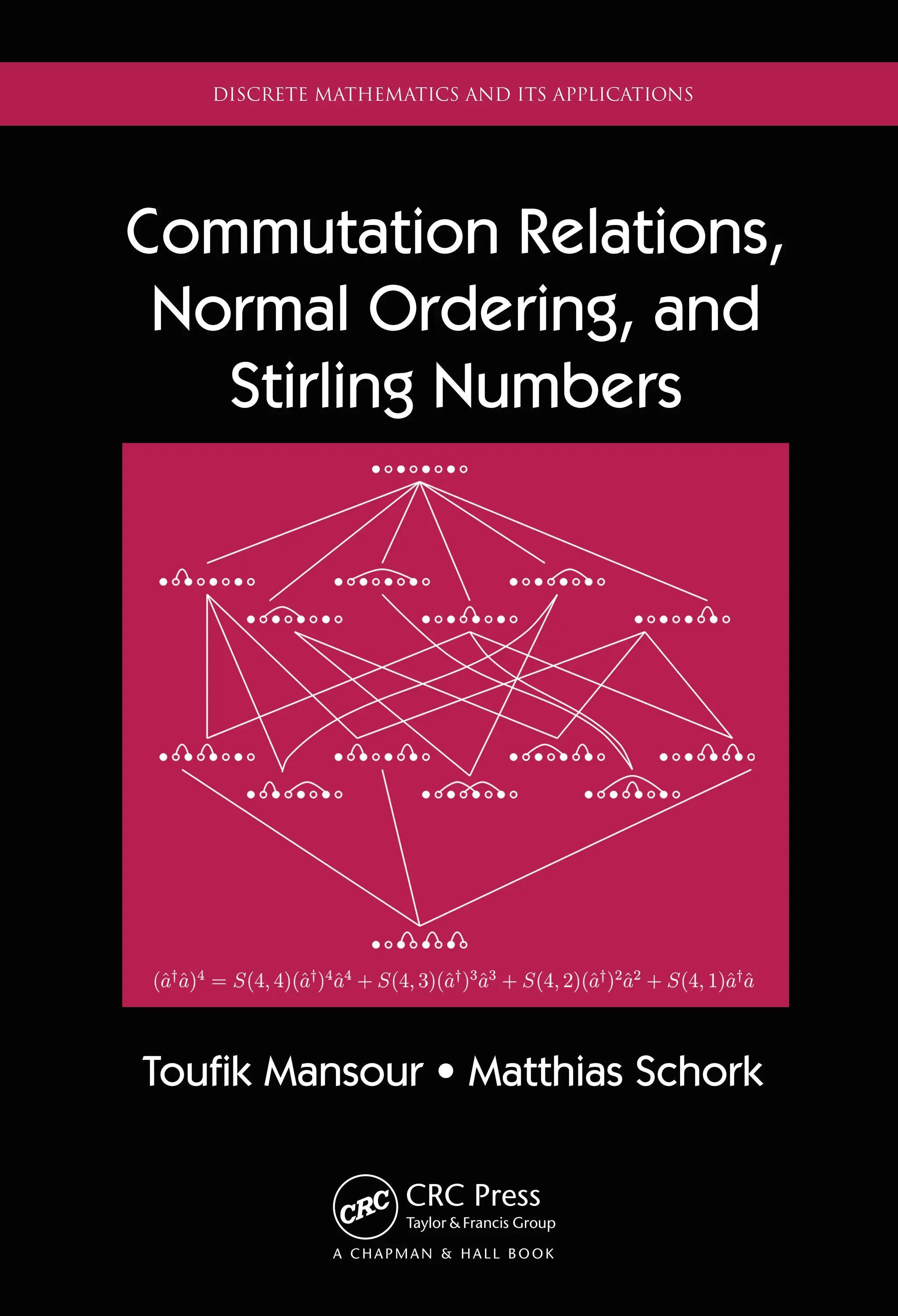


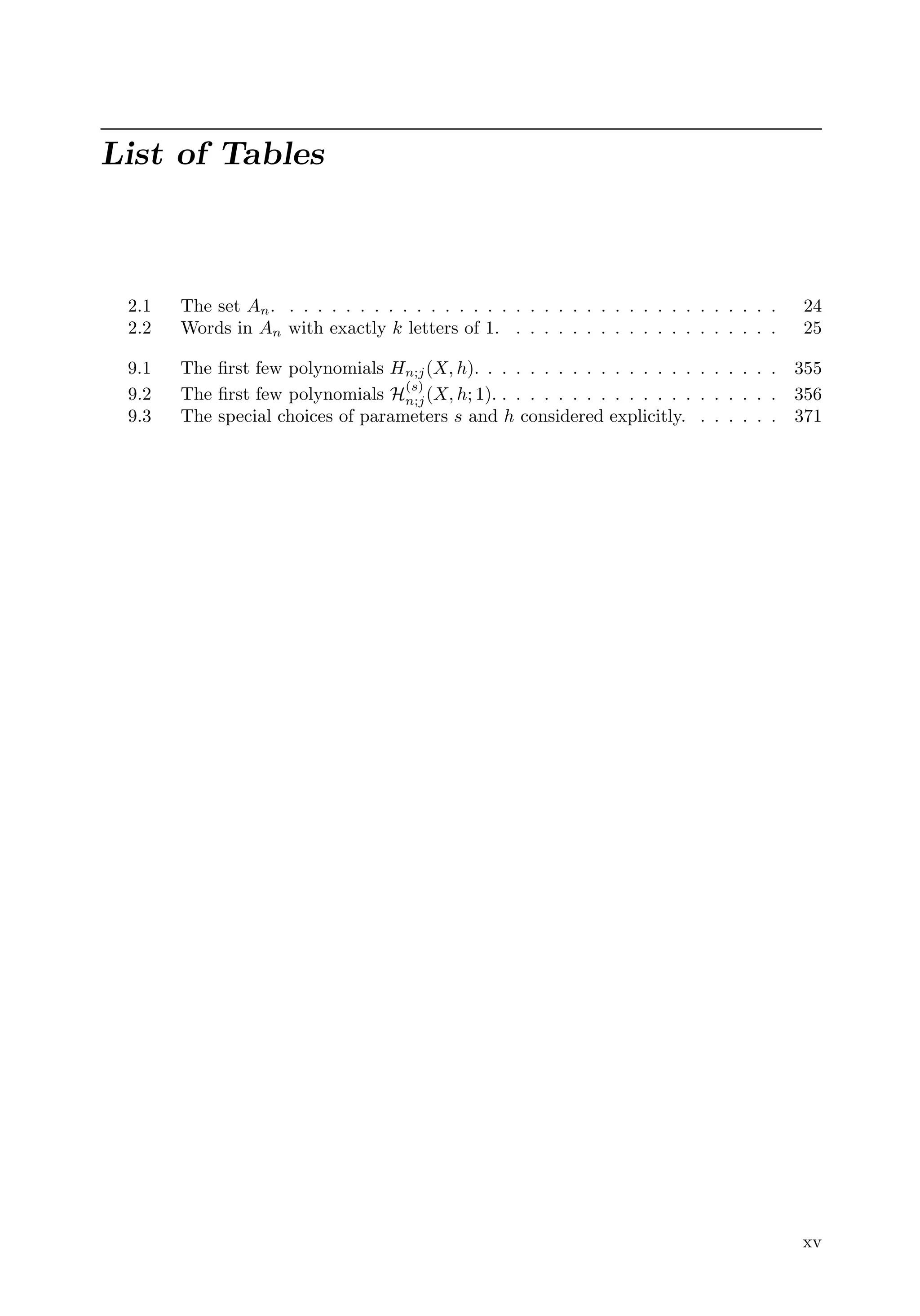

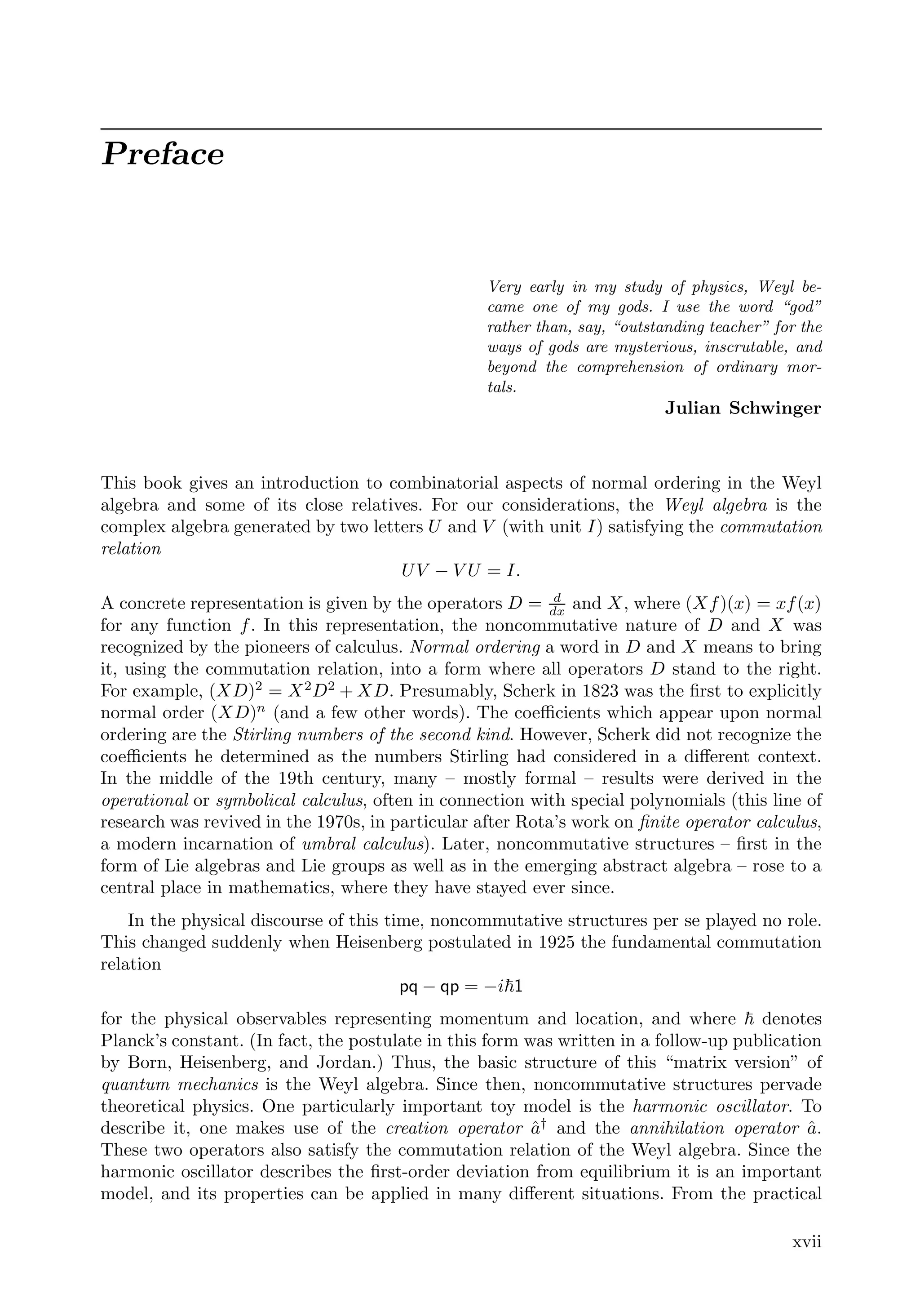
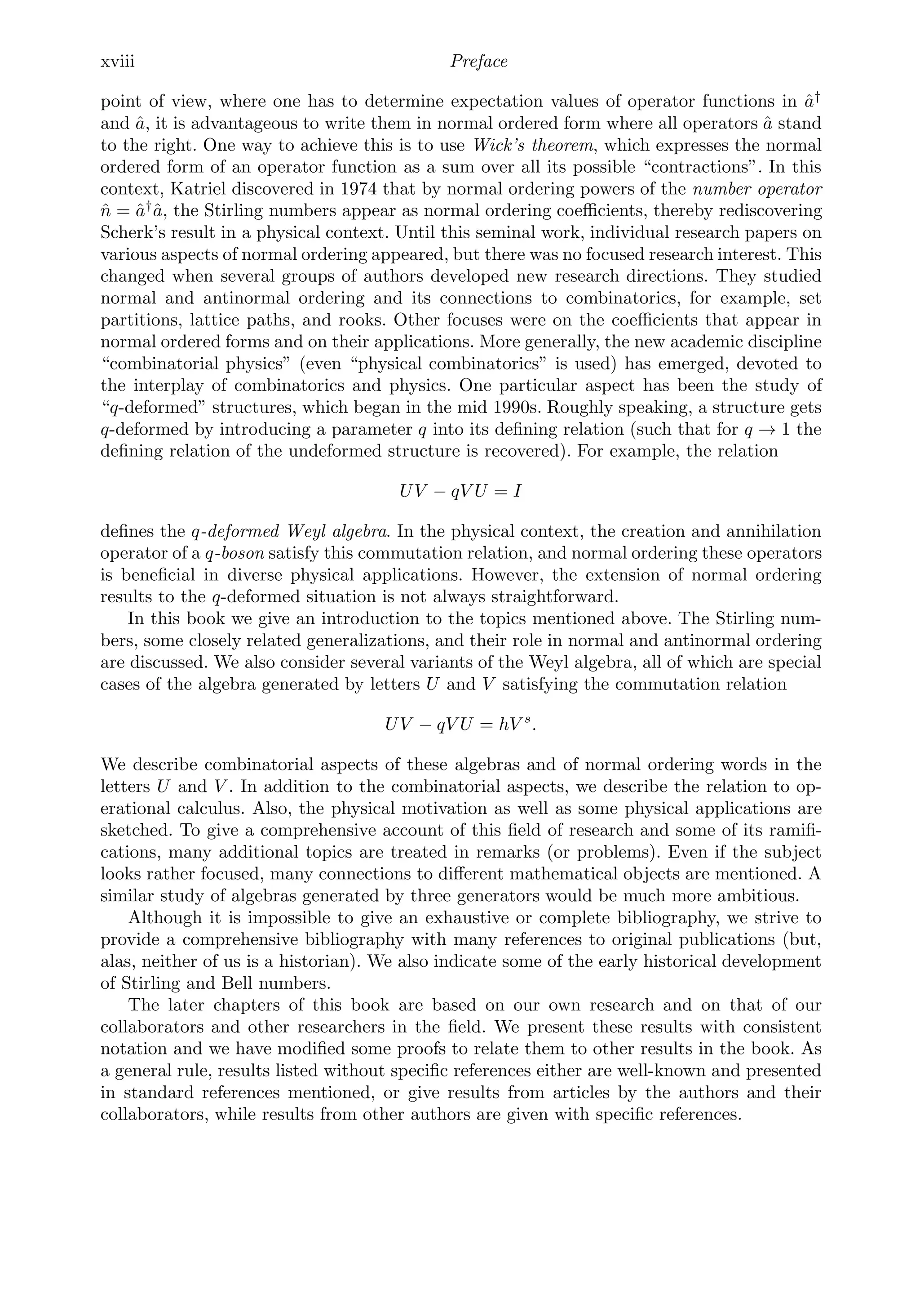
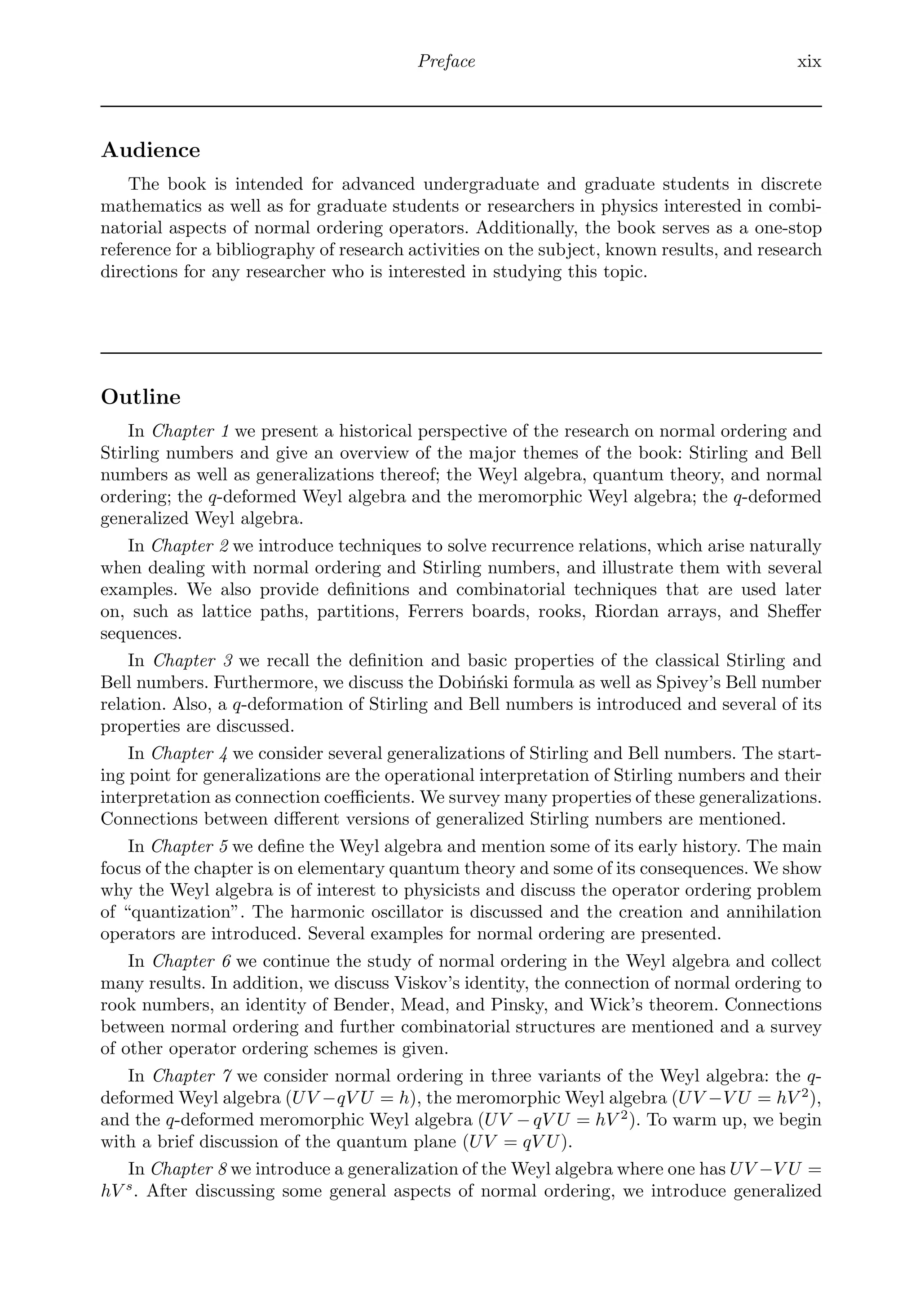


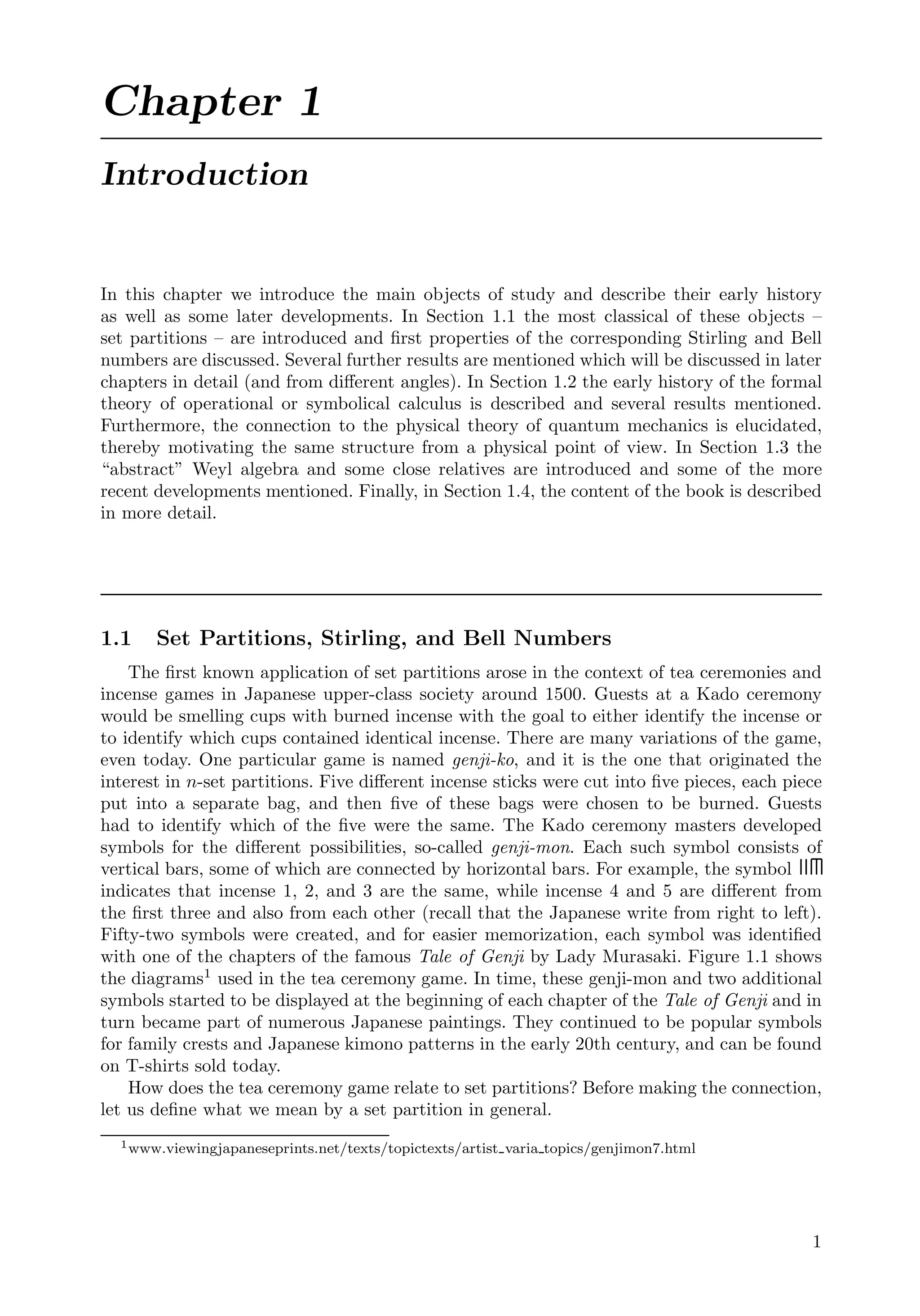
![2 Commutation Relations, Normal Ordering, and Stirling Numbers
FIGURE 1.1: Diagrams used to represent set partitions in 16th century Japan.
1.1.1 Definition of Stirling and Bell Numbers
In the following S will be a set of natural numbers where 0 is included, that is, S ⊆
N0 = N ∪ {0}. For the particular set of the first n natural numbers we use the convenient
notation
[n] = {1, 2, 3, . . ., n}.
Definition 1.1 A set partition π of a set S is a collection B1, B2, . . . , Bk of nonempty
disjoint subsets of S such that ∪k
i=1Bi = S. The elements of a set partition are called blocks,
and the size of a block B is given by |B|, the number of elements in B. We assume that
B1, B2, . . . , Bk are listed in increasing order of their minimal elements, that is, min B1
min B2 · · · min Bk. The set of all set partitions of S is denoted by Π(S).
Note that an equivalent way of representing a set partition is to order the blocks by
their maximal element, that is, max B1 max B2 · · · max Bk. Unless otherwise noted,
we will use the ordering according to the minimal element of the blocks.
Example 1.2 The set partitions of the set {1, 3, 5} are given by
{1, 3, 5}; {1, 3}, {5}; {1, 5}, {3}; {1}, {3, 5} and {1}, {3}, {5}.
Definition 1.3 The set of all set partitions of [n] is denoted by Πn = Π([n]), and the
number of all set partitions of [n] by n = |Πn|, with 0 = 1 (as there is only one set
partition of the empty set).
Example 1.4 For [1], there exists exactly one set partition. Thus, 1 = 1. For [2], the
set partitions are {1}, {2} and {1, 2}, implying 2 = 2. The set partitions of [3] are given
by {1, 2, 3}; {1, 2}, {3}; {1, 3}, {2}; {1}, {2, 3} and {1}, {2}, {3}, giving 3 = 5. In the same
way one determines 4 = 15 as well as 5 = 52. Thus, the sequence of n starts with
1, 1, 2, 5, 15, 52, . . ..
Definition 1.5 Let π be any set partition of [n]. We represent π in either sequential or
canonical form. In the sequential form, each block is represented as sequence of increasing
numbers and different blocks are separated by the symbol /. In the canonical representation,
we indicate for each integer the block in which it occurs, that is, π = π1π2 · · · πn such that
j ∈ Bπj , 1 ≤ j ≤ n.
Example 1.6 The set partitions of [3] in sequential form are 123, 12/3, 13/2, 1/23, and
1/2/3, while the set partitions of [3] in canonical representation are 111, 112, 121, 122, and
123, respectively.](https://image.slidesharecdn.com/2621069-250519064418-1a6380f3/75/Commutation-Relations-Normal-Ordering-And-Stirling-Numbers-Toufik-Mansour-31-2048.jpg)
![Introduction 3
Example 1.7 The set partition 14/257/3/6 has canonical form 1231242.
The two representations can be distinguished easily due to the symbol /, except in the
single case when all elements of [n] are in a single block. In this case, π = 12345 · · ·n, and
its corresponding canonical form is 11 · · ·1. On the other hand, the set partition 12345 · · ·n
in canonical form represents the set partition 1/2/ · · ·/n in sequential form. The canonical
representations can be formulated in terms of words satisfying certain conditions. At first,
we explain what we mean by the concept of a word, and then we characterize which kind
of words correspond to a canonical representation of a set partition.
Definition 1.8 Let a finite set A = {a1, a2, . . . , an} of objects be given. We call each ak
(for k = 1, . . . , n) a letter and A the alphabet. An element of AN
will be called a word
in the alphabet A (of length N). A word ω = (ai1 , ai2 , . . . , aiN ) will be written in the
form ω = ai1 ai2 · · · aiN , that is, as concatenation of its letters. For convenience, we also
introduce the empty word ∅ ∈ A0
. If ω is a word, we denote the concatenation ωω · · · ω (k
times) briefly by ωk
. In the case A = [k], an element of An
is called k-ary word of size n.
Words with letters from the set {0, 1} are called binary words or binary strings, and words
with letters from the set {0, 1, 2} are called ternary words or ternary strings.
Example 1.9 The 2-ary words of size three are 111, 112, 121, 122, 211, 212, 221, and 222,
the binary strings of size two are given by 00, 01, 10, and 11, while the ternary strings of
size two are given by 00, 01, 02, 10, 11, 12, 20, 21, and 22.
Example 1.10 Let A = {a, b} be an alphabet with two letters. Then ω1 = abba, ω2 = baba
and ω3 = aabb are words of length 4 which in general are not related. Note that we can write
briefly ω1 = ab2
a, ω2 = (ba)2
and ω3 = a2
b2
.
In the following we are interested in expressions which are sums of words. Two words
can be added if they are equal and we then write ω + ω = 2ω (since in our applications the
letters are not numbers, no confusion can arise).
After having clarified what we mean by a word, we can characterize which words arise
as the canonical representation of a set partition of [n].
Fact 1.11 A (canonical representation of a) set partition π = π1π2 · · · πn of [n] is a word
π such that π1 = 1, and the first occurrence of the letter i ≥ 1 precedes that of j if i j.
Now we draw the connection between genji-ko and set partitions: each of the possible
incense selections corresponds to a set partition of [5], where the partition is according
to flavor of the incense. Thus, can be written as the set partition 123/4/5 of [5]. As
5 = 52, there are 52 genji-mon, as mentioned at the beginning of Section 1.1 and drawn
in Figure 1.1. According to Knuth [675], a systematic investigation to find the number of
set partitions of [n] for any n, was first undertaken by Takakazu Seki and his students in
the early 1700s. One of his pupils, Yoshisuke Matsunaga, found a recurrence relation for
the number of set partitions of [n], as well as a formula for the number of set partitions of
[n] with exactly k blocks of sizes n1, n2, . . . , nk with n1 + · · · + nk = n.
Theorem 1.12 (Matsunaga) Let n be the number of set partitions of [n]. Then n
satisfies the recurrence relation
n =
n−1
j=0
n − 1
j
j (1.1)
with initial condition 0 = 1.](https://image.slidesharecdn.com/2621069-250519064418-1a6380f3/75/Commutation-Relations-Normal-Ordering-And-Stirling-Numbers-Toufik-Mansour-32-2048.jpg)
![4 Commutation Relations, Normal Ordering, and Stirling Numbers
Proof Assume that the first block contains j + 1 elements from the set [n], where 0 ≤ j ≤
n − 1. Since the first block contains the minimal element of the set, namely 1, we need to
choose j elements from the set {2, 3, . . ., n} to complete the first block. Thus, the number of
set partitions of [n] with exactly j + 1 elements in the first block is given by
n−1
j
n−1−j.
Summing over all possible values of j, we obtain that
n =
n−1
j=0
n − 1
j
n−1−j =
n−1
j=0
n − 1
n − 1 − j
n−1−j =
n−1
j=0
n − 1
j
j,
with 0 = 1.
Theorem 1.13 (Matsunaga) The number of set partitions of [n] with exactly k blocks of
sizes n1, . . . , nk with n1 + · · · + nk = n is given by
k
j=1
n − 1 − n1 − · · · − nj−1
nj − 1
.
Proof The proof is similar to the one for Theorem 1.12. For the first block, we choose
n1 − 1 elements from the set {2, 3, . . ., n}. From the n − n1 available elements, we place the
minimal element into the second block and then choose n2 − 1 elements from the n − n1 − 1
remaining elements, and so on, until we have placed all elements. Thus, the number of set
partitions of [n] with exactly k blocks of sizes n1, n2, . . . , nk with n1 + n2 + · · · + nk = n is
given by
n − 1
n1 − 1
n − 1 − n1
n2 − 1
· · ·
n − 1 − n1 − · · · − ns−1
ns − 1
,
which completes the proof.
A more general formula for the number of set partitions of [n] into kj blocks of sizes nj
with k1n1 + · · · + kmnm = n can be obtained directly from Theorem 1.13. These results
were not published by Matsunaga himself, but were mentioned (with proper credit given)
in Yoriyuki Arima’s book Shūki Sanpō, which was published in 1769. One of the questions
posed in this text was to find the value of n for which the number of set partitions of [n]
is equal to 678.570 (the answer is n = 11). Additional results were derived by Masanobu
Saka in 1782 in his work Sanpō-Gakkai. Saka established a recurrence for the number of
set partitions of [n] into k subsets, and using this recurrence, he computed the values for
n ≤ 11.
Definition 1.14 The set of all set partitions of [n] with exactly k blocks is denoted by Πn,k.
The number |Πn,k| of set partitions of [n] into k blocks is denoted by S(n, k) and is called
Stirling number of the second kind (Sequence A008277 in [1019]).
Example 1.15 From Example 1.4 one reads off that the set [3] has exactly one partition
with one block (123), three partitions into two blocks (1/23, 12/3 and 13/2), and one parti-
tion into three blocks (1/2/3). Thus, S(3, 1) = 1, S(3, 2) = 3 and S(3, 3) = 1. In particular,
3 = S(3, 1) + S(3, 2) + S(3, 3).
Remark 1.16 Note that, by definition,
n =
n
k=0
S(n, k). (1.2)
The numbers n are also known as Bell numbers (in honor of Eric Temple Bell) and
denoted by Bn (Sequence A000110 in [1019]).](https://image.slidesharecdn.com/2621069-250519064418-1a6380f3/75/Commutation-Relations-Normal-Ordering-And-Stirling-Numbers-Toufik-Mansour-33-2048.jpg)
![Introduction 5
Theorem 1.17 (Saka) The number S(n, k) of set partitions of [n] into exactly k blocks
satisfies the recurrence relation
S(n + 1, k) = S(n, k − 1) + kS(n, k),
with S(1, 1) = 1, S(n, 0) = 0 for n ≥ 1, and S(n, k) = 0 for n k.
Proof For any partition of [n + 1] into k blocks, there are two possibilities: either n + 1
forms a single block, or the block containing n + 1 has more than one element. In the first
case, there are S(n, k − 1) such set partitions, while in the second case, the element n + 1
can be placed into one of the k blocks of a partition of [n] into k blocks, that is, there are
kS(n, k) such partitions.
Saka was not the first one to discover the numbers S(n, k). James Stirling, on the
other side of the globe in England, had found these numbers in a purely algebraic setting
in his book Methodus Differentialis [1040] in 1730. Stirling’s interest was in speeding up
convergence of series, and the S(n, k) arise as connection coefficients between monomials
and falling polynomials.
Definition 1.18 Polynomials of the form z(z − 1) · · · (z − n + 1) are called falling polyno-
mials and are denoted by (z)n.
Example 1.19 The first three monomials can be expressed in terms of falling polynomials
as
z1
= z = (z)1,
z2
= z + z(z − 1) = (z)1 + (z)2,
z3
= z + 3z(z − 1) + z(z − 1)(z − 2) = (z)1 + 3(z)2 + (z)3.
The values of the coefficients in the falling polynomials were given in the introduction of
Methodus Differentialis, reproduced as Figure 1.2, where columns correspond to n, and rows
correspond to k. For example, S(7, 3) = 301. The relation (1.2) shows that n is given as
the sum of the entries in the nth column of Figure 1.2. Thus, the sequence n of Bell
numbers starts with 1, 1, 2, 5, 15, 52, 203, 877, 4.140, 21.146, . . ..
The description given by Stirling on how to compute these values makes it clear that
he did not use the recurrence given by Saka (Theorem 1.17). To read more about how
Stirling used the falling polynomials for series convergence, see the English translation of
Methodus Differentialis with annotations by Tweddle [1091] (or [1090]). Despite Stirling’s
earlier discovery of the numbers S(n, k), Saka receives credit for being the first one to
associate a combinatorial meaning to these numbers, which are now named after James
Stirling.
Theorem 1.20 (Stirling) For all n ≥ 1, one has that
zn
=
n
k=1
S(n, k)(z)k. (1.3)
Proof We proceed the proof by induction on n. The first few cases can be checked by
comparing Example 1.19 and Figure 1.2. Assume that the claim holds for n and let us prove
it for n+ 1. By the induction hypothesis, we have that zn+1
=
n
k=1 S(n, k)(z)k(z − k + k).
Using that (z)k(z − k) = (z)k+1 and shifting the index from k to k − 1, this yields
zn+1
=
n+1
k=1
S(n, k − 1)(z)k +
n+1
k=1
kS(n, k)(z)k.](https://image.slidesharecdn.com/2621069-250519064418-1a6380f3/75/Commutation-Relations-Normal-Ordering-And-Stirling-Numbers-Toufik-Mansour-34-2048.jpg)
![6 Commutation Relations, Normal Ordering, and Stirling Numbers
FIGURE 1.2: Stirling numbers of the second kind from Stirling’s Methodus Differentialis.
Writing this in one sum and using the recurrence given in Theorem 1.17, one obtains that
zn+1
=
n+1
k=1 S(n + 1, k)(z)k, as was to be shown.
We introduce Stirling numbers of the first kind in analogy to (1.3) as connection coeffi-
cients.
Definition 1.21 The Stirling numbers of the first kind s(n, k) are defined as connection
coefficients between falling polynomials and monomials,
(z)n =
n
k=1
s(n, k)zk
. (1.4)
Combining (1.3) and (1.4), this gives the orthogonality relations
n
k=1
s(n, k)S(k, l) =
n
k=1
S(n, k)s(k, l) = δn,l, (1.5)
where δn,l is the Kronecker symbol (δn,l = 1 if n = l and δn,l = 0 if n = l).
Let us mention that another notation is also used for Stirling numbers, see, for example,
[508] and the discussion in [674]. One writes
n
k
= S(n, k),
n
k
= (−1)n−k
s(n, k).
1.1.2 Early History of Stirling and Bell Numbers
While set partitions were studied by several Japanese authors and Toshiaki Honda de-
vised algorithms to generate a list of all set partitions of [n], the problem did not receive
equal interest in Europe. There were isolated incidences of research, but no systematic study.
The first known occurrence of set partitions in Europe also occurred outside of mathemat-
ics, in the context of the structure of poetry. In the second book of The Arte of English](https://image.slidesharecdn.com/2621069-250519064418-1a6380f3/75/Commutation-Relations-Normal-Ordering-And-Stirling-Numbers-Toufik-Mansour-35-2048.jpg)
![Introduction 7
Poesie [921], George Puttenham in 1589 compared the metrical form of verses to arithmeti-
cal, geometrical, and musical patterns. Several diagrams, which are in essence the same as
the genji-mon, were given in [921].
The first mathematical investigation of set partitions was conducted by Gottfried Wil-
helm Leibniz in the late 1600s (the manuscript was written probably in 1676). The un-
published manuscript shows that he tried to enumerate the number of ways to write an
as a product of k factors, which is equivalent to the question of partitioning a set of n
elements into k blocks. He enumerated the cases for n ≤ 5, and, unfortunately, double-
counted the case for n = 4 into two blocks of size 2 and the case for n = 5 into three
blocks of sizes one, two, and two. These two mistakes prevented him from discovering that
S(n, 2) = 2n−1
− 1 and also the recurrence given in Theorem 1.17. Further details can
be found in the commentary by Knobloch [668, Pages 229–233], [669] and the reprint of
Leibniz’s original manuscript [670, Pages 316–321].
The second investigation was made by John Wallis, who asked a more general question
in the third chapter of his Discourse of Combinations, Alternations, and Aliquot Parts
in 1685 [1125]. (For example, see Jordan [610], Riordan [935], Goldberg et al. [484], or
Knuth [672].) He was interested in questions relating to proper divisors (=aliquot parts)
of numbers in general and integers in particular. The question of finding all the ways to
factor an integer is equivalent to finding all partitions of the multiset consisting of the prime
factors of the integer (with multiplicities). He devised an algorithm to list all factorizations
of a given integer, but did not investigate special cases.
Back in Japan, a modification of Theorem 1.12 was given by Saka in 1782, when he
showed that the number of set partitions of [n] with exactly k blocks is given by S(n, k),
the Stirling number of the second kind. After 1782, the Bell numbers n received more
attention. It seems that the first occurrence in print of the Bell numbers has never been
traced, but these numbers have been attributed to Euler (see Bell [73], but there is no
reference for this statement). Following Bell [73,74], they are also called exponential numbers.
Touchard [1077,1079] used the notation an to celebrate the birth of his daughter Anne, and
later Becker and Riordan [67] used the notation Bn in honor of Bell. Throughout this book,
we will use the notation Bn or n.
The first appearance of the numbers Bn seems to be in a paper by Christian Kramp [686]
from 1796, who considered an expansion of the function eex
−1
(which we now know is the
exponential generating function of the Bn). Tate [1058] gave in 1845 formula (1.26), which
is equivalent to the Dobiński formula (1.25). This formula was discussed by Dobiński [358]
in 1877 and he gave an explicit formula for the nth Bell number. One year later, in 1878,
Ligowski [729] gave a more general formula involving the exponential generating function
eex
−1
. These results were preceded by the work of Grunert [521], who in 1843 had considered
expressions which contain the Dobiński formula. The Dobiński formula also appeared as
a problem in Mathematicheskii Sbornik in 1868 with solution provided in the following
year [1,2]. Whitworth [1139] discussed in the classical book Choice and Chance from 1870
problems of set partitions and derived explicit formulas for the Stirling and Bell numbers
using the generating function eex
−1
. In 1880, Peirce [900] gave explicit expressions for the
Bell numbers. In the context of difference equations, Cesàro [214] also considered the Bell
numbers and rederived the Dobiński formula in 1885. D’Ocagne [360] studied in 1887 the
generating function for the sequence {n}n≥0. In 1901, Anderegg [32] showed that
2e =
k≥1
k2
k!
, 5e =
k≥1
k3
k!
, 15e =
k≥1
k4
k!
,
and also obtained the general Dobiński’s formula. In the 1920s, Ramanujan studied the Bell
and Stirling numbers in his unpublished notebooks. His work is presented and discussed in](https://image.slidesharecdn.com/2621069-250519064418-1a6380f3/75/Commutation-Relations-Normal-Ordering-And-Stirling-Numbers-Toufik-Mansour-36-2048.jpg)
![8 Commutation Relations, Normal Ordering, and Stirling Numbers
[93]. In the 1930s, Becker and Riordan [67] studied several arithmetic properties of Bell and
Stirling numbers, and Bell [73,74] recovered the Bell numbers. Later, Epstein [399] studied
the exponential generating function for the Bell numbers (see also Williams [1146] and
Touchard [1077,1079]). Rota [946] presented in 1964 a modern approach to Bell numbers and
set partitions. Concerning Bell numbers, we refer the reader to the bibliography compiled
by Gould [502], which contains over 200 entries.
The Stirling numbers of the first and second kind were considered in different contexts,
for example, as connection coefficients, in the calculus of finite differences, in the theory
of factorials, in connection with Bernoulli and Euler numbers, and evaluation of partic-
ular series (and, of course, in connection with the Bell numbers). Apart from Stirling’s
work mentioned above, they were considered – explicitly or implicitly – by many famous
mathematicians, for instance, Euler (1755 [404]), Emerson (1763 [397]), Kramp (1799 [687]),
Lacroix (1800 [702]), Ivory (1806 [580]), Brinkley (1807 [154]), Laplace (1812 [714]), Herschel
(1816 [552], 1820 [553]), Scherk (1823 [959], 1834 [960]), Ettingshausen (1826 [403]), Grunert
(1827 [520], 1843 [521]), Gudermann (1830 [523]), Oettinger (1831 [880]), Schlömilch (1846
[966–968], 1852 [969], 1858 [970], 1859 [971]), Schläfli (1852 [964], 1867 [965]), Catalan
(1856 [204]), Jeffery (1861 [600]), Blissard (1867 [119], 1868 [120]), Whitworth (1870 [1139]),
Worpitzky (1883 [1158]), and Cayley (1888, [208]). The Stirling numbers were so named by
Nielsen [872–874] in 1904 in honor of James Stirling. From the beginning of the 20th century
we single out Tweedie (1918 [1092]), Ramanujan (1920s, see [93]), Ginsburg (1928 [475]),
Carlitz (1930 [183], 1932 [184]), Aitken (1933 [15]), Jordan (1933 [609]), Touchard (1933
[1077]), Becker and Riordan (1934 [67]), Bell (1934 [73,74]), Goldstein (1934 [487]), Toscano
(1936 [1068]), Epstein (1939 [399]) and Williams (1945 [1146]).
The Stirling numbers of the first kind were also discussed by Stirling [1040] in 1730. In
fact, in roughly the same context Thomas Harriot had come across these numbers already
in 1618 in his unpublished manuscript Magisteria Magna [531] (reprinted and annotated
in [68]). Some remarks concerning the history of Stirling numbers can be found in [140,230,
232,609,610,674,675].
1.2 Commutation Relations and Operator Ordering
A commutation relation describes the discrepancy between different orders of operation
of two operations U and V . To describe it, we use the commutator [U, V ] ≡ UV − V U. If U
and V commute, then the commutator vanishes. Nowadays, many examples for noncommut-
ing structures are well-known, for example, matrices, Grassmann algebras, quaternions, Lie
algebras, but the formal recognition of the algebraic properties like commutativity or asso-
ciativity emerged rather slowly and at first in concrete examples. How far a given structure
deviates from the commutative case is described by the right-hand side of the commutation
relation. For example, in a complex Lie algebra g one has a set of generators {Xα}α∈I with
the Lie bracket [XαXβ] =
γ∈I fγ
αβXγ, where the coefficients fγ
αβ ∈ C are called struc-
ture constants. The associated universal enveloping algebra U(g) is an associative algebra
generated by {Xα}α∈I, and the above bracket becomes the commutation relation
[Xα, Xβ] =
γ∈I
fγ
αβXγ.
One of the earliest instances of a noncommutative structure was recognized in the context of
operational calculus (also called symbolical calculus). Recall that one of the basic properties](https://image.slidesharecdn.com/2621069-250519064418-1a6380f3/75/Commutation-Relations-Normal-Ordering-And-Stirling-Numbers-Toufik-Mansour-37-2048.jpg)
![Introduction 9
of calculus is the product rule, which implies that D(x · f(x)) = D(x) · f(x) + x · Df(x).
Interpreting the multiplication with the variable as an application of the multiplication
operator X, this can be written in the form (D ◦ X − X ◦ D)f = f, or, suppressing “◦” and
the operand f, as commutation relation between the operators X and D,
DX − XD = I. (1.6)
1.2.1 Operational (or Symbolical) Calculus
In this section we present some of the early development of operational calculus, following
mainly the account given by Koppelman [681] (and, in addition, the remarks given in [331,
Chapter 1]). In both accounts many references to the original literature can be found.
Furthermore, the classical book [201] of Carmichael from 1855 and [127] of Boole from 1859
are recommended.
The first steps in the formal theory of linear operators can be traced back to a letter
from Leibniz to Johann Bernoulli in 1695; a published account appeared in 1710 [718]. In
it Leibniz discussed the formula for higher derivatives of a product of functions (what we
call today the Leibniz rule) and stressed the analogy to the binomial formula. Furthermore,
he discussed a beautiful combinatorial argument for the coefficients appearing. If we denote
the derivative with respect to x by D and let Dm
f ≡ f(m)
, then Leibniz showed that
Dn
(ψu)(x) =
n
k=0
n
k
ψ(n−k)
(x)u(k)
(x). (1.7)
In 1772 Lagrange [703] discussed many operational formulas which would later be inter-
preted as the first steps in the calculus of finite differences. Let us introduce in addition to
D the shift operator
Eu(x) = u(x + 1) (1.8)
and the operator of finite difference
Δu(x) = u(x + 1) − u(x). (1.9)
Clearly, one has Eu(x) = (1 + Δ)u(x). In this notation, Taylor’s theorem can be formally
denoted by f(x + h) = ehD
f(x), where the right-hand side has to be expanded using
the conventional exponential series. Thus, Eu(x) = eD
u(x). Introducing a constant ξ and
denoting Δξu(x) = u(x + ξ) − u(x), Lagrange derived the operational relation
Δλ
ξ u = eξ du
dx − 1
λ
. (1.10)
A proof of (1.10) was given by Laplace [713] in 1776. The next big step was taken by
Arbogast in his book Du Calcul Des Dérivations [40] from 1800 (following ideas of Lorgna).
His idea was to separate the “symbols” (that is, operators) from the subject on which they
act and to consider the rules the symbols satisfy algebraically. For example, he wrote (1.10)
for λ = 1 as
1 + Δξ = eξD
,
that is, as equation between the symbols itself. By considering the symbols apart from the
subjects on which they act and manipulating them as if they were algebraic quantities, he
was clearly working in the realm of operational calculus. In 1814, Servois published two
notable papers [987,988], in which he showed that the reason for the analogy between op-
erational and algebraical symbols was that both types of symbols satisfy the distributive,](https://image.slidesharecdn.com/2621069-250519064418-1a6380f3/75/Commutation-Relations-Normal-Ordering-And-Stirling-Numbers-Toufik-Mansour-38-2048.jpg)
![10 Commutation Relations, Normal Ordering, and Stirling Numbers
associative and commutative law. Servois introduced the names “distributive” and “com-
mutative”, but the name “associative” seems to be due to Hamilton. Cauchy [205] discussed
operational calculus in 1827 (mentioning, in particular, the work of Brisson) and showed,
among many other results, that
F(D)[erx
f(x)] = erx
F(r + D)f(x), (1.11)
where F is a polynomial. Cauchy used these results to solve particular differential equa-
tions, and he inquired into the convergence of the series obtained by formal processes and
considered methods for establishing the validity of results of operational methods.
However, the operational methods did not become popular on the continent. The accep-
tance of the methods and notation of the continentals was surprisingly quick in England,
and it was here that the calculus of operations was extended in scope and its applica-
tions. The first mathematicians in England who were responsible for this development were
Babbage, Herschel, Peacock, and Woodhouse; see [681] for a discussion. In the next 30–40
years, from the late 1830s to the 1870s, many important results were achieved. In 1837
Murphy published a paper [855] in which a very clear and general account of the theory of
linear operations was given, and in which he also noticed explicitly the difference between
commuting and noncommuting operations. The next mathematician whom we single out
is Gregory, who in the late 1830s and early 1840s published several papers in which the
operational calculus was applied to differential and difference equations. He also discussed
more general questions concerning operational calculus and its algebraic contents, see, for
example, [516,517]. Some information about Gregory, who died at the early age of 30, can
be found in [29,342,681]. The work of Murphy and Gregory influenced Boole and his most
important work concerned with operational calculus appeared in 1844 [126] (and can also
be found in his book [127]). For example, in [126] he considered symbols π and ρ which
are assumed to be associative and distributive and which satisfy for any function f, which
can be developed into a power series in x, that ρf(π) = λf(π)ρ, where λ acts on π so that
λf(π) = f(φ(π)). He showed that one can write
f(π + ρ) =
m≥0
fm(π)ρm
,
where f0(π) = f(π) and fm(π) = λ−1
(λm−1)π fm−1(π). Furthermore, he showed that f(π)ρm
u =
ρm
f(π + m)u. Choosing π = d
dθ = D and x = ρ = eθ
, this implied that
f(D)emθ
u = emθ
f(D + m)u, (1.12)
reproducing (1.11). As a second application, Boole derived for D = d
dx that
xD(xD − 1)(xD − 2) · · · (xD − n + 1)u = xn
Dn
u, (1.13)
which he called “known relation”. In the late 1840s and early 1850s many attempts to extend
and generalize Boole’s results appeared. One of the most prolific adherents was the Reverend
Bronwin, who devoted several papers to the symbolic method; see, for example, [157,158].
Another follower was Hargreave, whose most important contribution appeared in 1848 [530].
His generalization of the Leibniz rule (1.7) can be written as
φ(D)[ψ(x) · u(x)] = ψ(x)φ(D)u(x) + φ
(x)ψ
(D)u(x) +
1
2!
ψ
(x)φ
(D)u(x) + · · · ,
where φ and ψ were assumed to be functions which can be developed in ascending or
descending integral powers of the variable. Shortly after that, the Reverend Graves [510]](https://image.slidesharecdn.com/2621069-250519064418-1a6380f3/75/Commutation-Relations-Normal-Ordering-And-Stirling-Numbers-Toufik-Mansour-39-2048.jpg)
![Introduction 11
discussed the symbolical content of Hargreaves’s results and introduced for that purpose
symbols π and ρ satisfying
πρ − ρπ = α, (1.14)
where α was assumed to commute with π and ρ. Graves discussed that a particular represen-
tation for this commutation relation is given (for α = 1) by π → D = d
dx and ρ → X, where
X denotes again the operator of multiplication with the independent variable x. He also
showed that this commutation relation implies an abstract version of Hargreaves’ results.
In fact, a few years earlier, in 1850, Donkin [362] had considered a more general situation
in which symbols ω, ρ1, . . . , ρn+1 are involved which satisfy
ωρ − ρω = ρ1
ωρ1 − ρ1ω = ρ2
.
.
.
ωρn − ρnω = ρn+1.
Clearly, if ρk = 0 for k ≥ 2, this reduces to the situation considered by Graves. Assuming
that f(x) can be expanded in integral powers of x, Donkin showed, for example, that
f(ω)ρ = ρf(ω)+ρ1f
(ω)+ ρ2
2! f
(ω)+· · · , and applied this to several questions in differential
and difference calculus. In another interesting paper [509], Graves considered the action of
eg(x)D
on functions u(x). He discovered that if eg(x)D
u(x) = f(x), then f can be described
as
f(x) = u{G−1
[G(x) + 1]}, (1.15)
where G(x) =
x dt
g(t)
and G−1
is the inverse function of G. For example, if g(x) = xm
with
m ∈ N {1}, then
eλxm
D
u(x) = u
x
m−1
1 − (m − 1)λxm−1
. (1.16)
In the particular case m = 1, one obtains for the exponential of the Euler operator xD due
to G(x) = ln(x) for λ ∈ R the well-known result
eλxD
u(x) = u(eλ
x). (1.17)
In the early 1860s a series of papers of Russel [951–953] appeared in which he con-
sidered noncommutative symbols along the lines of Boole (but satisfying slightly different
commutation relations), and in 1882 Cazzaniga [209, 210] gave a systematic exposition of
symbolical calculus. Around this time, Crofton [308–311] and Glaisher [476–479] published
several interesting papers. From 1881 on, Heaviside worked out his operational calculus (the
so-called Heaviside calculus) in a long series of publications; see the discussion in [331,903].
The importance of this work was recognized in 1910–1920, and several mathematicians tried
to give it a rigorous foundation (for a well-known early work; see Wiener [1141] and the
references therein). Let us also mention the work of Carmichael, Cockle, Greatheed, DeMor-
gan, Roberts, and Spottiswoode (see the discussion in [681]). As Davis [331] remarked, the
period of formal development of operational methods may be regarded as having ended by
1900. At this time, the theory of integral equations began fascinating mathematicians, and
from these beginnings the modern theory of functional analysis emerged. Since the 1970s,
Gian-Carlo Rota and collaborators revived many of these classical topics in finite operator
calculus – or also under the classical name umbral calculus; see, for example, [939–941,947].](https://image.slidesharecdn.com/2621069-250519064418-1a6380f3/75/Commutation-Relations-Normal-Ordering-And-Stirling-Numbers-Toufik-Mansour-40-2048.jpg)
![12 Commutation Relations, Normal Ordering, and Stirling Numbers
1.2.2 Early Results for Normal Ordering Operators
The problem of bringing operators into a convenient order arose with the appearance
of noncommutative objects (“symbols”). Clearly, if the operators under consideration com-
mute, one can write them in any order one wishes. Recall the terminology considering words
introduced in Definition 1.8. Let us turn to the concrete situation where the alphabet con-
sists of the two operators X and D. An arbitrary word ω in these letters can be written
as
ω = Xrn
Dsn
· · · Xr2
Ds2
Xr1
Ds1
(1.18)
for some rk, sk ∈ N0. In our context (1.6) holds true, that is, two adjacent letters X and D
in a word can be interchanged according to this relation. Each time one uses it in a word
ω, two new words result. If we write the original word as ω = ω1DXω2 (where each ωk can
be the empty word), then applying (1.6) yields that ω = ω1XDω2 + ω1ω2.
Example 1.22 The simplest example results when ω1 = ω2 = ∅, and ω = DX can be
written as DX = XD + 1. The more complex word D2
XD can be written as DDXD =
DXDD + DD = DXD2
+ D2
.
Using successively (1.6), one can transform each word in X and D into a sum of words,
where each of these words has all the powers of D to the right.
Definition 1.23 A word ω in the letters X and D is in normal ordered form if ω =
ar,sXr
Ds
for r, s ∈ N0 (and arbitrary coefficients ar,s ∈ C). An expression consisting of
a sum of words is called normal ordered if each of the summands is normal ordered. The
process of bringing a word (or a sum of words) into its normal ordered form is called normal
ordering. Writing the word ω in its normal ordered form,
ω =
r,s∈N0
Ar,s(ω)Xr
Ds
,
the – uniquely determined – coefficients Ar,s(ω) are called normal ordering coefficients of ω
(the sum is only finite). In a similar fashion, ω = br,sDr
Xs
is called antinormal ordered.
As shown above, the normal ordered form of DX is XD + 1. As the next example, we
show that it is possible to interpret the Leibniz rule (1.7) as a formula concerning normal
ordering. Indeed, if we consider the left-hand side Dn
(ψu)(x) as the successive application
of the multiplication operator ψ(X) followed by Dn
on u, we can write this relation as
(Dn
◦ ψ(X)) u(x) =
n
k=0
n
k
ψ(n−k)
(X) ◦ Dk
u(x),
which we interpret as the following normal ordering relation
Dn
ψ(X) =
n
k=0
n
k
ψ(n−k)
(X)Dk
.
Choosing ψ(X) = X, one gets back (1.6) for n = 1. Choosing ψ(X) = Xm
with m ≥ n, one
can use that Dl
(xm
) = l!
m
l
xm−l
to find
Dn
Xm
=
n
k=0
n
k
m
k
k!Xm−k
Dn−k
. (1.19)
Let us point out that this interpretation of the Leibniz rule (1.7) is an unhistorical one.
Maybe the first explicit results concerning normal ordering were derived by Scherk [959] in
his dissertation from 1823.](https://image.slidesharecdn.com/2621069-250519064418-1a6380f3/75/Commutation-Relations-Normal-Ordering-And-Stirling-Numbers-Toufik-Mansour-41-2048.jpg)
![Introduction 13
Theorem 1.24 (Scherk) Let X and D satisfy (1.6).
1. The powers (XD)n
have for n ∈ N the normal ordered form
(XD)n
=
n
k=1
ak
nXk
Dk
, (1.20)
where the coefficients ak
n satisfy the recurrence relation
ak
n = ak−1
n−1 + kak
n−1. (1.21)
2. The powers (eX
D)n
have for n ∈ N the normal ordered form
(eX
D)n
= enX
n
k=1
ck
nDk
, (1.22)
where the coefficients ck
n satisfy the recurrence relation
ck
n = ck−1
n−1 + (n − 1)ck
n−1.
Note that eX
is an infinite series and is treated formally. Scherk also gave combinatorial in-
terpretations and explicit expressions for the expansion coefficients ak
n and ck
n. He considered
in his dissertation also briefly the expansion of (Xp
D)n
with p ∈ N and wrote
(Xp
D)n
= Xnp−n
n
k=1
bk
nXk
Dk
, (1.23)
where the coefficients bk
n are described combinatorially as a sum over certain partitions.
Scherk [960] mentioned in 1834 the following recurrence for them,
bk
n = bk−1
n−1 + ((n − 1)p − n + k + 1) bk
n−1.
Murphy derived in the already mentioned paper [855] from 1837 several remarkable formulas.
If v denotes an arbitrary function, he found the expansion
(vD)n
= vn
Dn
+
n
2
v
vn−1
Dn−1
+
n
3
3n − 5
4
(v
)2
+ v
v
vn−2
Dn−2
+ · · · , (1.24)
but gave no explicit expression for the general term; in fact, Scherk [959] had also considered
this expansion. Relation (1.13) mentioned by Boole [126] was used frequently as a starting
point to obtain generalizations. Grunert [521] considered in 1843 the expansion (1.20) and
found the recurrence (1.21). Cesàro [214] considered in 1885 (1.20) and derived for the
coefficients the expression ak
n = Δk
0n
k!
, where a symbolic notation of the calculus of finite
differences is used. Applying (1.20) to ex
and using on the left-hand side ex
=
k≥0
xk
k!
as
well as (XD)n
xk
= kn
xk
, the left-hand side gives
k≥1
kn
xk
k!
. On the right-hand side, one
obtains
n
k=1 ak
nxk
ex
. Comparing both sides for x = 1, one obtains that (here we use that
ak
n = S(n, k))
1
e
k≥1
kn
k!
= n, (1.25)](https://image.slidesharecdn.com/2621069-250519064418-1a6380f3/75/Commutation-Relations-Normal-Ordering-And-Stirling-Numbers-Toufik-Mansour-42-2048.jpg)
![14 Commutation Relations, Normal Ordering, and Stirling Numbers
where n are the Bell numbers (Cesàro did not recognize these numbers as partition num-
bers). Thus, Cesàro derived the Dobiński formula (1.25), and he also derived the exponential
generating function eex
−1
of the numbers n. Note that we can write (1.25) also as
1n
1!
+
2n
2!
+
3n
3!
+ · · · = e
Δ0n
1!
+
Δ2
0n
2!
+
Δ3
0n
3!
+ · · · . (1.26)
In this form, (1.26) was already shown by Tate [1058] in 1845, and he considered the
case n = 3 explicitly (where 3 = 5). In the beautiful paper [360] from 1887 d’Ocagne
obtained several results for the “remarkable numbers” Kk
n, which he defined by (1.21), that
is, Kk
n = Kk−1
n−1 + kKk
n−1 (since the initial values coincide, one has Kk
n = ak
n). D’Ocagne
derived (1.20) and also
(DX)n
=
n
k=0
Kk+1
n+1Xk
Dk
.
In addition, denoting φm+1(x) =
m
k=0 Kk+1
m+1xk
, he derived the expression
(X + DX)n
=
n
k=0
φ
(k)
m+1(X)
k!
Xk
Dk
.
Several other expansions were treated, in particular in connection with higher derivatives
of “functions of functions”. In this context, we should mention the work of Meyer [812,813],
Schlömilch [966–971], and Schläfli [964, 965]. These authors noticed the appearance of in-
teresting coefficients and studied their properties. Nielsen [872,873] introduced in 1904 the
name “Stirling numbers” for the coefficients ak
n, and Tweedie [1092] wrote a first compre-
hensive paper in 1918. Shortly after that, Schwatt [984] noticed in 1924 that the coefficients
in (1.20) are given by the Stirling numbers (of the second kind), that is, we can write
(XD)n
=
n
k=1
S(n, k)Xk
Dk
. (1.27)
In the early 1930s, Carlitz [183, 184], seemingly unaware of the work of Scherk, defined
in analogy to (1.20) and (1.23) generalized Stirling numbers Sr,s(n, k) as normal ordering
coefficients for r ≥ s by
(Xr
Ds
)n
= Xn(r−s)
k≥0
Sr,s(n, k)Xk
Dk
. (1.28)
Clearly, S1,1(n, k) = S(n, k) = ak
n and Sp,1(n, k) = bk
n. Independently, Toscano followed the
same idea and, beginning in 1935, treated the generalized Stirling numbers in a long series
of papers [1067–1075]. McCoy [791] considered in 1934 arbitrary words (1.18) in X and D,
Xrn
Dsn
· · · Xr2
Ds2
Xr1
Ds1
= X|r|−|s|
k≥0
Sr,s(k)Xk
Dk
, (1.29)
where r = (r1, . . . , rn) and |r| = r1 + · · · + rn (and, similarly, for s). The coefficients
Sr,s(k) generalize the Stirling numbers of Carlitz: If rk = r and sk = s for k = 1, . . . , n,
then Sr,s(k) = Sr,s(n, k) and (1.29) reduces to (1.28). Since many classical polynomials –
for example, the Bell, Bessel, Hermite, and Laguerre polynomials – allow an operational
treatment, many other researchers followed this line of research and discovered many in-
teresting relations involving Stirling numbers or their generalizations; see, for example,](https://image.slidesharecdn.com/2621069-250519064418-1a6380f3/75/Commutation-Relations-Normal-Ordering-And-Stirling-Numbers-Toufik-Mansour-43-2048.jpg)
![Introduction 15
Cakić [175–178, 392, 393, 826], Chak [216–219], Comtet [279], Gould [496–499, 501, 503],
Lang [710–712], Mitrinović [834–836], Al-Salam [17,18], and Al-Salam [19–21].
Let us point out another way to generalize Stirling numbers. Introducing the generalized
factorial (z|γ)n = z(z−γ) · · · (z−(n−1)γ), Hsu and Shiue [568] defined generalized Stirling
numbers S(n, k; α, β, r) as connection coefficients,
(z|α)n =
n
k=0
S(n, k; α, β, r)(z − r|β)k. (1.30)
Clearly, (1.3) and (1.4) are particular instances of (1.30), and many previous generalizations
of Stirling numbers are special cases of S(n, k; α, β, r).
1.2.3 Operator Ordering in Quantum Theory
Recall from the preceding section that Graves discovered in the 1850s that the main
property to derive many of the algebraic consequences of operational calculus is the com-
mutation relation (1.14) (with α ∈ C), which is an abstract version of (1.6). Unfortunately,
he was roughly 70 years ahead of his time. In 1925, Werner Heisenberg [545] discovered
that to understand the physics of the atom one should depart from classical notions, im-
plying in particular that the mathematical objects representing physical properties need
not commute. The relations he postulated for the momentum and location were recognized
immediately by Born and Jordan [131] as the commutation relation
pq − qp = −i1 (1.31)
for the infinite matrices p (resp. q) which represent the momentum (resp. location) and
where = h/2π denotes Planck’s constant. Independently, Dirac [349–351] considered ab-
stract q-numbers satisfying (1.31) and developed a quantum algebra for them. Thus, this
noncommutative structure – coinciding with (1.14) considered by Graves – lies at the heart
of quantum theory. Very shortly after the discovery of this matrix mechanics, a different
version of quantum theory was found by Erwin Schrödinger in the form of wave mechanics
– the famous Schrödinger equation. However, it was soon established that both versions of
the theory are equivalent.
Born and Jordan [131] recognized that one needs to consider particularly ordered forms
of expressions in the noncommuting objects p and q. Calling an expression in these two
variables normal ordered (resp. antinormal ordered), if all powers of p stand to the right
(resp. left) of the powers of q, they gave the following normal ordering formula
pn
q = qpn
+ n(−i)pn−1
,
as well as the analogous antinormal ordering formula
qn
p = pqn
− n(−i)qn−1
.
More generally, they also mentioned that
pn
qm
=
min(n,m)
k=0
k!
n
k
m
k
(−i)k
qm−k
pn−k
, (1.32)
and gave the analogous antinormal ordering formula. Note that (1.32) has the same structure
as (1.19) due to the common algebraic structure. In the subsequent paper [130] together](https://image.slidesharecdn.com/2621069-250519064418-1a6380f3/75/Commutation-Relations-Normal-Ordering-And-Stirling-Numbers-Toufik-Mansour-44-2048.jpg)
![16 Commutation Relations, Normal Ordering, and Stirling Numbers
with Heisenberg , they derived for any function f(q, p), which can be formally expressed as
power series in p and q, the rule
pf − fp = (−i)
∂f
∂q
,
as well as
qf − fq = (−i)
∂f
∂p
. (1.33)
Dirac, who independently found (1.31) in [349], considered in his subsequent work [351]
algebraic consequences of (1.31) and also derived (1.33). Furthermore, Dirac showed that
f(q, p)eiαq
= eiαq
f(q, p + α),
which one recognizes as (1.12) already discussed by Boole – or, even earlier, by Cauchy
(1.11). Dirac [350] considered many other interesting consequences of (1.31). Coutinho [304]
gave a beautiful account of the early history of the underlying Weyl algebra. From a more
mathematical point of view, several consequences of relation (1.31) were discussed in the
early 1930s by McCoy [786–791] as well as Kermack and McCrea [649,650,792]. An instruc-
tive discussion of their work from a modern perspective can be found in [306]. Motivated by
the example of “quantum algebra”, Littlewood [733] started in 1933 a thorough examination
of this algebra.
Let us turn back to quantum theory. In its applications, it is often convenient to switch
to Fock space and consider two adjoint operators in it satisfying the bosonic commutation
relation
ââ†
− â†
â = 1. (1.34)
Note that this is again an instance of (1.14)! The creation operator â†
(resp. annihilation
operator â) has the interpretation of creating (resp. annihilating) one quantum in the system
considered (for example, a photon). In the simplest example a physical state just denotes
the number of quanta present in the system, and a state representing n quanta is denoted
by |n . Fock space F is the linear span {|1 , |2 , . . ., |n , . . .} of these states, and one has
that
â†
|n =
√
n + 1|n + 1 , â|n =
√
n|n − 1 .
Destroying the last quantum, only the vacuum remains, that is, â|1 = 0. The number
operator n̂ = â†
â has the property n̂|n = n|n , hence its name. To calculate expectation
values of interesting operators in â and â†
, it is advantageous to write them in normal
ordered form, meaning that the powers of â†
stand to the left of the powers of â. The
reason for this is that destroying more quanta than are present, the vacuum results, that
is, (â†
)m
âk
|n = 0 if k n.
For the states one has that n||m = δn,m. A simple calculation gives n|â†
|m =
√
m + 1n||m + 1 =
√
m + 1δn,m+1. One easily finds that m|n̂k
|m = mk
for any k ∈ N.
As an example, consider k = 2, where n̂2
= â†
ââ†
â. Using (1.34), one obtains that
n̂2
= (â†
)2
â2
+ â†
â, hence,
m|n̂2
|m = m|(â†
)2
â2
|m + m|â†
â|m = m(m − 1) + m = m2
,
as it should. Higher powers of the number operator can be written as
n̂n
=
n
k=1
Tn,k (â†
)k
âk
(1.35)
for some coefficients Tn,k. Normal ordered expressions for powers of n̂ were derived by](https://image.slidesharecdn.com/2621069-250519064418-1a6380f3/75/Commutation-Relations-Normal-Ordering-And-Stirling-Numbers-Toufik-Mansour-45-2048.jpg)
![Introduction 17
Agarwal and Wolf [8] in 1970. In the same context, similar relations had been discussed a
few years earlier by Schwinger [985,986], Mandel [755], Louisell and Walker [741], Marburger
[775,776], Wilcox [1102,1142,1143]), Peřina [904,905]), and Cahill and Glauber [170]. Gluck
[482] considered in 1972 closely related operators. For our considerations, two important
papers appeared in the mid 1970s: Navon [861] considered in 1973 the anticommutation
relation
ˆ
f ˆ
f†
+ ˆ
f† ˆ
f = 1 (1.36)
for fermionic creation and annihilation operators – compare with (1.34) – and showed that
the normal ordering coefficients for arbitrary words in the multi-mode case can be expressed
as rook numbers. Katriel [634] recognized in 1974 that the coefficients in (1.35) are Stirling
numbers of the second kind, that is,
n̂n
=
n
k=1
S(n, k)(â†
)k
âk
. (1.37)
The work of Katriel was generalized from the 1980s up to the present, beginning by himself
[635–638] and Mikhaı̆lov [822,823], to more general expressions. Katriel [637] discovered in
2000 (see also [638]) that the Bell numbers appear as expectation values of n̂n
with respect
to coherent states. Since normal ordered expressions are useful in applications, this more
combinatorial approach gained speed after 2000 and more and more authors contributed to
an understanding of normal ordered expressions. By considering instead of n̂n
= (â†
â)n
the
expressions ((â†
)r
âs
)n
, generalized Stirling numbers Sr,s(n, k) were introduced by Blasiak,
Penson, and Solomon [114–116] in 2003 for r ≥ s by
((â†
)r
âs
)n
= (â†
)n(r−s)
n
k=0
Sr,s(n, k)(â†
)k
ak
, (1.38)
and many of their properties were studied. Since â → D and â†
→ X (hence, n̂ = â†
â →
XD) furnishes a representation of the commutation relation, the generalized Stirling num-
bers Sr,s(n, k) from (1.38) equal the generalized Stirling numbers Sr,s(n, k) introduced by
Carlitz (1.28).
In the above physical situation, Arik and Coon [41] considered a q-analog of (1.34), that
is, they introduced the q-deformed commutation relation
âqâ†
q − qâ†
qâq = 1 (1.39)
of a q-boson (where q ∈ C). Considering q → 1 gives the bosonic commutation relation
(1.34), while considering q → −1 gives the fermionic commutation relation (1.36). Here
the same problems as in the undeformed case appear and normal ordering powers of the
corresponding number operator involves the q-deformed Stirling numbers of the second kind,
as was shown in 1992 by Katriel and Kibler [642]. Many properties of this algebra have been
considered, and an extensive bibliography up to 2000 can be found in [549].
Since Katriel’s seminal work [634], the combinatorial aspects of boson normal ordering
have received a lot of attention; see, for example, [101,113,114,116,117,181,356,357,417,
419, 453, 494, 637, 639, 711, 764, 768–770, 807, 822, 974, 976, 989, 991, 1099, 1100, 1149] (more
references are given in later chapters). Wick’s theorem is the physicist’s way to determine
the normal ordered form of an arbitrary operator function in â and â†
. A closer look reveals
that the contractions used in it can be described in terms of set partitions, providing a
conceptual reason for the appearance of S(n, k) in (1.37).
Concerning introductions to normal ordering, we recommend the beautiful survey of
Blasiak and Flajolet [106], where many combinatorial aspects are discussed. An older ref-
erence is [740], while [113] provides an elementary first introduction. Also, [761] contains a
discussion on normal ordering.](https://image.slidesharecdn.com/2621069-250519064418-1a6380f3/75/Commutation-Relations-Normal-Ordering-And-Stirling-Numbers-Toufik-Mansour-46-2048.jpg)
![18 Commutation Relations, Normal Ordering, and Stirling Numbers
1.3 Normal Ordering in the Weyl Algebra and Relatives
For us, the Weyl algebra Ah (where h ∈ C) is the complex algebra generated by the
letters U and V satisfying UV − V U = hI, where the identity I on the right-hand side will
usually be suppressed. This relation is exactly (1.14) considered by Graves, and a concrete
representation is given for h = 1 by V → X and U → D, see (1.6) (or, V → â†
and U → â,
see (1.34)). The normal ordering results mentioned above only depend on the commutation
relation between the “symbols”, so also hold in A1. For example, normal ordering (V U)n
gives rise to the S(n, k) as normal ordering coefficients. In 2005, Varvak [1100] showed that
the normal ordering coefficients of an arbitrary word in U and V can be expressed as rook
numbers (Fomin [448] had shown the same in a different context in 1994). More precisely,
to a word ω in U and V one can associate a Ferrers board Bω, and it is then possible to
write for a word ω having m appearances of V (resp. n of U) the normal ordered expression
ω =
min(m,n)
k=0
rk(Bω)V m−k
Un−k
, (1.40)
where rk(Bω) denotes the kth rook number of the board Bω. For example, if ω = (V U)n
,
then the corresponding Ferrers board is given by the staircase board Jn,1, for which one
knows rn−k(Jn,1) = S(n, k). Thus, (1.40) gives
(V U)n
=
n
k=0
rn−k(Jn,1)V k
Uk
=
n
k=0
S(n, k)V k
Uk
, (1.41)
that is, the well-known result (1.27).
The q-deformed Weyl algebra Ah|q is defined – in analogy to Ah – to be the complex
algebra generated by the letters U and V satisfying
UV − qV U = h, (1.42)
where q ∈ C is assumed to be generic. A physical representation is given for h = 1 by
U → âq and V → â†
q; see (1.39). An operational representation of (1.42) is given for h = 1
by V → X and U → Dq, where Dq denotes the Jackson derivative. The action of the
Jackson derivative on a function f is defined by
(Dqf)(x) =
f(x) − f(qx)
(1 − q)x
.
Diaz and Pariguan [345] considered in 2005 the meromorphic Weyl algebra which results
by considering X−1
and D (instead of X and D, as in the Weyl algebra). One finds that
DX−1
− X−1
D = −(X−1
)2
, that is, abstractly,
UV − V U = −V 2
. (1.43)
One can consider different combinatorial aspects in this algebra, for example define associ-
ated Stirling numbers as normal ordering coefficients of (V U)n
. In the context of algebraic
geometry this algebra is known as Jordan plane and appeared occasionally in the litera-
ture. In more recent times, Shirikov [1005–1008] studied it thoroughly; see also [581]. From
a different point of view, Benaoum [77] had considered in 1998 the binomial formula for](https://image.slidesharecdn.com/2621069-250519064418-1a6380f3/75/Commutation-Relations-Normal-Ordering-And-Stirling-Numbers-Toufik-Mansour-47-2048.jpg)
![Introduction 19
variables U and V satisfying (1.43) in the form UV − V U = hV 2
. For these variables, he
introduced h-binomial coefficients and derived a normal ordered expansion
(U + V )n
=
n
k=0
n
k
h
V k
Un−k
,
in close analogy to the conventional case (recovered for h = 0). In 1999 Benaoum [78]
considered a q-deformation of this situation, where
UV − qV U = hV 2
, (1.44)
and introduced (q, h)-binomial coefficients, which reduce for q = 1 to the h-binomial coef-
ficients. Note in particular that the degenerate case h = 0 of (1.44) leads to q-commuting
variables, that is, UV = qV U, and the corresponding binomial formula is the classical
q-binomial theorem [917,983],
(U + V )n
=
n
k=0
n
k q
V k
Un−k
, (1.45)
where q-binomial coefficients are used. Variables U and V satisfying (1.44) have been con-
sidered also by other authors, for example, [255,346,544,945,1184]. In a completely different
context, Burde [162] considered in 2005 finite dimensional matrices U and V satisfying the
commutation relation
UV − V U = V p
(1.46)
for p ∈ N, and also considered the coefficients resulting from normal ordering (UV )n
. In the
same year, Varvak [1100] suggested to consider normal ordering expressions in variables U
and V satisfying (1.46) and drew a connection to p-rook numbers introduced by Goldman
and Haglund [485] in 2000. Comparing the different algebras considered above, a common
generalization emerges.
Definition 1.25 The q-deformed generalized Weyl algebra As;h|q is defined for s ∈ N0, h ∈
C {0} and q ∈ C as the complex algebra generated by U and V satisfying
UV − qV U = hV s
. (1.47)
Relation (1.47) can be specialized in different ways, thereby reducing to relations con-
sidered above. For example, the Weyl algebra Ah corresponds to A0;h|1, and A2;−1|1 is the
meromorphic Weyl algebra; see (1.43). Recall from (1.41) that the Stirling numbers S(n, k)
can be defined as normal ordering coefficients of (V U)n
in Ah. This motivates the following
definition [765].
Definition 1.26 The q-deformed generalized Stirling numbers Ss;h|q(n, k) are defined as
normal ordering coefficients of (V U)n
in As;h|q, that is,
(V U)n
=
n
k=1
Ss;h|q(n, k)V s(n−k)+k
Uk
. (1.48)
The generalized Stirling numbers Ss;h(n, k) = Ss;h|q=1(n, k) are a subfamiliy of the gener-
alized Stirling numbers S(n, k; α, β, r) from (1.30), and one has that S0;1(n, k) = S(n, k).
Particularly interesting is the case s = 2 (corresponding to the meromorphic Weyl algebra),
where the generalized Stirling numbers are given by Bessel numbers. These generalized
Stirling numbers were studied in several papers [289,290,763,765–767,771–773].](https://image.slidesharecdn.com/2621069-250519064418-1a6380f3/75/Commutation-Relations-Normal-Ordering-And-Stirling-Numbers-Toufik-Mansour-48-2048.jpg)

![Chapter 2
Basic Tools
Today, combinatorics is an important branch of mathematics and has many applications
in computer science, physics, chemistry, and biology. Usually, one is interested in counting
objects of a set that depend on a parameter or several parameters, for example, the number
of partitions of the set [n] (here the parameter is n), or the number of set partitions of the set
[n] with exactly k blocks (here the parameters are n and k). It is not hard to enumerate the
number of such partitions for small values of n and k by exhibiting all possibilities, but as n
(k) increases, the number of such partitions grows very fast, and so we need to be smarter
about enumeration. In this chapter, we will give an overview of some basic techniques and
ideas of combinatorics. The main goal of this chapter is to provide and to overview some
basic facts and ideas of counting without proofs, where we will illustrate several techniques
such as the use of recurrence relations, generating functions, and combinatorial bijections
with very elementary examples. The proofs of these facts and ideas can be found in any
book on combinatorics; for example, see [230,506,935,1036].
2.1 Sequences
When we are interested in counting the number of objects in a set that depend on a
parameter n, we obtain a sequence (in this case of nonnegative integers).
Definition 2.1 A sequence with values in B is a function a : I → B, denoted by {an}n∈I,
where I ⊆ N0, the set of nonnegative integers. The set I is called the index set, and the set
B consists of the values of the sequence. If I = [m], then a is called a finite sequence of
length m.
Example 2.2 Let us count the number of objects in the set of partitions of the set [n] with
exactly two blocks and where the first block has exactly two elements. Denote the number of
such set partitions by an. Clearly, an = 0 for n = 1, 2. Let n ≥ 3. Since each such partition
has the form 1a/[n]{1, a}, where a = 2, 3, . . . , n, we obtain an = n − 1, in other words, the
number of partitions of the set [n] with exactly two blocks, where the first block has exactly
two elements equal to n − 1, where n ≥ 3.
Example 2.3 (Permutations) A permutation of [n] of length n is a one-to-one function
from [n] to itself; that is, it is a bijection from [n] to itself. There are n choices for the first
element in the arrangement, n − 1 choices for the next element, n − 2 choices for the third
element, . . ., and one choice for the last element. Therefore, the number of permutations of
[n] of length n is given by n · (n − 1) · · · 1 = n!. Note that n! reads “n factorial” and 0! = 1
by definition. With this explicit formula it is easy to compute the number of permutations of
length 10 as 10! = 3628800. The set (in fact, group) of permutations of [n] will be denoted
by Sn. Thus, |Sn| = n!.
23](https://image.slidesharecdn.com/2621069-250519064418-1a6380f3/75/Commutation-Relations-Normal-Ordering-And-Stirling-Numbers-Toufik-Mansour-52-2048.jpg)
![24 Commutation Relations, Normal Ordering, and Stirling Numbers
Example 2.4 (Words) A word of length n over the alphabet A is a word such that its
symbols belong to the set A (see Definition 1.8). For instance, 123123 is a word of length 6
over the alphabet [3] (and over any alphabet [k] with k = 3, 4, 5, . . .). The set of all words of
length n over the alphabet [k] will be denoted by [k]n
. We want to count the number of ways
to write a word of [k]n
, which equals the number of functions from [n] to A = [k]. There are
k choices for each symbol in the word, therefore, |[k]n
| = kn
. With this explicit formula it
is easy to compute the number of words of size n = 6 over the alphabet [3] as 36
= 729.
Sometimes it is not easy to find an explicit formula for the number of objects in a set
parameterized by one parameter (or by several parameters). In such a case, one can try to
write a recurrence relation. A recurrence relation defines the value of the general term of
the sequence in terms of the preceding value(s) of the sequence, together with an initial
condition or a set of initial conditions. The initial conditions are necessary to ensure a
uniquely defined sequence.
Example 2.5 (Set partitions) By Theorem 1.12, the sequence {n}n≥0 of Bell numbers
satisfies the recurrence relation
n =
n−1
j=0
n − 1
j
j =
n−1
j=0
(n − 1)!
j!(n − 1 − j)!
j
with the initial condition 0 = 1. From the initial condition, we can easily compute 1 =
0 = 1 and 2 = 1 +0 = 2. The first fifteen terms of the sequence are 1, 1, 2, 5, 15, 52,
203, 877, 4140, 21147, 115975, 678570, 4213597, 27644437, and 190899322 (see Sequence
A000110 in [1019]).
Example 2.6 (Fibonacci and Lucas sequence) The Fibonacci sequence is given by the
recurrence relation Fn = Fn−1 + Fn−2 with the initial conditions F0 = 0 and F1 = 1. From
the initial conditions we can easily compute F2 = F1 + F0 = 1, F3 = 2, . . . The first fifteen
terms of the sequence are given by 0, 1, 1, 2, 3, 5, 8, 13, 21, 34, 55, 89, 144, 233, and 377
(see [683] and Sequence A000045 in [1019]). The Lucas numbers Ln are defined by the same
recurrence relation Ln = Ln−1 + Ln−2, but with the initial conditions L0 = 2 and L1 = 1.
The first fifteen terms of the sequence are given by 2, 1, 3, 4, 7, 11, 18, 29, 47, 76, 123,
199, 322, 521, and 843 (see Sequence A000032 in [1019]).
Fibonacci numbers appear in many different contexts in many branches of science in
general and mathematics in particular. Here we give two examples.
Example 2.7 Let An be the set of words of length n over the alphabet [2] such that there
are no two consecutive letters of 1s. For the first few values of n, we can easily make a list
of such words, as shown in Table 2.1, and count their numbers directly.
TABLE 2.1: The set An.
n Elements of An
1 1, 2
2 12, 21, 22
3 121, 122, 212, 221, 222
4 1212, 1221, 1222, 2121, 2122, 2212, 2221, 2222
The sequence {|An|}n≥0 looks very much like the Fibonacci sequence. We have to check
whether this Fibonacci pattern continues beyond the first few values. Let’s think about a](https://image.slidesharecdn.com/2621069-250519064418-1a6380f3/75/Commutation-Relations-Normal-Ordering-And-Stirling-Numbers-Toufik-Mansour-53-2048.jpg)
![Basic Tools 25
systematic way to create the words in An recursively. For each such word its first letters are
either 12 or 2. It is customary to define the number of words of length 0 to be 1 (for the
empty word). If we denote the number of words in An by an, then we obtain the recurrence
relation an = an−1 + an−2 with the initial conditions a0 = a1 = 1, which, by induction,
shows that an = Fn+1 for all n; see Example 2.6.
Example 2.8 Let’s determine an, the number of words over the alphabet {0, 1} of length n
which do not contain the substring 00 unless the word does not contain the letter 1. Similarly
as in Example 2.7, we obtain a0 = 1, a1 = 2, and an = an−1 + an−2 + 1. It is not hard to
verify by induction that an = Fn+3 − 1; see Example 2.6.
Sometimes the recurrence relations can be obtained easily whereas explicit formulas are
very difficult to derive directly. Recurrence relations can be obtained naturally and describe
how the objects under consideration can be obtained from other (simpler) objects. The aim
of the counting is to divide the set of objects into disjoint subsets (classes), each of which
is counted separately. In Example 2.7, we considered the first letters of the word. In that
case, we could have just as easily focused on the first letter, as each first letter is either 1
or 2. Focusing on the first letter (the last letter, the maximal letter, or the minimal letter)
are common methods for obtaining small classes.
The recurrence relation can be used to find the value of a specific term of the sequence,
say 20, where all preceding values j for j = 0, 1, . . . , 19 have to be determined (see
Example 2.5), unless an explicit formula can be derived. Later, we will discuss several
methods for obtaining an explicit formula from a recurrence relation.
Sometimes we are interested in more than one parameter, for instance, in addition to
the number of partitions of [n] we may want to keep track of the number of blocks. In this
case, we obtain a sequence with several indices.
Definition 2.9 Fix d ≥ 1. A sequence with d indices is a function a : Id
→ A, denoted
by {an1,...,nd
}n1,...,nd∈I or {a−
→
n }−
→
n ∈Id , where I ⊆ N0. The element a−
→
n of the sequence a is
called the −
→
n th term, and the vector −
→
n of nonnegative integers is the sequence vector of
indices.
Example 2.10 How many possible arrangements exist to partition [n] into k nonempty
subsets? We already know the answer, which is S(n, k), the Stirling number of the second
kind, as described in Theorem 1.17. These numbers satisfy the recurrence relation S(n +
1, k) = S(n, k − 1) + kS(n, k) with the initial conditions S(1, 1) = S(n, 0) = 1 for all n ≥ 1,
and S(n, k) = 0 for all n k. Therefore, we present the values as a triangular array in
Figure 1.2.
Example 2.11 (Continuation of Example 2.7) We denote the number of words in An which
contain exactly k letters 1 by an,k. From Table 2.1, we read off that a1,0 = 1, a1,1 = 1,
TABLE 2.2: Words in An with exactly k letters of 1.
nk
0 1 2 3 4
0 a0,0 = 1
1 a1,0 = 1 a1,1 = 1
2 a2,0 = 1 a2,1 = 2 a2,2 = 0
3 a3,0 = 1 a3,1 = 3 a3,2 = 1 a3,3 = 0
4 a4,0 = 1 a4,1 = 4 a4,2 = 3 a4,3 = 0 a4,4 = 0
a2,0 = 1, a2,1 = 2, and a2,2 = 0. In order to obtain the recurrence relation for this sequence,](https://image.slidesharecdn.com/2621069-250519064418-1a6380f3/75/Commutation-Relations-Normal-Ordering-And-Stirling-Numbers-Toufik-Mansour-54-2048.jpg)