Algebraic Graph Theory Morphisms Monoids And Matrices 1st Edition Ulrich Knauer
1.
Algebraic Graph TheoryMorphisms Monoids And
Matrices 1st Edition Ulrich Knauer download
https://ebookbell.com/product/algebraic-graph-theory-morphisms-
monoids-and-matrices-1st-edition-ulrich-knauer-50378644
Explore and download more ebooks at ebookbell.com
2.
Here are somerecommended products that we believe you will be
interested in. You can click the link to download.
Algebraic Graph Theory Morphisms Monoids And Matrices 2 Rev And Ext Ed
Ulrich Knauer
https://ebookbell.com/product/algebraic-graph-theory-morphisms-
monoids-and-matrices-2-rev-and-ext-ed-ulrich-knauer-50378750
Algebraic Graph Theory 1st Edition Chris Godsil Gordon Royle Auth
https://ebookbell.com/product/algebraic-graph-theory-1st-edition-
chris-godsil-gordon-royle-auth-2413660
Algebraic Graph Theory Ulrich Knauer Kolja Knauer
https://ebookbell.com/product/algebraic-graph-theory-ulrich-knauer-
kolja-knauer-232954296
Topics In Algebraic Graph Theory 1st Edition Lowell W Beineke
https://ebookbell.com/product/topics-in-algebraic-graph-theory-1st-
edition-lowell-w-beineke-1276180
3.
Isomorphisms Symmetry AndComputations In Algebraic Graph Theory
Pilsen Czech Republic October 37 2016 Springer Proceedings In
Mathematics Statistics 1st Ed 2020 Gareth A Jones Editor
https://ebookbell.com/product/isomorphisms-symmetry-and-computations-
in-algebraic-graph-theory-pilsen-czech-republic-
october-37-2016-springer-proceedings-in-mathematics-statistics-1st-
ed-2020-gareth-a-jones-editor-11299804
Algebraic Structures And Graph Theory Irina Elena Cristea Hashem
Bordbar
https://ebookbell.com/product/algebraic-structures-and-graph-theory-
irina-elena-cristea-hashem-bordbar-54691940
Discrete Mathematics Graph Algorithms Algebraic Structures Coding
Theory And Cryptography Sriraman Sridharan R Balakrishnan
https://ebookbell.com/product/discrete-mathematics-graph-algorithms-
algebraic-structures-coding-theory-and-cryptography-sriraman-
sridharan-r-balakrishnan-10940474
Graphs In Perturbation Theory Algebraic Structure And Asymptotics 1st
Ed Michael Borinsky
https://ebookbell.com/product/graphs-in-perturbation-theory-algebraic-
structure-and-asymptotics-1st-ed-michael-borinsky-7321304
Essential Math For Ai Exploring Linear Algebra Probability And
Statistics Calculus Graph Theory Discrete Mathematics Numerical
Methods Optimization Techniques And More Ai Fundamentals Hinton
https://ebookbell.com/product/essential-math-for-ai-exploring-linear-
algebra-probability-and-statistics-calculus-graph-theory-discrete-
mathematics-numerical-methods-optimization-techniques-and-more-ai-
fundamentals-hinton-60355532
Preface
This book isa collection of the lectures I have given on algebraic graph theory. These
lectures were designed for mathematics students in a Master’s program, but they may
also be of interest to undergraduates in the final year of a Bachelor’s curriculum.
The lectures cover topics which can be used as starting points for a Master’s or
Bachelor’s thesis. Some questions raised in the text could even be suitable as sub-
jects of doctoral dissertations. The advantage afforded by the field of algebraic graph
theory is that it allows many questions to be understood from a general mathematical
background and tackled almost immediately.
In fact, my lectures have also been attended by graduate students in informatics with
a minor in mathematics. In computer science and informatics, many of the concepts
associated with graphs play an important role as structuring tools – they enable us to
model a wide variety of different systems, such as the structure of physical networks
(of roads, computers, telephones etc.) as well as abstract data structures (e.g. lists,
stacks, trees); functional and object oriented programming are also based on graphs
as a means of describing discrete entities. In addition, category theory is gaining more
and more importance in informatics; therefore, these lectures also include a basic and
concrete introduction to categories, with numerous examples and applications.
I gave the lectures first at the University of Bielefeld and then, in various incar-
nations, at the Carl von Ossietzky Universität Oldenburg. They were sometimes pre-
sented in English and in several other countries, including Thailand and New Zealand.
Selection of topics
The choice of topics is in part standard, but it also reflects my personal preferences.
Many students seem to have found the chosen topics engaging, as well as helpful and
useful in getting started on thesis research at various levels.
To mark the possibilities for further research, I have inserted many “Questions”, as
well as “Exercises” that lead to illuminating examples. Theorems for which I do not
give proofs are sometimes titled “Exerceorem”, to stress their role in the development
of the subject. I have also inserted some “Projects”, which are designed as exercises
to guide the reader in beginning their own research on the topic. I have not, however,
lost any sleep over whether to call each result a theorem, proposition, exerceorem,
or something else, so readers should neither deduce too much from the title given
to a result nor be unduly disturbed by any inconsistencies they may discover – this
10.
vi Preface
beautiful Englishsentence I have adopted from the introduction of John Howie’s An
Introduction to Semigroup Theory, published by Academic Press in 1976.
Homomorphisms, especially endomorphisms, form a common thread throughout
the book; you will meet this concept in almost all the chapters. Another focal point is
the standard part of algebraic graph theory dealing with matrices and eigenvalues. In
some parts of the book the presentation will be rather formal; my experience is that
this can be very helpful to students in a field where concepts are often presented in an
informal verbal manner and with varying terminology.
Content of the chapters
We begin, in Chapter 1, with basic definitions, concepts and results. This chapter is
very important, as standard terminology is far from being established in graph theory.
One reason for this is that graph models are so extremely useful in a great number of
applications in diverse fields. Many of the modelers are not mathematicians and have
developed their own terminology and results, without necessarily caring much about
existing theory. Chapter 1 contains some new variants of results on graph homomor-
phisms and the relations among them, connecting them, in turn, to the combinatorial
structure of the graph.
Chapter 2 makes connections to linear algebra by discussing the different matrices
associated to graphs. We then proceed to the characteristic polynomial and eigenval-
ues, topics that will be encountered again in Chapters 5 and 8. There is no intention
to be complete, and the content of this chapter is presented at a relatively elementary
level.
In Chapter 3 we introduce some basic concepts from category theory, focusing on
what will be helpful for a better understanding of graph concepts.
In Chapter 4 we look at graphs and their homomorphisms, in particular binary
operations such as unions, amalgams, products and tensor products; for the latter two
operations I use the illustrative names cross product and box product. It turns out
that, except for the lexicographic products and the corona, all of these operations
have a category-theoretical meaning. Moreover, adjointness leads to so-called Mor
constructions; some of the ones presented in this chapter are new, as far as I know,
and I call them diamond and power products.
In Chapter 5 we focus on unary operations such as the total graph, the tree graph
and, principally, line graphs. Line graphs are dealt with in some detail; in particular,
their spectra are discussed. Possible functorial properties are left for further investi-
gation.
In Chapter 6, the fruitful notion of duality, known from and used in linear algebra,
is illustrated with the so-called cycle and cocycle spaces. We then apply the concepts
to derive Kirchhoff’s laws and to “square the rectangle”. The chapter finishes with a
short survey of applications to transportation networks.
11.
Preface vii
Chapter 7discusses several connections between graphs and groups and, more gen-
erally, semigroups or monoids. We start with Cayley graphs and Frucht-type results,
which are also generalized to monoids. We give results relating the groups to combi-
natorial properties of the graph as well as to algebraic aspects of the graph.
In Chapter 8 we continue the investigation of eigenvalues and the characteristic
polynomial begun in Chapters 2 and 5. Here we present more of the standard results.
Many of the proofs in this chapter are omitted, and sometimes we mention only the
idea of the proof.
In Chapter 9 we present some results on endomorphism monoids of graphs. We
study von Neumann regularity of endomorphisms of bipartite graphs, locally strong
endomorphisms of paths, and strong monoids of arbitrary graphs. The chapter in-
cludes a fairly complete analysis of the strong monoid, with the help of lexicographic
products on the graph side and wreath products on the monoid side.
In Chapter 10 we discuss unretractivities, i.e. under what conditions on the graph
do its different endomorphism sets coincide? We also investigate questions such as
how the monoids of composed graphs (e.g. product graphs) relate to algebraic com-
positions (e.g. products) of the monoids of the components. This type of question can
be interpreted as follows: when is the formation of the monoid product-preserving?
In Chapter 11 we come back to the formation of Cayley graphs of a group or semi-
group. This procedure can be considered as a functor. As a side line, we investigate
(in Section 11.2) preservation and reflection properties of the Cayley functor. This
is applied to Cayley graphs of right and left groups and is used to characterize Cay-
ley graphs of certain completely regular semigroups and strong semilattices of semi-
groups.
In Chapter 12 we resume the investigation of transitivity questions from Chapter 8
for Cayley graphs of strong semilattices of semigroups, which may be groups or right
or left groups. We start with Aut- and ColAut-vertex transitivities and finish with
endomorphism vertex transitivity. Detailed examples are used to illustrate the results
and open problems.
Chapter 13 considers a more topological question: what are planar semigroups?
This concerns extending the notion of planarity from groups to semigroups. We
choose semigroups that are close to groups, i.e. which are unions of groups with some
additional properties. So we investigate right groups and Clifford semigroups, which
were introduced in Chapter 9. We note that the more topological questions about
planarity, embeddings on surfaces of higher genus or colorings are touched on only
briefly in this book. We use some of the results in certain places where they relate
to algebraic analysis of graphs – the main instances are planarity in Section 6.4 and
Chapter 13, and the chromatic number in Chapter 7 and some other places.
Each chapter ends with a “Comments” section, which mentions open problems and
some ideas for further investigation at various levels of difficulty. I hope they will
stimulate the reader’s interest.
12.
viii Preface
How touse this book
The text is meant to provide a solid foundation for courses on algebraic graph theory.
It is highly self-contained, and includes a brief introduction to categories and functors
and even some aspects of semigroup theory.
Different courses can be taught based on this book. Some examples are listed be-
low. In each case, the prerequisites are some basic knowledge of linear algebra.
Chapters 1 through 8 – a course covering mainly the matrix aspects of algebraic
graph theory.
Chapters 1, 3, 4, 7 and 9 through 13 – a course focusing on the semigroup and
monoid aspects.
A course skipping everything on categories, namely Chapter 3, the theorems in
Sections 4.1, 4.2, 4.3 and 4.6 (although the definitions and examples should be
retained) and Sections 11.1 through 11.2.
Complementary to the preceding option, it is also possible to use this text as a
short and concrete introduction to categories and functors, with many (some-
what unusual) examples from graph theory, by selecting exactly those parts
skipped above.
About the literature
The literature on graphs is enormous. In the bibliography at the end of the book, I
give a list of reference books and monographs, almost all on graphs, ordered chrono-
logically starting from 1936; it is by no means complete. As can be seen from the
list, a growing number of books on graph theory are published each year. Works from
this list are cited in the text by author name(s) and publication year enclosed in square
brackets.
Here I list some books, not all on graphs, which are particularly relevant to this
text; some of them are quite similar in content and are cited frequently.
N. Biggs, Algebraic Graph Theory, Cambridge University Press, Cambridge
1996.
M. Behzad, G. Chartrand, L. Lesniak-Forster, Graphs and Digraphs, Prindle,
Weber Schmidt, Boston 1979. New (fifth) edition: G. Chartrand, L. Lesniak,
P. Zhang, Graphs and Digraphs, Chapman and Hall, London 2010.
D. Cvetković, M. Doob, H. Sachs, Spectra of Graphs, Academic Press, New
York 1979.
C. Godsil, G. Royle, Algebraic Graph Theory, Springer, New York 2001.
G. Hahn, G. Sabidussi (eds.), Graph Symmetry, Kluwer, Dordrecht 1997.
13.
Preface ix
P.Hell, J. Nešetřil, Graphs and Homomorphisms, Oxford University Press, Ox-
ford 2004.
H. Herrlich, G. Strecker, Category Theory, Allyn and Bacon, Boston 1973.
W. Imrich, S. Klavžar, Product Graphs, Wiley, New York 2000.
R. Kaschek, U. Knauer (eds.), Graph Asymmetries, Discrete Mathematics 309
(special issue) (2009) 5349–5424.
M. Kilp, U. Knauer, A. V. Mikhalev, Monoids, Acts and Categories, De Gruyter,
Berlin 2000.
M. Petrich, N. Reilly, Completely Regular Semigroups, Wiley, New York 1999.
D. B. West, Introduction to Graph Theory, Prentice Hall, Upper Saddle River,
NJ 2001.
Papers, theses, book chapters and other references are given in the text where they are
used.
Acknowledgements
This book was originally planned as a joint work with Lothar Budach. But the un-
timely death of Lothar, before we could really get started, cut short our collaboration.
First of all I thank the De Gruyter publishing house and especially the Mathematics
Editor Friederike Dittberner, as well as Anja Möbius, for their cooperation and help.
Thanks go to all mathematicians, living or dead, whose work I have cannibalized
freely – starting with Horst Herrlich, from whose book Axiom of Choice (Springer,
Heidelberg 2006) I have taken this sentence.
Moreover, I thank all the students who have contributed over the years to improving
the course – especially Barbara Langfeld, who looked through a final version of the
text. One of my first students was Roland Kaschek, who became a professor in New
Zealand, and one of most recent was Xia Zhang, who is now a professor in China. I
thank all the colleagues who have used parts of my notes for their own courses and
lectures.
I thank Mati Kilp (Estonia) for his contributions to several parts of the book, and I
am grateful to Kolja Knauer for his comments, suggestions and contributions specially
to Chapter 13. I also thank Sayan Panma (Thailand) who contributed many results to
Chapters 11 and 12 while he was a PhD student at Oldenburg.
I thank Theresia Meyer for doing much of the typesetting of earlier versions, draw-
ing pictures and providing various other sorts of technical help.
Above all, I thank my wife Jane Richter for her many good ideas as a non-mathe-
matician, her encouragement and her patience with me during the intense periods of
work.
Oldenburg and Berlin, April 2011 Ulrich Knauer
Chapter 1
Directed andundirected graphs
In this chapter we collect some important basic concepts. These concepts are essential
for all mathematical modeling based on graphs. The language and visual representa-
tions of graphs are such powerful tools that graph models can be encountered almost
everywhere in mathematics and informatics, as well as in many other fields.
The most obvious phenomena that can be modeled by graphs are binary relations.
Moreover, graphs and relations between objects in a formal sense can be considered
the same. The concepts of graph theory also play a key role in the language of category
theory, where we consider objects and morphisms.
It is not necessary to read this chapter first. A reader who is already familiar with
the basic notions may just refer back to this chapter as needed for a review of the
notation and concepts.
1.1 Formal description of graphs
We shall use the word “graph” to refer to both directed and undirected graphs. Only
when discussing concepts or results that are specific to one of the two types of graph
we will use the corresponding adjective explicitly. An edge of a graph will be denoted
by .x; y/; this notation will also be used for directed graphs, whereas an edge in the
particular case of undirected graphs will be written as ¹x; yº.
Definition 1.1.1. A directed graph or digraph is a triple G D .V; E; p/ where V and
E are sets and
p W E ! V 2
is a mapping. We call V the set of vertices or points and E the set of edges or arcs of
the graph, and we will sometimes write these sets as V.G/ and E.G/. The mapping
p is called the incidence mapping.
The mapping p defines two more mappings o; t W E ! V by .o.e/; t.e// WD p.e/;
these are also called incidence mappings. We call o.e/ the origin or source and t.e/
the tail or end of e.
As p defines the mappings o and t, these in turn define p by p.e/ WD .o.e/; t.e//.
We will mostly be using the first of the two alternatives
G D .V; E; p/ or G D .V; E; o; t/:
We say that the vertex v and the edge e are incident if v is the source or the tail
of e. The edges e and e0 are said to be incident if they have a common vertex.
22.
2 Chapter 1Directed and undirected graphs
An undirected graph is a triple G D .V; E; p/ such that
p W E ! ¹V V j 1 jV j 2º:
An edge e with o.e/ D t.e/ is called a loop. A graph G is said to be loopless if it
has no loops.
Let G D .V; E; o; t/ be a directed graph, let e be an edge, and let u D o.e/ and
v D t.e/; then we also write e W u ! v. The vertices of graphs are drawn as points
or circles; directed edges are arrows from one point to another, and undirected edges
are lines, or sometimes two-sided arrows, joining two points. The name of the vertex
or edge may be written in the circle or close to the point or edge.
Definition 1.1.2. Let G D .V; E; p/ be a graph. If p is injective, we call G a sim-
ple graph (or a graph without multiple edges). If p is not injective, we call G a
multigraph or multiple graph; sometimes the term pseudograph is used.
If G D .V; E; p/ is a simple graph, we can consider E as a subset of V 2, identify-
ing p.E/ with E. We then write G D .V; E/ or G D .VG; EG/, and for the edge e
with p.e/ D .x; y/ we write .x; y/.
Simple graphs can now be defined as follows: a simple directed graph is a pair
G D .V; E/ with E V 2 D V V . Then we again call V the set of vertices and E
the set of edges.
A simple undirected graph is a simple directed graph G D .V; E/ such that
.x; y/ 2 E , .y; x/ 2 E:
The edge .x; y/ may also be written as ¹x; yº or xy.
Mappings w W E ! W or w W V ! W are called weight functions. Here W is
any set, called the set of weights, and w.x/ is called the weight of the edge x or of the
vertex x.
Definition 1.1.3. A path a from x to y or an x; y path in a graph G is a sequence
a D .e1; e2; : : : ; en/ of edges with o.e1/ D x, t.en/ D y and t.ei1/ D o.ei / for
i D 2; : : : ; n. We write a W x ! y and call x the start (origin, source) and y the
end (tail, sink) of the path a. The sequence x0; : : : ; xn is called the trace of the path
a. The set ¹x0; : : : ; xnº of all vertices of the trace is called the support of the path a,
denoted by supp a.
A path is said to be simple if every vertex appears at most once on the path. A
path is said to be closed, or is called a cycle, if the start and end of the path coincide.
A simple closed path, i.e. a simple cycle, is called a circuit. The words (simple)
semipath, semicycle or semicircuit will be used if, in the sequence of edges, the tail
or origin of each edge equals the origin or tail of the next edge. This means that at
least two consecutive edges have opposite directions. The notions of trace and support
23.
Section 1.1 Formaldescription of graphs 3
remain unchanged. In a simple graph, every (semi)path is uniquely determined by its
trace. We can describe a path also by its vertices x0; : : : ; xn where .x0; x1/, : : : ,
.xn1; xn/ are edges of the path. For undirected graphs, the notions of path and
semipath are identical.
For the sake of completeness we also mention the following definition: the trivial
x; x path is the path consisting only of the vertex x. It is also called a lazy path.
The reader should be aware that, in the literature, the words “cycle” and “circuit”
are often used in different ways by different authors.
Lemma 1.1.4. For x; y 2 G, every x; y path contains a simple x; y path. Every
cycle in G is the union of circuits.
Proof. Take x; y 2 G. Start on an x; y path from x and proceed until one vertex z
is met for the second time. If this does not happen, we already have a simple path;
otherwise, we have also traversed a circuit. Remove this circuit, together with all its
vertices but z, from the path. Continuing this procedure yields a simple x; y path. If
we start with a cycle, we remove one edge e D .y; x/, and this gives an x; y path.
Now collect the circuits as before. At the end we have a simple x; y path, which
together with e gives the last circuit.
Definition 1.1.5. Let G D .V; E/, and let a D .e1; : : : ; er / be a path with ei 2 E.
Then `.a/ WD r is called the length of a.
We denote by F.x; y/ the set of all x; y paths in G. Then d.x; y/ WD min¹`.a/ j
a 2 F.x; y/º is called the distance from x to y.
We call diam.G/ WD maxx;y2G d.x; y/ the diameter of G. The length of a shortest
cycle of G is called the girth of G. In German the figurative word Taillenweite,
meaning circumference of the waist, is used.
Remark 1.1.6. In connected, symmetric graphs the distance d W V V ! RC
0 is
a metric, if we set d.x; x/ D 0 for all x 2 V . In this way, .V; d/ becomes a metric
space. If ¹`.a/ j a 2 F.x; y/º D ;, then d.x; y/ is not defined. Often one sets
d.x; y/ D 1 in this case.
Definition 1.1.7. For a vertex x of a graph G, the outset of x is the set
out.x/ WD outG.x/ WD ¹e 2 E j o.e/ D xº:
The elements of
NC
.x/ WD NC
G .x/ WD ¹t.e/ j e 2 outG.x/º
are called the successors of x in G. The outdegree of a vertex x is the number of
successors of x; that is,
d .x/ D outdeg.x/ WD jout.x/j:
24.
4 Chapter 1Directed and undirected graphs
Definition 1.1.8. The graph Gop WD .V; E; t; o/ is called the opposite graph to G.
The inset of a vertex x is the outset of x in the opposite graph Gop, so
in.x/ D inG.x/ WD outGop .x/ D ¹e 2 E j t.e/ D xº:
The elements of
N
.x/ WD N
G .x/ WD NC
Gop .x/ WD ¹o.e/ j e 2 inG.x/º
are called predecessors of x in G. The indegree of a vertex x is the number of
predecessors of x; that is,
!
d .x/ D indeg.x/ WD jin.x/j:
A vertex which is a successor or a predecessor of the vertex x is said to be adjacent
to x.
Definition 1.1.9. In an undirected graph G, a predecessor of a vertex x is at the
same time a successor of x. Therefore, in this case, in.x/ D out.x/ and N.x/ WD
NC.x/ D N.x/. We call the elements of N.x/ the neighbors of x. Similarly,
indeg.x/ D outdeg.x/. The common value dG.x/ D d.x/ D deg.x/ is called the
degree of x in G.
An undirected graph is said to be regular or d-regular if all of its vertices have
degree d.
1.2 Connectedness and equivalence relations
Here we make precise some very natural concepts, in particular, how to reach certain
points from other points.
Definition 1.2.1. A directed graph G is said to be:
weakly connected if for all x; y 2 V there exists a semipath from x to y;
one-sided connected if for all x; y 2 V there exists a path from x to y or from
y to x;
strongly connected if for all x; y 2 V there exists a path from x to y and from
y to x.
For undirected graphs, all of the above three concepts coincide. We then simply say
that the graph is connected; we shall also use this word as a common name for all
three concepts.
If G satisfies none of the above three conditions, it is said to be unconnected or
disconnected.
25.
Section 1.3 Somespecial graphs 5
Example 1.2.2. The following three graphs illustrate the three properties above, in
the order given.
r
r
r
*
H
H
H
Y
r
r
r
* H
H
H
j r
r
r
* H
H
H
j
Definition 1.2.3. A connected graph is said to be n-vertex connected if at least n
vertices must be removed to obtain an unconnected graph. Analogously, one can
define n-edge connected graphs.
Remark 1.2.4. A binary relation on a set X is usually defined as a subset of the
Cartesian product X X. This often bothers beginners, since it seems too simple a
definition to cover all the complicated relations in the real world that one might wish
to model. It is immediately clear, however, that every binary relation is a directed
graph and vice versa. This is one reason that much of the literature on binary relations
is actually about graphs. Arbitrary relations on a set can similarly be described by
multigraphs.
An equivalence relation on a set X, i.e. a reflexive, symmetric and transitive binary
relation in this setting, corresponds to a disjoint union of various graphs with loops
at every vertex (reflexivity) which are undirected (symmetry), and such that any two
vertices in each of the disjoint graphs are adjacent (transitivity). Note that the above-
mentioned disjoint union is due to the fact that an equivalence relation on a set X
provides a partition of the set X into disjoint subsets and vice versa.
1.3 Some special graphs
We now define some standard graphs. These come up everywhere, in virtually any
discussion about graphs, so will serve as useful examples and counterexamples.
Definition 1.3.1. In the complete graph K
.l/
n with n vertices and l loops, where 0
l n, any two vertices are adjacent and l of the vertices have a loop.
The totally disconnected or discrete graph K
.l/
n with n vertices and l loops has no
edges between distinct vertices and has loops at l vertices. If l D 0, we write Kn or
Kn.
A simple, undirected path with n edges is denoted by Pn.
An undirected circuit with n edges is denoted by Cn.
An r-partite graph admits a partition of the vertex set V into r disjoint subsets
V1; : : : ; Vr such that no two vertices in one subset are adjacent.
An r-partite graph is said to be complete r-partite if all pairs of vertices from
different subsets are adjacent. The complete bipartite graph with jV1j D m and jV2j D
n is denoted by Km;n; similarly for complete r-partite graphs.
26.
6 Chapter 1Directed and undirected graphs
Example 1.3.2 (Some special graphs).
K1: K2: K3: K4:
r
r
r
r r
r
r r
r r
@
@
@
@
@
@
K2;3:
r r
r r
r
K
.2/
4 : @
@
@
r r
r r
m
m
K4:
r r
r r
K
.2/
4 :
r r
r r
m
m
P2: r r r C3 D K3, C4 D K2;2:
r r
r r
Definition 1.3.3. A graph without (semi)circuits is called a forest. A connected forest
is called a tree of G. A connected graph G0 with the same vertex set as G is called a
spanning tree if it is a tree. If G is not connected, the union of spanning trees for the
components of G is called a spanning forest.
Theorem 1.3.4. Let G be a graph with n vertices. The following statements are
equivalent:
(i) G is a tree.
(ii) G contains no semicircuits and has n 1 edges.
(iii) G is weakly connected and has n 1 edges.
(iv) Any two vertices of G are connected by a semipath.
(v) Adding any one edge produces exactly one semicircuit.
Proof. We describe briefly the idea of the proof. Starting from some tree, i.e. state-
ment (i), we verify (ii); then show the converse, that if (ii) does not hold then we
cannot have a tree, and so on.
Theorem 1.3.5. A graph is bipartite if and only if it has no semicircuits with an odd
number of edges.
27.
Section 1.4 Homomorphisms7
Proof. For “)”, let V D V1
S
V2. Since edges exist only between V1 and V2, all
circuits must have an even number of edges.
For “(”, let G be connected and take x 2 V . Take V1 to be the set of all vertices
which can be reached from x along paths using an odd number of edges. Set V2 WD
V n V1. If G is not connected, proceed in the same way with its connected parts.
Isolated vertices can be assigned arbitrarily.
We recall the following definition: a pair .P; /, where P is a set with a reflexive,
antisymmetric, transitive binary relation , is called a partially ordered set or a poset.
We write x y if x y and x ¤ y. We say that y covers x, written x y, if x y
and if x z y implies x D z. See also Remark 1.2.4.
Proposition 1.3.6. Every finite partially ordered set .P; / defines a simple directed
graph HP without cycles with vertex set P and edge set ¹.x; y/ j x yº, the so-
called Hasse diagram of .P; /, and conversely. Defining the edge set by ¹.y; x/ j
x yº gives a Hasse diagram where arcs are directed “down”.
Proof. A simple, directed graph H without cycles describes P completely, since x
y if and only if either x D y or there exists an x; y path in H whose edges .xi ; xiC1/
are interpreted as xi xiC1.
For the converse we use analogous arguments.
Definition 1.3.7. A rooted tree is a triple .T; ; r/ such that:
.T; / is a partially ordered set;
HT is a tree; and
r 2 T is an element, the root of the tree, where x r for all x 2 T .
A marked rooted tree is a quadruple .T; ; r; / such that .T; ; r/ is a rooted tree
and W T ! M, with M being a set, is a mapping (weight function), which in this
context is called the marking function. We call .x/ a marking of x.
1.4 Homomorphisms
In mathematics, as in the real world, mappings produce images. In such images,
certain aspects of the original may be suppressed, so that the image is in general
simpler than the original. But some of the structures of the original, those which
we want to study, should be preserved. Structure-preserving mappings are usually
called homomorphisms. For graphs it turns out that preservation of different levels of
structure or different intensities of preservation quite naturally lead to different types
of homomorphism.
First, we give a very general definition of homomorphisms. We will then intro-
duce the so-called covering, which has some importance in the field of informatics.
28.
8 Chapter 1Directed and undirected graphs
The general definition will then be specialized in various ways, and later we will use
almost exclusively these variants. A reader who is not especially interested in the
general aspects of homomorphisms may wish to start with Definition 1.4.3.
Definition 1.4.1. Let G1 D .V1; E1; o1; t1/ and G2 D .V2; E2; o2; t2/ be two di-
rected graphs. A graph homomorphism W G1 ! G2 is a pair D .V ; E / of
mappings
V W V1 ! V2
E W E1 ! E2
such that o2.E .e// D V .o1.e// and t2.E .e// D V .t1.e// for all e 2 E1.
If W G1 ! G2 is a graph homomorphism and v is a vertex of G1, then
E .outG1
.v// outG2
.V .v// and E .inG1
.v// inG2
.V .v//:
Definition 1.4.2. If E joutG1
.v/ is bijective for all v 2 V , we call a covering of G2.
If E joutG1
.v/ is only injective for all v 2 V , then it is called a precovering.
For simple directed or undirected graphs, we will mostly be working with the fol-
lowing formulations and concepts rather than the preceding two definitions.
The main idea is that homomorphisms have to preserve edges. If, in the following,
we replace “homo” by “ega”, we have the possibility of identifying adjacent vertices
as well. This could also be be achieved with usual homomorphisms if we consider
graphs that have a loop at every vertex.
Definition 1.4.3. Let G D .V; E/ and G0 D .V 0; E0/ be two graphs. A mapping
f W V ! V 0 is called a:
graph homomorphism if .x; y/ 2 E ) .f .x/; f .y// 2 E0;
graph egamorphism (weak homomorphism) if .x; y/2E and f .x/¤f .y/)
.f .x/; f .y// 2 E0;
graph comorphism (continuous graph mapping) if .f .x/; f .y// 2 E0 )
.x; y/ 2 E;
strong graph homomorphism if .x; y/ 2 E , .f .x/; f .y// 2 E0;
strong graph egamorphism if .x; y/2E and f .x/¤f .y/,.f .x/; f .y//2E0;
graph isomorphism if f is a strong graph homomorphism and bijective or,
equivalently, if f and f 1 are graph homomorphisms.
When G D G0, we use the prefixes “endo”, “auto” instead of “homo”, “iso” etc.
We note that the term “continuous graph mapping” is borrowed from topology; there
continuous mappings reflect open sets, whereas here they reflect edges.
29.
Section 1.4 Homomorphisms9
Remark 1.4.4. Note that, in contrast to algebraic structures, bijective graph homo-
morphisms are not necessarily graph isomorphisms. This can be seen from Exam-
ple 1.4.9; there the non-strong subgraph can be mapped bijectively onto the graph G
without being isomorphic to it.
Remark 1.4.5. Note that for f0 2 EHom.G; G0/, which identifies exactly two adja-
cent vertices, the graph f0.G/ is also called an elementary contraction of G. The re-
sult of a series of elementary contractions fn.fn1.: : : .f0.G// : : : // is usually called
a contraction of G. This terminology is used mainly for the characterization of planar
graphs (see Chapter 13).
Remark 1.4.6. Denote by Hom.G; G0/, Com.G; G0/, EHom.G; G0/, SHom.G; G0/,
SEHom.G; G0/ and Iso.G; G0/ the homomorphism sets.
Analogously, let End.G/, EEnd.G/, Cnd.G/, SEnd.G/, SEEnd.G/ and Aut.G/
denote the respective sets when G D G0. These form monoids.
Indeed, End.G/ and SEnd.G/, as well as EEnd.G/ and SEEnd.G/, are monoids,
i.e. sets with an associative multiplication (the composition of mappings) and an iden-
tity element (the identical mapping). Clearly, End.G/ is closed. Also, SEnd.G/ is
closed, since for f; g 2 SEnd.G/ we get
.fg.x/; fg.y// 2 E
f strong
(
H
H
H
) .g.x/; g.y// 2 E
g strong
(
H
H
) .x; y/ 2 E:
The rest is clear.
Proposition 1.4.7. Let G and G0 be graphs and f W G ! G0 a graph isomorphism.
For x 2 G, we have indeg.x/ D indeg.f .x// and outdeg.x/ D outdeg.f .x//.
Proof. We prove the statement for undirected graphs.
As f is injective, we get jNG.x/j D jf .NG.x//j.
As f is a homomorphism, we get f .NG.x// NG0 .f .x//, i.e. jf .NG.x//j
jNG0 .f .x//j.
As f is surjective, we have NG0 .f .x// f .G/; and, since f is strong, we get
jNG0 .f .x//j jNG.x/j.
Putting the above together, using the statements consecutively, we obtain jNG.x/jD
jNG0 .f .x//j.
Now we use deg.x/ D jNG.x/j and deg.f .x// D jNG0 .f .x//j to get the result.
Subgraphs
The different sorts of homomorphisms lead to different sorts of subgraphs. First, let
us explicitly define subgraphs and strong subgraphs.
30.
10 Chapter 1Directed and undirected graphs
Definition 1.4.8. Let G D .V; E/. A graph G0 D .V 0; E0/ is called a subgraph (or
partial subgraph) of G if there exists an injective graph homomorphism f W V 0 ! V .
A graph G0 is called a strong subgraph (or induced subgraph or vertex induced
subgraph) if there exists an injective strong graph homomorphism f W V 0 ! V .
Example 1.4.9 (Subgraphs).
@
@
@
R
-r -
r r
r
is a not strong subgraph while
6
-
r r
r
is a strong subgraph of G:
@
@
@
R
- -
r r
r
r
6
Remark 1.4.10. A strong subgraph in general has fewer vertices than the original
graph, but all edges of the original graph between these vertices are contained in the
strong subgraph.
A subgraph in general contains fewer vertices and fewer edges than the original
graph.
(Semi)paths, (semi)cycles and (semi)circuits are all subgraphs.
Definition 1.4.11. A strong, one-sided or weak component of a graph is, respec-
tively, a maximal strongly, one-sided or weakly connected subgraph.
A (strong) component is also called a clique of G. The number of vertices !.G/ of
the largest clique of G is called the clique number of G.
See Example 1.2.2 for comparison.
The “edge dual” concept to a clique is a maximal independent subset of V .
Definition 1.4.12. Two vertices x; y 2 V are called independent vertices if .x; y/ …
E and .y; x/ … E. The vertex independence number is defined as
ˇ0.G/ WD max¹jU j W U V; independentº:
Analogously, two non-incident edges are called independent edges, and we can
define the edge independence number ˇ1.G/.
The elements of an independent edge set of G are also called 1-factors of G; a
maximal independent edge set of G is called a matching of G.
31.
Section 1.5 Half-,locally, quasi-strong and metric homomorphisms 11
1.5 Half-, locally, quasi-strong and metric homomorphisms
In addition to the usual homomorphisms, we introduce the following four sorts of
homomorphisms. As always, homomorphisms are used to investigate the structure of
objects. The large number of different homomorphisms of graphs shows how rich and
variable the structure of a graph can be. In Section 1.8 we summarize which of these
homomorphisms have appeared where and under which names; we also suggest how
they might be used in modeling.
The motivation for these other homomorphisms comes from the concept of strong
homomorphisms or, more precisely, the notion of comorphism, i.e. the continuous
mapping. A continuous mapping “reflects” edges of graphs. The following types
of homomorphism reduce the intensity of reflection. In other words, an ordinary
homomorphism f W G ! G0 does not reflect edges at all. This means it could happen
that .f .x/; f .y// is an edge in G0 even though .x; y/ is not an edge in G, and there
may not even exist any preimage of f .x/ which is adjacent to any preimage of f .y/
in G. The following three concepts “improve” this situation step by step.
From the definitions it will become clear that there exist intermediate steps that
would refine the degree of reflection.
Definition 1.5.1. Let G D .V; E/ and G0 D .V 0; E0/ be graphs, and let f 2
Hom.G; G0/. For x; y 2 V , set
X WD f 1
.f .x//;
Y WD f 1
.f .y//:
Let .f .x/; f .y// 2 E0. Then f is said to be:
half-strong if there exists Q
x 2 X and Q
y 2 Y such that . Q
x; Q
y/ 2 E;
locally strong if
²
8 x 2 X; 9 yx 2 Y such that .x; yx/ 2 E and
8 y 2 Y; 9 xy 2 X such that .xy; y/ 2 EI
quasi-strong if
²
9 Q
x0 2 X such that 8 Q
y 2 Y; . Q
x0; Q
y/ 2 E and
9 Q
y0 2 Y such that 8 Q
x 2 X; . Q
x; Q
y0/ 2 E:
We call Q
x0 and Q
y0 central vertices or, in the directed case, the central source
and central sink in X and in Y with respect to .f .x/; f .y//.
Remark 1.5.2. With the obvious notation, one has
Hom.G; G0
/ HHom.G; G0
/ LHom.G; G0
/ QHom.G; G0
/
SHom.G; G0
/ Iso.G; G0
/;
End.G/ HEnd.G/ LEnd.G/ QEnd.G/
SEnd.G/ Aut.G/ ¹idGº:
32.
12 Chapter 1Directed and undirected graphs
Note that apart from SEnd.G/, Aut.G/ and ¹idGº, the other subsets of End.G/ are,
in general, not submonoids of End.G/. We will talk about the group and the strong
monoid of a graph, and about the quasi-strong monoid, locally strong monoid and
half-strong monoid of a graph if these really are monoids.
Example 1.5.3 (Different homomorphisms). We give three of the four examples for
undirected graphs. The example for the half-strong homomorphism in the directed
case shows that the other concepts can also be transferred to directed graphs.
f
f
f .y/
f .x/
Q
y
Q
x
Y
X
G half-strong
f
f
f .y/
f .x/
Y
X
G locally strong
Q
x0
Q
y0
f
f
f .y/
f .x/
Y
X
G quasi-strong
f
f
f .y/
f .x/
Y
X
G
strong
From the definitions we immediately obtain the following theorem. To get an idea
of the proof, one can refer to the graphs in Example 1.5.3.
Theorem 1.5.4. Let G ¤ K1 be a bipartite graph with V D V1
S
V2. Let .x1; x2/
be an edge with x1 2 V1 and x2 2 V2. We define an endomorphism r of G by
r.V1/ D ¹x1º and r.V2/ D ¹x2º. Obviously, r 2 HEnd.G/. Moreover, the following
hold:
r 2 LEnd.G/ if and only if G has no isolated vertices;
r 2 QEnd.G/ if and only if V1 has a central vertex e
x0 with N.e
x0/ D V2 and
correspondingly for V2;
r 2 SEnd.G/ if and only if G is complete bipartite.
33.
Section 1.5 Half-,locally, quasi-strong and metric homomorphisms 13
Proposition 1.5.5. A non-injective endomorphism f of G is strong if and only if for
all x 2 V with f .x/ D f .x0/ one has NG.x/ D NG.x0/.
Note that for adjacent vertices x and x0, this is possible only if both have loops.
Proof. Necessity is clear from the definition. Now suppose that NG.x/ D NG.x0/
for x; x0 2 V.G/. Construct f by setting f .x/ D x0 and f .y/ D y for all y ¤ x; x0.
It is clear that f 2 SEnd.G/.
Corollary 1.5.6. If Aut.G/ ¤ SEnd.G/, then jSEnd.G/ n Aut.G/j contains at least
two idempotents.
Definition 1.5.7. A homomorphism f from G to G0 is said to be metric if for any
vertices x; y 2 V.G/ there exist x0 2 f 1f .x/ and y0 2 f 1f .y/ such that
d.f .x/; f .y// D d.x0; y0/. Denote by MEnd.G/ the set of metric endomorphisms
of G and by Idpt.G/ the set of idempotent endomorphisms, i.e. f 2 End.G/ with
f 2 D f , of G.
As usual we make the following definition.
Definition 1.5.8. A homomorphism f from G to f .G/ H is called a retraction if
there exists an injective homomorphism g from f .G/f to G such that fg D idf .G/.
In this case f .G/ is called a retract of G, and then G is called a coretract of f .G/
while g is called a coretraction.
If H is an unretractive retract of G, i.e. if End.H/ D Aut.H/, then H is also called
a core of G.
Remark 1.5.9. One has
Idpt.G/; LEnd.G/ MEnd.G/ HEnd.G/:
Example 1.5.10 (HEnd, LEnd, QEnd are not monoids). The sets HEnd, LEnd, QEnd
are not closed with respect to composition of mappings. To see this, consider the
following graph G
together with the mappings f D
1 2 3 4 5
3 4 5 4 5
and g D
1 2 3 4 5
1 2 3 2 5
. Now f 2
QEnd.G/ and g 2 HEnd.G/ but f 2 2 HEnd.G/ n LEnd.G/ and g ı f 2 End.G/ n
HEnd.G/. These properties are not changed if we add another vertex 0 to the graph
which we make adjacent to every other vertex. The graph is then connected but no
longer bipartite.
Question. Do Idpt and MEnd always form monoids? Can you describe graphs where
this is the case?
34.
14 Chapter 1Directed and undirected graphs
1.6 The factor graph, congruences, and the
Homomorphism Theorem
The study of factor graphs by graph congruences turns out to be fundamental for
the general investigation of homomorphisms. The connection to arbitrary homomor-
phisms is established through the canonical epimorphisms, and this leads to the Ho-
momorphism Theorem for graphs. We formulate the theorem only for ordinary graph
homomorphisms.
Factor graphs
Definition 1.6.1. Let % V V be an equivalence relation on the vertex set V of
a graph G D .V; E/, and denote by x% the equivalence class of x 2 E with respect
to %. Then G% D .V%; E%/ is called the factor graph of G with respect to %, where
V% D V
ı
% and .x%; y%/ 2 E% if there exist x0 2 x% and y0 2 y% with .x0; y0/ 2 E,
where % is called a graph congruence.
Example 1.6.2 (Congruence classes, factor graphs). We exhibit some graphs together
with congruence classes (encircled vertices) and the corresponding factor graphs:
G G%
35.
Section 1.6 Thefactor graph, congruences, and the Homomorphism Theorem 15
Remark 1.6.3. By the definition of G%, the canonical epimorphism
% W G ! G%
x 7! x%
(which is always surjective) is a half-strong graph homomorphism.
Note that, in general, a graph congruence % is just an equivalence relation. If we
have a graph G D .V; E/ and a congruence % V V such that there exist x; y 2 V
with .x; y/ 2 E and x % y, then .x%; x%/ 2 E%, i.e. G% has loops.
If we want to use only loopless graphs, then % W G ! G% is a graph homomor-
phism only if
x % y ) .x; y/ … E:
Therefore we make the following definition.
Definition 1.6.4. A (loop-free) graph congruence % is an equivalence relation with
the additional property that x % y ) .x; y/ … E.
Definition 1.6.5. Let G% be the factor graph of G with respect to %. If the canonical
mapping % W G ! G% is a strong (respectively quasi-strong, locally strong or metric)
graph homomorphism, then the graph congruence % is called a strong (respectively
quasi-strong, locally strong or metric) graph congruence.
Example 1.6.6 (Connectedness relations). On G D .V; E/, with x; y 2 V , consider
the following relations:
x %1 y , there exists an x; y path and a y; x path or x D y;
x %2 y , there exists an x; y semipath or x D y.
x %3 y , there exists an x; y path or a y; x path.
The relation %1 is an equivalence relation; the factor graph G%1 is called a conden-
sation of G.
The relation %2 is an equivalence relation; the factor graph G%2 consists only of
isolated vertices with loops.
The relation %3 is not transitive and therefore not an equivalence relation.
The Homomorphism Theorem
For convenience we start with the so-called Mapping Theorem, i.e. the Homomor-
phism Theorem for sets, preceded by the usual result on mapping-induced congruence
relations. Then, as for sets, we formulate the Homomorphism Theorem for graphs.
36.
16 Chapter 1Directed and undirected graphs
Proposition 1.6.7. Let G and H be sets, and let f W G ! H be a mapping. Using
f we obtain an equivalence relation on G, the so-called induced congruence, if we
define, for x; y 2 G,
x %f y , f .x/ D f .y/:
Moreover, by setting %f
.x/ D x%f
for x 2 G, we get a surjective mapping onto the
factor set G%f
D G=%f . Here x%f
denotes the equivalence class of x with respect to
%f and G=%f the set of all these equivalence classes.
Proof. It is straightforward to check that %f is reflexive, symmetric and transitive, i.e.
it is an equivalence relation on G. Surjectivity of %f
follows from the definition of
the factor set.
Proposition 1.6.8. Let G and H be graphs, and let f W G ! H be a graph homo-
morphism. Using f we obtain a graph congruence by defining, for x; y 2 V.G/,
x %f y , f .x/ D f .y/:
Moreover, by setting %f
.x/ D x%f
for x 2 G, we get a surjective graph homomor-
phism onto the factor graph G%f
D G=%f . Here x%f
denotes the congruence class of
x with respect to %f and G%f
the factor graph formed by these congruence classes.
Proof. As for sets we know that %f is an equivalence relation and %f
is a surjective
mapping by Proposition 1.6.7. Now use Remark 1.6.3.
Proposition 1.6.9 (The Homomorphism Theorem for sets). For every mapping f W
G ! H from a set G to a set H, there exists exactly one injective mapping f W
G%f
! H, with f .x%f
/ D f .x/ for x 2 G, such that the following diagram is
commutative, i.e. f D f ı %f
:
G%f
G H
?
-
%f
f
f
Moreover, the following statements hold:
(a) If f is surjective, then f is surjective.
(b) If we replace %f by an equivalence relation % %f , then f W G% ! H is
defined in the same way, but is injective only if % D %f .
37.
Section 1.6 Thefactor graph, congruences, and the Homomorphism Theorem 17
Proof. Define f as indicated. We shall show that f is well defined. Suppose that
x%f
D x0
%f
in G%f
; then x%f x0 and thus f .x%f
/ D f .x/ D f .x0/ D f .x0
%f
/.
It is clear that f makes the diagram commutative and is the uniquely determined
mapping with these properties. Indeed, if a mapping f 0 has the same properties, then
f 0.x%f
/ D f 0%f
.x/ D f .x/ D f %f
.x/ D f .x%f
/ for all x%f
2 G%f
.
It is also clear that the two additional properties are valid. In particular, the inclusion
% %f ensures that f is well defined also in this case.
Theorem 1.6.10 (The Homomorphism Theorem for graphs). For every graph ho-
momorphism f W G ! H, there exists exactly one injective graph homomorphism
f W G%f
! H, with f .x%f
/ D f .x/ for x 2 G, such that the following diagram is
commutative, i.e. f D f ı %f
:
G%f
G H
?
-
%f
f
f
Moreover, the following statements hold:
(a) If f is surjective, then f is surjective.
(b) If we replace %f by a graph congruence % %f , then f W G% ! H is defined
in the same way, but is injective only if % D %f .
Proof. Define f as indicated, just as we did for sets in Proposition 1.6.9. Then f is
well defined, is unique and makes the diagram commutative.
We only have to show that %f
and f are graph homomorphisms. For
%f
this comes from Proposition 1.6.8. Take .x%f
; y%f
/ 2 E.G%f
/ and consider
.f .x%f
/; f .y%f
// D .f .x/; f .y//. Now there exists a preimage .x0; y0/ 2 E.G/ of
.x%f
; y%f
/ 2 E.G%f
/, which implies .f .x/; f .y// 2 E.H/.
The two additional properties are the same as for sets, so nothing further needs to
be proved.
Remark 1.6.11. In category-theoretical language, the essence of the Homomorphism
Theorem is that every homomorphism has an epi-mono factorization in the given
category. Note that in the graph categories considered, epimorphisms (epis) are sur-
jective and monomorphism (monos) are injective. The monomorphism is called an
embedding of the factor graph into the image graph.
38.
18 Chapter 1Directed and undirected graphs
Corollary 1.6.12. Surjective endomorphisms and injective endomorphisms of a finite
graph (set) are already automorphisms.
Example 1.6.13. We consider again the homomorphism f from Example 1.5.10.
Here the congruence classes are ¹1º; ¹2; 4º and ¹3; 5º, so %f
maps every vertex to
its congruence class, and f is the embedding which takes 1%f
to 3, 2%f
to 4 and 3%f
to 5. The result of this procedure can be visualized in a diagram as follows:
Application 1.6.14. As an application, we observe that the Homomorphism Theorem
can be used to determine all homomorphisms from G to H as follows. We first
determine all congruences on G, giving all possible natural surjections . Then, for
each congruence relation % which is given by its congruence classes, i.e. for every
%, we determine all possible embeddings of G% into H. Each of these embeddings
corresponds to some f , all of which different but induce the same congruence.
In the example considered, we have G D H and obtain all embeddings as follows.
The class ¹1º can be mapped onto any vertex of G, and after that the classes ¹2; 4º and
¹3; 5º forming an edge in G% can be mapped onto every edge of G which does not
contain the image of ¹1º in the actual embedding. In particular, if we map ¹1º onto
1 we have six possible embeddings, and they all give quasi-strong endomorphisms.
If we map ¹1º onto 3 or 4, we have four possible embeddings in each case, two of
which give quasi-strong and the other two ordinary endomorphisms. If we map ¹1º
onto 2 or 5 ,we have two possible embeddings, which in each case give ordinary
endomorphisms. So, overall, this congruence relation gives ten quasi-strong and eight
ordinary endomorphisms.
The same method for groups is formulated in Project 9.1.8.
1.7 The endomorphism type of a graph
For a more systematic treatment of different endomorphisms we define the endomor-
phism spectrum and the endomorphism type of a graph.
Definition 1.7.1. For the graph X consider the following sequence from Remark 1.5.2
(brackets around G are omitted for simplicity):
End G HEnd G LEnd G QEnd G SEnd G Aut G:
With this sequence we associate the sequence of respective cardinalities,
Endospec G D .jEnd Gj; jHEnd Gj; jLEnd Gj; jQEnd Gj; jSEnd Gj; jAut Gj/;
39.
Section 1.7 Theendomorphism type of a graph 19
and we call this 6-tuple the endospectrum or endomorphism spectrum of G. Next,
associate with the above sequence a 5-tuple .s1; s2; s3; s4; s5/ with
si 2 ¹0; 1º for i D 1; : : : ; 5;
where si D 1 stands for ¤ and si D 0 stands for D;
such that s1 D 1 means that jEnd Gj ¤ jHEnd Gj, s2 D 0 means that jHEnd Gj D
jLEnd Gj, etc. We use decadic coding and call the integer
P5
iD1 si 2i1 the endotype
or endomorphism type of G and denote it by endotype G.
If End G D Aut G, we call the graph G unretractive or E-A unretractive; if
End G D 1, we call the graph rigid; and if Aut G D 1, we call the graph asym-
metric. More generally, if XG D X0G for X; X0 2 ¹End; HEnd; LEnd; QEnd; Autº,
we call the graph X-X0 unretractive.
In principle there are 32 possibilities, i.e. endotype 0 up to endotype 31.
We will now prove that graphs of endotypes 1 and 17 do not exist.
Proposition 1.7.2. Let G be a finite graph such that End G ¤ HEnd G. Then
HEnd G ¤ SEnd G.
Proof. Take f 2 End G n HEnd G. Then there exists .f .x/; f .x0// 2 E.G/ but
for all x; x0
with f .x/ D f .x/ and f .x0
/ D f .x0/ one has .x; x0
/ … E.G/. From
finiteness of End G we get an idempotent power f i of f , i.e. .f i /2 D f i , and thus
f i 2 HEnd G; see Remark 1.5.9. In particular, since .f i .x/; f i .x0// 2 E.G/, we
have that f i .x/ and f i .x0/ are fixed under f i , and thus they are adjacent preimages.
Moreover, f i … SEnd G since not all preimages are adjacent, in particular .x; x0/ …
E.G/.
Before analyzing the endotypes of graphs in more detail, we consider all endotypes
with regard to whether or not Aut G D 1.
Proposition 1.7.3. jAut Gj D 1 implies jSEnd Gj D 1.
Proof. Take f 2 SEnd G n Aut G. Then there exist x; x0 2 V.G/, x ¤ x0, with
f .x/ D f .x0/ and N.x/ D N.x0/ by Proposition 1.5.5. Then the mapping which
permutes exactly x and x0 is a non-trivial automorphism of G.
The preceding result shows that for endotypes 16 up to 31 we always have
Aut G ¤ 1, since SEnd G ¤ Aut G in these cases. So we add for endotypes 0 to
15 an additional a denoting asymmetry, if Aut G D 1.
We can say that endotype 0 describes unretractive graphs and endotype 0a describes
rigid graphs. Endotypes 0 up to 15 describe S-A unretractive graphs, and endotypes
0a; 2a; : : : ; 15a describe asymmetric graphs. Endotype 16 describes E-S unretractive
graphs which are not unretractive. Endotype 31 describes graphs for which all six sets
are different.
40.
20 Chapter 1Directed and undirected graphs
Theorem 1.7.4. There exist simple graphs without loops of endotype 0; 0a; 2; 2a; 3;
3a; : : : ; 15; 15a; 16; 18; 19; : : : ; 31.
Proof. See M. Böttcher and U. Knauer, Endomorphism spectra of graphs, Discrete
Math. 109 (1992) 45–57, and Postscript “Endomorphism spectra of graphs”, Discrete
Math. 270 (2003) 329–331.
The following result is an approach to the question of to what extent trees are de-
termined by their endospectrum. It also shows that the endospectrum in general does
not determine graphs up to isomorphism.
Theorem 1.7.5. Let G be a tree, with G ¤ K2. The following table characterizes G
with respect to endotypes, which are given by their decadic coding in the first column
and explicitly in the second column. Classes of endomorphisms are abbreviated by
their first letters, and G ¤ indicates the existence of two different vertices in
G which have exactly the same neighbors; cf. Definitions 9:5:1 and 10:2:2. For the
notation in the last column, see the generalized lexicographic product in Section 4:4.
Examples or
N0 Endotype G diam complete descriptions
6 E D H ¤ L ¤ Q D S D A D 4 P4 is the smallest
10 E D H ¤ L D Q ¤ S D A D D 3 P3 is the only one
16 E D H D L D Q D S ¤ A ¤ D 2 Exactly the stars, i.e. K1;n for
n 2
22 E D H ¤ L ¤ Q D S ¤ A ¤ 4 P4 with one end-vertex
doubled,
i.e. P4ŒK2; K1; K1; K1; K1,
is the smallest
26 E D H ¤ L D Q ¤ S ¤ A ¤ D 3 Exactly the “double stars”,
namely P3 with at least one
end-vertex at least doubled,
i.e. P3ŒKn; K1; K1; Km with
n 2 or m 2
Asymmetric trees G, i.e. G such that jAut Gj D 1, are possible only with endotype 6;
in other words, they have endotype 6a. The smallest is the path of length 5, with one
pending vertex at the third vertex, i.e. a vertex of degree 1.
A proof follows after Proposition 1.7.15.
41.
Section 1.7 Theendomorphism type of a graph 21
Lemma 1.7.6. A tree G with diam.G/ D 3 is a double star.
Proof. Let ¹x0
0; x0; x1; x0
1º be a longest simple path in G. The only possibility for
adding edges in G without changing the diameter or destroying the tree property is
that x0 or x1 have additional neighbors of degree 1.
Lemma 1.7.7. Let G be a graph such that N.x/ ¤ N.x0/ for some x; x0 2 G with
.x; x0/ … E.G/. Then HEnd G ¤ LEnd G.
Proof. Define f .x/ D f .x0/ D x0 and f .y/ D y for all y ¤ x 2 G. Then
obviously f 2 HEnd G. But f … LEnd G, because for x00 2 N.x0/ n N.x/ one
has .f .x00/; f .x// D .x00; x0/ 2 E.G/, f 1.x00/ D ¹x00º, f 1.x0/ D ¹x; x0º but
.x; x00/ … E.G/, i.e. not every preimage of x0 is adjacent to some preimage of x00.
The following two lemmas are clear.
Lemma 1.7.8. Suppose G is a tree with x; x0 2 G such that N.x/ ¤ N.x0/. Then
diam.G/ 3.
Lemma 1.7.9. Let G be a tree with diam.G/ 3. Take x; x0; x00 2 G with ¹x0º D
N.x/ ¤ N.x0/ ¹x; x00º. Then, by defining f .x/ D x00 and f .y/ D y for y ¤ x,
we get f 2 HEnd G n LEnd G.
Lemma 1.7.10. Let G be a double star as in Lemma 1:7:6. Then QEnd G ¤ SEnd G.
Proof. Take ¹x0
0; x0; x1; x0
1º from Lemma 1.7.6, a longest simple path in G. Define
f .N.x0// D ¹x1º and f .N.x1// D ¹x0º. Then f 2 QEnd G, since x1 2 f 1.x1/ is
adjacent to every vertex in N.x1/ D f 1.x0/ and x0 2 f 1.x0/ is adjacent to every
vertex in N.x0/ D f 1.x1/. But f … SEnd G as .x0
0; x0
1/ … E.G/.
Proposition 1.7.11. Let G be a tree with diam.G/ 4. Then QEnd G D SEnd G.
Proof. Take f 2 QEnd G. Then there exists .x; x0/ 2 E.G/ such that .f .x/; f .x0// 2
E.G/, and we may assume that x and x0 are central with respect to .f .x/; f .x0//.
Then U WD f 1.f .x// N.x0/ and U 0 WD f 1.f .x0// N.x/. As diam.G/
4, there exists y 2 N.U 0/ such that .y; x0/ 2 E.G/ for some x0 2 U 0. Then
.f .y/; f .x0// D .f .y/; f .x0// 2 E.G/, and since f 2 QEnd G we get that y,
say, is adjacent to all vertices in U 0, and hence to x0 in particular. But then jU 0j D 1,
because otherwise there would be a cycle ¹y; x0; x; x0; y/ in G, which is impossible
since G is a tree. Moreover, every vertex in U has degree 1 with the common neighbor
x0. Together with Proposition 1.5.5, this implies that f 2 SEnd G.
Proposition 1.7.12. If G is a tree with diam.G/ 4, then LEnd G ¤ QEnd G.
42.
22 Chapter 1Directed and undirected graphs
Proof. As diam.G/ 4, the tree contains P4 D ¹x0; x1; x2; x3; x4º. Define f W
G ! G as follows: all vertices with even distance from x2 are mapped onto x2; all
other vertices are mapped onto x1.
Then f 2 LEnd G, since every preimage of x2 is adjacent to some preimage of
x1 and vice versa. But f … QEnd G because no vertex exists in the preimage of x1
which is adjacent to x0 and to x4, as G has no cycles.
Lemma 1.7.13. For stars G D K1;n one has End G D SEnd G.
Proof. We may assume that n 1. If jf .G/j 2 for an endomorphism f , the central
vertex of the star is fixed and therefore f is strong. If jf .G/j D 2, i.e. f .G/ D K2,
then f is also strong.
Proposition 1.7.14. Let G ¤ K2 be a tree with diam.G/ 3. Then LEnd G D
QEnd G.
Proof. If G ¤ K2 is a tree with diam.G/ 3, then G is a star or a double star.
In the first case, the statement is contained in Lemma 1.7.13. So let G be a double
star, i.e. suppose that there exist x0; x1 2 G with V.G/ D N.x0/
S
N.x1/ and
.x0; x1/ 2 E.G/. Take f 2 LEnd G. Then it is impossible to have f .y/ D x1 and
f .y0/ ¤ x1 for y; y0 2 N.x0/n¹x1º. So f identifies only vertices inside N.x0/n¹x1º
or inside N.x1/ n ¹x0º, possibly followed by an automorphism of the resulting graph,
and we have f 2 SEnd G.
Proposition 1.7.15. For any graph G one has SEnd G D Aut G if and only if RG D
, i.e. N.x/ ¤ N.x0/ for all x ¤ x0 2 G.
Proof. If the vertices x ¤ x0 have the same neighbors, then f .x/ D x0 is a non-
bijective strong endomorphism, provided all other vertices are fixed.
Proof of Theorem 1:7:5. It is clear that the third column of the table covers all possible
trees.
The first column of equalities E D H is obvious for all trees.
In the second column, the inequalities H ¤ L are furnished by Lemmas 1.7.9 and
1.7.7. The equality H D L for type 16 is taken care of by Lemma 1.7.13.
The inequalities L ¤ Q are provided by Proposition 1.7.12, and the equalities
L D Q are given by Proposition 1.7.14.
The equalities Q D S are taken care of by Proposition 1.7.11 and for type 16 again
by Lemma 1.7.13. The inequalities are given by Lemma 1.7.10, noting that P3 is also
a double star.
The relations between S and A come from Proposition 1.7.15.
Now consider the “examples” and “complete descriptions” in the last column of
Theorem 1.7.5. The statements about endotypes 6, 10 and 22 follow, by inspection,
43.
Section 1.7 Theendomorphism type of a graph 23
from what was said about G and diam. The statement about endotype 16 follows
from Lemma 1.7.13 together with the fact that G ¤ and diam.G/ D 2. The
statement about endotype 26 is Lemma 1.7.6.
The last assertion about asymmetric trees is also implied by 4.13 in R. Novakovski
and I. Rival, Retract rigid Cartesian products of graphs, Discrete Math. 70 (1988)
169–184. Indeed, jAut Gj D 1 is possible only if SEnd G D Aut G (see Proposi-
tion 1.7.3), i.e. only for endotypes smaller than 16; so in our situation only endotype
6 remains.
The statement concerning the smallest examples follows by inspection.
In the following table we use the union and the multiple union of graphs in a naive
way. A formal definition (as coproduct) will follow in Chapter 3.
Theorem 1.7.16. Bipartite graphs are exactly of the following endotypes, where the
graphs or their common structures are given where possible.
Endotype Graph Endotype Graph
0 K2 16 Kn; K1;n, n 2
2 K1
S
K2 18 Kn
S
K2, n 2
4
S
n2 K2 19 Kn
S
.
S
n2 Kn/, Km
S
K1;n, n 2, m 1
6 22
7 23
10 P3 26 “double stars”
11 27
15 31
Proof. See U. Knauer, Endomorphism types of bipartite graphs, in M. Ito, H. Jür-
gensen (eds.), Words, Languages and Combinatorics II, pp. 234–251, World Scien-
tific, Singapore 1994.
Note that adding an isolated vertex to a connected graph which is not of endotype 0
or 16 adds 1 to the value of the endotype. This gives examples of graphs of endotypes
7, 11, 23 and 27 when starting with suitable trees from Theorem 1.7.5. The procedure
yields graphs with endotype 2 or 18 when starting with graphs of endotype 0 or 16.
Question. For which of the trees in Theorem 1.7.5 do the sets which are not monoids
in general form monoids? The question makes sense for LEnd and endotypes 6,10,22
and 26.
It seems possible that trees are determined by their endomorphism spectrum up
to isomorphism. Obviously this is not the case for the endotype. Would this be a
44.
24 Chapter 1Directed and undirected graphs
worthwhile question to investigate? Some more information about this can be found
in U. Knauer, Endomorphism types of trees, in M. Ito (ed.), Words, Languages and
Combinatorics, pp. 273–287, World Scientific, Singapore 1992.
1.8 Comments
Ordinary homomorphisms are widely used. Half-strong homomorphisms were called
“full” in P. Hell, Subdirect products of bipartite graphs (Coll. Math. Janos Bolyai 10,
Infinite and finite sets, 1973, Vol II), pp. 875–866, North Holland, Amsterdam 1975,
and in G. Sabidussi, Subdirect representations of graphs (Coll. Math. Janos Bolyai
10, Infinite and finite sets, 1973, Vol III), pp. 1199–1226, North-Holland, Amsterdam
1975; and they were called “partially adjacent” by S. Antohe and E. Olaru in On
homomorphisms and congruences of graphs, Bull. Univ. Galat 11 (1978) 15–23 (in
German).
Surjective locally strong homomorphisms appeared in the book by A. Pultr and
V. Trnkova, Combinatorial, Algebraic and Topological Representations of Groups,
Semigroups and Categories, North-Holland, Amsterdam 1980. As far as I know, the
term “quasi-strong” has not been used yet. Strong homomorphisms were first intro-
duced by K. Culik in On the theory of graphs, Casopis Pest. Mat. 83 (1958) (in
German), under the name homomorphism. Metric homomorphisms can be found in
the aforementioned paper by P. Hell. Egamorphisms are also called weak homomor-
phisms, for example in [Imrich/Klavzar 2000].
I would like to point out a more general phenomenon. Homomorphisms generate
an image of a given object. This is the basis of the main principle of model building:
we can view homomorphisms as the modeling tool and the homomorphic image as
the model. When we use isomorphisms, all the information is retained. Since a model
is usually thought of as a simplification, an isomorphic image is not really the kind of
model one usually needs. So, in modeling, we want to suppress certain information
about the original object, because in order to analyze the system it is helpful to first
simplify the structure. To investigate different questions we may wish to suppress dif-
ferent parts of the structure. Specializing this idea to graphs, strong homomorphisms
reduce the number of points but maintain the structure in the sense that they reflect
edges. Quasi-strong, locally strong and half-strong homomorphisms reflect edges to a
lesser and lesser extent in each step down to ordinary homomorphisms, which do not
reflect edges at all.
Now let us also look back on the Homomorphism Theorem. One important aspect
is that it produces an epi-mono factorization for every homomorphism. This is ex-
ploited in the following way. We start with one endomorphism f of G, which by the
induced congruence %f defines the epi- part of the epi-mono factorization, the natural
surjection G ! G=%f . If we now consider all possible embeddings of this factor
graph into G, we obtain all possible endomorphisms with the induced congruence %f .
45.
Section 1.8 Comments25
This principle can be used to find all endomorphisms of an object G. This is done,
for example, when we prove that the set LEnd Pn for a path of length n is a monoid if
and only if n D 3 or n C 1 is prime; see Section 9.3.
Recall that the Homomorphism Theorem gives especially nice approaches to group
and ring homomorphisms. In these two cases (categories), induced congruences are
uniquely described by subobjects, namely normal subgroups in groups, also called
normal divisors, and ideals in rings. These objects are much easier to handle than
congruence relations; thus the investigation of homomorphisms in these categories
is – to some extent – easier. For example, every endomorphism of a group A is
determined by the factor group A=N, where N is a normal subgroup of A, and all
possible embeddings of A=N into A. See also Project 9.1.8. Nothing similar can be
done for semigroups or in any of the graph categories (which will be introduced later).
46.
Chapter 2
Graphs andmatrices
Matrices are very useful for describing and analyzing graphs. In this chapter we
shall present most of the common matrices for graphs and apply them to investigate
various aspects of graph structures, such as isomorphic graphs, number of paths or
connectedness, and even endomorphisms and eigenvalues. All of this analysis is based
on the so-called adjacency matrix.
We also define another important matrix, the so-called incidence matrix, which we
will use later when discussing cycle and cocycle spaces.
2.1 Adjacency matrix
The definition of the adjacency matrix is the same for directed and undirected graphs,
which may have loops and multiple edges.
Definition 2.1.1. Let G D .V; E; p/ where V D ¹x1; : : : ; xnº is a graph. The n n
matrix A.G/ D .aij /i;j D1;:::;n defined by
aij WD
ˇ
ˇ¹e 2 E j p.e/ D .xi ; xj /º
ˇ
ˇ
is called the adjacency matrix of G.
Example 2.1.2 (Adjacency matrices). We show the “divisor graph” of 6 and a multi-
ple graph, along with their adjacency matrices.
3
A.G/ D
0
B
B
@
0 1 1 1
0 0 0 1
0 0 0 1
0 0 0 0
1
C
C
A
1
2
3
6
1
6
2
-
@
@
@
I
6
3
A.G/ D
0
@
0 2 0
1 0 0
0 1 1
1
A
2
1
-
6
6
?
j
Remark 2.1.3. There exists a bijective correspondence between the set of all graphs
with finitely many edges and n vertices and the set of all n n matrices over N0.
47.
Section 2.1 Adjacencymatrix 27
It is clear that if the matrix A.G/ is symmetric, then the graph G is symmetric (i.e.
undirected) and vice versa.
If G is simple, i.e. if it does not have multiple edges, then we can define A.G/ by
aij WD
²
1 if .xi ; xj / 2 E;
0 otherwise.
Proposition 2.1.4. For all xi 2 V with A.G/ D .aij /i;j 2 jV jDn we have
indeg.xi / D
n
X
j D1
aji ; column sum of column i;
outdeg.xi / D
n
X
j D1
aij ; row sum of row i.
In the symmetric case one has
deg.xi / D
n
X
j D1
aij D
n
X
j D1
aji :
Example 2.1.5 (Adjacency matrix and vertex degrees). This example shows that the
row sums of A.G/ are the outdegrees of the vertices and the column sums are the
indegrees.
r
r
r
r
r
?
-
@
@
@
@
@
@
R
v3 v4
v2 v1
v5
x1 x2 x3 x4 x5 row sum
v1 0 0 0 0 0 0
v2 1 0 1 1 0 3
v3 1 0 0 0 0 1
v4 0 0 1 0 0 1
v5 0 0 0 0 0 0
column sum 2 0 2 1 0
48.
28 Chapter 2Graphs and matrices
Isomorphic graphs and the adjacency matrix
The next theorem gives a simple formal description of isomorphic graphs. It does
not contribute in an essential way to a solution of the so-called isomorphism problem,
which describes the problem of testing two graphs for being isomorphic. This turns
out to be a real problem if one wants to construct, for example, all (non-isomorphic)
graphs of a given order.
Theorem 2.1.6. Let G D .V; E/ and G0 D .V 0; E0/ be two simple graphs with
n D jV j. The homomorphism
f W G D .V; E/ ! G0
is an isomorphism if and only if there exists a matrix P such that
A.G0
/ D P A.G/ P 1
;
where P is an n n row permutation matrix which comes from the identity matrix In
upon performing row permutations corresponding to f .
Proof. For “)”, suppose G Š G0, i.e. that G0 comes from G by permutation of
the vertices. Then, in A.G/, rows and columns are permuted correspondingly. Thus
A.G0/ D P A.G/ P 1, where P is the corresponding row permutation matrix. Left
multiplication by P then permutes the rows and right multiplication by P 1 permutes
the columns.
For “(”, suppose A.G0/ D P A.G/ P 1 where P is a permutation matrix. Then
there exists a mapping f W V ! V 0 with
.xi ; xj / 2 E; i.e. aij D 1 , af .i/;f .j / D 1; i.e. .xf .i/; xf .j // 2 E0
:
Example 2.1.7 (Isomorphisms and adjacency matrices). It is apparent that the graphs
G and G0 are isomorphic. The matrix P describes the permutation of vertex numbers
which leads from A.G/ to A.G0/, i.e. A.G0/ D P A.G/ P 1.
G G0
1 3
2
1 3
2
f
49.
Section 2.1 Adjacencymatrix 29
P D
0
@
0 1 0
0 0 1
1 0 0
1
A ; P 1
D t
P;
A.G/ D
0
@
0 1 0
0 0 1
1 1 0
1
A ; A.G0
/ D
0
@
0 1 0
1 0 1
1 0 0
1
A:
Components and the adjacency matrix
Simple matrix techniques enable restructuring of the adjacency matrix of a graph
according to its geometric structure.
Theorem 2.1.8. The graph G has s (weak) components G1; : : : ; Gs if and only if
there exists a permutation matrix P with
P A.G/ P 1
D
0
B
B
B
@
A.G1/ 0
A.G2/
:::
0 A.Gs/
1
C
C
C
A
(block diagonal form).
Proof. Weak connectedness defines an equivalence relation on V , so we get a de-
composition of V into V1; : : : ; Vs. These vertex sets induce subgraphs G1; : : : ; Gs.
Renumber G so that we first get all vertices in G1, then all vertices in G2, and so on.
Note that there are no edges between different components.
Theorem 2.1.9. The directed graph G has the strong components G1; : : : ; Gs if and
only if there exists a permutation matrix P with
P A.G/ P 1
D
0
B
B
B
@
A.Gi1 /
A.Gi2 /
:::
0 A.Gis /
1
C
C
C
A
(Frobenius form, block triangular form).
Proof. If we have the strong components, select Gi1 so that no arrows end in Gi1 .
Then select Gi2 so that except for arrows starting from Gi1 , no arrows end in Gi2 .
Note that there may be no arrows ending in Gi2 . Next, select Gi3 so that except for
arrows starting from Gi1 or from Gi2 , no arrows end in Gi3 . Continue in this fashion.
Observe that the numbering inside the diagonal blocks is arbitrary. The vertices of G
have to be renumbered correspondingly.
50.
30 Chapter 2Graphs and matrices
Example 2.1.10 (Frobenius form).
r 3 r 2
r 1
@
@
@
@
R
r 5
r 4
6
?
-
Gi1 Gi2
0
B
B
B
B
@
0 1 0 1 0
0 0 1 0 0
1 0 0 0 0
0 0 0 0 1
0 0 0 1 0
1
C
C
C
C
A
Adjacency list
The adjacency list is a tool that is often used when graphs have to be represented in a
computer, especially if the adjacency matrix has many zeros.
Definition 2.1.11. The adjacency list A.x/ of the vertex x 2 G in the directed case
consists of all successors of x, i.e. the elements of out.x/ in arbitrary order. In the
undirected case it consists of all neighbors of x in arbitrary order.
The adjacency list of the graph G is A.x1/I A.x2/I : : : for xi 2 G.
Example 2.1.12. The adjacency list of the graph from Example 2.1.10 is
A.1/ D 2; 4I A.2/ D 3I A.3/ D 1I A.4/ D 5I A.5/ D 4:
If the graph G has multiple edges, then the outsets in its adjacency list may contain
certain elements several times; in this case we get so-called multisets.
2.2 Incidence matrix
The incidence matrix relates vertices with edges, so multiple edges are possible but
loops have to be excluded completely. It will turn out to be useful later when we
consider cycle and cocycle spaces. Its close relation to linear algebra becomes clear
in Theorem 2.2.3. We give its definition now, although most of this section relates to
the adjacency matrix.
51.
Section 2.3 Distancesin graphs 31
Definition 2.2.1. Take G D .V; E; p/, with V D ¹x1; : : : ; xnº and E D ¹e1; : : : ; emº.
The n m matrix B.G/ over ¹1; 0; 1º where
bij WD
8
:
1 if xi D o.ej /
1 if xi D t.ej /
0 otherwise
or, in the undirected case,
bij WD
²
1 if xi 2 ej
0 otherwise
is called the (vertex–edge) incidence matrix of G.
Example 2.2.2 (Incidence matrix). Here we present the incidence matrix of the divi-
sor graph of 6; see Example 2.1.2. The matrix is the inner part of the table.
2
6
1 3
-
6
@
@
@
I
a
b
d e
c
a b c d e
1 0 1 0 1 1
2 1 0 0 1 0
3 0 0 1 0 1
6 1 1 1 0 0
Theorem 2.2.3. Let G be a graph with n vertices and s (weak) components, and
without loops. Then B.G/ has rank n s (over Z2 in the undirected case), and when
s D 1 any n 1 rows of B.G/ are linearly independent.
Proof. We number the vertices according to Theorem 2.1.8 (block diagonal form),
and get B.G/ also in block diagonal form. Its rank is the sum of the ranks of the
blocks. So we consider s D 1. Addition of the row vectors gives the zero vector;
therefore the rows are linearly dependent, i.e. we have rank.B.G// n 1. If we
delete one row, i.e. one vertex, then the sum of the remaining row vectors is obviously
not zero.
2.3 Distances in graphs
We now consider reachability and distances in graphs. For each graph, these can again
be represented by matrices.
52.
32 Chapter 2Graphs and matrices
Definition 2.3.1. Take G D .V; E/ with V D ¹x1; : : : ; xnº. The n n matrix R.G/
with
rij WD
²
1 if there exists a non-trivial xi ; xj path
0 otherwise
is called the reachability matrix of G.
The reachability matrix also shows the strong components of a graph.
Note that there may be a problem with the diagonal. In the definition we have
rii D 1 if and only if xi lies on a cycle. It is also possible to set all diagonal elements
to 0 or 1. This choice can be made when the graph models a problem that allows us
to decide whether a vertex can be reached from itself if it lies on a cycle.
Definition 2.3.2. Take G D .V; E/ and use the notation from Definition 1.1.5. The
matrix D.G/ with
dij WD
8
:
1 if F.xi ; xj / D ; and i ¤ j
0 if i D j
d.xi ; xj / otherwise
is called the distance matrix of G. The .i; j/th element of the distance matrix is the
distance from vertex xi to vertex xj , and is infinity if no path exists.
The adjacency matrix and paths
A simple but surprising observation is that the powers of the adjacency matrix count
the number of paths from one vertex to another. We start with an example.
Example 2.3.3 (Powers of the adjacency matrix).
3
1
4
2
6
?
-
@
@
@
R
@
@
@
I
G W
0
B
B
@
0 1 0 1
1 0 0 1
1 0 0 0
1 0 0 0
1
C
C
A
2
D
0
B
B
@
2 0 0 1
1 1 0 1
0 1 0 1
0 1 0 1
1
C
C
A D A.G/2
H with A.H/ D .A.G//2:
3
1
4
2
53.
Section 2.3 Distancesin graphs 33
Theorem 2.3.4. Take G D .V; E; p/ and let a
.r/
ij be an entry of .A.G//r . Then a
.r/
ij
is the number of xi ; xj paths of length r in G.
Proof. The result follows from the formula for the second power,
a
.2/
ij D
n
X
kD1
aik akj ;
together with induction. This is the formula for the entries in the product of matrices.
Remark 2.3.5. Note that forming the second power of an adjacency matrix can be
generalized to taking the product of two adjacency matrices of the same size. The
result can be interpreted as a graph containing as its edges the corresponding paths of
length two. A similar method works for products of more than two matrices. In all
cases, the resulting graph depends on the numbering.
If, conversely, we start from a given graph G and construct the graph G2 of paths of
length two, and then perform the corresponding steps with A.G/, we automatically get
the matrix product A.G/2 without having to know its definition from linear algebra.
The adjacency matrix, the distance matrix and circuits
The following remark and two theorems are obvious.
Remark 2.3.6. If jV j D n, then the length of a simple path in G is at most n. If the
length equals n, then the path is a circuit.
Theorem 2.3.7. Let G be a graph with n vertices. The elements of the distance matrix
D.G/ can be obtained from the powers of A.G/ as follows:
(a) dii D 0 for all i;
(b) dij is the smallest r 2 N with a
.r/
ij 0 and r n, if such an r exists;
(c) dij D 1 otherwise.
For the elements of the reachability matrix R.G/ we have:
(a) rii D 0 for all i;
(b) rij D 1 if and only if there exists r n with a
.r/
ij 0;
(c) rij D 0 otherwise.
Theorem 2.3.8. The graph G contains no circuits if and only if a
.r/
ii D 0 in .A.G//r
for r n and for all i.
54.
34 Chapter 2Graphs and matrices
2.4 Endomorphisms and commuting graphs
We briefly discuss two aspects of the adjacency matrix which have not gained much
attention so far.
Definition 2.4.1. Let f be a transformation of the finite set ¹1; : : : ; nº, i.e. a mapping
of the set into itself. Define the transformation matrix T .f / D .tij /i;j 2¹1;:::;nº of f
by setting its ith row ti to be 0 C
P
f .j /Di ej , where ej is the jth row of the identity
matrix In and 0 is the row of zeros with n elements.
This means that the ith row of T consists of the sum of rows ej such that j is
mapped onto i by f .
For the following, start by verifying some small examples.
Exerceorem 2.4.2.
(1) The transformation f is an endomorphism of the graph G with vertex set
¹x1; : : : ; xnº and adjacency matrix A.G/ if and only if the .i; j/th entry of
T .f /A.G/t T .f / being non-zero implies that the .i; j/th entry of A.G/ is non-
zero.
(2) The transformation f is an endomorphism of the graph G with vertex set
¹x1; : : : ; xnº and incidence matrix B.G/ if and only if the jth column of
T .f /B.G/ having non-zero entries implies that there exists a column of B.G/
which has the same non-zero entries in the same places.
Definition 2.4.3. We say that G and H (with the same number of vertices) are com-
muting graphs if there exist labelings of the graphs such that their adjacency matrices
commute, i.e. A.G/A.H/ D A.H/A.G/.
Theorem 2.4.4. The graph G commutes with Kn if and only if G is a regular graph;
it commutes with Kn;n if G is a regular subgraph of Kn;n.
Proof. See A. Heinze, Construction of commuting graphs, in: K. Denecke and
H.-J. Vogel (eds.), General Algebra and Discrete Mathematics: Proceedings of the
Conference on General Algebra and Discrete Mathematics in Potsdam 1998. Shaker
Verlag, 1999, pp. 113–120. In addition, there we have a construction of new commut-
ing graphs starting with two pairs of commuting graphs.
Question. Can you find a counterexample for the open “only if” part of the theorem?
Construct some positive examples and some negative ones.
kenties tapahtui siitäsyystä, että Mihiei Mihieitsh syödessään otti
toisenkin ryypyn viinaa. Korttia jaettaessa hän sanoi jo edeltäpäin
tietävänsä, että kaikki ässät ja valtit joutuvat Onufrij'ille, hänellä kun
on sellaiset näpistelijän kädet, jotka aina ovat valmiit sekoittamaan
väärin ja anastamaan parhaat kortit. Mutta tehtyään hänen kanssaan
korttilietteen, Mihiei Mihieitsh muuttui kokonaan ja alkoi häntä
kehua.
— No tietysti sinä olet, sano mitä tahansa, koko hylky mieheksesi,
— puheli hän hänelle: mutta minä pidän sinusta, jumal'avita, pidän
kun pidänkin; sentähden, ensinnäkin, että minulla on sellainen
luonto, ja toiseksi, jos asiaa tarkemmin harkitsee, niin on niitä
suurempiakin heittiöitä kuin sinä, täytyypä vielä sanoa, että sinä
sentään olet laadussasi koko mukiinmenevä mies.
— Siinä oli perää siinä puheessa, minkä nyt arvoisilta huuliltanne
kuulin, Mihiei Mihieitsh, — vastasi Onufrij Ilitsh, joka tunsi kuin
nousevansa noista sanoista: — ihan perujen perää oli siinä;
tietenkin, vaan vainoamista…
— Ja'a kortit, ja'a kortit, — keskeytti hänet Mihiei Mihieitsh: —
ettäkö vainoamista? mitä vainoamista? Kiitä Jumalaasi, ett'et istu
tällä hetkellä Pugatshovin [Kuuluisa kasakkapäällikkö,
kapinanjohtaja, joka m.m. esiintyy henkilönä Pushkinin Kapteenin
tyttäressä. Suoment. muist.] tornissa, kahleisiin kytkettynä… Ja'a
kortit.
Ja Onufrij Ilitsh alkoi jakaa, vilkuttaen silmiään ja kastaen kiireesti
oikean käden sormea pitkän, kapean kielensä päähän.
Mutta Stepan Petrovitsh yhä kulki edes takaisin, ja Boris Andrejitsh
pysytteli Veeran läheisyydessä. Heidän keskustelunsa oli katkonaista
57.
(Veera kävi ehtimiseenulkona) ja niin vähäpätöistä, että olisi vaikea
ruveta sitä kuvaamaan. Boris Andrejitsh kysyi häneltä, ketä
naapureita heillä on, matkustaako hän usein pois kotoaan,
rakastaako hän taloutta. Kysymykseen, mitä hän lukee, hän vastasi:
lukisin, mutt'ei ole aikaa! Ja kun keskustelun kestäessä poika tuli
ilmoittamaan, että hevoset olivat valjaissa, oli hänestä ikävä lähteä,
ikävä heretä katselemasta noita hyviä silmiä, tuota kirkasta hymyilyä.
Jospa Stepan Petrovitshin mieleen olisi juolahtanut pyytää heitä
jäämään, olisi hän varmasti suostunut. Mutta Stepan Petrovitsh ei
pyytänyt, ei siksi, ett'ei hän olisi iloinnut uudesta vieraastaan, vaan
siksi, että hänellä oli sellainen tapa: joka tahtoi yöpyä, hän sai
kursailematta tilata itselleen vuoteen. Niin tekivät Mihiei Mihieitsh ja
Onufrij Ilitsh, jopa asettuivat makaamaan samaan huoneeseen ja
pakisivat kauan yli puolenyön; heidän äänensä kuuluivat kumeina
seinän läpi; enemmän puhui Onufrij Ilitsh, tai ehkä oikeammin kertoi
jotakin, vakuutteli jotakin, mutta hänen toverinsa vaan äännähti
puheen väliin, milloin epäilevästi, milloin rohkaisevasti hm!
Seuraavana aamuna he läksivät ajamaan Mihiei Mihieitshin kylään, ja
sieltä kaupunkiin, sinnekin yhdessä.
Paluumatkallaan Pietari Vasiljitsh ja Boris Andrejitsh kauan istuivat
ääneti. Pietari Vasiljitsh nukahti aisakellon yksitoikkoiseen
nalkutukseen ja reen tasaiseen, tuudittavaan kulkuun.
— Pietari Vasiljitsh! — sanoi Boris Andrejitsh vihdoin.
Mitä? — kysyi Pietari Vasiljitsh kuin unesta.
— Miksi ette kysele minulta mitään?
— Mitä tässä nyt olisi kysellä?
58.
— Samaa kuinaina ennenkin — näillä matkoillamme?
— Veerotshkastako nyt?
— Niin!
— Siinä nyt oli! Pitäisikö minun kysyä, kun tiedän, että hän ei teille
kelpaa.
— Turhaan te sellaista luulette. Hän miellyttää minua paljon
enemmän, kuin kaikki teidän Emerentsianne ja Sofia Kirillovnanne.
— Mitä te nyt?
— Sen sanon teille.
— Pyydän, olkaahan nyt! — onhan hän aivan yksinkertainen
neitonen. Hyvä emäntä hän kyllä saattaa olla, — se on selvä; mutta
tarvitsetteko te sellaista?
— No, miksen? Ehkäpä minä etsinkin juuri sellaista.
— Mutta, Boris Andrejitsh, malttakaa! eihän hän puhu
ranskaakaan?
Pietari Vasiljitsh vaikeni.
— Minä en odottanut teiltä sellaista… teiltä, sanon minä…
varmaankin te laskette leikkiä.
— En ensinkään.
— Jumala teidät sitten yksin tuntenee! Minä olen aina pitänyt
häntä vaan meikäläiselle miehelle sopivana. Mutta muuten, hän on
59.
neitonen, joka pystyymihin tahansa.
Ja Pietari Vasiljitsh korjasi lakkiansa, painoi päänsä tyynyyn ja
nukahti. Boris Andrejitshin ajatukset vaan yhä asustivat Veerotshkan
luona. Hänen edessään väikkyi hänen hymyilynsä ja silmiensä iloinen
lempeys. Yö oli kirkas ja kylmä, lumi välkkyi kuin timanttinen
hohtovaippa; taivaalla olivat tähdet syttyneet tuikkimaan, pakkanen
paukkui ja kitisi jalasten alla; puiden oksissa kimalteli jäinen kuura.
Sellaisina hetkinä mielikuvitus nousee siivilleen. Vjasovnin sai kokea
sen. Mitä kaikkea hän lieneekään mietiskellyt. Reki viimein pysähtyi
portaiden eteen. Mutta Veerotshkan kuva ei häipynyt vielä silloinkaan
hänen mielestään, vaan salaa seurasi häntä unen helmoihin.
Pietari Vasiljitsh, kuten sanottu, oli ihmeissään siitä vaikutuksesta,
jonka Veerotshka oli Boris Andrejitshiin tehnyt, mutta hän ihmetteli
vielä enemmän, kun Boris Andrejitsh parin päivän kuluttua ilmestyi
hänen luoksensa kertoen välttämättä haluavansa lähteä Barsukoviin,
ja lupasi lähteä yksin, ell'ei Pietari Vasiljitsh tulisi mukaan. Pietari
Vasiljitsh tietysti oli iloinen ja valmis tulemaan, ja niin ystävykset
taaskin lähtivät ja viipyivät perillä kokonaisen päivän. Kuten ensi
kerralla, oli nytkin Barsukovin luona muutamia vieraita joita Veera
kestitsi kahvilla ja kahvin jälkeen hillolla; mutta Vjasovnin puheli
hänen kanssaan enemmän kuin edellisellä kerralla, ja nimenomaan
juuri hänelle. Hän kertoi hänelle entisyydestään, Pietarista,
matkoistaan, — sanalla sanoen kaikesta, mikä hänen mieleensä
juolahti. Hän kuunteli häntä rauhallisesti ja tarkkaavasti milloin
hymyillen katsellen häntä, mutta hetkeksikään unohtamatta
emännäntoimia, heti hän nousi, kun huomasi vieraiden jotain
tarvitsevan, ja läksi itse asiaa toimittamaan. Hänen poistuessaan
Vjasovnin yhä pysyi liikkumatta paikallaan, ja palattuaan Veera istui
käsitöineen hänen vierelleen jatkaakseen keskustelua. Stepan
60.
Petrovitsh, joka kulkihuoneessa edestakaisin, seisahtui toisinaan
heidän eteensä, kuunteli Vjasovnin puheita ja sanoi: brau, brau! —
ja niin aika kului. Tällä kertaa Vjasovnin ja Pietari Vasiljitsh jäivät
yöksi ja lähtivät paluumatkalle vasta seuraavan päivän illalla…
Hyvästellessään Vjasovnin puristi Veerotshkan kättä. Veerotshka
punastui. Ei kukaan mies ennen sitä päivää ollut puristanut hänen
kättänsä, mutta hän ajatteli, että niin mahtaa Pietarissa olla tapana.
Molemmat ystävät alkoivat usein käydä Stepan Petrovitshin luona,
erittäinkin Boris Andrejitsh tunsi jo olevansa siellä melkein kuin
kotonaan. Hän tunsi alituista vetovoimaa sinne. Muutaman kerran
hän kävi siellä yksinkin. Veerotshka alkoi miellyttää häntä yhä
enemmän; heidän välilleen syntyi ystävyys. Pietari Vasiljitsh ei enää
puhunut hänelle Veerasta niinkuin ennen… Mutta eräänä aamuna
kun Pietari Vasiljitsh oli katsellut häntä jonkun aikaa äänettömänä,
sanoi hän:
— Boris Andrejitsh!
— Mitä? — vastasi Boris Andrejitsh ja punastui hieman itsekään
tietämättä miksi.
— Mitäkö minä aioin teille sanoa, Boris Andrejitsh… Te katsotte…
sitä… mutta ei ole hyvä, ja, esimerkiksi, jotain…
— Mitä te oikeastaan tarkoitatte, vastasi Boris Andrejitsh: — en
ymmärrä teitä.
— Niin, tarkoitin Veerotshkaa…
— Veerotshkaako?
Ja Boris Andrejitsh punastui vielä enemmän.
61.
— Niin. Suokaaanteeksi, jos olen suora; mutta katson
velvollisuudekseni ystäväni…
— Mistä te olette tuollaisia keksineet Pietari Vasiljitsh? — keskeytti
hänet Boris Andrejitsh. — Veerotshka — on nainen, hieno ja ankara
itseään kohtaan, ja meidän välillämme ei ole ollut ystävyyttä
enempää.
— No, joutavia, Boris Andrejitsh, — puheli, vuorostaan Pietari
Vasiljitsh: — Kuinka sivistyneenä maailmanmiehenä voitte olla ystävä
vaatimattoman maalaistytön kanssa?
— Taas te sitä samaa! — Keskeytti toistamiseen Boris Andrejitsh.
—
Miksi te sekoitatte sivistystä tähän asiaan? Sitä minä en ymmärrä?
Boris Andrejitsh hieman suuttui.
— Mutta kuulkaa, — jatkoi Pietari Vasiljitsh kärsimättömästi, jos se
on sopimatonta, tahdon vaan sanoa, että teillä kyllä on oikeus salata
minulta mitä tahdotte, mutta jos aiotte pettää, sanon: minua ette
petä. Onhan minullakin silmät. Eilinen päivä (he olivat olleet yhdessä
Stepan Petrovitshin luona) paljasti minulle paljon…
— Mutta, mitä se paljasti juuri teille.
— Sen se minulle paljasti, että te rakastatte häntä. Olettepa
mustankipeäkin hänen tähtensä.
Vjasovnin vilkasi Pietari Vasiljitshiin.
— No, mutta rakastaako hän minua?
62.
— Sitä enosaa sanoa, mutta olisipa kumma, jos hän ei teitä
rakastaisi.
— Sentähden, että olen sivistynyt, aioitte kait sanoa?
— Sentähden, ja sentähden, että teillä on hyvä taloudellinen
asema. No, ja teidän ulkomuotonne on myös miellyttävä. Mutta
pääasia on — varallisuus.
Vjasovnin nousi ja meni ikkunan luo.
— Mistä te päätätte, että olin mustasukkainen? — kysyi hän äkkiä
kääntyen Pietari Vasiljitsh päin.
— Siitä, että te eilen ette olleet tapaisenne, ennenkuin tuo
tyhjäntoimittaja Karantjev oli matkustanut tiehensä.
Vjasovnin ei vastannut mitään, mutta tunsi ystävänsä puhuvan
totta. Tämä Karantjev oli huoleton ylioppilas, iloinen kaunosielu, ei
älytön, mutta toivottomuuteen vajonnut, sortunut. Intohimot olivat
jo nuorena jäytäneet hänen voimansa, hän jäi liian varhain hoivaa
vaille. Hänellä oli mustalaisen hurjat kasvot, ja muutenkin hän oli
mustalaisen näköinen, lauloi ja tanssi kuin mustalainen. Hän rakastui
kaikkiin naisiin. Veerotshka miellytti häntä suuresti. Boris Andrejitsh
tutustui häneen Barsukovin luona ja aluksi mieltyi häneen; mutta
huomattuaan millä kasvojenilmeillä Veerotshka kuunteli häntä,
alkoivat hänen ajatuksensa Karantjevista muuttua.
— Pietari Vasiljitsh, — sanoi Boris Andrejitsh, lähestyessään
ystäväänsä ja asettuen seisomaan hänen eteensä: — minun täytyy
tunnustaa, minusta tuntuu kuin olisitte oikeassa. Olen kyllä sellaista
kauankin tuntenut, mutta te avasitte lopullisesti silmäni. Minä en,
63.
tosiaankaan, ole välinpitämätönVeerotshkasta; mutta mitäpä siitä
sitten. Kuulkaahan, Pietari Vasiljitsh, emmehän kumpikaan, ei hän
enkä minä, halua mitään kunniatonta, sitä paitsi, sanoinhan sen jo
teille, en ole huomannut hänen puoleltaan mitään
myötätuntoisuuden oireita minua kohtaan.
— Yhä samaa, — vastasi Pietari Vasiljitsh: — viekkaudessa väkevä.
Boris Andrejitsh vaikeni.
— Mitä minun on tehtävä, Pietari Vasiljitsh?
— Mitäkö? Lakata kulkemasta.
— Niinkö arvelette?
— Tietysti… Ettehän aio naida häntä! Vjasovnin vaikeni taaskin.
— Niin, miksi ei voisi vaikkapa naidakin? — huudahti hän vihdoin.
— Siksi, Boris Andrejitsh, johan sen sanoin: hän ei ole teidän
vertaisenne.
— Sitä en saata huomata.
— Mutta, jos ette näe, niin tehkää kuin tahdotte. Sittepähän
näette.
Minä en ole teidän holhoojanne.
Ja Pietari Vasiljitsh alkoi täyttää piippuaan. Boris Andrejitsh istui
ikkunan luo ja vaipui ajatuksiinsa.
Pietari Vasiljitsh ei häirinnyt häntä, vaan rauhallisesti puhalteli
savupilviä ilmaan. Vihdoin Boris Andrejitsh nousi ja tavallista
64.
kiihtyneempänä käski valjastamaanhevoset.
— Mihin sinä nyt? — kysyi Pietari Vasiljitsh.
— Barsukoviin, — vastasi Boris Andrejitsh lyhyesti.
Pietari Vasiljitsh hämmästyi.
— Tulenko mukaan, vai kuinka?
— Ei, Pietari Vasiljitsh; tahtoisin tänään lähteä yksin. Tahdon
selvittää välini Veeran kanssa.
— Kuten tahdotte.
— Kas niin, — sanoi hän itselleen, saatettuaan Boris Andrejitshin
ovelle, — kuten sanottu, leikistä tuli tosi… Mutta kaikki on sulaa
hullutusta, — lisäsi hän, asettuen mukavasti sohvalle.
Saman päivän iltana Pietari Vasiljitsh odottamatta ystävänsä
palaamista oli juuri rupeamaisillaan makuulle, kun ovi yht'äkkiä
aukeni ja huoneeseen syöksyi lumisena Boris Andrejitsh heittäytyen
ystävänsä kaulaan.
— Ystäväni, Pietari Vasiljitsh, onnittele minua! — huudahti hän,
sinutellen ystäväänsä ensi kertaa: — hän on suostunut ja ukko
myöskin… Kaikki on jo suoritettu!
— Kuinka, mitä? — mörähti hämmästyneenä Pietari Vasiljitsh.
— Minä menen naimisiin!
— Veerotshkan kanssa.
65.
— Hänen… Kaikkion päätetty ja sovittu.
— Se on mahdotonta!
— No, mikä mies sinä olet!… Et usko, kun selvästi sanotaan.
Pietari Vasiljitsh pani kiireesti tohvelit paljaaseen jalkaansa, heitti
hartioilleen viitan ja huudahti:
— Makedonia, teetä! — lisäten: — Koska asia jo on päätetty, ei se
enää puhumisesta parane. Antakoon Jumala teille onnea ja
menestystä! Mutta kerro minulle, ole hyvä, kuinka se tapahtui?
Ja juuri siitä hetkestä aikain molemmat ystävät alkoivat sinutella
toisiaan, mikä ei milloinkaan ennen ollut tapahtunut.
— Aivan mielelläni, — vastasi Vjasovnin ja alkoi kertoa.
Ja todellakin, katsokaamme, kuinka kaikki tämä tapahtui.
Kun Boris Andrejitsh tuli Stepan Petrovitshin luo, ei tämän luona,
vastoin tavallisuutta, ollut ainoatakaan vierasta, eikä hän itse
kulkenut edestakaisin, vaan istui voltaire-tuolissaan: hän voi pahoin.
Hän ei puhunut senvuoksi sanaakaan, mutta nyökkäsi ystävällisesti
päätään Vjasovninille, kun tämä astui huoneeseen, osoitti pöytää,
jolla oli viinaa ja sakuskaa, sitten Veeraa ja sulki silmänsä. Vjasovnin
ei muuta halunnutkaan; hän istui Veerotshkan luo ja alkoi hänen
kanssaan puoliääneen puhella. Puhuivat Stepan Petrovitshin
terveydestä.
— Minua aina kammoksuttaa, kun hän tulee pahoinvoivaksi, —
sanoi Veerotshka. Hän on sellainen: ei valita, ei pyydä mitään, ei
sanaakaan sano. Ei sano, vaikka tuntee sairastuvansa.
66.
— Ja terakastatte häntä suuresti? — kysyi Vjasovnin.
— Ketä? Isääkö? Niin, yli kaiken koko maailmassa. Jumala
varjelkoon, jos hänelle jotain tapahtuisi. Minä, varmaankin, kuolisin.
— Siis, ette voi mitenkään hänestä erota?
— Erota? Miksi erota?
Boris Andrejitsh katsoi häneen.
— Neitonen ei saa koko ikäänsä elää vanhempainsa talossa.
— Kah! Mikä teille nyt pälkähti päähän… No, siihen nähden voin
olla levollinen… Kuka minusta huolisi?…
— Minä! oli Boris Andrejitsh vähällä vastata, mutta hillitsi
kielensä.
— Mitä te nyt kävitte noin miettimään? — kysyi hän katsoen Boris
Andrejitshiin lempeästi hymyillen, kuten tavallisesti.
— Minä mietin, — vastasi hän, minä mietin… että… — Mutta sitten
hän yht'äkkiä muutti äänensä ja kysyi, oliko Veera kauan ollut tuttu
Karantjevin kanssa.
— Minä en todellakaan muista… Niitä on aina kulkenut niin paljon
isän luona. Muistaakseni hän tuli meille ensi kerran viime vuonna.
— Sanokaa: pidättekö hänestä?
— En, — vastasi Veerotshka mietittyään hetkisen.
— Miksi ei?
67.
— Hän onniin likainen, — vastasi Veera suoraan. — Muuten hän
kyllä saattaa olla hyvä ihminen, ja laulaa kauniisti… sydän ihan
lämpenee, kun hän laulaa.
— Niinkö? sanoi Vjasovnin ja, vaiettuaan hetken lisäsi: — kenestä
te sitten pidätte?
— Monestakin, — esimerkiksi teistä.
— Mehän olemmekin ystäviä, sehän on tunnettu asia. Mutta
ettekö pidä kestään enemmän kuin minusta.
— Kylläpä te olette utelias.
— Mutta te olette kovin kylmä.
— Kuinka niin? kysyi Veerotshka, naivisti.
— Kuulkaa… — alkoi Vjasovnin sanoa. Mutta samassa Stepan
Petrovitsh kääntyi, nojatuolissaan.
— Kuulkaa, — jatkoi hän tuskin kuuluvasti, ja tunsi valtimon
tykyttävän: — minulla on teille jotain hyvin tärkeää sanottavana…
mutta ei täällä.
— Missä sitten?
— Vaikkapa viereisessä huoneessa.
— Mitä kummia? — kysyi Veerotshka: — varmaankin joku
salaisuus.
— Niin, salaisuus.
68.
— Salaisuusko, —ihmetteli Veerotshka uudelleen ja läksi
viereiseen huoneeseen.
Vjasovnin seurasi häntä kuin kuumeessa.
— No, mitä sitten? — kysyi Veera uteliaana.
Boris Andrejitsh olisi tahtonut puhua asiaa etäältä; mutta kun hän
katsoi noihin nuoriin kasvoihin, joilla väikkyi tuttu, rakas hymyily, kun
hän katsoi noihin kirkkaisiin silmiin, joista häntä kohtasi lempeä,
suora hyvyys, ei hän osannut muuta kuin aivan koruttomasti kysyä:
— Veera Stepanova, tahdotteko tulla vaimokseni?
— Mitä? — kysyi Veerotshka, kuin säikähtyen ja punastui korviaan
myöten.
— Tahdotteko te tulla minun vaimokseni? — toisti Vjasovnin
konemaisesti.
— Minäkö… minä, en tiedä todellakaan, en odottanut… se tuli
niin… — tapaili Veera, etsien tukea ikkunanlaudasta, sillä hän tunsi
kuin kaatuvansa, — sitten hän yht'äkkiä syöksyi ulos ja kiiruhti
omaan makuusuojaansa.
Boris Andrejitsh seisoi hetken aikaa paikallaan ja kokonaan
hämillään palasi takaisin huoneeseensa. Pöydällä oli numero
Moskovan sanomia. Hän otti sen ja istui katselemaan sen rivejä
vähääkään ajattelematta mitä luki ja ymmärtämättä, mitä hänelle oli
tapahtunut. Neljännestunti kului häneltä siinä mielentilassa. Mutta
sitten kuului takaa kevyttä kahinaa, ja katsomatta taakseen hän
tunsi Veeran lähestyvän.
69.
Kului vielä hetkinen.Hän katsoi hieman syrjään lehdestään. Veera
istui akkunan luona selin, hän näytti kalpealta. Viimein Boris
Andrejitsh rohkaisi mielensä, nousi, meni hänen luoksensa ja istui
tuolille hänen vierelleen…
Stepan Petrovitsh istui liikkumatta nojatuolissaan pää selkäimen
varassa.
— Suokaa anteeksi, Veera Stepanova, — alkoi Vjasovnin hieman
vaivalloisesti, — tein väärin alkaissani niin odottamatta… ja sitäpaitsi
— aiheettomasti…
Veerotshka ei vastannut mitään.
— Mutta kun se nyt kerran niin tapahtui, — jatkoi Boris Andrejitsh:
— niin tahtoisin tietää minkä vastauksen…
Veera loi silmänsä alas; hänen poskensa punottivat.
— Veera Stepanova, yksi sana.
— Minä, todellakaan, en tiedä, — alkoi hän: Boris Andrejitsh… Se
riippuu isästä…
— Etkö ole terve? — kuului äkkiä Stepan Petrovitshin ääni.
Veerotshka vavahti ja nosti äkkiä päänsä. Stepan Petrovitshin
silmät alkoivat tuijottaa ja ilmaista levottomuutta. Veera meni hänen
luokseen.
— Te kysyitte jotain minulta, isä? Stepan Petrovitsh katsoi häneen
tiukasti.
— Olethan terve? — kysyi hän vielä kerran.
70.
— Tietysti, kuinkate voitte?
— Brau, brau, — puhui hän hiljaa sulkien taas silmänsä.
Veerotshka lähti ovelle päin, Boris Andrejitsh pidätti hänet.
— Sanokaa minulle ainakin, saanko puhua isänne kanssa?
— Kuten suvaitsette, — kuiskasi hän: — mutta, Boris Andrejitsh,
minusta tuntuu, etten ole teidän vertaisenne.
Boris Andrejitsh olisi tahtonut ottaa häntä kädestä; mutta hän
väisti ja meni ulos.
Kummallista! — ajatteli hän: — hän haastaa aivan samaa kuin
Krupitsyn.
Jäätyään kahdenkesken Stepan Petrovitshin kanssa, Boris
Andrejitsh päätti vakaasti keskustella hänen kanssaan
äänekkäämmin, ja, mahdollisuuden mukaan, valmistaa häntä
odottamattomaan ehdotukseensa; mutta aikeen toteuttaminen näytti
tällä kertaa vaikeammalta, kuin Veeran kanssa. Stepan Petrovitsh oli
hiukan kuumeessa. Hän näytti milloin vaipuvan mietteisiinsä milloin
uinailevan, ja epämielellään vastasi kysymyksiin ja huomautuksiin,
joiden avulla Boris Andrejitsh toivoi kauttarantain pääsevänsä
keskustelun ydinkysymykseen… Toisin sanoen, kun Boris Andrejitsh
huomasi että kaikki hänen yrityksensä raukenevat tyhjiin, päätti hän
käydä suoraan asiaan.
Muutaman kerran hän kokosi voimansa, valmistautuakseen
puhumaan, mutta pysähtyi, eikä saanut sanaakaan sanotuksi.
71.
— Stepan Petrovitsh,— alkoi hän vihdoin: — aion tehdä teille
ehdotuksen, joka tulee suuresti teitä hämmästyttämään.
— Brau, brau, — sanoi Stepan Petrovitsh rauhallisesti.
— Sellaisen ehdotuksen, joka on teille aivan odottamaton.
Stepan Petrovitsh aukasi silmänsä.
— Mutta älkää vaan suuttuko minuun, pyydän…
Stepan Petrovitshin silmät aukenivat vielä suuremmiksi.
— Minä… minä aion pyytää teidän tyttärenne, Veera Stepanovnan
kättä…
Stepan Petrovitsh kohosi voltaire-tuolissaan korkeammalle…
— Mitä? kysyi hänkin ja hänen kasvonsa saivat aivan saman
ilmeen kuin Veeran äsken.
Boris Andrejitshin oli pakko uudistaa esityksensä.
Stepan Petrovitsh kiinnitti silmänsä Vjasovniniin ja katseli häntä
kauan ääneti, niin että Vjasovninista lopulta alkoi tuntua tukalalta.
— Tietääkö Veera? — kysäsi Stepan Petrovitsh.
— Minä puhuin asian Veera Stepanovnalle, ja hän salli minun
kääntyä teidän puoleenne.
— Juuri äskenkö puhuitte?
— Niin, juuri nyt.
72.
— Odottakaa, —pyysi Stepan Petrovitsh ja meni ulos.
Boris Andrejitsh jäi yksin ukon huoneeseen. Jäykistyneenä katsoi
hän milloin seiniin, milloin lattiaan, kunnes vihdoin kuului
kavionkopsetta ulkoa, portaiden luota, eteisen oveen kolkutettiin, ja
jykeä ääni kysyi: Kotonako? Kuului askeleita, ja huoneeseen astui
tuttavamme Mihiej Mihieitsh.
Boris Andrejitsh oli aivan pyörtyä harmista.
— Kylläpä täällä on kuuma! — huudahti Mihiej Mihieitsh ja istua
mäiskäytti sohvaan. - Ahaa, päivää! Mutta missä on Stepan
Petrovitsh?
— Hän meni ulos, kohta tulee.
— Kova pakkanen tänään, — huomautti Mihiej Mihieitsh, ja kaasi
viinaa lasiin. Minä tulen taaskin kaupungista.
— Kaupungistako? — vastasi Vjasovnin, vaivoin hilliten
mielenkuohuaan.
— Kaupungista tietysti, — toisti Mihiej Mihieitsh: — ja yhä saman
roiston, Onufreij'in tähden. Voitteko ajatella? Sanon teille sen, hän
on roisto, roisto joka tapauksessa. Ei tässä jouda muuta kuin
kuleksimaan hänen kanssaan maita mantereita. En tosiaan ymmärrä,
mitä poliisi odottaa. Viimein saa hänen tähtensä kulkea maailman
ympäri, Jumala nähköön!
Stepan Petrovitsh tuli huoneeseen.
Mihiej Mihieitsh alkoi kertoa hänelle retkistään Onufreij'n kanssa.
73.
— Miks'ei kukaankurista häntä, — huudahti hän.
— Kuristako, — matki Stepan Petrovitsh ja oli aivan menehtyä
nauruunsa.
Mihiej Mihieitshiäkin alkoi naurattaa katsellessaan Stepan
Petrovitshiä, ja hän sanoi toistamiseen: tosiaankin, hänet sietäisi
kuristaa hengiltä, mutta kun Stepan Petrovitsh viimein kellistyi
sohvalle suonenvetoiseen naurunkohtaukseen, niin Mihiej Mihieitsh
kääntyi Boris Andrejitshiin ja sanoi levitellen käsiään:
— Katsokaas, hän on aina sellainen: naurahtaa yht'äkkiä, mille,
sen tietää Jumala. Sellainen on hänen julkea tapansa.
Veerotshka tuli huoneeseen kuin ahdistettuna, silmät punaisina.
— Isä ei ole tänään oikein terve, — huomautti hän puoliääneen
Mihiej Mihieitshille.
Mihiej Mihieitsh nyökkäsi päällään ja pani suuhunsa palasen
juustoa. Lopulta Stepan Petrovitsh vaikeni, nousi huokaisten ja alkoi
kävellä huoneessa edestakaisin. Boris Andrejitsh väitteli hänen
katseitaan ja istui kuin neuloilla. Mihiej Mihieitsh alkoi taas panetella
Onufrij Ilitshiä.
Istuttiin pöytään. Pöydässäkin oli Mihiej Mihieitsh koko ajan yksin
äänessä. Vihdoin, kun ilta jo alkoi käydä myöhäiseksi, otti Stepan
Petrovitsh Boris Andrejitshiä kädestä ja vei hänet vaieten toiseen
huoneeseen.
— Oletteko te hyvä ihminen? — kysyi hän, katsoen häntä silmiin.
74.
— Olen rehellinenihminen, Stepan Petrovitsh, — vastasi Boris
Andrejitsh: — sen voin vannoa, — ja rakastan teidän tytärtänne.
— Rakastatteko? oikeinko?
— Rakastan ja tahdon ansaita hänen rakkautensa.
— Etteköhän kyllästy? — kysyi taaskin Stepan Petrovitsh.
— En milloinkaan!
Stepan Petrovitshin kasvoilla värähteli tuskallinen ilme, ne aivan
kuin kutistuivat kokoon.
— No, katsokaa… Jos rakastatte… niin suostun.
Boris Andrejitsh aikoi syleillä häntä, mutta hän sanoi:
— Myöhemmin… hyvä.
Hän kääntyi seinään päin. Boris saattoi huomata, että hän itki.
Stepan Petrovitsh hieroi silmiään, seisoen yhä selin, sitten hän
meni työhuoneeseensa Boris Andrejitshin ohi ja katsomatta häntä
kasvoihin, — puhui hymyten kuten tavallisesti:
— Olkaa hyvä, tänään ei enää tarvitse… huomenna… kaikki… mitä
tarvitaan…
— Hyvä, hyvä, — vastasi Boris Andrejitsh, ja, mennessään hänen
jälessään huoneeseen, vaihtoi ymmärtävän silmäyksen Veeran
kanssa.
75.
Hän oli iloisten,mutta samalla sekavien tunteiden vallassa. Hän ei
malttanut enää viipyä kauan Stepan Petrovitshin luona, Mihiej
Mihieitshin seurassa; hänen täytyi välttämättä päästä lähtemään, —
ja sitä paitsi tunsi hän nyt tarvitsevansa Pietari Vasiljitshiä. Hän lähti,
luvattuaan seuraavana päivänä uudistaa käyntinsä. Hyvästellessään
Veerotshkan kanssa eteisessä hän suuteli hänen kättänsä. Veera
katsoi häntä silmiin.
— Hyvästi huomiseen, — sanoi Boris Andrejitsh.
— Hyvästi, — vastasi neitonen hiljaa.
— Arvaappas, Pietari Vasiljitsh, — puheli Boris Andrejitsh,
lopetettuaan kertomuksensa ja astuessaan edestakaisin hänen
makuusuojansa lattiaa: — mikä ajatus on pälkähtänyt päähäni:
minkä tähden nuori mies ei useinkaan mene naimisiin? Sentähden,
ett'ei hän tahdo orjuuttaa elämäänsä; hän ajattelee: mikäpä kiire
minulla on? vielähän tässä on aikaa, ehkä tulee parempiakin
tilaisuuksia; mutta asia päättyy, tavallisesti, joko niin, että hän tulee
liian vanhaksi, tai nai ensimäisen, jonka tapaa, se on kaikki seuraus
itserakkaudesta ja ylpeydestä. Jos Jumala on lähettänyt tiellesi
armaan ja hyvän neitosen, niin älä päästä tilaisuutta käsistäsi, vaan
tule onnelliseksi äläkä turhia oikuttele. Veerotshkaa parempaa
vaimoa en löydä; ja jos häneltä puuttuu jotain kasvatukseen nähden,
niin on minun asiani korjata se. Hän on hieman flegmaattinen
esiintymiseltään, mutta se ei ole onnettomuus — päinvastoin! Kas
siitä näet, miksi minä tein kiirettä. Sinähän minua yllytit naimaan. Ja
jos minä olen erehtynyt, — lisäsi hän, seisahtuen ja arveltuaan
hiukan, jatkoi: — onnettomuus ei ole suuri sittenkään! minun
elämästäni ei kuitenkaan enää mitään tule.
76.
Pietari Vasiljitsh kuunteliystäväänsä äänettömänä unohtamatta
särpiä lasistaan huonoa teetä, jota uuttera Makedonia oli parhaansa
mukaan keittänyt.
— Miksi istut tuppisuuna? — kysyi vihdoin Boris Andrejitsh,
seisahtuen hänen eteensä. — Enkö puhu totta? Vai mitä sanot?
— Olet jo asian esittänyt, — vastasi Pietari Vasiljitsh kangertaen:
— isä on antanut siunauksensa, tytär ei ole vastustanut, mitä siitä
siis enää maksaa puhua. Ehkäpä on kaikki onneksi. Nyt on aika
ajatella häitä, eikä viisastella; ja aamu on iltaa viisaampi… Puhutaan
huomenna, niinkuin asiat vaativat.
— Syleile minua, onnittele, — vastasi Boris Andrejitsh: — ka, mikä
oletkaan!
— Syleilenpä vielä syleiltyänikin, varsin kernaasti.
Ja Pietari Vasiljitsh syleili Boris Andrejitshiä.
— Antakoon Jumala sinulle kaikkea tämän maailman hyvyyttä!
Ystävät erosivat.
Kaikki vaan sentähden, — sanoi Pietari Vasiljitsh itselleen ääneen
maattuaan jonkun aikaa vuoteellaan ja kääntyen toiselle kyljelle, —
kaikki tämä on vaan siitä, ettei jäänyt palvelemaan sotaväkeen! On
tottunut elämään oman päänsä mukaan mistään muusta
välittämättä.
* * * * *
77.
Kuukauden kuluttua Vjasovninja Veerotshka menivät naimisiin.
Vjasovnin nimenomaan vaati, että häitä ei enää siirrettäisi. Pietari
Vasiljitsh oli hänen sulhaspoikanaan. Koko ensi kuun kuluessa
Vjasovnin joka päivä kävi Stepan Petrovitshiä tervehtimässä; hänen
ja Veerotshkan suhteessa ei tapahtunut mitään muutosta:
Veerotshka kävi ujommaksi hänen seurassaan, siinä kaikki. Hän toi
Veerotshkalle Jurij Miloslavskij'n ja itse luki hänelle muutamia
lukuja. Tämä Sjakoskinin romaani miellytti häntä; mutta lopetettuaan
sen hän ei pyytänyt toista. Karantjev kävi jonkun kerran katsomassa
Veerotshkaa, joka nyt oli toisen morsian, ja, täytyy tunnustaa, tuli
juoneena, katseli häntä aivan kuin olisi tahtonut jotain sanoa, mutta
jätti sanomatta. Häntä pyydettiin laulamaan ja hän lauloi erään
alakuloisen laulun, sitten vielä toisen reippaan, heitti kitaran
sohvalle, sanoi hyvästit kaikille, istui rekeen ja asettui suulleen
heinille maata alkaen itkeä uikuttaa, kunnes nukkui sikeään uneen.
Häitten edellisenä päivänä Veerotshka oli surullinen, ja Stepan
Petrovitshin mieli oli masentunut. Hän toivoi Boris Andrejitshin
suostuvan muuttamaan heille asumaan, mutta tämä ei maininnut
sanaakaan siitä, päinvastoin hän ehdotti, että Stepan Petrovitsh
asettuisi joksikin ajaksi hänen luokseen. Ukko kieltäytyi: hän oli
tottunut omaan huoneeseensa. Veerotshka lupasi käydä häntä
tervehtimässä ainakin kerran viikossa, johon lupaukseen vanhus
vastasi surullisesti: brau brau!
Ja niin Boris Andrejitsh alkoi elää naineena miehenä. Ensi aikoina
kaikki sujui mainiosti. Veerotshka, erinomaisena emäntänä pani koko
talon hyvään kuntoon. Boris Andrejitsh ihaili hänen tyyntä, mutta
huolellista toimeliaisuuttaan, rakasti katsella, kuinka selvästi ja
hellävaroen hän kaikkia kohteli ja opasteli. Hän kutsui Veerotshkaa
pieneksi hollantilaisekseen eikä väsynyt yhä uudelleen kertomasta
78.
Pietari Vasiljitshille onnestaanHuomattakoon samalla, että Pietari
Vasiljitsh hääpäivästä alkain ei käynyt lainkaan niin usein Boris
Andrejitshin luona, kuin ennen, eikä istunut enää niin kauan kuin
ennen, vaikka Boris Andrejitsh, vastaanotti hänet aivan yhtä
ystävällisesti kuin nuorenamiehenä ja vaikka Veerotshka hänestä
paljon piti.
— Sinun elämäsi ei ole enää sama, — puheli hän Vjasovninille,
joka ystävällisesti nuhteli häntä aiheettomasta kylläytymisestä: —
sinä olet nainut, minä naimaton. Minä voin häiritä.
Ensimmältä Vjasovnin ei vastustanut häntä; mutta vähitellen hän
huomasi kotoisen elämänsä käyvän ikäväksi ilman Krupitsyniä. Boris
Andrejitsh ei syyttänyt siitä vaimoansa, sillä hänestä ei ollut mitään
vaivaa; päinvastoin, hän toisinaan sai kokonaan jäädä omiin
hoteisiinsa, jopa kului monta aamukautta perätysten niin, ett'ei
sanaakaan vaihdettu, vaikka Boris Andrejitsh lähettikin hänelle
alituiseen tyytyväisiä, helliä silmäyksiä, ja joka kerta kun Veerotshka
kulki hänen ohitsensa kevyttä, notkuvaa käyntiään, sieppasi kiinni ja
suuteli kättä saaden aina vastineeksi hellän hymyilyn. Tämä hymyily
oli sama, joka aina oli hänen rakkautensa uudeksi virittänyt; mutta
riittikö se yksin siihen?
Heidän välillään oli liian vähän yhteistä, ja hän alkoi sitä aavistaa
ja aprikoida.
Ei siitä pääse mihinkään, minun vaimollani on kovin vähän
edellytyksiä, — arveli Boris Andrejitsh kerran itsekseen sohvalla
kädet ristissä istuessaan.
Nyt kaikuivat hänen sielussaan entistä selvemmin Veerotshkan
kosimispäivänä lausumat sanat: Minä en ole teidän vertaisenne!
79.
Welcome to ourwebsite – the perfect destination for book lovers and
knowledge seekers. We believe that every book holds a new world,
offering opportunities for learning, discovery, and personal growth.
That’s why we are dedicated to bringing you a diverse collection of
books, ranging from classic literature and specialized publications to
self-development guides and children's books.
More than just a book-buying platform, we strive to be a bridge
connecting you with timeless cultural and intellectual values. With an
elegant, user-friendly interface and a smart search system, you can
quickly find the books that best suit your interests. Additionally,
our special promotions and home delivery services help you save time
and fully enjoy the joy of reading.
Join us on a journey of knowledge exploration, passion nurturing, and
personal growth every day!
ebookbell.com

!['H*UXWHU6WXGLHVLQ0DWKHPDWLFV
(GLWRUV
DUVWHQDUVWHQVHQ%HUOLQ*HUPDQ
1LFROD)XVFR1DSROL,WDO
)ULW]*HV]WHVROXPELD86$
1LHOV-DFRE6ZDQVHD8QLWHG.LQJGRP
.DUO+HUPDQQ1HHE(UODQJHQ*HUPDQ](https://image.slidesharecdn.com/25189322-250513055218-c0495bc1/75/Algebraic-Graph-Theory-Morphisms-Monoids-And-Matrices-1st-Edition-Ulrich-Knauer-5-2048.jpg)

![0DWKHPDWLFDO6XEMHFWODVVL¿FDWLRQ
0000%%
,6%1
H,6%1
,661
/LEUDURIRQJUHVVDWDORJLQJLQ3XEOLFDWLRQ'DWD
.QDXHU8±
$OJHEUDLFJUDSKWKHRUPRUSKLVPVPRQRLGVDQGPDWULFHVE8OULFK.QDXHU
SFP± 'H*UXWHUVWXGLHVLQPDWKHPDWLFV
,QFOXGHVELEOLRJUDSKLFDOUHIHUHQFHVDQGLQGH[
,6%1 DONSDSHU
*UDSKWKHRU $OJHEUDLFWRSRORJ ,7LWOH
4$.
±GF
%LEOLRJUDSKLFLQIRUPDWLRQSXEOLVKHGEWKH'HXWVFKH1DWLRQDOELEOLRWKHN
7KH'HXWVFKH1DWLRQDOELEOLRWKHNOLVWVWKLVSXEOLFDWLRQLQWKH'HXWVFKH1DWLRQDOELEOLRJUD¿H
GHWDLOHGELEOLRJUDSKLFGDWDDUHDYDLODEOHLQWKH,QWHUQHWDWKWWSGQEGQEGH
‹:DOWHUGH*UXWHU*PE+ R.*%HUOLQ%RVWRQ
7SHVHWWLQJ'D7H;*HUG%OXPHQVWHLQ/HLS]LJZZZGDWH[GH
3ULQWLQJDQGELQGLQJ+XEHUW R*PE+ R.**|WWLQJHQ
ƒƒ
3ULQWHGRQDFLGIUHHSDSHU
3ULQWHGLQ*HUPDQ
ZZZGHJUXWHUFRP](https://image.slidesharecdn.com/25189322-250513055218-c0495bc1/75/Algebraic-Graph-Theory-Morphisms-Monoids-And-Matrices-1st-Edition-Ulrich-Knauer-8-2048.jpg)

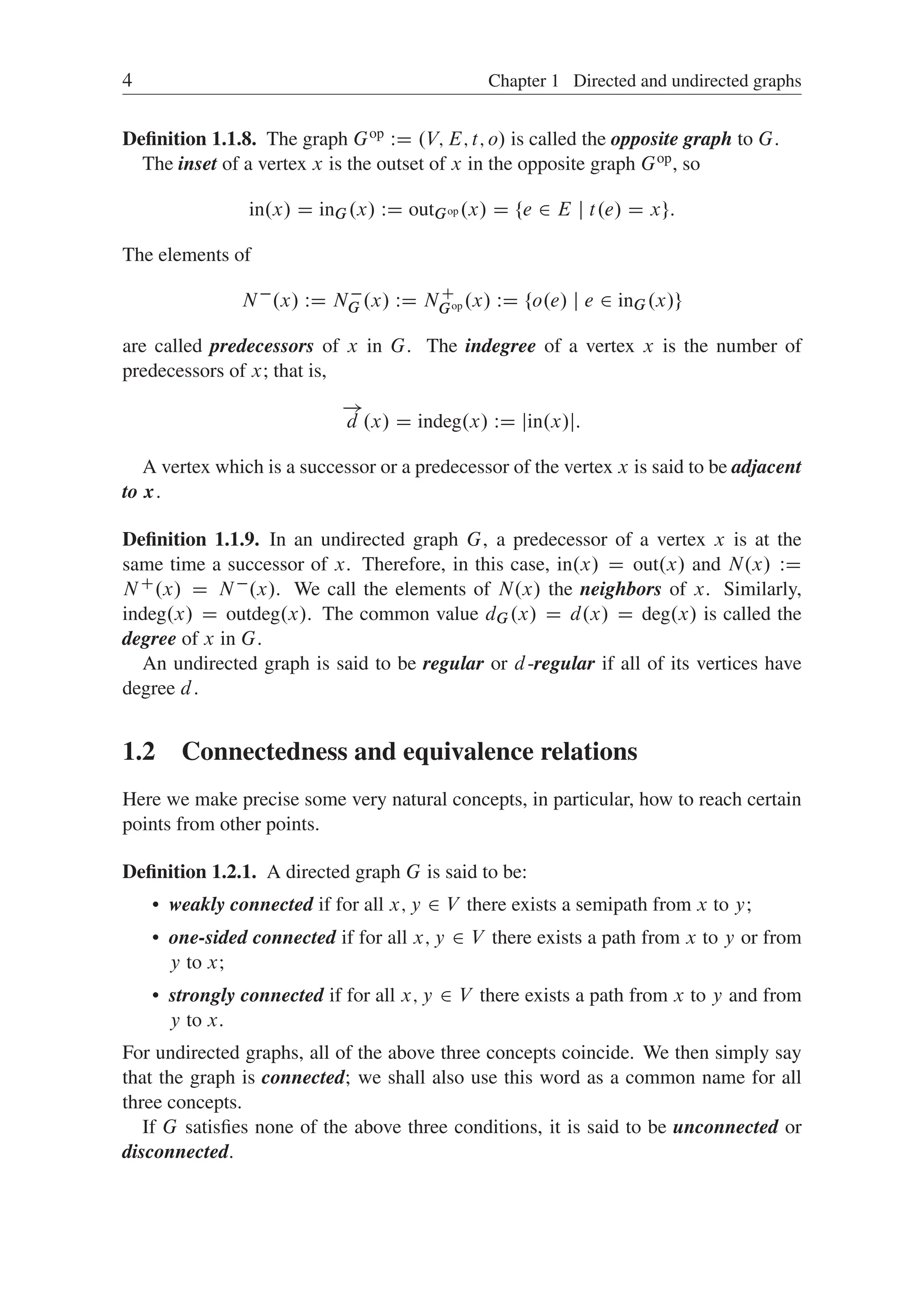
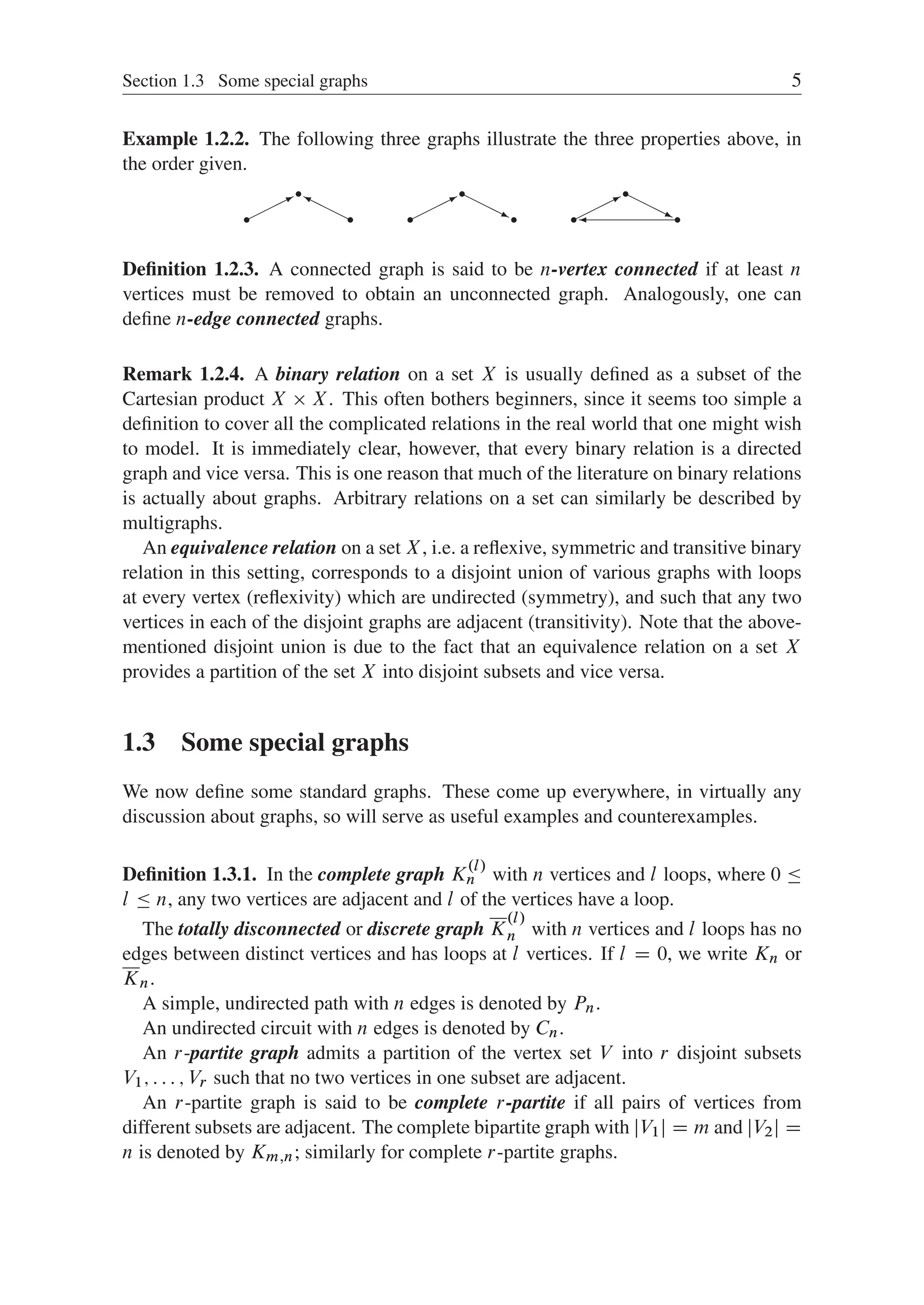
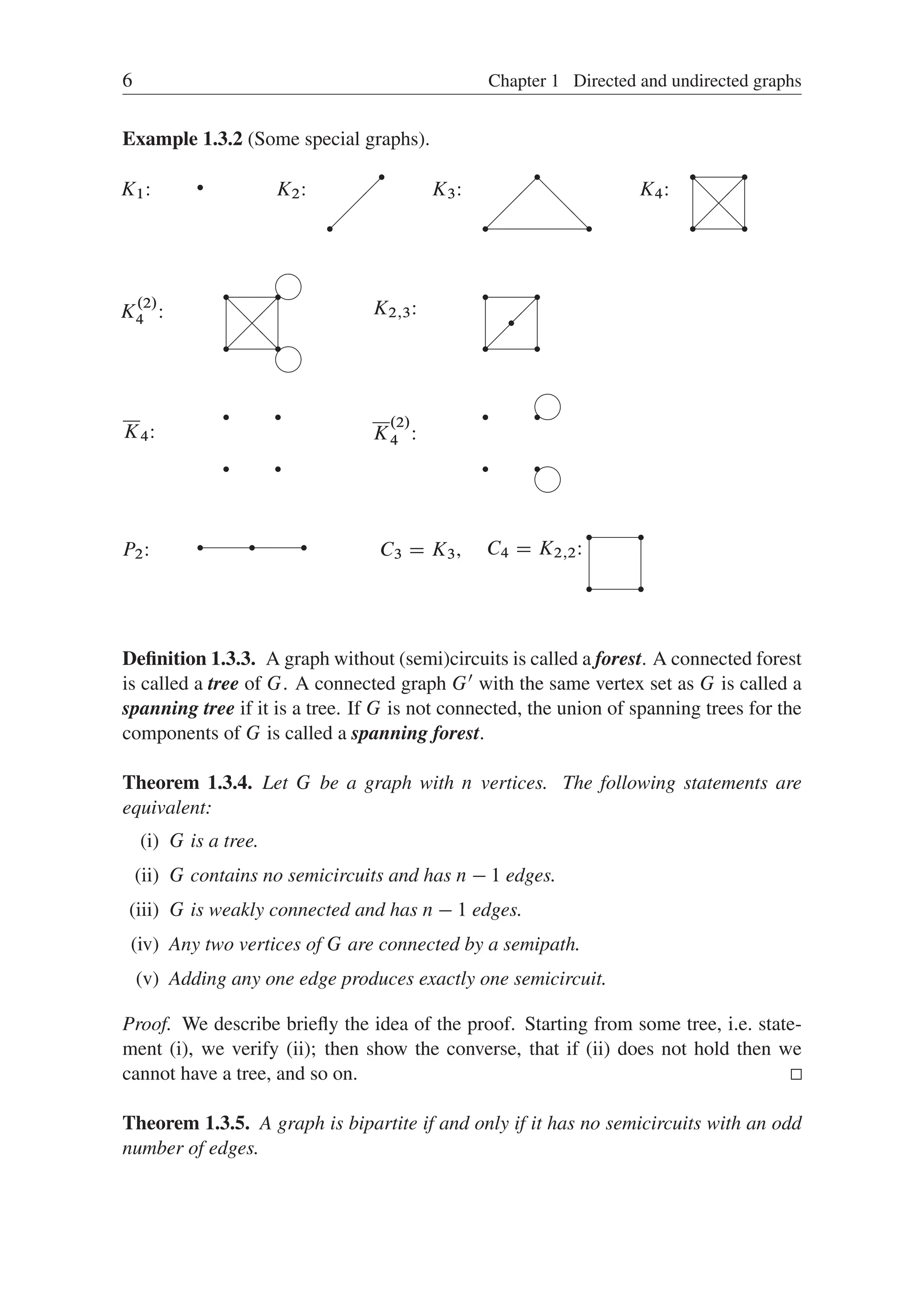
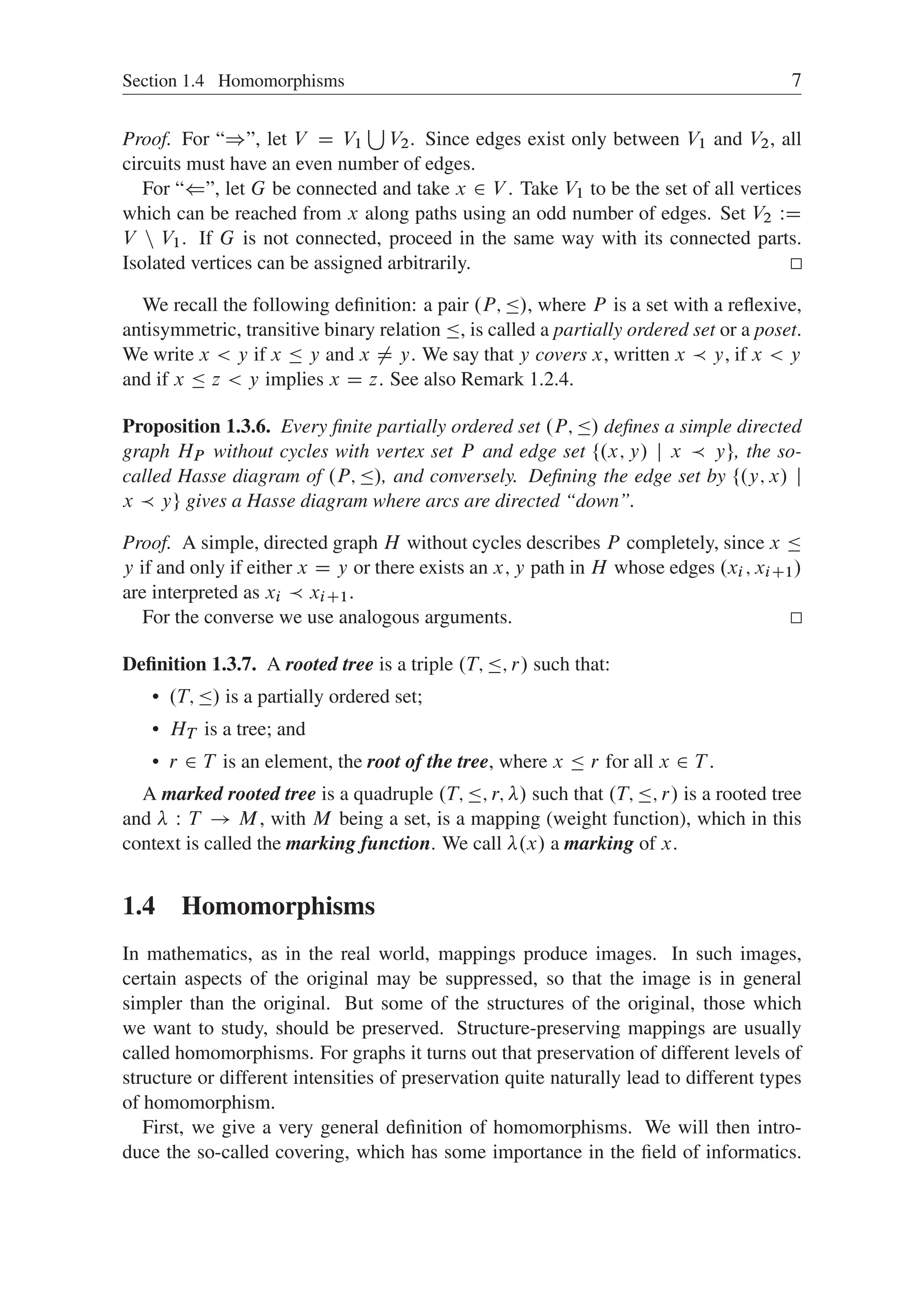
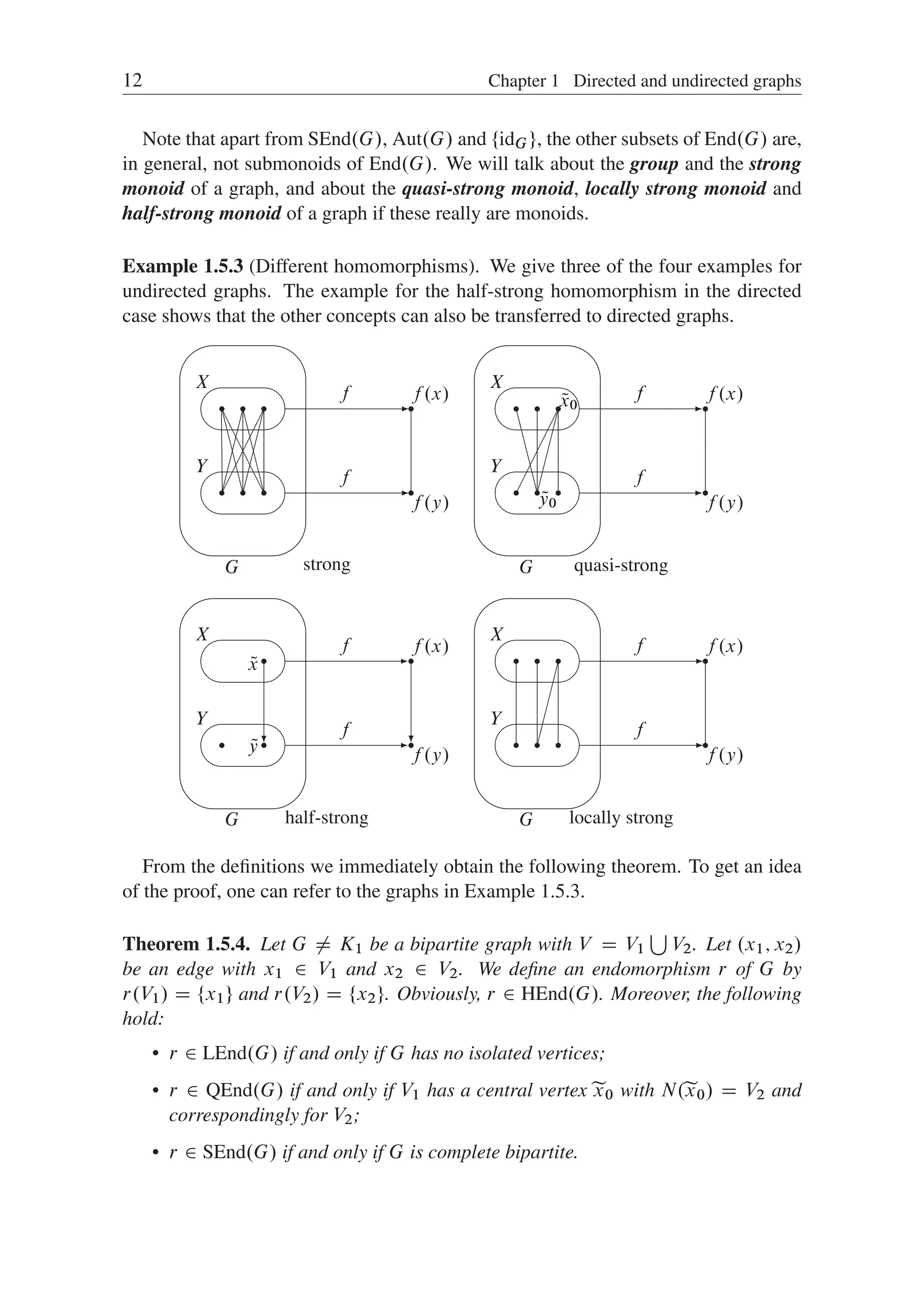
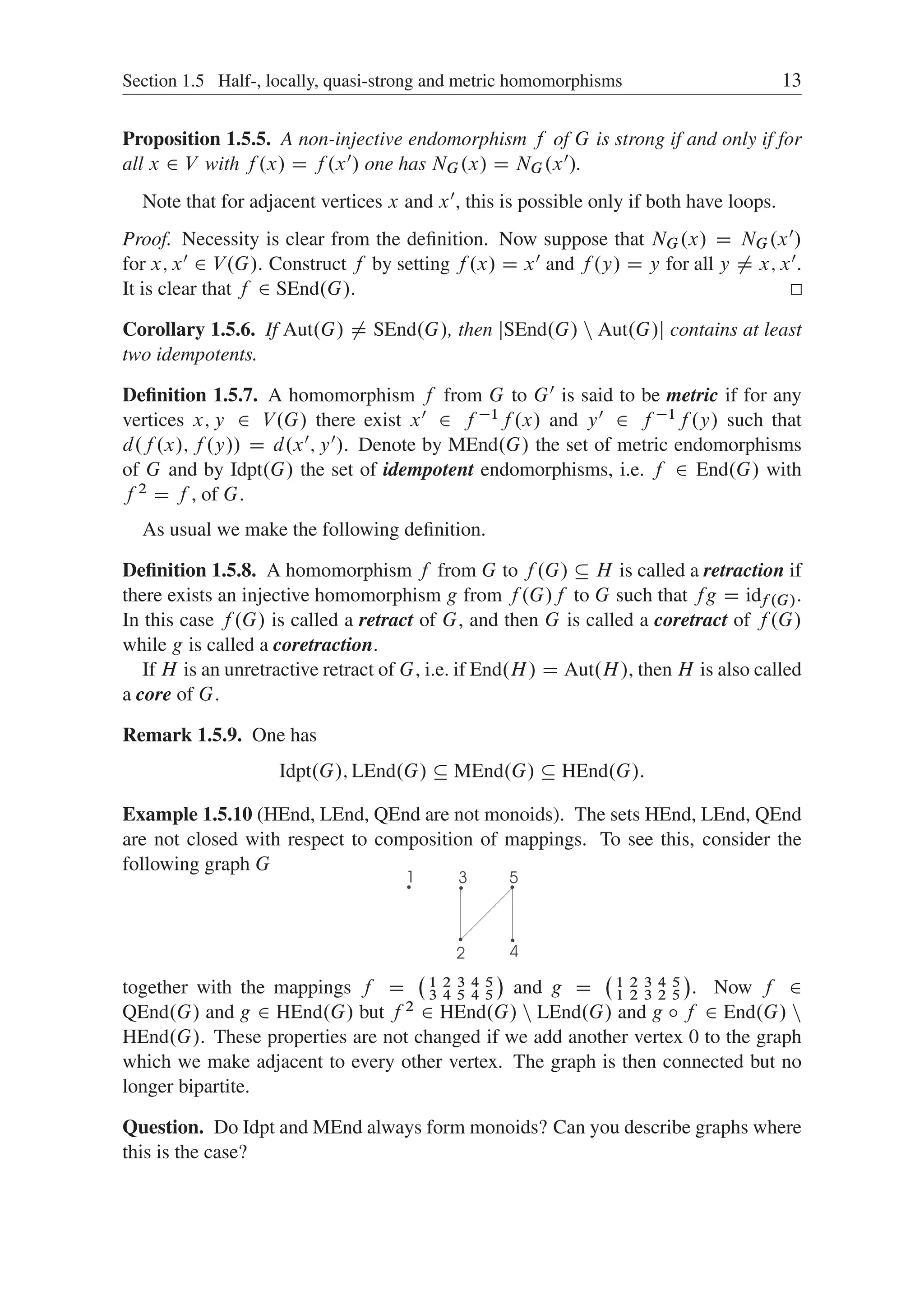
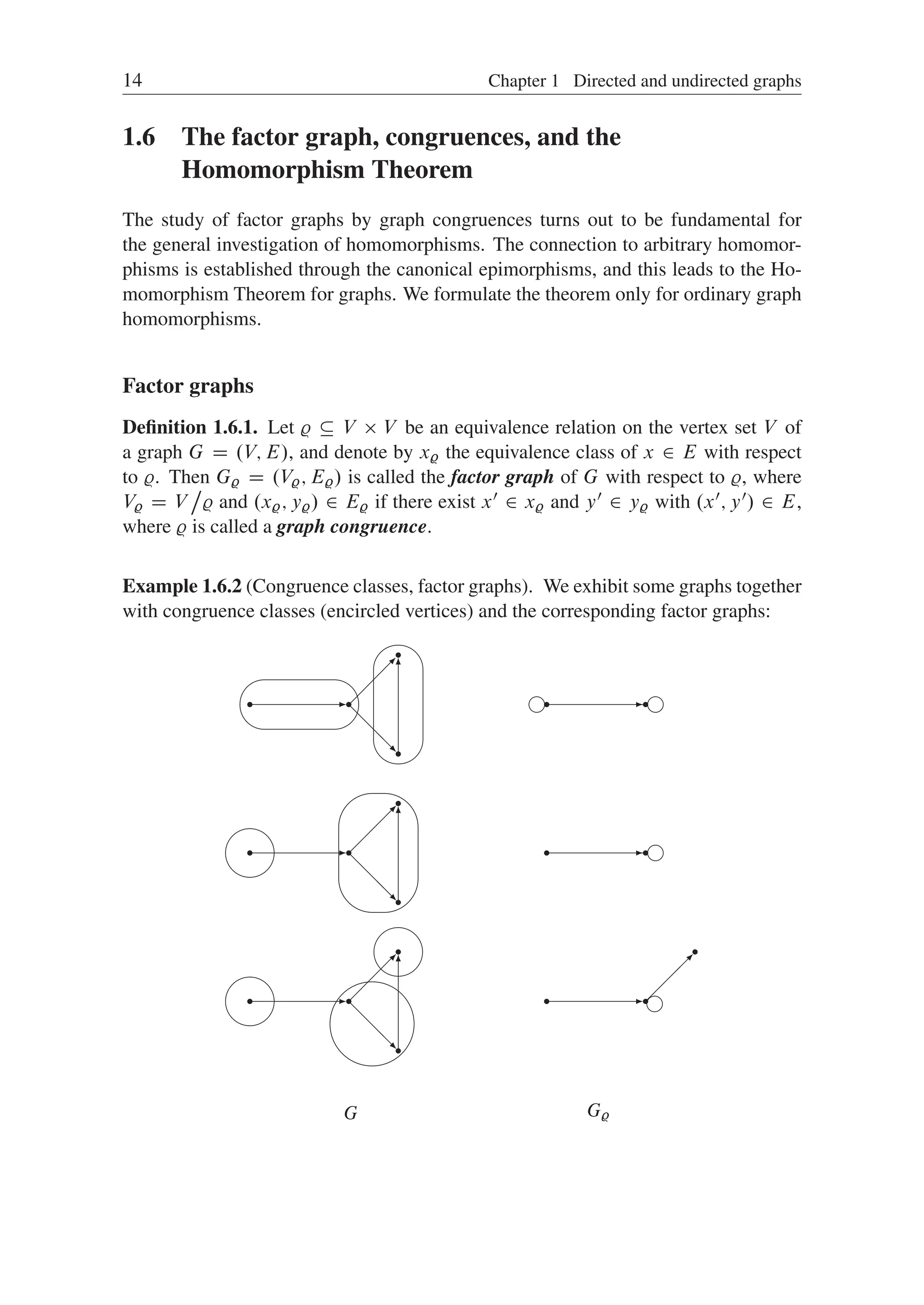
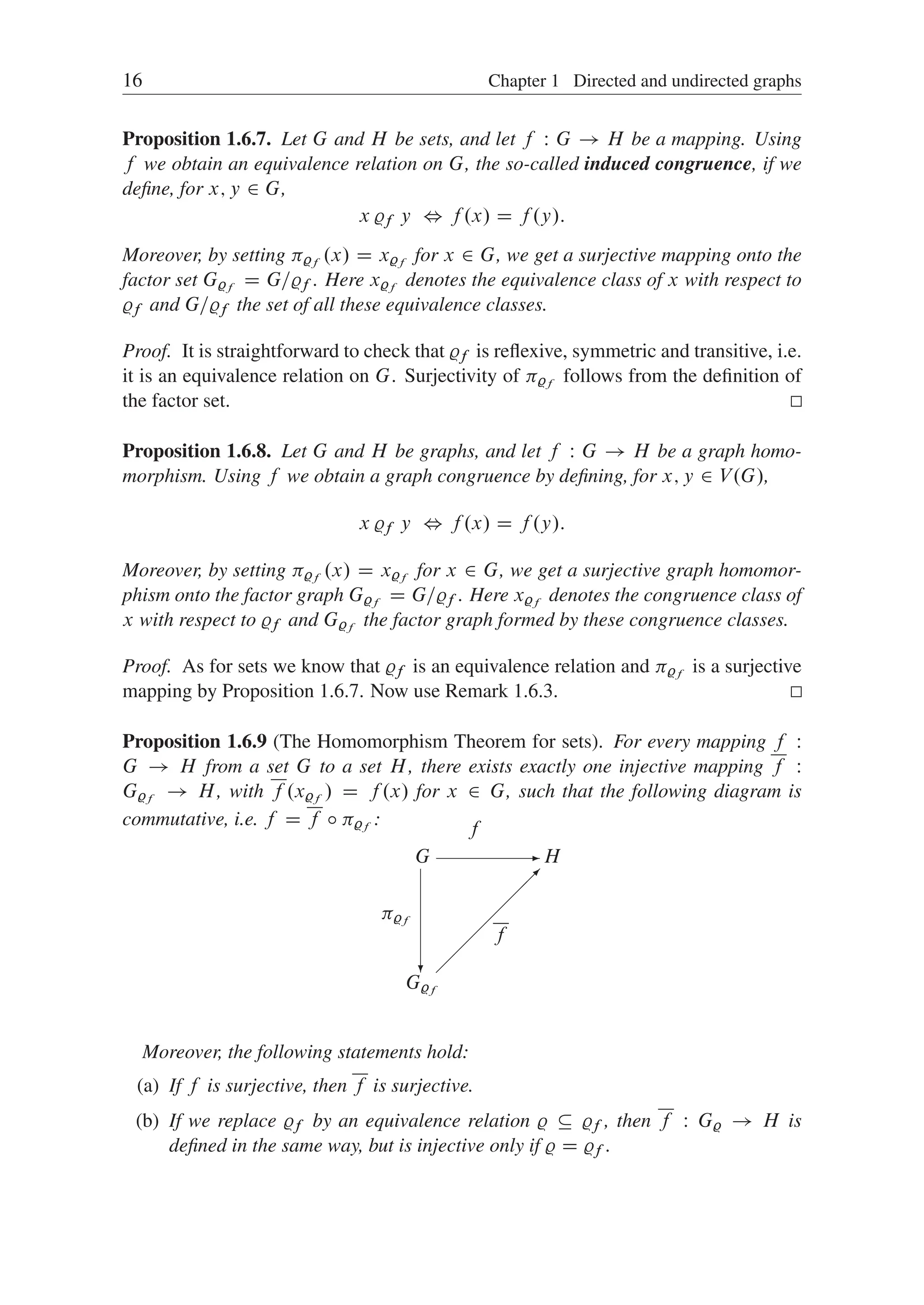
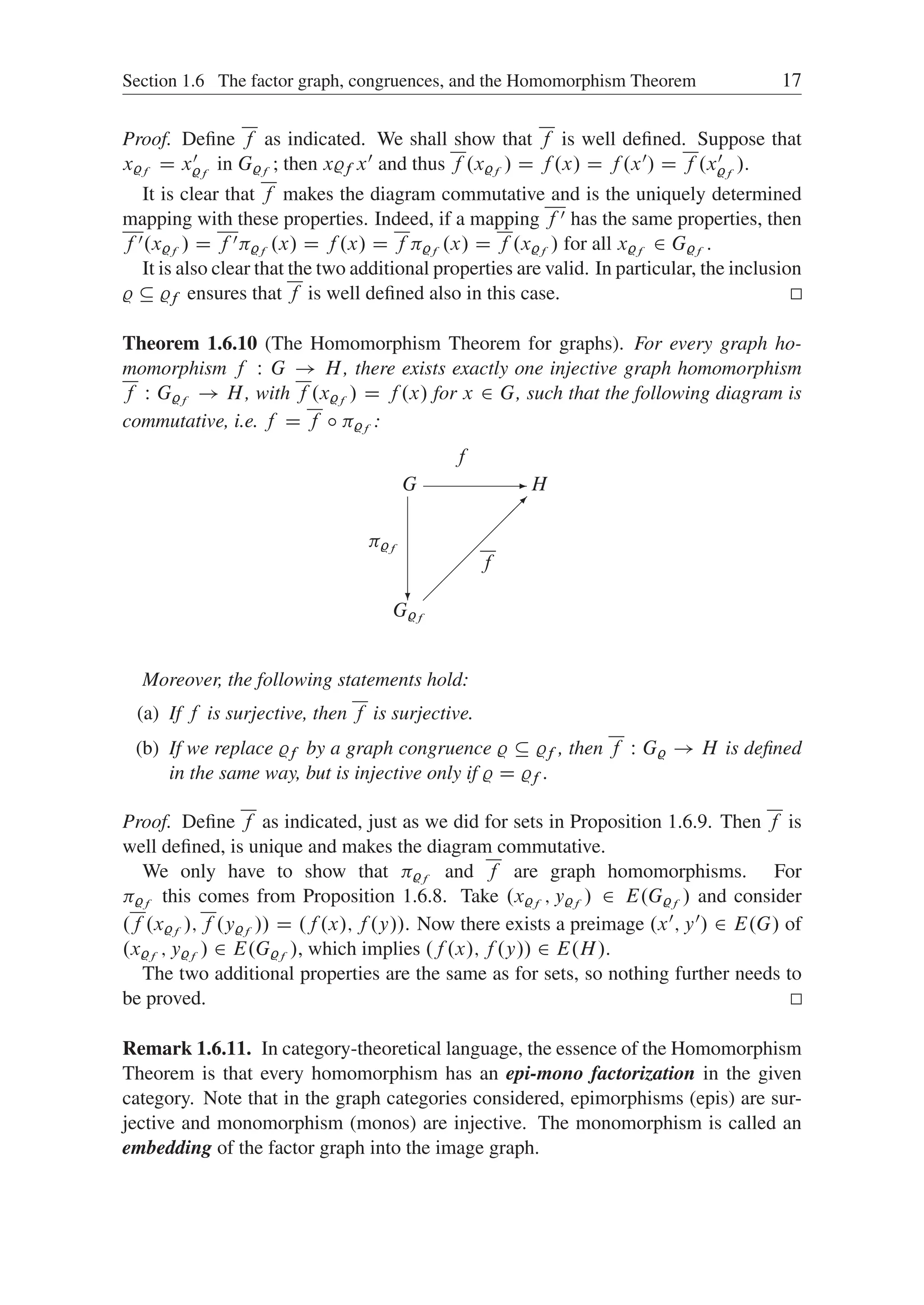
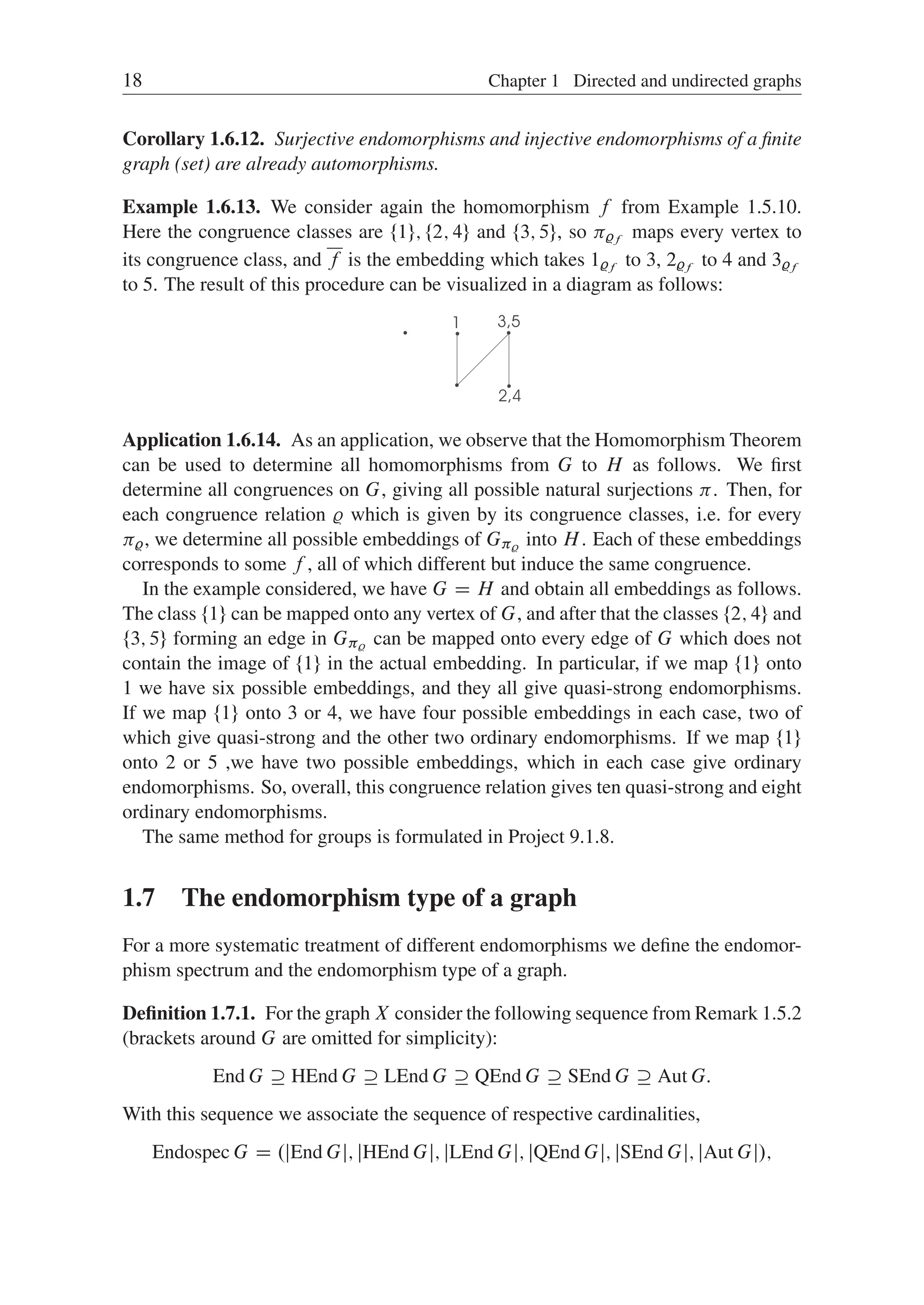
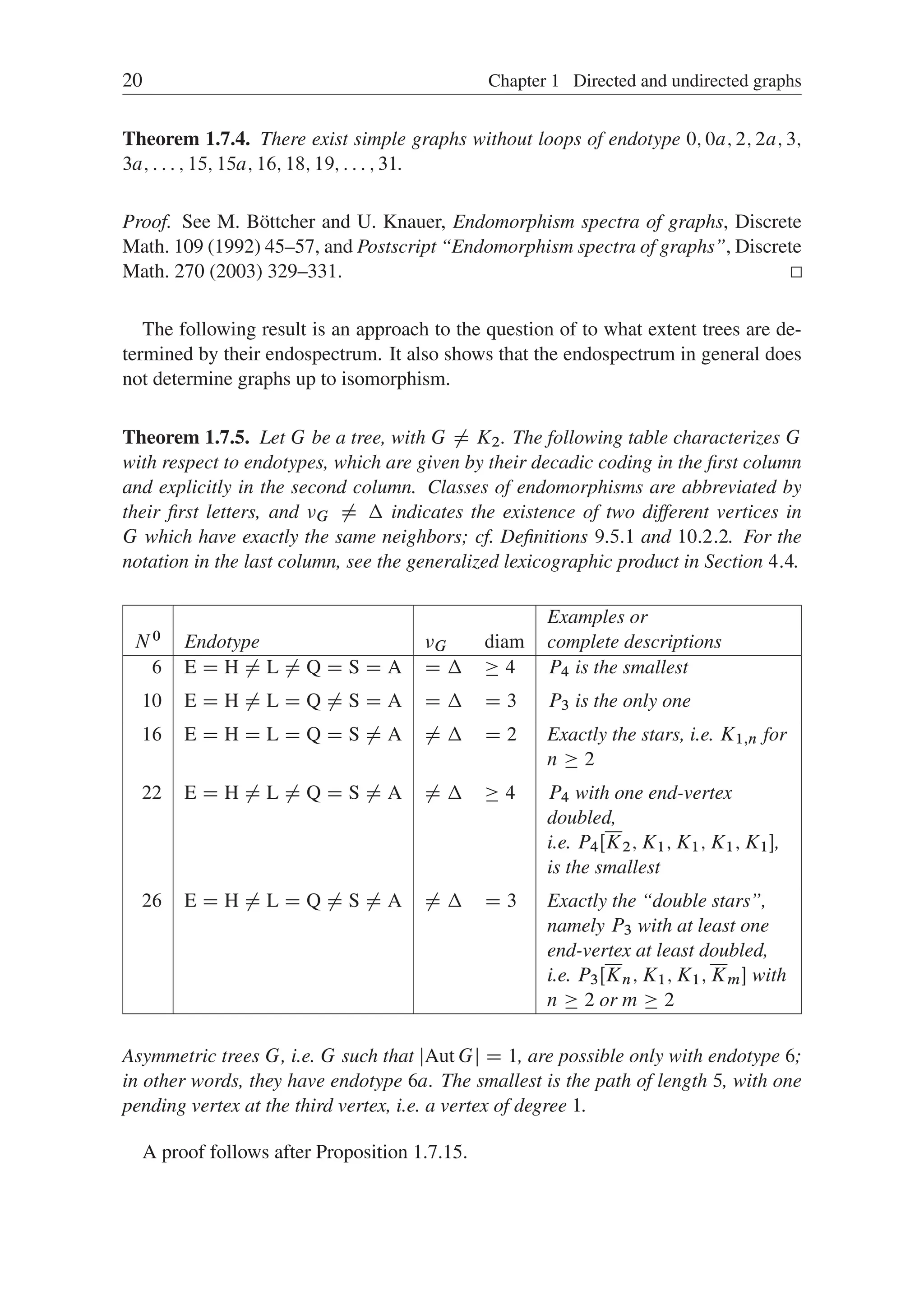
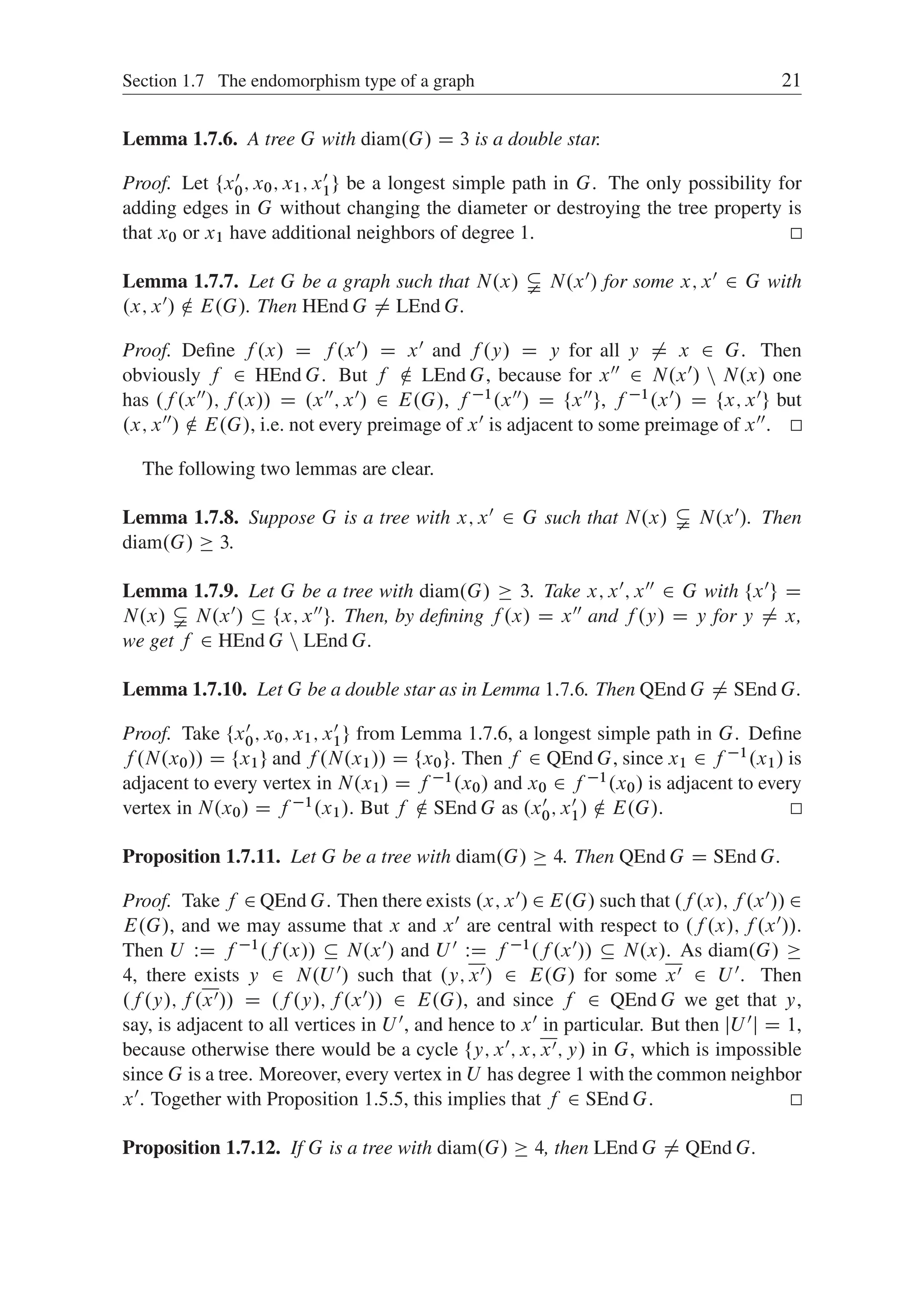
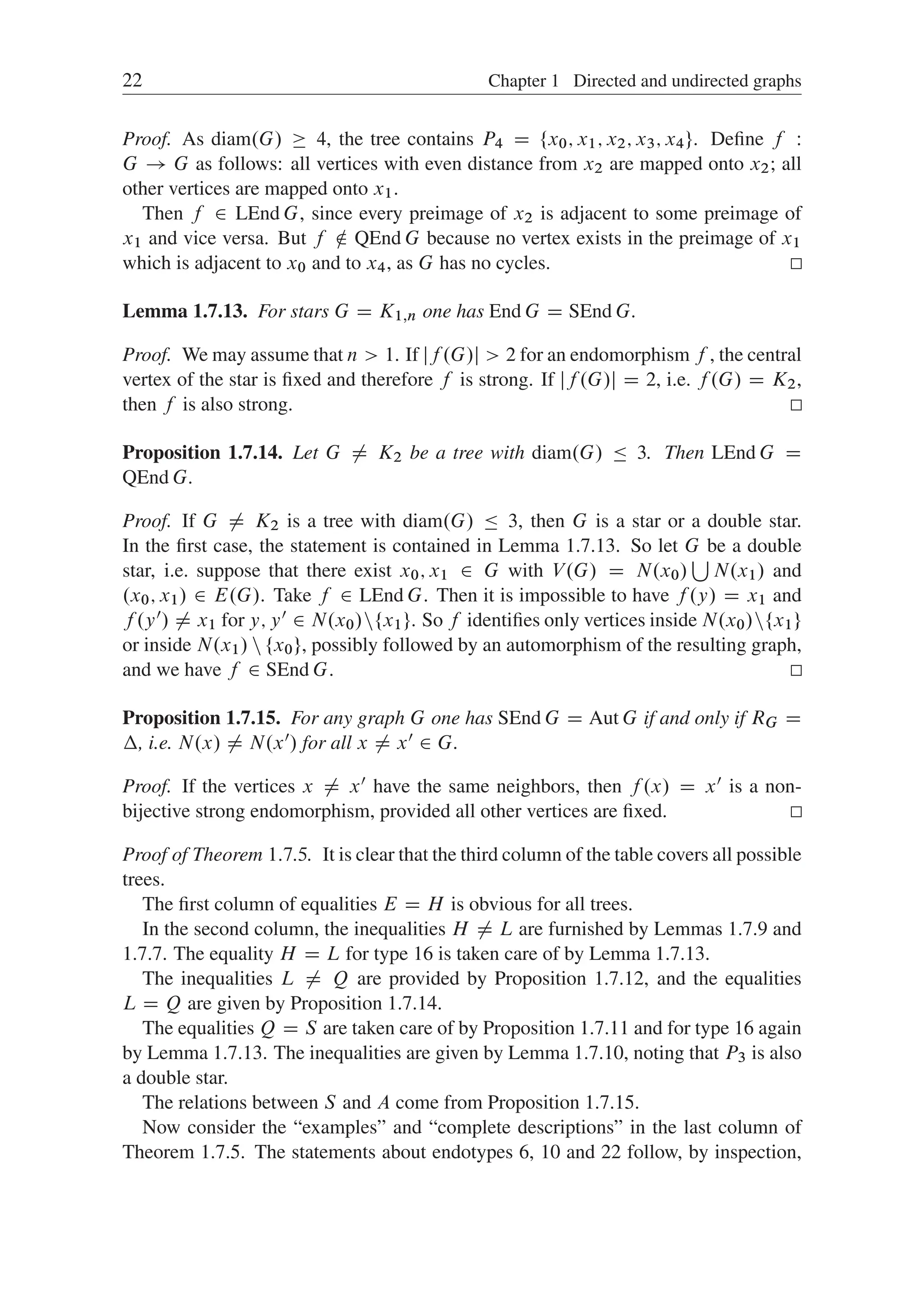
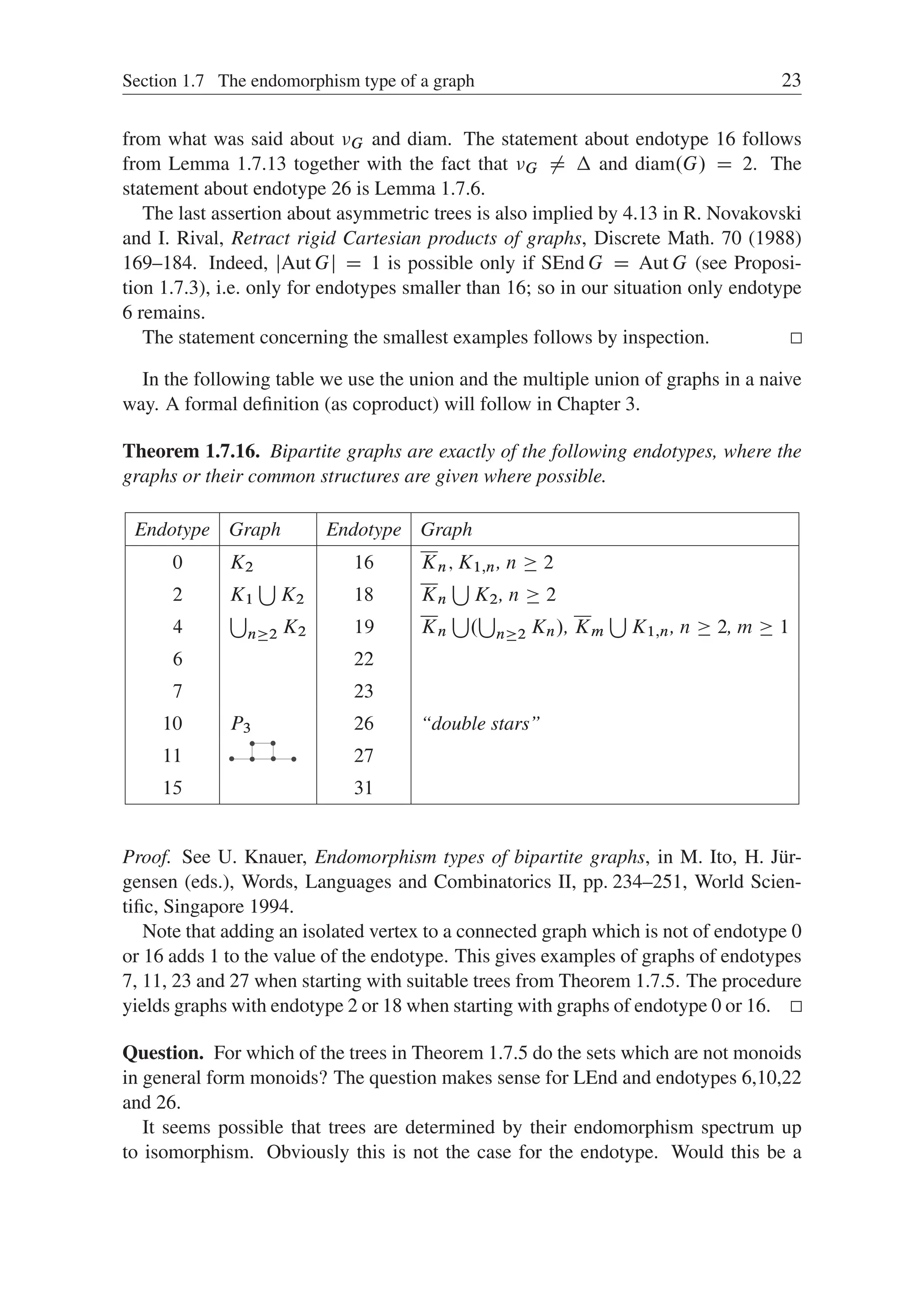
![24 Chapter 1 Directed and undirected graphs
worthwhile question to investigate? Some more information about this can be found
in U. Knauer, Endomorphism types of trees, in M. Ito (ed.), Words, Languages and
Combinatorics, pp. 273–287, World Scientific, Singapore 1992.
1.8 Comments
Ordinary homomorphisms are widely used. Half-strong homomorphisms were called
“full” in P. Hell, Subdirect products of bipartite graphs (Coll. Math. Janos Bolyai 10,
Infinite and finite sets, 1973, Vol II), pp. 875–866, North Holland, Amsterdam 1975,
and in G. Sabidussi, Subdirect representations of graphs (Coll. Math. Janos Bolyai
10, Infinite and finite sets, 1973, Vol III), pp. 1199–1226, North-Holland, Amsterdam
1975; and they were called “partially adjacent” by S. Antohe and E. Olaru in On
homomorphisms and congruences of graphs, Bull. Univ. Galat 11 (1978) 15–23 (in
German).
Surjective locally strong homomorphisms appeared in the book by A. Pultr and
V. Trnkova, Combinatorial, Algebraic and Topological Representations of Groups,
Semigroups and Categories, North-Holland, Amsterdam 1980. As far as I know, the
term “quasi-strong” has not been used yet. Strong homomorphisms were first intro-
duced by K. Culik in On the theory of graphs, Casopis Pest. Mat. 83 (1958) (in
German), under the name homomorphism. Metric homomorphisms can be found in
the aforementioned paper by P. Hell. Egamorphisms are also called weak homomor-
phisms, for example in [Imrich/Klavzar 2000].
I would like to point out a more general phenomenon. Homomorphisms generate
an image of a given object. This is the basis of the main principle of model building:
we can view homomorphisms as the modeling tool and the homomorphic image as
the model. When we use isomorphisms, all the information is retained. Since a model
is usually thought of as a simplification, an isomorphic image is not really the kind of
model one usually needs. So, in modeling, we want to suppress certain information
about the original object, because in order to analyze the system it is helpful to first
simplify the structure. To investigate different questions we may wish to suppress dif-
ferent parts of the structure. Specializing this idea to graphs, strong homomorphisms
reduce the number of points but maintain the structure in the sense that they reflect
edges. Quasi-strong, locally strong and half-strong homomorphisms reflect edges to a
lesser and lesser extent in each step down to ordinary homomorphisms, which do not
reflect edges at all.
Now let us also look back on the Homomorphism Theorem. One important aspect
is that it produces an epi-mono factorization for every homomorphism. This is ex-
ploited in the following way. We start with one endomorphism f of G, which by the
induced congruence %f defines the epi- part of the epi-mono factorization, the natural
surjection G ! G=%f . If we now consider all possible embeddings of this factor
graph into G, we obtain all possible endomorphisms with the induced congruence %f .](https://image.slidesharecdn.com/25189322-250513055218-c0495bc1/75/Algebraic-Graph-Theory-Morphisms-Monoids-And-Matrices-1st-Edition-Ulrich-Knauer-44-2048.jpg)
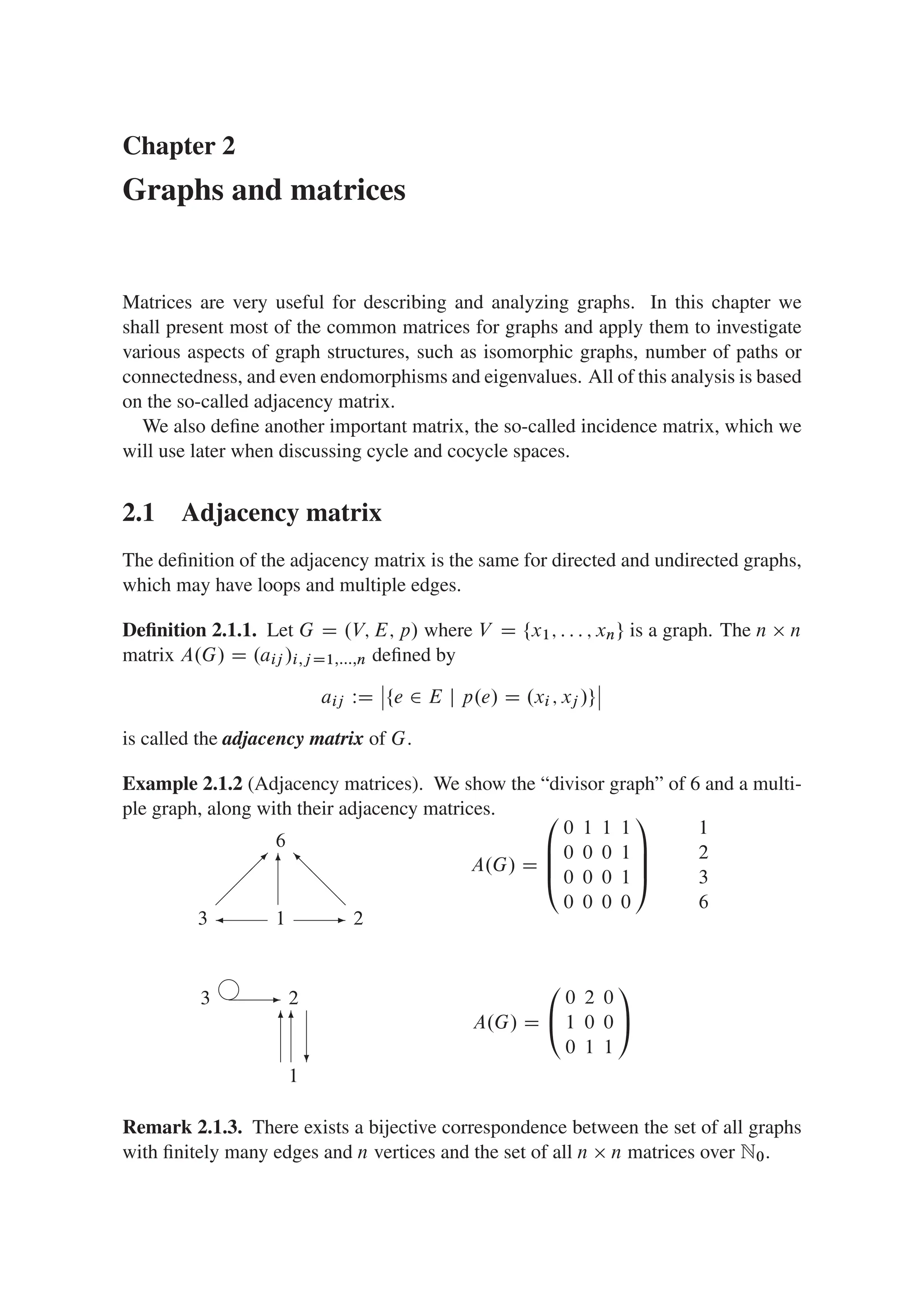
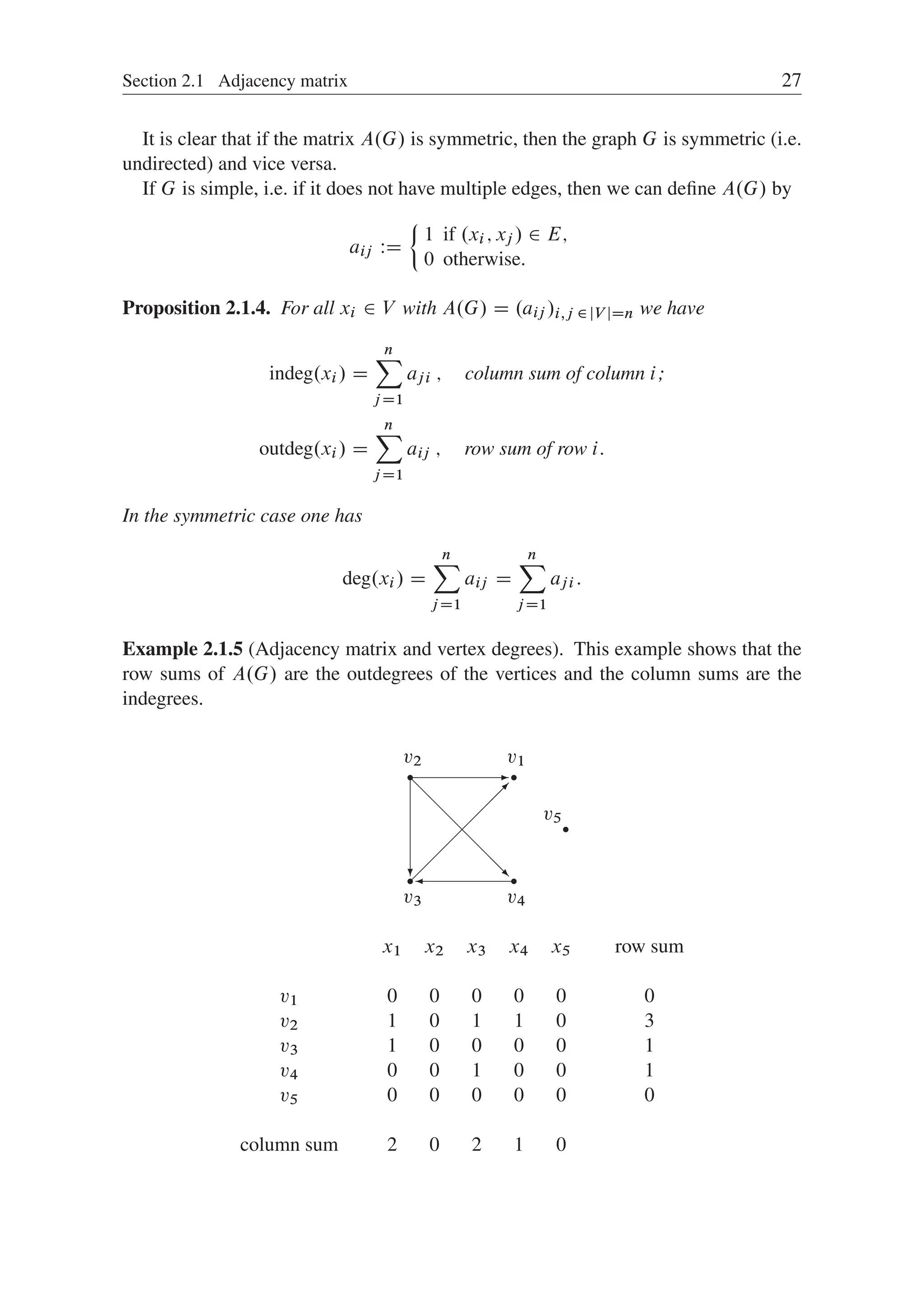
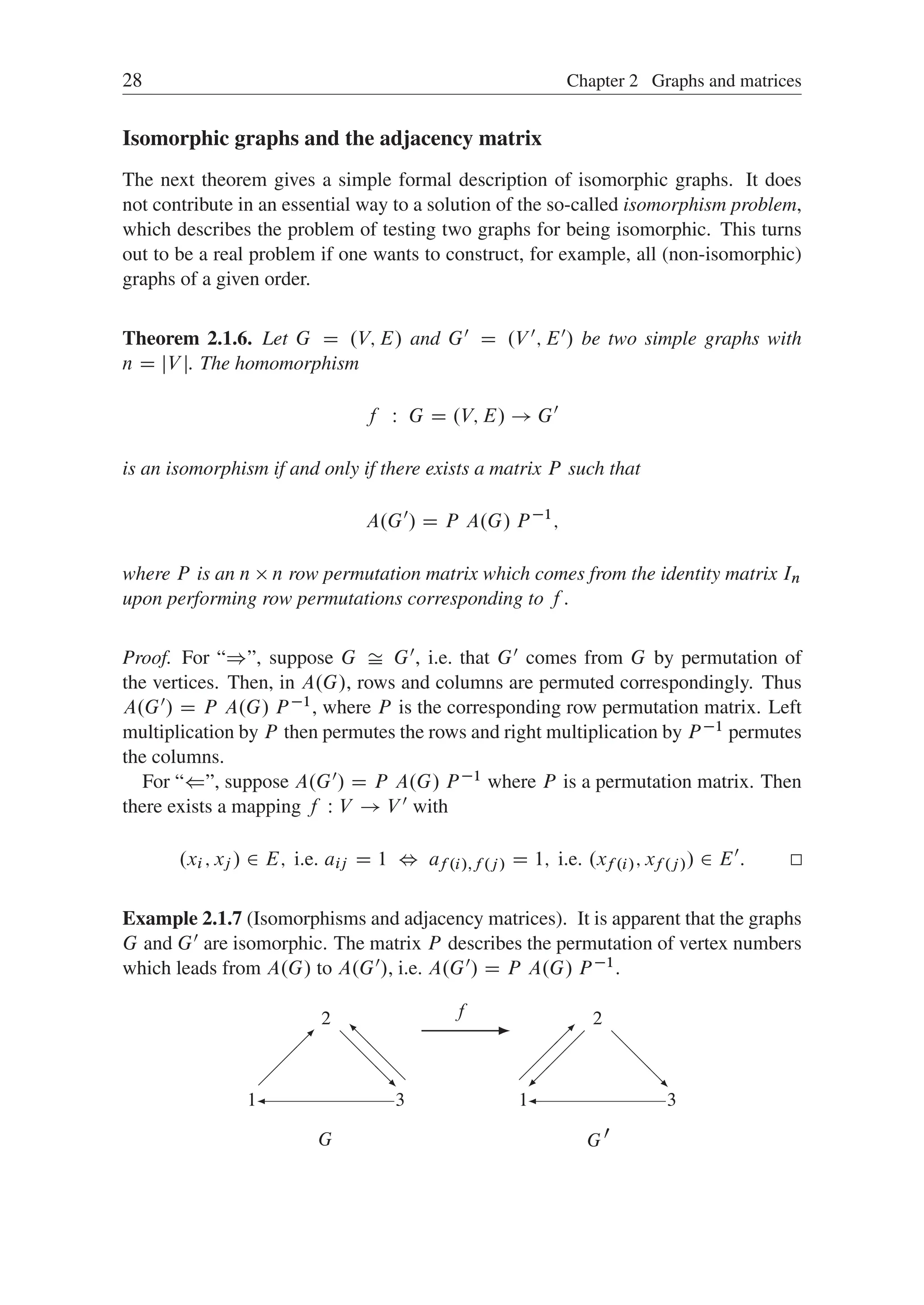
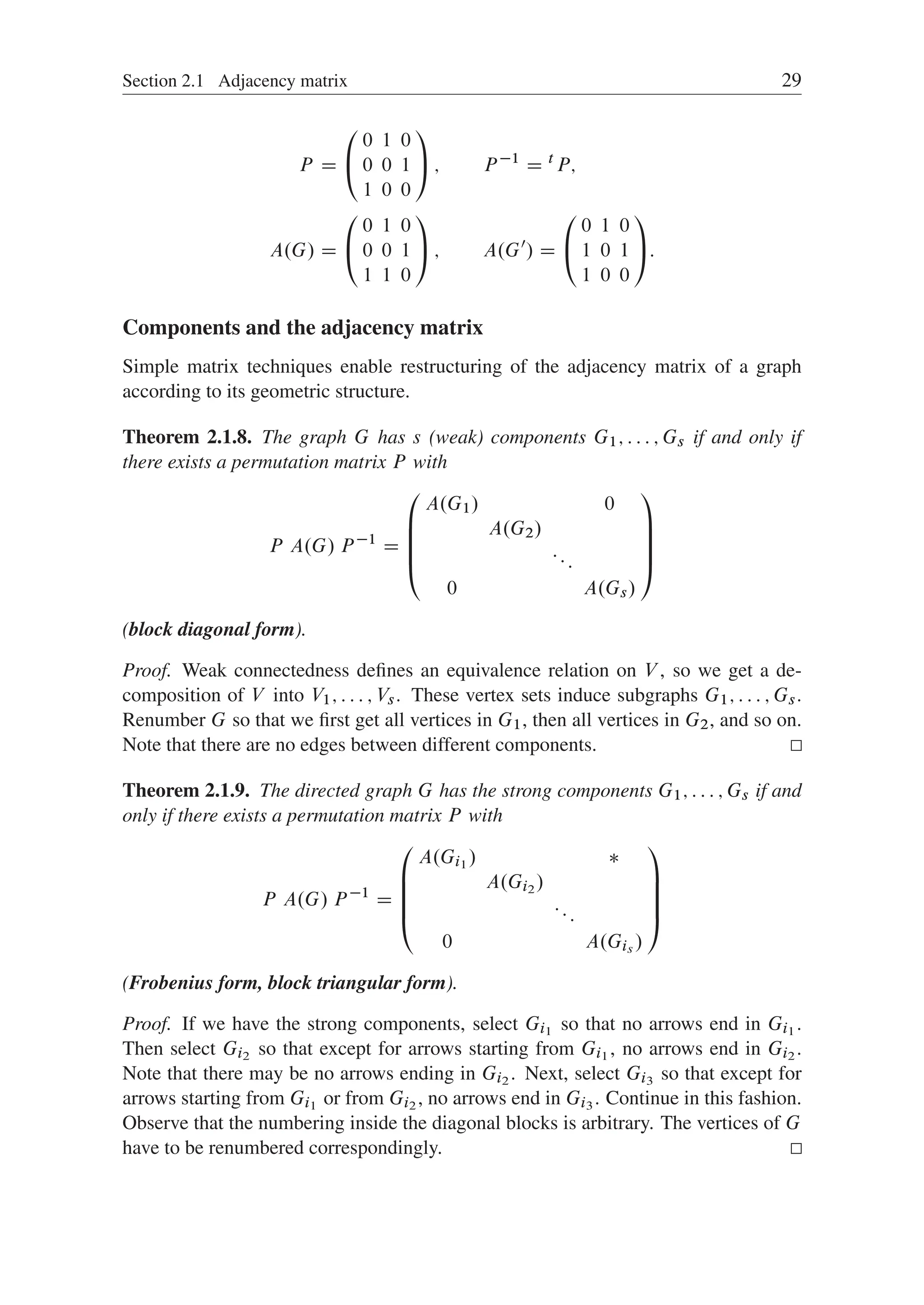
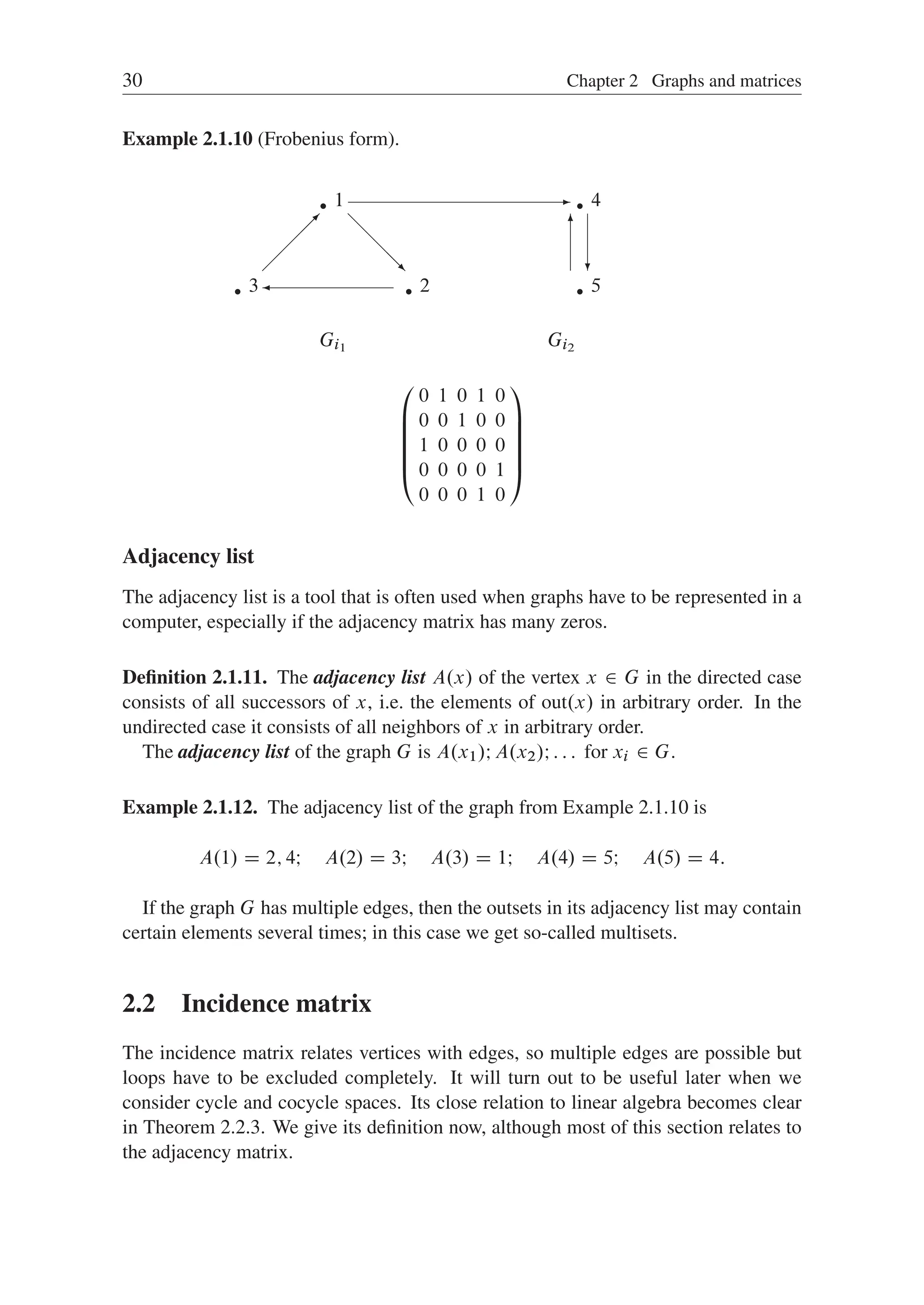
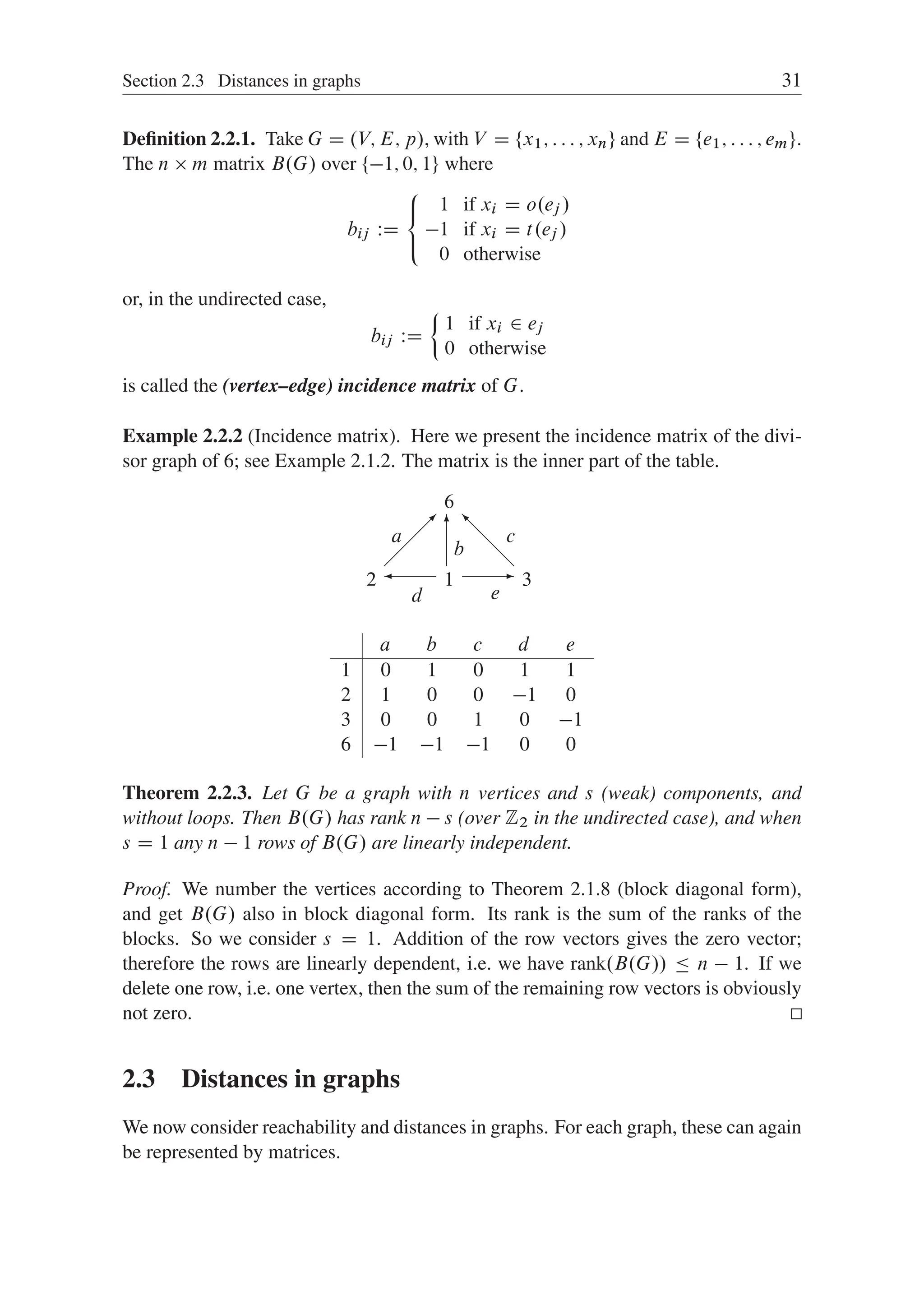
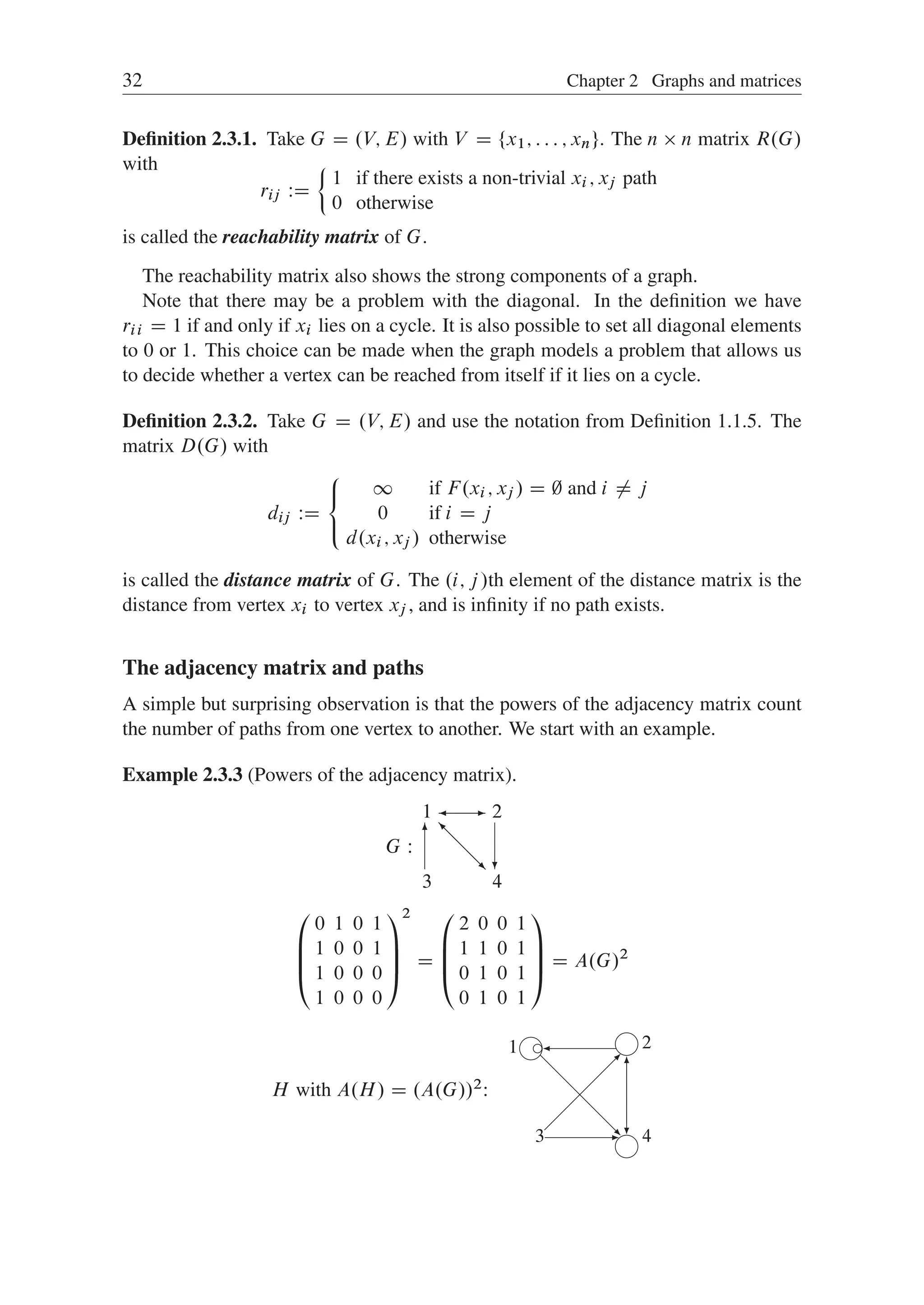
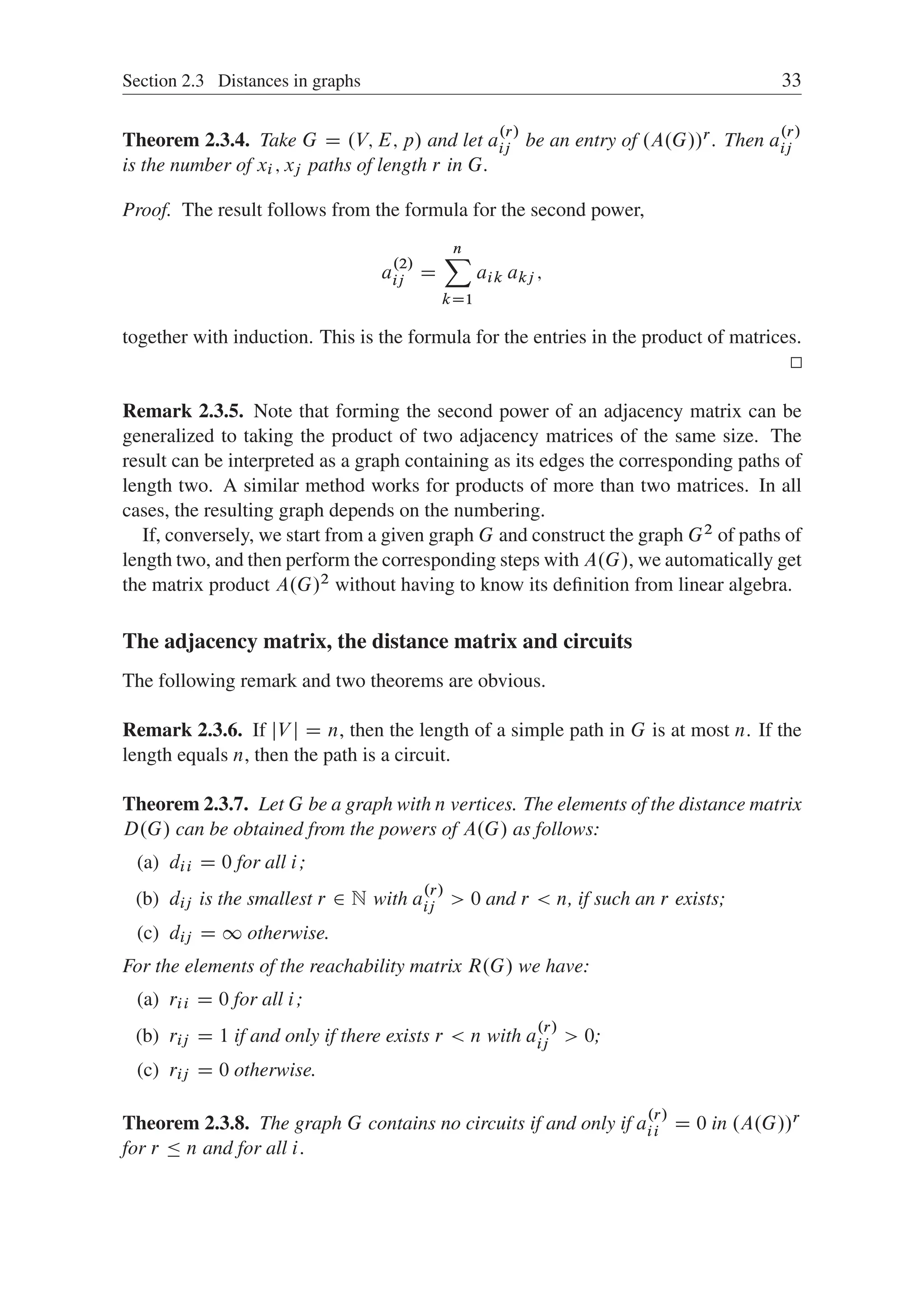
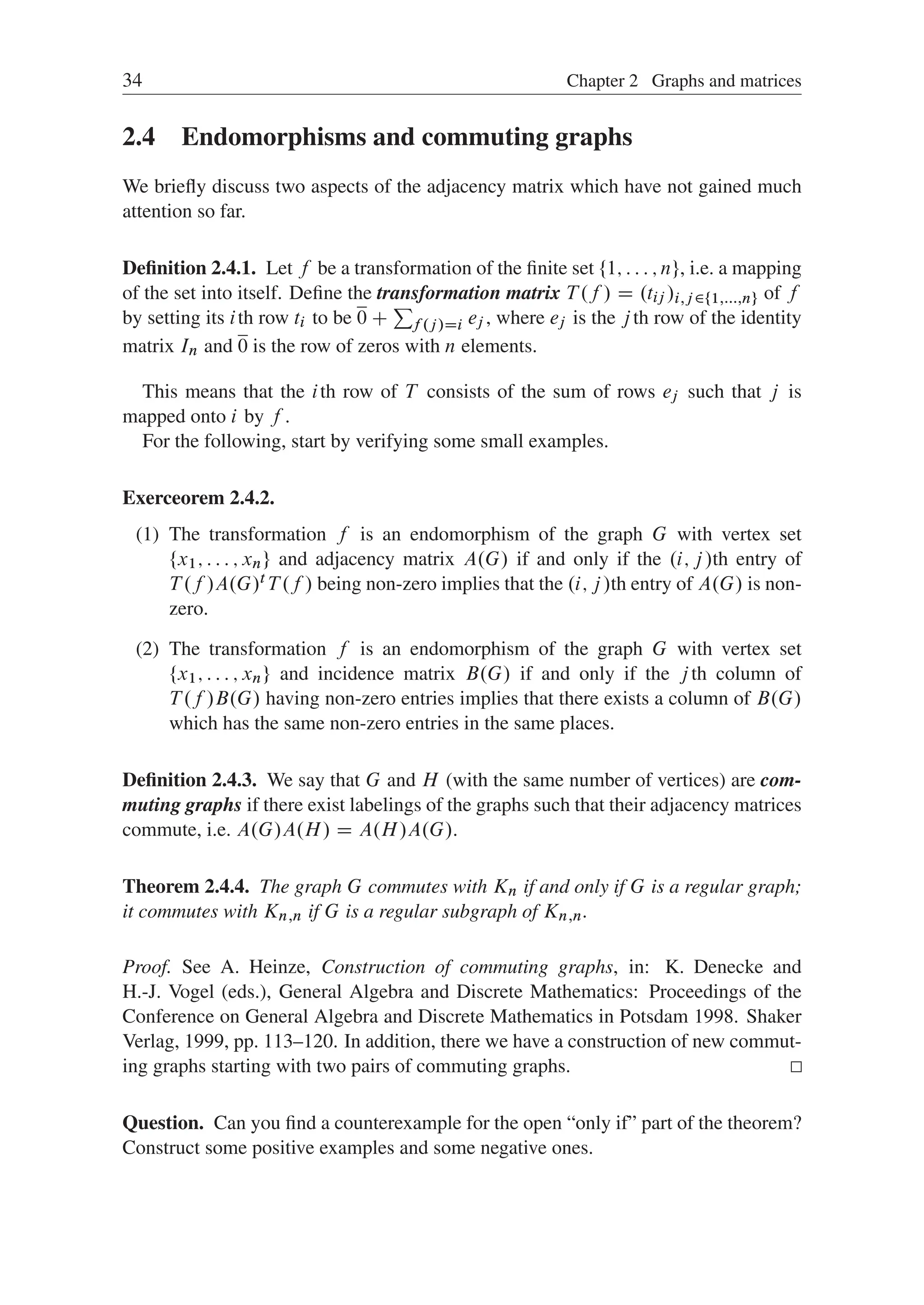

![kenties tapahtui siitä syystä, että Mihiei Mihieitsh syödessään otti
toisenkin ryypyn viinaa. Korttia jaettaessa hän sanoi jo edeltäpäin
tietävänsä, että kaikki ässät ja valtit joutuvat Onufrij'ille, hänellä kun
on sellaiset näpistelijän kädet, jotka aina ovat valmiit sekoittamaan
väärin ja anastamaan parhaat kortit. Mutta tehtyään hänen kanssaan
korttilietteen, Mihiei Mihieitsh muuttui kokonaan ja alkoi häntä
kehua.
— No tietysti sinä olet, sano mitä tahansa, koko hylky mieheksesi,
— puheli hän hänelle: mutta minä pidän sinusta, jumal'avita, pidän
kun pidänkin; sentähden, ensinnäkin, että minulla on sellainen
luonto, ja toiseksi, jos asiaa tarkemmin harkitsee, niin on niitä
suurempiakin heittiöitä kuin sinä, täytyypä vielä sanoa, että sinä
sentään olet laadussasi koko mukiinmenevä mies.
— Siinä oli perää siinä puheessa, minkä nyt arvoisilta huuliltanne
kuulin, Mihiei Mihieitsh, — vastasi Onufrij Ilitsh, joka tunsi kuin
nousevansa noista sanoista: — ihan perujen perää oli siinä;
tietenkin, vaan vainoamista…
— Ja'a kortit, ja'a kortit, — keskeytti hänet Mihiei Mihieitsh: —
ettäkö vainoamista? mitä vainoamista? Kiitä Jumalaasi, ett'et istu
tällä hetkellä Pugatshovin [Kuuluisa kasakkapäällikkö,
kapinanjohtaja, joka m.m. esiintyy henkilönä Pushkinin Kapteenin
tyttäressä. Suoment. muist.] tornissa, kahleisiin kytkettynä… Ja'a
kortit.
Ja Onufrij Ilitsh alkoi jakaa, vilkuttaen silmiään ja kastaen kiireesti
oikean käden sormea pitkän, kapean kielensä päähän.
Mutta Stepan Petrovitsh yhä kulki edes takaisin, ja Boris Andrejitsh
pysytteli Veeran läheisyydessä. Heidän keskustelunsa oli katkonaista](https://image.slidesharecdn.com/25189322-250513055218-c0495bc1/75/Algebraic-Graph-Theory-Morphisms-Monoids-And-Matrices-1st-Edition-Ulrich-Knauer-56-2048.jpg)