CONTENTS:
First article: Pulmonarysarcomatous tumors
Second article: effects of Toothpaste Containing 2% Zinc Citrate on Gingival Health and Three Related
Bacteria-A Randomized Double-Blind Study
Third article: comparison of clinical outcomes between single metal-ceramic and zirconia crowns
Fourth article: Impact of Reducing Water Fluoride on Dental Caries and Fluorosis
This study focuseson sarcomatous pulmonary neoplasms, a rare and diagnostically
complex group of tumors. The goal is to differentiate primary pulmonary sarcomas from
other similar conditions, such as metastatic sarcomas, pulmonary sarcomatoid
carcinoma, and diffuse malignant mesothelioma. The review emphasizes the role of
modern diagnostic tools, particularly immunohistochemistry and molecular analysis, in
accurately classifying these tumors. The study combines a literature review (covering
1961-2007) with primary cases from the author’s institution, providing diagnostic
criteria for primary lung sarcomas. Pathologists play a crucial role in identifying these
rare tumors, which can significantly impact patient care and treatment decisions.
ABSTRACT
5.
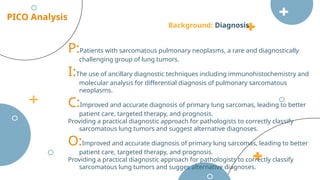
P:Patients with sarcomatouspulmonary neoplasms, a rare and diagnostically
challenging group of lung tumors.
I:The use of ancillary diagnostic techniques including immunohistochemistry and
molecular analysis for differential diagnosis of pulmonary sarcomatous
neoplasms.
C:Improved and accurate diagnosis of primary lung sarcomas, leading to better
patient care, targeted therapy, and prognosis.
Providing a practical diagnostic approach for pathologists to correctly classify
sarcomatous lung tumors and suggest alternative diagnoses.
O:Improved and accurate diagnosis of primary lung sarcomas, leading to better
patient care, targeted therapy, and prognosis.
Providing a practical diagnostic approach for pathologists to correctly classify
sarcomatous lung tumors and sugges alternative diagnoses.
Background: Diagnosis
PICO Analysis
6.
effects of ToothpasteContaining 2% Zinc Citrate on
Gingival Health and Three Related Bacteria-A
Randomized Double-Blind Study
02.
7.
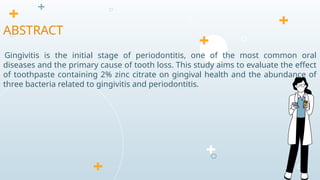
Gingivitis is theinitial stage of periodontitis, one of the most common oral
diseases and the primary cause of tooth loss. This study aims to evaluate the effect
of toothpaste containing 2% zinc citrate on gingival health and the abundance of
three bacteria related to gingivitis and periodontitis.
ABSTRACT
8.
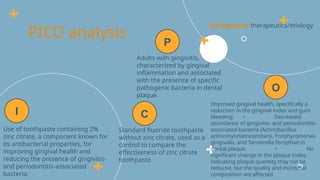
PICO analysis
Use oftoothpaste containing 2%
zinc citrate, a component known for
its antibacterial properties, for
improving gingival health and
reducing the presence of gingivitis-
and periodontitis-associated
bacteria.
Improved gingival health, specifically a
reduction in the gingival index and gum
bleeding. • Decreased
abundance of gingivitis- and periodontitis-
associated bacteria (Actinobacillus
actinomycetemcomitans, Porphyromonas
gingivalis, and Tannerella forsythia) in
dental plaque. • No
significant change in the plaque index,
indicating plaque quantity may not be
reduced, but the quality and microbial
composition are affected.
Adults with gingivitis,
characterized by gingival
inflammation and associated
with the presence of specific
pathogenic bacteria in dental
plaque.
P
I C
Standard fluoride toothpaste
without zinc citrate, used as a
control to compare the
effectiveness of zinc citrate
toothpaste.
O
Background:therapeutics/etiology
This study comparesthe long-term survival and complications of zirconia and metal-
ceramic crowns. A retrospective review of 403 patients treated at the University of
Toronto assessed 209 zirconia and 306 metal-ceramic crowns, followed for up to 7 years.
Failure rates, causes, and complications were evaluated. Results showed similar follow-
up times and failure rates for both types, with 8.5% of crowns failing overall. Biological
failures, especially tooth fractures, were the most common cause of failure. The survival
rate was 91.5% for both groups, with no significant differences in clinical complications.
The study concludes that both zirconia and metal-ceramic crowns have comparable
survival and complication rates.
ABSTRACT
11.
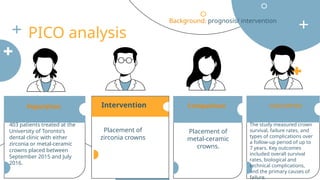
PICO analysis
Placement of
metal-ceramic
crowns.
403patients treated at the
University of Toronto’s
dental clinic with either
zirconia or metal-ceramic
crowns placed between
September 2015 and July
2016.
Placement of
zirconia crowns
Comparison
Intervention
Population
The study measured crown
survival, failure rates, and
types of complications over
a follow-up period of up to
7 years. Key outcomes
included overall survival
rates, biological and
technical complications,
and the primary causes of
failure.
outcomes
Background: prognosis/ intervention
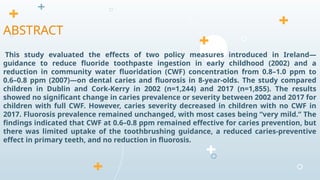
This study evaluatedthe effects of two policy measures introduced in Ireland—
guidance to reduce fluoride toothpaste ingestion in early childhood (2002) and a
reduction in community water fluoridation (CWF) concentration from 0.8–1.0 ppm to
0.6–0.8 ppm (2007)—on dental caries and fluorosis in 8-year-olds. The study compared
children in Dublin and Cork-Kerry in 2002 (n=1,244) and 2017 (n=1,855). The results
showed no significant change in caries prevalence or severity between 2002 and 2017 for
children with full CWF. However, caries severity decreased in children with no CWF in
2017. Fluorosis prevalence remained unchanged, with most cases being “very mild.” The
findings indicated that CWF at 0.6–0.8 ppm remained effective for caries prevention, but
there was limited uptake of the toothbrushing guidance, a reduced caries-preventive
effect in primary teeth, and no reduction in fluorosis.
ABSTRACT
14.
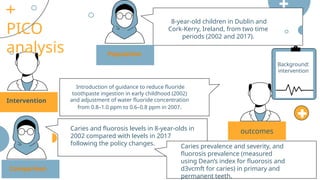
PICO
analysis
8-year-old children inDublin and
Cork-Kerry, Ireland, from two time
periods (2002 and 2017).
Introduction of guidance to reduce fluoride
toothpaste ingestion in early childhood (2002)
and adjustment of water fluoride concentration
from 0.8–1.0 ppm to 0.6–0.8 ppm in 2007.
Intervention
Population
Comparison
Caries and fluorosis levels in 8-year-olds in
2002 compared with levels in 2017
following the policy changes.
outcomes
Caries prevalence and severity, and
fluorosis prevalence (measured
using Dean’s index for fluorosis and
d3vcmft for caries) in primary and
permanent teeth.
Background:
intervention








![Proceedings of the world workshop on periodontal and [Autosaved].pptx](https://cdn.slidesharecdn.com/ss_thumbnails/proceedingsoftheworldworkshoponperiodontalandautosaved-250804052149-cf40bc35-thumbnail.jpg?width=640&height=640&fit=bounds)


