COMMUNITY NURSING Course Reflection
NUR4636 Directions and Grading Criteria
Category
Points
%
Description
(Introduction – see note under requirement #4 above)
8
8
Introduces the purpose of the reflection and addresses BSN
Essentials (AACN, 2008) pertinent to healthcare policy and
advocacy.
You Decide Reflection
80
80
Include a self-assessment regarding learning that you believe
represents your skills, knowledge, and integrative abilities to
meet the pertinent BSN Essential and sub-competencies (AACN,
2008) as a result of active learning throughout this course. Be
sure to use examples from selected readings, threaded
discussions, and/or applications to support your assertions to
address each of the following sub-competencies:
(a) “Demonstrate basic knowledge of healthcare policy, finance,
and regulatory environments, including local, state, national,
and global healthcare trends.
(b) Describe how health care is organized and financed,
including the implications of business principles, such as
patient and system cost factors.
(c) Compare the benefits and limitations of the major forms of
reimbursement on the delivery of healthcare services.
(d) Examine legislative and regulatory processes relevant to
the provision of health care.
(e) Describe state and national statutes, rules, and regulations
that authorize and define professional nursing practice.
(f) Explore the impact of sociocultural, economic, legal,
and political factors influencing healthcare delivery
and practice.
(g) Examine the roles and responsibilities of the regulatory
agencies and their effect on patient care quality, workplace
safety, and the scope of nursing and other health professionals’
practice.
(h) Discuss the implications of healthcare policy on issues of
access, equity, affordability, and social justice in
healthcare delivery.
(i) Use an ethical framework to evaluate the impact of social
policies on health care, especially for vulnerable populations.
(j) Articulate, through a nursing perspective, issues
concerning healthcare delivery to decision makers within
healthcare organizations and other policy arenas.
(k) Participate as a nursing professional in political processes
and grassroots legislative efforts to influence healthcare policy.
(l) Advocate for consumers and the nursing profession.
(m) Assess protective and predictive factors, including genetics,
which influence the health of individuals, families, groups,
communities, and populations.
(n) Conduct a health history, including environmental
exposure and a family history that recognizes genetic risks,
to identify current and future health problems.
(o) Assess health/illness beliefs, values, attitudes, and practices
of individuals, families, groups, communities, and populations.
(p) Use behavioral change techniques to promote health
and manage illness.
(q) Use evidence based practices to guide health teaching,
health counseling, screening, outreach,
disease and outbreak investigation, referral, and follow-
up throughout the lifespan.
(r) Use information and communication technologies in
preventive care.
(s) Collaborate with other healthcare professionals and patients
to provide spiritually and culturally appropriate health
promotion and disease and injury prevention interventions.
(t) Assess the health, healthcare, and emergency preparedness
needs of a defined population.
(u) Use clinical judgment and decision-making skills in
appropriate, timely nursing care during disaster, mass casualty,
and other emergency situations.
(v) Collaborate with others to develop an intervention plan that
takes into account determinants of health, available resources,
and the range of activities that contribute to health
and the prevention of illness, injury, disability,
and premature death.
(w) Participate in clinical prevention and population
focused interventions with attention to effectiveness, efficiency,
cost-effectiveness, and equity.
(x) Advocate for social justice, including a commitment to
the health of vulnerable populations and the elimination of
health disparities.
(y) Use evaluation results to influence the delivery of care,
deployment of resources, and to provide input into
the development of policies to promote health and prevent
disease.” (pp. 20-21, 24-25).
Conclusion
4
4
An effective conclusion identifies the main ideas and major
conclusions from the body of your essay. Minor details are left
out. Summarize the benefits of the pertinent BSN Essential and
sub-competencies (AACN, 2008) pertaining to scholarship for
evidence-based practice.
Clarity of writing
6
6
Use of standard English grammar and sentence structure. No
spelling errors or typographical errors. Organized around the
required components using appropriate headers. Writing should
demonstrate original thought without an over-reliance on the
works of others.
APA format
2
2
All information taken from another source, even if summarized,
must be appropriately cited in the manuscript and listed in the
references using APA (6th ed.) format:
1. Document setup
2. Title and reference pages
3. Citations in the text and references.
Total:
100
100
A quality essay will meet or exceed all of the above
requirements.
NUR4636 Course Reflection Guidelines.docx
08/21/19
1
Chapter 25
Communicable Disease
Copyright © 2015, 2011, 2007, 2001, 1997, 1993 by Saunders,
an imprint of Elsevier Inc.
Principles of Infection and Infectious Disease Occurrence
Biological and epidemiological principles
Multicausation
Spectrum of Infection
Stages of Infection
Spectrum of disease occurrence
Copyright © 2015, 2011, 2007, 2001, 1997, 1993 by Saunders,
an imprint of Elsevier Inc.
2
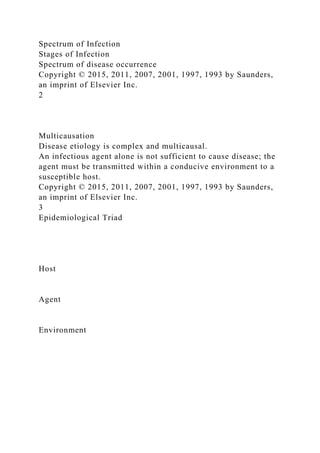
Multicausation
Disease etiology is complex and multicausal.
An infectious agent alone is not sufficient to cause disease; the
agent must be transmitted within a conducive environment to a
susceptible host.
Copyright © 2015, 2011, 2007, 2001, 1997, 1993 by Saunders,
an imprint of Elsevier Inc.
3
Epidemiological Triad
Host
Agent
Environment
Spectrum of Infection
Not all contact with an infectious agent leads to infection, and
not all infection leads to an infectious disease.
Subclinical infection: no overt symptomatic disease (unapparent
or asymptomatic)
Infections: entry and multiplication of infectious agent in host
Infectious disease and communicable disease:
pathophysiological responses of the host to the infectious agent,
manifesting as an illness (considered a case)
Carriers: people who continue to shed infectious agent without
any symptoms of disease
Copyright © 2015, 2011, 2007, 2001, 1997, 1993 by Saunders,
an imprint of Elsevier Inc.
4
Stages of Infection
Latent period
Infectious agent has invaded a host and found conditions
hospitable to replicate
Replication before shedding
Communicable period
Follows latency
Begins with shedding of agent
Incubation period
Time from invasion to time when disease symptoms first appear
May overlap with communicable period
Copyright © 2015, 2011, 2007, 2001, 1997, 1993 by Saunders,
an imprint of Elsevier Inc.
5
Stages of Infection (Cont.)
Copyright © 2015, 2011, 2007, 2001, 1997, 1993 by Saunders,
an imprint of Elsevier Inc.
6
Figure 25-1 From Grimes DE: Infectious diseases, St Louis,
1991, Mosby.
Spectrum of Disease Occurrence
Incidence—new cases in a population
Endemic—diseases that occur at a consistent, expected level in
a geographic area
Outbreak—an unexpected occurrence of an infectious disease in
a limited geographic area during a limited period of time
Epidemic—an unexpected increase of an infectious disease in a
geographic area over an extended period of time
Pandemic—steady occurrence of a disease over a large
geographic area or worldwide
Copyright © 2015, 2011, 2007, 2001, 1997, 1993 by Saunders,
an imprint of Elsevier Inc.
7
Chain of Transmission
Infectious agents
Reservoirs
Portals of exit and entry
Modes of transmission
Direct
Indirect
Fomites or vectors
Fecal-oral, airborne
Host susceptibility
Copyright © 2015, 2011, 2007, 2001, 1997, 1993 by Saunders,
an imprint of Elsevier Inc.
8
Chain of Transmission (Cont.)
Copyright © 2015, 2011, 2007, 2001, 1997, 1993 by Saunders,
an imprint of Elsevier Inc.
9
Figure 25-2
Chain of Transmission: Part 1
Copyright © 2015, 2011, 2007, 2001, 1997, 1993 by Saunders,
an imprint of Elsevier Inc.
10
Table 25-1
Links
of the Chain
Definition
Factors
Infectious agent
An organism (virus, rickettsia, bacteria, fungus, protozoan,
helminth, or prion) capable of producing infection or infectious
disease
Properties of the agent: morphology, chemical composition,
growth requirements, and viability.
Interaction with the host: mode of action, infectivity,
pathogenicity, virulence, toxigenicity, antigenicity, and ability
to adapt to the host
Reservoirs
The environment in which a pathogen lives and multiplies
Humans, animals, arthropods, plants, soil, or any other organic
substance
Portal of exit
Means by which an infectious agent is transported from the host
Respiratory secretions, vaginal secretions, semen, saliva, lesion
exudates, blood, and feces
Chain of Transmission: Part 2
Copyright © 2015, 2011, 2007, 2001, 1997, 1993 by Saunders,
an imprint of Elsevier Inc.
11
Table 25-1
Links of the Chain
Definition
Factors
Mode of transmission
Method whereby the infectious agent is transmitted from one
host (or reservoir) to another host
Direct: person to person
Indirect: implies a vehicle of transmission (biological or
mechanical vector, common vehicles or fomite)
Airborne droplets
Portal of entry
Means by which an infectious agent enters a new host
Respiratory passages, mucous membranes, skin, percutaneous
injection, ingestion, and through the placenta
Host susceptibility
The presence or lack of sufficient resistance to an infectious
agent to avoid or prevent contracting an infection or acquiring
an infectious disease
Biological and personal characteristics (e.g., gender, age,
genetics), general health status, personal behaviors, anatomical
and physiological lines of defense, immunity
Breaking the Chain of Transmission
Controlling the agent
Eradicating the nonhuman reservoir
Controlling the human reservoir
Quarantine—during incubation period
Controlling the portals of exit and entry
Isolation of sick persons
Universal precautions
Improving host resistance and
immunity
Copyright © 2015, 2011, 2007, 2001, 1997, 1993 by Saunders,
an imprint of Elsevier Inc.
12
Types of Immunity
Natural immunity: an innate resistance to a specific antigen or
toxin
Acquired immunity: derived from actual exposure to specific
infectious agent, toxin, or appropriate vaccine
Active acquired: body produces its own antibodies
Passive acquired: temporary resistance that has been donated to
the host
Primary vaccine failure: failure of vaccine to stimulate any
immune response
Secondary vaccine failure: waning of immunity following an
initial immune response
Copyright © 2015, 2011, 2007, 2001, 1997, 1993 by Saunders,
an imprint of Elsevier Inc.
13
Types of Acquired Immunity
Copyright © 2015, 2011, 2007, 2001, 1997, 1993 by Saunders,
an imprint of Elsevier Inc.
14
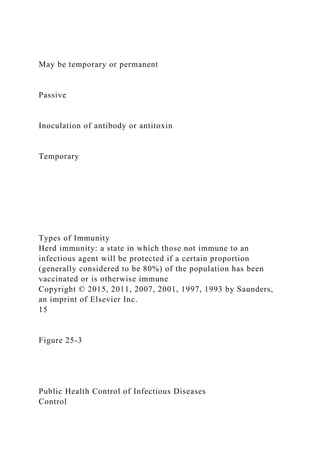
Table 25-2
Type
How Acquired
Length of Resistance
Natural
Active
Natural contact and infection with the antigen
May be temporary or permanent
Passive
Natural contact with antibody transplacentally or through
colostrum and breast milk
Temporary
Artificial
Active
Inoculation of antigen
May be temporary or permanent
Passive
Inoculation of antibody or antitoxin
Temporary
Types of Immunity
Herd immunity: a state in which those not immune to an
infectious agent will be protected if a certain proportion
(generally considered to be 80%) of the population has been
vaccinated or is otherwise immune
Copyright © 2015, 2011, 2007, 2001, 1997, 1993 by Saunders,
an imprint of Elsevier Inc.
15
Figure 25-3
Public Health Control of Infectious Diseases
Control
The reduction of incidence (new cases) or prevalence (existing
cases) of a given disease to a locally acceptable level as a result
of deliberate efforts
Elimination
Controlling a disease within a specified geographic area and
reducing the prevalence and incidence to near zero
The result of deliberate efforts, but continued intervention
measures are required
Eradication
Reducing the worldwide incidence of a disease to zero as a
function of deliberate efforts (e.g., smallpox in 1977)
No need for further control measures
Only possible under certain conditions
Copyright © 2015, 2011, 2007, 2001, 1997, 1993 by Saunders,
an imprint of Elsevier Inc.
16
Criteria for Disease Eradication
Human host only; no host in nature
Easy diagnosis; obvious clinical manifestations
Limited duration and intensity of infection
Natural lifelong immunity after infection
Highly seasonal transmission
Availability of vaccine, curative treatment, or both
Substantial global morbidity and mortality rates
Cost effectiveness of campaign and eradication
Integration of eradication with additional public health
variables
Eradication imperative over control measures
– CDC (1993)
Copyright © 2015, 2011, 2007, 2001, 1997, 1993 by Saunders,
an imprint of Elsevier Inc.
17
Notifiable Infectious Diseases in the United States
Reported weekly in the MMWR
Go to CDC website for latest listing of diseases:
http://www.cdc.gov
Note: State health departments have the responsibility for
monitoring and controlling communicable diseases within their
respective states; they determine which diseases will be
reported within their jurisdiction. Those lists might be longer
than the CDC’s list.
Copyright © 2015, 2011, 2007, 2001, 1997, 1993 by Saunders,
an imprint of Elsevier Inc.
18
Vaccines and Infectious Disease Prevention
Immunization is a broad term used to describe a process by
which active or passive immunity to an infectious disease is
induced or amplified.
Immunizing agents can include vaccines as well as immune
globulins or antitoxins.
Vaccination is a narrower term referring to the administration of
a vaccine or toxoid to confer active immunity by stimulating the
body to produce its own antibodies.
Copyright © 2015, 2011, 2007, 2001, 1997, 1993 by Saunders,
an imprint of Elsevier Inc.
19
Recommended Immunization Schedules
Recommendations for international immunization practices
determined by WHO
In the United States, AAP and ACIP
Current U.S. recommendations found on CDC website:
http://www.cdc.gov/vaccines
Schedules, footnotes, and educational fact sheets provide
guidelines for practice
Copyright © 2015, 2011, 2007, 2001, 1997, 1993 by Saunders,
an imprint of Elsevier Inc.
20
Vaccines: Words of Caution
Information and recommendations on immunizations and
vaccine usage change regularly
Vaccine Information Statements (VISs) that explain the benefits
and risks must be given out before vaccine is administered—a
federal law!! (http://www.cdc.gov/vaccines/hcp/vis/index.html)
Copyright © 2015, 2011, 2007, 2001, 1997, 1993 by Saunders,
an imprint of Elsevier Inc.
21
Available Vaccines by Type
Live attenuated vaccines (See Textbook Table 25-3)
Viral: measles, mumps, rubella, oral polio, vaccinia, yellow
fever, varicella
Bacterial: BCG (Bacille Calmette-Guérin)
Recombinant: oral typhoid
Copyright © 2015, 2011, 2007, 2001, 1997, 1993 by Saunders,
an imprint of Elsevier Inc.
22
Available Vaccines by Type (Cont.)
Inactivated vaccines (See Textbook Table 25-3)
Viral: influenza, polio, rabies, and hepatitis A
Bacterial: typhoid, cholera, and plague
Subunit (fractional): influenza, acellular pertussis, typhoid Vi
and Lyme disease
Toxoid: diphtheria and tetanus
Recombinant: hepatitis B
Conjugate polysaccharide: Haemophilus influenzae type B and
pneumococcal 7-valent
Pure polysaccharide: Pneumococcal 23-valent, meningococcal,
and Haemophilus influenzae type b
Copyright © 2015, 2011, 2007, 2001, 1997, 1993 by Saunders,
an imprint of Elsevier Inc.
23
Recommended Vaccine Schedules (Textbook Box 25-6)
Children/adolescents
http://www.cdc.gov/vaccines/schedules/hcp/child-
adolescent.html
Adults
http://www.cdc.gov/vaccines/schedules/hcp/adult.html
Travelers
http://wwwnc.cdc.gov/travel/destinations/list
Pregnant women
www.cdc.gov/vaccines/pubs/preg-guide.htm
Health care workers
www.cdc.gov/vaccines/spec-grps/hcw.htm
Specific health conditions
www.cdc.gov/vaccines/spec-grps/conditions.htm
Other special groups
www.cdc.gov/vaccines/spec-grps/default.htm
Copyright © 2015, 2011, 2007, 2001, 1997, 1993 by Saunders,
an imprint of Elsevier Inc.
24
Vaccine Storage, Transport,
and Handling
Cold chain
Routes of administration, dosage, and sites
Proper timing and spacing
Hypersensitivity and contraindications
Documentation
Vaccine safety and reporting of adverse events and vaccine-
related injuries (VAERS)
Vaccine needs for special groups
Copyright © 2015, 2011, 2007, 2001, 1997, 1993 by Saunders,
an imprint of Elsevier Inc.
25
Prevention of Communicable Diseases
Primary prevention
To prevent transmission of an infectious agent and to prevent
pathology in the person exposed to an infection
Secondary prevention
Activities to detect early and effectively treat persons who are
infected
Tertiary prevention
Caring for persons with an infectious disease to ensure that they
are cured or that their quality of life is maintained
Copyright © 2015, 2011, 2007, 2001, 1997, 1993 by Saunders,
an imprint of Elsevier Inc.
26
Chapter 24
Populations Affected by Mental Illness
Copyright © 2015, 2011, 2007, 2001, 1997, 1993 by Saunders,
an imprint of Elsevier Inc.
Mental Health
Mental health refers to the absence of mental disorders and to
the ability for social and occupational functioning.
Mental illness is diagnosable mental disorders that affect
alternations in thinking, mood, or behavior associated with
distress and impaired functioning.
Copyright © 2015, 2011, 2007, 2001, 1997, 1993 by Saunders,
an imprint of Elsevier Inc.
2
Challenges in the Community
Complex patient comorbidity
Lack of resources
Competent mental health professional workforce and law
enforcement
Physical facility inadequacies
Stigma of mental illness
Copyright © 2015, 2011, 2007, 2001, 1997, 1993 by Saunders,
an imprint of Elsevier Inc.
3
A community’s mental health is a reflection of community as a
whole.
Mental illness is a significant public health problem affecting
not only the person with mental illness, but also his or her
families, friends, schoolmates, workmates, and others.
Copyright © 2015, 2011, 2007, 2001, 1997, 1993 by Saunders,
an imprint of Elsevier Inc.
4
Community Mental Health Movement, 1960 to Present Day
Copyright © 2015, 2011, 2007, 2001, 1997, 1993 by Saunders,
an imprint of Elsevier Inc.
5Blue Ribbon Panel report Action for Mental Health
1963 Community Mental Health Clinics Legislation
Recommendations for intensive care of acutely ill mental
patients and community mental health clinics
Community mental health centers in some urban communities
1960's Deinstitutionalization Discharged mentally ill from state
hospitals patients returned to communities with inadequate
resources (e.g. finances, housing, health care, supportive
employment)1981 Mental Health Block Grant, as part of the
Omnibus Reconciliation Act
1986 State Mental Health Planning ActStates develop
comprehensive mental health plans for persons with
SMI1999U.S. Surgeon General’s Report on Mental Health2008
Mental Health Parity and Addiction Equity Act of
2008Insurance coverage for mental health and substance use
conditions
2010 Affordable Care Act Builds on the Mental Health Parity
and Addiction Equity Act of 2008 to extend federal parity
protections to 62 million Americans
Table 24-1
Deinstitutionalization
Courts’ actions
Limited involuntary institutionalization
Set minimum standards for care in institutions
Insufficient community resources
Inadequate housing
Insufficient supported employment
Insufficient community mental health professional workforce
Few community mental health care services
Funding did not follow the change in policy
Copyright © 2015, 2011, 2007, 2001, 1997, 1993 by Saunders,
an imprint of Elsevier Inc.
6
Present-Day Community Mental Health Reform
Mental Health Reform works toward monitoring federal
legislation, administration activity, and public education
initiatives.
Makes community mental health a national priority by
establishing early access, recovery, and high quality in mental
health services as standards
Medicalization of Mental Illness
Brain Neuroimaging, Genetics, and Hope for New Treatments
Copyright © 2015, 2011, 2007, 2001, 1997, 1993 by Saunders,
an imprint of Elsevier Inc.
7
Medicalization of Mental Illness
Has helped put mental disorders on parity with other diseases
Can impact treatment as forcefully as other medical conditions
Hope to make insurance coverage equal to other medical
treatments
Looks at holism and health and understanding on a functioning
level
Seen as treatment to achieve the absence of disease
Copyright © 2015, 2011, 2007, 2001, 1997, 1993 by Saunders,
an imprint of Elsevier Inc.
8
Factors Influencing Mental Health
Biological Factors
Genetic Factors
Brain Structural and Functioning Abnormalities
Social Factors
Gender, Racial, Sexual Orientation Disparities
Natural and Man-Made Disasters
Political Factors
Copyright © 2015, 2011, 2007, 2001, 1997, 1993 by Saunders,
an imprint of Elsevier Inc.
9
Mental Disorders Encountered in Community Settings
Schizophrenia
Depression (adults, children, and adolescents)
Bipolar disorder
Anxiety disorders
Eating disorders
ADHD/ADD
Suicide
Copyright © 2015, 2011, 2007, 2001, 1997, 1993 by Saunders,
an imprint of Elsevier Inc.
10
Schizophrenia
The most common psychotic disorder
Positive symptoms include hallucinations, delusions,
disorganized thinking and speech, and bizarre behaviors
Negative symptoms include flat affect, poor attention, lack of
motivation, apathy, lack of pleasure, and lack of energy
Increased risk for alcohol use, depression, suicide, and diabetes
Treatment is intensive—often with hospitalization (initially),
antipsychotic meds, and psychotherapy
Copyright © 2015, 2011, 2007, 2001, 1997, 1993 by Saunders,
an imprint of Elsevier Inc.
11
Depression
Most frequently diagnosed and one of the most disabling mental
illnesses in the United States
Includes major depressive disorder, dysthymic disorder, and
bipolar
Often co-occurs with serious physical disorders (heart attack,
stroke, diabetes, and cancer)
Health education includes risk factors identification, as well as
how and when to obtain treatment
Children and adolescents also suffer with depression.
Treatment includes pharmacological therapy, psychotherapy,
behavior therapy, electroconvulsive therapy, or a combination
of these
Copyright © 2015, 2011, 2007, 2001, 1997, 1993 by Saunders,
an imprint of Elsevier Inc.
12
Bipolar Disorder
Mood disorder that presents with changes in mood from
depression to mania.
May co-occur with hallucinations and delusions.
Management of bipolar disorder must be ongoing and involve
close monitoring.
Treatment generally involves use of mood stabilizing
medication, often in combination with antipsychotic and
antidepressant therapy.
Copyright © 2015, 2011, 2007, 2001, 1997, 1993 by Saunders,
an imprint of Elsevier Inc.
13
Anxiety Disorders
Characterized by feelings of severe anxiety
Generalized anxiety disorder
Panic disorder
Phobias
Obsessive-compulsive disorder (OCD)
Posttraumatic stress disorder (PTSD)
May be attributed to genetic makeup and life experiences of the
individual.
Treatment varies with disorder.
Support from family and friends beneficial.
Copyright © 2015, 2011, 2007, 2001, 1997, 1993 by Saunders,
an imprint of Elsevier Inc.
14
Eating Disorders
Often triggered by developmental milestones (e.g., puberty, first
sexual contact) or another crisis (e.g., death of a loved one,
ridicule over weight, starting college)
Primarily affect females
Bulimia nervosa (binge eating)
Anorexia nervosa (obsessed with fear of fat and with losing
weight)
Treatment: long-term nutrition counseling, psychotherapy, and
behavior modification
Copyright © 2015, 2011, 2007, 2001, 1997, 1993 by Saunders,
an imprint of Elsevier Inc.
15
ADHD and ADD
ADHD: attention deficit hyperactivity disorder
ADD: attention deficit disorder
Usually appear before age 7 and often accompanied by related
problems (e.g., learning disability, anxiety, and depression)
Three major characteristics are inattention, hyperactivity, and
impulsivity.
Symptoms are typically managed with a combination of
behavior therapy, emotional counseling, and practical support.
Copyright © 2015, 2011, 2007, 2001, 1997, 1993 by Saunders,
an imprint of Elsevier Inc.
16
Suicide
Risk factors—IS PATH WARM?
Previous suicide attempts, mental illness, substance abuse,
barriers to accessing mental health treatment
Protective factors
Appropriate mental health care, easy access to treatment,
community support, and continuing support from medical and
mental health providers
Warning signs of suicide
Question those at risk in terms of thoughts, plans, lethality,
means, and intent.
Copyright © 2015, 2011, 2007, 2001, 1997, 1993 by Saunders,
an imprint of Elsevier Inc.
17
How do you remember the warning signs of suicide?
Try using this
easy-to-remember mnemonic:
IS PATH WARM?
I – Ideation
S – Substance abuse
P – Purposelessness
A – Anxiety
T – Trapped
H – Hopelessness
W – Withdrawal
A – Anger
R – Recklessness
M – Mood changes
Copyright © 2015, 2011, 2007, 2001, 1997, 1993 by Saunders,
an imprint of Elsevier Inc.
18
Suicide
Identification of Mental Disorders
Early identification, appropriate treatment, and rehabilitation
can reduce duration and disability and decrease possibility of
relapse.
Direct questioning
Observations
Use of standardized assessment tools or questionnaires
Copyright © 2015, 2011, 2007, 2001, 1997, 1993 by Saunders,
an imprint of Elsevier Inc.
19
EBP Management of Mental Disorders
Psychotropic or Psychotherapeutic medications
Medications treat symptoms; they do not cure mental illness
Nurse needs to be up-to-date on medications:
http://www.nlm.nih.gov/medlineplus/druginformation.html
http:www.rxlist.com
Copyright © 2015, 2011, 2007, 2001, 1997, 1993 by Saunders,
an imprint of Elsevier Inc.
20
EBP Management of Mental Disorders (Cont.)
Psychotherapy
A process of discovery that helps alleviate troubling emotional
symptoms and returns individuals to a healthy life
Involves use of professional, therapeutic relationships and the
application of psychotherapy theories and best practices
Changes a client’s attitudes, feelings, beliefs, defenses,
personality, and behavior
Individual, family, couple, group therapy
Play, cognitive, behavioral therapy
Copyright © 2015, 2011, 2007, 2001, 1997, 1993 by Saunders,
an imprint of Elsevier Inc.
21
Community-Based
Mental Health Care Initiatives
Americans understand that mental health is essential to overall
health.
Mental health care is consumer and family driven.
Disparities in mental health services are eliminated.
Early mental health screening, assessment, and referral to
services are common practice.
Excellent mental health care is delivered, and research is
accelerated.
Technology is used to access mental health care and
information.
– New Freedom Commission on Mental Health (2003)
Copyright © 2015, 2011, 2007, 2001, 1997, 1993 by Saunders,
an imprint of Elsevier Inc.
22
Multidimensional Roles of the Community Mental Health Nurse
Court representative
Educator
Researcher
Collaborator
Consultant
Case manager
Content expert
Administrator
Activist
Politician
Advocate
Initiator
Evaluator
Grant writer
Practitioner
Coordinator
Copyright © 2015, 2011, 2007, 2001, 1997, 1993 by Saunders,
an imprint of Elsevier Inc.
23
Multidisciplinary Roles
Educator and advocate
Improves public awareness of effective treatments and existing
community resources
Dispels myths
Provides accurate information
Influences policy and legislation
Advocates for clients
Copyright © 2015, 2011, 2007, 2001, 1997, 1993 by Saunders,
an imprint of Elsevier Inc.
24
Multidisciplinary Roles (Cont.)
Practitioner and coordinator
Provides direct care, helps consumer “navigate” within web of
agencies and providers
Takes action to solve an immediate problem
Plans and intervenes to ensure safety, continuity, and quality of
care
Anticipates and evaluates actions of other providers
Communicates with consumers, families, rehabilitation services,
and government or social agencies
Copyright © 2015, 2011, 2007, 2001, 1997, 1993 by Saunders,
an imprint of Elsevier Inc.
25
Chapter 21
Populations Affected by Disabilities
Copyright © 2015, 2011, 2007, 2001, 1997, 1993 by Saunders,
an imprint of Elsevier Inc.
Most people whose lives do not end abruptly
will experience disability.
– Nies & McEwen (2015)
Copyright © 2015, 2011, 2007, 2001, 1997, 1993 by Saunders,
an imprint of Elsevier Inc.
2
Doing a Self-Assessment
What comes to mind when you think of someone with a
disability?
Picture yourself as a person with a disability.
Imagine yourself as a nurse with a visible disability, or a client
receiving care from a nurse with a disability.
Think about living in a family affected by disability.
What is the experience of living with disability within your
community?
Copyright © 2015, 2011, 2007, 2001, 1997, 1993 by Saunders,
an imprint of Elsevier Inc.
3
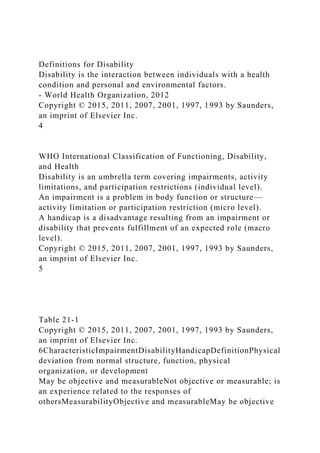
Definitions for Disability
Disability is the interaction between individuals with a health
condition and personal and environmental factors.
- World Health Organization, 2012
Copyright © 2015, 2011, 2007, 2001, 1997, 1993 by Saunders,
an imprint of Elsevier Inc.
4
WHO International Classification of Functioning, Disability,
and Health
Disability is an umbrella term covering impairments, activity
limitations, and participation restrictions (individual level).
An impairment is a problem in body function or structure—
activity limitation or participation restriction (micro level).
A handicap is a disadvantage resulting from an impairment or
disability that prevents fulfillment of an expected role (macro
level).
Copyright © 2015, 2011, 2007, 2001, 1997, 1993 by Saunders,
an imprint of Elsevier Inc.
5
Table 21-1
Copyright © 2015, 2011, 2007, 2001, 1997, 1993 by Saunders,
an imprint of Elsevier Inc.
6CharacteristicImpairmentDisabilityHandicapDefinitionPhysical
deviation from normal structure, function, physical
organization, or development
May be objective and measurableNot objective or measurable; is
an experience related to the responses of
othersMeasurabilityObjective and measurableMay be objective
and measurableNot objective or measurable; is an experience
related to the responses of othersIllustrationsSpina bifida,
spinal cord injury, amputation, and detached retinaCannot walk
unassisted; uses crutches and/or a manual or power wheelchair;
blindness
Reflects physical and psychological characteristics of the
person, culture, and specific circumstancesLevel of
analysisMicro level
(e.g., body organ)Individual level
(e.g., person)Macro level
(e.g., societal)
6
National Agenda for Prevention of Disabilities (NAPD) Model
Copyright © 2015, 2011, 2007, 2001, 1997, 1993 by Saunders,
an imprint of Elsevier Inc.
7
Figure 21-1 Reprinted with permission from Pope AM, Tarlov
AR, editors: Disability in America: toward a national agenda for
prevention, Washington, DC, 1991, Institute of Medicine,
National Academy Press. Copyright © 1991 by the National
Academy of Sciences. Courtesy National Academy Press,
Washington, DC.
Quality of Life Issues
Transportation to a needed service
Cost of care
Appointment challenges
Language barriers
Financial issues
Migrant/noninsured issues
Copyright © 2015, 2011, 2007, 2001, 1997, 1993 by Saunders,
an imprint of Elsevier Inc.
8
Models for Disability
Medical model—a defect in need of cure through medical
intervention
Rehabilitation model—a defect to be treated by a rehabilitation
professional
Moral model—connected with sin and shame
Disability model—socially constructed
Copyright © 2015, 2011, 2007, 2001, 1997, 1993 by Saunders,
an imprint of Elsevier Inc.
9
Disability: A Socially Constructed Issue
Disability is a complex, multifaceted, culturally rich concept
that cannot be readily defined, explained, or measured (Mont,
2007).
Whether the inability to perform a certain function is seen as
disabling depends on socio-environmental barriers (e.g.,
attitudinal, architectural, sensory, cognitive, and economic),
inadequate support services, and other factors (Kaplan, 2009).
Copyright © 2015, 2011, 2007, 2001, 1997, 1993 by Saunders,
an imprint of Elsevier Inc.
10
“Medicalization” Issues
Nurse needs to differentiate …
A person who has an illness and becomes disabled secondary to
the illness
versus …
A person who has a disability, but may not need treatment
Copyright © 2015, 2011, 2007, 2001, 1997, 1993 by Saunders,
an imprint of Elsevier Inc.
11
“Medicalization” Issues (Cont.)
Nurse’s interaction with PWD and families
Approach on an eye-to-eye level
Listen to understand
Collaborate with the person/family
Make plans and goals that meet the other’s needs and draw on
strengths and improve weaknesses
Empower and affirm the worth and knowledge of the
person/family with a disability
Promote self-determination and allow choices
Note: PWD = persons with disabilities
Copyright © 2015, 2011, 2007, 2001, 1997, 1993 by Saunders,
an imprint of Elsevier Inc.
12
Historical Perspectives
Long history of institutionalization/segregation
Often viewed as sick and helpless
In the 20th century, special interest groups emerged to advocate
for PWD (e.g., ARC)
Tragedies include Hitler’s euthanasia program
Deinstitutionalization began in 1960s-1970s
Stereotypical images still common in literature and media; these
images influence prevailing perceptions of disability
Copyright © 2015, 2011, 2007, 2001, 1997, 1993 by Saunders,
an imprint of Elsevier Inc.
13
Historical Context for Disability
Early attitudes toward PWD
Set apart from others
Viewed as different or unusual
Documented in carvings and writings
Infanticide or left to die (not in Jewish culture)
Viewed as unclean and/or sinful
Served as entertainers, circus performers, and
sideshow exhibitions
Copyright © 2015, 2011, 2007, 2001, 1997, 1993 by Saunders,
an imprint of Elsevier Inc.
14
Historical Context
18th and 19th century attitudes
No scientific model for understanding and treating
Disability seen as an irreparable condition caused by
supernatural agency
Viewed as sick and helpless
Expected to participate in whatever treatment was deemed
necessary to cure or perform
Industrial Revolution stimulated a societal need for increased
education
If not third-grade level = feeble-minded
Special schools established in early 1800s
Copyright © 2015, 2011, 2007, 2001, 1997, 1993 by Saunders,
an imprint of Elsevier Inc.
15
Historical Context (Cont.)
20th century attitudes
Special interest groups were formed
First federal vocational rehabilitation legislation passed in early
1920s
Involuntary sterilization of many with intellectual disabilities
ARC (Association for Retarded Children) began to advocate for
children with intellectual disabilities—today is Association for
Retarded Citizens
ARC is “world’s largest community-based organization of and
for people with intellectual and developmental disabilities”
(ARC, 2009)
Copyright © 2015, 2011, 2007, 2001, 1997, 1993 by Saunders,
an imprint of Elsevier Inc.
16
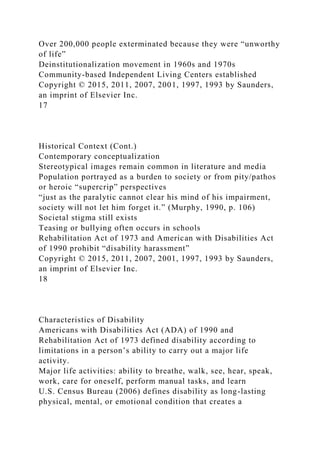
Historical Context (Cont.)
20th century attitudes
One of the most horrendous tragedies under Hitler’s euthanasia
or “good death” program
Killed at least 5000 mentally and physically disabled children
by starvation or lethal overdoses
Killed 70,274 adults with disabilities by 1941
Over 200,000 people exterminated because they were “unworthy
of life”
Deinstitutionalization movement in 1960s and 1970s
Community-based Independent Living Centers established
Copyright © 2015, 2011, 2007, 2001, 1997, 1993 by Saunders,
an imprint of Elsevier Inc.
17
Historical Context (Cont.)
Contemporary conceptualization
Stereotypical images remain common in literature and media
Population portrayed as a burden to society or from pity/pathos
or heroic “supercrip” perspectives
“just as the paralytic cannot clear his mind of his impairment,
society will not let him forget it.” (Murphy, 1990, p. 106)
Societal stigma still exists
Teasing or bullying often occurs in schools
Rehabilitation Act of 1973 and American with Disabilities Act
of 1990 prohibit “disability harassment”
Copyright © 2015, 2011, 2007, 2001, 1997, 1993 by Saunders,
an imprint of Elsevier Inc.
18
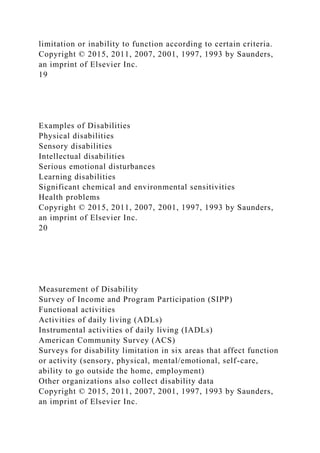
Characteristics of Disability
Americans with Disabilities Act (ADA) of 1990 and
Rehabilitation Act of 1973 defined disability according to
limitations in a person’s ability to carry out a major life
activity.
Major life activities: ability to breathe, walk, see, hear, speak,
work, care for oneself, perform manual tasks, and learn
U.S. Census Bureau (2006) defines disability as long-lasting
physical, mental, or emotional condition that creates a
limitation or inability to function according to certain criteria.
Copyright © 2015, 2011, 2007, 2001, 1997, 1993 by Saunders,
an imprint of Elsevier Inc.
19
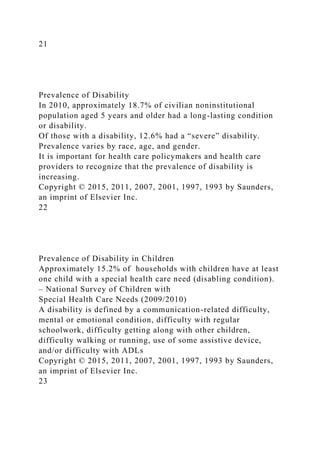
Examples of Disabilities
Physical disabilities
Sensory disabilities
Intellectual disabilities
Serious emotional disturbances
Learning disabilities
Significant chemical and environmental sensitivities
Health problems
Copyright © 2015, 2011, 2007, 2001, 1997, 1993 by Saunders,
an imprint of Elsevier Inc.
20
Measurement of Disability
Survey of Income and Program Participation (SIPP)
Functional activities
Activities of daily living (ADLs)
Instrumental activities of daily living (IADLs)
American Community Survey (ACS)
Surveys for disability limitation in six areas that affect function
or activity (sensory, physical, mental/emotional, self-care,
ability to go outside the home, employment)
Other organizations also collect disability data
Copyright © 2015, 2011, 2007, 2001, 1997, 1993 by Saunders,
an imprint of Elsevier Inc.
21
Prevalence of Disability
In 2010, approximately 18.7% of civilian noninstitutional
population aged 5 years and older had a long-lasting condition
or disability.
Of those with a disability, 12.6% had a “severe” disability.
Prevalence varies by race, age, and gender.
It is important for health care policymakers and health care
providers to recognize that the prevalence of disability is
increasing.
Copyright © 2015, 2011, 2007, 2001, 1997, 1993 by Saunders,
an imprint of Elsevier Inc.
22
Prevalence of Disability in Children
Approximately 15.2% of households with children have at least
one child with a special health care need (disabling condition).
– National Survey of Children with
Special Health Care Needs (2009/2010)
A disability is defined by a communication-related difficulty,
mental or emotional condition, difficulty with regular
schoolwork, difficulty getting along with other children,
difficulty walking or running, use of some assistive device,
and/or difficulty with ADLs
Copyright © 2015, 2011, 2007, 2001, 1997, 1993 by Saunders,
an imprint of Elsevier Inc.
23
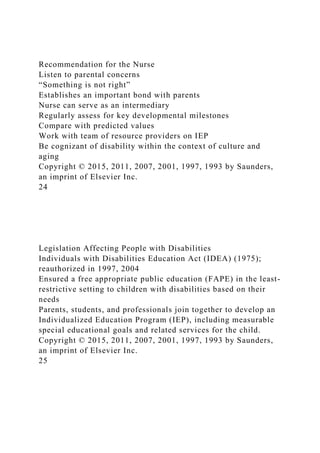
Recommendation for the Nurse
Listen to parental concerns
“Something is not right”
Establishes an important bond with parents
Nurse can serve as an intermediary
Regularly assess for key developmental milestones
Compare with predicted values
Work with team of resource providers on IEP
Be cognizant of disability within the context of culture and
aging
Copyright © 2015, 2011, 2007, 2001, 1997, 1993 by Saunders,
an imprint of Elsevier Inc.
24
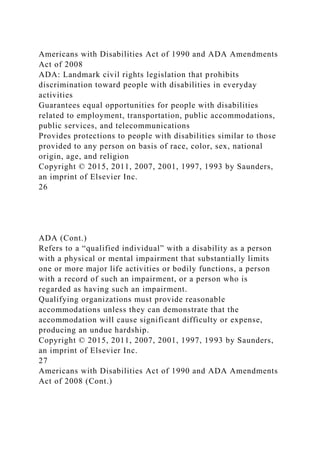
Legislation Affecting People with Disabilities
Individuals with Disabilities Education Act (IDEA) (1975);
reauthorized in 1997, 2004
Ensured a free appropriate public education (FAPE) in the least-
restrictive setting to children with disabilities based on their
needs
Parents, students, and professionals join together to develop an
Individualized Education Program (IEP), including measurable
special educational goals and related services for the child.
Copyright © 2015, 2011, 2007, 2001, 1997, 1993 by Saunders,
an imprint of Elsevier Inc.
25
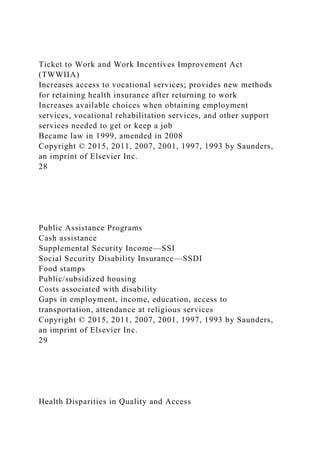
Americans with Disabilities Act of 1990 and ADA Amendments
Act of 2008
ADA: Landmark civil rights legislation that prohibits
discrimination toward people with disabilities in everyday
activities
Guarantees equal opportunities for people with disabilities
related to employment, transportation, public accommodations,
public services, and telecommunications
Provides protections to people with disabilities similar to those
provided to any person on basis of race, color, sex, national
origin, age, and religion
Copyright © 2015, 2011, 2007, 2001, 1997, 1993 by Saunders,
an imprint of Elsevier Inc.
26
ADA (Cont.)
Refers to a “qualified individual” with a disability as a person
with a physical or mental impairment that substantially limits
one or more major life activities or bodily functions, a person
with a record of such an impairment, or a person who is
regarded as having such an impairment.
Qualifying organizations must provide reasonable
accommodations unless they can demonstrate that the
accommodation will cause significant difficulty or expense,
producing an undue hardship.
Copyright © 2015, 2011, 2007, 2001, 1997, 1993 by Saunders,
an imprint of Elsevier Inc.
27
Americans with Disabilities Act of 1990 and ADA Amendments
Act of 2008 (Cont.)
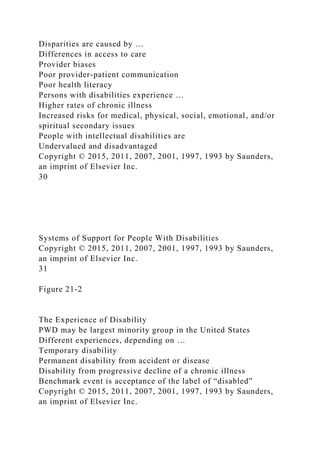
Ticket to Work and Work Incentives Improvement Act
(TWWIIA)
Increases access to vocational services; provides new methods
for retaining health insurance after returning to work
Increases available choices when obtaining employment
services, vocational rehabilitation services, and other support
services needed to get or keep a job
Became law in 1999, amended in 2008
Copyright © 2015, 2011, 2007, 2001, 1997, 1993 by Saunders,
an imprint of Elsevier Inc.
28
Public Assistance Programs
Cash assistance
Supplemental Security Income—SSI
Social Security Disability Insurance—SSDI
Food stamps
Public/subsidized housing
Costs associated with disability
Gaps in employment, income, education, access to
transportation, attendance at religious services
Copyright © 2015, 2011, 2007, 2001, 1997, 1993 by Saunders,
an imprint of Elsevier Inc.
29
Health Disparities in Quality and Access
Disparities are caused by …
Differences in access to care
Provider biases
Poor provider-patient communication
Poor health literacy
Persons with disabilities experience …
Higher rates of chronic illness
Increased risks for medical, physical, social, emotional, and/or
spiritual secondary issues
People with intellectual disabilities are
Undervalued and disadvantaged
Copyright © 2015, 2011, 2007, 2001, 1997, 1993 by Saunders,
an imprint of Elsevier Inc.
30
Systems of Support for People With Disabilities
Copyright © 2015, 2011, 2007, 2001, 1997, 1993 by Saunders,
an imprint of Elsevier Inc.
31
Figure 21-2
The Experience of Disability
PWD may be largest minority group in the United States
Different experiences, depending on …
Temporary disability
Permanent disability from accident or disease
Disability from progressive decline of a chronic illness
Benchmark event is acceptance of the label of “disabled”
Copyright © 2015, 2011, 2007, 2001, 1997, 1993 by Saunders,
an imprint of Elsevier Inc.
32
Children With Disabilities (CWD)
Family and caregiver responses
Redefine image and expectations for child and self
Sibling response influenced by age, coping, peer relationships,
parents, impact on family
Levels of parental adjustment
The ostrich phase
Special designation
Normalization
Self-actualization
Copyright © 2015, 2011, 2007, 2001, 1997, 1993 by Saunders,
an imprint of Elsevier Inc.
33
Family Research Outcomes
Established various benefits, amid challenges
Families with satisfying emotional support experience fewer
potentially negative effects of unplanned or distressing events.
Parents may grieve the loss of idealized or expected child over
time.
Supportive relationship is needed.
Empowerment and enabling decision making on behalf of CWD
is important.
Copyright © 2015, 2011, 2007, 2001, 1997, 1993 by Saunders,
an imprint of Elsevier Inc.
34
Knowledgeable Client
A person who lives with a disability commonly becomes an
expert at knowing what works best for his or her body.
Copyright © 2015, 2011, 2007, 2001, 1997, 1993 by Saunders,
an imprint of Elsevier Inc.
35
The nurse who has information about the disability and the
available community and governmental resources.
Knowledgeable Nurse
Strategies for the CH Nurse
Do not assume anything.
Adopt the client’s perspective.
Listen to and learn from client. Gather data from the perspective
of the client and family.
Care for the client and family, not for the disability.
Be well informed about community resources.
Become a powerful advocate.
Copyright © 2015, 2011, 2007, 2001, 1997, 1993 by Saunders,
an imprint of Elsevier Inc.
36
Dealing With Ethical Issues
Spiritual perspectives
Quality of life (QOL) and justice perspectives
Proper use of scientific advances
Self-determination, deinstitutionalization, and disability rights
Copyright © 2015, 2011, 2007, 2001, 1997, 1993 by Saunders,
an imprint of Elsevier Inc.
37
When the Nurse Has a Disability
Education programs and employers must provide reasonable
accommodations for qualified students and nurses.
Technical aspects of nursing tend to discriminate; nursing
should emphasize “humanistic” capacities.
Type of setting influences functionability.
Copyright © 2015, 2011, 2007, 2001, 1997, 1993 by Saunders,
an imprint of Elsevier Inc.
38
Nurses Can …
… become familiar with a variety of ethical frameworks for
decision making.
… help the patient and family access needed information to
make informed decisions.
… help educate the public on health care issues.
… participate in the development of institutional policies and
procedures related to disability.
… take a position on an ethical issue.
… work to influence government policies and laws.
Copyright © 2015, 2011, 2007, 2001, 1997, 1993 by Saunders,
an imprint of Elsevier Inc.
39
Chapter 20
Family Health
Copyright © 2015, 2011, 2007, 2001, 1997, 1993 by Saunders,
an imprint of Elsevier Inc.
Working with Families
Working with families has never been more complex or
rewarding than now.
Nurses understand the actual and potential impact that families
have in changing the health status of individual family
members, communities, and society as a whole.
Families have challenging health care needs that are not usually
addressed by the health care system.
Copyright © 2015, 2011, 2007, 2001, 1997, 1993 by Saunders,
an imprint of Elsevier Inc.
2
.
How Do You Define a Family?
Copyright © 2015, 2011, 2007, 2001, 1997, 1993 by Saunders,
an imprint of Elsevier Inc.
3
Definitions of a Family
Historical definitions:
The environment affecting individual clients
Small to large groups of interacting people
A single unit of care with definable boundaries
A unit of care within a specific environment of a community or
society
Current theorists:
Two or more individuals who depend on one another for
emotional, physical, and economic support. Members of family
are self-defined.
– Hanson & Kaakimen (2005)
The family is who they say they are.
– Wright & Leahey (2000)
Copyright © 2015, 2011, 2007, 2001, 1997, 1993 by Saunders,
an imprint of Elsevier Inc.
4
Inclusive Definitions of Family
“Family” means any person(s) playing a significant role in an
individual’s life. This may include person(s) not legally related
to the individual. Members of “family” include spouses,
domestic partners, and both different-sex and same-sex
significant others. “Family” includes a minor patient’s parents,
regardless of gender of either parent … without limitation as
encompassing legal parents, foster parents, same-sex parent,
step-parents, those serving in loco parentis, and others
operating in caretaker roles.
– Human Rights Campaign ( 2009)
Copyright © 2015, 2011, 2007, 2001, 1997, 1993 by Saunders,
an imprint of Elsevier Inc.
5
The Changing Family
Purposes of the family
To meet the needs of society
To meet the needs of individual family members
Examples of different family types
Traditional, nuclear family
Multigenerational family household
Cohabitating families
Single-parent families
Grandparent-headed families
Gay or lesbian families
Unmarried teen mothers
Copyright © 2015, 2011, 2007, 2001, 1997, 1993 by Saunders,
an imprint of Elsevier Inc.
6
The “Sandwich” Generation
Copyright © 2015, 2011, 2007, 2001, 1997, 1993 by Saunders,
an imprint of Elsevier Inc.
7
Figure 20-1 From Pew Research Center: Social and
Demographic Trends: The Sandwich Generation.
http://www.pewsocialtrends.org/2013/01/30/the-sandwich-
generation/. Accessed March 15, 2013.
Why Is It Important for the CHN to Work with Families?
The family is a critical resource.
Any dysfunction in a family unit will affect the members and
the unit as a whole.
Case finding can identify a health problem that leads to risks
for the entire family.
Nursing care can be improved by providing holistic care to the
family and its members.
– Friedman, Bowden, & Jones (2003)
Copyright © 2015, 2011, 2007, 2001, 1997, 1993 by Saunders,
an imprint of Elsevier Inc.
8
Approaches to Meeting the Health Needs of Families
Copyright © 2015, 2011, 2007, 2001, 1997, 1993 by Saunders,
an imprint of Elsevier Inc.
9
Moving from the Family to the Community
Moving from the Individual to the Family
Family interviewing
Manners
Therapeutic conversations
Genogram and Ecomap
Therapeutic questions
Commending family or individual strengths
Issues in family interviewing
Many locations, family informant, family health portrait,
involvement of children
Intervention in cases of chronic illness
Copyright © 2015, 2011, 2007, 2001, 1997, 1993 by Saunders,
an imprint of Elsevier Inc.
10
Moving from the Family to the Community
The health of communities is measured by the well-being of its
people and families.
Families are components of communities.
Cross-comparison of communities must include health needs as
well as resources.
Cross-compare the needs of the families within the community
and set priorities.
Delegation of scarce resources is essential.
A double standard in public health is tolerated.
Copyright © 2015, 2011, 2007, 2001, 1997, 1993 by Saunders,
an imprint of Elsevier Inc.
11
Family Theory Approach
Any “dysfunction” that affects one member will probably affect
others and the family as a whole.
The family’s wellness is highly dependent on the role of the
family in every aspect of health care.
The level of wellness of the whole family can be raised by
reducing lifestyle and environmental risks by emphasizing
health promotion, self-care, health education, and family
counseling.
Copyright © 2015, 2011, 2007, 2001, 1997, 1993 by Saunders,
an imprint of Elsevier Inc.
12
Family Theory Approach (Cont.)
Commonalities in risk factors and diseases shared by family
members can lead to case finding within family.
Individual is assessed within larger context of family.
Family is vital support system to individual member.
– Friedman (1994)
Copyright © 2015, 2011, 2007, 2001, 1997, 1993 by Saunders,
an imprint of Elsevier Inc.
13
Systems Theory Approach
The family as a unit interacts with larger units outside the
family (suprasystem) and with smaller units inside the family
(subsystem).
– Friedman (1998)
Copyright © 2015, 2011, 2007, 2001, 1997, 1993 by Saunders,
an imprint of Elsevier Inc.
14
Healthy Families
Members interact with each other; listen and communicate
repeatedly in many contexts.
Healthy families establish priorities. Members understand that
family needs are the priority.
Healthy families affirm, support, and respect each other.
Members engage in flexible role relationships, share power,
respond to change, support the growth/autonomy of others, and
engage in decision making that affects them.
– DeFrain (1999) and Montalvo (2004)
Copyright © 2015, 2011, 2007, 2001, 1997, 1993 by Saunders,
an imprint of Elsevier Inc.
15
Healthy Families (Cont.)
The family teaches family and societal values and beliefs and
shares a religious core.
Healthy families foster responsibility and value service to
others.
Healthy families have a sense of play and humor and share
leisure time.
Healthy families have the ability to cope with stress and crisis
and grow from problems. They know when to seek help from
professionals.
– DeFrain (1999) and Montalvo (2004)
Copyright © 2015, 2011, 2007, 2001, 1997, 1993 by Saunders,
an imprint of Elsevier Inc.
16
Structural-Functional Conceptual Framework
Internal structure
Family composition, gender, rank order, functional subsystem,
and boundaries
External structure
Extended family and larger systems (work, health, welfare)
Context: ethnicity, race, social class, religion, environment
Instrumental functioning (routine ADLs)
Expressive functioning
Emotional, verbal, nonverbal, circular communication; problem
solving; roles; influence; beliefs; alliances and coalitions
Copyright © 2015, 2011, 2007, 2001, 1997, 1993 by Saunders,
an imprint of Elsevier Inc.
17
Developmental Theory
Family life cycle (Duvall & Miller, 1985)
Leaving home
Beginning family through marriage or commitment as a couple
relationship
Parenting the first child
Living with adolescent
Launching family (youngest child leaves home)
Middle-age family (remaining marital dyad to retirement)
Aging family (from retirement to death of both spouses)
Copyright © 2015, 2011, 2007, 2001, 1997, 1993 by Saunders,
an imprint of Elsevier Inc.
18
Family Health Assessment Tools
Genogram
A tool that helps the nurse outline the family's structure
Family health tree
Family’s medical and health histories
Ecomap
Depicts a family’s linkages to their suprasystems
Copyright © 2015, 2011, 2007, 2001, 1997, 1993 by Saunders,
an imprint of Elsevier Inc.
19
Family Health Assessment Tools
Family Health Assessment
Addresses family characteristics, including structure and
process and family environment
Information obtained through interviews with one or more
family members, subsystems within the family, or group
interviews of more than two members of the family
Additional information obtained through observation of family
and their environment
Copyright © 2015, 2011, 2007, 2001, 1997, 1993 by Saunders,
an imprint of Elsevier Inc.
20
Genogram
Copyright © 2015, 2011, 2007, 2001, 1997, 1993 by Saunders,
an imprint of Elsevier Inc.
21
Figure 20-2 Redrawn from Genopro Software: Symbols used in
genograms, 2009: www.genopro.com.
Ecomap
Copyright © 2015, 2011, 2007, 2001, 1997, 1993 by Saunders,
an imprint of Elsevier Inc.
22
Figure 20-4 Redrawn from Hartman A: Diagrammatic
assessment of family relationships, Soc Casework 59:496, 1978.
Social and Structural Constraints
Identify what prevents families from receiving needed health
care or achieving a state of health
Usually based on social and economic causes
Literacy, education, employment
If disadvantaged, often unable to buy health care from private
sector
Hours of service, distance and transportation, availability of
interpreters, and criteria for receiving services (age, sex,
income barriers)
Copyright © 2015, 2011, 2007, 2001, 1997, 1993 by Saunders,
an imprint of Elsevier Inc.
23
Family Health Interventions
Institutional context of family therapists
Ecological framework: A blend of systems and developmental
theory that focus on the interaction and interdependence of
families within the context of their environment
Social Network Framework: Involves all connections and ties
within a group; social support
Transactional model: A system that focuses on process as
opposed to a linear approach
Copyright © 2015, 2011, 2007, 2001, 1997, 1993 by Saunders,
an imprint of Elsevier Inc.
24
Applying the Nursing Process
Knowledge of self, previous life experiences, and values is
crucial in planning home visits
Gather referral information, review assessment forms, and
gather intervention tools (e.g., screening materials, supplies)
before going to the home
Flexibility is important in working with families
Copyright © 2015, 2011, 2007, 2001, 1997, 1993 by Saunders,
an imprint of Elsevier Inc.
25
 COMMUNITY NURSING Course Reflection                          .docx

COMMUNITY NURSING Course Reflection .docx

  • 1.
    COMMUNITY NURSING CourseReflection NUR4636 Directions and Grading Criteria Category Points % Description (Introduction – see note under requirement #4 above) 8 8 Introduces the purpose of the reflection and addresses BSN Essentials (AACN, 2008) pertinent to healthcare policy and advocacy. You Decide Reflection 80 80 Include a self-assessment regarding learning that you believe represents your skills, knowledge, and integrative abilities to meet the pertinent BSN Essential and sub-competencies (AACN, 2008) as a result of active learning throughout this course. Be sure to use examples from selected readings, threaded discussions, and/or applications to support your assertions to address each of the following sub-competencies: (a) “Demonstrate basic knowledge of healthcare policy, finance, and regulatory environments, including local, state, national, and global healthcare trends. (b) Describe how health care is organized and financed, including the implications of business principles, such as patient and system cost factors. (c) Compare the benefits and limitations of the major forms of reimbursement on the delivery of healthcare services. (d) Examine legislative and regulatory processes relevant to the provision of health care.
  • 2.
    (e) Describe stateand national statutes, rules, and regulations that authorize and define professional nursing practice. (f) Explore the impact of sociocultural, economic, legal, and political factors influencing healthcare delivery and practice. (g) Examine the roles and responsibilities of the regulatory agencies and their effect on patient care quality, workplace safety, and the scope of nursing and other health professionals’ practice. (h) Discuss the implications of healthcare policy on issues of access, equity, affordability, and social justice in healthcare delivery. (i) Use an ethical framework to evaluate the impact of social policies on health care, especially for vulnerable populations. (j) Articulate, through a nursing perspective, issues concerning healthcare delivery to decision makers within healthcare organizations and other policy arenas. (k) Participate as a nursing professional in political processes and grassroots legislative efforts to influence healthcare policy. (l) Advocate for consumers and the nursing profession. (m) Assess protective and predictive factors, including genetics, which influence the health of individuals, families, groups, communities, and populations. (n) Conduct a health history, including environmental exposure and a family history that recognizes genetic risks, to identify current and future health problems. (o) Assess health/illness beliefs, values, attitudes, and practices of individuals, families, groups, communities, and populations. (p) Use behavioral change techniques to promote health and manage illness. (q) Use evidence based practices to guide health teaching, health counseling, screening, outreach, disease and outbreak investigation, referral, and follow- up throughout the lifespan. (r) Use information and communication technologies in preventive care.
  • 3.
    (s) Collaborate withother healthcare professionals and patients to provide spiritually and culturally appropriate health promotion and disease and injury prevention interventions. (t) Assess the health, healthcare, and emergency preparedness needs of a defined population. (u) Use clinical judgment and decision-making skills in appropriate, timely nursing care during disaster, mass casualty, and other emergency situations. (v) Collaborate with others to develop an intervention plan that takes into account determinants of health, available resources, and the range of activities that contribute to health and the prevention of illness, injury, disability, and premature death. (w) Participate in clinical prevention and population focused interventions with attention to effectiveness, efficiency, cost-effectiveness, and equity. (x) Advocate for social justice, including a commitment to the health of vulnerable populations and the elimination of health disparities. (y) Use evaluation results to influence the delivery of care, deployment of resources, and to provide input into the development of policies to promote health and prevent disease.” (pp. 20-21, 24-25). Conclusion 4 4 An effective conclusion identifies the main ideas and major conclusions from the body of your essay. Minor details are left out. Summarize the benefits of the pertinent BSN Essential and sub-competencies (AACN, 2008) pertaining to scholarship for evidence-based practice. Clarity of writing 6 6 Use of standard English grammar and sentence structure. No spelling errors or typographical errors. Organized around the
  • 4.
    required components usingappropriate headers. Writing should demonstrate original thought without an over-reliance on the works of others. APA format 2 2 All information taken from another source, even if summarized, must be appropriately cited in the manuscript and listed in the references using APA (6th ed.) format: 1. Document setup 2. Title and reference pages 3. Citations in the text and references. Total: 100 100 A quality essay will meet or exceed all of the above requirements. NUR4636 Course Reflection Guidelines.docx 08/21/19 1 Chapter 25 Communicable Disease Copyright © 2015, 2011, 2007, 2001, 1997, 1993 by Saunders, an imprint of Elsevier Inc. Principles of Infection and Infectious Disease Occurrence Biological and epidemiological principles Multicausation
  • 5.
    Spectrum of Infection Stagesof Infection Spectrum of disease occurrence Copyright © 2015, 2011, 2007, 2001, 1997, 1993 by Saunders, an imprint of Elsevier Inc. 2 Multicausation Disease etiology is complex and multicausal. An infectious agent alone is not sufficient to cause disease; the agent must be transmitted within a conducive environment to a susceptible host. Copyright © 2015, 2011, 2007, 2001, 1997, 1993 by Saunders, an imprint of Elsevier Inc. 3 Epidemiological Triad Host Agent Environment
  • 6.
    Spectrum of Infection Notall contact with an infectious agent leads to infection, and not all infection leads to an infectious disease. Subclinical infection: no overt symptomatic disease (unapparent or asymptomatic) Infections: entry and multiplication of infectious agent in host Infectious disease and communicable disease: pathophysiological responses of the host to the infectious agent, manifesting as an illness (considered a case) Carriers: people who continue to shed infectious agent without any symptoms of disease Copyright © 2015, 2011, 2007, 2001, 1997, 1993 by Saunders, an imprint of Elsevier Inc. 4 Stages of Infection Latent period Infectious agent has invaded a host and found conditions hospitable to replicate Replication before shedding Communicable period Follows latency Begins with shedding of agent Incubation period Time from invasion to time when disease symptoms first appear May overlap with communicable period Copyright © 2015, 2011, 2007, 2001, 1997, 1993 by Saunders,
  • 7.
    an imprint ofElsevier Inc. 5 Stages of Infection (Cont.) Copyright © 2015, 2011, 2007, 2001, 1997, 1993 by Saunders, an imprint of Elsevier Inc. 6 Figure 25-1 From Grimes DE: Infectious diseases, St Louis, 1991, Mosby. Spectrum of Disease Occurrence Incidence—new cases in a population Endemic—diseases that occur at a consistent, expected level in a geographic area Outbreak—an unexpected occurrence of an infectious disease in a limited geographic area during a limited period of time Epidemic—an unexpected increase of an infectious disease in a geographic area over an extended period of time Pandemic—steady occurrence of a disease over a large geographic area or worldwide Copyright © 2015, 2011, 2007, 2001, 1997, 1993 by Saunders, an imprint of Elsevier Inc. 7 Chain of Transmission Infectious agents Reservoirs
  • 8.
    Portals of exitand entry Modes of transmission Direct Indirect Fomites or vectors Fecal-oral, airborne Host susceptibility Copyright © 2015, 2011, 2007, 2001, 1997, 1993 by Saunders, an imprint of Elsevier Inc. 8 Chain of Transmission (Cont.) Copyright © 2015, 2011, 2007, 2001, 1997, 1993 by Saunders, an imprint of Elsevier Inc. 9 Figure 25-2 Chain of Transmission: Part 1 Copyright © 2015, 2011, 2007, 2001, 1997, 1993 by Saunders, an imprint of Elsevier Inc. 10 Table 25-1 Links of the Chain Definition
  • 9.
    Factors Infectious agent An organism(virus, rickettsia, bacteria, fungus, protozoan, helminth, or prion) capable of producing infection or infectious disease Properties of the agent: morphology, chemical composition, growth requirements, and viability. Interaction with the host: mode of action, infectivity, pathogenicity, virulence, toxigenicity, antigenicity, and ability to adapt to the host Reservoirs The environment in which a pathogen lives and multiplies Humans, animals, arthropods, plants, soil, or any other organic substance Portal of exit Means by which an infectious agent is transported from the host Respiratory secretions, vaginal secretions, semen, saliva, lesion
  • 10.
    exudates, blood, andfeces Chain of Transmission: Part 2 Copyright © 2015, 2011, 2007, 2001, 1997, 1993 by Saunders, an imprint of Elsevier Inc. 11 Table 25-1 Links of the Chain Definition Factors Mode of transmission Method whereby the infectious agent is transmitted from one host (or reservoir) to another host Direct: person to person Indirect: implies a vehicle of transmission (biological or mechanical vector, common vehicles or fomite) Airborne droplets
  • 11.
    Portal of entry Meansby which an infectious agent enters a new host Respiratory passages, mucous membranes, skin, percutaneous injection, ingestion, and through the placenta Host susceptibility The presence or lack of sufficient resistance to an infectious agent to avoid or prevent contracting an infection or acquiring an infectious disease Biological and personal characteristics (e.g., gender, age, genetics), general health status, personal behaviors, anatomical and physiological lines of defense, immunity Breaking the Chain of Transmission Controlling the agent Eradicating the nonhuman reservoir Controlling the human reservoir Quarantine—during incubation period Controlling the portals of exit and entry Isolation of sick persons
  • 12.
    Universal precautions Improving hostresistance and immunity Copyright © 2015, 2011, 2007, 2001, 1997, 1993 by Saunders, an imprint of Elsevier Inc. 12 Types of Immunity Natural immunity: an innate resistance to a specific antigen or toxin Acquired immunity: derived from actual exposure to specific infectious agent, toxin, or appropriate vaccine Active acquired: body produces its own antibodies Passive acquired: temporary resistance that has been donated to the host Primary vaccine failure: failure of vaccine to stimulate any immune response Secondary vaccine failure: waning of immunity following an initial immune response Copyright © 2015, 2011, 2007, 2001, 1997, 1993 by Saunders, an imprint of Elsevier Inc. 13 Types of Acquired Immunity Copyright © 2015, 2011, 2007, 2001, 1997, 1993 by Saunders, an imprint of Elsevier Inc. 14 Table 25-2
  • 13.
    Type How Acquired Length ofResistance Natural Active Natural contact and infection with the antigen May be temporary or permanent Passive Natural contact with antibody transplacentally or through colostrum and breast milk Temporary Artificial Active Inoculation of antigen
  • 14.
    May be temporaryor permanent Passive Inoculation of antibody or antitoxin Temporary Types of Immunity Herd immunity: a state in which those not immune to an infectious agent will be protected if a certain proportion (generally considered to be 80%) of the population has been vaccinated or is otherwise immune Copyright © 2015, 2011, 2007, 2001, 1997, 1993 by Saunders, an imprint of Elsevier Inc. 15 Figure 25-3 Public Health Control of Infectious Diseases Control
  • 15.
    The reduction ofincidence (new cases) or prevalence (existing cases) of a given disease to a locally acceptable level as a result of deliberate efforts Elimination Controlling a disease within a specified geographic area and reducing the prevalence and incidence to near zero The result of deliberate efforts, but continued intervention measures are required Eradication Reducing the worldwide incidence of a disease to zero as a function of deliberate efforts (e.g., smallpox in 1977) No need for further control measures Only possible under certain conditions Copyright © 2015, 2011, 2007, 2001, 1997, 1993 by Saunders, an imprint of Elsevier Inc. 16 Criteria for Disease Eradication Human host only; no host in nature Easy diagnosis; obvious clinical manifestations Limited duration and intensity of infection Natural lifelong immunity after infection Highly seasonal transmission Availability of vaccine, curative treatment, or both Substantial global morbidity and mortality rates Cost effectiveness of campaign and eradication Integration of eradication with additional public health variables Eradication imperative over control measures – CDC (1993) Copyright © 2015, 2011, 2007, 2001, 1997, 1993 by Saunders, an imprint of Elsevier Inc. 17
  • 16.
    Notifiable Infectious Diseasesin the United States Reported weekly in the MMWR Go to CDC website for latest listing of diseases: http://www.cdc.gov Note: State health departments have the responsibility for monitoring and controlling communicable diseases within their respective states; they determine which diseases will be reported within their jurisdiction. Those lists might be longer than the CDC’s list. Copyright © 2015, 2011, 2007, 2001, 1997, 1993 by Saunders, an imprint of Elsevier Inc. 18 Vaccines and Infectious Disease Prevention Immunization is a broad term used to describe a process by which active or passive immunity to an infectious disease is induced or amplified. Immunizing agents can include vaccines as well as immune globulins or antitoxins. Vaccination is a narrower term referring to the administration of a vaccine or toxoid to confer active immunity by stimulating the body to produce its own antibodies. Copyright © 2015, 2011, 2007, 2001, 1997, 1993 by Saunders, an imprint of Elsevier Inc. 19
  • 17.
    Recommended Immunization Schedules Recommendationsfor international immunization practices determined by WHO In the United States, AAP and ACIP Current U.S. recommendations found on CDC website: http://www.cdc.gov/vaccines Schedules, footnotes, and educational fact sheets provide guidelines for practice Copyright © 2015, 2011, 2007, 2001, 1997, 1993 by Saunders, an imprint of Elsevier Inc. 20 Vaccines: Words of Caution Information and recommendations on immunizations and vaccine usage change regularly Vaccine Information Statements (VISs) that explain the benefits and risks must be given out before vaccine is administered—a federal law!! (http://www.cdc.gov/vaccines/hcp/vis/index.html) Copyright © 2015, 2011, 2007, 2001, 1997, 1993 by Saunders, an imprint of Elsevier Inc. 21 Available Vaccines by Type Live attenuated vaccines (See Textbook Table 25-3) Viral: measles, mumps, rubella, oral polio, vaccinia, yellow
  • 18.
    fever, varicella Bacterial: BCG(Bacille Calmette-Guérin) Recombinant: oral typhoid Copyright © 2015, 2011, 2007, 2001, 1997, 1993 by Saunders, an imprint of Elsevier Inc. 22 Available Vaccines by Type (Cont.) Inactivated vaccines (See Textbook Table 25-3) Viral: influenza, polio, rabies, and hepatitis A Bacterial: typhoid, cholera, and plague Subunit (fractional): influenza, acellular pertussis, typhoid Vi and Lyme disease Toxoid: diphtheria and tetanus Recombinant: hepatitis B Conjugate polysaccharide: Haemophilus influenzae type B and pneumococcal 7-valent Pure polysaccharide: Pneumococcal 23-valent, meningococcal, and Haemophilus influenzae type b Copyright © 2015, 2011, 2007, 2001, 1997, 1993 by Saunders, an imprint of Elsevier Inc. 23 Recommended Vaccine Schedules (Textbook Box 25-6) Children/adolescents http://www.cdc.gov/vaccines/schedules/hcp/child- adolescent.html Adults http://www.cdc.gov/vaccines/schedules/hcp/adult.html
  • 19.
    Travelers http://wwwnc.cdc.gov/travel/destinations/list Pregnant women www.cdc.gov/vaccines/pubs/preg-guide.htm Health careworkers www.cdc.gov/vaccines/spec-grps/hcw.htm Specific health conditions www.cdc.gov/vaccines/spec-grps/conditions.htm Other special groups www.cdc.gov/vaccines/spec-grps/default.htm Copyright © 2015, 2011, 2007, 2001, 1997, 1993 by Saunders, an imprint of Elsevier Inc. 24 Vaccine Storage, Transport, and Handling Cold chain Routes of administration, dosage, and sites Proper timing and spacing Hypersensitivity and contraindications Documentation Vaccine safety and reporting of adverse events and vaccine- related injuries (VAERS) Vaccine needs for special groups Copyright © 2015, 2011, 2007, 2001, 1997, 1993 by Saunders, an imprint of Elsevier Inc. 25 Prevention of Communicable Diseases Primary prevention To prevent transmission of an infectious agent and to prevent
  • 20.
    pathology in theperson exposed to an infection Secondary prevention Activities to detect early and effectively treat persons who are infected Tertiary prevention Caring for persons with an infectious disease to ensure that they are cured or that their quality of life is maintained Copyright © 2015, 2011, 2007, 2001, 1997, 1993 by Saunders, an imprint of Elsevier Inc. 26 Chapter 24 Populations Affected by Mental Illness Copyright © 2015, 2011, 2007, 2001, 1997, 1993 by Saunders, an imprint of Elsevier Inc. Mental Health Mental health refers to the absence of mental disorders and to the ability for social and occupational functioning. Mental illness is diagnosable mental disorders that affect alternations in thinking, mood, or behavior associated with distress and impaired functioning. Copyright © 2015, 2011, 2007, 2001, 1997, 1993 by Saunders, an imprint of Elsevier Inc. 2
  • 21.
    Challenges in theCommunity Complex patient comorbidity Lack of resources Competent mental health professional workforce and law enforcement Physical facility inadequacies Stigma of mental illness Copyright © 2015, 2011, 2007, 2001, 1997, 1993 by Saunders, an imprint of Elsevier Inc. 3 A community’s mental health is a reflection of community as a whole. Mental illness is a significant public health problem affecting not only the person with mental illness, but also his or her families, friends, schoolmates, workmates, and others. Copyright © 2015, 2011, 2007, 2001, 1997, 1993 by Saunders, an imprint of Elsevier Inc. 4 Community Mental Health Movement, 1960 to Present Day Copyright © 2015, 2011, 2007, 2001, 1997, 1993 by Saunders, an imprint of Elsevier Inc. 5Blue Ribbon Panel report Action for Mental Health 1963 Community Mental Health Clinics Legislation Recommendations for intensive care of acutely ill mental patients and community mental health clinics Community mental health centers in some urban communities 1960's Deinstitutionalization Discharged mentally ill from state
  • 22.
    hospitals patients returnedto communities with inadequate resources (e.g. finances, housing, health care, supportive employment)1981 Mental Health Block Grant, as part of the Omnibus Reconciliation Act 1986 State Mental Health Planning ActStates develop comprehensive mental health plans for persons with SMI1999U.S. Surgeon General’s Report on Mental Health2008 Mental Health Parity and Addiction Equity Act of 2008Insurance coverage for mental health and substance use conditions 2010 Affordable Care Act Builds on the Mental Health Parity and Addiction Equity Act of 2008 to extend federal parity protections to 62 million Americans Table 24-1 Deinstitutionalization Courts’ actions Limited involuntary institutionalization Set minimum standards for care in institutions Insufficient community resources Inadequate housing Insufficient supported employment Insufficient community mental health professional workforce Few community mental health care services Funding did not follow the change in policy Copyright © 2015, 2011, 2007, 2001, 1997, 1993 by Saunders, an imprint of Elsevier Inc. 6 Present-Day Community Mental Health Reform Mental Health Reform works toward monitoring federal legislation, administration activity, and public education initiatives. Makes community mental health a national priority by
  • 23.
    establishing early access,recovery, and high quality in mental health services as standards Medicalization of Mental Illness Brain Neuroimaging, Genetics, and Hope for New Treatments Copyright © 2015, 2011, 2007, 2001, 1997, 1993 by Saunders, an imprint of Elsevier Inc. 7 Medicalization of Mental Illness Has helped put mental disorders on parity with other diseases Can impact treatment as forcefully as other medical conditions Hope to make insurance coverage equal to other medical treatments Looks at holism and health and understanding on a functioning level Seen as treatment to achieve the absence of disease Copyright © 2015, 2011, 2007, 2001, 1997, 1993 by Saunders, an imprint of Elsevier Inc. 8 Factors Influencing Mental Health Biological Factors Genetic Factors Brain Structural and Functioning Abnormalities Social Factors Gender, Racial, Sexual Orientation Disparities Natural and Man-Made Disasters Political Factors Copyright © 2015, 2011, 2007, 2001, 1997, 1993 by Saunders, an imprint of Elsevier Inc. 9
  • 24.
    Mental Disorders Encounteredin Community Settings Schizophrenia Depression (adults, children, and adolescents) Bipolar disorder Anxiety disorders Eating disorders ADHD/ADD Suicide Copyright © 2015, 2011, 2007, 2001, 1997, 1993 by Saunders, an imprint of Elsevier Inc. 10 Schizophrenia The most common psychotic disorder Positive symptoms include hallucinations, delusions, disorganized thinking and speech, and bizarre behaviors Negative symptoms include flat affect, poor attention, lack of motivation, apathy, lack of pleasure, and lack of energy Increased risk for alcohol use, depression, suicide, and diabetes Treatment is intensive—often with hospitalization (initially), antipsychotic meds, and psychotherapy Copyright © 2015, 2011, 2007, 2001, 1997, 1993 by Saunders, an imprint of Elsevier Inc. 11 Depression Most frequently diagnosed and one of the most disabling mental
  • 25.
    illnesses in theUnited States Includes major depressive disorder, dysthymic disorder, and bipolar Often co-occurs with serious physical disorders (heart attack, stroke, diabetes, and cancer) Health education includes risk factors identification, as well as how and when to obtain treatment Children and adolescents also suffer with depression. Treatment includes pharmacological therapy, psychotherapy, behavior therapy, electroconvulsive therapy, or a combination of these Copyright © 2015, 2011, 2007, 2001, 1997, 1993 by Saunders, an imprint of Elsevier Inc. 12 Bipolar Disorder Mood disorder that presents with changes in mood from depression to mania. May co-occur with hallucinations and delusions. Management of bipolar disorder must be ongoing and involve close monitoring. Treatment generally involves use of mood stabilizing medication, often in combination with antipsychotic and antidepressant therapy. Copyright © 2015, 2011, 2007, 2001, 1997, 1993 by Saunders, an imprint of Elsevier Inc. 13 Anxiety Disorders Characterized by feelings of severe anxiety
  • 26.
    Generalized anxiety disorder Panicdisorder Phobias Obsessive-compulsive disorder (OCD) Posttraumatic stress disorder (PTSD) May be attributed to genetic makeup and life experiences of the individual. Treatment varies with disorder. Support from family and friends beneficial. Copyright © 2015, 2011, 2007, 2001, 1997, 1993 by Saunders, an imprint of Elsevier Inc. 14 Eating Disorders Often triggered by developmental milestones (e.g., puberty, first sexual contact) or another crisis (e.g., death of a loved one, ridicule over weight, starting college) Primarily affect females Bulimia nervosa (binge eating) Anorexia nervosa (obsessed with fear of fat and with losing weight) Treatment: long-term nutrition counseling, psychotherapy, and behavior modification Copyright © 2015, 2011, 2007, 2001, 1997, 1993 by Saunders, an imprint of Elsevier Inc. 15 ADHD and ADD ADHD: attention deficit hyperactivity disorder ADD: attention deficit disorder
  • 27.
    Usually appear beforeage 7 and often accompanied by related problems (e.g., learning disability, anxiety, and depression) Three major characteristics are inattention, hyperactivity, and impulsivity. Symptoms are typically managed with a combination of behavior therapy, emotional counseling, and practical support. Copyright © 2015, 2011, 2007, 2001, 1997, 1993 by Saunders, an imprint of Elsevier Inc. 16 Suicide Risk factors—IS PATH WARM? Previous suicide attempts, mental illness, substance abuse, barriers to accessing mental health treatment Protective factors Appropriate mental health care, easy access to treatment, community support, and continuing support from medical and mental health providers Warning signs of suicide Question those at risk in terms of thoughts, plans, lethality, means, and intent. Copyright © 2015, 2011, 2007, 2001, 1997, 1993 by Saunders, an imprint of Elsevier Inc. 17 How do you remember the warning signs of suicide? Try using this easy-to-remember mnemonic: IS PATH WARM?
  • 28.
    I – Ideation S– Substance abuse P – Purposelessness A – Anxiety T – Trapped H – Hopelessness W – Withdrawal A – Anger R – Recklessness M – Mood changes Copyright © 2015, 2011, 2007, 2001, 1997, 1993 by Saunders, an imprint of Elsevier Inc. 18 Suicide Identification of Mental Disorders Early identification, appropriate treatment, and rehabilitation can reduce duration and disability and decrease possibility of relapse. Direct questioning Observations Use of standardized assessment tools or questionnaires Copyright © 2015, 2011, 2007, 2001, 1997, 1993 by Saunders, an imprint of Elsevier Inc. 19 EBP Management of Mental Disorders
  • 29.
    Psychotropic or Psychotherapeuticmedications Medications treat symptoms; they do not cure mental illness Nurse needs to be up-to-date on medications: http://www.nlm.nih.gov/medlineplus/druginformation.html http:www.rxlist.com Copyright © 2015, 2011, 2007, 2001, 1997, 1993 by Saunders, an imprint of Elsevier Inc. 20 EBP Management of Mental Disorders (Cont.) Psychotherapy A process of discovery that helps alleviate troubling emotional symptoms and returns individuals to a healthy life Involves use of professional, therapeutic relationships and the application of psychotherapy theories and best practices Changes a client’s attitudes, feelings, beliefs, defenses, personality, and behavior Individual, family, couple, group therapy Play, cognitive, behavioral therapy Copyright © 2015, 2011, 2007, 2001, 1997, 1993 by Saunders, an imprint of Elsevier Inc. 21 Community-Based Mental Health Care Initiatives Americans understand that mental health is essential to overall health. Mental health care is consumer and family driven.
  • 30.
    Disparities in mentalhealth services are eliminated. Early mental health screening, assessment, and referral to services are common practice. Excellent mental health care is delivered, and research is accelerated. Technology is used to access mental health care and information. – New Freedom Commission on Mental Health (2003) Copyright © 2015, 2011, 2007, 2001, 1997, 1993 by Saunders, an imprint of Elsevier Inc. 22 Multidimensional Roles of the Community Mental Health Nurse Court representative Educator Researcher Collaborator Consultant Case manager Content expert Administrator Activist Politician Advocate Initiator Evaluator Grant writer Practitioner Coordinator Copyright © 2015, 2011, 2007, 2001, 1997, 1993 by Saunders, an imprint of Elsevier Inc. 23
  • 31.
    Multidisciplinary Roles Educator andadvocate Improves public awareness of effective treatments and existing community resources Dispels myths Provides accurate information Influences policy and legislation Advocates for clients Copyright © 2015, 2011, 2007, 2001, 1997, 1993 by Saunders, an imprint of Elsevier Inc. 24 Multidisciplinary Roles (Cont.) Practitioner and coordinator Provides direct care, helps consumer “navigate” within web of agencies and providers Takes action to solve an immediate problem Plans and intervenes to ensure safety, continuity, and quality of care Anticipates and evaluates actions of other providers Communicates with consumers, families, rehabilitation services, and government or social agencies Copyright © 2015, 2011, 2007, 2001, 1997, 1993 by Saunders, an imprint of Elsevier Inc. 25
  • 32.
    Chapter 21 Populations Affectedby Disabilities Copyright © 2015, 2011, 2007, 2001, 1997, 1993 by Saunders, an imprint of Elsevier Inc. Most people whose lives do not end abruptly will experience disability. – Nies & McEwen (2015) Copyright © 2015, 2011, 2007, 2001, 1997, 1993 by Saunders, an imprint of Elsevier Inc. 2 Doing a Self-Assessment What comes to mind when you think of someone with a disability? Picture yourself as a person with a disability. Imagine yourself as a nurse with a visible disability, or a client receiving care from a nurse with a disability. Think about living in a family affected by disability. What is the experience of living with disability within your community? Copyright © 2015, 2011, 2007, 2001, 1997, 1993 by Saunders, an imprint of Elsevier Inc. 3
  • 33.
    Definitions for Disability Disabilityis the interaction between individuals with a health condition and personal and environmental factors. - World Health Organization, 2012 Copyright © 2015, 2011, 2007, 2001, 1997, 1993 by Saunders, an imprint of Elsevier Inc. 4 WHO International Classification of Functioning, Disability, and Health Disability is an umbrella term covering impairments, activity limitations, and participation restrictions (individual level). An impairment is a problem in body function or structure— activity limitation or participation restriction (micro level). A handicap is a disadvantage resulting from an impairment or disability that prevents fulfillment of an expected role (macro level). Copyright © 2015, 2011, 2007, 2001, 1997, 1993 by Saunders, an imprint of Elsevier Inc. 5 Table 21-1 Copyright © 2015, 2011, 2007, 2001, 1997, 1993 by Saunders, an imprint of Elsevier Inc. 6CharacteristicImpairmentDisabilityHandicapDefinitionPhysical deviation from normal structure, function, physical organization, or development May be objective and measurableNot objective or measurable; is an experience related to the responses of othersMeasurabilityObjective and measurableMay be objective
  • 34.
    and measurableNot objectiveor measurable; is an experience related to the responses of othersIllustrationsSpina bifida, spinal cord injury, amputation, and detached retinaCannot walk unassisted; uses crutches and/or a manual or power wheelchair; blindness Reflects physical and psychological characteristics of the person, culture, and specific circumstancesLevel of analysisMicro level (e.g., body organ)Individual level (e.g., person)Macro level (e.g., societal) 6 National Agenda for Prevention of Disabilities (NAPD) Model Copyright © 2015, 2011, 2007, 2001, 1997, 1993 by Saunders, an imprint of Elsevier Inc. 7 Figure 21-1 Reprinted with permission from Pope AM, Tarlov AR, editors: Disability in America: toward a national agenda for prevention, Washington, DC, 1991, Institute of Medicine, National Academy Press. Copyright © 1991 by the National Academy of Sciences. Courtesy National Academy Press, Washington, DC. Quality of Life Issues Transportation to a needed service Cost of care Appointment challenges Language barriers
  • 35.
    Financial issues Migrant/noninsured issues Copyright© 2015, 2011, 2007, 2001, 1997, 1993 by Saunders, an imprint of Elsevier Inc. 8 Models for Disability Medical model—a defect in need of cure through medical intervention Rehabilitation model—a defect to be treated by a rehabilitation professional Moral model—connected with sin and shame Disability model—socially constructed Copyright © 2015, 2011, 2007, 2001, 1997, 1993 by Saunders, an imprint of Elsevier Inc. 9 Disability: A Socially Constructed Issue Disability is a complex, multifaceted, culturally rich concept that cannot be readily defined, explained, or measured (Mont, 2007). Whether the inability to perform a certain function is seen as disabling depends on socio-environmental barriers (e.g., attitudinal, architectural, sensory, cognitive, and economic), inadequate support services, and other factors (Kaplan, 2009). Copyright © 2015, 2011, 2007, 2001, 1997, 1993 by Saunders, an imprint of Elsevier Inc. 10
  • 36.
    “Medicalization” Issues Nurse needsto differentiate … A person who has an illness and becomes disabled secondary to the illness versus … A person who has a disability, but may not need treatment Copyright © 2015, 2011, 2007, 2001, 1997, 1993 by Saunders, an imprint of Elsevier Inc. 11 “Medicalization” Issues (Cont.) Nurse’s interaction with PWD and families Approach on an eye-to-eye level Listen to understand Collaborate with the person/family Make plans and goals that meet the other’s needs and draw on strengths and improve weaknesses Empower and affirm the worth and knowledge of the person/family with a disability Promote self-determination and allow choices Note: PWD = persons with disabilities Copyright © 2015, 2011, 2007, 2001, 1997, 1993 by Saunders, an imprint of Elsevier Inc. 12 Historical Perspectives Long history of institutionalization/segregation Often viewed as sick and helpless In the 20th century, special interest groups emerged to advocate
  • 37.
    for PWD (e.g.,ARC) Tragedies include Hitler’s euthanasia program Deinstitutionalization began in 1960s-1970s Stereotypical images still common in literature and media; these images influence prevailing perceptions of disability Copyright © 2015, 2011, 2007, 2001, 1997, 1993 by Saunders, an imprint of Elsevier Inc. 13 Historical Context for Disability Early attitudes toward PWD Set apart from others Viewed as different or unusual Documented in carvings and writings Infanticide or left to die (not in Jewish culture) Viewed as unclean and/or sinful Served as entertainers, circus performers, and sideshow exhibitions Copyright © 2015, 2011, 2007, 2001, 1997, 1993 by Saunders, an imprint of Elsevier Inc. 14 Historical Context 18th and 19th century attitudes No scientific model for understanding and treating Disability seen as an irreparable condition caused by supernatural agency Viewed as sick and helpless Expected to participate in whatever treatment was deemed necessary to cure or perform
  • 38.
    Industrial Revolution stimulateda societal need for increased education If not third-grade level = feeble-minded Special schools established in early 1800s Copyright © 2015, 2011, 2007, 2001, 1997, 1993 by Saunders, an imprint of Elsevier Inc. 15 Historical Context (Cont.) 20th century attitudes Special interest groups were formed First federal vocational rehabilitation legislation passed in early 1920s Involuntary sterilization of many with intellectual disabilities ARC (Association for Retarded Children) began to advocate for children with intellectual disabilities—today is Association for Retarded Citizens ARC is “world’s largest community-based organization of and for people with intellectual and developmental disabilities” (ARC, 2009) Copyright © 2015, 2011, 2007, 2001, 1997, 1993 by Saunders, an imprint of Elsevier Inc. 16 Historical Context (Cont.) 20th century attitudes One of the most horrendous tragedies under Hitler’s euthanasia or “good death” program Killed at least 5000 mentally and physically disabled children by starvation or lethal overdoses Killed 70,274 adults with disabilities by 1941
  • 39.
    Over 200,000 peopleexterminated because they were “unworthy of life” Deinstitutionalization movement in 1960s and 1970s Community-based Independent Living Centers established Copyright © 2015, 2011, 2007, 2001, 1997, 1993 by Saunders, an imprint of Elsevier Inc. 17 Historical Context (Cont.) Contemporary conceptualization Stereotypical images remain common in literature and media Population portrayed as a burden to society or from pity/pathos or heroic “supercrip” perspectives “just as the paralytic cannot clear his mind of his impairment, society will not let him forget it.” (Murphy, 1990, p. 106) Societal stigma still exists Teasing or bullying often occurs in schools Rehabilitation Act of 1973 and American with Disabilities Act of 1990 prohibit “disability harassment” Copyright © 2015, 2011, 2007, 2001, 1997, 1993 by Saunders, an imprint of Elsevier Inc. 18 Characteristics of Disability Americans with Disabilities Act (ADA) of 1990 and Rehabilitation Act of 1973 defined disability according to limitations in a person’s ability to carry out a major life activity. Major life activities: ability to breathe, walk, see, hear, speak, work, care for oneself, perform manual tasks, and learn U.S. Census Bureau (2006) defines disability as long-lasting physical, mental, or emotional condition that creates a
  • 40.
    limitation or inabilityto function according to certain criteria. Copyright © 2015, 2011, 2007, 2001, 1997, 1993 by Saunders, an imprint of Elsevier Inc. 19 Examples of Disabilities Physical disabilities Sensory disabilities Intellectual disabilities Serious emotional disturbances Learning disabilities Significant chemical and environmental sensitivities Health problems Copyright © 2015, 2011, 2007, 2001, 1997, 1993 by Saunders, an imprint of Elsevier Inc. 20 Measurement of Disability Survey of Income and Program Participation (SIPP) Functional activities Activities of daily living (ADLs) Instrumental activities of daily living (IADLs) American Community Survey (ACS) Surveys for disability limitation in six areas that affect function or activity (sensory, physical, mental/emotional, self-care, ability to go outside the home, employment) Other organizations also collect disability data Copyright © 2015, 2011, 2007, 2001, 1997, 1993 by Saunders, an imprint of Elsevier Inc.
  • 41.
    21 Prevalence of Disability In2010, approximately 18.7% of civilian noninstitutional population aged 5 years and older had a long-lasting condition or disability. Of those with a disability, 12.6% had a “severe” disability. Prevalence varies by race, age, and gender. It is important for health care policymakers and health care providers to recognize that the prevalence of disability is increasing. Copyright © 2015, 2011, 2007, 2001, 1997, 1993 by Saunders, an imprint of Elsevier Inc. 22 Prevalence of Disability in Children Approximately 15.2% of households with children have at least one child with a special health care need (disabling condition). – National Survey of Children with Special Health Care Needs (2009/2010) A disability is defined by a communication-related difficulty, mental or emotional condition, difficulty with regular schoolwork, difficulty getting along with other children, difficulty walking or running, use of some assistive device, and/or difficulty with ADLs Copyright © 2015, 2011, 2007, 2001, 1997, 1993 by Saunders, an imprint of Elsevier Inc. 23
  • 42.
    Recommendation for theNurse Listen to parental concerns “Something is not right” Establishes an important bond with parents Nurse can serve as an intermediary Regularly assess for key developmental milestones Compare with predicted values Work with team of resource providers on IEP Be cognizant of disability within the context of culture and aging Copyright © 2015, 2011, 2007, 2001, 1997, 1993 by Saunders, an imprint of Elsevier Inc. 24 Legislation Affecting People with Disabilities Individuals with Disabilities Education Act (IDEA) (1975); reauthorized in 1997, 2004 Ensured a free appropriate public education (FAPE) in the least- restrictive setting to children with disabilities based on their needs Parents, students, and professionals join together to develop an Individualized Education Program (IEP), including measurable special educational goals and related services for the child. Copyright © 2015, 2011, 2007, 2001, 1997, 1993 by Saunders, an imprint of Elsevier Inc. 25
  • 43.
    Americans with DisabilitiesAct of 1990 and ADA Amendments Act of 2008 ADA: Landmark civil rights legislation that prohibits discrimination toward people with disabilities in everyday activities Guarantees equal opportunities for people with disabilities related to employment, transportation, public accommodations, public services, and telecommunications Provides protections to people with disabilities similar to those provided to any person on basis of race, color, sex, national origin, age, and religion Copyright © 2015, 2011, 2007, 2001, 1997, 1993 by Saunders, an imprint of Elsevier Inc. 26 ADA (Cont.) Refers to a “qualified individual” with a disability as a person with a physical or mental impairment that substantially limits one or more major life activities or bodily functions, a person with a record of such an impairment, or a person who is regarded as having such an impairment. Qualifying organizations must provide reasonable accommodations unless they can demonstrate that the accommodation will cause significant difficulty or expense, producing an undue hardship. Copyright © 2015, 2011, 2007, 2001, 1997, 1993 by Saunders, an imprint of Elsevier Inc. 27 Americans with Disabilities Act of 1990 and ADA Amendments Act of 2008 (Cont.)
  • 44.
    Ticket to Workand Work Incentives Improvement Act (TWWIIA) Increases access to vocational services; provides new methods for retaining health insurance after returning to work Increases available choices when obtaining employment services, vocational rehabilitation services, and other support services needed to get or keep a job Became law in 1999, amended in 2008 Copyright © 2015, 2011, 2007, 2001, 1997, 1993 by Saunders, an imprint of Elsevier Inc. 28 Public Assistance Programs Cash assistance Supplemental Security Income—SSI Social Security Disability Insurance—SSDI Food stamps Public/subsidized housing Costs associated with disability Gaps in employment, income, education, access to transportation, attendance at religious services Copyright © 2015, 2011, 2007, 2001, 1997, 1993 by Saunders, an imprint of Elsevier Inc. 29 Health Disparities in Quality and Access
  • 45.
    Disparities are causedby … Differences in access to care Provider biases Poor provider-patient communication Poor health literacy Persons with disabilities experience … Higher rates of chronic illness Increased risks for medical, physical, social, emotional, and/or spiritual secondary issues People with intellectual disabilities are Undervalued and disadvantaged Copyright © 2015, 2011, 2007, 2001, 1997, 1993 by Saunders, an imprint of Elsevier Inc. 30 Systems of Support for People With Disabilities Copyright © 2015, 2011, 2007, 2001, 1997, 1993 by Saunders, an imprint of Elsevier Inc. 31 Figure 21-2 The Experience of Disability PWD may be largest minority group in the United States Different experiences, depending on … Temporary disability Permanent disability from accident or disease Disability from progressive decline of a chronic illness Benchmark event is acceptance of the label of “disabled” Copyright © 2015, 2011, 2007, 2001, 1997, 1993 by Saunders, an imprint of Elsevier Inc.
  • 46.
    32 Children With Disabilities(CWD) Family and caregiver responses Redefine image and expectations for child and self Sibling response influenced by age, coping, peer relationships, parents, impact on family Levels of parental adjustment The ostrich phase Special designation Normalization Self-actualization Copyright © 2015, 2011, 2007, 2001, 1997, 1993 by Saunders, an imprint of Elsevier Inc. 33 Family Research Outcomes Established various benefits, amid challenges Families with satisfying emotional support experience fewer potentially negative effects of unplanned or distressing events. Parents may grieve the loss of idealized or expected child over time. Supportive relationship is needed. Empowerment and enabling decision making on behalf of CWD is important. Copyright © 2015, 2011, 2007, 2001, 1997, 1993 by Saunders, an imprint of Elsevier Inc. 34
  • 47.
    Knowledgeable Client A personwho lives with a disability commonly becomes an expert at knowing what works best for his or her body. Copyright © 2015, 2011, 2007, 2001, 1997, 1993 by Saunders, an imprint of Elsevier Inc. 35 The nurse who has information about the disability and the available community and governmental resources. Knowledgeable Nurse Strategies for the CH Nurse Do not assume anything. Adopt the client’s perspective. Listen to and learn from client. Gather data from the perspective of the client and family. Care for the client and family, not for the disability. Be well informed about community resources. Become a powerful advocate. Copyright © 2015, 2011, 2007, 2001, 1997, 1993 by Saunders, an imprint of Elsevier Inc. 36 Dealing With Ethical Issues Spiritual perspectives Quality of life (QOL) and justice perspectives Proper use of scientific advances Self-determination, deinstitutionalization, and disability rights
  • 48.
    Copyright © 2015,2011, 2007, 2001, 1997, 1993 by Saunders, an imprint of Elsevier Inc. 37 When the Nurse Has a Disability Education programs and employers must provide reasonable accommodations for qualified students and nurses. Technical aspects of nursing tend to discriminate; nursing should emphasize “humanistic” capacities. Type of setting influences functionability. Copyright © 2015, 2011, 2007, 2001, 1997, 1993 by Saunders, an imprint of Elsevier Inc. 38 Nurses Can … … become familiar with a variety of ethical frameworks for decision making. … help the patient and family access needed information to make informed decisions. … help educate the public on health care issues. … participate in the development of institutional policies and procedures related to disability. … take a position on an ethical issue. … work to influence government policies and laws. Copyright © 2015, 2011, 2007, 2001, 1997, 1993 by Saunders, an imprint of Elsevier Inc. 39
  • 49.
    Chapter 20 Family Health Copyright© 2015, 2011, 2007, 2001, 1997, 1993 by Saunders, an imprint of Elsevier Inc. Working with Families Working with families has never been more complex or rewarding than now. Nurses understand the actual and potential impact that families have in changing the health status of individual family members, communities, and society as a whole. Families have challenging health care needs that are not usually addressed by the health care system. Copyright © 2015, 2011, 2007, 2001, 1997, 1993 by Saunders, an imprint of Elsevier Inc. 2 . How Do You Define a Family? Copyright © 2015, 2011, 2007, 2001, 1997, 1993 by Saunders, an imprint of Elsevier Inc. 3
  • 50.
    Definitions of aFamily Historical definitions: The environment affecting individual clients Small to large groups of interacting people A single unit of care with definable boundaries A unit of care within a specific environment of a community or society Current theorists: Two or more individuals who depend on one another for emotional, physical, and economic support. Members of family are self-defined. – Hanson & Kaakimen (2005) The family is who they say they are. – Wright & Leahey (2000) Copyright © 2015, 2011, 2007, 2001, 1997, 1993 by Saunders, an imprint of Elsevier Inc. 4 Inclusive Definitions of Family
  • 51.
    “Family” means anyperson(s) playing a significant role in an individual’s life. This may include person(s) not legally related to the individual. Members of “family” include spouses, domestic partners, and both different-sex and same-sex significant others. “Family” includes a minor patient’s parents, regardless of gender of either parent … without limitation as encompassing legal parents, foster parents, same-sex parent, step-parents, those serving in loco parentis, and others operating in caretaker roles. – Human Rights Campaign ( 2009) Copyright © 2015, 2011, 2007, 2001, 1997, 1993 by Saunders, an imprint of Elsevier Inc. 5 The Changing Family Purposes of the family To meet the needs of society To meet the needs of individual family members Examples of different family types Traditional, nuclear family Multigenerational family household Cohabitating families Single-parent families Grandparent-headed families Gay or lesbian families Unmarried teen mothers Copyright © 2015, 2011, 2007, 2001, 1997, 1993 by Saunders, an imprint of Elsevier Inc. 6
  • 52.
    The “Sandwich” Generation Copyright© 2015, 2011, 2007, 2001, 1997, 1993 by Saunders, an imprint of Elsevier Inc. 7 Figure 20-1 From Pew Research Center: Social and Demographic Trends: The Sandwich Generation. http://www.pewsocialtrends.org/2013/01/30/the-sandwich- generation/. Accessed March 15, 2013. Why Is It Important for the CHN to Work with Families? The family is a critical resource. Any dysfunction in a family unit will affect the members and the unit as a whole. Case finding can identify a health problem that leads to risks for the entire family. Nursing care can be improved by providing holistic care to the family and its members. – Friedman, Bowden, & Jones (2003) Copyright © 2015, 2011, 2007, 2001, 1997, 1993 by Saunders, an imprint of Elsevier Inc. 8 Approaches to Meeting the Health Needs of Families Copyright © 2015, 2011, 2007, 2001, 1997, 1993 by Saunders, an imprint of Elsevier Inc. 9 Moving from the Family to the Community Moving from the Individual to the Family
  • 53.
    Moving from theIndividual to the Family Family interviewing Manners Therapeutic conversations Genogram and Ecomap Therapeutic questions Commending family or individual strengths Issues in family interviewing Many locations, family informant, family health portrait, involvement of children Intervention in cases of chronic illness Copyright © 2015, 2011, 2007, 2001, 1997, 1993 by Saunders, an imprint of Elsevier Inc. 10 Moving from the Family to the Community The health of communities is measured by the well-being of its people and families. Families are components of communities. Cross-comparison of communities must include health needs as well as resources. Cross-compare the needs of the families within the community and set priorities. Delegation of scarce resources is essential. A double standard in public health is tolerated. Copyright © 2015, 2011, 2007, 2001, 1997, 1993 by Saunders, an imprint of Elsevier Inc. 11
  • 54.
    Family Theory Approach Any“dysfunction” that affects one member will probably affect others and the family as a whole. The family’s wellness is highly dependent on the role of the family in every aspect of health care. The level of wellness of the whole family can be raised by reducing lifestyle and environmental risks by emphasizing health promotion, self-care, health education, and family counseling. Copyright © 2015, 2011, 2007, 2001, 1997, 1993 by Saunders, an imprint of Elsevier Inc. 12 Family Theory Approach (Cont.) Commonalities in risk factors and diseases shared by family members can lead to case finding within family. Individual is assessed within larger context of family. Family is vital support system to individual member. – Friedman (1994) Copyright © 2015, 2011, 2007, 2001, 1997, 1993 by Saunders, an imprint of Elsevier Inc. 13 Systems Theory Approach The family as a unit interacts with larger units outside the family (suprasystem) and with smaller units inside the family
  • 55.
    (subsystem). – Friedman (1998) Copyright© 2015, 2011, 2007, 2001, 1997, 1993 by Saunders, an imprint of Elsevier Inc. 14 Healthy Families Members interact with each other; listen and communicate repeatedly in many contexts. Healthy families establish priorities. Members understand that family needs are the priority. Healthy families affirm, support, and respect each other. Members engage in flexible role relationships, share power, respond to change, support the growth/autonomy of others, and engage in decision making that affects them. – DeFrain (1999) and Montalvo (2004) Copyright © 2015, 2011, 2007, 2001, 1997, 1993 by Saunders, an imprint of Elsevier Inc. 15 Healthy Families (Cont.) The family teaches family and societal values and beliefs and shares a religious core. Healthy families foster responsibility and value service to others. Healthy families have a sense of play and humor and share leisure time. Healthy families have the ability to cope with stress and crisis and grow from problems. They know when to seek help from
  • 56.
    professionals. – DeFrain (1999)and Montalvo (2004) Copyright © 2015, 2011, 2007, 2001, 1997, 1993 by Saunders, an imprint of Elsevier Inc. 16 Structural-Functional Conceptual Framework Internal structure Family composition, gender, rank order, functional subsystem, and boundaries External structure Extended family and larger systems (work, health, welfare) Context: ethnicity, race, social class, religion, environment Instrumental functioning (routine ADLs) Expressive functioning Emotional, verbal, nonverbal, circular communication; problem solving; roles; influence; beliefs; alliances and coalitions Copyright © 2015, 2011, 2007, 2001, 1997, 1993 by Saunders, an imprint of Elsevier Inc. 17 Developmental Theory Family life cycle (Duvall & Miller, 1985) Leaving home Beginning family through marriage or commitment as a couple relationship Parenting the first child Living with adolescent Launching family (youngest child leaves home) Middle-age family (remaining marital dyad to retirement)
  • 57.
    Aging family (fromretirement to death of both spouses) Copyright © 2015, 2011, 2007, 2001, 1997, 1993 by Saunders, an imprint of Elsevier Inc. 18 Family Health Assessment Tools Genogram A tool that helps the nurse outline the family's structure Family health tree Family’s medical and health histories Ecomap Depicts a family’s linkages to their suprasystems Copyright © 2015, 2011, 2007, 2001, 1997, 1993 by Saunders, an imprint of Elsevier Inc. 19 Family Health Assessment Tools Family Health Assessment Addresses family characteristics, including structure and process and family environment Information obtained through interviews with one or more family members, subsystems within the family, or group interviews of more than two members of the family Additional information obtained through observation of family and their environment Copyright © 2015, 2011, 2007, 2001, 1997, 1993 by Saunders,
  • 58.
    an imprint ofElsevier Inc. 20 Genogram Copyright © 2015, 2011, 2007, 2001, 1997, 1993 by Saunders, an imprint of Elsevier Inc. 21 Figure 20-2 Redrawn from Genopro Software: Symbols used in genograms, 2009: www.genopro.com. Ecomap Copyright © 2015, 2011, 2007, 2001, 1997, 1993 by Saunders, an imprint of Elsevier Inc. 22 Figure 20-4 Redrawn from Hartman A: Diagrammatic assessment of family relationships, Soc Casework 59:496, 1978. Social and Structural Constraints Identify what prevents families from receiving needed health care or achieving a state of health Usually based on social and economic causes Literacy, education, employment If disadvantaged, often unable to buy health care from private sector
  • 59.
    Hours of service,distance and transportation, availability of interpreters, and criteria for receiving services (age, sex, income barriers) Copyright © 2015, 2011, 2007, 2001, 1997, 1993 by Saunders, an imprint of Elsevier Inc. 23 Family Health Interventions Institutional context of family therapists Ecological framework: A blend of systems and developmental theory that focus on the interaction and interdependence of families within the context of their environment Social Network Framework: Involves all connections and ties within a group; social support Transactional model: A system that focuses on process as opposed to a linear approach Copyright © 2015, 2011, 2007, 2001, 1997, 1993 by Saunders, an imprint of Elsevier Inc. 24 Applying the Nursing Process Knowledge of self, previous life experiences, and values is crucial in planning home visits Gather referral information, review assessment forms, and gather intervention tools (e.g., screening materials, supplies) before going to the home Flexibility is important in working with families Copyright © 2015, 2011, 2007, 2001, 1997, 1993 by Saunders, an imprint of Elsevier Inc. 25