Communication Skills for
Engineers
​
2
Agenda
A
Introduction
Importance
Active Listening Techniques
Effective Presentation Skills
Giving and Receiving Feedback
Written Communication Best
Practices
Nonverbal Communication Cues
Conflict Resolution Strategies
Communicating with Cross-
Functional Teams
Conclusion and Key Takeaways
3
Introduction
Effective communication is a essential skill for engineers to master.
Clear, concise, and persuasive communication helps engineers
collaborate with team members, present ideas to stakeholders, and
write technical documentation. This section will explore key
communication techniques to enhance an engineer's professional
impact.
Presentation title 4
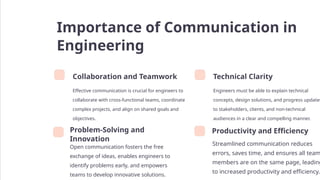
Importance of Communication in
Engineering
Collaboration and Teamwork
Effective communication is crucial for engineers to
collaborate with cross-functional teams, coordinate
complex projects, and align on shared goals and
objectives.
Technical Clarity
Engineers must be able to explain technical
concepts, design solutions, and progress updates
to stakeholders, clients, and non-technical
audiences in a clear and compelling manner.
Problem-Solving and
Innovation
Open communication fosters the free
exchange of ideas, enables engineers to
identify problems early, and empowers
teams to develop innovative solutions.
Productivity and Efficiency
Streamlined communication reduces
errors, saves time, and ensures all team
members are on the same page, leading
to increased productivity and efficiency.
5
Active Listening Techniques
1. Maintain eye contact to show engagement and focus on the
speaker.
2. Avoid interrupting and instead use nods and affirmative
phrases to indicate you are listening.
3. Paraphrase the speaker's key points to demonstrate
understanding and clarify any confusion.
6
Effective Presentation Skills
• Commanding attention and delivering impactful presentations are essential
skills for engineers. Mastering techniques like eye contact, vocal variety,
and strategic use of visuals can elevate your ability to communicate
complex technical information clearly and persuasively.
• Practicing public speaking, developing a confident presence, and
tailoring your message to the audience are keys to effective presentations
that inform, inspire, and influence.
7
• Commanding attention and delivering impactful presentations are essential
skills for engineers. Mastering techniques like eye contact, vocal variety,
and strategic use of visuals can elevate your ability to communicate
complex technical information clearly and persuasively.
• Practicing public speaking, developing a confident presence, and
tailoring your message to the audience are keys to effective presentations
that inform, inspire, and influence.
Giving and Receiving Feedback
Presentation title 8
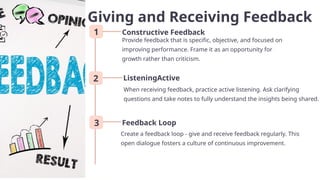
Giving and Receiving Feedback
1 Constructive Feedback
Provide feedback that is specific, objective, and focused on
improving performance. Frame it as an opportunity for
growth rather than criticism.
2 ListeningActive
When receiving feedback, practice active listening. Ask clarifying
questions and take notes to fully understand the insights being shared.
Feedback Loop
Create a feedback loop - give and receive feedback regularly. This
open dialogue fosters a culture of continuous improvement.
3
Presentation title 9
Areas of growth
B2B Supply chain ROI E-commerce
Q1 4.5 2.3 1.7 5.0
Q2 3.2 5.1 4.4 3.0
Q3 2.1 1.7 2.5 2.8
Q4 4.5 2.2 1.7 7.0
Written Communication
Best Practices
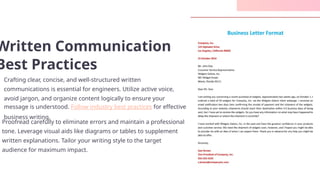
Crafting clear, concise, and well-structured written
communications is essential for engineers. Utilize active voice,
avoid jargon, and organize content logically to ensure your
message is understood. Follow industry best practices for effective
business writing.
Proofread carefully to eliminate errors and maintain a professional
tone. Leverage visual aids like diagrams or tables to supplement
written explanations. Tailor your writing style to the target
audience for maximum impact.
10
Nonverbal Communication Cues
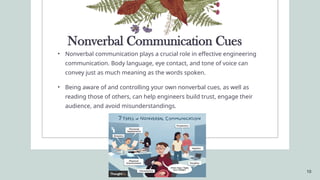
• Nonverbal communication plays a crucial role in effective engineering
communication. Body language, eye contact, and tone of voice can
convey just as much meaning as the words spoken.
• Being aware of and controlling your own nonverbal cues, as well as
reading those of others, can help engineers build trust, engage their
audience, and avoid misunderstandings.
11
Conflict Resolution Strategies
Identify the Issue
Clearly understand the root cause of the conflict by listening actively and
gathering all relevant information.
Seek Common Ground
Explore shared goals, values, or interests that can serve as a basis for resolving
the conflict.
Communicate Effectively
Use open, honest, and empathetic communication to understand the other
person's perspective and find a mutually agreeable solution.
Business opportunities are like buses.
There's always another one coming.
“ Richard Branson
”
Communicating with Cross-
Functional Teams
Collaboration
Engage team
members from
different departments
to leverage diverse
perspectives and
expertise. Foster an
environment of open
communication and
teamwork.
Clarity
Communicate
objectives, roles, and
responsibilities clearly.
Use plain language to
ensure everyone
understands the
project goals and their
contributions.
Empathy
Understand your team
members'
backgrounds,
priorities, and
communication styles.
Adapt your approach
to build trust and
foster productive
relationships.
Coordination
Establish efficient
coordination
mechanisms, such as
regular meetings and
progress updates. Align
on timelines, milestones,
and interdependencies to
ensure seamless
execution.
Presentation title 13
Meet our team
Takuma Hayashi​
President
Mirjam Nilsson​
Chief Executive Officer
Flora Berggren​
Chief Operations
Officer
Rajesh Santoshi​
VP Marketing
Conclusion and Key Takeaways
Effective
Communication
Communication is a
critical skill for engineers
that enables
collaboration, problem-
solving, and project
success.
Continuous
Improvement
Developing
communication abilities
requires ongoing practice
and a willingness to learn
and grow.
Diverse Perspectives
Engaging with cross-
functional teams exposes
engineers to diverse
communication styles,
enhancing their
versatility.
Thank you
R. Thangamari Subhidsha ,
BE.,
thangamarisubhidshar@gm
ail.com

Communication Skills for Engineerss.pptx

  • 1.
  • 2.
    2 Agenda A Introduction Importance Active Listening Techniques EffectivePresentation Skills Giving and Receiving Feedback Written Communication Best Practices Nonverbal Communication Cues Conflict Resolution Strategies Communicating with Cross- Functional Teams Conclusion and Key Takeaways
  • 3.
    3 Introduction Effective communication isa essential skill for engineers to master. Clear, concise, and persuasive communication helps engineers collaborate with team members, present ideas to stakeholders, and write technical documentation. This section will explore key communication techniques to enhance an engineer's professional impact.
  • 4.
    Presentation title 4 Importanceof Communication in Engineering Collaboration and Teamwork Effective communication is crucial for engineers to collaborate with cross-functional teams, coordinate complex projects, and align on shared goals and objectives. Technical Clarity Engineers must be able to explain technical concepts, design solutions, and progress updates to stakeholders, clients, and non-technical audiences in a clear and compelling manner. Problem-Solving and Innovation Open communication fosters the free exchange of ideas, enables engineers to identify problems early, and empowers teams to develop innovative solutions. Productivity and Efficiency Streamlined communication reduces errors, saves time, and ensures all team members are on the same page, leading to increased productivity and efficiency.
  • 5.
    5 Active Listening Techniques 1.Maintain eye contact to show engagement and focus on the speaker. 2. Avoid interrupting and instead use nods and affirmative phrases to indicate you are listening. 3. Paraphrase the speaker's key points to demonstrate understanding and clarify any confusion.
  • 6.
    6 Effective Presentation Skills •Commanding attention and delivering impactful presentations are essential skills for engineers. Mastering techniques like eye contact, vocal variety, and strategic use of visuals can elevate your ability to communicate complex technical information clearly and persuasively. • Practicing public speaking, developing a confident presence, and tailoring your message to the audience are keys to effective presentations that inform, inspire, and influence.
  • 7.
    7 • Commanding attentionand delivering impactful presentations are essential skills for engineers. Mastering techniques like eye contact, vocal variety, and strategic use of visuals can elevate your ability to communicate complex technical information clearly and persuasively. • Practicing public speaking, developing a confident presence, and tailoring your message to the audience are keys to effective presentations that inform, inspire, and influence. Giving and Receiving Feedback
  • 8.
    Presentation title 8 Givingand Receiving Feedback 1 Constructive Feedback Provide feedback that is specific, objective, and focused on improving performance. Frame it as an opportunity for growth rather than criticism. 2 ListeningActive When receiving feedback, practice active listening. Ask clarifying questions and take notes to fully understand the insights being shared. Feedback Loop Create a feedback loop - give and receive feedback regularly. This open dialogue fosters a culture of continuous improvement. 3
  • 9.
    Presentation title 9 Areasof growth B2B Supply chain ROI E-commerce Q1 4.5 2.3 1.7 5.0 Q2 3.2 5.1 4.4 3.0 Q3 2.1 1.7 2.5 2.8 Q4 4.5 2.2 1.7 7.0 Written Communication Best Practices Crafting clear, concise, and well-structured written communications is essential for engineers. Utilize active voice, avoid jargon, and organize content logically to ensure your message is understood. Follow industry best practices for effective business writing. Proofread carefully to eliminate errors and maintain a professional tone. Leverage visual aids like diagrams or tables to supplement written explanations. Tailor your writing style to the target audience for maximum impact.
  • 10.
    10 Nonverbal Communication Cues •Nonverbal communication plays a crucial role in effective engineering communication. Body language, eye contact, and tone of voice can convey just as much meaning as the words spoken. • Being aware of and controlling your own nonverbal cues, as well as reading those of others, can help engineers build trust, engage their audience, and avoid misunderstandings.
  • 11.
    11 Conflict Resolution Strategies Identifythe Issue Clearly understand the root cause of the conflict by listening actively and gathering all relevant information. Seek Common Ground Explore shared goals, values, or interests that can serve as a basis for resolving the conflict. Communicate Effectively Use open, honest, and empathetic communication to understand the other person's perspective and find a mutually agreeable solution.
  • 12.
    Business opportunities arelike buses. There's always another one coming. “ Richard Branson ” Communicating with Cross- Functional Teams Collaboration Engage team members from different departments to leverage diverse perspectives and expertise. Foster an environment of open communication and teamwork. Clarity Communicate objectives, roles, and responsibilities clearly. Use plain language to ensure everyone understands the project goals and their contributions. Empathy Understand your team members' backgrounds, priorities, and communication styles. Adapt your approach to build trust and foster productive relationships. Coordination Establish efficient coordination mechanisms, such as regular meetings and progress updates. Align on timelines, milestones, and interdependencies to ensure seamless execution.
  • 13.
    Presentation title 13 Meetour team Takuma Hayashi​ President Mirjam Nilsson​ Chief Executive Officer Flora Berggren​ Chief Operations Officer Rajesh Santoshi​ VP Marketing Conclusion and Key Takeaways Effective Communication Communication is a critical skill for engineers that enables collaboration, problem- solving, and project success. Continuous Improvement Developing communication abilities requires ongoing practice and a willingness to learn and grow. Diverse Perspectives Engaging with cross- functional teams exposes engineers to diverse communication styles, enhancing their versatility.
  • 14.
    Thank you R. ThangamariSubhidsha , BE., thangamarisubhidshar@gm ail.com