Common Banking Training
Basic Training Program
Ressorces: Price Waterhouse Cooper & Unicredit
Group Education Center
Sana‘a, date
www.pr-ofession.com
Introduction
• Banking is based on reliable relations between the Bank and its Counterparts, no
matter if they are institutional or private clients. It is a matter of trust which is built
on Confidentiality, Transparency and a Code of Conduct.
• The lack of the Basic Understanding about how the Banking System should work
causes uncertainty and open space for rumours which could end up damaging the
Employee‘s career or even the Bank itself.
• Apart from that, a trusted partner is always enjoying Credibility within the operating
Environment what leads automatically to a significant Improvement of the Bank‘s
gains in a long term prospective.
• To achieve this target, Banks has to invest in their Workforce and encourage them
to invest in themselves. Only a responsible Employee will be able to present and
follow the Bank‘s Interests at the same time handle the Interest of his Clients with
the same amount of responsibility and courage.
• The following Topics include part of the Basic Information any Banker should
know, and any Banking Institution should implement into its Code of Conduct.
2
www.pr-ofession.com 3
Index
• Awareness/understanding of the main risk policies
• Banking rule book
• Types of internal and external authorisations
• Rules and policies
• Closing of contracts
• Basic principles and requirements of confidentiality
• Trading behaviour (Trading code of ethics)
• Compliance & MIFID (Markets in Financial Instruments Directive)
• Anti-corruption / fraud preventive
• Anti money loundering model from US-customs authorities
• Insider Trading
• Avoiding conflicts of interest that result from contractual obligations
www.pr-ofession.com
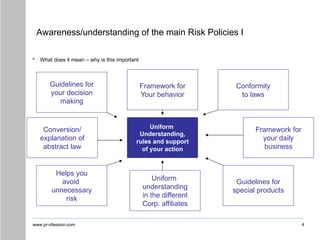
Awareness/understanding of the main Risk Policies I
4
• What does it mean – why is this important
Uniform
Understanding,
rules and support
of your action
Uniform
understanding
in the different
Corp. affiliates
Guidelines for
special products
Framework for
your daily
business
Helps you
avoid
unnecessary
risk
Conversion/
explanation of
abstract law
Guidelines for
your decision
making
Framework for
Your behavior
Conformity
to laws
www.pr-ofession.com
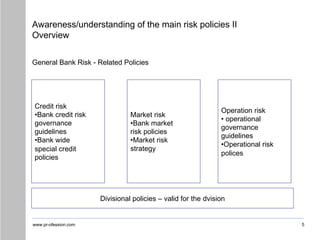
Awareness/understanding of the main risk policies II
Overview
5
General Bank Risk - Related Policies
Credit risk
•Bank credit risk
governance
guidelines
•Bank wide
special credit
policies
Market risk
•Bank market
risk policies
•Market risk
strategy
Operation risk
• operational
governance
guidelines
•Operational risk
polices
Divisional policies – valid for the dvision
www.pr-ofession.com
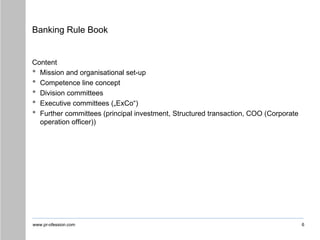
Banking Rule Book
6
Content
• Mission and organisational set-up
• Competence line concept
• Division committees
• Executive committees („ExCo“)
• Further committees (principal investment, Structured transaction, COO (Corporate
operation officer))
www.pr-ofession.com
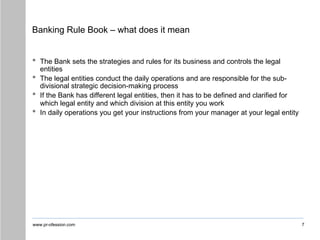
Banking Rule Book – what does it mean
7
• The Bank sets the strategies and rules for its business and controls the legal
entities
• The legal entities conduct the daily operations and are responsible for the sub-
divisional strategic decision-making process
• If the Bank has different legal entities, then it has to be defined and clarified for
which legal entity and which division at this entity you work
• In daily operations you get your instructions from your manager at your legal entity
www.pr-ofession.com
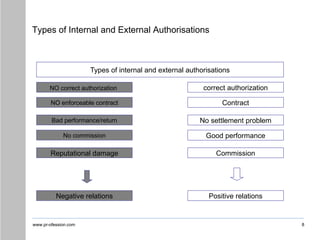
Types of Internal and External Authorisations
8
Types of internal and external authorisations
NO correct authorization
Bad performance/return
NO enforceable contract
No commission
Reputational damage
Negative relations
correct authorization
Contract
No settlement problem
Good performance
Commission
Positive relations
www.pr-ofession.com
Rules Types of Internal and External Authorisations and Policies
9
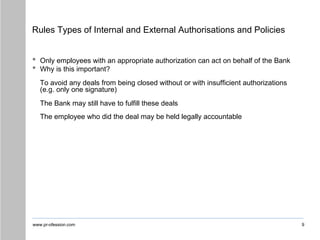
• Only employees with an appropriate authorization can act on behalf of the Bank
• Why is this important?
To avoid any deals from being closed without or with insufficient authorizations
(e.g. only one signature)
The Bank may still have to fulfill these deals
The employee who did the deal may be held legally accountable
www.pr-ofession.com
Rules Types of Internal and External Authorisations and Policies
10
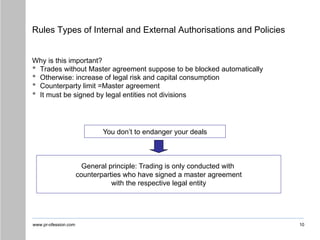
Why is this important?
• Trades without Master agreement suppose to be blocked automatically
• Otherwise: increase of legal risk and capital consumption
• Counterparty limit =Master agreement
• It must be signed by legal entities not divisions
You don’t to endanger your deals
General principle: Trading is only conducted with
counterparties who have signed a master agreement
with the respective legal entity
www.pr-ofession.com
Rules Types of Internal and External Authorisations and Policies
11
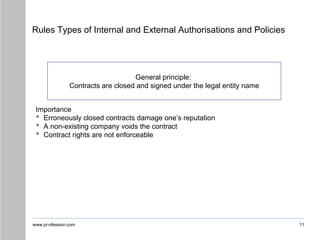
Importance
• Erroneously closed contracts damage one’s reputation
• A non-existing company voids the contract
• Contract rights are not enforceable
General principle:
Contracts are closed and signed under the legal entity name
www.pr-ofession.com
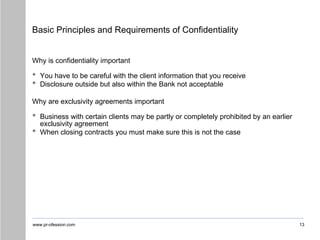
Basic Principles and Requirements of Confidentiality
12
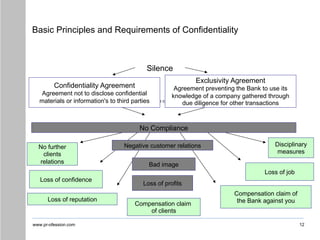
Silence
Compliance to contract clauses
Confidentiality Agreement
Agreement not to disclose confidential
materials or information's to third parties
Exclusivity Agreement
Agreement preventing the Bank to use its
knowledge of a company gathered through
due diligence for other transactions
No Compliance
Negative customer relations
Bad image
Loss of profits
Compensation claim
of clients
No further
clients
relations
Loss of confidence
Loss of reputation
Disciplinary
measures
Loss of job
Compensation claim of
the Bank against you
www.pr-ofession.com
Basic Principles and Requirements of Confidentiality
13
Why is confidentiality important
• You have to be careful with the client information that you receive
• Disclosure outside but also within the Bank not acceptable
Why are exclusivity agreements important
• Business with certain clients may be partly or completely prohibited by an earlier
exclusivity agreement
• When closing contracts you must make sure this is not the case
www.pr-ofession.com
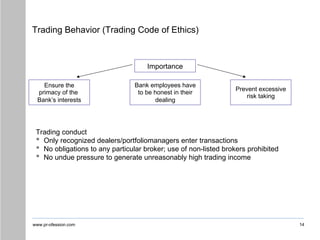
Trading Behavior (Trading Code of Ethics)
14
Trading conduct
• Only recognized dealers/portfoliomanagers enter transactions
• No obligations to any particular broker; use of non-listed brokers prohibited
• No undue pressure to generate unreasonably high trading income
Importance
Ensure the
primacy of the
Bank’s interests
Bank employees have
to be honest in their
dealing
Prevent excessive
risk taking
www.pr-ofession.com
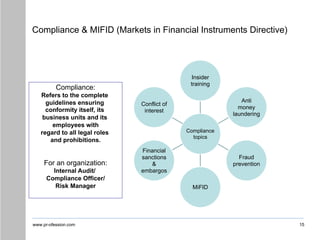
Compliance & MIFID (Markets in Financial Instruments Directive)
15
Compliance
topics
Insider
training
Anti
money
laundering
Fraud
prevention
MiFID
Financial
sanctions
&
embargos
Conflict of
interest
Compliance:
Refers to the complete
guidelines ensuring
conformity itself, its
business units and its
employees with
regard to all legal roles
and prohibitions.
For an organization:
Internal Audit/
Compliance Officer/
Risk Manager
www.pr-ofession.com
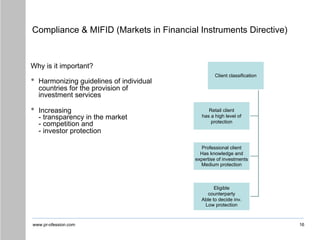
Compliance & MIFID (Markets in Financial Instruments Directive)
16
Why is it important?
• Harmonizing guidelines of individual
countries for the provision of
investment services
• Increasing
- transparency in the market
- competition and
- investor protection
Client classification
Retail client
has a high level of
protection
Professional client
Has knowledge and
expertise of investments
Medium protection
Eligible
counterparty
Able to decide inv.
Low protection
www.pr-ofession.com
Compliance & MIFID (Markets in Financial Instruments Directive)
17
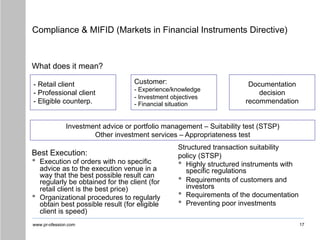
What does it mean?
Best Execution:
• Execution of orders with no specific
advice as to the execution venue in a
way that the best possible result can
regularly be obtained for the client (for
retail client is the best price)
• Organizational procedures to regularly
obtain best possible result (for eligible
client is speed)
- Retail client
- Professional client
- Eligible counterp.
Customer:
- Experience/knowledge
- Investment objectives
- Financial situation
Documentation
decision
recommendation
Investment advice or portfolio management – Suitability test (STSP)
Other investment services – Appropriateness test
Structured transaction suitability
policy (STSP)
• Highly structured instruments with
specific regulations
• Requirements of customers and
investors
• Requirements of the documentation
• Preventing poor investments
www.pr-ofession.com
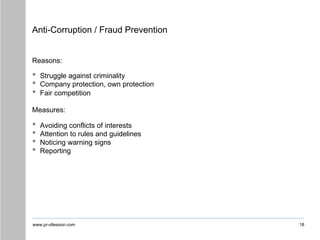
Anti-Corruption / Fraud Prevention
18
Reasons:
• Struggle against criminality
• Company protection, own protection
• Fair competition
Measures:
• Avoiding conflicts of interests
• Attention to rules and guidelines
• Noticing warning signs
• Reporting
www.pr-ofession.com
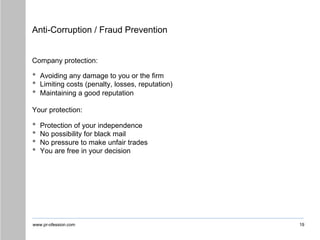
Anti-Corruption / Fraud Prevention
19
Company protection:
• Avoiding any damage to you or the firm
• Limiting costs (penalty, losses, reputation)
• Maintaining a good reputation
Your protection:
• Protection of your independence
• No possibility for black mail
• No pressure to make unfair trades
• You are free in your decision
www.pr-ofession.com
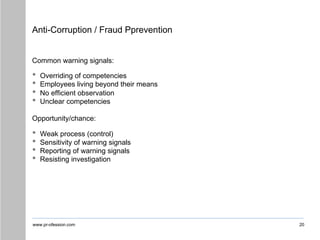
Anti-Corruption / Fraud Pprevention
20
Common warning signals:
• Overriding of competencies
• Employees living beyond their means
• No efficient observation
• Unclear competencies
Opportunity/chance:
• Weak process (control)
• Sensitivity of warning signals
• Reporting of warning signals
• Resisting investigation
www.pr-ofession.com
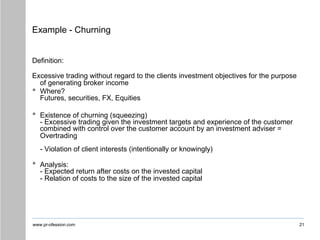
Example - Churning
21
Definition:
Excessive trading without regard to the clients investment objectives for the purpose
of generating broker income
• Where?
Futures, securities, FX, Equities
• Existence of churning (squeezing)
- Excessive trading given the investment targets and experience of the customer
combined with control over the customer account by an investment adviser =
Overtrading
- Violation of client interests (intentionally or knowingly)
• Analysis:
- Expected return after costs on the invested capital
- Relation of costs to the size of the invested capital
www.pr-ofession.com
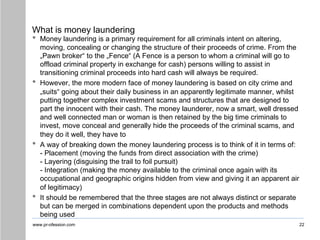
What is money laundering
• Money laundering is a primary requirement for all criminals intent on altering,
moving, concealing or changing the structure of their proceeds of crime. From the
„Pawn broker“ to the „Fence“ (A Fence is a person to whom a criminal will go to
offload criminal property in exchange for cash) persons willing to assist in
transitioning criminal proceeds into hard cash will always be required.
• However, the more modern face of money laundering is based on city crime and
„suits“ going about their daily business in an apparently legitimate manner, whilst
putting together complex investment scams and structures that are designed to
part the innocent with their cash. The money launderer, now a smart, well dressed
and well connected man or woman is then retained by the big time criminals to
invest, move conceal and generally hide the proceeds of the criminal scams, and
they do it well, they have to
• A way of breaking down the money laundering process is to think of it in terms of:
- Placement (moving the funds from direct association with the crime)
- Layering (disguising the trail to foil pursuit)
- Integration (making the money available to the criminal once again with its
occupational and geographic origins hidden from view and giving it an apparent air
of legitimacy)
• It should be remembered that the three stages are not always distinct or separate
but can be merged in combinations dependent upon the products and methods
being used
22
www.pr-ofession.com
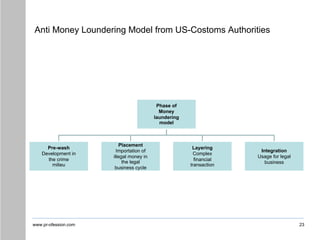
Anti Money Loundering Model from US-Costoms Authorities
23
Phase of
Money
laundering
model
Pre-wash
Development in
the crime
milieu
Placement
Importation of
illegal money in
the legal
business cycle
Layering
Complex
financial
transaction
Integration
Usage for legal
business
www.pr-ofession.com
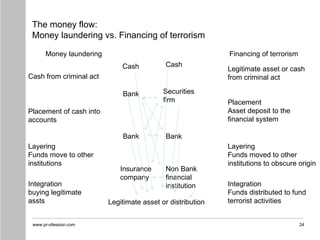
The money flow:
Money laundering vs. Financing of terrorism
24
Money laundering Financing of terrorism
Cash from criminal act
Integration
buying legitimate
assts
Placement of cash into
accounts
Layering
Funds move to other
institutions
Insurance
company
Bank
Non Bank
financial
institution
Bank
Securities
firm
Cash
Bank
Cash
Integration
Funds distributed to fund
terrorist activities
Layering
Funds moved to other
institutions to obscure origin
Placement
Asset deposit to the
financial system
Legitimate asset or cash
from criminal act
Legitimate asset or distribution
www.pr-ofession.com
Anti Money Loundering Model From US-Costoms Authorities
25
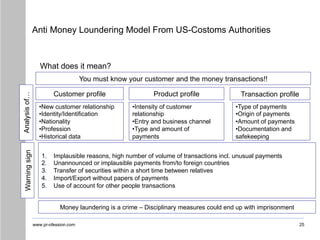
What does it mean?
You must know your customer and the money transactions!!
Customer profile Product profile Transaction profile
•New customer relationship
•Identity/Identification
•Nationality
•Profession
•Historical data
Warning
sign
Analysis
of…
•Intensity of customer
relationship
•Entry and business channel
•Type and amount of
payments
•Type of payments
•Origin of payments
•Amount of payments
•Documentation and
safekeeping
1. Implausible reasons, high number of volume of transactions incl. unusual payments
2. Unannounced or implausible payments from/to foreign countries
3. Transfer of securities within a short time between relatives
4. Import/Export without papers of payments
5. Use of account for other people transactions
Money laundering is a crime – Disciplinary measures could end up with imprisonment
www.pr-ofession.com
Example – Money Laundering
26
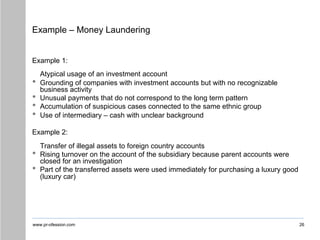
Example 1:
Atypical usage of an investment account
• Grounding of companies with investment accounts but with no recognizable
business activity
• Unusual payments that do not correspond to the long term pattern
• Accumulation of suspicious cases connected to the same ethnic group
• Use of intermediary – cash with unclear background
Example 2:
Transfer of illegal assets to foreign country accounts
• Rising turnover on the account of the subsidiary because parent accounts were
closed for an investigation
• Part of the transferred assets were used immediately for purchasing a luxury good
(luxury car)
www.pr-ofession.com
Example – Money Laundering
27
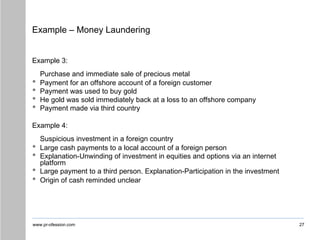
Example 3:
Purchase and immediate sale of precious metal
• Payment for an offshore account of a foreign customer
• Payment was used to buy gold
• He gold was sold immediately back at a loss to an offshore company
• Payment made via third country
Example 4:
Suspicious investment in a foreign country
• Large cash payments to a local account of a foreign person
• Explanation-Unwinding of investment in equities and options via an internet
platform
• Large payment to a third person. Explanation-Participation in the investment
• Origin of cash reminded unclear
www.pr-ofession.com
Insider Trading
28
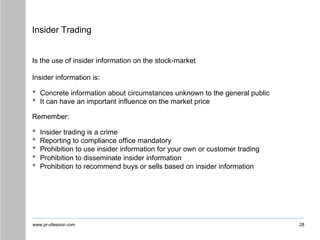
Is the use of insider information on the stock-market
Insider information is:
• Concrete information about circumstances unknown to the general public
• It can have an important influence on the market price
Remember:
• Insider trading is a crime
• Reporting to compliance office mandatory
• Prohibition to use insider information for your own or customer trading
• Prohibition to disseminate insider information
• Prohibition to recommend buys or sells based on insider information
www.pr-ofession.com
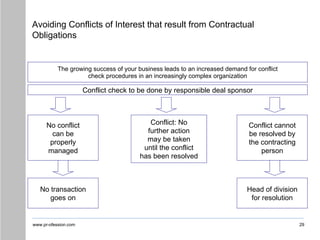
Avoiding Conflicts of Interest that result from Contractual
Obligations
29
The growing success of your business leads to an increased demand for conflict
check procedures in an increasingly complex organization
Conflict check to be done by responsible deal sponsor
No conflict
can be
properly
managed
No transaction
goes on
Head of division
for resolution
Conflict: No
further action
may be taken
until the conflict
has been resolved
Conflict cannot
be resolved by
the contracting
person
www.pr-ofession.com
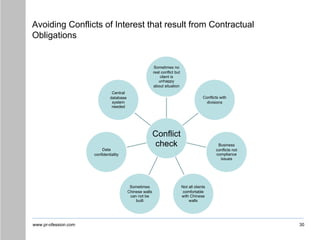
Avoiding Conflicts of Interest that result from Contractual
Obligations
30
Conflict
check
Sometimes no
real conflict but
client is
unhappy
about situation
Conflicts with
divisions
Business
conflicts not
compliance
issues
Not all clients
comfortable
with Chinese
walls
Sometimes
Chinese walls
can not be
built
Data
confidentiality
Central
database
system
needed
www.pr-ofession.com
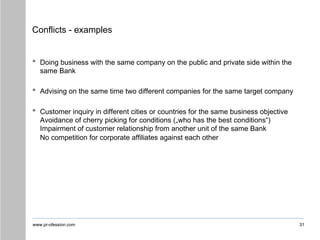
Conflicts - examples
• Doing business with the same company on the public and private side within the
same Bank
• Advising on the same time two different companies for the same target company
• Customer inquiry in different cities or countries for the same business objective
Avoidance of cherry picking for conditions („who has the best conditions“)
Impairment of customer relationship from another unit of the same Bank
No competition for corporate affiliates against each other
31
www.pr-ofession.com
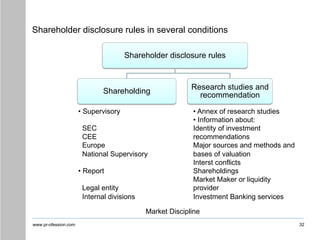
Shareholder disclosure rules in several conditions
Shareholder disclosure rules
Shareholding
Research studies and
recommendation
32
• Supervisory
SEC
CEE
Europe
National Supervisory
• Report
Legal entity
Internal divisions
• Annex of research studies
• Information about:
Identity of investment
recommendations
Major sources and methods and
bases of valuation
Interst conflicts
Shareholdings
Market Maker or liquidity
provider
Investment Banking services
Market Discipline
www.pr-ofession.com
Compliance & MIFID (Markets in Financial Instruments Directive)
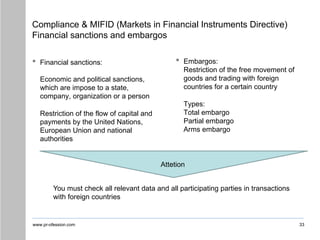
Financial sanctions and embargos
• Financial sanctions:
Economic and political sanctions,
which are impose to a state,
company, organization or a person
Restriction of the flow of capital and
payments by the United Nations,
European Union and national
authorities
33
• Embargos:
Restriction of the free movement of
goods and trading with foreign
countries for a certain country
Types:
Total embargo
Partial embargo
Arms embargo
Attetion
You must check all relevant data and all participating parties in transactions
with foreign countries
www.pr-ofession.com
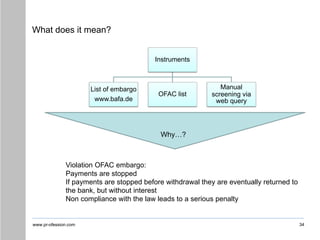
What does it mean?
Instruments
List of embargo
www.bafa.de
OFAC list
Manual
screening via
web query
34
Violation OFAC embargo:
Payments are stopped
If payments are stopped before withdrawal they are eventually returned to
the bank, but without interest
Non compliance with the law leads to a serious penalty
Why…?
www.pr-ofession.com
Risk and Regulatory Framework
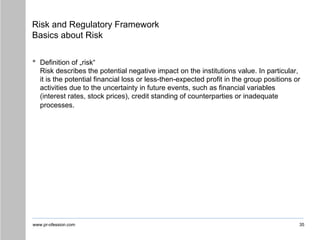
Basics about Risk
• Definition of „risk“
Risk describes the potential negative impact on the institutions value. In particular,
it is the potential financial loss or less-then-expected profit in the group positions or
activities due to the uncertainty in future events, such as financial variables
(interest rates, stock prices), credit standing of counterparties or inadequate
processes.
35
www.pr-ofession.com
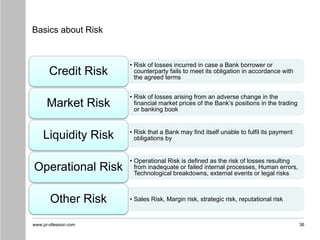
Basics about Risk
• Risk of losses incurred in case a Bank borrower or
counterparty fails to meet its obligation in accordance with
the agreed terms
Credit Risk
• Risk of losses arising from an adverse change in the
financial market prices of the Bank‘s positions in the trading
or banking book
Market Risk
• Risk that a Bank may find itself unable to fulfil its payment
obligations by
Liquidity Risk
• Operational Risk is defined as the risk of losses resulting
from inadequate or failed internal processes, Human errors,
Technological breakdowns, external events or legal risks
Operational Risk
• Sales Risk, Margin risk, strategic risk, reputational risk
Other Risk
36
www.pr-ofession.com
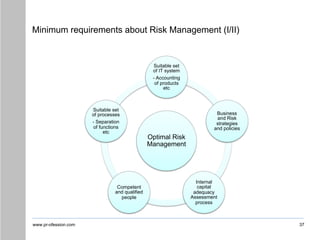
Minimum requirements about Risk Management (I/II)
Optimal Risk
Management
Suitable set
of IT system
- Accounting
of products
etc
Business
and Risk
strategies
and policies
Internal
capital
adequacy
Assessment
process
Competent
and qualified
people
Suitable set
of processes
- Separation
of functions
etc
37
www.pr-ofession.com
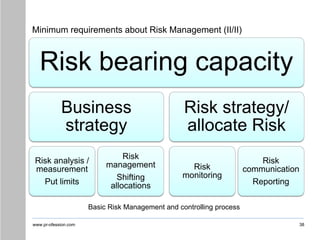
Minimum requirements about Risk Management (II/II)
Risk bearing capacity
Business
strategy
Risk analysis /
measurement
Put limits
Risk
management
Shifting
allocations
Risk strategy/
allocate Risk
Risk
monitoring
Risk
communication
Reporting
38
Basic Risk Management and controlling process
www.pr-ofession.com
Why is it important?
• Risk-bearing capacity – Determines the overall limit for risk taking (how much the
Bank can survive)
• Strategy – Determines how this overall limit is going to be divided among business
lines
• Process – Makes sure that business stays with limits
• Result – Profit/loss increase/decrease the risk-bearing capacity
• In daily business YOU have to follow the established process
• The strategy tells you where the Bank is going
• You must follow the spirit of the strategy
• The results of your actions are reflected in the P&L
39
www.pr-ofession.com
Minimum Requirements about Risk Management
• General principle: Segregation of functions
The risk taking Front Office (FO) and the risk controlling Back Office (BO)
functions have to be structurally separated and of equal standing
• What does it mean?
- FO can not take risks on its own, because the BO oversees the actions of the FO
- The FO has to consider the opinion of Risk Controlling when taking risks
- The FO may need to make adjustments to its positions to conform Risk
Management rules
• Why is it important?
- Opposite goals – Equally important for the survival of a Bank
- Balance the interest – No domination of one over the other
- Conflict of interest if combined
- Transparency and trust are necessary for a banking system
40
www.pr-ofession.com
Example - Barings
• Barings
- Speculation on futures contracts
- Lack of segregation of function- Floor manager at the same time Head of
Settlement
- Poor supervision – someone reports to himself, no oversight by Head-Office
41
www.pr-ofession.com
Minimum requirements about Risk Management
Summary
Banks must:
• Ascertain a segregation of duties
• Hold enough capital to cover risks
• Establish strategies, internal control systems and sound processes to limit risk
exposure
• Disclose their risk exposure
Basel II
42
www.pr-ofession.com
Example – Subprime crisis
Subprime crisis:
• Huge exposure by many Banks in relation to balance sheet or outstanding equity
(leverage)
• Lack of transparency and less trust in 2007 lead to increased volatility and inactive
markets and significant fair value losses (market to market)
• Banks cease to lend to each other because no one is sure how large the
counterparty risks are. The inter-bank market breaks down, and banks hoard cash
to manage their own liabilities. Some Banks could not survive on their own, others
could not survive at all.
43
www.pr-ofession.com
Risk and Regulatory Framework
Basel II objectives
• To improve the overall level of Risk Management systems and thereby increase
the stability of the banking sector
• To help Banks to improve their Risk Management system and increase
effectiveness allowing them to reduce losses and in some cases reduce required
capital
• To increase the competitiveness and the prestige of Banks by rewarding the
adoption of more advanced Risk Management methods
44
www.pr-ofession.com
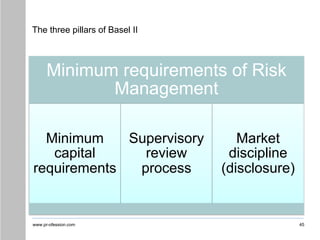
The three pillars of Basel II
Minimum requirements of Risk
Management
Minimum
capital
requirements
Supervisory
review
process
Market
discipline
(disclosure)
45
www.pr-ofession.com
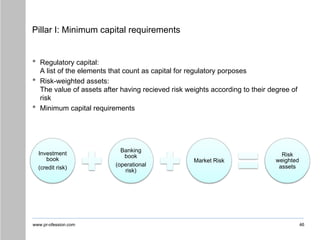
Pillar I: Minimum capital requirements
• Regulatory capital:
A list of the elements that count as capital for regulatory porposes
• Risk-weighted assets:
The value of assets after having recieved risk weights according to their degree of
risk
• Minimum capital requirements
46
Investment
book
(credit risk)
Banking
book
(operational
risk)
Market Risk
Risk
weighted
assets
www.pr-ofession.com
Pillar I: Minimum capital requirements
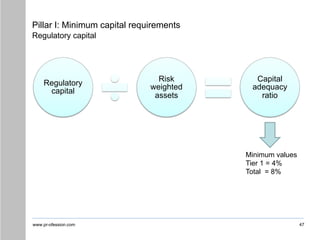
Regulatory capital
Regulatory
capital
Risk
weighted
assets
Capital
adequacy
ratio
47
Minimum values
Tier 1 = 4%
Total = 8%
www.pr-ofession.com
Pillar II: Supervisory review process
• Pillar II seeks to ensure that each Bank has sound internal processes in place,
based on a through evaluation of its risks
• The supervisory review process tries to capture risks that are not fully captured by
the pillar I calculations, e.g. Operational Risk
Why is it important?
• Non-quantifiable risks are just as dangerous as quantifiable risks
• Operational risks have been at the heart of many financial disasters
Conclusion:
It is all about risk weighting and the methods of its evaluation
48
www.pr-ofession.com
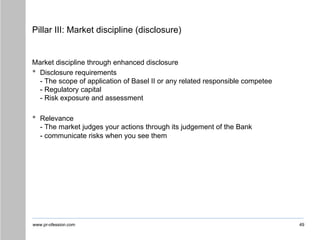
Pillar III: Market discipline (disclosure)
Market discipline through enhanced disclosure
• Disclosure requirements
- The scope of application of Basel II or any related responsible competee
- Regulatory capital
- Risk exposure and assessment
• Relevance
- The market judges your actions through its judgement of the Bank
- communicate risks when you see them
49
www.pr-ofession.com
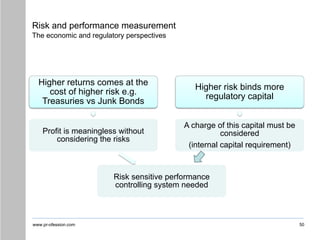
Risk and performance measurement
The economic and regulatory perspectives
Higher returns comes at the
cost of higher risk e.g.
Treasuries vs Junk Bonds
Profit is meaningless without
considering the risks
Risk sensitive performance
controlling system needed
Higher risk binds more
regulatory capital
A charge of this capital must be
considered
(internal capital requirement)
50
www.pr-ofession.com
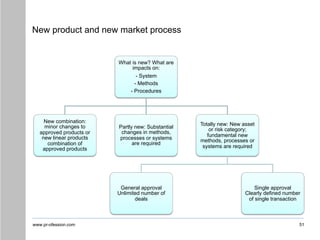
New product and new market process
What is new? What are
impacts on:
- System
- Methods
- Procedures
New combination:
minor changes to
approved products or
new linear products
combination of
approved products
Partly new: Substantial
changes in methods,
processes or systems
are required
Totally new: New asset
or risk category;
fundamental new
methods, processes or
systems are required
General approval
Unlimited number of
deals
Single approval
Clearly defined number
of single transaction
51
www.pr-ofession.com
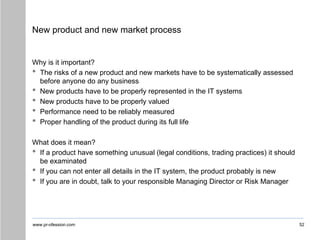
New product and new market process
Why is it important?
• The risks of a new product and new markets have to be systematically assessed
before anyone do any business
• New products have to be properly represented in the IT systems
• New products have to be properly valued
• Performance need to be reliably measured
• Proper handling of the product during its full life
What does it mean?
• If a product have something unusual (legal conditions, trading practices) it should
be examinated
• If you can not enter all details in the IT system, the product probably is new
• If you are in doubt, talk to your responsible Managing Director or Risk Manager
52
www.pr-ofession.com
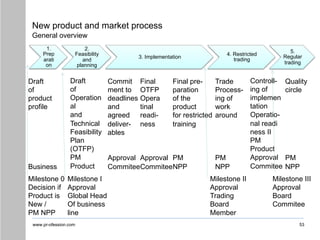
New product and market process
General overview
1.
Prep
arati
on
2.
Feasibility
and
planning
3. Implementation
4. Restricted
trading
5.
Regular
trading
53
Draft
of
product
profile
Business
Draft
of
Operation
al
and
Technical
Feasibility
Plan
(OTFP)
PM
Product
Commit
ment to
deadlines
and
agreed
deliver-
ables
Approval
Commitee
Final
OTFP
Opera
tinal
readi-
ness
Approval
Commitee
Final pre-
paration
of the
product
for restricted
training
PM
NPP
Trade
Process-
ing of
work
around
PM
NPP
Controll-
ing of
implemen
tation
Operatio-
nal readi
ness II
PM
Product
Approval
Commitee
Quality
circle
PM
NPP
Milestone 0
Decision if
Product is
New /
PM NPP
Milestone I
Approval
Global Head
Of business
line
Milestone II
Approval
Trading
Board
Member
Milestone III
Approval
Board
Commitee
www.pr-ofession.com
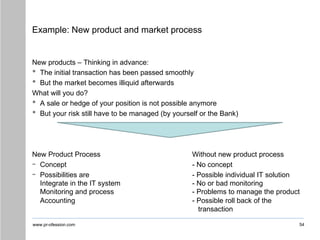
Example: New product and market process
New products – Thinking in advance:
• The initial transaction has been passed smoothly
• But the market becomes illiquid afterwards
What will you do?
• A sale or hedge of your position is not possible anymore
• But your risk still have to be managed (by yourself or the Bank)
New Product Process Without new product process
- Concept - No concept
- Possibilities are - Possible individual IT solution
Integrate in the IT system - No or bad monitoring
Monitoring and process - Problems to manage the product
Accounting - Possible roll back of the
transaction
54
www.pr-ofession.com
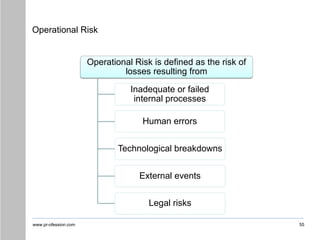
Operational Risk
Operational Risk is defined as the risk of
losses resulting from
Inadequate or failed
internal processes
Human errors
Technological breakdowns
External events
Legal risks
55
www.pr-ofession.com
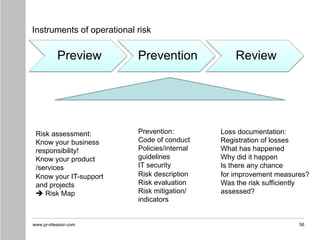
Instruments of operational risk
Preview Prevention Review
56
Risk assessment:
Know your business
responsibility!
Know your product
/services
Know your IT-support
and projects
! Risk Map
Prevention:
Code of conduct
Policies/internal
guidelines
IT security
Risk description
Risk evaluation
Risk mitigation/
indicators
Loss documentation:
Registration of losses
What has happened
Why did it happen
Is there any chance
for improvement measures?
Was the risk sufficiently
assessed?
www.pr-ofession.com
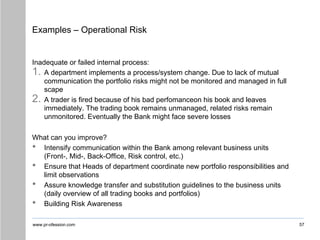
Examples – Operational Risk
Inadequate or failed internal process:
1. A department implements a process/system change. Due to lack of mutual
communication the portfolio risks might not be monitored and managed in full
scape
2. A trader is fired because of his bad perfomanceon his book and leaves
immediately. The trading book remains unmanaged, related risks remain
unmonitored. Eventually the Bank might face severe losses
What can you improve?
• Intensify communication within the Bank among relevant business units
(Front-, Mid-, Back-Office, Risk control, etc.)
• Ensure that Heads of department coordinate new portfolio responsibilities and
limit observations
• Assure knowledge transfer and substitution guidelines to the business units
(daily overview of all trading books and portfolios)
• Building Risk Awareness
57
www.pr-ofession.com
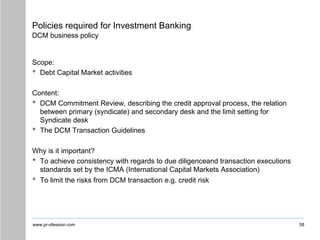
Policies required for Investment Banking
DCM business policy
Scope:
• Debt Capital Market activities
Content:
• DCM Commitment Review, describing the credit approval process, the relation
between primary (syndicate) and secondary desk and the limit setting for
Syndicate desk
• The DCM Transaction Guidelines
Why is it important?
• To achieve consistency with regards to due diligenceand transaction executions
standards set by the ICMA (International Capital Markets Association)
• To limit the risks from DCM transaction e.g. credit risk
58
www.pr-ofession.com
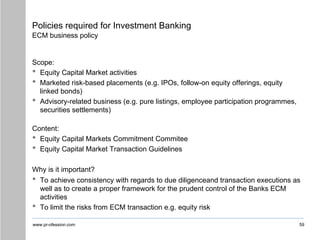
Policies required for Investment Banking
ECM business policy
Scope:
• Equity Capital Market activities
• Marketed risk-based placements (e.g. IPOs, follow-on equity offerings, equity
linked bonds)
• Advisory-related business (e.g. pure listings, employee participation programmes,
securities settlements)
Content:
• Equity Capital Markets Commitment Commitee
• Equity Capital Market Transaction Guidelines
Why is it important?
• To achieve consistency with regards to due diligenceand transaction executions as
well as to create a proper framework for the prudent control of the Banks ECM
activities
• To limit the risks from ECM transaction e.g. equity risk
59
www.pr-ofession.com
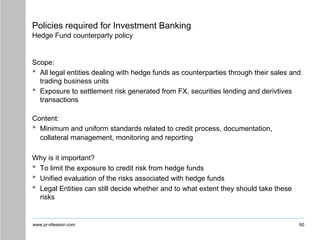
Policies required for Investment Banking
Hedge Fund counterparty policy
Scope:
• All legal entities dealing with hedge funds as counterparties through their sales and
trading business units
• Exposure to settlement risk generated from FX, securities lending and derivtives
transactions
Content:
• Minimum and uniform standards related to credit process, documentation,
collateral management, monitoring and reporting
Why is it important?
• To limit the exposure to credit risk from hedge funds
• Unified evaluation of the risks associated with hedge funds
• Legal Entities can still decide whether and to what extent they should take these
risks
60
www.pr-ofession.com
Policies required for Investment Banking
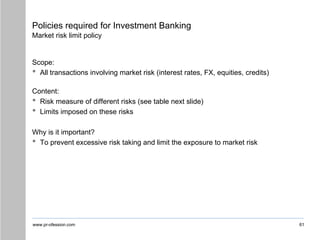
Market risk limit policy
Scope:
• All transactions involving market risk (interest rates, FX, equities, credits)
Content:
• Risk measure of different risks (see table next slide)
• Limits imposed on these risks
Why is it important?
• To prevent excessive risk taking and limit the exposure to market risk
61
www.pr-ofession.com
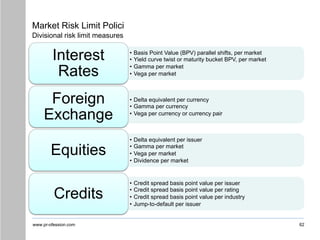
Market Risk Limit Polici
Divisional risk limit measures
• Basis Point Value (BPV) parallel shifts, per market
• Yield curve twist or maturity bucket BPV, per market
• Gamma per market
• Vega per market
Interest
Rates
• Delta equivalent per currency
• Gamma per currency
• Vega per currency or currency pair
Foreign
Exchange
• Delta equivalent per issuer
• Gamma per market
• Vega per market
• Dividence per market
Equities
• Credit spread basis point value per issuer
• Credit spread basis point value per rating
• Credit spread basis point value per industry
• Jump-to-default per issuer
Credits
62
www.pr-ofession.com
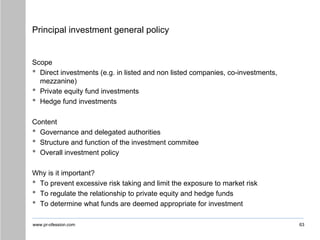
Principal investment general policy
Scope
• Direct investments (e.g. in listed and non listed companies, co-investments,
mezzanine)
• Private equity fund investments
• Hedge fund investments
Content
• Governance and delegated authorities
• Structure and function of the investment commitee
• Overall investment policy
Why is it important?
• To prevent excessive risk taking and limit the exposure to market risk
• To regulate the relationship to private equity and hedge funds
• To determine what funds are deemed appropriate for investment
63
www.pr-ofession.com
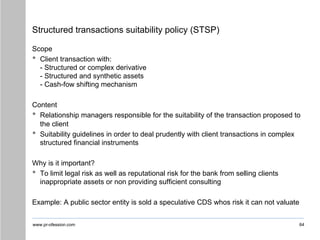
Structured transactions suitability policy (STSP)
Scope
• Client transaction with:
- Structured or complex derivative
- Structured and synthetic assets
- Cash-fow shifting mechanism
Content
• Relationship managers responsible for the suitability of the transaction proposed to
the client
• Suitability guidelines in order to deal prudently with client transactions in complex
structured financial instruments
Why is it important?
• To limit legal risk as well as reputational risk for the bank from selling clients
inappropriate assets or non providing sufficient consulting
Example: A public sector entity is sold a speculative CDS whos risk it can not valuate
64
www.pr-ofession.com
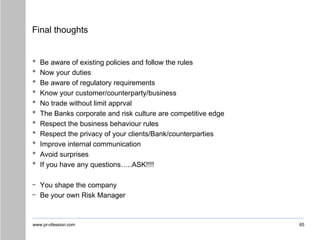
Final thoughts
• Be aware of existing policies and follow the rules
• Now your duties
• Be aware of regulatory requirements
• Know your customer/counterparty/business
• No trade without limit apprval
• The Banks corporate and risk culture are competitive edge
• Respect the business behaviour rules
• Respect the privacy of your clients/Bank/counterparties
• Improve internal communication
• Avoid surprises
• If you have any questions…..ASK!!!!
- You shape the company
- Be your own Risk Manager
65
www.pr-ofession.com
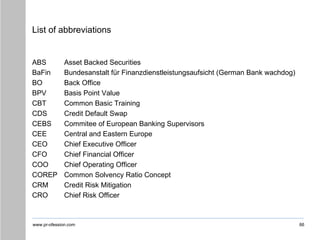
List of abbreviations
ABS Asset Backed Securities
BaFin Bundesanstalt für Finanzdienstleistungsaufsicht (German Bank wachdog)
BO Back Office
BPV Basis Point Value
CBT Common Basic Training
CDS Credit Default Swap
CEBS Commitee of European Banking Supervisors
CEE Central and Eastern Europe
CEO Chief Executive Officer
CFO Chief Financial Officer
COO Chief Operating Officer
COREP Common Solvency Ratio Concept
CRM Credit Risk Mitigation
CRO Chief Risk Officer
66
www.pr-ofession.com
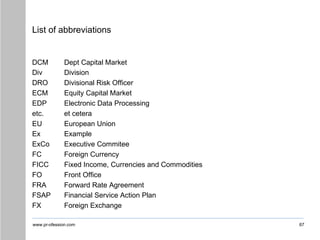
List of abbreviations
DCM Dept Capital Market
Div Division
DRO Divisional Risk Officer
ECM Equity Capital Market
EDP Electronic Data Processing
etc. et cetera
EU European Union
Ex Example
ExCo Executive Commitee
FC Foreign Currency
FICC Fixed Income, Currencies and Commodities
FO Front Office
FRA Forward Rate Agreement
FSAP Financial Service Action Plan
FX Foreign Exchange
67
www.pr-ofession.com
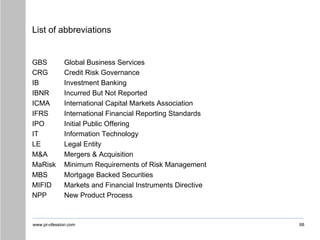
List of abbreviations
GBS Global Business Services
CRG Credit Risk Governance
IB Investment Banking
IBNR Incurred But Not Reported
ICMA International Capital Markets Association
IFRS International Financial Reporting Standards
IPO Initial Public Offering
IT Information Technology
LE Legal Entity
M&A Mergers & Acquisition
MaRisk Minimum Requirements of Risk Management
MBS Mortgage Backed Securities
MIFID Markets and Financial Instruments Directive
NPP New Product Process
68
www.pr-ofession.com
List of abbreviations
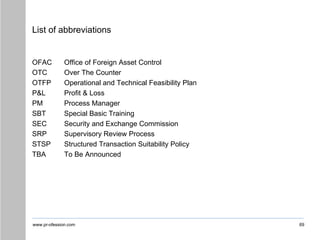
OFAC Office of Foreign Asset Control
OTC Over The Counter
OTFP Operational and Technical Feasibility Plan
P&L Profit & Loss
PM Process Manager
SBT Special Basic Training
SEC Security and Exchange Commission
SRP Supervisory Review Process
STSP Structured Transaction Suitability Policy
TBA To Be Announced
69
www.pr-ofession.com
Disclaimer
• The information contained in this presentation is for general guidance on matters of interest only. The application and
impact of laws can vary widely based on the specific facts involved. Given the changing nature of laws, rules and
regulations, and the inherent hazards of communication, there may be delays, omissions or inaccuracies in information
contained in this presentation. Accordingly, the information on this agenda is provided with the understanding that the
authors and publishers are not herein engaged in rendering legal, accounting, tax, or other professional advice and
services. As such, it should not be used as a substitute for consultation with professional accounting, tax, legal or other
competent advisers. Before making any decision or taking any action, you should consult a PR-ofession consulting e.K.
staff
• While we have made every attempt to ensure that the information contained in this presentation has been obtained from
reliable sources, PR-ofession consulting e.K. is not responsible for any errors or omissions, or for the results obtained
from the use of this information. All information in this site is provided "as is", with no guarantee of completeness,
accuracy, timeliness or of the results obtained from the use of this information, and without warranty of any kind, express
or implied, including, but not limited to warranties of performance, merchantability and fitness for a particular purpose. In
no event will PR-ofession consulting e.K., its related partnerships or corporations, or the partners, agents or employees
thereof be liable to you or anyone else for any decision made or action taken in reliance on the information in this site or
for any consequential, special or similar damages, even if advised of the possibility of such damages.
• PR-ofession consulting e.K
General Manager: Rabieb Al Khatib
• Legal Status: Registered Salesman // Registered Office: Munich and Sana‚a // German Tax-Id.No.: 144/104/70714
Dresdner Bank Acc. 0415956100 Bank code 700 800 00
70
www.pr-ofession.com
Contact
71
PR-ofession consulting
Managing Director
Rabieb AL Khatib
Artur-Kutscher-Platz 2a
D-80802 munich
office +49 (0) 89 235 121 22
mobile +49 (0) 160 89 62 401
Haddah Street
Next to Jordanian Embassy
P.O.Box 19068
office +9671 423 43-5
Fax +9671 423 43-7
Mobile +9677 13 2030 60
PR-ofession consulting is a German Agency which is operating according to the
German law. Any legal issues are subject to be negotiated at the
Legal-Court of Munich.
Tax number 144/104/70714
www.pr-ofession.com
Rabieb Al Khatib
72
Investment Banking Fixed Income & FX adviser
Sales Fixed Income & Credit Derivatives
MENA Countries
Unicreditgroup - HVB - MIB 04/2004 – 10/2008
www.unicreditgroup.eu
Public Relations Manager (DAPR 2007)
www.dapr.de
Dipl. Public Relations Fachwirt (BAW 2007)
www.baw-online.de
Marketing Expert-Adviser Study (CBZ Munich 2002)
Project Manager (self-employed Munich/Berlin 2000 - 2004)
Hotel/Gastronomy F&B/Accounting (Munich/Berlin 1994 - 2000)
FH Coburg – 1993
Languages: Arabic, German, English

Investment Banking Training, 2008

  • 1.
    Common Banking Training BasicTraining Program Ressorces: Price Waterhouse Cooper & Unicredit Group Education Center Sana‘a, date
  • 2.
    www.pr-ofession.com Introduction • Banking isbased on reliable relations between the Bank and its Counterparts, no matter if they are institutional or private clients. It is a matter of trust which is built on Confidentiality, Transparency and a Code of Conduct. • The lack of the Basic Understanding about how the Banking System should work causes uncertainty and open space for rumours which could end up damaging the Employee‘s career or even the Bank itself. • Apart from that, a trusted partner is always enjoying Credibility within the operating Environment what leads automatically to a significant Improvement of the Bank‘s gains in a long term prospective. • To achieve this target, Banks has to invest in their Workforce and encourage them to invest in themselves. Only a responsible Employee will be able to present and follow the Bank‘s Interests at the same time handle the Interest of his Clients with the same amount of responsibility and courage. • The following Topics include part of the Basic Information any Banker should know, and any Banking Institution should implement into its Code of Conduct. 2
  • 3.
    www.pr-ofession.com 3 Index • Awareness/understandingof the main risk policies • Banking rule book • Types of internal and external authorisations • Rules and policies • Closing of contracts • Basic principles and requirements of confidentiality • Trading behaviour (Trading code of ethics) • Compliance & MIFID (Markets in Financial Instruments Directive) • Anti-corruption / fraud preventive • Anti money loundering model from US-customs authorities • Insider Trading • Avoiding conflicts of interest that result from contractual obligations
  • 4.
    www.pr-ofession.com Awareness/understanding of themain Risk Policies I 4 • What does it mean – why is this important Uniform Understanding, rules and support of your action Uniform understanding in the different Corp. affiliates Guidelines for special products Framework for your daily business Helps you avoid unnecessary risk Conversion/ explanation of abstract law Guidelines for your decision making Framework for Your behavior Conformity to laws
  • 5.
    www.pr-ofession.com Awareness/understanding of themain risk policies II Overview 5 General Bank Risk - Related Policies Credit risk •Bank credit risk governance guidelines •Bank wide special credit policies Market risk •Bank market risk policies •Market risk strategy Operation risk • operational governance guidelines •Operational risk polices Divisional policies – valid for the dvision
  • 6.
    www.pr-ofession.com Banking Rule Book 6 Content •Mission and organisational set-up • Competence line concept • Division committees • Executive committees („ExCo“) • Further committees (principal investment, Structured transaction, COO (Corporate operation officer))
  • 7.
    www.pr-ofession.com Banking Rule Book– what does it mean 7 • The Bank sets the strategies and rules for its business and controls the legal entities • The legal entities conduct the daily operations and are responsible for the sub- divisional strategic decision-making process • If the Bank has different legal entities, then it has to be defined and clarified for which legal entity and which division at this entity you work • In daily operations you get your instructions from your manager at your legal entity
  • 8.
    www.pr-ofession.com Types of Internaland External Authorisations 8 Types of internal and external authorisations NO correct authorization Bad performance/return NO enforceable contract No commission Reputational damage Negative relations correct authorization Contract No settlement problem Good performance Commission Positive relations
  • 9.
    www.pr-ofession.com Rules Types ofInternal and External Authorisations and Policies 9 • Only employees with an appropriate authorization can act on behalf of the Bank • Why is this important? To avoid any deals from being closed without or with insufficient authorizations (e.g. only one signature) The Bank may still have to fulfill these deals The employee who did the deal may be held legally accountable
  • 10.
    www.pr-ofession.com Rules Types ofInternal and External Authorisations and Policies 10 Why is this important? • Trades without Master agreement suppose to be blocked automatically • Otherwise: increase of legal risk and capital consumption • Counterparty limit =Master agreement • It must be signed by legal entities not divisions You don’t to endanger your deals General principle: Trading is only conducted with counterparties who have signed a master agreement with the respective legal entity
  • 11.
    www.pr-ofession.com Rules Types ofInternal and External Authorisations and Policies 11 Importance • Erroneously closed contracts damage one’s reputation • A non-existing company voids the contract • Contract rights are not enforceable General principle: Contracts are closed and signed under the legal entity name
  • 12.
    www.pr-ofession.com Basic Principles andRequirements of Confidentiality 12 Silence Compliance to contract clauses Confidentiality Agreement Agreement not to disclose confidential materials or information's to third parties Exclusivity Agreement Agreement preventing the Bank to use its knowledge of a company gathered through due diligence for other transactions No Compliance Negative customer relations Bad image Loss of profits Compensation claim of clients No further clients relations Loss of confidence Loss of reputation Disciplinary measures Loss of job Compensation claim of the Bank against you
  • 13.
    www.pr-ofession.com Basic Principles andRequirements of Confidentiality 13 Why is confidentiality important • You have to be careful with the client information that you receive • Disclosure outside but also within the Bank not acceptable Why are exclusivity agreements important • Business with certain clients may be partly or completely prohibited by an earlier exclusivity agreement • When closing contracts you must make sure this is not the case
  • 14.
    www.pr-ofession.com Trading Behavior (TradingCode of Ethics) 14 Trading conduct • Only recognized dealers/portfoliomanagers enter transactions • No obligations to any particular broker; use of non-listed brokers prohibited • No undue pressure to generate unreasonably high trading income Importance Ensure the primacy of the Bank’s interests Bank employees have to be honest in their dealing Prevent excessive risk taking
  • 15.
    www.pr-ofession.com Compliance & MIFID(Markets in Financial Instruments Directive) 15 Compliance topics Insider training Anti money laundering Fraud prevention MiFID Financial sanctions & embargos Conflict of interest Compliance: Refers to the complete guidelines ensuring conformity itself, its business units and its employees with regard to all legal roles and prohibitions. For an organization: Internal Audit/ Compliance Officer/ Risk Manager
  • 16.
    www.pr-ofession.com Compliance & MIFID(Markets in Financial Instruments Directive) 16 Why is it important? • Harmonizing guidelines of individual countries for the provision of investment services • Increasing - transparency in the market - competition and - investor protection Client classification Retail client has a high level of protection Professional client Has knowledge and expertise of investments Medium protection Eligible counterparty Able to decide inv. Low protection
  • 17.
    www.pr-ofession.com Compliance & MIFID(Markets in Financial Instruments Directive) 17 What does it mean? Best Execution: • Execution of orders with no specific advice as to the execution venue in a way that the best possible result can regularly be obtained for the client (for retail client is the best price) • Organizational procedures to regularly obtain best possible result (for eligible client is speed) - Retail client - Professional client - Eligible counterp. Customer: - Experience/knowledge - Investment objectives - Financial situation Documentation decision recommendation Investment advice or portfolio management – Suitability test (STSP) Other investment services – Appropriateness test Structured transaction suitability policy (STSP) • Highly structured instruments with specific regulations • Requirements of customers and investors • Requirements of the documentation • Preventing poor investments
  • 18.
    www.pr-ofession.com Anti-Corruption / FraudPrevention 18 Reasons: • Struggle against criminality • Company protection, own protection • Fair competition Measures: • Avoiding conflicts of interests • Attention to rules and guidelines • Noticing warning signs • Reporting
  • 19.
    www.pr-ofession.com Anti-Corruption / FraudPrevention 19 Company protection: • Avoiding any damage to you or the firm • Limiting costs (penalty, losses, reputation) • Maintaining a good reputation Your protection: • Protection of your independence • No possibility for black mail • No pressure to make unfair trades • You are free in your decision
  • 20.
    www.pr-ofession.com Anti-Corruption / FraudPprevention 20 Common warning signals: • Overriding of competencies • Employees living beyond their means • No efficient observation • Unclear competencies Opportunity/chance: • Weak process (control) • Sensitivity of warning signals • Reporting of warning signals • Resisting investigation
  • 21.
    www.pr-ofession.com Example - Churning 21 Definition: Excessivetrading without regard to the clients investment objectives for the purpose of generating broker income • Where? Futures, securities, FX, Equities • Existence of churning (squeezing) - Excessive trading given the investment targets and experience of the customer combined with control over the customer account by an investment adviser = Overtrading - Violation of client interests (intentionally or knowingly) • Analysis: - Expected return after costs on the invested capital - Relation of costs to the size of the invested capital
  • 22.
    www.pr-ofession.com What is moneylaundering • Money laundering is a primary requirement for all criminals intent on altering, moving, concealing or changing the structure of their proceeds of crime. From the „Pawn broker“ to the „Fence“ (A Fence is a person to whom a criminal will go to offload criminal property in exchange for cash) persons willing to assist in transitioning criminal proceeds into hard cash will always be required. • However, the more modern face of money laundering is based on city crime and „suits“ going about their daily business in an apparently legitimate manner, whilst putting together complex investment scams and structures that are designed to part the innocent with their cash. The money launderer, now a smart, well dressed and well connected man or woman is then retained by the big time criminals to invest, move conceal and generally hide the proceeds of the criminal scams, and they do it well, they have to • A way of breaking down the money laundering process is to think of it in terms of: - Placement (moving the funds from direct association with the crime) - Layering (disguising the trail to foil pursuit) - Integration (making the money available to the criminal once again with its occupational and geographic origins hidden from view and giving it an apparent air of legitimacy) • It should be remembered that the three stages are not always distinct or separate but can be merged in combinations dependent upon the products and methods being used 22
  • 23.
    www.pr-ofession.com Anti Money LounderingModel from US-Costoms Authorities 23 Phase of Money laundering model Pre-wash Development in the crime milieu Placement Importation of illegal money in the legal business cycle Layering Complex financial transaction Integration Usage for legal business
  • 24.
    www.pr-ofession.com The money flow: Moneylaundering vs. Financing of terrorism 24 Money laundering Financing of terrorism Cash from criminal act Integration buying legitimate assts Placement of cash into accounts Layering Funds move to other institutions Insurance company Bank Non Bank financial institution Bank Securities firm Cash Bank Cash Integration Funds distributed to fund terrorist activities Layering Funds moved to other institutions to obscure origin Placement Asset deposit to the financial system Legitimate asset or cash from criminal act Legitimate asset or distribution
  • 25.
    www.pr-ofession.com Anti Money LounderingModel From US-Costoms Authorities 25 What does it mean? You must know your customer and the money transactions!! Customer profile Product profile Transaction profile •New customer relationship •Identity/Identification •Nationality •Profession •Historical data Warning sign Analysis of… •Intensity of customer relationship •Entry and business channel •Type and amount of payments •Type of payments •Origin of payments •Amount of payments •Documentation and safekeeping 1. Implausible reasons, high number of volume of transactions incl. unusual payments 2. Unannounced or implausible payments from/to foreign countries 3. Transfer of securities within a short time between relatives 4. Import/Export without papers of payments 5. Use of account for other people transactions Money laundering is a crime – Disciplinary measures could end up with imprisonment
  • 26.
    www.pr-ofession.com Example – MoneyLaundering 26 Example 1: Atypical usage of an investment account • Grounding of companies with investment accounts but with no recognizable business activity • Unusual payments that do not correspond to the long term pattern • Accumulation of suspicious cases connected to the same ethnic group • Use of intermediary – cash with unclear background Example 2: Transfer of illegal assets to foreign country accounts • Rising turnover on the account of the subsidiary because parent accounts were closed for an investigation • Part of the transferred assets were used immediately for purchasing a luxury good (luxury car)
  • 27.
    www.pr-ofession.com Example – MoneyLaundering 27 Example 3: Purchase and immediate sale of precious metal • Payment for an offshore account of a foreign customer • Payment was used to buy gold • He gold was sold immediately back at a loss to an offshore company • Payment made via third country Example 4: Suspicious investment in a foreign country • Large cash payments to a local account of a foreign person • Explanation-Unwinding of investment in equities and options via an internet platform • Large payment to a third person. Explanation-Participation in the investment • Origin of cash reminded unclear
  • 28.
    www.pr-ofession.com Insider Trading 28 Is theuse of insider information on the stock-market Insider information is: • Concrete information about circumstances unknown to the general public • It can have an important influence on the market price Remember: • Insider trading is a crime • Reporting to compliance office mandatory • Prohibition to use insider information for your own or customer trading • Prohibition to disseminate insider information • Prohibition to recommend buys or sells based on insider information
  • 29.
    www.pr-ofession.com Avoiding Conflicts ofInterest that result from Contractual Obligations 29 The growing success of your business leads to an increased demand for conflict check procedures in an increasingly complex organization Conflict check to be done by responsible deal sponsor No conflict can be properly managed No transaction goes on Head of division for resolution Conflict: No further action may be taken until the conflict has been resolved Conflict cannot be resolved by the contracting person
  • 30.
    www.pr-ofession.com Avoiding Conflicts ofInterest that result from Contractual Obligations 30 Conflict check Sometimes no real conflict but client is unhappy about situation Conflicts with divisions Business conflicts not compliance issues Not all clients comfortable with Chinese walls Sometimes Chinese walls can not be built Data confidentiality Central database system needed
  • 31.
    www.pr-ofession.com Conflicts - examples •Doing business with the same company on the public and private side within the same Bank • Advising on the same time two different companies for the same target company • Customer inquiry in different cities or countries for the same business objective Avoidance of cherry picking for conditions („who has the best conditions“) Impairment of customer relationship from another unit of the same Bank No competition for corporate affiliates against each other 31
  • 32.
    www.pr-ofession.com Shareholder disclosure rulesin several conditions Shareholder disclosure rules Shareholding Research studies and recommendation 32 • Supervisory SEC CEE Europe National Supervisory • Report Legal entity Internal divisions • Annex of research studies • Information about: Identity of investment recommendations Major sources and methods and bases of valuation Interst conflicts Shareholdings Market Maker or liquidity provider Investment Banking services Market Discipline
  • 33.
    www.pr-ofession.com Compliance & MIFID(Markets in Financial Instruments Directive) Financial sanctions and embargos • Financial sanctions: Economic and political sanctions, which are impose to a state, company, organization or a person Restriction of the flow of capital and payments by the United Nations, European Union and national authorities 33 • Embargos: Restriction of the free movement of goods and trading with foreign countries for a certain country Types: Total embargo Partial embargo Arms embargo Attetion You must check all relevant data and all participating parties in transactions with foreign countries
  • 34.
    www.pr-ofession.com What does itmean? Instruments List of embargo www.bafa.de OFAC list Manual screening via web query 34 Violation OFAC embargo: Payments are stopped If payments are stopped before withdrawal they are eventually returned to the bank, but without interest Non compliance with the law leads to a serious penalty Why…?
  • 35.
    www.pr-ofession.com Risk and RegulatoryFramework Basics about Risk • Definition of „risk“ Risk describes the potential negative impact on the institutions value. In particular, it is the potential financial loss or less-then-expected profit in the group positions or activities due to the uncertainty in future events, such as financial variables (interest rates, stock prices), credit standing of counterparties or inadequate processes. 35
  • 36.
    www.pr-ofession.com Basics about Risk •Risk of losses incurred in case a Bank borrower or counterparty fails to meet its obligation in accordance with the agreed terms Credit Risk • Risk of losses arising from an adverse change in the financial market prices of the Bank‘s positions in the trading or banking book Market Risk • Risk that a Bank may find itself unable to fulfil its payment obligations by Liquidity Risk • Operational Risk is defined as the risk of losses resulting from inadequate or failed internal processes, Human errors, Technological breakdowns, external events or legal risks Operational Risk • Sales Risk, Margin risk, strategic risk, reputational risk Other Risk 36
  • 37.
    www.pr-ofession.com Minimum requirements aboutRisk Management (I/II) Optimal Risk Management Suitable set of IT system - Accounting of products etc Business and Risk strategies and policies Internal capital adequacy Assessment process Competent and qualified people Suitable set of processes - Separation of functions etc 37
  • 38.
    www.pr-ofession.com Minimum requirements aboutRisk Management (II/II) Risk bearing capacity Business strategy Risk analysis / measurement Put limits Risk management Shifting allocations Risk strategy/ allocate Risk Risk monitoring Risk communication Reporting 38 Basic Risk Management and controlling process
  • 39.
    www.pr-ofession.com Why is itimportant? • Risk-bearing capacity – Determines the overall limit for risk taking (how much the Bank can survive) • Strategy – Determines how this overall limit is going to be divided among business lines • Process – Makes sure that business stays with limits • Result – Profit/loss increase/decrease the risk-bearing capacity • In daily business YOU have to follow the established process • The strategy tells you where the Bank is going • You must follow the spirit of the strategy • The results of your actions are reflected in the P&L 39
  • 40.
    www.pr-ofession.com Minimum Requirements aboutRisk Management • General principle: Segregation of functions The risk taking Front Office (FO) and the risk controlling Back Office (BO) functions have to be structurally separated and of equal standing • What does it mean? - FO can not take risks on its own, because the BO oversees the actions of the FO - The FO has to consider the opinion of Risk Controlling when taking risks - The FO may need to make adjustments to its positions to conform Risk Management rules • Why is it important? - Opposite goals – Equally important for the survival of a Bank - Balance the interest – No domination of one over the other - Conflict of interest if combined - Transparency and trust are necessary for a banking system 40
  • 41.
    www.pr-ofession.com Example - Barings •Barings - Speculation on futures contracts - Lack of segregation of function- Floor manager at the same time Head of Settlement - Poor supervision – someone reports to himself, no oversight by Head-Office 41
  • 42.
    www.pr-ofession.com Minimum requirements aboutRisk Management Summary Banks must: • Ascertain a segregation of duties • Hold enough capital to cover risks • Establish strategies, internal control systems and sound processes to limit risk exposure • Disclose their risk exposure Basel II 42
  • 43.
    www.pr-ofession.com Example – Subprimecrisis Subprime crisis: • Huge exposure by many Banks in relation to balance sheet or outstanding equity (leverage) • Lack of transparency and less trust in 2007 lead to increased volatility and inactive markets and significant fair value losses (market to market) • Banks cease to lend to each other because no one is sure how large the counterparty risks are. The inter-bank market breaks down, and banks hoard cash to manage their own liabilities. Some Banks could not survive on their own, others could not survive at all. 43
  • 44.
    www.pr-ofession.com Risk and RegulatoryFramework Basel II objectives • To improve the overall level of Risk Management systems and thereby increase the stability of the banking sector • To help Banks to improve their Risk Management system and increase effectiveness allowing them to reduce losses and in some cases reduce required capital • To increase the competitiveness and the prestige of Banks by rewarding the adoption of more advanced Risk Management methods 44
  • 45.
    www.pr-ofession.com The three pillarsof Basel II Minimum requirements of Risk Management Minimum capital requirements Supervisory review process Market discipline (disclosure) 45
  • 46.
    www.pr-ofession.com Pillar I: Minimumcapital requirements • Regulatory capital: A list of the elements that count as capital for regulatory porposes • Risk-weighted assets: The value of assets after having recieved risk weights according to their degree of risk • Minimum capital requirements 46 Investment book (credit risk) Banking book (operational risk) Market Risk Risk weighted assets
  • 47.
    www.pr-ofession.com Pillar I: Minimumcapital requirements Regulatory capital Regulatory capital Risk weighted assets Capital adequacy ratio 47 Minimum values Tier 1 = 4% Total = 8%
  • 48.
    www.pr-ofession.com Pillar II: Supervisoryreview process • Pillar II seeks to ensure that each Bank has sound internal processes in place, based on a through evaluation of its risks • The supervisory review process tries to capture risks that are not fully captured by the pillar I calculations, e.g. Operational Risk Why is it important? • Non-quantifiable risks are just as dangerous as quantifiable risks • Operational risks have been at the heart of many financial disasters Conclusion: It is all about risk weighting and the methods of its evaluation 48
  • 49.
    www.pr-ofession.com Pillar III: Marketdiscipline (disclosure) Market discipline through enhanced disclosure • Disclosure requirements - The scope of application of Basel II or any related responsible competee - Regulatory capital - Risk exposure and assessment • Relevance - The market judges your actions through its judgement of the Bank - communicate risks when you see them 49
  • 50.
    www.pr-ofession.com Risk and performancemeasurement The economic and regulatory perspectives Higher returns comes at the cost of higher risk e.g. Treasuries vs Junk Bonds Profit is meaningless without considering the risks Risk sensitive performance controlling system needed Higher risk binds more regulatory capital A charge of this capital must be considered (internal capital requirement) 50
  • 51.
    www.pr-ofession.com New product andnew market process What is new? What are impacts on: - System - Methods - Procedures New combination: minor changes to approved products or new linear products combination of approved products Partly new: Substantial changes in methods, processes or systems are required Totally new: New asset or risk category; fundamental new methods, processes or systems are required General approval Unlimited number of deals Single approval Clearly defined number of single transaction 51
  • 52.
    www.pr-ofession.com New product andnew market process Why is it important? • The risks of a new product and new markets have to be systematically assessed before anyone do any business • New products have to be properly represented in the IT systems • New products have to be properly valued • Performance need to be reliably measured • Proper handling of the product during its full life What does it mean? • If a product have something unusual (legal conditions, trading practices) it should be examinated • If you can not enter all details in the IT system, the product probably is new • If you are in doubt, talk to your responsible Managing Director or Risk Manager 52
  • 53.
    www.pr-ofession.com New product andmarket process General overview 1. Prep arati on 2. Feasibility and planning 3. Implementation 4. Restricted trading 5. Regular trading 53 Draft of product profile Business Draft of Operation al and Technical Feasibility Plan (OTFP) PM Product Commit ment to deadlines and agreed deliver- ables Approval Commitee Final OTFP Opera tinal readi- ness Approval Commitee Final pre- paration of the product for restricted training PM NPP Trade Process- ing of work around PM NPP Controll- ing of implemen tation Operatio- nal readi ness II PM Product Approval Commitee Quality circle PM NPP Milestone 0 Decision if Product is New / PM NPP Milestone I Approval Global Head Of business line Milestone II Approval Trading Board Member Milestone III Approval Board Commitee
  • 54.
    www.pr-ofession.com Example: New productand market process New products – Thinking in advance: • The initial transaction has been passed smoothly • But the market becomes illiquid afterwards What will you do? • A sale or hedge of your position is not possible anymore • But your risk still have to be managed (by yourself or the Bank) New Product Process Without new product process - Concept - No concept - Possibilities are - Possible individual IT solution Integrate in the IT system - No or bad monitoring Monitoring and process - Problems to manage the product Accounting - Possible roll back of the transaction 54
  • 55.
    www.pr-ofession.com Operational Risk Operational Riskis defined as the risk of losses resulting from Inadequate or failed internal processes Human errors Technological breakdowns External events Legal risks 55
  • 56.
    www.pr-ofession.com Instruments of operationalrisk Preview Prevention Review 56 Risk assessment: Know your business responsibility! Know your product /services Know your IT-support and projects ! Risk Map Prevention: Code of conduct Policies/internal guidelines IT security Risk description Risk evaluation Risk mitigation/ indicators Loss documentation: Registration of losses What has happened Why did it happen Is there any chance for improvement measures? Was the risk sufficiently assessed?
  • 57.
    www.pr-ofession.com Examples – OperationalRisk Inadequate or failed internal process: 1. A department implements a process/system change. Due to lack of mutual communication the portfolio risks might not be monitored and managed in full scape 2. A trader is fired because of his bad perfomanceon his book and leaves immediately. The trading book remains unmanaged, related risks remain unmonitored. Eventually the Bank might face severe losses What can you improve? • Intensify communication within the Bank among relevant business units (Front-, Mid-, Back-Office, Risk control, etc.) • Ensure that Heads of department coordinate new portfolio responsibilities and limit observations • Assure knowledge transfer and substitution guidelines to the business units (daily overview of all trading books and portfolios) • Building Risk Awareness 57
  • 58.
    www.pr-ofession.com Policies required forInvestment Banking DCM business policy Scope: • Debt Capital Market activities Content: • DCM Commitment Review, describing the credit approval process, the relation between primary (syndicate) and secondary desk and the limit setting for Syndicate desk • The DCM Transaction Guidelines Why is it important? • To achieve consistency with regards to due diligenceand transaction executions standards set by the ICMA (International Capital Markets Association) • To limit the risks from DCM transaction e.g. credit risk 58
  • 59.
    www.pr-ofession.com Policies required forInvestment Banking ECM business policy Scope: • Equity Capital Market activities • Marketed risk-based placements (e.g. IPOs, follow-on equity offerings, equity linked bonds) • Advisory-related business (e.g. pure listings, employee participation programmes, securities settlements) Content: • Equity Capital Markets Commitment Commitee • Equity Capital Market Transaction Guidelines Why is it important? • To achieve consistency with regards to due diligenceand transaction executions as well as to create a proper framework for the prudent control of the Banks ECM activities • To limit the risks from ECM transaction e.g. equity risk 59
  • 60.
    www.pr-ofession.com Policies required forInvestment Banking Hedge Fund counterparty policy Scope: • All legal entities dealing with hedge funds as counterparties through their sales and trading business units • Exposure to settlement risk generated from FX, securities lending and derivtives transactions Content: • Minimum and uniform standards related to credit process, documentation, collateral management, monitoring and reporting Why is it important? • To limit the exposure to credit risk from hedge funds • Unified evaluation of the risks associated with hedge funds • Legal Entities can still decide whether and to what extent they should take these risks 60
  • 61.
    www.pr-ofession.com Policies required forInvestment Banking Market risk limit policy Scope: • All transactions involving market risk (interest rates, FX, equities, credits) Content: • Risk measure of different risks (see table next slide) • Limits imposed on these risks Why is it important? • To prevent excessive risk taking and limit the exposure to market risk 61
  • 62.
    www.pr-ofession.com Market Risk LimitPolici Divisional risk limit measures • Basis Point Value (BPV) parallel shifts, per market • Yield curve twist or maturity bucket BPV, per market • Gamma per market • Vega per market Interest Rates • Delta equivalent per currency • Gamma per currency • Vega per currency or currency pair Foreign Exchange • Delta equivalent per issuer • Gamma per market • Vega per market • Dividence per market Equities • Credit spread basis point value per issuer • Credit spread basis point value per rating • Credit spread basis point value per industry • Jump-to-default per issuer Credits 62
  • 63.
    www.pr-ofession.com Principal investment generalpolicy Scope • Direct investments (e.g. in listed and non listed companies, co-investments, mezzanine) • Private equity fund investments • Hedge fund investments Content • Governance and delegated authorities • Structure and function of the investment commitee • Overall investment policy Why is it important? • To prevent excessive risk taking and limit the exposure to market risk • To regulate the relationship to private equity and hedge funds • To determine what funds are deemed appropriate for investment 63
  • 64.
    www.pr-ofession.com Structured transactions suitabilitypolicy (STSP) Scope • Client transaction with: - Structured or complex derivative - Structured and synthetic assets - Cash-fow shifting mechanism Content • Relationship managers responsible for the suitability of the transaction proposed to the client • Suitability guidelines in order to deal prudently with client transactions in complex structured financial instruments Why is it important? • To limit legal risk as well as reputational risk for the bank from selling clients inappropriate assets or non providing sufficient consulting Example: A public sector entity is sold a speculative CDS whos risk it can not valuate 64
  • 65.
    www.pr-ofession.com Final thoughts • Beaware of existing policies and follow the rules • Now your duties • Be aware of regulatory requirements • Know your customer/counterparty/business • No trade without limit apprval • The Banks corporate and risk culture are competitive edge • Respect the business behaviour rules • Respect the privacy of your clients/Bank/counterparties • Improve internal communication • Avoid surprises • If you have any questions…..ASK!!!! - You shape the company - Be your own Risk Manager 65
  • 66.
    www.pr-ofession.com List of abbreviations ABSAsset Backed Securities BaFin Bundesanstalt für Finanzdienstleistungsaufsicht (German Bank wachdog) BO Back Office BPV Basis Point Value CBT Common Basic Training CDS Credit Default Swap CEBS Commitee of European Banking Supervisors CEE Central and Eastern Europe CEO Chief Executive Officer CFO Chief Financial Officer COO Chief Operating Officer COREP Common Solvency Ratio Concept CRM Credit Risk Mitigation CRO Chief Risk Officer 66
  • 67.
    www.pr-ofession.com List of abbreviations DCMDept Capital Market Div Division DRO Divisional Risk Officer ECM Equity Capital Market EDP Electronic Data Processing etc. et cetera EU European Union Ex Example ExCo Executive Commitee FC Foreign Currency FICC Fixed Income, Currencies and Commodities FO Front Office FRA Forward Rate Agreement FSAP Financial Service Action Plan FX Foreign Exchange 67
  • 68.
    www.pr-ofession.com List of abbreviations GBSGlobal Business Services CRG Credit Risk Governance IB Investment Banking IBNR Incurred But Not Reported ICMA International Capital Markets Association IFRS International Financial Reporting Standards IPO Initial Public Offering IT Information Technology LE Legal Entity M&A Mergers & Acquisition MaRisk Minimum Requirements of Risk Management MBS Mortgage Backed Securities MIFID Markets and Financial Instruments Directive NPP New Product Process 68
  • 69.
    www.pr-ofession.com List of abbreviations OFACOffice of Foreign Asset Control OTC Over The Counter OTFP Operational and Technical Feasibility Plan P&L Profit & Loss PM Process Manager SBT Special Basic Training SEC Security and Exchange Commission SRP Supervisory Review Process STSP Structured Transaction Suitability Policy TBA To Be Announced 69
  • 70.
    www.pr-ofession.com Disclaimer • The informationcontained in this presentation is for general guidance on matters of interest only. The application and impact of laws can vary widely based on the specific facts involved. Given the changing nature of laws, rules and regulations, and the inherent hazards of communication, there may be delays, omissions or inaccuracies in information contained in this presentation. Accordingly, the information on this agenda is provided with the understanding that the authors and publishers are not herein engaged in rendering legal, accounting, tax, or other professional advice and services. As such, it should not be used as a substitute for consultation with professional accounting, tax, legal or other competent advisers. Before making any decision or taking any action, you should consult a PR-ofession consulting e.K. staff • While we have made every attempt to ensure that the information contained in this presentation has been obtained from reliable sources, PR-ofession consulting e.K. is not responsible for any errors or omissions, or for the results obtained from the use of this information. All information in this site is provided "as is", with no guarantee of completeness, accuracy, timeliness or of the results obtained from the use of this information, and without warranty of any kind, express or implied, including, but not limited to warranties of performance, merchantability and fitness for a particular purpose. In no event will PR-ofession consulting e.K., its related partnerships or corporations, or the partners, agents or employees thereof be liable to you or anyone else for any decision made or action taken in reliance on the information in this site or for any consequential, special or similar damages, even if advised of the possibility of such damages. • PR-ofession consulting e.K General Manager: Rabieb Al Khatib • Legal Status: Registered Salesman // Registered Office: Munich and Sana‚a // German Tax-Id.No.: 144/104/70714 Dresdner Bank Acc. 0415956100 Bank code 700 800 00 70
  • 71.
    www.pr-ofession.com Contact 71 PR-ofession consulting Managing Director RabiebAL Khatib Artur-Kutscher-Platz 2a D-80802 munich office +49 (0) 89 235 121 22 mobile +49 (0) 160 89 62 401 Haddah Street Next to Jordanian Embassy P.O.Box 19068 office +9671 423 43-5 Fax +9671 423 43-7 Mobile +9677 13 2030 60 PR-ofession consulting is a German Agency which is operating according to the German law. Any legal issues are subject to be negotiated at the Legal-Court of Munich. Tax number 144/104/70714
  • 72.
    www.pr-ofession.com Rabieb Al Khatib 72 InvestmentBanking Fixed Income & FX adviser Sales Fixed Income & Credit Derivatives MENA Countries Unicreditgroup - HVB - MIB 04/2004 – 10/2008 www.unicreditgroup.eu Public Relations Manager (DAPR 2007) www.dapr.de Dipl. Public Relations Fachwirt (BAW 2007) www.baw-online.de Marketing Expert-Adviser Study (CBZ Munich 2002) Project Manager (self-employed Munich/Berlin 2000 - 2004) Hotel/Gastronomy F&B/Accounting (Munich/Berlin 1994 - 2000) FH Coburg – 1993 Languages: Arabic, German, English