10     )DOO


                                     Hog Wild for Commodities?
,1 7+,6 ,668(
                                     % 0DWWKHZ &DUYDOKR )$ /RULQJ :DUG 6HQLRU 3RUWIROLR $QDOVW

3    7D[ 3ODQQLQJ
IRU                              You mean I may already own commodities?
                                     “Unusually uncertain.” Simple words uttered on July 21st by Federal Reserve Chairman Ben Bernanke when discuss-
3     :KDW ,QYHVWRUV                ing his economic outlook during a Senate Banking Committee hearing.1 If there’s one bad omen for the financial
5HDOO :DQW                          markets, it’s uncertainty. And with the Federal Reserve Chairman expressing his lack of clarity, stock markets quickly
                                     headed south; the Dow Jones Industrial Average closed the day down 109 points.
                                     Chairman Bernanke’s quote was in line with a larger sentiment of worry in the markets. Government debt and
                                     deficits are high, unemployment persists, and a double dip in the economy is a possibility. Paradoxically, fears of
                                     both inflation and deflation run rampant in the media. It certainly feels uncertain.
                                     This feeling has lead some investors to wonder if they would feel safer by putting money into something they
                                     view as “real,” like commodities. Commodities are appealing in that they may act as a natural hedge against
                                     rising prices, and have the potential to “zig” when the rest of your portfolio “zags.”
                                     Investors can certainly buy commodities directly — stacking gold bars in the attic, raising a plethora of pigs in
                                     the backyard or filling the garage with barrels of oil. Yet most investors would rather not bear the costs and risks
                                     of physically holding commodities.
                                     Additional investment opportunities are expanding each year. Some investors look to gain access through Mutual
                                     Funds, Exchange Traded Funds (ETFs) or Exchange Traded Notes (ETNs), which attempt to track the market
                                     prices of traded commodities. Some work well, but others suffer from high management and trading costs, large
                                     tracking errors or taxation issues.
                                     There is another way…
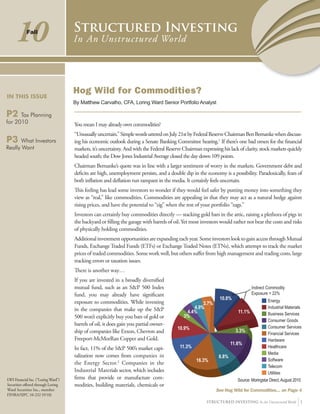
                                     If you are invested in a broadly diversified
                                     mutual fund, such as an SP 500 Index                                                            ,QGLUHFW RPPRGLW
                                     fund, you may already have significant                                                           ([SRVXUH 
                                                                                                                                            (QHUJ
                                     exposure to commodities. While investing                                
                                     in the companies that make up the SP                                                                   ,QGXVWULDO 0DWHULDOV
                                                                                                                                         %XVLQHVV 6HUYLFHV
                                     500 won’t explicitly buy you bars of gold or            
                                                                                                                                                RQVXPHU *RRGV
                                     barrels of oil, it does gain you partial owner-
                                                                                                                                            RQVXPHU 6HUYLFHV
                                     ship of companies like Exxon, Chevron and                                               
                                                                                                                                                )LQDQFLDO 6HUYLFHV
                                     Freeport-McMorRan Copper and Gold.                                                                         +DUGZDUH
                                                                                                                           
                                     In fact, 11% of the SP 500’s market capi-                                                             +HDOWKFDUH
                                                                                                                                                0HGLD
                                     talization now comes from companies in                                         
                                                                                                                                            6RIWZDUH
                                     the Energy Sector.2 Companies in the
                                                                                                                                                7HOHFRP
                                     Industrial Materials sector, which includes                                                                8WLOLWLHV
LWI Financial Inc. (“Loring Ward”)   firms that provide or manufacture com-                                                   6RXUFH 0RULQJVWDU 'LUHFW $XJXVW 
Securities offered through Loring    modities, building materials, chemicals or
Ward Securities Inc., member                                                                                       See Hog Wild for Commodities... on Page 4
FINRA/SIPC 10-232 (9/10)
                                                                                                              0OMPOPM@? DIQ@NODI$ In An Unstructured World
Structured Investing In An Unstructured World


                                                What Investors Really Want... continued from Page 3

                                                We want to stay true to our values                                     We want education, advice, and protection
                                                Some socially-responsible investors are willing to sacrifice invest-   Because we are increasingly responsible for our financial futures,
                                                ment returns to support human rights or environmental issues.          we seek information, protection, and advice from Financial Advisors,
                                                Other values that affect investment choices can include religion,      the Internet, the government, and other investors. Some advice is
                                                ideology, patriotism, and philanthropy. We want to feel good           good and some isn’t. We remember and utilize some of it, while
                                                about our investment decisions.                                        the rest may be forgotten or dismissed.
                                                We want fairness                                                    People buy and sell investments for myriad reasons. Some feel
                                                We want a level playing field when we participate in sports, invest-they have a true advantage over other investors, and some have
                                                ments, and every other aspect of our lives. Some of us, for exam-   cognitive errors mislead them. Still others enjoy the thrill of trading.
                                                ple, will not invest in companies that don’t share our values.      Whatever the reason, it is important to distinguish truth from
                                                We want to invest in our children and families                      cognitive errors and cognitive errors from wants. And it is critical to
                                                We encourage our children to do well in school and we save for remember that investments are ultimately about your life beyond
                                                their college expenses. Middle-class parents worry that they might money.
                                                not have enough for their children’s education while wealthy par- What Investors Really Want will be published by McGraw-Hill in October
                                                ents worry that their children may feel entitled to spend what they 2010. It is available by advance orders at Amazon, Barnes and Nobles, and
                                                do not earn.                                                        Borders. Meir Statman is a member of Loring Ward’s Investment Committee.


                                                Hog Wild for Commodities... continued from Page 1

                                                machinery, account for an additional 11%.2                             A portfolio consisting of broadly-diversified stocks in US and
                                                Therefore, nearly 22% of the SP 500 exposure is indirectly related    International markets (such as a typical Structured Investing port-
                                                to commodities.2 These are the companies that mine the precious        folio) may have a 15-30% indirect exposure to commodity sectors.
                                                metals out of the ground, own the oil producing fields, or grow the    So, if this sounds like the way you invest, the next time you hear in
                                                agricultural products we all consume.                                  the news about commodities, you can be confident that you may
                                                The significance of commodity related companies remains elevated       already have significant exposure to them.
                                                                                                                       1
                                                when looking abroad. Most investors might not have realized that         Bernanke Comment on Uncertainty Unsettles Market, Christine
                                                almost 25% of the exposure in the SP Developed Broad Market           Hauser, The New York Times, July 21, 2010.
                                                                                                                       2
                                                Index is classified in the Energy or Industrial Materials sectors.2     Moringstar Direct, August 2010. Data as of 8/31/10.
                                                                                                                       Indices are unmanaged and do not reflect the payment of advisory fees and
                                                We see even higher levels of exposure in Emerging Markets, as
                                                                                                                       other expenses associated with an investment in a mutual fund or separate
                                                many of these countries are significantly engaged in commodity
                                                                                                                       account. Investors cannot directly invest in an index. Investing in foreign
                                                extraction or production. The Energy sector represents 13% of the
                                                                                                                       securities may involve certain additional risks, including exchange rate fluc-
                                                SP Emerging Broad Market Index while the Industrial Materials
                                                                                                                       tuations, less liquidity, greater volatility, different financial and accounting
                                                sector accounts for another 20%, totaling 33% of that index.2 These
                                                                                                                       standards and political instability. Diversification does not assure a profit
                                                include Brazilian and Russian Oil companies, gold mining compa-
                                                                                                                       and does not protect against loss in declining markets.
                                                nies in South Africa and the coal companies of China.


                                                 NOMPOPM@? DIQ@NODI$ In An Unstructured World

Commodities si newsletter fall 2010 (2)

  • 1.
    10 )DOO Hog Wild for Commodities? ,1 7+,6 ,668( % 0DWWKHZ &DUYDOKR )$ /RULQJ :DUG 6HQLRU 3RUWIROLR $QDOVW 3 7D[ 3ODQQLQJ IRU You mean I may already own commodities? “Unusually uncertain.” Simple words uttered on July 21st by Federal Reserve Chairman Ben Bernanke when discuss- 3 :KDW ,QYHVWRUV ing his economic outlook during a Senate Banking Committee hearing.1 If there’s one bad omen for the financial 5HDOO :DQW markets, it’s uncertainty. And with the Federal Reserve Chairman expressing his lack of clarity, stock markets quickly headed south; the Dow Jones Industrial Average closed the day down 109 points. Chairman Bernanke’s quote was in line with a larger sentiment of worry in the markets. Government debt and deficits are high, unemployment persists, and a double dip in the economy is a possibility. Paradoxically, fears of both inflation and deflation run rampant in the media. It certainly feels uncertain. This feeling has lead some investors to wonder if they would feel safer by putting money into something they view as “real,” like commodities. Commodities are appealing in that they may act as a natural hedge against rising prices, and have the potential to “zig” when the rest of your portfolio “zags.” Investors can certainly buy commodities directly — stacking gold bars in the attic, raising a plethora of pigs in the backyard or filling the garage with barrels of oil. Yet most investors would rather not bear the costs and risks of physically holding commodities. Additional investment opportunities are expanding each year. Some investors look to gain access through Mutual Funds, Exchange Traded Funds (ETFs) or Exchange Traded Notes (ETNs), which attempt to track the market prices of traded commodities. Some work well, but others suffer from high management and trading costs, large tracking errors or taxation issues. There is another way… If you are invested in a broadly diversified mutual fund, such as an SP 500 Index ,QGLUHFW RPPRGLW fund, you may already have significant ([SRVXUH (QHUJ exposure to commodities. While investing in the companies that make up the SP ,QGXVWULDO 0DWHULDOV %XVLQHVV 6HUYLFHV 500 won’t explicitly buy you bars of gold or RQVXPHU *RRGV barrels of oil, it does gain you partial owner- RQVXPHU 6HUYLFHV ship of companies like Exxon, Chevron and )LQDQFLDO 6HUYLFHV Freeport-McMorRan Copper and Gold. +DUGZDUH In fact, 11% of the SP 500’s market capi- +HDOWKFDUH 0HGLD talization now comes from companies in 6RIWZDUH the Energy Sector.2 Companies in the 7HOHFRP Industrial Materials sector, which includes 8WLOLWLHV LWI Financial Inc. (“Loring Ward”) firms that provide or manufacture com- 6RXUFH 0RULQJVWDU 'LUHFW $XJXVW Securities offered through Loring modities, building materials, chemicals or Ward Securities Inc., member See Hog Wild for Commodities... on Page 4 FINRA/SIPC 10-232 (9/10) 0OMPOPM@? DIQ@NODI$ In An Unstructured World
  • 2.
    Structured Investing InAn Unstructured World What Investors Really Want... continued from Page 3 We want to stay true to our values We want education, advice, and protection Some socially-responsible investors are willing to sacrifice invest- Because we are increasingly responsible for our financial futures, ment returns to support human rights or environmental issues. we seek information, protection, and advice from Financial Advisors, Other values that affect investment choices can include religion, the Internet, the government, and other investors. Some advice is ideology, patriotism, and philanthropy. We want to feel good good and some isn’t. We remember and utilize some of it, while about our investment decisions. the rest may be forgotten or dismissed. We want fairness People buy and sell investments for myriad reasons. Some feel We want a level playing field when we participate in sports, invest-they have a true advantage over other investors, and some have ments, and every other aspect of our lives. Some of us, for exam- cognitive errors mislead them. Still others enjoy the thrill of trading. ple, will not invest in companies that don’t share our values. Whatever the reason, it is important to distinguish truth from We want to invest in our children and families cognitive errors and cognitive errors from wants. And it is critical to We encourage our children to do well in school and we save for remember that investments are ultimately about your life beyond their college expenses. Middle-class parents worry that they might money. not have enough for their children’s education while wealthy par- What Investors Really Want will be published by McGraw-Hill in October ents worry that their children may feel entitled to spend what they 2010. It is available by advance orders at Amazon, Barnes and Nobles, and do not earn. Borders. Meir Statman is a member of Loring Ward’s Investment Committee. Hog Wild for Commodities... continued from Page 1 machinery, account for an additional 11%.2 A portfolio consisting of broadly-diversified stocks in US and Therefore, nearly 22% of the SP 500 exposure is indirectly related International markets (such as a typical Structured Investing port- to commodities.2 These are the companies that mine the precious folio) may have a 15-30% indirect exposure to commodity sectors. metals out of the ground, own the oil producing fields, or grow the So, if this sounds like the way you invest, the next time you hear in agricultural products we all consume. the news about commodities, you can be confident that you may The significance of commodity related companies remains elevated already have significant exposure to them. 1 when looking abroad. Most investors might not have realized that Bernanke Comment on Uncertainty Unsettles Market, Christine almost 25% of the exposure in the SP Developed Broad Market Hauser, The New York Times, July 21, 2010. 2 Index is classified in the Energy or Industrial Materials sectors.2 Moringstar Direct, August 2010. Data as of 8/31/10. Indices are unmanaged and do not reflect the payment of advisory fees and We see even higher levels of exposure in Emerging Markets, as other expenses associated with an investment in a mutual fund or separate many of these countries are significantly engaged in commodity account. Investors cannot directly invest in an index. Investing in foreign extraction or production. The Energy sector represents 13% of the securities may involve certain additional risks, including exchange rate fluc- SP Emerging Broad Market Index while the Industrial Materials tuations, less liquidity, greater volatility, different financial and accounting sector accounts for another 20%, totaling 33% of that index.2 These standards and political instability. Diversification does not assure a profit include Brazilian and Russian Oil companies, gold mining compa- and does not protect against loss in declining markets. nies in South Africa and the coal companies of China. NOMPOPM@? DIQ@NODI$ In An Unstructured World