THE RELATION BETWEEN GROUPTHINK
THEORY AND SOCIAL MEDIA
PRESENTED BY TRONG NGUYEN & VICTORIA GRIFFIN
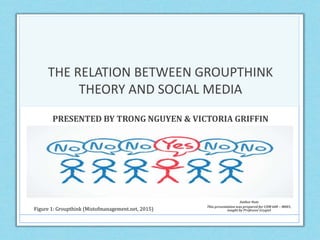
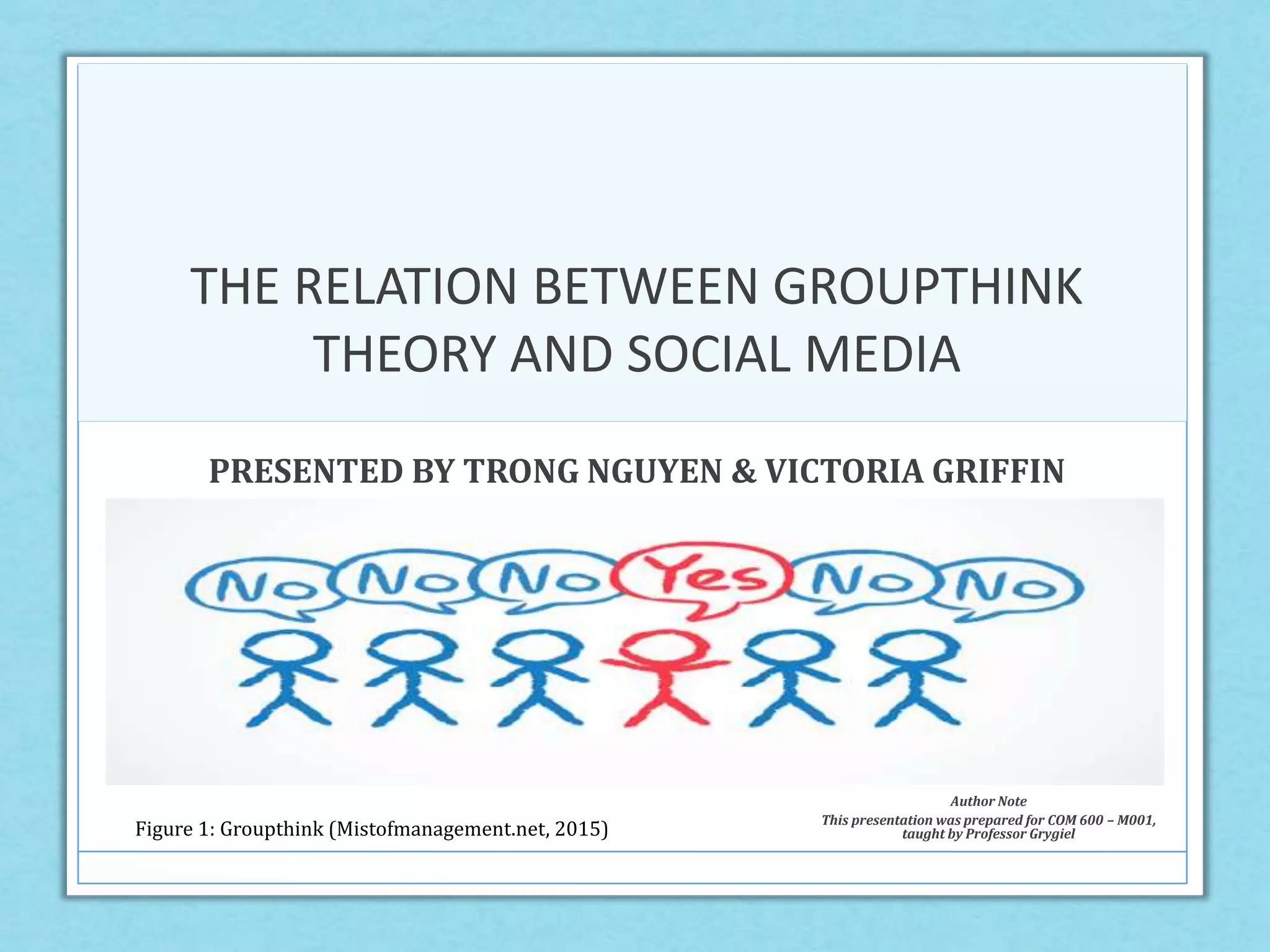
Figure 1: Groupthink (Mistofmanagement.net, 2015)
Author Note
This presentation was prepared for COM 600 – M001,
taught by Professor Grygiel
IRVING JANIS
• Born in Buffalo, New York,
in 1918 and studied at the
University of Chicago and
earned his doctorate from
Columbia University in
1948. He completed his
postdoctoral study at the
New York Psychoanalytic
Institute. (“Goodtherapy.or
g,” 2007)
• Be identified for the group
think theory.
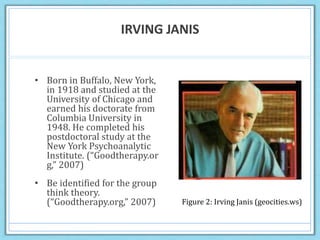
(“Goodtherapy.org,” 2007) Figure 2: Irving Janis (geocities.ws)
GROUPTHINK THEORY
“In a group sometimes there comes a situation when
all the members of the group think it is more
important to come to a unanimous decision than to
carefully go through all their options to get at the most
beneficial course of action.” (“Communication Theory,”
2010)
http://communicationtheory.org/groupthink/
A FAMOUS CASE
The Challenger space shuttle disaster:
• The engineers knew about faulty parts, but in order
to avoid negative press, they went ahead with the
launch anyway. (“History.com,” 2016)
• On Jan 28, 1986, the American shuttle orbiter
Challenger broke up 73 seconds after liftoff,
bringing a devastating end to the spacecraft’s 10th
mission. (“History.com,” 2016)
http://www.history.com/topics/challenger-disaster
MAY GROUPTHINK RELATE TO SOCIAL MEDIA?
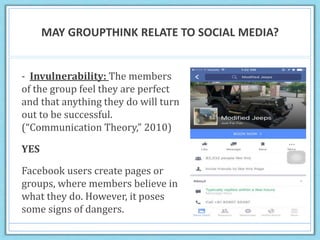
- Invulnerability: The members
of the group feel they are perfect
and that anything they do will turn
out to be successful.
(“Communication Theory,” 2010)
YES
Facebook users create pages or
groups, where members believe in
what they do. However, it poses
some signs of dangers.
MAY GROUPTHINK RELATE TO…? (Cont)
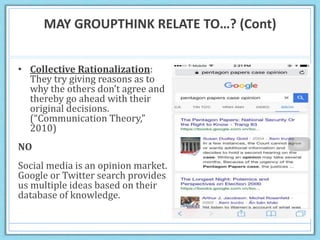
• Collective Rationalization:
They try giving reasons as to
why the others don’t agree and
thereby go ahead with their
original decisions.
(“Communication Theory,”
2010)
NO
Social media is an opinion market.
Google or Twitter search provides
us multiple ideas based on their
database of knowledge.
MAY GROUPTHINK RELATE TO…? (Cont)
• Morality: whatever the group does will be
right as they all know the difference between
right and wrong. They overlook the
consequences of what they decide.
(“Communication Theory,” 2010)
YES
No face-to-face conversation will make people
less thoughtful and irresponsible.
MAY GROUPTHINK RELATE TO…? (Cont)
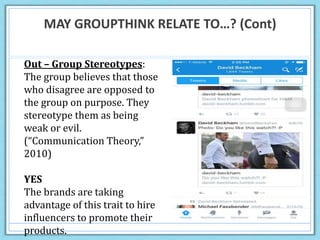
Out – Group Stereotypes:
The group believes that those
who disagree are opposed to
the group on purpose. They
stereotype them as being
weak or evil.
(“Communication Theory,”
2010)
YES
The brands are taking
advantage of this trait to hire
influencers to promote their
products.
MAY GROUPTHINK RELATE
TO…? (Cont)
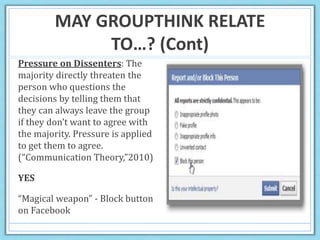
Pressure on Dissenters: The
majority directly threaten the
person who questions the
decisions by telling them that
they can always leave the group
if they don’t want to agree with
the majority. Pressure is applied
to get them to agree.
(“Communication Theory,”2010)
YES
“Magical weapon” - Block button
on Facebook
MAY GROUPTHINK RELATE
TO…? (Cont)
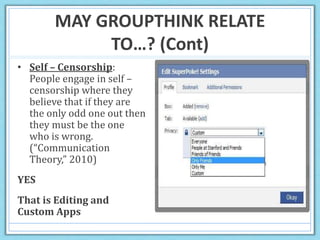
• Self – Censorship:
People engage in self –
censorship where they
believe that if they are
the only odd one out then
they must be the one
who is wrong.
(“Communication
Theory,” 2010)
YES
That is Editing and
Custom Apps
MAY GROUPTHINK RELATE
TO…? (Cont)
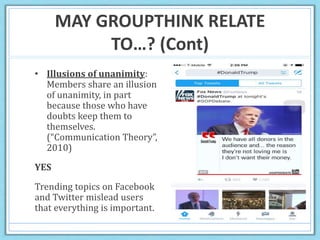
• Illusions of unanimity:
Members share an illusion
of unanimity, in part
because those who have
doubts keep them to
themselves.
(“Communication Theory”,
2010)
YES
Trending topics on Facebook
and Twitter mislead users
that everything is important.
MAY GROUPTHINK RELATE
TO…? (Cont)
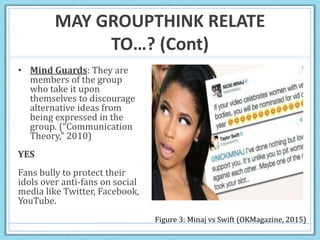
• Mind Guards: They are
members of the group
who take it upon
themselves to discourage
alternative ideas from
being expressed in the
group. (“Communication
Theory,” 2010)
YES
Fans bully to protect their
idols over anti-fans on social
media like Twitter, Facebook,
YouTube.
Figure 3: Minaj vs Swift (OKMagazine, 2015)
THE RELATION
BETWEEN
SOCIAL
IDENTITY AND
SOCIAL MEDIA
Author Note
This presentation was prepared for
COM 600 – M001, taught by
Professor Grygiel
PRESENTED BY: VICTORIA
GRIFFIN & TRONG NGUYEN
Syracuse University
Figure 1. Fake Identities (Meir, 2012).
HENRI TAJFEL &
JOHN TURNER
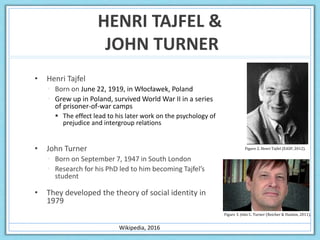
• Henri Tajfel
 Born on June 22, 1919, in Włocławek, Poland
 Grew up in Poland, survived World War II in a series
of prisoner-of-war camps
 The effect lead to his later work on the psychology of
prejudice and intergroup relations
• John Turner
 Born on September 7, 1947 in South London
 Research for his PhD led to him becoming Tajfel’s
student
• They developed the theory of social identity in
1979
Wikipedia, 2016
Figure 3. John C. Turner (Reicher & Haslam, 2011).
Figure 2. Henri Tajfel (EASP, 2012).
3 COGNITIVE PROCESSES
Being part of the in-group or the out-group
Social Identification
Social Categorization
Social Comparison
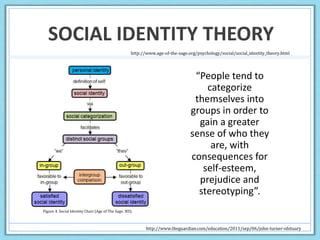
SOCIAL IDENTITY THEORY
“People tend to
categorize
themselves into
groups in order to
gain a greater
sense of who they
are, with
consequences for
self-esteem,
prejudice and
stereotyping”.
http://www.theguardian.com/education/2011/sep/06/john-turner-obituary
http://www.age-of-the-sage.org/psychology/social/social_identity_theory.html
Figure 4. Social Identity Chart (Age of The Sage, ND).
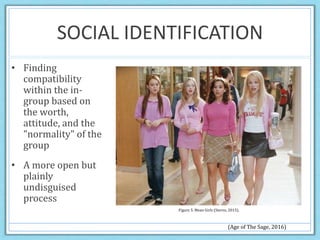
SOCIAL IDENTIFICATION
• Finding
compatibility
within the in-
group based on
the worth,
attitude, and the
"normality" of the
group
• A more open but
plainly
undisguised
process
Figure 5. Mean Girls (Sterns, 2015).
(Age of The Sage, 2016)
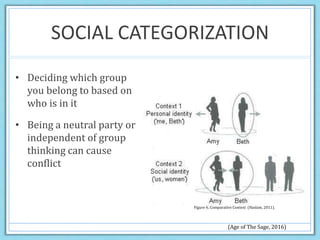
SOCIAL CATEGORIZATION
• Deciding which group
you belong to based on
who is in it
• Being a neutral party or
independent of group
thinking can cause
conflict
(Age of The Sage, 2016)
Figure 6. Comparative Context (Haslam, 2011).
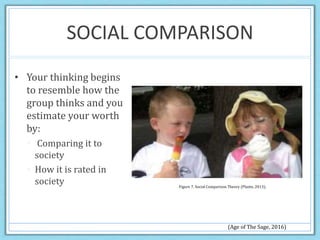
SOCIAL COMPARISON
• Your thinking begins
to resemble how the
group thinks and you
estimate your worth
by:
• Comparing it to
society
• How it is rated in
society
(Age of The Sage, 2016)
Figure 7. Social Comparison Theory (Plante, 2013).
HOW IT RELATES TO…
FACEBOOK, TWITTER, INSTAGRAM, LINKEDIN, PINTEREST,
TUMBLR, ETC…
POSITIVE SELF-
DISTINCTIVENESS STRATEGY
Social Identity theory details certain strategies which help to
achieve and maintain positive self-distinctiveness in a group of
individuals.
(Communication Theory, 2010)
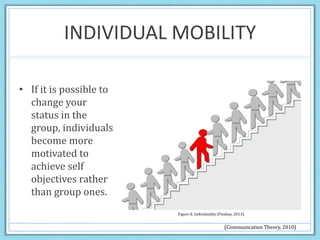
INDIVIDUAL MOBILITY
• If it is possible to
change your
status in the
group, individuals
become more
motivated to
achieve self
objectives rather
than group ones.
Figure 8. Individuality (Pixabay, 2013).
(Communication Theory, 2010)
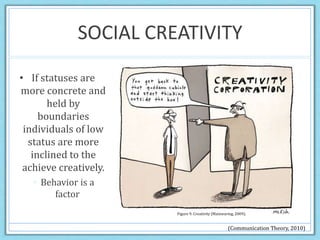
SOCIAL CREATIVITY
• If statuses are
more concrete and
held by
boundaries
individuals of low
status are more
inclined to the
achieve creatively.
 Behavior is a
factor
Figure 9. Creativity (Mainwaring, 2009).
(Communication Theory, 2010)
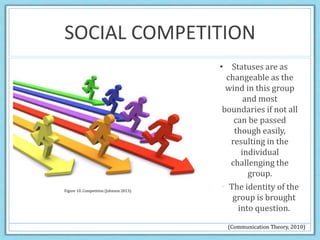
SOCIAL COMPETITION
• Statuses are as
changeable as the
wind in this group
and most
boundaries if not all
can be passed
though easily,
resulting in the
individual
challenging the
group.
 The identity of the
group is brought
into question.
(Communication Theory, 2010)
Figure 10. Competition (Johnson 2013).
REFERENCE
1. Group Think. Group Communication, Organizational Communication, Psychology, Behavioral and Social Science.
Retrieved Feb 8, 2016, from http://communicationtheory.org/groupthink/
2. Social Identity. Group Communication, Organizational Communication, Psychology, Behavioral and Social Science.
Retrieved Feb 7, 2016, from http://communicationtheory.org/social-identity-theory/
3. Challenger Disaster. A&E Television Network. Retrieved Feb 8, 2016, from
http://www.history.com/topics/challenger-disaster
4. Brian, Solis. Q&A: Why the Future of Business is Shared Experiences. Brian Solis Blog. Retrieved Feb 8, 2016, from
http://www.briansolis.com/2013/04/qa-why-the-future-of-business-is-shared-experiences/
5. Henri Tajfel - Wikipedia, The Free Encyclopedia. Retrieved February 8, 2016, from
https://en.wikipedia.org/wiki/Henri_Tajfel
6. John Turner obituary | Education | The Guardian. Retrieved from
http://www.theguardian.com/education/2011/sep/06/john-turner-obituary
7. Social Identity Theory - Tajfel and Turner 1979. Retrieved from http://www.age-of-the-
sage.org/psychology/social/social_identity_theory.html
Q&A

Comm 600 presentation social media

  • 1.
    THE RELATION BETWEENGROUPTHINK THEORY AND SOCIAL MEDIA PRESENTED BY TRONG NGUYEN & VICTORIA GRIFFIN Figure 1: Groupthink (Mistofmanagement.net, 2015) Author Note This presentation was prepared for COM 600 – M001, taught by Professor Grygiel
  • 2.
    IRVING JANIS • Bornin Buffalo, New York, in 1918 and studied at the University of Chicago and earned his doctorate from Columbia University in 1948. He completed his postdoctoral study at the New York Psychoanalytic Institute. (“Goodtherapy.or g,” 2007) • Be identified for the group think theory. (“Goodtherapy.org,” 2007) Figure 2: Irving Janis (geocities.ws)
  • 3.
    GROUPTHINK THEORY “In agroup sometimes there comes a situation when all the members of the group think it is more important to come to a unanimous decision than to carefully go through all their options to get at the most beneficial course of action.” (“Communication Theory,” 2010) http://communicationtheory.org/groupthink/
  • 4.
    A FAMOUS CASE TheChallenger space shuttle disaster: • The engineers knew about faulty parts, but in order to avoid negative press, they went ahead with the launch anyway. (“History.com,” 2016) • On Jan 28, 1986, the American shuttle orbiter Challenger broke up 73 seconds after liftoff, bringing a devastating end to the spacecraft’s 10th mission. (“History.com,” 2016) http://www.history.com/topics/challenger-disaster
  • 5.
    MAY GROUPTHINK RELATETO SOCIAL MEDIA? - Invulnerability: The members of the group feel they are perfect and that anything they do will turn out to be successful. (“Communication Theory,” 2010) YES Facebook users create pages or groups, where members believe in what they do. However, it poses some signs of dangers.
  • 6.
    MAY GROUPTHINK RELATETO…? (Cont) • Collective Rationalization: They try giving reasons as to why the others don’t agree and thereby go ahead with their original decisions. (“Communication Theory,” 2010) NO Social media is an opinion market. Google or Twitter search provides us multiple ideas based on their database of knowledge.
  • 7.
    MAY GROUPTHINK RELATETO…? (Cont) • Morality: whatever the group does will be right as they all know the difference between right and wrong. They overlook the consequences of what they decide. (“Communication Theory,” 2010) YES No face-to-face conversation will make people less thoughtful and irresponsible.
  • 8.
    MAY GROUPTHINK RELATETO…? (Cont) Out – Group Stereotypes: The group believes that those who disagree are opposed to the group on purpose. They stereotype them as being weak or evil. (“Communication Theory,” 2010) YES The brands are taking advantage of this trait to hire influencers to promote their products.
  • 9.
    MAY GROUPTHINK RELATE TO…?(Cont) Pressure on Dissenters: The majority directly threaten the person who questions the decisions by telling them that they can always leave the group if they don’t want to agree with the majority. Pressure is applied to get them to agree. (“Communication Theory,”2010) YES “Magical weapon” - Block button on Facebook
  • 10.
    MAY GROUPTHINK RELATE TO…?(Cont) • Self – Censorship: People engage in self – censorship where they believe that if they are the only odd one out then they must be the one who is wrong. (“Communication Theory,” 2010) YES That is Editing and Custom Apps
  • 11.
    MAY GROUPTHINK RELATE TO…?(Cont) • Illusions of unanimity: Members share an illusion of unanimity, in part because those who have doubts keep them to themselves. (“Communication Theory”, 2010) YES Trending topics on Facebook and Twitter mislead users that everything is important.
  • 12.
    MAY GROUPTHINK RELATE TO…?(Cont) • Mind Guards: They are members of the group who take it upon themselves to discourage alternative ideas from being expressed in the group. (“Communication Theory,” 2010) YES Fans bully to protect their idols over anti-fans on social media like Twitter, Facebook, YouTube. Figure 3: Minaj vs Swift (OKMagazine, 2015)
  • 13.
    THE RELATION BETWEEN SOCIAL IDENTITY AND SOCIALMEDIA Author Note This presentation was prepared for COM 600 – M001, taught by Professor Grygiel PRESENTED BY: VICTORIA GRIFFIN & TRONG NGUYEN Syracuse University Figure 1. Fake Identities (Meir, 2012).
  • 14.
    HENRI TAJFEL & JOHNTURNER • Henri Tajfel  Born on June 22, 1919, in Włocławek, Poland  Grew up in Poland, survived World War II in a series of prisoner-of-war camps  The effect lead to his later work on the psychology of prejudice and intergroup relations • John Turner  Born on September 7, 1947 in South London  Research for his PhD led to him becoming Tajfel’s student • They developed the theory of social identity in 1979 Wikipedia, 2016 Figure 3. John C. Turner (Reicher & Haslam, 2011). Figure 2. Henri Tajfel (EASP, 2012).
  • 15.
    3 COGNITIVE PROCESSES Beingpart of the in-group or the out-group Social Identification Social Categorization Social Comparison
  • 16.
    SOCIAL IDENTITY THEORY “Peopletend to categorize themselves into groups in order to gain a greater sense of who they are, with consequences for self-esteem, prejudice and stereotyping”. http://www.theguardian.com/education/2011/sep/06/john-turner-obituary http://www.age-of-the-sage.org/psychology/social/social_identity_theory.html Figure 4. Social Identity Chart (Age of The Sage, ND).
  • 17.
    SOCIAL IDENTIFICATION • Finding compatibility withinthe in- group based on the worth, attitude, and the "normality" of the group • A more open but plainly undisguised process Figure 5. Mean Girls (Sterns, 2015). (Age of The Sage, 2016)
  • 18.
    SOCIAL CATEGORIZATION • Decidingwhich group you belong to based on who is in it • Being a neutral party or independent of group thinking can cause conflict (Age of The Sage, 2016) Figure 6. Comparative Context (Haslam, 2011).
  • 19.
    SOCIAL COMPARISON • Yourthinking begins to resemble how the group thinks and you estimate your worth by: • Comparing it to society • How it is rated in society (Age of The Sage, 2016) Figure 7. Social Comparison Theory (Plante, 2013).
  • 20.
    HOW IT RELATESTO… FACEBOOK, TWITTER, INSTAGRAM, LINKEDIN, PINTEREST, TUMBLR, ETC…
  • 21.
    POSITIVE SELF- DISTINCTIVENESS STRATEGY SocialIdentity theory details certain strategies which help to achieve and maintain positive self-distinctiveness in a group of individuals. (Communication Theory, 2010)
  • 22.
    INDIVIDUAL MOBILITY • Ifit is possible to change your status in the group, individuals become more motivated to achieve self objectives rather than group ones. Figure 8. Individuality (Pixabay, 2013). (Communication Theory, 2010)
  • 23.
    SOCIAL CREATIVITY • Ifstatuses are more concrete and held by boundaries individuals of low status are more inclined to the achieve creatively.  Behavior is a factor Figure 9. Creativity (Mainwaring, 2009). (Communication Theory, 2010)
  • 24.
    SOCIAL COMPETITION • Statusesare as changeable as the wind in this group and most boundaries if not all can be passed though easily, resulting in the individual challenging the group.  The identity of the group is brought into question. (Communication Theory, 2010) Figure 10. Competition (Johnson 2013).
  • 25.
    REFERENCE 1. Group Think.Group Communication, Organizational Communication, Psychology, Behavioral and Social Science. Retrieved Feb 8, 2016, from http://communicationtheory.org/groupthink/ 2. Social Identity. Group Communication, Organizational Communication, Psychology, Behavioral and Social Science. Retrieved Feb 7, 2016, from http://communicationtheory.org/social-identity-theory/ 3. Challenger Disaster. A&E Television Network. Retrieved Feb 8, 2016, from http://www.history.com/topics/challenger-disaster 4. Brian, Solis. Q&A: Why the Future of Business is Shared Experiences. Brian Solis Blog. Retrieved Feb 8, 2016, from http://www.briansolis.com/2013/04/qa-why-the-future-of-business-is-shared-experiences/ 5. Henri Tajfel - Wikipedia, The Free Encyclopedia. Retrieved February 8, 2016, from https://en.wikipedia.org/wiki/Henri_Tajfel 6. John Turner obituary | Education | The Guardian. Retrieved from http://www.theguardian.com/education/2011/sep/06/john-turner-obituary 7. Social Identity Theory - Tajfel and Turner 1979. Retrieved from http://www.age-of-the- sage.org/psychology/social/social_identity_theory.html
  • 26.