
COLOUR SCHEMES

Creating a colour scheme may seem difficult, but many
manufacturers of paints and wallcoverings carefully co-
ordinate their colour cards and design collections so that
most of the hard work is already done for you


You may need to climb a ladder to paint a ceiling or hang
wallpaper. Make sure the ladder is stable, and take care not
to over-reach.


Colour is the first thing you notice when you enter a room. It
creates mood and atmosphere, and allows you to transform
your home quickly and cheaply with stunning results.

When we come to choose colours, most of us are aware that
dark colours will make a room look smaller, and pale ones
make a room seem more spacious, but colour, together with
pattern and texture, are far more versatile than this. Paints,
wallcoverings and fabrics can be used to create a variety of
impressions and, armed with just a few basic facts, you will
be able to make them work for you in many different ways.


2 - Choosing colour
Red or pink tones look deeper and richer in artificial light,
but blues and greens can look washed out. Keep this in mind
when choosing colours for a room that will be used primarily
in the evenings.


Colours have characteristics that can affect our mood and
make the same room appear completely different, simply by
the way it is decorated. So before you begin to think about
colours, take a good look around the room and make a note
of how much natural light it gets and what you like or dislike
about it.


Warm colours such as red, orange and yellow are
'advancing' colours which appear to draw surfaces closer,
and create a sense of cosy comfort. These are lively colours,
which make them a good choice for gloomy rooms facing
north or east which receive little natural light, basements,
and rooms heavily shaded by trees.


Cool colours such as green, blue and violet are 'receding'
colours which maximise space, and make a room feel fresh
and airy. These are relaxing colours ideal for sunny rooms
facing south and west, or anywhere there is abundant
natural light.
Neutral colours such as cream and beige are useful for
toning down more adventurous colours but, used in their
own right, will allow attention to be focused on the contents
of a room, rather than the room itself. They also
complement natural woods and cork well.


Some colours evoke a definite mood which makes them a
good choice for particular rooms. Pinks and red-blues, for
example, have a romantic feel that is perfect for dining
rooms and bedrooms, while fresh outdoor colours like yellow
and green are best suited to busy daytime rooms.


3 - Mixing colours
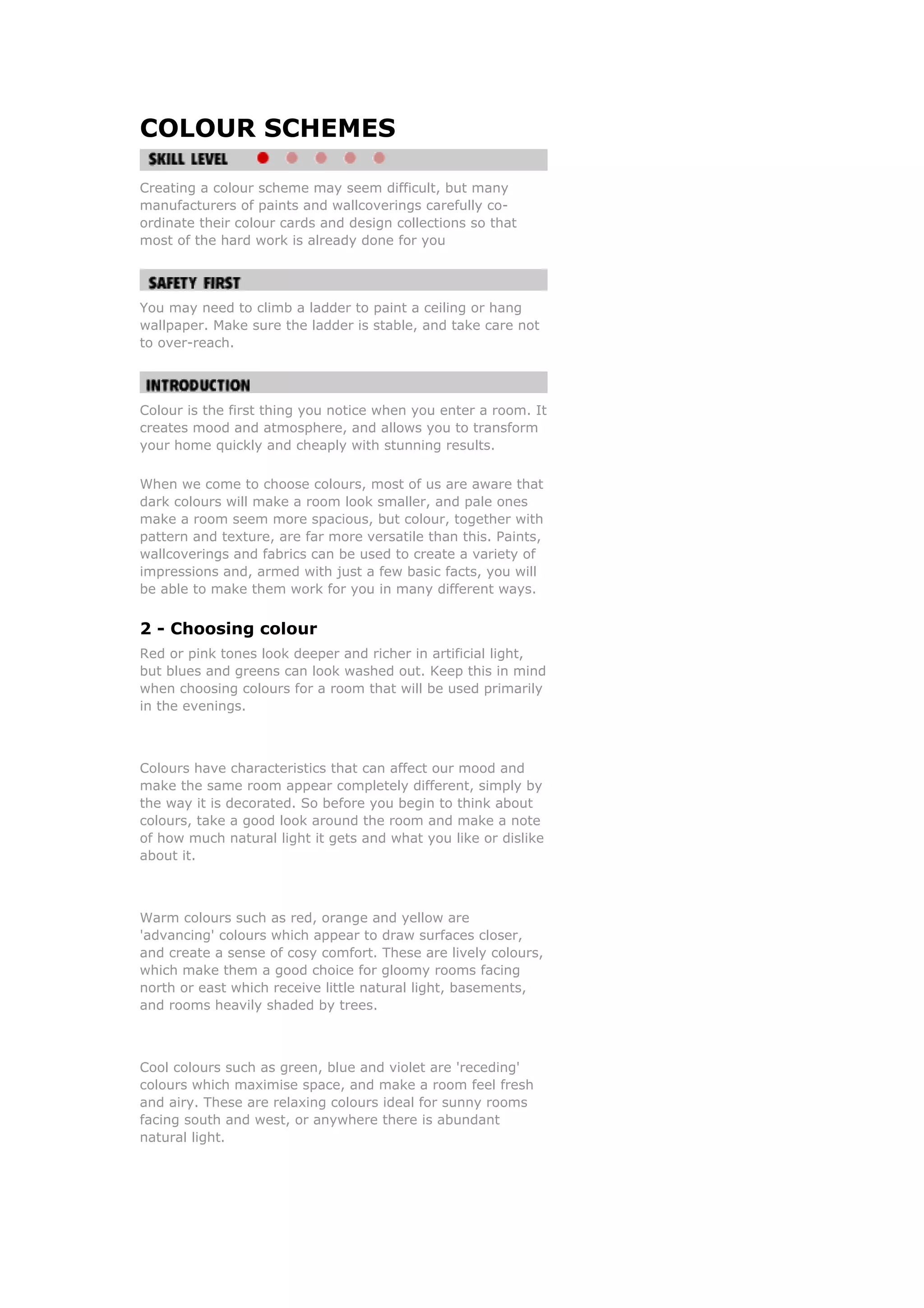
                              Colours that are opposite
                              each other on the colour
                              wheel, such as yellow and
                              blue, create stimulating
                              colour schemes, while those
                              that are close to each other,
                              like blue and green,
                              harmonise well and are more
                              relaxing to live with (1).


To create light and depth in a room and to make sure that
no one colour dominates, use colours in different strengths
and add neutral accessories.


Pale colours reflect over 80% of light and dark colours
absorb nearly 90%, so a higher level of artificial light is
needed in a room where there is a dark or strong colour
scheme.


Contrasting colours that clash, like lime and yellow or pink
and orange, can create a very dramatic, modern colour
scheme, and work best in big bold blocks with nothing else
competing for attention.


If you are not a confident decorator, a colour scheme which
uses several strengths of the same basic colour is a safe
choice and very easy on the eye. Use the mid-tone for a
large area like curtains or the floorcovering, a lighter tone
for walls and ceiling, and the strongest only for emphasis
with accessories.


Using only shades of a single colour can look dull, but the
effect is easily spiced up with an accent colour from the
opposite side of the colour spectrum. A splash of orange or
peach will brighten up a blue room; green makes an elegant
contrast to rosy pinks; and yellow adds warmth to a lilac
colour scheme. An accent colour needn't be paint or
wallpaper - colourful lampshades or cushions will do just as
well.


4 - Using colours
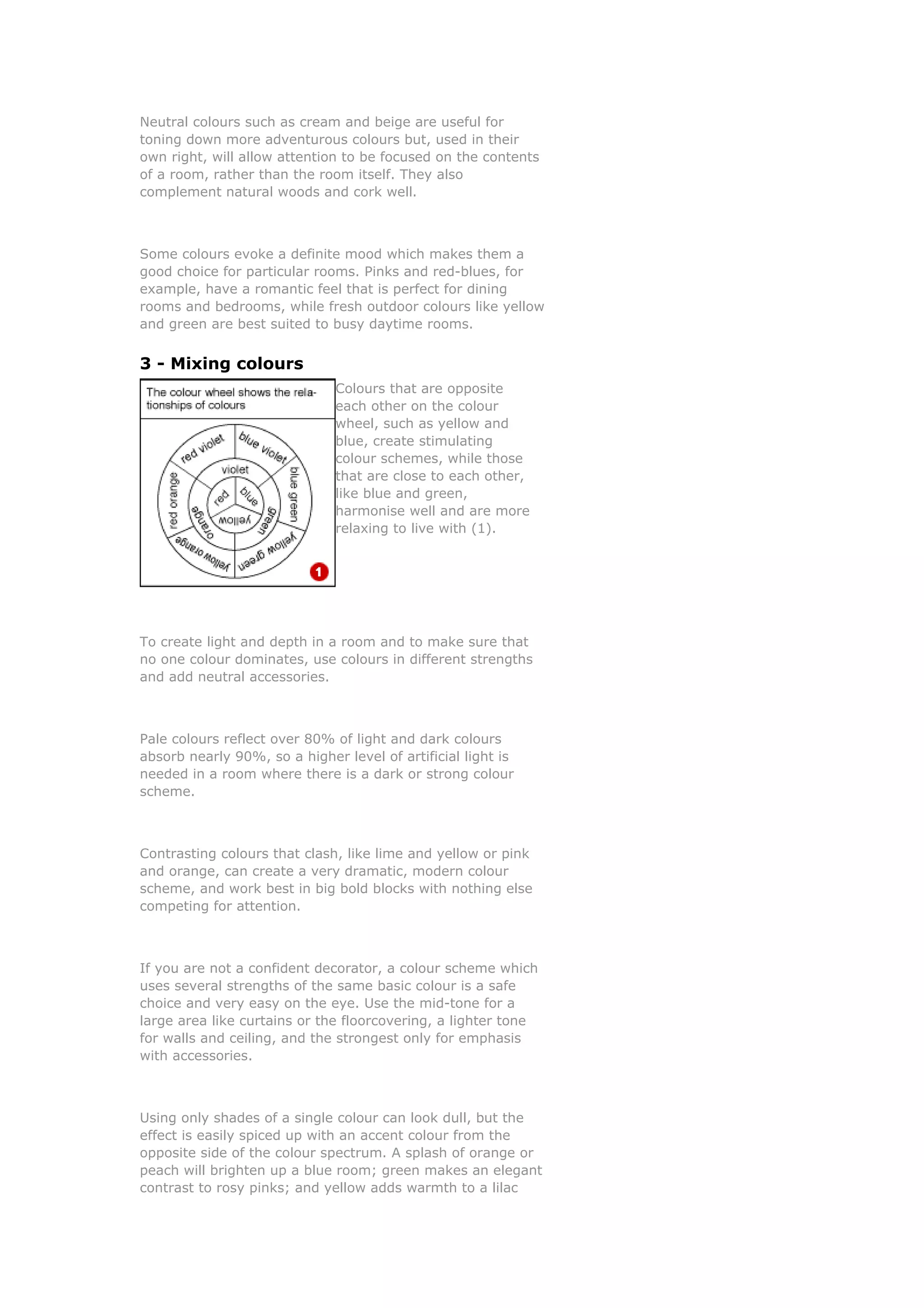
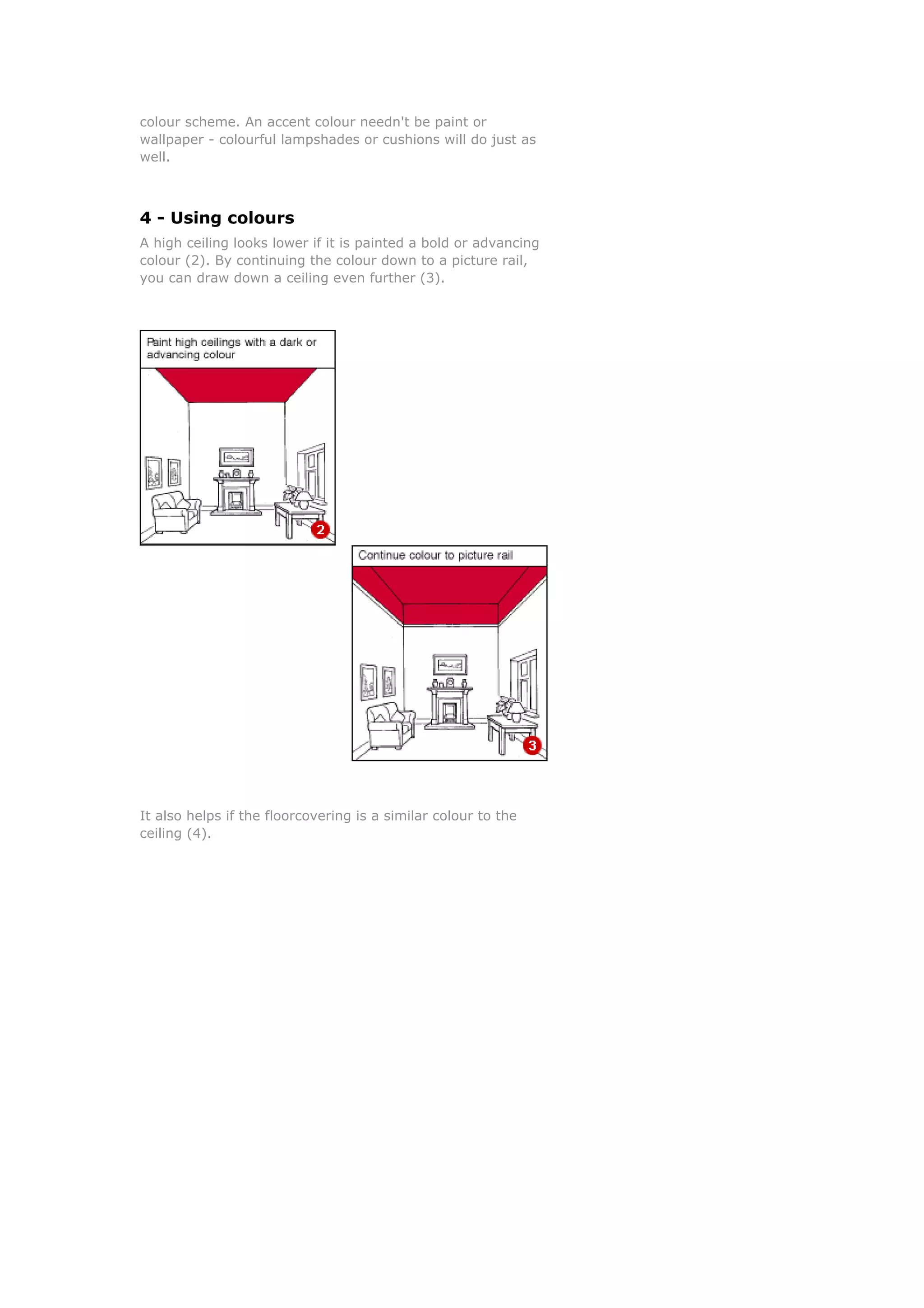
A high ceiling looks lower if it is painted a bold or advancing
colour (2). By continuing the colour down to a picture rail,
you can draw down a ceiling even further (3).


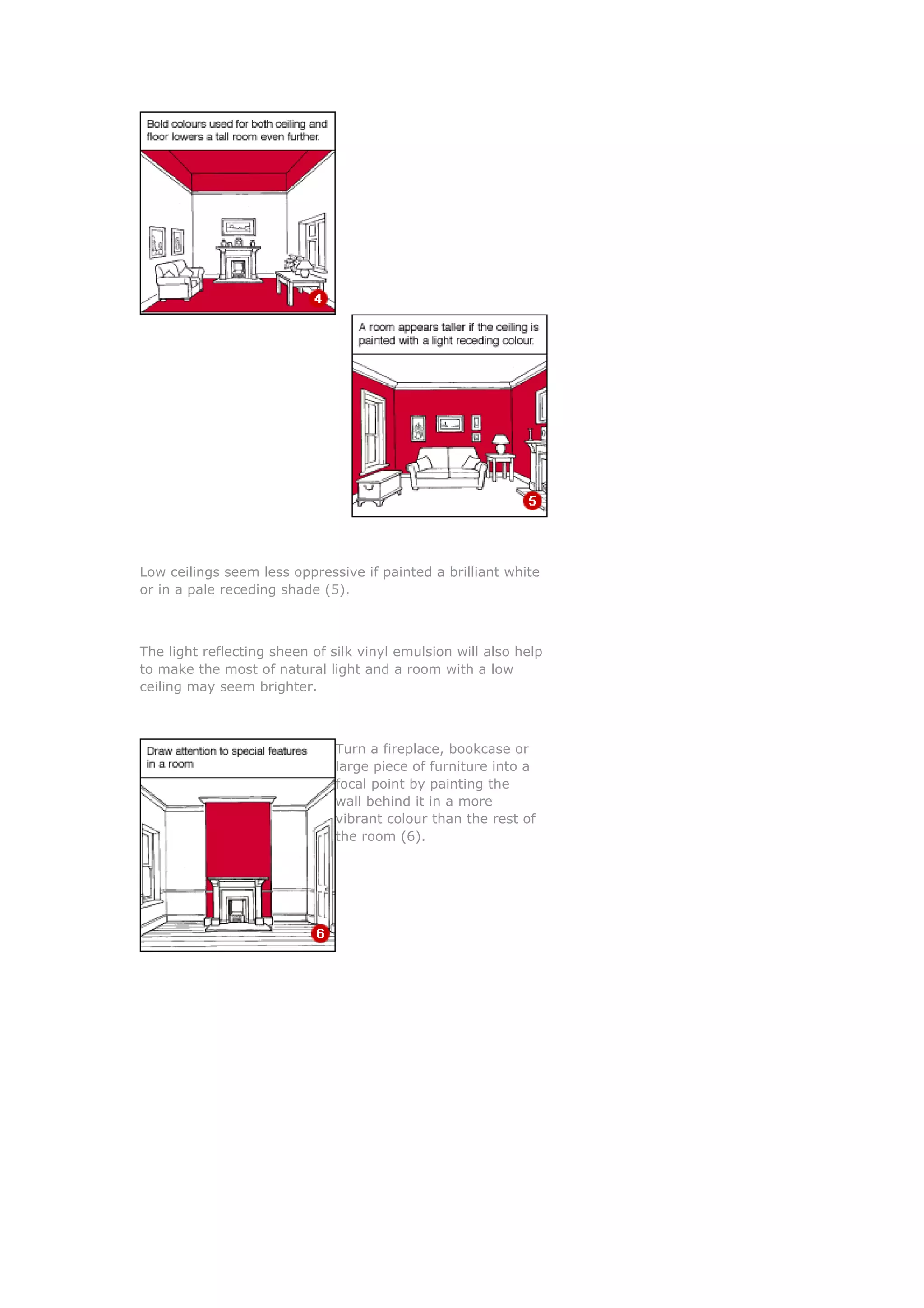
It also helps if the floorcovering is a similar colour to the
ceiling (4).
Low ceilings seem less oppressive if painted a brilliant white
or in a pale receding shade (5).


The light reflecting sheen of silk vinyl emulsion will also help
to make the most of natural light and a room with a low
ceiling may seem brighter.


                               Turn a fireplace, bookcase or
                               large piece of furniture into a
                               focal point by painting the
                               wall behind it in a more
                               vibrant colour than the rest of
                               the room (6).
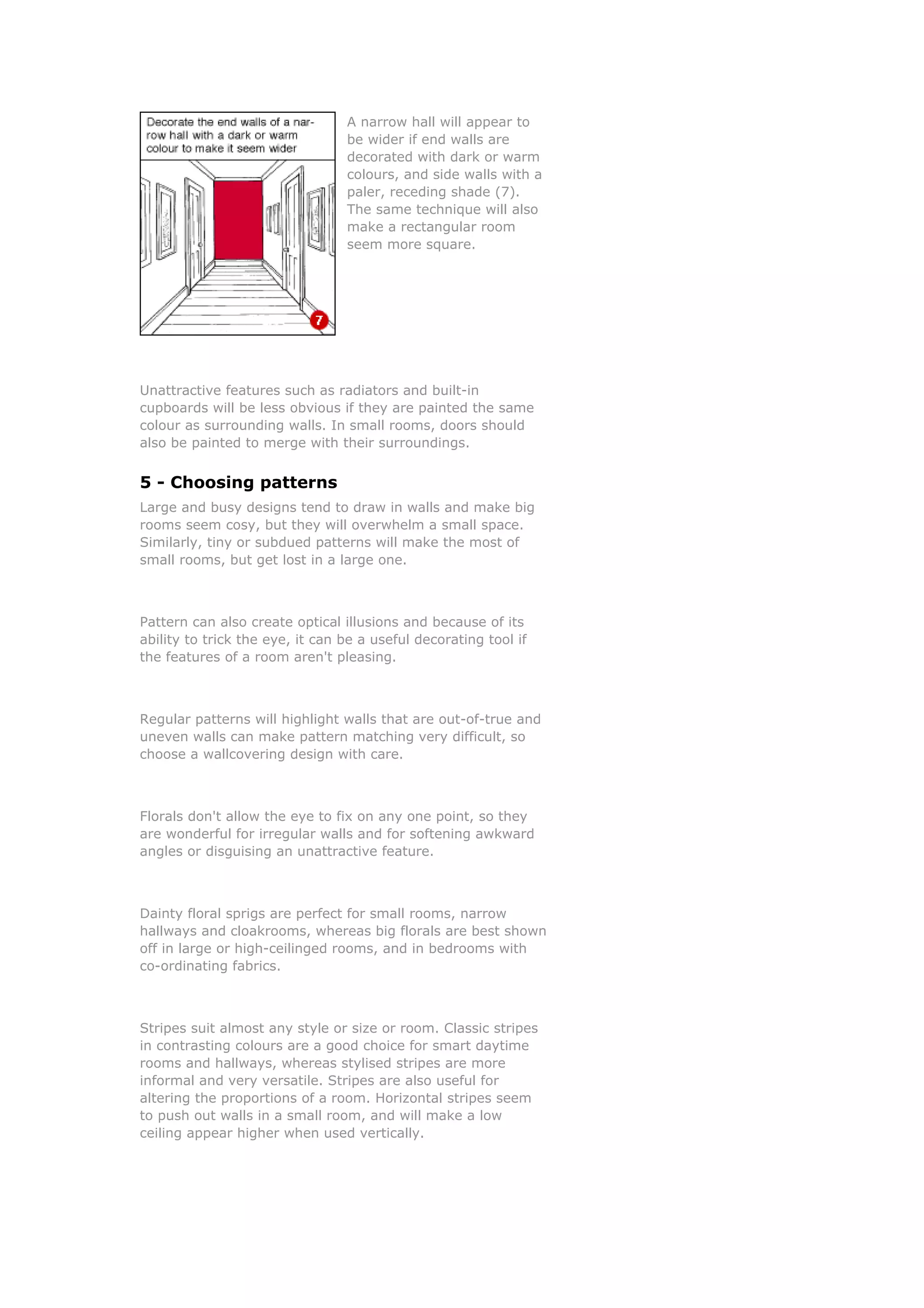
A narrow hall will appear to
                                 be wider if end walls are
                                 decorated with dark or warm
                                 colours, and side walls with a
                                 paler, receding shade (7).
                                 The same technique will also
                                 make a rectangular room
                                 seem more square.


Unattractive features such as radiators and built-in
cupboards will be less obvious if they are painted the same
colour as surrounding walls. In small rooms, doors should
also be painted to merge with their surroundings.


5 - Choosing patterns
Large and busy designs tend to draw in walls and make big
rooms seem cosy, but they will overwhelm a small space.
Similarly, tiny or subdued patterns will make the most of
small rooms, but get lost in a large one.


Pattern can also create optical illusions and because of its
ability to trick the eye, it can be a useful decorating tool if
the features of a room aren't pleasing.


Regular patterns will highlight walls that are out-of-true and
uneven walls can make pattern matching very difficult, so
choose a wallcovering design with care.


Florals don't allow the eye to fix on any one point, so they
are wonderful for irregular walls and for softening awkward
angles or disguising an unattractive feature.


Dainty floral sprigs are perfect for small rooms, narrow
hallways and cloakrooms, whereas big florals are best shown
off in large or high-ceilinged rooms, and in bedrooms with
co-ordinating fabrics.


Stripes suit almost any style or size or room. Classic stripes
in contrasting colours are a good choice for smart daytime
rooms and hallways, whereas stylised stripes are more
informal and very versatile. Stripes are also useful for
altering the proportions of a room. Horizontal stripes seem
to push out walls in a small room, and will make a low
ceiling appear higher when used vertically.
Trimming wallpaper around doors, windows or cupboards
can ruin the look of a large pattern. Stripes and small
designs will be a better choice, and more economical on the
number of rolls needed.


Checks range from smart tartans to informal ginghams, and
are as versatile as stripes but look busier, so they work best
in simple colour schemes where the pattern can be fully
appreciated. Checks are also useful for drawing in far-away
walls and softening harsh edges.


Geometrics are neat and restful, and make walls seem to
recede, so they create the perfect backdrop to a busy or
cluttered room, or pictures and memorabilia that you want
to display.


If you have chosen a stimulating colour scheme, be sparing
with pattern on furnishing and accessories. Busy patterns
will simply compete for attention.


6 - Mixing patterns
Pay attention to the size and scale of a pattern, and use
large designs over large areas such as a sofa or curtains for
a wide window, and keep small-scale designs for accessories
like cushion covers and lampshades.


In a large room, don't be afraid to break up walls with
pattern and add deep borders for emphasis. In more modest
rooms, mix a small pattern with a bolder design, and if you
think that a room is becoming too busy, tone it down with
areas of plain colour or paint-effect wallpaper.


Decorating a stairwell can be tricky, but dividing tall walls
with a dado rail or border and using complementary
wallcoverings above and below will make the job easier and
add interest.


If you are not a confident decorator, choose wallcoverings
and fabrics from a fully co-ordinated collection which will
ensure that patterns are evenly balanced and have a similar
dominating colour. This allows the eye to flow from one part
of the room to the other, and is especially important for
open-plan living areas and dual-purpose rooms.


However, if you do want to try mixing different patterns, the
key to success is to choose designs that have a common
colour and style, and stick to it throughout.
Decorative borders aren't just for walls. They help to
integrate patterns, and can be used to jazz up doors, an old
pelmet or bedhead, and even some types of furniture.


7 - Introducing texture
Texture is a subtle way of adding visual interest. Matt, rough
textures such as wool, brick, wood and cork add warmth,
while smooth, shiny surfaces such as chrome, glass and
ceramic tiles are cool and more sophisticated.


Texture can enhance the overall effect you want to create.
Matt emulsion, for example, has a rich velvety finish that
helps to make big rooms seem more cosy, while the light-
reflecting sheen of silk vinyl has a brightening effect that
makes small rooms seem more airy.


Texture is very important in one-colour schemes. Where a
room has no colour contrast, add rugs and fabrics with a
woven pattern for warmth.


Poor surfaces will be much more obvious with a plain painted
finish so, if you don't want to add pattern, add texture. Paint
techniques such as sponging and ragging will help to
disguise blemishes.


If pattern isn't to your taste, paint-effect paper will give
walls an instant facelift with colour and texture, but without
the skill or effort needed for the real thing.


8 - Starting out
Few of us are lucky enough to start decorating from scratch.
There is usually an item that we don't want to replace, and
which has to blend in with the new colour scheme.


With plain carpets and fabrics, you can be as bold or as
restrained as the mood takes you, but picking colours or
patterns to complement existing designs can be more tricky.
Take your cue from a shade in carpet or curtains, and use it
as the starting point for the new scheme.


Florals look good against an otherwise plain background,
while stripes and small geometrics mix well with other
patterns and won't compete with more demanding designs.
Paint-effect papers are extremely adaptable, and a failsafe
choice.


9 - Finishing touches
Don't forget to update accessories such as picture frames
and table lamps to complement your new colour scheme. If
you can't afford to buy, it is possible to paint many surfaces
with the right preparation.


Lampshades that complement or contrast with your colour
scheme are a quick and easy way to create a stylish, co-
ordinated look.


Dimmer switches are easy to install but will allow you to
change the mood of a room at the touch of a button.

Colour schemes

  • 1.
    COLOUR SCHEMES Creating acolour scheme may seem difficult, but many manufacturers of paints and wallcoverings carefully co- ordinate their colour cards and design collections so that most of the hard work is already done for you You may need to climb a ladder to paint a ceiling or hang wallpaper. Make sure the ladder is stable, and take care not to over-reach. Colour is the first thing you notice when you enter a room. It creates mood and atmosphere, and allows you to transform your home quickly and cheaply with stunning results. When we come to choose colours, most of us are aware that dark colours will make a room look smaller, and pale ones make a room seem more spacious, but colour, together with pattern and texture, are far more versatile than this. Paints, wallcoverings and fabrics can be used to create a variety of impressions and, armed with just a few basic facts, you will be able to make them work for you in many different ways. 2 - Choosing colour Red or pink tones look deeper and richer in artificial light, but blues and greens can look washed out. Keep this in mind when choosing colours for a room that will be used primarily in the evenings. Colours have characteristics that can affect our mood and make the same room appear completely different, simply by the way it is decorated. So before you begin to think about colours, take a good look around the room and make a note of how much natural light it gets and what you like or dislike about it. Warm colours such as red, orange and yellow are 'advancing' colours which appear to draw surfaces closer, and create a sense of cosy comfort. These are lively colours, which make them a good choice for gloomy rooms facing north or east which receive little natural light, basements, and rooms heavily shaded by trees. Cool colours such as green, blue and violet are 'receding' colours which maximise space, and make a room feel fresh and airy. These are relaxing colours ideal for sunny rooms facing south and west, or anywhere there is abundant natural light.
  • 2.
    Neutral colours suchas cream and beige are useful for toning down more adventurous colours but, used in their own right, will allow attention to be focused on the contents of a room, rather than the room itself. They also complement natural woods and cork well. Some colours evoke a definite mood which makes them a good choice for particular rooms. Pinks and red-blues, for example, have a romantic feel that is perfect for dining rooms and bedrooms, while fresh outdoor colours like yellow and green are best suited to busy daytime rooms. 3 - Mixing colours Colours that are opposite each other on the colour wheel, such as yellow and blue, create stimulating colour schemes, while those that are close to each other, like blue and green, harmonise well and are more relaxing to live with (1). To create light and depth in a room and to make sure that no one colour dominates, use colours in different strengths and add neutral accessories. Pale colours reflect over 80% of light and dark colours absorb nearly 90%, so a higher level of artificial light is needed in a room where there is a dark or strong colour scheme. Contrasting colours that clash, like lime and yellow or pink and orange, can create a very dramatic, modern colour scheme, and work best in big bold blocks with nothing else competing for attention. If you are not a confident decorator, a colour scheme which uses several strengths of the same basic colour is a safe choice and very easy on the eye. Use the mid-tone for a large area like curtains or the floorcovering, a lighter tone for walls and ceiling, and the strongest only for emphasis with accessories. Using only shades of a single colour can look dull, but the effect is easily spiced up with an accent colour from the opposite side of the colour spectrum. A splash of orange or peach will brighten up a blue room; green makes an elegant contrast to rosy pinks; and yellow adds warmth to a lilac
  • 3.
    colour scheme. Anaccent colour needn't be paint or wallpaper - colourful lampshades or cushions will do just as well. 4 - Using colours A high ceiling looks lower if it is painted a bold or advancing colour (2). By continuing the colour down to a picture rail, you can draw down a ceiling even further (3). It also helps if the floorcovering is a similar colour to the ceiling (4).
  • 4.
    Low ceilings seemless oppressive if painted a brilliant white or in a pale receding shade (5). The light reflecting sheen of silk vinyl emulsion will also help to make the most of natural light and a room with a low ceiling may seem brighter. Turn a fireplace, bookcase or large piece of furniture into a focal point by painting the wall behind it in a more vibrant colour than the rest of the room (6).
  • 5.
    A narrow hallwill appear to be wider if end walls are decorated with dark or warm colours, and side walls with a paler, receding shade (7). The same technique will also make a rectangular room seem more square. Unattractive features such as radiators and built-in cupboards will be less obvious if they are painted the same colour as surrounding walls. In small rooms, doors should also be painted to merge with their surroundings. 5 - Choosing patterns Large and busy designs tend to draw in walls and make big rooms seem cosy, but they will overwhelm a small space. Similarly, tiny or subdued patterns will make the most of small rooms, but get lost in a large one. Pattern can also create optical illusions and because of its ability to trick the eye, it can be a useful decorating tool if the features of a room aren't pleasing. Regular patterns will highlight walls that are out-of-true and uneven walls can make pattern matching very difficult, so choose a wallcovering design with care. Florals don't allow the eye to fix on any one point, so they are wonderful for irregular walls and for softening awkward angles or disguising an unattractive feature. Dainty floral sprigs are perfect for small rooms, narrow hallways and cloakrooms, whereas big florals are best shown off in large or high-ceilinged rooms, and in bedrooms with co-ordinating fabrics. Stripes suit almost any style or size or room. Classic stripes in contrasting colours are a good choice for smart daytime rooms and hallways, whereas stylised stripes are more informal and very versatile. Stripes are also useful for altering the proportions of a room. Horizontal stripes seem to push out walls in a small room, and will make a low ceiling appear higher when used vertically.
  • 6.
    Trimming wallpaper arounddoors, windows or cupboards can ruin the look of a large pattern. Stripes and small designs will be a better choice, and more economical on the number of rolls needed. Checks range from smart tartans to informal ginghams, and are as versatile as stripes but look busier, so they work best in simple colour schemes where the pattern can be fully appreciated. Checks are also useful for drawing in far-away walls and softening harsh edges. Geometrics are neat and restful, and make walls seem to recede, so they create the perfect backdrop to a busy or cluttered room, or pictures and memorabilia that you want to display. If you have chosen a stimulating colour scheme, be sparing with pattern on furnishing and accessories. Busy patterns will simply compete for attention. 6 - Mixing patterns Pay attention to the size and scale of a pattern, and use large designs over large areas such as a sofa or curtains for a wide window, and keep small-scale designs for accessories like cushion covers and lampshades. In a large room, don't be afraid to break up walls with pattern and add deep borders for emphasis. In more modest rooms, mix a small pattern with a bolder design, and if you think that a room is becoming too busy, tone it down with areas of plain colour or paint-effect wallpaper. Decorating a stairwell can be tricky, but dividing tall walls with a dado rail or border and using complementary wallcoverings above and below will make the job easier and add interest. If you are not a confident decorator, choose wallcoverings and fabrics from a fully co-ordinated collection which will ensure that patterns are evenly balanced and have a similar dominating colour. This allows the eye to flow from one part of the room to the other, and is especially important for open-plan living areas and dual-purpose rooms. However, if you do want to try mixing different patterns, the key to success is to choose designs that have a common colour and style, and stick to it throughout.
  • 7.
    Decorative borders aren'tjust for walls. They help to integrate patterns, and can be used to jazz up doors, an old pelmet or bedhead, and even some types of furniture. 7 - Introducing texture Texture is a subtle way of adding visual interest. Matt, rough textures such as wool, brick, wood and cork add warmth, while smooth, shiny surfaces such as chrome, glass and ceramic tiles are cool and more sophisticated. Texture can enhance the overall effect you want to create. Matt emulsion, for example, has a rich velvety finish that helps to make big rooms seem more cosy, while the light- reflecting sheen of silk vinyl has a brightening effect that makes small rooms seem more airy. Texture is very important in one-colour schemes. Where a room has no colour contrast, add rugs and fabrics with a woven pattern for warmth. Poor surfaces will be much more obvious with a plain painted finish so, if you don't want to add pattern, add texture. Paint techniques such as sponging and ragging will help to disguise blemishes. If pattern isn't to your taste, paint-effect paper will give walls an instant facelift with colour and texture, but without the skill or effort needed for the real thing. 8 - Starting out Few of us are lucky enough to start decorating from scratch. There is usually an item that we don't want to replace, and which has to blend in with the new colour scheme. With plain carpets and fabrics, you can be as bold or as restrained as the mood takes you, but picking colours or patterns to complement existing designs can be more tricky. Take your cue from a shade in carpet or curtains, and use it as the starting point for the new scheme. Florals look good against an otherwise plain background, while stripes and small geometrics mix well with other patterns and won't compete with more demanding designs. Paint-effect papers are extremely adaptable, and a failsafe choice. 9 - Finishing touches Don't forget to update accessories such as picture frames and table lamps to complement your new colour scheme. If you can't afford to buy, it is possible to paint many surfaces
  • 8.
    with the rightpreparation. Lampshades that complement or contrast with your colour scheme are a quick and easy way to create a stylish, co- ordinated look. Dimmer switches are easy to install but will allow you to change the mood of a room at the touch of a button.