Aim: What were the
similarities and
differences between the
, ,
and colonies?
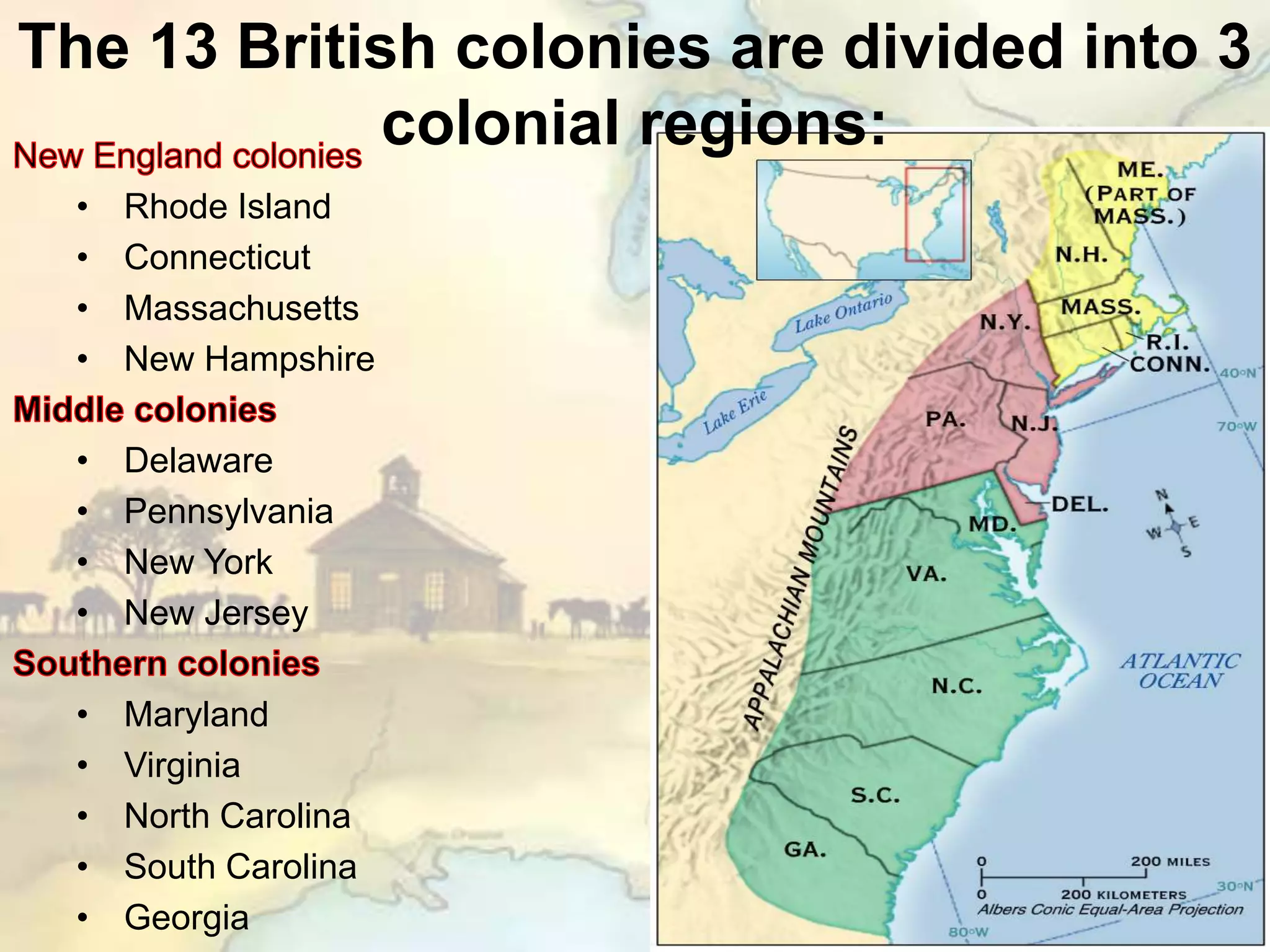
The 13 British colonies are divided into 3
colonial regions:
• Rhode Island
• Connecticut
• Massachusetts
• New Hampshire
• Delaware
• Pennsylvania
• New York
• New Jersey
• Maryland
• Virginia
• North Carolina
• South Carolina
• Georgia
Reasons why the colonies began
•God – Religious Freedoms
•The Puritans and the Pilgrims fled from
England to the colonies
•Glory – Wanted the fame of
starting a new country
•Gold – People could make lots of
money in the colonies especially on
plantations
New England
•Rhode Island
•Connecticut
•Massachusetts
•New Hampshire
New England Colonies
• Why colonies were started
–Religious Freedom
•Puritans and Pilgrims wanted
religious freedom.
Geography
Geography
New England
–Long, cold winters
–Rocky soil difficult to grow food
–Bad farming conditions
• Short farming season
• Subsistence farming (only grow the crops
you need to survive)
–Great harbors for port
• Cities like Boston
People
–Believed in “purifying”
the Church of
England.
–Believed
the Church of England was too corrupt
and could not be reformed (changed)
–Only male who owned property could
vote
God
Pope
Cardinals/Bishops
priests
People
Ministers
People
Roger Williams—was
kicked out of Massachusetts
because he disagreed with the
Puritans. He founded his own
colony in Rhode Island.
Anne Hutchinson—was kicked
out of Massachusetts because she
argued that people can read and
interpret the bible by themselves
without the minister. She was
encouraged by Roger Williams to
settle in Rhode Island.
Salem Witch Trials 1692
When the daughter of a minister died of
mysterious causes several people
including young women are blamed for
doing witchcraft.
• Many people were accused and 20
were declared witches and hanged.
• Those who were not
killed, lived with the
reputation of being
witches.
Economic
activities
Government
Mayflower Compact—
agreement between the settlers
where the town was the basic unit
of government where decisions
would be made by voting.
Only church members are
allowed to participate.
New England Town Meetings -
1629
• Meeting for
townspeople to express
themselves openly
• Helped further direct
democracy as self-
government in the
colonies
• One vote/one person
Fundamental Orders
of Connecticut- 1639
• 1st written constitution in the
American colonies
• constitution = a written plan for
government
– Long, cold winters
– Rocky soil difficult
to grow food
– Bad farming
conditions
• Short farming
season
– Great harbors for
port
• Cities like
Boston
– Puritans & Pilgrims
– John Winthrop (1st
governor of
Massachusetts)
– Roger Williams &
Anne Hutchison
(Rhode Island)
– Furs and skins
– Fish
– Iron
– Ships
– Rum
– Timber
– Whaling products
– Mayflower Compact
– New England Town
Meetings
– Fundamental Orders
of Connecticut
Middle Colonies
•Delaware
•Pennsylvania
•New York
•New Jersey
Middle Colonies
• Why colonies were started
–Religious Freedom
•Make money through trade
(New York and New Jersey)
Geography
Middle colonies
–Milder climate (not as cold as New
England but not as warm as Southern
colonies)
–Rocky soil but better able to have
small farms (longer growing season)
–Considered the “bread basket”
• Grew large amounts of grains for
trading
–Great harbors for port
People:
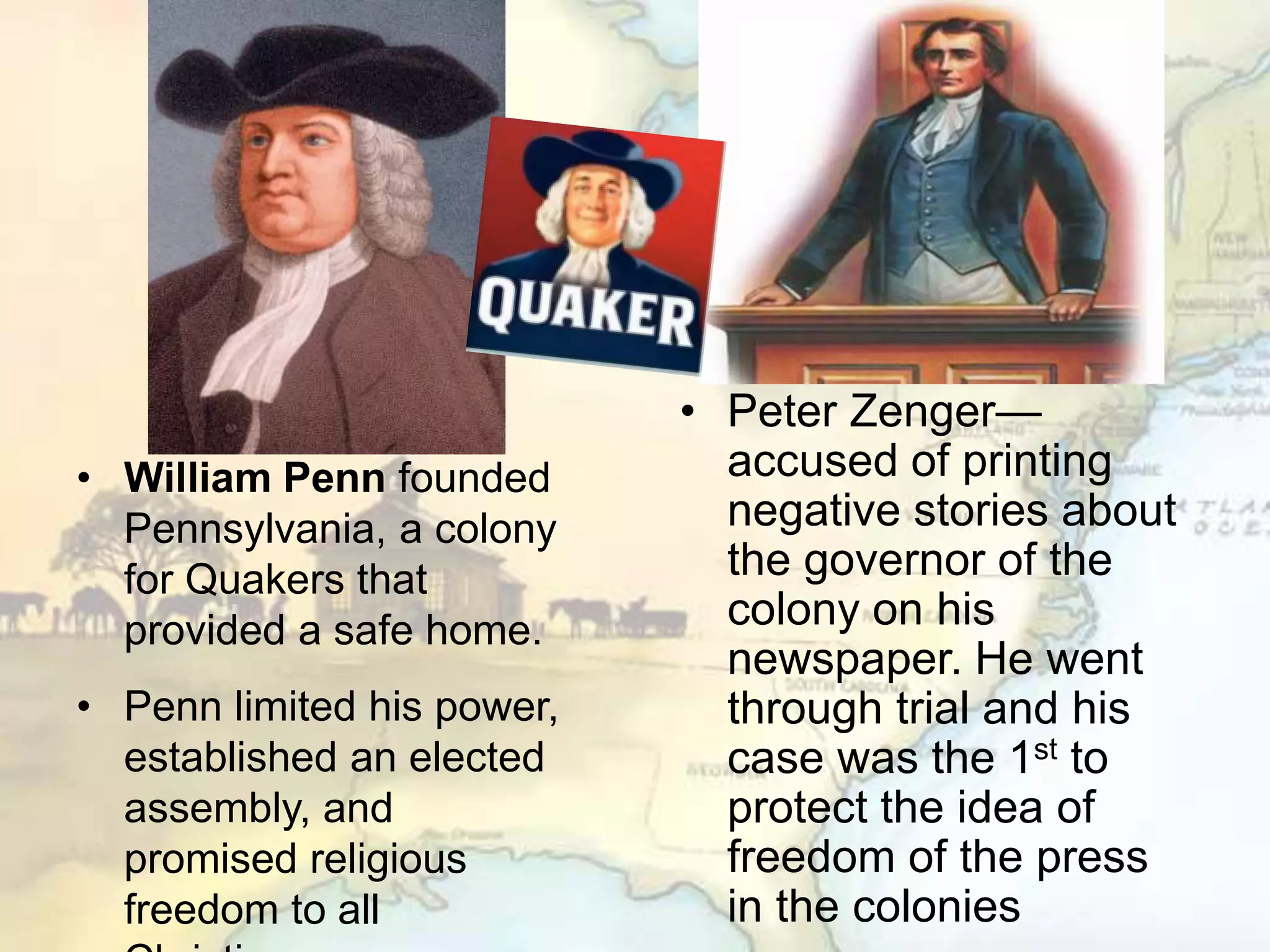
• Peter Zenger—
accused of printing
negative stories about
the governor of the
colony on his
newspaper. He went
through trial and his
case was the 1st to
protect the idea of
freedom of the press
in the colonies
• William Penn founded
Pennsylvania, a colony
for Quakers that
provided a safe home.
• Penn limited his power,
established an elected
assembly, and
promised religious
freedom to all
Economic
activities
Middle Colonies
• Known as the
“Breadbasket”
•Grew crops like wheat
and corn
–Provided food for other
colonies
–Some shipping and
manufacturing
Government
The Middle colonies are
recognized for their
.
In 1735, Peter Zenger is
declared innocent of
printing information about
the governor in his
newspaper. The courts
declared that newspapers
enjoyed the right to have
freedom of the press.
– Not as cold or warm
– Rocky soil
– Small farms “bread
basket”
– Great harbors
– Ports in cities
like New York
City
– William Penn
– Peter Zenger
– “breadbasket”
– Shipping and
manufacturing
– Ships
– Iron
– Timber
– Cattle and grain
– Strong courts (Peter
Zenger trial—
freedom of the
press)
Southern Colonies
•Maryland
•Virginia
•North Carolina
•South Carolina
•Georgia
Southern Colonies
• Why colonies were started
–Almost all were started to make
money by growing cash crops
–Maryland was started for religious
freedom
–Georgia
•A place for criminals/ debtors
Geography
Southern Colonies
• Climate and Physical Features
–Great Soil
–Warm Weather
–Very long growing seasons
–Bad harbors
People
:
• James Oglethorpe—
wealthy Englishman
who founded the
colony of Georgia as a
safe place for debtors
(people who owe
• John Rolfe—
Englishman who
introduced tobacco to
the Southern colonies.
He married Pocahontas.
Economic
activities
Southern Colonies
• Economic Advantage
–Focused on farming cash crops like
•Tobacco “brown gold”
•Cotton “white gold”
–Large farms called plantations
–Relied on slave work to maintain
plantations
A plantation
Government
Virginia House of Burgesses-
1619
• 1st representative
assembly in
America
• Beginning of
representative
government
– Long, cold winters
– Rocky soil difficult
to grow food
– Bad farming
conditions
• Short farming
season
– Great harbors for
port
• Cities like
Boston
– Puritans & Pilgrims
– John Winthrop (1st
governor of
Massachusetts)
– Roger Williams &
Anne Hutchison
(Rhode Island)
– Furs and skins
– Fish
– Iron
– Ships
– Rum
– Timber
– Whaling products
– Mayflower Compact
– New England Town
Meetings
– Fundamental Orders
of Connecticut
– Not as cold or warm
– Rocky soil
– Small farms “bread
basket”
– Great harbors
– Ports in cities
like New York
City
– William Penn
– Peter Zenger
– “breadbasket”
– Shipping and
manufacturing
– Ships
– Iron
– Timber
– Cattle and grain
– Strong courts (Peter
Zenger trial—
freedom of the
press)
– Fertile soil
– Warm weather
– Very long growing
seasons
– bad harbors
– John Rolfe
– James Oglethorpe
– Relied on
plantations or large
farms
– Cotton
– Rice
– Indigo
– Cattle
– Tobacco
– Fish
– Rum
– Virginia House of
Burgesses (house of
representatives)

Colonial Regions

  • 1.
    Aim: What werethe similarities and differences between the , , and colonies?
  • 2.
    The 13 Britishcolonies are divided into 3 colonial regions: • Rhode Island • Connecticut • Massachusetts • New Hampshire • Delaware • Pennsylvania • New York • New Jersey • Maryland • Virginia • North Carolina • South Carolina • Georgia
  • 4.
    Reasons why thecolonies began •God – Religious Freedoms •The Puritans and the Pilgrims fled from England to the colonies •Glory – Wanted the fame of starting a new country •Gold – People could make lots of money in the colonies especially on plantations
  • 5.
  • 6.
    New England Colonies •Why colonies were started –Religious Freedom •Puritans and Pilgrims wanted religious freedom.
  • 7.
  • 8.
  • 9.
    New England –Long, coldwinters –Rocky soil difficult to grow food –Bad farming conditions • Short farming season • Subsistence farming (only grow the crops you need to survive) –Great harbors for port • Cities like Boston
  • 11.
  • 12.
    –Believed in “purifying” theChurch of England. –Believed the Church of England was too corrupt and could not be reformed (changed) –Only male who owned property could vote
  • 14.
  • 16.
    Roger Williams—was kicked outof Massachusetts because he disagreed with the Puritans. He founded his own colony in Rhode Island. Anne Hutchinson—was kicked out of Massachusetts because she argued that people can read and interpret the bible by themselves without the minister. She was encouraged by Roger Williams to settle in Rhode Island.
  • 17.
    Salem Witch Trials1692 When the daughter of a minister died of mysterious causes several people including young women are blamed for doing witchcraft. • Many people were accused and 20 were declared witches and hanged. • Those who were not killed, lived with the reputation of being witches.
  • 18.
  • 20.
  • 21.
    Mayflower Compact— agreement betweenthe settlers where the town was the basic unit of government where decisions would be made by voting. Only church members are allowed to participate.
  • 22.
    New England TownMeetings - 1629 • Meeting for townspeople to express themselves openly • Helped further direct democracy as self- government in the colonies • One vote/one person
  • 23.
    Fundamental Orders of Connecticut-1639 • 1st written constitution in the American colonies • constitution = a written plan for government
  • 24.
    – Long, coldwinters – Rocky soil difficult to grow food – Bad farming conditions • Short farming season – Great harbors for port • Cities like Boston – Puritans & Pilgrims – John Winthrop (1st governor of Massachusetts) – Roger Williams & Anne Hutchison (Rhode Island) – Furs and skins – Fish – Iron – Ships – Rum – Timber – Whaling products – Mayflower Compact – New England Town Meetings – Fundamental Orders of Connecticut
  • 25.
  • 26.
    Middle Colonies • Whycolonies were started –Religious Freedom •Make money through trade (New York and New Jersey)
  • 27.
  • 29.
    Middle colonies –Milder climate(not as cold as New England but not as warm as Southern colonies) –Rocky soil but better able to have small farms (longer growing season) –Considered the “bread basket” • Grew large amounts of grains for trading –Great harbors for port
  • 30.
  • 31.
    • Peter Zenger— accusedof printing negative stories about the governor of the colony on his newspaper. He went through trial and his case was the 1st to protect the idea of freedom of the press in the colonies • William Penn founded Pennsylvania, a colony for Quakers that provided a safe home. • Penn limited his power, established an elected assembly, and promised religious freedom to all
  • 32.
  • 33.
    Middle Colonies • Knownas the “Breadbasket” •Grew crops like wheat and corn –Provided food for other colonies –Some shipping and manufacturing
  • 35.
  • 36.
    The Middle coloniesare recognized for their . In 1735, Peter Zenger is declared innocent of printing information about the governor in his newspaper. The courts declared that newspapers enjoyed the right to have freedom of the press.
  • 37.
    – Not ascold or warm – Rocky soil – Small farms “bread basket” – Great harbors – Ports in cities like New York City – William Penn – Peter Zenger – “breadbasket” – Shipping and manufacturing – Ships – Iron – Timber – Cattle and grain – Strong courts (Peter Zenger trial— freedom of the press)
  • 38.
  • 39.
    Southern Colonies • Whycolonies were started –Almost all were started to make money by growing cash crops –Maryland was started for religious freedom –Georgia •A place for criminals/ debtors
  • 40.
  • 42.
    Southern Colonies • Climateand Physical Features –Great Soil –Warm Weather –Very long growing seasons –Bad harbors
  • 43.
  • 44.
    • James Oglethorpe— wealthyEnglishman who founded the colony of Georgia as a safe place for debtors (people who owe • John Rolfe— Englishman who introduced tobacco to the Southern colonies. He married Pocahontas.
  • 45.
  • 46.
    Southern Colonies • EconomicAdvantage –Focused on farming cash crops like •Tobacco “brown gold” •Cotton “white gold” –Large farms called plantations –Relied on slave work to maintain plantations
  • 48.
  • 49.
  • 50.
    Virginia House ofBurgesses- 1619 • 1st representative assembly in America • Beginning of representative government
  • 51.
    – Long, coldwinters – Rocky soil difficult to grow food – Bad farming conditions • Short farming season – Great harbors for port • Cities like Boston – Puritans & Pilgrims – John Winthrop (1st governor of Massachusetts) – Roger Williams & Anne Hutchison (Rhode Island) – Furs and skins – Fish – Iron – Ships – Rum – Timber – Whaling products – Mayflower Compact – New England Town Meetings – Fundamental Orders of Connecticut – Not as cold or warm – Rocky soil – Small farms “bread basket” – Great harbors – Ports in cities like New York City – William Penn – Peter Zenger – “breadbasket” – Shipping and manufacturing – Ships – Iron – Timber – Cattle and grain – Strong courts (Peter Zenger trial— freedom of the press) – Fertile soil – Warm weather – Very long growing seasons – bad harbors – John Rolfe – James Oglethorpe – Relied on plantations or large farms – Cotton – Rice – Indigo – Cattle – Tobacco – Fish – Rum – Virginia House of Burgesses (house of representatives)