Collective Bargaining
(Positional)
Taking the Firefighters' Heat
Great negotiators are not "naturals" who simply possess some hidden talent
unknown to others. Effective negotiation requires shill building that can only be
perfected through knowledge and repetitive practice on a regular basis in each
negotiating situation. Positional bargaining is a strategy that is based on moving
from position to position, without one's true agenda, until compromise is
reached. Unlike problem-solving negotiation, which has been called "getting to
yes, " positional bargaining is more like "getting to OK."
The City of Concord, New Hampshire, has a population of 50, 000 inhabitant, and its city hall is
currently preparing for negotiations with the International Association of Firefighters (IAFF),
Local ft37, which represents the 120 full-time firefighters and paramedics who are deployed
among seven station houses. Both parties are approaching the upcoming negotiations with
some trepidation because labor-management relations under the present collective bargaining
agreement have been anything but harmonious.
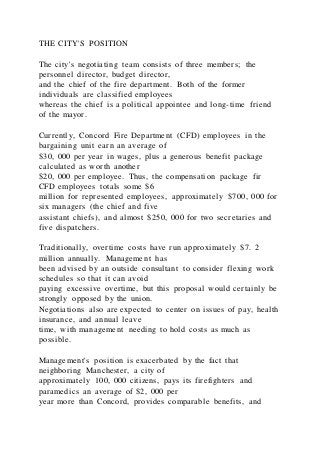
THE CITY'S POSITION
The city's negotiating team consists of three members; the personnel director, budget director,
and the chief of the fire department. Both of the former individuals are classified employees
whereas the chief is a political appointee and long-time friend of the mayor.
Currently, Concord Fire Department (CFD) employees in the bargaining unit earn an average of
$30, 000 per year in wages, plus a generous benefit package calculated as worth another
$20, 000 per employee. Thus, the compensation package fir CFD employees totals some $6
million for represented employees, approximately $700, 000 for six managers (the chief and five
assistant chiefs), and almost $250, 000 for two secretaries and five dispatchers.
Traditionally, overtime costs have run approximately $7. 2 million annually. Management has
been advised by an outside consultant to consider flexing work schedules so that it can avoid
paying excessive overtime, but this proposal would certainly be strongly opposed by the union.
Negotiations also are expected to center on issues of pay, health insurance, and annual leave
time, with management needing to hold costs as much as possible.
Management's position is exacerbated by the fact that neighboring Manchester, a city of
approximately 100, 000 citizens, pays its firefighters and paramedics an average of $2, 000 per
year more than Concord, provides comparable benefits, and allows a week more annual leave
(three to five weeks, depending on seniority, in contrast to the two to four weeks given by
CFD). Increased annual leave would mean hiring more employees, and the mayor is adamantly
opposed to new hires. The negotiating team believes that the union will want a package similar
to the Manchester Fire Department, but the mayor has ordered the management team to hold
the line on labor costs.
Budget projections for next year are p ...





![elements of the final product. It should
reflect the incorporation of feedback gained throughout the
course. This submission will be graded with the Final Project
Rubric (below).
Final Project Rubric
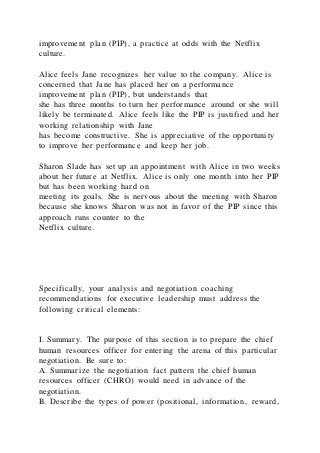
Guidelines for Submission: Your analysis and negotiation
coaching recommendations for executive leadership paper
should be 6–8 pages, double-spaced, using
12-point Times New Roman font and APA 6th edition format.
You also have the option of submitting your analysis and
negotiation coaching recommendations for
executive leadership as a presentation with 14–16 slides
accompanied by speaker notes. Your presentation should be of
professional quality and use APA 6th
edition format.
Critical Elements Exemplary (100%) Proficient (90%) Needs
Improvement (70%) Not Evident (0%) Value
Summary: Negotiation
Fact Pattern
[WCM-510-01]
Meets “Proficient” criteria and
summary offers keen insight into
what might happen in the
negotiation
Summarizes the negotiation fact](https://image.slidesharecdn.com/collectivebargainingpositionaltakingthefirefighte-220921143907-1c487474/85/Collective-Bargaining-Positional-Taking-the-Firefighte-18-320.jpg)
![pattern the CHRO would need in
advance of the negotiation
Summarizes the negotiation fact
pattern the CHRO would need in
advance of negotiation, but
summary is verbose or lacks
necessary detail
Does not summarize the
negotiation fact pattern the
CHRO would need in advance of
the negotiation
6.4
Summary: Types of
Power
[WCM-510-01]
Meets “Proficient” criteria and
makes especially cogent
connections between the types
of power the CHRO has and the
negotiation
Describes the types of power the
CHRO has and how they are
important to the particular
negotiation
Describes the types of power the
CHRO has and how they are
important to the particular
negotiation, but description is](https://image.slidesharecdn.com/collectivebargainingpositionaltakingthefirefighte-220921143907-1c487474/85/Collective-Bargaining-Positional-Taking-the-Firefighte-19-320.jpg)
![cursory or contains inaccuracies
Does not describe the types of
power the CHRO has and how
they are important to the
particular negotiation
6.4
Summary: Appropriate
Alternatives
[WCM-510-01]
Meets “Proficient” criteria and
described alternatives offer keen
insight into what might happen in
the negotiation
Describes appropriate
alternatives that the CHRO would
want to consider in the event
that an agreement is not reached
Describes alternatives that the
CHRO would want to consider in
the event that an agreement is
not reached, but description is
cursory, contains inaccuracies, or
alternatives are not appropriate
Does not describe alternatives
that the CHRO would want to
consider in the event that an
agreement is not reached](https://image.slidesharecdn.com/collectivebargainingpositionaltakingthefirefighte-220921143907-1c487474/85/Collective-Bargaining-Positional-Taking-the-Firefighte-20-320.jpg)
![6.4
Cultural Analysis:
Organizational
Culture [WCM-510-02]
Meets “Proficient” criteria and
examples provided make
particularly cogent connections
between the company’s reaction
and organizational culture
Determines what inferences can
be drawn about the company’s
organizational culture based on
the company’s reaction to an
employee leaving, supporting
reasoning with specific examples
Determines what inferences can
be drawn about the company’s
organizational culture based on
the company’s reaction to an
employee leaving, but
determination is illogical, or does
not support reasoning with
specific examples
Does not determine what
inferences can be drawn about
the company’s organizational
culture based on the company’s
reaction to an employee leaving
6.4](https://image.slidesharecdn.com/collectivebargainingpositionaltakingthefirefighte-220921143907-1c487474/85/Collective-Bargaining-Positional-Taking-the-Firefighte-21-320.jpg)
![Cultural Analysis:
Cultural Assumptions
[WCM-510-02]
Meets “Proficient” criteria and
examples provided demonstrate
keen insight into the influence of
cultural assumptions on
organizational policy decisions
Describes what cultural
assumptions drive the
organization’s policy decisions,
supporting response with
examples
Describes what cultural
assumptions drive the
organization’s policy decisions,
supporting response with
examples, but description is
cursory, contains inaccuracies, or
contains gaps in support
Does not describe what cultural
assumptions drive the
organization’s policy decisions,
supporting response with
examples
6.4](https://image.slidesharecdn.com/collectivebargainingpositionaltakingthefirefighte-220921143907-1c487474/85/Collective-Bargaining-Positional-Taking-the-Firefighte-22-320.jpg)
![Cultural Analysis:
Severance
Negotiation
[WCM-510-02]
Meets “Proficient” criteria and
examples provided demonstrate
keen insight into how cultural
assumptions in severance
negotiations can be beneficial for
the company
Explains how assumptions could
be used to engage in a severance
negotiation that results in the
most beneficial outcome for the
company and supports
explanation with effective
examples
Explains how assumptions could
be used to engage in a severance
negotiation that results in the
most beneficial outcome for the
company and supports
explanation with examples, but
explanation is cursory, contains
inaccuracies, or examples are not
effective
Does not explain how
assumptions could be used to
engage in a severance
negotiation that results in the
most beneficial outcome for the](https://image.slidesharecdn.com/collectivebargainingpositionaltakingthefirefighte-220921143907-1c487474/85/Collective-Bargaining-Positional-Taking-the-Firefighte-23-320.jpg)
![company
6.4
PIOC Analysis: CHRO’s
Opening Remarks
[WCM-510-03]
Meets “Proficient” criteria and
phrasing demonstrates an astute
ability to separate people from
problems with principled
negotiation tactics
Formulates appropriate phrasing,
based on principled negotiation
practices, for the CHRO’s opening
remarks that separates the
people from the problems
Formulates phrasing for the
CHRO’s opening remarks based
on principled negotiation
practices, but phrasing is not
appropriate or logical, or does
not separate the people from the
problems
Does not formulate phrasing for
the CHRO’s opening remarks
4.8
PIOC Analysis: Case-
Specific Negotiating](https://image.slidesharecdn.com/collectivebargainingpositionaltakingthefirefighte-220921143907-1c487474/85/Collective-Bargaining-Positional-Taking-the-Firefighte-24-320.jpg)
![[WCM-510-03]
Meets “Proficient” criteria and
rephrasing demonstrates keen
insight into case-specific
negotiating positions
Identifies appropriate case-
specific negotiating positions and
rephrases them as interests
Identifies negotiating positions
and rephrases them as interests,
but some positions are
inappropriate or are not case-
specific
Does not identify negotiating
positions and rephrase them as
interests
4.8
PIOC Analysis:
Integrative
Interests
[WCM-510-03]
Meets “Proficient” criteria and
recommendations demonstrate a
sophisticated approach to
addressing integrative interests
Recommends options that can](https://image.slidesharecdn.com/collectivebargainingpositionaltakingthefirefighte-220921143907-1c487474/85/Collective-Bargaining-Positional-Taking-the-Firefighte-25-320.jpg)
![appropriately address the parties’
integrative interests
Recommends options that can
address the parties’ integrative
interests, but some
recommendations are illogical or
inappropriate
Does not recommend options
that can address the parties’
integrative interests
4.8
PIOC Analysis:
Objective
Criteria
[WCM-510-03]
Meets “Proficient” criteria and
explanation makes especially
cogent connections between
objective criteria and distributive
elements
Identifies objective criteria that
can be used to measure
distributive elements of the
negotiation, explaining reasoning
for choices
Identifies criteria that can be
used to measure distributive
elements of the negotiation, but](https://image.slidesharecdn.com/collectivebargainingpositionaltakingthefirefighte-220921143907-1c487474/85/Collective-Bargaining-Positional-Taking-the-Firefighte-26-320.jpg)
![not all criteria are objective, or
does not explain choices
Does not identify criteria that can
be used to measure distributive
elements of the negotiation
4.8
Communication
Strategies: Overt
Communication
[WCM-510-04]
Meets “Proficient” criteria and
reasoning offers keen insight into
what makes overt
communication effective in
different circumstances
Identifies examples of effective
overt communication that could
be used in the negotiation,
explaining reasoning
Identifies examples of overt
communication that could be
used in the negotiation,
explaining reasoning, but not all
examples are effective for the
given situation, or reasoning is
cursory or illogical
Does not identify examples of
overt communication that could
be used in the negotiation,](https://image.slidesharecdn.com/collectivebargainingpositionaltakingthefirefighte-220921143907-1c487474/85/Collective-Bargaining-Positional-Taking-the-Firefighte-27-320.jpg)
![explaining reasoning for choices
6.4
Communication
Strategies: Tacit
Communication
[WCM-510-04]
Meets “Proficient” criteria and
examples offer keen insight into
the role of tacit communication
in the negotiation
Identifies situations where tacit
communication is important to
the negotiation and provides
examples of how such
communication might be used in
upcoming meetings
Identifies situations where tacit
communication might be used in
the negotiation and provides
examples of how to do so, but
not all situations and examples
identified are important to the
negotiation, involve tacit
communication, or are relevant
for the given situation
Does not identify situations
where tacit communication might
be used and provide examples of](https://image.slidesharecdn.com/collectivebargainingpositionaltakingthefirefighte-220921143907-1c487474/85/Collective-Bargaining-Positional-Taking-the-Firefighte-28-320.jpg)
![how to do so
6.4
Communication
Strategies: Benefits and
Risks
[WCM-510-04]
Meets “Proficient” criteria and is
exceptionally insightful about
how overt and tacit
communication can be both
beneficial and risky in
negotiations
Contrasts the benefits and risks
of using overt and tacit
communication methods with
respect to the negotiation
Contrasts the benefits and risks
of using overt and tacit
communication methods, but
contrast contains inaccuracies, or
is not done with respect to the
negotiation
Does not contrast the benefits
and risks of using overt and tacit
communication methods
6.4
Negotiation Tactics and](https://image.slidesharecdn.com/collectivebargainingpositionaltakingthefirefighte-220921143907-1c487474/85/Collective-Bargaining-Positional-Taking-the-Firefighte-29-320.jpg)
![Strategies: Potential
Gambits
[WCM-510-05]
Meets “Proficient” criteria and
summary offers keen insight into
how potential negotiating
gambits could advance a
distributive negotiating agenda
Summarizes potential negotiating
gambits that could advance a
distributive negotiating agenda in
the situation
Summarizes potential negotiating
gambits that could advance a
distributive negotiating agenda,
but summary is verbose, lacks
necessary detail, or gambits are
not specific to the situation
Does not summarize potential
negotiating gambits that could
advance a distributive
negotiating agenda
6.4
Negotiation Tactics and
Strategies: Specific
Gambits
[WCM-510-05]](https://image.slidesharecdn.com/collectivebargainingpositionaltakingthefirefighte-220921143907-1c487474/85/Collective-Bargaining-Positional-Taking-the-Firefighte-30-320.jpg)
![Meets “Proficient” criteria and
explanation makes especially
cogent connections between
specific gambits and the
negotiation
Recommends which specific
gambits would be most
appropriate for advancing agenda
in this negotiation, explaining
reasoning
Recommends specific gambits for
advancing agenda in this
situation, explaining reasoning,
but not all gambits are
appropriate, or reasoning
contains gaps in logic
Does not recommend specific
gambits for advancing agenda in
this situation, explaining
reasoning
6.4
Negotiation Tactics and
Strategies: Tactics
[WCM-510-05]
Meets “Proficient” criteria and
explanation offers keen insight
into why the negotiator should
avoid certain tactics](https://image.slidesharecdn.com/collectivebargainingpositionaltakingthefirefighte-220921143907-1c487474/85/Collective-Bargaining-Positional-Taking-the-Firefighte-31-320.jpg)


