Records Management
For Community Engagement and
Consultation with Aboriginal
Peoples
Presented by:
Colin Ellis
SustaiNet Software International Inc.
Unique Considerations:
• Aboriginal Peoples are not stakeholders
• Relationship driven VS Deadline driven
• Unique Organizational Structures
• Often Blurred Authority and Responsibility
• Land Interest and Land Use
“The complexities are clear to the practitioner
and should be clear in the documentation so it
can be shared and understood”
To help demonstrate transparency…
Let your records tell the STORY!
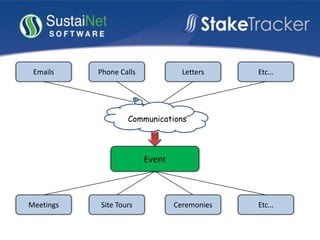
• Consider separating Communication records from
Event Records
Meetings CeremoniesSite Tours
Event
Emails LettersPhone Calls Etc…
Etc…
Communications
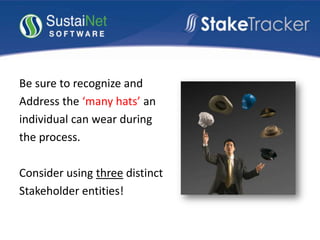
Be sure to recognize and
Address the ‘many hats’ an
individual can wear during
the process.
Consider using three distinct
Stakeholder entities!
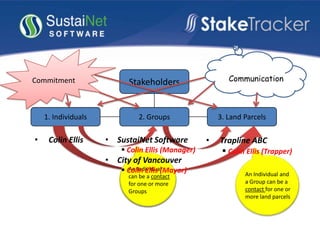
2. Groups1. Individuals
Stakeholders
3. Land Parcels
An Individual and
a Group can be a
contact for one or
more land parcels
An Individual
can be a contact
for one or more
Groups
An Individual
can be a contact
for one or more
Groups
• Colin Ellis • SustaiNet Software
 Colin Ellis (Manager)
• City of Vancouver
 Colin Ellis (Mayor)
• Trapline ABC
 Colin Ellis (Trapper)
CommunicationCommitment
How to clarify Roles, Responsibility and Authority:
1. Date stamp an Individual’s
affiliation to Groups
 Job Title and Job Role
 Contact Type (Primary/Secondary/Other)
and Preferred Method of Contact
 Group Spokesperson (Yes/No)
2. Date stamp an Individual’s interest to Land
 Land Interest (Trapper/Owner/Tenant/Etc)
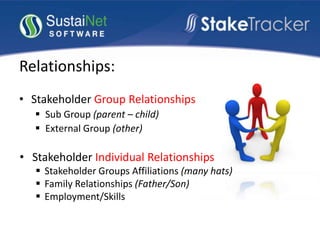
Relationships:
• Stakeholder Group Relationships
 Sub Group (parent – child)
 External Group (other)
• Stakeholder Individual Relationships
 Stakeholder Groups Affiliations (many hats)
 Family Relationships (Father/Son)
 Employment/Skills
Best ‘Documentation’ Practices
• Stakeholder Group Attributes (First Nations, Métis, Inuit)
• Election Dates
• Documents/Agreements/Email records
• Confidentiality (security of sensitive information)
• Geo-references (Points of Interest related to the land)
• Issues (Topics) and Resolutions (Mitigation measures)
• Commitments (Promises)
• Incidents, Complaints and Grievances
Questions?
Lauren & Charlotte
April 12 2013
Please download our EBook:
‘Best Practices for Documenting Aboriginal
Community Engagement And Consultation
in Canada’
www.SustaiNet.com

Records Management For Community Engagement and Consultation with Aboriginal Peoples - Colin Ellis

  • 1.
    Records Management For CommunityEngagement and Consultation with Aboriginal Peoples Presented by: Colin Ellis SustaiNet Software International Inc.
  • 2.
    Unique Considerations: • AboriginalPeoples are not stakeholders • Relationship driven VS Deadline driven • Unique Organizational Structures • Often Blurred Authority and Responsibility • Land Interest and Land Use “The complexities are clear to the practitioner and should be clear in the documentation so it can be shared and understood”
  • 3.
    To help demonstratetransparency… Let your records tell the STORY! • Consider separating Communication records from Event Records
  • 4.
    Meetings CeremoniesSite Tours Event EmailsLettersPhone Calls Etc… Etc… Communications
  • 5.
    Be sure torecognize and Address the ‘many hats’ an individual can wear during the process. Consider using three distinct Stakeholder entities!
  • 6.
    2. Groups1. Individuals Stakeholders 3.Land Parcels An Individual and a Group can be a contact for one or more land parcels An Individual can be a contact for one or more Groups An Individual can be a contact for one or more Groups • Colin Ellis • SustaiNet Software  Colin Ellis (Manager) • City of Vancouver  Colin Ellis (Mayor) • Trapline ABC  Colin Ellis (Trapper) CommunicationCommitment
  • 7.
    How to clarifyRoles, Responsibility and Authority: 1. Date stamp an Individual’s affiliation to Groups  Job Title and Job Role  Contact Type (Primary/Secondary/Other) and Preferred Method of Contact  Group Spokesperson (Yes/No) 2. Date stamp an Individual’s interest to Land  Land Interest (Trapper/Owner/Tenant/Etc)
  • 8.
    Relationships: • Stakeholder GroupRelationships  Sub Group (parent – child)  External Group (other) • Stakeholder Individual Relationships  Stakeholder Groups Affiliations (many hats)  Family Relationships (Father/Son)  Employment/Skills
  • 9.
    Best ‘Documentation’ Practices •Stakeholder Group Attributes (First Nations, Métis, Inuit) • Election Dates • Documents/Agreements/Email records • Confidentiality (security of sensitive information) • Geo-references (Points of Interest related to the land) • Issues (Topics) and Resolutions (Mitigation measures) • Commitments (Promises) • Incidents, Complaints and Grievances
  • 10.
    Questions? Lauren & Charlotte April12 2013 Please download our EBook: ‘Best Practices for Documenting Aboriginal Community Engagement And Consultation in Canada’ www.SustaiNet.com

Editor's Notes

  • #2 Share some “best practices” and considerations to help you track and report on your Aboriginal engagement processes.I’m going to share some database essentials, talk about the unique environment that is Aboriginal engagement, I will then take you through 2 key methods to help you demonstrate transparency and maintain data integrity, and then conclude with sharing some Aboriginal engagement records management best practices.
  • #3 1. Different Rights therefore different needs 2. Think in terms of relationships and not timelines therefore records should be kept prior, during and following the regulatory process 3. Unique organizational structures + Blurred authority & responsibility - often hard to define, not ‘black and white’ 5. Land plays a big part in these people’s lives and therefore that relationship needs to be understood.
  • #4 People like stories. For those of you involved in EA’s, stories get approved faster, it’s human nature to take on the easiest task first (Story – Suncor). A good starting point to help is to consider separating Communication records from Event Records.
  • #5 Example – Events are often the starting point for your consultation processExample – Planning/at the meeting/following the meeting (action items)Story – Total (Aboriginal meeting reschedule)
  • #6 Story many hats = Aboriginal chief, mayor of the town, family works a trapline and son operates a snow removal business.
  • #8 So the landscape of who you’re talking to is inevitably going to change over time (snapshot story). In order to keep track of all these changes and clarify roles, responsibility and authority, I suggest doing the following:
  • #9 Sub group examples: IRC’s (industry Relations Corporation) or Businesses (Tsleilwatuth story)