SLIDESMANIA.
Lesson 1.2 Lesson 1.3 Materials Videos Activities
Lesson 1.1
Lesson 1.1 Lesson 1.2 Lesson 1.3
Materials Videos Activities
Home
SLIDESMANIA.
Cognitive Development
of Primary Schoolers
SLIDESMANIA.
Lesson 1.2 Lesson 1.3 Materials Videos Activities
Lesson 1.1
SLIDESMANIA.
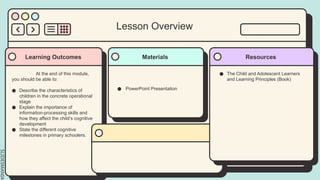
Learning Outcomes
At the end of this module,
you should be able to:
â—Ź Describe the characteristics of
children in the concrete operational
stage
â—Ź Explain the importance of
information-processing skills and
how they affect the child’s cognitive
development
â—Ź State the different cognitive
milestones in primary schoolers.
Lesson Overview
Resources
â—Ź The Child and Adolescent Learners
and Learning Principles (Book)
Materials
â—Ź PowerPoint Presentation
SLIDESMANIA.
Lesson 1.2 Lesson 1.3 Materials Videos Activities
Lesson 1.1
Lesson 1.1 Lesson 1.2 Lesson 1.3
Materials Videos Activities
Home
SLIDESMANIA.
INTRODUCTION
Let's get started!
SLIDESMANIA.
Lesson 1.2 Lesson 1.3 Materials Videos Activities
Lesson 1.1
Lesson 1 | Part 1- Introduction
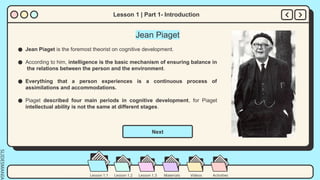
Jean Piaget
â—Ź Jean Piaget is the foremost theorist on cognitive development.
â—Ź According to him, intelligence is the basic mechanism of ensuring balance in
the relations between the person and the environment.
â—Ź Everything that a person experiences is a continuous process of
assimilations and accommodations.
â—Ź Piaget described four main periods in cognitive development, for Piaget
intellectual ability is not the same at different stages.
Next
SLIDESMANIA.
Lesson 1.2 Lesson 1.3 Materials Videos Activities
Lesson 1.1
Lesson 1 | Part 2
Jean Piaget’s Concrete Operational Stage
1. LOGIC
• Concrete operational thinkers according to
Piaget can already make use of inductive logic.
• Inductive logic involves thinking from a specific
experience to a general principle.
• But at the stage, children have great difficulty in
using deductive logic or beginning with a
general principle leading to specific event.
2. REVERSIBILITY
• One of the most important developments in this
stage is an understanding of reversibility, or
awareness that actions can be reversed.
• An example of this is being able to reverse the
order of relationships between mental
categories.
SLIDESMANIA.
Lesson 1.2 Lesson 1.3 Materials Videos Activities
Lesson 1.1
Lesson 1 | Part 3
Cognitive Milestones
Elementary aged children encounter developmental milestones.
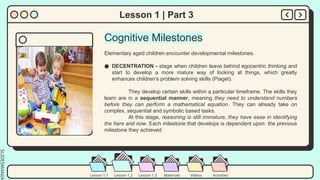
â—Ź DECENTRATION - stage when children leave behind egocentric thinking and
start to develop a more mature way of looking at things, which greatly
enhances children’s problem solving skills (Piaget).
They develop certain skills within a particular timeframe. The skills they
learn are in a sequential manner, meaning they need to understand numbers
before they can perform a mathematical equation. They can already take on
complex, sequential and symbolic based tasks.
At this stage, reasoning is still immature, they have ease in identifying
the here and now. Each milestone that develops is dependent upon the previous
milestone they achieved.
SLIDESMANIA.
Lesson 1.2 Lesson 1.3 Materials Videos Activities
Lesson 1.1
Lesson 1 | Part 3
Cognitive Milestones
Up until age 8, a child learns new skills at a rapid pace. Once
they reached the age of 8, the skills they learn start to level off so there
is a steady increase of new skills.
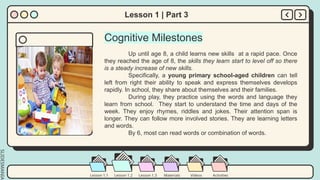
Specifically, a young primary school-aged children can tell
left from right their ability to speak and express themselves develops
rapidly. In school, they share about themselves and their families.
During play, they practice using the words and language they
learn from school. They start to understand the time and days of the
week. They enjoy rhymes, riddles and jokes. Their attention span is
longer. They can follow more involved stories. They are learning letters
and words.
By 6, most can read words or combination of words.
SLIDESMANIA.
Lesson 1.2 Lesson 1.3 Materials Videos Activities
Lesson 1.1
Lesson 1 | Part 4
Information Processing Skills
“Several theorists argue that
like the computer, the human mind
is a system that can process
information through the application
of logical rules and strategies. They
also believe that the mind receives
information, performs operations to
change it’s form and content,
stores and locates it and generates
responses from it.”
Next
SLIDESMANIA.
Lesson 1.2 Lesson 1.3 Materials Videos Activities
Lesson 1.1
Lesson 1 | Part 5
Implications to Childcare, Education and Parenting
Children have varying intelligence profiles. This
profiles may be based on influences of learning and
achievement. Parents, childcare providers and teachers should
be able to recognize these by:
• Helping children draw on their strengths and promote
growth in their weaknesses.
• Planning lessons that cater to multiple intelligences
base on instructional objectives.
• Encouraging children to read more everyday to
increase their vocabulary.
• Bringing children to museums, art exhibits and
historical landmarks to widen their perspective about
the world and people and;
• Lessening children’s screen time and increasing their
personal and face-to-face interactions.
SLIDESMANIA.
Lesson 1.2 Lesson 1.3 Materials Videos Activities
Lesson 1.1
-END-
THANK YOU!

Cognitive Development of Primary Schoolers

  • 1.
    SLIDESMANIA. Lesson 1.2 Lesson1.3 Materials Videos Activities Lesson 1.1 Lesson 1.1 Lesson 1.2 Lesson 1.3 Materials Videos Activities Home SLIDESMANIA. Cognitive Development of Primary Schoolers
  • 2.
    SLIDESMANIA. Lesson 1.2 Lesson1.3 Materials Videos Activities Lesson 1.1 SLIDESMANIA. Learning Outcomes At the end of this module, you should be able to: ● Describe the characteristics of children in the concrete operational stage ● Explain the importance of information-processing skills and how they affect the child’s cognitive development ● State the different cognitive milestones in primary schoolers. Lesson Overview Resources ● The Child and Adolescent Learners and Learning Principles (Book) Materials ● PowerPoint Presentation
  • 3.
    SLIDESMANIA. Lesson 1.2 Lesson1.3 Materials Videos Activities Lesson 1.1 Lesson 1.1 Lesson 1.2 Lesson 1.3 Materials Videos Activities Home SLIDESMANIA. INTRODUCTION Let's get started!
  • 4.
    SLIDESMANIA. Lesson 1.2 Lesson1.3 Materials Videos Activities Lesson 1.1 Lesson 1 | Part 1- Introduction Jean Piaget â—Ź Jean Piaget is the foremost theorist on cognitive development. â—Ź According to him, intelligence is the basic mechanism of ensuring balance in the relations between the person and the environment. â—Ź Everything that a person experiences is a continuous process of assimilations and accommodations. â—Ź Piaget described four main periods in cognitive development, for Piaget intellectual ability is not the same at different stages. Next
  • 5.
    SLIDESMANIA. Lesson 1.2 Lesson1.3 Materials Videos Activities Lesson 1.1 Lesson 1 | Part 2 Jean Piaget’s Concrete Operational Stage 1. LOGIC • Concrete operational thinkers according to Piaget can already make use of inductive logic. • Inductive logic involves thinking from a specific experience to a general principle. • But at the stage, children have great difficulty in using deductive logic or beginning with a general principle leading to specific event. 2. REVERSIBILITY • One of the most important developments in this stage is an understanding of reversibility, or awareness that actions can be reversed. • An example of this is being able to reverse the order of relationships between mental categories.
  • 6.
    SLIDESMANIA. Lesson 1.2 Lesson1.3 Materials Videos Activities Lesson 1.1 Lesson 1 | Part 3 Cognitive Milestones Elementary aged children encounter developmental milestones. ● DECENTRATION - stage when children leave behind egocentric thinking and start to develop a more mature way of looking at things, which greatly enhances children’s problem solving skills (Piaget). They develop certain skills within a particular timeframe. The skills they learn are in a sequential manner, meaning they need to understand numbers before they can perform a mathematical equation. They can already take on complex, sequential and symbolic based tasks. At this stage, reasoning is still immature, they have ease in identifying the here and now. Each milestone that develops is dependent upon the previous milestone they achieved.
  • 7.
    SLIDESMANIA. Lesson 1.2 Lesson1.3 Materials Videos Activities Lesson 1.1 Lesson 1 | Part 3 Cognitive Milestones Up until age 8, a child learns new skills at a rapid pace. Once they reached the age of 8, the skills they learn start to level off so there is a steady increase of new skills. Specifically, a young primary school-aged children can tell left from right their ability to speak and express themselves develops rapidly. In school, they share about themselves and their families. During play, they practice using the words and language they learn from school. They start to understand the time and days of the week. They enjoy rhymes, riddles and jokes. Their attention span is longer. They can follow more involved stories. They are learning letters and words. By 6, most can read words or combination of words.
  • 8.
    SLIDESMANIA. Lesson 1.2 Lesson1.3 Materials Videos Activities Lesson 1.1 Lesson 1 | Part 4 Information Processing Skills “Several theorists argue that like the computer, the human mind is a system that can process information through the application of logical rules and strategies. They also believe that the mind receives information, performs operations to change it’s form and content, stores and locates it and generates responses from it.” Next
  • 9.
    SLIDESMANIA. Lesson 1.2 Lesson1.3 Materials Videos Activities Lesson 1.1 Lesson 1 | Part 5 Implications to Childcare, Education and Parenting Children have varying intelligence profiles. This profiles may be based on influences of learning and achievement. Parents, childcare providers and teachers should be able to recognize these by: • Helping children draw on their strengths and promote growth in their weaknesses. • Planning lessons that cater to multiple intelligences base on instructional objectives. • Encouraging children to read more everyday to increase their vocabulary. • Bringing children to museums, art exhibits and historical landmarks to widen their perspective about the world and people and; • Lessening children’s screen time and increasing their personal and face-to-face interactions.
  • 10.
    SLIDESMANIA. Lesson 1.2 Lesson1.3 Materials Videos Activities Lesson 1.1 -END- THANK YOU!