COGNITIVE DEVELOPMENT
&
COGNITIVE DYSFUNCTION
TOPIC
OUTLINE
• COGNITIVE DEVELOPMENT
• PIAGET
• VYGOTSKY
• BRUNER
• COGNITIVE DYSFUNCTION
CAUSES
• SYMPTOMS
• INTERVENTION
COGNITIVE
DEVELOPMENT
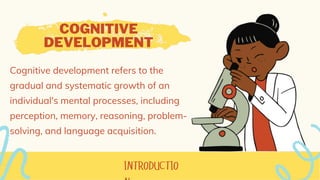
Cognitive development refers to the
gradual and systematic growth of an
individual's mental processes, including
perception, memory, reasoning, problem-
solving, and language acquisition.
VYGOTSKY
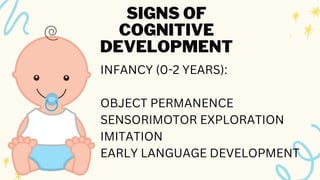
INFANCY (0-2 YEARS):
OBJECT PERMANENCE
SENSORIMOTOR EXPLORATION
IMITATION
EARLY LANGUAGE DEVELOPMENT
SIGNS OF
COGNITIVE
DEVELOPMENT
SYMBOLIC PLAY
LANGUAGE DEVELOPMENT
CONCEPTUAL
UNDERSTANDING IMAGINATIVE
THINKING
EARLY CHILDHOOD (2-6 YEARS):
SIGNS OF
COGNITIVE
DEVELOPMENT
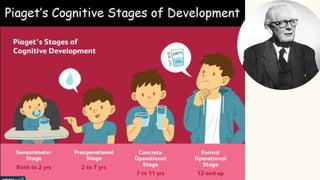
CONCRETE OPERATIONS
PROBLEM-SOLVING SKILLS
MENTAL REVERSIBILITY
UNDERSTANDING
MIDDLE CHILDHOOD (7-11
YEARS):
SIGNS OF
COGNITIVE
DEVELOPMENT
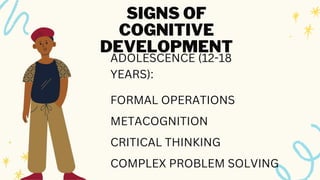
FORMAL OPERATIONS
METACOGNITION
CRITICAL THINKING
COMPLEX PROBLEM SOLVING
ADOLESCENCE (12-18
YEARS):
SIGNS OF
COGNITIVE
DEVELOPMENT
COGNITIVE
DYSFUNCTION
COGNITIVE DYSFUNCTION
COGNITIVE DYSFUNCTION REFERS TO A
CONDITION WHERE THERE IS IMPAIRMENT OR
DISRUPTION IN COGNITIVE PROCESSES, WHICH
ENCOMPASS A RANGE OF MENTAL ACTIVITIES
RELATED TO ACQUIRING, PROCESSING, STORING,
AND USING INFORMATION.
CAUSES
Neurological Disorders
Psychiatric Illnesses
Traumatic Brain Injury (TBI)
Infections and Inflammatory Conditio
Medication Side Effect
CAUSES
Substance Abuse
Sleep Disorders
Age-RelatedCognitive Decline
Genetic Factors
Memory Impairment
Attention Deficits
Language Difficulties
Executive Function Impairment
Impaired Judgement
Difficulty with Problem-
Solving Spatial Disorientation
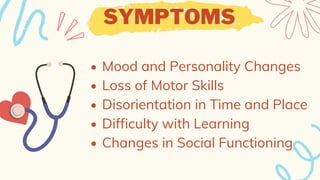
SYMPTOMS
Mood and Personality Changes
Loss of Motor Skills
Disorientation in Time and Place
Difficulty with Learning
Changes in Social Functioning
SYMPTOMS
DELAYED MILESTONES
LEARNING DIFFICULTIES
POOR MEMORY
ATTENTION ISSUES
LANGUAGE DELAYS
SOCIAL CHALLENGES
CLASSROOM CONTEXT
IMPAIRED MOTOR SKILLS
BEHAVIORAL CHANGES
EXECUTIVE FUNCTION
CHALLENGES
SPATIAL AWARENESS
ISSUES DIFFICULTY
FOLLOWING INSTRUCTIONS
REGRESSION
INTERVENTION
MEDICAL MANAGEMENT
COGNITIVE REHABILITATION
BEHAVIORAL THERAPY
OCCUPATIONAL THERAPY
SPEECH THERAPY
PHYSICAL EXERCISE
INTERVENTION
NUTRITIONAL
INTERVENTIONS SLEEP
MANAGEMENT
STRESS MANAGEMENT
SOCIAL ENGAGEMENT
SUPPORTIVE ENVIRONMENT
TIME FOR
QUESTIONS
!
What is the main focus of cognitive
development theories?
a. Emotional growth
b. Physical development
c. Mental processes
d. Social skills
Which theorist proposed the Zone of Proximal
Development (ZPD) concept?
a. Jean Piaget
b. Lev Vygotsky
c. Erik Erikson
d. B.F. Skinner
At which stage of cognitive development do
individuals typically develop abstract reasoning
abilities?
a. Sensorimotor stage
b. Preoperational stage
c. Concrete operational stage
d. Formal operational stage
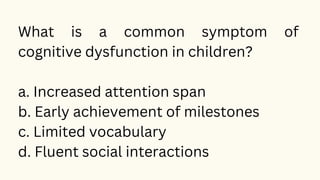
What is a common symptom of
cognitive dysfunction in children?
a. Increased attention span
b. Early achievement of milestones
c. Limited vocabulary
d. Fluent social interactions
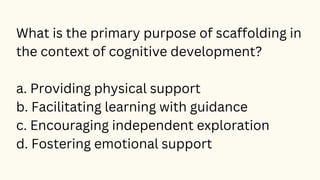
What is the primary purpose of scaffolding in
the context of cognitive development?
a. Providing physical support
b. Facilitating learning with guidance
c. Encouraging independent exploration
d. Fostering emotional support
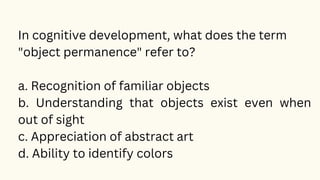
In cognitive development, what does the term
"object permanence" refer to?
a. Recognition of familiar objects
b. Understanding that objects exist even when
out of sight
c. Appreciation of abstract art
d. Ability to identify colors
Which age group is most likely to experience age-
related cognitive decline?
a. Infants
b. Adolescents
c. Adults
d. Seniors
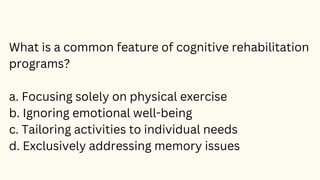
What is a common feature of cognitive rehabilitation
programs?
a. Focusing solely on physical exercise
b. Ignoring emotional well-being
c. Tailoring activities to individual needs
d. Exclusively addressing memory issues
Which factor is often considered a protective
element against cognitive decline in older
adults?
a. Sedentary lifestyle
b. Chronic stress
c. Intellectual stimulation
d. Irregular sleep patterns
What is the term for a temporary loss of
previously acquired skills or knowledge?
a. Regression
b. Developmental delay
c. Memory lapse
d. Retrograde amnesia
THANK
YOU FOR
LISTENIN
G

cognitive development and dysfunction.pptx