
1
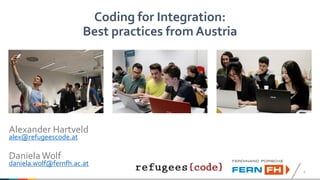
Coding for Integration:
Best practices from Austria
Alexander Hartveld
alex@refugeescode.at
Daniela Wolf
daniela.wolf@fernfh.ac.at
2
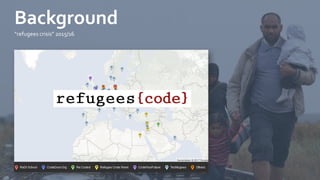
Background
“refugees crisis” 2015/16
3
Background
“refugees crisis” 2015/16
4
Background
“refugees crisis” 2015/16
5
Overview
1. An example of an iterative research approach – Action Research
2. Course History and Description
3. 7 Good Practices, 3 Key Learnings
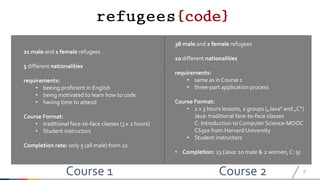
6Course 1 Course 2
7Course 1 Course 2
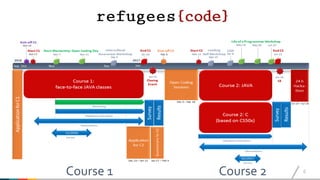
21 male and 1 female refugees
5 different nationalities
requirements:
• beeing proficient in English
• being motivated to learn how to code
• having time to attend
Course Format:
• traditional face-to-face classes (3 x 2 hours)
• Student instructors
Completion rate: only 5 (all male) from 22
8Course 1 Course 2
21 male and 1 female refugees
5 different nationalities
requirements:
• beeing proficient in English
• being motivated to learn how to code
• having time to attend
Course Format:
• traditional face-to-face classes (3 x 2 hours)
• Student instructors
Completion rate: only 5 (all male) from 22
38 male and 2 female refugees
10 different nationalities
requirements:
• same as in Course 1
• three-part application process
Course Format:
• 2 x 3 hours lessons, 2 groups („Java“ and „C“)
Java: traditional face-to-face classes
C: Introduction to Computer Science-MOOC
CS50x from Harvard University
• Student instructors
• Completion: 23 (Java: 10 male & 2 women, C: 9)
9
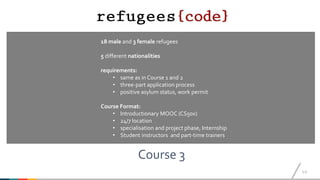
Course 3
10
Course 3
18 male and 3 female refugees
5 different nationalities
requirements:
• same as in Course 1 and 2
• three-part application process
• positive asylum status, work permit
Course Format:
• Introductionary MOOC (CS50x)
• 24/7 location
• specialisation and project phase, Internship
• Student instructors and part-time trainers
11
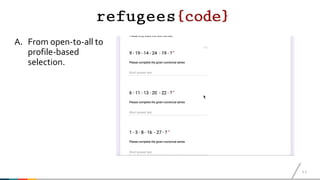
A. From open-to-all to
profile-based
selection.
12
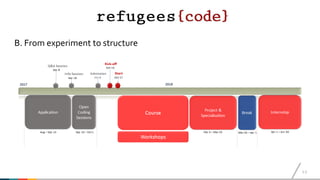
B. From experiment to structure
13
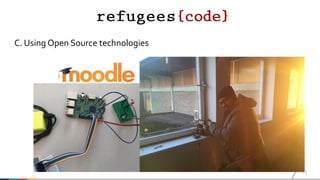
C. Using Open Source technologies
14
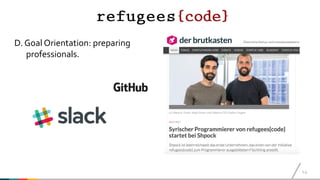
D. Goal Orientation: preparing
professionals.
15
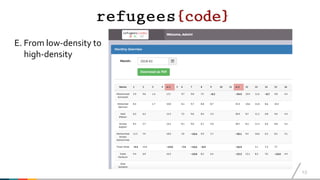
E. From low-density to
high-density
16
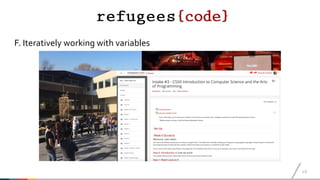
F. Iteratively working with variables
Space Content
Community System
17
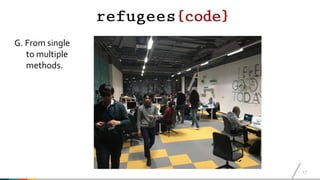
G. From single
to multiple
methods.
18
Key Learnings
• Flexibility, iterative, working non-hierarchical.
• Zeitgeist is technology and migration.
• Awareness of Challenges.
19
Questions?
Lorem ipsum dolor sit amet, consectetur adipiscing elit
bit.ly/2EHF3Cx
Link to paper (Research Gate)

Coding for Integration. Best practices from Austria

  • 1.
    1 Coding for Integration: Bestpractices from Austria Alexander Hartveld alex@refugeescode.at Daniela Wolf daniela.wolf@fernfh.ac.at
  • 2.
  • 3.
  • 4.
  • 5.
    5 Overview 1. An exampleof an iterative research approach – Action Research 2. Course History and Description 3. 7 Good Practices, 3 Key Learnings
  • 6.
  • 7.
    7Course 1 Course2 21 male and 1 female refugees 5 different nationalities requirements: • beeing proficient in English • being motivated to learn how to code • having time to attend Course Format: • traditional face-to-face classes (3 x 2 hours) • Student instructors Completion rate: only 5 (all male) from 22
  • 8.
    8Course 1 Course2 21 male and 1 female refugees 5 different nationalities requirements: • beeing proficient in English • being motivated to learn how to code • having time to attend Course Format: • traditional face-to-face classes (3 x 2 hours) • Student instructors Completion rate: only 5 (all male) from 22 38 male and 2 female refugees 10 different nationalities requirements: • same as in Course 1 • three-part application process Course Format: • 2 x 3 hours lessons, 2 groups („Java“ and „C“) Java: traditional face-to-face classes C: Introduction to Computer Science-MOOC CS50x from Harvard University • Student instructors • Completion: 23 (Java: 10 male & 2 women, C: 9)
  • 9.
  • 10.
    10 Course 3 18 maleand 3 female refugees 5 different nationalities requirements: • same as in Course 1 and 2 • three-part application process • positive asylum status, work permit Course Format: • Introductionary MOOC (CS50x) • 24/7 location • specialisation and project phase, Internship • Student instructors and part-time trainers
  • 11.
    11 A. From open-to-allto profile-based selection.
  • 12.
  • 13.
    13 C. Using OpenSource technologies
  • 14.
    14 D. Goal Orientation:preparing professionals.
  • 15.
    15 E. From low-densityto high-density
  • 16.
    16 F. Iteratively workingwith variables Space Content Community System
  • 17.
    17 G. From single tomultiple methods.
  • 18.
    18 Key Learnings • Flexibility,iterative, working non-hierarchical. • Zeitgeist is technology and migration. • Awareness of Challenges.
  • 19.
    19 Questions? Lorem ipsum dolorsit amet, consectetur adipiscing elit bit.ly/2EHF3Cx Link to paper (Research Gate)