Reactive Streams
Алексей Романчук
2
Обо мне
10k msg/s
4
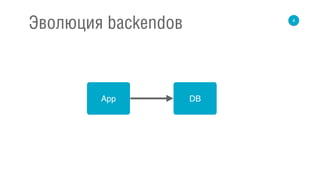
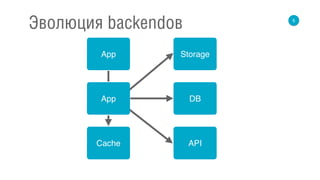
Эволюция backendов
DBApp
5
Эволюция backendов
DB
API
Storage
Cache
App
App
Высокопроизводительный
backend
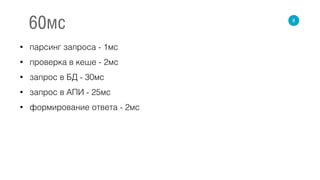
60мс
• парсинг запроса - 1мс
• проверка в кеше - 2мс
• запрос в БД - 30мс
• запрос в АПИ - 25мс
• формирование ответа - 2мс
8
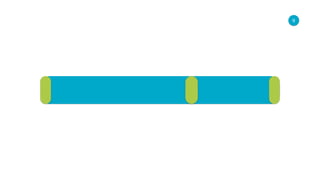
60мс
9
• Отдельный поток
• 95% ожидает
• Занимает ресурсы
10
Синхронная модель
11
Ожидание
• Обработка в разных потоках
• Потоки не простаивают
• Эффективное использование ресурсов
12
Асинхронная модель
• БД
• Внешние API
• Сеть
• Взаимодействие с другими потокам
13
Асинхронные границы везде
• Композиция
• Ветвление
• Обработка ошибок
• Backpressure
14
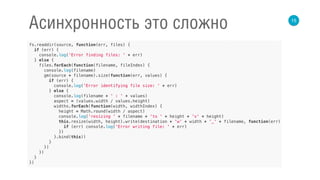
Асинхронность это сложно
15
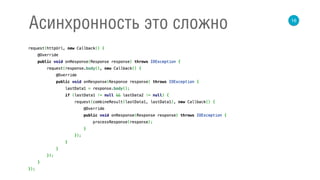
Асинхронность это сложно
16
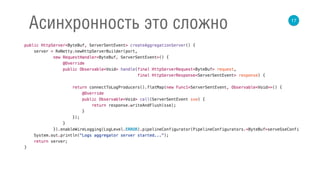
Асинхронность это сложно
17
Асинхронность это сложно
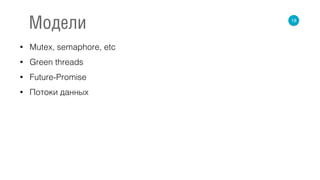
• Mutex, semaphore, etc
• Green threads
• Future-Promise
• Потоки данных
18
Модели
Потоки
20
“В одну реку нельзя войти
дважды”
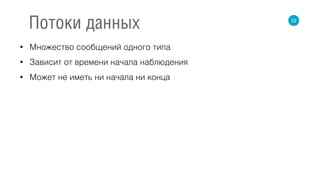
• Множество сообщений одного типа
• Зависит от времени начала наблюдения
• Может не иметь ни начала ни конца
22
Потоки данных
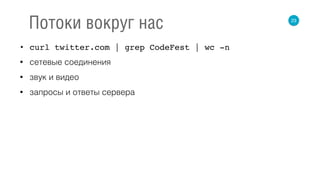
• curl twitter.com | grep CodeFest | wc -n
• сетевые соединения
• звук и видео
• запросы и ответы сервера
23
Потоки вокруг нас
24
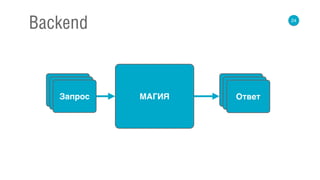
Backend
Запрос Ответ
МАГИЯЗапросЗапрос ОтветОтвет
25
26
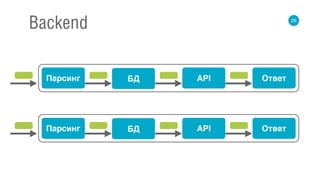
Backend
Парсинг БД API Ответ
27
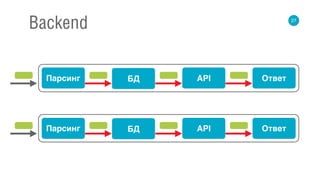
Backend
Парсинг БД API Ответ
28
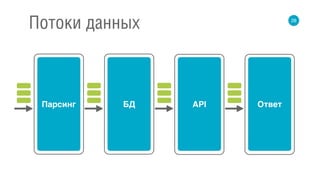
Потоки данных
Парсинг БД API Ответ
• Простые асинхронные границы
• Картина в целом
• Параллельное программирование
• Ошибки и завершение
29
Преимущества
Backpressure
31
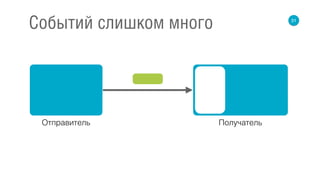
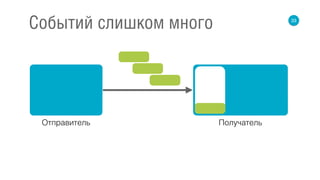
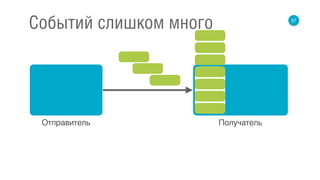
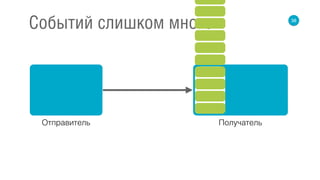
Событий слишком много
Отправитель Получатель
32
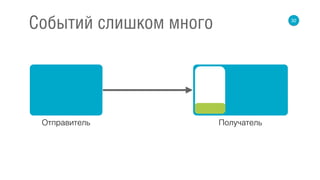
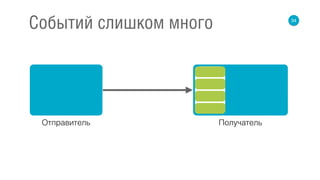
Событий слишком много
Отправитель Получатель
33
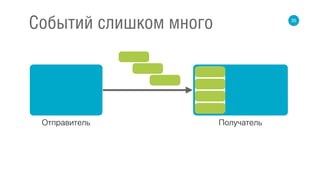
Событий слишком много
Отправитель Получатель
34
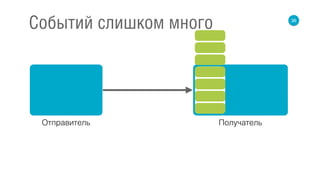
Событий слишком много
Отправитель Получатель
35
Событий слишком много
Отправитель Получатель
36
Событий слишком много
Отправитель Получатель
37
Событий слишком много
Отправитель Получатель
38
Событий слишком много
Отправитель Получатель
39
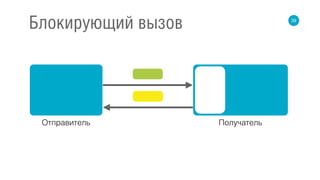
Блокирующий вызов
Отправитель Получатель
40
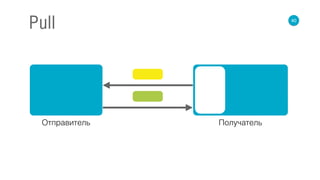
Pull
Отправитель Получатель
41
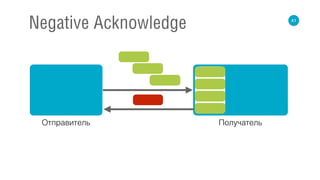
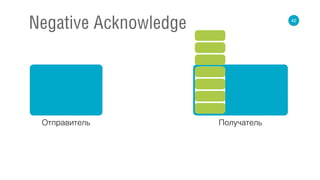
Negative Acknowledge
Отправитель Получатель
42
Negative Acknowledge
Отправитель Получатель
43
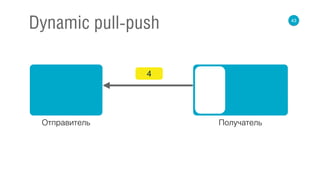
Dynamic pull-push
Отправитель Получатель
4
44
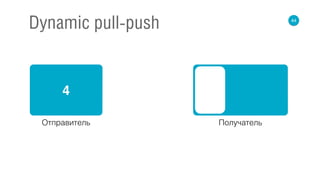
Dynamic pull-push
4
Отправитель Получатель
45
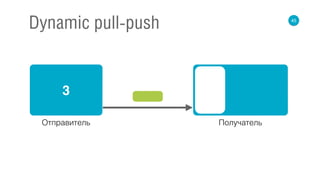
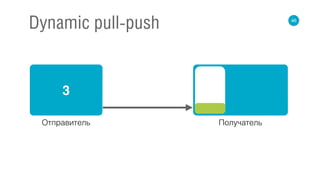
Dynamic pull-push
3
Отправитель Получатель
46
Dynamic pull-push
3
Отправитель Получатель
47
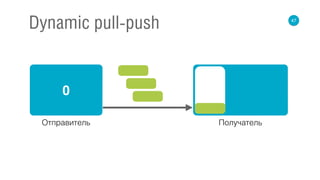
Dynamic pull-push
0
Отправитель Получатель
48
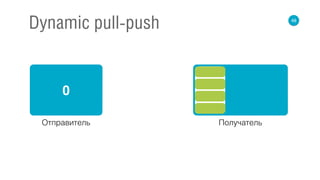
Dynamic pull-push
0
Отправитель Получатель
49
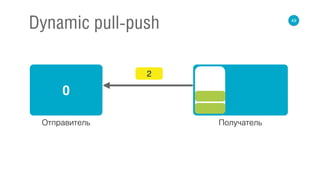
Dynamic pull-push
0
Отправитель Получатель
2
50
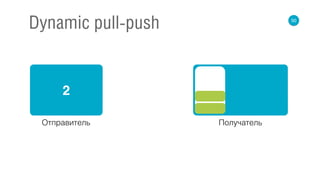
Dynamic pull-push
2
Отправитель Получатель
51
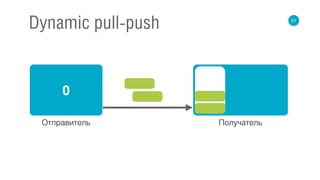
Dynamic pull-push
0
Отправитель Получатель
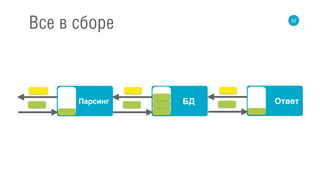
ОтветБДПарсинг
52
Все в сборе
Reactive Streams
• Спецификация
• Асинхронного взаимодействия
• Упорядоченные сообщения
• Обратная связь
54
Reactive Streams
• RxJava
• Akka Stream
• Reactor
• Ratpack
55
Реализации
“Talk is cheap,
show me the code”
• Reactive Stream
• Dynamic pull-push model
• Scala, Java
• Статическая типизация
• Модель акторов
57
Akka Stream
* <dl>

* <dt><b>Scheduler:</b></dt>

* <dd>you specify which {@link Scheduler} this operator will use</dd>

* </dl>

*

* @param notificationHandler

* receives an Observable of notifications with which a user can complete or error, aborting the repeat.

* @param scheduler

* the {@link Scheduler} to emit the items on

* @return the source Observable modified with repeat logic

* @see <a href="http://reactivex.io/documentation/operators/repeat.html">ReactiveX operators documentation: Repeat</a>

*/

public final Observable<T> repeatWhen(final Func1<? super Observable<? extends Void>, ? extends Observable<?>> notificationHandler, Scheduler scheduler) {

Func1<? super Observable<? extends Notification<?>>, ? extends Observable<?>> dematerializedNotificationHandler = new Func1<Observable<? extends Notification<?>>, Observable<?>>()
@Override

public Observable<?> call(Observable<? extends Notification<?>> notifications) {

return notificationHandler.call(notifications.map(new Func1<Notification<?>, Void>() {

@Override

public Void call(Notification<?> notification) {

return null;

}

}));

}

};

return OnSubscribeRedo.repeat(this, dematerializedNotificationHandler, scheduler);

}


/**

* Returns an Observable that emits the same values as the source Observable with the exception of an

* {@code onCompleted}. An {@code onCompleted} notification from the source will result in the emission of

* a {@code void} item to the Observable provided as an argument to the {@code notificationHandler}

* function. If that Observable calls {@code onComplete} or {@code onError} then {@code repeatWhen} will

* call {@code onCompleted} or {@code onError} on the child subscription. Otherwise, this Observable will

* resubscribe to the source observable.

* <p>

* <img width="640" height="430" src="https://raw.github.com/wiki/ReactiveX/RxJava/images/rx-operators/repeatWhen.f.png" alt="">

* <dl>

* <dt><b>Scheduler:</b></dt>

* <dd>{@code repeatWhen} operates by default on the {@code trampoline} {@link Scheduler}.</dd>

* </dl>

*

* @param notificationHandler

* receives an Observable of notifications with which a user can complete or error, aborting the repeat.

* @return the source Observable modified with repeat logic

* @see <a href="http://reactivex.io/documentation/operators/repeat.html">ReactiveX operators documentation: Repeat</a>

*/

public final Observable<T> repeatWhen(final Func1<? super Observable<? extends Void>, ? extends Observable<?>> notificationHandler) {

Func1<? super Observable<? extends Notification<?>>, ? extends Observable<?>> dematerializedNotificationHandler = new Func1<Observable<? extends Notification<?>>, Observable<?>>()
@Override

public Observable<?> call(Observable<? extends Notification<?>> notifications) {

return notificationHandler.call(notifications.map(new Func1<Notification<?>, Void>() {

@Override

public Void call(Notification<?> notification) {

return null;

}

}));

}

};

return OnSubscribeRedo.repeat(this, dematerializedNotificationHandler);

}
/**

* An Observable that never sends any information to an {@link Observer}.

* This Observable is useful primarily for testing purposes.

*

* @param <T>

* the type of item (not) emitted by the Observable

*/

private static class NeverObservable<T> extends Observable<T> {

public NeverObservable() {

super(new OnSubscribe<T>() {


@Override

public void call(Subscriber<? super T> observer) {

// do nothing

}


});

}

}


/**

* An Observable that invokes {@link Observer#onError onError} when the {@link Observer} subscribes to it.

*

* @param <T>

* the type of item (ostensibly) emitted by the Observable

*/

private static class ThrowObservable<T> extends Observable<T> {


public ThrowObservable(final Throwable exception) {

super(new OnSubscribe<T>() {


/**

* Accepts an {@link Observer} and calls its {@link Observer#onError onError} method.

*

* @param observer

* an {@link Observer} of this Observable

*/

@Override

/**

* Operator function for lifting into an Observable.

*/

public interface Operator<R, T> extends Func1<Subscriber<? super R>, Subscriber<? super T>> {

// cover for generics insanity

}

/**

* Lifts a function to the current Observable and returns a new Observable that when subscribed to will pass

* the values of the current Observable through the Operator function.

* <p>

* In other words, this allows chaining Observers together on an Observable for acting on the values within

* the Observable.

* <p> {@code

* observable.map(...).filter(...).take(5).lift(new OperatorA()).lift(new OperatorB(...)).subscribe()

* }

* <p>

* If the operator you are creating is designed to act on the individual items emitted by a source

* Observable, use {@code lift}. If your operator is designed to transform the source Observable as a whole

* (for instance, by applying a particular set of existing RxJava operators to it) use {@link #compose}.

* <dl>

* <dt><b>Scheduler:</b></dt>

* <dd>{@code lift} does not operate by default on a particular {@link Scheduler}.</dd>

* </dl>

*

* @param lift the Operator that implements the Observable-operating function to be applied to the source

* Observable

* @return an Observable that is the result of applying the lifted Operator to the source Observable

* @see <a href="https://github.com/ReactiveX/RxJava/wiki/Implementing-Your-Own-Operators">RxJava wiki: Implementing Your Own Operators</a>

*/

public final <R> Observable<R> lift(final Operator<? extends R, ? super T> lift) {

return new Observable<R>(new OnSubscribe<R>() {

@Override

public void call(Subscriber<? super R> o) {

try {

Subscriber<? super T> st = hook.onLift(lift).call(o);

try {

// new Subscriber created and being subscribed with so 'onStart' it

st.onStart();

onSubscribe.call(st);

} catch (Throwable e) {

// localized capture of errors rather than it skipping all operators 

// and ending up in the try/catch of the subscribe method which then

// prevents onErrorResumeNext and other similar approaches to error handling

if (e instanceof OnErrorNotImplementedException) {

throw (OnErrorNotImplementedException) e;

}

st.onError(e);

}

} catch (Throwable e) {

if (e instanceof OnErrorNotImplementedException) {

throw (OnErrorNotImplementedException) e;

}

// if the lift function failed all we can do is pass the error to the final Subscriber

// as we don't have the operator available to us

o.onError(e);

}

}

});

}

/**

* Transform an Observable by applying a particular Transformer function to it.

* <p>

* This method operates on the Observable itself whereas {@link #lift} operates on the Observable's

* Subscribers or Observers.

* <p>

* If the operator you are creating is designed to act on the individual items emitted by a source

* Observable, use {@link #lift}. If your operator is designed to transform the source Observable as a whole

* (for instance, by applying a particular set of existing RxJava operators to it) use {@code compose}.

* <dl>

* <dt><b>Scheduler:</b></dt>

* <dd>{@code compose} does not operate by default on a particular {@link Scheduler}.</dd>

* </dl>

*

* @param transformer implements the function that transforms the source Observable

* @return the source Observable, transformed by the transformer function

* @see <a href="https://github.com/ReactiveX/RxJava/wiki/Implementing-Your-Own-Operators">RxJava wiki: Implementing Your Own Operators</a>

*/

@SuppressWarnings("unchecked")

public <R> Observable<R> compose(Transformer<? super T, ? extends R> transformer) {

return ((Transformer<T, R>) transformer).call(this);

}

/**

* Transformer function used by {@link #compose}.

* @warn more complete description needed

*/

public static interface Transformer<T, R> extends Func1<Observable<T>, Observable<R>> {

// cover for generics insanity

}


/* *********************************************************************************************************

* Operators Below Here

* *********************************************************************************************************

59
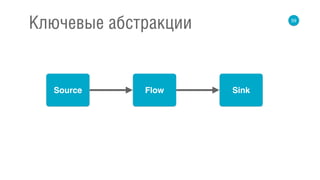
Ключевые абстракции
Source SinkFlow
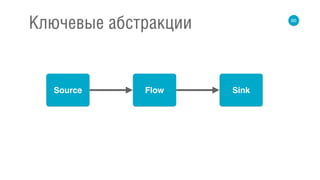
60
Ключевые абстракции
Source SinkFlow
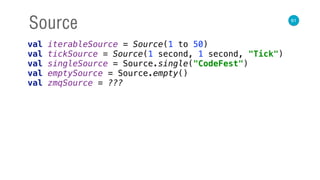
61
Source
val iterableSource = Source(1 to 50)

val tickSource = Source(1 second, 1 second, "Tick")

val singleSource = Source.single("CodeFest")

val emptySource = Source.empty()

val zmqSource = ???
62
Sink
val blackhole = Sink.ignore

val onComplete = Sink.onComplete { result =>

System.exit(0)

}

val foreach = Sink.foreach(println)

val firstElement = Sink.head[Int]
63
Flow
implicit val as = ActorSystem("CodeFest")

implicit val materializer = ActorFlowMaterializer()


val source = Source(1 to 50)

val sink = Sink.foreach[Int](println)

val flow = source.to(sink)

flow.run()
64
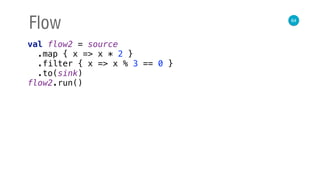
Flow
val flow2 = source

.map { x => x * 2 }

.filter { x => x % 3 == 0 }

.to(sink)

flow2.run()
65
Flow
val source = Source(1 to 50)

val sink = Sink.foreach[String](println)


val flow2 = source

.map { x => x.toString }

.map { x => x / 13 }

.to(sink)

flow2.run()
66
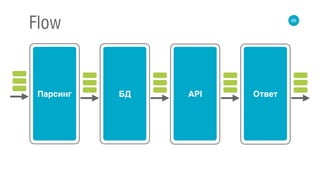
Flow
Парсинг БД API Ответ
67
Flow
val request: Source[Request] = ???

def parser: Request => Query = ???

def dbCall: Query => Future[List[Int]] = ???

def apiCall: List[Int] => Future[List[String]] = ???

def buildResponse: List[String] => Response = ???
val flow3 = request

.map(parser)

.mapAsync(dbCall)

.mapAsync(apiCall)

.map(buildResponse)

.to(response)
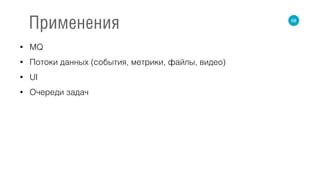
• MQ
• Потоки данных (события, метрики, файлы, видео)
• UI
• Очереди задач
68
Применения
69
Adopters
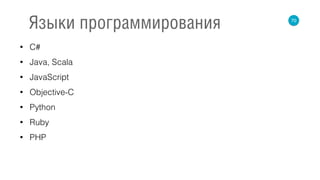
• C#
• Java, Scala
• JavaScript
• Objective-C
• Python
• Ruby
• PHP
70
Языки программирования
Мир изменился
Вопросы?
al.romanchuk@2gis.ru @1esha
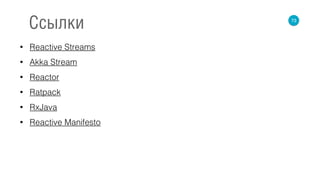
• Reactive Streams
• Akka Stream
• Reactor
• Ratpack
• RxJava
• Reactive Manifesto
73
Ссылки
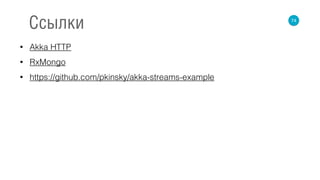
• Akka HTTP
• RxMongo
• https://github.com/pkinsky/akka-streams-example
74
Ссылки
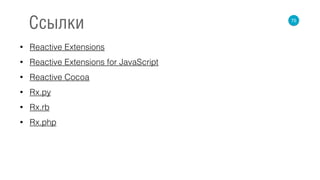
• Reactive Extensions
• Reactive Extensions for JavaScript
• Reactive Cocoa
• Rx.py
• Rx.rb
• Rx.php
75
Ссылки
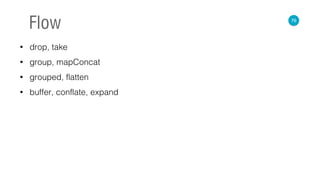
• drop, take
• group, mapConcat
• grouped, flatten
• buffer, conflate, expand
76
Flow
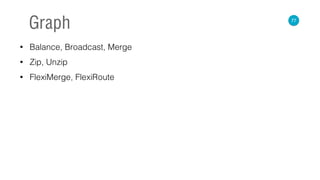
• Balance, Broadcast, Merge
• Zip, Unzip
• FlexiMerge, FlexiRoute
77
Graph

Codefest-2015 Reactive Streams