
Code Sec.304
Related Party Stock Sales
Silicon Valley, San Francisco, Los Angeles
rroyse@rroyselaw.com
www.rroyselaw.com
Constructive Redemption
 Sale of Corporate stock either to a Subsidiary Corporation or to a Sister
Corporation is subject to §304
 Requires “control”
o brother-sister stock sale - the person selling the stock is in control of both issuing
and acquiring corporation;
o parent-subsidiary stock sale - the issuing corporation is in control of the acquiring
corporation.
 Recharacterization of the stock sale as a §302 stock redemption.
o Reflect the acknowledgment that a related party sale is an easy device for
withdrawing corporate earnings;
o Capital gain treatment is not warranted where the selling shareholder has not
really severed its ownership interests in the “sold” target shares.
Brother-Sister stock sale
§304(a)(1)
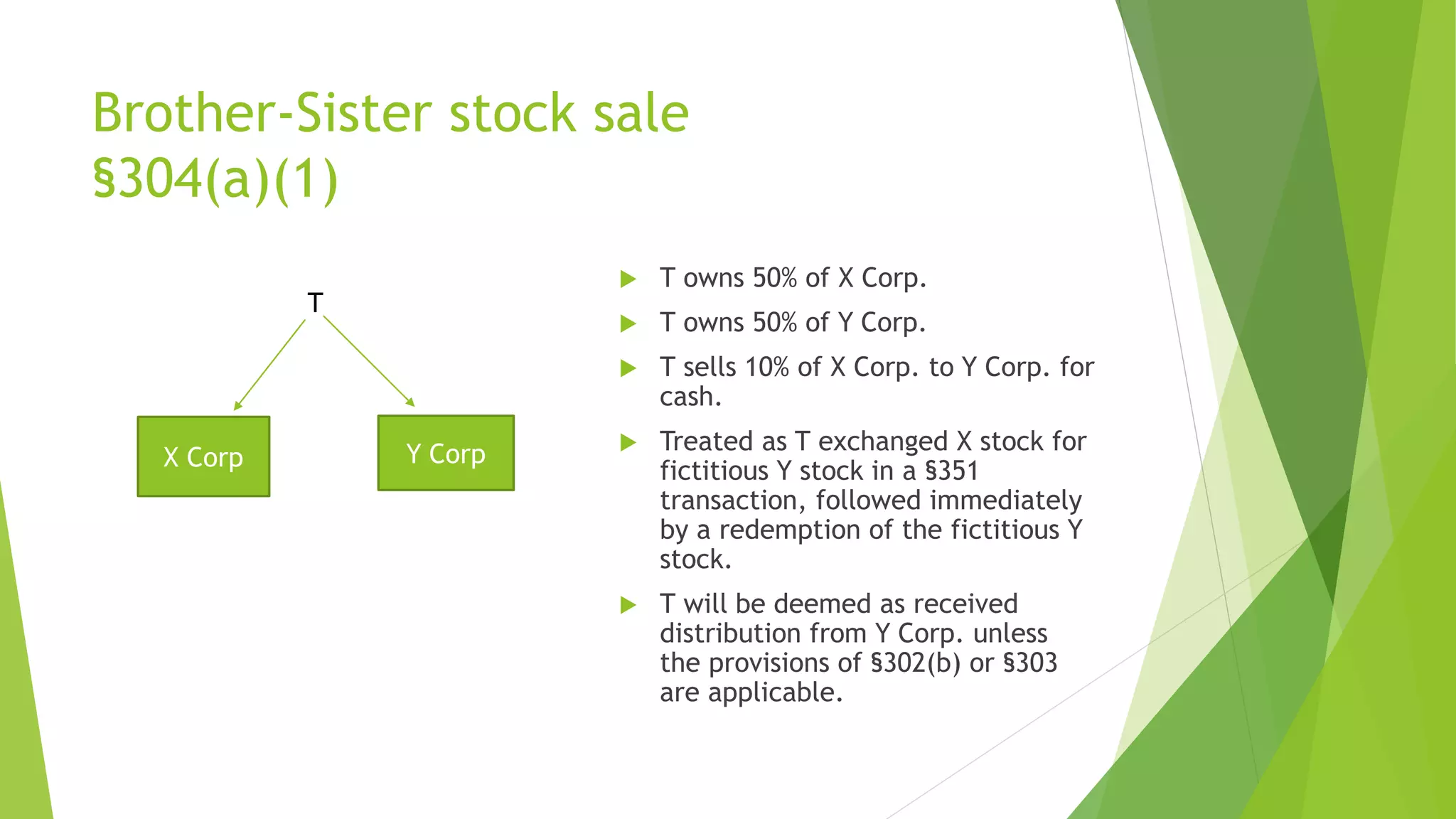
 T owns 50% of X Corp.
 T owns 50% of Y Corp.
 T sells 10% of X Corp. to Y Corp. for
cash.
 Treated as T exchanged X stock for
fictitious Y stock in a §351
transaction, followed immediately
by a redemption of the fictitious Y
stock.
 T will be deemed as received
distribution from Y Corp. unless
the provisions of §302(b) or §303
are applicable.
X Corp Y Corp
T
Parent-Subsidiary stock sale
§304(a)(2)
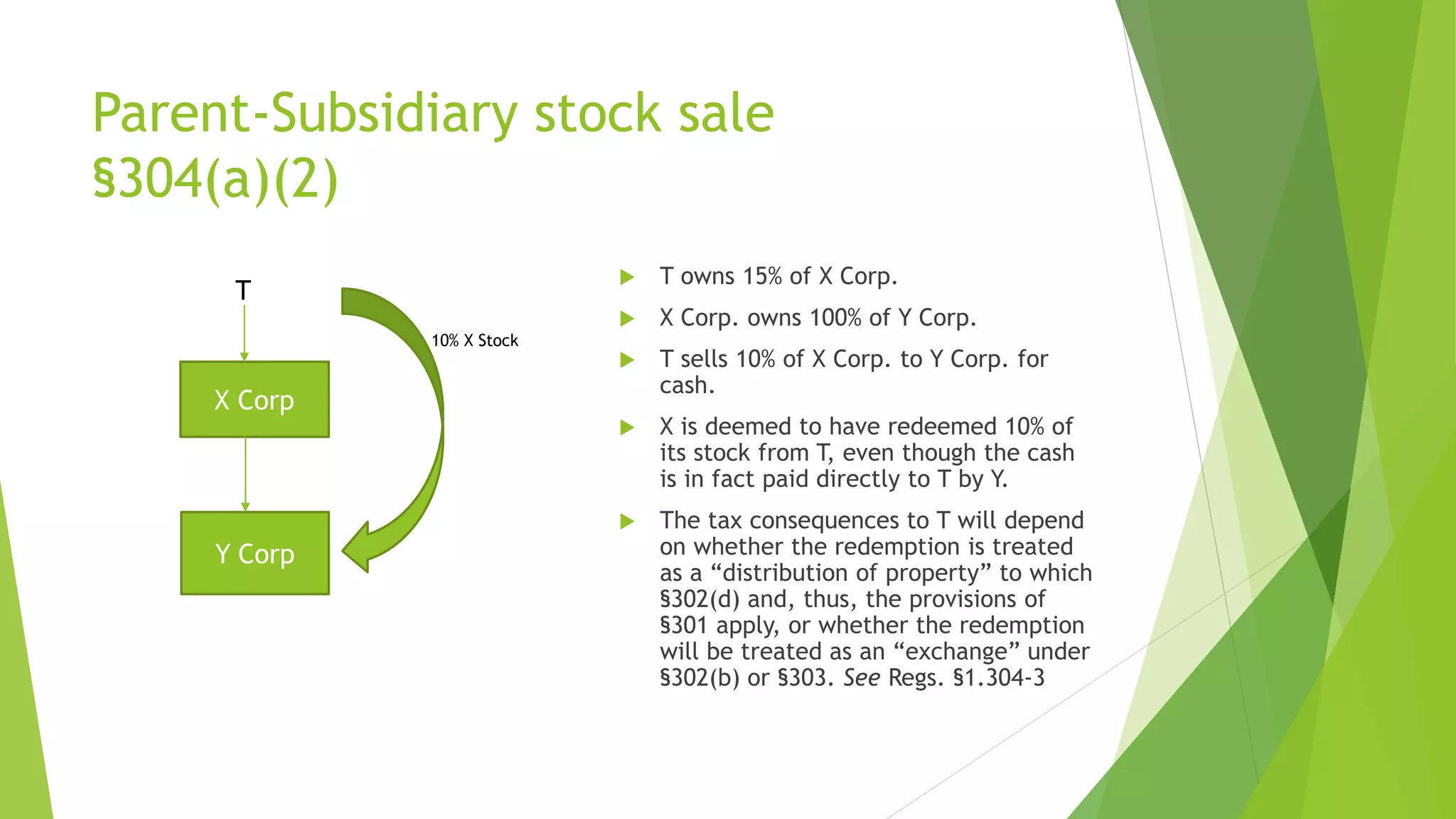
 T owns 15% of X Corp.
 X Corp. owns 100% of Y Corp.
 T sells 10% of X Corp. to Y Corp. for
cash.
 X is deemed to have redeemed 10% of
its stock from T, even though the cash
is in fact paid directly to T by Y.
 The tax consequences to T will depend
on whether the redemption is treated
as a “distribution of property” to which
§302(d) and, thus, the provisions of
§301 apply, or whether the redemption
will be treated as an “exchange” under
§302(b) or §303. See Regs. §1.304-3
X Corp
Y Corp
T
10% X Stock
Tax Consequences of T
 If the transaction is treated as §301 distribution, all of the distribution will be
a dividend to T to the extent it does not exceeds the combined e and p of X
Corp. and Y Corp.
o In a parent-subsidiary sale, T’s basis in the transferred stock is added to his basis in
his remaining shares of X Corp.
o In a brother-sister sale, T’s basis in the transferred stock is added to his basis in his
remaining shares of Y Corp.
 For purpose of determining whether the “redemption” qualifies as a purchase
under §302(b), the stock position of the issuing corporation (X Corp.) is
determinative. §304(b)(1)
Rev. Rul. 2004-83
Apply the Step-Transaction Doctrine
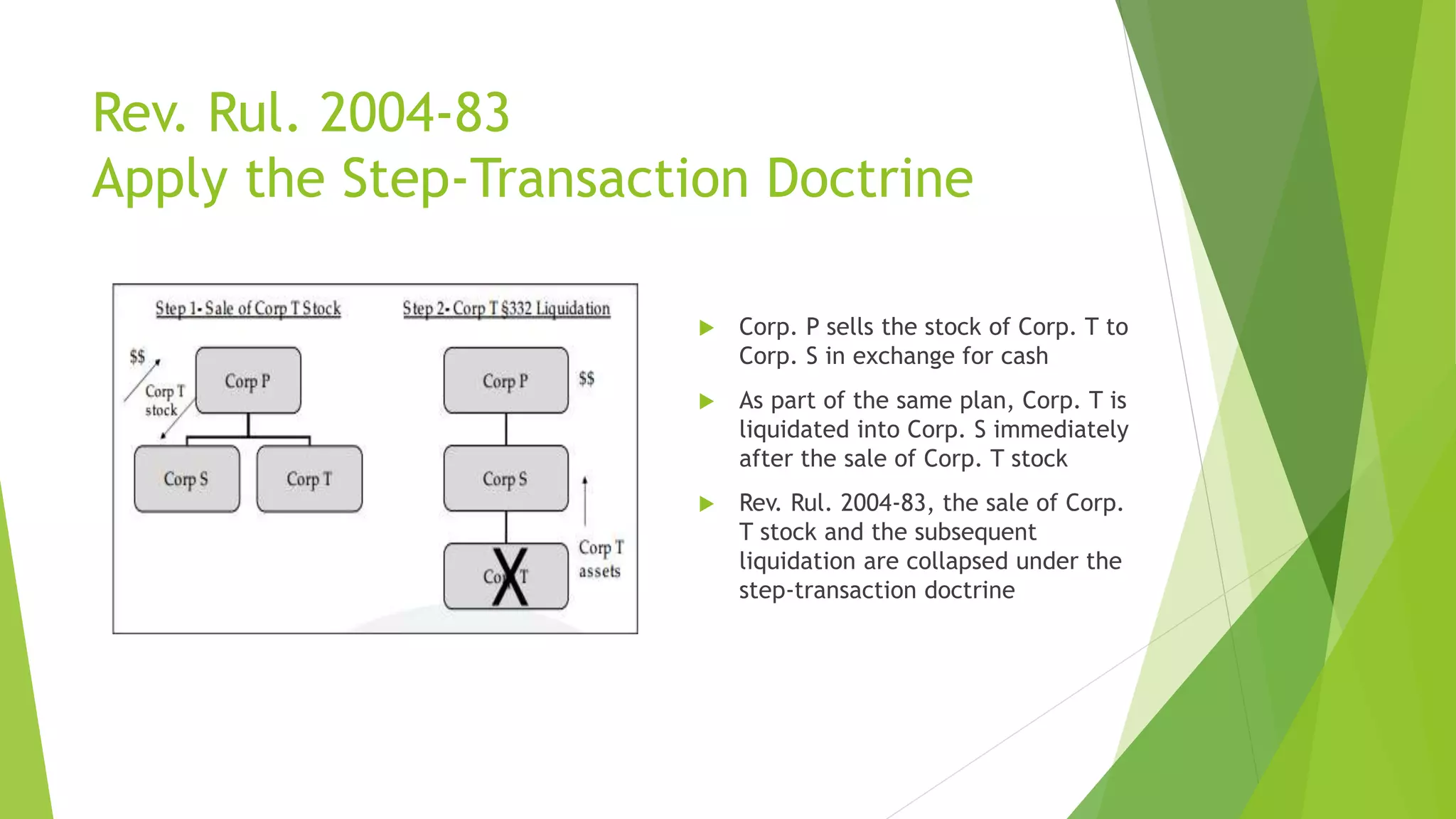
 Corp. P sells the stock of Corp. T to
Corp. S in exchange for cash
 As part of the same plan, Corp. T is
liquidated into Corp. S immediately
after the sale of Corp. T stock
 Rev. Rul. 2004-83, the sale of Corp.
T stock and the subsequent
liquidation are collapsed under the
step-transaction doctrine
Rev. Rul. 2004-83
Apply the Step-Transaction Doctrine
 First, Corp. P’ transfer of Corp. T
stock to Corp. S is ignored - §351
does not apply.
 Thus, Corp. T is viewed as
transferring its assets to Corp. S in
exchange for the cash sale
proceeds.
 Second, the asset sale is combined
with the liquidation, treated as a
qualifying §368(a)(1)(D)
reorganization with boot.
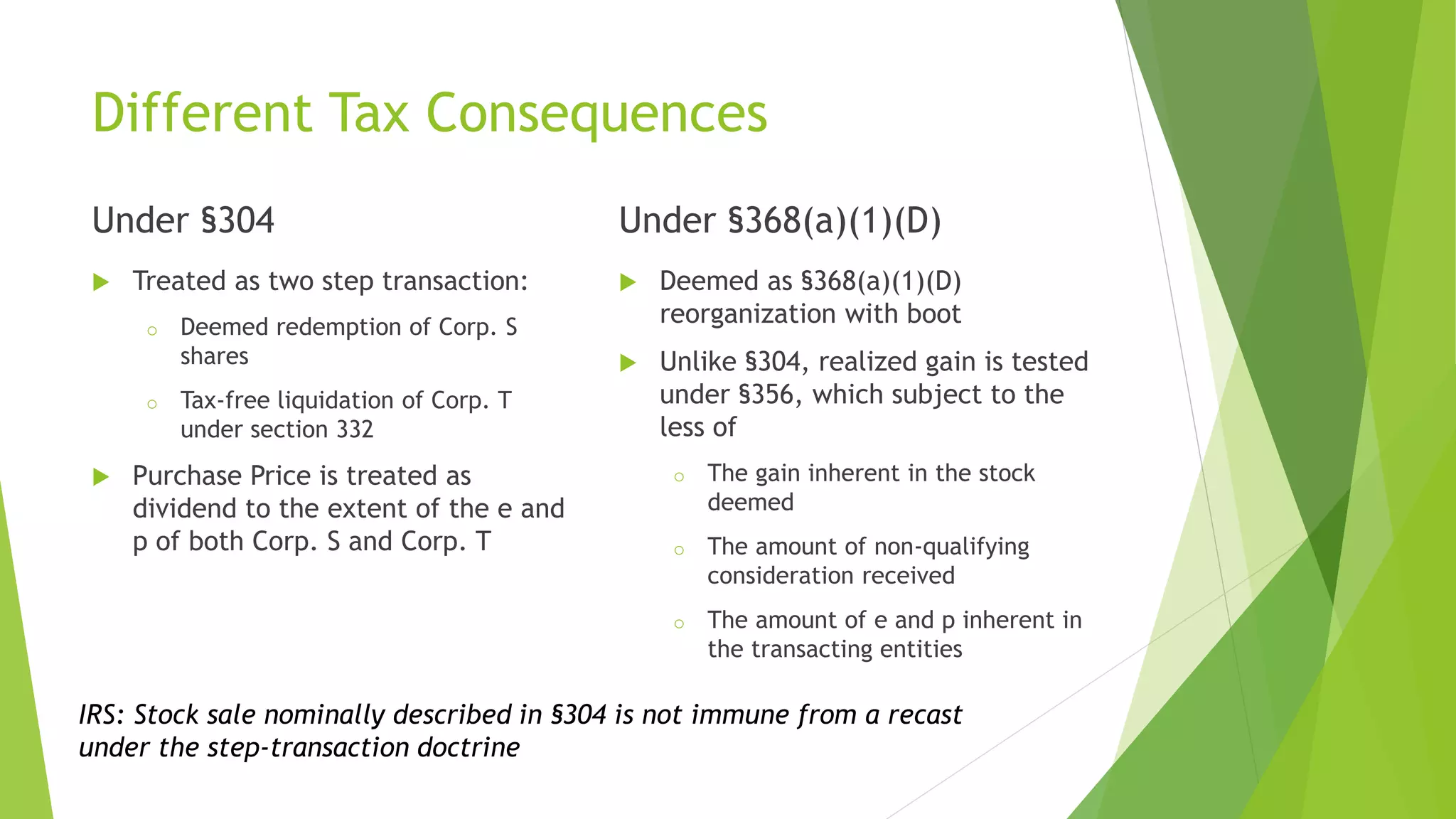
Different Tax Consequences
Under §304
 Treated as two step transaction:
o Deemed redemption of Corp. S
shares
o Tax-free liquidation of Corp. T
under section 332
 Purchase Price is treated as
dividend to the extent of the e and
p of both Corp. S and Corp. T
Under §368(a)(1)(D)
 Deemed as §368(a)(1)(D)
reorganization with boot
 Unlike §304, realized gain is tested
under §356, which subject to the
less of
o The gain inherent in the stock
deemed
o The amount of non-qualifying
consideration received
o The amount of e and p inherent in
the transacting entities
IRS: Stock sale nominally described in §304 is not immune from a recast
under the step-transaction doctrine

Code Sec.304 Related Party Stock Sales

  • 1.
    Code Sec.304 Related PartyStock Sales Silicon Valley, San Francisco, Los Angeles rroyse@rroyselaw.com www.rroyselaw.com
  • 2.
    Constructive Redemption  Saleof Corporate stock either to a Subsidiary Corporation or to a Sister Corporation is subject to §304  Requires “control” o brother-sister stock sale - the person selling the stock is in control of both issuing and acquiring corporation; o parent-subsidiary stock sale - the issuing corporation is in control of the acquiring corporation.  Recharacterization of the stock sale as a §302 stock redemption. o Reflect the acknowledgment that a related party sale is an easy device for withdrawing corporate earnings; o Capital gain treatment is not warranted where the selling shareholder has not really severed its ownership interests in the “sold” target shares.
  • 3.
    Brother-Sister stock sale §304(a)(1) T owns 50% of X Corp.  T owns 50% of Y Corp.  T sells 10% of X Corp. to Y Corp. for cash.  Treated as T exchanged X stock for fictitious Y stock in a §351 transaction, followed immediately by a redemption of the fictitious Y stock.  T will be deemed as received distribution from Y Corp. unless the provisions of §302(b) or §303 are applicable. X Corp Y Corp T
  • 4.
    Parent-Subsidiary stock sale §304(a)(2) T owns 15% of X Corp.  X Corp. owns 100% of Y Corp.  T sells 10% of X Corp. to Y Corp. for cash.  X is deemed to have redeemed 10% of its stock from T, even though the cash is in fact paid directly to T by Y.  The tax consequences to T will depend on whether the redemption is treated as a “distribution of property” to which §302(d) and, thus, the provisions of §301 apply, or whether the redemption will be treated as an “exchange” under §302(b) or §303. See Regs. §1.304-3 X Corp Y Corp T 10% X Stock
  • 5.
    Tax Consequences ofT  If the transaction is treated as §301 distribution, all of the distribution will be a dividend to T to the extent it does not exceeds the combined e and p of X Corp. and Y Corp. o In a parent-subsidiary sale, T’s basis in the transferred stock is added to his basis in his remaining shares of X Corp. o In a brother-sister sale, T’s basis in the transferred stock is added to his basis in his remaining shares of Y Corp.  For purpose of determining whether the “redemption” qualifies as a purchase under §302(b), the stock position of the issuing corporation (X Corp.) is determinative. §304(b)(1)
  • 6.
    Rev. Rul. 2004-83 Applythe Step-Transaction Doctrine  Corp. P sells the stock of Corp. T to Corp. S in exchange for cash  As part of the same plan, Corp. T is liquidated into Corp. S immediately after the sale of Corp. T stock  Rev. Rul. 2004-83, the sale of Corp. T stock and the subsequent liquidation are collapsed under the step-transaction doctrine
  • 7.
    Rev. Rul. 2004-83 Applythe Step-Transaction Doctrine  First, Corp. P’ transfer of Corp. T stock to Corp. S is ignored - §351 does not apply.  Thus, Corp. T is viewed as transferring its assets to Corp. S in exchange for the cash sale proceeds.  Second, the asset sale is combined with the liquidation, treated as a qualifying §368(a)(1)(D) reorganization with boot.
  • 8.
    Different Tax Consequences Under§304  Treated as two step transaction: o Deemed redemption of Corp. S shares o Tax-free liquidation of Corp. T under section 332  Purchase Price is treated as dividend to the extent of the e and p of both Corp. S and Corp. T Under §368(a)(1)(D)  Deemed as §368(a)(1)(D) reorganization with boot  Unlike §304, realized gain is tested under §356, which subject to the less of o The gain inherent in the stock deemed o The amount of non-qualifying consideration received o The amount of e and p inherent in the transacting entities IRS: Stock sale nominally described in §304 is not immune from a recast under the step-transaction doctrine