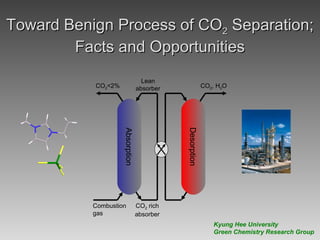
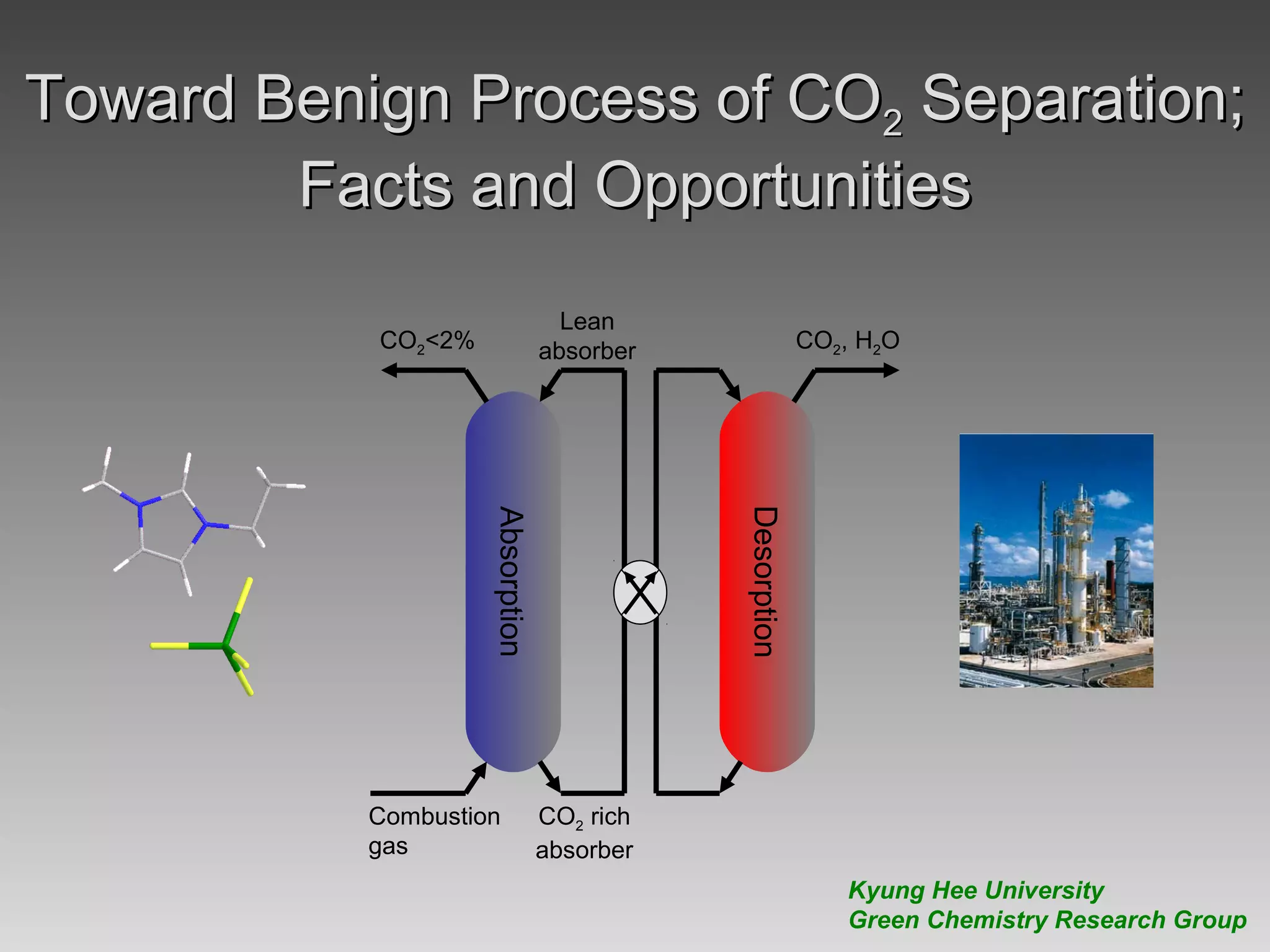
Toward Benign Process of CO2 Separation;
Facts and Opportunities
Lean
absorber

CO2<2%

Desorption

Absorption
Combustion
gas

CO2, H2O

CO2 rich
absorber
Kyung Hee University
Green Chemistry Research Group
Red Alert !!
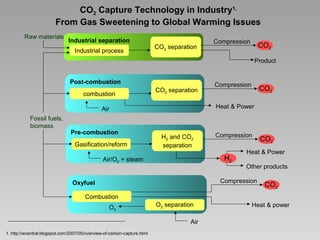
CO2 Capture Technology in Industry1,
From Gas Sweetening to Global Warming Issues
Raw materials

Industrial separation
Industrial process

CO2 separation

Compression

CO2
Product

Post-combustion
combustion

CO2 separation

Pre-combustion
Gasification/reform

CO2

Heat & Power

Air
Fossil fuels,
biomass

Compression

H2 and CO2
separation

Compression

H2

Air/O2 + steam

Heat & Power
Other products

Compression

Oxyfuel

CO2

CO2

Air/O
Combustion2-steam
O2

O2 separation
Air

1. http://wcentral.blogspot.com/2007/05/overview-of-carbon-capture.html

Heat & power
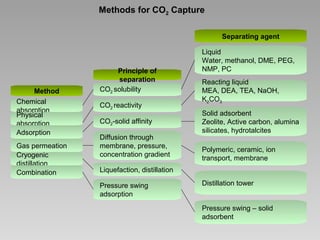
Methods for CO2 Capture
Separating agent

Method
Chemical
absorption
Physical
absorption
Adsorption
Gas permeation
Cryogenic
distillation
Combination

Principle of
separation
CO2 solubility
CO2 reactivity
CO2-solid affinity
Diffusion through
membrane, pressure,
concentration gradient

Liquid
Water, methanol, DME, PEG,
NMP, PC
Reacting liquid
MEA, DEA, TEA, NaOH,
K2CO3
Solid adsorbent
Zeolite, Active carbon, alumina
silicates, hydrotalcites
Polymeric, ceramic, ion
transport, membrane

Liquefaction, distillation
Pressure swing
adsorption

Distillation tower
Pressure swing – solid
adsorbent
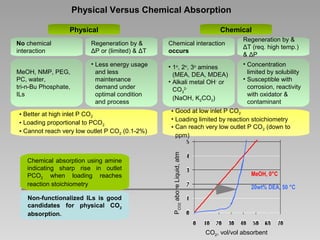
Physical Versus Chemical Absorption
Physical

Chemical

No chemical
interaction

Regeneration by &
ΔP or (limited) & ΔT

Chemical interaction
occurs

Regeneration by &
ΔT (req. high temp.)
& ΔP

MeOH, NMP, PEG,
PC, water,
tri-n-Bu Phosphate,
ILs

• Less energy usage
and less
maintenance
demand under
optimal condition
and process

• 1o, 2o, 3o amines
(MEA, DEA, MDEA)
• Alkali metal OH- or
CO32(NaOH, K2CO3)

• Concentration
limited by solubility
• Susceptible with
corrosion, reactivity
with oxidator &
contaminant

Chemical absorption using amine
indicating sharp rise in outlet
PCO2 when loading reaches
reaction stoichiometry
Non-functionalized ILs is good
candidates for physical CO2
absorption.

• Good at low inlet P CO2
• Loading limited by reaction stoichiometry
• Can reach very low outlet P CO2 (down to
ppm)
PCO2 above Liquid, atm

• Better at high inlet P CO2
• Loading proportional to PCO 2
• Cannot reach very low outlet P CO2 (0.1-2%)

MeOH, 0°C
20wt% DEA, 50 °C

CO2, vol/vol absorbent
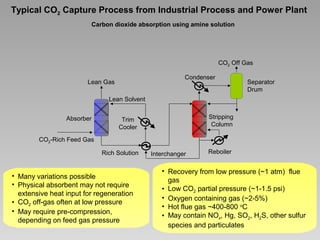
Typical CO2 Capture Process from Industrial Process and Power Plant
Carbon dioxide absorption using amine solution

CO2 Off Gas
Condenser

Lean Gas

Separator
Drum

Lean Solvent
Absorber

Stripping
Column

Trim
Cooler

CO2-Rich Feed Gas
Rich Solution

• Many variations possible
• Physical absorbent may not require
extensive heat input for regeneration
• CO2 off-gas often at low pressure
• May require pre-compression,
depending on feed gas pressure

Interchanger

Reboiler

• Recovery from low pressure (~1 atm) flue
gas
• Low CO2 partial pressure (~1-1.5 psi)
• Oxygen containing gas (~2-5%)
• Hot flue gas ~400-800 oC
• May contain NOx, Hg, SO2, H2S, other sulfur
species and particulates
CO2 Capture Through Facilitated Membrane; Tons of Works Awaiting 2
1.
2.
3.
4.
5.

Process is under rapid investigations & developments
Numerous absorbents & membranes are available
Novel processes are possible
Some problems persist (solutions may directly correspond to costs)
Model, reaction mechanism, and kinetics are available

Problems

Current status

Vapor invasion through
membrane pores at
high temp. (wetting)
1.

Non/less-volatile
liquids
Surface
modification
composite

2.
3.

Opportunities

2. separ & Puri Tech 41(2005)109

Durability & thermal
stability

1.
2.

1.
2.
3.
4.
5.

Fluorinated
polymers
Non-aggressive
liquids

Selectivity

1.
2.

Selective liquids
Composite

Introduction of less volatile absorbent
Combination of membrane-novel absorbent
Membrane modification
Hybrid absorbent
Module design
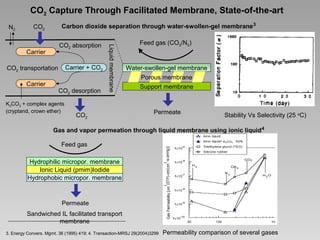
CO2 Capture Through Facilitated Membrane, State-of-the-art
N2

Carbon dioxide separation through water-swollen-gel membrane 3

CO2

Carrier

Carrier + CO2

CO2 transportation
Carrier

CO2 desorption

K2CO3 + complex agents
(cryptand, crown ether)

Liquid membrane

CO2 absorption

CO2

Feed gas (CO2/N2)

Water-swollen-gel membrane
Porous membrane
Support membrane

Permeate

Stability Vs Selectivity (25 oC)

Gas and vapor permeation through liquid membrane using ionic liquid 4
Feed gas
Hydrophilic micropor. membrane
Ionic Liquid (pmim)Iodide
Hydrophobic micropor. membrane

Permeate
Sandwiched IL facilitated transport
membrane
3. Energy Convers. Mgmt. 36 (1995) 419; 4. Transaction-MRSJ 29(2004)3299

Permeability comparison of several gases
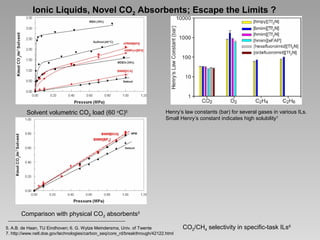
Ionic Liquids, Novel CO2 Absorbents; Escape the Limits ?

Solvent volumetric CO2 load (60 oC)5

Henry’s law constants (bar) for several gases in various ILs.
Small Henry’s constant indicates high solubility7

Comparison with physical CO2 absorbents5
5. A.B. de Haan, TU Eindhoven; 6. G. Wytze Meindersma, Univ. of Twente
7. http://www.netl.doe.gov/technologies/carbon_seq/core_rd/breakthrough/42122.html

CO2/CH4 selectivity in specific-task ILs6
Anion and Cation Effects on the Solubility of CO2
70

O

[bmim][PF6]

60

[bmim][BF4]

F3C

[bmim][Tf2N]

50

[MeBu3N][Tf2N]

40

S

S

O

[MeBuPyrr][Tf2N]

N

O

Anion effect

Cation effect

10
0

Henry’s law constants (bar) for CO2 in various ILs

CF3

F
F

F
P
F

F
F

determining the
CO2 solubility3;

The anions

30
20

O

Fluorinated anions are excellent but
costly, sometimes not
environmentally friendly.

Some strategies in ILs for CO2 absorption8
Creating more free
volume (introducing
ether and long,
branched alkyl chain
on the cation

8. Journal of Physical Chemistry B 109 (2005) 6366

Incorporating with CO2phylic functional groups
(carbonyl, sulfonyl,
phosphate, amine
groups)

Controlling the viscosity
(using dicyanamide
anions, trialkylsulfonium
cation)
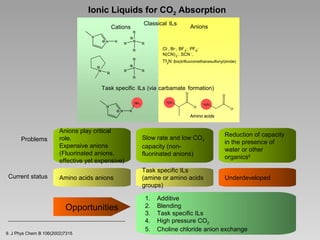
Ionic Liquids for CO2 Absorption
Classical ILs

Cations

Anions

R
N
N

R

N

R

R

Cl -, Br -, BF 4-, PF 6N(CN) 2-, SCN -,

R
R
N

P

R

R

Tf 2N (bis(trifluoromethanesulfonyl)aminde
(bis(trifluoromethanesulfonyl)imide) )
R

R

Task specific ILs (via carbamate formation)
O
H2 N

NH2

N
N

O
O-

H2N

R

O-

Amino acids

Problems

Current status

Anions play critical
role.
Expensive anions
(Fluorinated anions,
effective yet expensive)

Slow rate and low CO2
capacity (nonfluorinated anions)

Reduction of capacity
in the presence of
water or other
organics9

Amino acids anions

Task specific ILs
(amine or amino acids
groups)

Underdeveloped

Opportunities
9. J Phys Chem B 106(2002)7315

1.
2.
3.
4.
5.

Additive
Blending
Task specific ILs
High pressure CO2
Choline chloride anion exchange
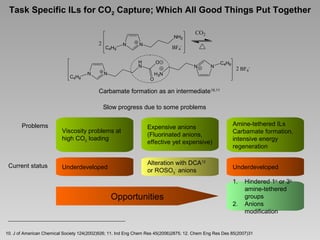
Task Specific ILs for CO2 Capture; Which All Good Things Put Together

2

NH2
C4H9

N

N

BF4-

H
N
C4H9

N

CO2

O

N
O

N

N

H3N

C4H9

2 BF4-

Carbamate formation as an intermediate 10,11
Slow progress due to some problems
Problems

Current status

Viscosity problems at
high CO2 loading

Expensive anions
(Fluorinated anions,
effective yet expensive)

Amine-tethered ILs
Carbamate formation,
intensive energy
regeneration

Underdeveloped

Alteration with DCA12
or ROSO3- anions

Underdeveloped
1.

Opportunities

2.

Hindered 1o or 3o
amine-tethered
groups
Anions
modification

10. J of American Chemical Society 124(2002)926; 11. Ind Eng Chem Res 45(2006)2875; 12. Chem Eng Res Des 85(2007)31
Poly(ionic liquid)s; Creative Effort13,14,15
*
*

*

n

*

*

*

n

*

*

n

n

x

*

*
1-x
O

x

*

*
1-x
O

O

O

O

O

O

BF4N

N
R

R
R

P[VBTMA][BF4]

BF4

-

N

O

O

n

N

N

R

n

O

P[VBBI][BF4]

P[MABI]BF4

P[VBTMA][BF4]-g-PEG

O

P[MATMA][BF4]-g-PEG

Brittle materials

Current status

O

N
R

Problems

BF4N

R

P[MATMA][BF4]

BF4-

BF4-

N

BF4-

R

R

O
O

Thermodynamics,
kinetics and
mechanism

Low efficiency

Grafting polymers

In progress, limited
results available

Underdeveloped
1.

Opportunities

13. Chem Commun (2005)3325; 14. Ind Eng Chem Res 46(2007)5397; 15. J Membrane Sci 281(2006)130

2.

ILs grafted onto
selective polymers
Specific
membrane
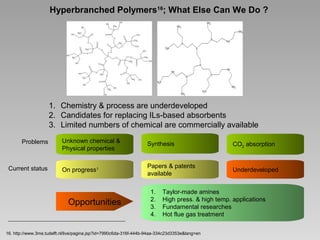
Hyperbranched Polymers16; What Else Can We Do ?

1. Chemistry & process are underdeveloped
2. Candidates for replacing ILs-based absorbents
3. Limited numbers of chemical are commercially available
Problems

Current status

Unknown chemical &
Physical properties

Synthesis

CO2 absorption

On progress1

Papers & patents
available

Underdeveloped

Opportunities

1.
2.
3.
4.

Taylor-made amines
High press. & high temp. applications
Fundamental researches
Hot flue gas treatment

16. http://www.3me.tudelft.nl/live/pagina.jsp?id=7990c6da-316f-444b-94aa-334c23d3353e&lang=en
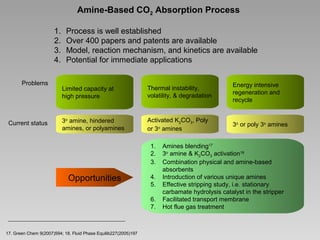
Amine-Based CO2 Absorption Process
1.
2.
3.
4.
Problems

Current status

Process is well established
Over 400 papers and patents are available
Model, reaction mechanism, and kinetics are available
Potential for immediate applications

Limited capacity at
high pressure

Thermal instability,
volatility, & degradation

Energy intensive
regeneration and
recycle

3o amine, hindered
amines, or polyamines

Activated K2CO3, Poly
or 3o amines

3o or poly 3o amines

1.
2.
3.

Opportunities

4.
5.
6.
7.

17. Green Chem 9(2007)594; 18. Fluid Phase Equilib227(2005)197

Amines blending17
3o amine & K2CO3 activation18
Combination physical and amine-based
absorbents
Introduction of various unique amines
Effective stripping study, i.e. stationary
carbamate hydrolysis catalyst in the stripper
Facilitated transport membrane
Hot flue gas treatment
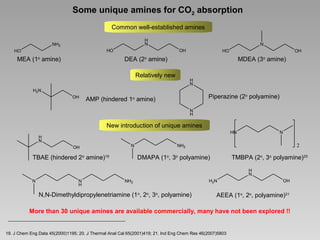
Some unique amines for CO2 absorption
Common well-established amines
H
N

NH2

HO

HO

MEA (1o amine)

N
OH

HO

OH

DEA (2o amine)

MDEA (3o amine)

Relatively new

H
N

H2N
OH

Piperazine (2o polyamine)

AMP (hindered 1o amine)
N
H

New introduction of unique amines
HN

H
N
OH

N

TBAE (hindered 2o amine)19

N

2

NH2

DMAPA (1o, 3o polyamine)

TMBPA (2o, 3o polyamine)20
H
N

N

N
H

NH2

N,N-Dimethyldipropylenetriamine (1 o, 2o, 3o, polyamine)

H2N

OH

AEEA (1o, 2o, polyamine)21

More than 30 unique amines are available commercially, many have not been explored !!

19. J Chem Eng Data 45(2000)1195; 20. J Thermal Anal Cal 65(2001)419; 21. Ind Eng Chem Res 46(2007)5803
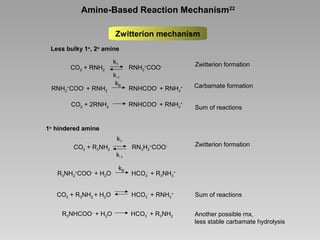
Amine-Based Reaction Mechanism22
Zwitterion mechanism
Less bulky 1o, 2o amine
CO2 + RNH2
RNH2+COO- + RNH2

k1

CO2 + 2RNH2

Zwitterion formation

RNHCOO- + RNH3+

Carbamate formation

RNHCOO- + RNH3+

k-1
kB

RNH2+COO-

Sum of reactions

1o hindered amine
k1
CO2 + R3NH2

R3NH2+COO- + H2O

k-1
kB

RN3H2+COO-

Zwitterion formation

HCO3- + R3NH3+

CO2 + R3NH2 + H2O

HCO3- + RNH3+

Sum of reactions

R3NHCOO- + H2O

HCO3- + R3NH2

Another possible rnx,
less stable carbamate hydrolysis
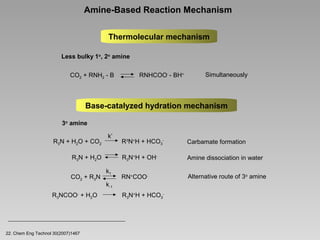
Amine-Based Reaction Mechanism
Thermolecular mechanism
Less bulky 1o, 2o amine
CO2 + RNH2 - B

RNHCOO- - BH+

Simultaneously

Base-catalyzed hydration mechanism
3o amine
R3N + H2O + CO2

k’

CO2 + R3N
R3NCOO- + H2O

22. Chem Eng Technol 30(2007)1467

k1

Carbamate formation

R3N+H + OH-

R3N + H2O

R3N+H + HCO3-

Amine dissociation in water

RN+COO-

Alternative route of 3o amine

k-1
R3N+H + HCO3-
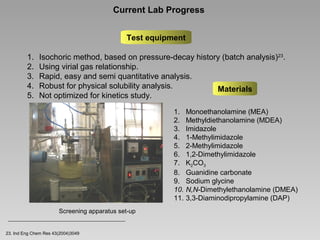
Current Lab Progress
Test equipment
1.
2.
3.
4.
5.

Isochoric method, based on pressure-decay history (batch analysis)23.
Using virial gas relationship.
Rapid, easy and semi quantitative analysis.
Robust for physical solubility analysis.
Materials
Not optimized for kinetics study.
1. Monoethanolamine (MEA)
2. Methyldiethanolamine (MDEA)
3. Imidazole
4. 1-Methylimidazole
5. 2-Methylimidazole
6. 1,2-Dimethylimidazole
7. K2CO3
8. Guanidine carbonate
9. Sodium glycine
10. N,N-Dimethylethanolamine (DMEA)
11. 3,3-Diaminodipropylamine (DAP)
Screening apparatus set-up

23. Ind Eng Chem Res 43(2004)3049
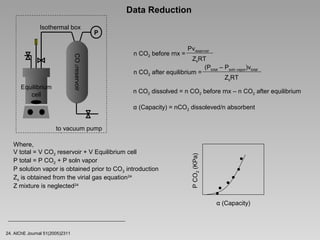
Data Reduction
Isothermal box

P

CO 2 reservoir

Equilibrium
cell

n CO2 before rnx =

Pvreservoir

ZsRT
(Ptotal – Psoln vapor)vtotal
n CO2 after equilibrium =
ZsRT

n CO2 dissolved = n CO2 before rnx – n CO2 after equilibrium
Îą (Capacity) = nCO2 dissoleved/n absorbent

Where,
V total = V CO2 reservoir + V Equilibrium cell
P total = P CO2 + P soln vapor
P solution vapor is obtained prior to CO 2 introduction
Zs is obtained from the virial gas equation24
Z mixture is neglected24

P CO2 (KPa)

to vacuum pump

Îą (Capacity)

24. AIChE Journal 51(2005)2311
Total Equilibrium
Pressure (KPa)
Total Equilibrium Pressure (KPa)

Total Pressure equilibrium Vs CO2 capacity (30 mins capacity (30 mins run)
Total Pressure equilibrium Vs CO2 run)

80. 0

80.00

80. 0

Total Equilibrium
Pressure (KPa)

Total equilibrium pressure (KPa)

100.00

60. 0

60.00

60. 0

40. 0

40.00

0.00 5.00
5.00
0.00

10.00
10.00

5.00

10.00

0. 0
15.00
15.00

15.00

mole of CO2/2kg of absorbent
mole of CO / kg of absorbent

60.0

40. 040.0

20. 0

20.00

80.0

20. 020.0
0. 0

0. 0
20.00

0.0
20.00
20.00
0. 4
0.0 0.0

mole of CO2/ kg of absorbent

1mL MDEA + + 4mL H2O
1mL MDEA 4mL H2O
5mL 4.76%wt 2- methylimidazole/ H2O
5mL 4. 76%wt 2- methylimidazole/ H2O
5mL 4.76%wt imidazole/ H2O
5mL 4. 76%wt imidazole/ H2O
5mL 4.76%wt guanidine carbonate/ H2O
5mL 4. 76%wt guanidine carbonate/ H2O
5mL 4.76%wt DMEA/ H2O
5mL 4. 76%wt DMEA/ H2O
5mL 4.76%wt DAP
5mL 4. 76%wt DAP

2mL MDEA +2mL MDEA + 3mL H2O
3mL H2O
5mL 23.08%wt K2CO3/ H2O
5mL 23. 08%wt K2CO3/ H2O
5mL 23.08%wt K2CO3/ H2O K2CO3/ H2O
5mL 23.08%wt
5mL 4.76%wt Naglycine/ H2O
5mL 4.76%wt 1,2- dimethylimidazole/ H2O
5mL 4.76%wt 1,2- dimethylimidazole/ H2O 5mL 4.76%wt Naglycine/ H2O
5mL 4.76%wt MEA/ H2O MEA/ H2O
5mL 4.76%wt
5mL 4.76%wt MEA/ H2O
5mL 4.76%wt DMEA/ H2O DMEA/ H2O
5mL 4.76%wt
1mL DMEA + + 4mL H2O
1mL DMEA 4mL H2O

4mL 4.76%wt DAP + 1 mL DMEA 1 mL DMEA
4mL 4.76%wt DAP +

1mL
5mL
5mL
5mL
1mL
5mL

2. 0
2.4 2.4

MDEA +1mL MDEA + 4mL H2O
4mL H2O
4.76%wt 2- methylimidazole/ H2O
5mL 4. 76%wt 2- methylimidazol
4.76%wt 1,2- dimethylimidazole/ H2O
5mL 4. 76%wt 1,2- dimethylimid
9.09%wt guan-09%wt guan- car/ H2O
5mL 9. car/ H2O
DMEA +1mL DMEA + 4mL H2O
4mL H2O
4.76%wt DAP 76%wt DAP
5mL 4.

Capacity (mol of CO2/mol absorbent) of various amines

CO
Loading (mol of CO2/kgSolubility (Validation of Experiments)
absorbent) of various amines
2

16

160

[emim]etOSO3

120

CO2 mole fraction (x1000)

140

PCO2 equilibrium (KPa)

1.6
0.0. 8
4
0.8
1.2.0
6
0.4
0.8 1.2 1.2 1.2 1.6
2.0
a (molmol absorbent)
a (mol CO2(mol2/CO2absorbent)
a / CO mol / mol absorbent)

Jones et al; J Chem Eng Data4(1959)85
Shen et al; J Chem Eng Data 37(1992)96
Song et al; J Chem Eng Data 41(1996)497
This work

100
80
60
40
20
0

[emim]etOSO3 + 7.0% w/w ZnBr2
[emim]etOSO3 + 7.0% w/w sugar

12

[bmim]BF4

8

4

0

0. 4

0.5
0. 6
Capacity (mol CO2/ mol of MEA)

0. 7

Experimental Validation of CO2 solubility test (15.3%wt. MEA)

30

50

70

90

110

Pequilibrium (KPa)

Effect of additive on the CO2 absorption capacity of simple ILs
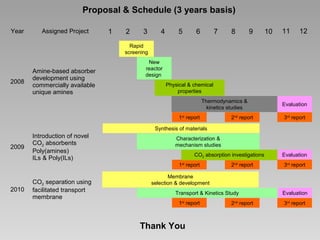
Proposal & Schedule (3 years basis)
Year

Assigned Project

1

2

3

4

5

6

7

8

9

10

11

12

Rapid
screening

2008

Amine-based absorber
development using
commercially available
unique amines

New
reactor
design
Physical & chemical
properties
Thermodynamics &
kinetics studies
1st report

2nd report

Evaluation
3rd report

Synthesis of materials

2009

Introduction of novel
CO2 absorbents
Poly(amines)
ILs & Poly(ILs)

Characterization &
mechanism studies
CO2 absorption investigations
1st report

2010

CO2 separation using
facilitated transport
membrane

2nd report

Evaluation
3rd report

Membrane
selection & development
Transport & Kinetics Study
1st report

Thank You

2nd report

Evaluation
3rd report

CO2 Separation - A Proposal

  • 1.
    Toward Benign Processof CO2 Separation; Facts and Opportunities Lean absorber CO2<2% Desorption Absorption Combustion gas CO2, H2O CO2 rich absorber Kyung Hee University Green Chemistry Research Group
  • 2.
  • 3.
    CO2 Capture Technologyin Industry1, From Gas Sweetening to Global Warming Issues Raw materials Industrial separation Industrial process CO2 separation Compression CO2 Product Post-combustion combustion CO2 separation Pre-combustion Gasification/reform CO2 Heat & Power Air Fossil fuels, biomass Compression H2 and CO2 separation Compression H2 Air/O2 + steam Heat & Power Other products Compression Oxyfuel CO2 CO2 Air/O Combustion2-steam O2 O2 separation Air 1. http://wcentral.blogspot.com/2007/05/overview-of-carbon-capture.html Heat & power
  • 4.
    Methods for CO2Capture Separating agent Method Chemical absorption Physical absorption Adsorption Gas permeation Cryogenic distillation Combination Principle of separation CO2 solubility CO2 reactivity CO2-solid affinity Diffusion through membrane, pressure, concentration gradient Liquid Water, methanol, DME, PEG, NMP, PC Reacting liquid MEA, DEA, TEA, NaOH, K2CO3 Solid adsorbent Zeolite, Active carbon, alumina silicates, hydrotalcites Polymeric, ceramic, ion transport, membrane Liquefaction, distillation Pressure swing adsorption Distillation tower Pressure swing – solid adsorbent
  • 5.
    Physical Versus ChemicalAbsorption Physical Chemical No chemical interaction Regeneration by & ΔP or (limited) & ΔT Chemical interaction occurs Regeneration by & ΔT (req. high temp.) & ΔP MeOH, NMP, PEG, PC, water, tri-n-Bu Phosphate, ILs • Less energy usage and less maintenance demand under optimal condition and process • 1o, 2o, 3o amines (MEA, DEA, MDEA) • Alkali metal OH- or CO32(NaOH, K2CO3) • Concentration limited by solubility • Susceptible with corrosion, reactivity with oxidator & contaminant Chemical absorption using amine indicating sharp rise in outlet PCO2 when loading reaches reaction stoichiometry Non-functionalized ILs is good candidates for physical CO2 absorption. • Good at low inlet P CO2 • Loading limited by reaction stoichiometry • Can reach very low outlet P CO2 (down to ppm) PCO2 above Liquid, atm • Better at high inlet P CO2 • Loading proportional to PCO 2 • Cannot reach very low outlet P CO2 (0.1-2%) MeOH, 0°C 20wt% DEA, 50 °C CO2, vol/vol absorbent
  • 6.
    Typical CO2 CaptureProcess from Industrial Process and Power Plant Carbon dioxide absorption using amine solution CO2 Off Gas Condenser Lean Gas Separator Drum Lean Solvent Absorber Stripping Column Trim Cooler CO2-Rich Feed Gas Rich Solution • Many variations possible • Physical absorbent may not require extensive heat input for regeneration • CO2 off-gas often at low pressure • May require pre-compression, depending on feed gas pressure Interchanger Reboiler • Recovery from low pressure (~1 atm) flue gas • Low CO2 partial pressure (~1-1.5 psi) • Oxygen containing gas (~2-5%) • Hot flue gas ~400-800 oC • May contain NOx, Hg, SO2, H2S, other sulfur species and particulates
  • 7.
    CO2 Capture ThroughFacilitated Membrane; Tons of Works Awaiting 2 1. 2. 3. 4. 5. Process is under rapid investigations & developments Numerous absorbents & membranes are available Novel processes are possible Some problems persist (solutions may directly correspond to costs) Model, reaction mechanism, and kinetics are available Problems Current status Vapor invasion through membrane pores at high temp. (wetting) 1. Non/less-volatile liquids Surface modification composite 2. 3. Opportunities 2. separ & Puri Tech 41(2005)109 Durability & thermal stability 1. 2. 1. 2. 3. 4. 5. Fluorinated polymers Non-aggressive liquids Selectivity 1. 2. Selective liquids Composite Introduction of less volatile absorbent Combination of membrane-novel absorbent Membrane modification Hybrid absorbent Module design
  • 8.
    CO2 Capture ThroughFacilitated Membrane, State-of-the-art N2 Carbon dioxide separation through water-swollen-gel membrane 3 CO2 Carrier Carrier + CO2 CO2 transportation Carrier CO2 desorption K2CO3 + complex agents (cryptand, crown ether) Liquid membrane CO2 absorption CO2 Feed gas (CO2/N2) Water-swollen-gel membrane Porous membrane Support membrane Permeate Stability Vs Selectivity (25 oC) Gas and vapor permeation through liquid membrane using ionic liquid 4 Feed gas Hydrophilic micropor. membrane Ionic Liquid (pmim)Iodide Hydrophobic micropor. membrane Permeate Sandwiched IL facilitated transport membrane 3. Energy Convers. Mgmt. 36 (1995) 419; 4. Transaction-MRSJ 29(2004)3299 Permeability comparison of several gases
  • 9.
    Ionic Liquids, NovelCO2 Absorbents; Escape the Limits ? Solvent volumetric CO2 load (60 oC)5 Henry’s law constants (bar) for several gases in various ILs. Small Henry’s constant indicates high solubility7 Comparison with physical CO2 absorbents5 5. A.B. de Haan, TU Eindhoven; 6. G. Wytze Meindersma, Univ. of Twente 7. http://www.netl.doe.gov/technologies/carbon_seq/core_rd/breakthrough/42122.html CO2/CH4 selectivity in specific-task ILs6
  • 10.
    Anion and CationEffects on the Solubility of CO2 70 O [bmim][PF6] 60 [bmim][BF4] F3C [bmim][Tf2N] 50 [MeBu3N][Tf2N] 40 S S O [MeBuPyrr][Tf2N] N O Anion effect Cation effect 10 0 Henry’s law constants (bar) for CO2 in various ILs CF3 F F F P F F F determining the CO2 solubility3; The anions 30 20 O Fluorinated anions are excellent but costly, sometimes not environmentally friendly. Some strategies in ILs for CO2 absorption8 Creating more free volume (introducing ether and long, branched alkyl chain on the cation 8. Journal of Physical Chemistry B 109 (2005) 6366 Incorporating with CO2phylic functional groups (carbonyl, sulfonyl, phosphate, amine groups) Controlling the viscosity (using dicyanamide anions, trialkylsulfonium cation)
  • 11.
    Ionic Liquids forCO2 Absorption Classical ILs Cations Anions R N N R N R R Cl -, Br -, BF 4-, PF 6N(CN) 2-, SCN -, R R N P R R Tf 2N (bis(trifluoromethanesulfonyl)aminde (bis(trifluoromethanesulfonyl)imide) ) R R Task specific ILs (via carbamate formation) O H2 N NH2 N N O O- H2N R O- Amino acids Problems Current status Anions play critical role. Expensive anions (Fluorinated anions, effective yet expensive) Slow rate and low CO2 capacity (nonfluorinated anions) Reduction of capacity in the presence of water or other organics9 Amino acids anions Task specific ILs (amine or amino acids groups) Underdeveloped Opportunities 9. J Phys Chem B 106(2002)7315 1. 2. 3. 4. 5. Additive Blending Task specific ILs High pressure CO2 Choline chloride anion exchange
  • 12.
    Task Specific ILsfor CO2 Capture; Which All Good Things Put Together 2 NH2 C4H9 N N BF4- H N C4H9 N CO2 O N O N N H3N C4H9 2 BF4- Carbamate formation as an intermediate 10,11 Slow progress due to some problems Problems Current status Viscosity problems at high CO2 loading Expensive anions (Fluorinated anions, effective yet expensive) Amine-tethered ILs Carbamate formation, intensive energy regeneration Underdeveloped Alteration with DCA12 or ROSO3- anions Underdeveloped 1. Opportunities 2. Hindered 1o or 3o amine-tethered groups Anions modification 10. J of American Chemical Society 124(2002)926; 11. Ind Eng Chem Res 45(2006)2875; 12. Chem Eng Res Des 85(2007)31
  • 13.
    Poly(ionic liquid)s; CreativeEffort13,14,15 * * * n * * * n * * n n x * * 1-x O x * * 1-x O O O O O O BF4N N R R R P[VBTMA][BF4] BF4 - N O O n N N R n O P[VBBI][BF4] P[MABI]BF4 P[VBTMA][BF4]-g-PEG O P[MATMA][BF4]-g-PEG Brittle materials Current status O N R Problems BF4N R P[MATMA][BF4] BF4- BF4- N BF4- R R O O Thermodynamics, kinetics and mechanism Low efficiency Grafting polymers In progress, limited results available Underdeveloped 1. Opportunities 13. Chem Commun (2005)3325; 14. Ind Eng Chem Res 46(2007)5397; 15. J Membrane Sci 281(2006)130 2. ILs grafted onto selective polymers Specific membrane
  • 14.
    Hyperbranched Polymers16; WhatElse Can We Do ? 1. Chemistry & process are underdeveloped 2. Candidates for replacing ILs-based absorbents 3. Limited numbers of chemical are commercially available Problems Current status Unknown chemical & Physical properties Synthesis CO2 absorption On progress1 Papers & patents available Underdeveloped Opportunities 1. 2. 3. 4. Taylor-made amines High press. & high temp. applications Fundamental researches Hot flue gas treatment 16. http://www.3me.tudelft.nl/live/pagina.jsp?id=7990c6da-316f-444b-94aa-334c23d3353e&lang=en
  • 15.
    Amine-Based CO2 AbsorptionProcess 1. 2. 3. 4. Problems Current status Process is well established Over 400 papers and patents are available Model, reaction mechanism, and kinetics are available Potential for immediate applications Limited capacity at high pressure Thermal instability, volatility, & degradation Energy intensive regeneration and recycle 3o amine, hindered amines, or polyamines Activated K2CO3, Poly or 3o amines 3o or poly 3o amines 1. 2. 3. Opportunities 4. 5. 6. 7. 17. Green Chem 9(2007)594; 18. Fluid Phase Equilib227(2005)197 Amines blending17 3o amine & K2CO3 activation18 Combination physical and amine-based absorbents Introduction of various unique amines Effective stripping study, i.e. stationary carbamate hydrolysis catalyst in the stripper Facilitated transport membrane Hot flue gas treatment
  • 16.
    Some unique aminesfor CO2 absorption Common well-established amines H N NH2 HO HO MEA (1o amine) N OH HO OH DEA (2o amine) MDEA (3o amine) Relatively new H N H2N OH Piperazine (2o polyamine) AMP (hindered 1o amine) N H New introduction of unique amines HN H N OH N TBAE (hindered 2o amine)19 N 2 NH2 DMAPA (1o, 3o polyamine) TMBPA (2o, 3o polyamine)20 H N N N H NH2 N,N-Dimethyldipropylenetriamine (1 o, 2o, 3o, polyamine) H2N OH AEEA (1o, 2o, polyamine)21 More than 30 unique amines are available commercially, many have not been explored !! 19. J Chem Eng Data 45(2000)1195; 20. J Thermal Anal Cal 65(2001)419; 21. Ind Eng Chem Res 46(2007)5803
  • 17.
    Amine-Based Reaction Mechanism22 Zwitterionmechanism Less bulky 1o, 2o amine CO2 + RNH2 RNH2+COO- + RNH2 k1 CO2 + 2RNH2 Zwitterion formation RNHCOO- + RNH3+ Carbamate formation RNHCOO- + RNH3+ k-1 kB RNH2+COO- Sum of reactions 1o hindered amine k1 CO2 + R3NH2 R3NH2+COO- + H2O k-1 kB RN3H2+COO- Zwitterion formation HCO3- + R3NH3+ CO2 + R3NH2 + H2O HCO3- + RNH3+ Sum of reactions R3NHCOO- + H2O HCO3- + R3NH2 Another possible rnx, less stable carbamate hydrolysis
  • 18.
    Amine-Based Reaction Mechanism Thermolecularmechanism Less bulky 1o, 2o amine CO2 + RNH2 - B RNHCOO- - BH+ Simultaneously Base-catalyzed hydration mechanism 3o amine R3N + H2O + CO2 k’ CO2 + R3N R3NCOO- + H2O 22. Chem Eng Technol 30(2007)1467 k1 Carbamate formation R3N+H + OH- R3N + H2O R3N+H + HCO3- Amine dissociation in water RN+COO- Alternative route of 3o amine k-1 R3N+H + HCO3-
  • 19.
    Current Lab Progress Testequipment 1. 2. 3. 4. 5. Isochoric method, based on pressure-decay history (batch analysis)23. Using virial gas relationship. Rapid, easy and semi quantitative analysis. Robust for physical solubility analysis. Materials Not optimized for kinetics study. 1. Monoethanolamine (MEA) 2. Methyldiethanolamine (MDEA) 3. Imidazole 4. 1-Methylimidazole 5. 2-Methylimidazole 6. 1,2-Dimethylimidazole 7. K2CO3 8. Guanidine carbonate 9. Sodium glycine 10. N,N-Dimethylethanolamine (DMEA) 11. 3,3-Diaminodipropylamine (DAP) Screening apparatus set-up 23. Ind Eng Chem Res 43(2004)3049
  • 20.
    Data Reduction Isothermal box P CO2 reservoir Equilibrium cell n CO2 before rnx = Pvreservoir ZsRT (Ptotal – Psoln vapor)vtotal n CO2 after equilibrium = ZsRT n CO2 dissolved = n CO2 before rnx – n CO2 after equilibrium α (Capacity) = nCO2 dissoleved/n absorbent Where, V total = V CO2 reservoir + V Equilibrium cell P total = P CO2 + P soln vapor P solution vapor is obtained prior to CO 2 introduction Zs is obtained from the virial gas equation24 Z mixture is neglected24 P CO2 (KPa) to vacuum pump α (Capacity) 24. AIChE Journal 51(2005)2311
  • 21.
    Total Equilibrium Pressure (KPa) TotalEquilibrium Pressure (KPa) Total Pressure equilibrium Vs CO2 capacity (30 mins capacity (30 mins run) Total Pressure equilibrium Vs CO2 run) 80. 0 80.00 80. 0 Total Equilibrium Pressure (KPa) Total equilibrium pressure (KPa) 100.00 60. 0 60.00 60. 0 40. 0 40.00 0.00 5.00 5.00 0.00 10.00 10.00 5.00 10.00 0. 0 15.00 15.00 15.00 mole of CO2/2kg of absorbent mole of CO / kg of absorbent 60.0 40. 040.0 20. 0 20.00 80.0 20. 020.0 0. 0 0. 0 20.00 0.0 20.00 20.00 0. 4 0.0 0.0 mole of CO2/ kg of absorbent 1mL MDEA + + 4mL H2O 1mL MDEA 4mL H2O 5mL 4.76%wt 2- methylimidazole/ H2O 5mL 4. 76%wt 2- methylimidazole/ H2O 5mL 4.76%wt imidazole/ H2O 5mL 4. 76%wt imidazole/ H2O 5mL 4.76%wt guanidine carbonate/ H2O 5mL 4. 76%wt guanidine carbonate/ H2O 5mL 4.76%wt DMEA/ H2O 5mL 4. 76%wt DMEA/ H2O 5mL 4.76%wt DAP 5mL 4. 76%wt DAP 2mL MDEA +2mL MDEA + 3mL H2O 3mL H2O 5mL 23.08%wt K2CO3/ H2O 5mL 23. 08%wt K2CO3/ H2O 5mL 23.08%wt K2CO3/ H2O K2CO3/ H2O 5mL 23.08%wt 5mL 4.76%wt Naglycine/ H2O 5mL 4.76%wt Naglycine/ H2O 5mL 4.76%wt Naglycine/ H2O 5mL 4.76%wt 1,2- dimethylimidazole/ H2O 5mL 4.76%wt 1,2- dimethylimidazole/ H2O 5mL 4.76%wt Naglycine/ H2O 5mL 4.76%wt MEA/ H2O MEA/ H2O 5mL 4.76%wt 5mL 4.76%wt MEA/ H2O 5mL 4.76%wt MEA/ H2O 5mL 4.76%wt DMEA/ H2O DMEA/ H2O 5mL 4.76%wt 1mL DMEA + + 4mL H2O 1mL DMEA 4mL H2O 4mL 4.76%wt DAP + 1 mL DMEA 1 mL DMEA 4mL 4.76%wt DAP + 1mL 5mL 5mL 5mL 1mL 5mL 2. 0 2.4 2.4 MDEA +1mL MDEA + 4mL H2O 4mL H2O 4.76%wt 2- methylimidazole/ H2O 5mL 4. 76%wt 2- methylimidazol 4.76%wt 1,2- dimethylimidazole/ H2O 5mL 4. 76%wt 1,2- dimethylimid 9.09%wt guan-09%wt guan- car/ H2O 5mL 9. car/ H2O DMEA +1mL DMEA + 4mL H2O 4mL H2O 4.76%wt DAP 76%wt DAP 5mL 4. Capacity (mol of CO2/mol absorbent) of various amines CO Loading (mol of CO2/kgSolubility (Validation of Experiments) absorbent) of various amines 2 16 160 [emim]etOSO3 120 CO2 mole fraction (x1000) 140 PCO2 equilibrium (KPa) 1.6 0.0. 8 4 0.8 1.2.0 6 0.4 0.8 1.2 1.2 1.2 1.6 2.0 a (molmol absorbent) a (mol CO2(mol2/CO2absorbent) a / CO mol / mol absorbent) Jones et al; J Chem Eng Data4(1959)85 Shen et al; J Chem Eng Data 37(1992)96 Song et al; J Chem Eng Data 41(1996)497 This work 100 80 60 40 20 0 [emim]etOSO3 + 7.0% w/w ZnBr2 [emim]etOSO3 + 7.0% w/w sugar 12 [bmim]BF4 8 4 0 0. 4 0.5 0. 6 Capacity (mol CO2/ mol of MEA) 0. 7 Experimental Validation of CO2 solubility test (15.3%wt. MEA) 30 50 70 90 110 Pequilibrium (KPa) Effect of additive on the CO2 absorption capacity of simple ILs
  • 22.
    Proposal & Schedule(3 years basis) Year Assigned Project 1 2 3 4 5 6 7 8 9 10 11 12 Rapid screening 2008 Amine-based absorber development using commercially available unique amines New reactor design Physical & chemical properties Thermodynamics & kinetics studies 1st report 2nd report Evaluation 3rd report Synthesis of materials 2009 Introduction of novel CO2 absorbents Poly(amines) ILs & Poly(ILs) Characterization & mechanism studies CO2 absorption investigations 1st report 2010 CO2 separation using facilitated transport membrane 2nd report Evaluation 3rd report Membrane selection & development Transport & Kinetics Study 1st report Thank You 2nd report Evaluation 3rd report