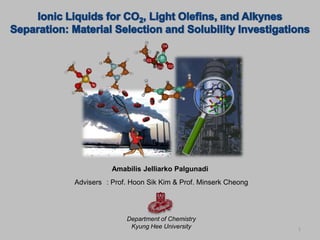
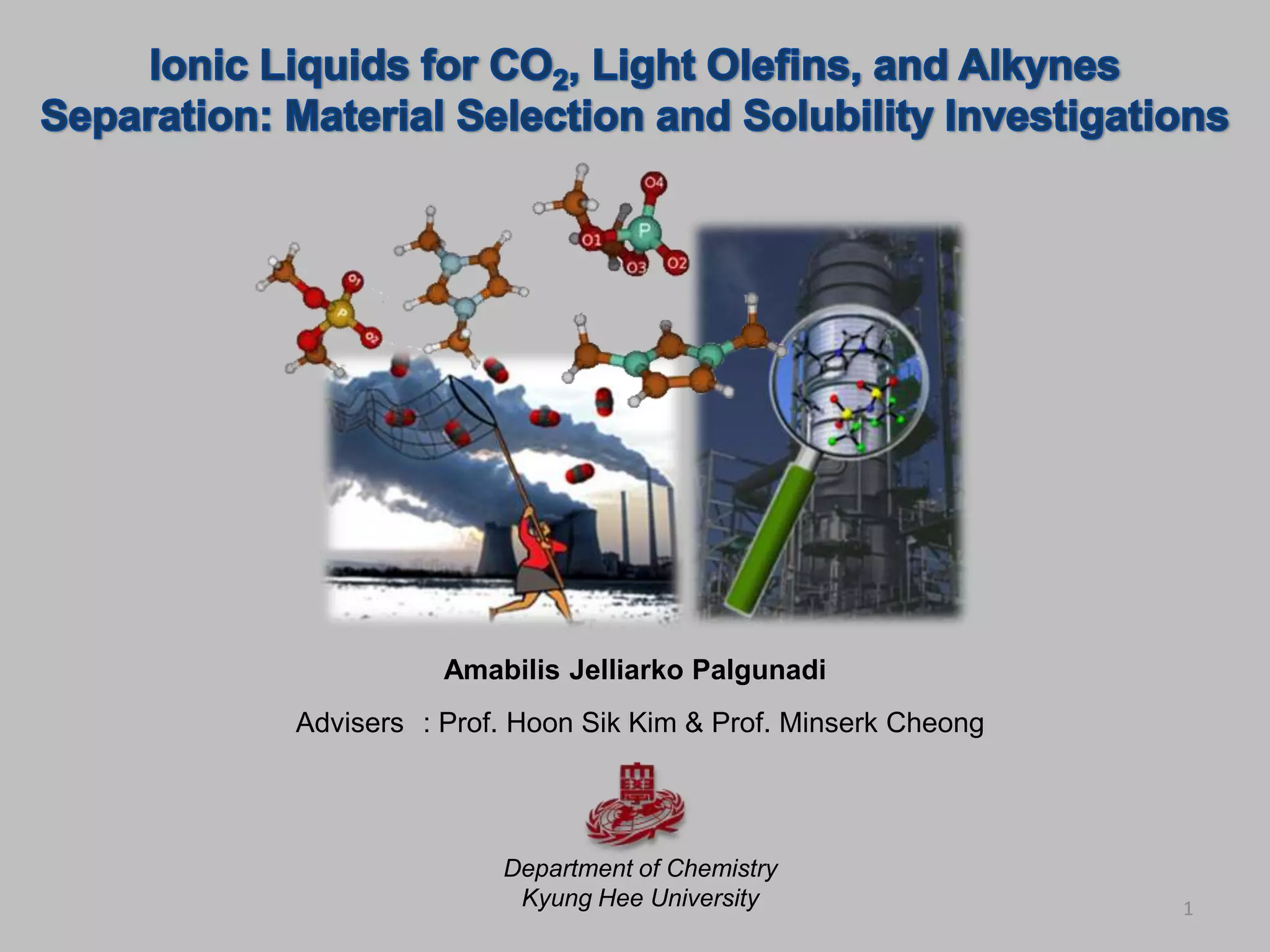
Ionic Liquids for CO2, Light Olefins, and Alkynes Separation: Material Selection and Solubility InvestigationsAmabilis Jelliarko PalgunadiAdvisers	: Prof. HoonSikKim & Prof. Minserk CheongDepartment of ChemistryKyung HeeUniversity1
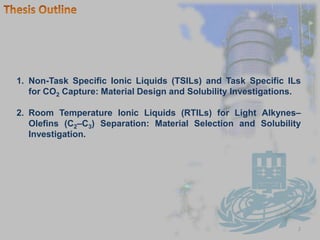
2Thesis OutlineNon-Task Specific Ionic Liquids (TSILs) and Task Specific ILs for CO2Capture: Material Design and Solubility Investigations.Room Temperature Ionic Liquids (RTILs) for Light Alkynes–Olefins (C2–C3) Separation: Material Selection and Solubility Investigation.
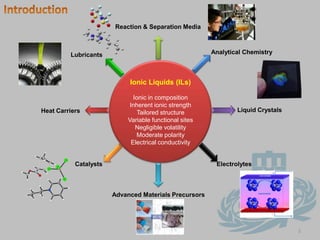
IntroductionReaction & Separation MediaAnalytical ChemistryLubricantsIonic Liquids (ILs)Ionic in compositionInherent ionic strengthTailored structureVariable functional sitesNegligible volatilityModerate polarityElectrical conductivityLiquid CrystalsHeat CarriersCatalystsElectrolytesAdvanced Materials Precursors3
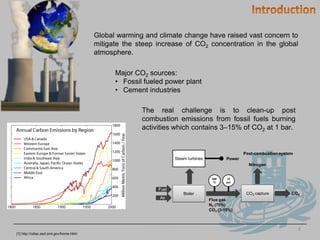
4IntroductionGlobal warming and climate change have raised vast concern to mitigate the steep increase of CO2 concentration in the global atmosphere.Major CO2 sources:Fossil fueled power plant
Cement industriesThe real challenge is to clean-up post combustion emissions from fossil fuels burning activities which contains 3–15% of CO2 at 1 bar.[1] http://cdiac.esd.ornl.gov/home.html
5ObjectiveCO2 Capture Employing Room Temperature Ionic Liquids (RTILs)Established Liquid-based CO2 Scrubber SystemPower Plant–Coal CombustionRoom Temperature Ionic Liquids??
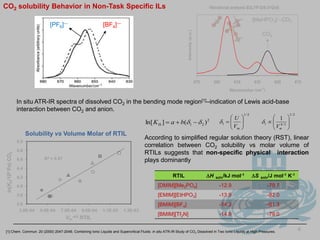
CO2 solubility Behavior in Non-Task Specific ILs[BF4]—[PF6]—In situ ATR-IR spectra of dissolved CO2in the bending mode region[1]–indication of Lewis acid-base interaction between CO2 and anion.[1] Chem. Commun. 20 (2000) 2047-2048; Combining Ionic Liquids and Supercritical Fluids: in situ ATR-IR Study of CO2 Dissolved in Two Ionic Liquids at High Pressures.6Solubility vsVolume Molar of RTIL According to simplified regular solution theory (RST), linear correlation between CO2 solubility vs molar volume of RTILs suggests that non-specific physical  interaction plays dominantly
Task Specific ILs Having Amino Acid Structure (AA–TSILs)7Synthesis amineMe-acrylateFeature:Cheap materials
Customized structure
Simple reaction
green process (RT, water medium)β AA–TSILProducts Property:Viscous–gell-like
Stable under constant 100 °C for 1 month.[Bu4N][BzAPr][Bu4N][CyhexAPr][Bu4N][BuAPr][Bu4N][dEAEAPr]
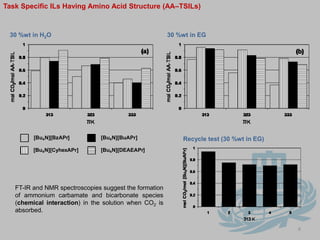
Task Specific ILs Having Amino Acid Structure (AA–TSILs)830 %wt in H2O30 %wt in EGRecycle test (30 %wt in EG)FT-IR and NMR spectroscopies suggest the formation of ammonium carbamate and bicarbonate species (chemical interaction) in the solution when CO2 is absorbed.
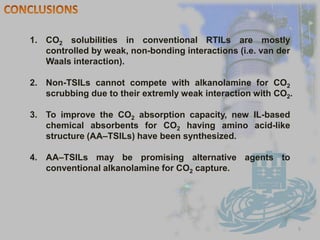
CONCLUSIONSCO2solubilities in conventional RTILs are mostly controlled by weak, non-bonding interactions (i.e. van der Waals interaction).Non-TSILs cannot compete with alkanolamine for CO2 scrubbing due to their extremly weak interaction with CO2.To improve the CO2 absorption capacity, new IL-based chemical absorbents for CO2 having amino acid-like structure (AA–TSILs) have been synthesized.AA–TSILs may be promising alternative agents to conventional alkanolamine for CO2 capture.9
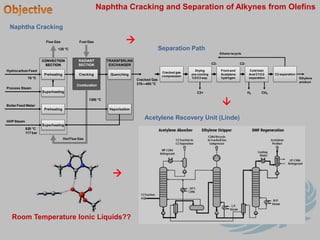
Naphtha Cracking and Separation of Alkynes from OlefinsObjectiveNaphtha CrackingSeparation PathAcetylene Recovery Unit (Linde)Room Temperature Ionic Liquids??10
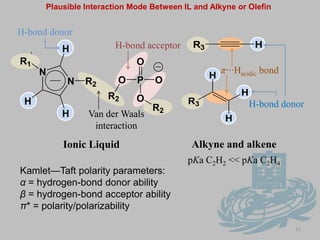
Plausible Interaction Mode Between IL and Alkyne or Olefin11H-bond donorH-bond acceptorπ···Hacidic bondH-bond donorVan der Waals interactionAlkyne and alkeneIonic LiquidpKa C2H2 << pKa C2H4Kamlet—Taft polarity parameters:α = hydrogen-bond donor abilityβ = hydrogen-bond acceptor abilityπ* = polarity/polarizability
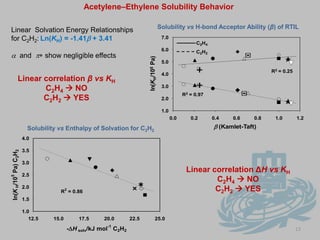
Solubility vsVolume Molar of RTIL Simplified RST modelC2H4  YESC2H2  NO12Acetylene–Ethylene Solubility BehaviorThis linear correlation suggests that non-specific physical interaction plays dominantly in determining the gas solubility.

CO2-Olefins-Alkyne in Ionic Liquids: Solubilities & Material Selection - Ph.D Thesis

  • 1.
    Ionic Liquids forCO2, Light Olefins, and Alkynes Separation: Material Selection and Solubility InvestigationsAmabilis Jelliarko PalgunadiAdvisers : Prof. HoonSikKim & Prof. Minserk CheongDepartment of ChemistryKyung HeeUniversity1
  • 2.
    2Thesis OutlineNon-Task SpecificIonic Liquids (TSILs) and Task Specific ILs for CO2Capture: Material Design and Solubility Investigations.Room Temperature Ionic Liquids (RTILs) for Light Alkynes–Olefins (C2–C3) Separation: Material Selection and Solubility Investigation.
  • 3.
    IntroductionReaction & SeparationMediaAnalytical ChemistryLubricantsIonic Liquids (ILs)Ionic in compositionInherent ionic strengthTailored structureVariable functional sitesNegligible volatilityModerate polarityElectrical conductivityLiquid CrystalsHeat CarriersCatalystsElectrolytesAdvanced Materials Precursors3
  • 4.
    4IntroductionGlobal warming andclimate change have raised vast concern to mitigate the steep increase of CO2 concentration in the global atmosphere.Major CO2 sources:Fossil fueled power plant
  • 5.
    Cement industriesThe realchallenge is to clean-up post combustion emissions from fossil fuels burning activities which contains 3–15% of CO2 at 1 bar.[1] http://cdiac.esd.ornl.gov/home.html
  • 6.
    5ObjectiveCO2 Capture EmployingRoom Temperature Ionic Liquids (RTILs)Established Liquid-based CO2 Scrubber SystemPower Plant–Coal CombustionRoom Temperature Ionic Liquids??
  • 7.
    CO2 solubility Behaviorin Non-Task Specific ILs[BF4]—[PF6]—In situ ATR-IR spectra of dissolved CO2in the bending mode region[1]–indication of Lewis acid-base interaction between CO2 and anion.[1] Chem. Commun. 20 (2000) 2047-2048; Combining Ionic Liquids and Supercritical Fluids: in situ ATR-IR Study of CO2 Dissolved in Two Ionic Liquids at High Pressures.6Solubility vsVolume Molar of RTIL According to simplified regular solution theory (RST), linear correlation between CO2 solubility vs molar volume of RTILs suggests that non-specific physical interaction plays dominantly
  • 8.
    Task Specific ILsHaving Amino Acid Structure (AA–TSILs)7Synthesis amineMe-acrylateFeature:Cheap materials
  • 9.
  • 10.
  • 11.
    green process (RT,water medium)β AA–TSILProducts Property:Viscous–gell-like
  • 12.
    Stable under constant100 °C for 1 month.[Bu4N][BzAPr][Bu4N][CyhexAPr][Bu4N][BuAPr][Bu4N][dEAEAPr]
  • 13.
    Task Specific ILsHaving Amino Acid Structure (AA–TSILs)830 %wt in H2O30 %wt in EGRecycle test (30 %wt in EG)FT-IR and NMR spectroscopies suggest the formation of ammonium carbamate and bicarbonate species (chemical interaction) in the solution when CO2 is absorbed.
  • 14.
    CONCLUSIONSCO2solubilities in conventionalRTILs are mostly controlled by weak, non-bonding interactions (i.e. van der Waals interaction).Non-TSILs cannot compete with alkanolamine for CO2 scrubbing due to their extremly weak interaction with CO2.To improve the CO2 absorption capacity, new IL-based chemical absorbents for CO2 having amino acid-like structure (AA–TSILs) have been synthesized.AA–TSILs may be promising alternative agents to conventional alkanolamine for CO2 capture.9
  • 15.
    Naphtha Cracking andSeparation of Alkynes from OlefinsObjectiveNaphtha CrackingSeparation PathAcetylene Recovery Unit (Linde)Room Temperature Ionic Liquids??10
  • 16.
    Plausible Interaction ModeBetween IL and Alkyne or Olefin11H-bond donorH-bond acceptorπ···Hacidic bondH-bond donorVan der Waals interactionAlkyne and alkeneIonic LiquidpKa C2H2 << pKa C2H4Kamlet—Taft polarity parameters:α = hydrogen-bond donor abilityβ = hydrogen-bond acceptor abilityπ* = polarity/polarizability
  • 17.
    Solubility vsVolume Molarof RTIL Simplified RST modelC2H4  YESC2H2  NO12Acetylene–Ethylene Solubility BehaviorThis linear correlation suggests that non-specific physical interaction plays dominantly in determining the gas solubility.