1
Advantages of
CNTFETs Over
MOSFETs
•Rajesh Yadav
•Durlabha Chaudhary
•Dr. Neeraj Kr. Shukla
2
Contents
Setbacks of MOSFETs
Introduction to CNTFETs
Quantum Capacitance
Neural Network Principle
Conclusion
Future Work
3
Setbacks of MOSFETs
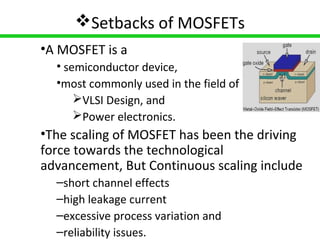
•A MOSFET is a
• semiconductor device,
•most commonly used in the field of
VLSI Design, and
Power electronics.
•The scaling of MOSFET has been the driving
force towards the technological
advancement, But Continuous scaling include
–short channel effects
–high leakage current
–excessive process variation and
–reliability issues.
4
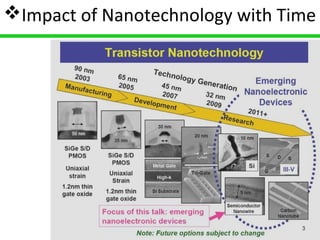
Impact of Nanotechnology with Time
5
Introduction to CNTFETs
•Carbon Nanotubes (CNTs) are
•Hexagonal networks of carbon atoms.
•Can be taken as a layer of graphite rolled up into a
cylinder.
•Their band structure depends on the position
of carbon atom forming the tube.
•Carbon Nanotubes can be
–metallic or
–semiconducting
depending on the folding angle and diameter.
6
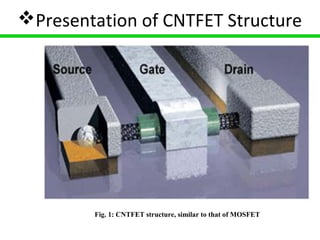
Presentation of CNTFET Structure
Fig. 1: CNTFET structure, similar to that of MOSFET
7
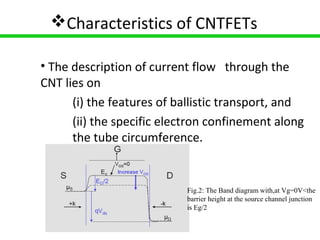
Characteristics of CNTFETs
• The description of current flow through the
CNT lies on
(i) the features of ballistic transport, and
(ii) the specific electron confinement along
the tube circumference.
Fig.2: The Band diagram with,at Vg=0V<the
barrier height at the source channel junction
is Eg/2
8
Quantum Capacitance
•The inversion layer of channel in MOSFET
devices can be represented as a
series of quantum capacitance CQ and
Cetroid capacitance (Ccent).
• If all the charges are assumed to be located at
the same position inside semiconductor layer,
centroid capacitance is not considered.
9
Continues…
•Amount of energy delivered to MOS
={Qs2
/Cins + Qs2
/2Cq}
•Normally Cins is much smaller than CQ.
•As device scaling approaches a few
nanometers,
Cins becomes very much comparable to or even
bigger than CQ, and
CQ should be carefully considered in these scaled
down devices.
10
Continues…
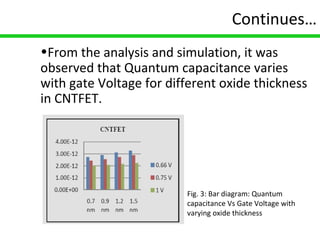
•From the analysis and simulation, it was
observed that Quantum capacitance varies
with gate Voltage for different oxide thickness
in CNTFET.
Fig. 3: Bar diagram: Quantum
capacitance Vs Gate Voltage with
varying oxide thickness
11
Neural Network Principle
• A typical neural network structure has two
types of basic components, namely,
Neurons and
The link between them.
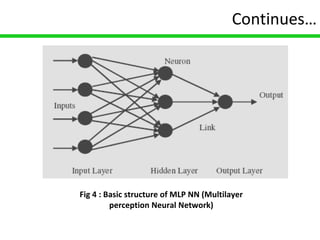
•The network consists of
– an input layer,
– an output layer and
– one or more hidden layer(s).
•Every link has a corresponding weight
coefficient associated to it.
12
Continues…
Fig 4 : Basic structure of MLP NN (Multilayer
perception Neural Network)
13
Continues…
•Each neuron is defined by
– a set of inputs
– bias coefficient and
– An activation function.
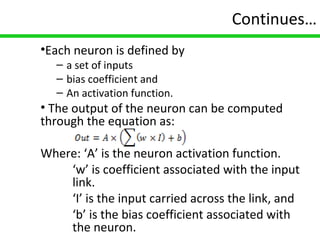
• The output of the neuron can be computed
through the equation as:
Where: ‘A’ is the neuron activation function.
‘w’ is coefficient associated with the input
link.
‘I’ is the input carried across the link, and
‘b’ is the bias coefficient associated with
the neuron.
14
Continues…
•The training algorithm is executed in order
to specify the weight and bias coefficient .
•It consists of two parts through the different
layer of network: forward and backward
path.
15
Conclusion
•Lesser quantum capacitance thus decreased
propagation delay.
•Use of neural network which is well
compatible for any analog simulator due to
its simple, continuous and derivable
equations, it is also scalable and can fit the
effect of channel length variation.
16
Continues…
•It is still difficult to exactly control CNT
growth into desired forms, and
•CNT growth is still very expensive due to the
low yield of CNTs that meet desired
geometrical specification.
17
Future Work
•More experiments need to be done to
guarantee the yield of CNTs growth.
•More fabricated devices are needed for
statistical analysis and the dependence on
contact metal, dielectric thickness would be
measured interests.
18
Continues…
•Several fabrication steps may be improved.
For example, SiO2 is used as the substrate to
grow nanotubes.
•Some of the proposal ideas are not fully
implemented due to lack equipment.
19
THANK YOU!!!
20
QA???

CNTFET

  • 1.
    1 Advantages of CNTFETs Over MOSFETs •RajeshYadav •Durlabha Chaudhary •Dr. Neeraj Kr. Shukla
  • 2.
    2 Contents Setbacks of MOSFETs Introductionto CNTFETs Quantum Capacitance Neural Network Principle Conclusion Future Work
  • 3.
    3 Setbacks of MOSFETs •AMOSFET is a • semiconductor device, •most commonly used in the field of VLSI Design, and Power electronics. •The scaling of MOSFET has been the driving force towards the technological advancement, But Continuous scaling include –short channel effects –high leakage current –excessive process variation and –reliability issues.
  • 4.
  • 5.
    5 Introduction to CNTFETs •CarbonNanotubes (CNTs) are •Hexagonal networks of carbon atoms. •Can be taken as a layer of graphite rolled up into a cylinder. •Their band structure depends on the position of carbon atom forming the tube. •Carbon Nanotubes can be –metallic or –semiconducting depending on the folding angle and diameter.
  • 6.
    6 Presentation of CNTFETStructure Fig. 1: CNTFET structure, similar to that of MOSFET
  • 7.
    7 Characteristics of CNTFETs •The description of current flow through the CNT lies on (i) the features of ballistic transport, and (ii) the specific electron confinement along the tube circumference. Fig.2: The Band diagram with,at Vg=0V<the barrier height at the source channel junction is Eg/2
  • 8.
    8 Quantum Capacitance •The inversionlayer of channel in MOSFET devices can be represented as a series of quantum capacitance CQ and Cetroid capacitance (Ccent). • If all the charges are assumed to be located at the same position inside semiconductor layer, centroid capacitance is not considered.
  • 9.
    9 Continues… •Amount of energydelivered to MOS ={Qs2 /Cins + Qs2 /2Cq} •Normally Cins is much smaller than CQ. •As device scaling approaches a few nanometers, Cins becomes very much comparable to or even bigger than CQ, and CQ should be carefully considered in these scaled down devices.
  • 10.
    10 Continues… •From the analysisand simulation, it was observed that Quantum capacitance varies with gate Voltage for different oxide thickness in CNTFET. Fig. 3: Bar diagram: Quantum capacitance Vs Gate Voltage with varying oxide thickness
  • 11.
    11 Neural Network Principle •A typical neural network structure has two types of basic components, namely, Neurons and The link between them. •The network consists of – an input layer, – an output layer and – one or more hidden layer(s). •Every link has a corresponding weight coefficient associated to it.
  • 12.
    12 Continues… Fig 4 :Basic structure of MLP NN (Multilayer perception Neural Network)
  • 13.
    13 Continues… •Each neuron isdefined by – a set of inputs – bias coefficient and – An activation function. • The output of the neuron can be computed through the equation as: Where: ‘A’ is the neuron activation function. ‘w’ is coefficient associated with the input link. ‘I’ is the input carried across the link, and ‘b’ is the bias coefficient associated with the neuron.
  • 14.
    14 Continues… •The training algorithmis executed in order to specify the weight and bias coefficient . •It consists of two parts through the different layer of network: forward and backward path.
  • 15.
    15 Conclusion •Lesser quantum capacitancethus decreased propagation delay. •Use of neural network which is well compatible for any analog simulator due to its simple, continuous and derivable equations, it is also scalable and can fit the effect of channel length variation.
  • 16.
    16 Continues… •It is stilldifficult to exactly control CNT growth into desired forms, and •CNT growth is still very expensive due to the low yield of CNTs that meet desired geometrical specification.
  • 17.
    17 Future Work •More experimentsneed to be done to guarantee the yield of CNTs growth. •More fabricated devices are needed for statistical analysis and the dependence on contact metal, dielectric thickness would be measured interests.
  • 18.
    18 Continues… •Several fabrication stepsmay be improved. For example, SiO2 is used as the substrate to grow nanotubes. •Some of the proposal ideas are not fully implemented due to lack equipment.
  • 19.
  • 20.