FLOOR PLANNING
BY AMIT KR. CHAMOLI
Outlines
 Introduction
 Efficacy
 Merits
 Input/Output
 Floorplanning Problem
 Challenges
 Floorplanning Representations and Approaches
 Floorplanning Model
 Algorithms
 Assignment
 Conclusion
Introduction
 Floorplanning is an essential element of
hierarchical design flows, especially for
large SoC(System On Chip) designs. A
typical SoC could include hundreds of
RAMs, soft and hard IP(Intellectual
property), analog blocks, and multiple
power domains.
 A hierarchical methodology that extends
the capacity of design-automation tools,
improves tool runtimes, and mitigates
overall design risk by minimizing last
minute design changes
Floorplanning
 block placement
 Pin assignment
 Design partitioning
 Time budgeting
 Power and clock planning
Efficacy
 Floorplanning is considered when the
Design has not met timing or does
not meet timing consistently
 Critical logic to Improve performance
 Reduce routing congestion
 Improve module-level performance
and Area
 Improve Implementation Run time
and consistency with partitions
Merits
 Eliminate Guess work
 Minimize the impact of surprises in
chip assembly
 Reduce the risks associated with
Hierarchical Flows and Shorten the
time to design closure
 Timing
 Congestion
 More Flexibility in Design layout
Floorplanning phase
 Input
A set of blocks with constraints on area,
shapes, relative positions, Constraints on
chip area and aspect ratio, Netlist.
 Output
Shapes, Locations, Pin positions of the
blocks
 Objective Functions
Performance, chip area, and wire length
Floorplanning Problem
The floorplanning problem is to plan the
positions and shapes of the modules at the
beginning of the design cycle to optimize
the circuit performance:
 chip area
 total wirelength
 delay of critical path
 routability
 others, e.g., noise, heat dissipation, etc.
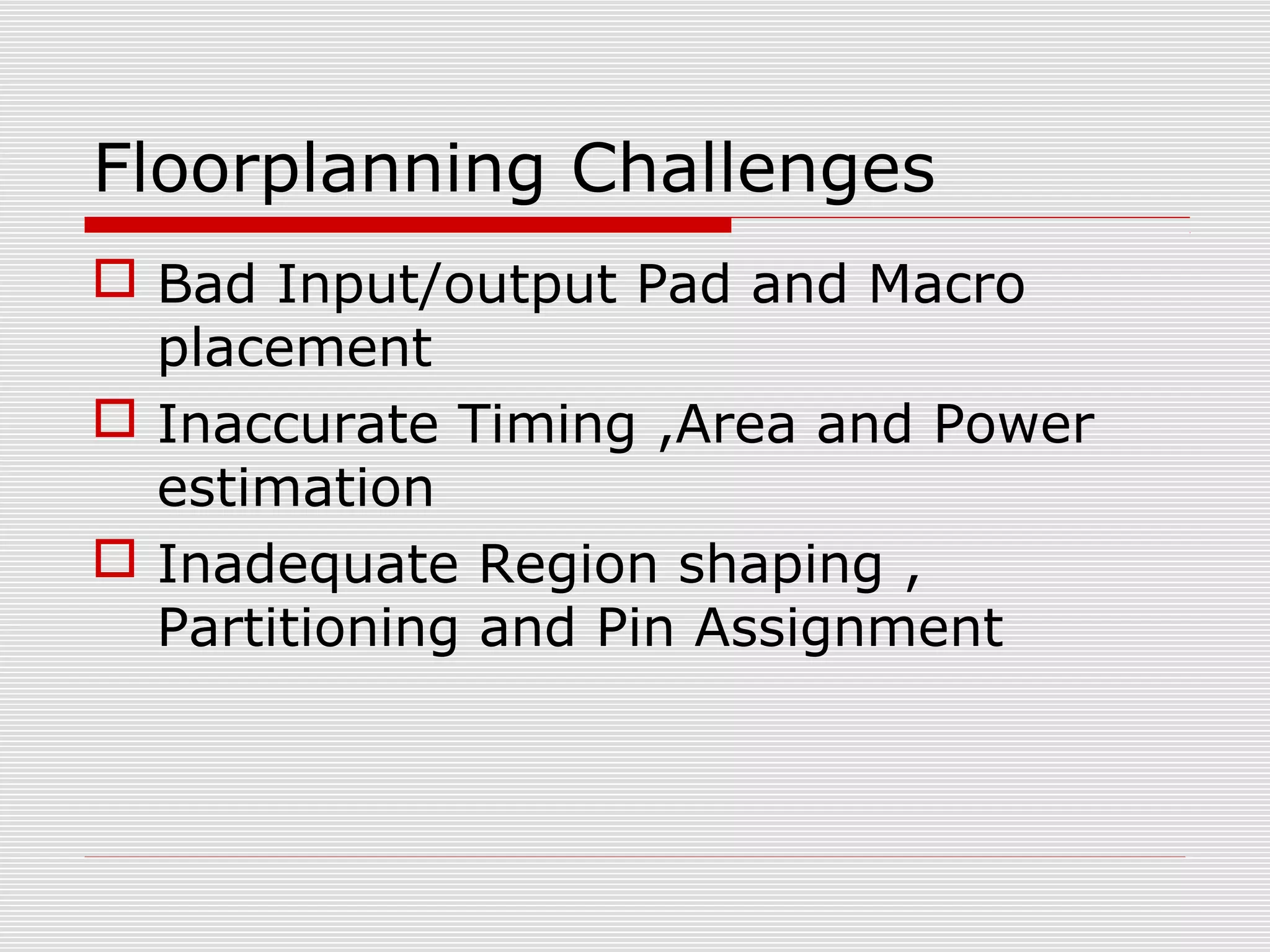
Floorplanning Challenges
 Bad Input/output Pad and Macro
placement
 Inaccurate Timing ,Area and Power
estimation
 Inadequate Region shaping ,
Partitioning and Pin Assignment
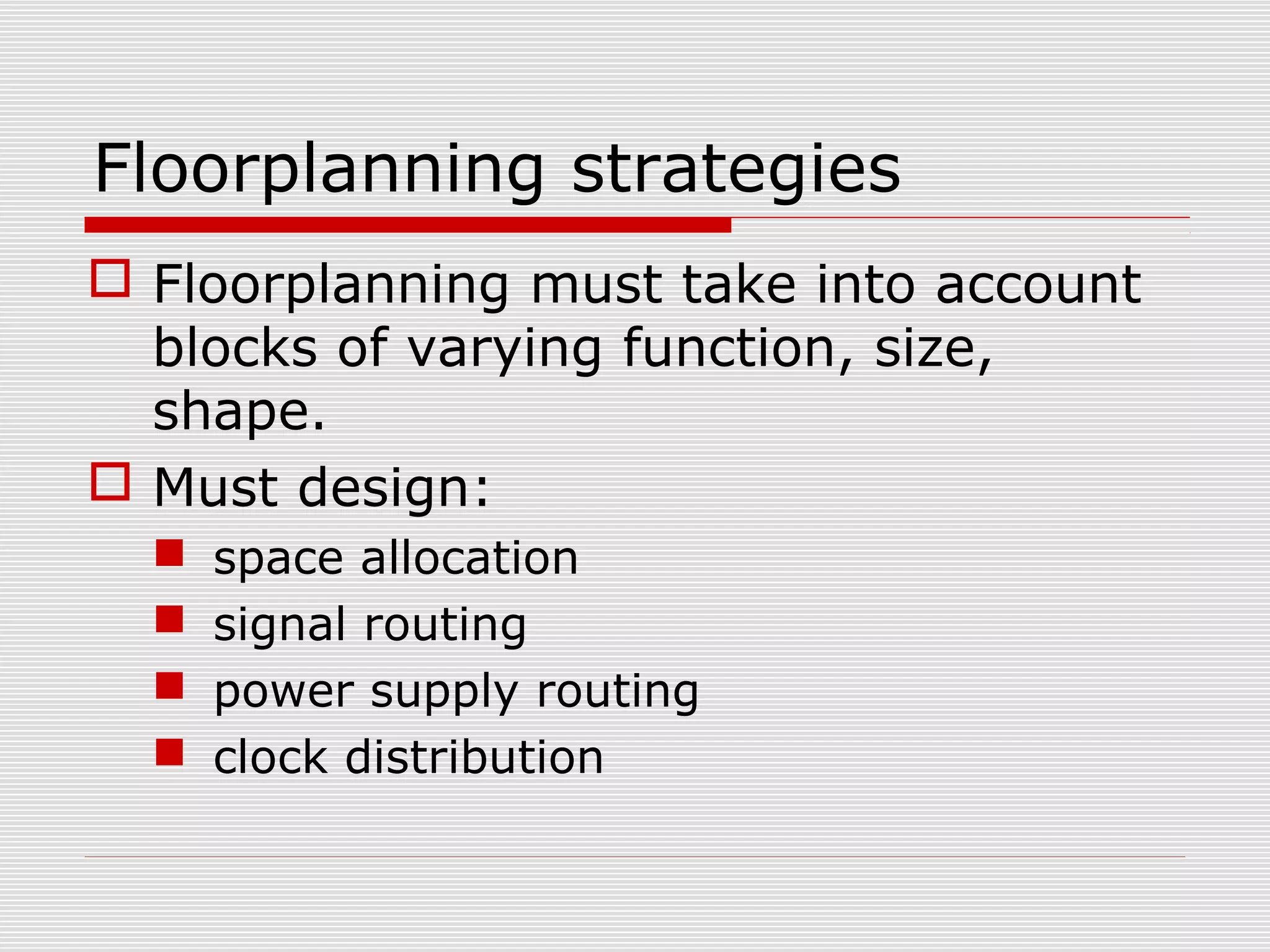
Floorplanning strategies
 Floorplanning must take into account
blocks of varying function, size,
shape.
 Must design:
 space allocation
 signal routing
 power supply routing
 clock distribution
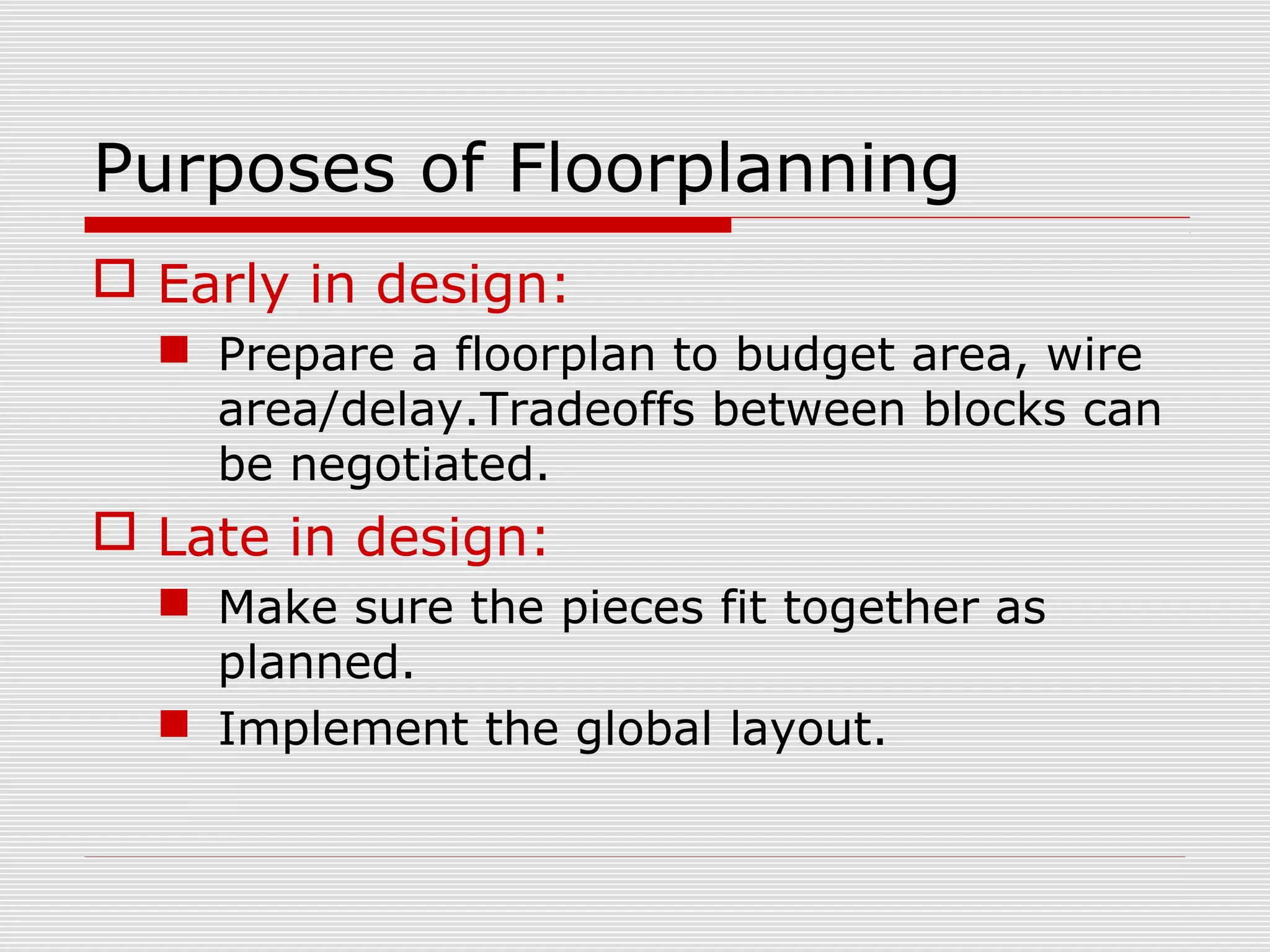
Purposes of Floorplanning
 Early in design:
 Prepare a floorplan to budget area, wire
area/delay.Tradeoffs between blocks can
be negotiated.
 Late in design:
 Make sure the pieces fit together as
planned.
 Implement the global layout.
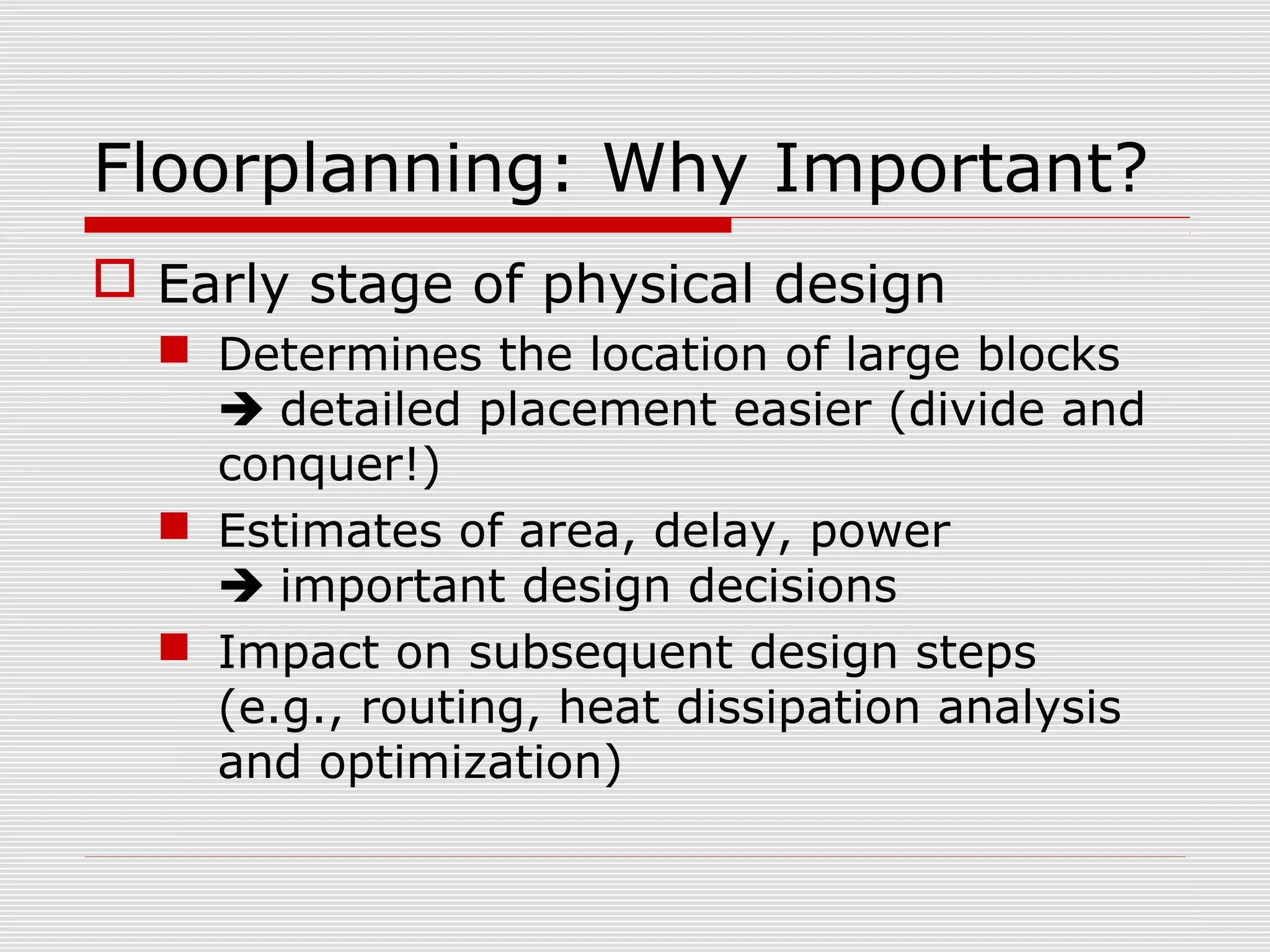
Floorplanning: Why Important?
 Early stage of physical design
 Determines the location of large blocks
 detailed placement easier (divide and
conquer!)
 Estimates of area, delay, power
 important design decisions
 Impact on subsequent design steps
(e.g., routing, heat dissipation analysis
and optimization)
Floorplanning tips
• Develop a wiring plan. Think about how
layers will be used to distribute important
wires.
• Sweep small components into larger blocks.
A floorplan with a single NAND gate in the
middle will be hard to work with.
• Design wiring that looks simple. If it looks
complicated, it is complicated.
• Draw separate wiring plans for power and
clocking. These are important design tasks
which should be tackled early.
Representations and Approaches
 Two popular approaches to floorplan
1. Simulated annealing
2. Analytical formulation
 Floorplan representations
1. Normalized Polish expression
2. B*-tree
3. Sequence Pair
4. Polar Graph
Floorplanning Model
1. Slicing floorplans
2. Non-slicing floorplans
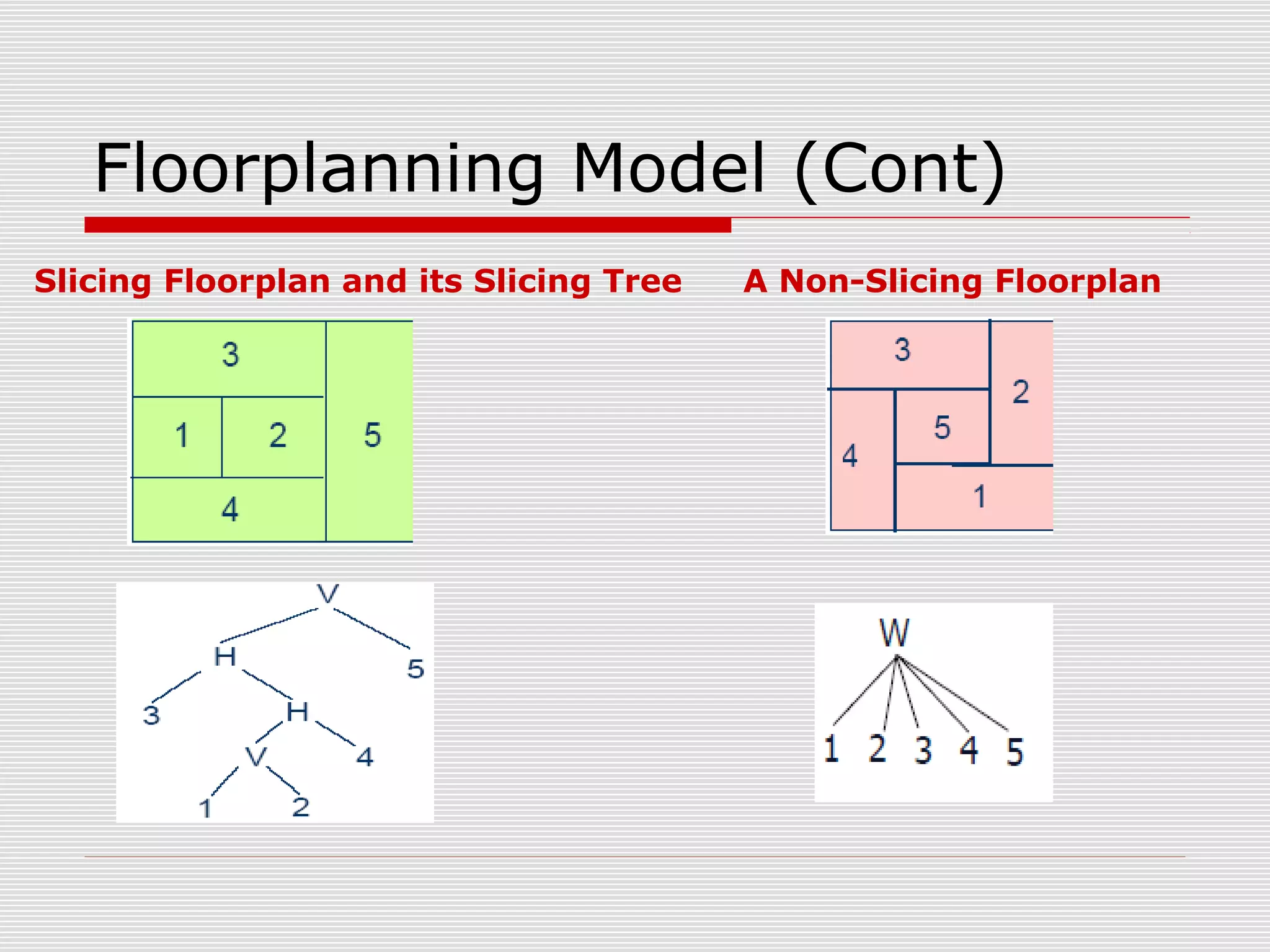
 Slicing Tree
 A binary tree that models a slicing
structure.
 Each node represents a vertical cut line
(V), or a horizontal cut line (H).
 A third kind of node called Wheel (W)
appears for non sliceable floorplans
Floorplanning Model (Cont)
A Non-Slicing FloorplanSlicing Floorplan and its Slicing Tree
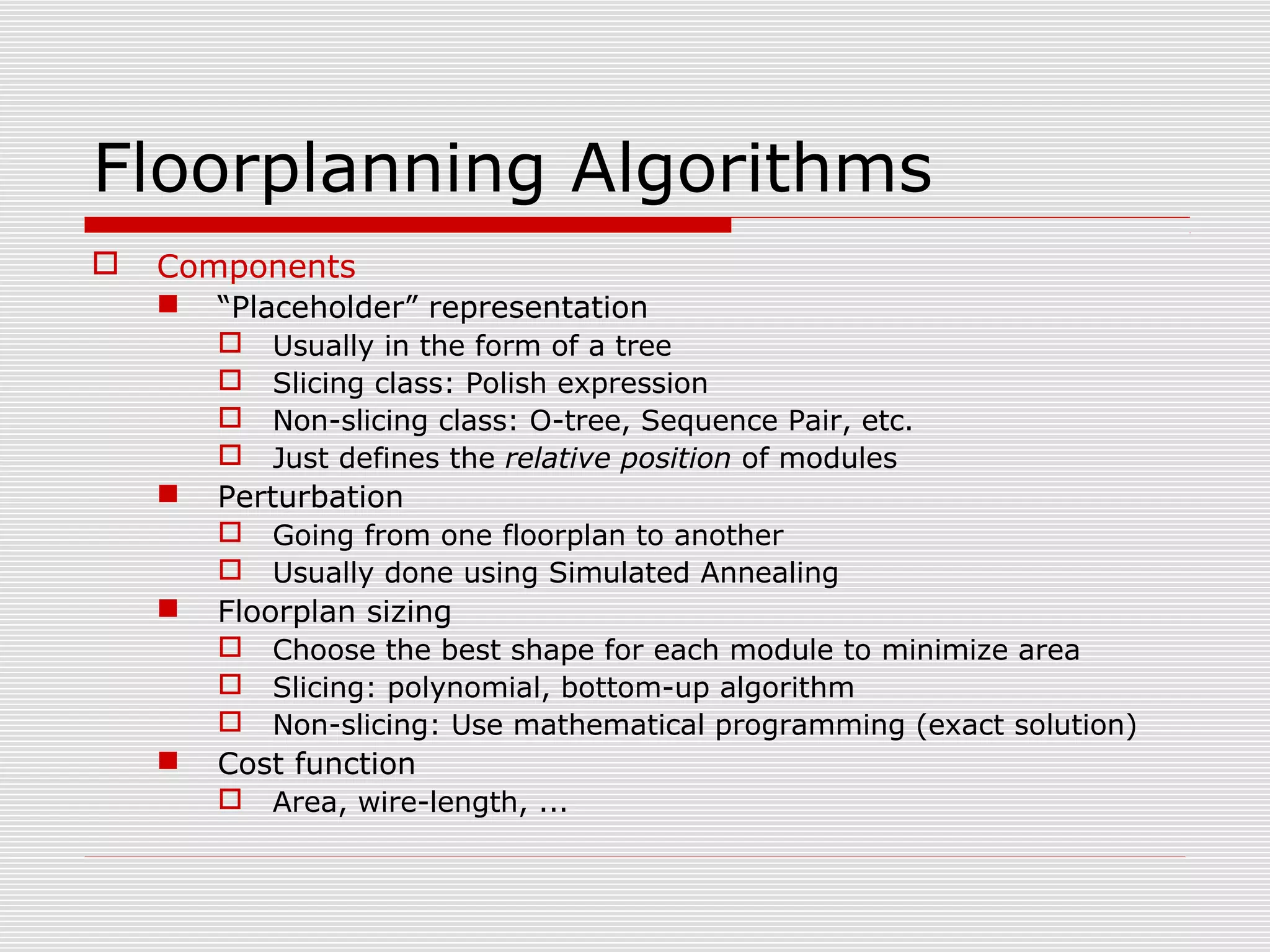
Floorplanning Algorithms
 Components
 “Placeholder” representation
 Usually in the form of a tree
 Slicing class: Polish expression
 Non-slicing class: O-tree, Sequence Pair, etc.
 Just defines the relative position of modules
 Perturbation
 Going from one floorplan to another
 Usually done using Simulated Annealing
 Floorplan sizing
 Choose the best shape for each module to minimize area
 Slicing: polynomial, bottom-up algorithm
 Non-slicing: Use mathematical programming (exact solution)
 Cost function
 Area, wire-length, ...
Classification of Algorithms
 Simulated Annealing
 Constraint Based methods
 (Integer) Linear Programming
Methods
 Rectangular Dualization Based
Methods
 Hierarchical Tree Based Methods
 Timing Driven Floorplanning
Algorithms
Simulated Annealing
 In this process, a material is first heated up
to a temperature that allow all its
molecules to move freely around and is
then cooled down very slowly.
 Perform computation that analogous to
physical process.
 The energy corresponds to the cost function
 Molecular movement corresponds to a sequence
of moves in the set of feasible solution
 Temperature corresponds to a control parameter
T which control the acceptance probability for a
move i.e. A good move
Wong-Liu Floorplanning Algorithm
 Uses simulated annealing
 Normalized Polish expressions represent
floorplans
 Cost function:
 cost = area + total WireLength
 Floorplan sizing is used to determine area
 After floorplan sizing, the exact location of each
module is known, hence wire-length can be
calculated
Wong-Liu Floorplanning Algorithm
(cont.)
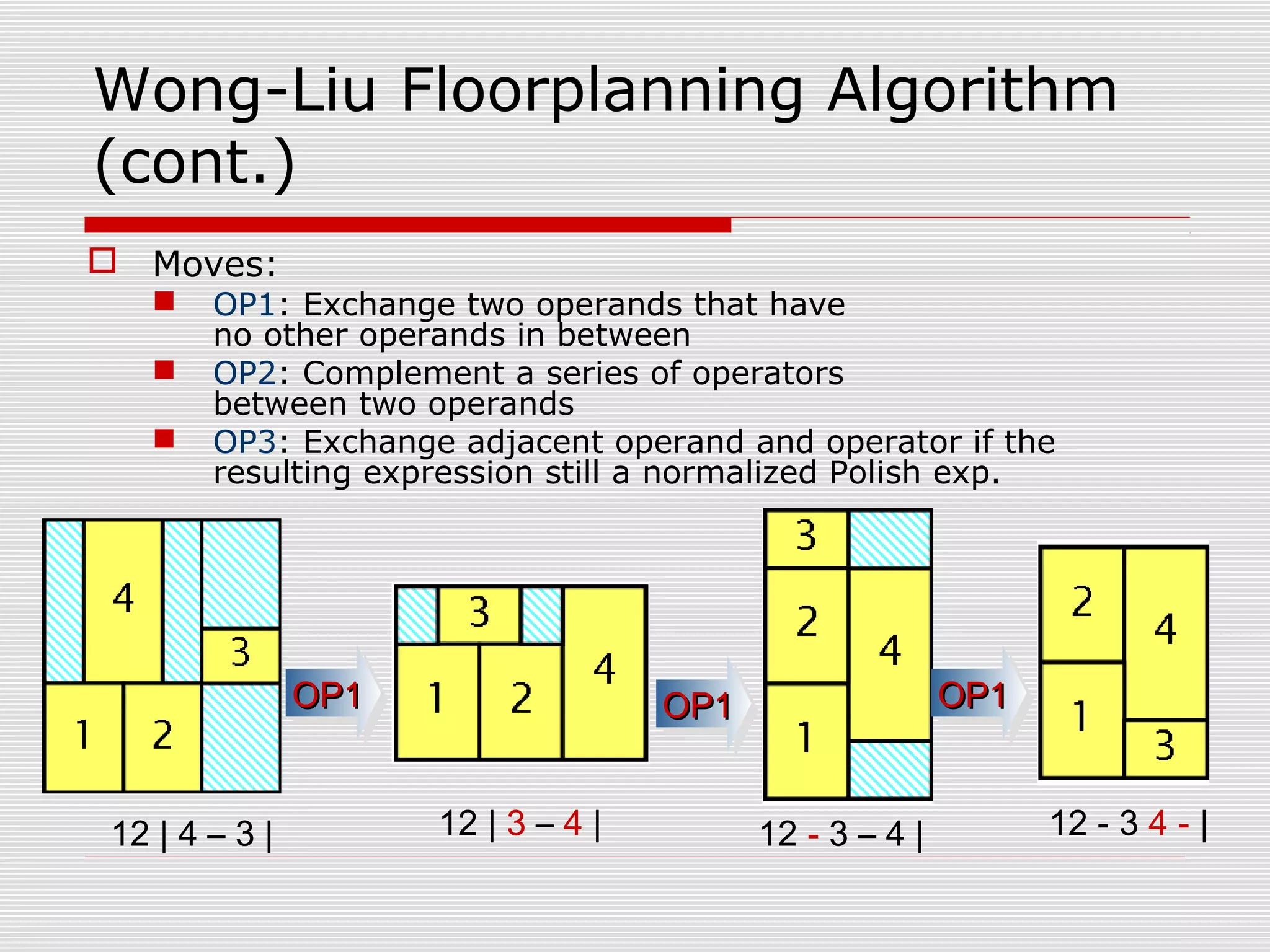
 Moves:
 OP1: Exchange two operands that have
no other operands in between
 OP2: Complement a series of operators
between two operands
 OP3: Exchange adjacent operand and operator if the
resulting expression still a normalized Polish exp.
OP1OP1OP1OP1
OP1OP1OP1OP1 OP1OP1OP1OP1
12 | 4 – 3 | 12 | 3 – 4 | 12 - 3 – 4 | 12 - 3 4 - |
Assignment
 What are timing failure?
 What are the critical hierarchical
Block and Risk?
 Are changes/moves to the Floorplan
or critical logic going to be sufficient
to meet timing?
 Does anything else need to be
Floorplaned?
Conclusion
 Floorplanning is the foundation of a quality
IC implementation. The decisions made
regarding IO pad placement, macro
placement, partitioning, pin assignment,
and power planning ripple through the
place-and-route flow. Designers need
solutions that can handle extremely large
data sets, design variability and
complexity, in addition to enabling fast,
high-quality floorplanning.
Q & A
 THANK YOU

floor planning

  • 1.
  • 2.
    Outlines  Introduction  Efficacy Merits  Input/Output  Floorplanning Problem  Challenges  Floorplanning Representations and Approaches  Floorplanning Model  Algorithms  Assignment  Conclusion
  • 3.
    Introduction  Floorplanning isan essential element of hierarchical design flows, especially for large SoC(System On Chip) designs. A typical SoC could include hundreds of RAMs, soft and hard IP(Intellectual property), analog blocks, and multiple power domains.  A hierarchical methodology that extends the capacity of design-automation tools, improves tool runtimes, and mitigates overall design risk by minimizing last minute design changes
  • 4.
    Floorplanning  block placement Pin assignment  Design partitioning  Time budgeting  Power and clock planning
  • 5.
    Efficacy  Floorplanning isconsidered when the Design has not met timing or does not meet timing consistently  Critical logic to Improve performance  Reduce routing congestion  Improve module-level performance and Area  Improve Implementation Run time and consistency with partitions
  • 6.
    Merits  Eliminate Guesswork  Minimize the impact of surprises in chip assembly  Reduce the risks associated with Hierarchical Flows and Shorten the time to design closure  Timing  Congestion  More Flexibility in Design layout
  • 7.
    Floorplanning phase  Input Aset of blocks with constraints on area, shapes, relative positions, Constraints on chip area and aspect ratio, Netlist.  Output Shapes, Locations, Pin positions of the blocks  Objective Functions Performance, chip area, and wire length
  • 8.
    Floorplanning Problem The floorplanningproblem is to plan the positions and shapes of the modules at the beginning of the design cycle to optimize the circuit performance:  chip area  total wirelength  delay of critical path  routability  others, e.g., noise, heat dissipation, etc.
  • 9.
    Floorplanning Challenges  BadInput/output Pad and Macro placement  Inaccurate Timing ,Area and Power estimation  Inadequate Region shaping , Partitioning and Pin Assignment
  • 10.
    Floorplanning strategies  Floorplanningmust take into account blocks of varying function, size, shape.  Must design:  space allocation  signal routing  power supply routing  clock distribution
  • 11.
    Purposes of Floorplanning Early in design:  Prepare a floorplan to budget area, wire area/delay.Tradeoffs between blocks can be negotiated.  Late in design:  Make sure the pieces fit together as planned.  Implement the global layout.
  • 12.
    Floorplanning: Why Important? Early stage of physical design  Determines the location of large blocks  detailed placement easier (divide and conquer!)  Estimates of area, delay, power  important design decisions  Impact on subsequent design steps (e.g., routing, heat dissipation analysis and optimization)
  • 13.
    Floorplanning tips • Developa wiring plan. Think about how layers will be used to distribute important wires. • Sweep small components into larger blocks. A floorplan with a single NAND gate in the middle will be hard to work with. • Design wiring that looks simple. If it looks complicated, it is complicated. • Draw separate wiring plans for power and clocking. These are important design tasks which should be tackled early.
  • 14.
    Representations and Approaches Two popular approaches to floorplan 1. Simulated annealing 2. Analytical formulation  Floorplan representations 1. Normalized Polish expression 2. B*-tree 3. Sequence Pair 4. Polar Graph
  • 15.
    Floorplanning Model 1. Slicingfloorplans 2. Non-slicing floorplans  Slicing Tree  A binary tree that models a slicing structure.  Each node represents a vertical cut line (V), or a horizontal cut line (H).  A third kind of node called Wheel (W) appears for non sliceable floorplans
  • 16.
    Floorplanning Model (Cont) ANon-Slicing FloorplanSlicing Floorplan and its Slicing Tree
  • 17.
    Floorplanning Algorithms  Components “Placeholder” representation  Usually in the form of a tree  Slicing class: Polish expression  Non-slicing class: O-tree, Sequence Pair, etc.  Just defines the relative position of modules  Perturbation  Going from one floorplan to another  Usually done using Simulated Annealing  Floorplan sizing  Choose the best shape for each module to minimize area  Slicing: polynomial, bottom-up algorithm  Non-slicing: Use mathematical programming (exact solution)  Cost function  Area, wire-length, ...
  • 18.
    Classification of Algorithms Simulated Annealing  Constraint Based methods  (Integer) Linear Programming Methods  Rectangular Dualization Based Methods  Hierarchical Tree Based Methods  Timing Driven Floorplanning Algorithms
  • 19.
    Simulated Annealing  Inthis process, a material is first heated up to a temperature that allow all its molecules to move freely around and is then cooled down very slowly.  Perform computation that analogous to physical process.  The energy corresponds to the cost function  Molecular movement corresponds to a sequence of moves in the set of feasible solution  Temperature corresponds to a control parameter T which control the acceptance probability for a move i.e. A good move
  • 20.
    Wong-Liu Floorplanning Algorithm Uses simulated annealing  Normalized Polish expressions represent floorplans  Cost function:  cost = area + total WireLength  Floorplan sizing is used to determine area  After floorplan sizing, the exact location of each module is known, hence wire-length can be calculated
  • 21.
    Wong-Liu Floorplanning Algorithm (cont.) Moves:  OP1: Exchange two operands that have no other operands in between  OP2: Complement a series of operators between two operands  OP3: Exchange adjacent operand and operator if the resulting expression still a normalized Polish exp. OP1OP1OP1OP1 OP1OP1OP1OP1 OP1OP1OP1OP1 12 | 4 – 3 | 12 | 3 – 4 | 12 - 3 – 4 | 12 - 3 4 - |
  • 22.
    Assignment  What aretiming failure?  What are the critical hierarchical Block and Risk?  Are changes/moves to the Floorplan or critical logic going to be sufficient to meet timing?  Does anything else need to be Floorplaned?
  • 23.
    Conclusion  Floorplanning isthe foundation of a quality IC implementation. The decisions made regarding IO pad placement, macro placement, partitioning, pin assignment, and power planning ripple through the place-and-route flow. Designers need solutions that can handle extremely large data sets, design variability and complexity, in addition to enabling fast, high-quality floorplanning.
  • 24.
    Q & A THANK YOU