Cloud Native Development on Azure
More than Kubernetes
Eran Stiller
Chief Technology Officer
erans@codevalue.net
@eranstiller
https://stiller.blog
https://codevalue.net
The Hype of Microservices
5
It’s Not All Kubernetes…
6
Agenda
 Azure App Service
 Azure Messaging Platforms
 Azure Queues
 Azure Service Bus Messaging
 Azure Event Hubs
 Azure Serverless Platform
 Azure Functions
7
About Eran
Eran Stiller
 @eranstiller
 CTO & Founder at CodeValue
 Software architect, consultant and instructor
 Microsoft Regional Director & Azure MVP
 Founder of Azure Israel Meetup
8
About CodeValue
 Awesome software company!
 Technology experts
 High quality software development solutions
9
Azure App Service
11
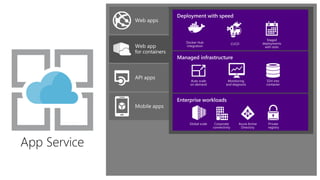
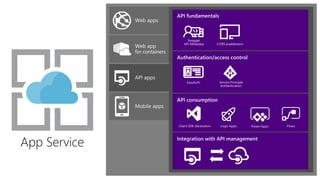
Azure App Service
 Web Host as-a-Service
 Supports both Windows & Linux
12
iOS
Demo
App Service
17
Azure Messaging
18
Azure Queues
 A basic, cost effective, queueing platform
19
Image source: https://docs.microsoft.com/en-us/azure/storage/queues/storage-queues-introduction
Demo
Azure Queues
20
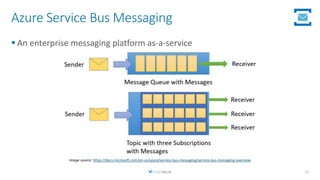
Azure Service Bus Messaging
 An enterprise messaging platform as-a-service
21
Image source: https://docs.microsoft.com/en-us/azure/service-bus-messaging/service-bus-messaging-overview
Azure Service Bus Messaging Advanced Features
 Message sessions
 Auto-forwarding
 Dead-lettering
 Scheduled delivery
 Message deferral
 Batching
 Transactions
 Filtering and actions
 Auto-delete on idle
 Duplicate detection
22
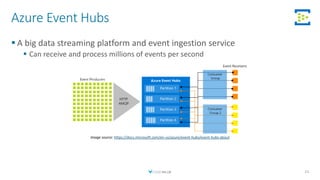
Azure Event Hubs
 A big data streaming platform and event ingestion service
 Can receive and process millions of events per second
23
Image source: https://docs.microsoft.com/en-us/azure/event-hubs/event-hubs-about
Azure Event Hubs Special Capabilities
 Event Hubs for Apache Kafka
 Event Hubs Capture
 Event Hubs Dedicated
24
Azure Serverless Platform
25
https://github.com/Azure/Azure-Functions/wiki/Samples-and-content
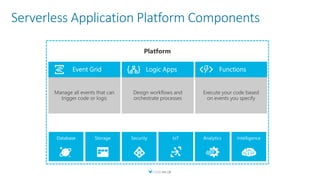
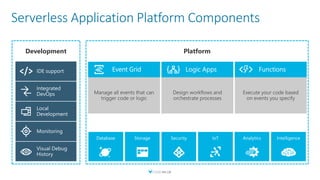
Serverless Application Platform Components
https://github.com/Azure/Azure-Functions/wiki/Samples-and-content
Demo
Azure Functions
33
Takeaways
34
Takeaways
 Azure provides a rich platform for application development
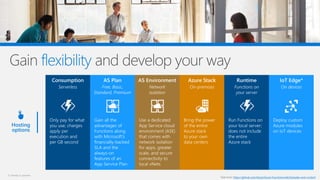
 Hosting
 Messaging
 Serverless
 Fast TTM, low development cost
 Not every solution requires Kubernetes…
 Use the right tool for the job
35
Resources
 Slide Deck
 https://www.slideshare.net/EranStiller
 Sample Code
 https://github.com/estiller/eShopOnWeb
 Branches – 1-app, 2-queue, 3-function
 Reach out on Twitter
 @eranstiller
36
Eran Stiller
Chief Technology Officer
erans@codevalue.net
@eranstiller
https://stiller.blog
https://codevalue.net

Cloud Native Development on Azure

Editor's Notes

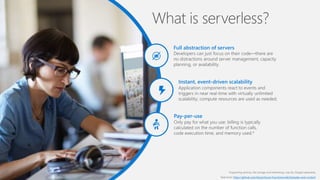
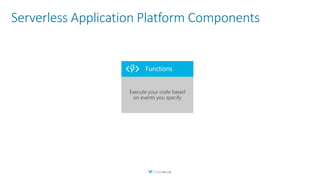
  • #28 Good after noon everyone. Very excited to be here to talk to you about why exactly it is that Microsoft would just not stop talking about this serverless thing – whether it is our CEO or just us measly product managers. Now the concept that I want to talk about is that of a platform, not an individual service, but a collection of fully managed services that come together and allow you to build serverless applications. When we talk about serverless, the first thing that obviously comes to mind is Functions-as-a-Service. Basically the ability to execute custom code, on demand, without having to worry about where the code is executing, or how it would scale if the demand goes up. This is what Azure Functions does for you. We will go into details later but that is the basic thing to remember.
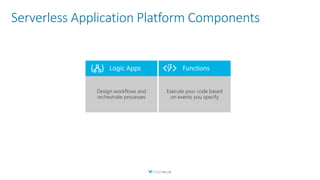
  • #29 Now let me talk about Logic Apps. How many of you have heard about Logic Apps? This service was actually introduced before Functions. And I want to talk about why this service is an important part of the serverless story. Imagine you are drawing a flowchart that represents a certain process in your business. For example - when a new customer record is created in my CRM system, go ahead and create a project in my project management system, and then send a notification email to these 3 people. We need to have processes like these all the time. What if you could just convert these flowcharts, with a few clicks of your mouse, into real applications that actually do those things? Azure Logic Apps effectively does that for you. Through a visual design experience, you can create workflows, that could have multiple steps. And each step could be performed by a different first party or 3rd party service, or even an Azure Function that you might have written. And goes without saying that you don’t have to worry about where all of this processing is happening – a server, a VM, a container or whatever else. You focus only on the what, not on the how. In a way this experience is not only serverless, but from a user’s perspective, it is often code-less.
  • #30 Now lets talk about Event Grid, the latest entry in our serverless toolkit. It is a fairly new service. We announced its general availability just recently. If you think about it, in many ways the popularity of these instant scale, pay as you go compute services can be attributed to the fact that modern computing is all about events. And these events need to be responded to. Whether it is IoT devices sending signals to a central location, users performing some actions on their mobile apps, or even some systems communicating with each other. All of these are examples of event-driven scenarios in which there are certain events that need to be processed. But how do we manage all these events? This is where Event Grid comes in. This service makes it super easy by providing a single simple interface for managing all your events. Things like: Where these events are coming from – whether it is a storage change, a database change, a resource being provisioned, or a new user being added to your subscription And where these events are headed to – whether you need to invoke an Azure Function or an Azure Logic App to respond to this event, or even some other destinations. We believe that for modern apps an event is an important enough entity that we should make it a first class citizen of Azure, and take away the burden of managing events in either produces or consumers of these events. This is what Event Grid does.
  • #31 OK now that we have the basic building blocks of serverless computing – what do you want to do next? We are building applications after all. And applications don’t exist in vacuum. They talk to databases, they enable authentication for their users, if it is an IoT app, it potentially receives data from and sends data to IoT devices. Maybe they need to processes that data to prepare it for further analysis, and more and more applications these days are required to have some kind of intelligence in them. How do we achieve these things in our apps? It wouldn’t be fun if our application code was running in a serverless environment but we still had to manage an army of Virtual Machines to perform these other tasks. We need serverless services for serverless apps. And this is what Azure provides us – we have Cosmos DB, a globally distributed, elastic scale database, a perfect ally for your serverless apps. We have Azure Active Directory (AAD) and AAD B2C for your security and access control needs, IoT Hub solves your IoT needs. You have services like Event Hubs and Stream Analytics to ingest and analyze real-time streaming data. Lastly, we have the Microsoft Cognitive Services API to provide intelligence in your apps. All of these services together comprise the Azure Serverless application platform. Using these pieces you can compose your applications.
  • #32 So we have a platform now. But how about the process of building these applications? How does the developer experience look like? How many of you were at the vision keynote yesterday? Satya and his friends – with a combined IQ of 5 million – sitting and talking about Quantum computing. Just like you, I understood everything. Anyway, the thing that strikes me is this – Quantum computing is in the works, it hasn’t arrived yet. But the programming language, the Visual Studio experience are already here. This is Microsoft. If there is one thing we do right – it is the developer experience. Even in the cloud world, we don’t subscribe to the mentality that just because you are reaping the benefits of running application in the cloud, you can be subjected to pain and heartburn while building those apps. So for serverless apps, we provide full E2E development experience through tools like Visual Studio and VS Code. We in fact support unique features like the ability to build, test and debug your applications locally on your dev machines, before even deploying them to the cloud. This is a massive productivity boost while building cloud apps and something no other cloud vendor can match. These technologies support continuous deployment so you can easily integrate them into your existing deployment pipelines. And finally, we provide full monitoring support through Azure Application Insights to monitor your apps in production. So that is how we think of a comprehensive serverless application platform in Azure. Now, I would like to invite Chris back to do a demo and show some of these services in action. Chris.