Cloud Computing: A New Trend
           in IT
             Dr.PutchongUthayopas
       Department of Computer Engineering
             Faculty of Engineering
              Kasetsart University
                  pu@ku.ac.th
Cloud computing is everywhere
New Demand for IT infrastructure


  Capacity
    Massive processing power
    Massive Storage
  Security
  Availability
  Scalability
    Start small and grow on demand
  Cost effective
New Challenges


High operating cost
  Man power cost
  Equipment cost
  Energy cost
High operating complexity
  Changing technology
  Increase complexity
    Network, server, storage , security
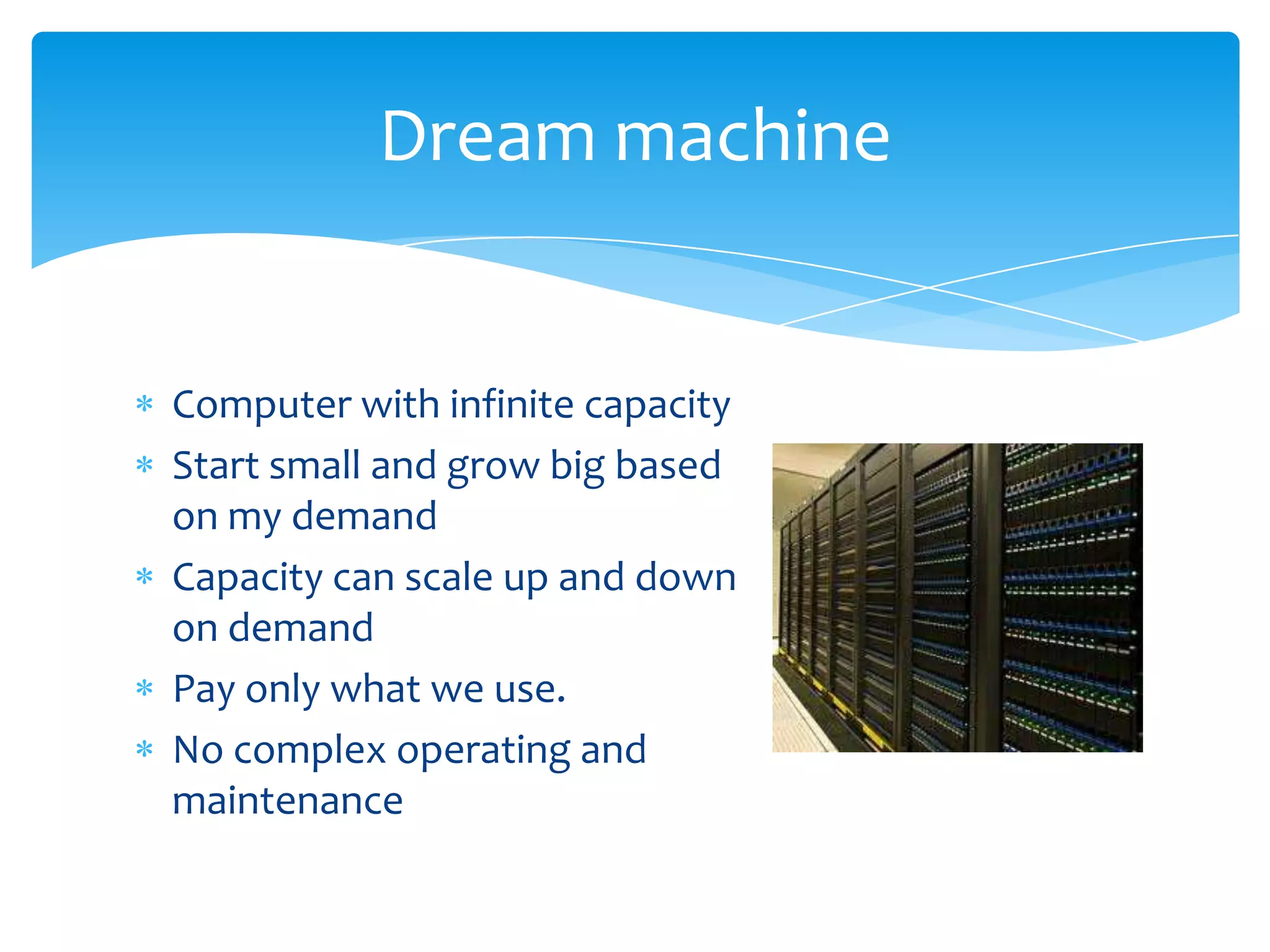
Dream machine


Computer with infinite capacity
Start small and grow big based
on my demand
Capacity can scale up and down
on demand
Pay only what we use.
No complex operating and
maintenance
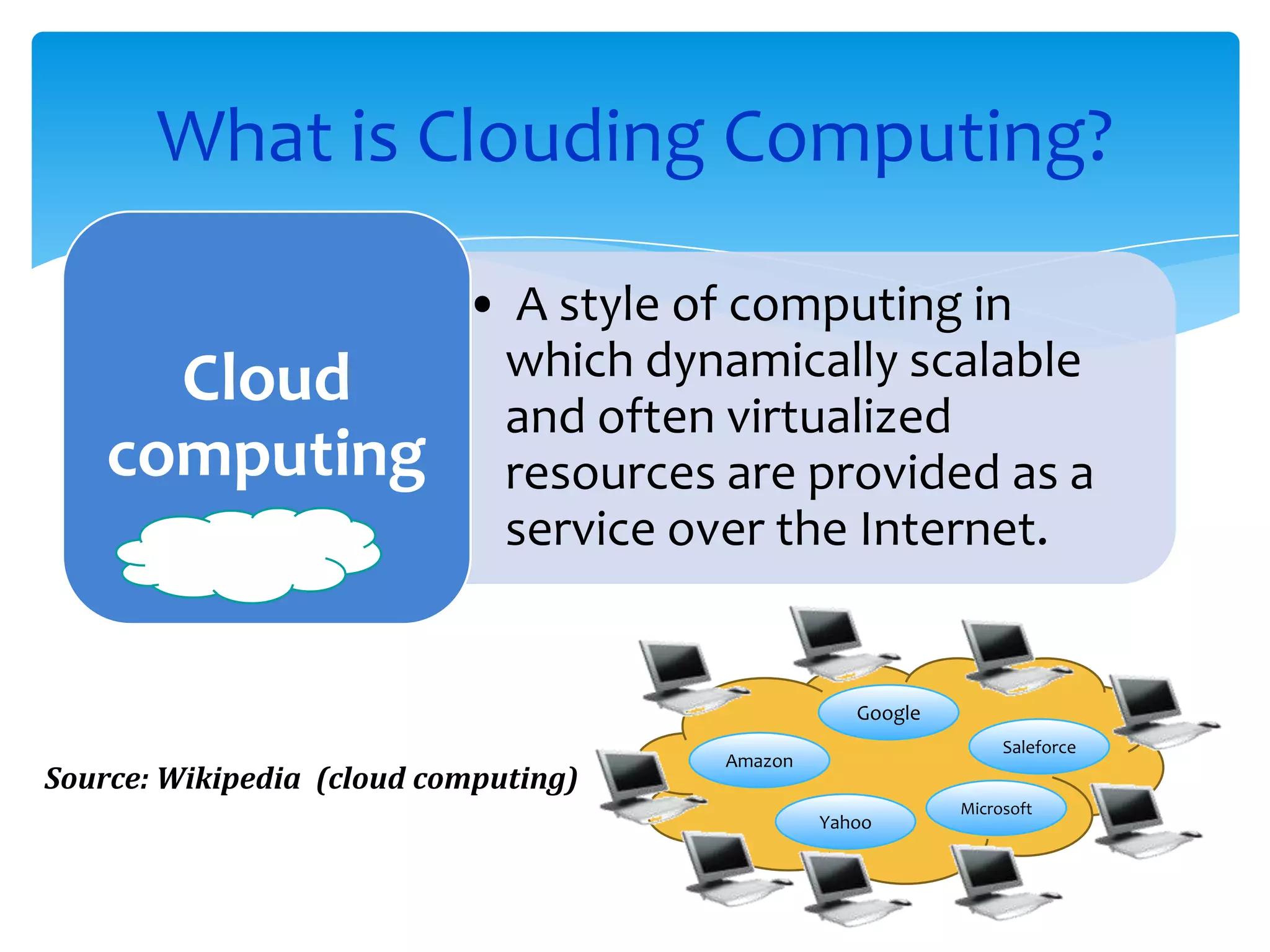
What is Clouding Computing?

                           • A style of computing in
      Cloud                 which dynamically scalable
                            and often virtualized
    computing               resources are provided as a
                            service over the Internet.


                                                  Google
                                                                Saleforce
                                      Amazon
Source: Wikipedia (cloud computing)
                                                           Microsoft
                                               Yahoo
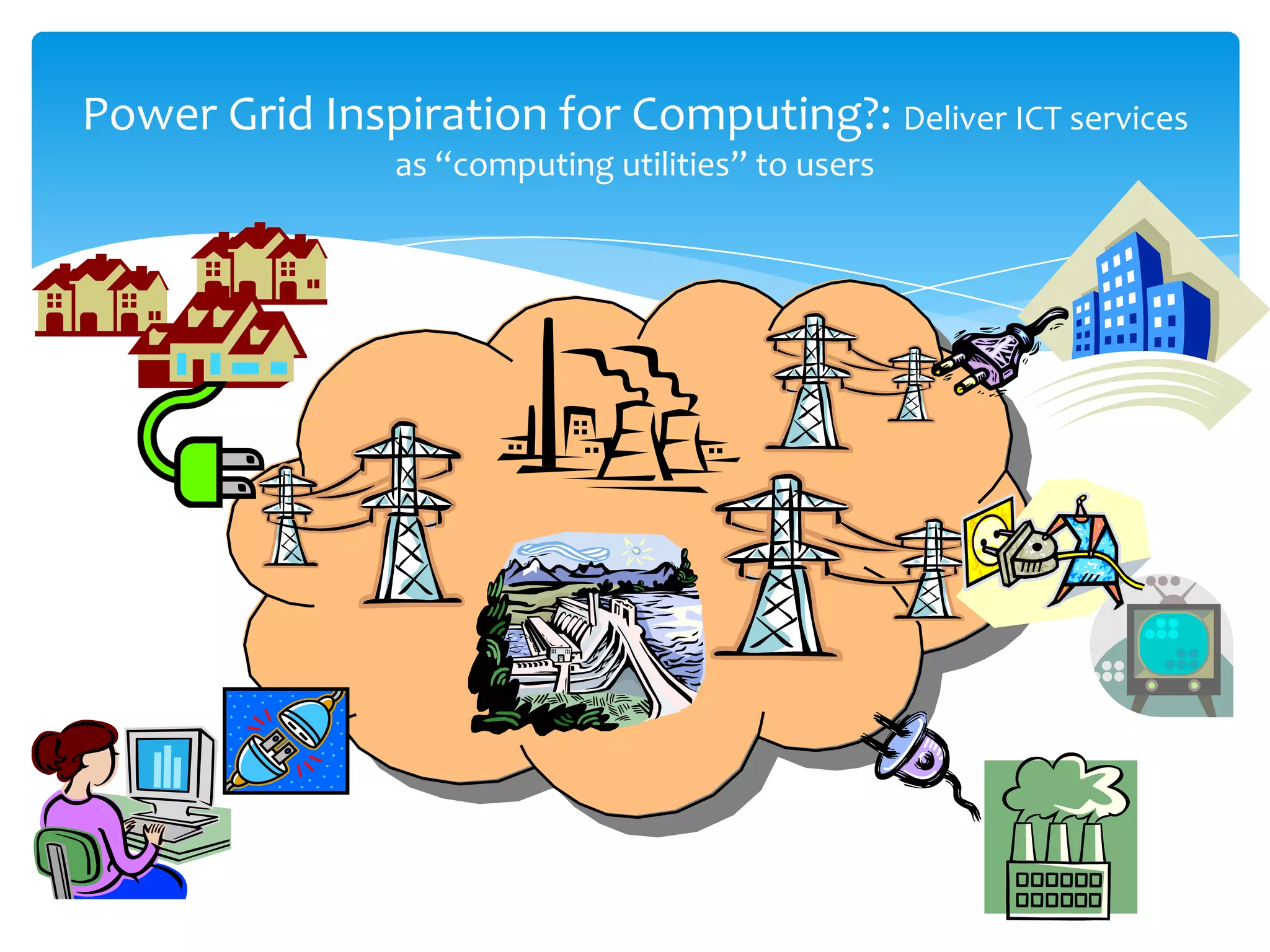
Power Grid Inspiration for Computing?: Deliver ICT services
                as “computing utilities” to users
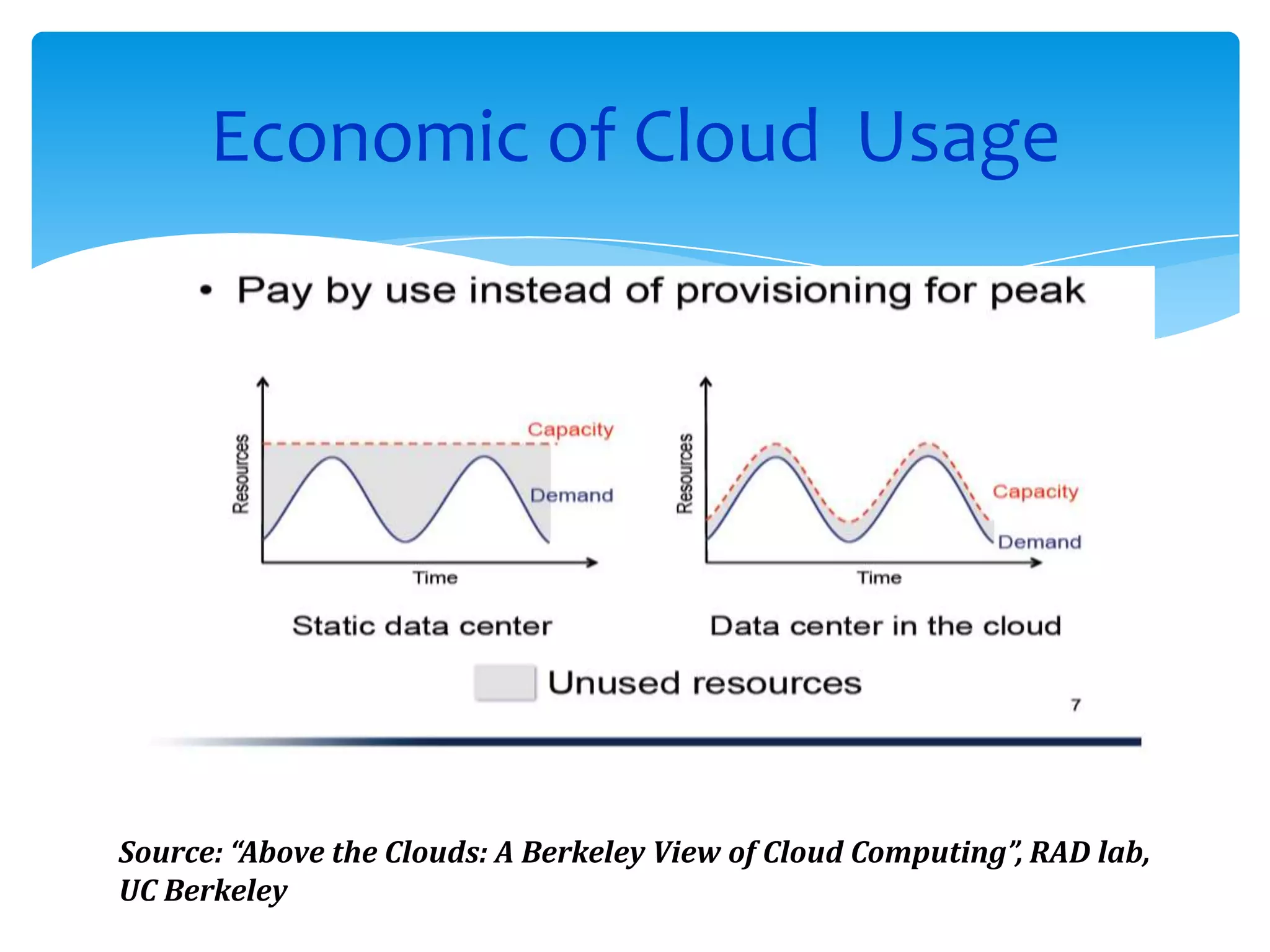
Economic of Cloud Usage


Source: “Above the Clouds: A Berkeley View of Cloud Computing”, RAD lab,
UC Berkeley
Why we should move to the cloud?

Quick start up
   no need to purchase any equipment. Subscribe, pay, and use it.
Scalability
   less demand less computing power, more demand more
   computing power
Elasticity
   Handle the demand surge
Less maintenance
   No need to hire people to fix server broken, hacking, tuning
Less operation cost
   Pay only what you really use
   Cut the cost of maintaining huge infrastructure
It is cool, trendy
   Just a stupid execute when people do not believe you ^_^
Cloud Computing Definition (NIST)


 This cloud model is composed of
   five essential characteristic
   three service models
   four deployment models.
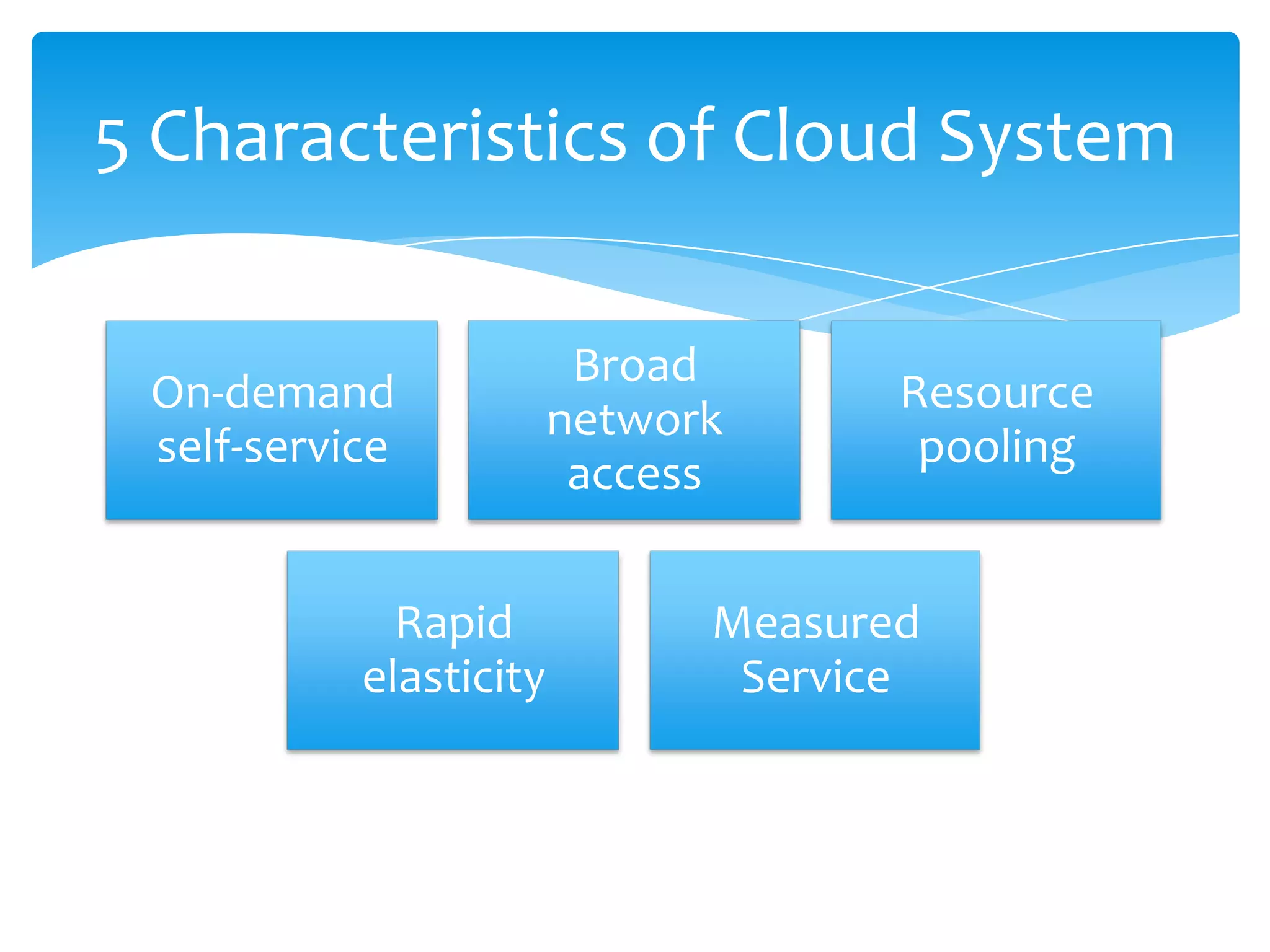
5 Characteristics of Cloud System

                         Broad
 On-demand                           Resource
                        network
 self-service                         pooling
                         access


             Rapid            Measured
           elasticity          Service
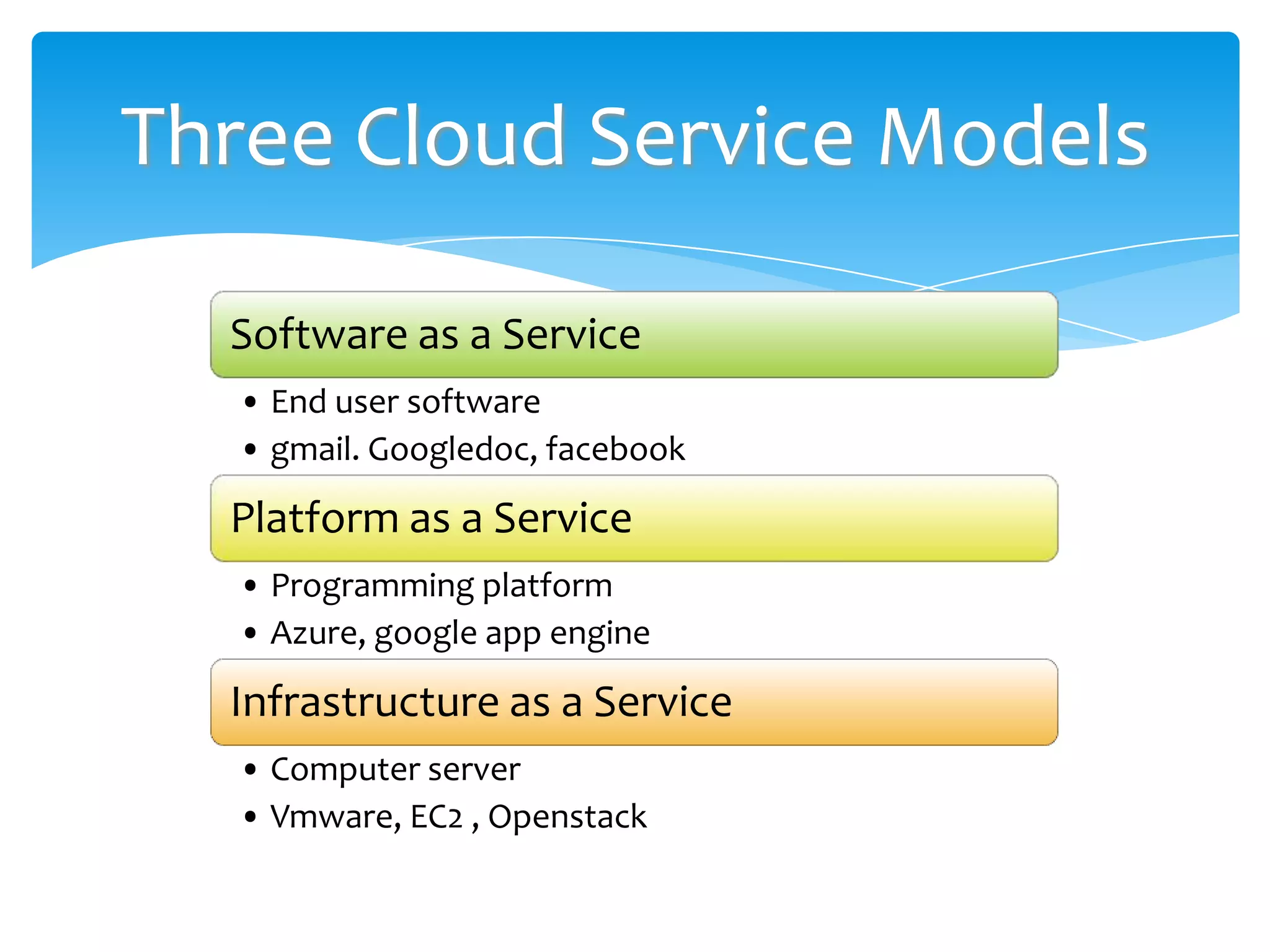
Three Cloud Service Models

  Software as a Service
  • End user software
  • gmail. Googledoc, facebook

  Platform as a Service
  • Programming platform
  • Azure, google app engine

  Infrastructure as a Service
  • Computer server
  • Vmware, EC2 , Openstack
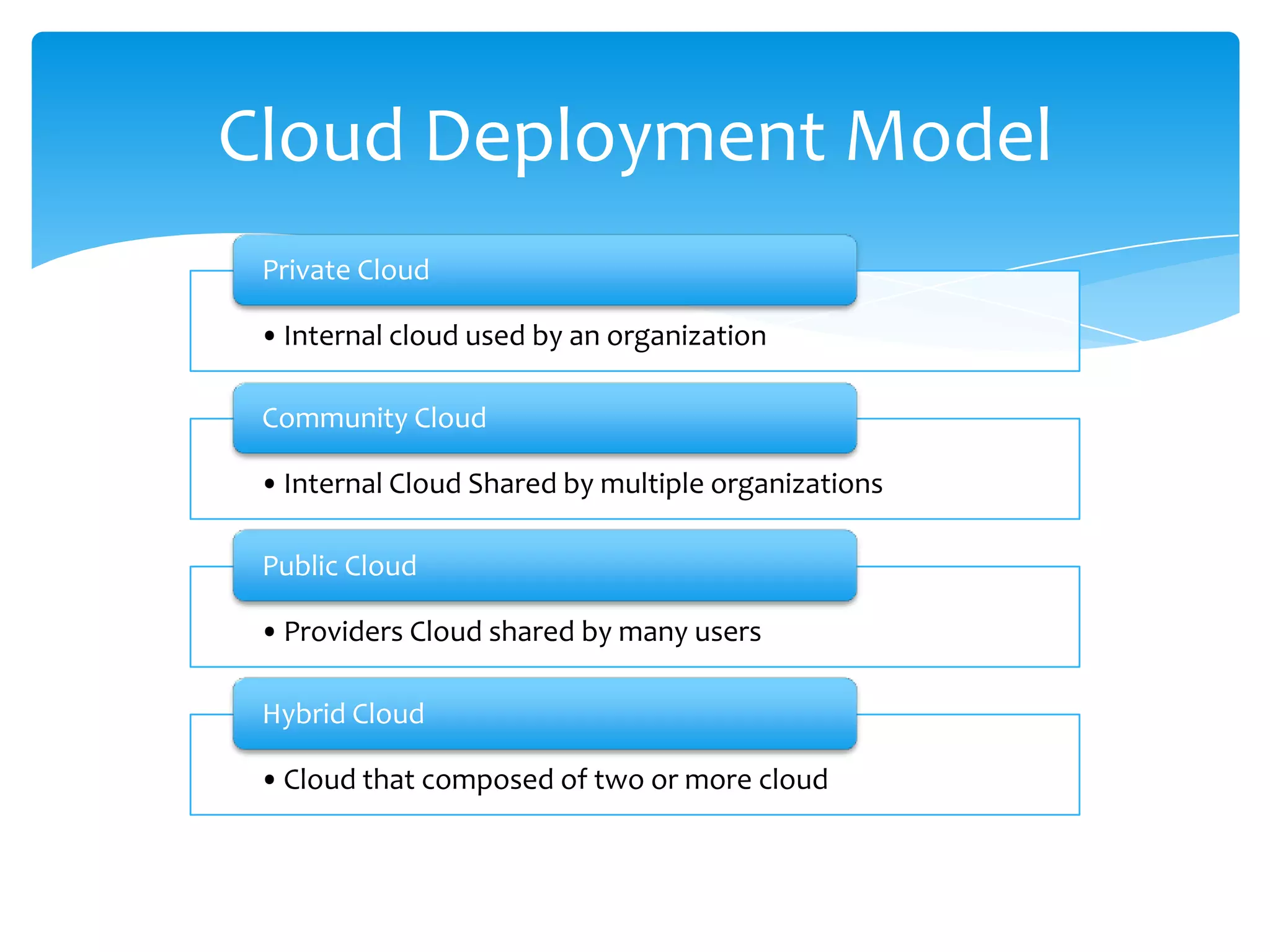
Cloud Deployment Model
 Private Cloud

 • Internal cloud used by an organization

 Community Cloud

 • Internal Cloud Shared by multiple organizations

 Public Cloud

 • Providers Cloud shared by many users

 Hybrid Cloud

 • Cloud that composed of two or more cloud
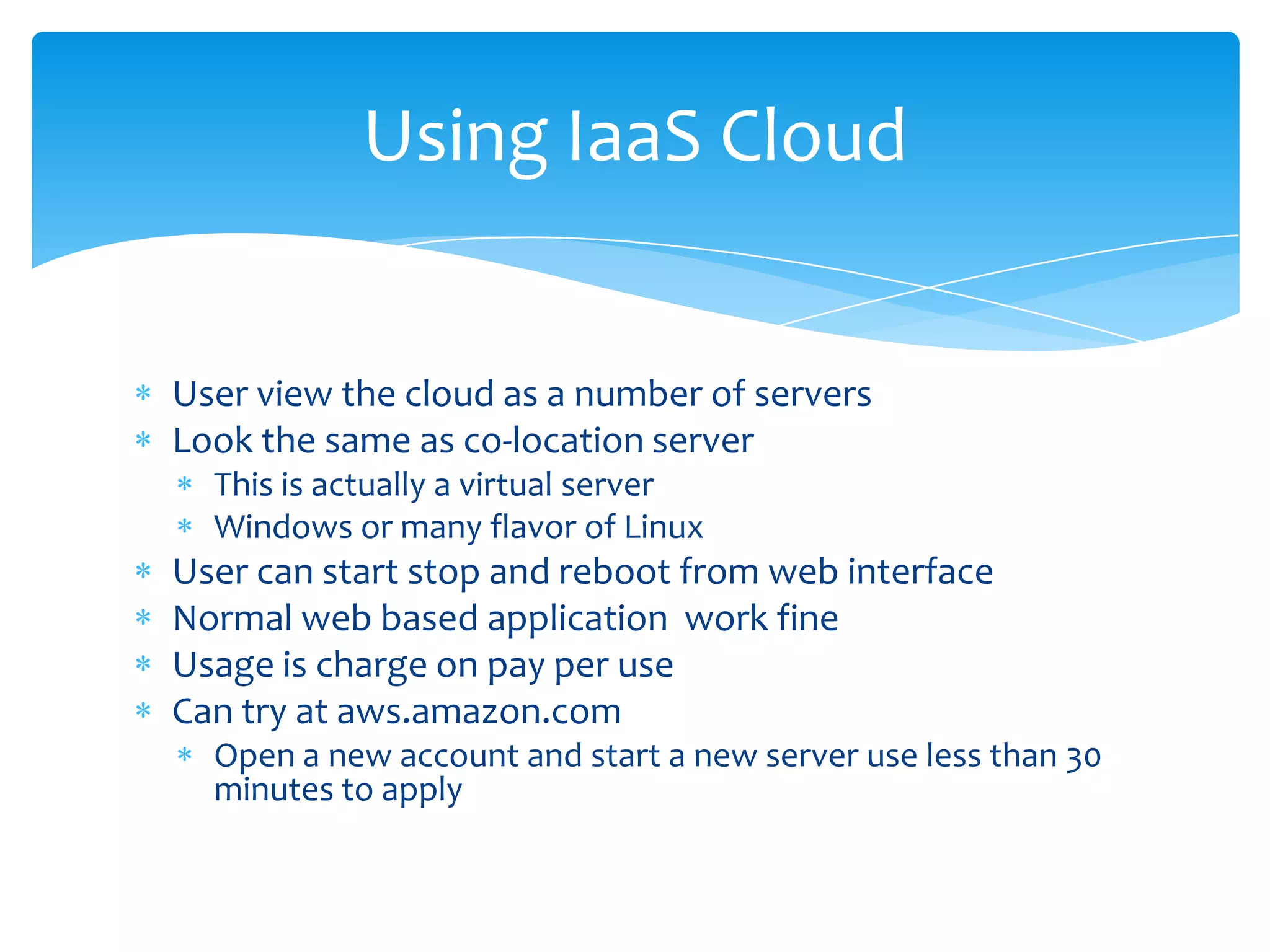
Using IaaS Cloud


User view the cloud as a number of servers
Look the same as co-location server
  This is actually a virtual server
  Windows or many flavor of Linux
User can start stop and reboot from web interface
Normal web based application work fine
Usage is charge on pay per use
Can try at aws.amazon.com
  Open a new account and start a new server use less than 30
  minutes to apply
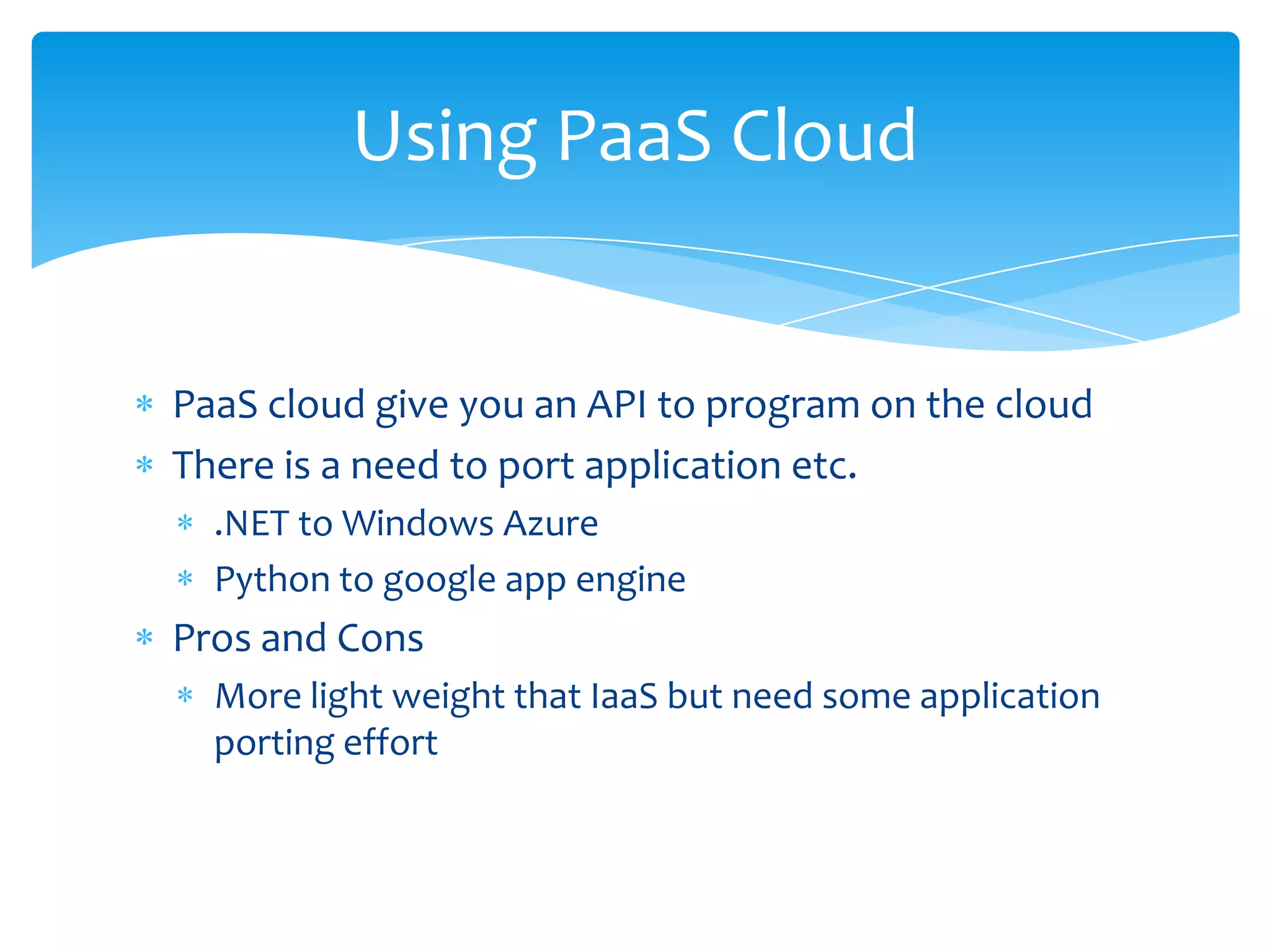
Using PaaS Cloud


PaaS cloud give you an API to program on the cloud
There is a need to port application etc.
  .NET to Windows Azure
  Python to google app engine
Pros and Cons
  More light weight that IaaS but need some application
  porting effort
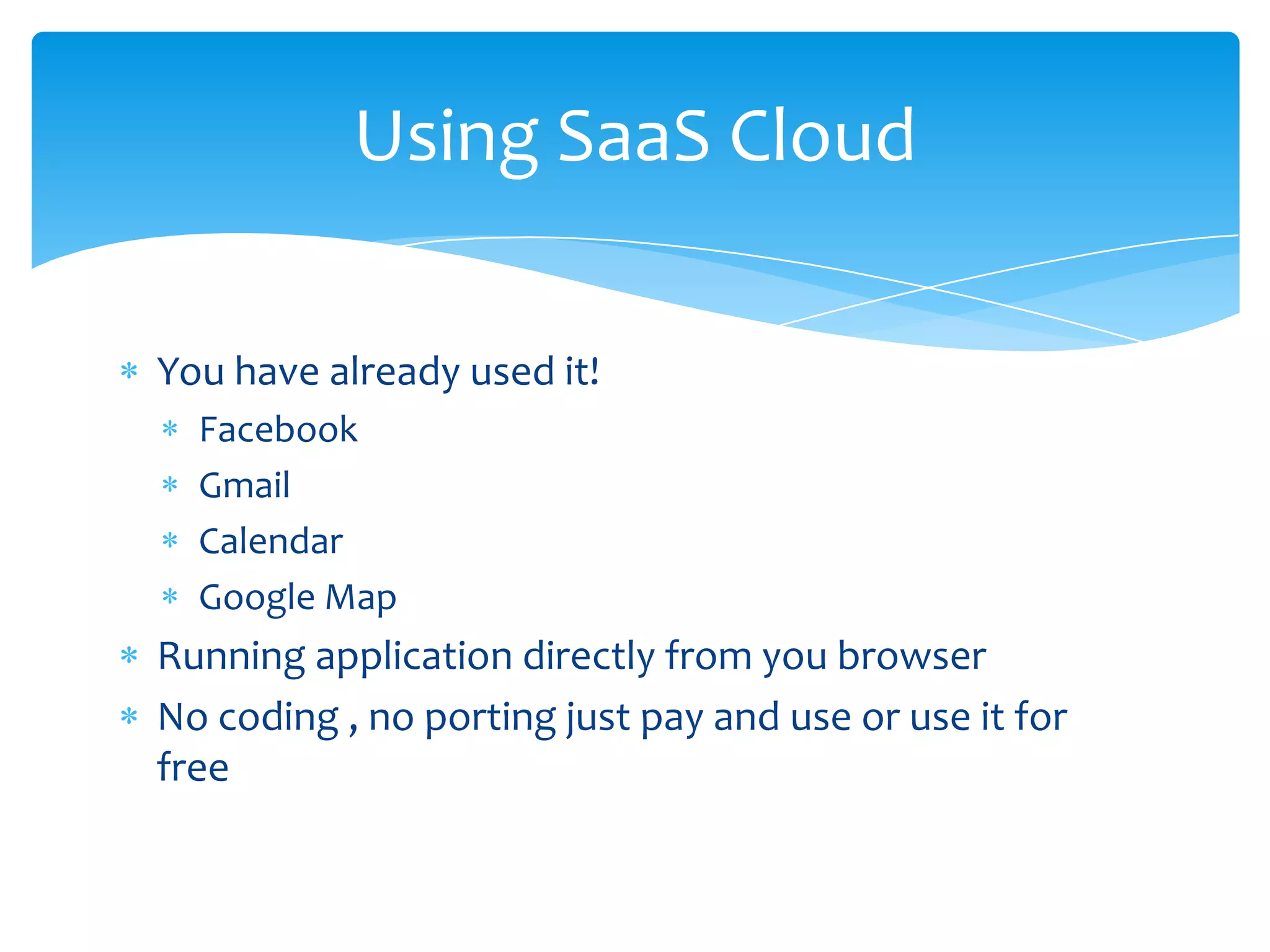
Using SaaS Cloud

You have already used it!
  Facebook
  Gmail
  Calendar
  Google Map
Running application directly from you browser
No coding , no porting just pay and use or use it for
free
What the Cloud can do?


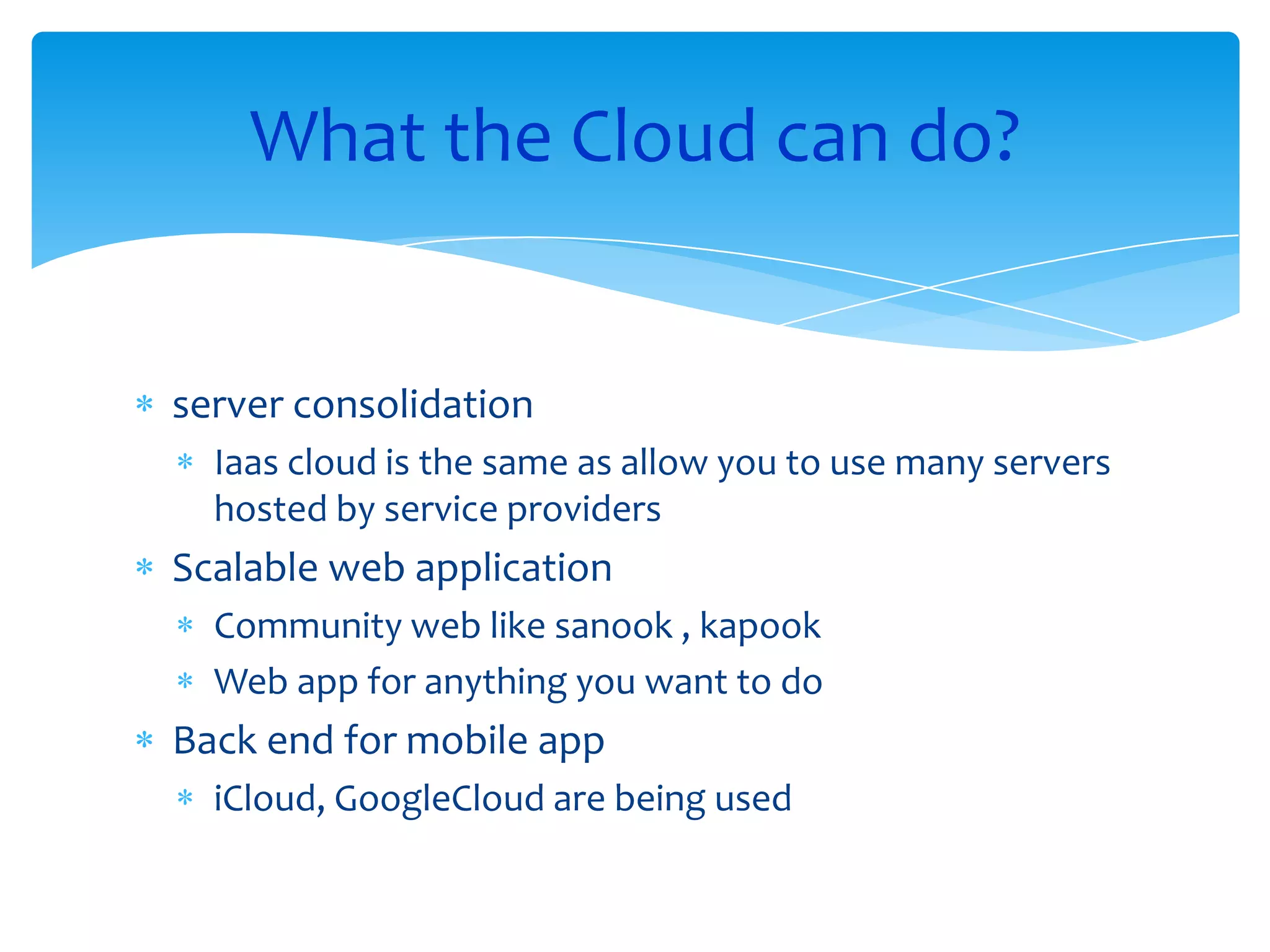
server consolidation
  Iaas cloud is the same as allow you to use many servers
  hosted by service providers
Scalable web application
  Community web like sanook , kapook
  Web app for anything you want to do
Back end for mobile app
  iCloud, GoogleCloud are being used
The Cloud and I

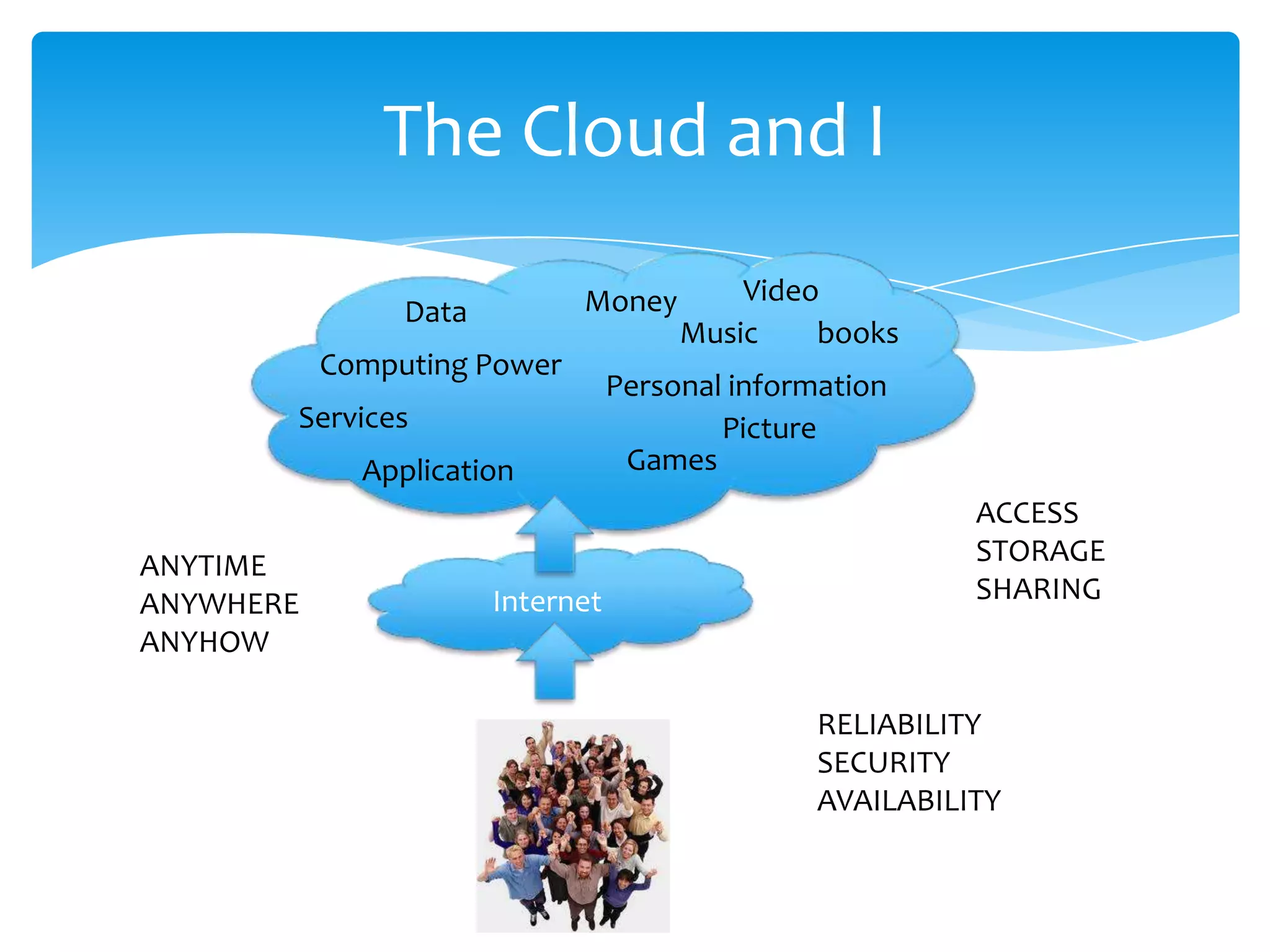
                             Money         Video
                Data
                                       Music    books
           Computing Power
                                  Personal information
       Services                           Picture
             Application           Games
                                                           ACCESS
ANYTIME                                                    STORAGE
ANYWHERE               Internet                            SHARING
ANYHOW

                                                 RELIABILITY
                                                 SECURITY
                                                 AVAILABILITY
The Cloud and I

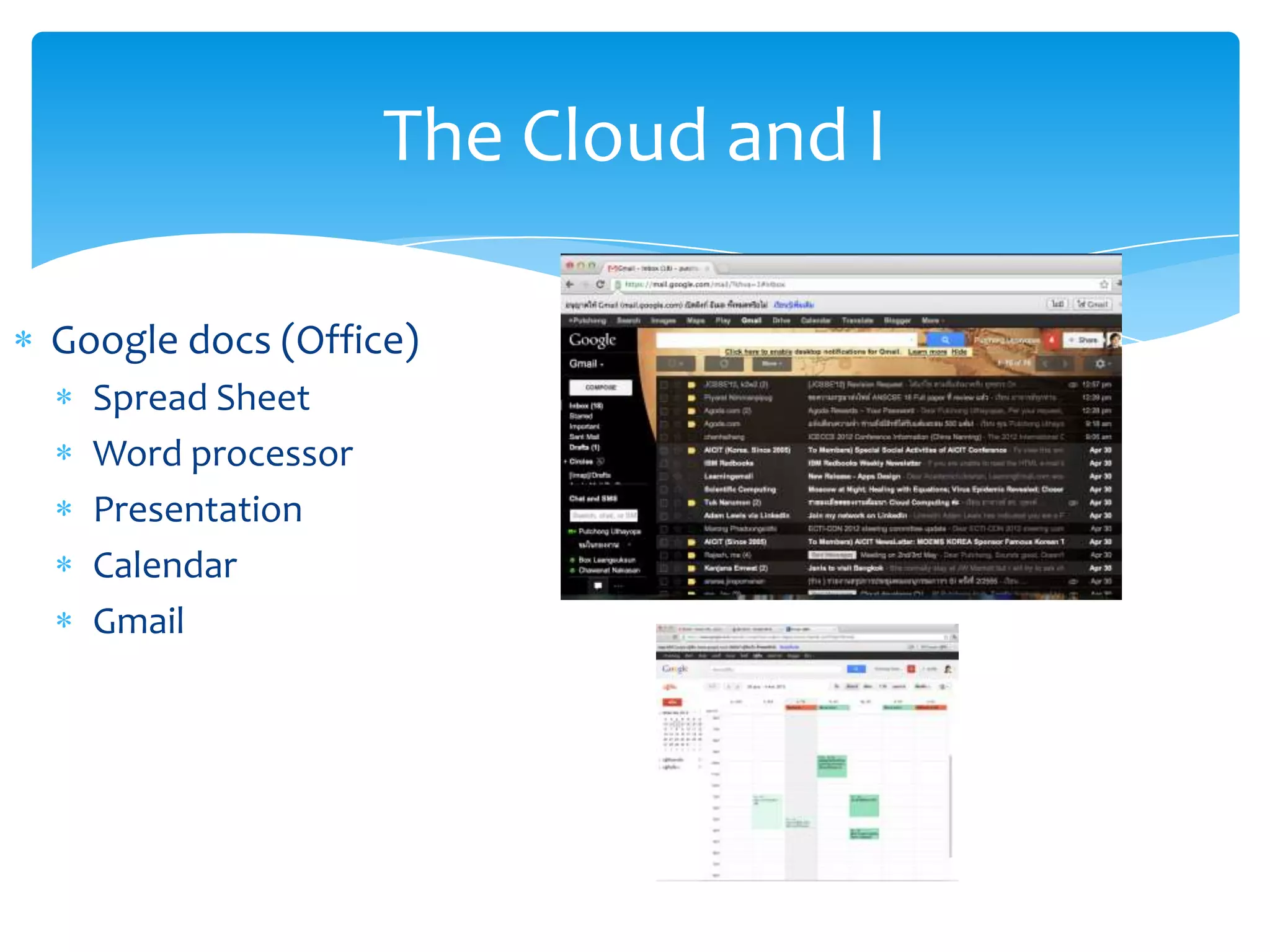
Google docs (Office)
  Spread Sheet
  Word processor
  Presentation
  Calendar
  Gmail
The Cloud and I

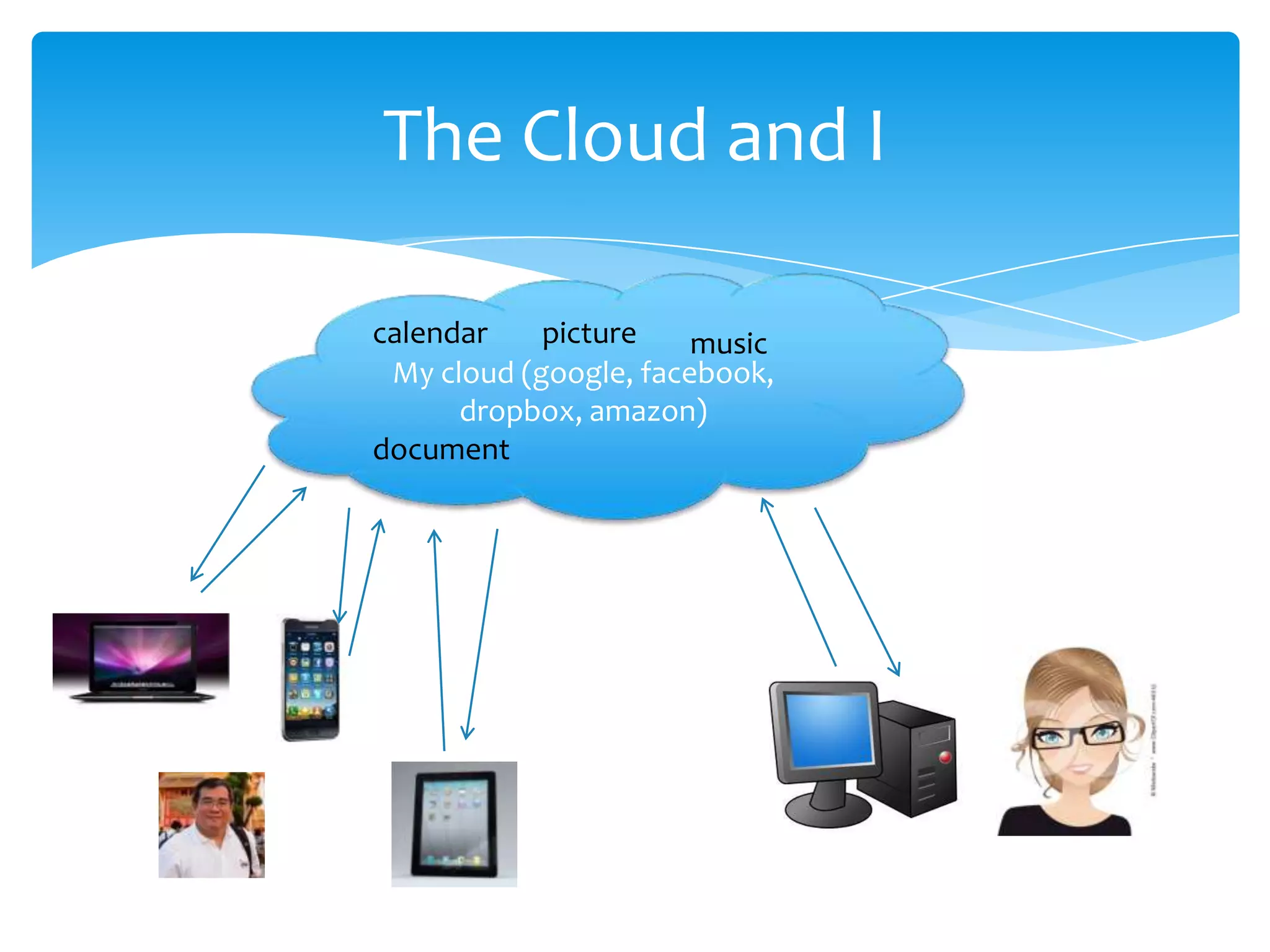
calendar    picture    music
 My cloud (google, facebook,
      dropbox, amazon)
document
Work Life with a Cloud


Appointment (google calendar)
  My secretary take appointment , add to calendar
  I got to see it on every device quickly, so is she
  Device notify me
Email (gmail)
  I can go to any computer/device with browser, my email
  follow me there.
  I have no need to install mail client, maintain mail server
Work Life with a Cloud


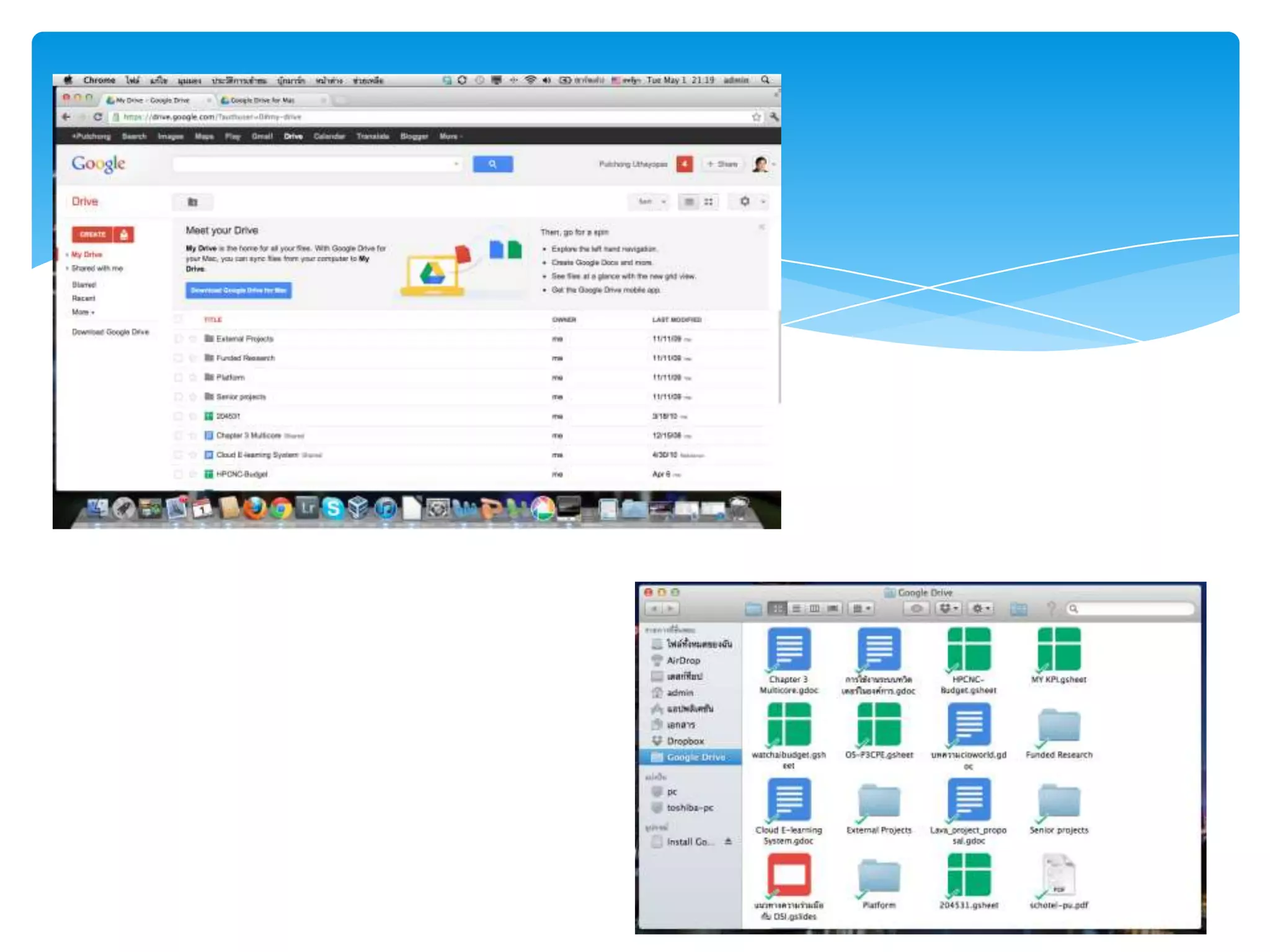
Document (google docs)
  I can create basic document, good spreadsheet, basic
  presentation without installing any software
  I can down load document and edit it on my computer
  I can share my document with other on internet and edit it
  together
Storage (google drive, dropbox)
  Create presentation on notebook, drop in in dropbox
  Present from iPad, Smartphone
  Secure, no need to carry thumb drive
  Easily share file with other people making team work easy
Play Life with a Cloud


Picture
  Using Instagram, photo, video I take instantly appear on
  twitter and facebook and neatly catalog
  Picture can be shared, tag, comment among my 2000 friends
  on facebook!
  If I want, they will know where I was. (Little dangerous)
Communication
  My thought can be spread anytime anyway using facebook,
  googleplus, multiply
  I can even “hang out” with friend on google plus
Play Life with a Cloud


Book
 Amazon Kindle Store. Buy book from amazon and they
 will keep it on their cloud
   Unlimited book shelves, no cleaning, dusting
 Read your book on any device iPad, iPhone, Androiod
 Phone, Tablet, PC, Mac
   I read mine on iPad, and my Galaxy S2 phone
Play Life with a Cloud


Music
 iTune Store allow you to shopping for music, movies
 You can load it and play on many of your devices
 Media Industry is changing, now you can own a radio
 station and TV station and get audiences around the
 world
   Power shift from infrastructure provider (TV station) to
   content creator ( like grammy etc.)
Some Existing Cloud Computing Systems


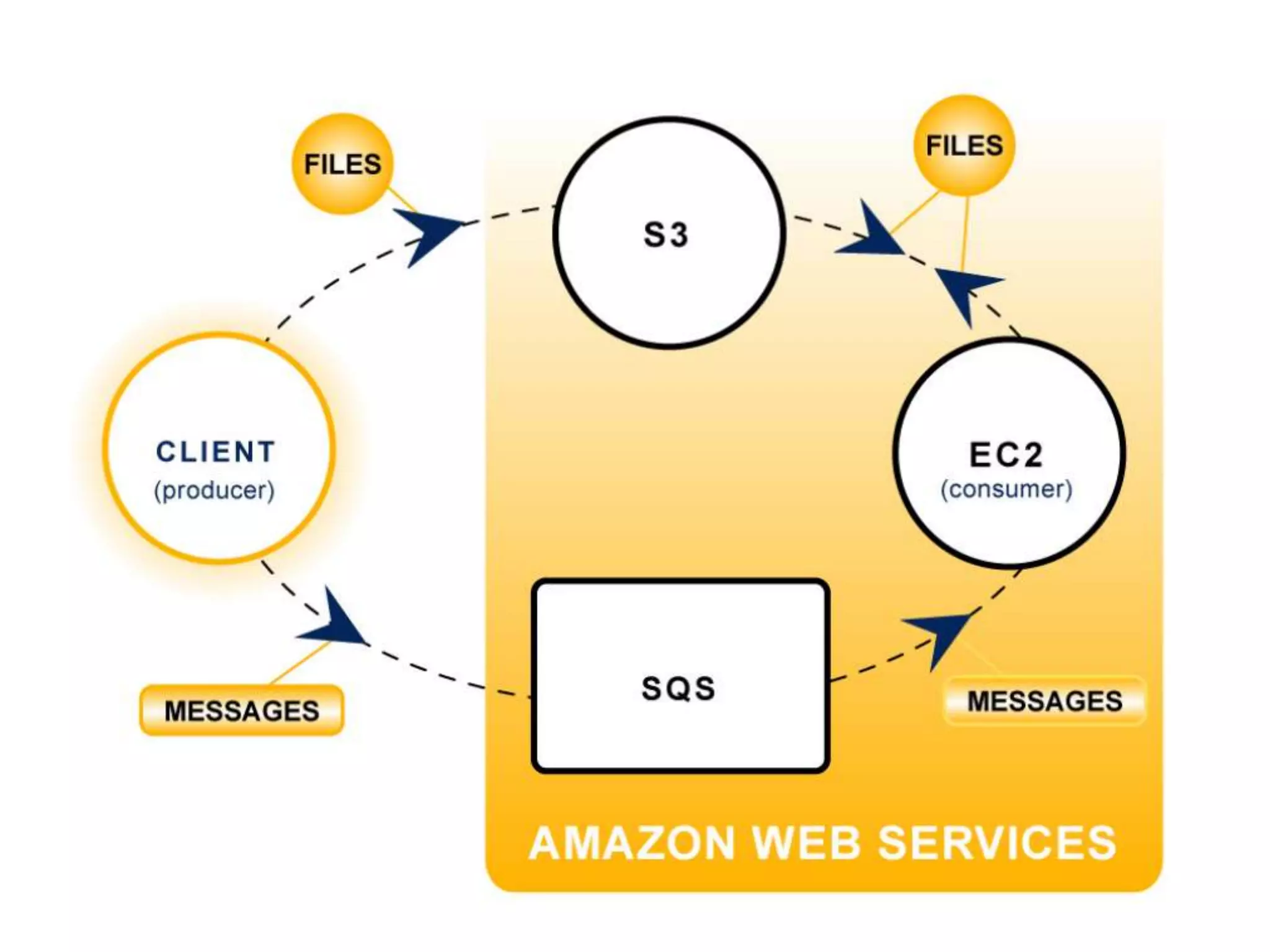
  Amazon AWS
  Google App Engine
  Microsoft Azure
  Openstack
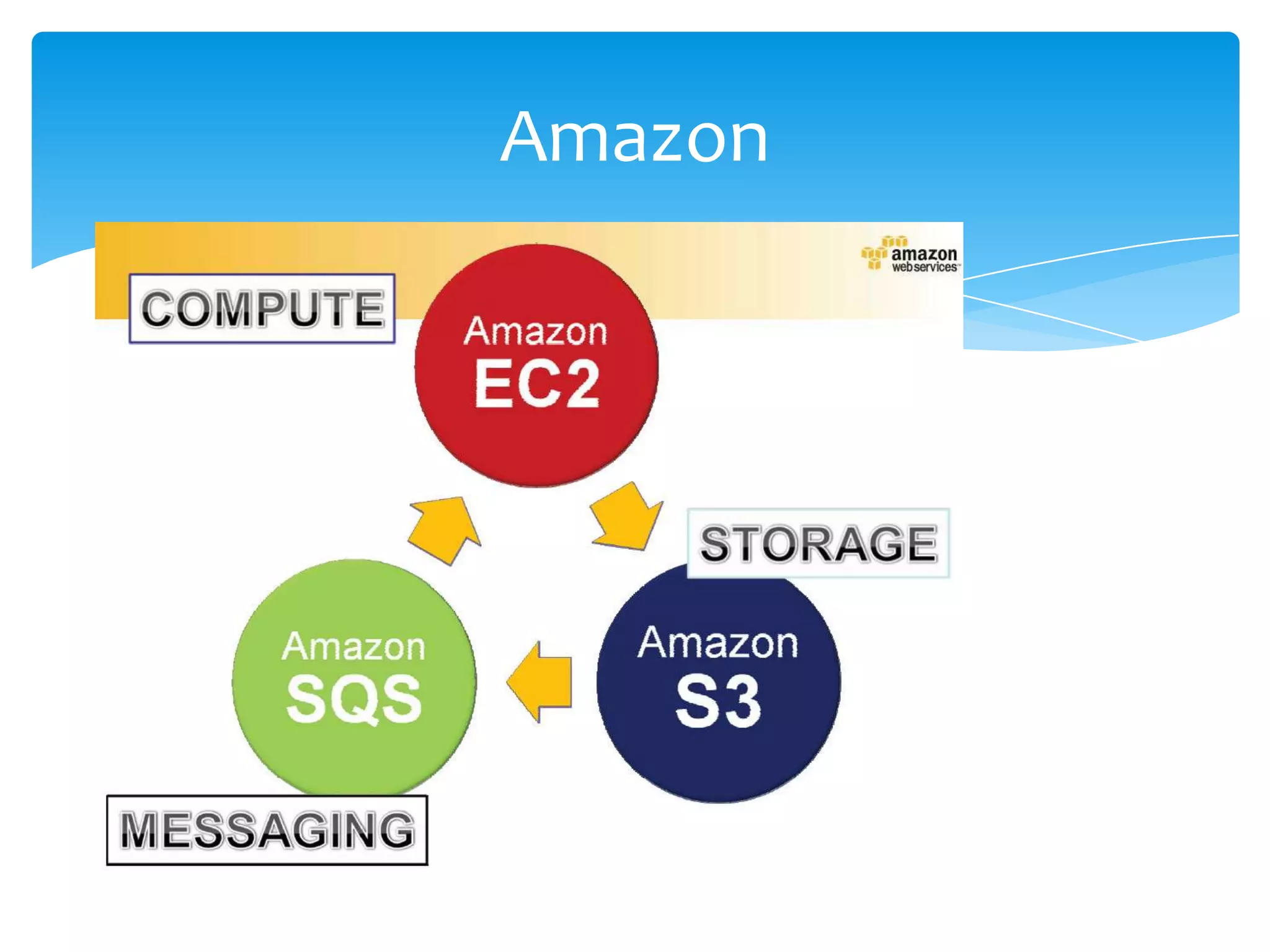
Amazon
Google App Engine
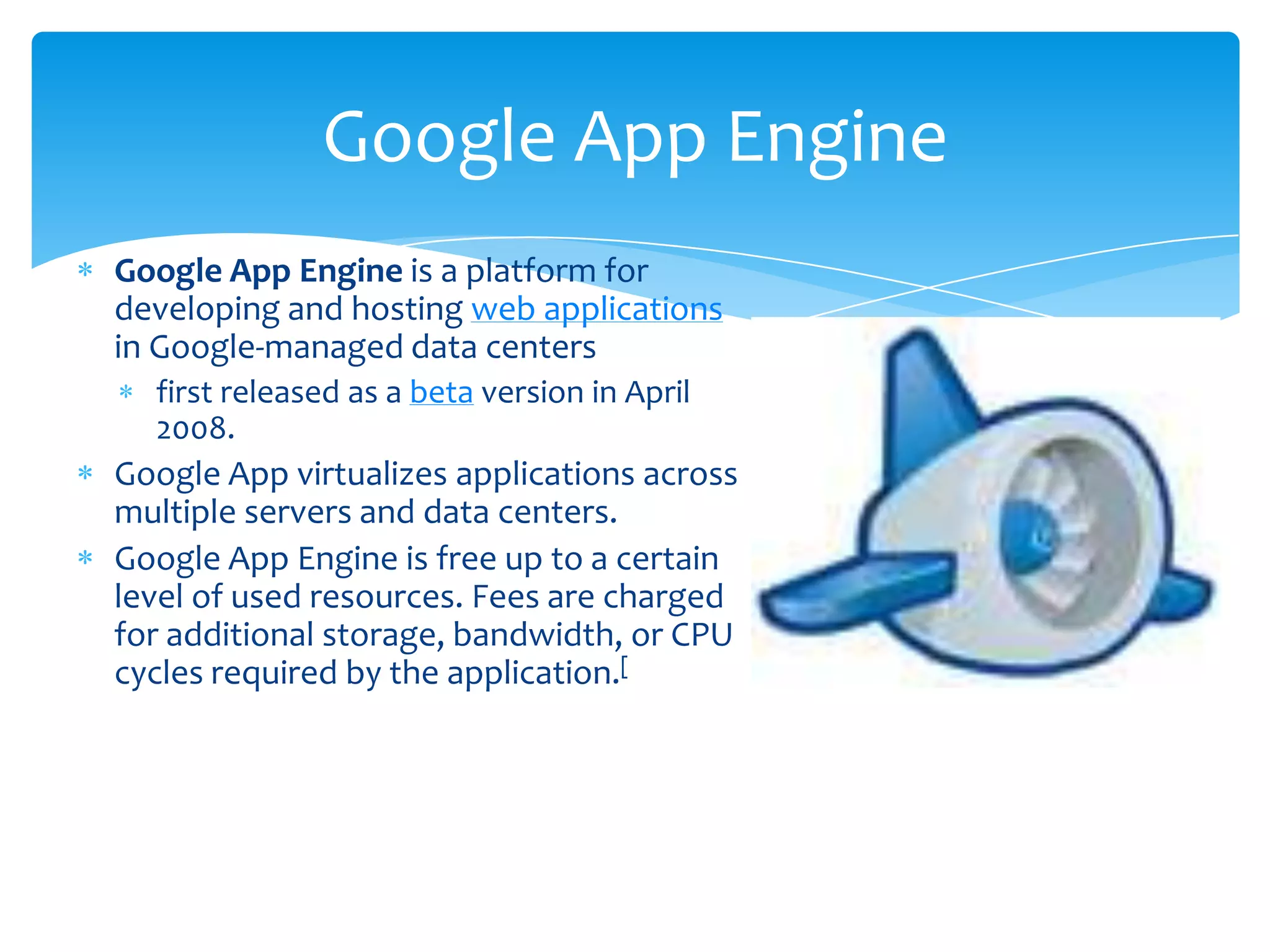
Google App Engine is a platform for
developing and hosting web applications
in Google-managed data centers
  first released as a beta version in April
  2008.
Google App virtualizes applications across
multiple servers and data centers.
Google App Engine is free up to a certain
level of used resources. Fees are charged
for additional storage, bandwidth, or CPU
cycles required by the application.[
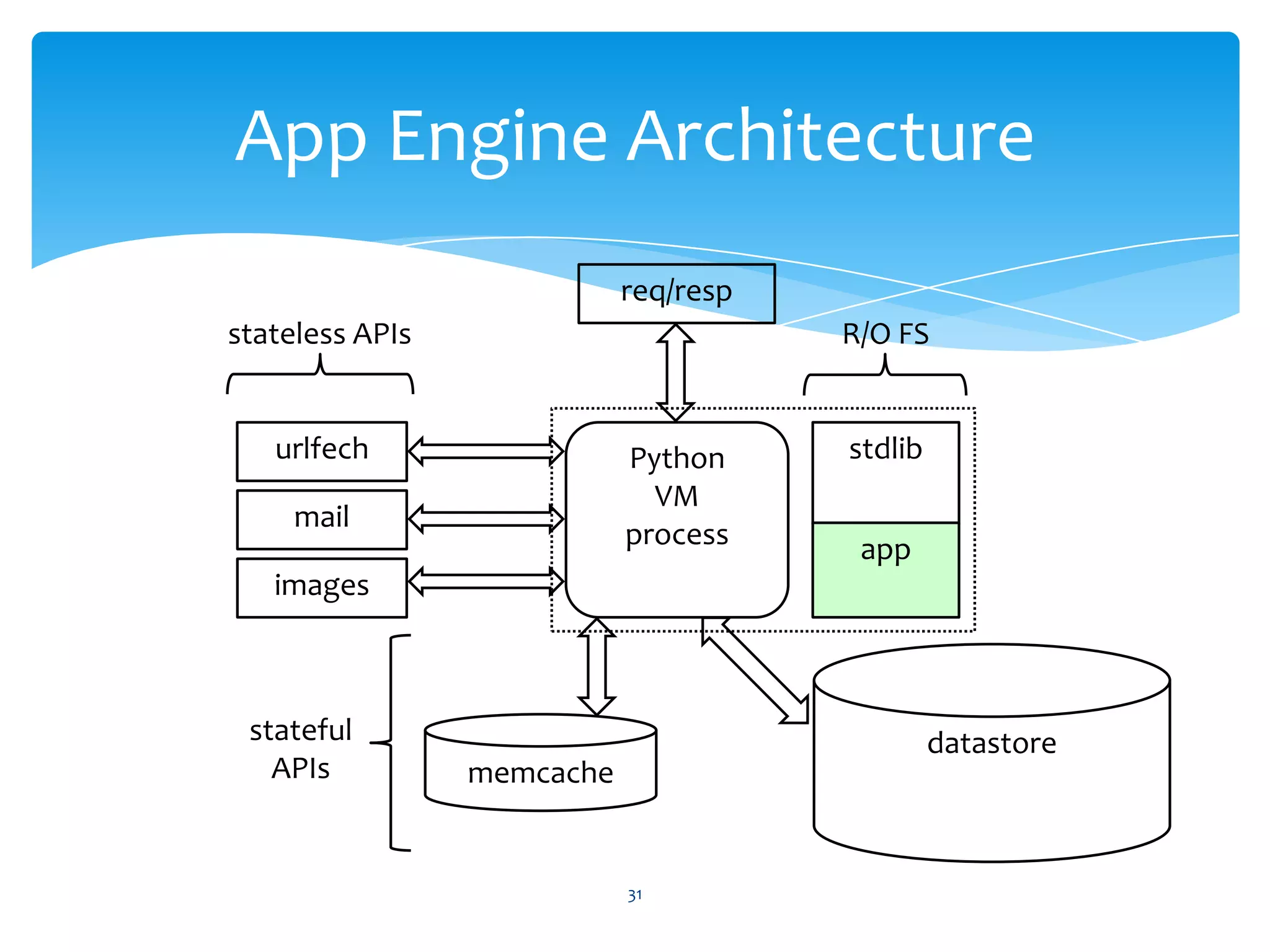
App Engine Architecture
                            req/resp
stateless APIs                         R/O FS


   urlfech                  Python     stdlib
                              VM
     mail
                            process     app
   images


 stateful                                       datastore
   APIs          memcache


                            31
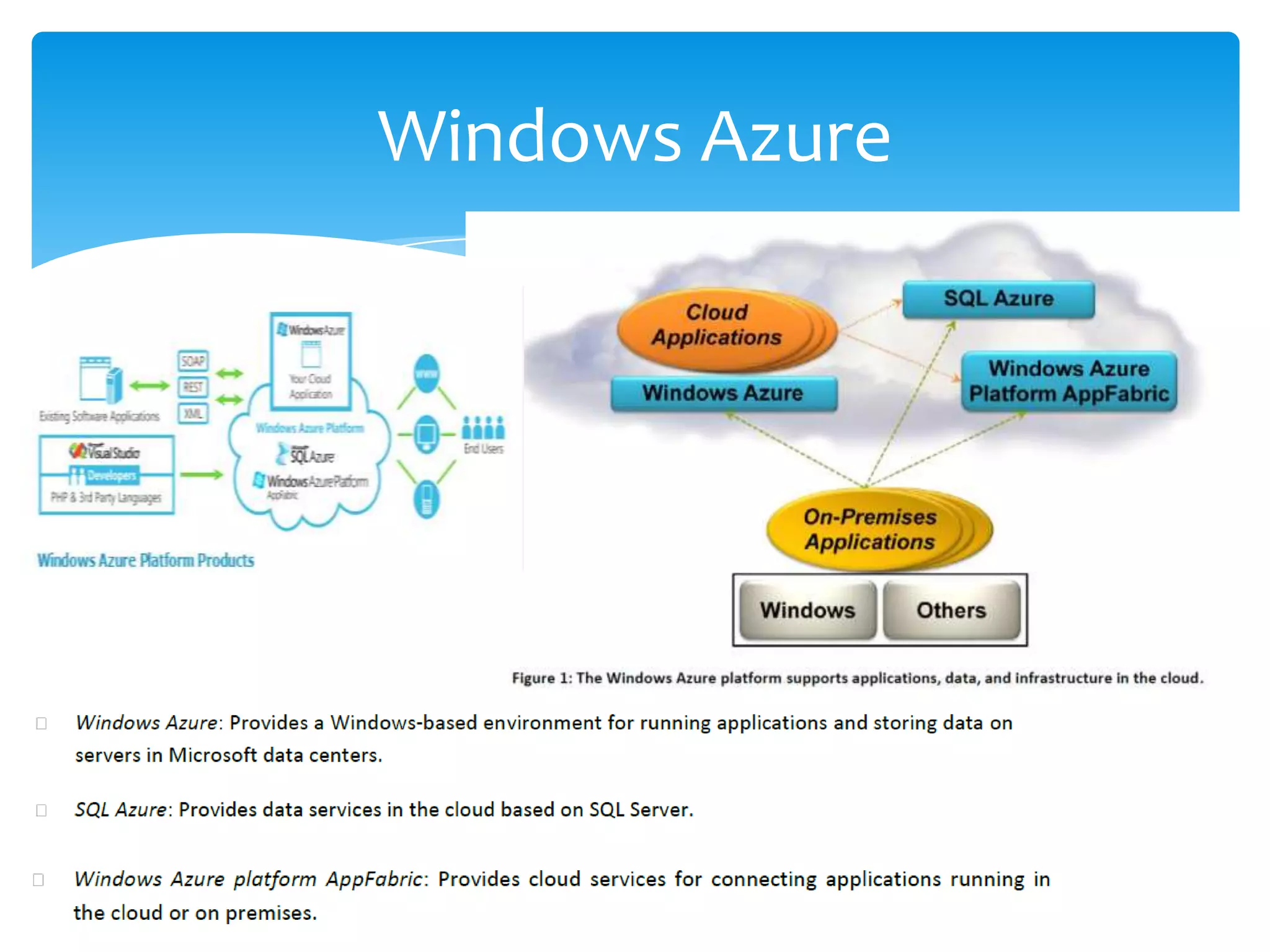
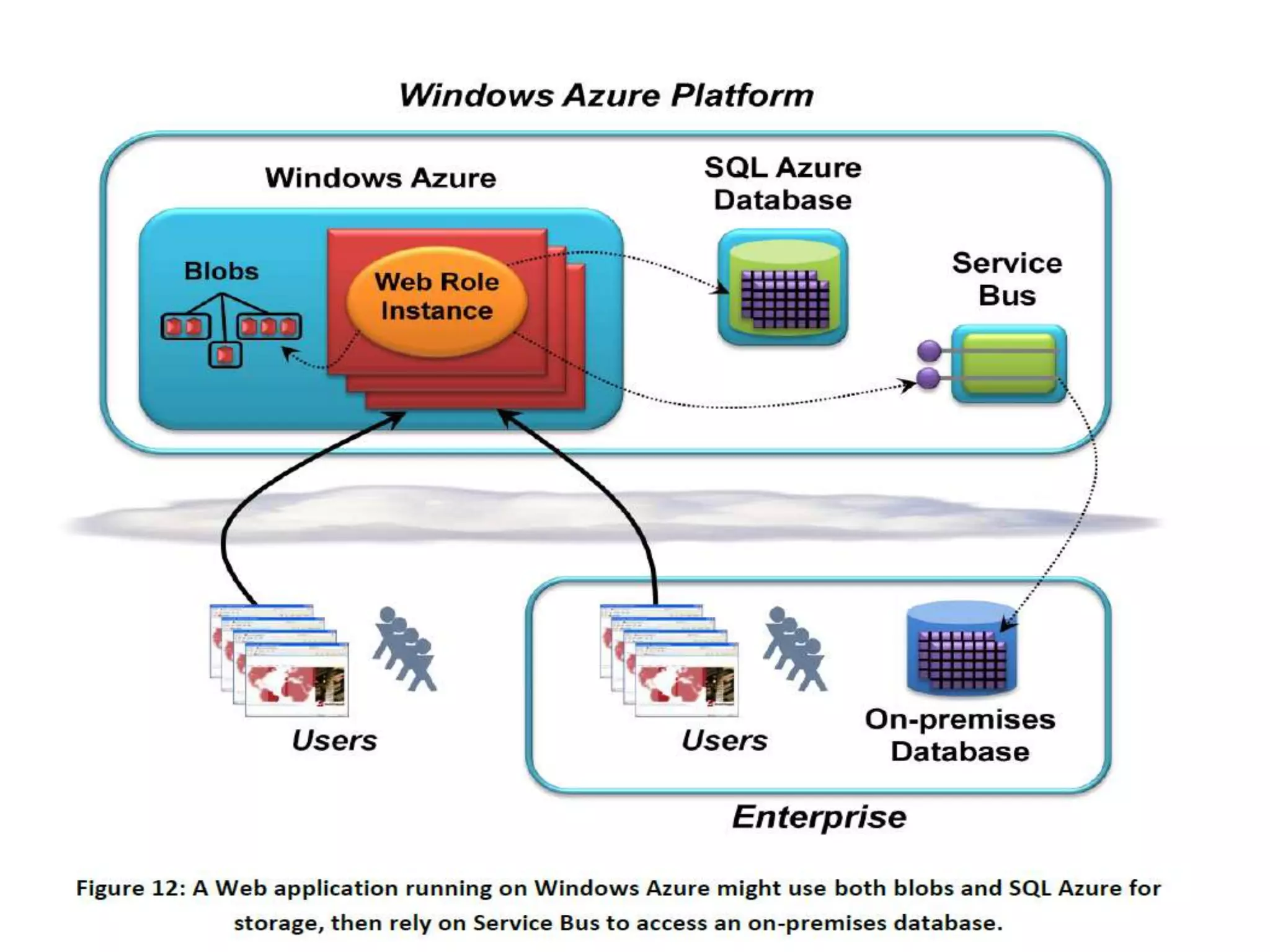
Windows Azure
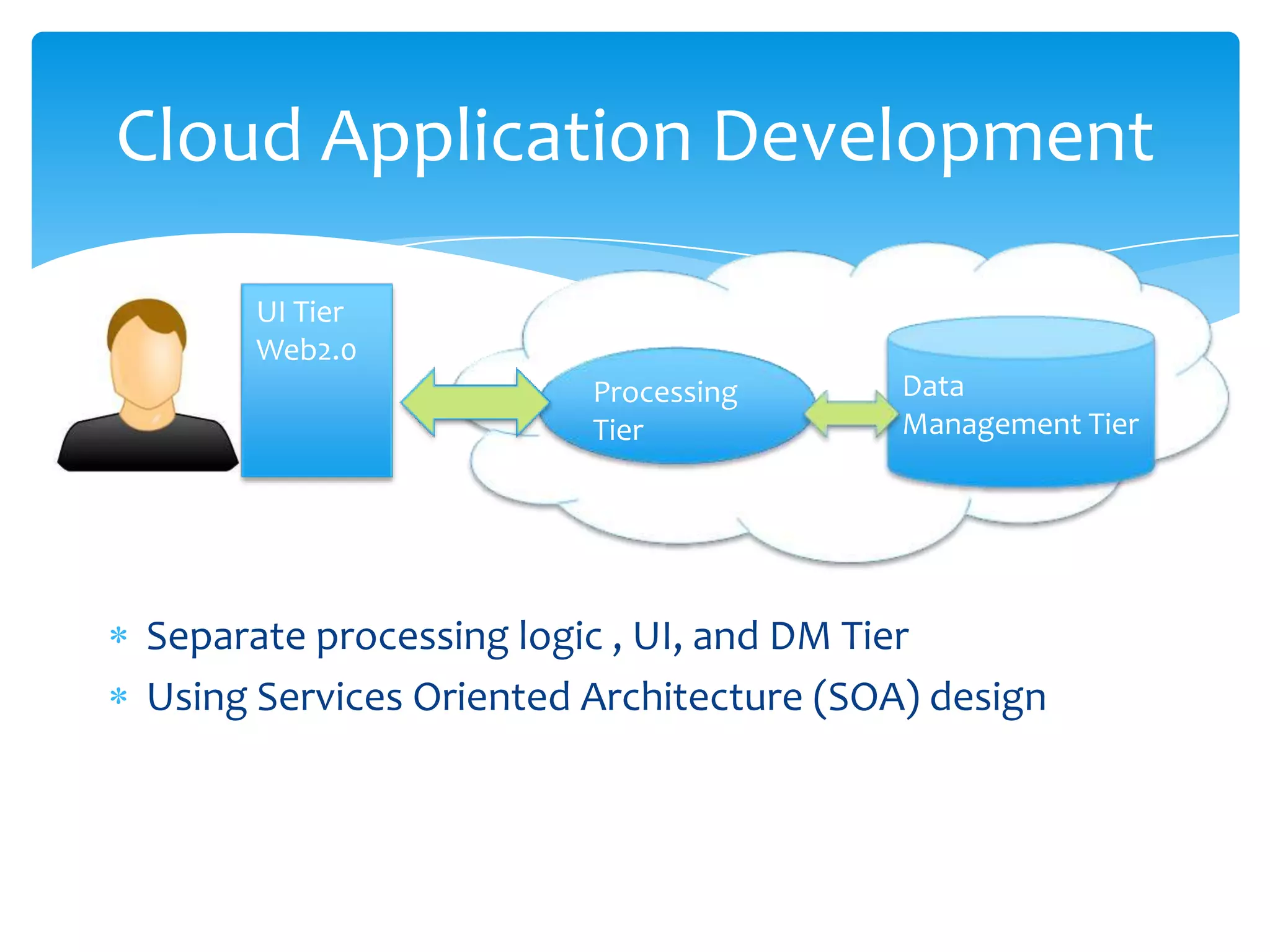
Cloud Application Development

     UI Tier
     Web2.0
                        Processing       Data
                        Tier             Management Tier


Separate processing logic , UI, and DM Tier
Using Services Oriented Architecture (SOA) design
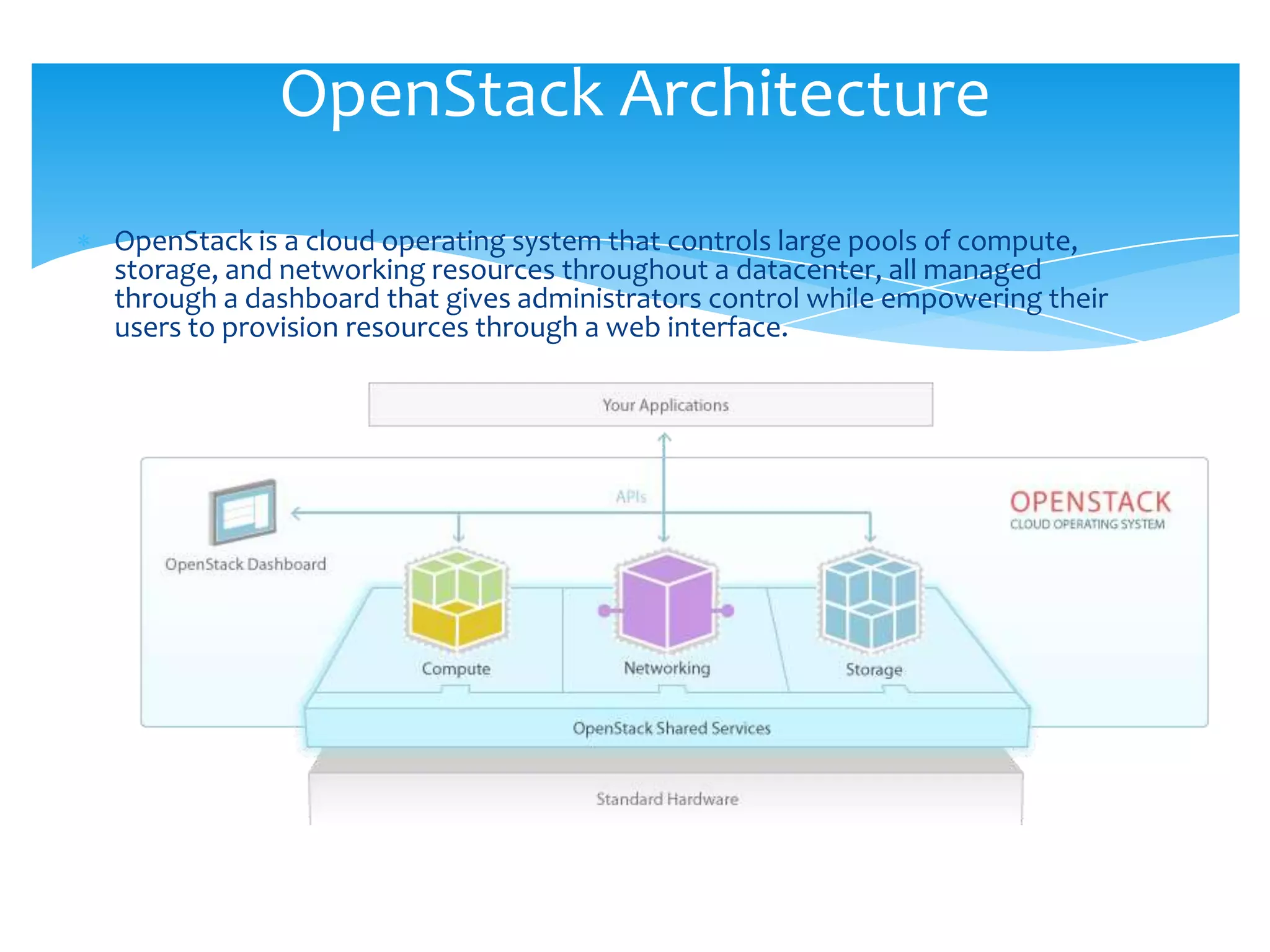
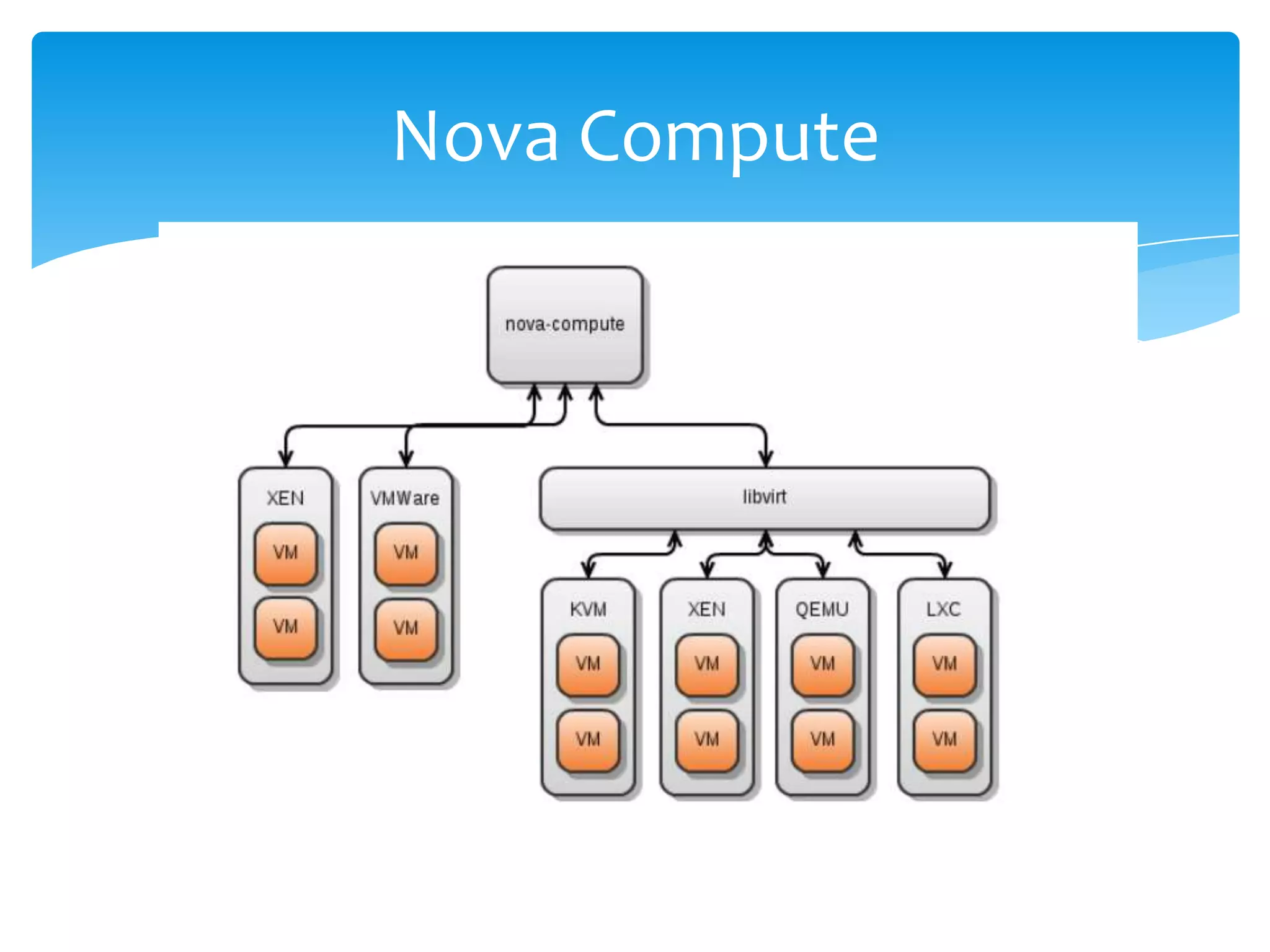
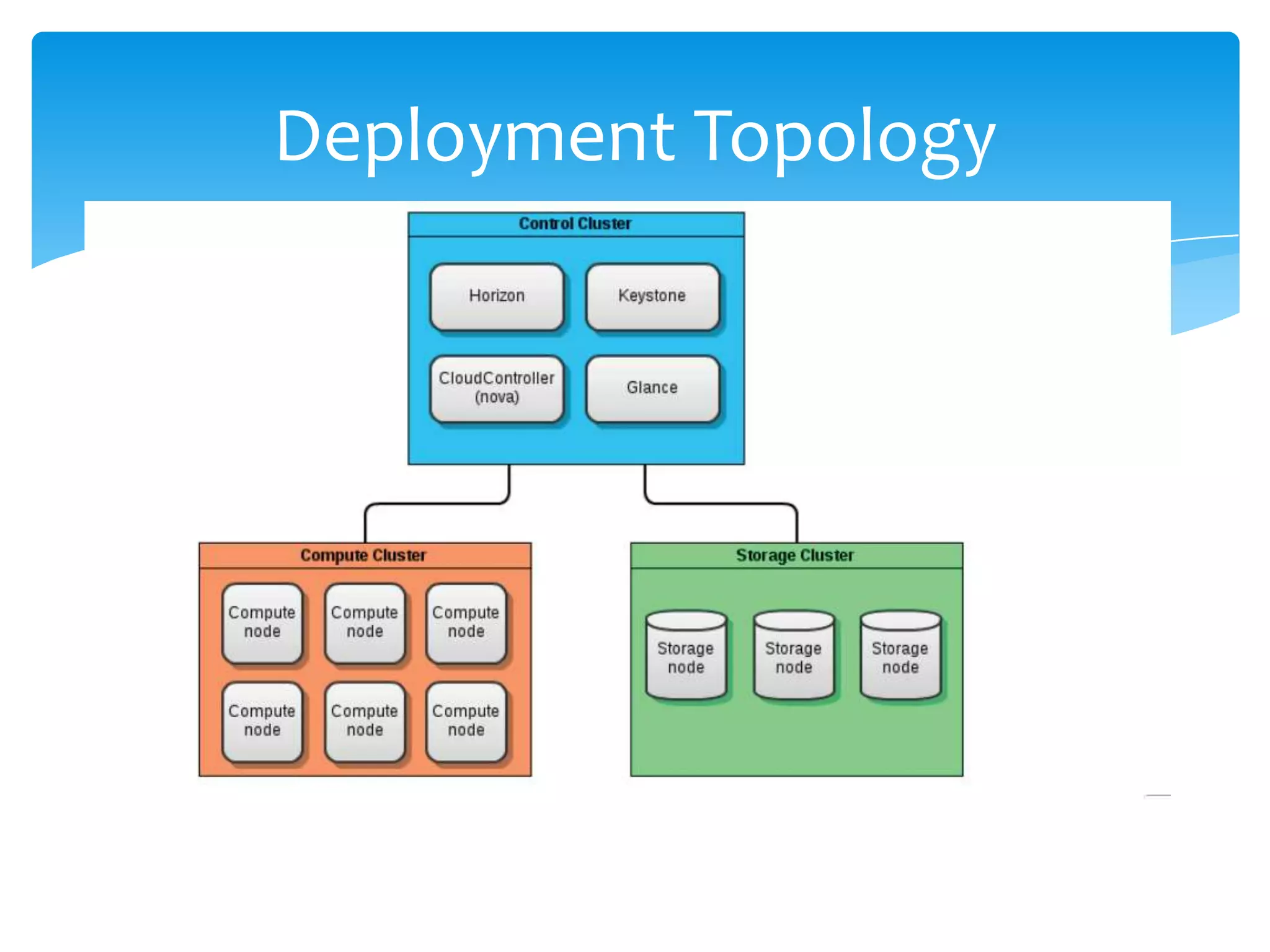
OpenStack Architecture
OpenStack is a cloud operating system that controls large pools of compute,
storage, and networking resources throughout a datacenter, all managed
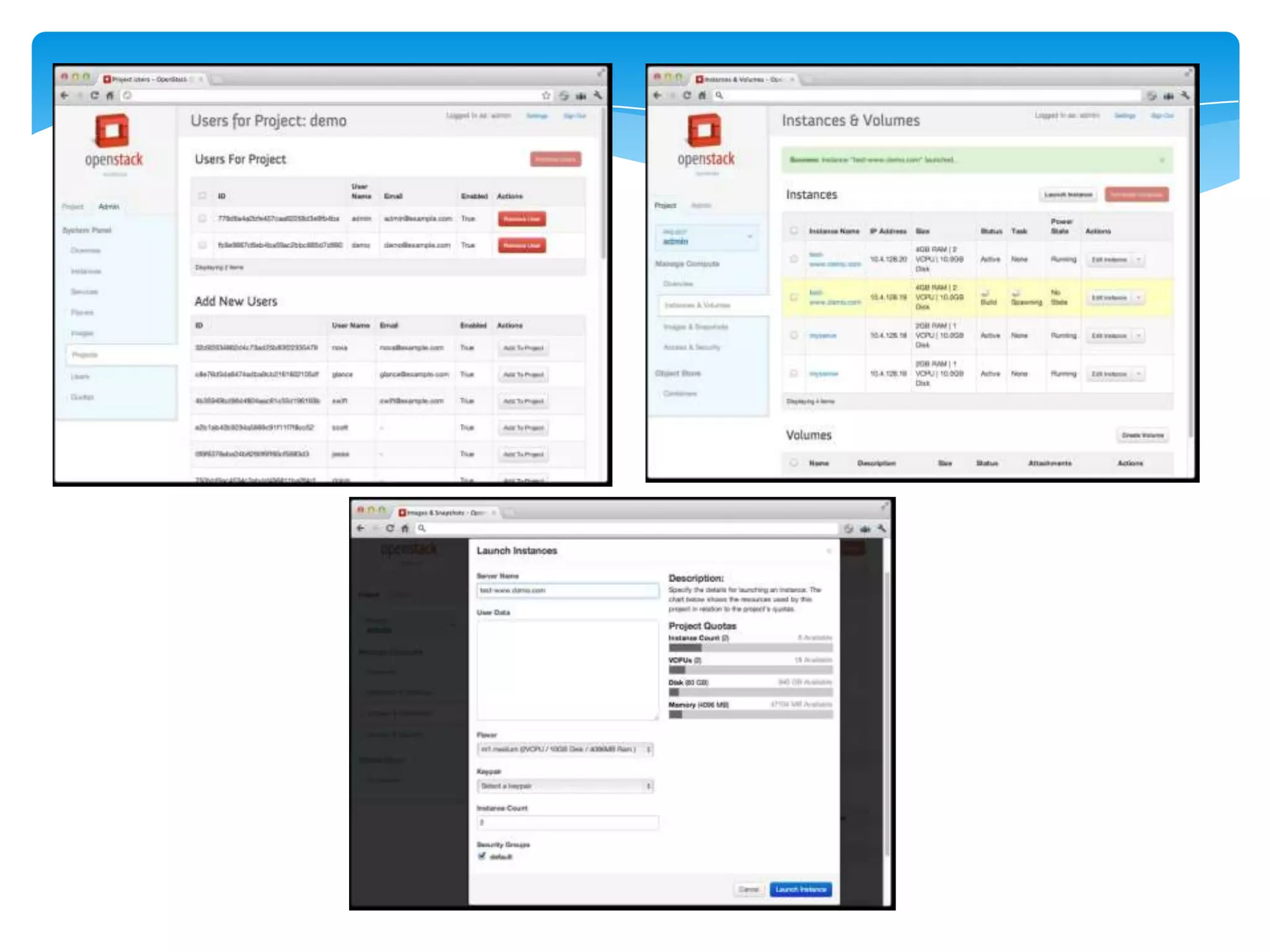
through a dashboard that gives administrators control while empowering their
users to provision resources through a web interface.
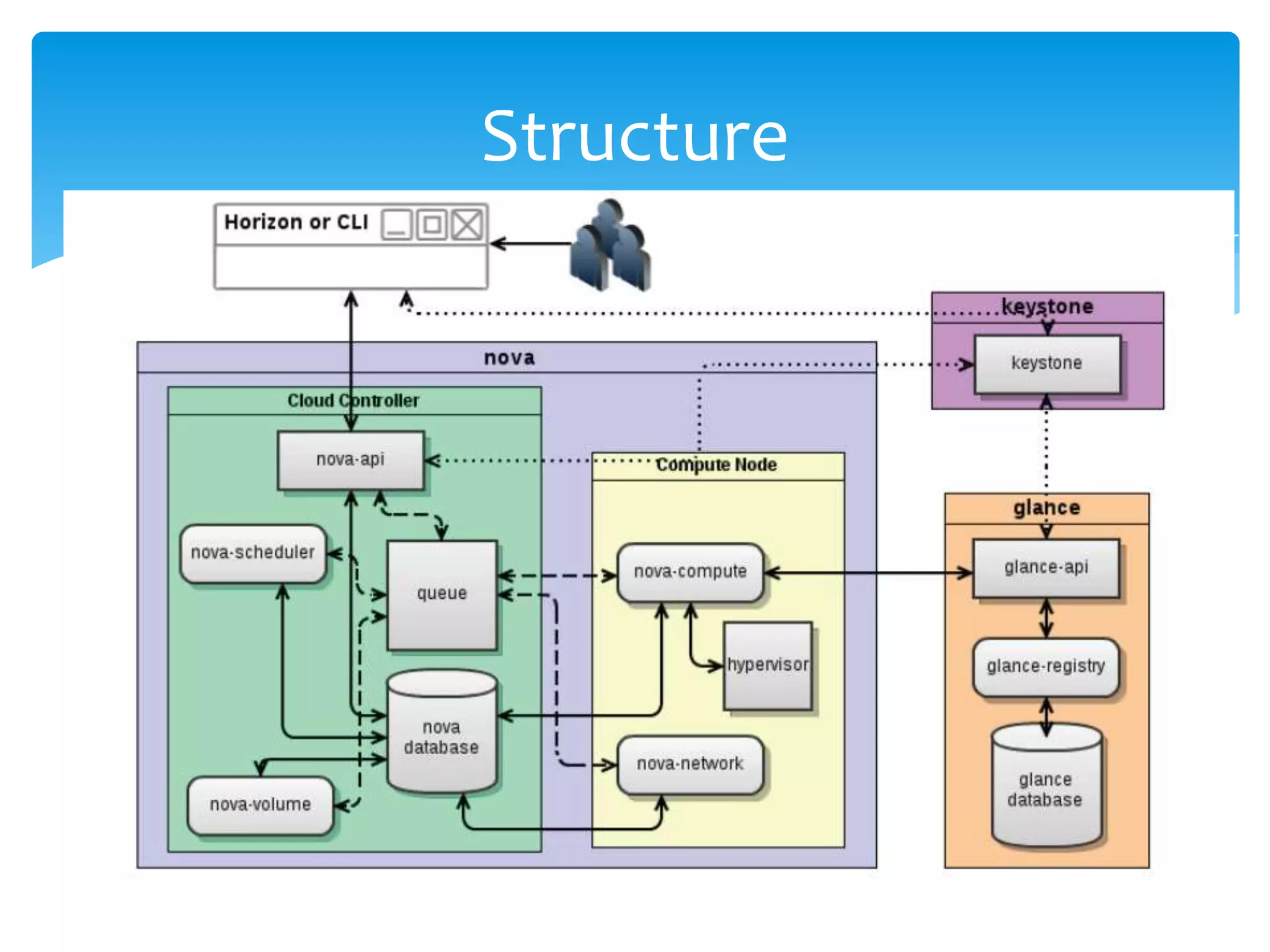
Structure
Nova Compute
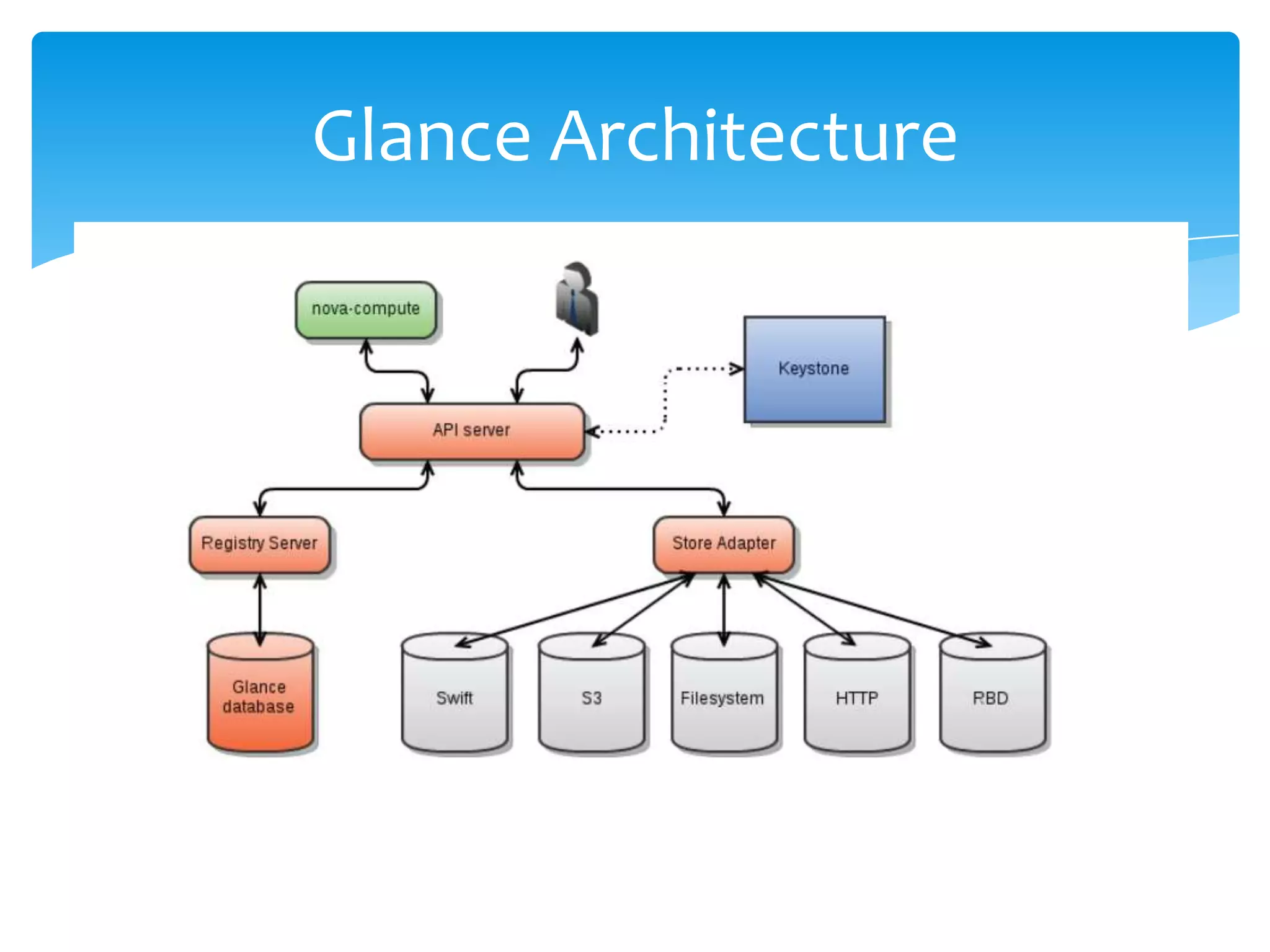
Glance Architecture
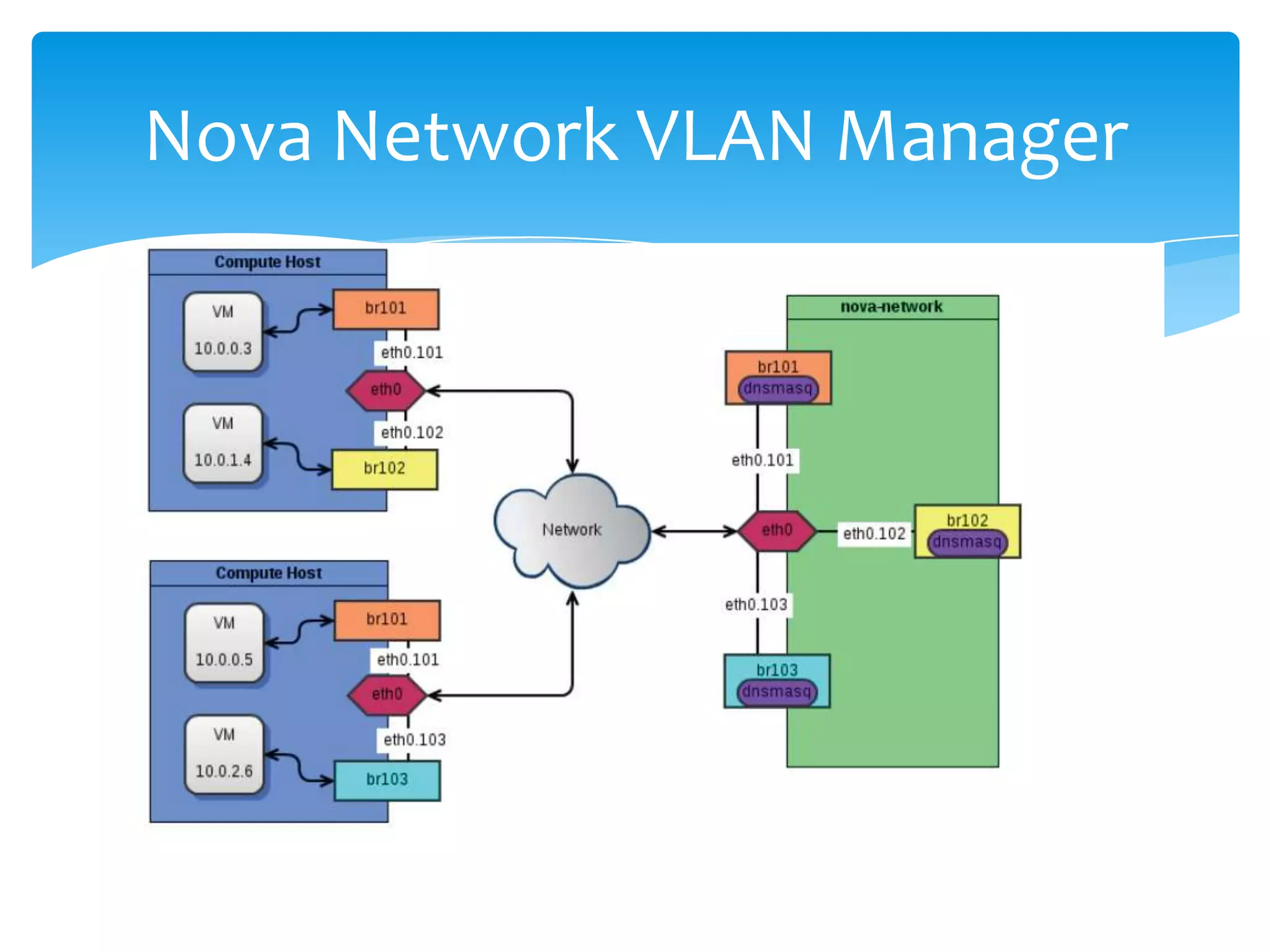
Nova Network VLAN Manager
Deployment Topology
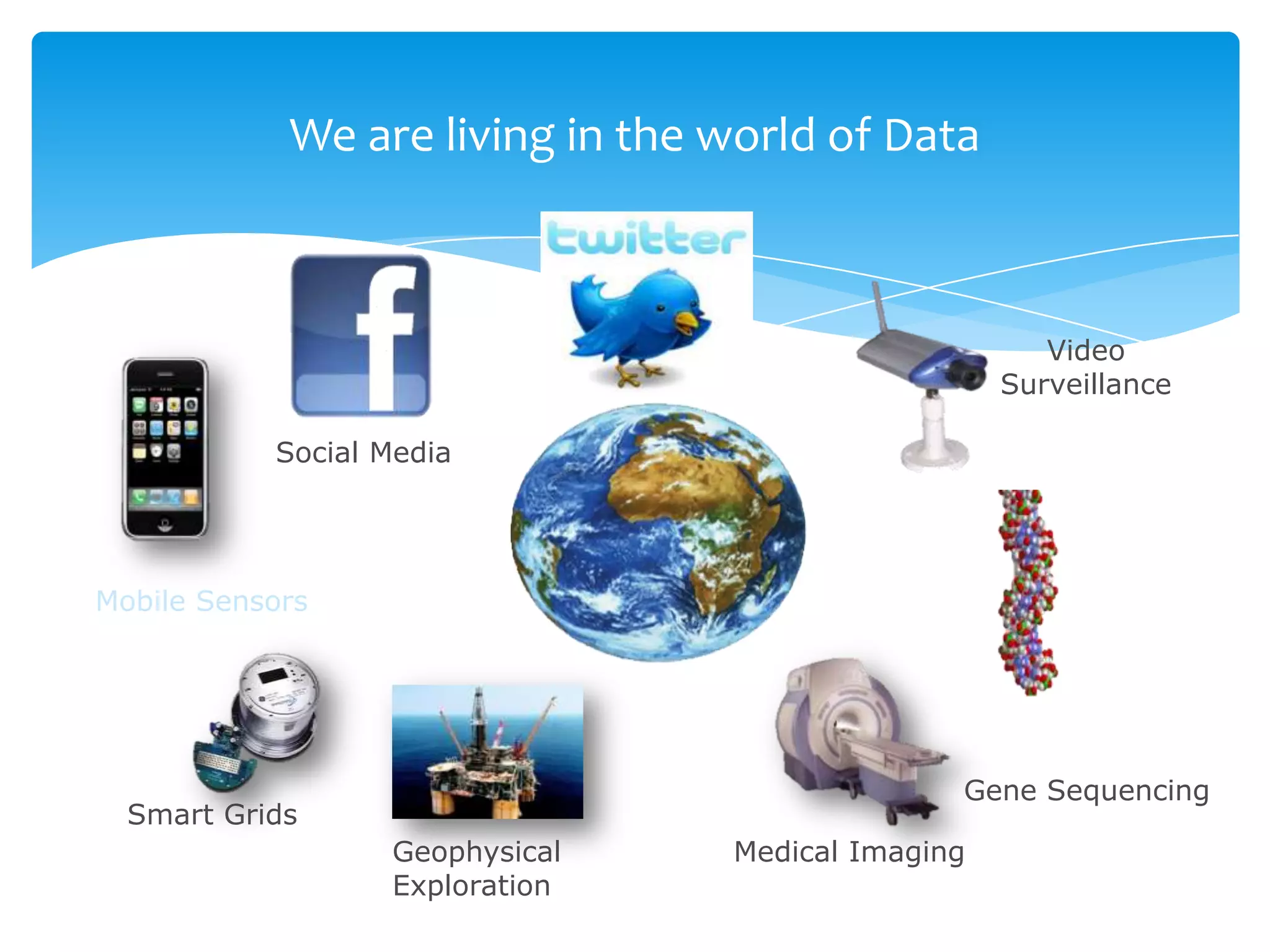
We are living in the world of Data


                                                      Video
                                                   Surveillance

           Social Media


Mobile Sensors


                                               Gene Sequencing
  Smart Grids
                  Geophysical    Medical Imaging
                  Exploration
Big Data
“Big data is data that exceeds the processing capacity of
conventional database systems. The data is too big,
moves too fast, or doesn’t fit the strictures of your
database architectures. To gain value from this data, you
must choose an alternative way to process it.”


        Reference: “What is big data? An introduction to the big data
        landscape.”, EddDumbill, http://radar.oreilly.com/2012/01/what-is-big-
        data.html
The Value of Big Data


Analytical use
  Big data analytics can reveal insights hidden previously by
  data too costly to process.
     peer influence among customers, revealed by analyzing
     shoppers’ transactions, social and geographical data.
  Being able to process every item of data in reasonable time
  removes the troublesome need for sampling and promotes an
  investigative approach to data.
Enabling new products.
  Facebookhas been able to craft a highly personalized user
  experience and create a new kind of advertising business
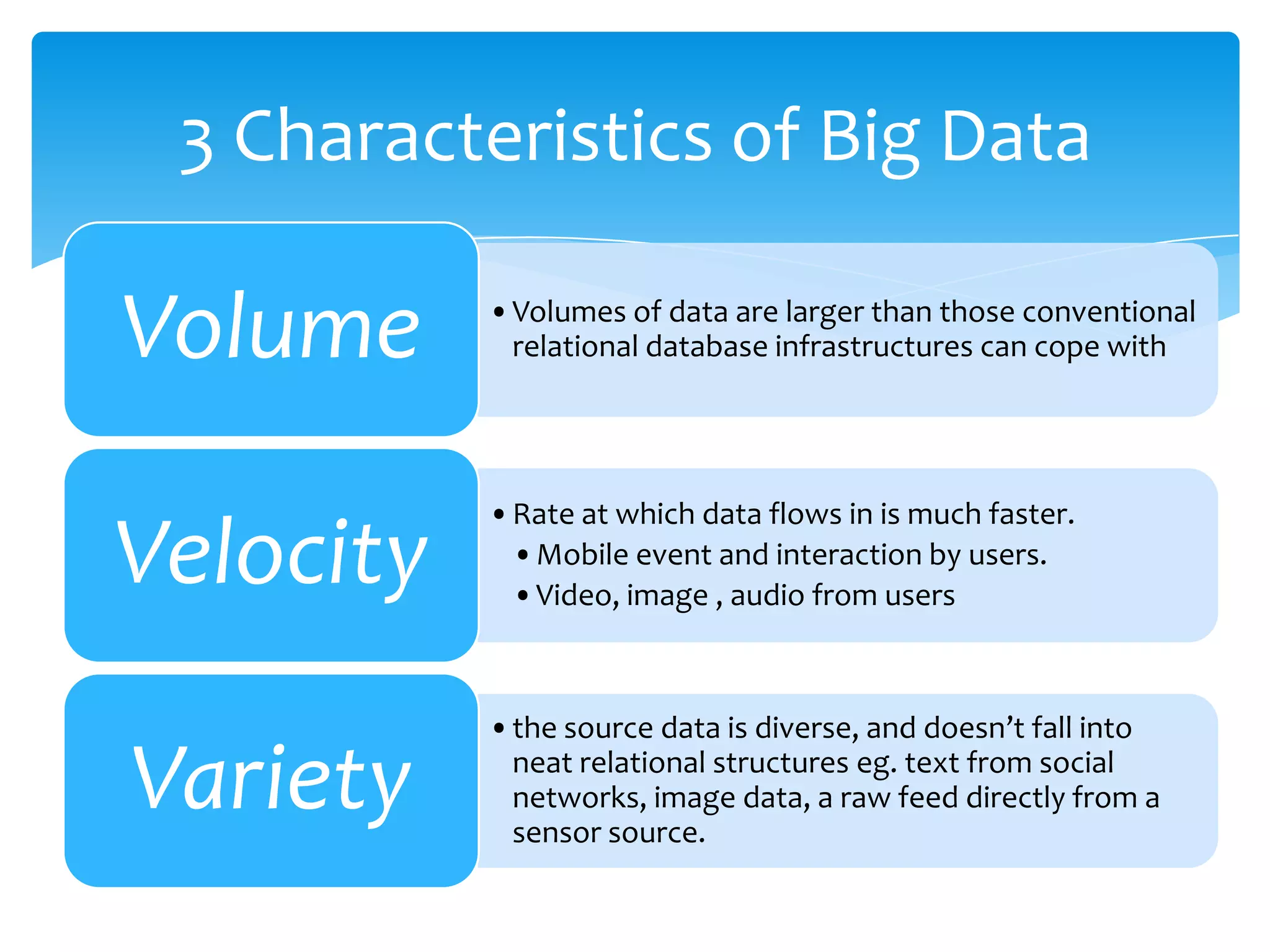
3 Characteristics of Big Data

Volume     •Volumes of data are larger than those conventional
            relational database infrastructures can cope with


           •Rate at which data flows in is much faster.
Velocity    •Mobile event and interaction by users.
            •Video, image , audio from users


           •the source data is diverse, and doesn’t fall into

Variety     neat relational structures eg. text from social
            networks, image data, a raw feed directly from a
            sensor source.
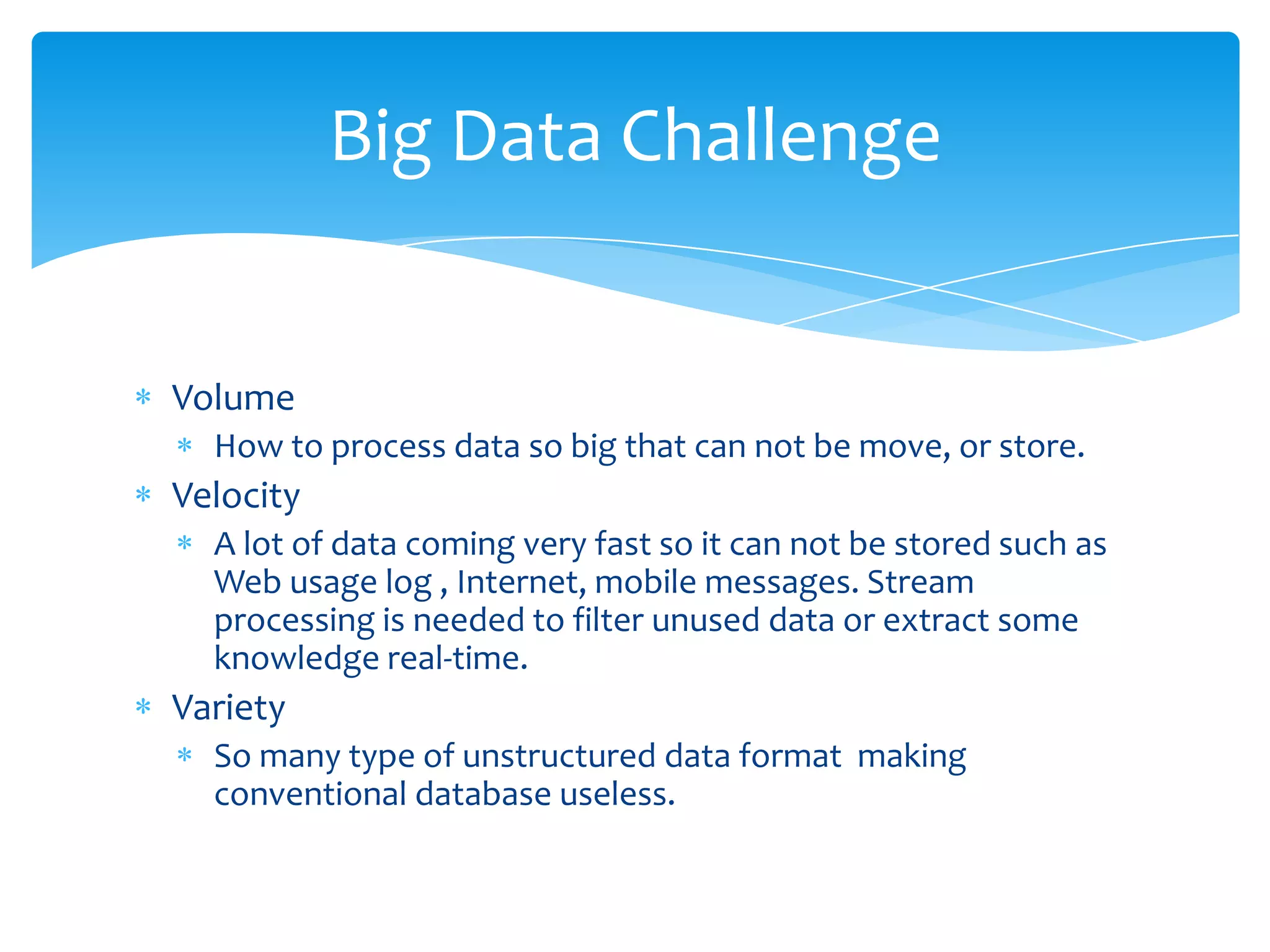
Big Data Challenge


Volume
  How to process data so big that can not be move, or store.
Velocity
  A lot of data coming very fast so it can not be stored such as
  Web usage log , Internet, mobile messages. Stream
  processing is needed to filter unused data or extract some
  knowledge real-time.
Variety
  So many type of unstructured data format making
  conventional database useless.
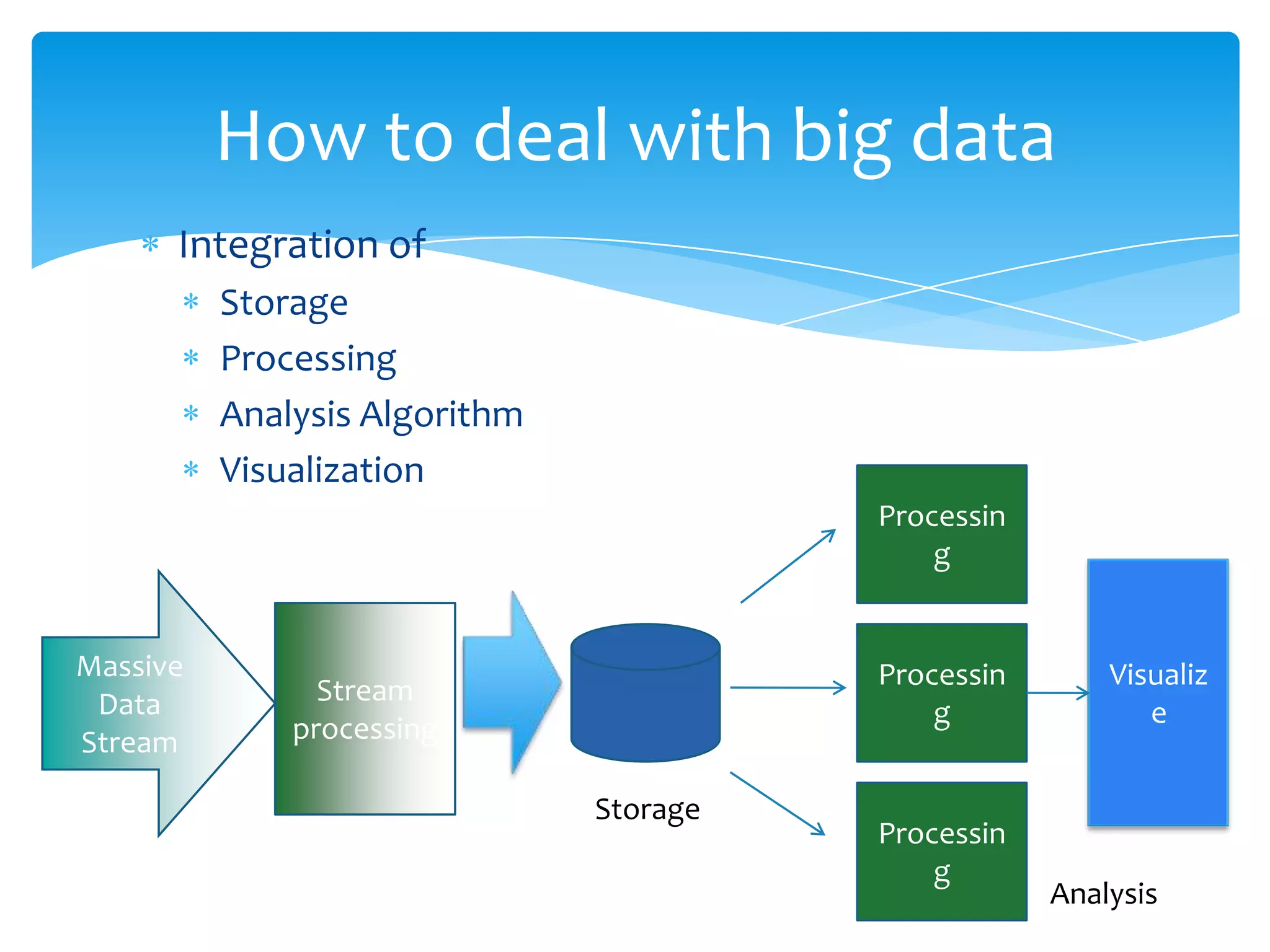
How to deal with big data
      Integration of
          Storage
          Processing
          Analysis Algorithm
          Visualization
                                         Processin
                                             g


Massive                                  Processin       Visualiz
 Data           Stream
                                             g              e
Stream        processing

                               Storage
                                         Processin
                                             g
                                                     Analysis
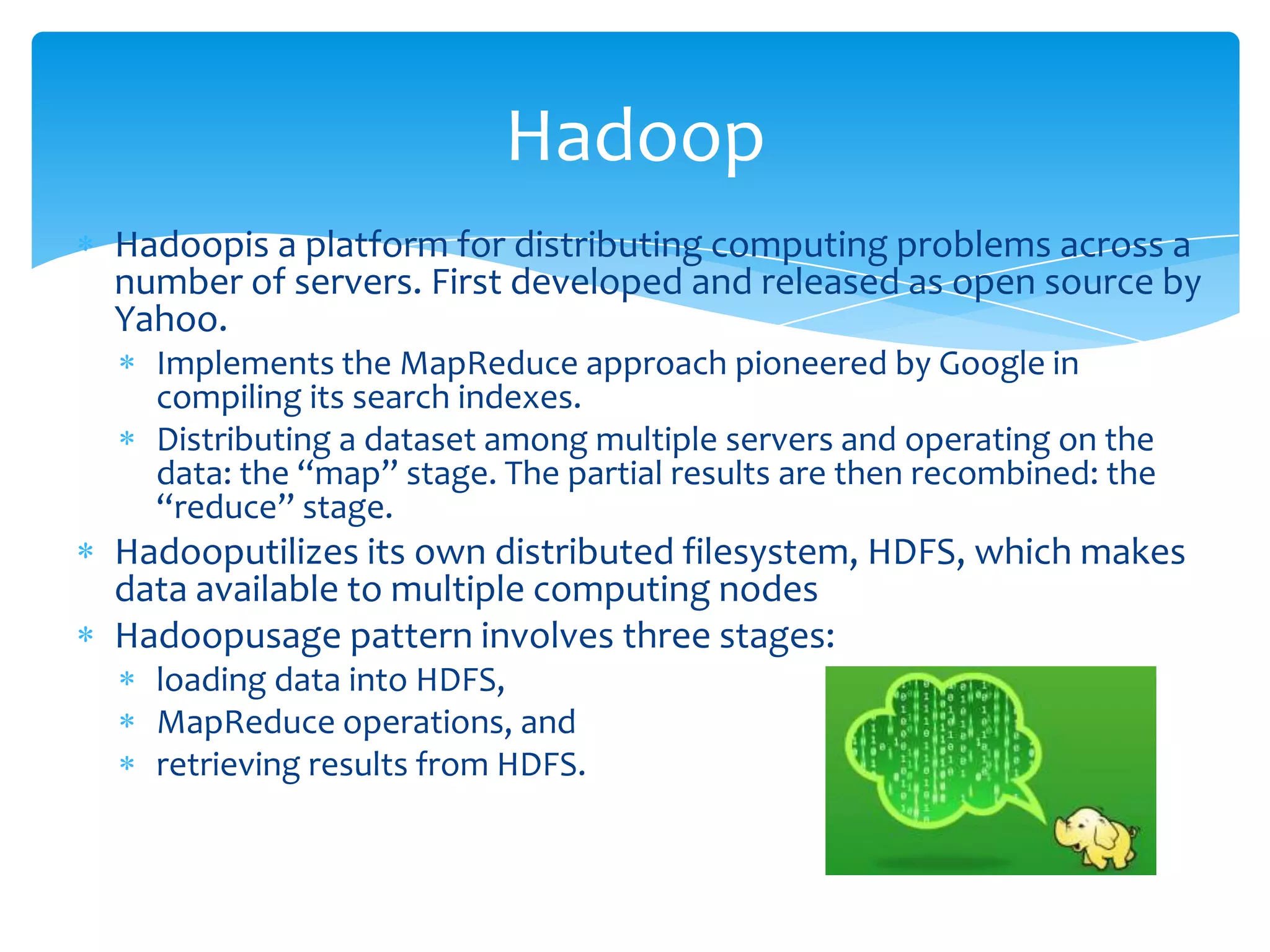
Hadoop
Hadoopis a platform for distributing computing problems across a
number of servers. First developed and released as open source by
Yahoo.
  Implements the MapReduce approach pioneered by Google in
  compiling its search indexes.
  Distributing a dataset among multiple servers and operating on the
  data: the “map” stage. The partial results are then recombined: the
  “reduce” stage.
Hadooputilizes its own distributed filesystem, HDFS, which makes
data available to multiple computing nodes
Hadoopusage pattern involves three stages:
  loading data into HDFS,
  MapReduce operations, and
  retrieving results from HDFS.
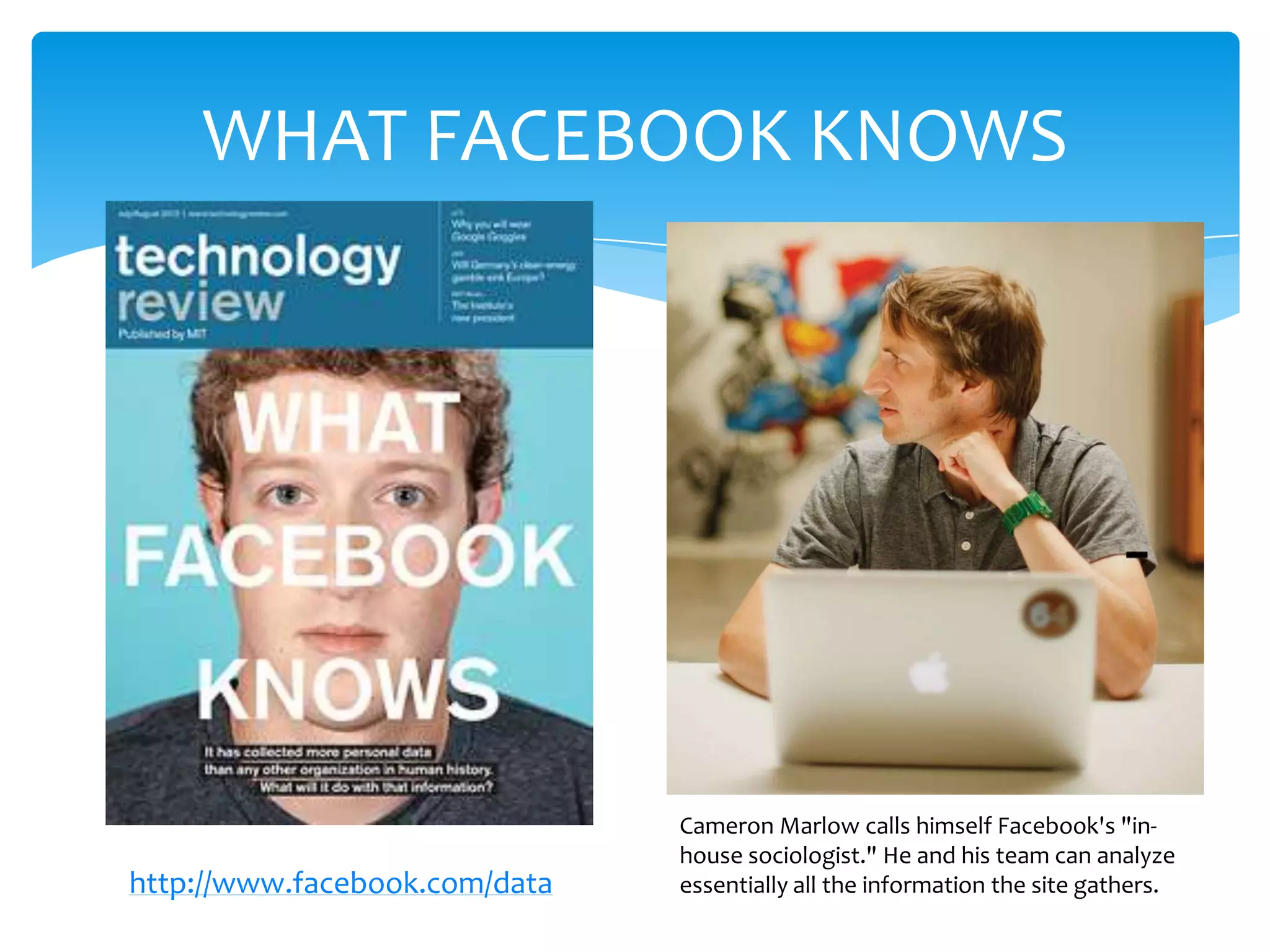
WHAT FACEBOOK KNOWS


                               Cameron Marlow calls himself Facebook's "in-
                               house sociologist." He and his team can analyze
http://www.facebook.com/data   essentially all the information the site gathers.
Study of Human Society


Facebook, in collaboration with the University of
Milan, conducted experiment that involved
  the entire social network as of May 2011
  more than 10 percent of the world's population.
Analyzing the 69 billion friend connections among
those 721 million people showed that
  four intermediary friends are usually enough to
  introduce anyone to a random stranger.
The links of Love
Often young women specify that
they are “in a relationship” with
their “best friend forever”.
   Roughly 20% of all relationships for
   the 15-and-under crowd are between
   girls.
   This number dips to 15% for 18-year-
   olds and is just 7% for 25-year-olds.
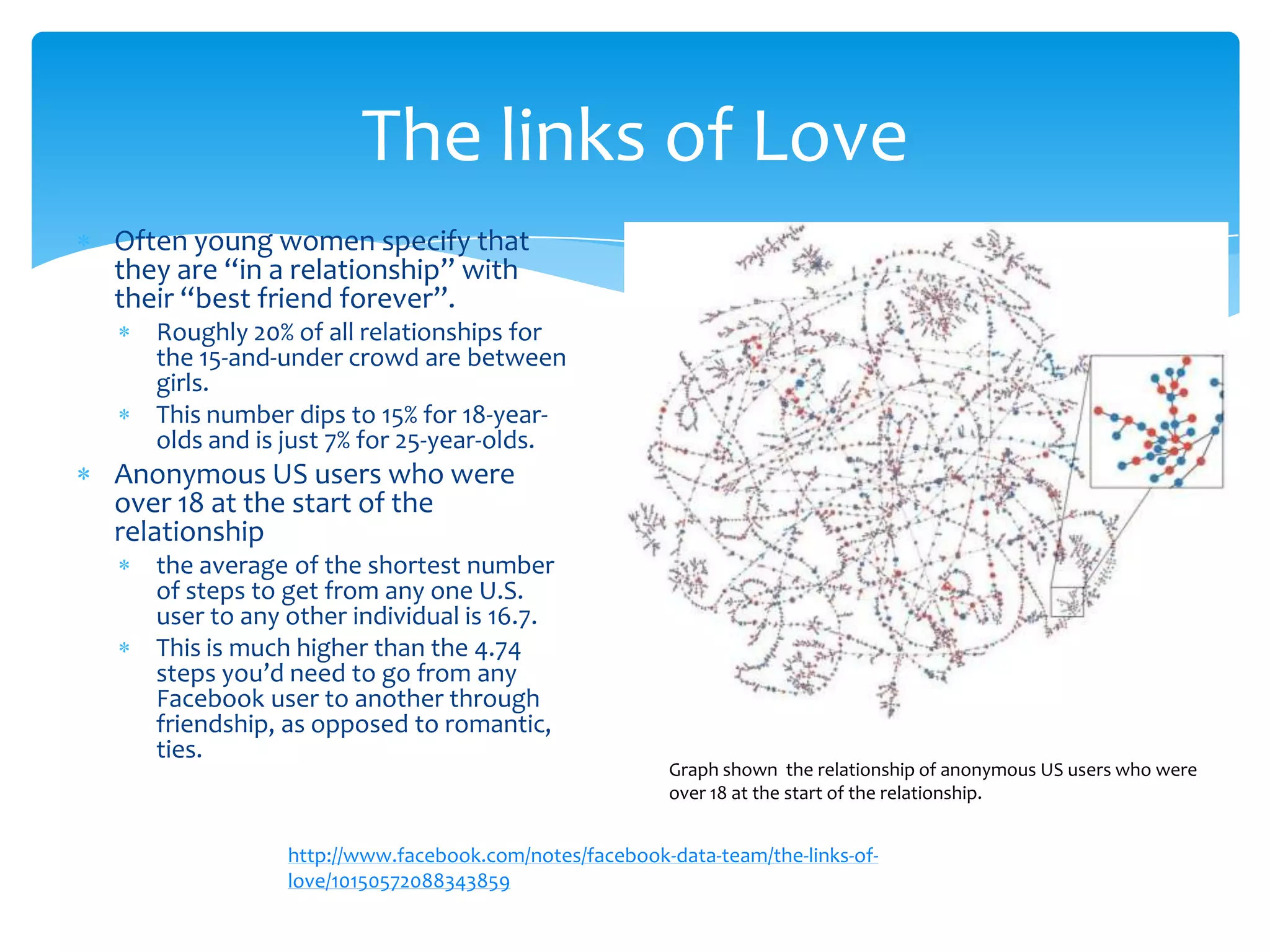
Anonymous US users who were
over 18 at the start of the
relationship
   the average of the shortest number
   of steps to get from any one U.S.
   user to any other individual is 16.7.
   This is much higher than the 4.74
   steps you’d need to go from any
   Facebook user to another through
   friendship, as opposed to romantic,
   ties.
                                                      Graph shown the relationship of anonymous US users who were
                                                      over 18 at the start of the relationship.


               http://www.facebook.com/notes/facebook-data-team/the-links-of-
               love/10150572088343859
Why?


Facebook can improve users experience
  make useful predictions about users' behavior
  make better guesses about which ads you might be
  more or less open to at any given time
Right before Valentine's Day this year a blog post
from the Data Science Team listed the songs most
popular with people who had recently signaled on
Facebook that they had entered or left a relationship
How facebook handle Big Data?


 Facebook built its data storage system using open-source
 software called Hadoop.
   Hadoop spreading them across many machines inside a data
   center.
   Use Hive, open-source that acts as a translation service, making it
   possible to query vast Hadoop data stores using relatively simple
   code.
 Much of Facebook's data resides in one Hadoop store more than
 100 petabytes (a million gigabytes) in size, says SameetAgarwal,
 a director of engineering at Facebook who works on data
 infrastructure, and the quantity is growing exponentially. "Over
 the last few years we have more than doubled in size every
 year,”
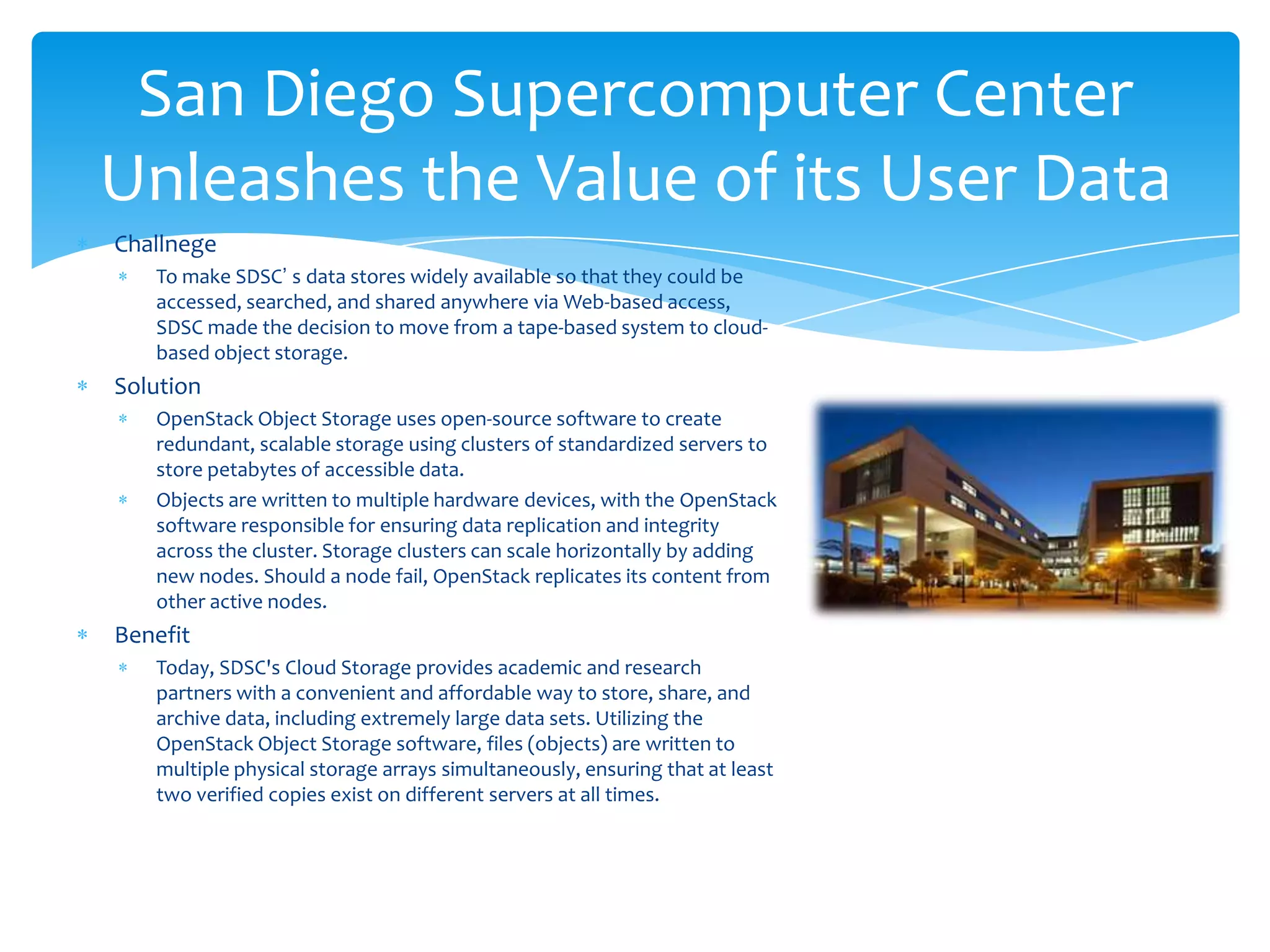
San Diego Supercomputer Center
Unleashes the Value of its User Data
Challnege
   To make SDSC’ s data stores widely available so that they could be
   accessed, searched, and shared anywhere via Web-based access,
   SDSC made the decision to move from a tape-based system to cloud-
   based object storage.
Solution
   OpenStack Object Storage uses open-source software to create
   redundant, scalable storage using clusters of standardized servers to
   store petabytes of accessible data.
   Objects are written to multiple hardware devices, with the OpenStack
   software responsible for ensuring data replication and integrity
   across the cluster. Storage clusters can scale horizontally by adding
   new nodes. Should a node fail, OpenStack replicates its content from
   other active nodes.
Benefit
   Today, SDSC's Cloud Storage provides academic and research
   partners with a convenient and affordable way to store, share, and
   archive data, including extremely large data sets. Utilizing the
   OpenStack Object Storage software, files (objects) are written to
   multiple physical storage arrays simultaneously, ensuring that at least
   two verified copies exist on different servers at all times.
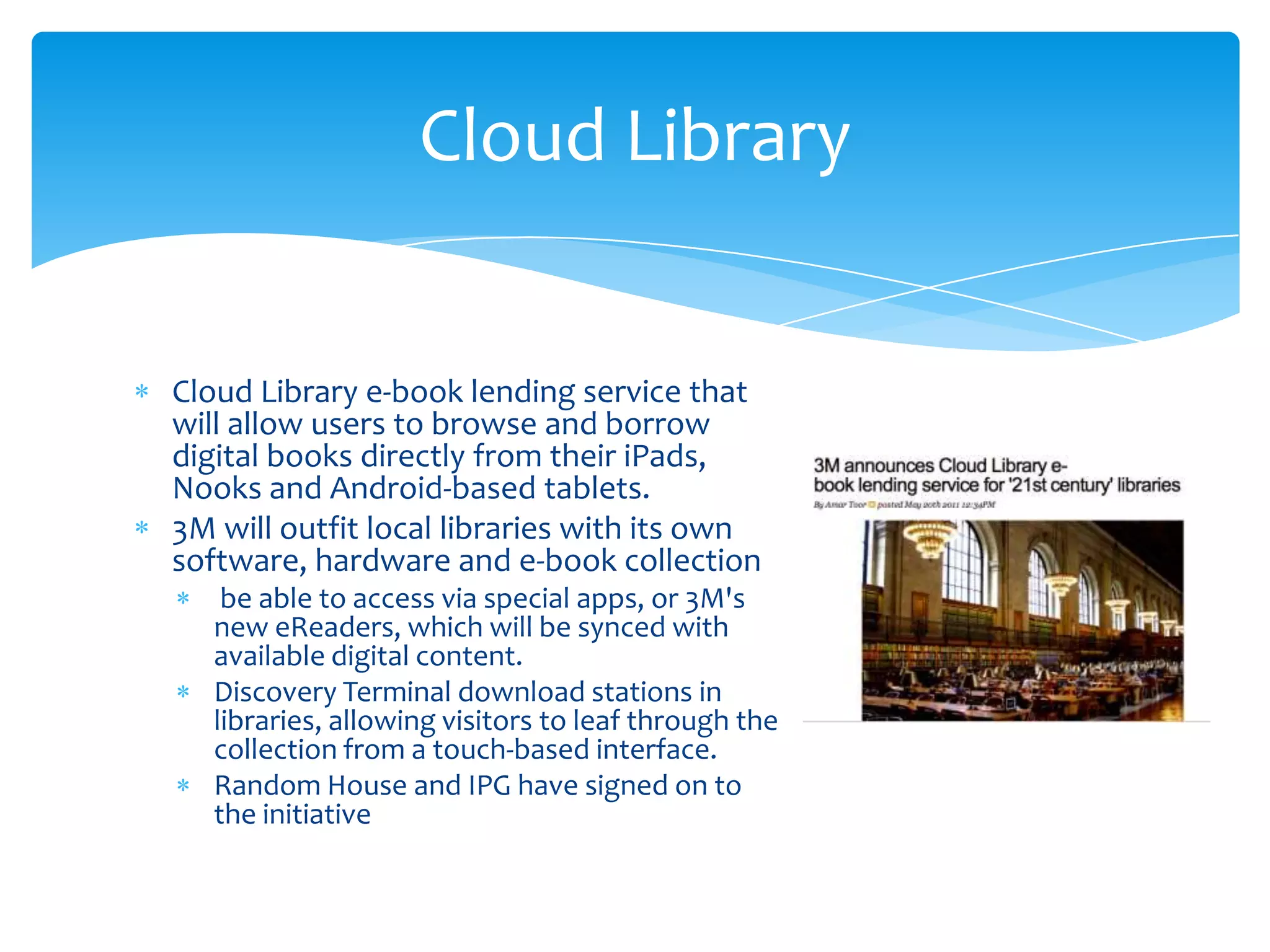
Cloud Library


Cloud Library e-book lending service that
will allow users to browse and borrow
digital books directly from their iPads,
Nooks and Android-based tablets.
3M will outfit local libraries with its own
software, hardware and e-book collection
    be able to access via special apps, or 3M's
   new eReaders, which will be synced with
   available digital content.
   Discovery Terminal download stations in
   libraries, allowing visitors to leaf through the
   collection from a touch-based interface.
   Random House and IPG have signed on to
   the initiative
Moving KU Computer Engineering on
            the Cloud

  Introduction
    Department of Computer Engineering is one of the leading
    computer engineering in Thailand (23 years)
    Research and Education
      30 faculty member
      20-30 Ph.D students 50 Master, 120 MSIT, 400 Undergrad
  Mission
    Must support the teaching and research by providing server /
    network/ service infrastructure
    Driving toward mobile anytime anywhere infrastructure
Moving KU Computer Engineering on
            the Cloud


  Challenge and Opportunity
    Must provide a scalable and reliable infrastructure
      Servers, Storage
      Services
    Previously, a number of physical server has been used
      Getting old quickly, hard to maintain, a lot of space
      Consume a lot of power, cooling
Moving KU Computer Engineering on
            the Cloud


  Cloud is Solution
      For Server, use VM cloud (VMware) to consolidate all small
      server into a set of VM on only 5 machines
      Every lab, professor can request for VM for their use
      Can scale easily using more physical server
      Moving to centralize large storage using NAS/SAN storage
      cloud
Standard is needed

IEEE Standards Association (IEEE-SA) has formed two
new Working Groups (WGs) around IEEE P2301 and
IEEE P2302.
  IEEE P2301 is a cloud computing standards in critical
  areas such as application, portability, management, and
  interoperability interfaces, as well as file formats and
  operation conventions.
  IEEE P2302 defines essential topology, protocols,
  functionality, and governance required for reliable
  cloud-to-cloud interoperability and federation.
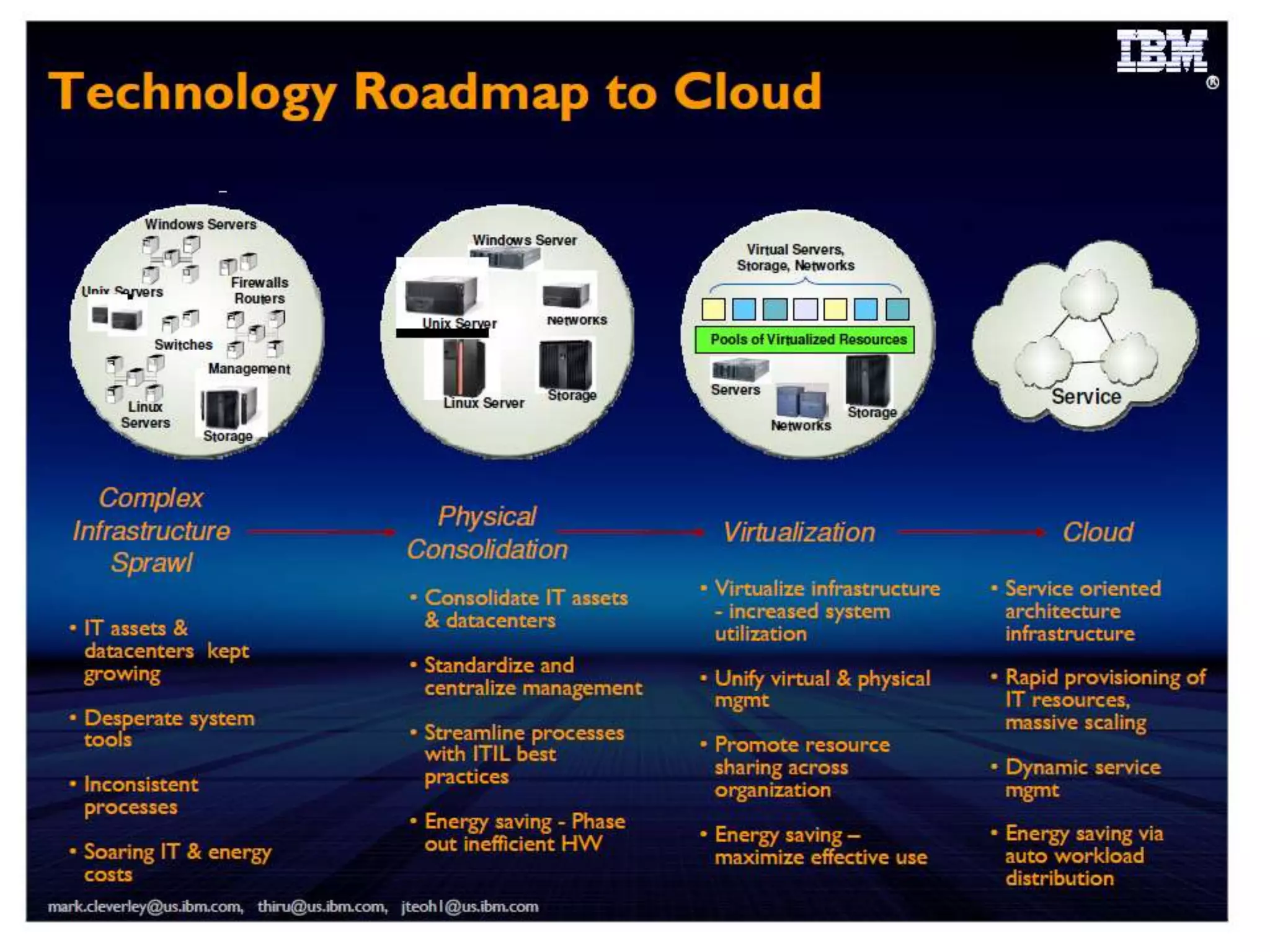
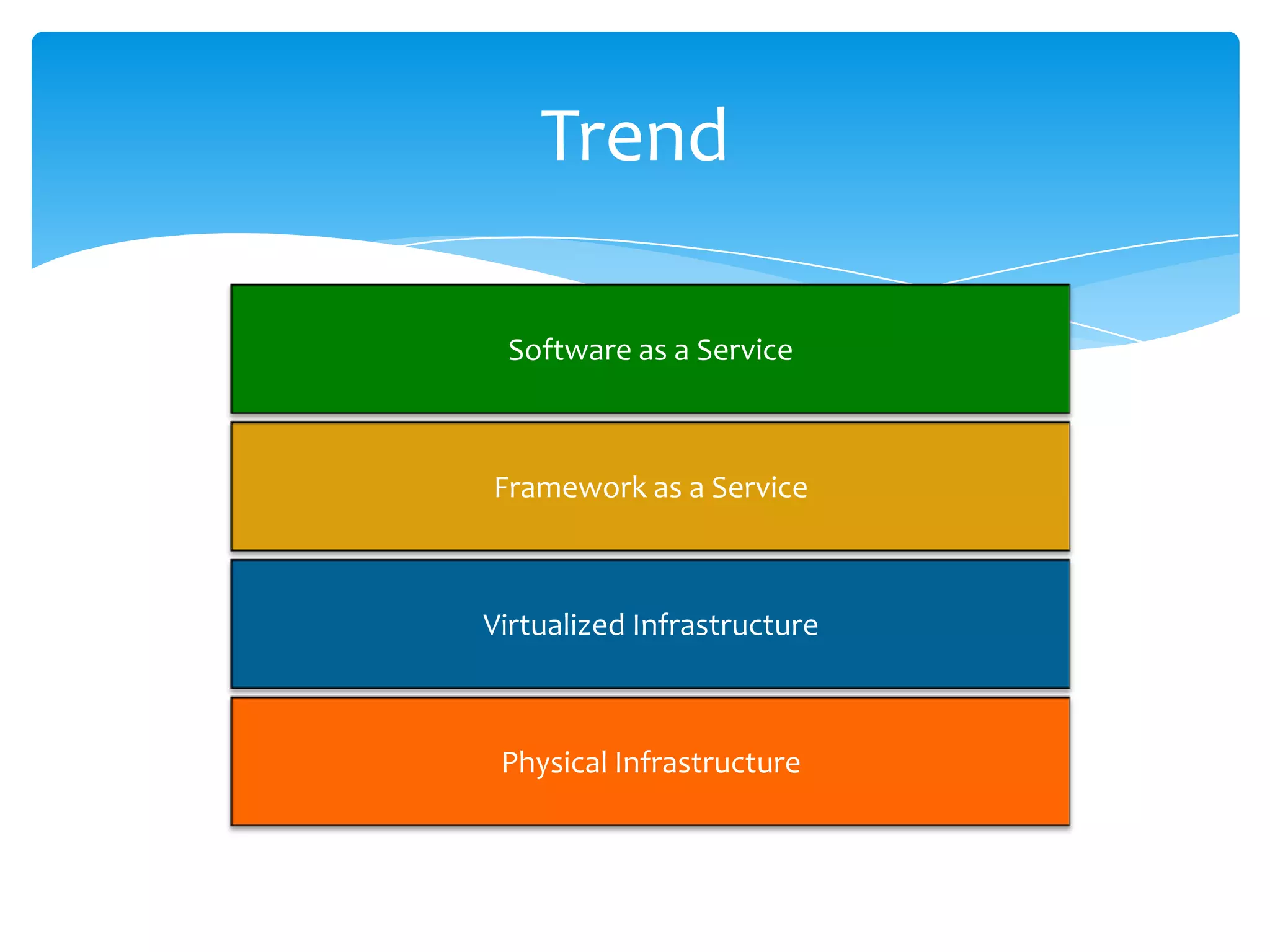
Trend

 Software as a Service


Framework as a Service


Virtualized Infrastructure


 Physical Infrastructure
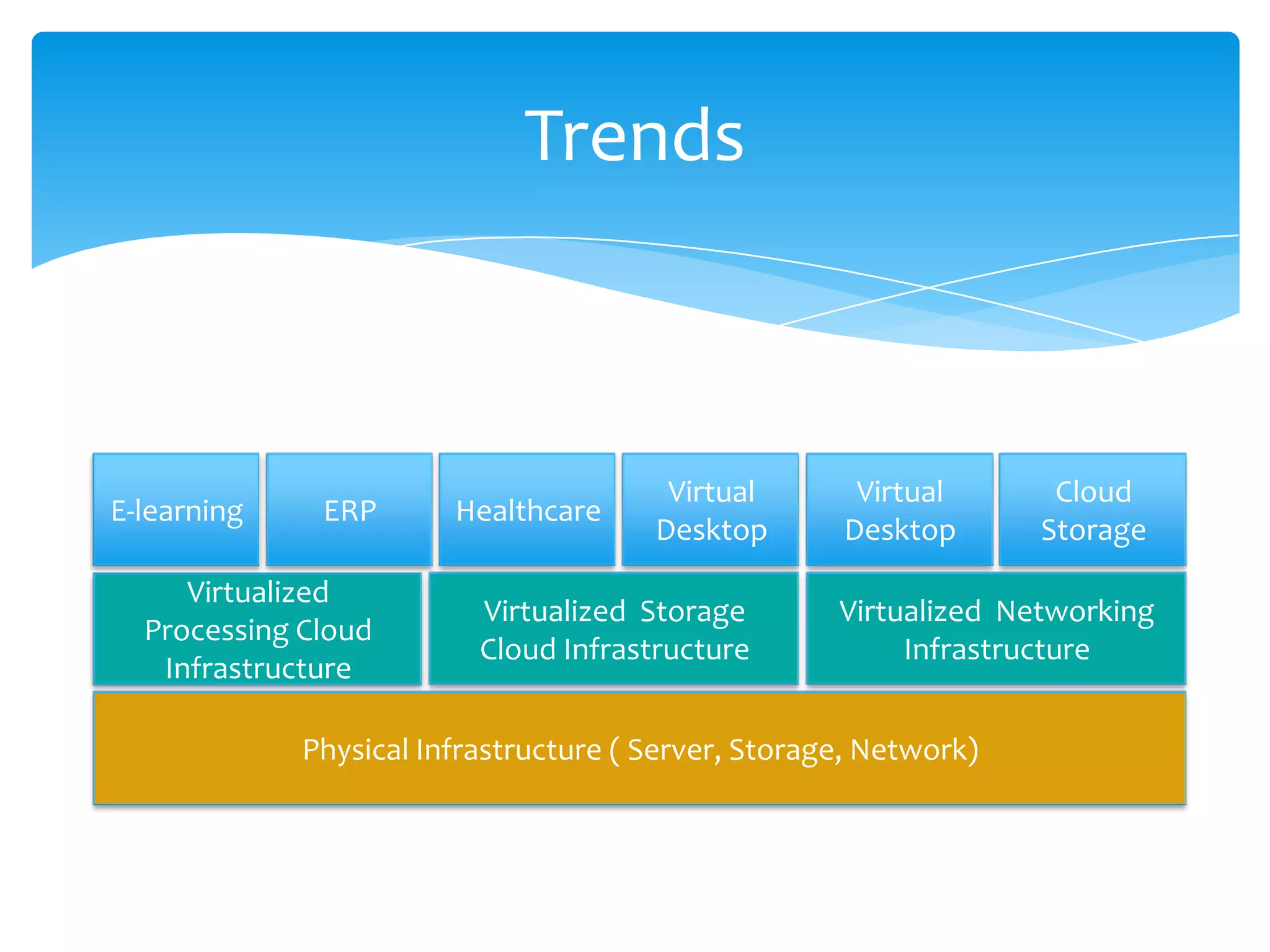
Trends


                                        Virtual       Virtual       Cloud
E-learning    ERP       Healthcare
                                       Desktop       Desktop       Storage
     Virtualized
                          Virtualized Storage        Virtualized Networking
  Processing Cloud
                          Cloud Infrastructure            Infrastructure
   Infrastructure

             Physical Infrastructure ( Server, Storage, Network)
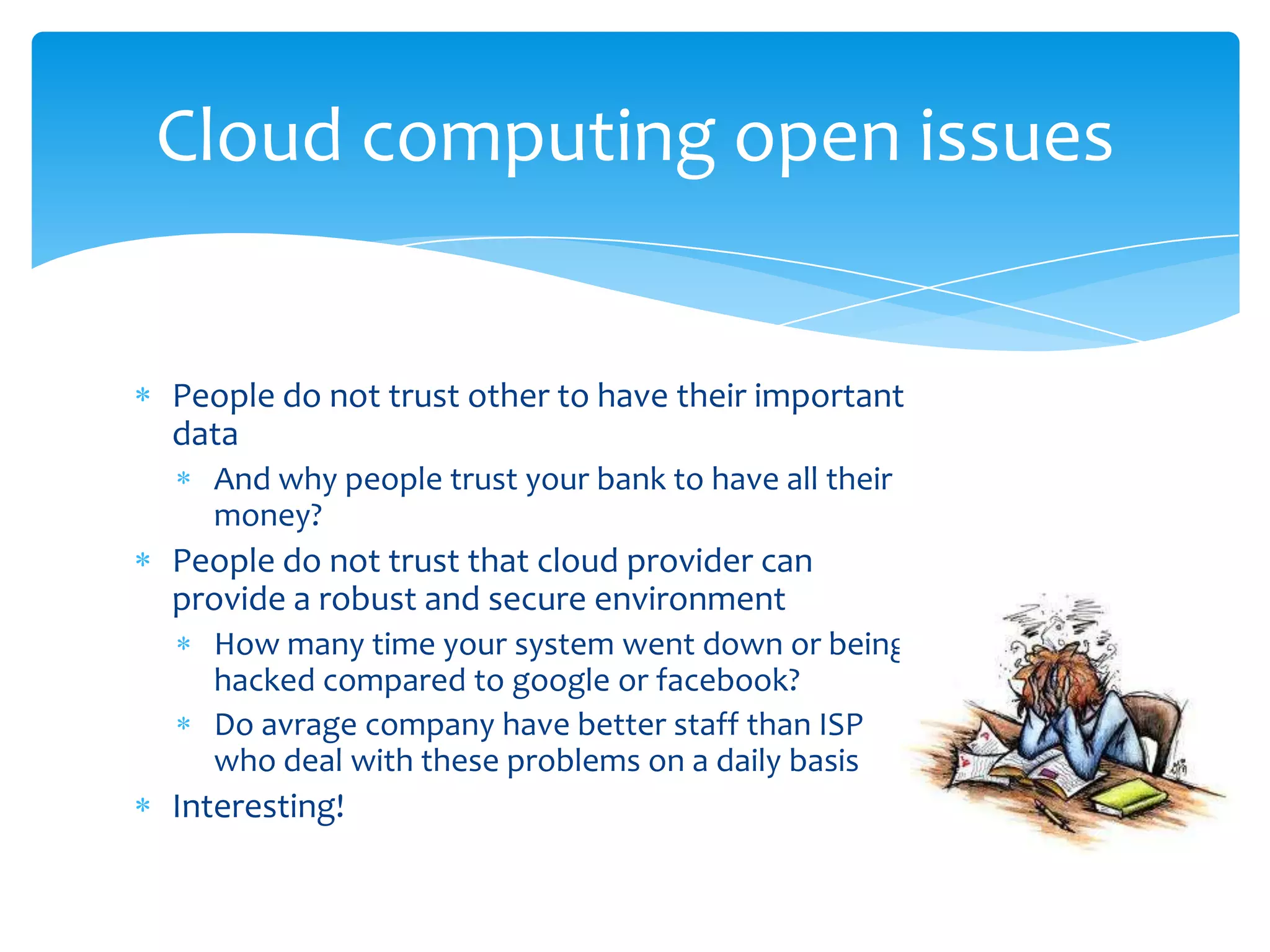
Cloud computing open issues


People do not trust other to have their important
data
  And why people trust your bank to have all their
  money?
People do not trust that cloud provider can
provide a robust and secure environment
  How many time your system went down or being
  hacked compared to google or facebook?
  Do avrage company have better staff than ISP
  who deal with these problems on a daily basis
Interesting!
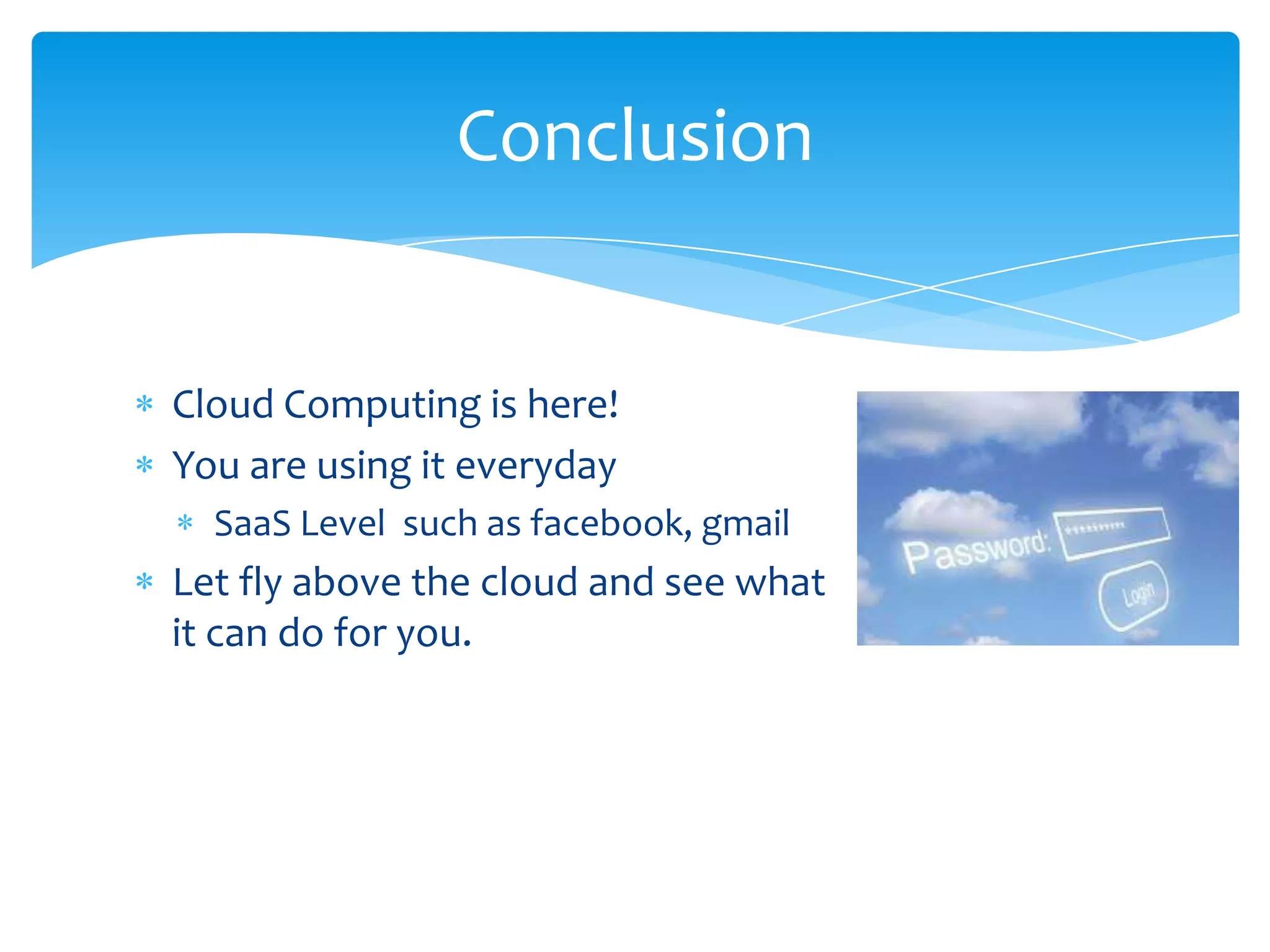
Conclusion


Cloud Computing is here!
You are using it everyday
  SaaS Level such as facebook, gmail
Let fly above the cloud and see what
it can do for you.
Thank you… Q&A

Cloud Computing: A New Trend in IT

  • 1.
    Cloud Computing: ANew Trend in IT Dr.PutchongUthayopas Department of Computer Engineering Faculty of Engineering Kasetsart University pu@ku.ac.th
  • 2.
  • 3.
    New Demand forIT infrastructure Capacity Massive processing power Massive Storage Security Availability Scalability Start small and grow on demand Cost effective
  • 4.
    New Challenges High operatingcost Man power cost Equipment cost Energy cost High operating complexity Changing technology Increase complexity Network, server, storage , security
  • 5.
    Dream machine Computer withinfinite capacity Start small and grow big based on my demand Capacity can scale up and down on demand Pay only what we use. No complex operating and maintenance
  • 6.
    What is CloudingComputing? • A style of computing in Cloud which dynamically scalable and often virtualized computing resources are provided as a service over the Internet. Google Saleforce Amazon Source: Wikipedia (cloud computing) Microsoft Yahoo
  • 7.
    Power Grid Inspirationfor Computing?: Deliver ICT services as “computing utilities” to users
  • 8.
    Economic of CloudUsage Source: “Above the Clouds: A Berkeley View of Cloud Computing”, RAD lab, UC Berkeley
  • 9.
    Why we shouldmove to the cloud? Quick start up no need to purchase any equipment. Subscribe, pay, and use it. Scalability less demand less computing power, more demand more computing power Elasticity Handle the demand surge Less maintenance No need to hire people to fix server broken, hacking, tuning Less operation cost Pay only what you really use Cut the cost of maintaining huge infrastructure It is cool, trendy Just a stupid execute when people do not believe you ^_^
  • 10.
    Cloud Computing Definition(NIST) This cloud model is composed of five essential characteristic three service models four deployment models.
  • 11.
    5 Characteristics ofCloud System Broad On-demand Resource network self-service pooling access Rapid Measured elasticity Service
  • 12.
    Three Cloud ServiceModels Software as a Service • End user software • gmail. Googledoc, facebook Platform as a Service • Programming platform • Azure, google app engine Infrastructure as a Service • Computer server • Vmware, EC2 , Openstack
  • 13.
    Cloud Deployment Model Private Cloud • Internal cloud used by an organization Community Cloud • Internal Cloud Shared by multiple organizations Public Cloud • Providers Cloud shared by many users Hybrid Cloud • Cloud that composed of two or more cloud
  • 14.
    Using IaaS Cloud Userview the cloud as a number of servers Look the same as co-location server This is actually a virtual server Windows or many flavor of Linux User can start stop and reboot from web interface Normal web based application work fine Usage is charge on pay per use Can try at aws.amazon.com Open a new account and start a new server use less than 30 minutes to apply
  • 15.
    Using PaaS Cloud PaaScloud give you an API to program on the cloud There is a need to port application etc. .NET to Windows Azure Python to google app engine Pros and Cons More light weight that IaaS but need some application porting effort
  • 16.
    Using SaaS Cloud Youhave already used it! Facebook Gmail Calendar Google Map Running application directly from you browser No coding , no porting just pay and use or use it for free
  • 17.
    What the Cloudcan do? server consolidation Iaas cloud is the same as allow you to use many servers hosted by service providers Scalable web application Community web like sanook , kapook Web app for anything you want to do Back end for mobile app iCloud, GoogleCloud are being used
  • 18.
    The Cloud andI Money Video Data Music books Computing Power Personal information Services Picture Application Games ACCESS ANYTIME STORAGE ANYWHERE Internet SHARING ANYHOW RELIABILITY SECURITY AVAILABILITY
  • 19.
    The Cloud andI Google docs (Office) Spread Sheet Word processor Presentation Calendar Gmail
  • 20.
    The Cloud andI calendar picture music My cloud (google, facebook, dropbox, amazon) document
  • 21.
    Work Life witha Cloud Appointment (google calendar) My secretary take appointment , add to calendar I got to see it on every device quickly, so is she Device notify me Email (gmail) I can go to any computer/device with browser, my email follow me there. I have no need to install mail client, maintain mail server
  • 22.
    Work Life witha Cloud Document (google docs) I can create basic document, good spreadsheet, basic presentation without installing any software I can down load document and edit it on my computer I can share my document with other on internet and edit it together Storage (google drive, dropbox) Create presentation on notebook, drop in in dropbox Present from iPad, Smartphone Secure, no need to carry thumb drive Easily share file with other people making team work easy
  • 24.
    Play Life witha Cloud Picture Using Instagram, photo, video I take instantly appear on twitter and facebook and neatly catalog Picture can be shared, tag, comment among my 2000 friends on facebook! If I want, they will know where I was. (Little dangerous) Communication My thought can be spread anytime anyway using facebook, googleplus, multiply I can even “hang out” with friend on google plus
  • 25.
    Play Life witha Cloud Book Amazon Kindle Store. Buy book from amazon and they will keep it on their cloud Unlimited book shelves, no cleaning, dusting Read your book on any device iPad, iPhone, Androiod Phone, Tablet, PC, Mac I read mine on iPad, and my Galaxy S2 phone
  • 26.
    Play Life witha Cloud Music iTune Store allow you to shopping for music, movies You can load it and play on many of your devices Media Industry is changing, now you can own a radio station and TV station and get audiences around the world Power shift from infrastructure provider (TV station) to content creator ( like grammy etc.)
  • 27.
    Some Existing CloudComputing Systems Amazon AWS Google App Engine Microsoft Azure Openstack
  • 28.
  • 30.
    Google App Engine GoogleApp Engine is a platform for developing and hosting web applications in Google-managed data centers first released as a beta version in April 2008. Google App virtualizes applications across multiple servers and data centers. Google App Engine is free up to a certain level of used resources. Fees are charged for additional storage, bandwidth, or CPU cycles required by the application.[
  • 31.
    App Engine Architecture req/resp stateless APIs R/O FS urlfech Python stdlib VM mail process app images stateful datastore APIs memcache 31
  • 32.
  • 34.
    Cloud Application Development UI Tier Web2.0 Processing Data Tier Management Tier Separate processing logic , UI, and DM Tier Using Services Oriented Architecture (SOA) design
  • 35.
    OpenStack Architecture OpenStack isa cloud operating system that controls large pools of compute, storage, and networking resources throughout a datacenter, all managed through a dashboard that gives administrators control while empowering their users to provision resources through a web interface.
  • 36.
  • 37.
  • 38.
  • 39.
  • 41.
  • 42.
    We are livingin the world of Data Video Surveillance Social Media Mobile Sensors Gene Sequencing Smart Grids Geophysical Medical Imaging Exploration
  • 43.
    Big Data “Big datais data that exceeds the processing capacity of conventional database systems. The data is too big, moves too fast, or doesn’t fit the strictures of your database architectures. To gain value from this data, you must choose an alternative way to process it.” Reference: “What is big data? An introduction to the big data landscape.”, EddDumbill, http://radar.oreilly.com/2012/01/what-is-big- data.html
  • 44.
    The Value ofBig Data Analytical use Big data analytics can reveal insights hidden previously by data too costly to process. peer influence among customers, revealed by analyzing shoppers’ transactions, social and geographical data. Being able to process every item of data in reasonable time removes the troublesome need for sampling and promotes an investigative approach to data. Enabling new products. Facebookhas been able to craft a highly personalized user experience and create a new kind of advertising business
  • 45.
    3 Characteristics ofBig Data Volume •Volumes of data are larger than those conventional relational database infrastructures can cope with •Rate at which data flows in is much faster. Velocity •Mobile event and interaction by users. •Video, image , audio from users •the source data is diverse, and doesn’t fall into Variety neat relational structures eg. text from social networks, image data, a raw feed directly from a sensor source.
  • 46.
    Big Data Challenge Volume How to process data so big that can not be move, or store. Velocity A lot of data coming very fast so it can not be stored such as Web usage log , Internet, mobile messages. Stream processing is needed to filter unused data or extract some knowledge real-time. Variety So many type of unstructured data format making conventional database useless.
  • 47.
    How to dealwith big data Integration of Storage Processing Analysis Algorithm Visualization Processin g Massive Processin Visualiz Data Stream g e Stream processing Storage Processin g Analysis
  • 48.
    Hadoop Hadoopis a platformfor distributing computing problems across a number of servers. First developed and released as open source by Yahoo. Implements the MapReduce approach pioneered by Google in compiling its search indexes. Distributing a dataset among multiple servers and operating on the data: the “map” stage. The partial results are then recombined: the “reduce” stage. Hadooputilizes its own distributed filesystem, HDFS, which makes data available to multiple computing nodes Hadoopusage pattern involves three stages: loading data into HDFS, MapReduce operations, and retrieving results from HDFS.
  • 49.
    WHAT FACEBOOK KNOWS Cameron Marlow calls himself Facebook's "in- house sociologist." He and his team can analyze http://www.facebook.com/data essentially all the information the site gathers.
  • 50.
    Study of HumanSociety Facebook, in collaboration with the University of Milan, conducted experiment that involved the entire social network as of May 2011 more than 10 percent of the world's population. Analyzing the 69 billion friend connections among those 721 million people showed that four intermediary friends are usually enough to introduce anyone to a random stranger.
  • 51.
    The links ofLove Often young women specify that they are “in a relationship” with their “best friend forever”. Roughly 20% of all relationships for the 15-and-under crowd are between girls. This number dips to 15% for 18-year- olds and is just 7% for 25-year-olds. Anonymous US users who were over 18 at the start of the relationship the average of the shortest number of steps to get from any one U.S. user to any other individual is 16.7. This is much higher than the 4.74 steps you’d need to go from any Facebook user to another through friendship, as opposed to romantic, ties. Graph shown the relationship of anonymous US users who were over 18 at the start of the relationship. http://www.facebook.com/notes/facebook-data-team/the-links-of- love/10150572088343859
  • 52.
    Why? Facebook can improveusers experience make useful predictions about users' behavior make better guesses about which ads you might be more or less open to at any given time Right before Valentine's Day this year a blog post from the Data Science Team listed the songs most popular with people who had recently signaled on Facebook that they had entered or left a relationship
  • 53.
    How facebook handleBig Data? Facebook built its data storage system using open-source software called Hadoop. Hadoop spreading them across many machines inside a data center. Use Hive, open-source that acts as a translation service, making it possible to query vast Hadoop data stores using relatively simple code. Much of Facebook's data resides in one Hadoop store more than 100 petabytes (a million gigabytes) in size, says SameetAgarwal, a director of engineering at Facebook who works on data infrastructure, and the quantity is growing exponentially. "Over the last few years we have more than doubled in size every year,”
  • 55.
    San Diego SupercomputerCenter Unleashes the Value of its User Data Challnege To make SDSC’ s data stores widely available so that they could be accessed, searched, and shared anywhere via Web-based access, SDSC made the decision to move from a tape-based system to cloud- based object storage. Solution OpenStack Object Storage uses open-source software to create redundant, scalable storage using clusters of standardized servers to store petabytes of accessible data. Objects are written to multiple hardware devices, with the OpenStack software responsible for ensuring data replication and integrity across the cluster. Storage clusters can scale horizontally by adding new nodes. Should a node fail, OpenStack replicates its content from other active nodes. Benefit Today, SDSC's Cloud Storage provides academic and research partners with a convenient and affordable way to store, share, and archive data, including extremely large data sets. Utilizing the OpenStack Object Storage software, files (objects) are written to multiple physical storage arrays simultaneously, ensuring that at least two verified copies exist on different servers at all times.
  • 56.
    Cloud Library Cloud Librarye-book lending service that will allow users to browse and borrow digital books directly from their iPads, Nooks and Android-based tablets. 3M will outfit local libraries with its own software, hardware and e-book collection be able to access via special apps, or 3M's new eReaders, which will be synced with available digital content. Discovery Terminal download stations in libraries, allowing visitors to leaf through the collection from a touch-based interface. Random House and IPG have signed on to the initiative
  • 57.
    Moving KU ComputerEngineering on the Cloud Introduction Department of Computer Engineering is one of the leading computer engineering in Thailand (23 years) Research and Education 30 faculty member 20-30 Ph.D students 50 Master, 120 MSIT, 400 Undergrad Mission Must support the teaching and research by providing server / network/ service infrastructure Driving toward mobile anytime anywhere infrastructure
  • 58.
    Moving KU ComputerEngineering on the Cloud Challenge and Opportunity Must provide a scalable and reliable infrastructure Servers, Storage Services Previously, a number of physical server has been used Getting old quickly, hard to maintain, a lot of space Consume a lot of power, cooling
  • 59.
    Moving KU ComputerEngineering on the Cloud Cloud is Solution For Server, use VM cloud (VMware) to consolidate all small server into a set of VM on only 5 machines Every lab, professor can request for VM for their use Can scale easily using more physical server Moving to centralize large storage using NAS/SAN storage cloud
  • 60.
    Standard is needed IEEEStandards Association (IEEE-SA) has formed two new Working Groups (WGs) around IEEE P2301 and IEEE P2302. IEEE P2301 is a cloud computing standards in critical areas such as application, portability, management, and interoperability interfaces, as well as file formats and operation conventions. IEEE P2302 defines essential topology, protocols, functionality, and governance required for reliable cloud-to-cloud interoperability and federation.
  • 61.
    Trend Software asa Service Framework as a Service Virtualized Infrastructure Physical Infrastructure
  • 62.
    Trends Virtual Virtual Cloud E-learning ERP Healthcare Desktop Desktop Storage Virtualized Virtualized Storage Virtualized Networking Processing Cloud Cloud Infrastructure Infrastructure Infrastructure Physical Infrastructure ( Server, Storage, Network)
  • 63.
    Cloud computing openissues People do not trust other to have their important data And why people trust your bank to have all their money? People do not trust that cloud provider can provide a robust and secure environment How many time your system went down or being hacked compared to google or facebook? Do avrage company have better staff than ISP who deal with these problems on a daily basis Interesting!
  • 64.
    Conclusion Cloud Computing ishere! You are using it everyday SaaS Level such as facebook, gmail Let fly above the cloud and see what it can do for you.
  • 65.

Editor's Notes

  • #12 The sources of information are expanding. Many new sources are machine generated. It’s also big files (siesmic scans can be 5TB per file) and massive numbers of small files (email, social media).Leading companies for decades have always sought to leverage new sources of data, and the insights that can be gleaned from those data sources, as new sources of competitive advantage.More detailed structured dataNew unstructured dataDevice-generated dataBut big data isn’t only about data, a comprehensive big data strategy also needs to consider the role and prominence of new, enabling-technologies such as:Scale out storageMPP database architecturesHadoop and the Hadoop ecosystemIn-database analyticsIn-memory computingData virtualizationData visualization