Climate Model and Weather
Modification in Indonesia
The Houw Liong
P.M. Siregar
F.H. Widodo
Outline
• Climate Model : Computing Intensive vs Soft
Computing
• Computing Intensive Climate Model
• Soft Computing: ANFIS & Fuzzy Clustering
• Fuzzy Rules & ANFIS
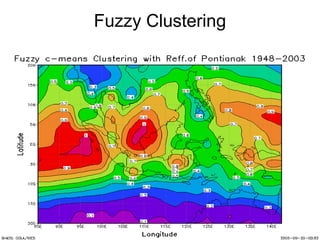
• Fuzzy Clustering
• Time Series of Sun Spot Numbers and Rainfall
== Climate Forecasting
• Weather Modification
• Conclusion
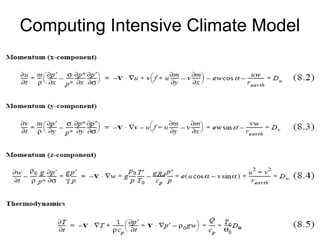
Computing Intensive Climate Model
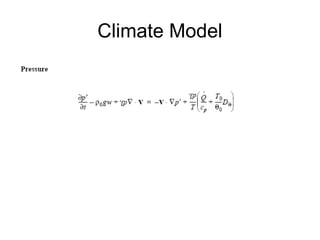
Climate Model
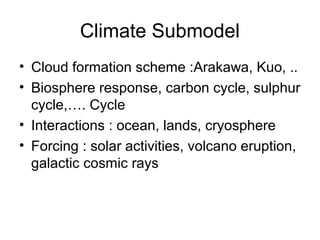
Climate Submodel
• Cloud formation scheme :Arakawa, Kuo, ..
• Biosphere response, carbon cycle, sulphur
cycle,…. Cycle
• Interactions : ocean, lands, cryosphere
• Forcing : solar activities, volcano eruption,
galactic cosmic rays
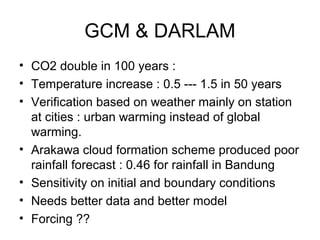
GCM & DARLAM
• CO2 double in 100 years :
• Temperature increase : 0.5 --- 1.5 in 50 years
• Verification based on weather mainly on station
at cities : urban warming instead of global
warming.
• Arakawa cloud formation scheme produced poor
rainfall forecast : 0.46 for rainfall in Bandung
• Sensitivity on initial and boundary conditions
• Needs better data and better model
• Forcing ??
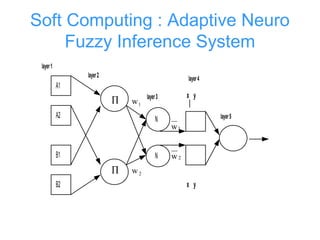
Soft Computing : Adaptive Neuro
Fuzzy Inference System
A1
A2
B2
B1 N
N
∏
∏
layer1
layer2
layer3
layer4
layer5
x y
1w
2w
1w
2w
x y
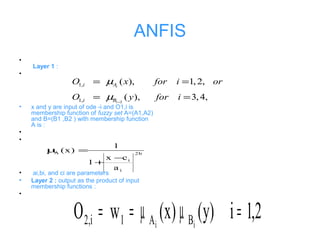
ANFIS
•
Layer 1 :
•
• x and y are input of ode -i and O1,i is
membership function of fuzzy set A=(A1,A2)
and B=(B1 ,B2 ) with membership function
A is :
•
•
• ai,bi, and ci are parameters
• Layer 2 : output as the product of input
membership functions :
•
2
1,
1,
( ), 1, 2,
( ), 3,4,
i
i
i A
i B
O x for i or
O y for i
µ
µ −
= =
= =
b2
i
i
A
a
cx
1
1
)x(
−
+
=µ
2,1i)y()x(wO ii BA1i,2 =µµ==
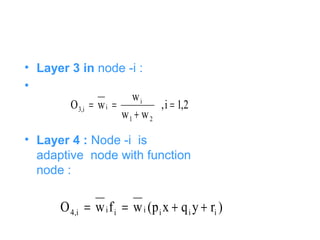
• Layer 3 in node -i :
•
• Layer 4 : Node -i is
adaptive node with function
node :
2,1i,
ww
w
wO
21
i
ii,3 =
+
==
)ryqxp(wfwO iiiiiii,4 ++==
ANFIS
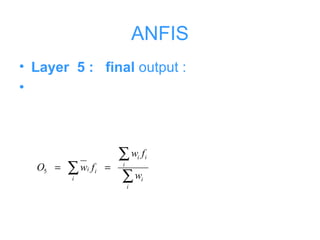
• Layer 5 : final output :
•
5
i i
i
i i
i i
i
w f
O w f
w
= =
∑
∑
∑
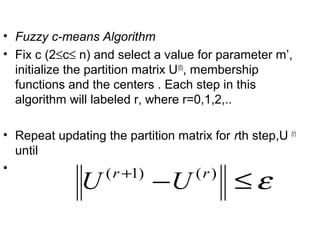
• Fuzzy c-means Algorithm
• Fix c (2≤c≤ n) and select a value for parameter m’,
initialize the partition matrix U(0)
, membership
functions and the centers . Each step in this
algorithm will labeled r, where r=0,1,2,..
• Repeat updating the partition matrix for rth step,U (r)
until
•
ε≤−+ )()1( rr
UU
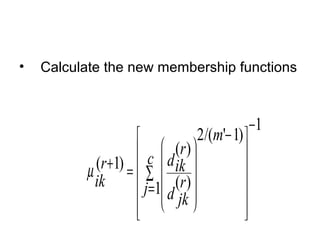
• Calculate the new membership functions
1
)1'/(2
1 )(
)(
)1(
−
−
∑
=
=+




























m
c
j d
r
jk
d
r
ikr
ik
µ
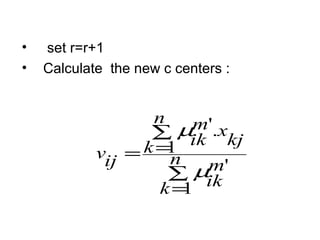
• set r=r+1
• Calculate the new c centers :
∑
=
∑
== n
k
m
ik
n
k kj
xm
ik
ijv
1
'
1
.'
µ
µ
Solar activities & Climate
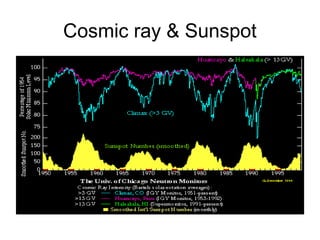
Cosmic ray & Sunspot
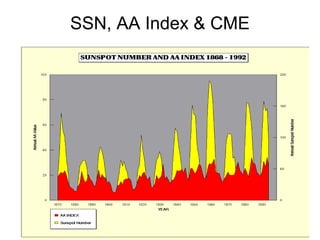
SSN, AA Index & CME
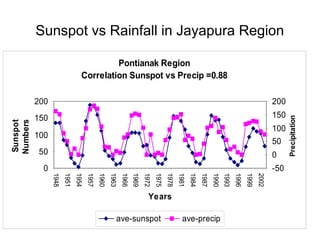
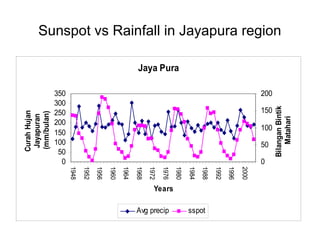
Sunspot vs Rainfall in Jayapura Region
Pontianak Region
Correlation Sunspot vs Precip =0.88
0
50
100
150
200
1948
1951
1954
1957
1960
1963
1966
1969
1972
1975
1978
1981
1984
1987
1990
1993
1996
1999
2002
Years
Sunspot
Numbers
-50
0
50
100
150
200
Precipitation
ave-sunspot ave-precip
Sunspot vs Rainfall in Jayapura region
Jaya Pura
0
50
100
150
200
250
300
350
1948
1952
1956
1960
1964
1968
1972
1976
1980
1984
1988
1992
1996
2000
Years
CurahHujan
Jayapuran
(mm/bulan)
0
50
100
150
200
BilanganBintik
Matahari
Avg precip sspot
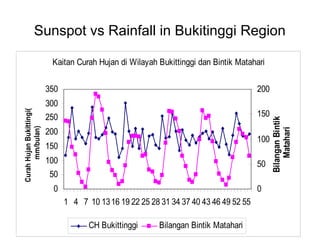
Sunspot vs Rainfall in Bukitinggi Region
Kaitan Curah Hujan di Wilayah Bukittinggi dan Bintik Matahari
0
50
100
150
200
250
300
350
1 4 7 10 1316 19 22 25 28 31 34 37 40 43 46 49 52 55
CurahHujanBukittingi(
mm/bulan)
0
50
100
150
200
BilanganBintik
Matahari
CH Bukittinggi Bilangan Bintik Matahari
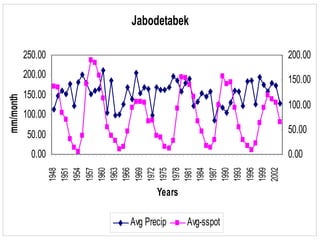
Jabodetabek
0.00
50.00
100.00
150.00
200.00
250.001948
1951
1954
1957
1960
1963
1966
1969
1972
1975
1978
1981
1984
1987
1990
1993
1996
1999
2002
Years
mm/month
0.00
50.00
100.00
150.00
200.00
Avg Precip Avg-sspot
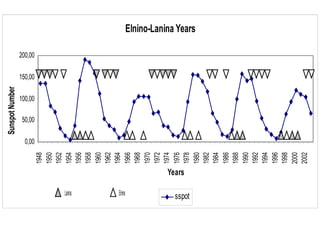
Elnino-Lanina Years
0,00
50,00
100,00
150,00
200,00
1948
1950
1952
1954
1956
1958
1960
1962
1964
1966
1968
1970
1972
1974
1976
1978
1980
1982
1984
1986
1988
1990
1992
1994
1996
1998
2000
2002
Years
SunspotNumber
sspotLanina Elnino
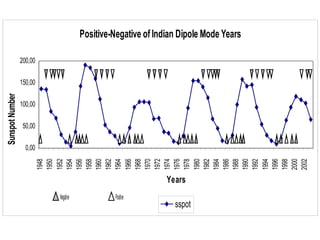
Positive-Negative of Indian Dipole Mode Years
0,00
50,00
100,00
150,00
200,00
1948
1950
1952
1954
1956
1958
1960
1962
1964
1966
1968
1970
1972
1974
1976
1978
1980
1982
1984
1986
1988
1990
1992
1994
1996
1998
2000
2002
Years
SunspotNumber
sspot
Negative Positive
Fuzzy Clustering
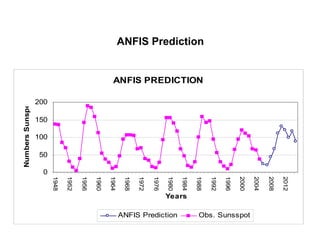
ANFIS Prediction
ANFIS PREDICTION
0
50
100
150
200
1948
1952
1956
1960
1964
1968
1972
1976
1980
1984
1988
1992
1996
2000
2004
2008
2012
Years
NumbersSunspot
ANFIS Prediction Obs. Sunsspot
Concluding Remarks
• Numerical Climate Model for Indonesian
regions needs modifications
• Long term climate prediction has poor
accuracy due to chaos & forcing
• ANFIS and Fuzzy Clustering can be used
in forecasting of climate in Indonesia
• Solar Activity is the main factor that
determined climate in Indonesian regions
Climate model

Climate model