#ClimateReport #IPCC
SIXTH ASSESSMENT REPORT
Working Group I – The Physical Science Basis
9 August 2021
[Climate Change]
“Recent changes in the climate
are widespread, rapid, and
intensifying, and
unprecedented in thousands
of years.
[Credit:NASA]
“Unless there are immediate,
rapid, and large-scale
reductions in greenhouse gas
emissions, limiting warming to
1.5°C will be beyond reach.
[Credit: Peter John Maridable | Unsplash]
“It is indisputable that human
activities are causing climate
change, making extreme climate
events, including heat waves,
heavy rainfall, and droughts,
more frequent and severe.
[Credit: Yoda Adaman | Unsplash]
“Climate change is already
affecting every region on Earth,
in multiple ways.
The changes we experience will
increase with further warming.
[Credit: Hong Nguyen | Unsplash]
“
There’s no going back from
some changes in the climate
system…
[Credit: Jenn Caselle | UCSB]
“…However, some changes could
be slowed and others could be
stopped by limiting warming.
[Credit: Andy Mahoney | NSIDC]
“There’s no going back from
some changes in the climate
system. However, some
changes could be slowed and
others could be stopped by
limiting warming.
[Credit: Shari Gearheard | NSIDC]
“To limit global warming, strong,
rapid, and sustained reductions in
CO2, methane, and other
greenhouse gases are necessary.
This would not only reduce the
consequences of climate change
but also improve air quality.
[Credit: Evgeny Nelmin | Unsplash]
SIXTH ASSESSMENT REPORT
WorkingGroupI –ThePhysical ScienceBasis
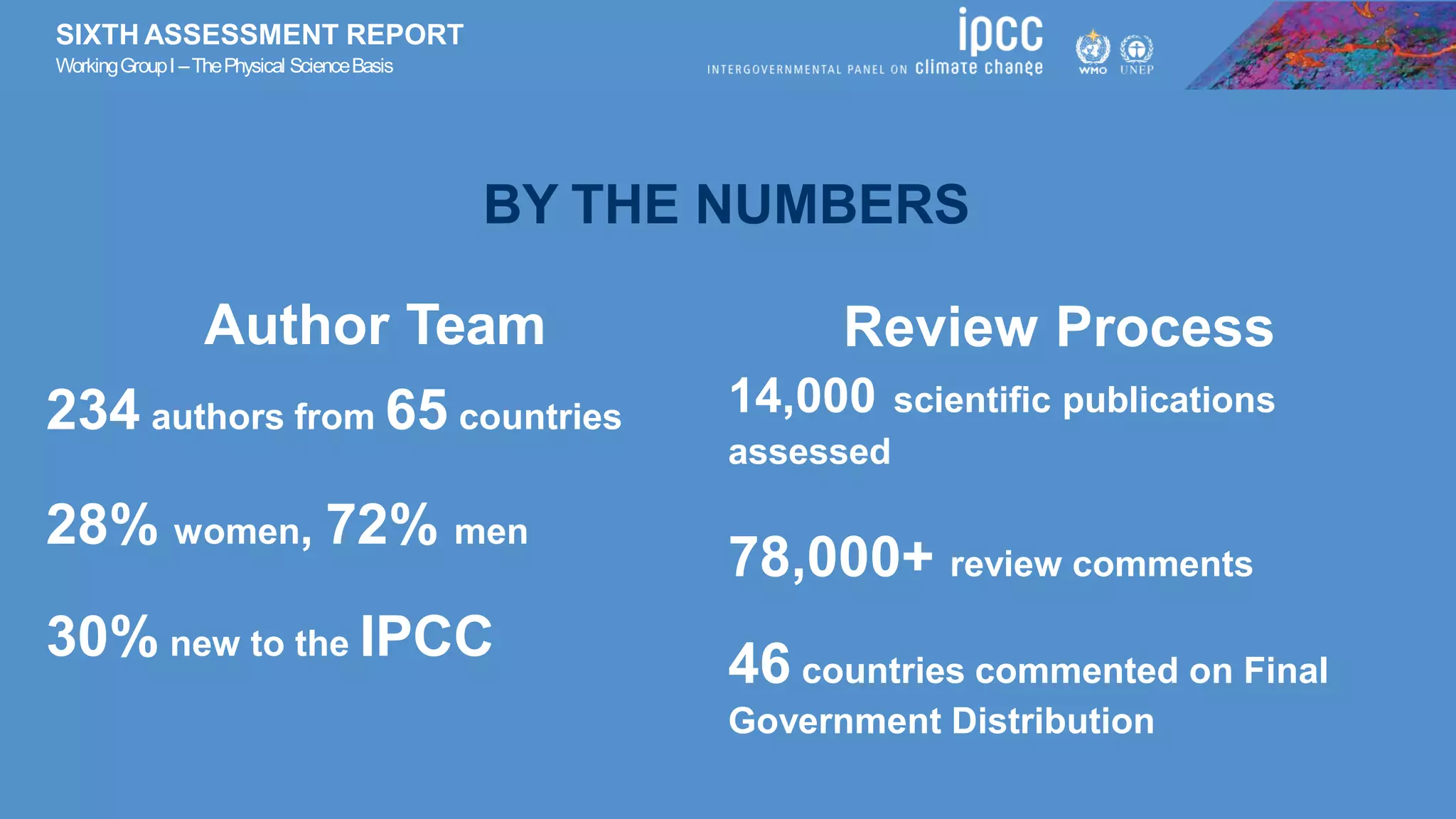
BY THE NUMBERS
Author Team
234 authors from 65 countries
28% women, 72% men
30% new to the IPCC
Review Process
14,000 scientific publications
assessed
78,000+ review comments
46 countries commented on Final
Government Distribution
SIXTH ASSESSMENT REPORT
WorkingGroupI –ThePhysical ScienceBasis
Interactive Atlas
Interactive Atlas interactive-atlas.ipcc.ch
SIXTH ASSESSMENT REPORT
WorkingGroupI –ThePhysical ScienceBasis
Interactive atlas
https://interactive-atlas.ipcc.ch/
#IPCCData #IPCCAtlas
SIXTH ASSESSMENT REPORT
WorkingGroupI –ThePhysical ScienceBasis
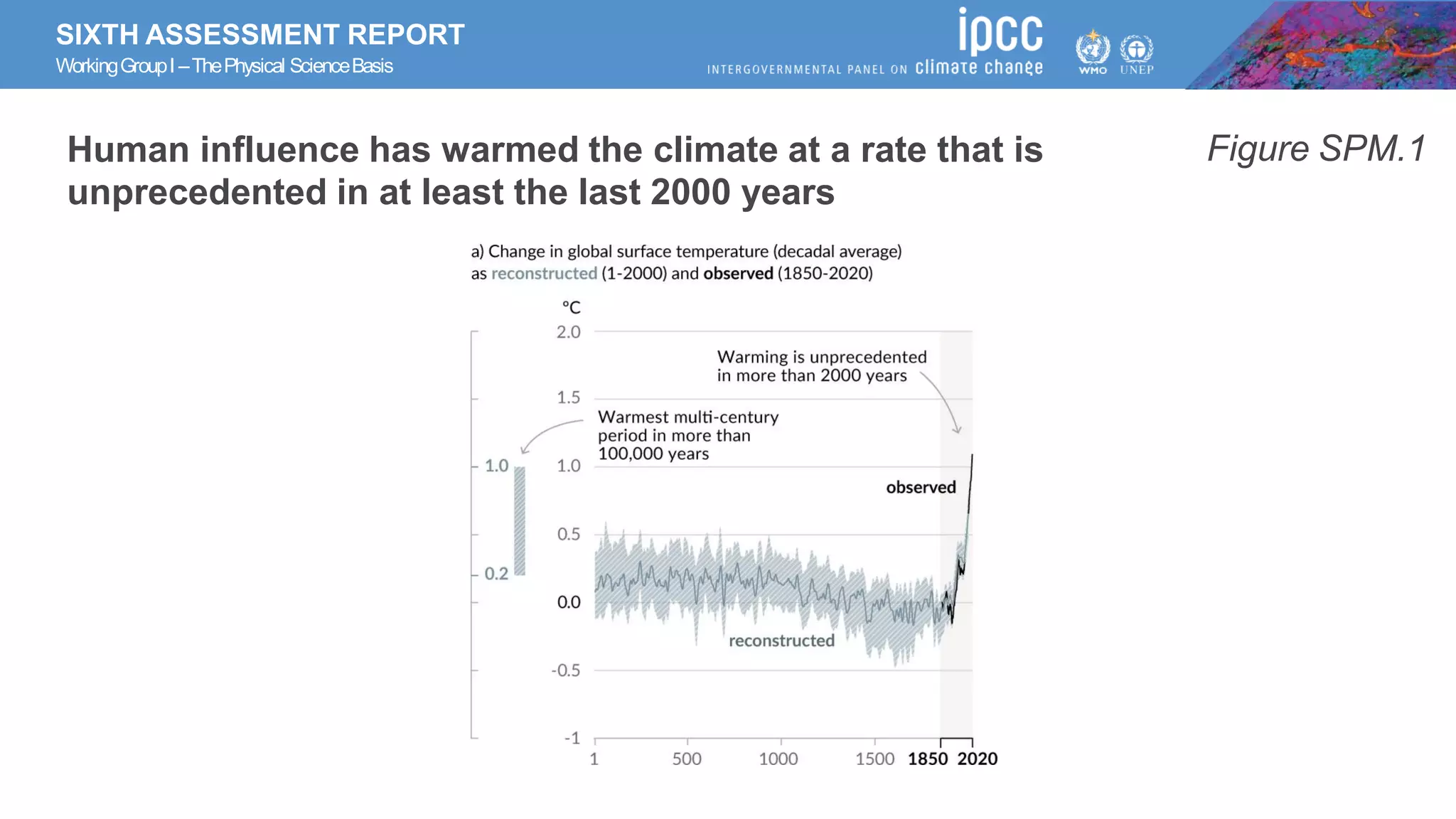
Human influence has warmed the climate at a rate that is
unprecedented in at least the last 2000 years
Figure SPM.1
SIXTH ASSESSMENT REPORT
WorkingGroupI –ThePhysical ScienceBasis
Human influence has warmed the climate at a rate that is
unprecedented in at least the last 2000 years
Figure SPM.1
SIXTH ASSESSMENT REPORT
WorkingGroupI –ThePhysical ScienceBasis
Human influence has warmed the climate at a rate that is
unprecedented in at least the last 2000 years
Figure SPM.1
SIXTH ASSESSMENT REPORT
WorkingGroupI –ThePhysical ScienceBasis
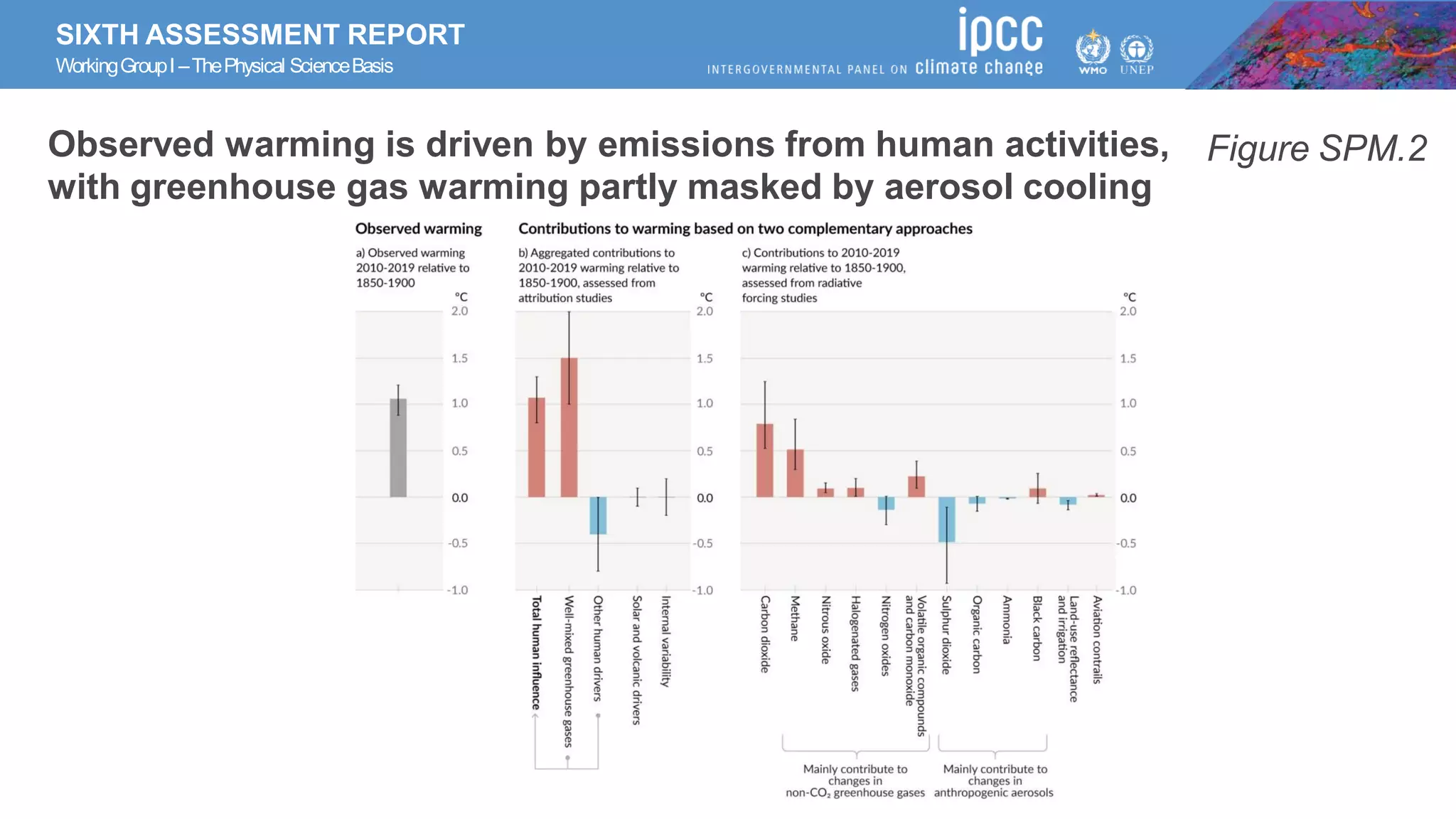
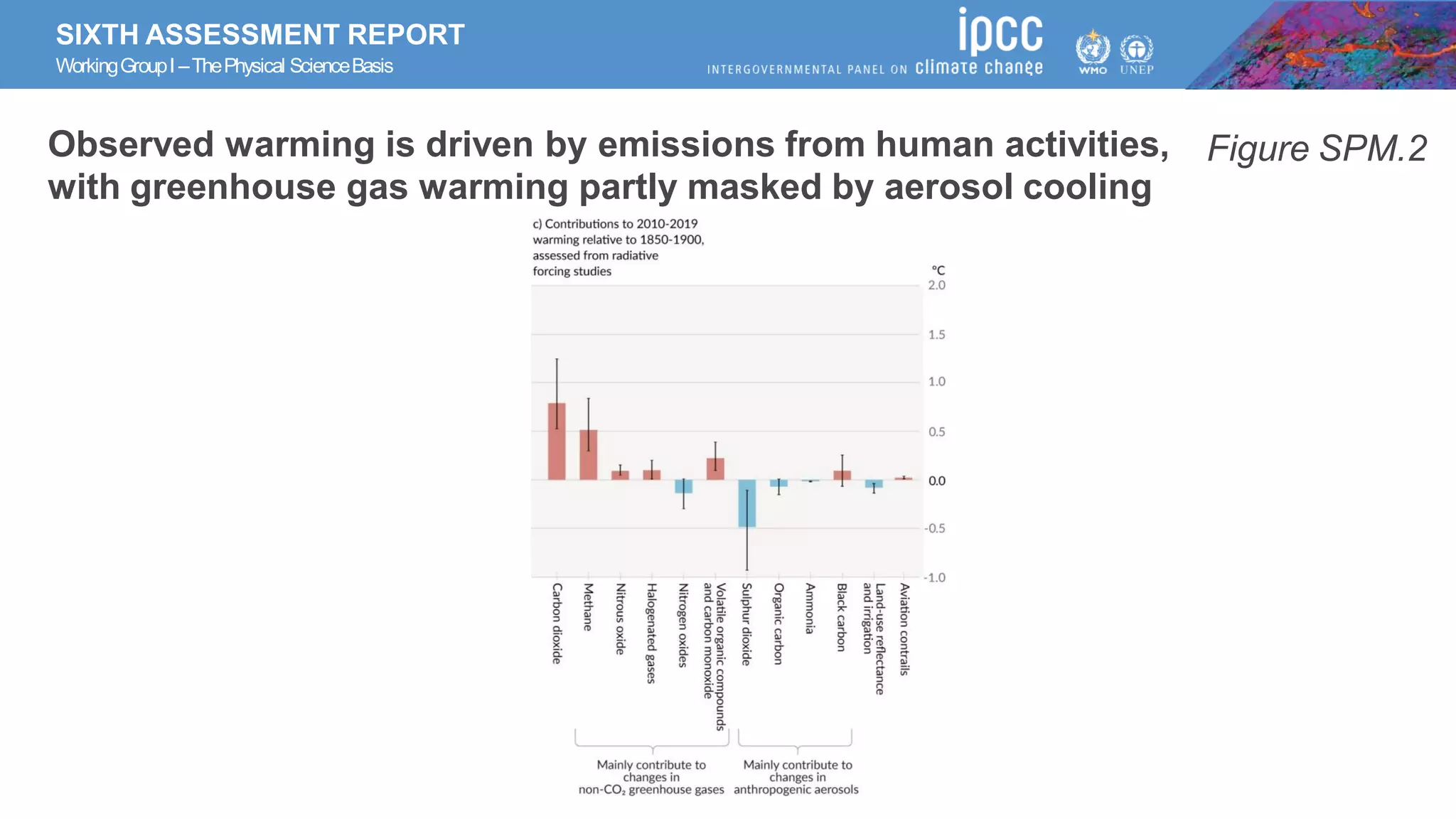
Figure SPM.2
Observed warming is driven by emissions from human activities,
with greenhouse gas warming partly masked by aerosol cooling
SIXTH ASSESSMENT REPORT
WorkingGroupI –ThePhysical ScienceBasis
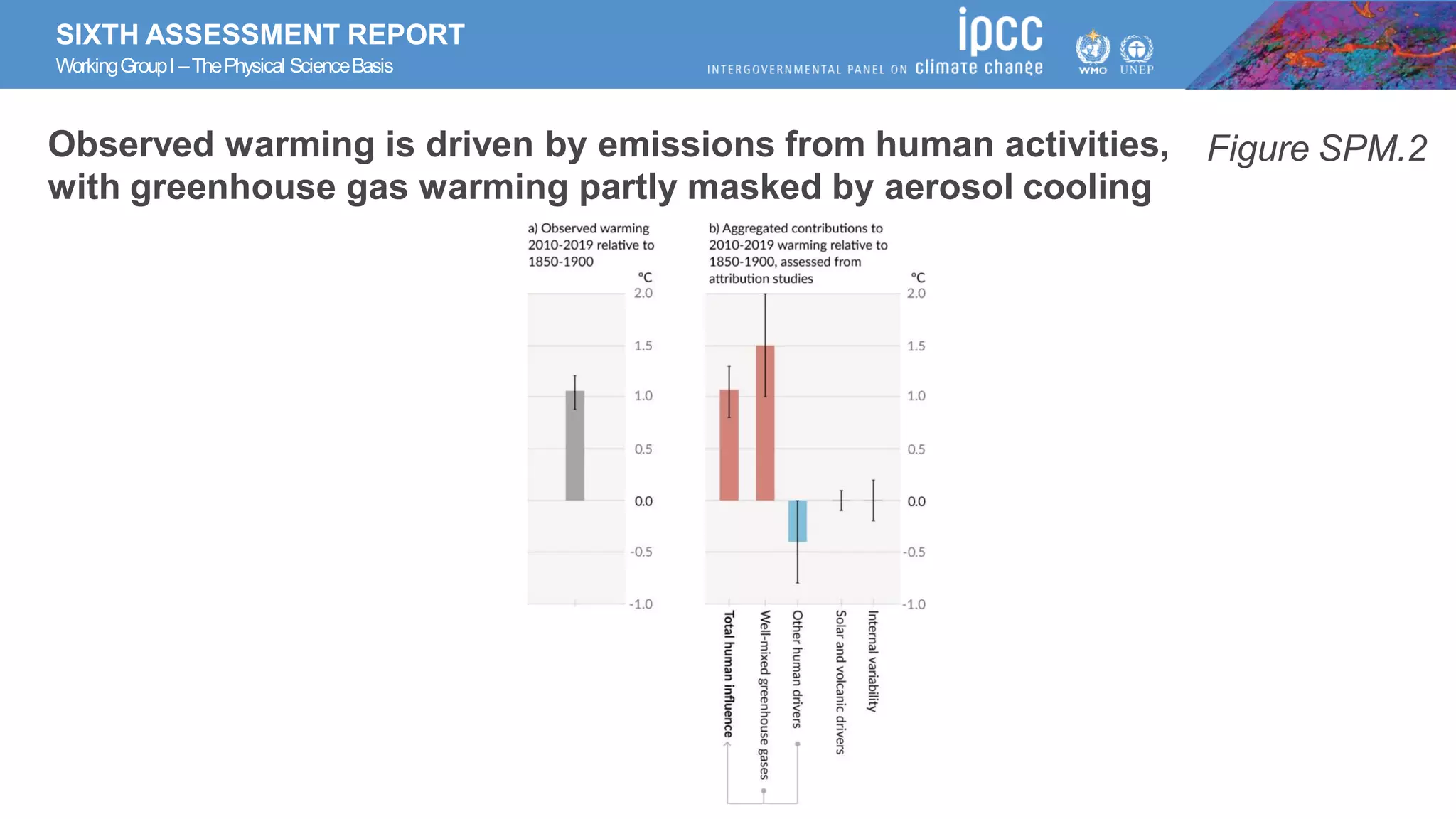
Figure SPM.2
Observed warming is driven by emissions from human activities,
with greenhouse gas warming partly masked by aerosol cooling
SIXTH ASSESSMENT REPORT
WorkingGroupI –ThePhysical ScienceBasis
Figure SPM.2
Observed warming is driven by emissions from human activities,
with greenhouse gas warming partly masked by aerosol cooling
SIXTH ASSESSMENT REPORT
WorkingGroupI –ThePhysical ScienceBasis
Figure SPM.2
Observed warming is driven by emissions from human activities,
with greenhouse gas warming partly masked by aerosol cooling
SIXTH ASSESSMENT REPORT
WorkingGroupI –ThePhysical ScienceBasis
Climate change is already affecting every inhabited region
across the globe, with human influence contributing to many
observed changes in weather and climate extremes
Figure SPM.3
SIXTH ASSESSMENT REPORT
WorkingGroupI –ThePhysical ScienceBasis
Figure SPM.3
Climate change is already affecting every inhabited region
across the globe, with human influence contributing to many
observed changes in weather and climate extremes
SIXTH ASSESSMENT REPORT
WorkingGroupI –ThePhysical ScienceBasis
Figure SPM.3
Climate change is already affecting every inhabited region
across the globe, with human influence contributing to many
observed changes in weather and climate extremes
SIXTH ASSESSMENT REPORT
WorkingGroupI –ThePhysical ScienceBasis
Figure SPM.3
Climate change is already affecting every inhabited region
across the globe, with human influence contributing to many
observed changes in weather and climate extremes
SIXTH ASSESSMENT REPORT
WorkingGroupI –ThePhysical ScienceBasis
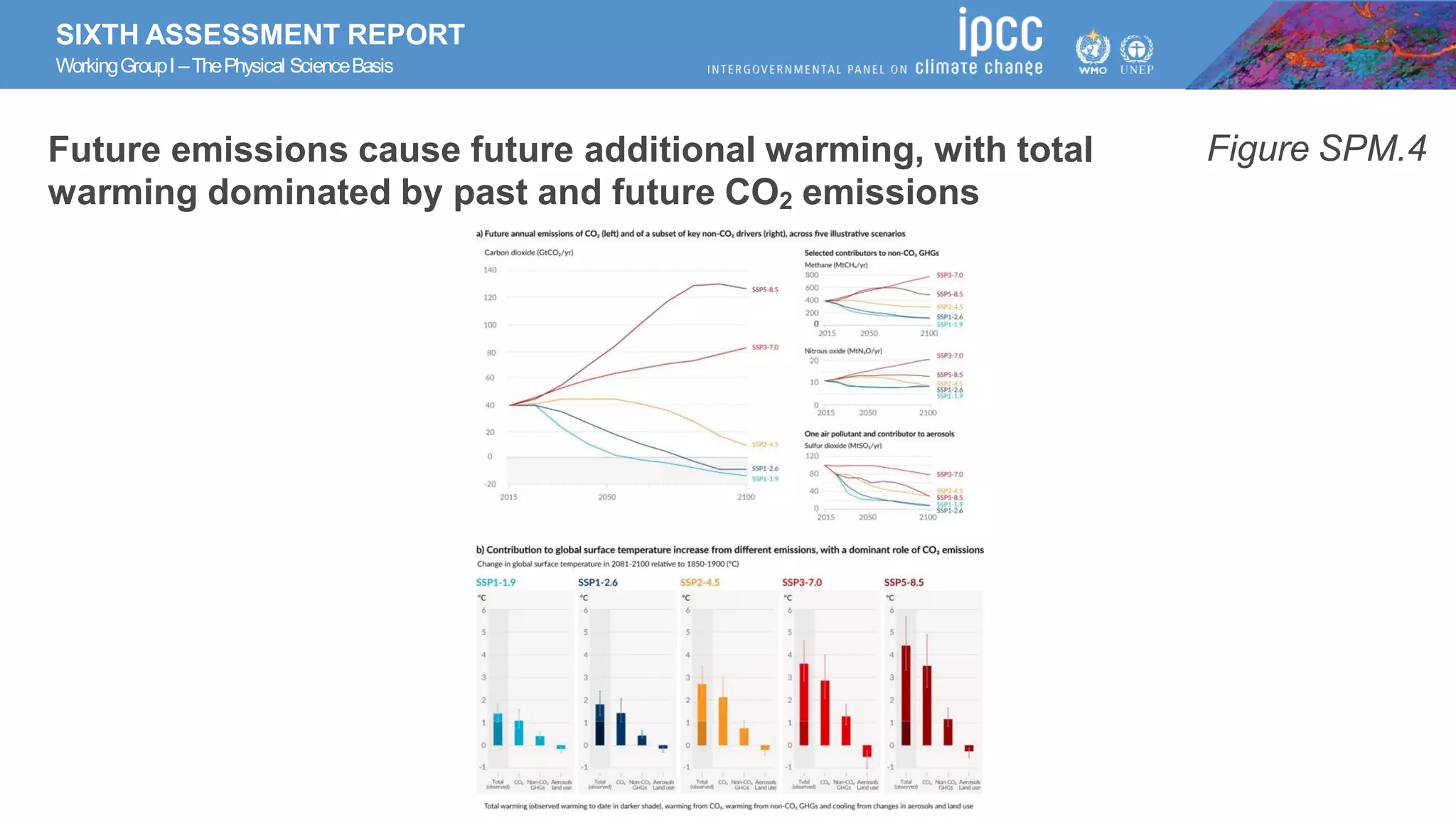
Future emissions cause future additional warming, with total
warming dominated by past and future CO2 emissions
Figure SPM.4
SIXTH ASSESSMENT REPORT
WorkingGroupI –ThePhysical ScienceBasis
Future emissions cause future additional warming, with total
warming dominated by past and future CO2 emissions
Figure SPM.4
SIXTH ASSESSMENT REPORT
WorkingGroupI –ThePhysical ScienceBasis
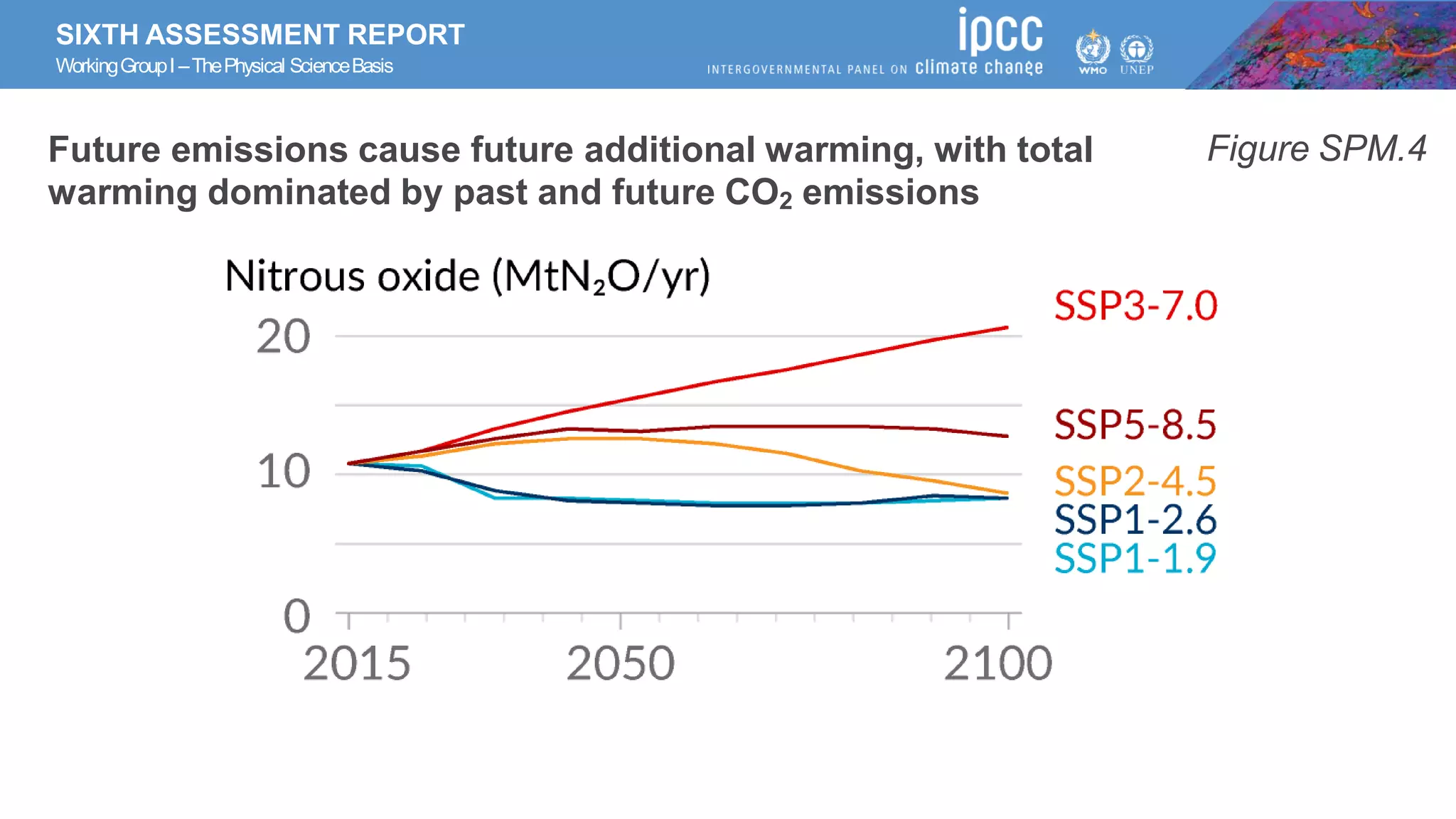
Future emissions cause future additional warming, with total
warming dominated by past and future CO2 emissions
Figure SPM.4
SIXTH ASSESSMENT REPORT
WorkingGroupI –ThePhysical ScienceBasis
Future emissions cause future additional warming, with total
warming dominated by past and future CO2 emissions
Figure SPM.4
SIXTH ASSESSMENT REPORT
WorkingGroupI –ThePhysical ScienceBasis
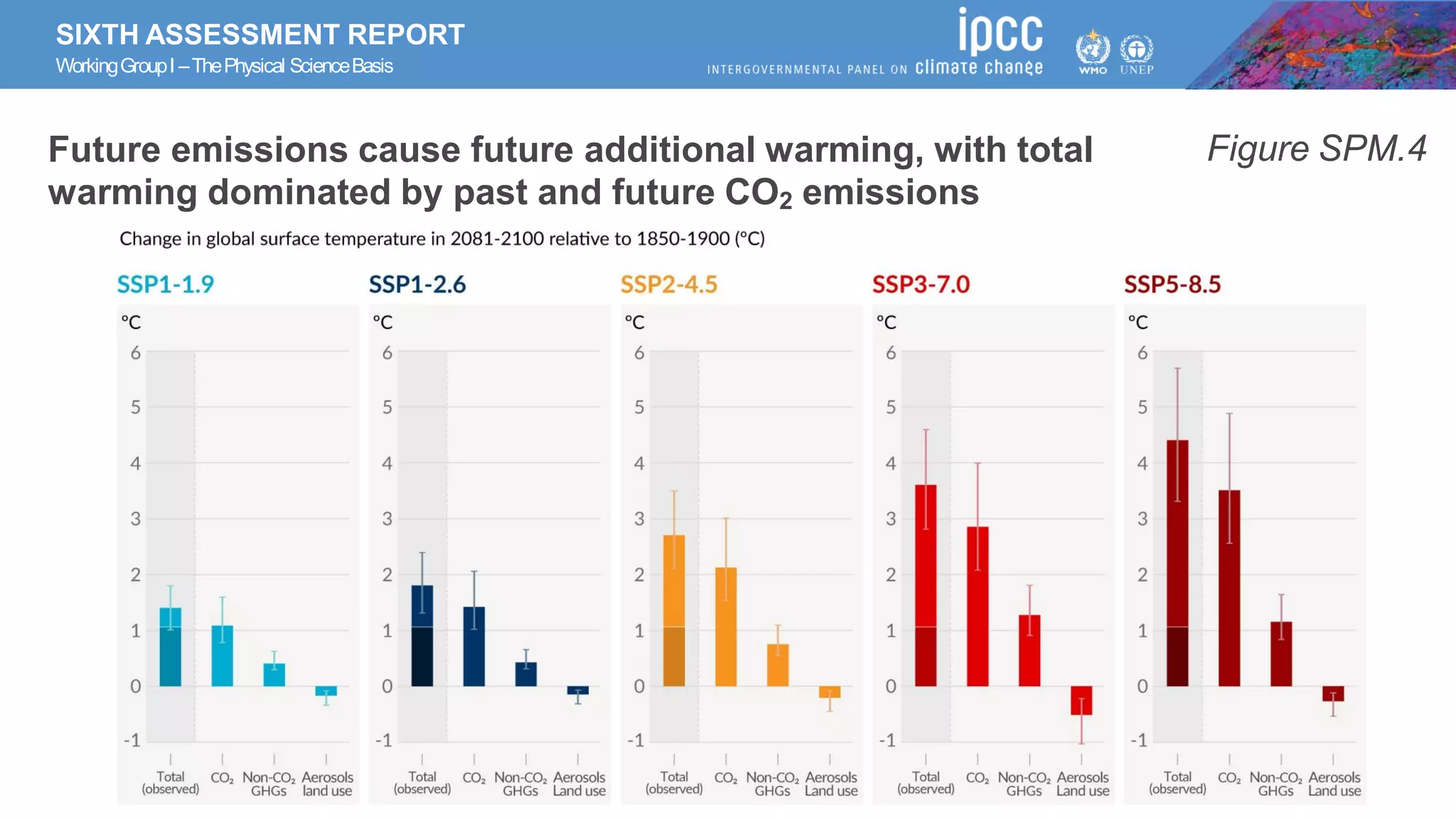
Future emissions cause future additional warming, with total
warming dominated by past and future CO2 emissions
Figure SPM.4
SIXTH ASSESSMENT REPORT
WorkingGroupI –ThePhysical ScienceBasis
Future emissions cause future additional warming, with total
warming dominated by past and future CO2 emissions
Figure SPM.4
SIXTH ASSESSMENT REPORT
WorkingGroupI –ThePhysical ScienceBasis
Future emissions cause future additional warming, with total
warming dominated by past and future CO2 emissions
Figure SPM.4
SIXTH ASSESSMENT REPORT
WorkingGroupI –ThePhysical ScienceBasis
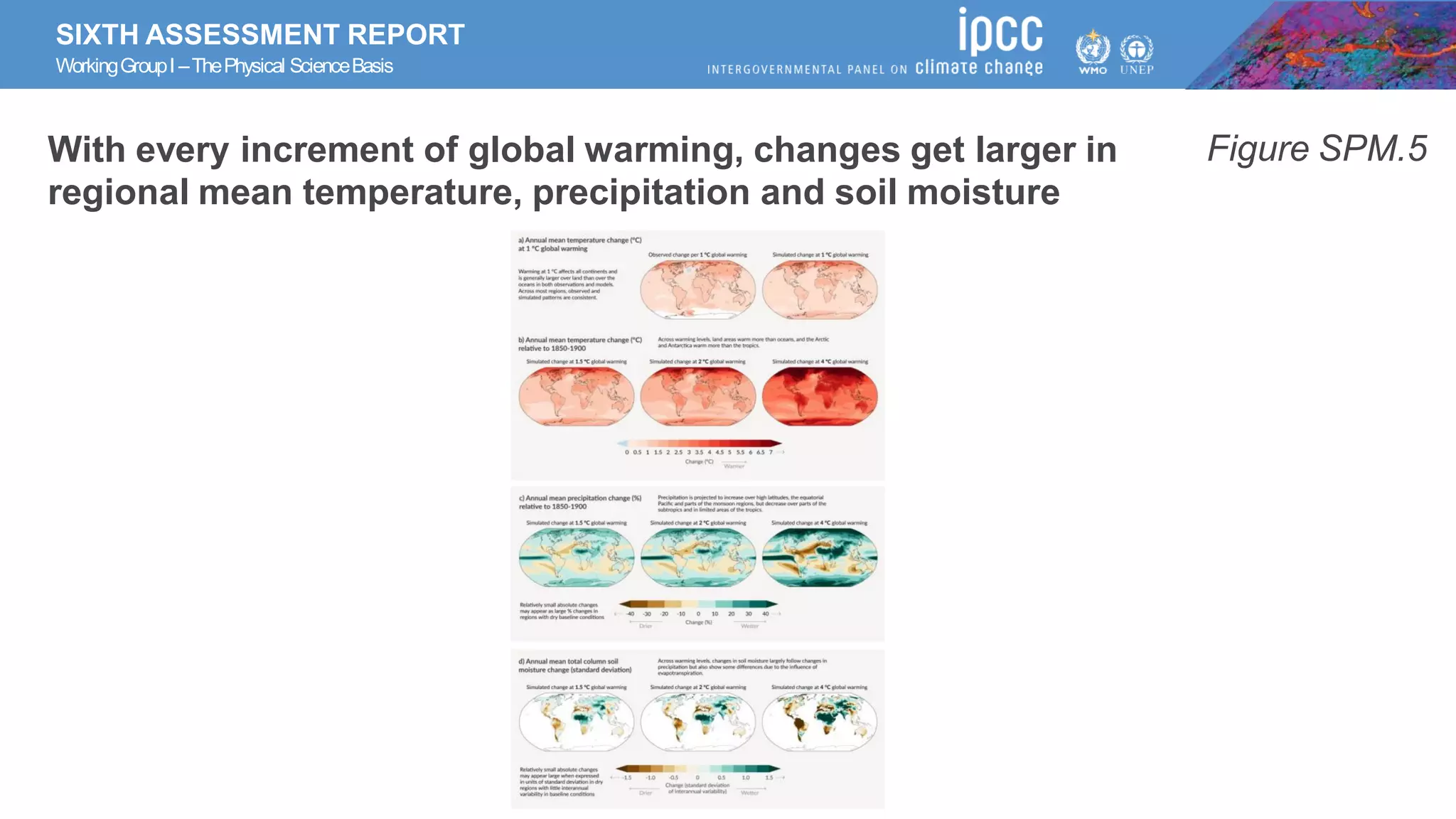
With every increment of global warming, changes get larger in
regional mean temperature, precipitation and soil moisture
Figure SPM.5
SIXTH ASSESSMENT REPORT
WorkingGroupI –ThePhysical ScienceBasis
With every increment of global warming, changes get larger in
regional mean temperature, precipitation and soil moisture
Figure SPM.5
SIXTH ASSESSMENT REPORT
WorkingGroupI –ThePhysical ScienceBasis
With every increment of global warming, changes get larger in
regional mean temperature, precipitation and soil moisture
Figure SPM.5
SIXTH ASSESSMENT REPORT
WorkingGroupI –ThePhysical ScienceBasis
With every increment of global warming, changes get larger in
regional mean temperature, precipitation and soil moisture
Figure SPM.5
SIXTH ASSESSMENT REPORT
WorkingGroupI –ThePhysical ScienceBasis
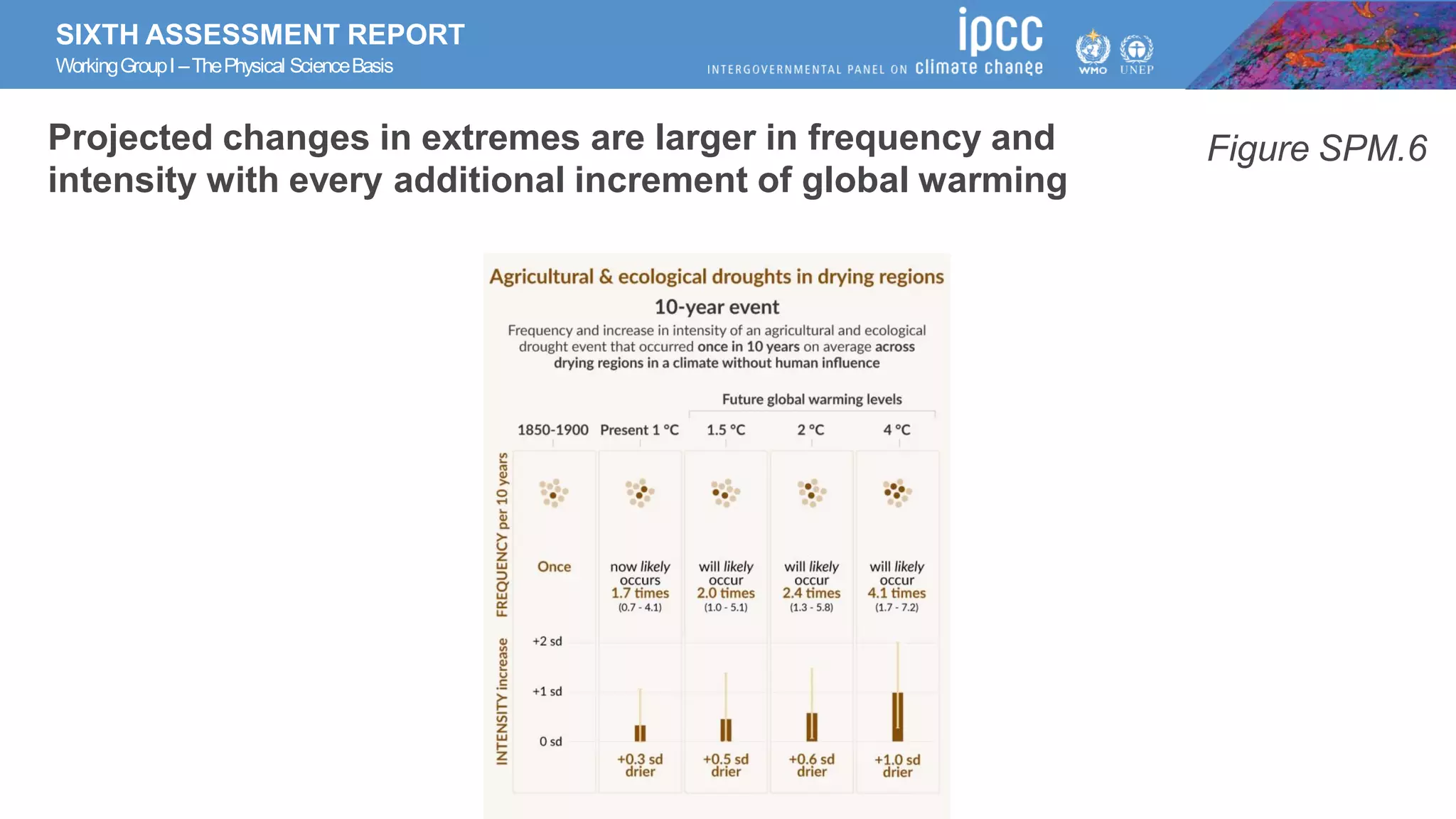
Projected changes in extremes are larger in frequency and
intensity with every additional increment of global warming
Figure SPM.6
SIXTH ASSESSMENT REPORT
WorkingGroupI –ThePhysical ScienceBasis
Figure SPM.6
Projected changes in extremes are larger in frequency and
intensity with every additional increment of global warming
SIXTH ASSESSMENT REPORT
WorkingGroupI –ThePhysical ScienceBasis
Figure SPM.6
Projected changes in extremes are larger in frequency and
intensity with every additional increment of global warming
SIXTH ASSESSMENT REPORT
WorkingGroupI –ThePhysical ScienceBasis
Figure SPM.6
Projected changes in extremes are larger in frequency and
intensity with every additional increment of global warming
SIXTH ASSESSMENT REPORT
WorkingGroupI –ThePhysical ScienceBasis
Figure SPM.7
The proportion of CO2 emissions taken up by land and ocean
carbon sinks is smaller in scenarios with higher cumulative CO2
emissions
SIXTH ASSESSMENT REPORT
WorkingGroupI –ThePhysical ScienceBasis
Figure SPM.8
Human activities affect all the major climate system components,
with some responding over decades and others over centuries
SIXTH ASSESSMENT REPORT
WorkingGroupI –ThePhysical ScienceBasis
Figure SPM.8
Human activities affect all the major climate system components,
with some responding over decades and others over centuries
SIXTH ASSESSMENT REPORT
WorkingGroupI –ThePhysical ScienceBasis
Figure SPM.8
Human activities affect all the major climate system components,
with some responding over decades and others over centuries
SIXTH ASSESSMENT REPORT
WorkingGroupI –ThePhysical ScienceBasis
Figure SPM.8
Human activities affect all the major climate system components,
with some responding over decades and others over centuries
SIXTH ASSESSMENT REPORT
WorkingGroupI –ThePhysical ScienceBasis
Human activities affect all the major
climate system components, with
some responding over decades and
others over centuries
Figure SPM.8
SIXTH ASSESSMENT REPORT
WorkingGroupI –ThePhysical ScienceBasis
Figure SPM.9
Multiple climatic impact-drivers are projected to change in all
regions of the world
SIXTH ASSESSMENT REPORT
WorkingGroupI –ThePhysical ScienceBasis
Figure SPM.9
Multiple climatic impact-drivers are projected to change in all
regions of the world
SIXTH ASSESSMENT REPORT
WorkingGroupI –ThePhysical ScienceBasis
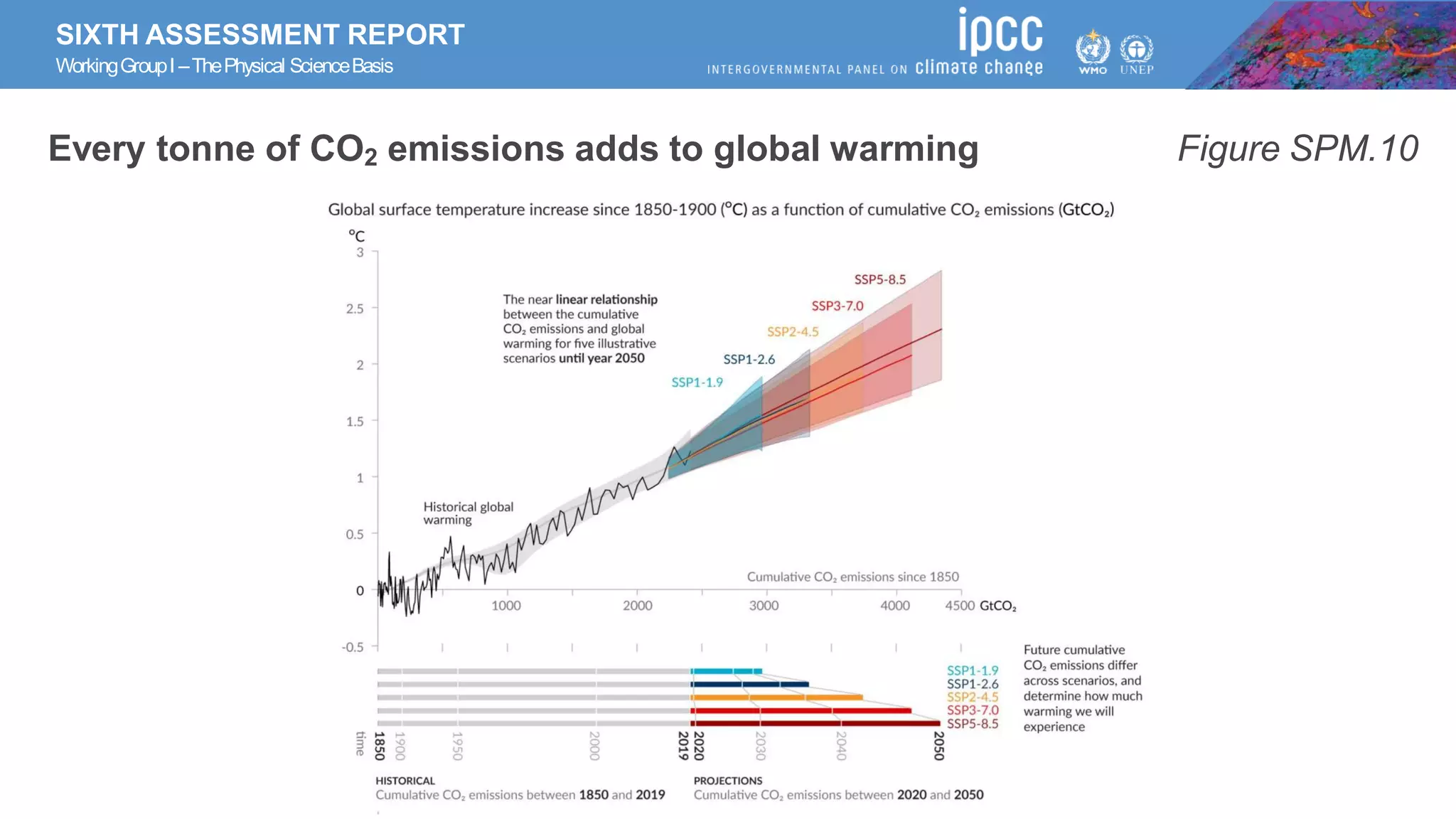
Every tonne of CO2 emissions adds to global warming Figure SPM.10
SIXTH ASSESSMENT REPORT
WorkingGroupI –ThePhysical ScienceBasis
Every tonne of CO2 emissions adds to global warming Figure SPM.10
SIXTH ASSESSMENT REPORT
WorkingGroupI –ThePhysical ScienceBasis
Every tonne of CO2 emissions adds to global warming Figure SPM.10
#ClimateReport #IPCC
@IPCC
@IPCC_CH
linkedin.com/company/ipcc
Thank you.
9 August 2021
IPCC: www.ipcc.ch
IPCC Secretariat: ipcc-sec@wmo.int
IPCC Press Office: ipcc-media@wmo.int
Follow Us:

Climate Change PPT by IPCC

  • 1.
    #ClimateReport #IPCC SIXTH ASSESSMENTREPORT Working Group I – The Physical Science Basis 9 August 2021 [Climate Change]
  • 2.
    “Recent changes inthe climate are widespread, rapid, and intensifying, and unprecedented in thousands of years. [Credit:NASA]
  • 3.
    “Unless there areimmediate, rapid, and large-scale reductions in greenhouse gas emissions, limiting warming to 1.5°C will be beyond reach. [Credit: Peter John Maridable | Unsplash]
  • 4.
    “It is indisputablethat human activities are causing climate change, making extreme climate events, including heat waves, heavy rainfall, and droughts, more frequent and severe. [Credit: Yoda Adaman | Unsplash]
  • 5.
    “Climate change isalready affecting every region on Earth, in multiple ways. The changes we experience will increase with further warming. [Credit: Hong Nguyen | Unsplash]
  • 6.
    “ There’s no goingback from some changes in the climate system… [Credit: Jenn Caselle | UCSB]
  • 7.
    “…However, some changescould be slowed and others could be stopped by limiting warming. [Credit: Andy Mahoney | NSIDC]
  • 8.
    “There’s no goingback from some changes in the climate system. However, some changes could be slowed and others could be stopped by limiting warming. [Credit: Shari Gearheard | NSIDC]
  • 9.
    “To limit globalwarming, strong, rapid, and sustained reductions in CO2, methane, and other greenhouse gases are necessary. This would not only reduce the consequences of climate change but also improve air quality. [Credit: Evgeny Nelmin | Unsplash]
  • 10.
    SIXTH ASSESSMENT REPORT WorkingGroupI–ThePhysical ScienceBasis BY THE NUMBERS Author Team 234 authors from 65 countries 28% women, 72% men 30% new to the IPCC Review Process 14,000 scientific publications assessed 78,000+ review comments 46 countries commented on Final Government Distribution
  • 11.
    SIXTH ASSESSMENT REPORT WorkingGroupI–ThePhysical ScienceBasis Interactive Atlas Interactive Atlas interactive-atlas.ipcc.ch
  • 12.
    SIXTH ASSESSMENT REPORT WorkingGroupI–ThePhysical ScienceBasis Interactive atlas https://interactive-atlas.ipcc.ch/ #IPCCData #IPCCAtlas
  • 13.
    SIXTH ASSESSMENT REPORT WorkingGroupI–ThePhysical ScienceBasis Human influence has warmed the climate at a rate that is unprecedented in at least the last 2000 years Figure SPM.1
  • 14.
    SIXTH ASSESSMENT REPORT WorkingGroupI–ThePhysical ScienceBasis Human influence has warmed the climate at a rate that is unprecedented in at least the last 2000 years Figure SPM.1
  • 15.
    SIXTH ASSESSMENT REPORT WorkingGroupI–ThePhysical ScienceBasis Human influence has warmed the climate at a rate that is unprecedented in at least the last 2000 years Figure SPM.1
  • 16.
    SIXTH ASSESSMENT REPORT WorkingGroupI–ThePhysical ScienceBasis Figure SPM.2 Observed warming is driven by emissions from human activities, with greenhouse gas warming partly masked by aerosol cooling
  • 17.
    SIXTH ASSESSMENT REPORT WorkingGroupI–ThePhysical ScienceBasis Figure SPM.2 Observed warming is driven by emissions from human activities, with greenhouse gas warming partly masked by aerosol cooling
  • 18.
    SIXTH ASSESSMENT REPORT WorkingGroupI–ThePhysical ScienceBasis Figure SPM.2 Observed warming is driven by emissions from human activities, with greenhouse gas warming partly masked by aerosol cooling
  • 19.
    SIXTH ASSESSMENT REPORT WorkingGroupI–ThePhysical ScienceBasis Figure SPM.2 Observed warming is driven by emissions from human activities, with greenhouse gas warming partly masked by aerosol cooling
  • 20.
    SIXTH ASSESSMENT REPORT WorkingGroupI–ThePhysical ScienceBasis Climate change is already affecting every inhabited region across the globe, with human influence contributing to many observed changes in weather and climate extremes Figure SPM.3
  • 21.
    SIXTH ASSESSMENT REPORT WorkingGroupI–ThePhysical ScienceBasis Figure SPM.3 Climate change is already affecting every inhabited region across the globe, with human influence contributing to many observed changes in weather and climate extremes
  • 22.
    SIXTH ASSESSMENT REPORT WorkingGroupI–ThePhysical ScienceBasis Figure SPM.3 Climate change is already affecting every inhabited region across the globe, with human influence contributing to many observed changes in weather and climate extremes
  • 23.
    SIXTH ASSESSMENT REPORT WorkingGroupI–ThePhysical ScienceBasis Figure SPM.3 Climate change is already affecting every inhabited region across the globe, with human influence contributing to many observed changes in weather and climate extremes
  • 24.
    SIXTH ASSESSMENT REPORT WorkingGroupI–ThePhysical ScienceBasis Future emissions cause future additional warming, with total warming dominated by past and future CO2 emissions Figure SPM.4
  • 25.
    SIXTH ASSESSMENT REPORT WorkingGroupI–ThePhysical ScienceBasis Future emissions cause future additional warming, with total warming dominated by past and future CO2 emissions Figure SPM.4
  • 26.
    SIXTH ASSESSMENT REPORT WorkingGroupI–ThePhysical ScienceBasis Future emissions cause future additional warming, with total warming dominated by past and future CO2 emissions Figure SPM.4
  • 27.
    SIXTH ASSESSMENT REPORT WorkingGroupI–ThePhysical ScienceBasis Future emissions cause future additional warming, with total warming dominated by past and future CO2 emissions Figure SPM.4
  • 28.
    SIXTH ASSESSMENT REPORT WorkingGroupI–ThePhysical ScienceBasis Future emissions cause future additional warming, with total warming dominated by past and future CO2 emissions Figure SPM.4
  • 29.
    SIXTH ASSESSMENT REPORT WorkingGroupI–ThePhysical ScienceBasis Future emissions cause future additional warming, with total warming dominated by past and future CO2 emissions Figure SPM.4
  • 30.
    SIXTH ASSESSMENT REPORT WorkingGroupI–ThePhysical ScienceBasis Future emissions cause future additional warming, with total warming dominated by past and future CO2 emissions Figure SPM.4
  • 31.
    SIXTH ASSESSMENT REPORT WorkingGroupI–ThePhysical ScienceBasis With every increment of global warming, changes get larger in regional mean temperature, precipitation and soil moisture Figure SPM.5
  • 32.
    SIXTH ASSESSMENT REPORT WorkingGroupI–ThePhysical ScienceBasis With every increment of global warming, changes get larger in regional mean temperature, precipitation and soil moisture Figure SPM.5
  • 33.
    SIXTH ASSESSMENT REPORT WorkingGroupI–ThePhysical ScienceBasis With every increment of global warming, changes get larger in regional mean temperature, precipitation and soil moisture Figure SPM.5
  • 34.
    SIXTH ASSESSMENT REPORT WorkingGroupI–ThePhysical ScienceBasis With every increment of global warming, changes get larger in regional mean temperature, precipitation and soil moisture Figure SPM.5
  • 35.
    SIXTH ASSESSMENT REPORT WorkingGroupI–ThePhysical ScienceBasis Projected changes in extremes are larger in frequency and intensity with every additional increment of global warming Figure SPM.6
  • 36.
    SIXTH ASSESSMENT REPORT WorkingGroupI–ThePhysical ScienceBasis Figure SPM.6 Projected changes in extremes are larger in frequency and intensity with every additional increment of global warming
  • 37.
    SIXTH ASSESSMENT REPORT WorkingGroupI–ThePhysical ScienceBasis Figure SPM.6 Projected changes in extremes are larger in frequency and intensity with every additional increment of global warming
  • 38.
    SIXTH ASSESSMENT REPORT WorkingGroupI–ThePhysical ScienceBasis Figure SPM.6 Projected changes in extremes are larger in frequency and intensity with every additional increment of global warming
  • 39.
    SIXTH ASSESSMENT REPORT WorkingGroupI–ThePhysical ScienceBasis Figure SPM.7 The proportion of CO2 emissions taken up by land and ocean carbon sinks is smaller in scenarios with higher cumulative CO2 emissions
  • 40.
    SIXTH ASSESSMENT REPORT WorkingGroupI–ThePhysical ScienceBasis Figure SPM.8 Human activities affect all the major climate system components, with some responding over decades and others over centuries
  • 41.
    SIXTH ASSESSMENT REPORT WorkingGroupI–ThePhysical ScienceBasis Figure SPM.8 Human activities affect all the major climate system components, with some responding over decades and others over centuries
  • 42.
    SIXTH ASSESSMENT REPORT WorkingGroupI–ThePhysical ScienceBasis Figure SPM.8 Human activities affect all the major climate system components, with some responding over decades and others over centuries
  • 43.
    SIXTH ASSESSMENT REPORT WorkingGroupI–ThePhysical ScienceBasis Figure SPM.8 Human activities affect all the major climate system components, with some responding over decades and others over centuries
  • 44.
    SIXTH ASSESSMENT REPORT WorkingGroupI–ThePhysical ScienceBasis Human activities affect all the major climate system components, with some responding over decades and others over centuries Figure SPM.8
  • 45.
    SIXTH ASSESSMENT REPORT WorkingGroupI–ThePhysical ScienceBasis Figure SPM.9 Multiple climatic impact-drivers are projected to change in all regions of the world
  • 46.
    SIXTH ASSESSMENT REPORT WorkingGroupI–ThePhysical ScienceBasis Figure SPM.9 Multiple climatic impact-drivers are projected to change in all regions of the world
  • 47.
    SIXTH ASSESSMENT REPORT WorkingGroupI–ThePhysical ScienceBasis Every tonne of CO2 emissions adds to global warming Figure SPM.10
  • 48.
    SIXTH ASSESSMENT REPORT WorkingGroupI–ThePhysical ScienceBasis Every tonne of CO2 emissions adds to global warming Figure SPM.10
  • 49.
    SIXTH ASSESSMENT REPORT WorkingGroupI–ThePhysical ScienceBasis Every tonne of CO2 emissions adds to global warming Figure SPM.10
  • 50.
    #ClimateReport #IPCC @IPCC @IPCC_CH linkedin.com/company/ipcc Thank you. 9August 2021 IPCC: www.ipcc.ch IPCC Secretariat: ipcc-sec@wmo.int IPCC Press Office: ipcc-media@wmo.int Follow Us: