http://bit.ly/ipcc_outreach_myanmar
From IPCC WGI AR5 to AR6
Panmao Zhai, Co-Chair, WGI
Outreach Event on IPCC Activities and Findings
Nay Pyi Taw, Myanmar, 30-31 May 2019
Key SPM Messages
19 Headlines
on less than 2 Pages
2
2009: WGI Outline Approved
14 Chapters, >106 Words
Atlas of Regional Projections
54,677 Review Comments
by 1089 Experts
2010: 259 Authors Selected
Summary for Policymakers
ca. 14,000 Words
3
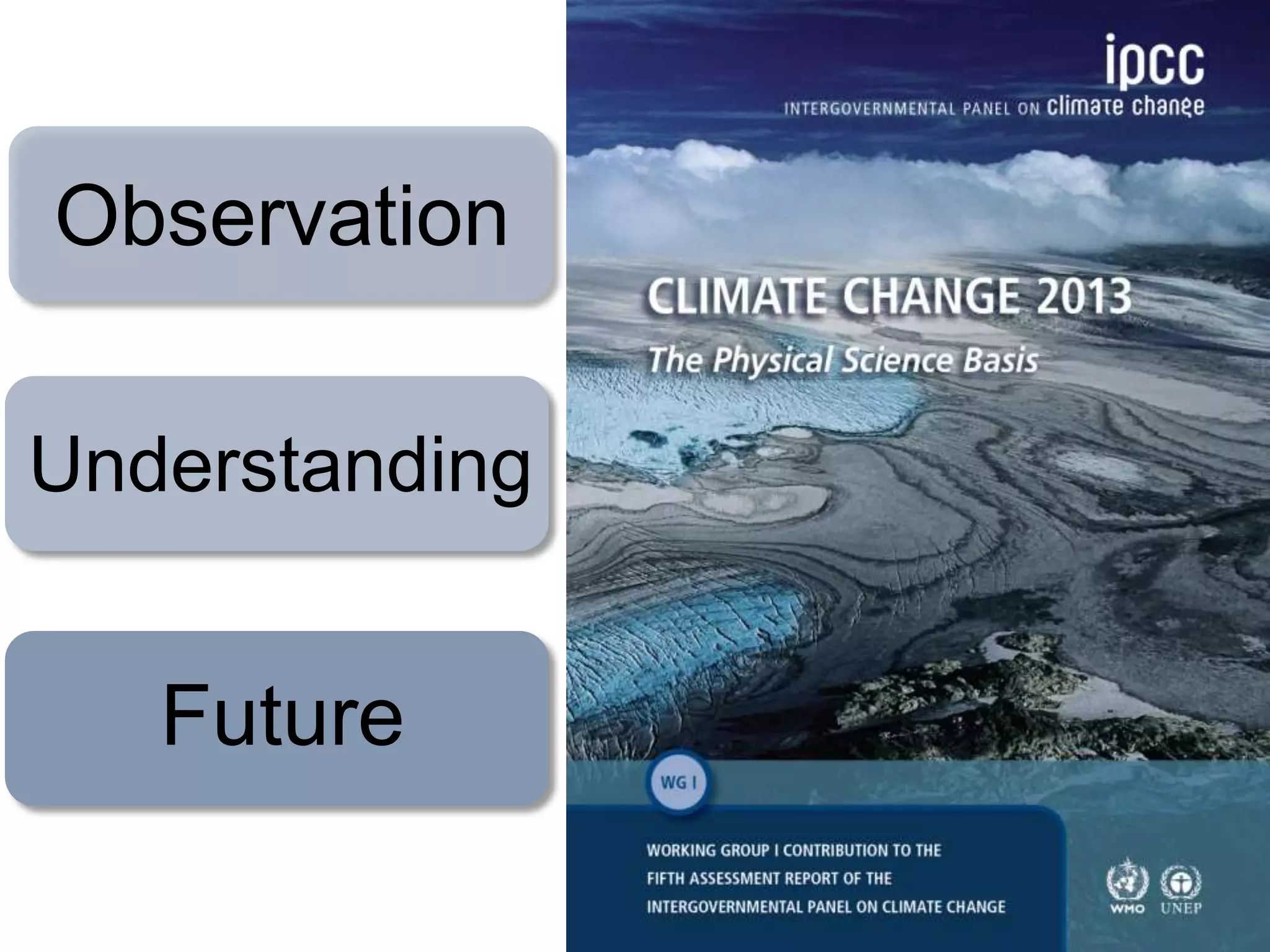
Observation
Understanding
Future
Each of the last three decades has been successively warmer at the
Earth’s surface than any preceding decade since 1850.
In the Northern Hemisphere, 1983–2012 was likely the warmest 30-
year period of the last 1400 years (medium confidence).
Fig. SPM.1a
Anomaly(°C)relativeto1961-1990
©IPCC2013
Fig.SPM.1b
Temperature Difference 1901 to 2012 based on trend (°C)
Warming of the climate system is unequivocal, [...]
Fig.SPM.2
Precipitation Trend (mm/yr per decade)
© IPCC 2013© IPCC 2013
(Lüthi et al.,2008, NOAA)
+40%
2013
The atmospheric concentrations of carbon dioxide,
methane, and nitrous oxide have increased to levels
unprecedented in at least the last 800,000 years.
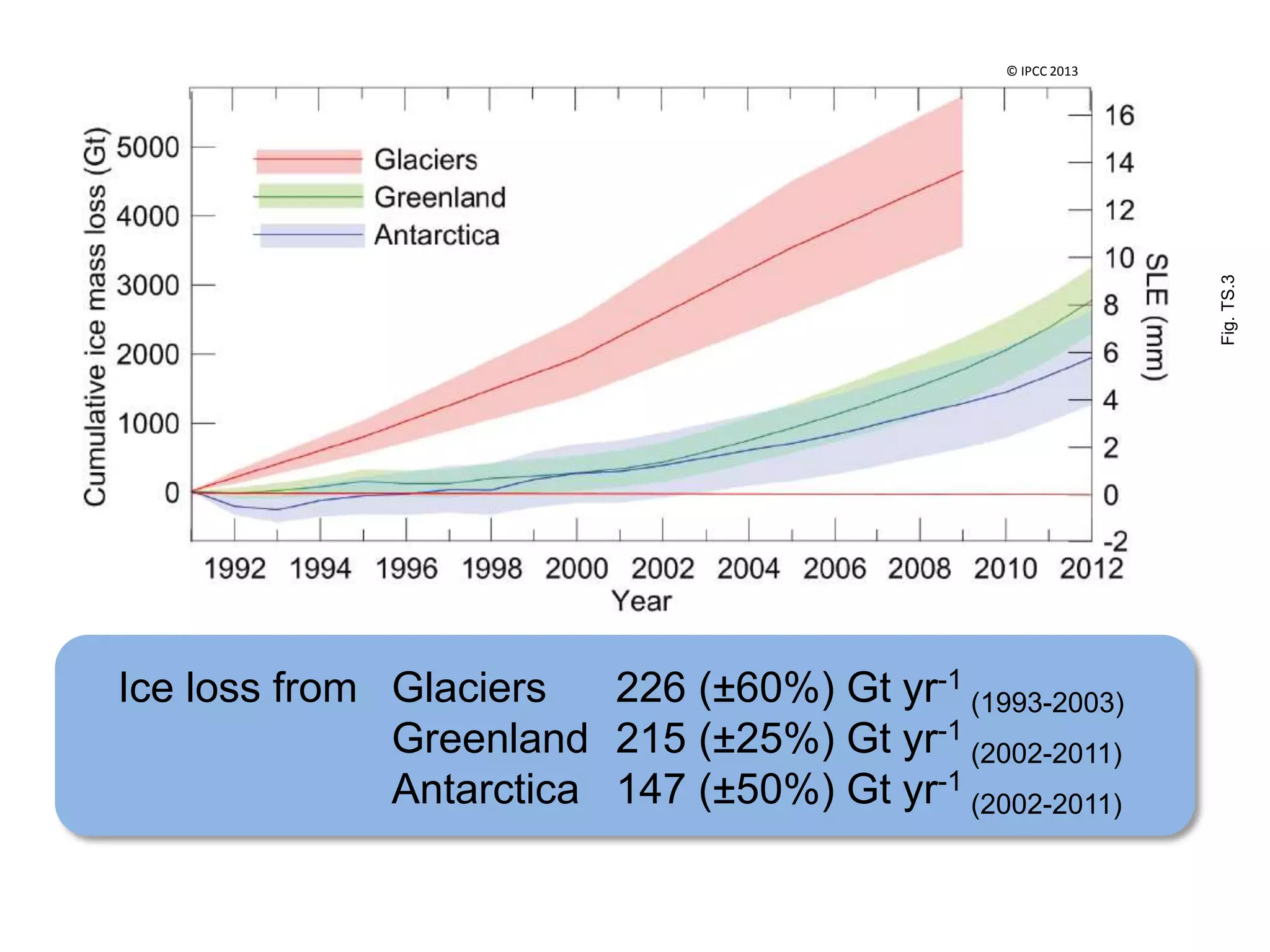
Fig.TS.3
Ice loss from Glaciers 226 (±60%) Gt yr-1
(1993-2003)
Greenland 215 (±25%) Gt yr-1
(2002-2011)
Antarctica 147 (±50%) Gt yr-1
(2002-2011)
© IPCC 2013
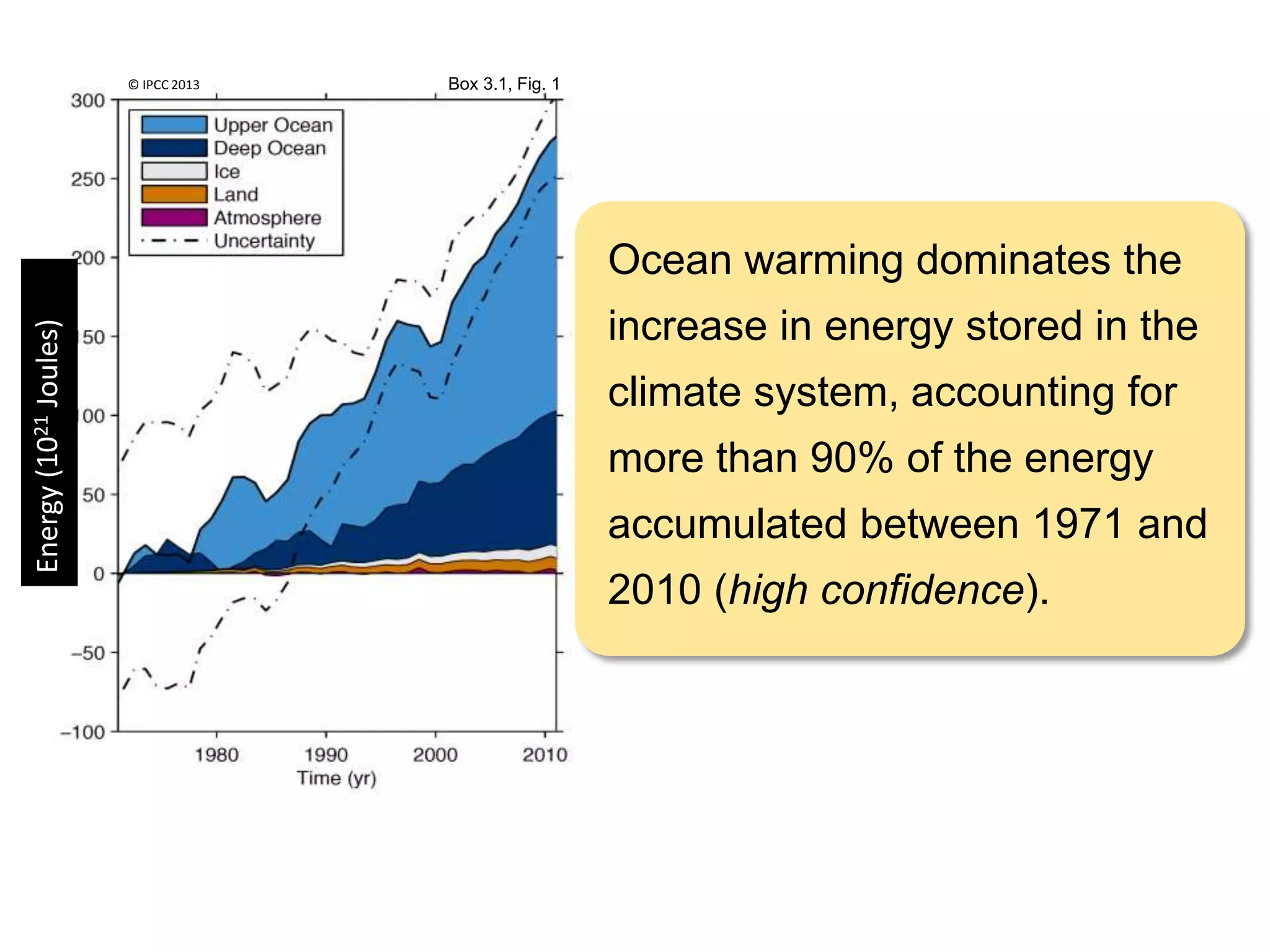
Energy(1021Joules)
Ocean warming dominates the
increase in energy stored in the
climate system, accounting for
more than 90% of the energy
accumulated between 1971 and
2010 (high confidence).
Box 3.1, Fig. 1© IPCC 2013
Total radiative forcing is positive, and has led to an uptake
of energy in the climate system. The largest contribution [...]
is caused by the increase in the atmospheric concentration
of CO2 since 1750.
Fig.SPM.5
© IPCC 2013
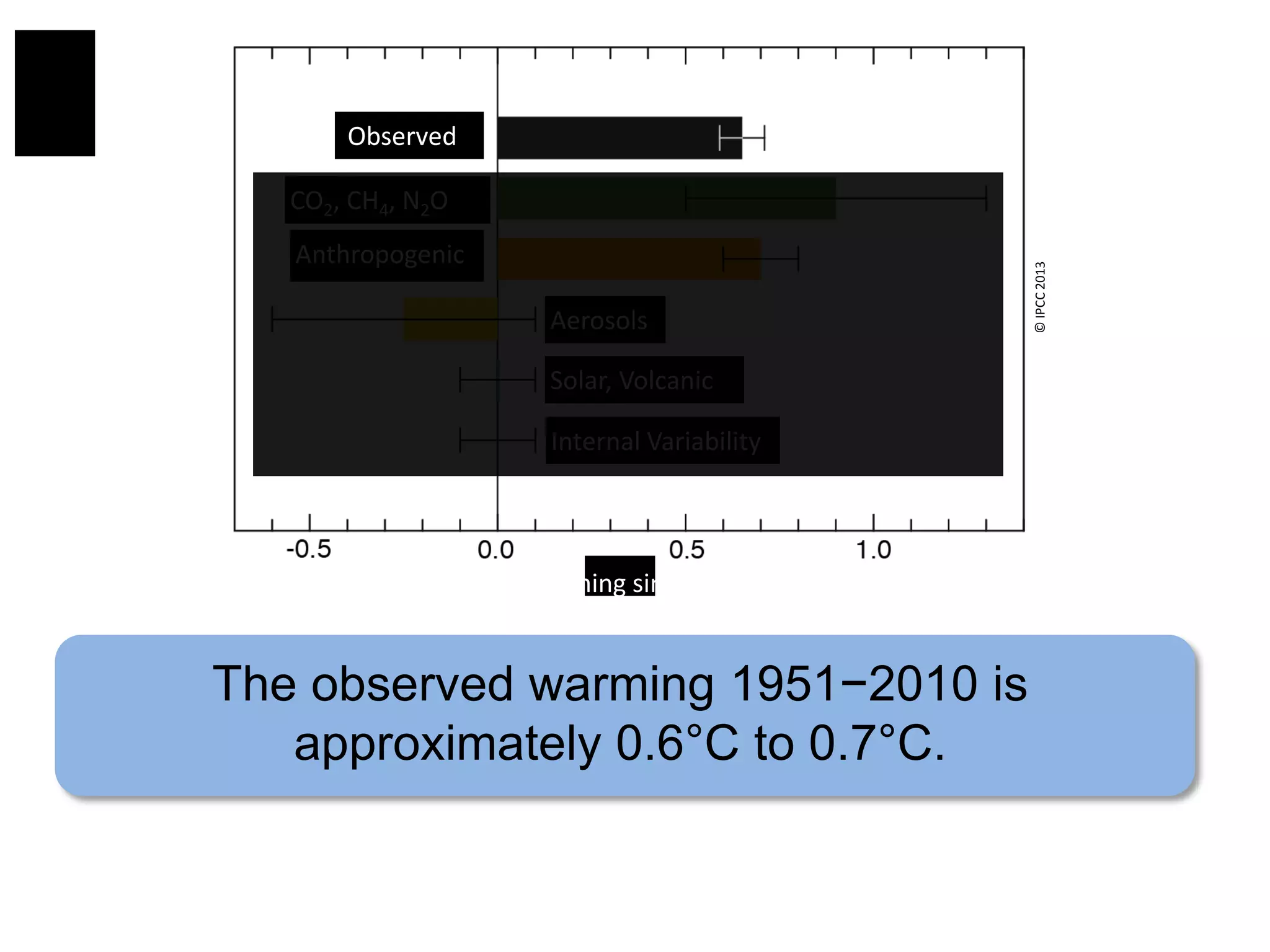
Global mean warming since 1951 (°C)
Solar, Volcanic
Aerosols
CO2, CH4, N2O
Anthropogenic
Internal Variability
Observed
Fig. TS.10
The observed warming 1951−2010 is
approximately 0.6°C to 0.7°C.
©IPCC2013
Global mean warming since 1951 (°C)
Solar, Volcanic
Aerosols
CO2, CH4, N2O
Anthropogenic
Internal Variability
Observed
Fig. TS.10
It is extremely likely that human influence has
been the dominant cause of the observed
warming since the mid-20th century.
©IPCC2013
Global mean warming since 1951 (°C)
Solar, Volcanic
Aerosols
CO2, CH4, N2O
Anthropogenic
Internal Variability
Observed
Fig. TS.10
Human influence on the
climate system is clear.
©IPCC2013
Fig. SPM.7a
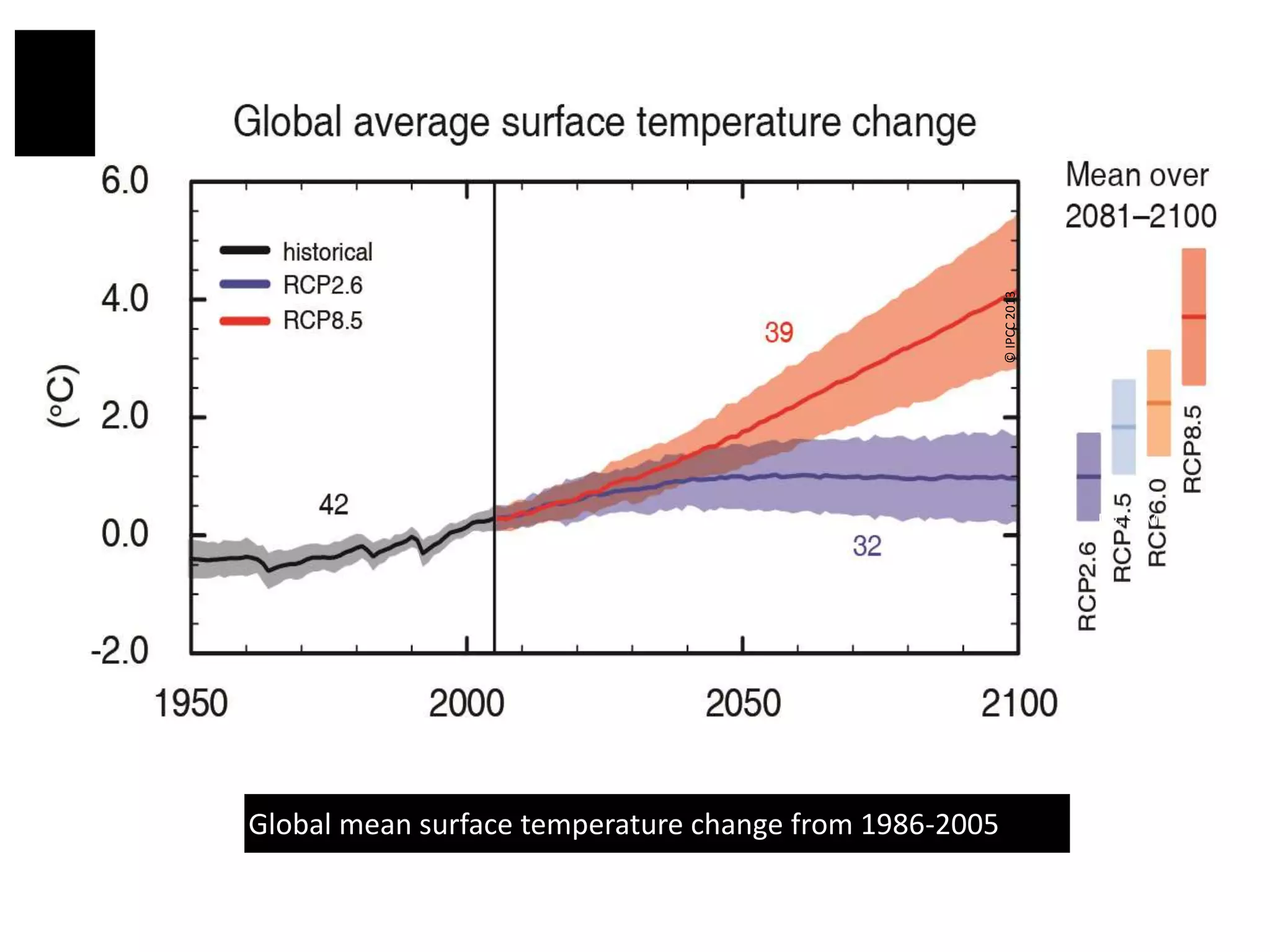
Global mean surface temperature change from 1986-2005
©IPCC2013
TSTFE.1,Fig.2
The contrast in precipitation between wet and dry regions
and between wet and dry seasons will increase, [...]
©IPCC2013
Change in water cycle properties from 1986-2005 to 2081-2100 in RCP8.5
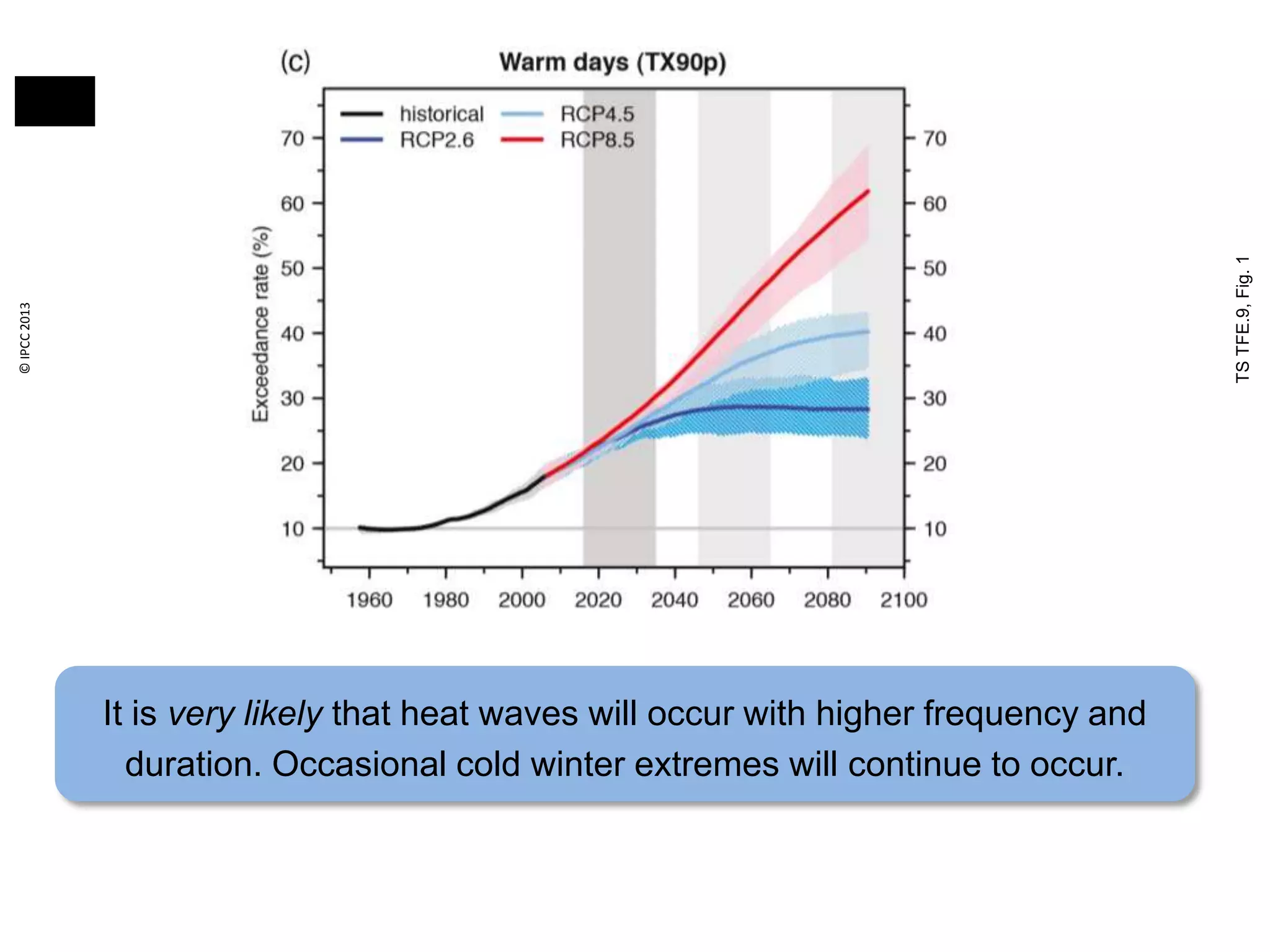
TSTFE.9,Fig.1
It is very likely that heat waves will occur with higher frequency and
duration. Occasional cold winter extremes will continue to occur.
©IPCC2013
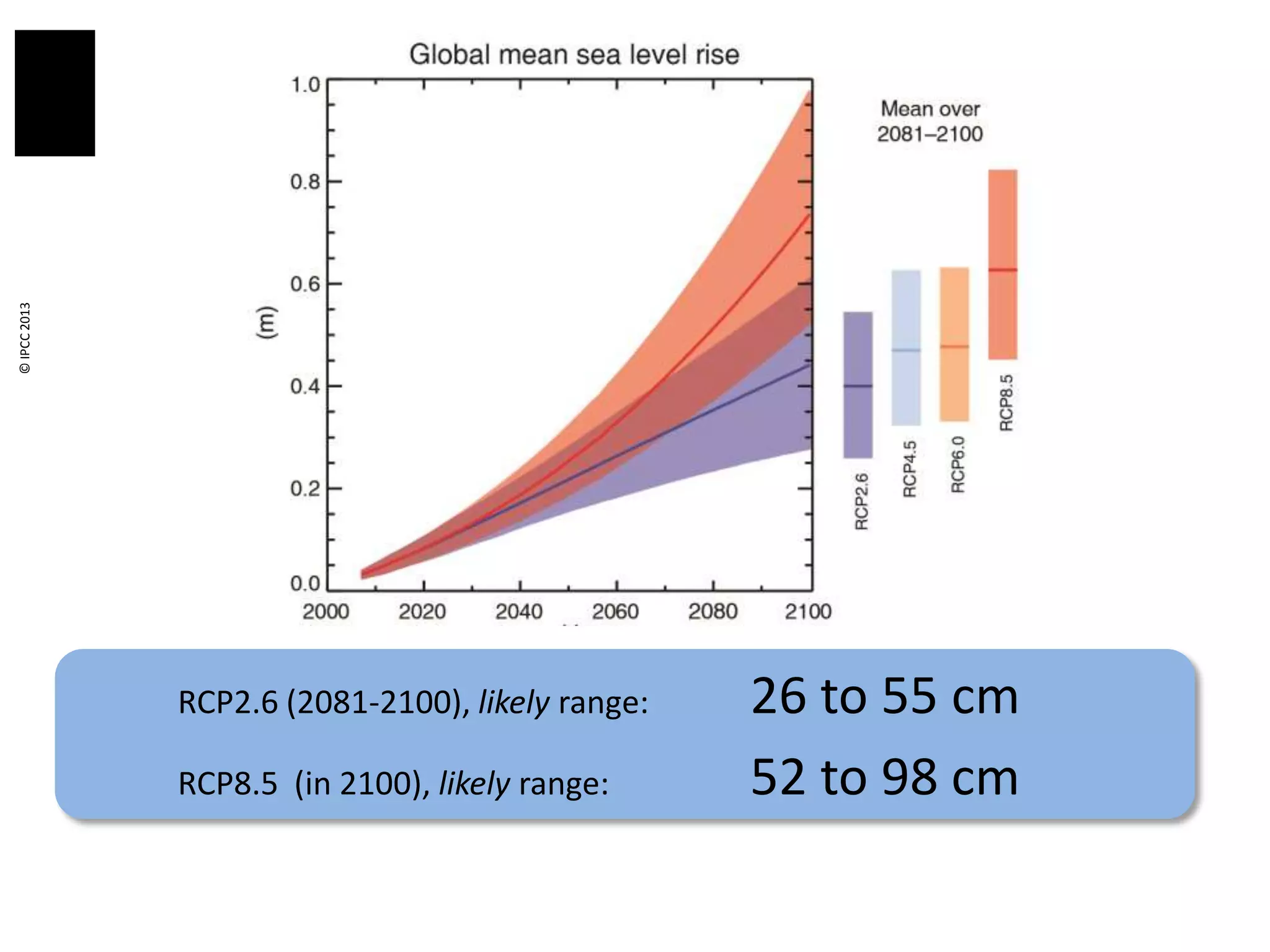
RCP2.6 (2081-2100), likely range: 26 to 55 cm
RCP8.5 (in 2100), likely range: 52 to 98 cm
Fig. SPM.9
©IPCC2013
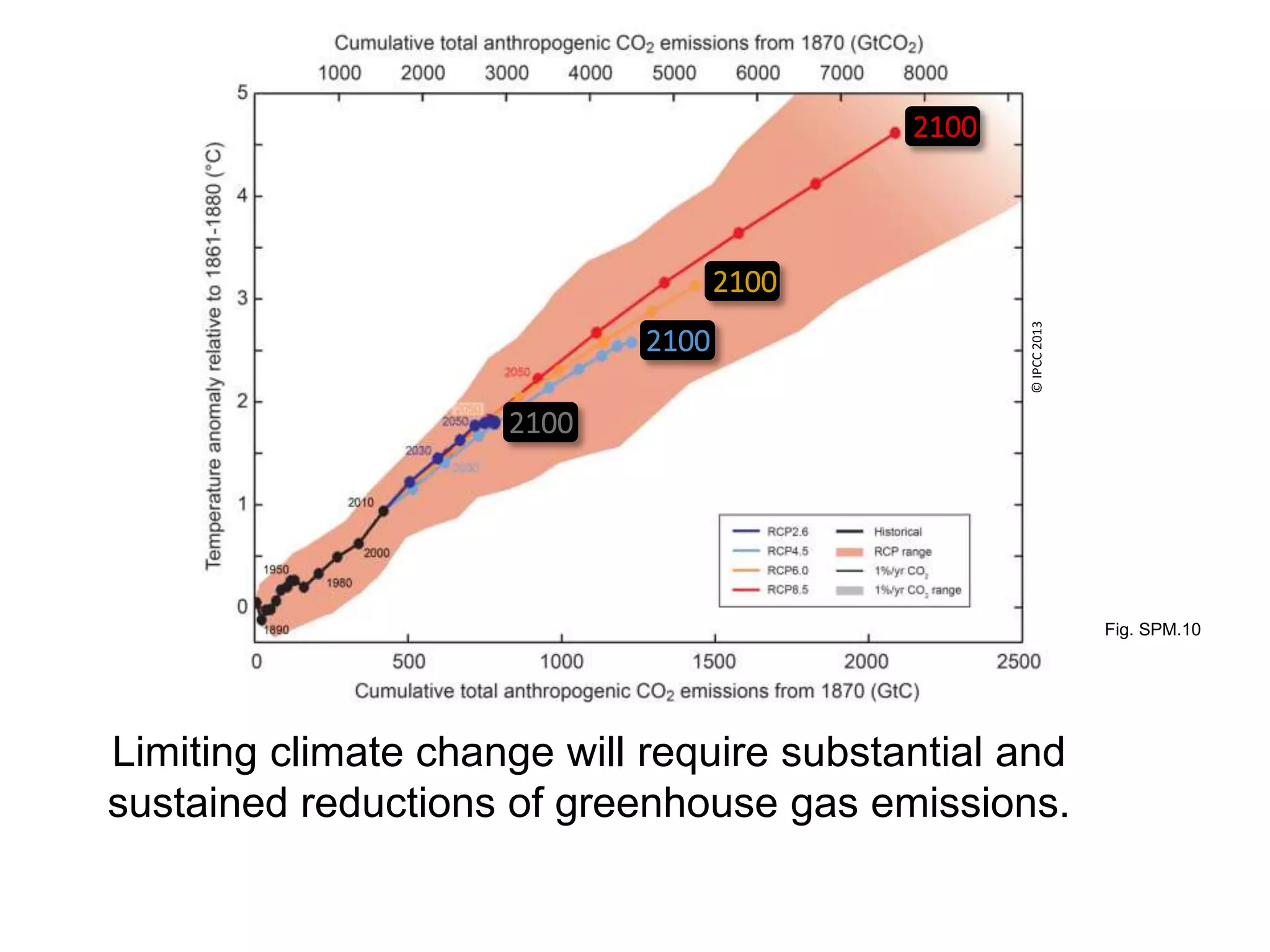
Cumulative emissions of CO2 largely determine global mean
surface warming by the late 21st century and beyond.
Fig. SPM.10
©IPCC2013
Fig. SPM.10
Limiting climate change will require substantial and
sustained reductions of greenhouse gas emissions.
©IPCC2013
Fig. SPM.10
Limiting climate change will require substantial and
sustained reductions of greenhouse gas emissions.
2100
2100
2100
2100
©IPCC2013
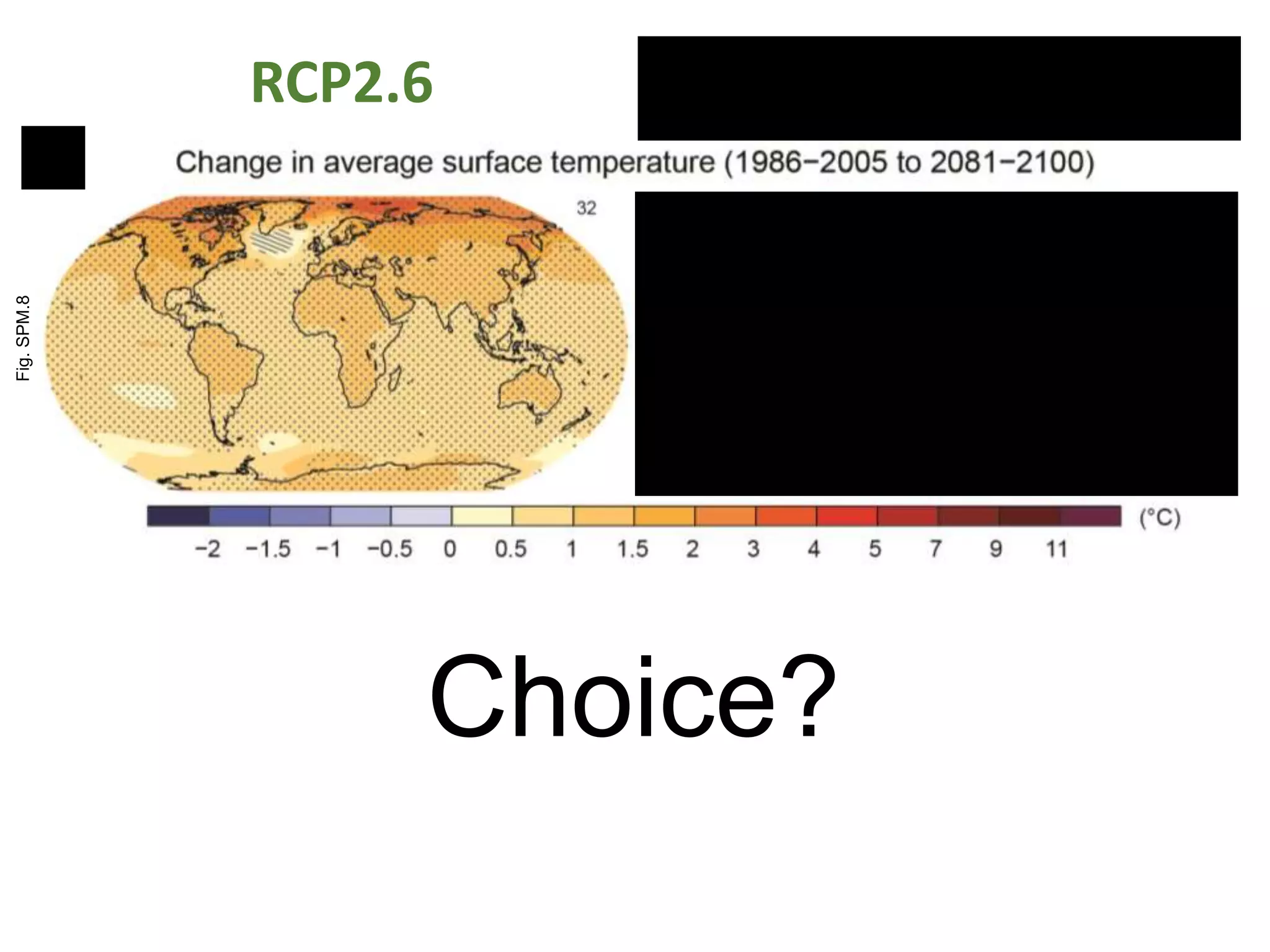
Choice?
RCP2.6 RCP8.5
Fig.SPM.8
OVERVIEW OF WGI AR5 OUTLINE
14 CHAPTERS
INTRODUCTION CH. 1
OBSERVATIONS AND PALEOCLIMATE INFORMATION CH. 2, 3, 4, 5
PROCESS UNDERSTANDING : CARBON AND BIOGEOCHEMICAL CYCLES, CLOUDS AND AEROSOLS CH. 6, 7
FROM FORCINGS TO ATTRIBUTION OF CLIMATE CHANGE : FORCINGS, MODEL EVALUATION, D&A CH. 8, 9, 10
FUTURE CLIMATE CHANGE AND PREDICTABILITY CH. 11, 12
INTEGRATION : SEA LEVEL, CLIMATE PHENOMENA CH. 13, 14
ATLAS OF GLOBAL AND REGIONAL PROJECTIONS
1523 pages
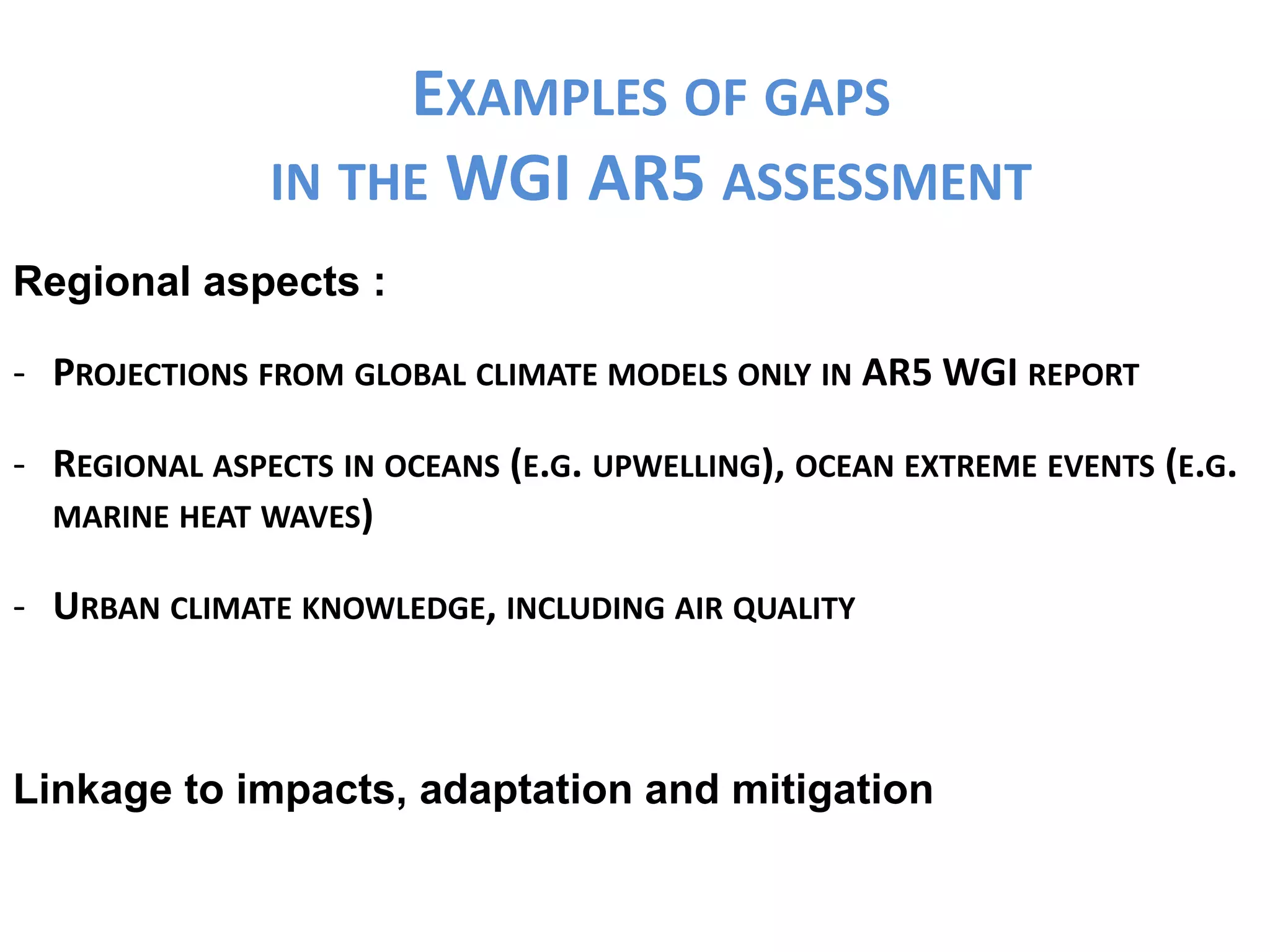
EXAMPLES OF GAPS
IN THE WGI AR5 ASSESSMENT
Regional aspects :
- PROJECTIONS FROM GLOBAL CLIMATE MODELS ONLY IN AR5 WGI REPORT
- REGIONAL ASPECTS IN OCEANS (E.G. UPWELLING), OCEAN EXTREME EVENTS (E.G.
MARINE HEAT WAVES)
- URBAN CLIMATE KNOWLEDGE, INCLUDING AIR QUALITY
Linkage to impacts, adaptation and mitigation
Projections, global emission pathway
and long-term goals
New shared socio-economic pathways
CMIP6
ScenarioMIP for CMIP6, O’Neil et al, GMD Discussion 2016
`Attribution of anthropogenic climate change on
extreme events
NAS Report, Attribution of extreme
weather events, 2016
Atmospheric
Environment Climate
change
GHG,
Short lived drivers
Climate impact on
natural processes
Climate change and air quality
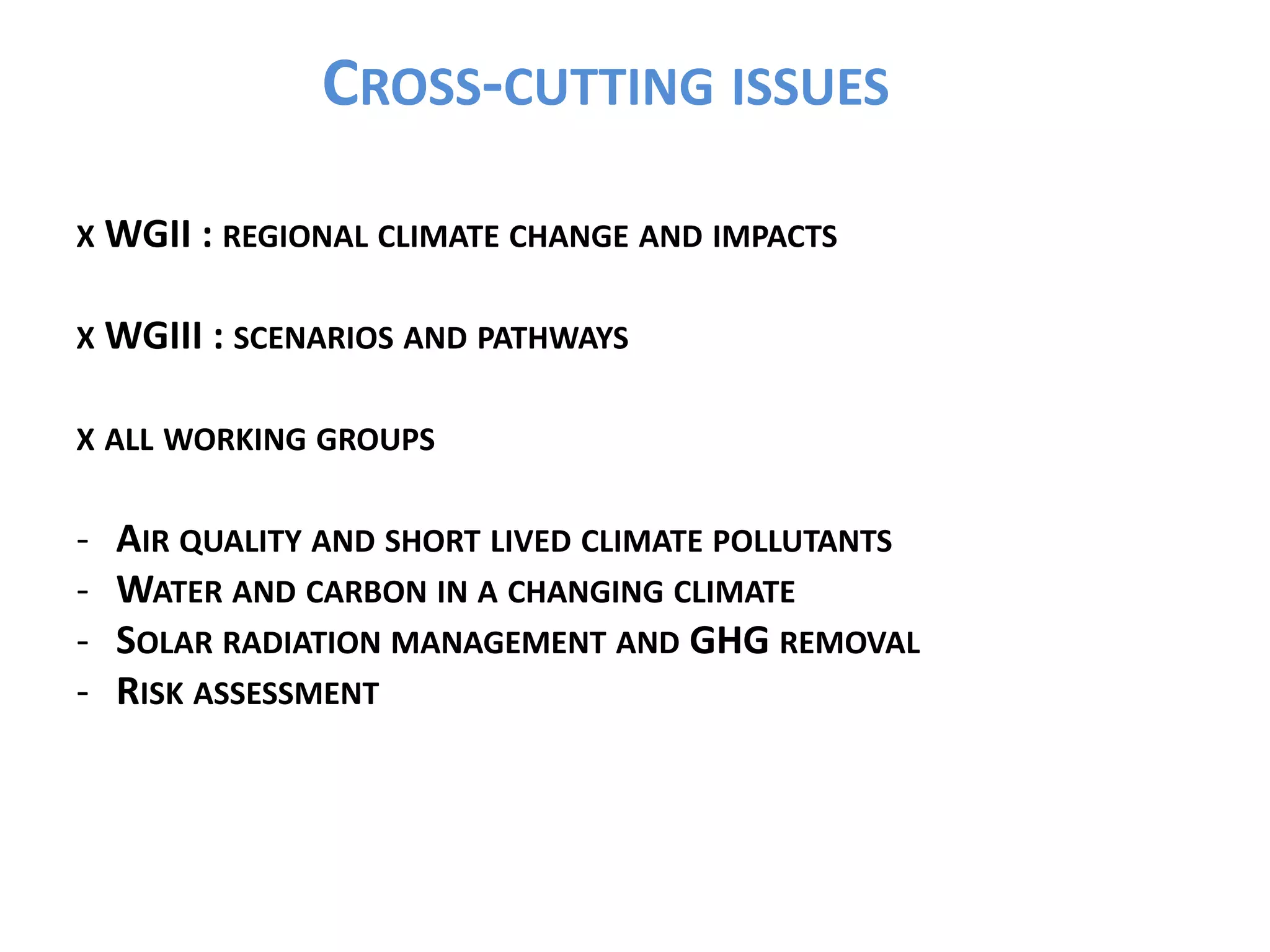
CROSS-CUTTING ISSUES
X WGII : REGIONAL CLIMATE CHANGE AND IMPACTS
X WGIII : SCENARIOS AND PATHWAYS
X ALL WORKING GROUPS
- AIR QUALITY AND SHORT LIVED CLIMATE POLLUTANTS
- WATER AND CARBON IN A CHANGING CLIMATE
- SOLAR RADIATION MANAGEMENT AND GHG REMOVAL
- RISK ASSESSMENT
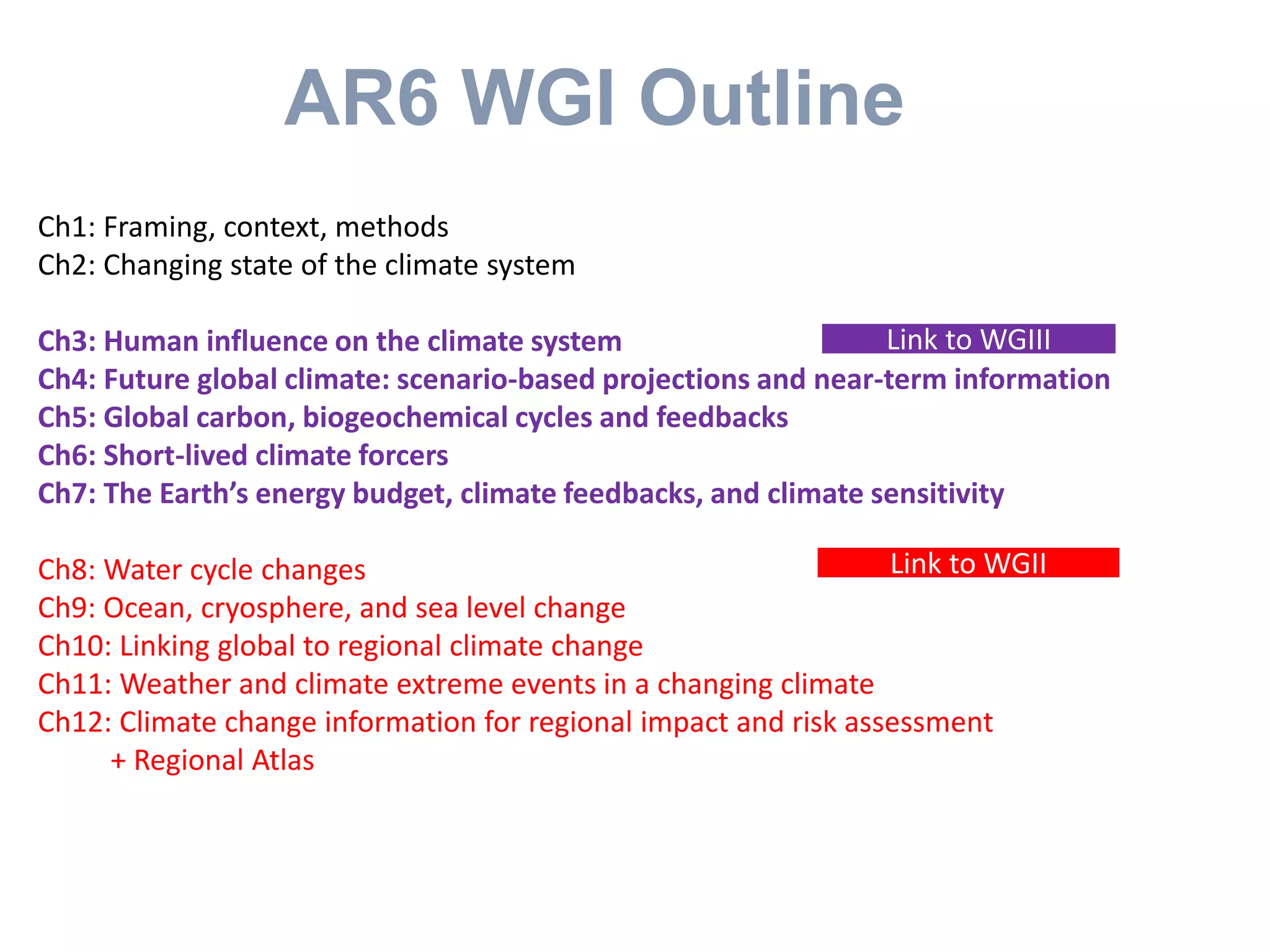
AR6 WGI Outline
Ch1: Framing, context, methods
Ch2: Changing state of the climate system
Ch3: Human influence on the climate system
Ch4: Future global climate: scenario-based projections and near-term information
Ch5: Global carbon, biogeochemical cycles and feedbacks
Ch6: Short-lived climate forcers
Ch7: The Earth’s energy budget, climate feedbacks, and climate sensitivity
Ch8: Water cycle changes
Ch9: Ocean, cryosphere, and sea level change
Ch10: Linking global to regional climate change
Ch11: Weather and climate extreme events in a changing climate
Ch12: Climate change information for regional impact and risk assessment
+ Regional Atlas
Link to WGIII
Link to WGII
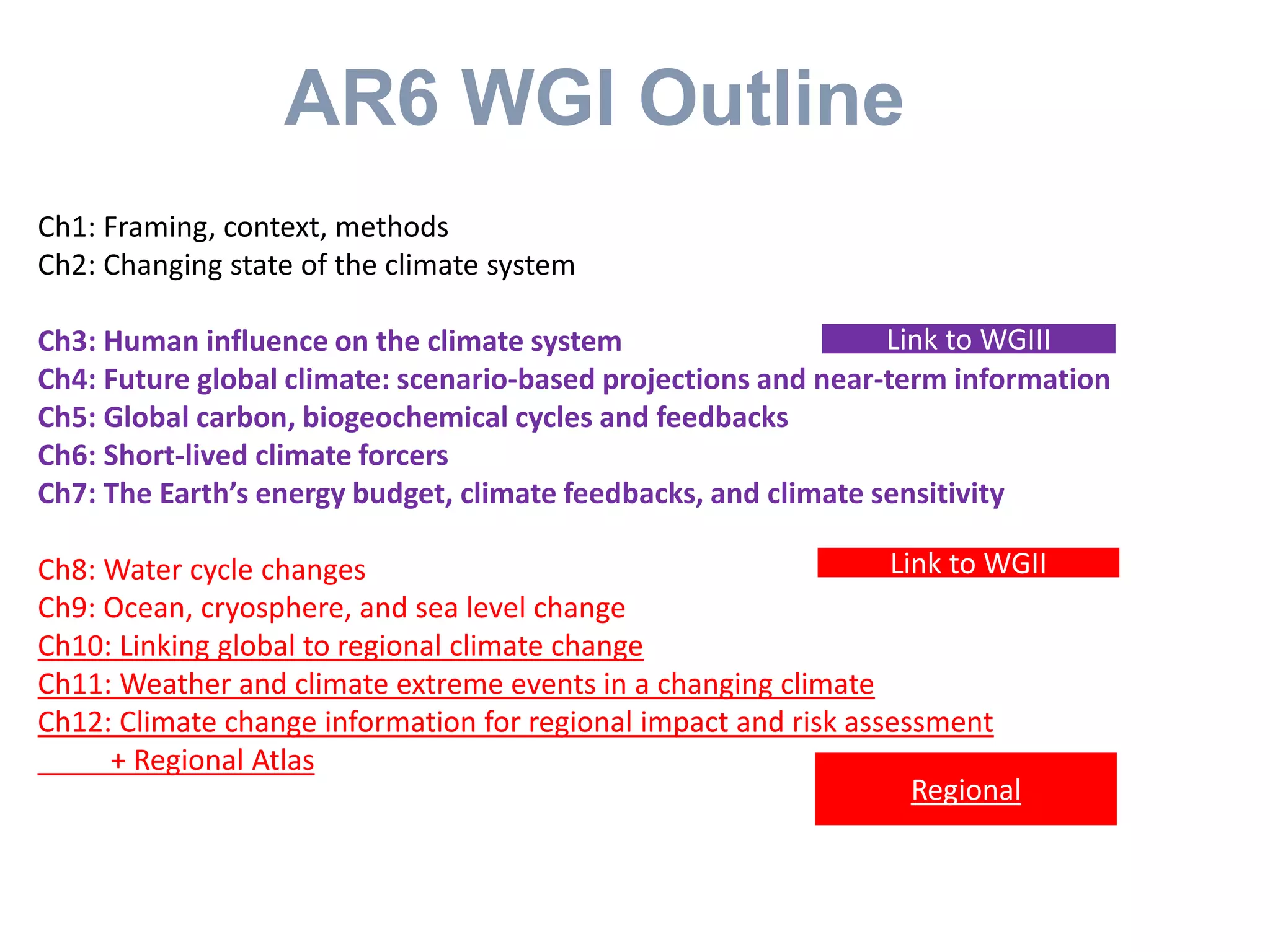
AR6 WGI Outline
Ch1: Framing, context, methods
Ch2: Changing state of the climate system
Ch3: Human influence on the climate system
Ch4: Future global climate: scenario-based projections and near-term information
Ch5: Global carbon, biogeochemical cycles and feedbacks
Ch6: Short-lived climate forcers
Ch7: The Earth’s energy budget, climate feedbacks, and climate sensitivity
Ch8: Water cycle changes
Ch9: Ocean, cryosphere, and sea level change
Ch10: Linking global to regional climate change
Ch11: Weather and climate extreme events in a changing climate
Ch12: Climate change information for regional impact and risk assessment
+ Regional Atlas
Link to WGIII
Link to WGII
Regional
IPCC
IPCC
http://www.slideshare.net/ipcc-
media/presentations
https://www.youtube.com/c/ipccgeneva
Find us on:
Website: http://ipcc.ch/
IPCC Secretariat: ipcc-sec@wmo.int
IPCC Press Office: ipcc-media@wmo.int
@IPCC_CH
https://www.linkedin.com/company/ipcc
https://www.flickr.com/photos/ipccphoto/sets/
https://vimeo.com/ipcc
THANK YOU FOR YOUR ATTENTION!
For more information:

From IPCC WGI AR5 to AR6

  • 1.
    http://bit.ly/ipcc_outreach_myanmar From IPCC WGIAR5 to AR6 Panmao Zhai, Co-Chair, WGI Outreach Event on IPCC Activities and Findings Nay Pyi Taw, Myanmar, 30-31 May 2019
  • 2.
    Key SPM Messages 19Headlines on less than 2 Pages 2 2009: WGI Outline Approved 14 Chapters, >106 Words Atlas of Regional Projections 54,677 Review Comments by 1089 Experts 2010: 259 Authors Selected Summary for Policymakers ca. 14,000 Words
  • 3.
  • 4.
    Each of thelast three decades has been successively warmer at the Earth’s surface than any preceding decade since 1850. In the Northern Hemisphere, 1983–2012 was likely the warmest 30- year period of the last 1400 years (medium confidence). Fig. SPM.1a Anomaly(°C)relativeto1961-1990 ©IPCC2013
  • 5.
    Fig.SPM.1b Temperature Difference 1901to 2012 based on trend (°C) Warming of the climate system is unequivocal, [...] Fig.SPM.2 Precipitation Trend (mm/yr per decade) © IPCC 2013© IPCC 2013
  • 6.
    (Lüthi et al.,2008,NOAA) +40% 2013 The atmospheric concentrations of carbon dioxide, methane, and nitrous oxide have increased to levels unprecedented in at least the last 800,000 years.
  • 7.
    Fig.TS.3 Ice loss fromGlaciers 226 (±60%) Gt yr-1 (1993-2003) Greenland 215 (±25%) Gt yr-1 (2002-2011) Antarctica 147 (±50%) Gt yr-1 (2002-2011) © IPCC 2013
  • 8.
    Energy(1021Joules) Ocean warming dominatesthe increase in energy stored in the climate system, accounting for more than 90% of the energy accumulated between 1971 and 2010 (high confidence). Box 3.1, Fig. 1© IPCC 2013
  • 9.
    Total radiative forcingis positive, and has led to an uptake of energy in the climate system. The largest contribution [...] is caused by the increase in the atmospheric concentration of CO2 since 1750. Fig.SPM.5 © IPCC 2013
  • 10.
    Global mean warmingsince 1951 (°C) Solar, Volcanic Aerosols CO2, CH4, N2O Anthropogenic Internal Variability Observed Fig. TS.10 The observed warming 1951−2010 is approximately 0.6°C to 0.7°C. ©IPCC2013
  • 11.
    Global mean warmingsince 1951 (°C) Solar, Volcanic Aerosols CO2, CH4, N2O Anthropogenic Internal Variability Observed Fig. TS.10 It is extremely likely that human influence has been the dominant cause of the observed warming since the mid-20th century. ©IPCC2013
  • 12.
    Global mean warmingsince 1951 (°C) Solar, Volcanic Aerosols CO2, CH4, N2O Anthropogenic Internal Variability Observed Fig. TS.10 Human influence on the climate system is clear. ©IPCC2013
  • 13.
    Fig. SPM.7a Global meansurface temperature change from 1986-2005 ©IPCC2013
  • 14.
    TSTFE.1,Fig.2 The contrast inprecipitation between wet and dry regions and between wet and dry seasons will increase, [...] ©IPCC2013 Change in water cycle properties from 1986-2005 to 2081-2100 in RCP8.5
  • 15.
    TSTFE.9,Fig.1 It is verylikely that heat waves will occur with higher frequency and duration. Occasional cold winter extremes will continue to occur. ©IPCC2013
  • 16.
    RCP2.6 (2081-2100), likelyrange: 26 to 55 cm RCP8.5 (in 2100), likely range: 52 to 98 cm Fig. SPM.9 ©IPCC2013
  • 17.
    Cumulative emissions ofCO2 largely determine global mean surface warming by the late 21st century and beyond. Fig. SPM.10 ©IPCC2013
  • 18.
    Fig. SPM.10 Limiting climatechange will require substantial and sustained reductions of greenhouse gas emissions. ©IPCC2013
  • 19.
    Fig. SPM.10 Limiting climatechange will require substantial and sustained reductions of greenhouse gas emissions. 2100 2100 2100 2100 ©IPCC2013
  • 20.
  • 21.
    OVERVIEW OF WGIAR5 OUTLINE 14 CHAPTERS INTRODUCTION CH. 1 OBSERVATIONS AND PALEOCLIMATE INFORMATION CH. 2, 3, 4, 5 PROCESS UNDERSTANDING : CARBON AND BIOGEOCHEMICAL CYCLES, CLOUDS AND AEROSOLS CH. 6, 7 FROM FORCINGS TO ATTRIBUTION OF CLIMATE CHANGE : FORCINGS, MODEL EVALUATION, D&A CH. 8, 9, 10 FUTURE CLIMATE CHANGE AND PREDICTABILITY CH. 11, 12 INTEGRATION : SEA LEVEL, CLIMATE PHENOMENA CH. 13, 14 ATLAS OF GLOBAL AND REGIONAL PROJECTIONS 1523 pages
  • 22.
    EXAMPLES OF GAPS INTHE WGI AR5 ASSESSMENT Regional aspects : - PROJECTIONS FROM GLOBAL CLIMATE MODELS ONLY IN AR5 WGI REPORT - REGIONAL ASPECTS IN OCEANS (E.G. UPWELLING), OCEAN EXTREME EVENTS (E.G. MARINE HEAT WAVES) - URBAN CLIMATE KNOWLEDGE, INCLUDING AIR QUALITY Linkage to impacts, adaptation and mitigation
  • 23.
    Projections, global emissionpathway and long-term goals New shared socio-economic pathways CMIP6 ScenarioMIP for CMIP6, O’Neil et al, GMD Discussion 2016
  • 24.
    `Attribution of anthropogenicclimate change on extreme events NAS Report, Attribution of extreme weather events, 2016
  • 25.
    Atmospheric Environment Climate change GHG, Short liveddrivers Climate impact on natural processes Climate change and air quality
  • 26.
    CROSS-CUTTING ISSUES X WGII: REGIONAL CLIMATE CHANGE AND IMPACTS X WGIII : SCENARIOS AND PATHWAYS X ALL WORKING GROUPS - AIR QUALITY AND SHORT LIVED CLIMATE POLLUTANTS - WATER AND CARBON IN A CHANGING CLIMATE - SOLAR RADIATION MANAGEMENT AND GHG REMOVAL - RISK ASSESSMENT
  • 27.
    AR6 WGI Outline Ch1:Framing, context, methods Ch2: Changing state of the climate system Ch3: Human influence on the climate system Ch4: Future global climate: scenario-based projections and near-term information Ch5: Global carbon, biogeochemical cycles and feedbacks Ch6: Short-lived climate forcers Ch7: The Earth’s energy budget, climate feedbacks, and climate sensitivity Ch8: Water cycle changes Ch9: Ocean, cryosphere, and sea level change Ch10: Linking global to regional climate change Ch11: Weather and climate extreme events in a changing climate Ch12: Climate change information for regional impact and risk assessment + Regional Atlas Link to WGIII Link to WGII
  • 28.
    AR6 WGI Outline Ch1:Framing, context, methods Ch2: Changing state of the climate system Ch3: Human influence on the climate system Ch4: Future global climate: scenario-based projections and near-term information Ch5: Global carbon, biogeochemical cycles and feedbacks Ch6: Short-lived climate forcers Ch7: The Earth’s energy budget, climate feedbacks, and climate sensitivity Ch8: Water cycle changes Ch9: Ocean, cryosphere, and sea level change Ch10: Linking global to regional climate change Ch11: Weather and climate extreme events in a changing climate Ch12: Climate change information for regional impact and risk assessment + Regional Atlas Link to WGIII Link to WGII Regional
  • 29.
    IPCC IPCC http://www.slideshare.net/ipcc- media/presentations https://www.youtube.com/c/ipccgeneva Find us on: Website:http://ipcc.ch/ IPCC Secretariat: ipcc-sec@wmo.int IPCC Press Office: ipcc-media@wmo.int @IPCC_CH https://www.linkedin.com/company/ipcc https://www.flickr.com/photos/ipccphoto/sets/ https://vimeo.com/ipcc THANK YOU FOR YOUR ATTENTION! For more information: