What is the value of
class action
settlement?
Class action
A class action, also known as a class action
lawsuit, class suit, or representative action, is
a type of lawsuit where one of the parties is
a group of people who are represented
collectively by a member of that group. The
class action originated in the United States
and is still predominantly a U.S.
phenomenon, but Canada, as well as several
European countries with civil law have made
changes in recent years to allow consumer
organizations to bring claims on behalf of
consumers.
2
What Are Class
Action Lawsuits?Class action lawsuits are appropriate when the damages claimed by each plaintiff are
too small for individual claims to be worthwhile. By filing this legal action as a group, the
plaintiffs have the resources to hire an attorney and obtain restitution. Class actions also
relieve courts of the burden of hearing hundreds or thousands of small claims.
Class action lawsuits are often filed against government entities, financial institutions,
manufacturers, retailers, and employers. Many are based on allegations of defective
products, false advertising, discrimination, or unlawful employment practices. Some
suits have even alleged that the defendant violated the Telephone Consumer Protection
Act, which was enacted in 1991.
3
4
5
6
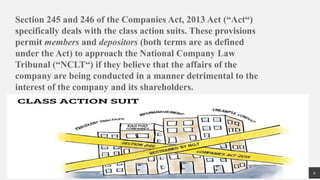
Section 245 and 246 of the Companies Act, 2013 Act (“Act“)
specifically deals with the class action suits. These provisions
permit members and depositors (both terms are as defined
under the Act) to approach the National Company Law
Tribunal (“NCLT“) if they believe that the affairs of the
company are being conducted in a manner detrimental to the
interest of the company and its shareholders.
7
No. of Required
Members/
Depositors
Percentage of
total Members/
Depositors
Percentage of
shareholding/deposits owed
Whichever is less.
Members(In case
of a company
having a share
capital)
100 5% In the event of a listed company –
2%In the event of an unlisted
company – 5%
Depositors 100 5% 5% 
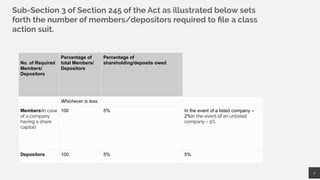
Sub-Section 3 of Section 245 of the Act as illustrated below sets
forth the number of members/depositors required to file a class
action suit.
How do
class action
works ?
1.
Determine
whether a
class action
can be
filled
2. File a law
suit
3.
Certifying
the class
4.
Discovery
5.
Resolution
of claim
through
settlement
s or trials.
6. Notify
the class
members
8
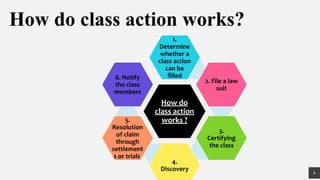
How do class action works?
9
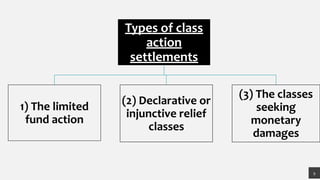
Types of class
action
settlements
1) The limited
fund action
(2) Declarative or
injunctive relief
classes
(3) The classes
seeking
monetary
damages
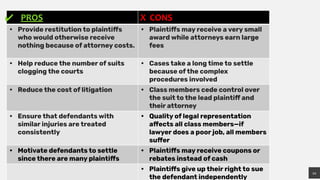
✔ PROS X CONS
• Provide restitution to plaintiffs
who would otherwise receive
nothing because of attorney costs.
• Plaintiffs may receive a very small
award while attorneys earn large
fees
• Help reduce the number of suits
clogging the courts
• Cases take a long time to settle
because of the complex
procedures involved
• Reduce the cost of litigation • Class members cede control over
the suit to the lead plaintiff and
their attorney
• Ensure that defendants with
similar injuries are treated
consistently
• Quality of legal representation
affects all class members—if
lawyer does a poor job, all members
suffer
• Motivate defendants to settle
since there are many plaintiffs
• Plaintiffs may receive coupons or
rebates instead of cash
• Plaintiffs give up their right to sue
the defendant independently
10
11
12
13
ThankYou
PRESENTED BY-
Nidhi Bhardwaj 14

Class Action Settlement

  • 1.
    What is thevalue of class action settlement?
  • 2.
    Class action A classaction, also known as a class action lawsuit, class suit, or representative action, is a type of lawsuit where one of the parties is a group of people who are represented collectively by a member of that group. The class action originated in the United States and is still predominantly a U.S. phenomenon, but Canada, as well as several European countries with civil law have made changes in recent years to allow consumer organizations to bring claims on behalf of consumers. 2
  • 3.
    What Are Class ActionLawsuits?Class action lawsuits are appropriate when the damages claimed by each plaintiff are too small for individual claims to be worthwhile. By filing this legal action as a group, the plaintiffs have the resources to hire an attorney and obtain restitution. Class actions also relieve courts of the burden of hearing hundreds or thousands of small claims. Class action lawsuits are often filed against government entities, financial institutions, manufacturers, retailers, and employers. Many are based on allegations of defective products, false advertising, discrimination, or unlawful employment practices. Some suits have even alleged that the defendant violated the Telephone Consumer Protection Act, which was enacted in 1991. 3
  • 4.
  • 5.
  • 6.
    6 Section 245 and246 of the Companies Act, 2013 Act (“Act“) specifically deals with the class action suits. These provisions permit members and depositors (both terms are as defined under the Act) to approach the National Company Law Tribunal (“NCLT“) if they believe that the affairs of the company are being conducted in a manner detrimental to the interest of the company and its shareholders.
  • 7.
    7 No. of Required Members/ Depositors Percentageof total Members/ Depositors Percentage of shareholding/deposits owed Whichever is less. Members(In case of a company having a share capital) 100 5% In the event of a listed company – 2%In the event of an unlisted company – 5% Depositors 100 5% 5%  Sub-Section 3 of Section 245 of the Act as illustrated below sets forth the number of members/depositors required to file a class action suit.
  • 8.
    How do class action works? 1. Determine whether a class action can be filled 2. File a law suit 3. Certifying the class 4. Discovery 5. Resolution of claim through settlement s or trials. 6. Notify the class members 8 How do class action works?
  • 9.
    9 Types of class action settlements 1)The limited fund action (2) Declarative or injunctive relief classes (3) The classes seeking monetary damages
  • 10.
    ✔ PROS XCONS • Provide restitution to plaintiffs who would otherwise receive nothing because of attorney costs. • Plaintiffs may receive a very small award while attorneys earn large fees • Help reduce the number of suits clogging the courts • Cases take a long time to settle because of the complex procedures involved • Reduce the cost of litigation • Class members cede control over the suit to the lead plaintiff and their attorney • Ensure that defendants with similar injuries are treated consistently • Quality of legal representation affects all class members—if lawyer does a poor job, all members suffer • Motivate defendants to settle since there are many plaintiffs • Plaintiffs may receive coupons or rebates instead of cash • Plaintiffs give up their right to sue the defendant independently 10
  • 11.
  • 12.
  • 13.
  • 14.