The Story of Village Palampur
Overview
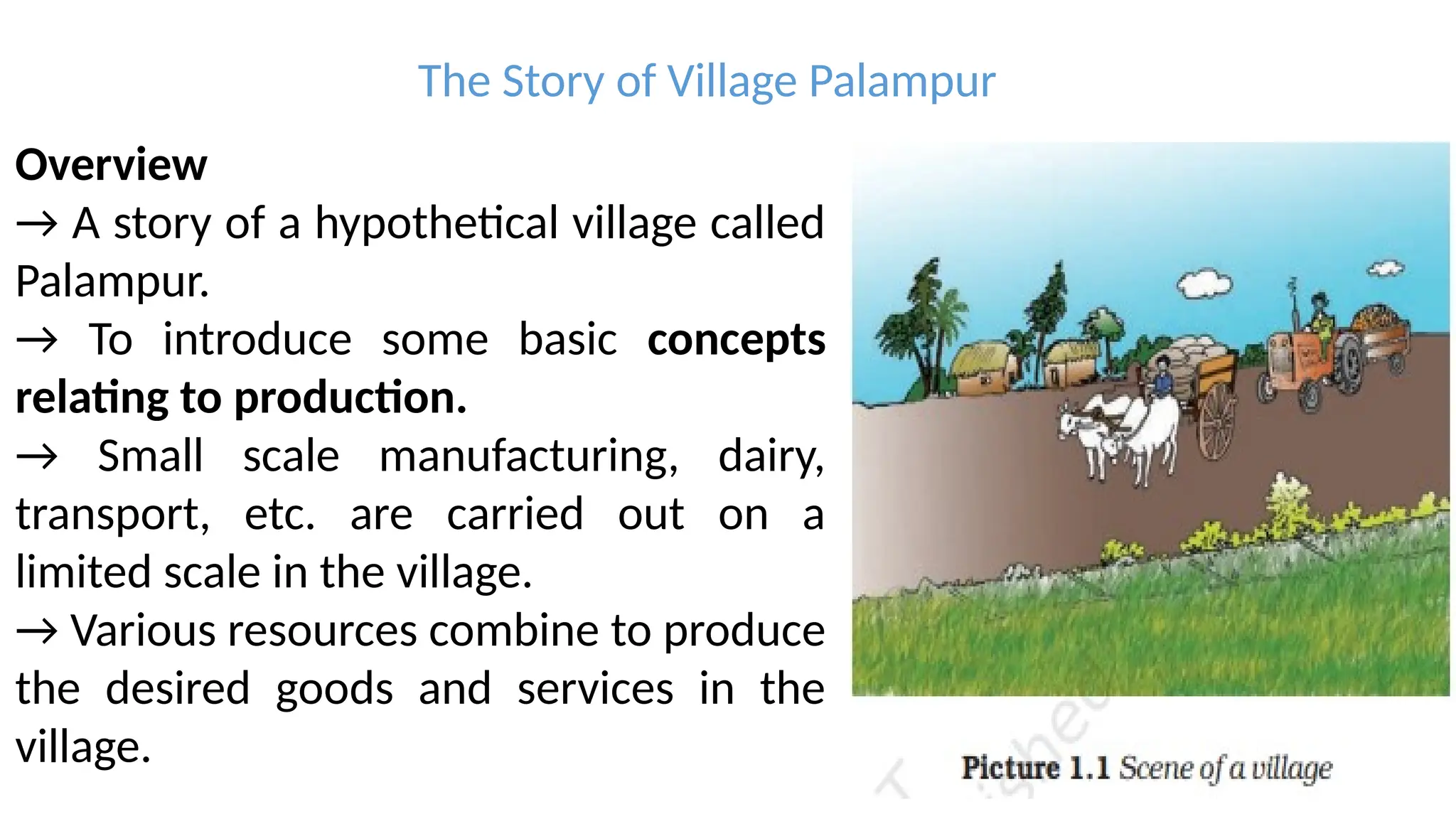
→ A story of a hypothetical village called
Palampur.
→ To introduce some basic concepts
relating to production.
→ Small scale manufacturing, dairy,
transport, etc. are carried out on a
limited scale in the village.
→ Various resources combine to produce
the desired goods and services in the
village.
Introduction
• Palampur is a small village, well-connected with neighbouring villages and towns like,
Raiganj.
• Bullock carts, tongas, bogeys , motorcycles, jeeps, tractors and trucks types of visible
transport facilities are available on the road of Palampur.
• This village has two primary and one high school and also has a primary health center
run by the government and one private dispensary.
• About 450 different caste families are living here.
→ Out of them, 80 upper caste families have land majority in this village. One third of
total population is covered by schedule caste.
• Most of the houses have electric connections.
→ Small manufacturing, transport, shop-keeping and farming are the production activities
of the village Palampur.
Organization of Production
Production: Goods &service that we want
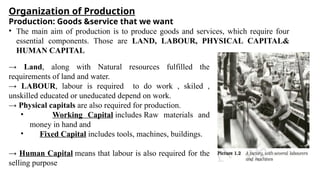
• The main aim of production is to produce goods and services, which require four
essential components. Those are LAND, LABOUR, PHYSICAL CAPITAL&
HUMAN CAPITAL
→ Land, along with Natural resources fulfilled the
requirements of land and water.
→ LABOUR, labour is required to do work , skiled ,
unskilled educated or uneducated depend on work.
→ Physical capitals are also required for production.
• Working Capital includes Raw materials and
money in hand and
• Fixed Capital includes tools, machines, buildings.
→ Human Capital means that labour is also required for the
selling purpose
Farming in Palampur
Farming in Palampur is based on following factor:
(i) Land is fixed
(ii) Change in the method of cultivation
(iii) Multiple cropping
(iv) Modern Farming
(v) Sustainability of land
(vi) Distribution of land
(vii) Labour
(viii) Capital
(ix) Selling of farms products
(1) Land is fixed
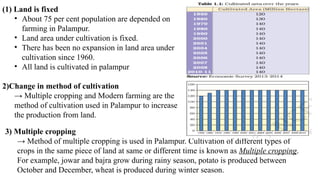
• About 75 per cent population are depended on
farming in Palampur.
• Land area under cultivation is fixed.
• There has been no expansion in land area under
cultivation since 1960.
• All land is cultivated in palampur
2)Change in method of cultivation
→ Multiple cropping and Modern farming are the
method of cultivation used in Palampur to increase
the production from land.
3) Multiple cropping
→ Method of multiple cropping is used in Palampur. Cultivation of different types of
crops in the same piece of land at same or different time is known as Multiple cropping.
For example, jowar and bajra grow during rainy season, potato is produced between
October and December, wheat is produced during winter season.
4) Modern farming
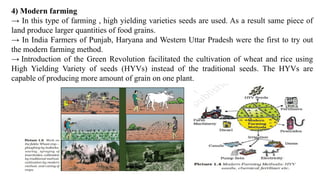
→ In this type of farming , high yielding varieties seeds are used. As a result same piece of
land produce larger quantities of food grains.
→ In India Farmers of Punjab, Haryana and Western Uttar Pradesh were the first to try out
the modern farming method.
→ Introduction of the Green Revolution facilitated the cultivation of wheat and rice using
High Yielding Variety of seeds (HYVs) instead of the traditional seeds. The HYVs are
capable of producing more amount of grain on one plant.
5) Sustainability of land
→ According to a scientific report, in modern farming natural resource are
overused.
→ Groundwater, rivers and lakes are polluted by the way of using of chemical
fertilizers.
→ Chemical fertilizers also kill bacteria and other micro-organisms in the soil
which are essential for the growth of plants.
6) Distribution of land
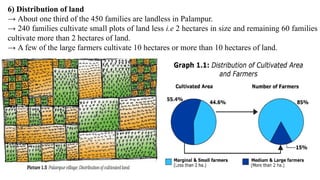
→ About one third of the 450 families are landless in Palampur.
→ 240 families cultivate small plots of land less i.e 2 hectares in size and remaining 60 families
cultivate more than 2 hectares of land.
→ A few of the large farmers cultivate 10 hectares or more than 10 hectares of land.
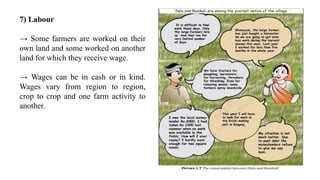
7) Labour
→ Some farmers are worked on their
own land and some worked on another
land for which they receive wage.
→ Wages can be in cash or in kind.
Wages vary from region to region,
crop to crop and one farm activity to
another.
8) Capital
→ Huge capital is required in the method of modern farming.
→ Small farmers have lack of capital. They borrow money from large
farmers and moneylenders at higher rate of interest.
→ There are three type of capital which are mostly used in any
organization i.e working capital, fixed capital and human capital.
9) Selling of Farm Products
→ Surplus products are sold to medium or large farmers by the small farmers.
→ After that, medium and large farmers sell their surplus directly to the market.
→ The traders buy the products from market and sell the products to shopkeepers in the
towns and cities.
Non-Farm Activities in Palampur
25 per cent of total population is engaged in non-farming activities in Palampur.
1) Small-scale manufacturing
→ In Palampur, small scale manufacturing is done. Basically, the work is carried out at
home or in the fields with the help of family labour. So, labour is hired rarely.
2) Transporting
→ People and goods are ferried from one place to another through transporting service.
For this service the worker get paid. In Palampur, road is the mode of transportation.
3) Dairy
→ Dairy is a major source of earning money in Palampur.
→ Dairy is a type of business where harvesting or processing of animal milk are done
mostly from cow and buffaloes.
4) Shopkeeping
→ Shopkeeping is also a source of earning money in Palampur.
→ Shopkeepers earn money by selling a wide range of items like rice, wheat, sugar, tea,
oil, biscuits, soap, toothpaste, batteries, candles, notebooks, pen, pencil, even some
cloth. Here, shopkeeper is an individual who run the shop.
Q.1 Modern farming methods require more inputs which are manufactured in
industry. Do you agree?
Sol. This statement is quite correct. Modern farming methods require chemical fertilisers,
pesticides and modern farm equipments. All of these are manufactured in industry.
Q.2 How did the spread of electricity help farmers in Palampur?
Sol. Electricity can help any village. Availability of electricity ensures better irrigation. It
also means that villagers can engage in some manufacturing activities; like flour mills,
jaggery production, etc. Children can study late in the evening and shopkeepers can do better
business if proper electricity supply can be provided.
Q.3 Is it important to increase the area under irrigation? Why?
Sol. As per estimates, 60% of the villages still need proper irrigation facility. Since land
under cultivation cannot be increased to increasing the area under irrigation is a major way to
improve farm productivity.
Q.5 Why are the wages for farm labourers in Palampur less than minimum wages?
Sol. There is more supply of workers than the demand. Due to this, the workers are not in a
position to bargain from their employers. Hence, the wages for farm labourers are less than
minimum wages.
Q.6 In your region, talk to two labourers. Choose either farm labourers or labourers
working at construction sites. What wages do they get? Are they paid in cash or kind? Do
they get work regularly? Are they in debt?
Sol. People who work at construction site usually get the minimum wages. An unskilled
worker gets around Rs. 250 per day. A skilled worker; such as a mason; get around Rs. 500 per
day.
Q.7 What are the different ways of increasing production on the same piece of land? Use
examples to explain.
Sol. Production can be increased by using HYV seeds, fertilisers and proper irrigation.
Mixed farming can also be used to improve farm production.
Q.8 Describe the work of a farmer with 1 hectare of land.
Sol. A farmer with 1 hectare of land shall put under the category of small farmer. Most of the
work would be done by the farmer and his family members. The farmer will normally use a pair
of bullocks to plough the field. His family members would assist him in sowing the seeds.
During harvest time, he may require to hire some labourers.
Q.9 How do the medium and large farmers obtain capital for farming? How is it
different from the small farmers?
Sol. Medium and large farmers usually have surplus cash by selling their farm produce. Since
they have land and house, they easily get loan from banks. Small farmers, on the other hand,
may not be able to get bank loans. They have to depend on the local merchant and moneylender
for loan.
Q.10 Talk to some old residents in your region and write a short report on the changes in
irrigation and changes in production methods during the last 30 years.
Sol. During the early period, irrigation was done by Persian wheel. Diesel operated or
electricity operated pumps have replaced the Persian wheels. Tractors have replaced bullocks for
ploughing the large farms. Now more and more farmers are in a position to grow up to three
crops in a year.
Q.11 What are the non-farm production activities taking place in your region? Make
a short list.
Sol. Cycle repair shop, carpenter, ironsmith, general store, tea stall, stationary shop,
computer training institute, etc.
Q.12 What can be done so that more non-farm production activities can be started in
villages?
Sol. The government should improve electricity supply in the villages. It should open
more schools so that children can grow to become educated adults. Moreover, government
can also provide vocational training to the rural youths. These activities would help in
increasing non-farm production activities in a village.
People as Resource
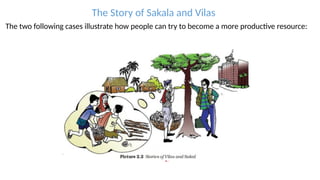
The Story of Sakala and Vilas
The two following cases illustrate how people can try to become a more productive resource:
• Population of a nation can be its asset rather than liability.
• ‘People as resource’ refers to a country’s working people in terms
of their existing productive skills and abilities.
• When existing human resource is developed by becoming
educated and healthy it turns into human capital.
• Human capital is superior to other resources like land and
physical capital, as it uses these capitals and adds value to them.
• Investment in human capital via education and medical care can
give high returns in the future. Country like Japan have invested
a lot in human resources. They do not have rich natural
resources, but still they are called developed nations.
• Human beings perform many activities which can be grouped
into economic and non-economic.
Sectors under economic activities
(i) Primary Sector
(ii) Secondary Sector
(iii) Tertiary Sector
(i) Primary Sector
It is also known as agriculture sector. This sector considers directly using of natural
resources. This sector includes agriculture, forestry, animal husbandry, fishing,
poultry farming, mining, and quarrying.
(ii) Secondary Sector
It is also known as manufacturing sector. This sector considers manufacturing of
goods.
(iii) Tertiary sector
This sector provides service. This sector includes trade, transport, communication,
banking, education, health, tourism, services, insurance.
Two parts of Economic activities
(i) Market activities
Market activities consider production of goods or services including
government service for remuneration.
(ii) Non-market activities
Non-market activities consider production of goods or services for self-
consumption.
Works Performed under Economic activities
• There are huge difference between economic activity performed by men
and economic activity performed by women.
• Women look after domestic affairs like cooking of food, washing of
clothes, cleaning of utensils, housekeeping and looking after children. Men
work in the field.
• Men are paid for their work on the contrary women are not paid for their
performances in the house.
• The work done by men is recognized in the National Income whereas the
household work done by women is not recognized in the National Income.
Quality of Population: The quality of population depends upon the literacy rate,
life expectancy and skills formation acquired by the people of the country.
(i) Education
• Education is the process of learning for acquisition of knowledge. It is an
important input for growth of a person.
• Development of a country is basically depended on literacy rate. When a
person is educated, then a family can be educated. After that, society can be
educated and hence literacy rate of the country can increase.
• An educated person can earn more income compared than an uneducated
person because of their skill. For this term, National income of a country can
increase.
• Governance efficiency can also be enhanced through learning process.
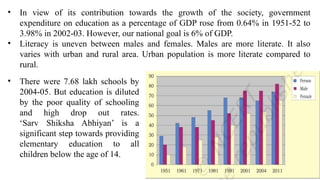
• There were 7.68 lakh schools by
2004-05. But education is diluted
by the poor quality of schooling
and high drop out rates.
‘Sarv Shiksha Abhiyan’ is a
significant step towards providing
elementary education to all
children below the age of 14.
• In view of its contribution towards the growth of the society, government
expenditure on education as a percentage of GDP rose from 0.64% in 1951-52 to
3.98% in 2002-03. However, our national goal is 6% of GDP.
• Literacy is uneven between males and females. Males are more literate. It also
varies with urban and rural area. Urban population is more literate compared to
rural.
(ii) Health
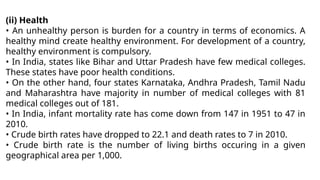
• An unhealthy person is burden for a country in terms of economics. A
healthy mind create healthy environment. For development of a country,
healthy environment is compulsory.
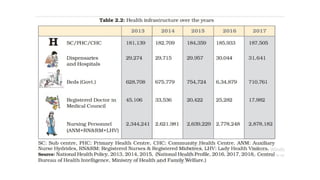
• In India, states like Bihar and Uttar Pradesh have few medical colleges.
These states have poor health conditions.
• On the other hand, four states Karnataka, Andhra Pradesh, Tamil Nadu
and Maharashtra have majority in number of medical colleges with 81
medical colleges out of 181.
• In India, infant mortality rate has come down from 147 in 1951 to 47 in
2010.
• Crude birth rates have dropped to 22.1 and death rates to 7 in 2010.
• Crude birth rate is the number of living births occuring in a given
geographical area per 1,000.
Unemployment
• Unemployment is a phenomenon that occurs when a person want to do
work but unable to find work.
• Unemployment is liability to the nation. It leads to wastage of manpower
resource.
Two types of unemployment found in rural areas:
(i) Seasonal unemployment
(ii) Disguised unemployment
(i) Seasonal unemployment
• In case of Seasonal unemployment, people are not able to find jobs during
some months of the year.
• Generally, in agriculture sector this kind of problem is visible. In agriculture
sector, some seasonal foodgrains are produced. So, the farmers are
employed only in that particular season.
(ii) Disguised unemployment
• Disguised unemployment happens when people appear to be employed.
• For example, in agriculture sector the field requires the service of six people
and nine people are worked in the same field then, three extra people are
come under the category of disguised unemployed. Production will not
decrease when three people are removed.
Urban areas unemployment
• In urban areas educated unemployment are seen. This problem occurs when
an educated person is willing to work but, he/she unable to find work.
• Number of graduated and post-graduated unemployed has increased faster
than among matriculates unemployed.
Nature of Unemployment in India:
Seasonal unemployment occurs when people fail to get work during some
months of the year (that is, during off-season). Farm labourers usually face
this kind of problem.
Disguised unemployment is another kind of unemployment found in rural
areas. Such kind of problem arises due to excessive pressure of population
on agriculture. Disguised unemployment refers to a situation where in the
number of workers in a job is more than actually required to do the job. The
extra number of workers are disguisedly unemployed.
Increase in unemployment is an indicator of depressed economy.
Consequences of Unemployment:
(i) Unemployment leads to wastage of manpower resource
(ii) Unemployment tends to increase the economic overload that is
dependence of the unemployed on the working population.
(iii) Unemployment may lead to increase in social unrest and tension.
Poverty as a
Challenge
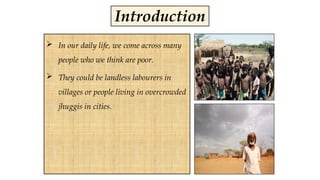
 In our daily life, we come across many
people who we think are poor.
 They could be landless labourers in
villages or people living in overcrowded
jhuggis in cities.
Introduction
Introduction
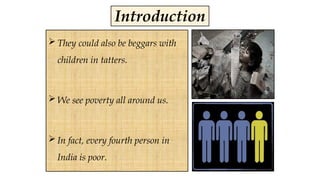
 They could also be beggars with
children in tatters.
 We see poverty all around us.
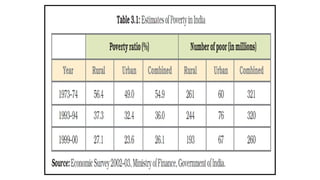
 In fact, every fourth person in
India is poor.
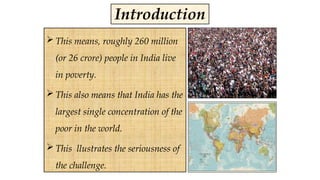
 This means, roughly 260 million
(or 26 crore) people in India live
in poverty.
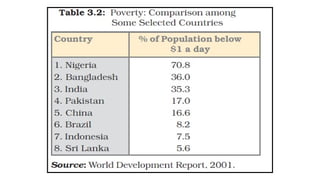
 This also means that India has the
largest single concentration of the
poor in the world.
 This llustrates the seriousness of
the challenge.
Introduction
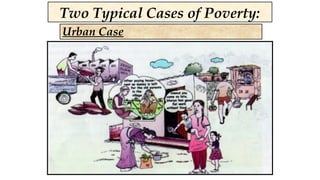
Urban Case
Two Typical Cases of Poverty:
• Thirty-three year old Ram Saran works as a daily-wage laborer in a wheat
flour mill near Ranchi in Jharkhand.
• He manages to earn around Rs 1,500 a month when he finds employment.
• The money is not enough to sustain a family of six – including himself,
his wife, and four children [aged between 6 months to 12 years].
• He has to send money home to his old parents who live in a village near
Ramgarh.
• Ram Saran lives in a one-room rented house in a crowded urban
settlement in the outskirts of the city.
• His wife Santa Devi, works as a part time maid in a few houses and
manages to earn another Rs 800.
• They manage a meager meal of dal and rice twice a day, but its never
enough for all of them.
• His elder son works as a helper in a tea shop to supplement the family
income and earns another Rs 300.
• His 10- year-old daughter takes care of the younger siblings.
• None of the children go to school and have only 2 pairs of second hand
clothes. Shoes are a luxury.
• The children have no healthcare when they fall ill.
Story of Ram Saran
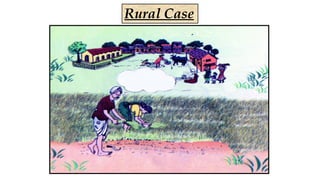
Rural Case
• Lakha Singh belongs to a small village near Meerut in Uttar
Pradesh.
• His family doesn’t own any land, so they do odd jobs for the big
farmers.
• At times they get paid Rs 50 for a hard day’s work..
• The family of eight cannot always manage two square meals a day.
• They live in a Kucha hut in the outskirts of the village.
• The women of the family spend the day chopping fodder and
collecting firewood in the fields.
• He had to start earning when he was 10 years old.
• His father a TB patient, passed away two years ago due to lack of
medication. His mother now suffers from the same disease and life is
slowly ebbing away.
• Although the village has a primary school, Lakha never went there.
• He started earning when he was 10 .
• New clothes are bought once in a few years, and even soap and oil
are a luxury for the family.
Story of Lakha Singh
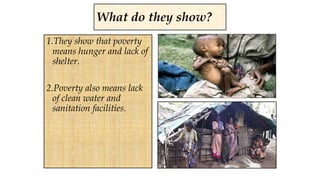
1.They show that poverty
means hunger and lack of
shelter.
2.Poverty also means lack
of clean water and
sanitation facilities.
What do they show?
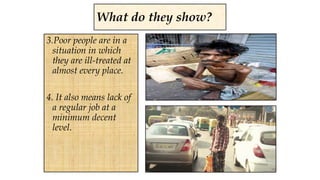
3.Poor people are in a
situation in which
they are ill-treated at
almost every place.
4. It also means lack of
a regular job at a
minimum decent
level.
What do they show?
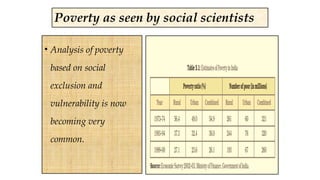
Poverty as seen by social scientists
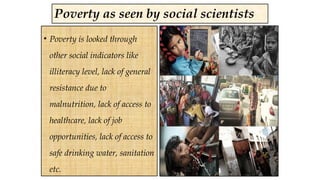
• Poverty is looked through
other social indicators like
illiteracy level, lack of general
resistance due to
malnutrition, lack of access to
healthcare, lack of job
opportunities, lack of access to
safe drinking water, sanitation
etc.
• Analysis of poverty
based on social
exclusion and
vulnerability is now
becoming very
common.
Poverty as seen by social scientists
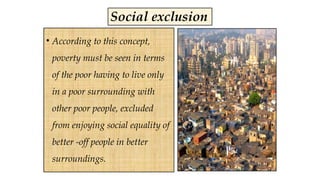
Social exclusion
• According to this concept,
poverty must be seen in terms
of the poor having to live only
in a poor surrounding with
other poor people, excluded
from enjoying social equality of
better -off people in better
surroundings.
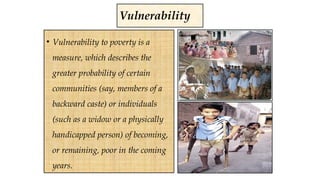
Vulnerability
• Vulnerability to poverty is a
measure, which describes the
greater probability of certain
communities (say, members of a
backward caste) or individuals
(such as a widow or a physically
handicapped person) of becoming,
or remaining, poor in the coming
years.
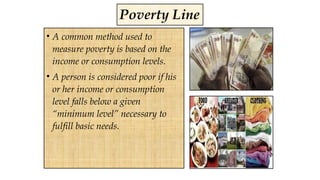
Poverty Line
• A common method used to
measure poverty is based on the
income or consumption levels.
• A person is considered poor if his
or her income or consumption
level falls below a given
“minimum level” necessary to
fulfill basic needs.
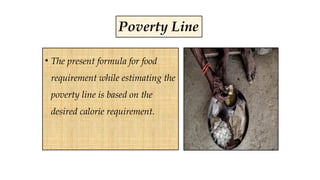
• The present formula for food
requirement while estimating the
poverty line is based on the
desired calorie requirement.
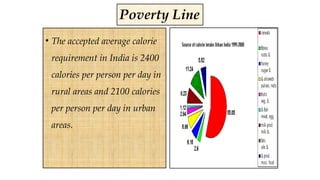
Poverty Line
• The accepted average calorie
requirement in India is 2400
calories per person per day in
rural areas and 2100 calories
per person per day in urban
areas.
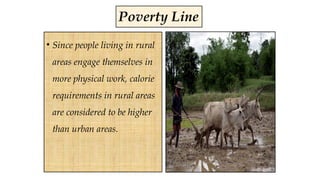
Poverty Line
• Since people living in rural
areas engage themselves in
more physical work, calorie
requirements in rural areas
are considered to be higher
than urban areas.
Poverty Line
Causes of Poverty
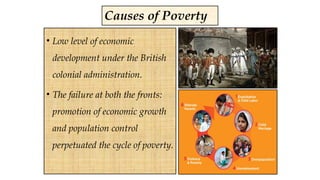
• Low level of economic
development under the British
colonial administration.
• The failure at both the fronts:
promotion of economic growth
and population control
perpetuated the cycle of poverty.
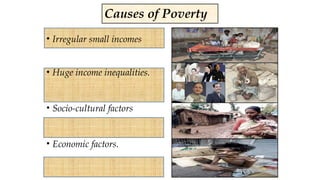
• Irregular small incomes
• Huge income inequalities.
• Socio-cultural factors
• Economic factors.
Causes of Poverty
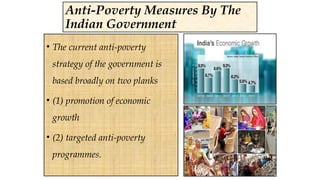
Anti-Poverty Measures By The
Indian Government
• The current anti-poverty
strategy of the government is
based broadly on two planks
• (1) promotion of economic
growth
• (2) targeted anti-poverty
programmes.
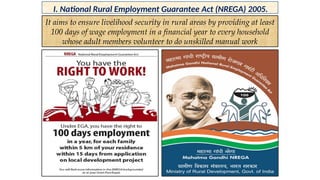
I. National Rural Employment Guarantee Act (NREGA) 2005.
It aims to ensure livelihood security in rural areas by providing at least
100 days of wage employment in a financial year to every household
whose adult members volunteer to do unskilled manual work
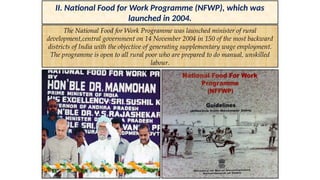
II. National Food for Work Programme (NFWP), which was
launched in 2004.
The National Food for Work Programme was launched minister of rural
development,central government on 14 November 2004 in 150 of the most backward
districts of India with the objective of generating supplementary wage employment.
The programme is open to all rural poor who are prepared to do manual, unskilled
labour.
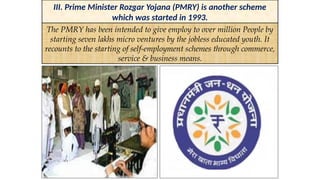
III. Prime Minister Rozgar Yojana (PMRY) is another scheme
which was started in 1993.
The PMRY has been intended to give employ to over million People by
starting seven lakhs micro ventures by the jobless educated youth. It
recounts to the starting of self-employment schemes through commerce,
service & business means.
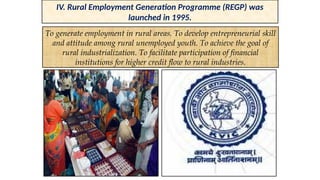
IV. Rural Employment Generation Programme (REGP) was
launched in 1995.
To generate employment in rural areas. To develop entrepreneurial skill
and attitude among rural unemployed youth. To achieve the goal of
rural industrialization. To facilitate participation of financial
institutions for higher credit flow to rural industries.
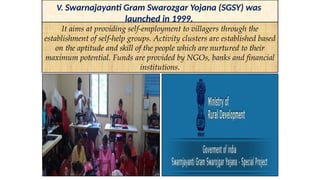
V. Swarnajayanti Gram Swarozgar Yojana (SGSY) was
launched in 1999.
It aims at providing self-employment to villagers through the
establishment of self-help groups. Activity clusters are established based
on the aptitude and skill of the people which are nurtured to their
maximum potential. Funds are provided by NGOs, banks and financial
institutions.
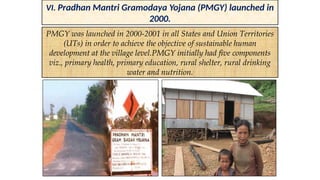
VI. Pradhan Mantri Gramodaya Yojana (PMGY) launched in
2000.
PMGY was launched in 2000-2001 in all States and Union Territories
(UTs) in order to achieve the objective of sustainable human
development at the village level.PMGY initially had five components
viz., primary health, primary education, rural shelter, rural drinking
water and nutrition.
VII. Antyodaya Anna Yojana (AAY).
Antyodaya Anna Yojana (AAY) is an Indian government sponsored
scheme for ten million of the poorest families.It is on the look out for the
'poorest of the poor'[1] by providing them 35 kilograms of rice and
wheat at Rs.3 & Rs.2 per kg respectively.
The Challenges Ahead
• Challenges that still remain: providing health care,
education and job security for all, and achieving gender
equality and dignity for the poor.
• These will be even bigger tasks.
• But despite the progress, poverty reduction remains
India’s most compelling challenge.
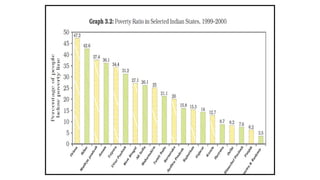
• Wide disparities in poverty are visible between rural and
urban areas and among different states.
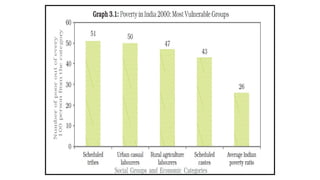
• Certain social and economic groups are more vulnerable to
poverty.
The Challenges Ahead
• Poverty reduction is expected to make better progress in
the next ten to fifteen years.
• This would be possible mainly due to higher economic
growth, increasing stress on universal free elementary
education, declining population growth, increasing
empowerment of the women and the economically weaker
sections of society.
The Challenges Ahead
Class – 9th
ECONOMIC
S
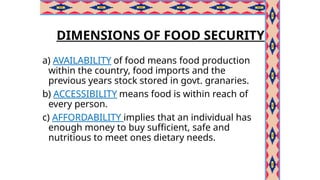
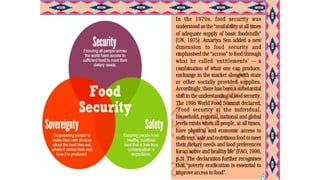
DIMENSIONS OF FOOD SECURITY
a) AVAILABILITY of food means food production
within the country, food imports and the
previous years stock stored in govt. granaries.
b) ACCESSIBILITY means food is within reach of
every person.
c) AFFORDABILITY implies that an individual has
enough money to buy sufficient, safe and
nutritious to meet ones dietary needs.
OVERVIEW
Food security means availability, accessibility
and affordability of food to all people at all
times. The poor households are more
vulnerable to food insecurity whenever there
is a problem of production or distribution of
food crops. Food security depends on the
Public Distribution System (PDS) and
government vigilance and action at times,
when this security is threatened.
Food Security
Necessity Of Food Security
Food security is needed in a country to ensure food at all times. It
is needed to ensure that no person in a country dies of hunger.
Effect of Natural Calamity on Food Security
Most of the time, the poorest section of society might be food
insecure. But persons above the poverty line might also be food
insecure when the country faces a national disaster/calamity like
earthquake, drought, flood, tsunami, widespread failure of crops
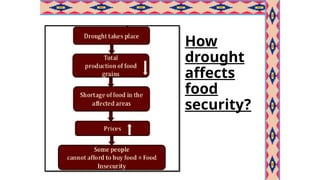
causing famine, etc.- The total production of food grains
decreases due to a natural calamity. It creates a shortage of food
in the affected areas. The price of the food products goes up due
to this shortage. At high prices, some people cannot afford to
buy food. If such calamity happens in a very wide area or is
stretched over a longer time period, it may cause a situation of
starvation. Massive starvation might take a turn of famine. Thus,
natural calamity affects food security adversely.
Food Security is ensured in a
country only if :-
Enough food is available for all the persons.
 All persons have the capacity to buy food of
acceptable quality.
 There is no barrier on access to food.
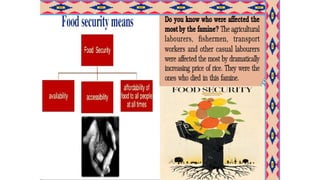
What is food security?
Food security has the following dimensions
(a) availability of food means food production within the
country, food imports and the previous years stock stored
in government granaries.
(b) accessibility means food is within reach of every person.
(c) affordability implies that an individual has enough money
to buy sufficient, safe and nutritious food to meet one’s
dietary needs.
Food security is ensured in a country only if
(1) enough food is available for all the persons
(2) all persons have the capacity to buy food of acceptable
quality
(3) there is no barrier on access to food.
Why food security?
During natural calamity such as drought, production
of food grains get decreased, creating a shortage of
food in the affected areas. The prices get increased
due to shortage of food. People cannot afford to buy
food and if such a calamity happens in a very wide
spread area or is stretched over a longer time
period, it might cause a situation of starvation.
Massive starvation might take a turn into a famine. A
Famine is characterised by widespread deaths due
to starvation and epidemics caused by forced use of
contaminated water or decaying food and loss of
body resistance due to weakening from starvation.
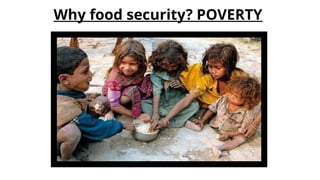
Why food security? POVERTY
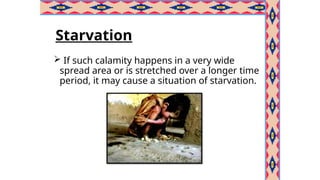
Starvation
 If such calamity happens in a very wide
spread area or is stretched over a longer time
period, it may cause a situation of starvation.
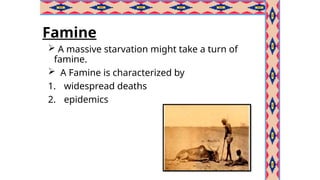
Famine
 A massive starvation might take a turn of
famine.
 A Famine is characterized by
1. widespread deaths
2. epidemics
Famines and Starvation Deaths in
India
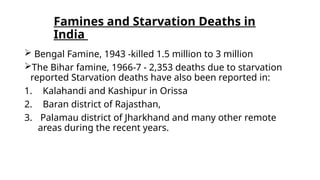
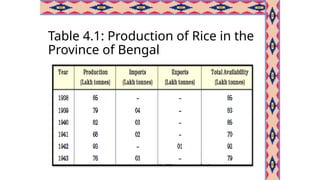
 Bengal Famine, 1943 -killed 1.5 million to 3 million
The Bihar famine, 1966-7 - 2,353 deaths due to starvation
reported Starvation deaths have also been reported in:
1. Kalahandi and Kashipur in Orissa
2. Baran district of Rajasthan,
3. Palamau district of Jharkhand and many other remote
areas during the recent years.
Hunger, another aspect of Food
Insecurity
India’s attempts at attaining Food
Security Green Revolution: Food
grain Production
Table 4.1: Production of Rice in the
Province of Bengal
How
drought
affects
food
security?
Who are food-insecure?
In India, a large section of people suffers from food and
nutrition insecurity. People having little or no land,
traditional artisans, providers of traditional services, petty
self-employed workers and destitute including beggars are
the worst affected groups. In the urban areas, the food-
insecure families are those who are generally employed in
ill-paid occupations and the casual labour market. These
workers are largely engaged in seasonal activities and are
paid very low wages.
The social composition along with the inability to buy food
also plays a role in food insecurity. People of SC, ST and OBC
communities who have either poor land-base or very low
land productivity are prone to food insecurity. People
affected by natural disasters, who migrate to other areas in
search of work, are among the most food-insecure people. A
large proportion of pregnant and nursing mothers and
children under the age of 5 years constitute an important
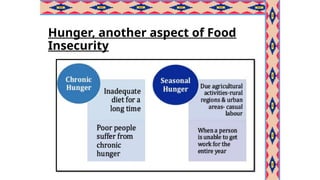
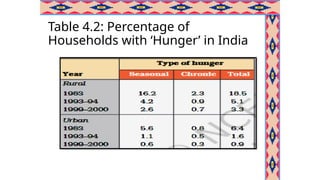
Another aspect of food insecurity is hunger, which
is not just an expression of poverty, it brings about
poverty. Hunger has chronic and seasonal
dimensions. Chronic hunger is a consequence of
diets persistently inadequate in terms of quantity
and/or quality. Seasonal hunger is related to cycles
of food growing and harvesting.
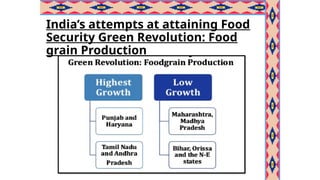
Since Independence, India has been aiming at self-
sufficiency in food grains. After Independence,
Indian policymakers adopted all measures to
achieve self-sufficiency in food grains. In the field
of agriculture, India adopted a new strategy, which
resulted in the ‘Green Revolution’.
Table 4.2: Percentage of
Households with ‘Hunger’ in India
Food Security in India
Since the Green Revolution, the country has
avoided famine even during adverse weather
conditions. India has become self-sufficient in
food grains during the last 30 years because
of a variety of crops grown all over the
country. The availability of food grains has
been ensured with a carefully designed food
security system by the government.
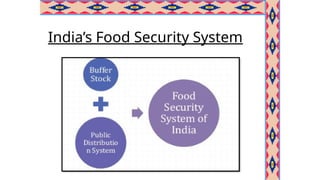
This system has two components:
(a) buffer stock,
(b) public distribution system.
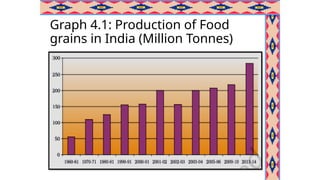
Graph 4.1: Production of Food
grains in India (Million Tonnes)
What is Buffer stock?
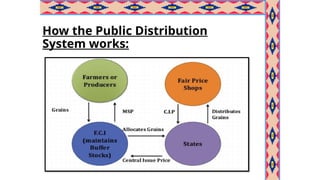
Buffer Stock is the stock of food grains, namely
wheat and rice, procured by the government
through the Food Corporation of India (FCI). The
stock of wheat and rice are purchased by the FCI
from the farmers where there is surplus
production. The farmers are paid a pre announced
price for their crops, called Minimum Support
Price (MSP). Every year, the MSP is declared by the
government before the sowing season to provide
incentives to farmers for raising the production of
these crops. Buffer Stock is created to distribute
food grains in the deficit areas and among the
poorer section of the society at a price lower than
the market price also known as Issue Price.
What is the Public Distribution
System?
FCI distributes the food procured from the farmer
through government-regulated ration shops. It is
called the Public Distribution System (PDS). Ration
shops also, known as Fair Price Shops, keep stock of
food grains, sugar, and kerosene for cooking.
Rationing in India was introduced during the 1940s
against the backdrop of the Bengal famine. In the
mid-1970s, three important.
 food intervention programmes were introduced:
1. Public Distribution System (PDS) for food grains
2. Integrated Child Development Services (ICDS) a
3. Food-for-Work (FFW).
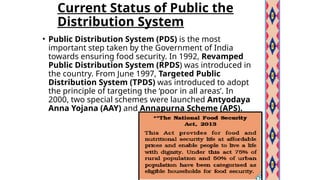
Current Status of Public the
Distribution System
• Public Distribution System (PDS) is the most
important step taken by the Government of India
towards ensuring food security. In 1992, Revamped
Public Distribution System (RPDS) was introduced in
the country. From June 1997, Targeted Public
Distribution System (TPDS) was introduced to adopt
the principle of targeting the ‘poor in all areas’. In
2000, two special schemes were launched Antyodaya
Anna Yojana (AAY) and Annapurna Scheme (APS).
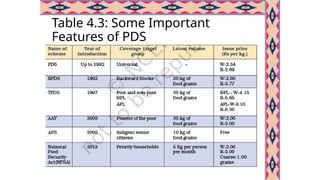
Table 4.3: Some Important
Features of PDS
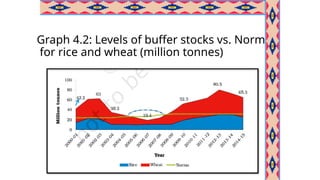
Graph 4.2: Levels of buffer stocks vs. Norms
for rice and wheat (million tonnes)
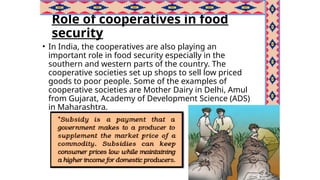
Role of cooperatives in food
security
• In India, the cooperatives are also playing an
important role in food security especially in the
southern and western parts of the country. The
cooperative societies set up shops to sell low priced
goods to poor people. Some of the examples of
cooperative societies are Mother Dairy in Delhi, Amul
from Gujarat, Academy of Development Science (ADS)
in Maharashtra.
India’s Food Security System
How the Public Distribution
System works:
Thank you

class 9 economics complete notes economics.pptx

  • 1.
    The Story ofVillage Palampur Overview → A story of a hypothetical village called Palampur. → To introduce some basic concepts relating to production. → Small scale manufacturing, dairy, transport, etc. are carried out on a limited scale in the village. → Various resources combine to produce the desired goods and services in the village.
  • 2.
    Introduction • Palampur isa small village, well-connected with neighbouring villages and towns like, Raiganj. • Bullock carts, tongas, bogeys , motorcycles, jeeps, tractors and trucks types of visible transport facilities are available on the road of Palampur. • This village has two primary and one high school and also has a primary health center run by the government and one private dispensary. • About 450 different caste families are living here. → Out of them, 80 upper caste families have land majority in this village. One third of total population is covered by schedule caste. • Most of the houses have electric connections. → Small manufacturing, transport, shop-keeping and farming are the production activities of the village Palampur.
  • 3.
    Organization of Production Production:Goods &service that we want • The main aim of production is to produce goods and services, which require four essential components. Those are LAND, LABOUR, PHYSICAL CAPITAL& HUMAN CAPITAL → Land, along with Natural resources fulfilled the requirements of land and water. → LABOUR, labour is required to do work , skiled , unskilled educated or uneducated depend on work. → Physical capitals are also required for production. • Working Capital includes Raw materials and money in hand and • Fixed Capital includes tools, machines, buildings. → Human Capital means that labour is also required for the selling purpose
  • 4.
    Farming in Palampur Farmingin Palampur is based on following factor: (i) Land is fixed (ii) Change in the method of cultivation (iii) Multiple cropping (iv) Modern Farming (v) Sustainability of land (vi) Distribution of land (vii) Labour (viii) Capital (ix) Selling of farms products
  • 5.
    (1) Land isfixed • About 75 per cent population are depended on farming in Palampur. • Land area under cultivation is fixed. • There has been no expansion in land area under cultivation since 1960. • All land is cultivated in palampur 2)Change in method of cultivation → Multiple cropping and Modern farming are the method of cultivation used in Palampur to increase the production from land. 3) Multiple cropping → Method of multiple cropping is used in Palampur. Cultivation of different types of crops in the same piece of land at same or different time is known as Multiple cropping. For example, jowar and bajra grow during rainy season, potato is produced between October and December, wheat is produced during winter season.
  • 6.
    4) Modern farming →In this type of farming , high yielding varieties seeds are used. As a result same piece of land produce larger quantities of food grains. → In India Farmers of Punjab, Haryana and Western Uttar Pradesh were the first to try out the modern farming method. → Introduction of the Green Revolution facilitated the cultivation of wheat and rice using High Yielding Variety of seeds (HYVs) instead of the traditional seeds. The HYVs are capable of producing more amount of grain on one plant.
  • 7.
    5) Sustainability ofland → According to a scientific report, in modern farming natural resource are overused. → Groundwater, rivers and lakes are polluted by the way of using of chemical fertilizers. → Chemical fertilizers also kill bacteria and other micro-organisms in the soil which are essential for the growth of plants.
  • 8.
    6) Distribution ofland → About one third of the 450 families are landless in Palampur. → 240 families cultivate small plots of land less i.e 2 hectares in size and remaining 60 families cultivate more than 2 hectares of land. → A few of the large farmers cultivate 10 hectares or more than 10 hectares of land.
  • 9.
    7) Labour → Somefarmers are worked on their own land and some worked on another land for which they receive wage. → Wages can be in cash or in kind. Wages vary from region to region, crop to crop and one farm activity to another.
  • 10.
    8) Capital → Hugecapital is required in the method of modern farming. → Small farmers have lack of capital. They borrow money from large farmers and moneylenders at higher rate of interest. → There are three type of capital which are mostly used in any organization i.e working capital, fixed capital and human capital.
  • 11.
    9) Selling ofFarm Products → Surplus products are sold to medium or large farmers by the small farmers. → After that, medium and large farmers sell their surplus directly to the market. → The traders buy the products from market and sell the products to shopkeepers in the towns and cities.
  • 12.
    Non-Farm Activities inPalampur 25 per cent of total population is engaged in non-farming activities in Palampur. 1) Small-scale manufacturing → In Palampur, small scale manufacturing is done. Basically, the work is carried out at home or in the fields with the help of family labour. So, labour is hired rarely. 2) Transporting → People and goods are ferried from one place to another through transporting service. For this service the worker get paid. In Palampur, road is the mode of transportation.
  • 13.
    3) Dairy → Dairyis a major source of earning money in Palampur. → Dairy is a type of business where harvesting or processing of animal milk are done mostly from cow and buffaloes. 4) Shopkeeping → Shopkeeping is also a source of earning money in Palampur. → Shopkeepers earn money by selling a wide range of items like rice, wheat, sugar, tea, oil, biscuits, soap, toothpaste, batteries, candles, notebooks, pen, pencil, even some cloth. Here, shopkeeper is an individual who run the shop.
  • 14.
    Q.1 Modern farmingmethods require more inputs which are manufactured in industry. Do you agree? Sol. This statement is quite correct. Modern farming methods require chemical fertilisers, pesticides and modern farm equipments. All of these are manufactured in industry. Q.2 How did the spread of electricity help farmers in Palampur? Sol. Electricity can help any village. Availability of electricity ensures better irrigation. It also means that villagers can engage in some manufacturing activities; like flour mills, jaggery production, etc. Children can study late in the evening and shopkeepers can do better business if proper electricity supply can be provided. Q.3 Is it important to increase the area under irrigation? Why? Sol. As per estimates, 60% of the villages still need proper irrigation facility. Since land under cultivation cannot be increased to increasing the area under irrigation is a major way to improve farm productivity.
  • 15.
    Q.5 Why arethe wages for farm labourers in Palampur less than minimum wages? Sol. There is more supply of workers than the demand. Due to this, the workers are not in a position to bargain from their employers. Hence, the wages for farm labourers are less than minimum wages. Q.6 In your region, talk to two labourers. Choose either farm labourers or labourers working at construction sites. What wages do they get? Are they paid in cash or kind? Do they get work regularly? Are they in debt? Sol. People who work at construction site usually get the minimum wages. An unskilled worker gets around Rs. 250 per day. A skilled worker; such as a mason; get around Rs. 500 per day. Q.7 What are the different ways of increasing production on the same piece of land? Use examples to explain. Sol. Production can be increased by using HYV seeds, fertilisers and proper irrigation. Mixed farming can also be used to improve farm production.
  • 16.
    Q.8 Describe thework of a farmer with 1 hectare of land. Sol. A farmer with 1 hectare of land shall put under the category of small farmer. Most of the work would be done by the farmer and his family members. The farmer will normally use a pair of bullocks to plough the field. His family members would assist him in sowing the seeds. During harvest time, he may require to hire some labourers. Q.9 How do the medium and large farmers obtain capital for farming? How is it different from the small farmers? Sol. Medium and large farmers usually have surplus cash by selling their farm produce. Since they have land and house, they easily get loan from banks. Small farmers, on the other hand, may not be able to get bank loans. They have to depend on the local merchant and moneylender for loan. Q.10 Talk to some old residents in your region and write a short report on the changes in irrigation and changes in production methods during the last 30 years. Sol. During the early period, irrigation was done by Persian wheel. Diesel operated or electricity operated pumps have replaced the Persian wheels. Tractors have replaced bullocks for ploughing the large farms. Now more and more farmers are in a position to grow up to three crops in a year.
  • 17.
    Q.11 What arethe non-farm production activities taking place in your region? Make a short list. Sol. Cycle repair shop, carpenter, ironsmith, general store, tea stall, stationary shop, computer training institute, etc. Q.12 What can be done so that more non-farm production activities can be started in villages? Sol. The government should improve electricity supply in the villages. It should open more schools so that children can grow to become educated adults. Moreover, government can also provide vocational training to the rural youths. These activities would help in increasing non-farm production activities in a village.
  • 19.
  • 20.
    The Story ofSakala and Vilas The two following cases illustrate how people can try to become a more productive resource:
  • 21.
    • Population ofa nation can be its asset rather than liability. • ‘People as resource’ refers to a country’s working people in terms of their existing productive skills and abilities. • When existing human resource is developed by becoming educated and healthy it turns into human capital. • Human capital is superior to other resources like land and physical capital, as it uses these capitals and adds value to them. • Investment in human capital via education and medical care can give high returns in the future. Country like Japan have invested a lot in human resources. They do not have rich natural resources, but still they are called developed nations. • Human beings perform many activities which can be grouped into economic and non-economic.
  • 22.
    Sectors under economicactivities (i) Primary Sector (ii) Secondary Sector (iii) Tertiary Sector (i) Primary Sector It is also known as agriculture sector. This sector considers directly using of natural resources. This sector includes agriculture, forestry, animal husbandry, fishing, poultry farming, mining, and quarrying. (ii) Secondary Sector It is also known as manufacturing sector. This sector considers manufacturing of goods. (iii) Tertiary sector This sector provides service. This sector includes trade, transport, communication, banking, education, health, tourism, services, insurance.
  • 23.
    Two parts ofEconomic activities (i) Market activities Market activities consider production of goods or services including government service for remuneration. (ii) Non-market activities Non-market activities consider production of goods or services for self- consumption. Works Performed under Economic activities • There are huge difference between economic activity performed by men and economic activity performed by women. • Women look after domestic affairs like cooking of food, washing of clothes, cleaning of utensils, housekeeping and looking after children. Men work in the field. • Men are paid for their work on the contrary women are not paid for their performances in the house. • The work done by men is recognized in the National Income whereas the household work done by women is not recognized in the National Income.
  • 24.
    Quality of Population:The quality of population depends upon the literacy rate, life expectancy and skills formation acquired by the people of the country. (i) Education • Education is the process of learning for acquisition of knowledge. It is an important input for growth of a person. • Development of a country is basically depended on literacy rate. When a person is educated, then a family can be educated. After that, society can be educated and hence literacy rate of the country can increase. • An educated person can earn more income compared than an uneducated person because of their skill. For this term, National income of a country can increase. • Governance efficiency can also be enhanced through learning process.
  • 25.
    • There were7.68 lakh schools by 2004-05. But education is diluted by the poor quality of schooling and high drop out rates. ‘Sarv Shiksha Abhiyan’ is a significant step towards providing elementary education to all children below the age of 14. • In view of its contribution towards the growth of the society, government expenditure on education as a percentage of GDP rose from 0.64% in 1951-52 to 3.98% in 2002-03. However, our national goal is 6% of GDP. • Literacy is uneven between males and females. Males are more literate. It also varies with urban and rural area. Urban population is more literate compared to rural.
  • 27.
    (ii) Health • Anunhealthy person is burden for a country in terms of economics. A healthy mind create healthy environment. For development of a country, healthy environment is compulsory. • In India, states like Bihar and Uttar Pradesh have few medical colleges. These states have poor health conditions. • On the other hand, four states Karnataka, Andhra Pradesh, Tamil Nadu and Maharashtra have majority in number of medical colleges with 81 medical colleges out of 181. • In India, infant mortality rate has come down from 147 in 1951 to 47 in 2010. • Crude birth rates have dropped to 22.1 and death rates to 7 in 2010. • Crude birth rate is the number of living births occuring in a given geographical area per 1,000.
  • 29.
    Unemployment • Unemployment isa phenomenon that occurs when a person want to do work but unable to find work. • Unemployment is liability to the nation. It leads to wastage of manpower resource. Two types of unemployment found in rural areas: (i) Seasonal unemployment (ii) Disguised unemployment (i) Seasonal unemployment • In case of Seasonal unemployment, people are not able to find jobs during some months of the year. • Generally, in agriculture sector this kind of problem is visible. In agriculture sector, some seasonal foodgrains are produced. So, the farmers are employed only in that particular season.
  • 30.
    (ii) Disguised unemployment •Disguised unemployment happens when people appear to be employed. • For example, in agriculture sector the field requires the service of six people and nine people are worked in the same field then, three extra people are come under the category of disguised unemployed. Production will not decrease when three people are removed. Urban areas unemployment • In urban areas educated unemployment are seen. This problem occurs when an educated person is willing to work but, he/she unable to find work. • Number of graduated and post-graduated unemployed has increased faster than among matriculates unemployed.
  • 31.
    Nature of Unemploymentin India: Seasonal unemployment occurs when people fail to get work during some months of the year (that is, during off-season). Farm labourers usually face this kind of problem. Disguised unemployment is another kind of unemployment found in rural areas. Such kind of problem arises due to excessive pressure of population on agriculture. Disguised unemployment refers to a situation where in the number of workers in a job is more than actually required to do the job. The extra number of workers are disguisedly unemployed. Increase in unemployment is an indicator of depressed economy. Consequences of Unemployment: (i) Unemployment leads to wastage of manpower resource (ii) Unemployment tends to increase the economic overload that is dependence of the unemployed on the working population. (iii) Unemployment may lead to increase in social unrest and tension.
  • 33.
  • 34.
     In ourdaily life, we come across many people who we think are poor.  They could be landless labourers in villages or people living in overcrowded jhuggis in cities. Introduction
  • 35.
    Introduction  They couldalso be beggars with children in tatters.  We see poverty all around us.  In fact, every fourth person in India is poor.
  • 36.
     This means,roughly 260 million (or 26 crore) people in India live in poverty.  This also means that India has the largest single concentration of the poor in the world.  This llustrates the seriousness of the challenge. Introduction
  • 37.
    Urban Case Two TypicalCases of Poverty:
  • 38.
    • Thirty-three yearold Ram Saran works as a daily-wage laborer in a wheat flour mill near Ranchi in Jharkhand. • He manages to earn around Rs 1,500 a month when he finds employment. • The money is not enough to sustain a family of six – including himself, his wife, and four children [aged between 6 months to 12 years]. • He has to send money home to his old parents who live in a village near Ramgarh. • Ram Saran lives in a one-room rented house in a crowded urban settlement in the outskirts of the city. • His wife Santa Devi, works as a part time maid in a few houses and manages to earn another Rs 800. • They manage a meager meal of dal and rice twice a day, but its never enough for all of them. • His elder son works as a helper in a tea shop to supplement the family income and earns another Rs 300. • His 10- year-old daughter takes care of the younger siblings. • None of the children go to school and have only 2 pairs of second hand clothes. Shoes are a luxury. • The children have no healthcare when they fall ill. Story of Ram Saran
  • 39.
  • 40.
    • Lakha Singhbelongs to a small village near Meerut in Uttar Pradesh. • His family doesn’t own any land, so they do odd jobs for the big farmers. • At times they get paid Rs 50 for a hard day’s work.. • The family of eight cannot always manage two square meals a day. • They live in a Kucha hut in the outskirts of the village. • The women of the family spend the day chopping fodder and collecting firewood in the fields. • He had to start earning when he was 10 years old. • His father a TB patient, passed away two years ago due to lack of medication. His mother now suffers from the same disease and life is slowly ebbing away. • Although the village has a primary school, Lakha never went there. • He started earning when he was 10 . • New clothes are bought once in a few years, and even soap and oil are a luxury for the family. Story of Lakha Singh

  • 41.
    1.They show thatpoverty means hunger and lack of shelter. 2.Poverty also means lack of clean water and sanitation facilities. What do they show?
  • 42.
    3.Poor people arein a situation in which they are ill-treated at almost every place. 4. It also means lack of a regular job at a minimum decent level. What do they show?
  • 43.
    Poverty as seenby social scientists • Poverty is looked through other social indicators like illiteracy level, lack of general resistance due to malnutrition, lack of access to healthcare, lack of job opportunities, lack of access to safe drinking water, sanitation etc.
  • 44.
    • Analysis ofpoverty based on social exclusion and vulnerability is now becoming very common. Poverty as seen by social scientists
  • 45.
    Social exclusion • Accordingto this concept, poverty must be seen in terms of the poor having to live only in a poor surrounding with other poor people, excluded from enjoying social equality of better -off people in better surroundings.
  • 46.
    Vulnerability • Vulnerability topoverty is a measure, which describes the greater probability of certain communities (say, members of a backward caste) or individuals (such as a widow or a physically handicapped person) of becoming, or remaining, poor in the coming years.
  • 48.
    Poverty Line • Acommon method used to measure poverty is based on the income or consumption levels. • A person is considered poor if his or her income or consumption level falls below a given “minimum level” necessary to fulfill basic needs.
  • 49.
    • The presentformula for food requirement while estimating the poverty line is based on the desired calorie requirement. Poverty Line
  • 50.
    • The acceptedaverage calorie requirement in India is 2400 calories per person per day in rural areas and 2100 calories per person per day in urban areas. Poverty Line
  • 51.
    • Since peopleliving in rural areas engage themselves in more physical work, calorie requirements in rural areas are considered to be higher than urban areas. Poverty Line
  • 55.
    Causes of Poverty •Low level of economic development under the British colonial administration. • The failure at both the fronts: promotion of economic growth and population control perpetuated the cycle of poverty.
  • 56.
    • Irregular smallincomes • Huge income inequalities. • Socio-cultural factors • Economic factors. Causes of Poverty
  • 57.
    Anti-Poverty Measures ByThe Indian Government • The current anti-poverty strategy of the government is based broadly on two planks • (1) promotion of economic growth • (2) targeted anti-poverty programmes.
  • 58.
    I. National RuralEmployment Guarantee Act (NREGA) 2005. It aims to ensure livelihood security in rural areas by providing at least 100 days of wage employment in a financial year to every household whose adult members volunteer to do unskilled manual work
  • 59.
    II. National Foodfor Work Programme (NFWP), which was launched in 2004. The National Food for Work Programme was launched minister of rural development,central government on 14 November 2004 in 150 of the most backward districts of India with the objective of generating supplementary wage employment. The programme is open to all rural poor who are prepared to do manual, unskilled labour.
  • 60.
    III. Prime MinisterRozgar Yojana (PMRY) is another scheme which was started in 1993. The PMRY has been intended to give employ to over million People by starting seven lakhs micro ventures by the jobless educated youth. It recounts to the starting of self-employment schemes through commerce, service & business means.
  • 61.
    IV. Rural EmploymentGeneration Programme (REGP) was launched in 1995. To generate employment in rural areas. To develop entrepreneurial skill and attitude among rural unemployed youth. To achieve the goal of rural industrialization. To facilitate participation of financial institutions for higher credit flow to rural industries.
  • 62.
    V. Swarnajayanti GramSwarozgar Yojana (SGSY) was launched in 1999. It aims at providing self-employment to villagers through the establishment of self-help groups. Activity clusters are established based on the aptitude and skill of the people which are nurtured to their maximum potential. Funds are provided by NGOs, banks and financial institutions.
  • 63.
    VI. Pradhan MantriGramodaya Yojana (PMGY) launched in 2000. PMGY was launched in 2000-2001 in all States and Union Territories (UTs) in order to achieve the objective of sustainable human development at the village level.PMGY initially had five components viz., primary health, primary education, rural shelter, rural drinking water and nutrition.
  • 64.
    VII. Antyodaya AnnaYojana (AAY). Antyodaya Anna Yojana (AAY) is an Indian government sponsored scheme for ten million of the poorest families.It is on the look out for the 'poorest of the poor'[1] by providing them 35 kilograms of rice and wheat at Rs.3 & Rs.2 per kg respectively.
  • 65.
    The Challenges Ahead •Challenges that still remain: providing health care, education and job security for all, and achieving gender equality and dignity for the poor. • These will be even bigger tasks.
  • 66.
    • But despitethe progress, poverty reduction remains India’s most compelling challenge. • Wide disparities in poverty are visible between rural and urban areas and among different states. • Certain social and economic groups are more vulnerable to poverty. The Challenges Ahead
  • 67.
    • Poverty reductionis expected to make better progress in the next ten to fifteen years. • This would be possible mainly due to higher economic growth, increasing stress on universal free elementary education, declining population growth, increasing empowerment of the women and the economically weaker sections of society. The Challenges Ahead
  • 69.
  • 71.
    DIMENSIONS OF FOODSECURITY a) AVAILABILITY of food means food production within the country, food imports and the previous years stock stored in govt. granaries. b) ACCESSIBILITY means food is within reach of every person. c) AFFORDABILITY implies that an individual has enough money to buy sufficient, safe and nutritious to meet ones dietary needs.
  • 72.
    OVERVIEW Food security meansavailability, accessibility and affordability of food to all people at all times. The poor households are more vulnerable to food insecurity whenever there is a problem of production or distribution of food crops. Food security depends on the Public Distribution System (PDS) and government vigilance and action at times, when this security is threatened.
  • 74.
    Food Security Necessity OfFood Security Food security is needed in a country to ensure food at all times. It is needed to ensure that no person in a country dies of hunger. Effect of Natural Calamity on Food Security Most of the time, the poorest section of society might be food insecure. But persons above the poverty line might also be food insecure when the country faces a national disaster/calamity like earthquake, drought, flood, tsunami, widespread failure of crops causing famine, etc.- The total production of food grains decreases due to a natural calamity. It creates a shortage of food in the affected areas. The price of the food products goes up due to this shortage. At high prices, some people cannot afford to buy food. If such calamity happens in a very wide area or is stretched over a longer time period, it may cause a situation of starvation. Massive starvation might take a turn of famine. Thus, natural calamity affects food security adversely.
  • 75.
    Food Security isensured in a country only if :- Enough food is available for all the persons.  All persons have the capacity to buy food of acceptable quality.  There is no barrier on access to food.
  • 76.
    What is foodsecurity? Food security has the following dimensions (a) availability of food means food production within the country, food imports and the previous years stock stored in government granaries. (b) accessibility means food is within reach of every person. (c) affordability implies that an individual has enough money to buy sufficient, safe and nutritious food to meet one’s dietary needs. Food security is ensured in a country only if (1) enough food is available for all the persons (2) all persons have the capacity to buy food of acceptable quality (3) there is no barrier on access to food.
  • 77.
    Why food security? Duringnatural calamity such as drought, production of food grains get decreased, creating a shortage of food in the affected areas. The prices get increased due to shortage of food. People cannot afford to buy food and if such a calamity happens in a very wide spread area or is stretched over a longer time period, it might cause a situation of starvation. Massive starvation might take a turn into a famine. A Famine is characterised by widespread deaths due to starvation and epidemics caused by forced use of contaminated water or decaying food and loss of body resistance due to weakening from starvation.
  • 78.
  • 79.
    Starvation  If suchcalamity happens in a very wide spread area or is stretched over a longer time period, it may cause a situation of starvation.
  • 80.
    Famine  A massivestarvation might take a turn of famine.  A Famine is characterized by 1. widespread deaths 2. epidemics
  • 81.
    Famines and StarvationDeaths in India  Bengal Famine, 1943 -killed 1.5 million to 3 million The Bihar famine, 1966-7 - 2,353 deaths due to starvation reported Starvation deaths have also been reported in: 1. Kalahandi and Kashipur in Orissa 2. Baran district of Rajasthan, 3. Palamau district of Jharkhand and many other remote areas during the recent years.
  • 82.
    Hunger, another aspectof Food Insecurity
  • 83.
    India’s attempts atattaining Food Security Green Revolution: Food grain Production
  • 84.
    Table 4.1: Productionof Rice in the Province of Bengal
  • 85.
  • 86.
    Who are food-insecure? InIndia, a large section of people suffers from food and nutrition insecurity. People having little or no land, traditional artisans, providers of traditional services, petty self-employed workers and destitute including beggars are the worst affected groups. In the urban areas, the food- insecure families are those who are generally employed in ill-paid occupations and the casual labour market. These workers are largely engaged in seasonal activities and are paid very low wages. The social composition along with the inability to buy food also plays a role in food insecurity. People of SC, ST and OBC communities who have either poor land-base or very low land productivity are prone to food insecurity. People affected by natural disasters, who migrate to other areas in search of work, are among the most food-insecure people. A large proportion of pregnant and nursing mothers and children under the age of 5 years constitute an important
  • 87.
    Another aspect offood insecurity is hunger, which is not just an expression of poverty, it brings about poverty. Hunger has chronic and seasonal dimensions. Chronic hunger is a consequence of diets persistently inadequate in terms of quantity and/or quality. Seasonal hunger is related to cycles of food growing and harvesting. Since Independence, India has been aiming at self- sufficiency in food grains. After Independence, Indian policymakers adopted all measures to achieve self-sufficiency in food grains. In the field of agriculture, India adopted a new strategy, which resulted in the ‘Green Revolution’.
  • 88.
    Table 4.2: Percentageof Households with ‘Hunger’ in India
  • 89.
    Food Security inIndia Since the Green Revolution, the country has avoided famine even during adverse weather conditions. India has become self-sufficient in food grains during the last 30 years because of a variety of crops grown all over the country. The availability of food grains has been ensured with a carefully designed food security system by the government. This system has two components: (a) buffer stock, (b) public distribution system.
  • 90.
    Graph 4.1: Productionof Food grains in India (Million Tonnes)
  • 91.
    What is Bufferstock? Buffer Stock is the stock of food grains, namely wheat and rice, procured by the government through the Food Corporation of India (FCI). The stock of wheat and rice are purchased by the FCI from the farmers where there is surplus production. The farmers are paid a pre announced price for their crops, called Minimum Support Price (MSP). Every year, the MSP is declared by the government before the sowing season to provide incentives to farmers for raising the production of these crops. Buffer Stock is created to distribute food grains in the deficit areas and among the poorer section of the society at a price lower than the market price also known as Issue Price.
  • 92.
    What is thePublic Distribution System? FCI distributes the food procured from the farmer through government-regulated ration shops. It is called the Public Distribution System (PDS). Ration shops also, known as Fair Price Shops, keep stock of food grains, sugar, and kerosene for cooking. Rationing in India was introduced during the 1940s against the backdrop of the Bengal famine. In the mid-1970s, three important.  food intervention programmes were introduced: 1. Public Distribution System (PDS) for food grains 2. Integrated Child Development Services (ICDS) a 3. Food-for-Work (FFW).
  • 93.
    Current Status ofPublic the Distribution System • Public Distribution System (PDS) is the most important step taken by the Government of India towards ensuring food security. In 1992, Revamped Public Distribution System (RPDS) was introduced in the country. From June 1997, Targeted Public Distribution System (TPDS) was introduced to adopt the principle of targeting the ‘poor in all areas’. In 2000, two special schemes were launched Antyodaya Anna Yojana (AAY) and Annapurna Scheme (APS).
  • 94.
    Table 4.3: SomeImportant Features of PDS
  • 95.
    Graph 4.2: Levelsof buffer stocks vs. Norms for rice and wheat (million tonnes)
  • 96.
    Role of cooperativesin food security • In India, the cooperatives are also playing an important role in food security especially in the southern and western parts of the country. The cooperative societies set up shops to sell low priced goods to poor people. Some of the examples of cooperative societies are Mother Dairy in Delhi, Amul from Gujarat, Academy of Development Science (ADS) in Maharashtra.
  • 97.
  • 98.
    How the PublicDistribution System works:
  • 100.