1
Class- VIIIClass- VIII
English 1st paperEnglish 1st paper
Presented by:Presented by:
Fauzia JesminFauzia Jesmin
Asst. TeacherAsst. Teacher
Camb Id:0412Camb Id:0412
Department of EnglshDepartment of Englsh
2
3
Unit -5 (The beginning)Unit -5 (The beginning)
Lesson -1Lesson -1
4
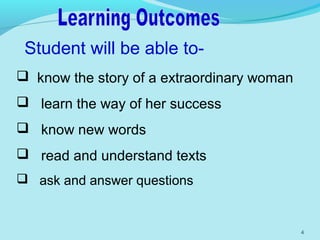
 know the story of a extraordinary woman
 learn the way of her success
 know new words
 read and understand texts
 ask and answer questions
Student will be able to-
5
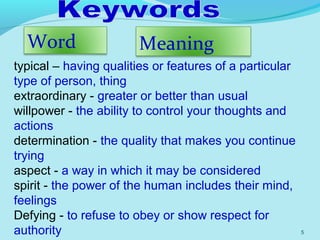
MeaningWord
typical – having qualities or features of a particular
type of person, thing
extraordinary - greater or better than usual
willpower - the ability to control your thoughts and
actions
determination - the quality that makes you continue
trying
aspect - a way in which it may be considered
spirit - the power of the human includes their mind,
feelings
Defying - to refuse to obey or show respect for
authority
6
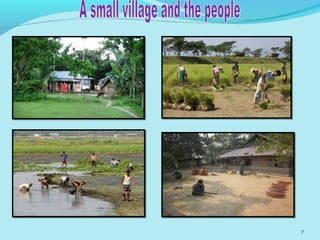
There is a small village called Bhabanipur in Jhenaidah. It is
a typical Bangladeshi village. People here spend their day-
to-day life mostly working in the fields and doing small jobs.
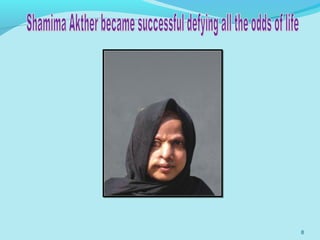
In this ordinary village, there lives an extraordinary woman
named Shamima Akhter. Shamima’s willpower and
determination have made her extraordinary. She has seen
the most cruel aspect of life. But the cruelty could not
defeat her spirit. She has come out as a winner, defying all
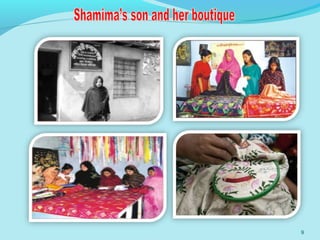
the odds of life. Shamima is now 32 years old. She runs a
small boutique called ‘Oikko Nari Kollayan Shangstha’ in her
village. Let’s hear from Shamima, how she succeeded in
setting up her boutique.
7
8
9
10
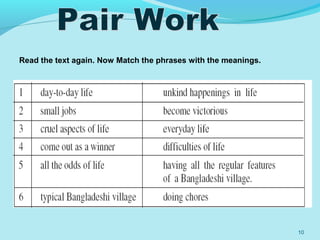
Read the text again. Now Match the phrases with the meanings.
11
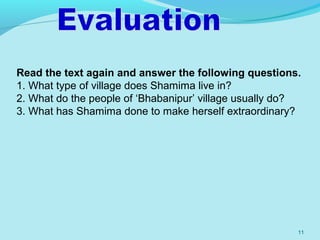
Read the text again and answer the following questions.
1. What type of village does Shamima live in?
2. What do the people of ‘Bhabanipur’ village usually do?
3. What has Shamima done to make herself extraordinary?
12
Write a paragraph about Shamima from your
imagination. In your paragraph write what Shamima
should do for the good of her own family as well as
the other families in the village.
13

Class 8 english lesson 1 the beginning

  • 1.
    1 Class- VIIIClass- VIII English1st paperEnglish 1st paper Presented by:Presented by: Fauzia JesminFauzia Jesmin Asst. TeacherAsst. Teacher Camb Id:0412Camb Id:0412 Department of EnglshDepartment of Englsh
  • 2.
  • 3.
    3 Unit -5 (Thebeginning)Unit -5 (The beginning) Lesson -1Lesson -1
  • 4.
    4  know thestory of a extraordinary woman  learn the way of her success  know new words  read and understand texts  ask and answer questions Student will be able to-
  • 5.
    5 MeaningWord typical – havingqualities or features of a particular type of person, thing extraordinary - greater or better than usual willpower - the ability to control your thoughts and actions determination - the quality that makes you continue trying aspect - a way in which it may be considered spirit - the power of the human includes their mind, feelings Defying - to refuse to obey or show respect for authority
  • 6.
    6 There is asmall village called Bhabanipur in Jhenaidah. It is a typical Bangladeshi village. People here spend their day- to-day life mostly working in the fields and doing small jobs. In this ordinary village, there lives an extraordinary woman named Shamima Akhter. Shamima’s willpower and determination have made her extraordinary. She has seen the most cruel aspect of life. But the cruelty could not defeat her spirit. She has come out as a winner, defying all the odds of life. Shamima is now 32 years old. She runs a small boutique called ‘Oikko Nari Kollayan Shangstha’ in her village. Let’s hear from Shamima, how she succeeded in setting up her boutique.
  • 7.
  • 8.
  • 9.
  • 10.
    10 Read the textagain. Now Match the phrases with the meanings.
  • 11.
    11 Read the textagain and answer the following questions. 1. What type of village does Shamima live in? 2. What do the people of ‘Bhabanipur’ village usually do? 3. What has Shamima done to make herself extraordinary?
  • 12.
    12 Write a paragraphabout Shamima from your imagination. In your paragraph write what Shamima should do for the good of her own family as well as the other families in the village.
  • 13.