Basic Econometrics
UM20BB258A
BBA IV SEM
Dr SURESH.M
Department of Commerce
Basic Econometrics
BASIC ECONOMETRICS
Introduction to Econometrics
UNIT I
BASIC ECONOMETRICS
BASIC ECONOMETRICS
INTRODUCTION TO ECONOMETRICS
DEFINATION & MEANING
Basic Econometrics
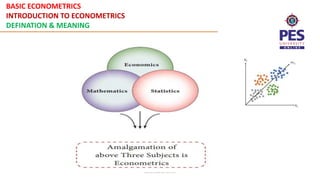
Econometrics means “economic measurement”.
the scope of econometrics is much broader, as can be seen from
the following definitions:
“Econometrics may be defined as the social science in which the
tools of economic theory, mathematics, and statistical inference
are applied to the analysis of economic phenomena” (Goldberger
1964).
“Econometrics is concerned with the empirical determination of
economic laws” (Theil 1971).
BASIC ECONOMETRICS
INTRODUCTION TO ECONOMETRICS
DEFINATION & MEANING
Basic Econometrics
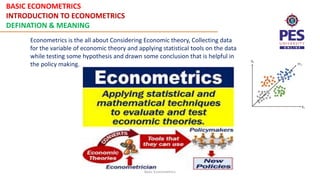
Econometrics is the all about Considering Economic theory, Collecting data
for the variable of economic theory and applying statistical tools on the data
while testing some hypothesis and drawn some conclusion that is helpful in
the policy making.
BASIC ECONOMETRICS
INTRODUCTION TO ECONOMETRICS
DEFINATION & MEANING
Basic Econometrics
BASIC ECONOMETRICS
INTRODUCTION TO ECONOMETRICS
Why Econometrics is a separate Discipline?
Basic Econometrics
WHY ECONOMETRICS IS A SEPARATE DISCIPLINE?
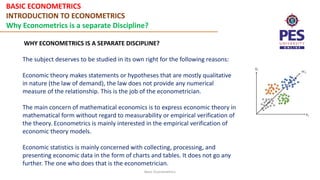
The subject deserves to be studied in its own right for the following reasons:
Economic theory makes statements or hypotheses that are mostly qualitative
in nature (the law of demand), the law does not provide any numerical
measure of the relationship. This is the job of the econometrician.
The main concern of mathematical economics is to express economic theory in
mathematical form without regard to measurability or empirical verification of
the theory. Econometrics is mainly interested in the empirical verification of
economic theory models.
Economic statistics is mainly concerned with collecting, processing, and
presenting economic data in the form of charts and tables. It does not go any
further. The one who does that is the econometrician.
BASIC ECONOMETRICS
INTRODUCTION TO ECONOMETRICS
Why should you study Econometrics?
Basic Econometrics
Why should you study Econometrics?
•Econometrics provides research tools for your subject.
•Econometrics provides empirical evidence for theoretical statements. Without
empirical support the statements may have no value. The theories are tested
based of different models and we can forecast the results and make
predictions.
•Data never speaks for themselves; Econometrics makes Data speak
•From Idea to forecasting: First we may have an Idea that can be converted to
a sound theory. To test the theory we need a functional form showing the
relationship of the variables. After that we can go for specification in which we
use mathematical equations to reflect the nature of relationship of the
variables. The next step may be data collection. We then may use the data for
estimation, testing, forecasting based on the model that we have specified.
BASIC ECONOMETRICS
INTRODUCTION TO ECONOMETRICS
IMPORTANCE OF ECONOMETRICS IN ADVANCE RESEARCH
Basic Econometrics
Econometrics has three major uses:
•describing economic reality
•testing hypotheses about economic theory
•forecasting future economic activity
BASIC ECONOMETRICS
INTRODUCTION TO ECONOMETRICS
IMPORTANCE OF ECONOMETRICS IN ADVANCE RESEARCH
Basic Econometrics
1.The simplest use of econometrics is description.
We can use econometrics to quantify economic activity because econometrics allows
us to estimate numbers and put them in equations that previously contained only
abstract symbols.
For example, consumer demand for a particular commodity often can be thought of as
a relationship between the quantity demanded (Q) and the commodity’s price (P), the
price of a substitute good (Ps), and disposable income (Yd). For most goods, the
relationship
between consumption and disposable income is expected to be positive,
because an increase in disposable income will be associated with an in crease in the
consumption of the good. Econometrics actually allows us to estimate that
relationship based upon past consumption, income, and prices
BASIC ECONOMETRICS
INTRODUCTION TO ECONOMETRICS
IMPORTANCE OF ECONOMETRICS IN ADVANCE RESEARCH
Basic Econometrics
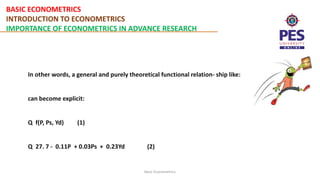
In other words, a general and purely theoretical functional relation- ship like:
can become explicit:
Q f(P, Ps, Yd) (1)
Q 27. 7 - 0.11P + 0.03Ps + 0.23Yd (2)
BASIC ECONOMETRICS
INTRODUCTION TO ECONOMETRICS
IMPORTANCE OF ECONOMETRICS IN ADVANCE RESEARCH
Basic Econometrics
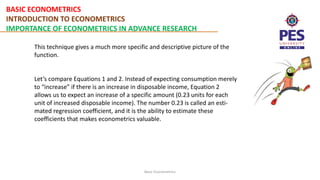
This technique gives a much more specific and descriptive picture of the
function.
Let’s compare Equations 1 and 2. Instead of expecting consumption merely
to “increase” if there is an increase in disposable income, Equation 2
allows us to expect an increase of a specific amount (0.23 units for each
unit of increased disposable income). The number 0.23 is called an esti-
mated regression coefficient, and it is the ability to estimate these
coefficients that makes econometrics valuable.
BASIC ECONOMETRICS
INTRODUCTION TO ECONOMETRICS
IMPORTANCE OF ECONOMETRICS IN ADVANCE RESEARCH
Basic Econometrics
2.The second and perhaps most common use of econometrics is hypothesis testing, the
evaluation of alternative theories with quantitative evidence. Much of economics
involves building theoretical models and testing them against evidence, and hypothesis
testing is vital to that scientific approach.
For example, you could test the hypothesis that the product in Equation 1 is what
economists call a normal good (one for which the quantity demanded increases when
disposable income increases).
You could do this by applying various statistical tests to the estimated coefficient (0.23) of
disposable income (Yd) in Equation 2.
At first glance, the evidence would seem to support this hypothesis, because the
coefficient’s sign is positive, but the “statistical significance” of that estimate would have to
be investigated before such a conclusion could be justified. Even though the estimated
coefficient is positive, as expected, it may not be sufficiently different from zero to
convince us that the true coefficient is indeed positive.
BASIC ECONOMETRICS
INTRODUCTION TO ECONOMETRICS
IMPORTANCE OF ECONOMETRICS IN ADVANCE RESEARCH
Basic Econometrics
3.The third and most difficult use of econometrics is to forecast or predict
what is likely to happen next quarter, next year, or further into the future,
based on what has happened in the past.
For example, economists use econometric models to make forecasts of variables like
sales, profits, Gross ), and the inflation rate. The accuracy of such fore- casts
depends in large measure on the degree to which the past is a good guide to the
future. Business leaders and politicians tend to be especially interested in this use of
econometrics because they need to make decisions about the future, and the
penalty for being wrong (bankruptcy for the entrepreneur and political defeat for
the candidate) is high. To the extent that econometrics can shed light on the impact
of their policies, business and government leaders will be better equipped to make
decisions. For example, if the president of a company that sold the product modeled
in Equation 1 wanted to decide whether to increase prices, forecasts of sales with
and without the price in- crease could be calculated and compared to help make
such a decision
THANK YOU
Dr Suresh.M
Department of Commerce
sureshm@pes.edu
Managerial Economics

Class 1.1 (1).pptx

  • 1.
    Basic Econometrics UM20BB258A BBA IVSEM Dr SURESH.M Department of Commerce Basic Econometrics
  • 2.
    BASIC ECONOMETRICS Introduction toEconometrics UNIT I BASIC ECONOMETRICS
  • 3.
    BASIC ECONOMETRICS INTRODUCTION TOECONOMETRICS DEFINATION & MEANING Basic Econometrics Econometrics means “economic measurement”. the scope of econometrics is much broader, as can be seen from the following definitions: “Econometrics may be defined as the social science in which the tools of economic theory, mathematics, and statistical inference are applied to the analysis of economic phenomena” (Goldberger 1964). “Econometrics is concerned with the empirical determination of economic laws” (Theil 1971).
  • 4.
    BASIC ECONOMETRICS INTRODUCTION TOECONOMETRICS DEFINATION & MEANING Basic Econometrics Econometrics is the all about Considering Economic theory, Collecting data for the variable of economic theory and applying statistical tools on the data while testing some hypothesis and drawn some conclusion that is helpful in the policy making.
  • 5.
    BASIC ECONOMETRICS INTRODUCTION TOECONOMETRICS DEFINATION & MEANING Basic Econometrics
  • 6.
    BASIC ECONOMETRICS INTRODUCTION TOECONOMETRICS Why Econometrics is a separate Discipline? Basic Econometrics WHY ECONOMETRICS IS A SEPARATE DISCIPLINE? The subject deserves to be studied in its own right for the following reasons: Economic theory makes statements or hypotheses that are mostly qualitative in nature (the law of demand), the law does not provide any numerical measure of the relationship. This is the job of the econometrician. The main concern of mathematical economics is to express economic theory in mathematical form without regard to measurability or empirical verification of the theory. Econometrics is mainly interested in the empirical verification of economic theory models. Economic statistics is mainly concerned with collecting, processing, and presenting economic data in the form of charts and tables. It does not go any further. The one who does that is the econometrician.
  • 7.
    BASIC ECONOMETRICS INTRODUCTION TOECONOMETRICS Why should you study Econometrics? Basic Econometrics Why should you study Econometrics? •Econometrics provides research tools for your subject. •Econometrics provides empirical evidence for theoretical statements. Without empirical support the statements may have no value. The theories are tested based of different models and we can forecast the results and make predictions. •Data never speaks for themselves; Econometrics makes Data speak •From Idea to forecasting: First we may have an Idea that can be converted to a sound theory. To test the theory we need a functional form showing the relationship of the variables. After that we can go for specification in which we use mathematical equations to reflect the nature of relationship of the variables. The next step may be data collection. We then may use the data for estimation, testing, forecasting based on the model that we have specified.
  • 8.
    BASIC ECONOMETRICS INTRODUCTION TOECONOMETRICS IMPORTANCE OF ECONOMETRICS IN ADVANCE RESEARCH Basic Econometrics Econometrics has three major uses: •describing economic reality •testing hypotheses about economic theory •forecasting future economic activity
  • 9.
    BASIC ECONOMETRICS INTRODUCTION TOECONOMETRICS IMPORTANCE OF ECONOMETRICS IN ADVANCE RESEARCH Basic Econometrics 1.The simplest use of econometrics is description. We can use econometrics to quantify economic activity because econometrics allows us to estimate numbers and put them in equations that previously contained only abstract symbols. For example, consumer demand for a particular commodity often can be thought of as a relationship between the quantity demanded (Q) and the commodity’s price (P), the price of a substitute good (Ps), and disposable income (Yd). For most goods, the relationship between consumption and disposable income is expected to be positive, because an increase in disposable income will be associated with an in crease in the consumption of the good. Econometrics actually allows us to estimate that relationship based upon past consumption, income, and prices
  • 10.
    BASIC ECONOMETRICS INTRODUCTION TOECONOMETRICS IMPORTANCE OF ECONOMETRICS IN ADVANCE RESEARCH Basic Econometrics In other words, a general and purely theoretical functional relation- ship like: can become explicit: Q f(P, Ps, Yd) (1) Q 27. 7 - 0.11P + 0.03Ps + 0.23Yd (2)
  • 11.
    BASIC ECONOMETRICS INTRODUCTION TOECONOMETRICS IMPORTANCE OF ECONOMETRICS IN ADVANCE RESEARCH Basic Econometrics This technique gives a much more specific and descriptive picture of the function. Let’s compare Equations 1 and 2. Instead of expecting consumption merely to “increase” if there is an increase in disposable income, Equation 2 allows us to expect an increase of a specific amount (0.23 units for each unit of increased disposable income). The number 0.23 is called an esti- mated regression coefficient, and it is the ability to estimate these coefficients that makes econometrics valuable.
  • 12.
    BASIC ECONOMETRICS INTRODUCTION TOECONOMETRICS IMPORTANCE OF ECONOMETRICS IN ADVANCE RESEARCH Basic Econometrics 2.The second and perhaps most common use of econometrics is hypothesis testing, the evaluation of alternative theories with quantitative evidence. Much of economics involves building theoretical models and testing them against evidence, and hypothesis testing is vital to that scientific approach. For example, you could test the hypothesis that the product in Equation 1 is what economists call a normal good (one for which the quantity demanded increases when disposable income increases). You could do this by applying various statistical tests to the estimated coefficient (0.23) of disposable income (Yd) in Equation 2. At first glance, the evidence would seem to support this hypothesis, because the coefficient’s sign is positive, but the “statistical significance” of that estimate would have to be investigated before such a conclusion could be justified. Even though the estimated coefficient is positive, as expected, it may not be sufficiently different from zero to convince us that the true coefficient is indeed positive.
  • 13.
    BASIC ECONOMETRICS INTRODUCTION TOECONOMETRICS IMPORTANCE OF ECONOMETRICS IN ADVANCE RESEARCH Basic Econometrics 3.The third and most difficult use of econometrics is to forecast or predict what is likely to happen next quarter, next year, or further into the future, based on what has happened in the past. For example, economists use econometric models to make forecasts of variables like sales, profits, Gross ), and the inflation rate. The accuracy of such fore- casts depends in large measure on the degree to which the past is a good guide to the future. Business leaders and politicians tend to be especially interested in this use of econometrics because they need to make decisions about the future, and the penalty for being wrong (bankruptcy for the entrepreneur and political defeat for the candidate) is high. To the extent that econometrics can shed light on the impact of their policies, business and government leaders will be better equipped to make decisions. For example, if the president of a company that sold the product modeled in Equation 1 wanted to decide whether to increase prices, forecasts of sales with and without the price in- crease could be calculated and compared to help make such a decision
  • 14.
    THANK YOU Dr Suresh.M Departmentof Commerce sureshm@pes.edu Managerial Economics