1
Urgent
Date: August 26, 2024
To,
Shri Sanjay Saxena
Additional Director General, Law and Order
adg.lo@mahapolice.gov.in
Shri Rakesh Ola (IPS)
Superintendent of Police, Ahmednagar
sp.ahmednagar@mahapolice.gov.in
Shri Siddharam Salimath (IAS)
District Collector & Magistrate, Ahmednagar
collector.ahmednagar@maharashtra.gov.in
Shri Sandip Koli
Police Inspector, Kopargaon Rural Police Station
ps.kopergaont.anr@mahapolice.gov.in
Subject: Citizen’s petition seeking preventive action against “Hindu Janakrosh Morcha”
organized by right-wing organization “Sakal Hindu Samaj” that is going to be held in
Dhotre Village, Kopargaon, Ahmednagar (Maharashtra) on August 28, 2024 at 10 AM in
line with orders of the Hon’ble Supreme Court and Bombay High Court
Sirs,
We at Citizens for Justice and Peace (CJP), are extremely concerned about a proposed and
published event of “Hindu Janakrosh Morcha” organized by Hindu right-wing extremist
organization Sakal Hindu Dalit Samaj, Kopargaon, that, according to the information available
on their poster, is going to be held in Dhotre Village, Kopargaon, Ahmednagar. The said event
is being called as “Hindu Janakrosh Morcha”. It will be held on August 28, 2024 at 10 AM.
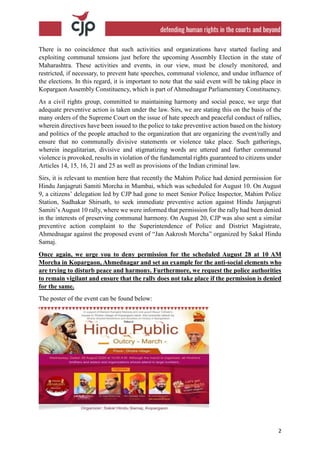
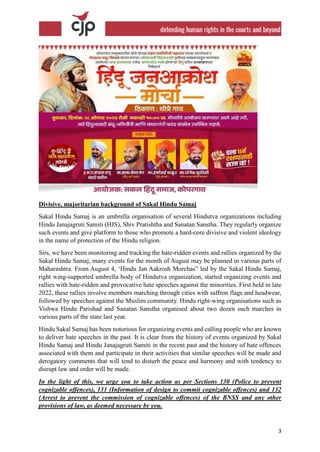
As per the details in the poster of the event available, right-wing leader & habitual hate offender
Harshatai Thakur, Sangram Bapu Bhandare, Sagar Beg and Yogesh Suryavanshi are invited as
keynote speakers for this event. As per the content of their poster, it is near certain that
provocative speeches will be delivered and calls for violence will be made, given the recent
track record of the organisation and speakers invited and the ‘principles’ that they stand for. In
the citizen’s petition we have cited recent orders of the Hon’ble Supreme Court, the Bombay
High Court as well as Orders issued by the Director General of Police Maharashtra on steps
that need to be taken, especially pre-emotive ones.
2
There is no coincidence that such activities and organizations have started fueling and
exploiting communal tensions just before the upcoming Assembly Election in the state of
Maharashtra. These activities and events, in our view, must be closely monitored, and
restricted, if necessary, to prevent hate speeches, communal violence, and undue influence of
the elections. In this regard, it is important to note that the said event will be taking place in
Kopargaon Assembly Constituency, which is part of Ahmednagar Parliamentary Constituency.
As a civil rights group, committed to maintaining harmony and social peace, we urge that
adequate preventive action is taken under the law. Sirs, we are stating this on the basis of the
many orders of the Supreme Court on the issue of hate speech and peaceful conduct of rallies,
wherein directives have been issued to the police to take preventive action based on the history
and politics of the people attached to the organization that are organizing the event/rally and
ensure that no communally divisive statements or violence take place. Such gatherings,
wherein inegalitarian, divisive and stigmatizing words are uttered and further communal
violence is provoked, results in violation of the fundamental rights guaranteed to citizens under
Articles 14, 15, 16, 21 and 25 as well as provisions of the Indian criminal law.
Sirs, it is relevant to mention here that recently the Mahim Police had denied permission for
Hindu Janjagruti Samiti Morcha in Mumbai, which was scheduled for August 10. On August
9, a citizens’ delegation led by CJP had gone to meet Senior Police Inspector, Mahim Police
Station, Sudhakar Shirsath, to seek immediate preventive action against Hindu Janjagruti
Samiti’s August 10 rally, where we were informed that permission for the rally had been denied
in the interests of preserving communal harmony. On August 20, CJP was also sent a similar
preventive action complaint to the Superintendence of Police and District Magistrate,
Ahmednagar against the proposed event of “Jan Aakrosh Morcha” organized by Sakal Hindu
Samaj.
Once again, we urge you to deny permission for the scheduled August 28 at 10 AM
Morcha in Kopargaon, Ahmednagar and set an example for the anti-social elements who
are trying to disturb peace and harmony. Furthermore, we request the police authorities
to remain vigilant and ensure that the rally does not take place if the permission is denied
for the same.
The poster of the event can be found below:
3
Divisive, majoritarian background of Sakal Hindu Samaj
Sakal Hindu Samaj is an umbrella organisation of several Hindutva organizations including
Hindu Janajagruti Samiti (HJS), Shiv Pratishtha and Sanatan Sanstha. They regularly organize
such events and give platform to those who promote a hard-core divisive and violent ideology
in the name of protection of the Hindu religion.
Sirs, we have been monitoring and tracking the hate-ridden events and rallies organized by the
Sakal Hindu Samaj, many events for the month of August may be planned in various parts of
Maharashtra. From August 4, ‘Hindu Jan Aakrosh Morchas” led by the Sakal Hindu Samaj,
right wing-supported umbrella body of Hindutva organization, started organizing events and
rallies with hate-ridden and provocative hate speeches against the minorities. First held in late
2022, these rallies involve members marching through cities with saffron flags and headwear,
followed by speeches against the Muslim community. Hindu right-wing organisations such as
Vishwa Hindu Parishad and Sanatan Sanstha organised about two dozen such marches in
various parts of the state last year.
Hindu Sakal Samaj has been notorious for organizing events and calling people who are known
to deliver hate speeches in the past. It is clear from the history of events organized by Sakal
Hindu Samaj and Hindu Janajagruti Samiti in the recent past and the history of hate offences
associated with them and participate in their activities that similar speeches will be made and
derogatory comments that will tend to disturb the peace and harmony and with tendency to
disrupt law and order will be made.
In the light of this, we urge you to take action as per Sections 130 (Police to prevent
cognizable offences), 131 (Information of design to commit cognizable offences) and 132
(Arrest to prevent the commission of cognizable offences) of the BNSS and any other
provisions of law, as deemed necessary by you.
4
It is crucial to highlight here that HJS has been notorious for organising such events and making
controversial and derogatory statements amounting to hate speech against the Muslim minority
community. This has grave potential of being blown up and leading to a law-and-order situation
in the city, not just in the immediate future but collectively, as these events are held state-wide
could have dangerous implications in the near future.
Sirs, it is also essential to highlight that the state assembly elections are going to take place in
the state of Maharashtra later this year. In a peaceful and communally harmonious place like
Kopargaon there should be no space for such divisionism. Thus, as peace-loving citizens of
this diverse and harmonious place, we humbly urge you to take preventive action as per the
law and the directions recently issued by the Supreme Court of India.
Preventive Measures when Speakers & Organisers have a record of Provocative Hate
Speech:
We are sure that the Police is aware of a slew of directives that the Hon’ble Supreme
Court has issued time and again for effective prevention of social disharmony, hate crimes
and communal violence.
These include:
In Mohd. Haroon and others v. Union of India (2014) 5 SCC 252 and another, it has been
clearly held that it is the responsibility of the State Administration in association with the
intelligence agencies of both the State and the Centre to prevent recurrence of communal
violence in any part of the State. If any officer responsible for maintaining law and order is
found negligent, he/she should be brought within the ambit of law.
In Firoz Iqbal Khan vs Union of India [W.P (Civ.) No. 956 of 2020], the Supreme Court had
held,
“..the edifice of a democratic society committed to the rule of law under a regime of
constitutional rights, values and duties is founded on the co-existence of communities. India is
a melting pot of civilizations, cultures, religions and languages. Any attempt to vilify a religious
community must be viewed with grave disfavour by this Court as the custodian of constitutional
values.”
In the case of Tehseen Poonawalla v UOI and ors (2018) 9 SCC 501 the Supreme Court held
that, it is the responsibility of the States to prevent untoward incidents and to prevent crime.
The court further given specific directions for the police to adopt preventative measures, in
which a senior police officer, not below the rank of Superintendent of Police, shall work as
Nodal Officer in each district. Such Nodal officers were then directed to constitute a special
task force so as to procure intelligence reports about the people who are likely to commit such
crimes, as mob violence and lynching, or who are involved in spreading hate speeches,
provocative statements and fake news.
5
In addition to this, the Nodal Officer, along with the Station House officers, have been directed
to take steps to prohibit instances of dissemination of offensive material through different social
media platforms or any other means for inciting tendencies leading to mob-violence and
lynching.
The court further said,
17. There can be no shadow of doubt that the authorities which are conferred with the
responsibility to maintain law and order in the States have the principal obligation to see that
vigilantism, be it cow vigilantism or any other vigilantism of any perception, does not take
place. When any core group with some kind of idea take the law into their own hands, it ushers
in anarchy, chaos, disorder and, eventually, there is an emergence of a violent society.
Vigilantism cannot, by any stretch of imagination, be given room to take shape, for it is
absolutely a perverse notion… No one has the authority to enter into the said field and harbour
the feeling that he is the law and the punisher himself. A country where the rule of law prevails
does not allow any such thought. It, in fact, commands for ostracization of such thoughts with
immediacy.
20. Hate crimes as a product of intolerance, ideological dominance and prejudice ought not to
be tolerated; lest it results in a reign of terror. Extra judicial elements and non-State actors
cannot be allowed to take the place of law or the law enforcing agency. A fabricated identity
with bigoted approach sans acceptance of plurality and diversity results in provocative
sentiments and display of reactionary retributive attitude transforming itself into
dehumanisation of human beings. Such an atmosphere is one in which rational debate, logical
discussion and sound administration of law eludes thereby manifesting clear danger to various
freedoms including freedom of speech and expressions. One man's freedom of thought, action,
speech, expression, belief, conscience and personal choices is not being tolerated by the other
and this is due to lack of objective rationalisation of acts and situations.
In the case of Amish Devgan vs Union of India 2021 1 SCC 1, the Supreme Court quoted
Benjamin Franklin, “It remains difficult in law to draw the outmost bounds of freedom of
speech and expression, the limit beyond which the right would fall foul and can be subordinated
to other democratic values and public law considerations, so as to constitute a criminal offence.
The difficulty arises in ascertaining the legitimate countervailing public duty, and in
proportionality and reasonableness of the restriction which criminalizes written or spoken
words. Further, criminalization of speech is often demarcated and delineated by the past and
recent significant events affecting the nation including explanation of their causes. Therefore,
constitutional and statutory treatment of ‘hate speech’ depends on the values sought to be
promoted, perceived harm involved and the importance of these harms. Consequently, a
universal definition of ‘hate speech’ remains difficult, except for one commonality that
‘incitement to violence’ is punishable.”
On February 26, the Navi Mumbai Commissioner of Police, Milind Bharambe, had videotaped
the entire event organized by Sakal Hindu Samajh in Navi Mumbai, Maharashtra as per the
orders of the Supreme Court. The content of the speeches given at the event are now being
investigated on whether they can be classified as hate speeches. The decision of video-tapping
6
the event came after Mr. Tushar Gandhi, president of the Mahatma Gandhi Foundation had
written a preventive letter to the Navi Mumbai police seeking preventative measures, much
like we are doing.
Importantly, on April 15 this year, the Calcutta High Court had restricted VHP rally on the
occasion of Ram Navami by limiting the upper cap to 200 participants in the rally. The single
judge bench of Justice Jay Sengupta had also asked the state and VHP to ensure that no
provocative slogans were raised, and display of arms and use of DJs were strictly prohibited.
On August 2, 2023, the apex court while allowing the VHP rallies in Delhi-NCR region had
strictly warned the police to take steps to prevent instances of any violence and hate speech at
the rallies. The bench consisting Justices Sanjiv Khanna and S.V. Bhatti had told the authorities,
“We hope and trust that the State Governments, including police authorities, will ensure that
there are no hate speeches against any community and there is no violence or damage to
properties. Wherever required, adequate police or paramilitary forces must be deployed.
Further, authorities must make use of the CCTV cameras wherever installed, or make video
recordings in all sensitive areas wherever required. The CCTV footage and the videos will be
preserved”.
We urge that Kopargaon Police follows these strict laid down preventive measures.
Recent Directions of the Supreme Court on Events after they Occur/are allowed:
As you must know, the issue of rampant hate speech being delivered in Maharashtra and the
inaction by law enforcement agencies has been highlighted before the Supreme Court multiple
times since 2022. In its October 21, 2022 order, the Supreme Court had issued interim
directions to the state Police wherein it had directed that
“As and when any speech or any action takes place which attracts offences such as Sections
153A, 153B and 295A and 505 of the IPC etc., suo moto action will be taken to register cases
even if no complaint is forthcoming and proceed against the offenders in accordance with law.”
The court had further said that non-compliance would amount to contempt of court:
“We make it clear that any hesitation to act in accordance with this direction will be viewed as
contempt of this Court and appropriate action will be taken against the erring officers,” the
order reads.
We would also like to highlight that on February 3, 2023, the Supreme Court issued directions
with respect to an event which was scheduled to be held in Mumbai on February 5, 2023
by another extremist Hindutva group, Sakal Hindu Samaj. The petitioner, Shaheen Abdullah
had contended that similar to its anti-Muslim speech during 'Hindu Jan Aakrosh Morcha' held
in Mumbai on January 29, it can be apprehended that the same will be repeated during the
February 5 meeting as well. The apex court had thus sought a video of the entire event to be
scrutinized by the court at the next hearing. The court has also taken an undertaking from
government of Maharashtra that if permission for this event is granted “it will be subject to the
condition that nobody will make any hate speech and in defiance of law or disturbing the public
order.”
The court also outlined directives with respect to taking preventive action in such cases:
7
“We also direct that the Officer(s), in case, permission is granted and, in case, the occasion
arises for invoking the power under Section 151 of Cr.P.C. as aforesaid, it shall be the duty
of the Officer(s) concerned to invoke the said power and to act as per the mandate of Section
151 of the Cr.P.C.”
The apex court has, thus, again outlined already codified statutory duties of a police officer
which makes it mandatory for them to take action under section 151 of CrPC in case there is
apprehension of hate speech. The court, during the hearing on February 3 had also expressed
its disappointment that the police was not taking preventive action or filing complaints suo-
moto in cases of hate speech, as it had directed in October, 2022 while hearing a bath of
petitions against hate speech at various occasions.
Sirs/Ma’am, on April 28, 2023 the Supreme Court had held that all States/UTs, including West
Bengal, are enjoined and bound to take suo-moto action to register FIR against hate speeches,
without waiting for any formal complaint. In its order, the Supreme Court bench comprising
Justices KM Joseph and BV Nagarathna had said the following:
"Respondents (states) shall ensure that immediately, as and when any speech or any action
takes place which attracts offences such as Section 153A, 153B, 295A and 506 of IPC etc,
without any complaint being filed suo moto action be taken to register cases and proceed
against the offenders in accordance with law. Respondents will issue directions to the
subordinates so that appropriate action can be taken at the earliest. We further make it clear
that such action be taken irrespective of the religion of the maker of the speech, so that the
secular character of Bharat as envisaged by the Preamble is preserved."
The apex court has, thus, again outlined already codified statutory duties of a police officer
which makes it mandatory for them to take action under section 151 of CrPC in case there is
apprehension of hate speech. Sir, given the well-orchestrated and numerous instances of hate
speech and actual hate crimes being committed, the minority community in various parts of
India already feels insecure and threatened. Furthermore, this was spoken at a public event and
this speech has reached not only the audience at the event but also all those who may have seen
these videos on their mobile phones, by the medium of social media. How large and wide the
reach of social media can be, we are sure you must be aware. The consequences of such an
inflammatory speech could have been worse.
Even in 2024 itself, while on January 17, 2024, the Supreme Court bench of Justices Sanjiv
Khanna and Dipankar Datta had expressed their anguish at the petitioners being forced to
approach the Supreme Court multiple times against individuals and organisations even after
there being guidelines for tacking and taking action against hate speeches. During the said
hearing, the Supreme Court issued an order directing the District Magistrate and
Superintendent of Police at Yavatmal, Maharashtra and Raipur, Chhattisgarh to take
‘appropriate steps’ to ensure that no incitement to violence or hate speech occurs at the rallies
scheduled in the said districts in the coming few days of January. The said order was passed
following the concerns raised by the petitioners over delivery of potential hate speeches at
rallies planned by Hindu Janajagruti Samiti and Bharatiya Janata Party legislator T Raja Singh
in the month of January.
8
The court had outlined directives with respect to taking preventive action in such cases:
“We would require the authorities to be conscious that no incitement to violence and hate
speech are permissible. The concerned District Magistrates and Superintendent of Police of
Yavatmal, Maharashtra and Raipur, Chattisgarh will take necessary steps, as may be
required. If necessary and deemed appropriate, police/administration will install CCTV
Cameras having recording facility, so as to ensure identification of the perpetrators in the
event of any violence/hate speech.”
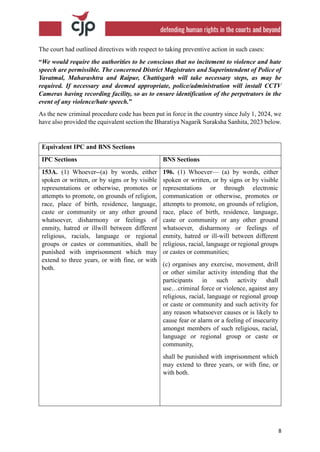
As the new criminal procedure code has been put in force in the country since July 1, 2024, we
have also provided the equivalent section the Bharatiya Nagarik Suraksha Sanhita, 2023 below.
Equivalent IPC and BNS Sections
IPC Sections BNS Sections
153A. (1) Whoever--(a) by words, either
spoken or written, or by signs or by visible
representations or otherwise, promotes or
attempts to promote, on grounds of religion,
race, place of birth, residence, language,
caste or community or any other ground
whatsoever, disharmony or feelings of
enmity, hatred or illwill between different
religious, racials, language or regional
groups or castes or communities, shall be
punished with imprisonment which may
extend to three years, or with fine, or with
both.
196. (1) Whoever— (a) by words, either
spoken or written, or by signs or by visible
representations or through electronic
communication or otherwise, promotes or
attempts to promote, on grounds of religion,
race, place of birth, residence, language,
caste or community or any other ground
whatsoever, disharmony or feelings of
enmity, hatred or ill-will between different
religious, racial, language or regional groups
or castes or communities;
(c) organises any exercise, movement, drill
or other similar activity intending that the
participants in such activity shall
use…criminal force or violence, against any
religious, racial, language or regional group
or caste or community and such activity for
any reason whatsoever causes or is likely to
cause fear or alarm or a feeling of insecurity
amongst members of such religious, racial,
language or regional group or caste or
community,
shall be punished with imprisonment which
may extend to three years, or with fine, or
with both.
9
503. Criminal intimidation.—
Whoever threatens another with any injury to
his person, reputation or property, or to the
person or reputation of any one in whom that
person is interested, with intent to cause
alarm to that person, or to cause that person
to do any act which he is not legally bound to
do, or to omit to do any act which that person
is legally entitled to do, as the means of
avoiding the execution of such threat,
commits criminal intimidation.
351. (1) Whoever threatens another by any
means, with any injury to his person,
reputation or property, or to the person or
reputation of any one in whom that person is
interested, with intent to cause alarm to that
person, or to cause that person to do any act
which he is not legally bound to do, or to
omit to do any act which that person is
legally entitled to do, as the means of
avoiding the execution of such threat,
commits criminal intimidation.
(2) Whoever commits the offence of criminal
intimidation shall be punished with
imprisonment of either description for a term
which may extend to two years, or with fine,
or with both.
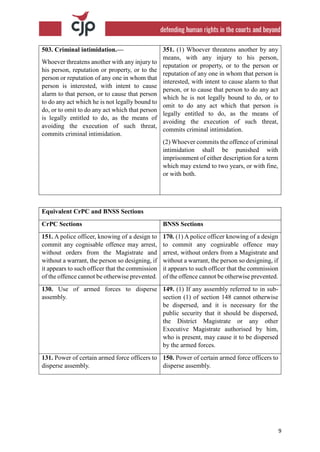
Equivalent CrPC and BNSS Sections
CrPC Sections BNSS Sections
151. A police officer, knowing of a design to
commit any cognisable offence may arrest,
without orders from the Magistrate and
without a warrant, the person so designing, if
it appears to such officer that the commission
of the offence cannot be otherwise prevented.
170. (1) A police officer knowing of a design
to commit any cognizable offence may
arrest, without orders from a Magistrate and
without a warrant, the person so designing, if
it appears to such officer that the commission
of the offence cannot be otherwise prevented.
130. Use of armed forces to disperse
assembly.
149. (1) If any assembly referred to in sub-
section (1) of section 148 cannot otherwise
be dispersed, and it is necessary for the
public security that it should be dispersed,
the District Magistrate or any other
Executive Magistrate authorised by him,
who is present, may cause it to be dispersed
by the armed forces.
131. Power of certain armed force officers to
disperse assembly.
150. Power of certain armed force officers to
disperse assembly.
10
Order of Bombay High Court demanding answers on action undertaken in cases of hate
speeches
On February 9 2024, the Bombay High Court had heard the petition seeking arrest of Bharatiya
Janata Party leader Vikram Pawaskar for delivering alleged hate speeches and his role in an
attack on a mosque in Satara in September 2023. During the hearing, the bench had demanded
for the Maharashtra state government to place on affidavit the steps it takes and procedures it
follows in cases of hate speeches, besides questioning them over the inadequacy in the action
taken on a petition seeking the arrest of Bharatiya Janata Party leader Vikram Pawaskar over
his alleged hate speech and role in an attack on a mosque in Satara in September 2023. The
High Court was hearing a writ petition filed by rights activist Shakir Tamboli wherein he had
sought for judicial intervention to direct the state government “to take immediate action”
against Pawaskar based on two FIRs filed against him.
Sirs/ Ma’am, in cases of hate speeches being delivered, even after reporting hate speeches,
filing complaints and lodging First Information Reports (FIRs) against speakers, ensuring that
action is taking in pursuance to the said FIRs is as big a task as one can imagine. To get action
taken against those indulging in hate speech, complaints are forced to move the High Courts
by filing a criminal writ petition to urge the courts to direct the police to take immediate action
against the offenders as well as investigate, arrest and prosecute all the accused.
Circulars issued by DGP Maharashtra in February 2023 and May 2023 urging strict
action on Hate Speech
In Circular No. DGP 20/ Petition No.940/ 2022/54.2023. issued by Dr Suhas Warke (Spl.
Inspector General of Police (L&O) for The Director General of Police M.S., Mumbai), dated
February 2, 2023, the Supreme Court order dated January 13, 2023 has been highlighted where
the court had asked the police to ensure that as and when any speech which attracts offences
such as Sections 153A, 153B and 295A and 505 of the IPC take place, suo moto action is taken
if no complaint is forthcoming.
The circular had directed all Unit Commanders to follow the Supreme Court order.
The Circular No. DGP/20/Petition No. 940-2022/54/2023 issued by Dr Suhas Warke (Spl.
Inspector General of Police (L&O) for The Director General of Police M.S., Mumbai), dated
April 3, 2023, entails “measures to be taken to maintain law and order due to agitations,
morchas, speeches etc.”
It gives detailed instructions on what steps are to be taken when any morchas are to be held:
2. All the Unit Commanders should hold a meeting with the concerned organizers before such
a morcha and fix the route of the morcha with appropriate terms and condition. A combined
meeting of all social groups should be taken to convey clearly, to all that they should maintain
peace and keep law and order during the morcha. Preventive action against Anti-social
elements should be taken. Those elements who help in maintaining peace and harmony should
be encouraged. Audio Video recording of the morcha should be done. Police Head Quarters
should ensure adequate supply of equipment’s, like Lathi, Helmets, etc. to police men deployed
for morcha bandobast. If any law-and-order situation arises, offences should be registered
11
immediately and arrest should be made. Intelligence machinery should be activated to collect
advance information about morcha, agitation and efforts should be made to pre-empt any
communal incidents.
Oath under the Indian Constitution
Sirs/Ma’am, we are sure you are aware of Schedule III of the Constitution that lays down the
constitutional obligation of every government servant. For a government servant, when they
take office after elections the Third Schedule of the Constitution [Articles 75(4), 99, 124(6),
148(2), 164(3), 188 and 219], the Oath is straightforward: whether sworn in the name of God
or the Constitution, the government servant must only be wedded to true faith solemnly affirm
and allegiance to the Constitution of India as by law established and function in accordance
with the Constitution and the law, without fear or favour, affection or ill will.
In your esteemed case, Sirs/Ma’am, under the Third Schedule, the Form of oath or affirmation
to be made by a government servant is as follows: —
[“I, A.B., do swear/solemnly affirm that I will be faithful and bear true allegiance to India
and to the Constitution of India as by law established, that I will uphold the sovereignty and
integrity of India, and that I will carry out the duties of my office loyally, honestly, and with
impartiality." (So, help me God!)”]
Sustained Campaign for Peace and Social Harmony by CJP
Sirs, in the month of April 2024, CJP had released a ready to use Handbook, Towards a Hate
Free Nation and the Handbook succinctly provides latest jurisprudence from the Supreme
Court of India (SC) and Bombay High Court (HC) CJP that re-emphasise the role and
responsibility to both prevent and prosecute targeted violence. This comprehensive booklet on
preventive and other measures provides the measures that must be adopted by police and
district administration in cases of such provocative events where inciting hate speeches are
likely to be delivered. CJP believes that countering hate is a collective responsibility of both
the concerned citizenry and the authorities.
The handbook titled ‘Towards a Hate Free Nation’ has been marked and annexed hereto as
Annexure A
We would like to mention that we have been following the events planned for by right wing
organisations across the country and have been sending memorandums to concerned authorities
to take pre-emptive action with the strong apprehension that hate speeches will be delivered at
such events. Our apprehensions have been proved right in the past as well when events
organised by Hindu Rashtra Jagruti Sabha had included instigating speeches and anti-Muslim
rhetoric, which could have been prevented basis our complaints sent to the police authorities
in the district and local police as well.
Considering the indisputable history of hate speech of the speakers and the organisers as well,
it is pertinent that you take immediate action in this regard and cancel the permission (if given)
or deny permission for this event, in the light of the Supreme Court directions of February 3,
(as indicated above).
12
Sirs, we urge you to take necessary action and follow due process of law to stop this event from
taking place and take any other preventive action within the powers of the Police. If the wider
public is kept abreast of developments, this would go a long way in rebuilding faith and
confidence in the rule of law in general and a police-citizen relationship in particular.
In anticipation,
Yours sincerely,
Nandan Maluste, CJP President
Teesta Setalvad, CJP Secretary
Annexures:
Annexure A- Handbook titled ‘Towards a Hate Free Nation’

CJP 1.pdf The Complaint can be read here:

  • 1.
    1 Urgent Date: August 26,2024 To, Shri Sanjay Saxena Additional Director General, Law and Order adg.lo@mahapolice.gov.in Shri Rakesh Ola (IPS) Superintendent of Police, Ahmednagar sp.ahmednagar@mahapolice.gov.in Shri Siddharam Salimath (IAS) District Collector & Magistrate, Ahmednagar collector.ahmednagar@maharashtra.gov.in Shri Sandip Koli Police Inspector, Kopargaon Rural Police Station ps.kopergaont.anr@mahapolice.gov.in Subject: Citizen’s petition seeking preventive action against “Hindu Janakrosh Morcha” organized by right-wing organization “Sakal Hindu Samaj” that is going to be held in Dhotre Village, Kopargaon, Ahmednagar (Maharashtra) on August 28, 2024 at 10 AM in line with orders of the Hon’ble Supreme Court and Bombay High Court Sirs, We at Citizens for Justice and Peace (CJP), are extremely concerned about a proposed and published event of “Hindu Janakrosh Morcha” organized by Hindu right-wing extremist organization Sakal Hindu Dalit Samaj, Kopargaon, that, according to the information available on their poster, is going to be held in Dhotre Village, Kopargaon, Ahmednagar. The said event is being called as “Hindu Janakrosh Morcha”. It will be held on August 28, 2024 at 10 AM. As per the details in the poster of the event available, right-wing leader & habitual hate offender Harshatai Thakur, Sangram Bapu Bhandare, Sagar Beg and Yogesh Suryavanshi are invited as keynote speakers for this event. As per the content of their poster, it is near certain that provocative speeches will be delivered and calls for violence will be made, given the recent track record of the organisation and speakers invited and the ‘principles’ that they stand for. In the citizen’s petition we have cited recent orders of the Hon’ble Supreme Court, the Bombay High Court as well as Orders issued by the Director General of Police Maharashtra on steps that need to be taken, especially pre-emotive ones.
  • 2.
    2 There is nocoincidence that such activities and organizations have started fueling and exploiting communal tensions just before the upcoming Assembly Election in the state of Maharashtra. These activities and events, in our view, must be closely monitored, and restricted, if necessary, to prevent hate speeches, communal violence, and undue influence of the elections. In this regard, it is important to note that the said event will be taking place in Kopargaon Assembly Constituency, which is part of Ahmednagar Parliamentary Constituency. As a civil rights group, committed to maintaining harmony and social peace, we urge that adequate preventive action is taken under the law. Sirs, we are stating this on the basis of the many orders of the Supreme Court on the issue of hate speech and peaceful conduct of rallies, wherein directives have been issued to the police to take preventive action based on the history and politics of the people attached to the organization that are organizing the event/rally and ensure that no communally divisive statements or violence take place. Such gatherings, wherein inegalitarian, divisive and stigmatizing words are uttered and further communal violence is provoked, results in violation of the fundamental rights guaranteed to citizens under Articles 14, 15, 16, 21 and 25 as well as provisions of the Indian criminal law. Sirs, it is relevant to mention here that recently the Mahim Police had denied permission for Hindu Janjagruti Samiti Morcha in Mumbai, which was scheduled for August 10. On August 9, a citizens’ delegation led by CJP had gone to meet Senior Police Inspector, Mahim Police Station, Sudhakar Shirsath, to seek immediate preventive action against Hindu Janjagruti Samiti’s August 10 rally, where we were informed that permission for the rally had been denied in the interests of preserving communal harmony. On August 20, CJP was also sent a similar preventive action complaint to the Superintendence of Police and District Magistrate, Ahmednagar against the proposed event of “Jan Aakrosh Morcha” organized by Sakal Hindu Samaj. Once again, we urge you to deny permission for the scheduled August 28 at 10 AM Morcha in Kopargaon, Ahmednagar and set an example for the anti-social elements who are trying to disturb peace and harmony. Furthermore, we request the police authorities to remain vigilant and ensure that the rally does not take place if the permission is denied for the same. The poster of the event can be found below:
  • 3.
    3 Divisive, majoritarian backgroundof Sakal Hindu Samaj Sakal Hindu Samaj is an umbrella organisation of several Hindutva organizations including Hindu Janajagruti Samiti (HJS), Shiv Pratishtha and Sanatan Sanstha. They regularly organize such events and give platform to those who promote a hard-core divisive and violent ideology in the name of protection of the Hindu religion. Sirs, we have been monitoring and tracking the hate-ridden events and rallies organized by the Sakal Hindu Samaj, many events for the month of August may be planned in various parts of Maharashtra. From August 4, ‘Hindu Jan Aakrosh Morchas” led by the Sakal Hindu Samaj, right wing-supported umbrella body of Hindutva organization, started organizing events and rallies with hate-ridden and provocative hate speeches against the minorities. First held in late 2022, these rallies involve members marching through cities with saffron flags and headwear, followed by speeches against the Muslim community. Hindu right-wing organisations such as Vishwa Hindu Parishad and Sanatan Sanstha organised about two dozen such marches in various parts of the state last year. Hindu Sakal Samaj has been notorious for organizing events and calling people who are known to deliver hate speeches in the past. It is clear from the history of events organized by Sakal Hindu Samaj and Hindu Janajagruti Samiti in the recent past and the history of hate offences associated with them and participate in their activities that similar speeches will be made and derogatory comments that will tend to disturb the peace and harmony and with tendency to disrupt law and order will be made. In the light of this, we urge you to take action as per Sections 130 (Police to prevent cognizable offences), 131 (Information of design to commit cognizable offences) and 132 (Arrest to prevent the commission of cognizable offences) of the BNSS and any other provisions of law, as deemed necessary by you.
  • 4.
    4 It is crucialto highlight here that HJS has been notorious for organising such events and making controversial and derogatory statements amounting to hate speech against the Muslim minority community. This has grave potential of being blown up and leading to a law-and-order situation in the city, not just in the immediate future but collectively, as these events are held state-wide could have dangerous implications in the near future. Sirs, it is also essential to highlight that the state assembly elections are going to take place in the state of Maharashtra later this year. In a peaceful and communally harmonious place like Kopargaon there should be no space for such divisionism. Thus, as peace-loving citizens of this diverse and harmonious place, we humbly urge you to take preventive action as per the law and the directions recently issued by the Supreme Court of India. Preventive Measures when Speakers & Organisers have a record of Provocative Hate Speech: We are sure that the Police is aware of a slew of directives that the Hon’ble Supreme Court has issued time and again for effective prevention of social disharmony, hate crimes and communal violence. These include: In Mohd. Haroon and others v. Union of India (2014) 5 SCC 252 and another, it has been clearly held that it is the responsibility of the State Administration in association with the intelligence agencies of both the State and the Centre to prevent recurrence of communal violence in any part of the State. If any officer responsible for maintaining law and order is found negligent, he/she should be brought within the ambit of law. In Firoz Iqbal Khan vs Union of India [W.P (Civ.) No. 956 of 2020], the Supreme Court had held, “..the edifice of a democratic society committed to the rule of law under a regime of constitutional rights, values and duties is founded on the co-existence of communities. India is a melting pot of civilizations, cultures, religions and languages. Any attempt to vilify a religious community must be viewed with grave disfavour by this Court as the custodian of constitutional values.” In the case of Tehseen Poonawalla v UOI and ors (2018) 9 SCC 501 the Supreme Court held that, it is the responsibility of the States to prevent untoward incidents and to prevent crime. The court further given specific directions for the police to adopt preventative measures, in which a senior police officer, not below the rank of Superintendent of Police, shall work as Nodal Officer in each district. Such Nodal officers were then directed to constitute a special task force so as to procure intelligence reports about the people who are likely to commit such crimes, as mob violence and lynching, or who are involved in spreading hate speeches, provocative statements and fake news.
  • 5.
    5 In addition tothis, the Nodal Officer, along with the Station House officers, have been directed to take steps to prohibit instances of dissemination of offensive material through different social media platforms or any other means for inciting tendencies leading to mob-violence and lynching. The court further said, 17. There can be no shadow of doubt that the authorities which are conferred with the responsibility to maintain law and order in the States have the principal obligation to see that vigilantism, be it cow vigilantism or any other vigilantism of any perception, does not take place. When any core group with some kind of idea take the law into their own hands, it ushers in anarchy, chaos, disorder and, eventually, there is an emergence of a violent society. Vigilantism cannot, by any stretch of imagination, be given room to take shape, for it is absolutely a perverse notion… No one has the authority to enter into the said field and harbour the feeling that he is the law and the punisher himself. A country where the rule of law prevails does not allow any such thought. It, in fact, commands for ostracization of such thoughts with immediacy. 20. Hate crimes as a product of intolerance, ideological dominance and prejudice ought not to be tolerated; lest it results in a reign of terror. Extra judicial elements and non-State actors cannot be allowed to take the place of law or the law enforcing agency. A fabricated identity with bigoted approach sans acceptance of plurality and diversity results in provocative sentiments and display of reactionary retributive attitude transforming itself into dehumanisation of human beings. Such an atmosphere is one in which rational debate, logical discussion and sound administration of law eludes thereby manifesting clear danger to various freedoms including freedom of speech and expressions. One man's freedom of thought, action, speech, expression, belief, conscience and personal choices is not being tolerated by the other and this is due to lack of objective rationalisation of acts and situations. In the case of Amish Devgan vs Union of India 2021 1 SCC 1, the Supreme Court quoted Benjamin Franklin, “It remains difficult in law to draw the outmost bounds of freedom of speech and expression, the limit beyond which the right would fall foul and can be subordinated to other democratic values and public law considerations, so as to constitute a criminal offence. The difficulty arises in ascertaining the legitimate countervailing public duty, and in proportionality and reasonableness of the restriction which criminalizes written or spoken words. Further, criminalization of speech is often demarcated and delineated by the past and recent significant events affecting the nation including explanation of their causes. Therefore, constitutional and statutory treatment of ‘hate speech’ depends on the values sought to be promoted, perceived harm involved and the importance of these harms. Consequently, a universal definition of ‘hate speech’ remains difficult, except for one commonality that ‘incitement to violence’ is punishable.” On February 26, the Navi Mumbai Commissioner of Police, Milind Bharambe, had videotaped the entire event organized by Sakal Hindu Samajh in Navi Mumbai, Maharashtra as per the orders of the Supreme Court. The content of the speeches given at the event are now being investigated on whether they can be classified as hate speeches. The decision of video-tapping
  • 6.
    6 the event cameafter Mr. Tushar Gandhi, president of the Mahatma Gandhi Foundation had written a preventive letter to the Navi Mumbai police seeking preventative measures, much like we are doing. Importantly, on April 15 this year, the Calcutta High Court had restricted VHP rally on the occasion of Ram Navami by limiting the upper cap to 200 participants in the rally. The single judge bench of Justice Jay Sengupta had also asked the state and VHP to ensure that no provocative slogans were raised, and display of arms and use of DJs were strictly prohibited. On August 2, 2023, the apex court while allowing the VHP rallies in Delhi-NCR region had strictly warned the police to take steps to prevent instances of any violence and hate speech at the rallies. The bench consisting Justices Sanjiv Khanna and S.V. Bhatti had told the authorities, “We hope and trust that the State Governments, including police authorities, will ensure that there are no hate speeches against any community and there is no violence or damage to properties. Wherever required, adequate police or paramilitary forces must be deployed. Further, authorities must make use of the CCTV cameras wherever installed, or make video recordings in all sensitive areas wherever required. The CCTV footage and the videos will be preserved”. We urge that Kopargaon Police follows these strict laid down preventive measures. Recent Directions of the Supreme Court on Events after they Occur/are allowed: As you must know, the issue of rampant hate speech being delivered in Maharashtra and the inaction by law enforcement agencies has been highlighted before the Supreme Court multiple times since 2022. In its October 21, 2022 order, the Supreme Court had issued interim directions to the state Police wherein it had directed that “As and when any speech or any action takes place which attracts offences such as Sections 153A, 153B and 295A and 505 of the IPC etc., suo moto action will be taken to register cases even if no complaint is forthcoming and proceed against the offenders in accordance with law.” The court had further said that non-compliance would amount to contempt of court: “We make it clear that any hesitation to act in accordance with this direction will be viewed as contempt of this Court and appropriate action will be taken against the erring officers,” the order reads. We would also like to highlight that on February 3, 2023, the Supreme Court issued directions with respect to an event which was scheduled to be held in Mumbai on February 5, 2023 by another extremist Hindutva group, Sakal Hindu Samaj. The petitioner, Shaheen Abdullah had contended that similar to its anti-Muslim speech during 'Hindu Jan Aakrosh Morcha' held in Mumbai on January 29, it can be apprehended that the same will be repeated during the February 5 meeting as well. The apex court had thus sought a video of the entire event to be scrutinized by the court at the next hearing. The court has also taken an undertaking from government of Maharashtra that if permission for this event is granted “it will be subject to the condition that nobody will make any hate speech and in defiance of law or disturbing the public order.” The court also outlined directives with respect to taking preventive action in such cases:
  • 7.
    7 “We also directthat the Officer(s), in case, permission is granted and, in case, the occasion arises for invoking the power under Section 151 of Cr.P.C. as aforesaid, it shall be the duty of the Officer(s) concerned to invoke the said power and to act as per the mandate of Section 151 of the Cr.P.C.” The apex court has, thus, again outlined already codified statutory duties of a police officer which makes it mandatory for them to take action under section 151 of CrPC in case there is apprehension of hate speech. The court, during the hearing on February 3 had also expressed its disappointment that the police was not taking preventive action or filing complaints suo- moto in cases of hate speech, as it had directed in October, 2022 while hearing a bath of petitions against hate speech at various occasions. Sirs/Ma’am, on April 28, 2023 the Supreme Court had held that all States/UTs, including West Bengal, are enjoined and bound to take suo-moto action to register FIR against hate speeches, without waiting for any formal complaint. In its order, the Supreme Court bench comprising Justices KM Joseph and BV Nagarathna had said the following: "Respondents (states) shall ensure that immediately, as and when any speech or any action takes place which attracts offences such as Section 153A, 153B, 295A and 506 of IPC etc, without any complaint being filed suo moto action be taken to register cases and proceed against the offenders in accordance with law. Respondents will issue directions to the subordinates so that appropriate action can be taken at the earliest. We further make it clear that such action be taken irrespective of the religion of the maker of the speech, so that the secular character of Bharat as envisaged by the Preamble is preserved." The apex court has, thus, again outlined already codified statutory duties of a police officer which makes it mandatory for them to take action under section 151 of CrPC in case there is apprehension of hate speech. Sir, given the well-orchestrated and numerous instances of hate speech and actual hate crimes being committed, the minority community in various parts of India already feels insecure and threatened. Furthermore, this was spoken at a public event and this speech has reached not only the audience at the event but also all those who may have seen these videos on their mobile phones, by the medium of social media. How large and wide the reach of social media can be, we are sure you must be aware. The consequences of such an inflammatory speech could have been worse. Even in 2024 itself, while on January 17, 2024, the Supreme Court bench of Justices Sanjiv Khanna and Dipankar Datta had expressed their anguish at the petitioners being forced to approach the Supreme Court multiple times against individuals and organisations even after there being guidelines for tacking and taking action against hate speeches. During the said hearing, the Supreme Court issued an order directing the District Magistrate and Superintendent of Police at Yavatmal, Maharashtra and Raipur, Chhattisgarh to take ‘appropriate steps’ to ensure that no incitement to violence or hate speech occurs at the rallies scheduled in the said districts in the coming few days of January. The said order was passed following the concerns raised by the petitioners over delivery of potential hate speeches at rallies planned by Hindu Janajagruti Samiti and Bharatiya Janata Party legislator T Raja Singh in the month of January.
  • 8.
    8 The court hadoutlined directives with respect to taking preventive action in such cases: “We would require the authorities to be conscious that no incitement to violence and hate speech are permissible. The concerned District Magistrates and Superintendent of Police of Yavatmal, Maharashtra and Raipur, Chattisgarh will take necessary steps, as may be required. If necessary and deemed appropriate, police/administration will install CCTV Cameras having recording facility, so as to ensure identification of the perpetrators in the event of any violence/hate speech.” As the new criminal procedure code has been put in force in the country since July 1, 2024, we have also provided the equivalent section the Bharatiya Nagarik Suraksha Sanhita, 2023 below. Equivalent IPC and BNS Sections IPC Sections BNS Sections 153A. (1) Whoever--(a) by words, either spoken or written, or by signs or by visible representations or otherwise, promotes or attempts to promote, on grounds of religion, race, place of birth, residence, language, caste or community or any other ground whatsoever, disharmony or feelings of enmity, hatred or illwill between different religious, racials, language or regional groups or castes or communities, shall be punished with imprisonment which may extend to three years, or with fine, or with both. 196. (1) Whoever— (a) by words, either spoken or written, or by signs or by visible representations or through electronic communication or otherwise, promotes or attempts to promote, on grounds of religion, race, place of birth, residence, language, caste or community or any other ground whatsoever, disharmony or feelings of enmity, hatred or ill-will between different religious, racial, language or regional groups or castes or communities; (c) organises any exercise, movement, drill or other similar activity intending that the participants in such activity shall use…criminal force or violence, against any religious, racial, language or regional group or caste or community and such activity for any reason whatsoever causes or is likely to cause fear or alarm or a feeling of insecurity amongst members of such religious, racial, language or regional group or caste or community, shall be punished with imprisonment which may extend to three years, or with fine, or with both.
  • 9.
    9 503. Criminal intimidation.— Whoeverthreatens another with any injury to his person, reputation or property, or to the person or reputation of any one in whom that person is interested, with intent to cause alarm to that person, or to cause that person to do any act which he is not legally bound to do, or to omit to do any act which that person is legally entitled to do, as the means of avoiding the execution of such threat, commits criminal intimidation. 351. (1) Whoever threatens another by any means, with any injury to his person, reputation or property, or to the person or reputation of any one in whom that person is interested, with intent to cause alarm to that person, or to cause that person to do any act which he is not legally bound to do, or to omit to do any act which that person is legally entitled to do, as the means of avoiding the execution of such threat, commits criminal intimidation. (2) Whoever commits the offence of criminal intimidation shall be punished with imprisonment of either description for a term which may extend to two years, or with fine, or with both. Equivalent CrPC and BNSS Sections CrPC Sections BNSS Sections 151. A police officer, knowing of a design to commit any cognisable offence may arrest, without orders from the Magistrate and without a warrant, the person so designing, if it appears to such officer that the commission of the offence cannot be otherwise prevented. 170. (1) A police officer knowing of a design to commit any cognizable offence may arrest, without orders from a Magistrate and without a warrant, the person so designing, if it appears to such officer that the commission of the offence cannot be otherwise prevented. 130. Use of armed forces to disperse assembly. 149. (1) If any assembly referred to in sub- section (1) of section 148 cannot otherwise be dispersed, and it is necessary for the public security that it should be dispersed, the District Magistrate or any other Executive Magistrate authorised by him, who is present, may cause it to be dispersed by the armed forces. 131. Power of certain armed force officers to disperse assembly. 150. Power of certain armed force officers to disperse assembly.
  • 10.
    10 Order of BombayHigh Court demanding answers on action undertaken in cases of hate speeches On February 9 2024, the Bombay High Court had heard the petition seeking arrest of Bharatiya Janata Party leader Vikram Pawaskar for delivering alleged hate speeches and his role in an attack on a mosque in Satara in September 2023. During the hearing, the bench had demanded for the Maharashtra state government to place on affidavit the steps it takes and procedures it follows in cases of hate speeches, besides questioning them over the inadequacy in the action taken on a petition seeking the arrest of Bharatiya Janata Party leader Vikram Pawaskar over his alleged hate speech and role in an attack on a mosque in Satara in September 2023. The High Court was hearing a writ petition filed by rights activist Shakir Tamboli wherein he had sought for judicial intervention to direct the state government “to take immediate action” against Pawaskar based on two FIRs filed against him. Sirs/ Ma’am, in cases of hate speeches being delivered, even after reporting hate speeches, filing complaints and lodging First Information Reports (FIRs) against speakers, ensuring that action is taking in pursuance to the said FIRs is as big a task as one can imagine. To get action taken against those indulging in hate speech, complaints are forced to move the High Courts by filing a criminal writ petition to urge the courts to direct the police to take immediate action against the offenders as well as investigate, arrest and prosecute all the accused. Circulars issued by DGP Maharashtra in February 2023 and May 2023 urging strict action on Hate Speech In Circular No. DGP 20/ Petition No.940/ 2022/54.2023. issued by Dr Suhas Warke (Spl. Inspector General of Police (L&O) for The Director General of Police M.S., Mumbai), dated February 2, 2023, the Supreme Court order dated January 13, 2023 has been highlighted where the court had asked the police to ensure that as and when any speech which attracts offences such as Sections 153A, 153B and 295A and 505 of the IPC take place, suo moto action is taken if no complaint is forthcoming. The circular had directed all Unit Commanders to follow the Supreme Court order. The Circular No. DGP/20/Petition No. 940-2022/54/2023 issued by Dr Suhas Warke (Spl. Inspector General of Police (L&O) for The Director General of Police M.S., Mumbai), dated April 3, 2023, entails “measures to be taken to maintain law and order due to agitations, morchas, speeches etc.” It gives detailed instructions on what steps are to be taken when any morchas are to be held: 2. All the Unit Commanders should hold a meeting with the concerned organizers before such a morcha and fix the route of the morcha with appropriate terms and condition. A combined meeting of all social groups should be taken to convey clearly, to all that they should maintain peace and keep law and order during the morcha. Preventive action against Anti-social elements should be taken. Those elements who help in maintaining peace and harmony should be encouraged. Audio Video recording of the morcha should be done. Police Head Quarters should ensure adequate supply of equipment’s, like Lathi, Helmets, etc. to police men deployed for morcha bandobast. If any law-and-order situation arises, offences should be registered
  • 11.
    11 immediately and arrestshould be made. Intelligence machinery should be activated to collect advance information about morcha, agitation and efforts should be made to pre-empt any communal incidents. Oath under the Indian Constitution Sirs/Ma’am, we are sure you are aware of Schedule III of the Constitution that lays down the constitutional obligation of every government servant. For a government servant, when they take office after elections the Third Schedule of the Constitution [Articles 75(4), 99, 124(6), 148(2), 164(3), 188 and 219], the Oath is straightforward: whether sworn in the name of God or the Constitution, the government servant must only be wedded to true faith solemnly affirm and allegiance to the Constitution of India as by law established and function in accordance with the Constitution and the law, without fear or favour, affection or ill will. In your esteemed case, Sirs/Ma’am, under the Third Schedule, the Form of oath or affirmation to be made by a government servant is as follows: — [“I, A.B., do swear/solemnly affirm that I will be faithful and bear true allegiance to India and to the Constitution of India as by law established, that I will uphold the sovereignty and integrity of India, and that I will carry out the duties of my office loyally, honestly, and with impartiality." (So, help me God!)”] Sustained Campaign for Peace and Social Harmony by CJP Sirs, in the month of April 2024, CJP had released a ready to use Handbook, Towards a Hate Free Nation and the Handbook succinctly provides latest jurisprudence from the Supreme Court of India (SC) and Bombay High Court (HC) CJP that re-emphasise the role and responsibility to both prevent and prosecute targeted violence. This comprehensive booklet on preventive and other measures provides the measures that must be adopted by police and district administration in cases of such provocative events where inciting hate speeches are likely to be delivered. CJP believes that countering hate is a collective responsibility of both the concerned citizenry and the authorities. The handbook titled ‘Towards a Hate Free Nation’ has been marked and annexed hereto as Annexure A We would like to mention that we have been following the events planned for by right wing organisations across the country and have been sending memorandums to concerned authorities to take pre-emptive action with the strong apprehension that hate speeches will be delivered at such events. Our apprehensions have been proved right in the past as well when events organised by Hindu Rashtra Jagruti Sabha had included instigating speeches and anti-Muslim rhetoric, which could have been prevented basis our complaints sent to the police authorities in the district and local police as well. Considering the indisputable history of hate speech of the speakers and the organisers as well, it is pertinent that you take immediate action in this regard and cancel the permission (if given) or deny permission for this event, in the light of the Supreme Court directions of February 3, (as indicated above).
  • 12.
    12 Sirs, we urgeyou to take necessary action and follow due process of law to stop this event from taking place and take any other preventive action within the powers of the Police. If the wider public is kept abreast of developments, this would go a long way in rebuilding faith and confidence in the rule of law in general and a police-citizen relationship in particular. In anticipation, Yours sincerely, Nandan Maluste, CJP President Teesta Setalvad, CJP Secretary Annexures: Annexure A- Handbook titled ‘Towards a Hate Free Nation’