VISVESVARAYA TECHNOLOGICAL UNIVERSITY
CAUVERYINSTITUTE OF TECHNOLOGY
DEPARTMENT OF CIVIL ENGINEERING
2024-25
TECHNICALSEMINARPRESENTATIONON
ENHANCING DISASTER RESILIENCE THROUGH BUILDING
DESIGN
Under the Guidance of
Prof. Arpitha A
Assistant Professor
Dept. of Civil Engineering
PRESENTED BY:
PRIYA B S
[4CA21CV005]
2.
ABSTRACT
This seminar exploresthe importance of
integrating disaster resilience into building design.
It highlights key strategies, innovative techniques,
case studies, and economic considerations.
Emphasizing safety, sustainability, and
preparedness, it offers a blueprint for resilient
infrastructure.
3.
INTRODUCTION
Disaster resilience isthe ability to withstand,
adapt to, and recover from disasters.
It involves robust design, preparedness,
community engagement, and rapid recovery.
Building resilience reduces risk, safeguards
infrastructure, and protects human life.
4.
IMPORTANCE OF DISASTERRESILIENCE
1.Saving Lives and Minimizing Damage
2.Maintaining Critical Services
3. Promoting Sustainability and Equity
4. Adapting to Climate Change
5. Supporting Economic Development
5.
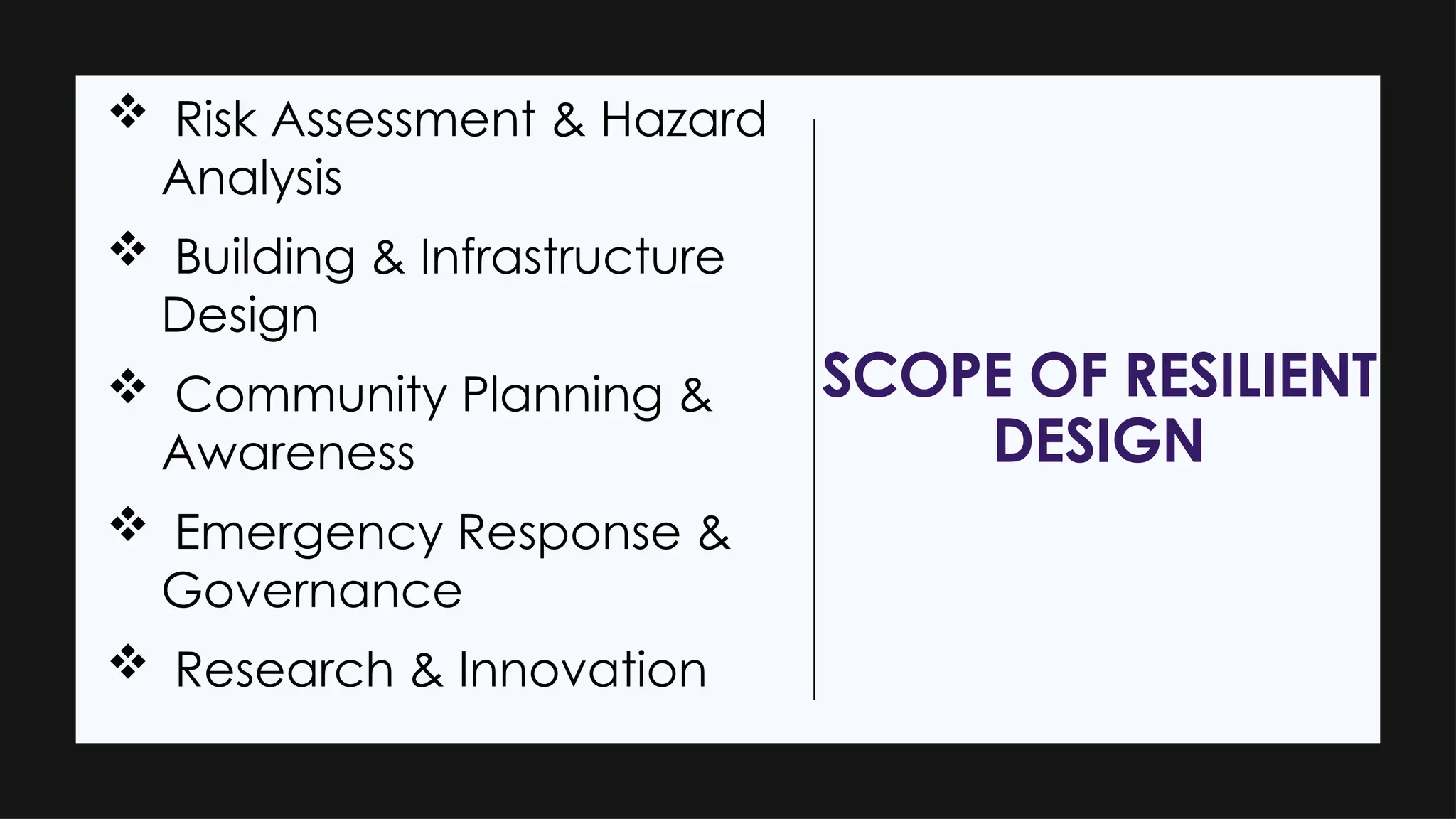
SCOPE OF RESILIENT
DESIGN
Risk Assessment & Hazard
Analysis
Building & Infrastructure
Design
Community Planning &
Awareness
Emergency Response &
Governance
Research & Innovation
6.
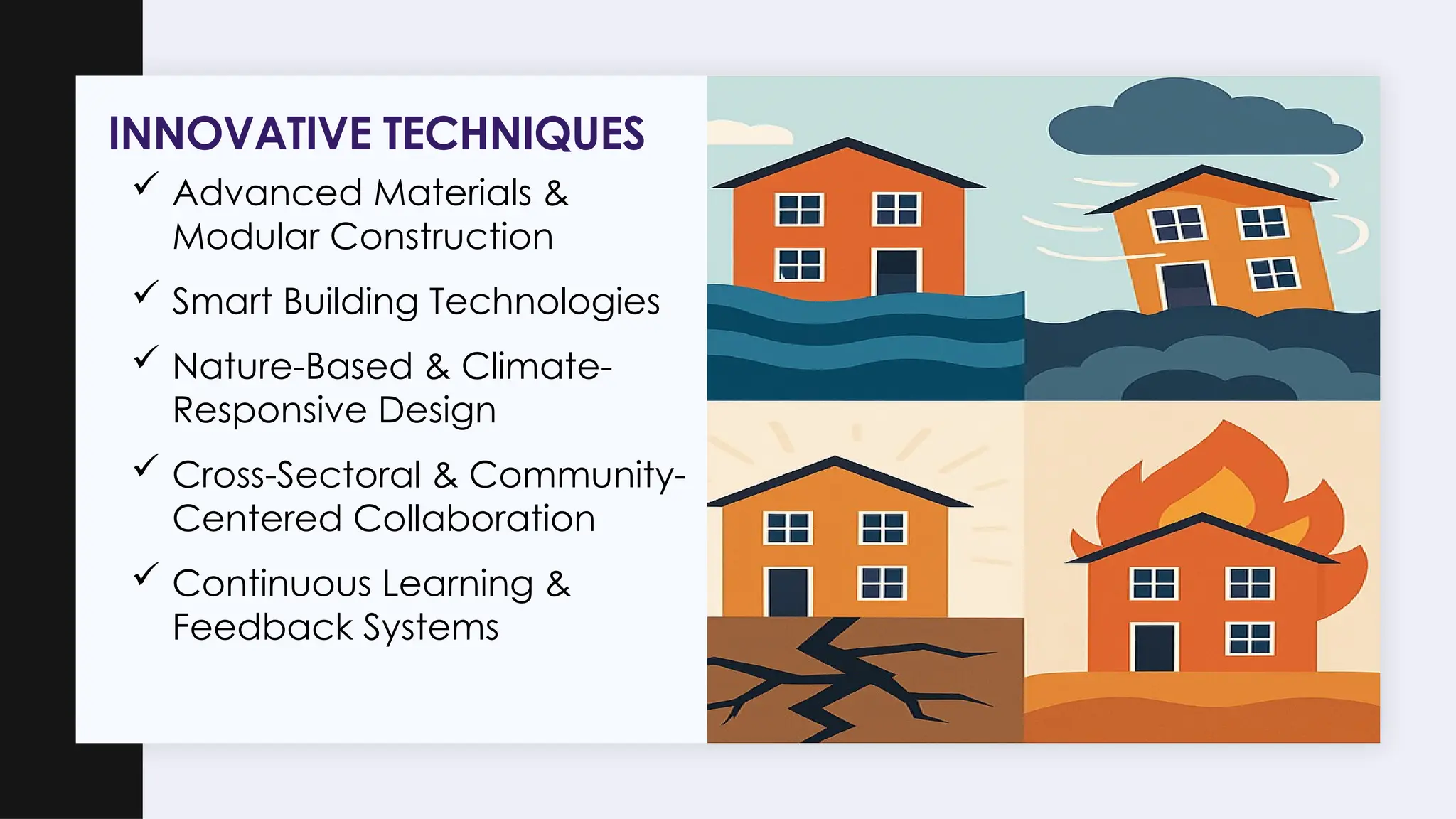
INNOVATIVE TECHNIQUES
AdvancedMaterials &
Modular Construction
Smart Building Technologies
Nature-Based & Climate-
Responsive Design
Cross-Sectoral & Community-
Centered Collaboration
Continuous Learning &
Feedback Systems
Click icon to add picture
7.
Design Principles
• SiteSelection & Risk Assessment
• Robust Structures with Safety Margins
• Flexible, Scalable, and Energy-Resilient
Systems
• Water & Fire Management
• Inclusive Planning and Emergency Readiness
8.
CASE STUDIES &BEST PRACTICES
• Japan – Earthquake-Resilient Structures
• Netherlands – Flood Management (Room for
the River)
• USA – Hurricane-Resilient Construction
• UAE – Masdar City Smart Urban Planning
• Brazil – Curitiba’s Public Transport and Green
Spaces
9.
Economic & SocialConsiderations
• Cost-Benefit Analysis for Resilient Investments
• Insurance & Financial Incentives
• Community Engagement and Education
• Promoting Equity and Well-being
•Green Bonds and Performance-Based
Contracts
10.
Conclusion
Resilient designprotects lives, property,
and the environment.
It combines engineering, innovation,
community input, and policy.
A proactive approach to building design
ensures long-term safety and
sustainability.
11.
REFERENCES
1. Building Resilienceby A. K. Jha et al.
2. Designing for Disaster by Boyce Thompson
3. Resilience-Based Design of Buildings by Adefila et al.
4. NACTO Green Infrastructure Guide
5. Additional case study references from the report
![VISVESVARAYA TECHNOLOGICAL UNIVERSITY
CAUVERY INSTITUTE OF TECHNOLOGY
DEPARTMENT OF CIVIL ENGINEERING
2024-25
TECHNICALSEMINARPRESENTATIONON
ENHANCING DISASTER RESILIENCE THROUGH BUILDING
DESIGN
Under the Guidance of
Prof. Arpitha A
Assistant Professor
Dept. of Civil Engineering
PRESENTED BY:
PRIYA B S
[4CA21CV005]](https://image.slidesharecdn.com/civilppt-250427091539-a4e3cfb2/75/CIVIL-presentation-is-right-to-edPPT-pptx-1-2048.jpg)