Citrix Xenapp 75 Desktop Virtualization
Solutions Andy Paul download
https://ebookbell.com/product/citrix-xenapp-75-desktop-
virtualization-solutions-andy-paul-53648022
Explore and download more ebooks at ebookbell.com
Here are some recommended products that we believe you will be
interested in. You can click the link to download.
Citrix Xenapp 75 Desktop Virtualization Solutions Andy Paul
https://ebookbell.com/product/citrix-xenapp-75-desktop-virtualization-
solutions-andy-paul-6808564
Citrix Xenapp 7x Performance Essentials Luca Dentella
https://ebookbell.com/product/citrix-xenapp-7x-performance-essentials-
luca-dentella-61382788
Citrix Xendesktop Xenapp 7778 Planbuildrun Reference Guide Eibel
https://ebookbell.com/product/citrix-xendesktop-
xenapp-7778-planbuildrun-reference-guide-eibel-11384310
Citrix Xenapp 65 Expert Cookbook Esther Barthel
https://ebookbell.com/product/citrix-xenapp-65-expert-cookbook-esther-
barthel-5132548
Citrix Xenapp Platinum Edition For Windows The Official Guide 4th
Edition Tim Reeser
https://ebookbell.com/product/citrix-xenapp-platinum-edition-for-
windows-the-official-guide-4th-edition-tim-reeser-1352392
Citrix Xenapp Performance Essentials Luca Dentella
https://ebookbell.com/product/citrix-xenapp-performance-essentials-
luca-dentella-61398512
Troubleshooting Citrix Xenapp Identify And Resolve Key Citrix Xenapp
Issues Using Trusted Troubleshooting And Monitoring Techniques Dragos
Madarasan
https://ebookbell.com/product/troubleshooting-citrix-xenapp-identify-
and-resolve-key-citrix-xenapp-issues-using-trusted-troubleshooting-
and-monitoring-techniques-dragos-madarasan-5475052
Getting Started With Citrix Xenapp 6 Guillermo Musumeci
https://ebookbell.com/product/getting-started-with-citrix-
xenapp-6-guillermo-musumeci-2440758
Getting Started With Citrix Xenapp 65 Guillermo Musumeci
https://ebookbell.com/product/getting-started-with-citrix-
xenapp-65-guillermo-musumeci-2609074
Citrix XenApp® 7.5 Desktop
Virtualization Solutions
Table of Contents
Citrix XenApp® 7.5 Desktop Virtualization Solutions
Credits
Notice
About the Author
About the Reviewers
www.PacktPub.com
Support files, eBooks, discount offers, and more
Why subscribe?
Free access for Packt account holders
Instant updates on new Packt books
Preface
What this book covers
What you need for this book
Who this book is for
Introduction to the XenApp® 7.5 platform
Benefits of using Citrix XenApp®
Citrix XenApp® 7.5 feature comparison
Comparing Citrix XenApp® 7.5 with previous versions
What’s new in Citrix XenApp® 7.5
Conventions
Reader feedback
Customer support
Downloading the color images of this book
Errata
Piracy
Questions
1. Planning Desktop Virtualization
The building blocks of VDI
Hosted Virtual Desktop (HVD)
Hosted Shared Desktop (HSD)
Session-based Computing (SBC)
Application virtualization
Understanding VDI layers
Analyzing your user data
Planning your personalization layer
Understanding your applications
Planning for operating system delivery
Anticipating device management
Infrastructure planning
Determining the right fit
The road map to success
Project management in the real world
Managing your project
Summary
2. Defining Your Desktop Virtualization Environment
Understanding your end users
Use case – clinical physicians
Use case – data entry clerks
Use case – office workers
Use case – hospital administration clerks
Use case – call center customer service representatives
Use case – business executives
Translating the user workflow
Understanding applications
Making a questionnaire for an application
Automated application data collection
Using Stratusphere FIT
Utilizing Network Inventory
Using Baseline Desktop Analyzer
Leveraging AppDNA
Implementing Lakeside Software SysTrack
Completing your software inventory
Understanding devices
Endpoints
Peripherals
Defining your use cases
Planning your strategy
Summary
3. Designing Your Infrastructure
Creating a reference architecture
A reference architecture diagram
Understanding the Access tier diagram
Understanding the Delivery tier diagram
Understanding the Supporting Systems tier diagram
Understanding the Backend Data Systems tier diagram
Understanding the Monitoring tier diagram
Understanding the Virtualization Infrastructure tier diagram
Designing highlights
Designing your virtual infrastructure
Resource requirements
Virtual machine requirements
Determining your virtualization platform
XenServer
VMware vSphere
Microsoft Hyper-V Server
Virtualization cluster design decisions
Designing your hardware infrastructure
Selecting between the rack and blade options
Understanding converged platforms
Reconsidering the cloud
Designing your network infrastructure
Planning network options
Designing your storage infrastructure
Capacity planning
Measuring throughput
Completing the architectural blueprint
Summary
4. Designing Your Access Layer
Determining your portal presence
Comparing Web Interface and StoreFront
Reviewing the Access tier diagram
Designing with StoreFront
Requirements for StoreFront
Design decisions for StoreFront
StoreFront recommendations
Customizations
Speeding up StoreFront
Using the application subscription model
Using keywords for StoreFront applications and desktops
Creating sticky applications for StoreFront
Filtering or hiding applications from StoreFront
Enabling discovery for mobile clients
Setting the default IIS page
Rebranding the Receiver for Web site
Using the HOST file to ease setup
Designing with NetScaler Gateway™
Requirements for NetScaler VPX
Configuring the base settings for NetScaler
Configuring load balancing services
Configuring NetScaler Gateway services
Tying it all together
Identifying the base requirements
Gathering all the prerequisites
Installing NetScaler appliances
Installing and configuring StoreFront servers
Configuring load balance virtual servers on NetScaler®
Configuring the NetScaler Gateway™ virtual server
Summary
5. Designing Your Application Delivery Layer
Welcome to XenApp® 7.5
What’s new in XenApp 7.5?
Updated concepts in XenApp 7.5
What’s missing in XenApp 7.5?
Designing your XenApp® deployment
Requirements for XenApp
Delivery controller
Studio
Database
Director
Virtual Delivery Agent (VDA) for the Windows desktop OS
Virtual Delivery Agent (VDA) for the Windows server OS
Design decisions for the XenApp site
Creating your XenApp® site
Quick start guide to deploy a XenApp site
Configuring your first XenApp delivery controller
Configuring your XenApp site
Configuring additional delivery controllers
Configuring your XenApp session hosts
Managing your XenApp® site
Getting started with Machine Catalogs
Getting started with Delivery Groups
Application delivery models
Getting the most out of Machine Catalogs and Delivery Groups
Planning your Machine Catalogs and Delivery Groups
Leveraging PowerShell
Moving machines between catalogs
Additional Delivery Group properties
Publishing multiple applications at a time
Additional application properties
Publishing resources to multiple Delivery Groups
Making sure machines are available
Summary
6. Designing Your Virtual Image Delivery
An overview of image management
Determining the right fit for your environment
Understanding Citrix® Machine Creation Services
The storage impact of MCS
Preparing a master image for MCS
Creating an MCS catalog using Studio
Updating an MCS catalog that reflects changes to the master image
Designing Citrix® Provisioning Services
The storage impact of PVS
The network impact of PVS
Designing your PVS farm
Requirements for Provisioning Services
Key design decisions
Preparing a master image for PVS
Creating a Machine Catalog using the PVS deployment wizard
Managing images using PVS
Additional PVS tips and tricks
Summary
7. Designing Your Supporting Infrastructure Components
Planning your license server
The role of the license server in the environment
The requirements for installing the license server
High Availability considerations for the licensing server
Design decisions for the license server
Designing your database platform
The role of the database in the XenApp environment
Planning your SQL server requirements
High Availability considerations for databases
Planning and sizing your Citrix® databases
SQL Server design decisions
Managing your databases
Configuring your file services
The role of file services in the environment
The requirements for file servers
High Availability considerations for file services
Design decisions
Configuring file share permissions
Implementing monitoring for your XenApp® environment
The role of monitoring in the environment
The requirements for installing Director
The requirements for installing the Insight appliance
High Availability considerations for Director
Monitoring design decisions
Using Director to monitor user experience
Summary
8. Optimizing Your XenApp® Solution
Managing user profiles
Types of profiles
Why we need to manage profiles
Planning Citrix Profile Management policies
Planning Microsoft folder redirection
Folder redirection and exclusions
What about home drives?
What about AppData?
Configuring Citrix® policies
Understanding the role of the Citrix policy engine
Using Citrix template policies
Planning your Citrix policies
Defining Citrix policy settings
Applying Citrix policy filters
Recommendations for Citrix policies
Planning Active Directory policies
Understanding the role of Active Directory group policies
Common Group Policy settings for Citrix environments
Best practices for Group Policies
Controlling printing
Understanding the different printing models in a Citrix environment
Using Citrix Universal Print Server
Summary
9. Implementing Your XenApp® Solution
Building your production-ready workload server images
Initial build
Optimizations
Deploying your server images
Testing the preproduction environment
Reviewing the design plan
Final system validation testing
Using capacity planning tools
Performing load testing
Conducting User Acceptance Testing
Defining your criteria
UAT process
UAT feedback
Production rollout
Communication plan
Pilot rollout
Phased production rollout
Supporting your environment during normal operations
Delegated administration
Using Director
SQL queries for monitoring/reporting
Additional troubleshooting tips and tricks
Troubleshooting the VDA registration
Troubleshooting Active Directory
Troubleshooting PVS performance
Troubleshooting storage performance
Troubleshooting Windows system performance
Troubleshooting application performance
Using Citrix troubleshooting tools
Soliciting user feedback
Summary
Index
Citrix XenApp® 7.5 Desktop
Virtualization Solutions
Citrix XenApp® 7.5 Desktop
Virtualization Solutions
Copyright © 2014 Packt Publishing
All rights reserved. No part of this book may be reproduced, stored in a retrieval system,
or transmitted in any form or by any means, without the prior written permission of the
publisher, except in the case of brief quotations embedded in critical articles or reviews.
Every effort has been made in the preparation of this book to ensure the accuracy of the
information presented. However, the information contained in this book is sold without
warranty, either express or implied. Neither the author, nor Packt Publishing, and its
dealers and distributors will be held liable for any damages caused or alleged to be caused
directly or indirectly by this book.
Packt Publishing has endeavored to provide trademark information about all of the
companies and products mentioned in this book by the appropriate use of capitals.
However, Packt Publishing cannot guarantee the accuracy of this information.
First published: October 2014
Production reference: 1141014
Published by Packt Publishing Ltd.
Livery Place
35 Livery Street
Birmingham B3 2PB, UK.
ISBN 978-1-84968-968-7
www.packtpub.com
Cover image by Shivani (<shivani6@gmail.com>)
Credits
Author
Andy Paul
Reviewers
Markus Darda
Ben Piper
Neil Spellings
Acquisition Editors
Pramila Balan
Meeta Rajani
Content Development Editor
Shubhangi Dhamgaye
Technical Editor
Shruti Rawool
Copy Editors
Insiya Morbiwala
Sayanee Mukherjee
Aditya Nair
Stuti Srivastava
Project Coordinator
Venitha Cutinho
Proofreaders
Simran Bhogal
Ameesha Green
Paul Hindle
Indexers
Hemangini Bari
Mariammal Chettiyar
Rekha Nair
Production Coordinator
Conidon Miranda
Cover Work
Conidon Miranda
Notice
The statements made and opinions expressed herein belong exclusively to the author and
reviewers of this publication, and are not shared by or represent the viewpoint of Citrix
Systems, Inc. This publication does not constitute an endorsement of any product, service,
or point of view. Citrix makes no representations, warranties or assurances of any kind,
express or implied, as to the completeness, accuracy, reliability, suitability, availability, or
currency of the content contained in this publication or any material related to this
publication. Any reliance you place on such content is strictly at your own risk. In no
event shall Citrix, its agents, officers, employees, licensees, or affiliates be liable for any
damages whatsoever (including, without limitation, damages for loss of profits, business
information, or loss of information) arising out of the information or statements contained
in the publication, even if Citrix has been advised of the possibility of such loss or
damages.
Citrix, Citrix XenApp, XenApp, XenDesktop, XenServer, XenCenter, XenMobile, Xen,
CloudPortal, NetScaler, NetScaler Gateway, NetScaler VPX, StoreFront, Citrix Receiver,
FlexCast, NetScaler Insight Center, EdgeSight, and other Citrix marks and brands
appearing herein are trademarks of Citrix Systems, Inc. and/or one or more of its
subsidiaries, and may be registered in the U.S. Patent and Trademark Office and in other
countries.
About the Author
Andy Paul is an accomplished virtualization architect, instructor, and speaker. He has
designed and delivered virtualization projects for Fortune 500 companies, public and
private health care organizations, and higher education institutions. He has also served as a
lead technical trainer, adjunct professor, and guest speaker for multiple organizations.
He is a leading industry consultant. He currently manages multiple delivery teams,
oversees project architecture, assists large enterprise customers across various industries,
and is a global VDI subject matter expert.
Visit his blog at www.paultechnologies.com/blog.
My wife, Mandy; our three beautiful children; and my parents, Steve and Vicki—thank
you for always encouraging and supporting me.
To my mentors, Steve Bone and David Lennox, for helping me stretch and reach further
than I ever expected. For all of your guidance and friendship over the years, thank you.
About the Reviewers
Markus Darda is the owner of MD Consultancy (Germany) and DaComp GmbH
(Switzerland). As a senior Citrix engineer and architect, he works for enterprise customers
across Europe to design and implement Citrix (XenApp and XenDesktop) environments.
As a Citrix trainer, he teaches all the Citrix products to customers and works for Citrix as a
subject matter expert in different courseware and exams.
He has worked for Lanxess, Germany; T-Systems, Germany; Koenen en Co, the
Netherlands; and for companies in Switzerland, Sweden, and Norway.
He has worked on different courseware from Citrix.
Ben Piper is a hands-on IT consultant, network and systems engineer, developer, and
author specializing in advanced enterprise networking and virtualization technologies,
including Cisco, Citrix, Microsoft, RedHat Enterprise Linux, and VMware. He has over
10 years of experience designing and implementing technology and consulting for
organizations such as McKesson, the National Science Center, the Department of Veterans
Affairs, as well as dozens of hospitals, health care organizations, and small businesses. He
has numerous Cisco, Citrix, and Microsoft certifications. He has authored technology
content for ExecSense and Corp! Magazine, and his technology advice has been featured
on news media outlets, including CNBC, Investor’s Business Daily, NASDAQ, and
Monster.com. His consulting website, http://benpiper.com, provides a variety of free
resources for Citrix, Cisco, Linux, VMware, scripting, coding, and more.
Neil Spellings is an independent virtualization and cloud infrastructure consultant who has
been working with Citrix products since the early days of WinFrame and MetaFrame, and
he was instrumental in the initial deployments of server-based computing technologies for
a number of large financial institutions in the UK and Europe.
He is a Citrix Certified Expert - Virtualization and is certified across numerous other
Citrix and Microsoft products to give a balanced view of the virtualization marketplace.
He is a recognized subject matter expert by Citrix Education and has contributed questions
to numerous XenApp 6, 6.5 CCA, CCAA, and CCEE exams, and he has also helped write
the recent XenDesktop 7 Design exam.
He is an active member of the Citrix community in the UK. He usually travels around
Europe to both present and attend E2E/PubForum events, such as Synergy; he is one of
the founding members of the UK Citrix user group and remains on its steering group. He
blogs at http://neil.spellings.net and frequently shares his opinions on Twitter via
@neilspellings.
He was awarded the Citrix Technology Professional (CTP) status in 2013 for his
contributions to the community.
He is a STEM ambassador and runs a Code Club in a local primary school with the
ambition to inspire and encourage children to take up a career in ICT and learn to code.
He lives in Surrey, England with his wife, Ina, and 6-year-old daughter, Zoë.
www.PacktPub.com
Support files, eBooks, discount offers, and
more
You might want to visit www.PacktPub.com for support files and downloads related to
your book.
Did you know that Packt offers eBook versions of every book published, with PDF and
ePub files available? You can upgrade to the eBook version at www.PacktPub.com and as
a print book customer, you are entitled to a discount on the eBook copy. Get in touch with
us at <service@packtpub.com> for more details.
At www.PacktPub.com, you can also read a collection of free technical articles, sign up
for a range of free newsletters and receive exclusive discounts and offers on Packt books
and eBooks.
http://PacktLib.PacktPub.com
Do you need instant solutions to your IT questions? PacktLib is Packt’s online digital
book library. Here, you can access, read and search across Packt’s entire library of books.
Why subscribe?
Fully searchable across every book published by Packt
Copy and paste, print and bookmark content
On demand and accessible via web browser
Free access for Packt account holders
If you have an account with Packt at www.PacktPub.com, you can use this to access
PacktLib today and view nine entirely free books. Simply use your login credentials for
immediate access.
Instant updates on new Packt books
Get notified! Find out when new books are published by following @PacktEnterprise on
Twitter, or the Packt Enterprise Facebook page.
Preface
Designing Citrix XenApp 7.5 as the basis for a desktop virtualization solution requires
extensive planning. There are numerous options and scenarios to consider. Taking the time
to properly plan and then execute is key to any successful deployment.
This book covers how to use Citrix XenApp 7.5 for desktop virtualization solutions.
XenApp can be classified as both application virtualization as well as desktop
virtualization. When using XenApp, you can provide end user access to select applications
or an entire virtual desktop. Providing a virtual desktop with XenApp is also known as
using the Hosted Shared Desktop (HSD) model. This means that multiple users can share
the same desktop with common resources as opposed to a dedicated desktop.
What this book covers
Chapter 1, Planning Desktop Virtualization, provides an overview of desktop
virtualization and the associated components. This includes an overview of the building
blocks of VDI and determining the right fit for your environment.
Chapter 2, Defining Your Desktop Virtualization Environment, focuses on understanding
the business requirements and driving factors of your virtual desktop strategy, including
creating use cases by understanding your users and applications as well as planning your
overall VDI strategy.
Chapter 3, Designing Your Infrastructure, explains how to design and scale the core
infrastructure to host your XenApp solution. This involves creating high-level reference
architectures and planning the virtual, physical, networking, and storage infrastructures.
Chapter 4, Designing Your Access Layer, explains how to design the Access layer
components, including NetScaler and StoreFront, delving into the design specifics and
identifying any constraints.
Chapter 5, Designing Your Application Delivery Layer, explains how to design the
Application Delivery layer components, including all of the XenApp site design elements
such as controllers, session hosts, Delivery Groups, and application publishing models.
Chapter 6, Designing Your Virtual Image Delivery, focuses on workload imaging services
and delivery. This includes an overview of Provisioning Services and Machine Creation
Services as well as best practices and recommendations.
Chapter 7, Designing Your Supporting Infrastructure Components, focuses on the
remaining supporting components for the XenApp solution, including licensing, database
requirements, monitoring services, and print services.
Chapter 8, Optimizing Your XenApp
®
Solution, focuses on the auxiliary components that
can be used to further optimize and customize the XenApp environment. This includes
profile management, Citrix policies, Active Directory policies, and printing
considerations.
Chapter 9, Implementing Your XenApp
®
Solution, covers the final steps to implement a
XenApp solution. It focuses on building the desktop and applications for delivery,
capacity planning, load testing, user acceptance testing, and production rollout planning.
What you need for this book
This is based on Citrix XenApp 7.5 Platinum Edition and all its associated components,
including StoreFront 2.5, License Server 11.11, and Provisioning Services 7.1. We will
also take a look at XenServer 6.0.2, Citrix NetScaler 10.1, Microsoft SQL Server 2012,
and Microsoft File Services.
In order to recreate the steps in this manual, you will need a minimum of two Windows
Server 2008 R2 or Windows Server 2012 systems, preferably more. You will also need the
downloadable Citrix XenApp 7.5 media from www.citrix.com.
Who this book is for
This book is written for Citrix engineers, Citrix architects, virtualization consultants, and
IT project managers. It is assumed that the reader has some prior experience with Citrix
XenApp and related technologies or with desktop virtualization. However, prior
experience is not required to understand the main concepts and flow of the material
presented.
This book attempts to balance technical detail and business logic. Each topic is written
using an easy-to-follow guide based on real-world experience and explains the reasoning
behind the recommended design decisions.
Introduction to the XenApp® 7.5 platform
Before we delve too deep into desktop virtualization solutions, you need to first
understand more about Citrix XenApp. Citrix XenApp was previously known as Citrix
Presentation Server. Prior to that, it was also known as Citrix MetaFrame Server and
Citrix WinFrame Server. You may hear some of these other terms or see them mentioned
in other articles or legacy documentation. With the introduction of Citrix XenDesktop 7,
XenApp and XenDesktop were merged into a common code base. The material presented
in this book for XenApp 7.5 applies to XenDesktop 7.5 environments as well.
Citrix XenApp operates on top of Microsoft Remote Desktop Services, also known as
Terminal Services or Remote Desktop Session Host. XenApp contains its own
management suite (called Studio) as well as its own transportation protocol (ICA, short for
Independent Computing Architecture). The combination of management and streamlined
protocol has allowed Citrix to maintain status as the industry leader in application and
desktop virtualization. Combining this with other products of Citrix allows enterprises to
create secure and scalable virtualization solutions.
In its most simplistic form, Citrix virtualization is about enabling users to use their
applications from any device anywhere. If a user is not able to use his/her applications
effectively, then there is little point to virtualization. Even in a traditional desktop
environment, Citrix can be leveraged to deliver applications to users in a secure and
scalable fashion.
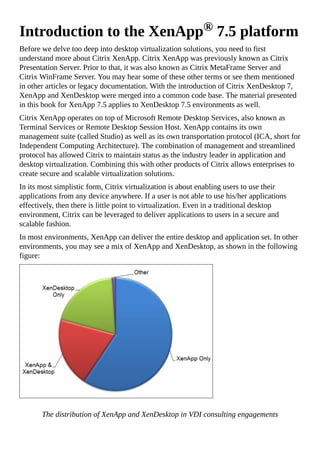
In most environments, XenApp can deliver the entire desktop and application set. In other
environments, you may see a mix of XenApp and XenDesktop, as shown in the following
figure:
The distribution of XenApp and XenDesktop in VDI consulting engagements
Benefits of using Citrix XenApp®
The key objective in all of this is to allow users to remotely interact with applications. If a
user is not able to use their application effectively, then there is no reason for businesses to
invest in virtualization. Using remote applications with Citrix XenApp offers numerous
benefits; they are outlined in the following table.
The following benefits illustrate why organizations, large and small, see the value of using
Citrix XenApp for their virtualization solution. There may be additional benefits for your
organization as well, such as:
Benefit Description
Accessibility
Using the latest Citrix Receiver allows users to access their Citrix XenApp applications and desktops
from virtually any device and any location in the world.
Compliance
Many industries, including health care and finance, have strict regulations governing computer systems.
These regulations could include software applications, versioning control, and data security. By using
XenApp, you centrally control the applications and the data.
Consistency
Since the applications and data are managed within the data center, users have a common and consistent
experience regardless of their client device. A user who is accessing applications from home has the
same experience as those accessing their applications from their office PC.
Convenience
Administrators can manage applications from a single console. Users can access all applications from a
single portal. This provides convenience and ease of use for everyone.
Management
The central management of applications and desktops and their maintenance allows ease of
administration.
Monitoring
By keeping all operations in the data center, you can effectively monitor the XenApp environment to
ensure optimal performance. This also allows the effective auditing of users and application access,
where required.
Portability
Citrix XenApp enables a flexible workforce, including BYOD users, work-at-home users, office
employees, and road warriors.
Reliability The ICA protocol, used by Citrix XenApp, is built to create a reliable and stable remote connection.
Scalability
Citrix XenApp can rapidly scale both up and out to support a growing number of applications or users,
or both.
Security
Keeping all data and data operations within the data center ensures that there is no sensitive information
leaving the secure zone. Since none of the data resides on the client device, there is limited risk of data
loss.
Stability
Citrix XenApp can be built on robust hardware configured for fault tolerance and High Availability. This
ensures a level of stability and minimal downtime, thus ensuring a production environment.
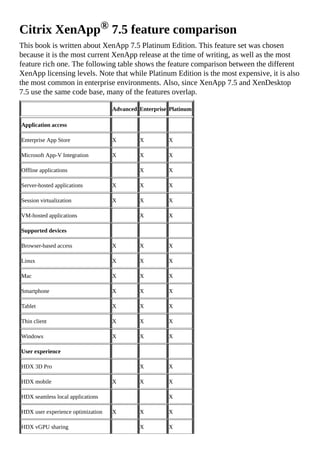
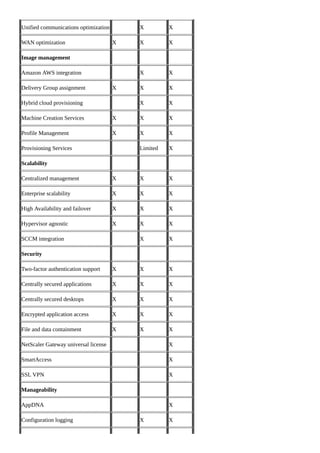
Citrix XenApp® 7.5 feature comparison
This book is written about XenApp 7.5 Platinum Edition. This feature set was chosen
because it is the most current XenApp release at the time of writing, as well as the most
feature rich one. The following table shows the feature comparison between the different
XenApp licensing levels. Note that while Platinum Edition is the most expensive, it is also
the most common in enterprise environments. Also, since XenApp 7.5 and XenDesktop
7.5 use the same code base, many of the features overlap.
Advanced Enterprise Platinum
Application access
Enterprise App Store X X X
Microsoft App-V Integration X X X
Offline applications X X
Server-hosted applications X X X
Session virtualization X X X
VM-hosted applications X X
Supported devices
Browser-based access X X X
Linux X X X
Mac X X X
Smartphone X X X
Tablet X X X
Thin client X X X
Windows X X X
User experience
HDX 3D Pro X X
HDX mobile X X X
HDX seamless local applications X
HDX user experience optimization X X X
HDX vGPU sharing X X
Unified communications optimization X X
WAN optimization X X X
Image management
Amazon AWS integration X X
Delivery Group assignment X X X
Hybrid cloud provisioning X X
Machine Creation Services X X X
Profile Management X X X
Provisioning Services Limited X
Scalability
Centralized management X X X
Enterprise scalability X X X
High Availability and failover X X X
Hypervisor agnostic X X X
SCCM integration X X
Security
Two-factor authentication support X X X
Centrally secured applications X X X
Centrally secured desktops X X X
Encrypted application access X X X
File and data containment X X X
NetScaler Gateway universal license X
SmartAccess X
SSL VPN X
Manageability
AppDNA X
Configuration logging X X
Delegated administration X X
Enhanced monitoring X X
Historical performance trending X
Simple to deploy X X X
User experience network analysis X
For a comparison of XenApp features across different product versions as well as
licensing levels, visit http://www.citrix.com/go/products/xendesktop/feature-matrix.html.
Comparing Citrix XenApp® 7.5 with previous
versions
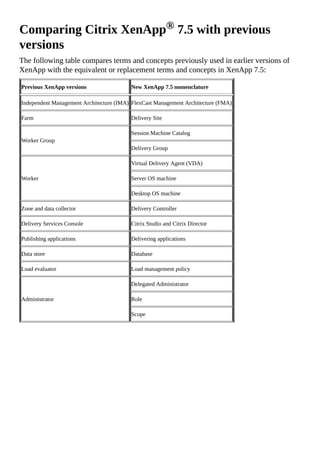
The following table compares terms and concepts previously used in earlier versions of
XenApp with the equivalent or replacement terms and concepts in XenApp 7.5:
Previous XenApp versions New XenApp 7.5 nomenclature
Independent Management Architecture (IMA) FlexCast Management Architecture (FMA)
Farm Delivery Site
Worker Group
Session Machine Catalog
Delivery Group
Worker
Virtual Delivery Agent (VDA)
Server OS machine
Desktop OS machine
Zone and data collector Delivery Controller
Delivery Services Console Citrix Studio and Citrix Director
Publishing applications Delivering applications
Data store Database
Load evaluator Load management policy
Administrator
Delegated Administrator
Role
Scope
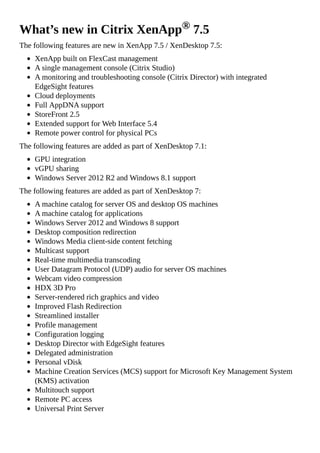
What’s new in Citrix XenApp® 7.5
The following features are new in XenApp 7.5 / XenDesktop 7.5:
XenApp built on FlexCast management
A single management console (Citrix Studio)
A monitoring and troubleshooting console (Citrix Director) with integrated
EdgeSight features
Cloud deployments
Full AppDNA support
StoreFront 2.5
Extended support for Web Interface 5.4
Remote power control for physical PCs
The following features are added as part of XenDesktop 7.1:
GPU integration
vGPU sharing
Windows Server 2012 R2 and Windows 8.1 support
The following features are added as part of XenDesktop 7:
A machine catalog for server OS and desktop OS machines
A machine catalog for applications
Windows Server 2012 and Windows 8 support
Desktop composition redirection
Windows Media client-side content fetching
Multicast support
Real-time multimedia transcoding
User Datagram Protocol (UDP) audio for server OS machines
Webcam video compression
HDX 3D Pro
Server-rendered rich graphics and video
Improved Flash Redirection
Streamlined installer
Profile management
Configuration logging
Desktop Director with EdgeSight features
Delegated administration
Personal vDisk
Machine Creation Services (MCS) support for Microsoft Key Management System
(KMS) activation
Multitouch support
Remote PC access
Universal Print Server
Conventions
In this book, you will find a number of styles of text that distinguish between different
kinds of information. Here are some examples of these styles and an explanation of their
meaning.
Code words in text, database table names, folder names, filenames, file extensions,
pathnames, dummy URLs, user input, and Twitter handles are shown as follows: “This
was accomplished by placing the application in a folder called VDIOnly and hiding this
folder.”
A block of code is set as follows:
select UserID, StartDate, MachineID from [MonitorData].[Session]
where userID = 2
order by StartDate DESC
Any command-line input or output is written as follows:
# cp /usr/src/asterisk-addons/configs/cdr_mysql.conf.sample
/etc/asterisk/cdr_mysql.conf
New terms and important words are shown in bold. Words that you see on the screen, in
menus or dialog boxes for example, appear in the text like this: “Click on Retrieve
Attributes to verify.”
Note
Warnings or important notes appear in a box like this.
Tip
Tips and tricks appear like this.
Reader feedback
Feedback from our readers is always welcome. Let us know what you think about this
book—what you liked or may have disliked. Reader feedback is important for us to
develop titles that you really get the most out of.
To send us general feedback, simply send an e-mail to <feedback@packtpub.com>, and
mention the book title via the subject of your message.
If there is a topic that you have expertise in and you are interested in either writing or
contributing to a book, see our author guide on www.packtpub.com/authors.
Random documents with unrelated
content Scribd suggests to you:
T
CHAPTER IV.—SLAVE REVOLT AT
SEA.
Madison Washington.—His Escape from the South.—His Love of
Liberty.—His Return.—His Capture.—The Brig “Creole.”—The Slave-
traders.—Capture of the Vessel.—Freedom of the Oppressed.
he revolt on board of the brig “Creole,” on the high seas, by a
number of slaves who had been shipped for the Southern
market, in the year 1841, created at the time a profound
sensation throughout the country. Before entering upon it, however,
I will introduce to the reader the hero of the occasion.
Among the great number of fugitive slaves who arrived in Canada
towards the close of the year 1840, was one whose tall figure, firm
step, and piercing eye attracted at once the attention of all who
beheld him. Nature had treated him as a favorite. His expressive
countenance painted and reflected every emotion of his soul. There
was a fascination in the gaze of his finely cut eyes that no one could
withstand. Born of African parentage, with no mixture in his blood,
he was one of the handsomest of his race. His dignified, calm, and
unaffected features announced at a glance that he was endowed
with genius, and created to guide his fellow-men. He called himself
Madison Washington, and said that his birthplace was in the “Old
Dominion.” He might have been twenty-five years; but very few
slaves have any correct idea of their age. Madison was not poorly
dressed, and had some money at the end of his journey, which
showed that he was not from amongst the worst-used slaves of the
South. He immediately sought employment at a neighboring farm,
where he remained some months. A strong, able-bodied man, and a
good worker, and apparently satisfied with his situation, his
employer felt that he had a servant who would stay with him a long
while. The farmer would occasionally raise a conversation, and try to
draw from Madison some account of his former life, but in this he
failed; for the fugitive was a man of few words, and kept his own
secrets. His leisure hours were spent in learning to read and write;
and in this he seemed to take the utmost interest. He appeared to
take no interest in the sports and amusements that occupied the
attention of others. Six months had not passed ere Madison began
to show signs of discontent. In vain his employer tried to discover
the cause.
“Do I not pay you enough, and treat you in a becoming manner?”
asked Mr. Dickson one day when the fugitive seemed in a very
desponding mood.
“Yes, sir,” replied Madison.
“Then why do you appear so dissatisfied of late?”
“Well, sir,” said the fugitive, “since you have treated me with such
kindness, and seem to take so much interest in me, I will tell you the
reason why I have changed, and appear to you to be dissatisfied. I
was born in slavery, in the State of Virginia. From my earliest
recollections I hated slavery, and determined to be free. I have
never yet called any man master, though I have been held by three
different men who claimed me as their property. The birds in the
trees and the wild beasts of the forest made me feel that I, like
them, ought to be free. My feelings were all thus centred in the one
idea of liberty, of which I thought by day and dreamed by night. I
had scarcely reached my twentieth year, when I became acquainted
with the angelic being who has since become my wife. It was my
intention to have escaped with her before we were married, but
circumstances prevented.
“I took her to my bosom as my wife, and then resolved to make
the attempt. But, unfortunately, my plans were discovered; and, to
save myself from being caught and sold off to the far South, I
escaped to the woods, where I remained during many weary
months. As I could not bring my wife away, I would not come
without her. Another reason for remaining was that I hoped to get
up an insurrection of the slaves, and thereby be the means of their
liberation. In this, too, I failed. At last it was agreed, between my
wife and I, that I should escape to Canada, get employment, save
my earnings, and with it purchase her freedom. With the hope of
attaining this end, I came into your service. I am now satisfied, that,
with the wages I can command here, it will take me not less than
five years to obtain by my labor the amount sufficient to purchase
the liberty of my dear Susan. Five years will be too long for me to
wait; for she may die, or be sold away, ere I can raise the money.
This, sir, makes me feel low spirited; and I have come to the rash
determination to return to Virginia for my wife.”
The recital of the story had already brought tears to the eyes of
the farmer, ere the fugitive had concluded. In vain did Mr. Dickson
try to persuade Madison to give up the idea of going back into the
very grasp of the tyrant, and risking the loss of his own freedom
without securing that of his wife. The heroic man had made up his
mind, and nothing could move him. Receiving the amount of wages
due him from his employer, Madison turned his face once more
towards the South. Supplied with papers purporting to have been
made out in Virginia, and certifying to his being a freeman, the
fugitive had no difficulty in reaching the neighborhood of his wife.
But these “free papers” were only calculated to serve him where he
was not known. Madison had also provided himself with files, saws,
and other implements, with which to cut his way out of any prison
into which he might be cast. These instruments were so small as to
be easily concealed in the lining of his clothing; and, armed with
them, the fugitive felt sure he should escape again were he ever
captured. On his return, Madison met, in the State of Ohio, many of
those whom he had seen on his journey to Canada; and all tried to
prevail upon him to give up the rash attempt. But to every one he
would reply, “Liberty is worth nothing to me while my wife is a
slave.” When near his former home, and unable to travel in open day
without being detected, Madison betook himself to the woods during
the day, and travelled by night. At last he arrived at the old farm at
night, and hid away in the nearest forest. Here he remained several
days, filled with hope and fear, without being able to obtain any
information about his wife. One evening, during this suspense,
Madison heard the singing of a company of slaves, the sound of
which appeared nearer and nearer, until he became convinced that it
was a gang going to a corn-shucking; and the fugitive resolved that
he would join it, and see if he could get any intelligence of his wife.
In Virginia, as well as in most of the other corn-raising slave-
States, there is a custom of having what is termed “a corn-
shucking,” to which slaves from the neighboring plantations, with the
consent of their masters, are invited. At the conclusion of the
shucking, a supper is provided by the owner of the corn; and thus,
together with the bad whiskey which is freely circulated on such
occasions, the slaves are made to feel very happy. Four or five
companies of men may be heard in different directions, and at the
same time, approaching the place of rendezvous; slaves joining the
gangs along the roads as they pass their masters’ farms. Madison
came out upon the highway; and, as the company came along
singing, he fell into the ranks, and joined in the song. Through the
darkness of the night he was able to keep from being recognized by
the remainder of the company, while he learned from the general
conversation the most important news of the day.
Although hungry and thirsty, the fugitive dared not go to the
supper-table for fear of recognition. However, before he left the
company that night, he gained information enough to satisfy him
that his wife was still with her old master; and he hoped to see her,
if possible, on the following night. The sun had scarcely set the next
evening, ere Madison was wending his way out of the forest, and
going towards the home of his loved one, if the slave can be said to
have a home. Susan, the object of his affections, was indeed a
woman every way worthy of his love. Madison knew well where to
find the room usually occupied by his wife, and to that spot he made
his way on arriving at the plantation; but, in his zeal and
enthusiasm, and his being too confident of success, he committed a
blunder which nearly cost him his life. Fearful that if he waited until
a late hour, Susan would be asleep, and in awakening her she would
in her fright alarm the household, Madison ventured to her room too
early in the evening, before the whites in the “great house” had
retired. Observed by the overseer, a sufficient number of whites
were called in, and the fugitive secured ere he could escape with his
wife; but the heroic slave did not yield until he with a club had laid
three of his assailants upon the ground with his manly blows; and
not then until weakened by loss of blood. Madison was at once taken
to Richmond, and sold to a slave-trader, then making up a gang of
slaves for the New-Orleans market.
The brig “Creole,” owned by Johnson & Eperson of Richmond, and
commanded by Capt. Enson, lay at the Richmond dock, waiting for
her cargo, which usually consisted of tobacco, hemp, flax, and
slaves. There were two cabins for the slaves,—one for the men, the
other for the women. The men were generally kept in chains while
on the voyage; but the women were usually unchained, and allowed
to roam at pleasure in their own cabin. On the 27th of October,
1841, “The Creole” sailed from Hampton Roads, bound for New
Orleans, with her full load of freight, a hundred and thirty-five
slaves, and three passengers, besides the crew. Forty of the slaves
were owned by Thomas McCargo, nine belonged to Henry Hewell,
and the remainder were held by Johnson & Eperson. Hewell had
once been an overseer for McCargo, and on this occasion was acting
as his agent.
Among the slaves owned by Johnson & Eperson, was Madison
Washington. He was heavily ironed, and chained down to the floor of
the cabin occupied by the men, which was in the forward hold. As it
was known by Madison’s purchasers that he had once escaped, and
had been in Canada, they kept a watchful eye over him. The two
cabins were separated, so that the men and women had no
communication whatever during the passage.
Although rather gloomy at times, Madison on this occasion
seemed very cheerful, and his owners thought that he had repented
of the experience he had undergone as a runaway, and in the future
would prove a more easily-governed chattel. But, from the first hour
that he had entered the cabin of “The Creole,” Madison had been
busily engaged in the selection of men who were to act parts in the
great drama. He picked out each one as if by intuition. Every thing
was done at night and in the dark, as far as the preparation was
concerned. The miniature saws and files were faithfully used when
the whites were asleep.
In the other cabin, among the slave-women, was one whose
beauty at once attracted attention. Though not tall, she yet had a
majestic figure. Her well-moulded shoulders, prominent bust, black
hair which hung in ringlets, mild blue eyes, finely-chiselled mouth,
with a splendid set of teeth, a turned and well-rounded chin, skin
marbled with the animation of life, and veined by blood given to her
by her master, she stood as the representative of two races. With
only one-eighth of African blood, she was what is called at the South
an “octoroon.” It was said that her grandfather had served his
country in the Revolutionary War, as well as in both Houses of
Congress. This was Susan, the wife of Madison. Few slaves, even
among the best-used house-servants, had so good an opportunity to
gain general information as she.
Accustomed to travel with her mistress, Susan had often been to
Richmond, Norfolk, White-Sulphur Springs, and other places of
resort for the aristocracy of the Old Dominion. Her language was far
more correct than that of most slaves in her position. Susan was as
devoted to Madison as she was beautiful and accomplished.
After the arrest of her husband, and his confinement in Richmond
jail, it was suspected that Susan had long been in possession of the
knowledge of his whereabouts when in Canada, and knew of his
being in the neighborhood; and for this crime it was resolved that
she should be sold, and sent off to a Southern plantation, where all
hope of escape would be at an end. Each was not aware that the
other was on board “The Creole;” for Madison and Susan were taken
to their respective cabins at different times. On the ninth day out,
“The Creole” encountered a rough sea, and most of the slaves were
sick, and therefore were not watched with that vigilance that they
had been since she first sailed. This was the time for Madison and
his accomplices to work, and nobly did they perform their duty. Night
came on, the first watch had just been summoned, the wind blowing
high, when Madison succeeded in reaching the quarter-deck,
followed by eighteen others, all of whom sprang to different parts of
the vessel, seizing whatever they could wield as weapons. The crew
were nearly all on deck. Capt. Enson and Mr. Merritt, the first mate,
were standing together, while Hewell was seated on the companion,
smoking a cigar. The appearance of the slaves all at once, and the
loud voice and commanding attitude of their leader, so completely
surprised the whites, that—
“They spake not a word;
But, like dumb statues or breathless stones,
Stared at each other, and looked deadly pale.”
The officers were all armed; but so swift were the motions of
Madison that they had nearly lost command of the vessel before
they attempted to use them.
Hewell, the greater part of whose life had been spent on the
plantation in the capacity of a negro-driver, and who knew that the
defiant looks of these men meant something, was the first to start.
Drawing his old horse-pistol from under his coat, he fired at one of
the blacks, and killed him. The next moment Hewell lay dead upon
the deck, for Madison had struck him with a capstan bar. The fight
now became general, the white passengers, as well as all the crew,
taking part. The battle was Madison’s element, and he plunged into
it without any care for his own preservation or safety. He was an
instrument of enthusiasm, whose value and whose place was in his
inspiration. “If the fire of heaven was in my hands, I would throw it
at those cowardly whites,” said he to his companions, before leaving
their cabin. But in this he did not mean revenge, only the possession
of his freedom and that of his fellow-slaves. Merritt and Gifford, the
first and second mates of the vessel, both attacked the heroic slave
at the same time. Both were stretched out upon the deck with a
single blow each, but were merely wounded: they were disabled,
and that was all that Madison cared for for the time being. The
sailors ran up the rigging for safety, and a moment more he that had
worn the fetters an hour before was master of the brig “Creole.” His
commanding attitude and daring orders, now that he was free, and
his perfect preparation for the grand alternative of liberty or death
which stood before him, are splendid exemplifications of the true
heroic. After his accomplices had covered the slaver’s deck, Madison
forbade the shedding of more blood, and ordered the sailors to
come down, which they did, and with his own hands dressed their
wounds. A guard was placed over all except Merritt, who was
retained to navigate the vessel. With a musket doubly charged, and
pointed at Merritt’s breast, the slaves made him swear that he would
safely take the brig into a British port. All things now secure, and the
white men in chains or under guard, Madison ordered that the
fetters should be severed from the limbs of those slaves who still
wore them. The next morning “Capt. Washington” (for such was the
name he now bore) ordered the cook to provide the best breakfast
that the storeroom could furnish, intending to surprise his fellow-
slaves, and especially the females, whom he had not yet seen. But
little did he think that the woman for whom he had risked his liberty
and life would meet him at the breakfast-table. The meeting of the
hero and his beautiful and accomplished wife, the tears of joy shed,
and the hurrahs that followed from the men, can better be imagined
than described. Madison’s cup of joy was filled to the brim. He had
not only gained his own liberty, and that of one hundred and thirty-
four others, but his dear Susan was safe. Only one man, Howell, had
been killed. Capt. Enson, and others who were wounded, soon
recovered, and were kindly treated by Madison, and for which they
proved ungrateful; for, on the second night, Capt. Enson, Mr. Gilford,
and Merritt, took advantage of the absence of Madison from the
deck, and attempted to retake the vessel. The slaves, exasperated at
this treachery, fell upon the whites with deadly weapons. The
captain and his men fled to the cabin, pursued by the blacks.
Nothing but the heroism of the negro leader saved the lives of the
white men on this occasion; for, as the slaves were rushing into the
cabin, Madison threw himself between them and their victims,
exclaiming, “Stop! no more blood. My life, that was perilled for your
liberty, I will lay down for the protection of these men. They have
proved themselves unworthy of life which we granted them; still let
us be magnanimous.” By the kind heart and noble bearing of
Madison, the vile slave-traders were again permitted to go
unwhipped of justice. This act of humanity raised the uncouth son of
Africa far above his Anglo-Saxon oppressors.
The next morning “The Creole” landed at Nassau, New
Providence, where the noble and heroic slaves were warmly greeted
by the inhabitants, who at once offered protection, and extended
hospitality to them.
But the noble heroism of Madison Washington and his companions
found no applause from the Government, then in the hands of the
slaveholders. Daniel Webster, then Secretary of State, demanded of
the British authorities the surrender of these men, claiming that they
were murderers and pirates: the English, however, could not see the
point.
Had the “Creole” revolters been white, and committed their noble
act of heroism in another land, the people of the United States
would have been the first to recognize their claims. The efforts of
Denmark Vesey, Nat Turner, and Madison Washington to strike the
chains of slavery from the limbs of their enslaved race will live in,
history, and will warn all tyrants to beware of the wrath of God and
the strong arm of man.
Every iniquity that society allows to subsist for the benefit of the
oppressor is a sword with which she herself arms the oppressed.
Right is the most dangerous of weapons: woe to him who leaves it
to his enemies.
T
CHAPTER V—GROWTH OF THE
SLAVE-POWER.
Introduction of the Cotton-gin.—Its effect on Slavery.—Fugitive
Slave Law.—Anthony Burns.—The Dred Scott Decision.—
Imprisonment for reading “Uncle Tom’s Cabin.”—Struggles with
Slavery.
he introduction of the cotton-gin into the South, by Whitney of
Connecticut, had materially enhanced the value of slave
property; the emancipation societies of Virginia and Maryland
had ceased to petition their Legislatures for the “Gradual
Emancipation” of the slaves; and the above two States had begun to
make slave-raising a profitable business, when the American
Antislavery Society was formed in the city of Philadelphia, in the year
1833. The agitation of the question in Congress, the mobbing of
William Lloyd Garrison in Boston, the murder of the Rev. E. P.
Lovejoy in Illinois, and the attempt to put down free speech
throughout the country, only hastened the downfall of the
institution.
In the earlier days of the Antislavery movement, not a year,
sometimes hardly a month, passed that did not bear upon its record
the report of mobs, almost always ferocious in spirit, and sometimes
cruel and blood-stained in act. It was the first instinctive and brutal
response of a proslavery people convicted of guilt and called to
repentance; and it was almost universal. Wherever antislavery was
preached, honestly, and effectually, there the mobocratic spirit
followed it; so that, in those times, he who escaped this ordeal was,
with some justice, held to be either inefficient or unfaithful. Hardly a
town or city, from Alton to Portland, where much antislavery labor
was bestowed, in the first fifteen years of this enterprise, that was
not the scene of one of these attempts to crush all free discussion of
the subject of slavery by violence or bloodshed. Hardly one of the
earlier public advocates of the cause that was not made to suffer,
either in person or in property, or in both, from popular violence,—
the penalty of obedience to the dictates of his own conscience. Nor
was this all: official countenance was often given to the mad
proceedings of the mob; or, if not given, its protection was withheld
from those who were the objects of popular hatred; and, as if this
were not enough, legislation was invoked to the same end. It was
suggested to the Legislature of one of the Southern States, that a
large reward be offered for the head of a citizen of Massachusetts
who was the pioneer in the modern antislavery movement. A similar
reward was offered for the head of a citizen of New York. Yet so foul
an insult excited neither the popular indignation nor legislative
resentment in either of those States.
Great damage was done to the cause of Christianity by the
position assumed on the question of slavery by the American
churches, and especially those in the Southern States. Think of a
religious kidnapper! a Christian slave-breeder! a slave-trader, loving
his neighbor as himself, receiving the “sacraments” in some
Protestant church from the hand of a Christian apostle, then the
next day selling babies by the dozen, and tearing young women
from the arms of their husbands to feed the lust of lecherous New
Orleans! Imagine a religious man selling his own children into
eternal bondage! Think of a Christian defending slavery out of the
Bible, and declaring there is no higher law, but atheism is the first
principle of Republican Government!
Yet this was the stand taken, and maintained, by the churches in
the slave States down to the day that Lee surrendered to Grant.
One of the bitterest fruits of slavery in our land is the cruel spirit
of caste, which makes the complexion even of the free negro a
badge of social inferiority, exposing him to insult in the steamboat
and the railcar, and in all places of public resort, not even excepting
the church; banishing him from remunerative occupations; expelling
him from the legislative hall, the magistrate’s bench, and the jury-
box; and crushing his noblest aspirations under a weight of prejudice
and proscription which he struggles in vain to throw off. Against this
unchristian and hateful spirit, every lover of liberty should enter his
solemn protest. This hateful prejudice caused the breaking up of the
school of Miss Prudence Crandall, in the State of Connecticut, in the
early days of the antislavery agitation.
Next came the burning of Pennsylvania Hall, one of the most
beautiful edifices in the City of Brotherly Love, simply because
colored persons were permitted to occupy seats by the side of
whites.
The enactment by Congress of the Fugitive Slave Law caused the
friends of freedom, both at home and abroad, to feel that the
General Government was fast becoming the bulwark of slavery. The
rendition of Thomas Sims, and still later that of Anthony Burns, was,
indeed, humiliating in the extreme to the people of the Northern
States.
On that occasion, the sons of free, enlightened, and Christian
Massachusetts, descendants of the Pilgrim Fathers, bowed
submissively to the behests of a tyranny more cruel than Austrian
despotism; yielded up their dignity and self-respect; became the
allies of slave-catchers, the associates and companions of
bloodhounds. At the bidding of slaveholders and serviles, they seized
the image of God, bound their fellow-man with chains, and
consigned him to torture and premature death under the lash of a
piratical overseer. God’s law and man’s rights were trampled upon;
the self-respect, the constitutional privileges, of the free States, were
ignominiously surrendered. A people who resisted a paltry tax upon
tea, at the cannon’s mouth, basely submitted to an imposition
tenfold greater, in favor of brutalizing their fellow-men. Soil which
had been moistened with the blood of American patriots was
polluted by the footsteps of slave-catchers and their allies.
The Boston Court House in chains, two hundred rowdies and
thieves sworn in as special policemen, respectable citizens shoved
off the side-walks by these slave-catchers; all for the purpose of
satisfying “our brethren of the South.” But this act did not appease
the feelings, or satisfy the demands, of the slave-holders, while it
still further inflamed the fire of abolitionism.
The “Dred Scott Decision” added fresh combustibles to the
smouldering heap. Dred Scott, a slave, taken by his master into free
Illinois, and then beyond the line of 36° 30’, and then back into
Missouri, sued for and obtained his freedom on the ground, that,
having been taken where by the Constitution slavery was illegal, his
master had lost all claim. But the Supreme Court, on appeal,
reversed the judgment; and Dred Scott, with his wife and children,
was taken back into slavery. By this decision in the highest court of
American law, it was affirmed that no free negro could claim to be a
citizen of the United States, but was only under the jurisdiction of
the separate State in which he resided; that the prohibition of
slavery in any Territory of the Union was unconstitutional; and that
the slave-owner might go where he pleased with his property,
throughout the United States, and retain his right.
This decision created much discussion, both in America and in
Europe, and materially injured the otherwise good name of our
country abroad.
The Constitution, thus interpreted by Judge Taney, became the
emblem of the tyrants and the winding sheet of liberty, and gave a
boldness to the people of the South, which soon showed itself, while
good men at the North felt ashamed of the Government under which
they lived.
The slave-holders in the cotton, sugar, and rice growing States
began to urge the re-opening of the African slave-trade, and the
driving out from the Southern States of all free colored persons.
In the Southern Rights’ Convention, which assembled at
Baltimore, June 8, 1800, a resolution was adopted, calling on the
Legislature to pass a law driving the free colored people out of the
State. Nearly every speaker took the ground that the free colored
people must be driven out to make the slave’s obedience more
secure. Judge Mason, in his speech, said, “It is the thrifty and well-
to-do free negroes, that are seen by our slaves, that make them
dissatisfied.” A similar appeal was made to the Legislature of
Tennessee. Judge Catron, of the Supreme Court of the United
States, in a long and able letter to “The Nashville Union,” opposed
the driving out of the colored people. He said they were among the
best mechanics, the best artisans, and the most industrious laborers
in the State, and that to drive them out would be an injury to the
State itself. This is certainly good evidence in their behalf.
The State of Arkansas passed a law driving the free colored people
out of the State, and they were driven out three years ago. The
Democratic press howled upon the heels of the free blacks until they
had all been expatriated; but, after they had been driven out, “The
Little Rock Gazette”—a Democratic paper—made a candid
acknowledgment with regard to the character of the free colored
people. It said, “Most of the exiled free negroes are industrious and
respectable. One of them, Henry King, we have known from our
boyhood, and take the greatest pleasure in testifying to his good
character. The community in which he casts his lot will be blessed
with that noblest work of God, an honest man.”
Yet these free colored people were driven out of the State, and
those who were unable to go, as many of the women and children
were, were reduced to slavery.
“The New Orleans True Delta” opposed the passage of a similar
law by the State of Louisiana. Among other things, it said, “There
are a large free colored population here, correct in their general
deportment, honorable in their intercourse with society, and free
from reproach so far as the laws are concerned; not surpassed in
the inoffensiveness of their lives by any equal number of-persons in
any place, North or South.”
And yet these free colored persons were not permitted by law to
school their children, or to read books that treated against the
institution of slavery. The Rev. Samuel Green, a colored Methodist
preacher, was convicted and sent to the Maryland penitentiary, in
1858, for the offence of being found reading “Uncle Tom’s Cabin.”
The growth of the “Free-Soil” party, which had taken the place of
the “Liberty” party; and then the rapid increase of the “Republican”
party; the struggle in Kansas; the “Oberlin Rescue Trials;” and, lastly,
the “John Brown Raid,” carried the discussion of slavery to its
highest point.
All efforts, in Congress, in the proslavery political conventions, and
in the churches, only added fuel to the flame that was fast making
inroads upon the vitals of the monster.
T
CHAPTER VI.—THE JOHN BROWN
RAID.
John Brown.—His Religious Zeal.—His Hatred to Slavery.—
Organization of his Army.—Attack on Harper’s Ferry.—His Execution.
—John Brown’s Companions, Green and Copeland.—The Executions.
he year 1859 will long be memorable for the bold attempt of
John Brown and his companions to burst the bolted door of
the Southern house of bondage, and lead out the captives by
a more effectual way than they had yet known: an attempt in which,
it is true, the little band of heroes dashed themselves to bloody
death, but, at the same time, shook the prison-walls from summit to
foundation, and shot wild alarm into every tyrant-heart in all the
slave-land. What were the plans and purposes of the noble old man
is not precisely known, and perhaps will never be; but, whatever
they were, there is reason to believe they had been long maturing,—
brooded over silently and secretly, with much earnest thought, and
under a solemn sense of religious duty. As early as the fall of 1857,
he began to organize his band, chiefly from among the companions
of his warfare against the “Border Ruffians” in Kansas. Nine or ten of
these spent the winter of 1857-8 in Iowa, where a Col. Forbes was
to have given them military instruction; but he, having-fallen out
with Brown, did not join them, and Aaron D. Stevens, one of the
company, took his place.
About the middle of April, 1858, they left Iowa, and went to
Chatham, Canada, where, on the 8th of May, was held a convention,
called by a written circular, which was sent to such persons only as
could be trusted. The convention was composed mostly of colored
men, a few of whom were from the States, but the greater part
residents in Canada, with no white men but the organized band
already mentioned. A “Provisional Constitution,” which Brown had
previously prepared, was adopted; and the members of the
convention took an oath to support it. Its manifest purpose was to
insure a perfect organization of all who should join the expedition,
whether free men or insurgent slaves, and to hold them under such
strict control as to restrain them from every act of wanton or
vindictive violence, all waste or needless destruction of life or
property, all indignity or unnecessary severity to prisoners, and all
immoral practices; in short, to keep the meditated movement free
from every possibly avoidable evil ordinarily incident to the armed
uprising of a long-oppressed and degraded people.
And let no one who glories in the revolutionary struggles of our
fathers for their freedom deny the right of the American bondsman
to imitate their high example. And those who rejoice in the deeds of
a Wallace or a Tell, a Washington or a Warren; who cherish with
unbounded gratitude the name of Lafayette for volunteering his aid
in behalf of an oppressed people in a desperate crisis, and at the
darkest hour of their fate,—cannot refuse equal merit to this strong,
free, heroic man, who freely consecrated all his powers, and the
labors of his whole life, to the help of the most needy, friendless,
and unfortunate of mankind.
The picture of the Good Samaritan will live to all future ages, as
the model of human excellence, for helping one whom he chanced
to find in need.
John Brown did more: he went to seek those who were lost that
he might save them.
On Sunday night, Oct. 16, John Brown, with twenty followers (five
of them colored), entered the town of Harper’s Ferry, in the State of
Virginia; captured the place, making the United-States Armory his
headquarters; sent his men in various directions in search of slaves
with which to increase his force.
The whole thing, though premature in its commencement, struck
a blow that rang on the fetters of the enslaved in every Southern
State, and caused the oppressor to tremble for his own safety, as
well as for that of the accursed institution.
John Brown’s trial, heroism, and execution, an excellent history of
which has been given to the public by Mr. James Redpath, saves me
from making any lengthened statement here. His life and acts are
matters of history, which will live with the language in which it is
written. But little can be said of his companions in the raid on
slavery. They were nearly all young men, unknown to fame,
enthusiastic admirers of the old Puritan, entering heartily into all of
his plans, obeying his orders, and dying bravely, with no reproach
against their leader.
Of the five colored men, two only were captured alive,—Shields
Green and John A. Copeland. The former was a native of South
Carolina, having been born in the city of Charleston in the year
1832. Escaping to the North in 1857, he resided in Rochester, N.Y.,
until attracted by the unadorned eloquence and native magnetism of
the hero of Harper’s Ferry. The latter was from North Carolina, and
was a mulatto of superior abilities, and a genuine lover of liberty and
justice. The following letter, written a short time before his
execution, needs no explanation:—
“Charlestown, Va., Dec. 10, 1859.
“My dear Brother,—I now take my pen to write you a few lines to
let you know how I am, and in answer to your kind letter of the 5th
inst. Dear brother, I am, it is true, so situated at present as scarcely
to know how to commence writing: not that my mind is filled with
fear, or that it has become shattered in view of my near approach to
death; not that I am terrified by the gallows which I see staring me
in the face, and upon which I am so soon to stand and suffer death
for doing what George Washington, the so-called father of this great
but slavery-cursed country, was made a hero for doing while he
lived, and when dead his name was immortalized, and his great and
noble deeds in behalf of freedom taught by parents to their children.
And now, brother, for having lent my aid to a general no less brave,
and engaged in a cause no less honorable and glorious, I am to
suffer death. Washington entered the field to fight for the freedom
of the American people,—not for the white man alone, but for both
black and white. Nor were they white men alone who fought for the
freedom of this country. The blood of black men flowed as freely as
that of white men. Yes, the very first blood that was spilt was that of
a negro. It was the blood of that heroic man (though black he was),
Crispus Attucks. And some of the very last blood shed was that of
black men. To the truth of this, history, though prejudiced, is
compelled to attest. It is true that black men did an equal share of
the fighting for American independence; and they were assured by
the whites that they should share equal benefits for so doing. But,
after having performed their part honorably, they were by the whites
most treacherously deceived,—they refusing to fulfil their part of the
contract. But this you know as well as I do; and I will therefore say
no more in reference to the claims which we, as colored men, have
on the American people....
“It was a sense of the wrongs which we have suffered that
prompted the noble but unfortunate Capt. Brown and his associates
to attempt to give freedom to a small number, at least, of those who
are now held by cruel and unjust laws, and by no less cruel and
unjust men. To this freedom they were entitled by every known
principle of justice and humanity; and, for the enjoyment of it, God
created them. And now, dear brother, could I die in a more noble
cause? Could I, brother, die in a manner and for a cause which
would induce true and honest men more to honor me, and the
angels more readily to receive me to their happy home of everlasting
joy above? I imagine that I hear you, and all of you, mother, father,
sisters and brothers, say, ‘No, there is not a cause for which we, with
less sorrow, could see you die!’”
“Your affectionate brother,
“John A. Copeland.”
“The Baltimore Sun” says, “A few moments before leaving the jail,
Copeland said, ‘If I am dying for freedom, I could not die for a
better cause. I had rather die than be a slave!’ A military officer in
charge on the day of the execution says, ‘I had a position near the
gallows, and carefully observed all. I can truly say I never witnessed
more firm and unwavering: fortitude, more perfect composure, or
more beautiful propriety, than were manifested by young Copeland
to the very last.’”
Shields Green behaved with equal heroism, ascending the scaffold
with a firm and unwavering step, and died, as he had lived, a brave
man, and expressing to the last his eternal hatred to human
bondage, prophesying that slavery would soon come to a bloody
end.
T
CHAPTER VII—THE FIRST GUN OF
THE REBELLION.
Nomination of Fremont.—Nomination of Lincoln.—The Mob Spirit.
—Spirit of Slavery.—The Democracy.—Cotton.—Northern Promises to
the Rebels.—Assault on Fort Sumter.—Call for 75,000 Men.—
Response of the Colored Men.
he nomination of John C. Fremont by the Republican party in
1856, and the large vote given him at the election that
autumn, cleared away all doubts, if any existed as to the
future action of the Federal Government on the spread and power of
slavery. The Democratic party, which had ruled the nation so long
and so badly, saw that it had been weighed, and found wanting; that
it must prepare to give up the Government into the hands of better
men.
But the party determined to make the most of Mr. Buchanan’s
administration, both in the profuse expenditure of money among
themselves, and in getting ready to take the Southern States out of
the Union.
Surrounded by the men who believed that the Government was
made for them, and that their mission was to rule the people of the
United States, Mr. Buchanan was nothing more than a tool,—clay in
the hands of the potters; and he permitted them to prepare leisurely
for disunion, which culminated, in 1860, in the nomination of
Abraham Lincoln for the presidency.
The proslavery Democracy became furious at the prospect of
losing the control of the situation, and their hatred of free speech
was revived. From the nomination of Mr. Lincoln to his inauguration,
mob-law ruled in most of the cities and large villages. These
disgraceful scenes, the first of which commenced at the antislavery-
meeting at the Tremont Temple, Boston, was always gotten up by
members of the Democratic party, who usually passed a series of
resolutions in favor of slavery. New York, Philadelphia, Albany,
Buffalo, Troy, Cincinnati, and Chicago, all followed the example set
by Boston.
These demonstrations were caused more by sympathy with the
South, and the long-accustomed subserviency of the Northern
people to slaveholding dictation, than to any real hatred to the
negro.
During all this time the Abolitionists were laboring faithfully to
widen the gulf between the North and South.
Towards the close of the year 1860, the spirit of compromise
began to show itself in such unmistakable terms as to cause serious
apprehension on the part of the friends of freedom for the future of
American liberty. The subdued tone of the liberal portion of the
press, the humiliating offers of Northern political leaders of
compromises, and the numerous cases of fugitive slaves being
returned to their masters, sent a thrill of fear to all colored men in
the land for their safety, and nearly every train going North found
more or less negroes fleeing to Canada.
At the South, the people were in earnest, and would listen to no
proposals whatever in favor of their continuance in the Union.
The vast wealth realized by the slave-holder had made him feel
that the South was independent of the rest of the world.
Prosperity had made him giddy. Cotton was not merely king: it
was God. Moral considerations were nothing. The sentiment of right,
he argued, would have no influence over starving operatives; and
England and France, as well as the Eastern States of the Union,
would stand aghast, and yield to the masterstroke which should
deprive them of the material of their labor. Millions were dependent
on it in all the great centres of civilization; and the ramifications of
its power extended into all ranks of society and all departments of
industry and commerce. It was only necessary to wave this imperial
sceptre over the nations; and all of them would fall prostrate, and
acknowledge the supremacy of the power which wielded it. Nothing
could be more plausible than this delusion. Satan himself, when
about to wage war in heaven, could not have invented one better
calculated to marshal his hosts, and give promise of success in
rebellion against the authority of the Most High. But, alas! the
supreme error of this anticipation lay in omitting from the calculation
all power of principle. The right still has authority over the minds of
men and in the counsels of nations. Factories may cease their din;
men and women may be thrown out of employment; the marts of
commerce may be silent and deserted: but truth and justice still
command some respect among men; and God yet remains the
object of their adoration.
Drunk with power, and dazzled with prosperity, monopolizing
cotton, and raising it to the influence of a veritable fetich, the
authors of the Rebellion did not admit a doubt of the success of their
attack on the Federal Government. They dreamed of perpetuating
slavery, though all history shows the decline of the system as
industry, commerce, and knowledge advance. The slave-holders
proposed nothing less than to reverse the currents of humanity, and
to make barbarism flourish in the bosom of civilization.
Weak as were the Southern people in point of numbers and
political power, compared with those of the opposite section, the
haughty slave-holders easily persuaded themselves and their
dependents that they could successfully cope in arms with the
Northern adversary, whom they affected to despise for his cowardly
and mercenary disposition. Proud and confident, they indulged the
belief that their great political prestige would continue to serve them
among their late party associates in the North, and that the counsels
of the adversary would be distracted, and his power weakened, by
the fatal effects of dissension.
The proslavery men in the North are very much to blame for the
encouragement that they gave the rebels before the breaking out of
the war. The Southerners had promises from their Northern friends,
that, in the event of a rebellion, civil war should reign in the free
States,—that men would not be permitted to leave the North to go
South to put down their rebellions brethren.
All legitimate revolutions are occasioned by the growth of society
beyond the growth of government; and they will be peaceful or
violent just in proportion as the people and government shall be
wise and virtuous or vicious and ignorant. Such revolutions or
reforms are generally of a peaceful nature in communities in which
the government has made provision for the gradual expansion of its
institutions to suit the onward march of society. No government is
wise in overlooking, whatever may be the strength of its own
traditions, or however glorious its history, that human institutions
which have been adapted for a barbarous age or state of society will
cease to be adapted for more civilized and intelligent times; and,
unless government makes a provision for the gradual expansion,
nothing can prevent a storm, either of an intellectual or a physical
nature. Slavery was always the barbarous institution of America; and
the Rebellion was the result of this incongruity between it and
freedom.
The assault on Fort Sumter on the 12th of April, 1861, was the
dawn of a new era for the negro. The proclamation of President
Lincoln, calling for the first 75,000 men to put down the Rebellion,
was responded to by the colored people throughout the country. In
Boston, at a public meeting of the blacks, a large number came
forward, put their names to an agreement to form a brigade, and
march at once to the seat of war. A committee waited on the
Governor three days later, and offered the services of these men. His
Excellency replied that he had no power to receive them. This was
the first wet blanket thrown over the negro’s enthusiasm. “This is a
white man’s war,” said most of the public journals. “I will never fight
by the side of a nigger,” was heard in every quarter where men were
seen in Uncle Sam’s uniform.
Wherever recruiting offices were opened, black men offered
themselves, and were rejected. Yet these people, feeling conscious
that right would eventually prevail, waited patiently for the coming
time, pledging themselves to go at their country’s call, as the
following will show:—
“Resolved, That our feelings urge us to say to our countrymen
that we are ready to stand by and defend the Government as the
equals of its white defenders; to do so with our lives, our fortunes,
and our sacred honor, for the sake of freedom and as good citizens;
and we ask you to modify your laws, that we may enlist,—that full
scope may be given to the patriotic feelings burning in the colored
man’s breast.”—Colored Men’s Meeting, Boston.
A
CHAPTER VIII—THE UNION AND
SLAVERY BOTH TO BE PRESERVED.
Union Generals offer to suppress Slave Insurrections.—Return of
Slaves coming into our Army.
t the very commencement of the Rebellion, the proslavery
generals in the field took the earliest opportunity of offering
their services, together with those under their commands, to
suppress any slave insurrection that might grow out of the unsettled
condition of the country. Major-Gen. B. F. Butler led off, by tendering
his services to Gov. Hicks of Maryland. About the same time, Major-
Gen. Geo. B. McClellan issued the following, “To the Union Men of
Western Virginia,” on entering that portion of the State with his
troops:—“The General Government cannot close its ears to the
demands you have made for assistance. I have ordered troops to
cross the river. They come as Your friends and brothers,—as
enemies only to the armed rebels who are preying upon you. Your
homes, your families, your property, are safe under our protection.
All your rights shall be religiously respected. Notwithstanding all that
has been said by the traitors to induce you to believe our advent
among you will be signalled by an interference with your slaves,
understand one thing clearly: not only will we abstain from all such
interference, but we shall, on the contrary, with an iron hand, crush
any attempt at insurrection on their part.”
Slaves escaping from their masters were promptly returned by the
officers of the army. Gen. W. S. Harney, commanding in Missouri, in
responding to the claims of slave-holders for their blacks, said,—
“Already, since the commencement of these unhappy
disturbances, slaves have escaped from their owners, and have
sought refuge in the camps of United-States troops from the
Northern States, and commanded by a Northern general. They were
carefully sent Back to their owners.”
The correspondent of “The New-York Herald” gave publicity to the
following:—
“The guard on the bridge across the Anacostia arrested a negro
who attempted to pass the sentries on the Maryland side. He
seemed to feel confident that he was among friends, for he made no
concealment of his character and purpose. He said he had walked
sixty miles, and was going North. He was very much surprised and
disappointed when he was taken into custody, and informed that he
would be sent back to his master. He is now in the guard-house, and
answers freely all questions relating to his weary march. Of course,
such an arrest excites much comment among the men. Nearly all are
restive under the thought of acting as slave-catchers. The Seventy-
first made a forced march, and the privations they endured have
been honorably mentioned in the country’s history. This poor negro
made a forced march, twice the length—in perils often, in fasting,—
hurrying toward the North for his liberty! And the Seventy-first
catches him at the end of his painful journey,—the goal in sight,—
and sends him back to the master who even now may be in arms
against us, or may take the slave, sell him for a rifle, and use it on
his friends in the Seventy-first New-York Regiment. Humanity speaks
louder here than it does in a large city; and the men who in New
York would dismiss the subject with a few words about
‘constitutional obligations’ are now the loudest in denouncing the
abuse of power which changes a regiment of gentlemen into a
regiment of negro-catchers.” At Pensacola, Slemmer did even more,
putting in irons fugitives who fled to him for protection, and
returning them to their masters to be scourged to death. Col.
Dimmick, at Fortress Monroe, told the rebel Virginians that he had
not an Abolitionist in his command, and that no molestation of their
slave-system would be suffered.
Gen. D. C. Buell, commanding in Tennessee, said, in reply to a
committee of slave-holders demanding the return of their fugitives,
—
“It has come to my knowledge that slaves sometimes make their
way improperly into our lines, and in some instances they may be
enticed there; but I think the number has been magnified by report.
Several applications have been made to me by persons whose
servants have been found in our camps; and, in every instance that I
know of, the master has removed his servant, and taken him away.
“I need hardly remind you that there will always be found some
lawless and mischievous persons in every army; but I assure you
that the mass of this army is law-abiding, and that it is neither its
disposition nor its policy to violate law or the rights of individuals in
any particular.”
Yet, while Union soldiers were returning escaped slaves to rebels,
it was a notorious fact that the enemy were using negroes to build
fortifications, drive teams, and raise food for the army.
Black hands piled up the Sand-bags, and raised the batteries,
which drove Anderson out of Sumter. At Montgomery, the capital of
the confederacy, negroes were being drilled and armed for military
duty.
I
CHAPTER IX—INTELLIGENT
CONTRABANDS
James Lawson.—His Bravery.—Rescue of his Wife and Children.—
He is sent out on Important Business.—He fights his Way Back.—He
is Admired by Gens. Hooker and Sickles.—Rhett’s Servant.
—“Foraging for Butter and Eggs.”
spent three weeks at Liverpool Point, the outpost of Hooker’s
Division, almost directly opposite Aquia Creek, waiting patiently
for the advance of our left wing to follow up the army,
becoming, if not a participator against the dying struggles of
rebeldom, at least a chronicler of the triumphs in the march of the
Union army.
During this time I was the guest of Col. Graham, of Mathias-Point
memory, who had brought over from that place (last November)
some thirty valuable chattels. A part of the camp was assigned to
them. They built log huts, and obtained from the soldiers many
comforts, making their quarters equal to any in the camp.
They had friends and relatives. Negroes feel as much sympathy
for their friends and kin as the whites; and, from November to the
present time, many a man in Virginia has lost a very likely slave, for
the camp contains now upwards of a hundred fat and healthy
negroes, in addition to its original number from Mathias Point.
One of the number deserves more honor than that accorded to
Toussaint L’Ouverture in the brilliant lecture delivered by Wendell
Phillips. He is unquestionably the hero of the Potomac, and deserves
to be placed by the side of his most renowned black brethren.
The name of this negro is James Lawson, born near Hempstead,
Virginia, and he belonged to a Mr. Taylor. He made his escape last
December. On hearing his praises spoken by the captains of the
gunboats on the Potomac, I was rather indisposed to admit the
possession of all the qualities they give him credit for, and thought
possibly his exploits had been exaggerated. His heroic courage,
truthfulness, and exalted Christian character seemed too romantic
for their realization. However, my doubts on that score were
dispelled; and I am a witness of his last crowning act.
Jim, after making his escape from Virginia, shipped on board of
“The Freeborn,” Flag-gunboat, Lieut. Samuel Ma-gaw commanding.
He furnished Capt. Magaw with much valuable intelligence
concerning the rebel movements, and, from his quiet, every-day
behavior, soon won the esteem of the commanding officer.
Capt. Magaw, shortly after Jim’s arrival on board “The Freeborn,”
sent him upon a scouting tour through the rebel fortifications, more
to test his reliability than anything else; and the mission, although
fraught with great danger, was executed by Jim in the most faithful
manner. Again Jim was sent into Virginia, landing at the White
House, below Mount Vernon, and going into the interior for several
miles; encountering the fire of picket-guards and posted sentries;
returned in safety to the shore; and was brought off in the captain’s
gig, under the fire of the rebel musketry.
Jim had a wife and four children at that time still in Virginia. They
belonged to the same man as Jim did. He was anxious to get them;
yet it seemed impossible.
One day in January, Jim came to the captain’s room, and asked for
permission to be landed that evening on the Virginia side, as he
wished to bring off his family. “Why, Jim,” said Capt. Magaw, “how
will you be able to pass the pickets?”
“I want to try, captain: I think I can get ‘em over safely,” meekly
replied Jim.
“Well, you have my permission;” and Capt. Magaw ordered one of
the gunboats to land Jim that night on whatever part of the shore he
designated, and return for him the following evening.
True to his appointment, Jim was at the spot with his wife and
family, and was taken on board the gunboat, and brought over to
Liverpool Point, where Col. Graham had given them a log-house to
live in, just back of his own quarters. Jim ran the gauntlet of the
sentries unharmed, never taking to the roads, but keeping in the
woods, every foot-path of which, and almost every tree, he knew
from his boyhood up.
Several weeks afterwards another reconnoissance was planned,
and Jim sent on it. He returned in safety, and was highly
complimented by Gens. Hooker, Sickles, and the entire flotilla.
On Thursday, week ago, it became necessary to obtain correct
information of the enemy’s movements. Since then, batteries at
Shipping and Cockpit Points had been evacuated, and their troops
moved to Fredericksburg. Jim was the man picked out for the
occasion, by Gen. Sickles and Capt. Magaw. The general came down
to Col. Graham’s quarters, about nine in the evening, and sent for
Jim. There were present, the general, Col. Graham, and myself. Jim
came into the colonel’s.
“Jim.” said the general, “I want you to go over to Virginia to-night,
and find out what forces they have at Aquia Creek and
Fredericksburg. If you want any men to accompany you, pick them
out.”
“I know two men that would like to go,” Jim answered.
“Well, get them, and be back as soon as possible.” Away went Jim
over to the contraband camp, and, returning almost immediately,
brought into our presence two very intelligent-looking darkies.
“Are you all ready?” inquired the general.
“All ready, sir,” the trio responded.
“Well, here, Jim, you take my pistol,” said Gen. Sickles, unbuckling
it from his belt; “and, if you are successful, I will give you $100.”
Jim hoped he would be, and, bidding us good-by, started off for
the gunboat “Satellite,” Capt. Foster, who landed them a short
distance below the Potomac-Creek Batteries. They were to return
early in the morning, but were unable, from the great distance they
went in the interior. Long before daylight on Saturday morning, the
gunboat was lying off at the appointed place. As the day dawned,
Capt. Foster discovered a mounted picket-guard near the beach, and
almost at the same instant saw Jim to the left of them, in the
woods, sighting his gun at the rebel cavalry. He ordered the “gig” to
be manned, and rowed to the shore. The rebels moved along slowly,
thinking to intercept the boat, when Foster gave them a shell, which
scattered them. Jim, with only one of his original companions, and
two fresh contrabands, came on board. Jim had lost the other. He
had been challenged by a picket when some distance in advance of
Jim, and the negro, instead of answering the summons, fired the
contents of Sickles’s revolver at the picket. It was an unfortunate
occurrence; for at that time the entire picket-guard rushed out of a
small house near the spot, and fired the contents of their muskets at
Jim’s companion, killing him instantly. Jim and the other three hid
themselves in a hollow, near a fence, and, after the pickets gave up
pursuit, crept through the woods to the shore. From the close
proximity of the rebel pickets, Jim could not display a light, which
was the signal for Capt. Foster to send a boat.
Capt. Foster, after hearing Jim’s story of the shooting of his
companion, determined to avenge his death; so, steaming his vessel
close in to the shore, he sighted his guns for a barn, where the rebel
cavalry were hiding behind. He fired two shells: one went right
through the barn, killing four of the rebels, and seven of their
horses. Capt. Foster, seeing the effect of his shot, said to Jim, who
stood by, “Well, Jim, I’ve avenged the death of poor Cornelius” (the
name of Jim’s lost companion).
Gen. Hooker has transmitted to the War Department an account of
Jim’s reconnoissance to Fredericksburg, and unites with the army
and navy stationed on the left wing of the Potomac, in the hope that
the Government will present Jim with a fitting recompense for his
gallant services.—War Correspondent of the New-York Times.
On Thursday, beyond Charlestown, our pickets descried a solitary
horseman, with a bucket on his arm, jogging soberly towards them.
He proved to be a dark mulatto, of about thirty-five. As he
approached, they ordered a halt.
“Where are you from?”
Welcome to our website – the perfect destination for book lovers and
knowledge seekers. We believe that every book holds a new world,
offering opportunities for learning, discovery, and personal growth.
That’s why we are dedicated to bringing you a diverse collection of
books, ranging from classic literature and specialized publications to
self-development guides and children's books.
More than just a book-buying platform, we strive to be a bridge
connecting you with timeless cultural and intellectual values. With an
elegant, user-friendly interface and a smart search system, you can
quickly find the books that best suit your interests. Additionally,
our special promotions and home delivery services help you save time
and fully enjoy the joy of reading.
Join us on a journey of knowledge exploration, passion nurturing, and
personal growth every day!
ebookbell.com


Citrix Xenapp 75 Desktop Virtualization Solutions Andy Paul

  • 1.
    Citrix Xenapp 75Desktop Virtualization Solutions Andy Paul download https://ebookbell.com/product/citrix-xenapp-75-desktop- virtualization-solutions-andy-paul-53648022 Explore and download more ebooks at ebookbell.com

  • 2.
    Here are somerecommended products that we believe you will be interested in. You can click the link to download. Citrix Xenapp 75 Desktop Virtualization Solutions Andy Paul https://ebookbell.com/product/citrix-xenapp-75-desktop-virtualization- solutions-andy-paul-6808564 Citrix Xenapp 7x Performance Essentials Luca Dentella https://ebookbell.com/product/citrix-xenapp-7x-performance-essentials- luca-dentella-61382788 Citrix Xendesktop Xenapp 7778 Planbuildrun Reference Guide Eibel https://ebookbell.com/product/citrix-xendesktop- xenapp-7778-planbuildrun-reference-guide-eibel-11384310 Citrix Xenapp 65 Expert Cookbook Esther Barthel https://ebookbell.com/product/citrix-xenapp-65-expert-cookbook-esther- barthel-5132548
  • 3.
    Citrix Xenapp PlatinumEdition For Windows The Official Guide 4th Edition Tim Reeser https://ebookbell.com/product/citrix-xenapp-platinum-edition-for- windows-the-official-guide-4th-edition-tim-reeser-1352392 Citrix Xenapp Performance Essentials Luca Dentella https://ebookbell.com/product/citrix-xenapp-performance-essentials- luca-dentella-61398512 Troubleshooting Citrix Xenapp Identify And Resolve Key Citrix Xenapp Issues Using Trusted Troubleshooting And Monitoring Techniques Dragos Madarasan https://ebookbell.com/product/troubleshooting-citrix-xenapp-identify- and-resolve-key-citrix-xenapp-issues-using-trusted-troubleshooting- and-monitoring-techniques-dragos-madarasan-5475052 Getting Started With Citrix Xenapp 6 Guillermo Musumeci https://ebookbell.com/product/getting-started-with-citrix- xenapp-6-guillermo-musumeci-2440758 Getting Started With Citrix Xenapp 65 Guillermo Musumeci https://ebookbell.com/product/getting-started-with-citrix- xenapp-65-guillermo-musumeci-2609074
  • 7.
    Citrix XenApp® 7.5Desktop Virtualization Solutions
  • 8.
    Table of Contents CitrixXenApp® 7.5 Desktop Virtualization Solutions Credits Notice About the Author About the Reviewers www.PacktPub.com Support files, eBooks, discount offers, and more Why subscribe? Free access for Packt account holders Instant updates on new Packt books Preface What this book covers What you need for this book Who this book is for Introduction to the XenApp® 7.5 platform Benefits of using Citrix XenApp® Citrix XenApp® 7.5 feature comparison Comparing Citrix XenApp® 7.5 with previous versions What’s new in Citrix XenApp® 7.5 Conventions Reader feedback Customer support Downloading the color images of this book Errata Piracy Questions 1. Planning Desktop Virtualization The building blocks of VDI Hosted Virtual Desktop (HVD)

  • 9.
    Hosted Shared Desktop(HSD) Session-based Computing (SBC) Application virtualization Understanding VDI layers Analyzing your user data Planning your personalization layer Understanding your applications Planning for operating system delivery Anticipating device management Infrastructure planning Determining the right fit The road map to success Project management in the real world Managing your project Summary 2. Defining Your Desktop Virtualization Environment Understanding your end users Use case – clinical physicians Use case – data entry clerks Use case – office workers Use case – hospital administration clerks Use case – call center customer service representatives Use case – business executives Translating the user workflow Understanding applications Making a questionnaire for an application Automated application data collection Using Stratusphere FIT Utilizing Network Inventory Using Baseline Desktop Analyzer Leveraging AppDNA
  • 10.
    Implementing Lakeside SoftwareSysTrack Completing your software inventory Understanding devices Endpoints Peripherals Defining your use cases Planning your strategy Summary 3. Designing Your Infrastructure Creating a reference architecture A reference architecture diagram Understanding the Access tier diagram Understanding the Delivery tier diagram Understanding the Supporting Systems tier diagram Understanding the Backend Data Systems tier diagram Understanding the Monitoring tier diagram Understanding the Virtualization Infrastructure tier diagram Designing highlights Designing your virtual infrastructure Resource requirements Virtual machine requirements Determining your virtualization platform XenServer VMware vSphere Microsoft Hyper-V Server Virtualization cluster design decisions Designing your hardware infrastructure Selecting between the rack and blade options Understanding converged platforms Reconsidering the cloud Designing your network infrastructure
  • 11.
    Planning network options Designingyour storage infrastructure Capacity planning Measuring throughput Completing the architectural blueprint Summary 4. Designing Your Access Layer Determining your portal presence Comparing Web Interface and StoreFront Reviewing the Access tier diagram Designing with StoreFront Requirements for StoreFront Design decisions for StoreFront StoreFront recommendations Customizations Speeding up StoreFront Using the application subscription model Using keywords for StoreFront applications and desktops Creating sticky applications for StoreFront Filtering or hiding applications from StoreFront Enabling discovery for mobile clients Setting the default IIS page Rebranding the Receiver for Web site Using the HOST file to ease setup Designing with NetScaler Gateway™ Requirements for NetScaler VPX Configuring the base settings for NetScaler Configuring load balancing services Configuring NetScaler Gateway services Tying it all together Identifying the base requirements
  • 12.
    Gathering all theprerequisites Installing NetScaler appliances Installing and configuring StoreFront servers Configuring load balance virtual servers on NetScaler® Configuring the NetScaler Gateway™ virtual server Summary 5. Designing Your Application Delivery Layer Welcome to XenApp® 7.5 What’s new in XenApp 7.5? Updated concepts in XenApp 7.5 What’s missing in XenApp 7.5? Designing your XenApp® deployment Requirements for XenApp Delivery controller Studio Database Director Virtual Delivery Agent (VDA) for the Windows desktop OS Virtual Delivery Agent (VDA) for the Windows server OS Design decisions for the XenApp site Creating your XenApp® site Quick start guide to deploy a XenApp site Configuring your first XenApp delivery controller Configuring your XenApp site Configuring additional delivery controllers Configuring your XenApp session hosts Managing your XenApp® site Getting started with Machine Catalogs Getting started with Delivery Groups Application delivery models Getting the most out of Machine Catalogs and Delivery Groups
  • 13.
    Planning your MachineCatalogs and Delivery Groups Leveraging PowerShell Moving machines between catalogs Additional Delivery Group properties Publishing multiple applications at a time Additional application properties Publishing resources to multiple Delivery Groups Making sure machines are available Summary 6. Designing Your Virtual Image Delivery An overview of image management Determining the right fit for your environment Understanding Citrix® Machine Creation Services The storage impact of MCS Preparing a master image for MCS Creating an MCS catalog using Studio Updating an MCS catalog that reflects changes to the master image Designing Citrix® Provisioning Services The storage impact of PVS The network impact of PVS Designing your PVS farm Requirements for Provisioning Services Key design decisions Preparing a master image for PVS Creating a Machine Catalog using the PVS deployment wizard Managing images using PVS Additional PVS tips and tricks Summary 7. Designing Your Supporting Infrastructure Components Planning your license server The role of the license server in the environment
  • 14.
    The requirements forinstalling the license server High Availability considerations for the licensing server Design decisions for the license server Designing your database platform The role of the database in the XenApp environment Planning your SQL server requirements High Availability considerations for databases Planning and sizing your Citrix® databases SQL Server design decisions Managing your databases Configuring your file services The role of file services in the environment The requirements for file servers High Availability considerations for file services Design decisions Configuring file share permissions Implementing monitoring for your XenApp® environment The role of monitoring in the environment The requirements for installing Director The requirements for installing the Insight appliance High Availability considerations for Director Monitoring design decisions Using Director to monitor user experience Summary 8. Optimizing Your XenApp® Solution Managing user profiles Types of profiles Why we need to manage profiles Planning Citrix Profile Management policies Planning Microsoft folder redirection Folder redirection and exclusions
  • 15.
    What about homedrives? What about AppData? Configuring Citrix® policies Understanding the role of the Citrix policy engine Using Citrix template policies Planning your Citrix policies Defining Citrix policy settings Applying Citrix policy filters Recommendations for Citrix policies Planning Active Directory policies Understanding the role of Active Directory group policies Common Group Policy settings for Citrix environments Best practices for Group Policies Controlling printing Understanding the different printing models in a Citrix environment Using Citrix Universal Print Server Summary 9. Implementing Your XenApp® Solution Building your production-ready workload server images Initial build Optimizations Deploying your server images Testing the preproduction environment Reviewing the design plan Final system validation testing Using capacity planning tools Performing load testing Conducting User Acceptance Testing Defining your criteria UAT process UAT feedback
  • 16.
    Production rollout Communication plan Pilotrollout Phased production rollout Supporting your environment during normal operations Delegated administration Using Director SQL queries for monitoring/reporting Additional troubleshooting tips and tricks Troubleshooting the VDA registration Troubleshooting Active Directory Troubleshooting PVS performance Troubleshooting storage performance Troubleshooting Windows system performance Troubleshooting application performance Using Citrix troubleshooting tools Soliciting user feedback Summary Index
  • 18.
    Citrix XenApp® 7.5Desktop Virtualization Solutions
  • 20.
    Citrix XenApp® 7.5Desktop Virtualization Solutions Copyright © 2014 Packt Publishing All rights reserved. No part of this book may be reproduced, stored in a retrieval system, or transmitted in any form or by any means, without the prior written permission of the publisher, except in the case of brief quotations embedded in critical articles or reviews. Every effort has been made in the preparation of this book to ensure the accuracy of the information presented. However, the information contained in this book is sold without warranty, either express or implied. Neither the author, nor Packt Publishing, and its dealers and distributors will be held liable for any damages caused or alleged to be caused directly or indirectly by this book. Packt Publishing has endeavored to provide trademark information about all of the companies and products mentioned in this book by the appropriate use of capitals. However, Packt Publishing cannot guarantee the accuracy of this information. First published: October 2014 Production reference: 1141014 Published by Packt Publishing Ltd. Livery Place 35 Livery Street Birmingham B3 2PB, UK. ISBN 978-1-84968-968-7 www.packtpub.com Cover image by Shivani (<shivani6@gmail.com>)

  • 22.
    Credits Author Andy Paul Reviewers Markus Darda BenPiper Neil Spellings Acquisition Editors Pramila Balan Meeta Rajani Content Development Editor Shubhangi Dhamgaye Technical Editor Shruti Rawool Copy Editors Insiya Morbiwala Sayanee Mukherjee Aditya Nair Stuti Srivastava Project Coordinator Venitha Cutinho Proofreaders Simran Bhogal Ameesha Green Paul Hindle Indexers Hemangini Bari Mariammal Chettiyar Rekha Nair Production Coordinator Conidon Miranda
  • 23.
  • 25.
    Notice The statements madeand opinions expressed herein belong exclusively to the author and reviewers of this publication, and are not shared by or represent the viewpoint of Citrix Systems, Inc. This publication does not constitute an endorsement of any product, service, or point of view. Citrix makes no representations, warranties or assurances of any kind, express or implied, as to the completeness, accuracy, reliability, suitability, availability, or currency of the content contained in this publication or any material related to this publication. Any reliance you place on such content is strictly at your own risk. In no event shall Citrix, its agents, officers, employees, licensees, or affiliates be liable for any damages whatsoever (including, without limitation, damages for loss of profits, business information, or loss of information) arising out of the information or statements contained in the publication, even if Citrix has been advised of the possibility of such loss or damages. Citrix, Citrix XenApp, XenApp, XenDesktop, XenServer, XenCenter, XenMobile, Xen, CloudPortal, NetScaler, NetScaler Gateway, NetScaler VPX, StoreFront, Citrix Receiver, FlexCast, NetScaler Insight Center, EdgeSight, and other Citrix marks and brands appearing herein are trademarks of Citrix Systems, Inc. and/or one or more of its subsidiaries, and may be registered in the U.S. Patent and Trademark Office and in other countries.
  • 27.
    About the Author AndyPaul is an accomplished virtualization architect, instructor, and speaker. He has designed and delivered virtualization projects for Fortune 500 companies, public and private health care organizations, and higher education institutions. He has also served as a lead technical trainer, adjunct professor, and guest speaker for multiple organizations. He is a leading industry consultant. He currently manages multiple delivery teams, oversees project architecture, assists large enterprise customers across various industries, and is a global VDI subject matter expert. Visit his blog at www.paultechnologies.com/blog. My wife, Mandy; our three beautiful children; and my parents, Steve and Vicki—thank you for always encouraging and supporting me. To my mentors, Steve Bone and David Lennox, for helping me stretch and reach further than I ever expected. For all of your guidance and friendship over the years, thank you.
  • 29.
    About the Reviewers MarkusDarda is the owner of MD Consultancy (Germany) and DaComp GmbH (Switzerland). As a senior Citrix engineer and architect, he works for enterprise customers across Europe to design and implement Citrix (XenApp and XenDesktop) environments. As a Citrix trainer, he teaches all the Citrix products to customers and works for Citrix as a subject matter expert in different courseware and exams. He has worked for Lanxess, Germany; T-Systems, Germany; Koenen en Co, the Netherlands; and for companies in Switzerland, Sweden, and Norway. He has worked on different courseware from Citrix. Ben Piper is a hands-on IT consultant, network and systems engineer, developer, and author specializing in advanced enterprise networking and virtualization technologies, including Cisco, Citrix, Microsoft, RedHat Enterprise Linux, and VMware. He has over 10 years of experience designing and implementing technology and consulting for organizations such as McKesson, the National Science Center, the Department of Veterans Affairs, as well as dozens of hospitals, health care organizations, and small businesses. He has numerous Cisco, Citrix, and Microsoft certifications. He has authored technology content for ExecSense and Corp! Magazine, and his technology advice has been featured on news media outlets, including CNBC, Investor’s Business Daily, NASDAQ, and Monster.com. His consulting website, http://benpiper.com, provides a variety of free resources for Citrix, Cisco, Linux, VMware, scripting, coding, and more. Neil Spellings is an independent virtualization and cloud infrastructure consultant who has been working with Citrix products since the early days of WinFrame and MetaFrame, and he was instrumental in the initial deployments of server-based computing technologies for a number of large financial institutions in the UK and Europe. He is a Citrix Certified Expert - Virtualization and is certified across numerous other Citrix and Microsoft products to give a balanced view of the virtualization marketplace. He is a recognized subject matter expert by Citrix Education and has contributed questions to numerous XenApp 6, 6.5 CCA, CCAA, and CCEE exams, and he has also helped write the recent XenDesktop 7 Design exam. He is an active member of the Citrix community in the UK. He usually travels around Europe to both present and attend E2E/PubForum events, such as Synergy; he is one of the founding members of the UK Citrix user group and remains on its steering group. He blogs at http://neil.spellings.net and frequently shares his opinions on Twitter via @neilspellings. He was awarded the Citrix Technology Professional (CTP) status in 2013 for his contributions to the community. He is a STEM ambassador and runs a Code Club in a local primary school with the ambition to inspire and encourage children to take up a career in ICT and learn to code. He lives in Surrey, England with his wife, Ina, and 6-year-old daughter, Zoë.


  • 31.
  • 32.
    Support files, eBooks,discount offers, and more You might want to visit www.PacktPub.com for support files and downloads related to your book. Did you know that Packt offers eBook versions of every book published, with PDF and ePub files available? You can upgrade to the eBook version at www.PacktPub.com and as a print book customer, you are entitled to a discount on the eBook copy. Get in touch with us at <service@packtpub.com> for more details. At www.PacktPub.com, you can also read a collection of free technical articles, sign up for a range of free newsletters and receive exclusive discounts and offers on Packt books and eBooks. http://PacktLib.PacktPub.com Do you need instant solutions to your IT questions? PacktLib is Packt’s online digital book library. Here, you can access, read and search across Packt’s entire library of books.
  • 33.
    Why subscribe? Fully searchableacross every book published by Packt Copy and paste, print and bookmark content On demand and accessible via web browser
  • 34.
    Free access forPackt account holders If you have an account with Packt at www.PacktPub.com, you can use this to access PacktLib today and view nine entirely free books. Simply use your login credentials for immediate access.
  • 35.
    Instant updates onnew Packt books Get notified! Find out when new books are published by following @PacktEnterprise on Twitter, or the Packt Enterprise Facebook page.
  • 37.
    Preface Designing Citrix XenApp7.5 as the basis for a desktop virtualization solution requires extensive planning. There are numerous options and scenarios to consider. Taking the time to properly plan and then execute is key to any successful deployment. This book covers how to use Citrix XenApp 7.5 for desktop virtualization solutions. XenApp can be classified as both application virtualization as well as desktop virtualization. When using XenApp, you can provide end user access to select applications or an entire virtual desktop. Providing a virtual desktop with XenApp is also known as using the Hosted Shared Desktop (HSD) model. This means that multiple users can share the same desktop with common resources as opposed to a dedicated desktop.
  • 38.
    What this bookcovers Chapter 1, Planning Desktop Virtualization, provides an overview of desktop virtualization and the associated components. This includes an overview of the building blocks of VDI and determining the right fit for your environment. Chapter 2, Defining Your Desktop Virtualization Environment, focuses on understanding the business requirements and driving factors of your virtual desktop strategy, including creating use cases by understanding your users and applications as well as planning your overall VDI strategy. Chapter 3, Designing Your Infrastructure, explains how to design and scale the core infrastructure to host your XenApp solution. This involves creating high-level reference architectures and planning the virtual, physical, networking, and storage infrastructures. Chapter 4, Designing Your Access Layer, explains how to design the Access layer components, including NetScaler and StoreFront, delving into the design specifics and identifying any constraints. Chapter 5, Designing Your Application Delivery Layer, explains how to design the Application Delivery layer components, including all of the XenApp site design elements such as controllers, session hosts, Delivery Groups, and application publishing models. Chapter 6, Designing Your Virtual Image Delivery, focuses on workload imaging services and delivery. This includes an overview of Provisioning Services and Machine Creation Services as well as best practices and recommendations. Chapter 7, Designing Your Supporting Infrastructure Components, focuses on the remaining supporting components for the XenApp solution, including licensing, database requirements, monitoring services, and print services. Chapter 8, Optimizing Your XenApp ® Solution, focuses on the auxiliary components that can be used to further optimize and customize the XenApp environment. This includes profile management, Citrix policies, Active Directory policies, and printing considerations. Chapter 9, Implementing Your XenApp ® Solution, covers the final steps to implement a XenApp solution. It focuses on building the desktop and applications for delivery, capacity planning, load testing, user acceptance testing, and production rollout planning.
  • 40.
    What you needfor this book This is based on Citrix XenApp 7.5 Platinum Edition and all its associated components, including StoreFront 2.5, License Server 11.11, and Provisioning Services 7.1. We will also take a look at XenServer 6.0.2, Citrix NetScaler 10.1, Microsoft SQL Server 2012, and Microsoft File Services. In order to recreate the steps in this manual, you will need a minimum of two Windows Server 2008 R2 or Windows Server 2012 systems, preferably more. You will also need the downloadable Citrix XenApp 7.5 media from www.citrix.com.
  • 42.
    Who this bookis for This book is written for Citrix engineers, Citrix architects, virtualization consultants, and IT project managers. It is assumed that the reader has some prior experience with Citrix XenApp and related technologies or with desktop virtualization. However, prior experience is not required to understand the main concepts and flow of the material presented. This book attempts to balance technical detail and business logic. Each topic is written using an easy-to-follow guide based on real-world experience and explains the reasoning behind the recommended design decisions.
  • 44.
    Introduction to theXenApp® 7.5 platform Before we delve too deep into desktop virtualization solutions, you need to first understand more about Citrix XenApp. Citrix XenApp was previously known as Citrix Presentation Server. Prior to that, it was also known as Citrix MetaFrame Server and Citrix WinFrame Server. You may hear some of these other terms or see them mentioned in other articles or legacy documentation. With the introduction of Citrix XenDesktop 7, XenApp and XenDesktop were merged into a common code base. The material presented in this book for XenApp 7.5 applies to XenDesktop 7.5 environments as well. Citrix XenApp operates on top of Microsoft Remote Desktop Services, also known as Terminal Services or Remote Desktop Session Host. XenApp contains its own management suite (called Studio) as well as its own transportation protocol (ICA, short for Independent Computing Architecture). The combination of management and streamlined protocol has allowed Citrix to maintain status as the industry leader in application and desktop virtualization. Combining this with other products of Citrix allows enterprises to create secure and scalable virtualization solutions. In its most simplistic form, Citrix virtualization is about enabling users to use their applications from any device anywhere. If a user is not able to use his/her applications effectively, then there is little point to virtualization. Even in a traditional desktop environment, Citrix can be leveraged to deliver applications to users in a secure and scalable fashion. In most environments, XenApp can deliver the entire desktop and application set. In other environments, you may see a mix of XenApp and XenDesktop, as shown in the following figure: The distribution of XenApp and XenDesktop in VDI consulting engagements
  • 45.
    Benefits of usingCitrix XenApp® The key objective in all of this is to allow users to remotely interact with applications. If a user is not able to use their application effectively, then there is no reason for businesses to invest in virtualization. Using remote applications with Citrix XenApp offers numerous benefits; they are outlined in the following table. The following benefits illustrate why organizations, large and small, see the value of using Citrix XenApp for their virtualization solution. There may be additional benefits for your organization as well, such as: Benefit Description Accessibility Using the latest Citrix Receiver allows users to access their Citrix XenApp applications and desktops from virtually any device and any location in the world. Compliance Many industries, including health care and finance, have strict regulations governing computer systems. These regulations could include software applications, versioning control, and data security. By using XenApp, you centrally control the applications and the data. Consistency Since the applications and data are managed within the data center, users have a common and consistent experience regardless of their client device. A user who is accessing applications from home has the same experience as those accessing their applications from their office PC. Convenience Administrators can manage applications from a single console. Users can access all applications from a single portal. This provides convenience and ease of use for everyone. Management The central management of applications and desktops and their maintenance allows ease of administration. Monitoring By keeping all operations in the data center, you can effectively monitor the XenApp environment to ensure optimal performance. This also allows the effective auditing of users and application access, where required. Portability Citrix XenApp enables a flexible workforce, including BYOD users, work-at-home users, office employees, and road warriors. Reliability The ICA protocol, used by Citrix XenApp, is built to create a reliable and stable remote connection. Scalability Citrix XenApp can rapidly scale both up and out to support a growing number of applications or users, or both. Security Keeping all data and data operations within the data center ensures that there is no sensitive information leaving the secure zone. Since none of the data resides on the client device, there is limited risk of data loss. Stability Citrix XenApp can be built on robust hardware configured for fault tolerance and High Availability. This ensures a level of stability and minimal downtime, thus ensuring a production environment.
  • 46.
    Citrix XenApp® 7.5feature comparison This book is written about XenApp 7.5 Platinum Edition. This feature set was chosen because it is the most current XenApp release at the time of writing, as well as the most feature rich one. The following table shows the feature comparison between the different XenApp licensing levels. Note that while Platinum Edition is the most expensive, it is also the most common in enterprise environments. Also, since XenApp 7.5 and XenDesktop 7.5 use the same code base, many of the features overlap. Advanced Enterprise Platinum Application access Enterprise App Store X X X Microsoft App-V Integration X X X Offline applications X X Server-hosted applications X X X Session virtualization X X X VM-hosted applications X X Supported devices Browser-based access X X X Linux X X X Mac X X X Smartphone X X X Tablet X X X Thin client X X X Windows X X X User experience HDX 3D Pro X X HDX mobile X X X HDX seamless local applications X HDX user experience optimization X X X HDX vGPU sharing X X
  • 47.
    Unified communications optimizationX X WAN optimization X X X Image management Amazon AWS integration X X Delivery Group assignment X X X Hybrid cloud provisioning X X Machine Creation Services X X X Profile Management X X X Provisioning Services Limited X Scalability Centralized management X X X Enterprise scalability X X X High Availability and failover X X X Hypervisor agnostic X X X SCCM integration X X Security Two-factor authentication support X X X Centrally secured applications X X X Centrally secured desktops X X X Encrypted application access X X X File and data containment X X X NetScaler Gateway universal license X SmartAccess X SSL VPN X Manageability AppDNA X Configuration logging X X
  • 48.
    Delegated administration XX Enhanced monitoring X X Historical performance trending X Simple to deploy X X X User experience network analysis X For a comparison of XenApp features across different product versions as well as licensing levels, visit http://www.citrix.com/go/products/xendesktop/feature-matrix.html.
  • 49.
    Comparing Citrix XenApp®7.5 with previous versions The following table compares terms and concepts previously used in earlier versions of XenApp with the equivalent or replacement terms and concepts in XenApp 7.5: Previous XenApp versions New XenApp 7.5 nomenclature Independent Management Architecture (IMA) FlexCast Management Architecture (FMA) Farm Delivery Site Worker Group Session Machine Catalog Delivery Group Worker Virtual Delivery Agent (VDA) Server OS machine Desktop OS machine Zone and data collector Delivery Controller Delivery Services Console Citrix Studio and Citrix Director Publishing applications Delivering applications Data store Database Load evaluator Load management policy Administrator Delegated Administrator Role Scope
  • 50.
    What’s new inCitrix XenApp® 7.5 The following features are new in XenApp 7.5 / XenDesktop 7.5: XenApp built on FlexCast management A single management console (Citrix Studio) A monitoring and troubleshooting console (Citrix Director) with integrated EdgeSight features Cloud deployments Full AppDNA support StoreFront 2.5 Extended support for Web Interface 5.4 Remote power control for physical PCs The following features are added as part of XenDesktop 7.1: GPU integration vGPU sharing Windows Server 2012 R2 and Windows 8.1 support The following features are added as part of XenDesktop 7: A machine catalog for server OS and desktop OS machines A machine catalog for applications Windows Server 2012 and Windows 8 support Desktop composition redirection Windows Media client-side content fetching Multicast support Real-time multimedia transcoding User Datagram Protocol (UDP) audio for server OS machines Webcam video compression HDX 3D Pro Server-rendered rich graphics and video Improved Flash Redirection Streamlined installer Profile management Configuration logging Desktop Director with EdgeSight features Delegated administration Personal vDisk Machine Creation Services (MCS) support for Microsoft Key Management System (KMS) activation Multitouch support Remote PC access Universal Print Server
  • 52.
    Conventions In this book,you will find a number of styles of text that distinguish between different kinds of information. Here are some examples of these styles and an explanation of their meaning. Code words in text, database table names, folder names, filenames, file extensions, pathnames, dummy URLs, user input, and Twitter handles are shown as follows: “This was accomplished by placing the application in a folder called VDIOnly and hiding this folder.” A block of code is set as follows: select UserID, StartDate, MachineID from [MonitorData].[Session] where userID = 2 order by StartDate DESC Any command-line input or output is written as follows: # cp /usr/src/asterisk-addons/configs/cdr_mysql.conf.sample /etc/asterisk/cdr_mysql.conf New terms and important words are shown in bold. Words that you see on the screen, in menus or dialog boxes for example, appear in the text like this: “Click on Retrieve Attributes to verify.” Note Warnings or important notes appear in a box like this. Tip Tips and tricks appear like this.
  • 54.
    Reader feedback Feedback fromour readers is always welcome. Let us know what you think about this book—what you liked or may have disliked. Reader feedback is important for us to develop titles that you really get the most out of. To send us general feedback, simply send an e-mail to <feedback@packtpub.com>, and mention the book title via the subject of your message. If there is a topic that you have expertise in and you are interested in either writing or contributing to a book, see our author guide on www.packtpub.com/authors.
  • 55.
    Random documents withunrelated content Scribd suggests to you:
  • 56.
    T CHAPTER IV.—SLAVE REVOLTAT SEA. Madison Washington.—His Escape from the South.—His Love of Liberty.—His Return.—His Capture.—The Brig “Creole.”—The Slave- traders.—Capture of the Vessel.—Freedom of the Oppressed. he revolt on board of the brig “Creole,” on the high seas, by a number of slaves who had been shipped for the Southern market, in the year 1841, created at the time a profound sensation throughout the country. Before entering upon it, however, I will introduce to the reader the hero of the occasion. Among the great number of fugitive slaves who arrived in Canada towards the close of the year 1840, was one whose tall figure, firm step, and piercing eye attracted at once the attention of all who beheld him. Nature had treated him as a favorite. His expressive countenance painted and reflected every emotion of his soul. There was a fascination in the gaze of his finely cut eyes that no one could withstand. Born of African parentage, with no mixture in his blood, he was one of the handsomest of his race. His dignified, calm, and unaffected features announced at a glance that he was endowed with genius, and created to guide his fellow-men. He called himself Madison Washington, and said that his birthplace was in the “Old Dominion.” He might have been twenty-five years; but very few slaves have any correct idea of their age. Madison was not poorly dressed, and had some money at the end of his journey, which showed that he was not from amongst the worst-used slaves of the South. He immediately sought employment at a neighboring farm, where he remained some months. A strong, able-bodied man, and a good worker, and apparently satisfied with his situation, his employer felt that he had a servant who would stay with him a long while. The farmer would occasionally raise a conversation, and try to
  • 57.
    draw from Madisonsome account of his former life, but in this he failed; for the fugitive was a man of few words, and kept his own secrets. His leisure hours were spent in learning to read and write; and in this he seemed to take the utmost interest. He appeared to take no interest in the sports and amusements that occupied the attention of others. Six months had not passed ere Madison began to show signs of discontent. In vain his employer tried to discover the cause. “Do I not pay you enough, and treat you in a becoming manner?” asked Mr. Dickson one day when the fugitive seemed in a very desponding mood. “Yes, sir,” replied Madison. “Then why do you appear so dissatisfied of late?” “Well, sir,” said the fugitive, “since you have treated me with such kindness, and seem to take so much interest in me, I will tell you the reason why I have changed, and appear to you to be dissatisfied. I was born in slavery, in the State of Virginia. From my earliest recollections I hated slavery, and determined to be free. I have never yet called any man master, though I have been held by three different men who claimed me as their property. The birds in the trees and the wild beasts of the forest made me feel that I, like them, ought to be free. My feelings were all thus centred in the one idea of liberty, of which I thought by day and dreamed by night. I had scarcely reached my twentieth year, when I became acquainted with the angelic being who has since become my wife. It was my intention to have escaped with her before we were married, but circumstances prevented. “I took her to my bosom as my wife, and then resolved to make the attempt. But, unfortunately, my plans were discovered; and, to save myself from being caught and sold off to the far South, I escaped to the woods, where I remained during many weary months. As I could not bring my wife away, I would not come without her. Another reason for remaining was that I hoped to get up an insurrection of the slaves, and thereby be the means of their
  • 58.
    liberation. In this,too, I failed. At last it was agreed, between my wife and I, that I should escape to Canada, get employment, save my earnings, and with it purchase her freedom. With the hope of attaining this end, I came into your service. I am now satisfied, that, with the wages I can command here, it will take me not less than five years to obtain by my labor the amount sufficient to purchase the liberty of my dear Susan. Five years will be too long for me to wait; for she may die, or be sold away, ere I can raise the money. This, sir, makes me feel low spirited; and I have come to the rash determination to return to Virginia for my wife.” The recital of the story had already brought tears to the eyes of the farmer, ere the fugitive had concluded. In vain did Mr. Dickson try to persuade Madison to give up the idea of going back into the very grasp of the tyrant, and risking the loss of his own freedom without securing that of his wife. The heroic man had made up his mind, and nothing could move him. Receiving the amount of wages due him from his employer, Madison turned his face once more towards the South. Supplied with papers purporting to have been made out in Virginia, and certifying to his being a freeman, the fugitive had no difficulty in reaching the neighborhood of his wife. But these “free papers” were only calculated to serve him where he was not known. Madison had also provided himself with files, saws, and other implements, with which to cut his way out of any prison into which he might be cast. These instruments were so small as to be easily concealed in the lining of his clothing; and, armed with them, the fugitive felt sure he should escape again were he ever captured. On his return, Madison met, in the State of Ohio, many of those whom he had seen on his journey to Canada; and all tried to prevail upon him to give up the rash attempt. But to every one he would reply, “Liberty is worth nothing to me while my wife is a slave.” When near his former home, and unable to travel in open day without being detected, Madison betook himself to the woods during the day, and travelled by night. At last he arrived at the old farm at night, and hid away in the nearest forest. Here he remained several days, filled with hope and fear, without being able to obtain any
  • 59.
    information about hiswife. One evening, during this suspense, Madison heard the singing of a company of slaves, the sound of which appeared nearer and nearer, until he became convinced that it was a gang going to a corn-shucking; and the fugitive resolved that he would join it, and see if he could get any intelligence of his wife. In Virginia, as well as in most of the other corn-raising slave- States, there is a custom of having what is termed “a corn- shucking,” to which slaves from the neighboring plantations, with the consent of their masters, are invited. At the conclusion of the shucking, a supper is provided by the owner of the corn; and thus, together with the bad whiskey which is freely circulated on such occasions, the slaves are made to feel very happy. Four or five companies of men may be heard in different directions, and at the same time, approaching the place of rendezvous; slaves joining the gangs along the roads as they pass their masters’ farms. Madison came out upon the highway; and, as the company came along singing, he fell into the ranks, and joined in the song. Through the darkness of the night he was able to keep from being recognized by the remainder of the company, while he learned from the general conversation the most important news of the day. Although hungry and thirsty, the fugitive dared not go to the supper-table for fear of recognition. However, before he left the company that night, he gained information enough to satisfy him that his wife was still with her old master; and he hoped to see her, if possible, on the following night. The sun had scarcely set the next evening, ere Madison was wending his way out of the forest, and going towards the home of his loved one, if the slave can be said to have a home. Susan, the object of his affections, was indeed a woman every way worthy of his love. Madison knew well where to find the room usually occupied by his wife, and to that spot he made his way on arriving at the plantation; but, in his zeal and enthusiasm, and his being too confident of success, he committed a blunder which nearly cost him his life. Fearful that if he waited until a late hour, Susan would be asleep, and in awakening her she would in her fright alarm the household, Madison ventured to her room too
  • 60.
    early in theevening, before the whites in the “great house” had retired. Observed by the overseer, a sufficient number of whites were called in, and the fugitive secured ere he could escape with his wife; but the heroic slave did not yield until he with a club had laid three of his assailants upon the ground with his manly blows; and not then until weakened by loss of blood. Madison was at once taken to Richmond, and sold to a slave-trader, then making up a gang of slaves for the New-Orleans market. The brig “Creole,” owned by Johnson & Eperson of Richmond, and commanded by Capt. Enson, lay at the Richmond dock, waiting for her cargo, which usually consisted of tobacco, hemp, flax, and slaves. There were two cabins for the slaves,—one for the men, the other for the women. The men were generally kept in chains while on the voyage; but the women were usually unchained, and allowed to roam at pleasure in their own cabin. On the 27th of October, 1841, “The Creole” sailed from Hampton Roads, bound for New Orleans, with her full load of freight, a hundred and thirty-five slaves, and three passengers, besides the crew. Forty of the slaves were owned by Thomas McCargo, nine belonged to Henry Hewell, and the remainder were held by Johnson & Eperson. Hewell had once been an overseer for McCargo, and on this occasion was acting as his agent. Among the slaves owned by Johnson & Eperson, was Madison Washington. He was heavily ironed, and chained down to the floor of the cabin occupied by the men, which was in the forward hold. As it was known by Madison’s purchasers that he had once escaped, and had been in Canada, they kept a watchful eye over him. The two cabins were separated, so that the men and women had no communication whatever during the passage. Although rather gloomy at times, Madison on this occasion seemed very cheerful, and his owners thought that he had repented of the experience he had undergone as a runaway, and in the future would prove a more easily-governed chattel. But, from the first hour that he had entered the cabin of “The Creole,” Madison had been busily engaged in the selection of men who were to act parts in the
  • 61.
    great drama. Hepicked out each one as if by intuition. Every thing was done at night and in the dark, as far as the preparation was concerned. The miniature saws and files were faithfully used when the whites were asleep. In the other cabin, among the slave-women, was one whose beauty at once attracted attention. Though not tall, she yet had a majestic figure. Her well-moulded shoulders, prominent bust, black hair which hung in ringlets, mild blue eyes, finely-chiselled mouth, with a splendid set of teeth, a turned and well-rounded chin, skin marbled with the animation of life, and veined by blood given to her by her master, she stood as the representative of two races. With only one-eighth of African blood, she was what is called at the South an “octoroon.” It was said that her grandfather had served his country in the Revolutionary War, as well as in both Houses of Congress. This was Susan, the wife of Madison. Few slaves, even among the best-used house-servants, had so good an opportunity to gain general information as she. Accustomed to travel with her mistress, Susan had often been to Richmond, Norfolk, White-Sulphur Springs, and other places of resort for the aristocracy of the Old Dominion. Her language was far more correct than that of most slaves in her position. Susan was as devoted to Madison as she was beautiful and accomplished. After the arrest of her husband, and his confinement in Richmond jail, it was suspected that Susan had long been in possession of the knowledge of his whereabouts when in Canada, and knew of his being in the neighborhood; and for this crime it was resolved that she should be sold, and sent off to a Southern plantation, where all hope of escape would be at an end. Each was not aware that the other was on board “The Creole;” for Madison and Susan were taken to their respective cabins at different times. On the ninth day out, “The Creole” encountered a rough sea, and most of the slaves were sick, and therefore were not watched with that vigilance that they had been since she first sailed. This was the time for Madison and his accomplices to work, and nobly did they perform their duty. Night came on, the first watch had just been summoned, the wind blowing
  • 62.
    high, when Madisonsucceeded in reaching the quarter-deck, followed by eighteen others, all of whom sprang to different parts of the vessel, seizing whatever they could wield as weapons. The crew were nearly all on deck. Capt. Enson and Mr. Merritt, the first mate, were standing together, while Hewell was seated on the companion, smoking a cigar. The appearance of the slaves all at once, and the loud voice and commanding attitude of their leader, so completely surprised the whites, that— “They spake not a word; But, like dumb statues or breathless stones, Stared at each other, and looked deadly pale.” The officers were all armed; but so swift were the motions of Madison that they had nearly lost command of the vessel before they attempted to use them. Hewell, the greater part of whose life had been spent on the plantation in the capacity of a negro-driver, and who knew that the defiant looks of these men meant something, was the first to start. Drawing his old horse-pistol from under his coat, he fired at one of the blacks, and killed him. The next moment Hewell lay dead upon the deck, for Madison had struck him with a capstan bar. The fight now became general, the white passengers, as well as all the crew, taking part. The battle was Madison’s element, and he plunged into it without any care for his own preservation or safety. He was an instrument of enthusiasm, whose value and whose place was in his inspiration. “If the fire of heaven was in my hands, I would throw it at those cowardly whites,” said he to his companions, before leaving their cabin. But in this he did not mean revenge, only the possession of his freedom and that of his fellow-slaves. Merritt and Gifford, the first and second mates of the vessel, both attacked the heroic slave at the same time. Both were stretched out upon the deck with a single blow each, but were merely wounded: they were disabled, and that was all that Madison cared for for the time being. The
  • 63.
    sailors ran upthe rigging for safety, and a moment more he that had worn the fetters an hour before was master of the brig “Creole.” His commanding attitude and daring orders, now that he was free, and his perfect preparation for the grand alternative of liberty or death which stood before him, are splendid exemplifications of the true heroic. After his accomplices had covered the slaver’s deck, Madison forbade the shedding of more blood, and ordered the sailors to come down, which they did, and with his own hands dressed their wounds. A guard was placed over all except Merritt, who was retained to navigate the vessel. With a musket doubly charged, and pointed at Merritt’s breast, the slaves made him swear that he would safely take the brig into a British port. All things now secure, and the white men in chains or under guard, Madison ordered that the fetters should be severed from the limbs of those slaves who still wore them. The next morning “Capt. Washington” (for such was the name he now bore) ordered the cook to provide the best breakfast that the storeroom could furnish, intending to surprise his fellow- slaves, and especially the females, whom he had not yet seen. But little did he think that the woman for whom he had risked his liberty and life would meet him at the breakfast-table. The meeting of the hero and his beautiful and accomplished wife, the tears of joy shed, and the hurrahs that followed from the men, can better be imagined than described. Madison’s cup of joy was filled to the brim. He had not only gained his own liberty, and that of one hundred and thirty- four others, but his dear Susan was safe. Only one man, Howell, had been killed. Capt. Enson, and others who were wounded, soon recovered, and were kindly treated by Madison, and for which they proved ungrateful; for, on the second night, Capt. Enson, Mr. Gilford, and Merritt, took advantage of the absence of Madison from the deck, and attempted to retake the vessel. The slaves, exasperated at this treachery, fell upon the whites with deadly weapons. The captain and his men fled to the cabin, pursued by the blacks. Nothing but the heroism of the negro leader saved the lives of the white men on this occasion; for, as the slaves were rushing into the cabin, Madison threw himself between them and their victims, exclaiming, “Stop! no more blood. My life, that was perilled for your
  • 64.
    liberty, I willlay down for the protection of these men. They have proved themselves unworthy of life which we granted them; still let us be magnanimous.” By the kind heart and noble bearing of Madison, the vile slave-traders were again permitted to go unwhipped of justice. This act of humanity raised the uncouth son of Africa far above his Anglo-Saxon oppressors. The next morning “The Creole” landed at Nassau, New Providence, where the noble and heroic slaves were warmly greeted by the inhabitants, who at once offered protection, and extended hospitality to them. But the noble heroism of Madison Washington and his companions found no applause from the Government, then in the hands of the slaveholders. Daniel Webster, then Secretary of State, demanded of the British authorities the surrender of these men, claiming that they were murderers and pirates: the English, however, could not see the point. Had the “Creole” revolters been white, and committed their noble act of heroism in another land, the people of the United States would have been the first to recognize their claims. The efforts of Denmark Vesey, Nat Turner, and Madison Washington to strike the chains of slavery from the limbs of their enslaved race will live in, history, and will warn all tyrants to beware of the wrath of God and the strong arm of man. Every iniquity that society allows to subsist for the benefit of the oppressor is a sword with which she herself arms the oppressed. Right is the most dangerous of weapons: woe to him who leaves it to his enemies.
  • 65.
    T CHAPTER V—GROWTH OFTHE SLAVE-POWER. Introduction of the Cotton-gin.—Its effect on Slavery.—Fugitive Slave Law.—Anthony Burns.—The Dred Scott Decision.— Imprisonment for reading “Uncle Tom’s Cabin.”—Struggles with Slavery. he introduction of the cotton-gin into the South, by Whitney of Connecticut, had materially enhanced the value of slave property; the emancipation societies of Virginia and Maryland had ceased to petition their Legislatures for the “Gradual Emancipation” of the slaves; and the above two States had begun to make slave-raising a profitable business, when the American Antislavery Society was formed in the city of Philadelphia, in the year 1833. The agitation of the question in Congress, the mobbing of William Lloyd Garrison in Boston, the murder of the Rev. E. P. Lovejoy in Illinois, and the attempt to put down free speech throughout the country, only hastened the downfall of the institution. In the earlier days of the Antislavery movement, not a year, sometimes hardly a month, passed that did not bear upon its record the report of mobs, almost always ferocious in spirit, and sometimes cruel and blood-stained in act. It was the first instinctive and brutal response of a proslavery people convicted of guilt and called to repentance; and it was almost universal. Wherever antislavery was preached, honestly, and effectually, there the mobocratic spirit followed it; so that, in those times, he who escaped this ordeal was, with some justice, held to be either inefficient or unfaithful. Hardly a town or city, from Alton to Portland, where much antislavery labor was bestowed, in the first fifteen years of this enterprise, that was not the scene of one of these attempts to crush all free discussion of
  • 66.
    the subject ofslavery by violence or bloodshed. Hardly one of the earlier public advocates of the cause that was not made to suffer, either in person or in property, or in both, from popular violence,— the penalty of obedience to the dictates of his own conscience. Nor was this all: official countenance was often given to the mad proceedings of the mob; or, if not given, its protection was withheld from those who were the objects of popular hatred; and, as if this were not enough, legislation was invoked to the same end. It was suggested to the Legislature of one of the Southern States, that a large reward be offered for the head of a citizen of Massachusetts who was the pioneer in the modern antislavery movement. A similar reward was offered for the head of a citizen of New York. Yet so foul an insult excited neither the popular indignation nor legislative resentment in either of those States. Great damage was done to the cause of Christianity by the position assumed on the question of slavery by the American churches, and especially those in the Southern States. Think of a religious kidnapper! a Christian slave-breeder! a slave-trader, loving his neighbor as himself, receiving the “sacraments” in some Protestant church from the hand of a Christian apostle, then the next day selling babies by the dozen, and tearing young women from the arms of their husbands to feed the lust of lecherous New Orleans! Imagine a religious man selling his own children into eternal bondage! Think of a Christian defending slavery out of the Bible, and declaring there is no higher law, but atheism is the first principle of Republican Government! Yet this was the stand taken, and maintained, by the churches in the slave States down to the day that Lee surrendered to Grant. One of the bitterest fruits of slavery in our land is the cruel spirit of caste, which makes the complexion even of the free negro a badge of social inferiority, exposing him to insult in the steamboat and the railcar, and in all places of public resort, not even excepting the church; banishing him from remunerative occupations; expelling him from the legislative hall, the magistrate’s bench, and the jury- box; and crushing his noblest aspirations under a weight of prejudice
  • 67.
    and proscription whichhe struggles in vain to throw off. Against this unchristian and hateful spirit, every lover of liberty should enter his solemn protest. This hateful prejudice caused the breaking up of the school of Miss Prudence Crandall, in the State of Connecticut, in the early days of the antislavery agitation. Next came the burning of Pennsylvania Hall, one of the most beautiful edifices in the City of Brotherly Love, simply because colored persons were permitted to occupy seats by the side of whites. The enactment by Congress of the Fugitive Slave Law caused the friends of freedom, both at home and abroad, to feel that the General Government was fast becoming the bulwark of slavery. The rendition of Thomas Sims, and still later that of Anthony Burns, was, indeed, humiliating in the extreme to the people of the Northern States. On that occasion, the sons of free, enlightened, and Christian Massachusetts, descendants of the Pilgrim Fathers, bowed submissively to the behests of a tyranny more cruel than Austrian despotism; yielded up their dignity and self-respect; became the allies of slave-catchers, the associates and companions of bloodhounds. At the bidding of slaveholders and serviles, they seized the image of God, bound their fellow-man with chains, and consigned him to torture and premature death under the lash of a piratical overseer. God’s law and man’s rights were trampled upon; the self-respect, the constitutional privileges, of the free States, were ignominiously surrendered. A people who resisted a paltry tax upon tea, at the cannon’s mouth, basely submitted to an imposition tenfold greater, in favor of brutalizing their fellow-men. Soil which had been moistened with the blood of American patriots was polluted by the footsteps of slave-catchers and their allies. The Boston Court House in chains, two hundred rowdies and thieves sworn in as special policemen, respectable citizens shoved off the side-walks by these slave-catchers; all for the purpose of satisfying “our brethren of the South.” But this act did not appease
  • 68.
    the feelings, orsatisfy the demands, of the slave-holders, while it still further inflamed the fire of abolitionism. The “Dred Scott Decision” added fresh combustibles to the smouldering heap. Dred Scott, a slave, taken by his master into free Illinois, and then beyond the line of 36° 30’, and then back into Missouri, sued for and obtained his freedom on the ground, that, having been taken where by the Constitution slavery was illegal, his master had lost all claim. But the Supreme Court, on appeal, reversed the judgment; and Dred Scott, with his wife and children, was taken back into slavery. By this decision in the highest court of American law, it was affirmed that no free negro could claim to be a citizen of the United States, but was only under the jurisdiction of the separate State in which he resided; that the prohibition of slavery in any Territory of the Union was unconstitutional; and that the slave-owner might go where he pleased with his property, throughout the United States, and retain his right. This decision created much discussion, both in America and in Europe, and materially injured the otherwise good name of our country abroad. The Constitution, thus interpreted by Judge Taney, became the emblem of the tyrants and the winding sheet of liberty, and gave a boldness to the people of the South, which soon showed itself, while good men at the North felt ashamed of the Government under which they lived. The slave-holders in the cotton, sugar, and rice growing States began to urge the re-opening of the African slave-trade, and the driving out from the Southern States of all free colored persons. In the Southern Rights’ Convention, which assembled at Baltimore, June 8, 1800, a resolution was adopted, calling on the Legislature to pass a law driving the free colored people out of the State. Nearly every speaker took the ground that the free colored people must be driven out to make the slave’s obedience more secure. Judge Mason, in his speech, said, “It is the thrifty and well- to-do free negroes, that are seen by our slaves, that make them
  • 69.
    dissatisfied.” A similarappeal was made to the Legislature of Tennessee. Judge Catron, of the Supreme Court of the United States, in a long and able letter to “The Nashville Union,” opposed the driving out of the colored people. He said they were among the best mechanics, the best artisans, and the most industrious laborers in the State, and that to drive them out would be an injury to the State itself. This is certainly good evidence in their behalf. The State of Arkansas passed a law driving the free colored people out of the State, and they were driven out three years ago. The Democratic press howled upon the heels of the free blacks until they had all been expatriated; but, after they had been driven out, “The Little Rock Gazette”—a Democratic paper—made a candid acknowledgment with regard to the character of the free colored people. It said, “Most of the exiled free negroes are industrious and respectable. One of them, Henry King, we have known from our boyhood, and take the greatest pleasure in testifying to his good character. The community in which he casts his lot will be blessed with that noblest work of God, an honest man.” Yet these free colored people were driven out of the State, and those who were unable to go, as many of the women and children were, were reduced to slavery. “The New Orleans True Delta” opposed the passage of a similar law by the State of Louisiana. Among other things, it said, “There are a large free colored population here, correct in their general deportment, honorable in their intercourse with society, and free from reproach so far as the laws are concerned; not surpassed in the inoffensiveness of their lives by any equal number of-persons in any place, North or South.” And yet these free colored persons were not permitted by law to school their children, or to read books that treated against the institution of slavery. The Rev. Samuel Green, a colored Methodist preacher, was convicted and sent to the Maryland penitentiary, in 1858, for the offence of being found reading “Uncle Tom’s Cabin.”
  • 70.
    The growth ofthe “Free-Soil” party, which had taken the place of the “Liberty” party; and then the rapid increase of the “Republican” party; the struggle in Kansas; the “Oberlin Rescue Trials;” and, lastly, the “John Brown Raid,” carried the discussion of slavery to its highest point. All efforts, in Congress, in the proslavery political conventions, and in the churches, only added fuel to the flame that was fast making inroads upon the vitals of the monster.
  • 71.
    T CHAPTER VI.—THE JOHNBROWN RAID. John Brown.—His Religious Zeal.—His Hatred to Slavery.— Organization of his Army.—Attack on Harper’s Ferry.—His Execution. —John Brown’s Companions, Green and Copeland.—The Executions. he year 1859 will long be memorable for the bold attempt of John Brown and his companions to burst the bolted door of the Southern house of bondage, and lead out the captives by a more effectual way than they had yet known: an attempt in which, it is true, the little band of heroes dashed themselves to bloody death, but, at the same time, shook the prison-walls from summit to foundation, and shot wild alarm into every tyrant-heart in all the slave-land. What were the plans and purposes of the noble old man is not precisely known, and perhaps will never be; but, whatever they were, there is reason to believe they had been long maturing,— brooded over silently and secretly, with much earnest thought, and under a solemn sense of religious duty. As early as the fall of 1857, he began to organize his band, chiefly from among the companions of his warfare against the “Border Ruffians” in Kansas. Nine or ten of these spent the winter of 1857-8 in Iowa, where a Col. Forbes was to have given them military instruction; but he, having-fallen out with Brown, did not join them, and Aaron D. Stevens, one of the company, took his place. About the middle of April, 1858, they left Iowa, and went to Chatham, Canada, where, on the 8th of May, was held a convention, called by a written circular, which was sent to such persons only as could be trusted. The convention was composed mostly of colored men, a few of whom were from the States, but the greater part residents in Canada, with no white men but the organized band already mentioned. A “Provisional Constitution,” which Brown had
  • 72.
    previously prepared, wasadopted; and the members of the convention took an oath to support it. Its manifest purpose was to insure a perfect organization of all who should join the expedition, whether free men or insurgent slaves, and to hold them under such strict control as to restrain them from every act of wanton or vindictive violence, all waste or needless destruction of life or property, all indignity or unnecessary severity to prisoners, and all immoral practices; in short, to keep the meditated movement free from every possibly avoidable evil ordinarily incident to the armed uprising of a long-oppressed and degraded people. And let no one who glories in the revolutionary struggles of our fathers for their freedom deny the right of the American bondsman to imitate their high example. And those who rejoice in the deeds of a Wallace or a Tell, a Washington or a Warren; who cherish with unbounded gratitude the name of Lafayette for volunteering his aid in behalf of an oppressed people in a desperate crisis, and at the darkest hour of their fate,—cannot refuse equal merit to this strong, free, heroic man, who freely consecrated all his powers, and the labors of his whole life, to the help of the most needy, friendless, and unfortunate of mankind. The picture of the Good Samaritan will live to all future ages, as the model of human excellence, for helping one whom he chanced to find in need. John Brown did more: he went to seek those who were lost that he might save them. On Sunday night, Oct. 16, John Brown, with twenty followers (five of them colored), entered the town of Harper’s Ferry, in the State of Virginia; captured the place, making the United-States Armory his headquarters; sent his men in various directions in search of slaves with which to increase his force. The whole thing, though premature in its commencement, struck a blow that rang on the fetters of the enslaved in every Southern State, and caused the oppressor to tremble for his own safety, as well as for that of the accursed institution.
  • 73.
    John Brown’s trial,heroism, and execution, an excellent history of which has been given to the public by Mr. James Redpath, saves me from making any lengthened statement here. His life and acts are matters of history, which will live with the language in which it is written. But little can be said of his companions in the raid on slavery. They were nearly all young men, unknown to fame, enthusiastic admirers of the old Puritan, entering heartily into all of his plans, obeying his orders, and dying bravely, with no reproach against their leader. Of the five colored men, two only were captured alive,—Shields Green and John A. Copeland. The former was a native of South Carolina, having been born in the city of Charleston in the year 1832. Escaping to the North in 1857, he resided in Rochester, N.Y., until attracted by the unadorned eloquence and native magnetism of the hero of Harper’s Ferry. The latter was from North Carolina, and was a mulatto of superior abilities, and a genuine lover of liberty and justice. The following letter, written a short time before his execution, needs no explanation:— “Charlestown, Va., Dec. 10, 1859. “My dear Brother,—I now take my pen to write you a few lines to let you know how I am, and in answer to your kind letter of the 5th inst. Dear brother, I am, it is true, so situated at present as scarcely to know how to commence writing: not that my mind is filled with fear, or that it has become shattered in view of my near approach to death; not that I am terrified by the gallows which I see staring me in the face, and upon which I am so soon to stand and suffer death for doing what George Washington, the so-called father of this great but slavery-cursed country, was made a hero for doing while he lived, and when dead his name was immortalized, and his great and noble deeds in behalf of freedom taught by parents to their children. And now, brother, for having lent my aid to a general no less brave, and engaged in a cause no less honorable and glorious, I am to suffer death. Washington entered the field to fight for the freedom of the American people,—not for the white man alone, but for both black and white. Nor were they white men alone who fought for the
  • 74.
    freedom of thiscountry. The blood of black men flowed as freely as that of white men. Yes, the very first blood that was spilt was that of a negro. It was the blood of that heroic man (though black he was), Crispus Attucks. And some of the very last blood shed was that of black men. To the truth of this, history, though prejudiced, is compelled to attest. It is true that black men did an equal share of the fighting for American independence; and they were assured by the whites that they should share equal benefits for so doing. But, after having performed their part honorably, they were by the whites most treacherously deceived,—they refusing to fulfil their part of the contract. But this you know as well as I do; and I will therefore say no more in reference to the claims which we, as colored men, have on the American people.... “It was a sense of the wrongs which we have suffered that prompted the noble but unfortunate Capt. Brown and his associates to attempt to give freedom to a small number, at least, of those who are now held by cruel and unjust laws, and by no less cruel and unjust men. To this freedom they were entitled by every known principle of justice and humanity; and, for the enjoyment of it, God created them. And now, dear brother, could I die in a more noble cause? Could I, brother, die in a manner and for a cause which would induce true and honest men more to honor me, and the angels more readily to receive me to their happy home of everlasting joy above? I imagine that I hear you, and all of you, mother, father, sisters and brothers, say, ‘No, there is not a cause for which we, with less sorrow, could see you die!’” “Your affectionate brother, “John A. Copeland.” “The Baltimore Sun” says, “A few moments before leaving the jail, Copeland said, ‘If I am dying for freedom, I could not die for a better cause. I had rather die than be a slave!’ A military officer in charge on the day of the execution says, ‘I had a position near the gallows, and carefully observed all. I can truly say I never witnessed more firm and unwavering: fortitude, more perfect composure, or
  • 75.
    more beautiful propriety,than were manifested by young Copeland to the very last.’” Shields Green behaved with equal heroism, ascending the scaffold with a firm and unwavering step, and died, as he had lived, a brave man, and expressing to the last his eternal hatred to human bondage, prophesying that slavery would soon come to a bloody end.
  • 76.
    T CHAPTER VII—THE FIRSTGUN OF THE REBELLION. Nomination of Fremont.—Nomination of Lincoln.—The Mob Spirit. —Spirit of Slavery.—The Democracy.—Cotton.—Northern Promises to the Rebels.—Assault on Fort Sumter.—Call for 75,000 Men.— Response of the Colored Men. he nomination of John C. Fremont by the Republican party in 1856, and the large vote given him at the election that autumn, cleared away all doubts, if any existed as to the future action of the Federal Government on the spread and power of slavery. The Democratic party, which had ruled the nation so long and so badly, saw that it had been weighed, and found wanting; that it must prepare to give up the Government into the hands of better men. But the party determined to make the most of Mr. Buchanan’s administration, both in the profuse expenditure of money among themselves, and in getting ready to take the Southern States out of the Union. Surrounded by the men who believed that the Government was made for them, and that their mission was to rule the people of the United States, Mr. Buchanan was nothing more than a tool,—clay in the hands of the potters; and he permitted them to prepare leisurely for disunion, which culminated, in 1860, in the nomination of Abraham Lincoln for the presidency. The proslavery Democracy became furious at the prospect of losing the control of the situation, and their hatred of free speech was revived. From the nomination of Mr. Lincoln to his inauguration, mob-law ruled in most of the cities and large villages. These disgraceful scenes, the first of which commenced at the antislavery- meeting at the Tremont Temple, Boston, was always gotten up by
  • 77.
    members of theDemocratic party, who usually passed a series of resolutions in favor of slavery. New York, Philadelphia, Albany, Buffalo, Troy, Cincinnati, and Chicago, all followed the example set by Boston. These demonstrations were caused more by sympathy with the South, and the long-accustomed subserviency of the Northern people to slaveholding dictation, than to any real hatred to the negro. During all this time the Abolitionists were laboring faithfully to widen the gulf between the North and South. Towards the close of the year 1860, the spirit of compromise began to show itself in such unmistakable terms as to cause serious apprehension on the part of the friends of freedom for the future of American liberty. The subdued tone of the liberal portion of the press, the humiliating offers of Northern political leaders of compromises, and the numerous cases of fugitive slaves being returned to their masters, sent a thrill of fear to all colored men in the land for their safety, and nearly every train going North found more or less negroes fleeing to Canada. At the South, the people were in earnest, and would listen to no proposals whatever in favor of their continuance in the Union. The vast wealth realized by the slave-holder had made him feel that the South was independent of the rest of the world. Prosperity had made him giddy. Cotton was not merely king: it was God. Moral considerations were nothing. The sentiment of right, he argued, would have no influence over starving operatives; and England and France, as well as the Eastern States of the Union, would stand aghast, and yield to the masterstroke which should deprive them of the material of their labor. Millions were dependent on it in all the great centres of civilization; and the ramifications of its power extended into all ranks of society and all departments of industry and commerce. It was only necessary to wave this imperial sceptre over the nations; and all of them would fall prostrate, and acknowledge the supremacy of the power which wielded it. Nothing
  • 78.
    could be moreplausible than this delusion. Satan himself, when about to wage war in heaven, could not have invented one better calculated to marshal his hosts, and give promise of success in rebellion against the authority of the Most High. But, alas! the supreme error of this anticipation lay in omitting from the calculation all power of principle. The right still has authority over the minds of men and in the counsels of nations. Factories may cease their din; men and women may be thrown out of employment; the marts of commerce may be silent and deserted: but truth and justice still command some respect among men; and God yet remains the object of their adoration. Drunk with power, and dazzled with prosperity, monopolizing cotton, and raising it to the influence of a veritable fetich, the authors of the Rebellion did not admit a doubt of the success of their attack on the Federal Government. They dreamed of perpetuating slavery, though all history shows the decline of the system as industry, commerce, and knowledge advance. The slave-holders proposed nothing less than to reverse the currents of humanity, and to make barbarism flourish in the bosom of civilization. Weak as were the Southern people in point of numbers and political power, compared with those of the opposite section, the haughty slave-holders easily persuaded themselves and their dependents that they could successfully cope in arms with the Northern adversary, whom they affected to despise for his cowardly and mercenary disposition. Proud and confident, they indulged the belief that their great political prestige would continue to serve them among their late party associates in the North, and that the counsels of the adversary would be distracted, and his power weakened, by the fatal effects of dissension. The proslavery men in the North are very much to blame for the encouragement that they gave the rebels before the breaking out of the war. The Southerners had promises from their Northern friends, that, in the event of a rebellion, civil war should reign in the free States,—that men would not be permitted to leave the North to go South to put down their rebellions brethren.
  • 79.
    All legitimate revolutionsare occasioned by the growth of society beyond the growth of government; and they will be peaceful or violent just in proportion as the people and government shall be wise and virtuous or vicious and ignorant. Such revolutions or reforms are generally of a peaceful nature in communities in which the government has made provision for the gradual expansion of its institutions to suit the onward march of society. No government is wise in overlooking, whatever may be the strength of its own traditions, or however glorious its history, that human institutions which have been adapted for a barbarous age or state of society will cease to be adapted for more civilized and intelligent times; and, unless government makes a provision for the gradual expansion, nothing can prevent a storm, either of an intellectual or a physical nature. Slavery was always the barbarous institution of America; and the Rebellion was the result of this incongruity between it and freedom. The assault on Fort Sumter on the 12th of April, 1861, was the dawn of a new era for the negro. The proclamation of President Lincoln, calling for the first 75,000 men to put down the Rebellion, was responded to by the colored people throughout the country. In Boston, at a public meeting of the blacks, a large number came forward, put their names to an agreement to form a brigade, and march at once to the seat of war. A committee waited on the Governor three days later, and offered the services of these men. His Excellency replied that he had no power to receive them. This was the first wet blanket thrown over the negro’s enthusiasm. “This is a white man’s war,” said most of the public journals. “I will never fight by the side of a nigger,” was heard in every quarter where men were seen in Uncle Sam’s uniform. Wherever recruiting offices were opened, black men offered themselves, and were rejected. Yet these people, feeling conscious that right would eventually prevail, waited patiently for the coming time, pledging themselves to go at their country’s call, as the following will show:—
  • 80.
    “Resolved, That ourfeelings urge us to say to our countrymen that we are ready to stand by and defend the Government as the equals of its white defenders; to do so with our lives, our fortunes, and our sacred honor, for the sake of freedom and as good citizens; and we ask you to modify your laws, that we may enlist,—that full scope may be given to the patriotic feelings burning in the colored man’s breast.”—Colored Men’s Meeting, Boston.
  • 81.
    A CHAPTER VIII—THE UNIONAND SLAVERY BOTH TO BE PRESERVED. Union Generals offer to suppress Slave Insurrections.—Return of Slaves coming into our Army. t the very commencement of the Rebellion, the proslavery generals in the field took the earliest opportunity of offering their services, together with those under their commands, to suppress any slave insurrection that might grow out of the unsettled condition of the country. Major-Gen. B. F. Butler led off, by tendering his services to Gov. Hicks of Maryland. About the same time, Major- Gen. Geo. B. McClellan issued the following, “To the Union Men of Western Virginia,” on entering that portion of the State with his troops:—“The General Government cannot close its ears to the demands you have made for assistance. I have ordered troops to cross the river. They come as Your friends and brothers,—as enemies only to the armed rebels who are preying upon you. Your homes, your families, your property, are safe under our protection. All your rights shall be religiously respected. Notwithstanding all that has been said by the traitors to induce you to believe our advent among you will be signalled by an interference with your slaves, understand one thing clearly: not only will we abstain from all such interference, but we shall, on the contrary, with an iron hand, crush any attempt at insurrection on their part.” Slaves escaping from their masters were promptly returned by the officers of the army. Gen. W. S. Harney, commanding in Missouri, in responding to the claims of slave-holders for their blacks, said,— “Already, since the commencement of these unhappy disturbances, slaves have escaped from their owners, and have sought refuge in the camps of United-States troops from the
  • 82.
    Northern States, andcommanded by a Northern general. They were carefully sent Back to their owners.” The correspondent of “The New-York Herald” gave publicity to the following:— “The guard on the bridge across the Anacostia arrested a negro who attempted to pass the sentries on the Maryland side. He seemed to feel confident that he was among friends, for he made no concealment of his character and purpose. He said he had walked sixty miles, and was going North. He was very much surprised and disappointed when he was taken into custody, and informed that he would be sent back to his master. He is now in the guard-house, and answers freely all questions relating to his weary march. Of course, such an arrest excites much comment among the men. Nearly all are restive under the thought of acting as slave-catchers. The Seventy- first made a forced march, and the privations they endured have been honorably mentioned in the country’s history. This poor negro made a forced march, twice the length—in perils often, in fasting,— hurrying toward the North for his liberty! And the Seventy-first catches him at the end of his painful journey,—the goal in sight,— and sends him back to the master who even now may be in arms against us, or may take the slave, sell him for a rifle, and use it on his friends in the Seventy-first New-York Regiment. Humanity speaks louder here than it does in a large city; and the men who in New York would dismiss the subject with a few words about ‘constitutional obligations’ are now the loudest in denouncing the abuse of power which changes a regiment of gentlemen into a regiment of negro-catchers.” At Pensacola, Slemmer did even more, putting in irons fugitives who fled to him for protection, and returning them to their masters to be scourged to death. Col. Dimmick, at Fortress Monroe, told the rebel Virginians that he had not an Abolitionist in his command, and that no molestation of their slave-system would be suffered. Gen. D. C. Buell, commanding in Tennessee, said, in reply to a committee of slave-holders demanding the return of their fugitives, —
  • 83.
    “It has cometo my knowledge that slaves sometimes make their way improperly into our lines, and in some instances they may be enticed there; but I think the number has been magnified by report. Several applications have been made to me by persons whose servants have been found in our camps; and, in every instance that I know of, the master has removed his servant, and taken him away. “I need hardly remind you that there will always be found some lawless and mischievous persons in every army; but I assure you that the mass of this army is law-abiding, and that it is neither its disposition nor its policy to violate law or the rights of individuals in any particular.” Yet, while Union soldiers were returning escaped slaves to rebels, it was a notorious fact that the enemy were using negroes to build fortifications, drive teams, and raise food for the army. Black hands piled up the Sand-bags, and raised the batteries, which drove Anderson out of Sumter. At Montgomery, the capital of the confederacy, negroes were being drilled and armed for military duty.
  • 84.
    I CHAPTER IX—INTELLIGENT CONTRABANDS James Lawson.—HisBravery.—Rescue of his Wife and Children.— He is sent out on Important Business.—He fights his Way Back.—He is Admired by Gens. Hooker and Sickles.—Rhett’s Servant. —“Foraging for Butter and Eggs.” spent three weeks at Liverpool Point, the outpost of Hooker’s Division, almost directly opposite Aquia Creek, waiting patiently for the advance of our left wing to follow up the army, becoming, if not a participator against the dying struggles of rebeldom, at least a chronicler of the triumphs in the march of the Union army. During this time I was the guest of Col. Graham, of Mathias-Point memory, who had brought over from that place (last November) some thirty valuable chattels. A part of the camp was assigned to them. They built log huts, and obtained from the soldiers many comforts, making their quarters equal to any in the camp. They had friends and relatives. Negroes feel as much sympathy for their friends and kin as the whites; and, from November to the present time, many a man in Virginia has lost a very likely slave, for the camp contains now upwards of a hundred fat and healthy negroes, in addition to its original number from Mathias Point. One of the number deserves more honor than that accorded to Toussaint L’Ouverture in the brilliant lecture delivered by Wendell Phillips. He is unquestionably the hero of the Potomac, and deserves to be placed by the side of his most renowned black brethren. The name of this negro is James Lawson, born near Hempstead, Virginia, and he belonged to a Mr. Taylor. He made his escape last December. On hearing his praises spoken by the captains of the
  • 85.
    gunboats on thePotomac, I was rather indisposed to admit the possession of all the qualities they give him credit for, and thought possibly his exploits had been exaggerated. His heroic courage, truthfulness, and exalted Christian character seemed too romantic for their realization. However, my doubts on that score were dispelled; and I am a witness of his last crowning act. Jim, after making his escape from Virginia, shipped on board of “The Freeborn,” Flag-gunboat, Lieut. Samuel Ma-gaw commanding. He furnished Capt. Magaw with much valuable intelligence concerning the rebel movements, and, from his quiet, every-day behavior, soon won the esteem of the commanding officer. Capt. Magaw, shortly after Jim’s arrival on board “The Freeborn,” sent him upon a scouting tour through the rebel fortifications, more to test his reliability than anything else; and the mission, although fraught with great danger, was executed by Jim in the most faithful manner. Again Jim was sent into Virginia, landing at the White House, below Mount Vernon, and going into the interior for several miles; encountering the fire of picket-guards and posted sentries; returned in safety to the shore; and was brought off in the captain’s gig, under the fire of the rebel musketry. Jim had a wife and four children at that time still in Virginia. They belonged to the same man as Jim did. He was anxious to get them; yet it seemed impossible. One day in January, Jim came to the captain’s room, and asked for permission to be landed that evening on the Virginia side, as he wished to bring off his family. “Why, Jim,” said Capt. Magaw, “how will you be able to pass the pickets?” “I want to try, captain: I think I can get ‘em over safely,” meekly replied Jim. “Well, you have my permission;” and Capt. Magaw ordered one of the gunboats to land Jim that night on whatever part of the shore he designated, and return for him the following evening. True to his appointment, Jim was at the spot with his wife and family, and was taken on board the gunboat, and brought over to
  • 86.
    Liverpool Point, whereCol. Graham had given them a log-house to live in, just back of his own quarters. Jim ran the gauntlet of the sentries unharmed, never taking to the roads, but keeping in the woods, every foot-path of which, and almost every tree, he knew from his boyhood up. Several weeks afterwards another reconnoissance was planned, and Jim sent on it. He returned in safety, and was highly complimented by Gens. Hooker, Sickles, and the entire flotilla. On Thursday, week ago, it became necessary to obtain correct information of the enemy’s movements. Since then, batteries at Shipping and Cockpit Points had been evacuated, and their troops moved to Fredericksburg. Jim was the man picked out for the occasion, by Gen. Sickles and Capt. Magaw. The general came down to Col. Graham’s quarters, about nine in the evening, and sent for Jim. There were present, the general, Col. Graham, and myself. Jim came into the colonel’s. “Jim.” said the general, “I want you to go over to Virginia to-night, and find out what forces they have at Aquia Creek and Fredericksburg. If you want any men to accompany you, pick them out.” “I know two men that would like to go,” Jim answered. “Well, get them, and be back as soon as possible.” Away went Jim over to the contraband camp, and, returning almost immediately, brought into our presence two very intelligent-looking darkies. “Are you all ready?” inquired the general. “All ready, sir,” the trio responded. “Well, here, Jim, you take my pistol,” said Gen. Sickles, unbuckling it from his belt; “and, if you are successful, I will give you $100.” Jim hoped he would be, and, bidding us good-by, started off for the gunboat “Satellite,” Capt. Foster, who landed them a short distance below the Potomac-Creek Batteries. They were to return early in the morning, but were unable, from the great distance they went in the interior. Long before daylight on Saturday morning, the gunboat was lying off at the appointed place. As the day dawned,
  • 87.
    Capt. Foster discovereda mounted picket-guard near the beach, and almost at the same instant saw Jim to the left of them, in the woods, sighting his gun at the rebel cavalry. He ordered the “gig” to be manned, and rowed to the shore. The rebels moved along slowly, thinking to intercept the boat, when Foster gave them a shell, which scattered them. Jim, with only one of his original companions, and two fresh contrabands, came on board. Jim had lost the other. He had been challenged by a picket when some distance in advance of Jim, and the negro, instead of answering the summons, fired the contents of Sickles’s revolver at the picket. It was an unfortunate occurrence; for at that time the entire picket-guard rushed out of a small house near the spot, and fired the contents of their muskets at Jim’s companion, killing him instantly. Jim and the other three hid themselves in a hollow, near a fence, and, after the pickets gave up pursuit, crept through the woods to the shore. From the close proximity of the rebel pickets, Jim could not display a light, which was the signal for Capt. Foster to send a boat. Capt. Foster, after hearing Jim’s story of the shooting of his companion, determined to avenge his death; so, steaming his vessel close in to the shore, he sighted his guns for a barn, where the rebel cavalry were hiding behind. He fired two shells: one went right through the barn, killing four of the rebels, and seven of their horses. Capt. Foster, seeing the effect of his shot, said to Jim, who stood by, “Well, Jim, I’ve avenged the death of poor Cornelius” (the name of Jim’s lost companion). Gen. Hooker has transmitted to the War Department an account of Jim’s reconnoissance to Fredericksburg, and unites with the army and navy stationed on the left wing of the Potomac, in the hope that the Government will present Jim with a fitting recompense for his gallant services.—War Correspondent of the New-York Times. On Thursday, beyond Charlestown, our pickets descried a solitary horseman, with a bucket on his arm, jogging soberly towards them. He proved to be a dark mulatto, of about thirty-five. As he approached, they ordered a halt. “Where are you from?”
  • 88.
    Welcome to ourwebsite – the perfect destination for book lovers and knowledge seekers. We believe that every book holds a new world, offering opportunities for learning, discovery, and personal growth. That’s why we are dedicated to bringing you a diverse collection of books, ranging from classic literature and specialized publications to self-development guides and children's books. More than just a book-buying platform, we strive to be a bridge connecting you with timeless cultural and intellectual values. With an elegant, user-friendly interface and a smart search system, you can quickly find the books that best suit your interests. Additionally, our special promotions and home delivery services help you save time and fully enjoy the joy of reading. Join us on a journey of knowledge exploration, passion nurturing, and personal growth every day! ebookbell.com