CISSP Review Seminar
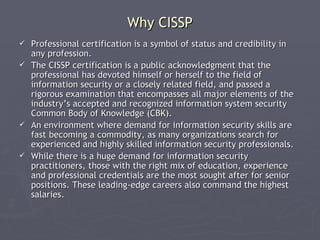
Why CISSP
 Professional certification is a symbol of status and credibility in
  any profession.
 The CISSP certification is a public acknowledgment that the
  professional has devoted himself or herself to the field of
  information security or a closely related field, and passed a
  rigorous examination that encompasses all major elements of the
  industry’s accepted and recognized information system security
  Common Body of Knowledge (CBK).
 An environment where demand for information security skills are
  fast becoming a commodity, as many organizations search for
  experienced and highly skilled information security professionals.
 While there is a huge demand for information security
  practitioners, those with the right mix of education, experience
  and professional credentials are the most sought after for senior
  positions. These leading-edge careers also command the highest
  salaries.
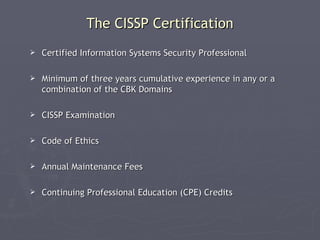
The CISSP Certification
   Certified Information Systems Security Professional

   Minimum of three years cumulative experience in any or a
    combination of the CBK Domains

   CISSP Examination

   Code of Ethics

   Annual Maintenance Fees

   Continuing Professional Education (CPE) Credits
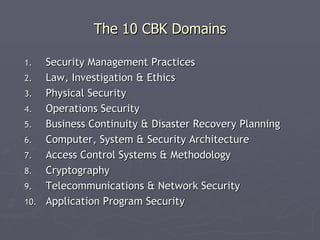
The 10 CBK Domains

1.    Security Management Practices
2.    Law, Investigation & Ethics
3.    Physical Security
4.    Operations Security
5.    Business Continuity & Disaster Recovery Planning
6.    Computer, System & Security Architecture
7.    Access Control Systems & Methodology
8.    Cryptography
9.    Telecommunications & Network Security
10.   Application Program Security
The CISSP Exam
   Format
     250 multiple choice questions
     Up to 6 hours to complete


   Fees (See Web Page www.isc2.org)

   Result
     Will be announced by email
Code of Ethics - Preamble

   Safety of the commonwealth, duty to our principals, and
    to each other requires that we adhere, and be seen to
    adhere, to the highest ethical standards of behavior.

   Therefore, strict adherence to this code is a condition of
    certification.
Code of Ethics - Certificate holders

   Protect society, the commonwealth, and the
    infrastructure.

   Act honorably, honestly, justly, responsibly, and
    legally.

   Provide diligent and competent service to principals.

   Advance and protect the profession.

Cissp why

  • 1.
  • 2.
    Why CISSP  Professionalcertification is a symbol of status and credibility in any profession.  The CISSP certification is a public acknowledgment that the professional has devoted himself or herself to the field of information security or a closely related field, and passed a rigorous examination that encompasses all major elements of the industry’s accepted and recognized information system security Common Body of Knowledge (CBK).  An environment where demand for information security skills are fast becoming a commodity, as many organizations search for experienced and highly skilled information security professionals.  While there is a huge demand for information security practitioners, those with the right mix of education, experience and professional credentials are the most sought after for senior positions. These leading-edge careers also command the highest salaries.
  • 3.
    The CISSP Certification  Certified Information Systems Security Professional  Minimum of three years cumulative experience in any or a combination of the CBK Domains  CISSP Examination  Code of Ethics  Annual Maintenance Fees  Continuing Professional Education (CPE) Credits
  • 4.
    The 10 CBKDomains 1. Security Management Practices 2. Law, Investigation & Ethics 3. Physical Security 4. Operations Security 5. Business Continuity & Disaster Recovery Planning 6. Computer, System & Security Architecture 7. Access Control Systems & Methodology 8. Cryptography 9. Telecommunications & Network Security 10. Application Program Security
  • 5.
    The CISSP Exam  Format  250 multiple choice questions  Up to 6 hours to complete  Fees (See Web Page www.isc2.org)  Result  Will be announced by email
  • 6.
    Code of Ethics- Preamble  Safety of the commonwealth, duty to our principals, and to each other requires that we adhere, and be seen to adhere, to the highest ethical standards of behavior.  Therefore, strict adherence to this code is a condition of certification.
  • 7.
    Code of Ethics- Certificate holders  Protect society, the commonwealth, and the infrastructure.  Act honorably, honestly, justly, responsibly, and legally.  Provide diligent and competent service to principals.  Advance and protect the profession.