Security Architecture and
         Models
Security Architecture and Models
   Security models in terms of confidentiality, integrity, and
    information flow
   Differences between commercial and government security
    requirements
   The role of system security evaluation criteria such as
    TCSEC, ITSEC, and CC
   Security practices for the Internet (IETF IPSec)
   Technical platforms in terms of hardware, firmware, and
    software
   System security techniques in terms of preventative,
    detective, and corrective controls
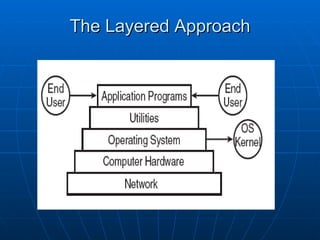
The Layered Approach
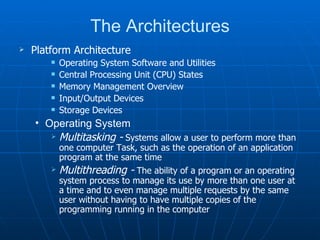
The Architectures
   Platform Architecture
           Operating System Software and Utilities
           Central Processing Unit (CPU) States
           Memory Management Overview
           Input/Output Devices
           Storage Devices
    • Operating System
        Multitasking - Systems allow a user to perform more than
            one computer Task, such as the operation of an application
            program at the same time
           Multithreading - The ability of a program or an operating
            system process to manage its use by more than one user at
            a time and to even manage multiple requests by the same
            user without having to have multiple copies of the
            programming running in the computer
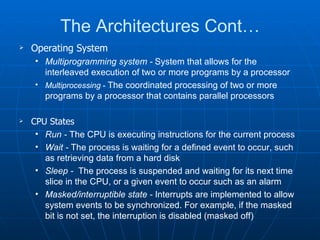
The Architectures Cont…
   Operating System
     • Multiprogramming system - System that allows for the
       interleaved execution of two or more programs by a processor
     • Multiprocessing - The coordinated processing of two or more
       programs by a processor that contains parallel processors

   CPU States
     • Run - The CPU is executing instructions for the current process
     • Wait - The process is waiting for a defined event to occur, such
       as retrieving data from a hard disk
     • Sleep - The process is suspended and waiting for its next time
       slice in the CPU, or a given event to occur such as an alarm
     • Masked/interruptible state - Interrupts are implemented to allow
       system events to be synchronized. For example, if the masked
       bit is not set, the interruption is disabled (masked off)
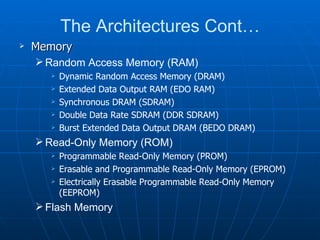
The Architectures Cont…
   Memory
     Random Access Memory (RAM)
         Dynamic Random Access Memory (DRAM)
         Extended Data Output RAM (EDO RAM)
         Synchronous DRAM (SDRAM)
         Double Data Rate SDRAM (DDR SDRAM)
         Burst Extended Data Output DRAM (BEDO DRAM)
     Read-Only Memory (ROM)
         Programmable Read-Only Memory (PROM)
         Erasable and Programmable Read-Only Memory (EPROM)
         Electrically Erasable Programmable Read-Only Memory
          (EEPROM)
     Flash Memory
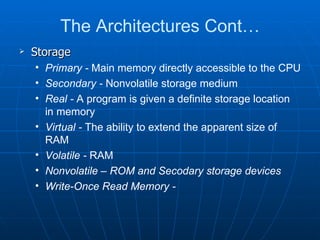
The Architectures Cont…
   Storage
    • Primary - Main memory directly accessible to the CPU
    • Secondary - Nonvolatile storage medium
    • Real - A program is given a definite storage location
      in memory
    • Virtual - The ability to extend the apparent size of
      RAM
    • Volatile - RAM
    • Nonvolatile – ROM and Secodary storage devices
    • Write-Once Read Memory -
The Architectures Cont…
   Network Environment - A data communication system allowing a
    number of devices to communicate with each other
     • Local Environment
     • Shared Environment
     • Security Environments
         •   Dedicated security mode -processing of one particular type or
             classification of information
         •   System high-security mode – system hardware/software is only
             trusted to provide need-to-know protection between users
         •   Multi-level security mode - allows two or more classification levels
         •   Controlled mode - type of multi-level security in which a more
             limited amount of trust
         •   Compartmentalized security mode - process two or more types of
             compartmented information

   Enterprise Architecture - Systematically derived and captured
    structural descriptions
Related Definitions
   Access control - Prevention of unauthorized use or
    misuse of a system
   ACL - Access control list
   Access Mode - An operation on an object recognized by
    the security mechanisms - think read, write or execute
    actions on files
   Accountability- Actions can be correlated to an entity
   Accreditation - Approval to operate in a given capacity in
    a given environment
   Asynchronous attack - An attack exploiting the time
    lapse between an attack action and a system reaction
Related Definitions Cont…
   Audit trail - Records that document actions on or against
    a system
   Bounds Checking - Within a program, the process of
    checking for references outside of declared limits. When
    bounds checking is not employed, attacks such as buffer
    overflows are possible
   Compartmentalization - Storing sensitive data in isolated
    blocks
   Configuration Control - management and control of
    changes to a system’s hardware, firmware, software,
    and documentation
   confinement - Ensuring data cannot be abused when a
    process is executing a borrowed program and has some
    access to that data
Related Definitions Cont…
   Contamination – Corruption of data of varying
    classification levels
   Correctness Proof - Mathematical proof of consistency
    between a specification and implementation
   Countermeasure - anything that neutralizes vulnerability
   Covert Channel - A communication channel that allows
    cooperating processes to transfer information in a way
    that violates a system’s security policy
    • covert storage channel involves memory shared by
      processes
    • covert timing channel involves modulation of system
      resource usage (like CPU time)
Related Definitions Cont…
   Criticality - Importance of system to mission
   Cycle - One cycle consists of writing a zero, then a 1 in
    every possible location
   Data Contamination - Deliberate or accidental change in
    the integrity of data
   Discretionary Access Control - An entity with access
    privileges can pass those privileges on to other entities
   Mandatory Access control - Requires that access control
    policy decisions are beyond the control of the individual
    owner of an object (think military security classification)
Related Definitions Cont…
   DoD Trusted Computer System Evaluation Criteria
    (TCSEC) - orange book
   Firmware - software permanently stored in hardware
    device (ROM, read only memory)
   Formal Proof - Mathematical argument
   Hacker/Cracker – Individual who cause Damage
   Logic bomb - An unauthorized action triggered by a
    system state
   Malicious logic - Evil hardware, software, or firmware
    included by malcontents for malcontents
Related Definitions Cont…
   Principle of Least Privilege - Every entity granted
    least privileges necessary to perform assigned tasks
   Memory bounds - The limits in a range of storage
    addresses for a protected memory region
   Piggy Back - Unauthorized system via another’s
    authorized access (shoulder surfing is similar)
   Privileged Instructions - Set of instructions generally
    executable only when system is operating in
    executive state
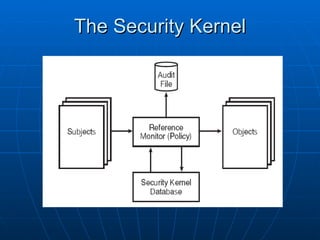
   Reference Monitor - A security control which controls
    subjects’ access to resources - an example is the
    security kernel for a given hardware base
Related Definitions Cont…
   Resource - Anything used while a system is functioning
    (eg CPU time, memory, disk space)
   Resource encapsulation - Property which states
    resources cannot be directly accessed by subjects
    because subject access must be controlled by the
    reference monitor
   Security Kernel - Hardware/software/firmware elements
    of the Trusted Computing Base - security kernel
    implements the reference monitor concept
   Trusted Computing Base - From the TCSEC, the portion
    of a computer system which contains all elements of the
    system responsible for supporting the security policy and
    supporting the isolation of objects on which the
    protection is based -follows the reference monitor
    concept
Related Definitions Cont…
   TCSEC - Trusted Computer Security Evaluation Criteria -
    Evaluation Guides other than the Orange Book
   ITSEC - Information Technology Security Evaluation
    Criteria (European)
   CTCPEC - Canadian Trusted Computer Product
    Evaluation Criteria
   CC - Common Criteria
Related Definitions Cont…
   Trusted System
    • follows from TCB
    • A system that can be expected to meet users’
      requirements for reliability, security, effectiveness due
      to having undergone testing and validation
   System Assurance
    • the trust that can be placed in a system, and the
      trusted ways the system can be proven to have been
      developed, tested, maintained, etc.
TCB Levels (from TCSEC)
   D - Minimal protection
   C - Discretionary Protection
    • C1 cooperative users who can protect their own info
    • C2 more granular DAC, has individual accountability
   B - Mandatory Protection
    •   B1 Labeled Security Protection
    •   B2 Structured Protection
    •   B3 Security Domains
   A - Verified Protection
    • A1 Verified Design
Related Definitions Cont…
   Virus - program that can infect other programs
   Worm - program that propagates but doesn’t necessarily
    modify other programs
   Bacteria or rabbit - programs that replicate themselves
    to overwhelm system resources
   Back Doors - trap doors - allow unauthorized access to
    systems
   Trojan horse - malicious program masquerading as a
    benign program
The Security Kernel
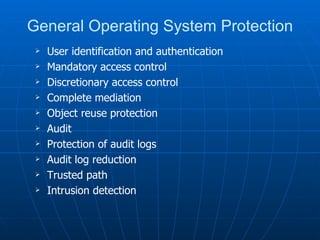
General Operating System Protection
    User identification and authentication
    Mandatory access control
    Discretionary access control
    Complete mediation
    Object reuse protection
    Audit
    Protection of audit logs
    Audit log reduction
    Trusted path
    Intrusion detection
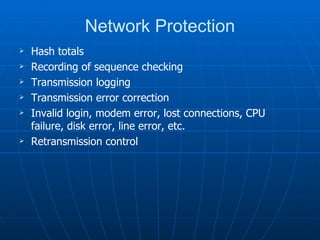
Network Protection
   Hash totals
   Recording of sequence checking
   Transmission logging
   Transmission error correction
   Invalid login, modem error, lost connections, CPU
    failure, disk error, line error, etc.
   Retransmission control
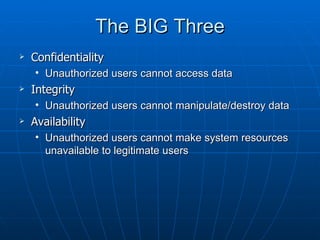
The BIG Three
   Confidentiality
    • Unauthorized users cannot access data
   Integrity
    • Unauthorized users cannot manipulate/destroy data
   Availability
    • Unauthorized users cannot make system resources
      unavailable to legitimate users
Security Models
Bell-LaPadula
Biba
Clark & Wilson
Non-interference
State machine
Access Matrix
Information flow
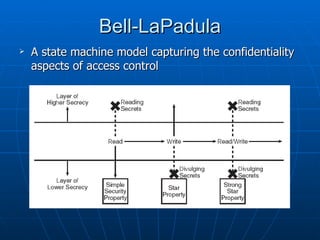
Bell-LaPadula
   A state machine model capturing the confidentiality
    aspects of access control
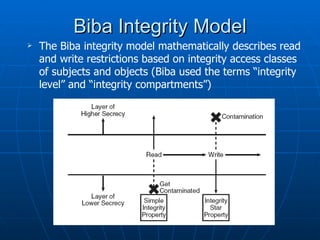
Biba Integrity Model
   The Biba integrity model mathematically describes read
    and write restrictions based on integrity access classes
    of subjects and objects (Biba used the terms “integrity
    level” and “integrity compartments”)
Clark & Wilson Model
   An Integrity Model, like Biba
   Addresses all 3 integrity goals
    • Prevents unauthorized users from making
      modifications
    • Maintains internal and external consistency
    • Prevents authorized users from making improper
      modifications
   T - cannot be Tampered with while being changed
   L - all changes must be Logged
   C - Integrity of data is Consistent
Clark & Wilson Model Cont…
   Proposes “Well Formed Transactions”
    •   perform steps in order
    •   perform exactly the steps listed
    •   authenticate the individuals who perform the steps
   Calls for separation of duty
   Well-formed transaction - The process and data items
    can be changed only by a specific set of trusted
    programs
More Models
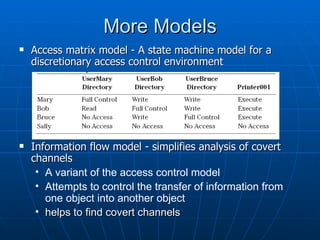
   Access matrix model - A state machine model for a
    discretionary access control environment


   Information flow model - simplifies analysis of covert
    channels
     • A variant of the access control model
     • Attempts to control the transfer of information from
       one object into another object
     • helps to find covert channels
More Models Cont…
   Noninterference model - Covers ways to prevent
    subjects operating in one domain from affecting each
    other in violation of security policy
   State machine model - Abstract mathematical model
    consisting of state variables and transition functions
   Chinese Wall Model – provides a model for access rules
    in a consultancy business where analysts have to make
    sure that no conflicts of interest arise
   Lattice Model - The higher up in secrecy, the more
    constraints on the data; the lower in secrecy, the less
    constraints on the data
Certification & Accreditation
   Procedures and judgements to determine the suitability
    of a system to operate in a target operational
    environment
   Certification considers system in operational
    environment
   Accreditation is the official management decision to
    operate a system
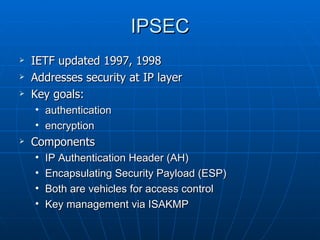
IPSEC
   IETF updated 1997, 1998
   Addresses security at IP layer
   Key goals:
    • authentication
    • encryption
   Components
    •   IP Authentication Header (AH)
    •   Encapsulating Security Payload (ESP)
    •   Both are vehicles for access control
    •   Key management via ISAKMP
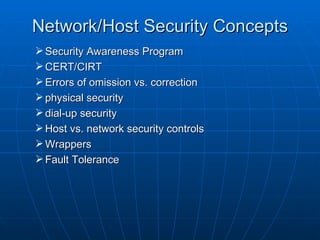
Network/Host Security Concepts
 Security Awareness Program
 CERT/CIRT
 Errors of omission vs. correction
 physical security
 dial-up security
 Host vs. network security controls
 Wrappers
 Fault Tolerance
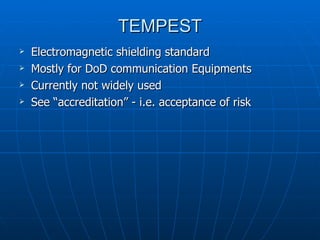
TEMPEST
   Electromagnetic shielding standard
   Mostly for DoD communication Equipments
   Currently not widely used
   See “accreditation” - i.e. acceptance of risk
?

3. security architecture and models

  • 1.
  • 2.
    Security Architecture andModels  Security models in terms of confidentiality, integrity, and information flow  Differences between commercial and government security requirements  The role of system security evaluation criteria such as TCSEC, ITSEC, and CC  Security practices for the Internet (IETF IPSec)  Technical platforms in terms of hardware, firmware, and software  System security techniques in terms of preventative, detective, and corrective controls
  • 3.
  • 4.
    The Architectures  Platform Architecture  Operating System Software and Utilities  Central Processing Unit (CPU) States  Memory Management Overview  Input/Output Devices  Storage Devices • Operating System  Multitasking - Systems allow a user to perform more than one computer Task, such as the operation of an application program at the same time  Multithreading - The ability of a program or an operating system process to manage its use by more than one user at a time and to even manage multiple requests by the same user without having to have multiple copies of the programming running in the computer
  • 5.
    The Architectures Cont…  Operating System • Multiprogramming system - System that allows for the interleaved execution of two or more programs by a processor • Multiprocessing - The coordinated processing of two or more programs by a processor that contains parallel processors  CPU States • Run - The CPU is executing instructions for the current process • Wait - The process is waiting for a defined event to occur, such as retrieving data from a hard disk • Sleep - The process is suspended and waiting for its next time slice in the CPU, or a given event to occur such as an alarm • Masked/interruptible state - Interrupts are implemented to allow system events to be synchronized. For example, if the masked bit is not set, the interruption is disabled (masked off)
  • 6.
    The Architectures Cont…  Memory  Random Access Memory (RAM)  Dynamic Random Access Memory (DRAM)  Extended Data Output RAM (EDO RAM)  Synchronous DRAM (SDRAM)  Double Data Rate SDRAM (DDR SDRAM)  Burst Extended Data Output DRAM (BEDO DRAM)  Read-Only Memory (ROM)  Programmable Read-Only Memory (PROM)  Erasable and Programmable Read-Only Memory (EPROM)  Electrically Erasable Programmable Read-Only Memory (EEPROM)  Flash Memory
  • 7.
    The Architectures Cont…  Storage • Primary - Main memory directly accessible to the CPU • Secondary - Nonvolatile storage medium • Real - A program is given a definite storage location in memory • Virtual - The ability to extend the apparent size of RAM • Volatile - RAM • Nonvolatile – ROM and Secodary storage devices • Write-Once Read Memory -
  • 8.
    The Architectures Cont…  Network Environment - A data communication system allowing a number of devices to communicate with each other • Local Environment • Shared Environment • Security Environments • Dedicated security mode -processing of one particular type or classification of information • System high-security mode – system hardware/software is only trusted to provide need-to-know protection between users • Multi-level security mode - allows two or more classification levels • Controlled mode - type of multi-level security in which a more limited amount of trust • Compartmentalized security mode - process two or more types of compartmented information  Enterprise Architecture - Systematically derived and captured structural descriptions
  • 9.
    Related Definitions  Access control - Prevention of unauthorized use or misuse of a system  ACL - Access control list  Access Mode - An operation on an object recognized by the security mechanisms - think read, write or execute actions on files  Accountability- Actions can be correlated to an entity  Accreditation - Approval to operate in a given capacity in a given environment  Asynchronous attack - An attack exploiting the time lapse between an attack action and a system reaction
  • 10.
    Related Definitions Cont…  Audit trail - Records that document actions on or against a system  Bounds Checking - Within a program, the process of checking for references outside of declared limits. When bounds checking is not employed, attacks such as buffer overflows are possible  Compartmentalization - Storing sensitive data in isolated blocks  Configuration Control - management and control of changes to a system’s hardware, firmware, software, and documentation  confinement - Ensuring data cannot be abused when a process is executing a borrowed program and has some access to that data
  • 11.
    Related Definitions Cont…  Contamination – Corruption of data of varying classification levels  Correctness Proof - Mathematical proof of consistency between a specification and implementation  Countermeasure - anything that neutralizes vulnerability  Covert Channel - A communication channel that allows cooperating processes to transfer information in a way that violates a system’s security policy • covert storage channel involves memory shared by processes • covert timing channel involves modulation of system resource usage (like CPU time)
  • 12.
    Related Definitions Cont…  Criticality - Importance of system to mission  Cycle - One cycle consists of writing a zero, then a 1 in every possible location  Data Contamination - Deliberate or accidental change in the integrity of data  Discretionary Access Control - An entity with access privileges can pass those privileges on to other entities  Mandatory Access control - Requires that access control policy decisions are beyond the control of the individual owner of an object (think military security classification)
  • 13.
    Related Definitions Cont…  DoD Trusted Computer System Evaluation Criteria (TCSEC) - orange book  Firmware - software permanently stored in hardware device (ROM, read only memory)  Formal Proof - Mathematical argument  Hacker/Cracker – Individual who cause Damage  Logic bomb - An unauthorized action triggered by a system state  Malicious logic - Evil hardware, software, or firmware included by malcontents for malcontents
  • 14.
    Related Definitions Cont…  Principle of Least Privilege - Every entity granted least privileges necessary to perform assigned tasks  Memory bounds - The limits in a range of storage addresses for a protected memory region  Piggy Back - Unauthorized system via another’s authorized access (shoulder surfing is similar)  Privileged Instructions - Set of instructions generally executable only when system is operating in executive state  Reference Monitor - A security control which controls subjects’ access to resources - an example is the security kernel for a given hardware base
  • 15.
    Related Definitions Cont…  Resource - Anything used while a system is functioning (eg CPU time, memory, disk space)  Resource encapsulation - Property which states resources cannot be directly accessed by subjects because subject access must be controlled by the reference monitor  Security Kernel - Hardware/software/firmware elements of the Trusted Computing Base - security kernel implements the reference monitor concept  Trusted Computing Base - From the TCSEC, the portion of a computer system which contains all elements of the system responsible for supporting the security policy and supporting the isolation of objects on which the protection is based -follows the reference monitor concept
  • 16.
    Related Definitions Cont…  TCSEC - Trusted Computer Security Evaluation Criteria - Evaluation Guides other than the Orange Book  ITSEC - Information Technology Security Evaluation Criteria (European)  CTCPEC - Canadian Trusted Computer Product Evaluation Criteria  CC - Common Criteria
  • 17.
    Related Definitions Cont…  Trusted System • follows from TCB • A system that can be expected to meet users’ requirements for reliability, security, effectiveness due to having undergone testing and validation  System Assurance • the trust that can be placed in a system, and the trusted ways the system can be proven to have been developed, tested, maintained, etc.
  • 18.
    TCB Levels (fromTCSEC)  D - Minimal protection  C - Discretionary Protection • C1 cooperative users who can protect their own info • C2 more granular DAC, has individual accountability  B - Mandatory Protection • B1 Labeled Security Protection • B2 Structured Protection • B3 Security Domains  A - Verified Protection • A1 Verified Design
  • 19.
    Related Definitions Cont…  Virus - program that can infect other programs  Worm - program that propagates but doesn’t necessarily modify other programs  Bacteria or rabbit - programs that replicate themselves to overwhelm system resources  Back Doors - trap doors - allow unauthorized access to systems  Trojan horse - malicious program masquerading as a benign program
  • 20.
  • 21.
    General Operating SystemProtection  User identification and authentication  Mandatory access control  Discretionary access control  Complete mediation  Object reuse protection  Audit  Protection of audit logs  Audit log reduction  Trusted path  Intrusion detection
  • 22.
    Network Protection  Hash totals  Recording of sequence checking  Transmission logging  Transmission error correction  Invalid login, modem error, lost connections, CPU failure, disk error, line error, etc.  Retransmission control
  • 23.
    The BIG Three  Confidentiality • Unauthorized users cannot access data  Integrity • Unauthorized users cannot manipulate/destroy data  Availability • Unauthorized users cannot make system resources unavailable to legitimate users
  • 24.
    Security Models Bell-LaPadula Biba Clark &Wilson Non-interference State machine Access Matrix Information flow
  • 25.
    Bell-LaPadula  A state machine model capturing the confidentiality aspects of access control
  • 26.
    Biba Integrity Model  The Biba integrity model mathematically describes read and write restrictions based on integrity access classes of subjects and objects (Biba used the terms “integrity level” and “integrity compartments”)
  • 27.
    Clark & WilsonModel  An Integrity Model, like Biba  Addresses all 3 integrity goals • Prevents unauthorized users from making modifications • Maintains internal and external consistency • Prevents authorized users from making improper modifications  T - cannot be Tampered with while being changed  L - all changes must be Logged  C - Integrity of data is Consistent
  • 28.
    Clark & WilsonModel Cont…  Proposes “Well Formed Transactions” • perform steps in order • perform exactly the steps listed • authenticate the individuals who perform the steps  Calls for separation of duty  Well-formed transaction - The process and data items can be changed only by a specific set of trusted programs
  • 29.
    More Models  Access matrix model - A state machine model for a discretionary access control environment  Information flow model - simplifies analysis of covert channels • A variant of the access control model • Attempts to control the transfer of information from one object into another object • helps to find covert channels
  • 30.
    More Models Cont…  Noninterference model - Covers ways to prevent subjects operating in one domain from affecting each other in violation of security policy  State machine model - Abstract mathematical model consisting of state variables and transition functions  Chinese Wall Model – provides a model for access rules in a consultancy business where analysts have to make sure that no conflicts of interest arise  Lattice Model - The higher up in secrecy, the more constraints on the data; the lower in secrecy, the less constraints on the data
  • 31.
    Certification & Accreditation  Procedures and judgements to determine the suitability of a system to operate in a target operational environment  Certification considers system in operational environment  Accreditation is the official management decision to operate a system
  • 32.
    IPSEC  IETF updated 1997, 1998  Addresses security at IP layer  Key goals: • authentication • encryption  Components • IP Authentication Header (AH) • Encapsulating Security Payload (ESP) • Both are vehicles for access control • Key management via ISAKMP
  • 33.
    Network/Host Security Concepts Security Awareness Program  CERT/CIRT  Errors of omission vs. correction  physical security  dial-up security  Host vs. network security controls  Wrappers  Fault Tolerance
  • 34.
    TEMPEST  Electromagnetic shielding standard  Mostly for DoD communication Equipments  Currently not widely used  See “accreditation” - i.e. acceptance of risk
  • 35.