New Qualification Structure and Syllabus
CIS Chartered Stockbroker Qualification
September 2010
Revised November 2009
www.cisnigeria.com
CHARTERED INSTITUTE OF STOCKBROKERS
Chartered By Act 105 of 1992
i
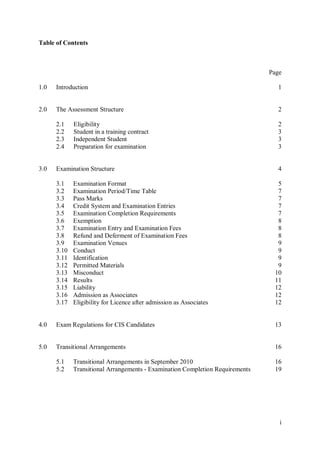
Table of Contents
Page
1.0 Introduction 1
2.0 The Assessment Structure 2
2.1 Eligibility 2
2.2 Student in a training contract 3
2.3 Independent Student 3
2.4 Preparation for examination 3
3.0 Examination Structure 4
3.1 Examination Format 5
3.2 Examination Period/Time Table 7
3.3 Pass Marks 7
3.4 Credit System and Examination Entries 7
3.5 Examination Completion Requirements 7
3.6 Exemption 8
3.7 Examination Entry and Examination Fees 8
3.8 Refund and Deferment of Examination Fees 8
3.9 Examination Venues 9
3.10 Conduct 9
3.11 Identification 9
3.12 Permitted Materials 9
3.13 Misconduct 10
3.14 Results 11
3.15 Liability 12
3.16 Admission as Associates 12
3.17 Eligibility for Licence after admission as Associates 12
4.0 Exam Regulations for CIS Candidates 13
5.0 Transitional Arrangements 16
5.1 Transitional Arrangements in September 2010 16
5.2 Transitional Arrangements - Examination Completion Requirements 19
ii
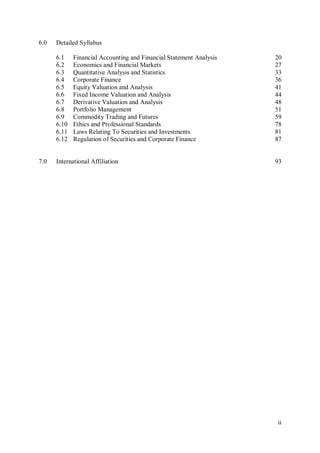
6.0 Detailed Syllabus
6.1 Financial Accounting and Financial Statement Analysis 20
6.2 Economics and Financial Markets 27
6.3 Quantitative Analysis and Statistics 33
6.4 Corporate Finance 36
6.5 Equity Valuation and Analysis 41
6.6 Fixed Income Valuation and Analysis 44
6.7 Derivative Valuation and Analysis 48
6.8 Portfolio Management 51
6.9 Commodity Trading and Futures 59
6.10 Ethics and Professional Standards 78
6.11 Laws Relating To Securities and Investments 81
6.12 Regulation of Securities and Corporate Finance 87
7.0 International Affiliation 93
1
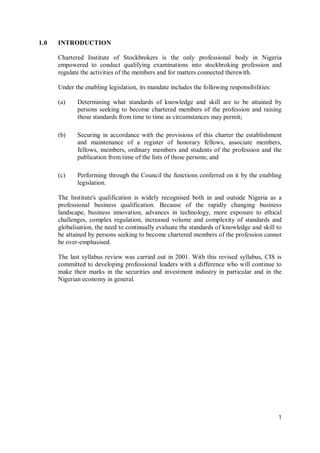
1.0 INTRODUCTION
Chartered Institute of Stockbrokers is the only professional body in Nigeria
empowered to conduct qualifying examinations into stockbroking profession and
regulate the activities of the members and for matters connected therewith.
Under the enabling legislation, its mandate includes the following responsibilities:
(a) Determining what standards of knowledge and skill are to be attained by
persons seeking to become chartered members of the profession and raising
those standards from time to time as circumstances may permit;
(b) Securing in accordance with the provisions of this charter the establishment
and maintenance of a register of honorary fellows, associate members,
fellows, members, ordinary members and students of the profession and the
publication from time of the lists of those persons; and
(c) Performing through the Council the functions conferred on it by the enabling
legislation.
The Institute's qualification is widely recognised both in and outside Nigeria as a
professional business qualification. Because of the rapidly changing business
landscape, business innovation, advances in technology, more exposure to ethical
challenges, complex regulation, increased volume and complexity of standards and
globalisation, the need to continually evaluate the standards of knowledge and skill to
be attained by persons seeking to become chartered members of the profession cannot
be over-emphasised.
The last syllabus review was carried out in 2001. With this revised syllabus, CIS is
committed to developing professional leaders with a difference who will continue to
make their marks in the securities and investment industry in particular and in the
Nigerian economy in general.
2
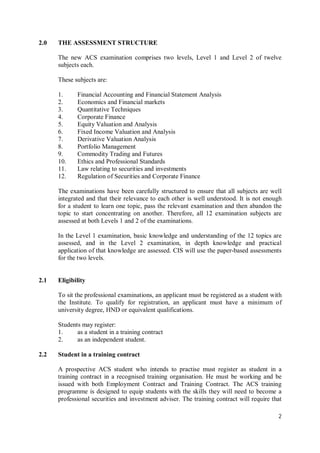
2.0 THE ASSESSMENT STRUCTURE
The new ACS examination comprises two levels, Level 1 and Level 2 of twelve
subjects each.
These subjects are:
1. Financial Accounting and Financial Statement Analysis
2. Economics and Financial markets
3. Quantitative Techniques
4. Corporate Finance
5. Equity Valuation and Analysis
6. Fixed Income Valuation and Analysis
7. Derivative Valuation Analysis
8. Portfolio Management
9. Commodity Trading and Futures
10. Ethics and Professional Standards
11. Law relating to securities and investments
12. Regulation of Securities and Corporate Finance
The examinations have been carefully structured to ensure that all subjects are well
integrated and that their relevance to each other is well understood. It is not enough
for a student to learn one topic, pass the relevant examination and then abandon the
topic to start concentrating on another. Therefore, all 12 examination subjects are
assessed at both Levels 1 and 2 of the examinations.
In the Level 1 examination, basic knowledge and understanding of the 12 topics are
assessed, and in the Level 2 examination, in depth knowledge and practical
application of that knowledge are assessed. CIS will use the paper-based assessments
for the two levels.
2.1 Eligibility
To sit the professional examinations, an applicant must be registered as a student with
the Institute. To qualify for registration, an applicant must have a minimum of
university degree, HND or equivalent qualifications.
Students may register:
1. as a student in a training contract
2. as an independent student.
2.2 Student in a training contract
A prospective ACS student who intends to practise must register as student in a
training contract in a recognised training organisation. He must be working and be
issued with both Employment Contract and Training Contract. The ACS training
programme is designed to equip students with the skills they will need to become a
professional securities and investment adviser. The training contract will require that
3
students receive practical on-the-job training alongside their preparation for the exams
for a minimum period of three years.
2.3 Independent Student
A prospective ACS student can register as an independent student if he is not working
in a recognised training organization. Registration as an independent student allows
applicant to sit ACS examination without having the relevant practical working
experience. A student registered as an independent student can qualify to practise if he
completes a minimum of a year’s work experience under a training contract after the
date of registration.
For further information on student registration, see the Students Section on our
website at www.cisnigeria.com.
2.4 Preparation for examination
Students are advised to study for a minimum period of twelve months before
attempting each level of the examination.
4
3.0 EXAMINATION STRUCTURE
The examination consists of four examination papers in each level. Each of the
examinations will be for a duration of 3 hours.
Examination I :
This examination will cover all the basic concepts that the students need to pursue
study of courses like Securities and Investment Analysis, Asset Valuation and
Portfolio Management.
This examination covers three courses –
Financial Accounting and Financial Statement Analysis
Economics and Financial Markets
Quantitative Analysis and Statistics
Examination II :
In this examination, a major portion of the inputs required to make a good portfolio
manager are covered.
The courses to be studied for this examination are –
Corporate Finance
Equity Valuation and Analysis
Fixed Income Valuation and Analysis
Examination III :
This examination covers three courses –
Derivative Valuation Analysis
Portfolio Management
Commodity Trading and Futures
Examination IV :
This examination covers the national securities laws, regulations and ethics and
professional standards. It consists of three courses –
Ethics and Professional Standards
Law relating to Securities and Investments
Regulations of Securities and Corporate Finance
5
3.1 Examination Format
Level 1 Examination
Each examination paper will be a three-hour paper and added time divided into three
sections:
SECTION A: One compulsory question of multiple choice drawn from the entire
subjects making up the paper. This section will carry 60% of the marks.
SECTION B: Compulsory short answer questions drawn from the entire subjects
making up the paper. This section will carry 10% of the marks.
SECTION C: Three compulsory questions consisting of essay type and/or calculation.
This section will carry 30% of the marks.
Candidates will be given 10 minutes at the start of each examination paper in which
to read the questions. They are strongly encouraged to use this time for reading only
but notes may be made.
Paper No Exam
Duration
Subjects covered
Paper 1.1 3 hours plus
10 minutes
Financial Accounting and Financial Statement Analysis (60
points)
Economics and Financial Markets (60 points)
Quantitative Analysis and Statistics (60 points)
Paper 1.2 3 hours plus
10 minutes
Corporate Finance (60 points)
Equity Valuation and Analysis (60 points)
Fixed Income Valuation and Analysis (60 points)
Paper 1.3 3 hours plus
10 minutes
Derivative Valuation Analysis (60 points)
Portfolio Management (80 points)
Commodity Trading and Futures (60 points)
Paper 1.4 3 hours plus
10 minutes
Ethics and Professional Standards (70 points)
Law relating to securities and investments (60 points
Regulations of securities and corporate finance (70 marks)
6
Level 2 Examination
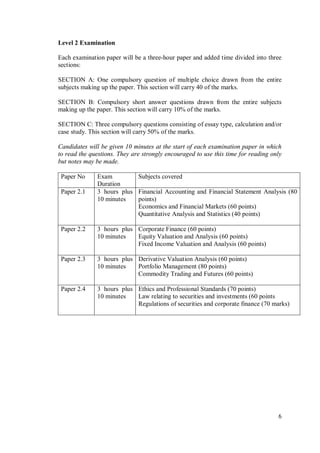
Each examination paper will be a three-hour paper and added time divided into three
sections:
SECTION A: One compulsory question of multiple choice drawn from the entire
subjects making up the paper. This section will carry 40 of the marks.
SECTION B: Compulsory short answer questions drawn from the entire subjects
making up the paper. This section will carry 10% of the marks.
SECTION C: Three compulsory questions consisting of essay type, calculation and/or
case study. This section will carry 50% of the marks.
Candidates will be given 10 minutes at the start of each examination paper in which
to read the questions. They are strongly encouraged to use this time for reading only
but notes may be made.
Paper No Exam
Duration
Subjects covered
Paper 2.1 3 hours plus
10 minutes
Financial Accounting and Financial Statement Analysis (80
points)
Economics and Financial Markets (60 points)
Quantitative Analysis and Statistics (40 points)
Paper 2.2 3 hours plus
10 minutes
Corporate Finance (60 points)
Equity Valuation and Analysis (60 points)
Fixed Income Valuation and Analysis (60 points)
Paper 2.3 3 hours plus
10 minutes
Derivative Valuation Analysis (60 points)
Portfolio Management (80 points)
Commodity Trading and Futures (60 points)
Paper 2.4 3 hours plus
10 minutes
Ethics and Professional Standards (70 points)
Law relating to securities and investments (60 points
Regulations of securities and corporate finance (70 marks)
7
3.2 Examination Period/Time Table
The examination will be held twice a year, March and September.
The proposed examination timetable for September 2010 is shown on the following
diagram:
Tuesday Wednesday
Level 1 Level 2 Level 1 Level 2
Morning Session
8:50 am to 12:00 pm
Exam Paper I Exam Paper I Exam Paper III Exam Paper III
Afternoon Session
1:50 pm to 5:00 pm
Exam Paper II Exam Paper II Exam Paper IV Exam Paper IV
Note: Times shown include examination paper reading time. CIS reserves the right to
modify or change this proposed timetable as necessary to meet operational
constraints.
3.3 Pass Marks
To gain a pass, the student must in each examination paper at any level secure a pass
mark of 50 per cent.
3.4 Credit System and Examination Entries
Candidates will retain any examination paper passed subject to completing the entire
examinations within an eight-year period.
Candidates must complete examination at Level 1 before attempting the Level 2
examination. Candidates cannot combine two levels of the examination at any sitting.
A candidate may enter for any number of examination papers in any examination
session in each level. In other words, candidates may enter for 1, 2, 3 or 4
examination papers at a sitting.
3.5 Examination Completion Requirements
For certification purposes, all candidates have eight years to complete the examination
papers in the two levels of examination. The 8-year period will commence from the
date of the registration as a student.
If a candidate fails in passing the two levels of examinations within the 8-year period,
all previous passes will be forfeited and the candidate would need to sit and pass all
examinations again to gain the qualification.
8
3.6 Exemption
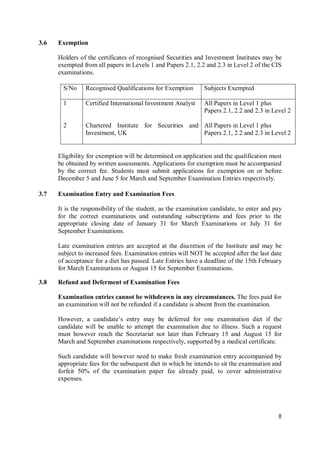
Holders of the certificates of recognised Securities and Investment Institutes may be
exempted from all papers in Levels 1 and Papers 2.1, 2.2 and 2.3 in Level 2 of the CIS
examinations.
S/No Recognised Qualifications for Exemption Subjects Exempted
1
2
Certified International Investment Analyst
Chartered Institute for Securities and
Investment, UK
All Papers in Level 1 plus
Papers 2.1, 2.2 and 2.3 in Level 2
All Papers in Level 1 plus
Papers 2.1, 2.2 and 2.3 in Level 2
Eligibility for exemption will be determined on application and the qualification must
be obtained by written assessments. Applications for exemption must be accompanied
by the correct fee. Students must submit applications for exemption on or before
December 5 and June 5 for March and September Examination Entries respectively.
3.7 Examination Entry and Examination Fees
It is the responsibility of the student, as the examination candidate, to enter and pay
for the correct examinations and outstanding subscriptions and fees prior to the
appropriate closing date of January 31 for March Examinations or July 31 for
September Examinations.
Late examination entries are accepted at the discretion of the Institute and may be
subject to increased fees. Examination entries will NOT be accepted after the last date
of acceptance for a diet has passed. Late Entries have a deadline of the 15th February
for March Examinations or August 15 for September Examinations.
3.8 Refund and Deferment of Examination Fees
Examination entries cannot be withdrawn in any circumstances. The fees paid for
an examination will not be refunded if a candidate is absent from the examination.
However, a candidate’s entry may be deferred for one examination diet if the
candidate will be unable to attempt the examination due to illness. Such a request
must however reach the Secretariat not later than February 15 and August 15 for
March and September examinations respectively, supported by a medical certificate.
Such candidate will however need to make fresh examination entry accompanied by
appropriate fees for the subsequent diet in which he intends to sit the examination and
forfeit 50% of the examination paper fee already paid, to cover administrative
expenses.
9
3.9 Examination Venues
Students should arrive at examination venues at least 30 minutes prior to the start of
the examination.
If a candidate is late by more than thirty minutes, he/she will not be allowed to enter
the examination premises. Students arriving late to an examination will not be
permitted additional time and their lateness will be reported to the Institute.
Students will be assigned seating. No candidate is allowed to change the seat allocated
to him/her for a particular examination paper without the permission of the exam
centre supervisor/invigilator, who has the authority to change or interchange seats of
any candidate, if circumstances so demand. Candidates found reluctant will be liable
to disciplinary action.
3.10 Conduct
Candidates may not leave the examination venue during an examination and return
unless accompanied by an invigilator.
Students taking examination may not leave an examination venue within the first one
hour after the commencement of the examination.
Students must at all times follow the instructions of the invigilator. Failure to do so
will be considered misconduct.
Candidates are not allowed to bring programmable calculators, organizers, PDA,
laptop, computer notebooks, mobile phones, blackberries, pagers or any other device
capable of transmitting, storing or receiving information into the examination halls.
Students may not remove materials provided at the examination venue unless
instructed otherwise.
3.11 Identification
Candidates must possess and be ready to produce on demand their Student
Registration Card and Exam/Centre Advice issued by the Examination Department of
the Institute, failing which they may not be allowed to appear in the examination.
If a student does not currently possess the Student Registration Card, he/she must
obtain it before the examination.
3.12 Permitted Materials
Candidates must only use the appropriate stationery provided in the examination
venue. Material submitted on other paper will not be marked. Use of any materials
brought into the examination venue other than those allowed will be considered
misconduct
10
Fountain pen or ballpoint with blue or black ink only should be used for writing
answer scripts. Candidates must bring their own pen (blue or black), eraser, ruler and
pencil (HB pencils for objective test answer sheets where supplied). No marks will be
given for the questions attempted in pencil or red ink.
Calculators may be used in the examination venue for examination. The use of
electronic equipment capable of being programmed to hold alphabetic or numerical
data and/or formulae is prohibited. Calculators must be pocket size, silent and non
mains operated.
Details of the calculator used by a candidate (Maker and Model number), must be
inserted in the space provided on the answer sheet. Candidates will be penalised for
violating the Institute’s regulation on the use of calculators.
Any personal belongings such as briefcases, pagers, blackberries, mobile phones,
books, dictionaries, revision notes or written material of any kind must be left in an
area designated by the invigilators. Mobile phones must be switched off.
The Institute reserves the right to change, amend, remove or vary at any point the
materials permitted in an examination.
3.13 Misconduct
Candidates shall not engage in any activity likely to give him/her an advantage. Such
activity by any student will be considered misconduct or malpractice.
Examination misconduct or malpractice includes but not limited to cheating,
colluding or impersonating.
Examples of these are:
(i) removing blank or completed answer scripts from the examination hall,
(ii) bringing prepared materials into the examination hall,
(iii) assisting another candidate to gain an advantage by any means, facilitating or
receiving such assistance
(iv) acting, appearing, or producing work on behalf of another candidate in order
to deceive the examiners, or soliciting another individual to act, appear or
produce work on your own behalf
(v) spying or copying from another candidate,
(vi) impersonation,
(vii) disturbing other candidates
(viii) disruptive conduct in the examination venue
(ix) arguing with or refusing to take lawful instruction from the invigilators etc.
The invigilators at examination centres will report all cases of irregularity or
misconduct in connection with an examination. They are empowered to discontinue
the examination of candidates who conduct themselves improperly and require them
to leave the examination room.
CIS reserves the right to contact a candidate’s employer, law enforcement agency and
any other appropriate authorities with regard to cases of misconduct.
11
CIS will investigate any candidate suspected of involvement in any irregularity or
misconduct. Where a case for misconduct is to be considered, the student will be
notified and given opportunity to write to explain the circumstances of the case.
Where the Institute believes a case of misconduct exists this will be referred to the
CIS Investigating Panel for investigation and potential disciplinary action.
The Institute reserves the right to withhold publication of the results of an
examination, and prevent further examination attempts, of students suspected of
having been involved in any irregularity or misconduct in connection with an
assessment, pending the completion of investigations into the alleged irregularity or
misconduct.
Any candidate found guilty of examination malpractices shall be punished
accordingly. Such punishment may be any or combination of the following:
(i) Disqualification from any examinations for which the results have not yet
been issued,
(ii) Ban from sitting examinations for a specified period, e.g. for two or more
examination diets
(iii) Removal from the student register,
(iv) Publication of the names of the candidates in newspapers, Institute’s magazine
and/or on the CIS website,
(v) Handing over to the police for prosecution, and/or
(vi) Be liable to such other penalty as the Disciplinary Tribunal may determine.
3.14 Results
The examination results will be graded as either “PASS” or “FAIL”.
Candidates who are unable to attend the examination will be regarded as
“ABSENT” in the examination paper.
Candidates will retain any examination paper passed subject to completing the entire
examinations within an eight-year period.
No appeal against examination results will be considered under any circumstances.
Results will be available by letter, email and on the CIS website at
www.cisnigeria.com/students.
The answer scripts and other submitted materials are the property of the Institute and
will not be returned to the candidates. Candidates must not in any circumstance
remove them from the examination hall either during or after examination time.
The CIS retains the right to use scripts and submitted materials for training and
feedback purposes.
12
3.15 Liability
The CIS will not be liable for any loss, theft or personal damage to any items brought
in to or left outside of the examination venue. All personal items are brought at the
owner’s own risk.
3.16 Admission as Associates
On successful completion of the Level 2 examination, qualified student members will
be automatically transferred to the Graduate list. To become a full member
(Associate), a graduate must have at least three years relevant experience in the
financial services industry and satisfy other admission criteria.
3.17 Eligibility for Licence after admission as Associates
Only Associates and Fellows of the Institute who trained in approved training
organizations will qualify for Practising Licences.
Members – Associates and Fellows- who qualified under this new examination
structure applying for Practising Licence must in addition to other criteria meet the
underlisted conditions:
(i) Passed the Institute’s Professional examinations.
(ii) Have at least 12 months post qualification practical experience in a
stockbroking firm and/or related securities and investment field including the
specified minimum number of continuous working days of training on trading
rules and procedures.
(iii) Passed the oral interview on trading rules and procedures jointly conducted by
the Exchange and the Institute.
13
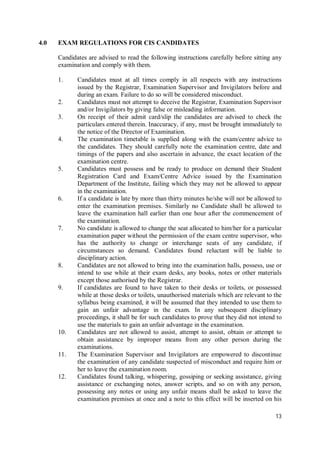
4.0 EXAM REGULATIONS FOR CIS CANDIDATES
Candidates are advised to read the following instructions carefully before sitting any
examination and comply with them.
1. Candidates must at all times comply in all respects with any instructions
issued by the Registrar, Examination Supervisor and Invigilators before and
during an exam. Failure to do so will be considered misconduct.
2. Candidates must not attempt to deceive the Registrar, Examination Supervisor
and/or Invigilators by giving false or misleading information.
3. On receipt of their admit card/slip the candidates are advised to check the
particulars entered therein. Inaccuracy, if any, must be brought immediately to
the notice of the Director of Examination.
4. The examination timetable is supplied along with the exam/centre advice to
the candidates. They should carefully note the examination centre, date and
timings of the papers and also ascertain in advance, the exact location of the
examination centre.
5. Candidates must possess and be ready to produce on demand their Student
Registration Card and Exam/Centre Advice issued by the Examination
Department of the Institute, failing which they may not be allowed to appear
in the examination.
6. If a candidate is late by more than thirty minutes he/she will not be allowed to
enter the examination premises. Similarly no Candidate shall be allowed to
leave the examination hall earlier than one hour after the commencement of
the examination.
7. No candidate is allowed to change the seat allocated to him/her for a particular
examination paper without the permission of the exam centre supervisor, who
has the authority to change or interchange seats of any candidate, if
circumstances so demand. Candidates found reluctant will be liable to
disciplinary action.
8. Candidates are not allowed to bring into the examination halls, possess, use or
intend to use while at their exam desks, any books, notes or other materials
except those authorised by the Registrar.
9. If candidates are found to have taken to their desks or toilets, or possessed
while at those desks or toilets, unauthorised materials which are relevant to the
syllabus being examined, it will be assumed that they intended to use them to
gain an unfair advantage in the exam. In any subsequent disciplinary
proceedings, it shall be for such candidates to prove that they did not intend to
use the materials to gain an unfair advantage in the examination.
10. Candidates are not allowed to assist, attempt to assist, obtain or attempt to
obtain assistance by improper means from any other person during the
examinations.
11. The Examination Supervisor and Invigilators are empowered to discontinue
the examination of any candidate suspected of misconduct and require him or
her to leave the examination room.
12. Candidates found talking, whispering, gossiping or seeking assistance, giving
assistance or exchanging notes, answer scripts, and so on with any person,
possessing any notes or using any unfair means shall be asked to leave the
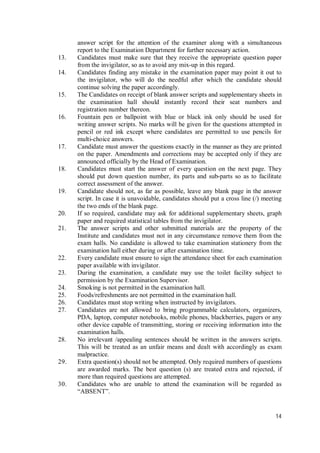
examination premises at once and a note to this effect will be inserted on his
14
answer script for the attention of the examiner along with a simultaneous
report to the Examination Department for further necessary action.
13. Candidates must make sure that they receive the appropriate question paper
from the invigilator, so as to avoid any mix-up in this regard.
14. Candidates finding any mistake in the examination paper may point it out to
the invigilator, who will do the needful after which the candidate should
continue solving the paper accordingly.
15. The Candidates on receipt of blank answer scripts and supplementary sheets in
the examination hall should instantly record their seat numbers and
registration number thereon.
16. Fountain pen or ballpoint with blue or black ink only should be used for
writing answer scripts. No marks will be given for the questions attempted in
pencil or red ink except where candidates are permitted to use pencils for
multi-choice answers.
17. Candidate must answer the questions exactly in the manner as they are printed
on the paper. Amendments and corrections may be accepted only if they are
announced officially by the Head of Examination.
18. Candidates must start the answer of every question on the next page. They
should put down question number, its parts and sub-parts so as to facilitate
correct assessment of the answer.
19. Candidate should not, as far as possible, leave any blank page in the answer
script. In case it is unavoidable, candidates should put a cross line (/) meeting
the two ends of the blank page.
20. If so required, candidate may ask for additional supplementary sheets, graph
paper and required statistical tables from the invigilator.
21. The answer scripts and other submitted materials are the property of the
Institute and candidates must not in any circumstance remove them from the
exam halls. No candidate is allowed to take examination stationery from the
examination hall either during or after examination time.
22. Every candidate must ensure to sign the attendance sheet for each examination
paper available with invigilator.
23. During the examination, a candidate may use the toilet facility subject to
permission by the Examination Supervisor.
24. Smoking is not permitted in the examination hall.
25. Foods/refreshments are not permitted in the examination hall.
26. Candidates must stop writing when instructed by invigilators.
27. Candidates are not allowed to bring programmable calculators, organizers,
PDA, laptop, computer notebooks, mobile phones, blackberries, pagers or any
other device capable of transmitting, storing or receiving information into the
examination halls.
28. No irrelevant /appealing sentences should be written in the answers scripts.
This will be treated as an unfair means and dealt with accordingly as exam
malpractice.
29. Extra question(s) should not be attempted. Only required numbers of questions
are awarded marks. The best question (s) are treated extra and rejected, if
more than required questions are attempted.
30. Candidates who are unable to attend the examination will be regarded as
“ABSENT”.
15
31. CIS will not be liable for any loss, theft or personal damage to any items
brought in to or left outside of the examination venue. All personal items are
brought at the owner’s own risk.
32. The above mentioned rules pre-suppose that the candidate has duly submitted
the requisite examination application on the prescribed form and completed all
the other formalities in this regard and that the same have been accepted and
approved by the appropriate authority of the Institute.
16
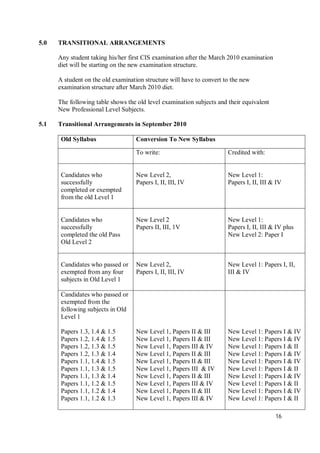
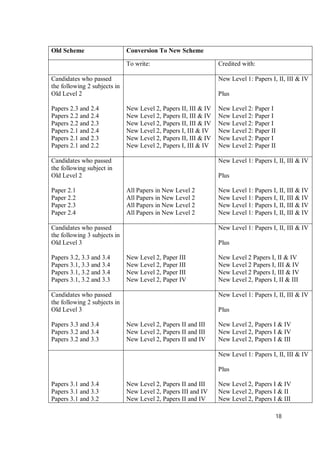
5.0 TRANSITIONAL ARRANGEMENTS
Any student taking his/her first CIS examination after the March 2010 examination
diet will be starting on the new examination structure.
A student on the old examination structure will have to convert to the new
examination structure after March 2010 diet.
The following table shows the old level examination subjects and their equivalent
New Professional Level Subjects.
5.1 Transitional Arrangements in September 2010
Old Syllabus Conversion To New Syllabus
To write: Credited with:
Candidates who
successfully
completed or exempted
from the old Level 1
New Level 2,
Papers I, II, III, IV
New Level 1:
Papers I, II, III & IV
Candidates who
successfully
completed the old Pass
Old Level 2
New Level 2
Papers II, III, 1V
New Level 1:
Papers I, II, III & IV plus
New Level 2: Paper I
Candidates who passed or
exempted from any four
subjects in Old Level 1
New Level 2,
Papers I, II, III, IV
New Level 1: Papers I, II,
III & IV
Candidates who passed or
exempted from the
following subjects in Old
Level 1
Papers 1.3, 1.4 & 1.5
Papers 1.2, 1.4 & 1.5
Papers 1.2, 1.3 & 1.5
Papers 1.2, 1.3 & 1.4
Papers 1.1, 1.4 & 1.5
Papers 1.1, 1.3 & 1.5
Papers 1.1, 1.3 & 1.4
Papers 1.1, 1.2 & 1.5
Papers 1.1, 1.2 & 1.4
Papers 1.1, 1.2 & 1.3
New Level 1, Papers II & III
New Level 1, Papers III & IV
New Level 1, Papers II & III
New Level 1, Papers III & IV
New Level 1, Papers II & III
New Level 1, Papers III & IV
New Level 1, Papers II & III
New Level 1, Papers III & IV
New Level 1: Papers I & IV
New Level 1: Papers I & II
New Level 1: Papers I & IV
New Level 1: Papers I & II
New Level 1: Papers I & IV
New Level 1: Papers I & II
New Level 1: Papers I & IV
New Level 1: Papers I & II
17
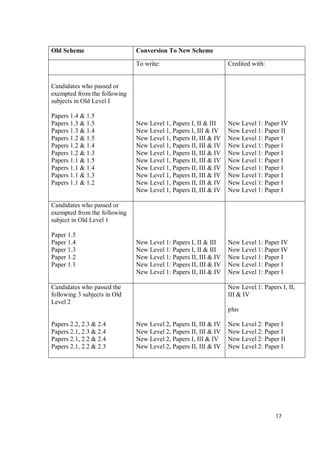
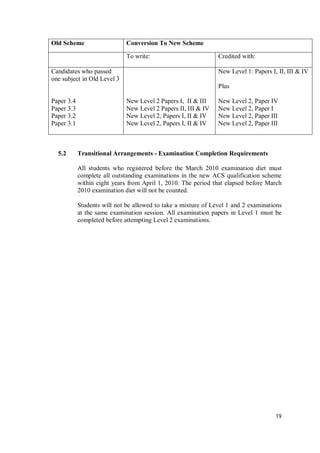
Old Scheme Conversion To New Scheme
To write: Credited with:
Candidates who passed or
exempted from the following
subjects in Old Level I
Papers 1.4 & 1.5
Papers 1.3 & 1.5
Papers 1.3 & 1.4
Papers 1.2 & 1.5
Papers 1.2 & 1.4
Papers 1.2 & 1.3
Papers 1.1 & 1.5
Papers 1.1 & 1.4
Papers 1.1 & 1.3
Papers 1.1 & 1.2
New Level 1, Papers I, II & III
New Level 1, Papers I, III & IV
New Level 1, Papers II, III & IV
New Level 1: Paper IV
New Level 1: Paper II
New Level 1: Paper I
Candidates who passed or
exempted from the following
subject in Old Level 1
Paper 1.5
Paper 1.4
Paper 1.3
Paper 1.2
Paper 1.1
New Level 1: Papers I, II & III
New Level 1: Papers II, III & IV
New Level 1: Paper IV
New Level 1: Paper I
Candidates who passed the
following 3 subjects in Old
Level 2
Papers 2.2, 2.3 & 2.4
Papers 2.1, 2.3 & 2.4
Papers 2.1, 2.2 & 2.4
Papers 2.1, 2.2 & 2.3
New Level 2, Papers II, III & IV
New Level 2, Papers I, III & IV
New Level 2, Papers II, III & IV
New Level 1: Papers I, II,
III & IV
plus
New Level 2: Paper I
New Level 2: Paper II
New Level 2: Paper I
18
Old Scheme Conversion To New Scheme
To write: Credited with:
Candidates who passed
the following 2 subjects in
Old Level 2
Papers 2.3 and 2.4
Papers 2.2 and 2.4
Papers 2.2 and 2.3
Papers 2.1 and 2.4
Papers 2.1 and 2.3
Papers 2.1 and 2.2
New Level 2, Papers II, III & IV
New Level 2, Papers I, III & IV
New Level 2, Papers II, III & IV
New Level 2, Papers I, III & IV
New Level 1: Papers I, II, III & IV
Plus
New Level 2: Paper I
New Level 2: Paper II
New Level 2: Paper I
New Level 2: Paper II
Candidates who passed
the following subject in
Old Level 2
Paper 2.1
Paper 2.2
Paper 2.3
Paper 2.4
All Papers in New Level 2
New Level 1: Papers I, II, III & IV
Plus
New Level 1: Papers I, II, III & IV
Candidates who passed
the following 3 subjects in
Old Level 3
Papers 3.2, 3.3 and 3.4
Papers 3.1, 3.3 and 3.4
Papers 3.1, 3.2 and 3.4
Papers 3.1, 3.2 and 3.3
New Level 2, Paper III
New Level 2, Paper IV
New Level 1: Papers I, II, III & IV
Plus
New Level 2 Papers I, II & IV
New Level 2 Papers I, III & IV
New Level 2, Papers I, II & III
Candidates who passed
the following 2 subjects in
Old Level 3
Papers 3.3 and 3.4
Papers 3.2 and 3.4
Papers 3.2 and 3.3
New Level 2, Papers II and III
New Level 2, Papers II and IV
New Level 1: Papers I, II, III & IV
Plus
New Level 2, Papers I & IV
New Level 2, Papers I & III
Papers 3.1 and 3.4
Papers 3.1 and 3.3
Papers 3.1 and 3.2
New Level 2, Papers II and III
New Level 2, Papers III and IV
New Level 2, Papers II and IV
New Level 1: Papers I, II, III & IV
Plus
New Level 2, Papers I & IV
New Level 2, Papers I & II
New Level 2, Papers I & III
19
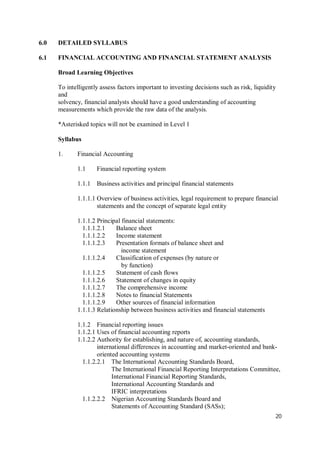
Old Scheme Conversion To New Scheme
To write: Credited with:
Candidates who passed
one subject in Old Level 3
Paper 3.4
Paper 3.3
Paper 3.2
Paper 3.1
New Level 2 Papers I, II & III
New Level 2 Papers II, III & IV
New Level 2, Papers I, II & IV
New Level 1: Papers I, II, III & IV
Plus
New Level 2, Paper IV
New Level 2, Paper I
New Level 2, Paper III
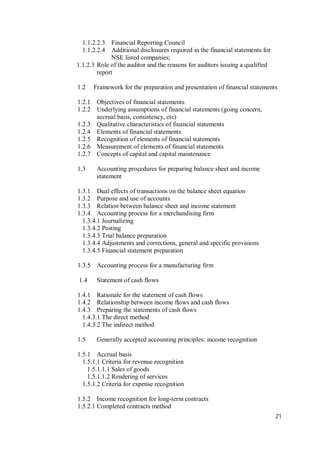
5.2 Transitional Arrangements - Examination Completion Requirements
All students who registered before the March 2010 examination diet must
complete all outstanding examinations in the new ACS qualification scheme
within eight years from April 1, 2010. The period that elapsed before March
2010 examination diet will not be counted.
Students will not be allowed to take a mixture of Level 1 and 2 examinations
at the same examination session. All examination papers in Level 1 must be
completed before attempting Level 2 examinations.
20
6.0 DETAILED SYLLABUS
6.1 FINANCIAL ACCOUNTING AND FINANCIAL STATEMENT ANALYSIS
Broad Learning Objectives
To intelligently assess factors important to investing decisions such as risk, liquidity
and
solvency, financial analysts should have a good understanding of accounting
measurements which provide the raw data of the analysis.
*Asterisked topics will not be examined in Level 1
Syllabus
1. Financial Accounting
1.1 Financial reporting system
1.1.1 Business activities and principal financial statements
1.1.1.1 Overview of business activities, legal requirement to prepare financial
statements and the concept of separate legal entity
1.1.1.2 Principal financial statements:
1.1.1.2.1 Balance sheet
1.1.1.2.2 Income statement
1.1.1.2.3 Presentation formats of balance sheet and
income statement
1.1.1.2.4 Classification of expenses (by nature or
by function)
1.1.1.2.5 Statement of cash flows
1.1.1.2.6 Statement of changes in equity
1.1.1.2.7 The comprehensive income
1.1.1.2.8 Notes to financial Statements
1.1.1.2.9 Other sources of financial information
1.1.1.3 Relationship between business activities and financial statements
1.1.2 Financial reporting issues
1.1.2.1 Uses of financial accounting reports
1.1.2.2 Authority for establishing, and nature of, accounting standards,
international differences in accounting and market-oriented and bank-
oriented accounting systems
1.1.2.2.1 The International Accounting Standards Board,
The International Financial Reporting Interpretations Committee,
International Financial Reporting Standards,
International Accounting Standards and
IFRIC interpretations
1.1.2.2.2 Nigerian Accounting Standards Board and
Statements of Accounting Standard (SASs);
21
1.1.2.2.3 Financial Reporting Council
1.1.2.2.4 Additional disclosures required in the financial statements for
NSE listed companies;
1.1.2.3 Role of the auditor and the reasons for auditors issuing a qualified
report
1.2 Framework for the preparation and presentation of financial statements
1.2.1 Objectives of financial statements
1.2.2 Underlying assumptions of financial statements (going concern,
accrual basis, consistency, etc)
1.2.3 Qualitative characteristics of financial statements
1.2.4 Elements of financial statements
1.2.5 Recognition of elements of financial statements
1.2.6 Measurement of elements of financial statements
1.2.7 Concepts of capital and capital maintenance
1.3 Accounting procedures for preparing balance sheet and income
statement
1.3.1 Dual effects of transactions on the balance sheet equation
1.3.2 Purpose and use of accounts
1.3.3 Relation between balance sheet and income statement
1.3.4 Accounting process for a merchandising firm
1.3.4.1 Journalizing
1.3.4.2 Posting
1.3.4.3 Trial balance preparation
1.3.4.4 Adjustments and corrections, general and specific provisions
1.3.4.5 Financial statement preparation
1.3.5 Accounting process for a manufacturing firm
1.4 Statement of cash flows
1.4.1 Rationale for the statement of cash flows
1.4.2 Relationship between income flows and cash flows
1.4.3 Preparing the statements of cash flows
1.4.3.1 The direct method
1.4.3.2 The indirect method
1.5 Generally accepted accounting principles: income recognition
1.5.1 Accrual basis
1.5.1.1 Criteria for revenue recognition
1.5.1.1.1 Sales of goods
1.5.1.1.2 Rendering of services
1.5.1.2 Criteria for expense recognition
1.5.2 Income recognition for long-term contracts
1.5.2.1 Completed contracts method
22
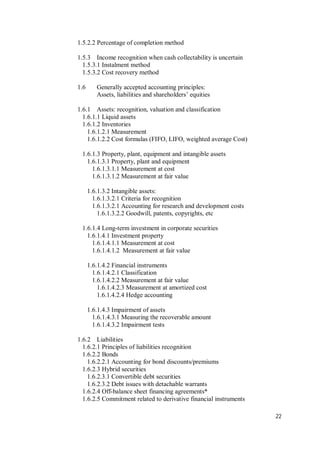
1.5.2.2 Percentage of completion method
1.5.3 Income recognition when cash collectability is uncertain
1.5.3.1 Instalment method
1.5.3.2 Cost recovery method
1.6 Generally accepted accounting principles:
Assets, liabilities and shareholders’ equities
1.6.1 Assets: recognition, valuation and classification
1.6.1.1 Liquid assets
1.6.1.2 Inventories
1.6.1.2.1 Measurement
1.6.1.2.2 Cost formulas (FIFO, LIFO, weighted average Cost)
1.6.1.3 Property, plant, equipment and intangible assets
1.6.1.3.1 Property, plant and equipment
1.6.1.3.1.1 Measurement at cost
1.6.1.3.1.2 Measurement at fair value
1.6.1.3.2 Intangible assets:
1.6.1.3.2.1 Criteria for recognition
1.6.1.3.2.1 Accounting for research and development costs
1.6.1.3.2.2 Goodwill, patents, copyrights, etc
1.6.1.4 Long-term investment in corporate securities
1.6.1.4.1 Investment property
1.6.1.4.1.1 Measurement at cost
1.6.1.4.1.2 Measurement at fair value
1.6.1.4.2 Financial instruments
1.6.1.4.2.1 Classification
1.6.1.4.2.2 Measurement at fair value
1.6.1.4.2.3 Measurement at amortized cost
1.6.1.4.2.4 Hedge accounting
1.6.1.4.3 Impairment of assets
1.6.1.4.3.1 Measuring the recoverable amount
1.6.1.4.3.2 Impairment tests
1.6.2 Liabilities
1.6.2.1 Principles of liabilities recognition
1.6.2.2 Bonds
1.6.2.2.1 Accounting for bond discounts/premiums
1.6.2.3 Hybrid securities
1.6.2.3.1 Convertible debt securities
1.6.2.3.2 Debt issues with detachable warrants
1.6.2.4 Off-balance sheet financing agreements*
1.6.2.5 Commitment related to derivative financial instruments
23
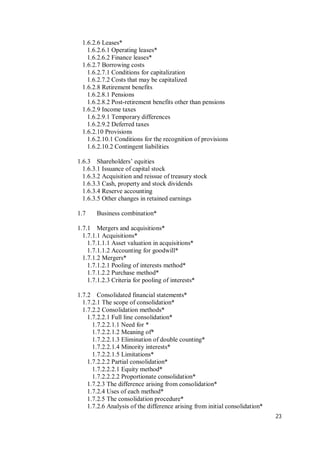
1.6.2.6 Leases*
1.6.2.6.1 Operating leases*
1.6.2.6.2 Finance leases*
1.6.2.7 Borrowing costs
1.6.2.7.1 Conditions for capitalization
1.6.2.7.2 Costs that may be capitalized
1.6.2.8 Retirement benefits
1.6.2.8.1 Pensions
1.6.2.8.2 Post-retirement benefits other than pensions
1.6.2.9 Income taxes
1.6.2.9.1 Temporary differences
1.6.2.9.2 Deferred taxes
1.6.2.10 Provisions
1.6.2.10.1 Conditions for the recognition of provisions
1.6.2.10.2 Contingent liabilities
1.6.3 Shareholders’ equities
1.6.3.1 Issuance of capital stock
1.6.3.2 Acquisition and reissue of treasury stock
1.6.3.3 Cash, property and stock dividends
1.6.3.4 Reserve accounting
1.6.3.5 Other changes in retained earnings
1.7 Business combination*
1.7.1 Mergers and acquisitions*
1.7.1.1 Acquisitions*
1.7.1.1.1 Asset valuation in acquisitions*
1.7.1.1.2 Accounting for goodwill*
1.7.1.2 Mergers*
1.7.1.2.1 Pooling of interests method*
1.7.1.2.2 Purchase method*
1.7.1.2.3 Criteria for pooling of interests*
1.7.2 Consolidated financial statements*
1.7.2.1 The scope of consolidation*
1.7.2.2 Consolidation methods*
1.7.2.2.1 Full line consolidation*

1.7.2.2.1.1 Need for *
1.7.2.2.1.2 Meaning of*
1.7.2.2.1.3 Elimination of double counting*
1.7.2.2.1.4 Minority interests*
1.7.2.2.1.5 Limitations*
1.7.2.2.2 Partial consolidation*
1.7.2.2.2.1 Equity method*
1.7.2.2.2.2 Proportionate consolidation*
1.7.2.3 The difference arising from consolidation*
1.7.2.4 Uses of each method*
1.7.2.5 The consolidation procedure*
1.7.2.6 Analysis of the difference arising from initial consolidation*
24
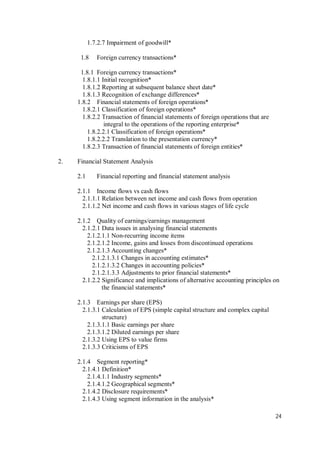
1.7.2.7 Impairment of goodwill*
1.8 Foreign currency transactions*
1.8.1 Foreign currency transactions*
1.8.1.1 Initial recognition*
1.8.1.2 Reporting at subsequent balance sheet date*
1.8.1.3 Recognition of exchange differences*
1.8.2 Financial statements of foreign operations*
1.8.2.1 Classification of foreign operations*
1.8.2.2 Transaction of financial statements of foreign operations that are
integral to the operations of the reporting enterprise*
1.8.2.2.1 Classification of foreign operations*
1.8.2.2.2 Translation to the presentation currency*
1.8.2.3 Transaction of financial statements of foreign entities*
2. Financial Statement Analysis
2.1 Financial reporting and financial statement analysis
2.1.1 Income flows vs cash flows
2.1.1.1 Relation between net income and cash flows from operation
2.1.1.2 Net income and cash flows in various stages of life cycle
2.1.2 Quality of earnings/earnings management
2.1.2.1 Data issues in analysing financial statements
2.1.2.1.1 Non-recurring income items
2.1.2.1.2 Income, gains and losses from discontinued operations
2.1.2.1.3 Accounting changes*
2.1.2.1.3.1 Changes in accounting estimates*
2.1.2.1.3.2 Changes in accounting policies*
2.1.2.1.3.3 Adjustments to prior financial statements*
2.1.2.2 Significance and implications of alternative accounting principles on
the financial statements*
2.1.3 Earnings per share (EPS)
2.1.3.1 Calculation of EPS (simple capital structure and complex capital
structure)
2.1.3.1.1 Basic earnings per share
2.1.3.1.2 Diluted earnings per share
2.1.3.2 Using EPS to value firms
2.1.3.3 Criticisms of EPS
2.1.4 Segment reporting*
2.1.4.1 Definition*
2.1.4.1.1 Industry segments*
2.1.4.1.2 Geographical segments*
2.1.4.2 Disclosure requirements*
2.1.4.3 Using segment information in the analysis*
25
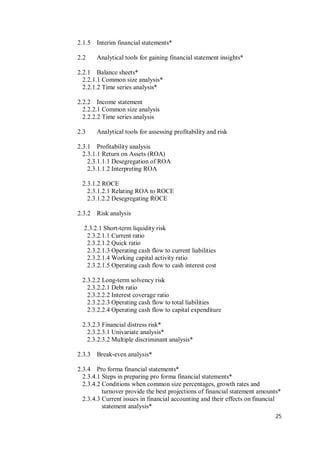
2.1.5 Interim financial statements*
2.2 Analytical tools for gaining financial statement insights*
2.2.1 Balance sheets*
2.2.1.1 Common size analysis*
2.2.1.2 Time series analysis*
2.2.2 Income statement
2.2.2.1 Common size analysis
2.2.2.2 Time series analysis
2.3 Analytical tools for assessing profitability and risk
2.3.1 Profitability analysis
2.3.1.1 Return on Assets (ROA)
2.3.1.1.1 Desegregation of ROA
2.3.1.1.2 Interpreting ROA
2.3.1.2 ROCE
2.3.1.2.1 Relating ROA to ROCE
2.3.1.2.2 Desegregating ROCE
2.3.2 Risk analysis
2.3.2.1 Short-term liquidity risk
2.3.2.1.1 Current ratio
2.3.2.1.2 Quick ratio
2.3.2.1.3 Operating cash flow to current liabilities
2.3.2.1.4 Working capital activity ratio
2.3.2.1.5 Operating cash flow to cash interest cost
2.3.2.2 Long-term solvency risk
2.3.2.2.1 Debt ratio
2.3.2.2.2 Interest coverage ratio
2.3.2.2.3 Operating cash flow to total liabilities
2.3.2.2.4 Operating cash flow to capital expenditure
2.3.2.3 Financial distress risk*
2.3.2.3.1 Univariate analysis*
2.3.2.3.2 Multiple discriminant analysis*
2.3.3 Break-even analysis*
2.3.4 Pro forma financial statements*
2.3.4.1 Steps in preparing pro forma financial statements*
2.3.4.2 Conditions when common size percentages, growth rates and
turnover provide the best projections of financial statement amounts*
2.3.4.3 Current issues in financial accounting and their effects on financial
statement analysis*
26
LIST OF REFERENCES
FINANCIAL ACCOUNTING AND FINANCIAL STATEMENT ANALYSIS
1. Eiteman, David K., Stonehill, Arthur & Moffett, Michael, Multinational
Business Finance, 8th edition, Addison-Wesley, Reading, MA, 1995.
2. Bill Rees, Financial Analysis, Prentice-Hall, Upper Saddle River, NJ, 1995.
3. White, Gerald I., Sondhi, Aashwinpaul C. & Fried, D.V., The Analysis and
Use of Financial Statements, John Wiley & Sons Inc. (2nd edition, 1994.
4. G. Holmes, A. Sugden and P. Gee, Interpreting Company Reports &
Accounts, 9th Edition, Pearson Higher Education, 2004.
5. Stephen Penman, Financial statement analysis and security valuation,
McGraw-Hill, international edition, 2001.
6. David Alexander, Anne Britton and Ann Jorissen, International financial

reporting and analysis, Thomson, 2005.
7. Krishna Palepu, Paul Healy and Victor Bernard, Business analysis and
valuation using financial statements, Thomson Learning, 2nd edition, 2000.
8. Krishna G. Palepu, Erik Peek, Paul M Healy, Victor L. Bernard, Business
Analysis and Valuation IFRS Edition, Thomson Learning, 2nd edition, 2007.
9. Benninga, Simon Z. & Sarig, Oded, Corporate Finance: A Valuation

Approach, McGraw-Hill, New York, 1997.
10. Elliot B. and Elliot J., Financial Accounting and Reporting, 2nd edition,
Prentice-Hall, Upper Saddle River, NJ, 1996.
11. Foster, George, Financial Statement Analysis, 2nd edition, Prentice-Hall,
Upper Saddle River, NJ, 1986.
12. IFRS/IAS Accounting Standards
13. Nigerian Accounting Standards Board, Statements of Accounting Standards
27
6.2 ECONOMICS AND FINANCIAL MARKETS
Broad Learning Objectives
To understand basic concepts and core principles of economics, including key
components of economic activity, so as to be able to apply economic
models/tools to address the many important issues that affect the investment
decision-making process (e.g. forecasting business cycles and economic
growth, company/industry/country analysis etc.).
*Asterisked topics will not be examined in Level 1
Syllabus
1. Microeconomics
1.1 Introduction to Micro Economics
1.1.1 Definition, scope and nature of Economics
1.1.2 Methods of economic study
1.1.3 Central problems of an economy and Production
possibilities curve.
1.1 Market forces of Demand and Supply
1.1.1 Meaning and determinants of demand, Law of demand
1.1.2 Elasticity of demand - Price, income and cross
elasticity
1.1.2.1 Meaning and calculation
1.1.2.2 Factors affecting elasticity of demand
1.1.2.3 Implications for revenue and business decisions
1.1.3 Meaning and determinants of supply, law of supply
1.1.4 Price elasticity of supply: determinants, implications for
speed/ease with which businesses react to changed
market conditions
1.1.5 Equilibrium of demand and supply
1.1.5.1 Equilibrium price; meaning of equilibrium and
disequilibrium
1.1.6 Effects of changes in supply and demand on equilibrium
price and quantity
1.1.7 Applications of demand and supply analysis
1.1.8 Prices as rationing and allocative mechanisms
1.1.9 Government intervention via maximum price controls,
price stabilisation, taxes, subsidies, direct provision of
goods and services
1.1.1 Utility analysis and indifference curve;
1.1.1.1 Marginal utility and consumer demand
1.1.1.2 The indifference curve analysis of consumer
demand
1.1.2 Consumer, producers and efficiency of market.
28
1.2 Theory of Production and Cost
1.2.1 Meaning and Factors of production
1.2.1.1 Laws of Production- The Law of variable
proportions and Laws of returns to scale
1.2.2 Costs of production
1.2.2.1 Concepts of Costs - opportunity cost, sunk costs,
explicit cost and implicit cost
1.2.2.2 Fixed and variable cost
1.2.2.3 Short-run and long-run costs
1.2.2.4 Average and marginal costs
1.2.2.5 Total, fixed and variable costs
1.2.3 Production function
1.2.4 Cost, revenue and profits; economic and accounting
profit
1.2.5 Cost minimisation
1.2.6 Maximization of profits
1.2.7 Cost and revenue curves
1.2.8 Distinction between long run and short run assumptions
1.2.9 Pricing of factors of production
1.2.10 Marginal productivity theory
1.3 Price Determination in Different Markets:
1.3.2 Various forms of markets:
1.3.2.1 Perfect Competition
1.3.2.2 Monopoly
1.3.2.3 Monopolistic Competition
1.3.2.4 Oligopoly
1.3.3 Price determination in these markets
1.3.4 Information, market failure and regulation
1.3.4.1 Markets with asymmetric information
1.3.4.2 Externality and public goods
1.3.4.3 Market failure and regulation
2. Macroeconomics
2.1 Measuring national income and price
2.1.1 National income accounting
2.1.1.1 Concept of national income
2.1.1.2 Different methods of measuring national income
2.1.2 Price indices
2.1.3 National income and price
2.1.4 Problems associated with GDP as a measure of national
product
2.2 Equilibrium in the real market
2.2.1 Consumption
Consumption function
2.2.2 Investment
Investment function
29
2.2.3 Government expenditure
1.2.3.1 Government revenue and expenditure
1.2.3.2 Effect of government expenditure and tax on
national income
1.2.3.3 Government expenditure and crowding-out
effect
2.2.4 Equilibrium relationship in the goods/service market:
IS curve
2.3 Equilibrium in the money market
2.3.1 Money and supply of money (including classification and
money statistics)
2.3.2 Credit creation and supply of inside money
2.3.3 Demand for money
2.3.4 Equilibrium relationship in the monetary market: LM
curve
2.4 Equilibrium in economy and aggregate demand
2.4.1 Equilibrium relationship between national income and
interest rate in the economy: IS–LM curve
2.4.2 Aggregate demand
2.5 Aggregate supply and determination of price of goods/services
2.5.1 Labour market and employment
2.5.2 Aggregate supply
3. Macro Dynamics
3.1 Inflation
3.1.1 Definition, type, causes and consequences of inflation
3.1.2 Unemployment and inflation rate
3.1.2.2 Tradeoff between unemployment and inflation
3.1.2.3 Natural rate of unemployment hypothesis and
expected inflation
3.1.3 Illusion and inflation
3.1.4 Inflation and unemployment rate in Nigeria (including
comparative analysis with major foreign countries)
3.15Unemployment
3.1.5.1 Definition, type, causes, consequences and
remedies of unemployment
3.2 Economic growth*
3.2.1 Main factor of economic growth*
2.2.1.1 Saving rate/capital*
2.2.1.2 Population growth*
3.2.2 Theory of economic growth*
3.2.2.1 Capital accumulation and economic growth*
3.2.2.2 Technological innovation and economic
growth*
30
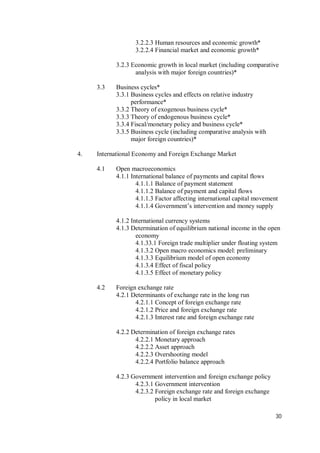
3.2.2.3 Human resources and economic growth*
3.2.2.4 Financial market and economic growth*
3.2.3 Economic growth in local market (including comparative
analysis with major foreign countries)*
3.3 Business cycles*
3.3.1 Business cycles and effects on relative industry
performance*
3.3.2 Theory of exogenous business cycle*
3.3.3 Theory of endogenous business cycle*
3.3.4 Fiscal/monetary policy and business cycle*
3.3.5 Business cycle (including comparative analysis with
major foreign countries)*
4. International Economy and Foreign Exchange Market
4.1 Open macroeconomics
4.1.1 International balance of payments and capital flows
4.1.1.1 Balance of payment statement
4.1.1.2 Balance of payment and capital flows
4.1.1.3 Factor affecting international capital movement
4.1.1.4 Government’s intervention and money supply
4.1.2 International currency systems
4.1.3 Determination of equilibrium national income in the open
economy
4.1.33.1 Foreign trade multiplier under floating system
4.1.3.2 Open macro economics model: preliminary
4.1.3.3 Equilibrium model of open economy
4.1.3.4 Effect of fiscal policy
4.1.3.5 Effect of monetary policy
4.2 Foreign exchange rate
4.2.1 Determinants of exchange rate in the long run
4.2.1.1 Concept of foreign exchange rate
4.2.1.2 Price and foreign exchange rate
4.2.1.3 Interest rate and foreign exchange rate
4.2.2 Determination of foreign exchange rates
4.2.2.1 Monetary approach
4.2.2.2 Asset approach
4.2.2.3 Overshooting model
4.2.2.4 Portfolio balance approach
4.2.3 Government intervention and foreign exchange policy
4.2.3.1 Government intervention
4.2.3.2 Foreign exchange rate and foreign exchange
policy in local market
31
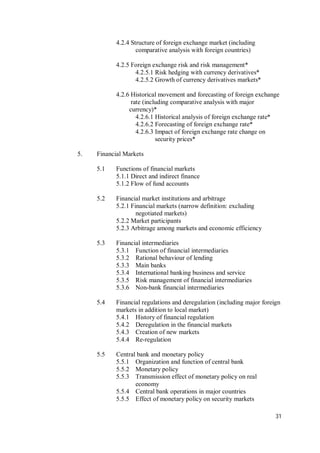
4.2.4 Structure of foreign exchange market (including
comparative analysis with foreign countries)
4.2.5 Foreign exchange risk and risk management*
4.2.5.1 Risk hedging with currency derivatives*
4.2.5.2 Growth of currency derivatives markets*
4.2.6 Historical movement and forecasting of foreign exchange
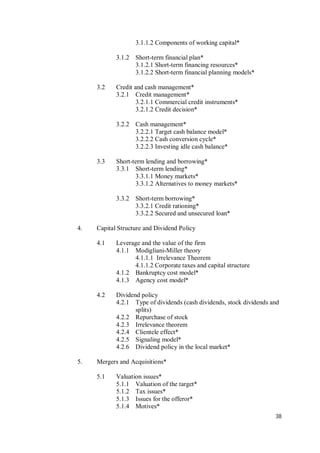
rate (including comparative analysis with major
currency)*
4.2.6.1 Historical analysis of foreign exchange rate*
4.2.6.2 Forecasting of foreign exchange rate*
4.2.6.3 Impact of foreign exchange rate change on
security prices*
5. Financial Markets
5.1 Functions of financial markets
5.1.1 Direct and indirect finance
5.1.2 Flow of fund accounts
5.2 Financial market institutions and arbitrage
5.2.1 Financial markets (narrow definition: excluding
negotiated markets)
5.2.2 Market participants
5.2.3 Arbitrage among markets and economic efficiency
5.3 Financial intermediaries
5.3.1 Function of financial intermediaries
5.3.2 Rational behaviour of lending
5.3.3 Main banks
5.3.4 International banking business and service
5.3.5 Risk management of financial intermediaries
5.3.6 Non-bank financial intermediaries
5.4 Financial regulations and deregulation (including major foreign
markets in addition to local market)
5.4.1 History of financial regulation
5.4.2 Deregulation in the financial markets
5.4.3 Creation of new markets
5.4.4 Re-regulation
5.5 Central bank and monetary policy
5.5.1 Organization and function of central bank
5.5.2 Monetary policy
5.5.3 Transmission effect of monetary policy on real
economy
5.5.4 Central bank operations in major countries
5.5.5 Effect of monetary policy on security markets
32
LIST OF REFERENCES
ECONOMICS AND FINANCIAL MARKETS
1. Krugmann, Paul R. & Obstfeld, Maurice, International Economics: Theory
and Policy, 3rd edition, HarperCollins College Publishers (Scott, Foresman &
Co), New York, 1994.
2. Samuelson, Nordhaus, Economics, 16th edition, Irwin McGraw-Hill, New
York, 1998.
3. Solnik, Bruno, International Investments, 3rd edition, Addision-Wesley,
Reading, MA, 1996
4. D. Begg, S. Fischer and R. Dornbusch; Economics, 8th Edition, McGraw-Hill,
2005
5. O. Blanchard, Macroeconomics, Prentice Hall, 2000, 2nd edition
33
6.3 QUANTITATIVE ANALYSIS AND STATISTICS
Broad Learning Objectives
To understand mathematical concepts (time value of money, etc.), statistical
concepts and
methods (probability, regression analysis etc.) and numerical procedures
(optimization etc.) and to apply these to asset valuation and portfolio
management.
*Asterisked topics will not be examined in Level 1
Syllabus
1. Time Value of Money and Other Mathematical Concepts
1.1 Simple interest and compound interest
1.1.1 Simple interest and compound interest
1.1.2 Future value, present value, discount rate
1.1.3 Total future/present value of annuities
1.1.4 Sum of constantly growing cash flows
1.1.5 Internal Rate of Return (IRR), Net Present Value (NPV)
1.1.6 Interest rates compounded more than once a year
(including continuous compounding), stated annual rate
and effective annual rate
1.2 Calculus and linear algebra
1.2.1 Differential (e.g. derivative, partial and total
differential)
1.2.2 Taylor expansion
1.2.3 Matrix and matrix algebra
2. Descriptive Statistics
2.1 Frequency distributions (and scatter diagrams)
2.2 Mean
2.2.1 Simple and weighted mean
2.2.2 Arithmetic and geometric mean
2.2.3 Mean, mode, median
2.3 Dispersion
2.3.1 Variance, standard deviation, coefficient of variation
2.3.2 Range, skewness, kurtosis
2.3.3 Percentiles, Z-scores
2.4 Correlation
2.4.1 Covariance, correlation coefficient
2.4.2 Rank correlation
34
2.5 Data collection and analysis
2.5.1 Selection of appropriate dependent and independent
variables
2.5.2 Data mining and survivorship bias
3. Probability and Statistical Inference
3.1 Probability
3.1.1 Probability theory and concepts
3.1.2 Probability distributions
3.2 Sampling and statistical tests
3.2.1 Population and sampling (statistical inference)
3.2.2 Statistical tests
3.2.3 Analysis of variance
3.2.4 Non-parametric tests
3.2.5 Bayesian statistics
3.3 Stochastic process
3.3.1 Random walk
3.3.2 Markov process
3.3.3 Binomial process
3.3.4 Poisson process
3.3.5 Wienner process
3.3.6 Ito’s lemma
4. Regression Analysis and Forecasting
4.1 Regression and correlation analysis
4.1.1 Variables, parameters, statistical measures
4.1.2 Common problems of linear regression
4.1.3 Extension of least square method
4.1.4 Forecasting
4.2 Time series analysis and forecasting models
4.2.1 Basic concepts of time series analysis
4.2.2 Forecasting models
4.3 Multivariate analysis
4.3.1 Principal component analysis
4.3.2 Factor analysis
4.3.3 Cluster analysis
4.3.4 Discriminant analysis
5. Index Numbers
5.1 Price, quantity and value indices
5.2 Simple and weighted index numbers
5.3 Paasche, Laspeyres and Fisher Indices
5.4 Consumer price index
5.5 Uses and limitations of index numbers
35
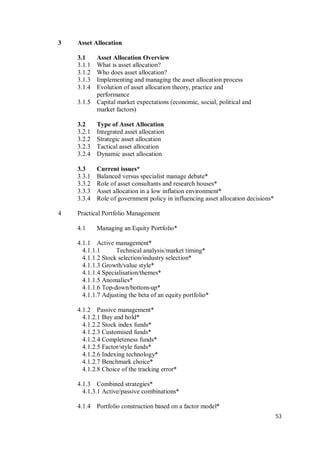
6. Optimization and Other Numerical Procedures
6.1 Optimization
6.1.1 Maximization or minimization under constraints (e.g.
Lagrange multiplier method)
6.1.2 Linear programming (LP)
6.1.3 Quadratic programming (QP)
6.1.4 Non-linear programming (NLP), dynamic programming
(DP)
6.2 Numerical analysis and simulation
6.2.1 Newton method
6.2.2 Finite difference method
6.2.3 Monte Carlo simulation
6.3 Non-linear techniques (e.g. chaos, neutral nets, genetic
algorithms, fuzzy logic)
LIST OF REFERENCES
QUANTITATIVE ANALYSIS AND STATISTICS
1. Richard A. DeFusco, Dennis W. McLeavey, Jerald E. Pinto, and
David E. Runkle, Quantitative Methods for Investment Analysis,
Second Edition
2. Jon Curwin and Roger Slater , Thomson Learning; (5th edition 2002),
Quantitative Methods for Business Decisions
3. Bedward, D (1999), Quantitative Methods: A Business Perspective,
Butterworth- Heinemann
36
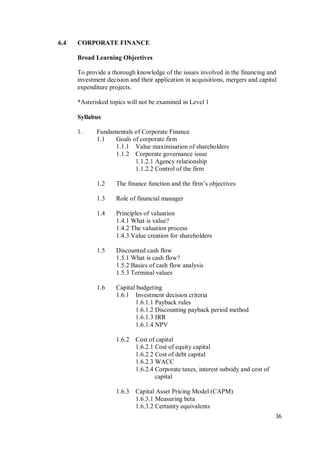
6.4 CORPORATE FINANCE
Broad Learning Objectives
To provide a thorough knowledge of the issues involved in the financing and
investment decision and their application in acquisitions, mergers and capital
expenditure projects.
*Asterisked topics will not be examined in Level 1
Syllabus
1. Fundamentals of Corporate Finance
1.1 Goals of corporate firm
1.1.1 Value maximisation of shareholders
1.1.2 Corporate governance issue
1.1.2.1 Agency relationship
1.1.2.2 Control of the firm
1.2 The finance function and the firm’s objectives
1.3 Role of financial manager
1.4 Principles of valuation
1.4.1 What is value?
1.4.2 The valuation process
1.4.3 Value creation for shareholders
1.5 Discounted cash flow
1.5.1 What is cash flow?
1.5.2 Basics of cash flow analysis
1.5.3 Terminal values
1.6 Capital budgeting
1.6.1 Investment decision criteria
1.6.1.1 Payback rules
1.6.1.2 Discounting payback period method
1.6.1.3 IRR
1.6.1.4 NPV
1.6.2 Cost of capital
1.6.2.1 Cost of equity capital
1.6.2.2 Cost of debt capital
1.6.2.3 WACC
1.6.2.4 Corporate taxes, interest subsidy and cost of
capital
1.6.3 Capital Asset Pricing Model (CAPM)
1.6.3.1 Measuring beta
1.6.3.2 Certainty equivalents
37
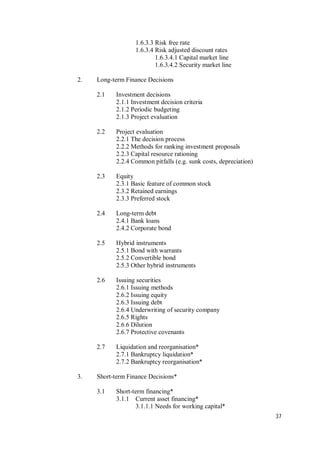
1.6.3.3 Risk free rate
1.6.3.4 Risk adjusted discount rates
1.6.3.4.1 Capital market line
1.6.3.4.2 Security market line
2. Long-term Finance Decisions
2.1 Investment decisions
2.1.1 Investment decision criteria
2.1.2 Periodic budgeting
2.1.3 Project evaluation
2.2 Project evaluation
2.2.1 The decision process
2.2.2 Methods for ranking investment proposals
2.2.3 Capital resource rationing
2.2.4 Common pitfalls (e.g. sunk costs, depreciation)
2.3 Equity
2.3.1 Basic feature of common stock
2.3.2 Retained earnings
2.3.3 Preferred stock
2.4 Long-term debt
2.4.1 Bank loans
2.4.2 Corporate bond
2.5 Hybrid instruments
2.5.1 Bond with warrants
2.5.2 Convertible bond
2.5.3 Other hybrid instruments
2.6 Issuing securities
2.6.1 Issuing methods
2.6.2 Issuing equity
2.6.3 Issuing debt
2.6.4 Underwriting of security company
2.6.5 Rights
2.6.6 Dilution
2.6.7 Protective covenants
2.7 Liquidation and reorganisation*
2.7.1 Bankruptcy liquidation*
2.7.2 Bankruptcy reorganisation*
3. Short-term Finance Decisions*
3.1 Short-term financing*
3.1.1 Current asset financing*
3.1.1.1 Needs for working capital*
38
3.1.1.2 Components of working capital*
3.1.2 Short-term financial plan*
3.1.2.1 Short-term financing resources*
3.1.2.2 Short-term financial planning models*
3.2 Credit and cash management*
3.2.1 Credit management*
3.2.1.1 Commercial credit instruments*
3.2.1.2 Credit decision*
3.2.2 Cash management*
3.2.2.1 Target cash balance model*
3.2.2.2 Cash conversion cycle*
3.2.2.3 Investing idle cash balance*
3.3 Short-term lending and borrowing*
3.3.1 Short-term lending*
3.3.1.1 Money markets*
3.3.1.2 Alternatives to money markets*
3.3.2 Short-term borrowing*
3.3.2.1 Credit rationing*
3.3.2.2 Secured and unsecured loan*
4. Capital Structure and Dividend Policy
4.1 Leverage and the value of the firm
4.1.1 Modigliani-Miller theory
4.1.1.1 Irrelevance Theorem
4.1.1.2 Corporate taxes and capital structure
4.1.2 Bankruptcy cost model*
4.1.3 Agency cost model*
4.2 Dividend policy
4.2.1 Type of dividends (cash dividends, stock dividends and
splits)
4.2.2 Repurchase of stock
4.2.3 Irrelevance theorem
4.2.4 Clientele effect*
4.2.5 Signaling model*
4.2.6 Dividend policy in the local market*
5. Mergers and Acquisitions*
5.1 Valuation issues*
5.1.1 Valuation of the target*
5.1.2 Tax issues*
5.1.3 Issues for the offeror*
5.1.4 Motives*
39
5.2 Forms of acquisition*
5.2.1 Takeovers*
5.2.2 Approved acquisitions*
5.4.3 Creeping takeovers*
5.4.4 Eliminating minority interests*
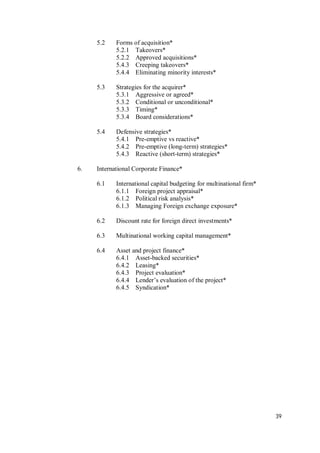
5.3 Strategies for the acquirer*
5.3.1 Aggressive or agreed*
5.3.2 Conditional or unconditional*
5.3.3 Timing*
5.3.4 Board considerations*
5.4 Defensive strategies*
5.4.1 Pre-emptive vs reactive*
5.4.2 Pre-emptive (long-term) strategies*
5.4.3 Reactive (short-term) strategies*
6. International Corporate Finance*
6.1 International capital budgeting for multinational firm*
6.1.1 Foreign project appraisal*
6.1.2 Political risk analysis*
6.1.3 Managing Foreign exchange exposure*
6.2 Discount rate for foreign direct investments*
6.3 Multinational working capital management*
6.4 Asset and project finance*
6.4.1 Asset-backed securities*
6.4.2 Leasing*
6.4.3 Project evaluation*
6.4.4 Lender’s evaluation of the project*
6.4.5 Syndication*
40
LIST OF REFERENCES
CORPORATE FINANCE
1. Brealey, Richard A. & Myers, Stewart C. Principles of Corporate Finance, 5th
edition, McGraw-Hill, New York. (6th edition, 2000)
2. Eiteman, David K., Stonehill, Arthur & Moffett, Michael (1995),
Multinational Business Finance, 8th edition, Addison-Wesley, Reading, MA.
3. W. Sharpe, G. Alexander and J Bailey; Fundamentals of Investments, 3rd
Edition, Pearson Higher Education, 2001
41
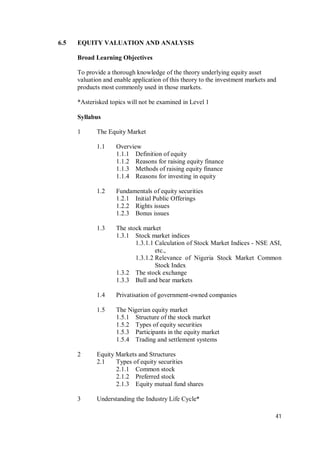
6.5 EQUITY VALUATION AND ANALYSIS
Broad Learning Objectives
To provide a thorough knowledge of the theory underlying equity asset
valuation and enable application of this theory to the investment markets and
products most commonly used in those markets.
*Asterisked topics will not be examined in Level 1
Syllabus
1 The Equity Market
1.1 Overview
1.1.1 Definition of equity
1.1.2 Reasons for raising equity finance
1.1.3 Methods of raising equity finance
1.1.4 Reasons for investing in equity
1.2 Fundamentals of equity securities
1.2.1 Initial Public Offerings
1.2.2 Rights issues
1.2.3 Bonus issues
1.3 The stock market
1.3.1 Stock market indices
1.3.1.1 Calculation of Stock Market Indices - NSE ASI,
etc.,
1.3.1.2 Relevance of Nigeria Stock Market Common
Stock Index
1.3.2 The stock exchange
1.3.3 Bull and bear markets
1.4 Privatisation of government-owned companies
1.5 The Nigerian equity market
1.5.1 Structure of the stock market
1.5.2 Types of equity securities
1.5.3 Participants in the equity market
1.5.4 Trading and settlement systems
2 Equity Markets and Structures
2.1 Types of equity securities
2.1.1 Common stock
2.1.2 Preferred stock
2.1.3 Equity mutual fund shares
3 Understanding the Industry Life Cycle*
42
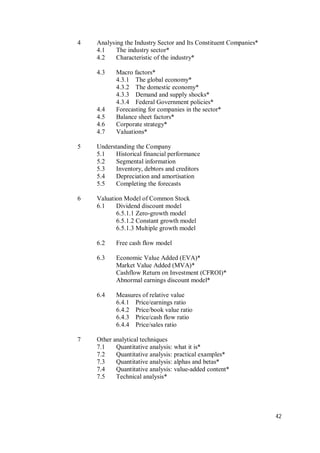
4 Analysing the Industry Sector and Its Constituent Companies*
4.1 The industry sector*
4.2 Characteristic of the industry*
4.3 Macro factors*
4.3.1 The global economy*
4.3.2 The domestic economy*
4.3.3 Demand and supply shocks*
4.3.4 Federal Government policies*
4.4 Forecasting for companies in the sector*
4.5 Balance sheet factors*
4.6 Corporate strategy*
4.7 Valuations*
5 Understanding the Company
5.1 Historical financial performance
5.2 Segmental information
5.3 Inventory, debtors and creditors
5.4 Depreciation and amortisation
5.5 Completing the forecasts
6 Valuation Model of Common Stock
6.1 Dividend discount model
6.5.1.1 Zero-growth model
6.5.1.2 Constant growth model
6.5.1.3 Multiple growth model
6.2 Free cash flow model
6.3 Economic Value Added (EVA)*
Market Value Added (MVA)*
Cashflow Return on Investment (CFROI)*
Abnormal earnings discount model*
6.4 Measures of relative value
6.4.1 Price/earnings ratio
6.4.2 Price/book value ratio
6.4.3 Price/cash flow ratio
6.4.4 Price/sales ratio
7 Other analytical techniques
7.1 Quantitative analysis: what it is*
7.2 Quantitative analysis: practical examples*
7.3 Quantitative analysis: alphas and betas*
7.4 Quantitative analysis: value-added content*
7.5 Technical analysis*
43
LIST OF REFERENCES
EQUITY VALUATION AND ANALYSIS
1. Sharpe, Alexander and Bailey, Investments, Prentice-Hall, 1999, 6th
edition
2. Brealey and Meyers, Principle of Corporate Finance, McGraw-Hill, 1996, 5th
edition
3. Bodie, Kane and Marcus, Investment, Irwin, 1996, 3rd edition
4. Bruno Solnik, International Investment, Addision-Wesley, 1996, 3rd
edition
44
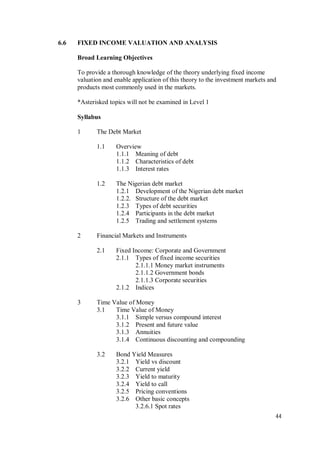
6.6 FIXED INCOME VALUATION AND ANALYSIS
Broad Learning Objectives
To provide a thorough knowledge of the theory underlying fixed income
valuation and enable application of this theory to the investment markets and
products most commonly used in the markets.
*Asterisked topics will not be examined in Level 1
Syllabus
1 The Debt Market
1.1 Overview
1.1.1 Meaning of debt
1.1.2 Characteristics of debt
1.1.3 Interest rates
1.2 The Nigerian debt market
1.2.1 Development of the Nigerian debt market
1.2.2. Structure of the debt market
1.2.3 Types of debt securities
1.2.4 Participants in the debt market
1.2.5 Trading and settlement systems
2 Financial Markets and Instruments
2.1 Fixed Income: Corporate and Government
2.1.1 Types of fixed income securities
2.1.1.1 Money market instruments
2.1.1.2 Government bonds
2.1.1.3 Corporate securities
2.1.2 Indices
3 Time Value of Money
3.1 Time Value of Money
3.1.1 Simple versus compound interest
3.1.2 Present and future value
3.1.3 Annuities
3.1.4 Continuous discounting and compounding
3.2 Bond Yield Measures
3.2.1 Yield vs discount
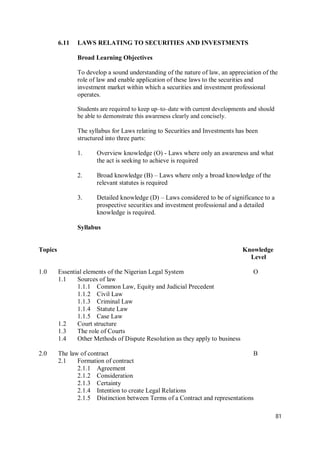
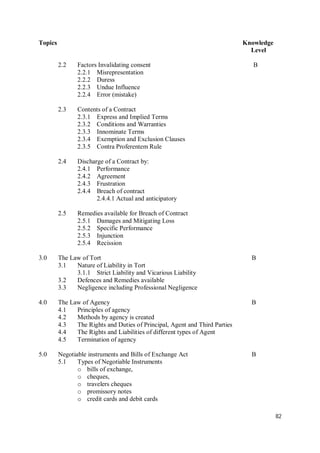
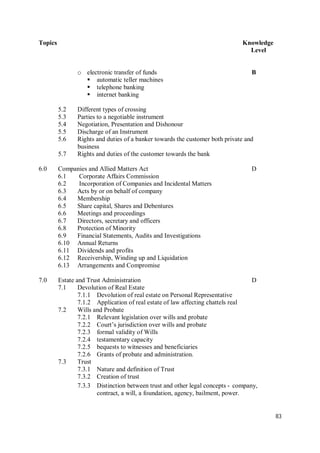
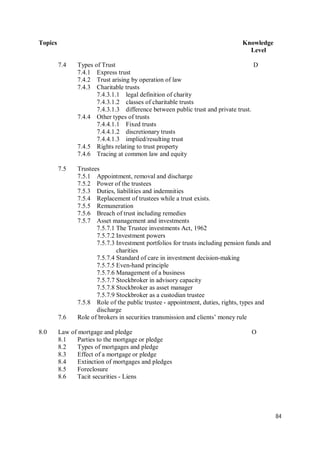
3.2.2 Current yield
3.2.3 Yield to maturity
3.2.4 Yield to call
3.2.5 Pricing conventions
3.2.6 Other basic concepts
3.2.6.1 Spot rates
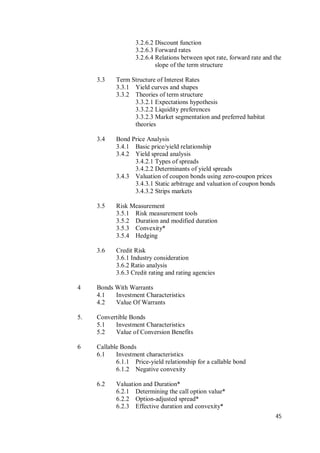
45
3.2.6.2 Discount function
3.2.6.3 Forward rates
3.2.6.4 Relations between spot rate, forward rate and the
slope of the term structure
3.3 Term Structure of Interest Rates
3.3.1 Yield curves and shapes
3.3.2 Theories of term structure
3.3.2.1 Expectations hypothesis
3.3.2.2 Liquidity preferences
3.3.2.3 Market segmentation and preferred habitat
theories
3.4 Bond Price Analysis
3.4.1 Basic price/yield relationship
3.4.2 Yield spread analysis
3.4.2.1 Types of spreads
3.4.2.2 Determinants of yield spreads
3.4.3 Valuation of coupon bonds using zero-coupon prices
3.4.3.1 Static arbitrage and valuation of coupon bonds
3.4.3.2 Strips markets
3.5 Risk Measurement
3.5.1 Risk measurement tools
3.5.2 Duration and modified duration
3.5.3 Convexity*
3.5.4 Hedging
3.6 Credit Risk
3.6.1 Industry consideration
3.6.2 Ratio analysis
3.6.3 Credit rating and rating agencies
4 Bonds With Warrants
4.1 Investment Characteristics
4.2 Value Of Warrants
5. Convertible Bonds
5.1 Investment Characteristics
5.2 Value of Conversion Benefits
6 Callable Bonds
6.1 Investment characteristics
6.1.1 Price-yield relationship for a callable bond
6.1.2 Negative convexity
6.2 Valuation and Duration*
6.2.1 Determining the call option value*
6.2.2 Option-adjusted spread*
6.2.3 Effective duration and convexity*
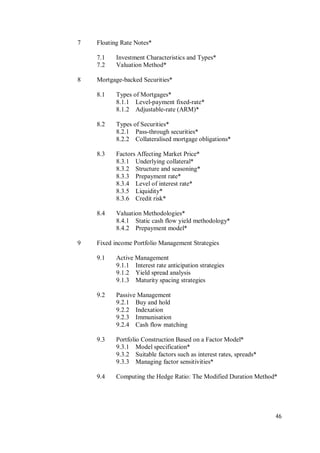
46
7 Floating Rate Notes*
7.1 Investment Characteristics and Types*
7.2 Valuation Method*
8 Mortgage-backed Securities*
8.1 Types of Mortgages*
8.1.1 Level-payment fixed-rate*
8.1.2 Adjustable-rate (ARM)*
8.2 Types of Securities*
8.2.1 Pass-through securities*
8.2.2 Collateralised mortgage obligations*
8.3 Factors Affecting Market Price*
8.3.1 Underlying collateral*
8.3.2 Structure and seasoning*
8.3.3 Prepayment rate*
8.3.4 Level of interest rate*
8.3.5 Liquidity*
8.3.6 Credit risk*
8.4 Valuation Methodologies*
8.4.1 Static cash flow yield methodology*
8.4.2 Prepayment model*
9 Fixed income Portfolio Management Strategies
9.1 Active Management
9.1.1 Interest rate anticipation strategies
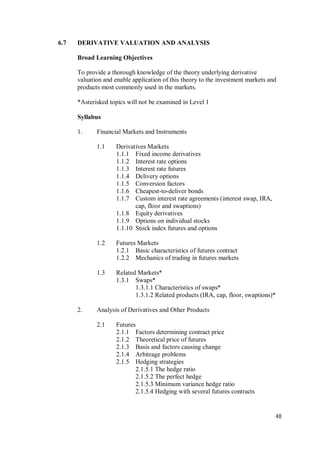
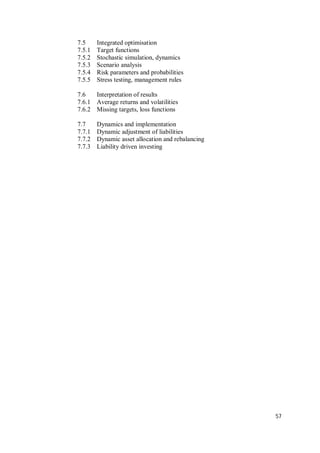
9.1.2 Yield spread analysis
9.1.3 Maturity spacing strategies
9.2 Passive Management
9.2.1 Buy and hold
9.2.2 Indexation
9.2.3 Immunisation
9.2.4 Cash flow matching
9.3 Portfolio Construction Based on a Factor Model*
9.3.1 Model specification*
9.3.2 Suitable factors such as interest rates, spreads*
9.3.3 Managing factor sensitivities*
9.4 Computing the Hedge Ratio: The Modified Duration Method*
47
LIST OF REFERENCES
FIXED INCOME VALUATION AND ANALYSIS
1. Bodie, Zvi, Kane, Alex & Marcus, Alan J. (1996), Investments, 3rd edition,
Irwin, Homewood, Ill. (4th edition, 1999, McGraw-Hill, New York.)
2. Fabozzi, Frank J. (1996), Bond Markets, Analysis and Strategies, 3rd edition,
Prentice-Hall, Upper Saddle River, NJ
3. Sharpe, W.F., Alexander, G.J. & Bailey, J.V. (1999), Investments, 6th edition,
Prentice-Hall, Upper Saddle River, NJ
4. Hull, John C. Options, Futures and other Derivatives, Pearson Prentice-Hall,
2006, 6th edition
5. Felsenheimer,Jochen, Gisdakis, Philip and Zaiser, Michael, Active Credit
Portfolio Management, A practical guide to credit risk management strategies,
Wiley, 2006
Suggested Readings
1. Douglas, L. (1990), Bond Risk Analysis, Institute of Finance, New York.
2. Elton, Edwin J. & Gruber, Martin J. (1991), Modern Portfolio Theory and
Investment Analysis, John Wiley & Sons Inc, New York, chs 18-20. (5th
edition, 1995)
3. Fabozzi, F. (ed) (1989), Bond and Mortgage Markets, Probus.
4. Fabozzi, F. (ed) (1991), The Handbook of Fixed Income Securities, Irwin.
5. Stern, Joel M. & Chew, Donald H. Jr (eds) (1998), The Revolution in
Corporate Finance, Blackwell, Blackwood, NJ.
48
6.7 DERIVATIVE VALUATION AND ANALYSIS
Broad Learning Objectives
To provide a thorough knowledge of the theory underlying derivative
valuation and enable application of this theory to the investment markets and
products most commonly used in the markets.
*Asterisked topics will not be examined in Level 1
Syllabus
1. Financial Markets and Instruments
1.1 Derivatives Markets
1.1.1 Fixed income derivatives
1.1.2 Interest rate options
1.1.3 Interest rate futures
1.1.4 Delivery options
1.1.5 Conversion factors
1.1.6 Cheapest-to-deliver bonds
1.1.7 Custom interest rate agreements (interest swap, IRA,
cap, floor and swaptions)
1.1.8 Equity derivatives
1.1.9 Options on individual stocks
1.1.10 Stock index futures and options
1.2 Futures Markets
1.2.1 Basic characteristics of futures contract
1.2.2 Mechanics of trading in futures markets
1.3 Related Markets*
1.3.1 Swaps*
1.3.1.1 Characteristics of swaps*
1.3.1.2 Related products (IRA, cap, floor, swaptions)*
2. Analysis of Derivatives and Other Products
2.1 Futures
2.1.1 Factors determining contract price
2.1.2 Theoretical price of futures
2.1.3 Basis and factors causing change
2.1.4 Arbitrage problems
2.1.5 Hedging strategies
2.1.5.1 The hedge ratio
2.1.5.2 The perfect hedge
2.1.5.3 Minimum variance hedge ratio
2.1.5.4 Hedging with several futures contracts
49
2.2 Options
2.2.1 Determinants of option price
2.2.2 Options pricing models
2.2.2.1 B&S option pricing formula and variants
2.2.2.2 European options on stocks paying known
dividends
2.2.2.3 European options on stocks paying unknown
dividends
2.2.2.4 American options on stocks paying known
dividends
2.2.2.5 Options on stock indices
2.2.2.6 Options on futures
2.2.2.7 Options on currencies
2.2.2.8 Warrants
2.2.2.9 Binomial option pricing model
2.2.3 Sensitivity analysis of options premiums
2.2.3.1 The strike price
2.2.3.2 Price of underlying assets, and delta and gamma
2.2.3.3 The time to maturity and theta
2.2.3.4 Interest rate and rho
2.2.3.5 Volatility of the stock returns and vega
2.2.4 Volatility and related topics*
2.2.4.1 Estimating volatility from historical data*
2.2.4.2 Implied volatility and volatility smile*
2.2.5 Exotic options*
2.2.6 Options strategies*
2.2.6.1 Covered call*
2.2.6.2 Protective put*
2.2.6.3 Spreads*
2.2.6.4 Straddles*
2.2.6.5 Strangles*
2.3 Asset-backed securities*
2.3.1 Types of underlying assets*
2.3.1.1 Instalment contract*
2.3.1.2 Revolving lines of credit*
2.3.1.3 Other assets*
2.3.2 Cash flow characteristics*
2.3.3 Credit enhancement*
2.3.4 Valuation methodologies*
50
LIST OF REFERENCES
DERIVATIVE VALUATION AND ANALYSIS
1. Bodie, Zvi, Kane, Alex & Marcus, Alan J. (1996), Investments, 3rd edition,
Irwin, Homewood, Ill. (4th edition, 1999, McGraw-Hill, New York.)
2. Eiteman, David K., Stonehill, Arthur & Moffett, Michael (1995),
Multinational Business Finance, 8th edition, Addison-Wesley, Reading, MA.
3. Fabozzi, Frank J. (1996), Bond Markets, Analysis and Strategies, 3rd edition,
Prentice-Hall, Upper Saddle River, NJ.
4. Hull, John C. (1998), Introduction to Futures Options Markets, 3rd edition,
Prentice-Hall, Upper Saddle River, NJ.
5. Sharpe, W.F., Alexander, G.J. & Bailey, J.V. (1999), Investments, 6th edition,
Prentice-Hall, Upper Saddle River, NJ.
Suggested Readings
1. Chriss, N. (1997), Black-Scholes and Beyond; Option Pricing Model.
2. Galitz, L. (1995), Financial Engineering.
3. Hull, John C. (1997), Options, Futures and other Derivatives and Securities,
4th edition, Prentice-Hall.
4. Natenberg, Sheldon (1994), Option Volatility and Pricing: Advanced Trading
Strategies and Techniques, 2nd edition, McGraw-Hill, New York.
5. Rebonato, Riccardo (1997), Interest-Rate Option Models: Understanding,
Analysing and Using Models for Exotic Interest-Rate Options, 2nd edition,
John Wiley & Sons Inc., New York (2nd edition, 1998)
51
6.8 PORTFOLIO MANAGEMENT
Broad Learning Objectives
To provide a thorough knowledge of the theory underlying portfolio management and
enable application of this theory to global investment markets.
Syllabus
*Asterisked topics will not be examined in Level 1
1. Modern Portfolio Theory
1.1 The Risk/Return Framework
1.1.1 Return
1.1.1.1 Measures of return (e.g. holding period, arithmetic average,
geometric average, time-weighted and dollar weighted)
1.1.2 Risk
1.1.2.1 Components of total risk (i.e. systematic or unsystematic)
1.1.3 Measures of risk
1.1.3.1 Measures (e.g. variance, standard deviation, coefficient of variation,
covariance, correlation and beta)
1.1.3.2 Value at Risk
1.2 Efficient Market Hypothesis
1.2.1 Definition and assumptions
1.2.2 Alternative hypothesis
1.2.3 Types of market efficiency
1.2.3.1 Weak form
1.2.3.2 Semi-strong form
1.2.3.3 Strong form hypothesis
1.2.4 Market anomalies*
1.2.4.1 Size effect (i.e. small firm effect)*
1.2.4.2 High E/P ratio effect*
1.2.4.3 Day of the week effect*
1.2.4.4 Year-end or January effect*
1.2.4.5 Return patterns (e.g. value line enigma, quarterly earnings
surprises)*
1.2.4.6 Fama-French book value/market value*
1.3 Portfolio Theory
1.3.1 Diversification and portfolio risk
1.3.2 Markowitz model and efficient frontier
1.3.3 Portfolio analysis using higher moments
52
1.4 Capital Asset Pricing Model (CAPM)
1.4.1 Major assumptions
1.4.2 Capital market line (CML)
1.4.3 Security market line (SML)
1.4.4 Zero-beta CAPM
1.4.5 International CAPM*
1.5 Arbitrage Pricing Theory*
1.5.1 Assumptions*
1.5.2 One factor models*
1.5.3 Multi-factor models*
1.5.3.1 Time-series approach*
1.5.3.2 Cross-sectional approaches*
1.5.3.3 Statistical approaches (factor analysis)*
1.5.4 Arbitrage pricing theory*
1.5.4.1 Factor models and arbitrage portfolios*
1.5.4.2 Factor risk premiums and expected returns*
2 Investment Policy
2.1 Investment Objectives
2.1.1 Setting investment objectives for individuals
2.1.2 Deciding portfolio structure
2.1.3 Setting objectives for institutions
2.1.3.1 Objectives (return requirement, risk tolerance)
2.1.3.2 Constraints (liquidity, time horizon, tax
considerations, legal and regulatory considerations)
2.1.3.3 Pensions and employee benefit funds
2.1.3.4 Endowment funds
2.1.3.5 Insurance companies and commercial banks
2.2 Capital market expectations
2.2.1 Economic, social, political and market factors
2.2.2 Forecasting models
2.3 Practical portfolio management
2.3.1 Defining the objectives for component parts of the portfolio
2.3.2 Seeking and briefing investment managers
2.3.3 Meeting the investment manager
2.3.4 Investment management
2.3.5 Monitoring and reviewing investment managers
2.4 Specifying the investment mandate
2.4.1 The need for an investment mandate
2.4.2 The mandate
2.4.3 Standard investment management agreement
2.5 Practice of portfolio management
2.5.1 Portfolio construction and re-balancing
53
3 Asset Allocation
3.1 Asset Allocation Overview
3.1.1 What is asset allocation?
3.1.2 Who does asset allocation?
3.1.3 Implementing and managing the asset allocation process
3.1.4 Evolution of asset allocation theory, practice and
performance
3.1.5 Capital market expectations (economic, social, political and
market factors)
3.2 Type of Asset Allocation
3.2.1 Integrated asset allocation
3.2.2 Strategic asset allocation
3.2.3 Tactical asset allocation
3.2.4 Dynamic asset allocation
3.3 Current issues*
3.3.1 Balanced versus specialist manage debate*
3.3.2 Role of asset consultants and research houses*
3.3.3 Asset allocation in a low inflation environment*
3.3.4 Role of government policy in influencing asset allocation decisions*
4 Practical Portfolio Management
4.1 Managing an Equity Portfolio*
4.1.1 Active management*
4.1.1.1 Technical analysis/market timing*
4.1.1.2 Stock selection/industry selection*
4.1.1.3 Growth/value style*
4.1.1.4 Specialisation/themes*
4.1.1.5 Anomalies*
4.1.1.6 Top-down/bottom-up*
4.1.1.7 Adjusting the beta of an equity portfolio*
4.1.2 Passive management*
4.1.2.1 Buy and hold*
4.1.2.2 Stock index funds*
4.1.2.3 Customised funds*
4.1.2.4 Completeness funds*
4.1.2.5 Factor/style funds*
4.1.2.6 Indexing technology*
4.1.2.7 Benchmark choice*
4.1.2.8 Choice of the tracking error*
4.1.3 Combined strategies*
4.1.3.1 Active/passive combinations*
4.1.4 Portfolio construction based on a factor model*
54
4.2 Derivatives in Portfolio Management
4.2.1 Combining options and traditional assets
4.2.2 Portfolio insurance
4.2.2.1 Static portfolio insurance
4.2.2.2 Dynamic portfolio insurance
4.2.2.3 Constant proportion portfolio insurance
4.2.3 Hedging with stock index futures
4.2.4 Hedging with foreign exchange futures
4.2.5 Hedging with interest rate futures
4.2.6 Use of swaps in portfolio management
4.2.7 Asset allocation with futures
4.3 Managing a Property Portfolio*
4.3.1 The role of property in a diversified portfolio*
4.3.2 The property investment decision*
4.3.3 Microeconomic influences on property returns*
4.3.4 Macroeconomic influences on property returns*
4.3.5 Difference property investments*
4.4 Alternative Assets/Private Capital*
4.4.1 Unlisted (non-property) securities*
4.4.2 Terms, conditions and characteristics*
4.4.3 Role in a traditional portfolio*
4.4.4 Managing unlisted security vehicles*
4.4.5 Monitoring and reporting*
4.5 International Investments
4.5.1 International diversification
4.5.1.1 Cross-correlations
4.5.1.2 Country risk
4.5.1.3 Emerging markets
4.5.2 Hedging foreign exchange risk
4.5.2.1 Effective management of currency risk
4.5.2.2 Behaviour of currency returns
4.5.2.3 Is it a separate asset class/zero sum game?
4.5.2.4 Treatment of currency within a global portfolio/optimal level of
hedge
4.5.2.5 Black’s paper on universal currency hedge
4.5.2.6 Use of overlay strategies
4.5.2.7 Key sensitivities
55
4.5.2.8 Currency-related example of performance attribution
4.5.3 International equities*
4.5.3.1 Reasons for holding international equity assets*
4.5.3.2 Performance objectives*
4.5.4 International fixed income*
4.5.4.1 Reasons for holding international fixed interest assets*
4.5.4.2 Performance objectives*
4.5.5 Managing a portfolio of international assets*
4.5.5.1 International investing*
4.5.5.2 Global asset allocation*
4.5.5.3 Portfolio management styles*
4.5.5.4 Portfolio construction*
4.5.5.5 Portfolio management strategy*
5 Performance Measurement
5.1 Monitoring influence of asset allocation on performance
5.2 Performance Measurement and Evaluations
5.2.1 Risk-return measurement
5.2.1.1 Market and book value evaluation
5.2.1.2 Time horizon and performance measurement
5.2.1.3 Inflow/outflow of cash and performance measurement
5.2.1.4 Time-weighted and dollar-weighted rate of return
5.2.2 Risk-adjusted performance measures
5.2.2.1 Sharpe’s measure
5.2.2.2 Treynor’s measure
5.2.2.3 Jensen’s alpha
5.2.2.4 Appraisal ratio
5.2.3 Relative investment performance *
5.2.3.1 Manager-universe comparison*
5.2.3.2 Indices and benchmarks*
5.2.3.2.1 Index definition and calculation*
5.2.3.2.2 Choosing and constructing a benchmark*
5.2.3.2.3 Domestic vs. International benchmarks*
5.2.3.2.4 Cash benchmark and currencies*
5.2.3.2.5 Multi-currency investments and interest rate differentials*
5.2.3.2.6 Currency overlay and performance measurement*
5.2.3.2.7 Balanced benchmarks*
5.2.3.2.8 Random and normal portfolios*
5.2.3.2.9 Index vs. universe median*
5.2.3.3 Style-bogey comparisons*
5.2.4 Performance attribution analysis*
56
5.2.4.1 Asset allocation effect*
5.2.4.2 Industry selection effect*
5.2.4.3 Security selection effect*
5.2.4.4 Investment timing effect*
5.2.4.5 Attribution analysis of fixed income portfolio*
5.2.5 Special issues*
5.2.5.1 Performance evaluation of international investments*
5.2.5.2 A single currency attribution model by Brinson et al*
5.2.5.3 Multi-currency attribution and interest rate differentials*
5.2.5.4 Performance evaluation of derivative investments*
5.2.5.5 Effects of costs (including taxes, commissions, incentive fees etc.)*
5.3 Monitoring fund performance
5.3.1 Performance measurement
5.3.2 The manager review process
5.3.3 Selection and evaluation of fund managers
6 Management of Investment Institutions
6.1 Assessing and Choosing Managers*
6.1.1 Style analysis*
6.1.2 Means of style analysis*
6.1.3 Style analysis: application to different asset classes equity*
6.1.4 Risks, controls and prudential issues: organisational issues*
6.1.5 Risks, controls and prudential issues: fee structures*
7 Asset liability-analysis and management
7.1 Introduction
7.1.1 The role of ALM in corporate finance
7.1.2 ALM with pension funds and insurance
7.1.3 Types of models (sequential, integrated, simultaneous dynamics)
7.2 Modelling liabilities
7.2.1 Types of liabilities
7.2.2 Factor growth and inflation
7.2.3 Discount rates
7.3 Modelling assets
7.3.1 Categorisation of assets and asset classes
7.3.2 Forecasting asset returns
7.3.3 Asset volatilities and correlations
7.4 Funding ratios
7.4.1 Definitions
7.4.2 Corridor accounting
57
7.5 Integrated optimisation
7.5.1 Target functions
7.5.2 Stochastic simulation, dynamics
7.5.3 Scenario analysis
7.5.4 Risk parameters and probabilities
7.5.5 Stress testing, management rules
7.6 Interpretation of results
7.6.1 Average returns and volatilities
7.6.2 Missing targets, loss functions
7.7 Dynamics and implementation
7.7.1 Dynamic adjustment of liabilities
7.7.2 Dynamic asset allocation and rebalancing
7.7.3 Liability driven investing
58
LIST OF REFERENCES
PORTFOLIO MANAGEMENT
1. Bodie, Kane and Marcus, Investments, Irwin, 1996, 3rd edition
2. Sharpe, Alexander and Bailey, Investments, Prentice-Hall, 1999, 6th
edition
3. Bruno Solnik, International Investments, Addision-Wesley, 1996, 3rd
edition
4. Grinold and Kahn, Active Portfolio Management, Probus Publishing, Chicago,
Cambridge (U.K.)
5. Blake, D. Pension Finance, 2006
6. Fabozzi, F.J. Investment Management, 1999
7. Scherer, B. Asset and Liability Management Tools, 2003
8. Leibowitz, M.l.; L.N./Bader & S.K. Kogelman, Return Targets and Shortfall
Risks, 1996
9. Muralidhar,A.S. Innovations in Pension Fund Management, 2001
10. Ambachtsheer, K. Ezra, D. Pension Fund Excellance, 1998
59
6.9 COMMODITY TRADING AND FUTURES
Broad Learning Objectives
To provide a basic knowledge of the regulations and practices in commodity
trading and futures, their underlying markets, trading and the principles of
investment strategies.
*Asterisked topics will not be examined in Level 1
Syllabus
1 Introduction to Commodity Trading and Futures
1.1 Development of Commodity Trading and Futures
1.1.1. Origins of commodity trading and futures
1.1.2. The roles of speculators, hedgers and arbitrageurs in
commodity derivative markets
1.1.3. The reasons for the development of more complex
and structured derivatives and who buys them
1.2 General Principles of Derivatives
1.2.1 The basic concepts and fundamental characteristics of:
1.2.1.1 forward and futures contracts
1.2.1.2 contracts for differences
1.2.2 The basic concepts and fundamental characteristics of
options contracts, including:
1.2.2.1 basic puts and calls
1.2.2.2 options on cash and futures
1.2.2.3 American, European
1.2.2.4 common path dependent and average
pricing options
1.2.3 The risks and rewards associated with derivatives:
1.2.3.1 counterparty risk
1.2.3.2 market risk
1.2.3.3 liquidity risk
1.2.3.4 risks to the buyer of options
1.2.3.5 risks to the writer of options
1.2.4 The significance of gearing to exchange-traded
derivatives:
1.2.4.1 how margin facilitates gearing
1.2.4.2 effect on derivative positions
1.2.4.3 reward versus outlay
1.2.4.4 reward versus risk
60
1.2.5 The principles and differences between the two
major measures of exchange-traded liquidity (open
interest and volume)
1.2.6 The main features and differences of Over The Counter
(OTC) traded products in contrast to exchange-traded
products:
1.2.6.1 how an OTC traded product is traded
1.2.6.2 standard versus bespoke OTC contracts
1.2.6.3 set maturity or expiry dates versus bespoke
OTC contracts
1.2.6.4 margin requirements versus collateral
1.2.6.5 central clearing versus counterparty risk
1.2.6.6 liquidity from standard versus bespoke OTC
contracts
1.2.6.7 actively managed exchange-traded versus
OTC hedging
1.2.6.8 market transparency versus confidential
transactions
1.2.7 The trading mechanisms by which OTC and
exchange-traded markets meet:
1.2.7.1 block trades
1.2.7.2 against Actuals/ Exchange for Physicals (EFPs)
/ Exchange for Swaps (EFSs)
1.2.8 How to interpret basic options diagrams (long call,
long put, short call, short put)
1.2.9 The main features and principles of commodity
markets:
 economics – supply and demand
 geopolitical developments
 correlation and substitutions
 regulation, taxation, subsidies and tariffs
 spot and forward markets
 physical and derivative markets
 market participants
 quote driven versus order driven
 electronic trading, floor and voice
2 Underlying Commodity Markets
2.1 Physical Markets
2.1.1 The main features of agricultural markets, and how
the physical characteristics, supply and demand, and
storage and transportation issues influence prices:
 grains
 timber and pulp
61
 soft commodities (e.g. coffee, cotton, sugar)
 citrus and orange juice
 livestock and crush contracts
2.1.2 The main features of metals markets and how the
physical characteristics, supply, demand, storage and
transportation issues influence prices in these markets,
including:
 precious metals
 non-ferrous (aluminium, copper, lead, tin, zinc)
 iron and steel
 scrap and secondary
2.1.3 The main features of energy markets and how
the physical characteristics, supply, demand, storage
and transportation issues influence prices in these
markets, including
 crude oil
 oil products (e.g. heating, gasoline, kerosene,
synthetics, crack)
 gas (e.g. Natural, LPG, LNG)
 coal
 bioenergy / biomass (e.g. ethanol, biodiesel,
biofuels)
2.1.4 The main features of power markets and how the
market characteristics, supply, demand, storage and
transportation issues influence prices in these markets,
including:
 electricity
 others (solar, wind, fuel cells)
2.1.5 The main features of plastics markets and how
the physical characteristics, supply, demand, storage
and transportation issues influence prices in these
markets, including:
 polyethylene, poly vinly chloride PVC,
polypropylene, polystyrene, EVA
2.1.6 The main features of the carbon and emissions
markets and how the market characteristic and supply
and demand issues influence prices in these markets,
including:
 legal and regulatory impacts
2.1.7 The main features of freight and shipping markets
and supply and demand issues influence prices:
 freight contracts
 cleared market contracts
62
2.2 Price discovery in Commodity Markets
2.2.1 The structure of the different commodity markets
(energy, precious metals, base metals, agricultural,
others) and how this impacts price discovery
2.2.2 The effect of short term speculation versus long term risk
management in commodity derivative markets and the
resultant relationship between near and far derivative
prices
2.2.3 The impact of storable versus non-storable
commodities, the role that storage facilitation plays in
arbitrage and hence derivative price discovery and the
impact of transportation constraints or costs on short
term commodity derivative pricing
2.2.4 The impact of seasonality affects on supply and
demand in and hence pricing of commodity derivative
markets
2.2.5 The role of yield or production forecasts, the impact
of short term inelasticity of supply and the current and
the expected supply and demand balance on commodity
derivative pricing
2.2.6 How good market liquidity and transparency leads to
better commodity price discovery
2.2.7 How artificial restrictions (e.g. tariffs and barriers)
impact commodity prices
2.2.8 The relationship of local to regional to global
commodity markets
2.2.9 How and where futures prices provide unbiased
estimates of future cash prices
2.2.10 How and where futures prices, rather than cash markets,
are the primary point for price discovery
2.2.11 Application of futures prices to determine expectations
of (future) cash market prices and cash market
information to derive future price relationships
2.2.12 The key features of other commodity-related markets
and the influences on supply and price:
 weather
 insurance
3 Exchange Traded Commodity Futures and Options
3.1 Commodity Derivative Exchanges
3.1.1 The structures, physical and electronic trading
processes, clearing mechanisms and main products of
the following exchanges:
 Abuja Securities and Commodity Exchange
 Liffe,
63
 CME Group
 Emerging Markets: BM&F, SAFEX, DME
3.1.2 The membership structures (brokers, dealers and
broker/dealers, general clearing, individual clearing
and non-clearing) and their principal rights:
 executing trades for third parties
 executing trades for their own account
 executing trades for other members
 capacity as broker
 capacity as dealer
 capacities of clearing members
3.2 Trading Platforms
3.2.1 The essential details of the trading mechanisms:
 electronic platforms, telephone and open outcry
 whether quote, order driven or hybrid markets
 how the trading host matches orders
 the order types accepted by the markets
 the trading strategies that are recognised
 record keeping
3.2.2 The essential details of wholesale trading facilities:
 block trades and basis trades
 against actuals, exchange for physical, exchange
for swaps
3.2.3 The significance, implications and uses of wholesale
trading facilities
4 Principles of Exchange-Traded Commodity Futures and Options
4.1 Commodity Futures Pricing
4.1.1 The mechanisms for futures pricing and the
relationship with the underlying cash prices together
with the significance of contributing factors:
 contango and backwardation
 price convergence at maturity
 the concept of fair value
 convenience yield
 terms structure and forward curves
4.1.2 The implications of the cost of carry and what may be
included in these:
 what is cost of carry
64
 interest rates and asset yields
 storage costs, insurance and interest costs
4.1.3 The relationship between a future and its relevant cash
market, price yield and interest rates
4.1.4 The importance of basis:
 behaviour at expiry
 significance of changes
 basis risk
4.1.5 The principles of cash/futures arbitrage:
 what should be included in arbitrage calculations
 cash and carry arbitrage
 when arbitrage opportunities exist
 arbitrage possibilities
 arbitrage risk
4.2 Commodity Options Pricing
4.2.1 The factors of options pricing:
 option premium
 time value
 intrinsic value
 what affects time and intrinsic values
 in-the-money, out-of-the-money and at-the-money
4.2.2 The factors determining option premiums:
 volatility
 interest rates
 strike or exercise price
 time to expiry
 the underlying price
4.2.3 Calculation of an option value using the Put /Call
Parity Theorem:
 what is the Put/Call Parity Theorem
 identifying arbitrage opportunities
 risk free interest rate
4.2.4 Calculation of the sensitivity of the option premium
to changes in price by applying delta values to
cumulative positions and the meaning and uses of delta
4.2.5 The meaning and uses of the concept of gamma
4.2.6 The meaning and uses of the concept of theta
4.2.7 The requirements of, and process for, premium
payment:
 when paid, immediately or marking to market
 the roles of the clearing house and broker
 what the seller receives
65
4.3 Market Transparency, Trade Reporting and Monitoring
4.3.1 The purpose and requirements of trade reporting in
markets:
 information to be reported
 process for reporting
 responsibility for reporting
4.3.2 The advantages and main sources for Exchange Price
Feeds:
 price transparency
 current bids and offers
 trade prices
 high/low prices
 last night closing price
 traded volume
4.3.3 The importance of monitoring volume and open interest
information and settlement:
 purpose of monitoring open interest
 breach of credit limit
 guarantee in the event of settlement failure
 effect of client’s failure to monitor open
interest
4.4 Order/Instruction Flow and Order Type
4.4.1 The principles of order flow:
 how clients, brokers and exchange members
are linked
 electronic and open outcry markets
 audit trail
4.4.2 The definition, significance and differences between
principal and agency orders (i.e. of dual capacity versus
agency orders):
 dealing as a principal
 cross trading
 advantages to the client
4.4.3 The range of types of orders, their uses and effects:
 concept of immediate and resting orders
 correction of mistakes and errors
 types of order
 market order
 limit order
 market if touched order
 opening and closing orders
 good till cancelled
66
 immediate or cancel / fill or kill order
 stop order
 stop limit order
4.5 Trade Registration
4.5.1 The processes involved in trade registration, trade input
and trade matching and differing requirements of
electronic and open outcry markets
4.5.2 The purpose and importance of give-ups and
allocations:
 reasons to allocate a trade to an account
 use of give-up agreements
 risk implications
4.5.3 The use of different types of accounts:
 use of house accounts
 customer accounts – segregated and non-segregated
5 Principles of OTC Commodity Derivatives*
5.1 Concepts and Characteristics*
6.1.1 The basic concepts and fundamental characteristics of
forwards, swaps, caps floors and collars*
6.1.2 The basic concepts and fundamental characteristics of
commodity- linked bonds and other structured
products*
5.2 International Swaps and Derivatives Association (ISDA)
Documentation*
5.2.1 the main ISDA documents supporting OTC derivative
activities:*
 master agreements and bridges*
 credit support documentation*
 master give up agreements*
 commodity definitions*
 energy agreement bridge*
 energy annexes*
 protocols*
5.3 Commodity Forwards and Swaps*
5.3.1 the mechanisms for OTC derivative pricing and the
relationship with the underlying cash prices together
with the significance of contributing factors:*
 forward and forward/forward rates*
 cash flow analysis and the zero curve*
67
 the role of interest rates and yields*
 other factors affecting pricing*
5.4 Commodity Options*
5.4.1 The common OTC option products*:
 European, American, Bermudan, Asian*
 swing options (single swing and multi swing)*
 lookbacks and variants*
 ratchets/cliquets*
 concept of lookalikes*
5.4.2 The mechanisms for option pricing and the
relationship with the underlying cash prices together
with the significance of contributing factors*:
 structure*
 arbitrage restrictions*
 valuation inputs*
 Black Scholes model*
 binomial model*
5.4.3 The requirements of, and process for, premium
payment*:
 when paid*
 credit exposure*
 the collateral process*
5.5 Market Platforms and Trade Processing*
5.5.1 The trading mechanisms and platforms for common OTC
Derivatives along with processing requirements and
platforms*:
 commodity products (forwards, swaps and
options)*
 energy products (forwards, swaps and
options)*
 confirmations and contracts*
 internal and external reconciliations*
 Swift*
6 Principles of Clearing and Margin
6..1 Definition and Purpose of Clearing
6.1.1 The purpose of clearing and the function of novation:
 mutual offset system
 principal to principal
 broker’s position
6.1.2 The risks usually associated with the clearing process:
 implications of default
 counterparty risk
68
 currency risk
 settlement risk
6.1.3 The role played by a clearing house in the clearing
process:
 clearing house relationship with members in
settlement
 payment systems between a clearing house and
its members
6.1.4 The backing arrangements in place in the event of a
member default:
 novation
 guarantee of performance of the contract
 default fund
 insurance cover
 members’ contributions
 principal to buyer and seller
 control of funds to clearing members’
accounts
 requirement for members to use an
approved bank
6.1.5 The relationship between clearing members and non-
clearing members:
 clearing versus non-clearing member
 use of general clearing members to clear
trades
 use of clearing member to clear non-member
trades
6.1.6 The principles of mutual and independent guarantees:
 mutual guarantees versus independent
guarantees
 purpose of the guarantees
 funding of the default fund at the clearing
house
6.1.7 The services offered by prime brokers as they relate to
derivatives:
 borrowing and lending
 financing positions
 providing custody and safekeeping of assets
 clearing and settling trades
 administering onshore and offshore funds
 corporate actions
 capital introductions
 risk management
 regulation of prime brokers
69
6.1.8 The importance of accurate and timely settlement
processes for OTC products:
 deal tickets and term sheets
 trade confirmations
 reconciliation processes (internal and external)
 cashflow/asset movement instructions and
control processes
 close out or maturity instructions
 the implications of spreadsheet environments
6.1.9 The definition, purpose and uses of collateral and the
major types of acceptable collateral (cash versus non-
cash)
6.1.10 The potential impact of credit exposures on OTC
positions*:
 nature of OTC contracts*
 mark to market and potential exposures*
 term of OTC derivatives*
 credit support agreements*
 acceptable forms of collateral (certainty and
currency of asset)*
 letters of credit*
 the collateral process (mark to market, hurdle,
minimum cashflow, parties involved)*
6.1.11 The definition and significance of credit lines*:
 purpose of credit lines*
 what credit lines cover*
 deals in excess of a credit line*
 significance of collateral*
6.1.12 How OTC products can be centrally cleared*:
 eligibility and credit standing of counterparts*
 constraints placed upon contract terms*
 the margin processes*
 advantages and uses of centralised clearing of
OTC products*
6.1.13 Exchanges/clearing houses offering OTC clearing
arrangements and for which major products*
6.1 .14 The role of the clearing house as counterparty in
delivery:
 when the clearing house becomes the
counterparty
 role of the clearing house as counterparty
 role of the clearing house as guarantor
 counterparty risk
 assignment
 use of warrants in delivery
70
6.2 Margin
6.2.1 The various types of margin and their purposes:
 initial
 variation
 marking to market
 trigger levels
 offsetting long and short positions
 when paid
 types of transactions on which these are
required
 counterparty risk
 counterparty for margin calls
 maintenance margining systems
 delivery margining systems
6.2.2 Price limits and position limits and the effects of their
application
6.2.3 How a firm deals with margin payments for its own
positions and for its clients' positions through its books:
 use of house accounts
 use of client segregated accounts
 use of client non-segregated / pooled accounts
 advantages and risks
6.2.4 The difference between the clearing house’s margin and
that of the broker and the collection/payment process:
 amounts paid by clearing member and its
clients
 acceptable collateral
 flow of margin
 letters of credit
6.2.5 The means by which exchanges establish settlement
prices:
 what are settlement prices
 closing ranges / prices
6.2.6 The nature and use of offsets for spread/spot month
margining
6.2.7 Why the clearing house might call intra-day margin
6.2.8 Methods of margining involving delta and SPAN and
their implications*:
 use of delta*
 use of SPAN*
 effect of price change in the underlying*
 use of Net Liquidation Value*
71
7 Delivery and Settlement
7.1 Aspects of Settlement
7.1.1 The purpose of the Exchange Delivery Settlement Price
(EDSP) and the factors affecting it:
 EDSP
 when is the EDSP set
 auction process
 contracts on which EDSP is set
 factors included in calculating the EDSP value
 reasons for exchange to set the EDSP
 no EDSP on the last notice day
7.1.2 The process of cash settlement and physically delivered
contracts and the final payment processes for each:
 cash settlement
 physical delivery
 factors used in ascertaining the invoice
amount
 who calculates the invoice amount
 differences between physical and non-
physical delivery of commodity products
7.1.3 The importance and implications of the delivery of
open contracts at expiry and the significance of the
short position:
 purpose of open contracts
 physical versus cash delivery
 financials versus commodities
 avoidance of delivery – reasons and methods
 advantages and disadvantages of cash delivery
 asset delivery to the clearing house
 seller’s choice of delivery time and method
 underlying asset delivery to the clearing house
 relevance of first notice day, last notice day and
delivery day or period
7.1.4 The purpose and uses of LME closing contracts
7.2 Exercising Commodity Options
7.2.1 The significance and implications of the exercise of
options, the assignment of obligations, abandonment
and expiry:
 purpose of assignment of obligations
 instigating an assignment notice
 receiving an assignment notice
72
 abandonment
 which options are most likely to be exercised
before expiry
 exercise at expiry
 European, American and Asian options
 action upon exercise
 reasons for assignments
 effect of assignment
 advantages to the investor
 probability of assignment
7.2.2 The significance of automatic exercise:
 purpose of automatic exercise
 options that may be subject to automatic
exercise
 reasons for clearing houses to adopt automatic
exercise
 benefits to members and holders of long
positions
 prevention of automatic exercise
8 Trading, Hedging and Investment Strategies
8.1 Commodity Derivatives Users
8.1.1 The categories of users of derivatives and their
respective use of derivative products:
 hedger
 speculator
 arbitrageur
8.2 Futures Spread Trading
8.2.1 The distinctions between intramarket spreads and
intermarket spreads and the scenarios in which they may
be appropriate:
 use in differing market conditions
 situations resulting in profitability/loss
 swaps versus futures trading
8.3 Options Strategies
8.3.1 The use of derivatives for speculation and hedging:
 speculation: long calls, short puts (bullish)
 speculation: short call, long puts (bearish)
 hedging: covered calls and protective puts
 recognise diagrammatic representation of each
strategy
 maximum upside and downside for each
73
strategy
8.3.2 Creation of basic synthetic options and futures:
 synthetic long
 synthetic short
 synthetic put
 synthetic cal
8.3.3 The characteristics and effects of vertical spreads:
 bull call and bear call spreads
 bull put and bear put spreads
 use in differing market conditions
 anticipating modest market rises/falls
(bull/bear markets)
 risks
8.3.4 The characteristics and effects of long and short
straddles and strangles:
 use in differing market conditions
 anticipating modest market rises/falls
(bull/bear markets)
 risks
8.3.5 Calculation of maximum profits/losses in simple
examples of the above strategies
8.3.6 The uses, characteristics and effects of horizontal and
diagonal spreads:
 use in differing market conditions
 anticipating modest market rises/falls
(bull/bear markets)
 risks
8.4 Commodity Hedging
8.4.1 The characteristics and implications of long and short
positions
8.4.2 Basis, basis trading and basis risk:
 problems caused by changes in basis
 how changes in basis can be used to advantage
by an investor
8.5 Basics of Hedging Options
8.5.1 The application and effects of delta hedging and how to
establish an equivalent long/short position
74
8.6 Comparison of Exchange-Traded and OTC Hedges*
8.6.1 The advantages and disadvantages of using exchange-
traded versus OTC products in hedge management*:
 exposure characteristics versus contract
specification*
 ease/cost of closing OTC transactions versus
exchange-traded positions*
 margins versus collateral processes*
 counterparty exposure versus centralised
clearing*
 price transparency*
 best execution*
8.7 Structured Commodity Financing*
8.7.1 how structured commodity financing enables producers
to finance their activities*:
 export pre-finance*
 counter trade finance*
 toll finance*
8.8 Applications of Commodity Derivative Strategies*
8.8.1 The benefits of portfolio diversification gained
through exposure to different commodities, as well as
across asset classes*:
 asset allocation within a commodity portfolio*
 commodity exposure within a portfolio of
other asset classes*
 the use of commodity exposure for hedging*
8.8.2 Calculation (through the knowledge gained above) of a
derivatives position with an underlying market
equivalency, either to establish or to hedge a
required exposure*:
 long/short through futures*
 long/short through single options*
 long/short through option combinations*
 long/short through simple OTC derivatives*
 long/short through exchange-traded contracts*
 limits to upside and/or downside exposures*
8.8.3 The uses and advantages of covered calls and covered
puts*:
 motivation for the writer of a covered call*
 motivation for the buyer of a protective put*
 risks/maximum losses*
75
 use in different market conditions*
8.8.4 Evaluation of the relative attractiveness of derivative
positions to specific client circumstances*:
 producers*
 suppliers*
 shippers*
 insurers*
 banks*
 private client investment portfolios*
 high net worth / portfolios*
 institutional asset managers*
 corporate treasurers*
 hedge funds*
9 Regulatory Requirements
9.1 Scope of Regulation
9.1.1 The scope and purposes of regulation of commodities
and commodity derivatives, the roles of, and interaction
between, physical market regulators and financial
market regulators and the main activities of financial
regulators.
9.1.2 The main financial regulators regulating commodity
derivatives, including the scope of their jurisdiction,
the regulatory frameworks and the licensing regimes
9.2 Exchange Rules and Regulations
9.2.1 The requirement to adhere to the principles of market
integrity, trading and membership rules and
regulations of the main commodity exchanges and
markets
9.3 Principles Based Regulation
9.3.1 The importance of the principles based approach to
regulation:
 client classification
 treating customers fairly
 suitability and appropriateness of the
transaction/product best execution
9.3.2 The differences between rules based and principles
based regulation
76
9.4 Dealing with clients
9.4.1 The difference in regulation once clients move from
pure physical commodity transactions to investment
activities
9.4.2 The client classification, Anti Money Laundering,
identification and verification requirements and the
financial crime issues that may arise when carrying on
business with physical trading companies located in
higher risk jurisdictions (e.g. risk assessment of clients,
PEPs, third party payments)
9.4.3 The appropriateness and suitability assessment and the
requirements to provide risk warnings to clients
9.4.4 The best execution, order handling and other client
relationship / client- facing rules
9.4.5 The market abuse regimes of the key regulators
 the prohibitions on front running
 the potential market abuse in the commodity
derivatives markets
9.4.6 The purpose of sanctions, the main regimes and how
they impact on commodity derivatives trading
9.5 Risk Management and Ethics
9.5.1 The key risks and how they are managed and mitigated
 Market
 Credit
 Operational
9.5.2 How and when reputational risks, environmental and
human rights issues may arise
9.5.3 The socioeconomic effects of buyer power
9.5.4 The management of conflicts of interest, personal
account dealing issues and inducements
9.6 International Accounting Standards*
9.6.1 The requirement under IAS 39 to disclose the ‘fair
value’ of all derivative positions held*
9.6.2 The impact that fair value accounting may have on the
derivative activities of banks and corporate*
77
LIST OF REFERENCES
COMMODITY DERIVATIVES
1. Kathleen Tener Smith, Pam Kennison, Commodity Derivatives & Finance,
Euromoney Publications; Rev Edition (1996)
2. A Practical Guide to IFRS for Derivatives and Structured Finance, Euromoney
Publications
3. Helyette Geman, Commodities and Commodity Derivatives: Modeling and
Pricing for Agriculturals, Metals, and Energy, John Wiley & Sons, 2005
78
6.10 ETHICS AND PROFESSIONAL STANDARDS
Broad Learning Objectives
To provide knowledge and understanding of the ethical framework of the
Nigerian securities and investment industry and their ability to apply such
knowledge and understanding in a practical manner.
Candidates will also be required to display an awareness of current topics of
interest in the field and be able to debate the major principles of such topics.
Syllabus
1. Professional Standards of Practice
1.1 CIS Code of Ethics
1.2 CIS Membership Regulations and Code of Conduct 2005
1.3 ACIIA Principles of Ethical Conduct
1.4 Standards of Professional Conduct
1.4.1 Responsibilities to the Institute and the profession
1.4.1.1 Duty to adhere to code of ethics and rules and
regulations
1.4.1.2 Proper use of professional qualification
1.4.1.3 Professional misconduct
1.4.2 Responsibilities to the employer
1.4.2.1 Obligation to inform employer of Code of Ethics
and Professional Standards
1.4.2.2 Duty to employer
1.4.2.3 Disclosure of conflicts to employer
1.4.2.4 Disclosure of all monetary compensation or
other benefits
1.4.2.5 Responsibilities of supervisors
1.4.3 Duties to clients and prospects
1.4.3.1 Reasonable basis and fair representations
1.4.3.2 Suitability of investment recommendation or
investment action
1.4.3.3 Prohibition against misrepresentation
1.4.3.4 Prevention and disclosure of conflicts to clients
and prospects
1.4.3.5 Disclosure of all monetary compensation or
other benefits
1.4.3.6 Fair dealing
1.4.3.7 Preservation of client confidentiality
1.4.3.8 Research reports
1.4.3.9 Independence and objectivity
1.4.3.10 Fiduciary duties
1.4.3.11Portfolio investment recommendations and
actions
79
1.4.3.12 Priority of transactions
1.4.4 Responsibilities to the investing public
1.4.4.1 Prohibition against use of material, non-public
information
1.4.4.2 Performance presentation
1.5. Disciplinary sanctions for violations
2. Corporate governance
2.1 Code of Corporate Governance in Nigeria
2.2 SEC Code of Conduct for Capital Market Operators and their
Employees
2.2.1 Code of Conduct for Capital Market Operators –
Institutions
2.2.2 Code of Conduct for Employees of Capital Market
Institutions (Operators)
2.2.3 Code of Conduct Peculiar to Employees of
Broker/Dealer Firms
2.2.4 Code of Ethics Peculiar to Employees of Issuing Houses
2.2.5 Code of Ethics for Investment Advisers/Portfolio
Managers
2.2.6 Code of Ethics Peculiar to Employees of Registrars’
Departments
2.3 NSE Code of Conduct for Dealing Members
2.4 Current topical issues on corporate governance in Nigeria
80
LIST OF REFERENCES
ETHICS AND PROFESSIONAL STANDARDS
1 Chartered Institute of Stockbrokers Act 105 of 1992
2 CIS Membership Regulations and Code of Conduct 2005
3 Association of Certified International Investment Analysts - Principles of
Ethical Conduct
4 International Organization of Securities Commissions: Objectives and
Principles of Securities Regulation
5 SEC Code of Conduct for Capital Market Operators (Institutions)
6 SEC Code of Conduct for Employees of Capital Market Institutions
(Operators)
7 SEC Code of Conduct Peculiar to Employees of Broker/Dealer Firms
8 SEC Code of Ethics Peculiar to Employees of Issuing Houses
9 SEC Code of Ethics for Investment Advisers/Portfolio Managers
10 SEC Code of Ethics Peculiar to Employees of Registrars’ Departments
11 SEC: Code of Corporate Governance in Nigeria
12 NSE: Code of Conduct for Dealing Members
81
6.11 LAWS RELATING TO SECURITIES AND INVESTMENTS
Broad Learning Objectives
To develop a sound understanding of the nature of law, an appreciation of the
role of law and enable application of these laws to the securities and
investment market within which a securities and investment professional
operates.
Students are required to keep up–to–date with current developments and should
be able to demonstrate this awareness clearly and concisely.
The syllabus for Laws relating to Securities and Investments has been
structured into three parts:
1. Overview knowledge (O) - Laws where only an awareness and what
the act is seeking to achieve is required
2. Broad knowledge (B) – Laws where only a broad knowledge of the
relevant statutes is required
3. Detailed knowledge (D) – Laws considered to be of significance to a
prospective securities and investment professional and a detailed
knowledge is required.
Syllabus
Topics Knowledge
Level
1.0 Essential elements of the Nigerian Legal System O
1.1 Sources of law
1.1.1 Common Law, Equity and Judicial Precedent
1.1.2 Civil Law
1.1.3 Criminal Law
1.1.4 Statute Law
1.1.5 Case Law
1.2 Court structure
1.3 The role of Courts
1.4 Other Methods of Dispute Resolution as they apply to business
2.0 The law of contract B
2.1 Formation of contract
2.1.1 Agreement
2.1.2 Consideration
2.1.3 Certainty
2.1.4 Intention to create Legal Relations
2.1.5 Distinction between Terms of a Contract and representations
82
Topics Knowledge
Level
2.2 Factors Invalidating consent B
2.2.1 Misrepresentation
2.2.2 Duress
2.2.3 Undue Influence
2.2.4 Error (mistake)
2.3 Contents of a Contract
2.3.1 Express and Implied Terms
2.3.2 Conditions and Warranties
2.3.3 Innominate Terms
2.3.4 Exemption and Exclusion Clauses
2.3.5 Contra Proferentem Rule
2.4 Discharge of a Contract by:
2.4.1 Performance
2.4.2 Agreement
2.4.3 Frustration
2.4.4 Breach of contract
2.4.4.1 Actual and anticipatory
2.5 Remedies available for Breach of Contract
2.5.1 Damages and Mitigating Loss
2.5.2 Specific Performance
2.5.3 Injunction
2.5.4 Recission
3.0 The Law of Tort B
3.1 Nature of Liability in Tort
3.1.1 Strict Liability and Vicarious Liability
3.2 Defences and Remedies available
3.3 Negligence including Professional Negligence
4.0 The Law of Agency B
4.1 Principles of agency
4.2 Methods by agency is created
4.3 The Rights and Duties of Principal, Agent and Third Parties
4.4 The Rights and Liabilities of different types of Agent
4.5 Termination of agency
5.0 Negotiable instruments and Bills of Exchange Act B
5.1 Types of Negotiable Instruments
o bills of exchange,
o cheques,
o travelers cheques
o promissory notes
o credit cards and debit cards
83
Topics Knowledge
Level
o electronic transfer of funds B
 automatic teller machines
 telephone banking
 internet banking
5.2 Different types of crossing
5.3 Parties to a negotiable instrument
5.4 Negotiation, Presentation and Dishonour
5.5 Discharge of an Instrument
5.6 Rights and duties of a banker towards the customer both private and
business
5.7 Rights and duties of the customer towards the bank
6.0 Companies and Allied Matters Act D
6.1 Corporate Affairs Commission
6.2 Incorporation of Companies and Incidental Matters
6.3 Acts by or on behalf of company
6.4 Membership
6.5 Share capital, Shares and Debentures
6.6 Meetings and proceedings
6.7 Directors, secretary and officers
6.8 Protection of Minority
6.9 Financial Statements, Audits and Investigations
6.10 Annual Returns
6.11 Dividends and profits
6.12 Receivership, Winding up and Liquidation
6.13 Arrangements and Compromise
7.0 Estate and Trust Administration D
7.1 Devolution of Real Estate
7.1.1 Devolution of real estate on Personal Representative
7.1.2 Application of real estate of law affecting chattels real
7.2 Wills and Probate
7.2.1 Relevant legislation over wills and probate
7.2.2 Court’s jurisdiction over wills and probate
7.2.3 formal validity of Wills
7.2.4 testamentary capacity
7.2.5 bequests to witnesses and beneficiaries
7.2.6 Grants of probate and administration.
7.3 Trust
7.3.1 Nature and definition of Trust
7.3.2 Creation of trust
7.3.3 Distinction between trust and other legal concepts - company,
contract, a will, a foundation, agency, bailment, power.
84
Topics Knowledge
Level
7.4 Types of Trust D
7.4.1 Express trust
7.4.2 Trust arising by operation of law
7.4.3 Charitable trusts
7.4.3.1.1 legal definition of charity
7.4.3.1.2 classes of charitable trusts
7.4.3.1.3 difference between public trust and private trust.
7.4.4 Other types of trusts
7.4.4.1.1 Fixed trusts
7.4.4.1.2 discretionary trusts
7.4.4.1.3 implied/resulting trust
7.4.5 Rights relating to trust property
7.4.6 Tracing at common law and equity
7.5 Trustees
7.5.1 Appointment, removal and discharge
7.5.2 Power of the trustees
7.5.3 Duties, liabilities and indemnities
7.5.4 Replacement of trustees while a trust exists.
7.5.5 Remuneration
7.5.6 Breach of trust including remedies
7.5.7 Asset management and investments
7.5.7.1 The Trustee investments Act, 1962
7.5.7.2 Investment powers
7.5.7.3 Investment portfolios for trusts including pension funds and
charities
7.5.7.4 Standard of care in investment decision-making
7.5.7.5 Even-hand principle
7.5.7.6 Management of a business
7.5.7.7 Stockbroker in advisory capacity
7.5.7.8 Stockbroker as asset manager
7.5.7.9 Stockbroker as a custodian trustee
7.5.8 Role of the public trustee - appointment, duties, rights, types and
discharge
7.6 Role of brokers in securities transmission and clients’ money rule
8.0 Law of mortgage and pledge O
8.1 Parties to the mortgage or pledge
8.2 Types of mortgages and pledge
8.3 Effect of a mortgage or pledge
8.4 Extinction of mortgages and pledges
8.5 Foreclosure
8.6 Tacit securities - Liens
85
Topics Knowledge
Level
9.0 The Investments and Securities Act (ISA) 2007 D
9.1 Background to making the ISA
9.2 Establishment and Management of Securities and Exchange Commission
9.3 Functions and Powers of SEC
9.4 Registration and Regulation of Securities Exchanges, Capital Trade Points and
Other Self Regulatory Organisations
9.5 Registration and Regulation of Capital Market Operators
9.6 Inspections and Investigations
9.7 Regulation of Securities
9.8 Public Offer and Sale of Securities and Invitation to the Public
9.9 Conduct of Securities Business
9.10 Trading in Securities
9.11 Mergers, Taker-overs and Acquisitions
9.12 Collective Investment Schemes
9.13 Investors Protection Fund
9.14 Borrowing by Federal, State and Local Governments and their Agencies
9.15 Establishment, Jurisdiction, Authority and Procedure of the Investments and
Securities Tribunal (IST)
9.16 Miscellaneous
10.0 Economic and Financial Crime Commission Act 2004 D
11.0 Money Laundering (Prohibition) Act 2004 D
11.1 Prohibition of Money Laundering
11.2 Offences
11.3 Miscellaneous
12.0 Nigerian Investment Promotion Commission Act 1995 B
12.1 Functions and powers of the Commission
12.2 Provisions relating to investment
13.0 Foreign Exchange (Monitoring and Miscellaneous Provisions) Act 1995 O
14.0 Pension Reform Act 2004 B
15.0 Relevance of the following to investments in the stock market: B
 Insurance Act 2003
 Central Bank of Nigeria Act 2007
 Banks and Other Financial Institutions Act 1991
 Nigerian Deposit Insurance Corporation Act 2006
 Debt Management Office (Establishment) (Etc.) Act 2003
86
LIST OF REFERENCES
LAWS RELATING TO SECURITIES AND INVESTMENTS
1. J. Olakunle Orojo, Company Law and Practice in Nigeria, Mbeyi &
Associates, 1992
2. Obilade, A.O., The Nigerian Legal System, (London: Sweet and Maxwell)
3. Elias T : Nigerian Legal System
4. Adesanya S A & Oloyede E O : Business Law in Nigeria
5. Charlesworth & Cain : Company Law
6. Joseph E O Abugu : Company Securities: Law and Practice
7. Omojola, F., General Principles of Business Law in Nigeria 2nd Ed, 2004
8. Omojola, S.F., Omojola’s Company Law in Nigeria 2005
9. Fabunmi, J.O., Equity and Trusts in Nigeria, 2nd ed., Obafemi Awolowo
University Press.
10. Jegede, M.I., Law of Trusts Bankruptcy and Administration of Estate, MIJ
Professional Publishers
11. Federal Republic of Nigeria, Trustees Act
12. Federal Republic of Nigeria, Companies and Allied Matters Act
13. Federal Republic of Nigeria, Investments and Securities Act 2007
14. Federal Republic of Nigeria, Banks and Other Financial Institutions Act 1991
15. Federal Republic of Nigeria, Insurance Act
16. Federal Republic of Nigeria, Central Bank of Nigeria Act 2007
17. Federal Republic of Nigeria, Money Laundering (Prohibition) Act 2004
18. Federal Republic of Nigeria, Nigerian Investment Promotion Commission Act
1995
19. Federal Republic of Nigeria, Foreign Exchange (Monitoring and
Miscellaneous Provisions) Act 1995
20. Federal Republic of Nigeria, Pension Reform Act 2004
21. Federal Republic of Nigeria, Economic and Financial Crime Commission Act
2004
22. Federal Republic of Nigeria, Nigerian Deposit Insurance Corporation Act
2006
23. Federal Republic of Nigeria, Debt Management Office (Establishment) (Etc.)
Act 2003
24. The Nigerian Stock Exchange: The Memorandum and Articles of Association
87
6.12 REGULATION OF SECURITIES AND CORPORATE FINANCE
Broad Learning Objectives
To provide knowledge and understanding of the regulatory framework of the
Nigerian securities and investment industry and their ability to apply such
knowledge and understanding in a practical manner.
Candidates will be required to display an awareness of current topics of
interest in the field and be able to debate the major principles of such topics.
The regulatory environment is subject to significant change and students
should ensure that their knowledge is up to date. They should read the material
published by the SEC and other regulatory agencies whose actions affect the
securities and investment industry.
Syllabus
1.0 SEC Rules and Regulations
1.1. Rules of general application
1.2 SEC Rules on Registrations:
i. General rules on registrations
ii. Securities exchanges and transactions on exchanges,
iii. capital trade points
iv. other self-regulatory organizations
v. Capital market operators
1.3 SEC Rules on Capital Requirements:
i. Securities exchanges and transactions on exchanges,
ii. capital trade points
iii. other self-regulatory organizations
iv. Capital market operators
1.4 Post Registration Compliance Requirements by Capital Market
Operators
1.5 SEC Rules on Registration of Securities
2.0 SEC Regulations on distribution of public securities
2.1 Public offer
2.2 Trading on rights
2.3 Private placement
3.0 SEC Regulation of Conduct of Securities Business
3.1 Electronic offer and transfer of securities.
3.2 Cash transaction.
3.3 Know your customer.
3.4 Securities pledged as collateral.
3.5 Trading in securities
88
4.0 SEC Rules on regulations:
4.1 Securities exchanges and transactions on exchanges,
4.2 Capital trade points
4.3 Other self-regulatory organizations, NASD
4.4 Commodity and Futures Exchange
4.5 Clearing and Settlement Agencies
5.0 Regulation of Capital market operators
6.0 SEC Regulation of Foreign Investments and Cross Border Securities
Transactions
7.0 SEC Regulation of mergers, take-overs and acquisitions
8.0 SEC Regulation of collective investment schemes
9.0 SEC Regulation of solicitation and use of proxies
10.0 SEC Regulation of establishment of investors protection fund
11.0 SEC Regulation of borrowing by states, local governments and other
government agencies
12.0 SEC rules on Inspection of documents
13.0 SEC Administrative Proceedings Committee
14.0 Business Conduct and Client Relations:
Code of Conduct for Capital Market Operators and their Employees
a. Code of Conduct for Capital Market Operators (Institutions)
b. Code of Conduct for Employees of Capital Market Institutions
(Operators)
c. Code of Conduct Peculiar to Employees of Broker/Dealer
Firms
d. Code of Ethics Peculiar to Employees of Issuing Houses
e. Code of Ethics for Investment Advisers/Portfolio Managers
f. Code of Ethics Peculiar to Employees of Registrars’
Departments
g. Sanctions for Violations
15.0 Capital Raising on the Primary Market
 Primary Issues of Ordinary Shares
 Securities Issues in the Secondary Market
 Listing Requirements of NSE for the Main Board
1 Basic characteristics of the Main Board
2 The Exchange’s roles and responsibilities
3 Issuer’s roles and responsibilities
4 Capital reductions and variations
5 New issues of securities
89
6 Methods of Listing
7 Listing procedures and criteria for different instruments
8 Underwriting/syndication process in an IPO or other offerings
9 Continuing obligations of a listed company
10 Suspension, cancellation, withdrawal of listing and winding up
11 Disciplinary proceedings
 Listing Requirements of NSE for the Second- and Third Tier
Markets
 Post Listing Requirements
16.0 Trading on the Secondary Market
 Equities, Debt Securities and Derivatives Products
 The Trading System
Essential details of the trading mechanisms:
 Automated trading system and open outcry
 Quote/order driven or hybrid markets
 Matching of trades orders
 Types of orders accepted
 Block sales
 buying on margin
 short sales
 Record keeping
17.0 Rules and regulations governing dealing members of the NSE
 General Rules
 Disciplinary Processes and Procedures
 Fees and Charges
 Investor Protection Fund
 Trading
 Trading Floor
 Delivery and Settlement Procedures
 Dispute Resolution Mechanisms
 Code of Conduct for Dealing Members
 Principal Officers of Dealing Member Firms
 Interpretations and Definitions
18.0 Guidelines on Prevention of Money Laundering for Capital Market
operators
 Definitions
 General Description of Money Laundering
 General Principles and Policies to Combat Money Laundering
 Customer Identification
 Record Keeping
 Suspicious Transactions
 Confidentiality of Reporting
90
19.0 Clearing, Delivery, Settlement, Documentations and Corporate Actions
 Clearing, Delivery and Settlement
o Transaction Cycle,
o Settlement Process,
o Settlement Agencies,
o Risks in Settlement
o Settlement Cycle
o Securities Settlement
o Funds Settlement
o Shortages Handling
o Risk Containment Measures
o Capital Adequacy Requirements,
o Margins
o Settlement Guarantee
o Dematerialisation and Electronic Transfer of Securities.
o Investor Protection Fund
o Clearing Software
o Reports
 Registrar Information - Dematerialized Certificates and Update of
Register
o Deposits of Share Certificates and stock delivery system
o Share registration and verification.
o Transmission of securities including nominal transfer
 Trading Accounts
 Trading In Rights
 E-bonus
 E-IPO
 Online trading
 Internet Trading
20.0 Transaction costs and documentation
 contract notes preparation
 commission and fee structure of the capital market
 stamp duty, withholding tax, VAT, and other taxes applicable to
capital market transactions
 documentation of bought and sold securities – equities, debt and
derivatives
21.0 Depositories Services
 Agreement between Depository and Participant
 Services of Depository
 Registration of Transfer of Securities
 Rights of Depositories and Beneficial Owner
 Pledge or Hypothecation
22.0 Market Misconduct and Offences
1 How market misconduct is regulated in Nigeria
2 Market misconduct
91
• Insider dealing
• False trading
• Price rigging
• Stock market manipulation
• Disclosure of information about prohibited transactions
• Disclosure of false or misleading information
• International aspects
3 Some improper trading practices
4 SEC Disciplinary Procedures and Penalties
23.0 Take-overs and Mergers and Share Repurchases
1 Status and principles
2 Roles and responsibilities
3 Mandatory and voluntary offers
4 Other rules and laws
5 Share repurchases
6 Decision making process
24.0 Taxation
Companies Income Tax
 Basic knowledge and understanding of companies income tax
 how companies are taxed in Nigeria
 tax rate and
 the timing of payments.
 Investor Taxes
 Basic knowledge and understanding of Personal Income Tax
rates of income tax applicable to
o earnings,
o dividend and
o interest income;
 Nature of withholding tax and the applicable rates
 Calculation of the further tax liability of an investor who
receives net interest or dividend income.
 Overseas Taxes
Basic knowledge and understanding of offset in Nigerian taxes
against taxes levied overseas.
92
LIST OF REFERENCES
REGULATIONS OF SECURITIES AND CORPORATE FINANCE
1 Investments and Securities Act 2007
2 Securities and Exchange Commission Rules and Regulations
3 Rules and Regulations governing dealing members of the NSE
4 Listing Requirements of NSE for the Main Board
5 Listing Requirements of NSE for the Second-Tier Market
6 Listing Requirements of NSE for the Third-Tier Market
7 Listing Requirements of Abuja Securities and Commodity Exchange Plc
8 Rules & Regulations of Central Securities Clearing System Ltd
9 Money Laundering Act 2004
10 SEC Code of Conduct for Capital Market Operators (Institutions)
11 SEC Code of Conduct for Employees of Capital Market Institutions
(Operators)
12 SEC Code of Conduct Peculiar to Employees of Broker/Dealer Firms
13 SEC Code of Ethics Peculiar to Employees of Issuing Houses
14 SEC Code of Ethics for Investment Advisers/Portfolio Managers
15 SEC Code of Ethics Peculiar to Employees of Registrars’ Departments
16 Areago R B, Nigerian Stock Exchange: Genesis, Organisation & Operation
17 Odife D, Understanding the Capital Market in Nigeria
18 Deacon Oba Ekiran, Basic Understanding of Capital Market Operations
19 Esosa Bob Osaze, Capital Markets - African and Global
20 NSE, Administrative Guidelines for Investment through The Nigerian Stock
Exchange
21 The Nigerian Stock Exchange Daily Official List
22 The Nigerian Stock Exchange Monthly Stock Market Review
23 Securities and Exchange Commission quarterly reports
24 The Nigerian Investment Promotion Commission Decree 1995
25 Hannigan, Brenda, Insider Dealing, Sweet & Maxwell, 2nd
Rev Ed. Edition,
1994
93
7.0 INTERNATIONAL AFFILIATION
CIS is a member of the Association of Certified International Investment Analysts
(ACIIA) based in Switzerland. Details can be found at www.aciia.org. It is also a
member of International Learning Platform for Investment Professionals
(ILPIP)
CIS supports the Principle of Ethical Conduct of ACIIA for investment professionals.
94
95
Chartered Institute of Stockbrokers
10th Floor, CSS Bookshop House
50/52 Broad Street
Lagos
Tel: 234(01) 2802180 – 5; 7615880-1; 2120431
Fax: 234(01) 2802186
Email: info@cisnigeria.com,
Website: www.cisnigeria.com

CIS_New_Syllabus

  • 1.
    New Qualification Structureand Syllabus CIS Chartered Stockbroker Qualification September 2010 Revised November 2009 www.cisnigeria.com CHARTERED INSTITUTE OF STOCKBROKERS Chartered By Act 105 of 1992
  • 2.
    i Table of Contents Page 1.0Introduction 1 2.0 The Assessment Structure 2 2.1 Eligibility 2 2.2 Student in a training contract 3 2.3 Independent Student 3 2.4 Preparation for examination 3 3.0 Examination Structure 4 3.1 Examination Format 5 3.2 Examination Period/Time Table 7 3.3 Pass Marks 7 3.4 Credit System and Examination Entries 7 3.5 Examination Completion Requirements 7 3.6 Exemption 8 3.7 Examination Entry and Examination Fees 8 3.8 Refund and Deferment of Examination Fees 8 3.9 Examination Venues 9 3.10 Conduct 9 3.11 Identification 9 3.12 Permitted Materials 9 3.13 Misconduct 10 3.14 Results 11 3.15 Liability 12 3.16 Admission as Associates 12 3.17 Eligibility for Licence after admission as Associates 12 4.0 Exam Regulations for CIS Candidates 13 5.0 Transitional Arrangements 16 5.1 Transitional Arrangements in September 2010 16 5.2 Transitional Arrangements - Examination Completion Requirements 19
  • 3.
    ii 6.0 Detailed Syllabus 6.1Financial Accounting and Financial Statement Analysis 20 6.2 Economics and Financial Markets 27 6.3 Quantitative Analysis and Statistics 33 6.4 Corporate Finance 36 6.5 Equity Valuation and Analysis 41 6.6 Fixed Income Valuation and Analysis 44 6.7 Derivative Valuation and Analysis 48 6.8 Portfolio Management 51 6.9 Commodity Trading and Futures 59 6.10 Ethics and Professional Standards 78 6.11 Laws Relating To Securities and Investments 81 6.12 Regulation of Securities and Corporate Finance 87 7.0 International Affiliation 93
  • 4.
    1 1.0 INTRODUCTION Chartered Instituteof Stockbrokers is the only professional body in Nigeria empowered to conduct qualifying examinations into stockbroking profession and regulate the activities of the members and for matters connected therewith. Under the enabling legislation, its mandate includes the following responsibilities: (a) Determining what standards of knowledge and skill are to be attained by persons seeking to become chartered members of the profession and raising those standards from time to time as circumstances may permit; (b) Securing in accordance with the provisions of this charter the establishment and maintenance of a register of honorary fellows, associate members, fellows, members, ordinary members and students of the profession and the publication from time of the lists of those persons; and (c) Performing through the Council the functions conferred on it by the enabling legislation. The Institute's qualification is widely recognised both in and outside Nigeria as a professional business qualification. Because of the rapidly changing business landscape, business innovation, advances in technology, more exposure to ethical challenges, complex regulation, increased volume and complexity of standards and globalisation, the need to continually evaluate the standards of knowledge and skill to be attained by persons seeking to become chartered members of the profession cannot be over-emphasised. The last syllabus review was carried out in 2001. With this revised syllabus, CIS is committed to developing professional leaders with a difference who will continue to make their marks in the securities and investment industry in particular and in the Nigerian economy in general.
  • 5.
    2 2.0 THE ASSESSMENTSTRUCTURE The new ACS examination comprises two levels, Level 1 and Level 2 of twelve subjects each. These subjects are: 1. Financial Accounting and Financial Statement Analysis 2. Economics and Financial markets 3. Quantitative Techniques 4. Corporate Finance 5. Equity Valuation and Analysis 6. Fixed Income Valuation and Analysis 7. Derivative Valuation Analysis 8. Portfolio Management 9. Commodity Trading and Futures 10. Ethics and Professional Standards 11. Law relating to securities and investments 12. Regulation of Securities and Corporate Finance The examinations have been carefully structured to ensure that all subjects are well integrated and that their relevance to each other is well understood. It is not enough for a student to learn one topic, pass the relevant examination and then abandon the topic to start concentrating on another. Therefore, all 12 examination subjects are assessed at both Levels 1 and 2 of the examinations. In the Level 1 examination, basic knowledge and understanding of the 12 topics are assessed, and in the Level 2 examination, in depth knowledge and practical application of that knowledge are assessed. CIS will use the paper-based assessments for the two levels. 2.1 Eligibility To sit the professional examinations, an applicant must be registered as a student with the Institute. To qualify for registration, an applicant must have a minimum of university degree, HND or equivalent qualifications. Students may register: 1. as a student in a training contract 2. as an independent student. 2.2 Student in a training contract A prospective ACS student who intends to practise must register as student in a training contract in a recognised training organisation. He must be working and be issued with both Employment Contract and Training Contract. The ACS training programme is designed to equip students with the skills they will need to become a professional securities and investment adviser. The training contract will require that
  • 6.
    3 students receive practicalon-the-job training alongside their preparation for the exams for a minimum period of three years. 2.3 Independent Student A prospective ACS student can register as an independent student if he is not working in a recognised training organization. Registration as an independent student allows applicant to sit ACS examination without having the relevant practical working experience. A student registered as an independent student can qualify to practise if he completes a minimum of a year’s work experience under a training contract after the date of registration. For further information on student registration, see the Students Section on our website at www.cisnigeria.com. 2.4 Preparation for examination Students are advised to study for a minimum period of twelve months before attempting each level of the examination.
  • 7.
    4 3.0 EXAMINATION STRUCTURE Theexamination consists of four examination papers in each level. Each of the examinations will be for a duration of 3 hours. Examination I : This examination will cover all the basic concepts that the students need to pursue study of courses like Securities and Investment Analysis, Asset Valuation and Portfolio Management. This examination covers three courses – Financial Accounting and Financial Statement Analysis Economics and Financial Markets Quantitative Analysis and Statistics Examination II : In this examination, a major portion of the inputs required to make a good portfolio manager are covered. The courses to be studied for this examination are – Corporate Finance Equity Valuation and Analysis Fixed Income Valuation and Analysis Examination III : This examination covers three courses – Derivative Valuation Analysis Portfolio Management Commodity Trading and Futures Examination IV : This examination covers the national securities laws, regulations and ethics and professional standards. It consists of three courses – Ethics and Professional Standards Law relating to Securities and Investments Regulations of Securities and Corporate Finance
  • 8.
    5 3.1 Examination Format Level1 Examination Each examination paper will be a three-hour paper and added time divided into three sections: SECTION A: One compulsory question of multiple choice drawn from the entire subjects making up the paper. This section will carry 60% of the marks. SECTION B: Compulsory short answer questions drawn from the entire subjects making up the paper. This section will carry 10% of the marks. SECTION C: Three compulsory questions consisting of essay type and/or calculation. This section will carry 30% of the marks. Candidates will be given 10 minutes at the start of each examination paper in which to read the questions. They are strongly encouraged to use this time for reading only but notes may be made. Paper No Exam Duration Subjects covered Paper 1.1 3 hours plus 10 minutes Financial Accounting and Financial Statement Analysis (60 points) Economics and Financial Markets (60 points) Quantitative Analysis and Statistics (60 points) Paper 1.2 3 hours plus 10 minutes Corporate Finance (60 points) Equity Valuation and Analysis (60 points) Fixed Income Valuation and Analysis (60 points) Paper 1.3 3 hours plus 10 minutes Derivative Valuation Analysis (60 points) Portfolio Management (80 points) Commodity Trading and Futures (60 points) Paper 1.4 3 hours plus 10 minutes Ethics and Professional Standards (70 points) Law relating to securities and investments (60 points Regulations of securities and corporate finance (70 marks)
  • 9.
    6 Level 2 Examination Eachexamination paper will be a three-hour paper and added time divided into three sections: SECTION A: One compulsory question of multiple choice drawn from the entire subjects making up the paper. This section will carry 40 of the marks. SECTION B: Compulsory short answer questions drawn from the entire subjects making up the paper. This section will carry 10% of the marks. SECTION C: Three compulsory questions consisting of essay type, calculation and/or case study. This section will carry 50% of the marks. Candidates will be given 10 minutes at the start of each examination paper in which to read the questions. They are strongly encouraged to use this time for reading only but notes may be made. Paper No Exam Duration Subjects covered Paper 2.1 3 hours plus 10 minutes Financial Accounting and Financial Statement Analysis (80 points) Economics and Financial Markets (60 points) Quantitative Analysis and Statistics (40 points) Paper 2.2 3 hours plus 10 minutes Corporate Finance (60 points) Equity Valuation and Analysis (60 points) Fixed Income Valuation and Analysis (60 points) Paper 2.3 3 hours plus 10 minutes Derivative Valuation Analysis (60 points) Portfolio Management (80 points) Commodity Trading and Futures (60 points) Paper 2.4 3 hours plus 10 minutes Ethics and Professional Standards (70 points) Law relating to securities and investments (60 points Regulations of securities and corporate finance (70 marks)
  • 10.
    7 3.2 Examination Period/TimeTable The examination will be held twice a year, March and September. The proposed examination timetable for September 2010 is shown on the following diagram: Tuesday Wednesday Level 1 Level 2 Level 1 Level 2 Morning Session 8:50 am to 12:00 pm Exam Paper I Exam Paper I Exam Paper III Exam Paper III Afternoon Session 1:50 pm to 5:00 pm Exam Paper II Exam Paper II Exam Paper IV Exam Paper IV Note: Times shown include examination paper reading time. CIS reserves the right to modify or change this proposed timetable as necessary to meet operational constraints. 3.3 Pass Marks To gain a pass, the student must in each examination paper at any level secure a pass mark of 50 per cent. 3.4 Credit System and Examination Entries Candidates will retain any examination paper passed subject to completing the entire examinations within an eight-year period. Candidates must complete examination at Level 1 before attempting the Level 2 examination. Candidates cannot combine two levels of the examination at any sitting. A candidate may enter for any number of examination papers in any examination session in each level. In other words, candidates may enter for 1, 2, 3 or 4 examination papers at a sitting. 3.5 Examination Completion Requirements For certification purposes, all candidates have eight years to complete the examination papers in the two levels of examination. The 8-year period will commence from the date of the registration as a student. If a candidate fails in passing the two levels of examinations within the 8-year period, all previous passes will be forfeited and the candidate would need to sit and pass all examinations again to gain the qualification.
  • 11.
    8 3.6 Exemption Holders ofthe certificates of recognised Securities and Investment Institutes may be exempted from all papers in Levels 1 and Papers 2.1, 2.2 and 2.3 in Level 2 of the CIS examinations. S/No Recognised Qualifications for Exemption Subjects Exempted 1 2 Certified International Investment Analyst Chartered Institute for Securities and Investment, UK All Papers in Level 1 plus Papers 2.1, 2.2 and 2.3 in Level 2 All Papers in Level 1 plus Papers 2.1, 2.2 and 2.3 in Level 2 Eligibility for exemption will be determined on application and the qualification must be obtained by written assessments. Applications for exemption must be accompanied by the correct fee. Students must submit applications for exemption on or before December 5 and June 5 for March and September Examination Entries respectively. 3.7 Examination Entry and Examination Fees It is the responsibility of the student, as the examination candidate, to enter and pay for the correct examinations and outstanding subscriptions and fees prior to the appropriate closing date of January 31 for March Examinations or July 31 for September Examinations. Late examination entries are accepted at the discretion of the Institute and may be subject to increased fees. Examination entries will NOT be accepted after the last date of acceptance for a diet has passed. Late Entries have a deadline of the 15th February for March Examinations or August 15 for September Examinations. 3.8 Refund and Deferment of Examination Fees Examination entries cannot be withdrawn in any circumstances. The fees paid for an examination will not be refunded if a candidate is absent from the examination. However, a candidate’s entry may be deferred for one examination diet if the candidate will be unable to attempt the examination due to illness. Such a request must however reach the Secretariat not later than February 15 and August 15 for March and September examinations respectively, supported by a medical certificate. Such candidate will however need to make fresh examination entry accompanied by appropriate fees for the subsequent diet in which he intends to sit the examination and forfeit 50% of the examination paper fee already paid, to cover administrative expenses.
  • 12.
    9 3.9 Examination Venues Studentsshould arrive at examination venues at least 30 minutes prior to the start of the examination. If a candidate is late by more than thirty minutes, he/she will not be allowed to enter the examination premises. Students arriving late to an examination will not be permitted additional time and their lateness will be reported to the Institute. Students will be assigned seating. No candidate is allowed to change the seat allocated to him/her for a particular examination paper without the permission of the exam centre supervisor/invigilator, who has the authority to change or interchange seats of any candidate, if circumstances so demand. Candidates found reluctant will be liable to disciplinary action. 3.10 Conduct Candidates may not leave the examination venue during an examination and return unless accompanied by an invigilator. Students taking examination may not leave an examination venue within the first one hour after the commencement of the examination. Students must at all times follow the instructions of the invigilator. Failure to do so will be considered misconduct. Candidates are not allowed to bring programmable calculators, organizers, PDA, laptop, computer notebooks, mobile phones, blackberries, pagers or any other device capable of transmitting, storing or receiving information into the examination halls. Students may not remove materials provided at the examination venue unless instructed otherwise. 3.11 Identification Candidates must possess and be ready to produce on demand their Student Registration Card and Exam/Centre Advice issued by the Examination Department of the Institute, failing which they may not be allowed to appear in the examination. If a student does not currently possess the Student Registration Card, he/she must obtain it before the examination. 3.12 Permitted Materials Candidates must only use the appropriate stationery provided in the examination venue. Material submitted on other paper will not be marked. Use of any materials brought into the examination venue other than those allowed will be considered misconduct
  • 13.
    10 Fountain pen orballpoint with blue or black ink only should be used for writing answer scripts. Candidates must bring their own pen (blue or black), eraser, ruler and pencil (HB pencils for objective test answer sheets where supplied). No marks will be given for the questions attempted in pencil or red ink. Calculators may be used in the examination venue for examination. The use of electronic equipment capable of being programmed to hold alphabetic or numerical data and/or formulae is prohibited. Calculators must be pocket size, silent and non mains operated. Details of the calculator used by a candidate (Maker and Model number), must be inserted in the space provided on the answer sheet. Candidates will be penalised for violating the Institute’s regulation on the use of calculators. Any personal belongings such as briefcases, pagers, blackberries, mobile phones, books, dictionaries, revision notes or written material of any kind must be left in an area designated by the invigilators. Mobile phones must be switched off. The Institute reserves the right to change, amend, remove or vary at any point the materials permitted in an examination. 3.13 Misconduct Candidates shall not engage in any activity likely to give him/her an advantage. Such activity by any student will be considered misconduct or malpractice. Examination misconduct or malpractice includes but not limited to cheating, colluding or impersonating. Examples of these are: (i) removing blank or completed answer scripts from the examination hall, (ii) bringing prepared materials into the examination hall, (iii) assisting another candidate to gain an advantage by any means, facilitating or receiving such assistance (iv) acting, appearing, or producing work on behalf of another candidate in order to deceive the examiners, or soliciting another individual to act, appear or produce work on your own behalf (v) spying or copying from another candidate, (vi) impersonation, (vii) disturbing other candidates (viii) disruptive conduct in the examination venue (ix) arguing with or refusing to take lawful instruction from the invigilators etc. The invigilators at examination centres will report all cases of irregularity or misconduct in connection with an examination. They are empowered to discontinue the examination of candidates who conduct themselves improperly and require them to leave the examination room. CIS reserves the right to contact a candidate’s employer, law enforcement agency and any other appropriate authorities with regard to cases of misconduct.
  • 14.
    11 CIS will investigateany candidate suspected of involvement in any irregularity or misconduct. Where a case for misconduct is to be considered, the student will be notified and given opportunity to write to explain the circumstances of the case. Where the Institute believes a case of misconduct exists this will be referred to the CIS Investigating Panel for investigation and potential disciplinary action. The Institute reserves the right to withhold publication of the results of an examination, and prevent further examination attempts, of students suspected of having been involved in any irregularity or misconduct in connection with an assessment, pending the completion of investigations into the alleged irregularity or misconduct. Any candidate found guilty of examination malpractices shall be punished accordingly. Such punishment may be any or combination of the following: (i) Disqualification from any examinations for which the results have not yet been issued, (ii) Ban from sitting examinations for a specified period, e.g. for two or more examination diets (iii) Removal from the student register, (iv) Publication of the names of the candidates in newspapers, Institute’s magazine and/or on the CIS website, (v) Handing over to the police for prosecution, and/or (vi) Be liable to such other penalty as the Disciplinary Tribunal may determine. 3.14 Results The examination results will be graded as either “PASS” or “FAIL”. Candidates who are unable to attend the examination will be regarded as “ABSENT” in the examination paper. Candidates will retain any examination paper passed subject to completing the entire examinations within an eight-year period. No appeal against examination results will be considered under any circumstances. Results will be available by letter, email and on the CIS website at www.cisnigeria.com/students. The answer scripts and other submitted materials are the property of the Institute and will not be returned to the candidates. Candidates must not in any circumstance remove them from the examination hall either during or after examination time. The CIS retains the right to use scripts and submitted materials for training and feedback purposes.
  • 15.
    12 3.15 Liability The CISwill not be liable for any loss, theft or personal damage to any items brought in to or left outside of the examination venue. All personal items are brought at the owner’s own risk. 3.16 Admission as Associates On successful completion of the Level 2 examination, qualified student members will be automatically transferred to the Graduate list. To become a full member (Associate), a graduate must have at least three years relevant experience in the financial services industry and satisfy other admission criteria. 3.17 Eligibility for Licence after admission as Associates Only Associates and Fellows of the Institute who trained in approved training organizations will qualify for Practising Licences. Members – Associates and Fellows- who qualified under this new examination structure applying for Practising Licence must in addition to other criteria meet the underlisted conditions: (i) Passed the Institute’s Professional examinations. (ii) Have at least 12 months post qualification practical experience in a stockbroking firm and/or related securities and investment field including the specified minimum number of continuous working days of training on trading rules and procedures. (iii) Passed the oral interview on trading rules and procedures jointly conducted by the Exchange and the Institute.
  • 16.
    13 4.0 EXAM REGULATIONSFOR CIS CANDIDATES Candidates are advised to read the following instructions carefully before sitting any examination and comply with them. 1. Candidates must at all times comply in all respects with any instructions issued by the Registrar, Examination Supervisor and Invigilators before and during an exam. Failure to do so will be considered misconduct. 2. Candidates must not attempt to deceive the Registrar, Examination Supervisor and/or Invigilators by giving false or misleading information. 3. On receipt of their admit card/slip the candidates are advised to check the particulars entered therein. Inaccuracy, if any, must be brought immediately to the notice of the Director of Examination. 4. The examination timetable is supplied along with the exam/centre advice to the candidates. They should carefully note the examination centre, date and timings of the papers and also ascertain in advance, the exact location of the examination centre. 5. Candidates must possess and be ready to produce on demand their Student Registration Card and Exam/Centre Advice issued by the Examination Department of the Institute, failing which they may not be allowed to appear in the examination. 6. If a candidate is late by more than thirty minutes he/she will not be allowed to enter the examination premises. Similarly no Candidate shall be allowed to leave the examination hall earlier than one hour after the commencement of the examination. 7. No candidate is allowed to change the seat allocated to him/her for a particular examination paper without the permission of the exam centre supervisor, who has the authority to change or interchange seats of any candidate, if circumstances so demand. Candidates found reluctant will be liable to disciplinary action. 8. Candidates are not allowed to bring into the examination halls, possess, use or intend to use while at their exam desks, any books, notes or other materials except those authorised by the Registrar. 9. If candidates are found to have taken to their desks or toilets, or possessed while at those desks or toilets, unauthorised materials which are relevant to the syllabus being examined, it will be assumed that they intended to use them to gain an unfair advantage in the exam. In any subsequent disciplinary proceedings, it shall be for such candidates to prove that they did not intend to use the materials to gain an unfair advantage in the examination. 10. Candidates are not allowed to assist, attempt to assist, obtain or attempt to obtain assistance by improper means from any other person during the examinations. 11. The Examination Supervisor and Invigilators are empowered to discontinue the examination of any candidate suspected of misconduct and require him or her to leave the examination room. 12. Candidates found talking, whispering, gossiping or seeking assistance, giving assistance or exchanging notes, answer scripts, and so on with any person, possessing any notes or using any unfair means shall be asked to leave the examination premises at once and a note to this effect will be inserted on his
  • 17.
    14 answer script forthe attention of the examiner along with a simultaneous report to the Examination Department for further necessary action. 13. Candidates must make sure that they receive the appropriate question paper from the invigilator, so as to avoid any mix-up in this regard. 14. Candidates finding any mistake in the examination paper may point it out to the invigilator, who will do the needful after which the candidate should continue solving the paper accordingly. 15. The Candidates on receipt of blank answer scripts and supplementary sheets in the examination hall should instantly record their seat numbers and registration number thereon. 16. Fountain pen or ballpoint with blue or black ink only should be used for writing answer scripts. No marks will be given for the questions attempted in pencil or red ink except where candidates are permitted to use pencils for multi-choice answers. 17. Candidate must answer the questions exactly in the manner as they are printed on the paper. Amendments and corrections may be accepted only if they are announced officially by the Head of Examination. 18. Candidates must start the answer of every question on the next page. They should put down question number, its parts and sub-parts so as to facilitate correct assessment of the answer. 19. Candidate should not, as far as possible, leave any blank page in the answer script. In case it is unavoidable, candidates should put a cross line (/) meeting the two ends of the blank page. 20. If so required, candidate may ask for additional supplementary sheets, graph paper and required statistical tables from the invigilator. 21. The answer scripts and other submitted materials are the property of the Institute and candidates must not in any circumstance remove them from the exam halls. No candidate is allowed to take examination stationery from the examination hall either during or after examination time. 22. Every candidate must ensure to sign the attendance sheet for each examination paper available with invigilator. 23. During the examination, a candidate may use the toilet facility subject to permission by the Examination Supervisor. 24. Smoking is not permitted in the examination hall. 25. Foods/refreshments are not permitted in the examination hall. 26. Candidates must stop writing when instructed by invigilators. 27. Candidates are not allowed to bring programmable calculators, organizers, PDA, laptop, computer notebooks, mobile phones, blackberries, pagers or any other device capable of transmitting, storing or receiving information into the examination halls. 28. No irrelevant /appealing sentences should be written in the answers scripts. This will be treated as an unfair means and dealt with accordingly as exam malpractice. 29. Extra question(s) should not be attempted. Only required numbers of questions are awarded marks. The best question (s) are treated extra and rejected, if more than required questions are attempted. 30. Candidates who are unable to attend the examination will be regarded as “ABSENT”.
  • 18.
    15 31. CIS willnot be liable for any loss, theft or personal damage to any items brought in to or left outside of the examination venue. All personal items are brought at the owner’s own risk. 32. The above mentioned rules pre-suppose that the candidate has duly submitted the requisite examination application on the prescribed form and completed all the other formalities in this regard and that the same have been accepted and approved by the appropriate authority of the Institute.
  • 19.
    16 5.0 TRANSITIONAL ARRANGEMENTS Anystudent taking his/her first CIS examination after the March 2010 examination diet will be starting on the new examination structure. A student on the old examination structure will have to convert to the new examination structure after March 2010 diet. The following table shows the old level examination subjects and their equivalent New Professional Level Subjects. 5.1 Transitional Arrangements in September 2010 Old Syllabus Conversion To New Syllabus To write: Credited with: Candidates who successfully completed or exempted from the old Level 1 New Level 2, Papers I, II, III, IV New Level 1: Papers I, II, III & IV Candidates who successfully completed the old Pass Old Level 2 New Level 2 Papers II, III, 1V New Level 1: Papers I, II, III & IV plus New Level 2: Paper I Candidates who passed or exempted from any four subjects in Old Level 1 New Level 2, Papers I, II, III, IV New Level 1: Papers I, II, III & IV Candidates who passed or exempted from the following subjects in Old Level 1 Papers 1.3, 1.4 & 1.5 Papers 1.2, 1.4 & 1.5 Papers 1.2, 1.3 & 1.5 Papers 1.2, 1.3 & 1.4 Papers 1.1, 1.4 & 1.5 Papers 1.1, 1.3 & 1.5 Papers 1.1, 1.3 & 1.4 Papers 1.1, 1.2 & 1.5 Papers 1.1, 1.2 & 1.4 Papers 1.1, 1.2 & 1.3 New Level 1, Papers II & III New Level 1, Papers II & III New Level 1, Papers III & IV New Level 1, Papers II & III New Level 1, Papers II & III New Level 1, Papers III & IV New Level 1, Papers II & III New Level 1, Papers III & IV New Level 1, Papers II & III New Level 1, Papers III & IV New Level 1: Papers I & IV New Level 1: Papers I & IV New Level 1: Papers I & II New Level 1: Papers I & IV New Level 1: Papers I & IV New Level 1: Papers I & II New Level 1: Papers I & IV New Level 1: Papers I & II New Level 1: Papers I & IV New Level 1: Papers I & II
  • 20.
    17 Old Scheme ConversionTo New Scheme To write: Credited with: Candidates who passed or exempted from the following subjects in Old Level I Papers 1.4 & 1.5 Papers 1.3 & 1.5 Papers 1.3 & 1.4 Papers 1.2 & 1.5 Papers 1.2 & 1.4 Papers 1.2 & 1.3 Papers 1.1 & 1.5 Papers 1.1 & 1.4 Papers 1.1 & 1.3 Papers 1.1 & 1.2 New Level 1, Papers I, II & III New Level 1, Papers I, III & IV New Level 1, Papers II, III & IV New Level 1, Papers II, III & IV New Level 1, Papers II, III & IV New Level 1, Papers II, III & IV New Level 1, Papers II, III & IV New Level 1, Papers II, III & IV New Level 1, Papers II, III & IV New Level 1, Papers II, III & IV New Level 1: Paper IV New Level 1: Paper II New Level 1: Paper I New Level 1: Paper I New Level 1: Paper I New Level 1: Paper I New Level 1: Paper I New Level 1: Paper I New Level 1: Paper I New Level 1: Paper I Candidates who passed or exempted from the following subject in Old Level 1 Paper 1.5 Paper 1.4 Paper 1.3 Paper 1.2 Paper 1.1 New Level 1: Papers I, II & III New Level 1: Papers I, II & III New Level 1: Papers II, III & IV New Level 1: Papers II, III & IV New Level 1: Papers II, III & IV New Level 1: Paper IV New Level 1: Paper IV New Level 1: Paper I New Level 1: Paper I New Level 1: Paper I Candidates who passed the following 3 subjects in Old Level 2 Papers 2.2, 2.3 & 2.4 Papers 2.1, 2.3 & 2.4 Papers 2.1, 2.2 & 2.4 Papers 2.1, 2.2 & 2.3 New Level 2, Papers II, III & IV New Level 2, Papers II, III & IV New Level 2, Papers I, III & IV New Level 2, Papers II, III & IV New Level 1: Papers I, II, III & IV plus New Level 2: Paper I New Level 2: Paper I New Level 2: Paper II New Level 2: Paper I
  • 21.
    18 Old Scheme ConversionTo New Scheme To write: Credited with: Candidates who passed the following 2 subjects in Old Level 2 Papers 2.3 and 2.4 Papers 2.2 and 2.4 Papers 2.2 and 2.3 Papers 2.1 and 2.4 Papers 2.1 and 2.3 Papers 2.1 and 2.2 New Level 2, Papers II, III & IV New Level 2, Papers II, III & IV New Level 2, Papers II, III & IV New Level 2, Papers I, III & IV New Level 2, Papers II, III & IV New Level 2, Papers I, III & IV New Level 1: Papers I, II, III & IV Plus New Level 2: Paper I New Level 2: Paper I New Level 2: Paper I New Level 2: Paper II New Level 2: Paper I New Level 2: Paper II Candidates who passed the following subject in Old Level 2 Paper 2.1 Paper 2.2 Paper 2.3 Paper 2.4 All Papers in New Level 2 All Papers in New Level 2 All Papers in New Level 2 All Papers in New Level 2 New Level 1: Papers I, II, III & IV Plus New Level 1: Papers I, II, III & IV New Level 1: Papers I, II, III & IV New Level 1: Papers I, II, III & IV New Level 1: Papers I, II, III & IV Candidates who passed the following 3 subjects in Old Level 3 Papers 3.2, 3.3 and 3.4 Papers 3.1, 3.3 and 3.4 Papers 3.1, 3.2 and 3.4 Papers 3.1, 3.2 and 3.3 New Level 2, Paper III New Level 2, Paper III New Level 2, Paper III New Level 2, Paper IV New Level 1: Papers I, II, III & IV Plus New Level 2 Papers I, II & IV New Level 2 Papers I, III & IV New Level 2 Papers I, III & IV New Level 2, Papers I, II & III Candidates who passed the following 2 subjects in Old Level 3 Papers 3.3 and 3.4 Papers 3.2 and 3.4 Papers 3.2 and 3.3 New Level 2, Papers II and III New Level 2, Papers II and III New Level 2, Papers II and IV New Level 1: Papers I, II, III & IV Plus New Level 2, Papers I & IV New Level 2, Papers I & IV New Level 2, Papers I & III Papers 3.1 and 3.4 Papers 3.1 and 3.3 Papers 3.1 and 3.2 New Level 2, Papers II and III New Level 2, Papers III and IV New Level 2, Papers II and IV New Level 1: Papers I, II, III & IV Plus New Level 2, Papers I & IV New Level 2, Papers I & II New Level 2, Papers I & III
  • 22.
    19 Old Scheme ConversionTo New Scheme To write: Credited with: Candidates who passed one subject in Old Level 3 Paper 3.4 Paper 3.3 Paper 3.2 Paper 3.1 New Level 2 Papers I, II & III New Level 2 Papers II, III & IV New Level 2, Papers I, II & IV New Level 2, Papers I, II & IV New Level 1: Papers I, II, III & IV Plus New Level 2, Paper IV New Level 2, Paper I New Level 2, Paper III New Level 2, Paper III 5.2 Transitional Arrangements - Examination Completion Requirements All students who registered before the March 2010 examination diet must complete all outstanding examinations in the new ACS qualification scheme within eight years from April 1, 2010. The period that elapsed before March 2010 examination diet will not be counted. Students will not be allowed to take a mixture of Level 1 and 2 examinations at the same examination session. All examination papers in Level 1 must be completed before attempting Level 2 examinations.
  • 23.
    20 6.0 DETAILED SYLLABUS 6.1FINANCIAL ACCOUNTING AND FINANCIAL STATEMENT ANALYSIS Broad Learning Objectives To intelligently assess factors important to investing decisions such as risk, liquidity and solvency, financial analysts should have a good understanding of accounting measurements which provide the raw data of the analysis. *Asterisked topics will not be examined in Level 1 Syllabus 1. Financial Accounting 1.1 Financial reporting system 1.1.1 Business activities and principal financial statements 1.1.1.1 Overview of business activities, legal requirement to prepare financial statements and the concept of separate legal entity 1.1.1.2 Principal financial statements: 1.1.1.2.1 Balance sheet 1.1.1.2.2 Income statement 1.1.1.2.3 Presentation formats of balance sheet and income statement 1.1.1.2.4 Classification of expenses (by nature or by function) 1.1.1.2.5 Statement of cash flows 1.1.1.2.6 Statement of changes in equity 1.1.1.2.7 The comprehensive income 1.1.1.2.8 Notes to financial Statements 1.1.1.2.9 Other sources of financial information 1.1.1.3 Relationship between business activities and financial statements 1.1.2 Financial reporting issues 1.1.2.1 Uses of financial accounting reports 1.1.2.2 Authority for establishing, and nature of, accounting standards, international differences in accounting and market-oriented and bank- oriented accounting systems 1.1.2.2.1 The International Accounting Standards Board, The International Financial Reporting Interpretations Committee, International Financial Reporting Standards, International Accounting Standards and IFRIC interpretations 1.1.2.2.2 Nigerian Accounting Standards Board and Statements of Accounting Standard (SASs);
  • 24.
    21 1.1.2.2.3 Financial ReportingCouncil 1.1.2.2.4 Additional disclosures required in the financial statements for NSE listed companies; 1.1.2.3 Role of the auditor and the reasons for auditors issuing a qualified report 1.2 Framework for the preparation and presentation of financial statements 1.2.1 Objectives of financial statements 1.2.2 Underlying assumptions of financial statements (going concern, accrual basis, consistency, etc) 1.2.3 Qualitative characteristics of financial statements 1.2.4 Elements of financial statements 1.2.5 Recognition of elements of financial statements 1.2.6 Measurement of elements of financial statements 1.2.7 Concepts of capital and capital maintenance 1.3 Accounting procedures for preparing balance sheet and income statement 1.3.1 Dual effects of transactions on the balance sheet equation 1.3.2 Purpose and use of accounts 1.3.3 Relation between balance sheet and income statement 1.3.4 Accounting process for a merchandising firm 1.3.4.1 Journalizing 1.3.4.2 Posting 1.3.4.3 Trial balance preparation 1.3.4.4 Adjustments and corrections, general and specific provisions 1.3.4.5 Financial statement preparation 1.3.5 Accounting process for a manufacturing firm 1.4 Statement of cash flows 1.4.1 Rationale for the statement of cash flows 1.4.2 Relationship between income flows and cash flows 1.4.3 Preparing the statements of cash flows 1.4.3.1 The direct method 1.4.3.2 The indirect method 1.5 Generally accepted accounting principles: income recognition 1.5.1 Accrual basis 1.5.1.1 Criteria for revenue recognition 1.5.1.1.1 Sales of goods 1.5.1.1.2 Rendering of services 1.5.1.2 Criteria for expense recognition 1.5.2 Income recognition for long-term contracts 1.5.2.1 Completed contracts method
  • 25.
    22 1.5.2.2 Percentage ofcompletion method 1.5.3 Income recognition when cash collectability is uncertain 1.5.3.1 Instalment method 1.5.3.2 Cost recovery method 1.6 Generally accepted accounting principles: Assets, liabilities and shareholders’ equities 1.6.1 Assets: recognition, valuation and classification 1.6.1.1 Liquid assets 1.6.1.2 Inventories 1.6.1.2.1 Measurement 1.6.1.2.2 Cost formulas (FIFO, LIFO, weighted average Cost) 1.6.1.3 Property, plant, equipment and intangible assets 1.6.1.3.1 Property, plant and equipment 1.6.1.3.1.1 Measurement at cost 1.6.1.3.1.2 Measurement at fair value 1.6.1.3.2 Intangible assets: 1.6.1.3.2.1 Criteria for recognition 1.6.1.3.2.1 Accounting for research and development costs 1.6.1.3.2.2 Goodwill, patents, copyrights, etc 1.6.1.4 Long-term investment in corporate securities 1.6.1.4.1 Investment property 1.6.1.4.1.1 Measurement at cost 1.6.1.4.1.2 Measurement at fair value 1.6.1.4.2 Financial instruments 1.6.1.4.2.1 Classification 1.6.1.4.2.2 Measurement at fair value 1.6.1.4.2.3 Measurement at amortized cost 1.6.1.4.2.4 Hedge accounting 1.6.1.4.3 Impairment of assets 1.6.1.4.3.1 Measuring the recoverable amount 1.6.1.4.3.2 Impairment tests 1.6.2 Liabilities 1.6.2.1 Principles of liabilities recognition 1.6.2.2 Bonds 1.6.2.2.1 Accounting for bond discounts/premiums 1.6.2.3 Hybrid securities 1.6.2.3.1 Convertible debt securities 1.6.2.3.2 Debt issues with detachable warrants 1.6.2.4 Off-balance sheet financing agreements* 1.6.2.5 Commitment related to derivative financial instruments
  • 26.
    23 1.6.2.6 Leases* 1.6.2.6.1 Operatingleases* 1.6.2.6.2 Finance leases* 1.6.2.7 Borrowing costs 1.6.2.7.1 Conditions for capitalization 1.6.2.7.2 Costs that may be capitalized 1.6.2.8 Retirement benefits 1.6.2.8.1 Pensions 1.6.2.8.2 Post-retirement benefits other than pensions 1.6.2.9 Income taxes 1.6.2.9.1 Temporary differences 1.6.2.9.2 Deferred taxes 1.6.2.10 Provisions 1.6.2.10.1 Conditions for the recognition of provisions 1.6.2.10.2 Contingent liabilities 1.6.3 Shareholders’ equities 1.6.3.1 Issuance of capital stock 1.6.3.2 Acquisition and reissue of treasury stock 1.6.3.3 Cash, property and stock dividends 1.6.3.4 Reserve accounting 1.6.3.5 Other changes in retained earnings 1.7 Business combination* 1.7.1 Mergers and acquisitions* 1.7.1.1 Acquisitions* 1.7.1.1.1 Asset valuation in acquisitions* 1.7.1.1.2 Accounting for goodwill* 1.7.1.2 Mergers* 1.7.1.2.1 Pooling of interests method* 1.7.1.2.2 Purchase method* 1.7.1.2.3 Criteria for pooling of interests* 1.7.2 Consolidated financial statements* 1.7.2.1 The scope of consolidation* 1.7.2.2 Consolidation methods* 1.7.2.2.1 Full line consolidation* 1.7.2.2.1.1 Need for * 1.7.2.2.1.2 Meaning of* 1.7.2.2.1.3 Elimination of double counting* 1.7.2.2.1.4 Minority interests* 1.7.2.2.1.5 Limitations* 1.7.2.2.2 Partial consolidation* 1.7.2.2.2.1 Equity method* 1.7.2.2.2.2 Proportionate consolidation* 1.7.2.3 The difference arising from consolidation* 1.7.2.4 Uses of each method* 1.7.2.5 The consolidation procedure* 1.7.2.6 Analysis of the difference arising from initial consolidation*
  • 27.
    24 1.7.2.7 Impairment ofgoodwill* 1.8 Foreign currency transactions* 1.8.1 Foreign currency transactions* 1.8.1.1 Initial recognition* 1.8.1.2 Reporting at subsequent balance sheet date* 1.8.1.3 Recognition of exchange differences* 1.8.2 Financial statements of foreign operations* 1.8.2.1 Classification of foreign operations* 1.8.2.2 Transaction of financial statements of foreign operations that are integral to the operations of the reporting enterprise* 1.8.2.2.1 Classification of foreign operations* 1.8.2.2.2 Translation to the presentation currency* 1.8.2.3 Transaction of financial statements of foreign entities* 2. Financial Statement Analysis 2.1 Financial reporting and financial statement analysis 2.1.1 Income flows vs cash flows 2.1.1.1 Relation between net income and cash flows from operation 2.1.1.2 Net income and cash flows in various stages of life cycle 2.1.2 Quality of earnings/earnings management 2.1.2.1 Data issues in analysing financial statements 2.1.2.1.1 Non-recurring income items 2.1.2.1.2 Income, gains and losses from discontinued operations 2.1.2.1.3 Accounting changes* 2.1.2.1.3.1 Changes in accounting estimates* 2.1.2.1.3.2 Changes in accounting policies* 2.1.2.1.3.3 Adjustments to prior financial statements* 2.1.2.2 Significance and implications of alternative accounting principles on the financial statements* 2.1.3 Earnings per share (EPS) 2.1.3.1 Calculation of EPS (simple capital structure and complex capital structure) 2.1.3.1.1 Basic earnings per share 2.1.3.1.2 Diluted earnings per share 2.1.3.2 Using EPS to value firms 2.1.3.3 Criticisms of EPS 2.1.4 Segment reporting* 2.1.4.1 Definition* 2.1.4.1.1 Industry segments* 2.1.4.1.2 Geographical segments* 2.1.4.2 Disclosure requirements* 2.1.4.3 Using segment information in the analysis*
  • 28.
    25 2.1.5 Interim financialstatements* 2.2 Analytical tools for gaining financial statement insights* 2.2.1 Balance sheets* 2.2.1.1 Common size analysis* 2.2.1.2 Time series analysis* 2.2.2 Income statement 2.2.2.1 Common size analysis 2.2.2.2 Time series analysis 2.3 Analytical tools for assessing profitability and risk 2.3.1 Profitability analysis 2.3.1.1 Return on Assets (ROA) 2.3.1.1.1 Desegregation of ROA 2.3.1.1.2 Interpreting ROA 2.3.1.2 ROCE 2.3.1.2.1 Relating ROA to ROCE 2.3.1.2.2 Desegregating ROCE 2.3.2 Risk analysis 2.3.2.1 Short-term liquidity risk 2.3.2.1.1 Current ratio 2.3.2.1.2 Quick ratio 2.3.2.1.3 Operating cash flow to current liabilities 2.3.2.1.4 Working capital activity ratio 2.3.2.1.5 Operating cash flow to cash interest cost 2.3.2.2 Long-term solvency risk 2.3.2.2.1 Debt ratio 2.3.2.2.2 Interest coverage ratio 2.3.2.2.3 Operating cash flow to total liabilities 2.3.2.2.4 Operating cash flow to capital expenditure 2.3.2.3 Financial distress risk* 2.3.2.3.1 Univariate analysis* 2.3.2.3.2 Multiple discriminant analysis* 2.3.3 Break-even analysis* 2.3.4 Pro forma financial statements* 2.3.4.1 Steps in preparing pro forma financial statements* 2.3.4.2 Conditions when common size percentages, growth rates and turnover provide the best projections of financial statement amounts* 2.3.4.3 Current issues in financial accounting and their effects on financial statement analysis*
  • 29.
    26 LIST OF REFERENCES FINANCIALACCOUNTING AND FINANCIAL STATEMENT ANALYSIS 1. Eiteman, David K., Stonehill, Arthur & Moffett, Michael, Multinational Business Finance, 8th edition, Addison-Wesley, Reading, MA, 1995. 2. Bill Rees, Financial Analysis, Prentice-Hall, Upper Saddle River, NJ, 1995. 3. White, Gerald I., Sondhi, Aashwinpaul C. & Fried, D.V., The Analysis and Use of Financial Statements, John Wiley & Sons Inc. (2nd edition, 1994. 4. G. Holmes, A. Sugden and P. Gee, Interpreting Company Reports & Accounts, 9th Edition, Pearson Higher Education, 2004. 5. Stephen Penman, Financial statement analysis and security valuation, McGraw-Hill, international edition, 2001. 6. David Alexander, Anne Britton and Ann Jorissen, International financial reporting and analysis, Thomson, 2005. 7. Krishna Palepu, Paul Healy and Victor Bernard, Business analysis and valuation using financial statements, Thomson Learning, 2nd edition, 2000. 8. Krishna G. Palepu, Erik Peek, Paul M Healy, Victor L. Bernard, Business Analysis and Valuation IFRS Edition, Thomson Learning, 2nd edition, 2007. 9. Benninga, Simon Z. & Sarig, Oded, Corporate Finance: A Valuation Approach, McGraw-Hill, New York, 1997. 10. Elliot B. and Elliot J., Financial Accounting and Reporting, 2nd edition, Prentice-Hall, Upper Saddle River, NJ, 1996. 11. Foster, George, Financial Statement Analysis, 2nd edition, Prentice-Hall, Upper Saddle River, NJ, 1986. 12. IFRS/IAS Accounting Standards 13. Nigerian Accounting Standards Board, Statements of Accounting Standards
  • 30.
    27 6.2 ECONOMICS ANDFINANCIAL MARKETS Broad Learning Objectives To understand basic concepts and core principles of economics, including key components of economic activity, so as to be able to apply economic models/tools to address the many important issues that affect the investment decision-making process (e.g. forecasting business cycles and economic growth, company/industry/country analysis etc.). *Asterisked topics will not be examined in Level 1 Syllabus 1. Microeconomics 1.1 Introduction to Micro Economics 1.1.1 Definition, scope and nature of Economics 1.1.2 Methods of economic study 1.1.3 Central problems of an economy and Production possibilities curve. 1.1 Market forces of Demand and Supply 1.1.1 Meaning and determinants of demand, Law of demand 1.1.2 Elasticity of demand - Price, income and cross elasticity 1.1.2.1 Meaning and calculation 1.1.2.2 Factors affecting elasticity of demand 1.1.2.3 Implications for revenue and business decisions 1.1.3 Meaning and determinants of supply, law of supply 1.1.4 Price elasticity of supply: determinants, implications for speed/ease with which businesses react to changed market conditions 1.1.5 Equilibrium of demand and supply 1.1.5.1 Equilibrium price; meaning of equilibrium and disequilibrium 1.1.6 Effects of changes in supply and demand on equilibrium price and quantity 1.1.7 Applications of demand and supply analysis 1.1.8 Prices as rationing and allocative mechanisms 1.1.9 Government intervention via maximum price controls, price stabilisation, taxes, subsidies, direct provision of goods and services 1.1.1 Utility analysis and indifference curve; 1.1.1.1 Marginal utility and consumer demand 1.1.1.2 The indifference curve analysis of consumer demand 1.1.2 Consumer, producers and efficiency of market.
  • 31.
    28 1.2 Theory ofProduction and Cost 1.2.1 Meaning and Factors of production 1.2.1.1 Laws of Production- The Law of variable proportions and Laws of returns to scale 1.2.2 Costs of production 1.2.2.1 Concepts of Costs - opportunity cost, sunk costs, explicit cost and implicit cost 1.2.2.2 Fixed and variable cost 1.2.2.3 Short-run and long-run costs 1.2.2.4 Average and marginal costs 1.2.2.5 Total, fixed and variable costs 1.2.3 Production function 1.2.4 Cost, revenue and profits; economic and accounting profit 1.2.5 Cost minimisation 1.2.6 Maximization of profits 1.2.7 Cost and revenue curves 1.2.8 Distinction between long run and short run assumptions 1.2.9 Pricing of factors of production 1.2.10 Marginal productivity theory 1.3 Price Determination in Different Markets: 1.3.2 Various forms of markets: 1.3.2.1 Perfect Competition 1.3.2.2 Monopoly 1.3.2.3 Monopolistic Competition 1.3.2.4 Oligopoly 1.3.3 Price determination in these markets 1.3.4 Information, market failure and regulation 1.3.4.1 Markets with asymmetric information 1.3.4.2 Externality and public goods 1.3.4.3 Market failure and regulation 2. Macroeconomics 2.1 Measuring national income and price 2.1.1 National income accounting 2.1.1.1 Concept of national income 2.1.1.2 Different methods of measuring national income 2.1.2 Price indices 2.1.3 National income and price 2.1.4 Problems associated with GDP as a measure of national product 2.2 Equilibrium in the real market 2.2.1 Consumption Consumption function 2.2.2 Investment Investment function
  • 32.
    29 2.2.3 Government expenditure 1.2.3.1Government revenue and expenditure 1.2.3.2 Effect of government expenditure and tax on national income 1.2.3.3 Government expenditure and crowding-out effect 2.2.4 Equilibrium relationship in the goods/service market: IS curve 2.3 Equilibrium in the money market 2.3.1 Money and supply of money (including classification and money statistics) 2.3.2 Credit creation and supply of inside money 2.3.3 Demand for money 2.3.4 Equilibrium relationship in the monetary market: LM curve 2.4 Equilibrium in economy and aggregate demand 2.4.1 Equilibrium relationship between national income and interest rate in the economy: IS–LM curve 2.4.2 Aggregate demand 2.5 Aggregate supply and determination of price of goods/services 2.5.1 Labour market and employment 2.5.2 Aggregate supply 3. Macro Dynamics 3.1 Inflation 3.1.1 Definition, type, causes and consequences of inflation 3.1.2 Unemployment and inflation rate 3.1.2.2 Tradeoff between unemployment and inflation 3.1.2.3 Natural rate of unemployment hypothesis and expected inflation 3.1.3 Illusion and inflation 3.1.4 Inflation and unemployment rate in Nigeria (including comparative analysis with major foreign countries) 3.15Unemployment 3.1.5.1 Definition, type, causes, consequences and remedies of unemployment 3.2 Economic growth* 3.2.1 Main factor of economic growth* 2.2.1.1 Saving rate/capital* 2.2.1.2 Population growth* 3.2.2 Theory of economic growth* 3.2.2.1 Capital accumulation and economic growth* 3.2.2.2 Technological innovation and economic growth*
  • 33.
    30 3.2.2.3 Human resourcesand economic growth* 3.2.2.4 Financial market and economic growth* 3.2.3 Economic growth in local market (including comparative analysis with major foreign countries)* 3.3 Business cycles* 3.3.1 Business cycles and effects on relative industry performance* 3.3.2 Theory of exogenous business cycle* 3.3.3 Theory of endogenous business cycle* 3.3.4 Fiscal/monetary policy and business cycle* 3.3.5 Business cycle (including comparative analysis with major foreign countries)* 4. International Economy and Foreign Exchange Market 4.1 Open macroeconomics 4.1.1 International balance of payments and capital flows 4.1.1.1 Balance of payment statement 4.1.1.2 Balance of payment and capital flows 4.1.1.3 Factor affecting international capital movement 4.1.1.4 Government’s intervention and money supply 4.1.2 International currency systems 4.1.3 Determination of equilibrium national income in the open economy 4.1.33.1 Foreign trade multiplier under floating system 4.1.3.2 Open macro economics model: preliminary 4.1.3.3 Equilibrium model of open economy 4.1.3.4 Effect of fiscal policy 4.1.3.5 Effect of monetary policy 4.2 Foreign exchange rate 4.2.1 Determinants of exchange rate in the long run 4.2.1.1 Concept of foreign exchange rate 4.2.1.2 Price and foreign exchange rate 4.2.1.3 Interest rate and foreign exchange rate 4.2.2 Determination of foreign exchange rates 4.2.2.1 Monetary approach 4.2.2.2 Asset approach 4.2.2.3 Overshooting model 4.2.2.4 Portfolio balance approach 4.2.3 Government intervention and foreign exchange policy 4.2.3.1 Government intervention 4.2.3.2 Foreign exchange rate and foreign exchange policy in local market
  • 34.
    31 4.2.4 Structure offoreign exchange market (including comparative analysis with foreign countries) 4.2.5 Foreign exchange risk and risk management* 4.2.5.1 Risk hedging with currency derivatives* 4.2.5.2 Growth of currency derivatives markets* 4.2.6 Historical movement and forecasting of foreign exchange rate (including comparative analysis with major currency)* 4.2.6.1 Historical analysis of foreign exchange rate* 4.2.6.2 Forecasting of foreign exchange rate* 4.2.6.3 Impact of foreign exchange rate change on security prices* 5. Financial Markets 5.1 Functions of financial markets 5.1.1 Direct and indirect finance 5.1.2 Flow of fund accounts 5.2 Financial market institutions and arbitrage 5.2.1 Financial markets (narrow definition: excluding negotiated markets) 5.2.2 Market participants 5.2.3 Arbitrage among markets and economic efficiency 5.3 Financial intermediaries 5.3.1 Function of financial intermediaries 5.3.2 Rational behaviour of lending 5.3.3 Main banks 5.3.4 International banking business and service 5.3.5 Risk management of financial intermediaries 5.3.6 Non-bank financial intermediaries 5.4 Financial regulations and deregulation (including major foreign markets in addition to local market) 5.4.1 History of financial regulation 5.4.2 Deregulation in the financial markets 5.4.3 Creation of new markets 5.4.4 Re-regulation 5.5 Central bank and monetary policy 5.5.1 Organization and function of central bank 5.5.2 Monetary policy 5.5.3 Transmission effect of monetary policy on real economy 5.5.4 Central bank operations in major countries 5.5.5 Effect of monetary policy on security markets
  • 35.
    32 LIST OF REFERENCES ECONOMICSAND FINANCIAL MARKETS 1. Krugmann, Paul R. & Obstfeld, Maurice, International Economics: Theory and Policy, 3rd edition, HarperCollins College Publishers (Scott, Foresman & Co), New York, 1994. 2. Samuelson, Nordhaus, Economics, 16th edition, Irwin McGraw-Hill, New York, 1998. 3. Solnik, Bruno, International Investments, 3rd edition, Addision-Wesley, Reading, MA, 1996 4. D. Begg, S. Fischer and R. Dornbusch; Economics, 8th Edition, McGraw-Hill, 2005 5. O. Blanchard, Macroeconomics, Prentice Hall, 2000, 2nd edition
  • 36.
    33 6.3 QUANTITATIVE ANALYSISAND STATISTICS Broad Learning Objectives To understand mathematical concepts (time value of money, etc.), statistical concepts and methods (probability, regression analysis etc.) and numerical procedures (optimization etc.) and to apply these to asset valuation and portfolio management. *Asterisked topics will not be examined in Level 1 Syllabus 1. Time Value of Money and Other Mathematical Concepts 1.1 Simple interest and compound interest 1.1.1 Simple interest and compound interest 1.1.2 Future value, present value, discount rate 1.1.3 Total future/present value of annuities 1.1.4 Sum of constantly growing cash flows 1.1.5 Internal Rate of Return (IRR), Net Present Value (NPV) 1.1.6 Interest rates compounded more than once a year (including continuous compounding), stated annual rate and effective annual rate 1.2 Calculus and linear algebra 1.2.1 Differential (e.g. derivative, partial and total differential) 1.2.2 Taylor expansion 1.2.3 Matrix and matrix algebra 2. Descriptive Statistics 2.1 Frequency distributions (and scatter diagrams) 2.2 Mean 2.2.1 Simple and weighted mean 2.2.2 Arithmetic and geometric mean 2.2.3 Mean, mode, median 2.3 Dispersion 2.3.1 Variance, standard deviation, coefficient of variation 2.3.2 Range, skewness, kurtosis 2.3.3 Percentiles, Z-scores 2.4 Correlation 2.4.1 Covariance, correlation coefficient 2.4.2 Rank correlation
  • 37.
    34 2.5 Data collectionand analysis 2.5.1 Selection of appropriate dependent and independent variables 2.5.2 Data mining and survivorship bias 3. Probability and Statistical Inference 3.1 Probability 3.1.1 Probability theory and concepts 3.1.2 Probability distributions 3.2 Sampling and statistical tests 3.2.1 Population and sampling (statistical inference) 3.2.2 Statistical tests 3.2.3 Analysis of variance 3.2.4 Non-parametric tests 3.2.5 Bayesian statistics 3.3 Stochastic process 3.3.1 Random walk 3.3.2 Markov process 3.3.3 Binomial process 3.3.4 Poisson process 3.3.5 Wienner process 3.3.6 Ito’s lemma 4. Regression Analysis and Forecasting 4.1 Regression and correlation analysis 4.1.1 Variables, parameters, statistical measures 4.1.2 Common problems of linear regression 4.1.3 Extension of least square method 4.1.4 Forecasting 4.2 Time series analysis and forecasting models 4.2.1 Basic concepts of time series analysis 4.2.2 Forecasting models 4.3 Multivariate analysis 4.3.1 Principal component analysis 4.3.2 Factor analysis 4.3.3 Cluster analysis 4.3.4 Discriminant analysis 5. Index Numbers 5.1 Price, quantity and value indices 5.2 Simple and weighted index numbers 5.3 Paasche, Laspeyres and Fisher Indices 5.4 Consumer price index 5.5 Uses and limitations of index numbers
  • 38.
    35 6. Optimization andOther Numerical Procedures 6.1 Optimization 6.1.1 Maximization or minimization under constraints (e.g. Lagrange multiplier method) 6.1.2 Linear programming (LP) 6.1.3 Quadratic programming (QP) 6.1.4 Non-linear programming (NLP), dynamic programming (DP) 6.2 Numerical analysis and simulation 6.2.1 Newton method 6.2.2 Finite difference method 6.2.3 Monte Carlo simulation 6.3 Non-linear techniques (e.g. chaos, neutral nets, genetic algorithms, fuzzy logic) LIST OF REFERENCES QUANTITATIVE ANALYSIS AND STATISTICS 1. Richard A. DeFusco, Dennis W. McLeavey, Jerald E. Pinto, and David E. Runkle, Quantitative Methods for Investment Analysis, Second Edition 2. Jon Curwin and Roger Slater , Thomson Learning; (5th edition 2002), Quantitative Methods for Business Decisions 3. Bedward, D (1999), Quantitative Methods: A Business Perspective, Butterworth- Heinemann
  • 39.
    36 6.4 CORPORATE FINANCE BroadLearning Objectives To provide a thorough knowledge of the issues involved in the financing and investment decision and their application in acquisitions, mergers and capital expenditure projects. *Asterisked topics will not be examined in Level 1 Syllabus 1. Fundamentals of Corporate Finance 1.1 Goals of corporate firm 1.1.1 Value maximisation of shareholders 1.1.2 Corporate governance issue 1.1.2.1 Agency relationship 1.1.2.2 Control of the firm 1.2 The finance function and the firm’s objectives 1.3 Role of financial manager 1.4 Principles of valuation 1.4.1 What is value? 1.4.2 The valuation process 1.4.3 Value creation for shareholders 1.5 Discounted cash flow 1.5.1 What is cash flow? 1.5.2 Basics of cash flow analysis 1.5.3 Terminal values 1.6 Capital budgeting 1.6.1 Investment decision criteria 1.6.1.1 Payback rules 1.6.1.2 Discounting payback period method 1.6.1.3 IRR 1.6.1.4 NPV 1.6.2 Cost of capital 1.6.2.1 Cost of equity capital 1.6.2.2 Cost of debt capital 1.6.2.3 WACC 1.6.2.4 Corporate taxes, interest subsidy and cost of capital 1.6.3 Capital Asset Pricing Model (CAPM) 1.6.3.1 Measuring beta 1.6.3.2 Certainty equivalents
  • 40.
    37 1.6.3.3 Risk freerate 1.6.3.4 Risk adjusted discount rates 1.6.3.4.1 Capital market line 1.6.3.4.2 Security market line 2. Long-term Finance Decisions 2.1 Investment decisions 2.1.1 Investment decision criteria 2.1.2 Periodic budgeting 2.1.3 Project evaluation 2.2 Project evaluation 2.2.1 The decision process 2.2.2 Methods for ranking investment proposals 2.2.3 Capital resource rationing 2.2.4 Common pitfalls (e.g. sunk costs, depreciation) 2.3 Equity 2.3.1 Basic feature of common stock 2.3.2 Retained earnings 2.3.3 Preferred stock 2.4 Long-term debt 2.4.1 Bank loans 2.4.2 Corporate bond 2.5 Hybrid instruments 2.5.1 Bond with warrants 2.5.2 Convertible bond 2.5.3 Other hybrid instruments 2.6 Issuing securities 2.6.1 Issuing methods 2.6.2 Issuing equity 2.6.3 Issuing debt 2.6.4 Underwriting of security company 2.6.5 Rights 2.6.6 Dilution 2.6.7 Protective covenants 2.7 Liquidation and reorganisation* 2.7.1 Bankruptcy liquidation* 2.7.2 Bankruptcy reorganisation* 3. Short-term Finance Decisions* 3.1 Short-term financing* 3.1.1 Current asset financing* 3.1.1.1 Needs for working capital*
  • 41.
    38 3.1.1.2 Components ofworking capital* 3.1.2 Short-term financial plan* 3.1.2.1 Short-term financing resources* 3.1.2.2 Short-term financial planning models* 3.2 Credit and cash management* 3.2.1 Credit management* 3.2.1.1 Commercial credit instruments* 3.2.1.2 Credit decision* 3.2.2 Cash management* 3.2.2.1 Target cash balance model* 3.2.2.2 Cash conversion cycle* 3.2.2.3 Investing idle cash balance* 3.3 Short-term lending and borrowing* 3.3.1 Short-term lending* 3.3.1.1 Money markets* 3.3.1.2 Alternatives to money markets* 3.3.2 Short-term borrowing* 3.3.2.1 Credit rationing* 3.3.2.2 Secured and unsecured loan* 4. Capital Structure and Dividend Policy 4.1 Leverage and the value of the firm 4.1.1 Modigliani-Miller theory 4.1.1.1 Irrelevance Theorem 4.1.1.2 Corporate taxes and capital structure 4.1.2 Bankruptcy cost model* 4.1.3 Agency cost model* 4.2 Dividend policy 4.2.1 Type of dividends (cash dividends, stock dividends and splits) 4.2.2 Repurchase of stock 4.2.3 Irrelevance theorem 4.2.4 Clientele effect* 4.2.5 Signaling model* 4.2.6 Dividend policy in the local market* 5. Mergers and Acquisitions* 5.1 Valuation issues* 5.1.1 Valuation of the target* 5.1.2 Tax issues* 5.1.3 Issues for the offeror* 5.1.4 Motives*
  • 42.
    39 5.2 Forms ofacquisition* 5.2.1 Takeovers* 5.2.2 Approved acquisitions* 5.4.3 Creeping takeovers* 5.4.4 Eliminating minority interests* 5.3 Strategies for the acquirer* 5.3.1 Aggressive or agreed* 5.3.2 Conditional or unconditional* 5.3.3 Timing* 5.3.4 Board considerations* 5.4 Defensive strategies* 5.4.1 Pre-emptive vs reactive* 5.4.2 Pre-emptive (long-term) strategies* 5.4.3 Reactive (short-term) strategies* 6. International Corporate Finance* 6.1 International capital budgeting for multinational firm* 6.1.1 Foreign project appraisal* 6.1.2 Political risk analysis* 6.1.3 Managing Foreign exchange exposure* 6.2 Discount rate for foreign direct investments* 6.3 Multinational working capital management* 6.4 Asset and project finance* 6.4.1 Asset-backed securities* 6.4.2 Leasing* 6.4.3 Project evaluation* 6.4.4 Lender’s evaluation of the project* 6.4.5 Syndication*
  • 43.
    40 LIST OF REFERENCES CORPORATEFINANCE 1. Brealey, Richard A. & Myers, Stewart C. Principles of Corporate Finance, 5th edition, McGraw-Hill, New York. (6th edition, 2000) 2. Eiteman, David K., Stonehill, Arthur & Moffett, Michael (1995), Multinational Business Finance, 8th edition, Addison-Wesley, Reading, MA. 3. W. Sharpe, G. Alexander and J Bailey; Fundamentals of Investments, 3rd Edition, Pearson Higher Education, 2001
  • 44.
    41 6.5 EQUITY VALUATIONAND ANALYSIS Broad Learning Objectives To provide a thorough knowledge of the theory underlying equity asset valuation and enable application of this theory to the investment markets and products most commonly used in those markets. *Asterisked topics will not be examined in Level 1 Syllabus 1 The Equity Market 1.1 Overview 1.1.1 Definition of equity 1.1.2 Reasons for raising equity finance 1.1.3 Methods of raising equity finance 1.1.4 Reasons for investing in equity 1.2 Fundamentals of equity securities 1.2.1 Initial Public Offerings 1.2.2 Rights issues 1.2.3 Bonus issues 1.3 The stock market 1.3.1 Stock market indices 1.3.1.1 Calculation of Stock Market Indices - NSE ASI, etc., 1.3.1.2 Relevance of Nigeria Stock Market Common Stock Index 1.3.2 The stock exchange 1.3.3 Bull and bear markets 1.4 Privatisation of government-owned companies 1.5 The Nigerian equity market 1.5.1 Structure of the stock market 1.5.2 Types of equity securities 1.5.3 Participants in the equity market 1.5.4 Trading and settlement systems 2 Equity Markets and Structures 2.1 Types of equity securities 2.1.1 Common stock 2.1.2 Preferred stock 2.1.3 Equity mutual fund shares 3 Understanding the Industry Life Cycle*
  • 45.
    42 4 Analysing theIndustry Sector and Its Constituent Companies* 4.1 The industry sector* 4.2 Characteristic of the industry* 4.3 Macro factors* 4.3.1 The global economy* 4.3.2 The domestic economy* 4.3.3 Demand and supply shocks* 4.3.4 Federal Government policies* 4.4 Forecasting for companies in the sector* 4.5 Balance sheet factors* 4.6 Corporate strategy* 4.7 Valuations* 5 Understanding the Company 5.1 Historical financial performance 5.2 Segmental information 5.3 Inventory, debtors and creditors 5.4 Depreciation and amortisation 5.5 Completing the forecasts 6 Valuation Model of Common Stock 6.1 Dividend discount model 6.5.1.1 Zero-growth model 6.5.1.2 Constant growth model 6.5.1.3 Multiple growth model 6.2 Free cash flow model 6.3 Economic Value Added (EVA)* Market Value Added (MVA)* Cashflow Return on Investment (CFROI)* Abnormal earnings discount model* 6.4 Measures of relative value 6.4.1 Price/earnings ratio 6.4.2 Price/book value ratio 6.4.3 Price/cash flow ratio 6.4.4 Price/sales ratio 7 Other analytical techniques 7.1 Quantitative analysis: what it is* 7.2 Quantitative analysis: practical examples* 7.3 Quantitative analysis: alphas and betas* 7.4 Quantitative analysis: value-added content* 7.5 Technical analysis*
  • 46.
    43 LIST OF REFERENCES EQUITYVALUATION AND ANALYSIS 1. Sharpe, Alexander and Bailey, Investments, Prentice-Hall, 1999, 6th edition 2. Brealey and Meyers, Principle of Corporate Finance, McGraw-Hill, 1996, 5th edition 3. Bodie, Kane and Marcus, Investment, Irwin, 1996, 3rd edition 4. Bruno Solnik, International Investment, Addision-Wesley, 1996, 3rd edition
  • 47.
    44 6.6 FIXED INCOMEVALUATION AND ANALYSIS Broad Learning Objectives To provide a thorough knowledge of the theory underlying fixed income valuation and enable application of this theory to the investment markets and products most commonly used in the markets. *Asterisked topics will not be examined in Level 1 Syllabus 1 The Debt Market 1.1 Overview 1.1.1 Meaning of debt 1.1.2 Characteristics of debt 1.1.3 Interest rates 1.2 The Nigerian debt market 1.2.1 Development of the Nigerian debt market 1.2.2. Structure of the debt market 1.2.3 Types of debt securities 1.2.4 Participants in the debt market 1.2.5 Trading and settlement systems 2 Financial Markets and Instruments 2.1 Fixed Income: Corporate and Government 2.1.1 Types of fixed income securities 2.1.1.1 Money market instruments 2.1.1.2 Government bonds 2.1.1.3 Corporate securities 2.1.2 Indices 3 Time Value of Money 3.1 Time Value of Money 3.1.1 Simple versus compound interest 3.1.2 Present and future value 3.1.3 Annuities 3.1.4 Continuous discounting and compounding 3.2 Bond Yield Measures 3.2.1 Yield vs discount 3.2.2 Current yield 3.2.3 Yield to maturity 3.2.4 Yield to call 3.2.5 Pricing conventions 3.2.6 Other basic concepts 3.2.6.1 Spot rates
  • 48.
    45 3.2.6.2 Discount function 3.2.6.3Forward rates 3.2.6.4 Relations between spot rate, forward rate and the slope of the term structure 3.3 Term Structure of Interest Rates 3.3.1 Yield curves and shapes 3.3.2 Theories of term structure 3.3.2.1 Expectations hypothesis 3.3.2.2 Liquidity preferences 3.3.2.3 Market segmentation and preferred habitat theories 3.4 Bond Price Analysis 3.4.1 Basic price/yield relationship 3.4.2 Yield spread analysis 3.4.2.1 Types of spreads 3.4.2.2 Determinants of yield spreads 3.4.3 Valuation of coupon bonds using zero-coupon prices 3.4.3.1 Static arbitrage and valuation of coupon bonds 3.4.3.2 Strips markets 3.5 Risk Measurement 3.5.1 Risk measurement tools 3.5.2 Duration and modified duration 3.5.3 Convexity* 3.5.4 Hedging 3.6 Credit Risk 3.6.1 Industry consideration 3.6.2 Ratio analysis 3.6.3 Credit rating and rating agencies 4 Bonds With Warrants 4.1 Investment Characteristics 4.2 Value Of Warrants 5. Convertible Bonds 5.1 Investment Characteristics 5.2 Value of Conversion Benefits 6 Callable Bonds 6.1 Investment characteristics 6.1.1 Price-yield relationship for a callable bond 6.1.2 Negative convexity 6.2 Valuation and Duration* 6.2.1 Determining the call option value* 6.2.2 Option-adjusted spread* 6.2.3 Effective duration and convexity*
  • 49.
    46 7 Floating RateNotes* 7.1 Investment Characteristics and Types* 7.2 Valuation Method* 8 Mortgage-backed Securities* 8.1 Types of Mortgages* 8.1.1 Level-payment fixed-rate* 8.1.2 Adjustable-rate (ARM)* 8.2 Types of Securities* 8.2.1 Pass-through securities* 8.2.2 Collateralised mortgage obligations* 8.3 Factors Affecting Market Price* 8.3.1 Underlying collateral* 8.3.2 Structure and seasoning* 8.3.3 Prepayment rate* 8.3.4 Level of interest rate* 8.3.5 Liquidity* 8.3.6 Credit risk* 8.4 Valuation Methodologies* 8.4.1 Static cash flow yield methodology* 8.4.2 Prepayment model* 9 Fixed income Portfolio Management Strategies 9.1 Active Management 9.1.1 Interest rate anticipation strategies 9.1.2 Yield spread analysis 9.1.3 Maturity spacing strategies 9.2 Passive Management 9.2.1 Buy and hold 9.2.2 Indexation 9.2.3 Immunisation 9.2.4 Cash flow matching 9.3 Portfolio Construction Based on a Factor Model* 9.3.1 Model specification* 9.3.2 Suitable factors such as interest rates, spreads* 9.3.3 Managing factor sensitivities* 9.4 Computing the Hedge Ratio: The Modified Duration Method*
  • 50.
    47 LIST OF REFERENCES FIXEDINCOME VALUATION AND ANALYSIS 1. Bodie, Zvi, Kane, Alex & Marcus, Alan J. (1996), Investments, 3rd edition, Irwin, Homewood, Ill. (4th edition, 1999, McGraw-Hill, New York.) 2. Fabozzi, Frank J. (1996), Bond Markets, Analysis and Strategies, 3rd edition, Prentice-Hall, Upper Saddle River, NJ 3. Sharpe, W.F., Alexander, G.J. & Bailey, J.V. (1999), Investments, 6th edition, Prentice-Hall, Upper Saddle River, NJ 4. Hull, John C. Options, Futures and other Derivatives, Pearson Prentice-Hall, 2006, 6th edition 5. Felsenheimer,Jochen, Gisdakis, Philip and Zaiser, Michael, Active Credit Portfolio Management, A practical guide to credit risk management strategies, Wiley, 2006 Suggested Readings 1. Douglas, L. (1990), Bond Risk Analysis, Institute of Finance, New York. 2. Elton, Edwin J. & Gruber, Martin J. (1991), Modern Portfolio Theory and Investment Analysis, John Wiley & Sons Inc, New York, chs 18-20. (5th edition, 1995) 3. Fabozzi, F. (ed) (1989), Bond and Mortgage Markets, Probus. 4. Fabozzi, F. (ed) (1991), The Handbook of Fixed Income Securities, Irwin. 5. Stern, Joel M. & Chew, Donald H. Jr (eds) (1998), The Revolution in Corporate Finance, Blackwell, Blackwood, NJ.
  • 51.
    48 6.7 DERIVATIVE VALUATIONAND ANALYSIS Broad Learning Objectives To provide a thorough knowledge of the theory underlying derivative valuation and enable application of this theory to the investment markets and products most commonly used in the markets. *Asterisked topics will not be examined in Level 1 Syllabus 1. Financial Markets and Instruments 1.1 Derivatives Markets 1.1.1 Fixed income derivatives 1.1.2 Interest rate options 1.1.3 Interest rate futures 1.1.4 Delivery options 1.1.5 Conversion factors 1.1.6 Cheapest-to-deliver bonds 1.1.7 Custom interest rate agreements (interest swap, IRA, cap, floor and swaptions) 1.1.8 Equity derivatives 1.1.9 Options on individual stocks 1.1.10 Stock index futures and options 1.2 Futures Markets 1.2.1 Basic characteristics of futures contract 1.2.2 Mechanics of trading in futures markets 1.3 Related Markets* 1.3.1 Swaps* 1.3.1.1 Characteristics of swaps* 1.3.1.2 Related products (IRA, cap, floor, swaptions)* 2. Analysis of Derivatives and Other Products 2.1 Futures 2.1.1 Factors determining contract price 2.1.2 Theoretical price of futures 2.1.3 Basis and factors causing change 2.1.4 Arbitrage problems 2.1.5 Hedging strategies 2.1.5.1 The hedge ratio 2.1.5.2 The perfect hedge 2.1.5.3 Minimum variance hedge ratio 2.1.5.4 Hedging with several futures contracts
  • 52.
    49 2.2 Options 2.2.1 Determinantsof option price 2.2.2 Options pricing models 2.2.2.1 B&S option pricing formula and variants 2.2.2.2 European options on stocks paying known dividends 2.2.2.3 European options on stocks paying unknown dividends 2.2.2.4 American options on stocks paying known dividends 2.2.2.5 Options on stock indices 2.2.2.6 Options on futures 2.2.2.7 Options on currencies 2.2.2.8 Warrants 2.2.2.9 Binomial option pricing model 2.2.3 Sensitivity analysis of options premiums 2.2.3.1 The strike price 2.2.3.2 Price of underlying assets, and delta and gamma 2.2.3.3 The time to maturity and theta 2.2.3.4 Interest rate and rho 2.2.3.5 Volatility of the stock returns and vega 2.2.4 Volatility and related topics* 2.2.4.1 Estimating volatility from historical data* 2.2.4.2 Implied volatility and volatility smile* 2.2.5 Exotic options* 2.2.6 Options strategies* 2.2.6.1 Covered call* 2.2.6.2 Protective put* 2.2.6.3 Spreads* 2.2.6.4 Straddles* 2.2.6.5 Strangles* 2.3 Asset-backed securities* 2.3.1 Types of underlying assets* 2.3.1.1 Instalment contract* 2.3.1.2 Revolving lines of credit* 2.3.1.3 Other assets* 2.3.2 Cash flow characteristics* 2.3.3 Credit enhancement* 2.3.4 Valuation methodologies*
  • 53.
    50 LIST OF REFERENCES DERIVATIVEVALUATION AND ANALYSIS 1. Bodie, Zvi, Kane, Alex & Marcus, Alan J. (1996), Investments, 3rd edition, Irwin, Homewood, Ill. (4th edition, 1999, McGraw-Hill, New York.) 2. Eiteman, David K., Stonehill, Arthur & Moffett, Michael (1995), Multinational Business Finance, 8th edition, Addison-Wesley, Reading, MA. 3. Fabozzi, Frank J. (1996), Bond Markets, Analysis and Strategies, 3rd edition, Prentice-Hall, Upper Saddle River, NJ. 4. Hull, John C. (1998), Introduction to Futures Options Markets, 3rd edition, Prentice-Hall, Upper Saddle River, NJ. 5. Sharpe, W.F., Alexander, G.J. & Bailey, J.V. (1999), Investments, 6th edition, Prentice-Hall, Upper Saddle River, NJ. Suggested Readings 1. Chriss, N. (1997), Black-Scholes and Beyond; Option Pricing Model. 2. Galitz, L. (1995), Financial Engineering. 3. Hull, John C. (1997), Options, Futures and other Derivatives and Securities, 4th edition, Prentice-Hall. 4. Natenberg, Sheldon (1994), Option Volatility and Pricing: Advanced Trading Strategies and Techniques, 2nd edition, McGraw-Hill, New York. 5. Rebonato, Riccardo (1997), Interest-Rate Option Models: Understanding, Analysing and Using Models for Exotic Interest-Rate Options, 2nd edition, John Wiley & Sons Inc., New York (2nd edition, 1998)
  • 54.
    51 6.8 PORTFOLIO MANAGEMENT BroadLearning Objectives To provide a thorough knowledge of the theory underlying portfolio management and enable application of this theory to global investment markets. Syllabus *Asterisked topics will not be examined in Level 1 1. Modern Portfolio Theory 1.1 The Risk/Return Framework 1.1.1 Return 1.1.1.1 Measures of return (e.g. holding period, arithmetic average, geometric average, time-weighted and dollar weighted) 1.1.2 Risk 1.1.2.1 Components of total risk (i.e. systematic or unsystematic) 1.1.3 Measures of risk 1.1.3.1 Measures (e.g. variance, standard deviation, coefficient of variation, covariance, correlation and beta) 1.1.3.2 Value at Risk 1.2 Efficient Market Hypothesis 1.2.1 Definition and assumptions 1.2.2 Alternative hypothesis 1.2.3 Types of market efficiency 1.2.3.1 Weak form 1.2.3.2 Semi-strong form 1.2.3.3 Strong form hypothesis 1.2.4 Market anomalies* 1.2.4.1 Size effect (i.e. small firm effect)* 1.2.4.2 High E/P ratio effect* 1.2.4.3 Day of the week effect* 1.2.4.4 Year-end or January effect* 1.2.4.5 Return patterns (e.g. value line enigma, quarterly earnings surprises)* 1.2.4.6 Fama-French book value/market value* 1.3 Portfolio Theory 1.3.1 Diversification and portfolio risk 1.3.2 Markowitz model and efficient frontier 1.3.3 Portfolio analysis using higher moments
  • 55.
    52 1.4 Capital AssetPricing Model (CAPM) 1.4.1 Major assumptions 1.4.2 Capital market line (CML) 1.4.3 Security market line (SML) 1.4.4 Zero-beta CAPM 1.4.5 International CAPM* 1.5 Arbitrage Pricing Theory* 1.5.1 Assumptions* 1.5.2 One factor models* 1.5.3 Multi-factor models* 1.5.3.1 Time-series approach* 1.5.3.2 Cross-sectional approaches* 1.5.3.3 Statistical approaches (factor analysis)* 1.5.4 Arbitrage pricing theory* 1.5.4.1 Factor models and arbitrage portfolios* 1.5.4.2 Factor risk premiums and expected returns* 2 Investment Policy 2.1 Investment Objectives 2.1.1 Setting investment objectives for individuals 2.1.2 Deciding portfolio structure 2.1.3 Setting objectives for institutions 2.1.3.1 Objectives (return requirement, risk tolerance) 2.1.3.2 Constraints (liquidity, time horizon, tax considerations, legal and regulatory considerations) 2.1.3.3 Pensions and employee benefit funds 2.1.3.4 Endowment funds 2.1.3.5 Insurance companies and commercial banks 2.2 Capital market expectations 2.2.1 Economic, social, political and market factors 2.2.2 Forecasting models 2.3 Practical portfolio management 2.3.1 Defining the objectives for component parts of the portfolio 2.3.2 Seeking and briefing investment managers 2.3.3 Meeting the investment manager 2.3.4 Investment management 2.3.5 Monitoring and reviewing investment managers 2.4 Specifying the investment mandate 2.4.1 The need for an investment mandate 2.4.2 The mandate 2.4.3 Standard investment management agreement 2.5 Practice of portfolio management 2.5.1 Portfolio construction and re-balancing
  • 56.
    53 3 Asset Allocation 3.1Asset Allocation Overview 3.1.1 What is asset allocation? 3.1.2 Who does asset allocation? 3.1.3 Implementing and managing the asset allocation process 3.1.4 Evolution of asset allocation theory, practice and performance 3.1.5 Capital market expectations (economic, social, political and market factors) 3.2 Type of Asset Allocation 3.2.1 Integrated asset allocation 3.2.2 Strategic asset allocation 3.2.3 Tactical asset allocation 3.2.4 Dynamic asset allocation 3.3 Current issues* 3.3.1 Balanced versus specialist manage debate* 3.3.2 Role of asset consultants and research houses* 3.3.3 Asset allocation in a low inflation environment* 3.3.4 Role of government policy in influencing asset allocation decisions* 4 Practical Portfolio Management 4.1 Managing an Equity Portfolio* 4.1.1 Active management* 4.1.1.1 Technical analysis/market timing* 4.1.1.2 Stock selection/industry selection* 4.1.1.3 Growth/value style* 4.1.1.4 Specialisation/themes* 4.1.1.5 Anomalies* 4.1.1.6 Top-down/bottom-up* 4.1.1.7 Adjusting the beta of an equity portfolio* 4.1.2 Passive management* 4.1.2.1 Buy and hold* 4.1.2.2 Stock index funds* 4.1.2.3 Customised funds* 4.1.2.4 Completeness funds* 4.1.2.5 Factor/style funds* 4.1.2.6 Indexing technology* 4.1.2.7 Benchmark choice* 4.1.2.8 Choice of the tracking error* 4.1.3 Combined strategies* 4.1.3.1 Active/passive combinations* 4.1.4 Portfolio construction based on a factor model*
  • 57.
    54 4.2 Derivatives inPortfolio Management 4.2.1 Combining options and traditional assets 4.2.2 Portfolio insurance 4.2.2.1 Static portfolio insurance 4.2.2.2 Dynamic portfolio insurance 4.2.2.3 Constant proportion portfolio insurance 4.2.3 Hedging with stock index futures 4.2.4 Hedging with foreign exchange futures 4.2.5 Hedging with interest rate futures 4.2.6 Use of swaps in portfolio management 4.2.7 Asset allocation with futures 4.3 Managing a Property Portfolio* 4.3.1 The role of property in a diversified portfolio* 4.3.2 The property investment decision* 4.3.3 Microeconomic influences on property returns* 4.3.4 Macroeconomic influences on property returns* 4.3.5 Difference property investments* 4.4 Alternative Assets/Private Capital* 4.4.1 Unlisted (non-property) securities* 4.4.2 Terms, conditions and characteristics* 4.4.3 Role in a traditional portfolio* 4.4.4 Managing unlisted security vehicles* 4.4.5 Monitoring and reporting* 4.5 International Investments 4.5.1 International diversification 4.5.1.1 Cross-correlations 4.5.1.2 Country risk 4.5.1.3 Emerging markets 4.5.2 Hedging foreign exchange risk 4.5.2.1 Effective management of currency risk 4.5.2.2 Behaviour of currency returns 4.5.2.3 Is it a separate asset class/zero sum game? 4.5.2.4 Treatment of currency within a global portfolio/optimal level of hedge 4.5.2.5 Black’s paper on universal currency hedge 4.5.2.6 Use of overlay strategies 4.5.2.7 Key sensitivities
  • 58.
    55 4.5.2.8 Currency-related exampleof performance attribution 4.5.3 International equities* 4.5.3.1 Reasons for holding international equity assets* 4.5.3.2 Performance objectives* 4.5.4 International fixed income* 4.5.4.1 Reasons for holding international fixed interest assets* 4.5.4.2 Performance objectives* 4.5.5 Managing a portfolio of international assets* 4.5.5.1 International investing* 4.5.5.2 Global asset allocation* 4.5.5.3 Portfolio management styles* 4.5.5.4 Portfolio construction* 4.5.5.5 Portfolio management strategy* 5 Performance Measurement 5.1 Monitoring influence of asset allocation on performance 5.2 Performance Measurement and Evaluations 5.2.1 Risk-return measurement 5.2.1.1 Market and book value evaluation 5.2.1.2 Time horizon and performance measurement 5.2.1.3 Inflow/outflow of cash and performance measurement 5.2.1.4 Time-weighted and dollar-weighted rate of return 5.2.2 Risk-adjusted performance measures 5.2.2.1 Sharpe’s measure 5.2.2.2 Treynor’s measure 5.2.2.3 Jensen’s alpha 5.2.2.4 Appraisal ratio 5.2.3 Relative investment performance * 5.2.3.1 Manager-universe comparison* 5.2.3.2 Indices and benchmarks* 5.2.3.2.1 Index definition and calculation* 5.2.3.2.2 Choosing and constructing a benchmark* 5.2.3.2.3 Domestic vs. International benchmarks* 5.2.3.2.4 Cash benchmark and currencies* 5.2.3.2.5 Multi-currency investments and interest rate differentials* 5.2.3.2.6 Currency overlay and performance measurement* 5.2.3.2.7 Balanced benchmarks* 5.2.3.2.8 Random and normal portfolios* 5.2.3.2.9 Index vs. universe median* 5.2.3.3 Style-bogey comparisons* 5.2.4 Performance attribution analysis*
  • 59.
    56 5.2.4.1 Asset allocationeffect* 5.2.4.2 Industry selection effect* 5.2.4.3 Security selection effect* 5.2.4.4 Investment timing effect* 5.2.4.5 Attribution analysis of fixed income portfolio* 5.2.5 Special issues* 5.2.5.1 Performance evaluation of international investments* 5.2.5.2 A single currency attribution model by Brinson et al* 5.2.5.3 Multi-currency attribution and interest rate differentials* 5.2.5.4 Performance evaluation of derivative investments* 5.2.5.5 Effects of costs (including taxes, commissions, incentive fees etc.)* 5.3 Monitoring fund performance 5.3.1 Performance measurement 5.3.2 The manager review process 5.3.3 Selection and evaluation of fund managers 6 Management of Investment Institutions 6.1 Assessing and Choosing Managers* 6.1.1 Style analysis* 6.1.2 Means of style analysis* 6.1.3 Style analysis: application to different asset classes equity* 6.1.4 Risks, controls and prudential issues: organisational issues* 6.1.5 Risks, controls and prudential issues: fee structures* 7 Asset liability-analysis and management 7.1 Introduction 7.1.1 The role of ALM in corporate finance 7.1.2 ALM with pension funds and insurance 7.1.3 Types of models (sequential, integrated, simultaneous dynamics) 7.2 Modelling liabilities 7.2.1 Types of liabilities 7.2.2 Factor growth and inflation 7.2.3 Discount rates 7.3 Modelling assets 7.3.1 Categorisation of assets and asset classes 7.3.2 Forecasting asset returns 7.3.3 Asset volatilities and correlations 7.4 Funding ratios 7.4.1 Definitions 7.4.2 Corridor accounting
  • 60.
    57 7.5 Integrated optimisation 7.5.1Target functions 7.5.2 Stochastic simulation, dynamics 7.5.3 Scenario analysis 7.5.4 Risk parameters and probabilities 7.5.5 Stress testing, management rules 7.6 Interpretation of results 7.6.1 Average returns and volatilities 7.6.2 Missing targets, loss functions 7.7 Dynamics and implementation 7.7.1 Dynamic adjustment of liabilities 7.7.2 Dynamic asset allocation and rebalancing 7.7.3 Liability driven investing
  • 61.
    58 LIST OF REFERENCES PORTFOLIOMANAGEMENT 1. Bodie, Kane and Marcus, Investments, Irwin, 1996, 3rd edition 2. Sharpe, Alexander and Bailey, Investments, Prentice-Hall, 1999, 6th edition 3. Bruno Solnik, International Investments, Addision-Wesley, 1996, 3rd edition 4. Grinold and Kahn, Active Portfolio Management, Probus Publishing, Chicago, Cambridge (U.K.) 5. Blake, D. Pension Finance, 2006 6. Fabozzi, F.J. Investment Management, 1999 7. Scherer, B. Asset and Liability Management Tools, 2003 8. Leibowitz, M.l.; L.N./Bader & S.K. Kogelman, Return Targets and Shortfall Risks, 1996 9. Muralidhar,A.S. Innovations in Pension Fund Management, 2001 10. Ambachtsheer, K. Ezra, D. Pension Fund Excellance, 1998
  • 62.
    59 6.9 COMMODITY TRADINGAND FUTURES Broad Learning Objectives To provide a basic knowledge of the regulations and practices in commodity trading and futures, their underlying markets, trading and the principles of investment strategies. *Asterisked topics will not be examined in Level 1 Syllabus 1 Introduction to Commodity Trading and Futures 1.1 Development of Commodity Trading and Futures 1.1.1. Origins of commodity trading and futures 1.1.2. The roles of speculators, hedgers and arbitrageurs in commodity derivative markets 1.1.3. The reasons for the development of more complex and structured derivatives and who buys them 1.2 General Principles of Derivatives 1.2.1 The basic concepts and fundamental characteristics of: 1.2.1.1 forward and futures contracts 1.2.1.2 contracts for differences 1.2.2 The basic concepts and fundamental characteristics of options contracts, including: 1.2.2.1 basic puts and calls 1.2.2.2 options on cash and futures 1.2.2.3 American, European 1.2.2.4 common path dependent and average pricing options 1.2.3 The risks and rewards associated with derivatives: 1.2.3.1 counterparty risk 1.2.3.2 market risk 1.2.3.3 liquidity risk 1.2.3.4 risks to the buyer of options 1.2.3.5 risks to the writer of options 1.2.4 The significance of gearing to exchange-traded derivatives: 1.2.4.1 how margin facilitates gearing 1.2.4.2 effect on derivative positions 1.2.4.3 reward versus outlay 1.2.4.4 reward versus risk
  • 63.
    60 1.2.5 The principlesand differences between the two major measures of exchange-traded liquidity (open interest and volume) 1.2.6 The main features and differences of Over The Counter (OTC) traded products in contrast to exchange-traded products: 1.2.6.1 how an OTC traded product is traded 1.2.6.2 standard versus bespoke OTC contracts 1.2.6.3 set maturity or expiry dates versus bespoke OTC contracts 1.2.6.4 margin requirements versus collateral 1.2.6.5 central clearing versus counterparty risk 1.2.6.6 liquidity from standard versus bespoke OTC contracts 1.2.6.7 actively managed exchange-traded versus OTC hedging 1.2.6.8 market transparency versus confidential transactions 1.2.7 The trading mechanisms by which OTC and exchange-traded markets meet: 1.2.7.1 block trades 1.2.7.2 against Actuals/ Exchange for Physicals (EFPs) / Exchange for Swaps (EFSs) 1.2.8 How to interpret basic options diagrams (long call, long put, short call, short put) 1.2.9 The main features and principles of commodity markets:  economics – supply and demand  geopolitical developments  correlation and substitutions  regulation, taxation, subsidies and tariffs  spot and forward markets  physical and derivative markets  market participants  quote driven versus order driven  electronic trading, floor and voice 2 Underlying Commodity Markets 2.1 Physical Markets 2.1.1 The main features of agricultural markets, and how the physical characteristics, supply and demand, and storage and transportation issues influence prices:  grains  timber and pulp
  • 64.
    61  soft commodities(e.g. coffee, cotton, sugar)  citrus and orange juice  livestock and crush contracts 2.1.2 The main features of metals markets and how the physical characteristics, supply, demand, storage and transportation issues influence prices in these markets, including:  precious metals  non-ferrous (aluminium, copper, lead, tin, zinc)  iron and steel  scrap and secondary 2.1.3 The main features of energy markets and how the physical characteristics, supply, demand, storage and transportation issues influence prices in these markets, including  crude oil  oil products (e.g. heating, gasoline, kerosene, synthetics, crack)  gas (e.g. Natural, LPG, LNG)  coal  bioenergy / biomass (e.g. ethanol, biodiesel, biofuels) 2.1.4 The main features of power markets and how the market characteristics, supply, demand, storage and transportation issues influence prices in these markets, including:  electricity  others (solar, wind, fuel cells) 2.1.5 The main features of plastics markets and how the physical characteristics, supply, demand, storage and transportation issues influence prices in these markets, including:  polyethylene, poly vinly chloride PVC, polypropylene, polystyrene, EVA 2.1.6 The main features of the carbon and emissions markets and how the market characteristic and supply and demand issues influence prices in these markets, including:  legal and regulatory impacts 2.1.7 The main features of freight and shipping markets and supply and demand issues influence prices:  freight contracts  cleared market contracts
  • 65.
    62 2.2 Price discoveryin Commodity Markets 2.2.1 The structure of the different commodity markets (energy, precious metals, base metals, agricultural, others) and how this impacts price discovery 2.2.2 The effect of short term speculation versus long term risk management in commodity derivative markets and the resultant relationship between near and far derivative prices 2.2.3 The impact of storable versus non-storable commodities, the role that storage facilitation plays in arbitrage and hence derivative price discovery and the impact of transportation constraints or costs on short term commodity derivative pricing 2.2.4 The impact of seasonality affects on supply and demand in and hence pricing of commodity derivative markets 2.2.5 The role of yield or production forecasts, the impact of short term inelasticity of supply and the current and the expected supply and demand balance on commodity derivative pricing 2.2.6 How good market liquidity and transparency leads to better commodity price discovery 2.2.7 How artificial restrictions (e.g. tariffs and barriers) impact commodity prices 2.2.8 The relationship of local to regional to global commodity markets 2.2.9 How and where futures prices provide unbiased estimates of future cash prices 2.2.10 How and where futures prices, rather than cash markets, are the primary point for price discovery 2.2.11 Application of futures prices to determine expectations of (future) cash market prices and cash market information to derive future price relationships 2.2.12 The key features of other commodity-related markets and the influences on supply and price:  weather  insurance 3 Exchange Traded Commodity Futures and Options 3.1 Commodity Derivative Exchanges 3.1.1 The structures, physical and electronic trading processes, clearing mechanisms and main products of the following exchanges:  Abuja Securities and Commodity Exchange  Liffe,
  • 66.
    63  CME Group Emerging Markets: BM&F, SAFEX, DME 3.1.2 The membership structures (brokers, dealers and broker/dealers, general clearing, individual clearing and non-clearing) and their principal rights:  executing trades for third parties  executing trades for their own account  executing trades for other members  capacity as broker  capacity as dealer  capacities of clearing members 3.2 Trading Platforms 3.2.1 The essential details of the trading mechanisms:  electronic platforms, telephone and open outcry  whether quote, order driven or hybrid markets  how the trading host matches orders  the order types accepted by the markets  the trading strategies that are recognised  record keeping 3.2.2 The essential details of wholesale trading facilities:  block trades and basis trades  against actuals, exchange for physical, exchange for swaps 3.2.3 The significance, implications and uses of wholesale trading facilities 4 Principles of Exchange-Traded Commodity Futures and Options 4.1 Commodity Futures Pricing 4.1.1 The mechanisms for futures pricing and the relationship with the underlying cash prices together with the significance of contributing factors:  contango and backwardation  price convergence at maturity  the concept of fair value  convenience yield  terms structure and forward curves 4.1.2 The implications of the cost of carry and what may be included in these:  what is cost of carry
  • 67.
    64  interest ratesand asset yields  storage costs, insurance and interest costs 4.1.3 The relationship between a future and its relevant cash market, price yield and interest rates 4.1.4 The importance of basis:  behaviour at expiry  significance of changes  basis risk 4.1.5 The principles of cash/futures arbitrage:  what should be included in arbitrage calculations  cash and carry arbitrage  when arbitrage opportunities exist  arbitrage possibilities  arbitrage risk 4.2 Commodity Options Pricing 4.2.1 The factors of options pricing:  option premium  time value  intrinsic value  what affects time and intrinsic values  in-the-money, out-of-the-money and at-the-money 4.2.2 The factors determining option premiums:  volatility  interest rates  strike or exercise price  time to expiry  the underlying price 4.2.3 Calculation of an option value using the Put /Call Parity Theorem:  what is the Put/Call Parity Theorem  identifying arbitrage opportunities  risk free interest rate 4.2.4 Calculation of the sensitivity of the option premium to changes in price by applying delta values to cumulative positions and the meaning and uses of delta 4.2.5 The meaning and uses of the concept of gamma 4.2.6 The meaning and uses of the concept of theta 4.2.7 The requirements of, and process for, premium payment:  when paid, immediately or marking to market  the roles of the clearing house and broker  what the seller receives
  • 68.
    65 4.3 Market Transparency,Trade Reporting and Monitoring 4.3.1 The purpose and requirements of trade reporting in markets:  information to be reported  process for reporting  responsibility for reporting 4.3.2 The advantages and main sources for Exchange Price Feeds:  price transparency  current bids and offers  trade prices  high/low prices  last night closing price  traded volume 4.3.3 The importance of monitoring volume and open interest information and settlement:  purpose of monitoring open interest  breach of credit limit  guarantee in the event of settlement failure  effect of client’s failure to monitor open interest 4.4 Order/Instruction Flow and Order Type 4.4.1 The principles of order flow:  how clients, brokers and exchange members are linked  electronic and open outcry markets  audit trail 4.4.2 The definition, significance and differences between principal and agency orders (i.e. of dual capacity versus agency orders):  dealing as a principal  cross trading  advantages to the client 4.4.3 The range of types of orders, their uses and effects:  concept of immediate and resting orders  correction of mistakes and errors  types of order  market order  limit order  market if touched order  opening and closing orders  good till cancelled
  • 69.
    66  immediate orcancel / fill or kill order  stop order  stop limit order 4.5 Trade Registration 4.5.1 The processes involved in trade registration, trade input and trade matching and differing requirements of electronic and open outcry markets 4.5.2 The purpose and importance of give-ups and allocations:  reasons to allocate a trade to an account  use of give-up agreements  risk implications 4.5.3 The use of different types of accounts:  use of house accounts  customer accounts – segregated and non-segregated 5 Principles of OTC Commodity Derivatives* 5.1 Concepts and Characteristics* 6.1.1 The basic concepts and fundamental characteristics of forwards, swaps, caps floors and collars* 6.1.2 The basic concepts and fundamental characteristics of commodity- linked bonds and other structured products* 5.2 International Swaps and Derivatives Association (ISDA) Documentation* 5.2.1 the main ISDA documents supporting OTC derivative activities:*  master agreements and bridges*  credit support documentation*  master give up agreements*  commodity definitions*  energy agreement bridge*  energy annexes*  protocols* 5.3 Commodity Forwards and Swaps* 5.3.1 the mechanisms for OTC derivative pricing and the relationship with the underlying cash prices together with the significance of contributing factors:*  forward and forward/forward rates*  cash flow analysis and the zero curve*
  • 70.
    67  the roleof interest rates and yields*  other factors affecting pricing* 5.4 Commodity Options* 5.4.1 The common OTC option products*:  European, American, Bermudan, Asian*  swing options (single swing and multi swing)*  lookbacks and variants*  ratchets/cliquets*  concept of lookalikes* 5.4.2 The mechanisms for option pricing and the relationship with the underlying cash prices together with the significance of contributing factors*:  structure*  arbitrage restrictions*  valuation inputs*  Black Scholes model*  binomial model* 5.4.3 The requirements of, and process for, premium payment*:  when paid*  credit exposure*  the collateral process* 5.5 Market Platforms and Trade Processing* 5.5.1 The trading mechanisms and platforms for common OTC Derivatives along with processing requirements and platforms*:  commodity products (forwards, swaps and options)*  energy products (forwards, swaps and options)*  confirmations and contracts*  internal and external reconciliations*  Swift* 6 Principles of Clearing and Margin 6..1 Definition and Purpose of Clearing 6.1.1 The purpose of clearing and the function of novation:  mutual offset system  principal to principal  broker’s position 6.1.2 The risks usually associated with the clearing process:  implications of default  counterparty risk
  • 71.
    68  currency risk settlement risk 6.1.3 The role played by a clearing house in the clearing process:  clearing house relationship with members in settlement  payment systems between a clearing house and its members 6.1.4 The backing arrangements in place in the event of a member default:  novation  guarantee of performance of the contract  default fund  insurance cover  members’ contributions  principal to buyer and seller  control of funds to clearing members’ accounts  requirement for members to use an approved bank 6.1.5 The relationship between clearing members and non- clearing members:  clearing versus non-clearing member  use of general clearing members to clear trades  use of clearing member to clear non-member trades 6.1.6 The principles of mutual and independent guarantees:  mutual guarantees versus independent guarantees  purpose of the guarantees  funding of the default fund at the clearing house 6.1.7 The services offered by prime brokers as they relate to derivatives:  borrowing and lending  financing positions  providing custody and safekeeping of assets  clearing and settling trades  administering onshore and offshore funds  corporate actions  capital introductions  risk management  regulation of prime brokers
  • 72.
    69 6.1.8 The importanceof accurate and timely settlement processes for OTC products:  deal tickets and term sheets  trade confirmations  reconciliation processes (internal and external)  cashflow/asset movement instructions and control processes  close out or maturity instructions  the implications of spreadsheet environments 6.1.9 The definition, purpose and uses of collateral and the major types of acceptable collateral (cash versus non- cash) 6.1.10 The potential impact of credit exposures on OTC positions*:  nature of OTC contracts*  mark to market and potential exposures*  term of OTC derivatives*  credit support agreements*  acceptable forms of collateral (certainty and currency of asset)*  letters of credit*  the collateral process (mark to market, hurdle, minimum cashflow, parties involved)* 6.1.11 The definition and significance of credit lines*:  purpose of credit lines*  what credit lines cover*  deals in excess of a credit line*  significance of collateral* 6.1.12 How OTC products can be centrally cleared*:  eligibility and credit standing of counterparts*  constraints placed upon contract terms*  the margin processes*  advantages and uses of centralised clearing of OTC products* 6.1.13 Exchanges/clearing houses offering OTC clearing arrangements and for which major products* 6.1 .14 The role of the clearing house as counterparty in delivery:  when the clearing house becomes the counterparty  role of the clearing house as counterparty  role of the clearing house as guarantor  counterparty risk  assignment  use of warrants in delivery
  • 73.
    70 6.2 Margin 6.2.1 Thevarious types of margin and their purposes:  initial  variation  marking to market  trigger levels  offsetting long and short positions  when paid  types of transactions on which these are required  counterparty risk  counterparty for margin calls  maintenance margining systems  delivery margining systems 6.2.2 Price limits and position limits and the effects of their application 6.2.3 How a firm deals with margin payments for its own positions and for its clients' positions through its books:  use of house accounts  use of client segregated accounts  use of client non-segregated / pooled accounts  advantages and risks 6.2.4 The difference between the clearing house’s margin and that of the broker and the collection/payment process:  amounts paid by clearing member and its clients  acceptable collateral  flow of margin  letters of credit 6.2.5 The means by which exchanges establish settlement prices:  what are settlement prices  closing ranges / prices 6.2.6 The nature and use of offsets for spread/spot month margining 6.2.7 Why the clearing house might call intra-day margin 6.2.8 Methods of margining involving delta and SPAN and their implications*:  use of delta*  use of SPAN*  effect of price change in the underlying*  use of Net Liquidation Value*
  • 74.
    71 7 Delivery andSettlement 7.1 Aspects of Settlement 7.1.1 The purpose of the Exchange Delivery Settlement Price (EDSP) and the factors affecting it:  EDSP  when is the EDSP set  auction process  contracts on which EDSP is set  factors included in calculating the EDSP value  reasons for exchange to set the EDSP  no EDSP on the last notice day 7.1.2 The process of cash settlement and physically delivered contracts and the final payment processes for each:  cash settlement  physical delivery  factors used in ascertaining the invoice amount  who calculates the invoice amount  differences between physical and non- physical delivery of commodity products 7.1.3 The importance and implications of the delivery of open contracts at expiry and the significance of the short position:  purpose of open contracts  physical versus cash delivery  financials versus commodities  avoidance of delivery – reasons and methods  advantages and disadvantages of cash delivery  asset delivery to the clearing house  seller’s choice of delivery time and method  underlying asset delivery to the clearing house  relevance of first notice day, last notice day and delivery day or period 7.1.4 The purpose and uses of LME closing contracts 7.2 Exercising Commodity Options 7.2.1 The significance and implications of the exercise of options, the assignment of obligations, abandonment and expiry:  purpose of assignment of obligations  instigating an assignment notice  receiving an assignment notice
  • 75.
    72  abandonment  whichoptions are most likely to be exercised before expiry  exercise at expiry  European, American and Asian options  action upon exercise  reasons for assignments  effect of assignment  advantages to the investor  probability of assignment 7.2.2 The significance of automatic exercise:  purpose of automatic exercise  options that may be subject to automatic exercise  reasons for clearing houses to adopt automatic exercise  benefits to members and holders of long positions  prevention of automatic exercise 8 Trading, Hedging and Investment Strategies 8.1 Commodity Derivatives Users 8.1.1 The categories of users of derivatives and their respective use of derivative products:  hedger  speculator  arbitrageur 8.2 Futures Spread Trading 8.2.1 The distinctions between intramarket spreads and intermarket spreads and the scenarios in which they may be appropriate:  use in differing market conditions  situations resulting in profitability/loss  swaps versus futures trading 8.3 Options Strategies 8.3.1 The use of derivatives for speculation and hedging:  speculation: long calls, short puts (bullish)  speculation: short call, long puts (bearish)  hedging: covered calls and protective puts  recognise diagrammatic representation of each strategy  maximum upside and downside for each
  • 76.
    73 strategy 8.3.2 Creation ofbasic synthetic options and futures:  synthetic long  synthetic short  synthetic put  synthetic cal 8.3.3 The characteristics and effects of vertical spreads:  bull call and bear call spreads  bull put and bear put spreads  use in differing market conditions  anticipating modest market rises/falls (bull/bear markets)  risks 8.3.4 The characteristics and effects of long and short straddles and strangles:  use in differing market conditions  anticipating modest market rises/falls (bull/bear markets)  risks 8.3.5 Calculation of maximum profits/losses in simple examples of the above strategies 8.3.6 The uses, characteristics and effects of horizontal and diagonal spreads:  use in differing market conditions  anticipating modest market rises/falls (bull/bear markets)  risks 8.4 Commodity Hedging 8.4.1 The characteristics and implications of long and short positions 8.4.2 Basis, basis trading and basis risk:  problems caused by changes in basis  how changes in basis can be used to advantage by an investor 8.5 Basics of Hedging Options 8.5.1 The application and effects of delta hedging and how to establish an equivalent long/short position
  • 77.
    74 8.6 Comparison ofExchange-Traded and OTC Hedges* 8.6.1 The advantages and disadvantages of using exchange- traded versus OTC products in hedge management*:  exposure characteristics versus contract specification*  ease/cost of closing OTC transactions versus exchange-traded positions*  margins versus collateral processes*  counterparty exposure versus centralised clearing*  price transparency*  best execution* 8.7 Structured Commodity Financing* 8.7.1 how structured commodity financing enables producers to finance their activities*:  export pre-finance*  counter trade finance*  toll finance* 8.8 Applications of Commodity Derivative Strategies* 8.8.1 The benefits of portfolio diversification gained through exposure to different commodities, as well as across asset classes*:  asset allocation within a commodity portfolio*  commodity exposure within a portfolio of other asset classes*  the use of commodity exposure for hedging* 8.8.2 Calculation (through the knowledge gained above) of a derivatives position with an underlying market equivalency, either to establish or to hedge a required exposure*:  long/short through futures*  long/short through single options*  long/short through option combinations*  long/short through simple OTC derivatives*  long/short through exchange-traded contracts*  limits to upside and/or downside exposures* 8.8.3 The uses and advantages of covered calls and covered puts*:  motivation for the writer of a covered call*  motivation for the buyer of a protective put*  risks/maximum losses*
  • 78.
    75  use indifferent market conditions* 8.8.4 Evaluation of the relative attractiveness of derivative positions to specific client circumstances*:  producers*  suppliers*  shippers*  insurers*  banks*  private client investment portfolios*  high net worth / portfolios*  institutional asset managers*  corporate treasurers*  hedge funds* 9 Regulatory Requirements 9.1 Scope of Regulation 9.1.1 The scope and purposes of regulation of commodities and commodity derivatives, the roles of, and interaction between, physical market regulators and financial market regulators and the main activities of financial regulators. 9.1.2 The main financial regulators regulating commodity derivatives, including the scope of their jurisdiction, the regulatory frameworks and the licensing regimes 9.2 Exchange Rules and Regulations 9.2.1 The requirement to adhere to the principles of market integrity, trading and membership rules and regulations of the main commodity exchanges and markets 9.3 Principles Based Regulation 9.3.1 The importance of the principles based approach to regulation:  client classification  treating customers fairly  suitability and appropriateness of the transaction/product best execution 9.3.2 The differences between rules based and principles based regulation
  • 79.
    76 9.4 Dealing withclients 9.4.1 The difference in regulation once clients move from pure physical commodity transactions to investment activities 9.4.2 The client classification, Anti Money Laundering, identification and verification requirements and the financial crime issues that may arise when carrying on business with physical trading companies located in higher risk jurisdictions (e.g. risk assessment of clients, PEPs, third party payments) 9.4.3 The appropriateness and suitability assessment and the requirements to provide risk warnings to clients 9.4.4 The best execution, order handling and other client relationship / client- facing rules 9.4.5 The market abuse regimes of the key regulators  the prohibitions on front running  the potential market abuse in the commodity derivatives markets 9.4.6 The purpose of sanctions, the main regimes and how they impact on commodity derivatives trading 9.5 Risk Management and Ethics 9.5.1 The key risks and how they are managed and mitigated  Market  Credit  Operational 9.5.2 How and when reputational risks, environmental and human rights issues may arise 9.5.3 The socioeconomic effects of buyer power 9.5.4 The management of conflicts of interest, personal account dealing issues and inducements 9.6 International Accounting Standards* 9.6.1 The requirement under IAS 39 to disclose the ‘fair value’ of all derivative positions held* 9.6.2 The impact that fair value accounting may have on the derivative activities of banks and corporate*
  • 80.
    77 LIST OF REFERENCES COMMODITYDERIVATIVES 1. Kathleen Tener Smith, Pam Kennison, Commodity Derivatives & Finance, Euromoney Publications; Rev Edition (1996) 2. A Practical Guide to IFRS for Derivatives and Structured Finance, Euromoney Publications 3. Helyette Geman, Commodities and Commodity Derivatives: Modeling and Pricing for Agriculturals, Metals, and Energy, John Wiley & Sons, 2005
  • 81.
    78 6.10 ETHICS ANDPROFESSIONAL STANDARDS Broad Learning Objectives To provide knowledge and understanding of the ethical framework of the Nigerian securities and investment industry and their ability to apply such knowledge and understanding in a practical manner. Candidates will also be required to display an awareness of current topics of interest in the field and be able to debate the major principles of such topics. Syllabus 1. Professional Standards of Practice 1.1 CIS Code of Ethics 1.2 CIS Membership Regulations and Code of Conduct 2005 1.3 ACIIA Principles of Ethical Conduct 1.4 Standards of Professional Conduct 1.4.1 Responsibilities to the Institute and the profession 1.4.1.1 Duty to adhere to code of ethics and rules and regulations 1.4.1.2 Proper use of professional qualification 1.4.1.3 Professional misconduct 1.4.2 Responsibilities to the employer 1.4.2.1 Obligation to inform employer of Code of Ethics and Professional Standards 1.4.2.2 Duty to employer 1.4.2.3 Disclosure of conflicts to employer 1.4.2.4 Disclosure of all monetary compensation or other benefits 1.4.2.5 Responsibilities of supervisors 1.4.3 Duties to clients and prospects 1.4.3.1 Reasonable basis and fair representations 1.4.3.2 Suitability of investment recommendation or investment action 1.4.3.3 Prohibition against misrepresentation 1.4.3.4 Prevention and disclosure of conflicts to clients and prospects 1.4.3.5 Disclosure of all monetary compensation or other benefits 1.4.3.6 Fair dealing 1.4.3.7 Preservation of client confidentiality 1.4.3.8 Research reports 1.4.3.9 Independence and objectivity 1.4.3.10 Fiduciary duties 1.4.3.11Portfolio investment recommendations and actions
  • 82.
    79 1.4.3.12 Priority oftransactions 1.4.4 Responsibilities to the investing public 1.4.4.1 Prohibition against use of material, non-public information 1.4.4.2 Performance presentation 1.5. Disciplinary sanctions for violations 2. Corporate governance 2.1 Code of Corporate Governance in Nigeria 2.2 SEC Code of Conduct for Capital Market Operators and their Employees 2.2.1 Code of Conduct for Capital Market Operators – Institutions 2.2.2 Code of Conduct for Employees of Capital Market Institutions (Operators) 2.2.3 Code of Conduct Peculiar to Employees of Broker/Dealer Firms 2.2.4 Code of Ethics Peculiar to Employees of Issuing Houses 2.2.5 Code of Ethics for Investment Advisers/Portfolio Managers 2.2.6 Code of Ethics Peculiar to Employees of Registrars’ Departments 2.3 NSE Code of Conduct for Dealing Members 2.4 Current topical issues on corporate governance in Nigeria
  • 83.
    80 LIST OF REFERENCES ETHICSAND PROFESSIONAL STANDARDS 1 Chartered Institute of Stockbrokers Act 105 of 1992 2 CIS Membership Regulations and Code of Conduct 2005 3 Association of Certified International Investment Analysts - Principles of Ethical Conduct 4 International Organization of Securities Commissions: Objectives and Principles of Securities Regulation 5 SEC Code of Conduct for Capital Market Operators (Institutions) 6 SEC Code of Conduct for Employees of Capital Market Institutions (Operators) 7 SEC Code of Conduct Peculiar to Employees of Broker/Dealer Firms 8 SEC Code of Ethics Peculiar to Employees of Issuing Houses 9 SEC Code of Ethics for Investment Advisers/Portfolio Managers 10 SEC Code of Ethics Peculiar to Employees of Registrars’ Departments 11 SEC: Code of Corporate Governance in Nigeria 12 NSE: Code of Conduct for Dealing Members
  • 84.
    81 6.11 LAWS RELATINGTO SECURITIES AND INVESTMENTS Broad Learning Objectives To develop a sound understanding of the nature of law, an appreciation of the role of law and enable application of these laws to the securities and investment market within which a securities and investment professional operates. Students are required to keep up–to–date with current developments and should be able to demonstrate this awareness clearly and concisely. The syllabus for Laws relating to Securities and Investments has been structured into three parts: 1. Overview knowledge (O) - Laws where only an awareness and what the act is seeking to achieve is required 2. Broad knowledge (B) – Laws where only a broad knowledge of the relevant statutes is required 3. Detailed knowledge (D) – Laws considered to be of significance to a prospective securities and investment professional and a detailed knowledge is required. Syllabus Topics Knowledge Level 1.0 Essential elements of the Nigerian Legal System O 1.1 Sources of law 1.1.1 Common Law, Equity and Judicial Precedent 1.1.2 Civil Law 1.1.3 Criminal Law 1.1.4 Statute Law 1.1.5 Case Law 1.2 Court structure 1.3 The role of Courts 1.4 Other Methods of Dispute Resolution as they apply to business 2.0 The law of contract B 2.1 Formation of contract 2.1.1 Agreement 2.1.2 Consideration 2.1.3 Certainty 2.1.4 Intention to create Legal Relations 2.1.5 Distinction between Terms of a Contract and representations
  • 85.
    82 Topics Knowledge Level 2.2 FactorsInvalidating consent B 2.2.1 Misrepresentation 2.2.2 Duress 2.2.3 Undue Influence 2.2.4 Error (mistake) 2.3 Contents of a Contract 2.3.1 Express and Implied Terms 2.3.2 Conditions and Warranties 2.3.3 Innominate Terms 2.3.4 Exemption and Exclusion Clauses 2.3.5 Contra Proferentem Rule 2.4 Discharge of a Contract by: 2.4.1 Performance 2.4.2 Agreement 2.4.3 Frustration 2.4.4 Breach of contract 2.4.4.1 Actual and anticipatory 2.5 Remedies available for Breach of Contract 2.5.1 Damages and Mitigating Loss 2.5.2 Specific Performance 2.5.3 Injunction 2.5.4 Recission 3.0 The Law of Tort B 3.1 Nature of Liability in Tort 3.1.1 Strict Liability and Vicarious Liability 3.2 Defences and Remedies available 3.3 Negligence including Professional Negligence 4.0 The Law of Agency B 4.1 Principles of agency 4.2 Methods by agency is created 4.3 The Rights and Duties of Principal, Agent and Third Parties 4.4 The Rights and Liabilities of different types of Agent 4.5 Termination of agency 5.0 Negotiable instruments and Bills of Exchange Act B 5.1 Types of Negotiable Instruments o bills of exchange, o cheques, o travelers cheques o promissory notes o credit cards and debit cards
  • 86.
    83 Topics Knowledge Level o electronictransfer of funds B  automatic teller machines  telephone banking  internet banking 5.2 Different types of crossing 5.3 Parties to a negotiable instrument 5.4 Negotiation, Presentation and Dishonour 5.5 Discharge of an Instrument 5.6 Rights and duties of a banker towards the customer both private and business 5.7 Rights and duties of the customer towards the bank 6.0 Companies and Allied Matters Act D 6.1 Corporate Affairs Commission 6.2 Incorporation of Companies and Incidental Matters 6.3 Acts by or on behalf of company 6.4 Membership 6.5 Share capital, Shares and Debentures 6.6 Meetings and proceedings 6.7 Directors, secretary and officers 6.8 Protection of Minority 6.9 Financial Statements, Audits and Investigations 6.10 Annual Returns 6.11 Dividends and profits 6.12 Receivership, Winding up and Liquidation 6.13 Arrangements and Compromise 7.0 Estate and Trust Administration D 7.1 Devolution of Real Estate 7.1.1 Devolution of real estate on Personal Representative 7.1.2 Application of real estate of law affecting chattels real 7.2 Wills and Probate 7.2.1 Relevant legislation over wills and probate 7.2.2 Court’s jurisdiction over wills and probate 7.2.3 formal validity of Wills 7.2.4 testamentary capacity 7.2.5 bequests to witnesses and beneficiaries 7.2.6 Grants of probate and administration. 7.3 Trust 7.3.1 Nature and definition of Trust 7.3.2 Creation of trust 7.3.3 Distinction between trust and other legal concepts - company, contract, a will, a foundation, agency, bailment, power.
  • 87.
    84 Topics Knowledge Level 7.4 Typesof Trust D 7.4.1 Express trust 7.4.2 Trust arising by operation of law 7.4.3 Charitable trusts 7.4.3.1.1 legal definition of charity 7.4.3.1.2 classes of charitable trusts 7.4.3.1.3 difference between public trust and private trust. 7.4.4 Other types of trusts 7.4.4.1.1 Fixed trusts 7.4.4.1.2 discretionary trusts 7.4.4.1.3 implied/resulting trust 7.4.5 Rights relating to trust property 7.4.6 Tracing at common law and equity 7.5 Trustees 7.5.1 Appointment, removal and discharge 7.5.2 Power of the trustees 7.5.3 Duties, liabilities and indemnities 7.5.4 Replacement of trustees while a trust exists. 7.5.5 Remuneration 7.5.6 Breach of trust including remedies 7.5.7 Asset management and investments 7.5.7.1 The Trustee investments Act, 1962 7.5.7.2 Investment powers 7.5.7.3 Investment portfolios for trusts including pension funds and charities 7.5.7.4 Standard of care in investment decision-making 7.5.7.5 Even-hand principle 7.5.7.6 Management of a business 7.5.7.7 Stockbroker in advisory capacity 7.5.7.8 Stockbroker as asset manager 7.5.7.9 Stockbroker as a custodian trustee 7.5.8 Role of the public trustee - appointment, duties, rights, types and discharge 7.6 Role of brokers in securities transmission and clients’ money rule 8.0 Law of mortgage and pledge O 8.1 Parties to the mortgage or pledge 8.2 Types of mortgages and pledge 8.3 Effect of a mortgage or pledge 8.4 Extinction of mortgages and pledges 8.5 Foreclosure 8.6 Tacit securities - Liens
  • 88.
    85 Topics Knowledge Level 9.0 TheInvestments and Securities Act (ISA) 2007 D 9.1 Background to making the ISA 9.2 Establishment and Management of Securities and Exchange Commission 9.3 Functions and Powers of SEC 9.4 Registration and Regulation of Securities Exchanges, Capital Trade Points and Other Self Regulatory Organisations 9.5 Registration and Regulation of Capital Market Operators 9.6 Inspections and Investigations 9.7 Regulation of Securities 9.8 Public Offer and Sale of Securities and Invitation to the Public 9.9 Conduct of Securities Business 9.10 Trading in Securities 9.11 Mergers, Taker-overs and Acquisitions 9.12 Collective Investment Schemes 9.13 Investors Protection Fund 9.14 Borrowing by Federal, State and Local Governments and their Agencies 9.15 Establishment, Jurisdiction, Authority and Procedure of the Investments and Securities Tribunal (IST) 9.16 Miscellaneous 10.0 Economic and Financial Crime Commission Act 2004 D 11.0 Money Laundering (Prohibition) Act 2004 D 11.1 Prohibition of Money Laundering 11.2 Offences 11.3 Miscellaneous 12.0 Nigerian Investment Promotion Commission Act 1995 B 12.1 Functions and powers of the Commission 12.2 Provisions relating to investment 13.0 Foreign Exchange (Monitoring and Miscellaneous Provisions) Act 1995 O 14.0 Pension Reform Act 2004 B 15.0 Relevance of the following to investments in the stock market: B  Insurance Act 2003  Central Bank of Nigeria Act 2007  Banks and Other Financial Institutions Act 1991  Nigerian Deposit Insurance Corporation Act 2006  Debt Management Office (Establishment) (Etc.) Act 2003
  • 89.
    86 LIST OF REFERENCES LAWSRELATING TO SECURITIES AND INVESTMENTS 1. J. Olakunle Orojo, Company Law and Practice in Nigeria, Mbeyi & Associates, 1992 2. Obilade, A.O., The Nigerian Legal System, (London: Sweet and Maxwell) 3. Elias T : Nigerian Legal System 4. Adesanya S A & Oloyede E O : Business Law in Nigeria 5. Charlesworth & Cain : Company Law 6. Joseph E O Abugu : Company Securities: Law and Practice 7. Omojola, F., General Principles of Business Law in Nigeria 2nd Ed, 2004 8. Omojola, S.F., Omojola’s Company Law in Nigeria 2005 9. Fabunmi, J.O., Equity and Trusts in Nigeria, 2nd ed., Obafemi Awolowo University Press. 10. Jegede, M.I., Law of Trusts Bankruptcy and Administration of Estate, MIJ Professional Publishers 11. Federal Republic of Nigeria, Trustees Act 12. Federal Republic of Nigeria, Companies and Allied Matters Act 13. Federal Republic of Nigeria, Investments and Securities Act 2007 14. Federal Republic of Nigeria, Banks and Other Financial Institutions Act 1991 15. Federal Republic of Nigeria, Insurance Act 16. Federal Republic of Nigeria, Central Bank of Nigeria Act 2007 17. Federal Republic of Nigeria, Money Laundering (Prohibition) Act 2004 18. Federal Republic of Nigeria, Nigerian Investment Promotion Commission Act 1995 19. Federal Republic of Nigeria, Foreign Exchange (Monitoring and Miscellaneous Provisions) Act 1995 20. Federal Republic of Nigeria, Pension Reform Act 2004 21. Federal Republic of Nigeria, Economic and Financial Crime Commission Act 2004 22. Federal Republic of Nigeria, Nigerian Deposit Insurance Corporation Act 2006 23. Federal Republic of Nigeria, Debt Management Office (Establishment) (Etc.) Act 2003 24. The Nigerian Stock Exchange: The Memorandum and Articles of Association
  • 90.
    87 6.12 REGULATION OFSECURITIES AND CORPORATE FINANCE Broad Learning Objectives To provide knowledge and understanding of the regulatory framework of the Nigerian securities and investment industry and their ability to apply such knowledge and understanding in a practical manner. Candidates will be required to display an awareness of current topics of interest in the field and be able to debate the major principles of such topics. The regulatory environment is subject to significant change and students should ensure that their knowledge is up to date. They should read the material published by the SEC and other regulatory agencies whose actions affect the securities and investment industry. Syllabus 1.0 SEC Rules and Regulations 1.1. Rules of general application 1.2 SEC Rules on Registrations: i. General rules on registrations ii. Securities exchanges and transactions on exchanges, iii. capital trade points iv. other self-regulatory organizations v. Capital market operators 1.3 SEC Rules on Capital Requirements: i. Securities exchanges and transactions on exchanges, ii. capital trade points iii. other self-regulatory organizations iv. Capital market operators 1.4 Post Registration Compliance Requirements by Capital Market Operators 1.5 SEC Rules on Registration of Securities 2.0 SEC Regulations on distribution of public securities 2.1 Public offer 2.2 Trading on rights 2.3 Private placement 3.0 SEC Regulation of Conduct of Securities Business 3.1 Electronic offer and transfer of securities. 3.2 Cash transaction. 3.3 Know your customer. 3.4 Securities pledged as collateral. 3.5 Trading in securities
  • 91.
    88 4.0 SEC Ruleson regulations: 4.1 Securities exchanges and transactions on exchanges, 4.2 Capital trade points 4.3 Other self-regulatory organizations, NASD 4.4 Commodity and Futures Exchange 4.5 Clearing and Settlement Agencies 5.0 Regulation of Capital market operators 6.0 SEC Regulation of Foreign Investments and Cross Border Securities Transactions 7.0 SEC Regulation of mergers, take-overs and acquisitions 8.0 SEC Regulation of collective investment schemes 9.0 SEC Regulation of solicitation and use of proxies 10.0 SEC Regulation of establishment of investors protection fund 11.0 SEC Regulation of borrowing by states, local governments and other government agencies 12.0 SEC rules on Inspection of documents 13.0 SEC Administrative Proceedings Committee 14.0 Business Conduct and Client Relations: Code of Conduct for Capital Market Operators and their Employees a. Code of Conduct for Capital Market Operators (Institutions) b. Code of Conduct for Employees of Capital Market Institutions (Operators) c. Code of Conduct Peculiar to Employees of Broker/Dealer Firms d. Code of Ethics Peculiar to Employees of Issuing Houses e. Code of Ethics for Investment Advisers/Portfolio Managers f. Code of Ethics Peculiar to Employees of Registrars’ Departments g. Sanctions for Violations 15.0 Capital Raising on the Primary Market  Primary Issues of Ordinary Shares  Securities Issues in the Secondary Market  Listing Requirements of NSE for the Main Board 1 Basic characteristics of the Main Board 2 The Exchange’s roles and responsibilities 3 Issuer’s roles and responsibilities 4 Capital reductions and variations 5 New issues of securities
  • 92.
    89 6 Methods ofListing 7 Listing procedures and criteria for different instruments 8 Underwriting/syndication process in an IPO or other offerings 9 Continuing obligations of a listed company 10 Suspension, cancellation, withdrawal of listing and winding up 11 Disciplinary proceedings  Listing Requirements of NSE for the Second- and Third Tier Markets  Post Listing Requirements 16.0 Trading on the Secondary Market  Equities, Debt Securities and Derivatives Products  The Trading System Essential details of the trading mechanisms:  Automated trading system and open outcry  Quote/order driven or hybrid markets  Matching of trades orders  Types of orders accepted  Block sales  buying on margin  short sales  Record keeping 17.0 Rules and regulations governing dealing members of the NSE  General Rules  Disciplinary Processes and Procedures  Fees and Charges  Investor Protection Fund  Trading  Trading Floor  Delivery and Settlement Procedures  Dispute Resolution Mechanisms  Code of Conduct for Dealing Members  Principal Officers of Dealing Member Firms  Interpretations and Definitions 18.0 Guidelines on Prevention of Money Laundering for Capital Market operators  Definitions  General Description of Money Laundering  General Principles and Policies to Combat Money Laundering  Customer Identification  Record Keeping  Suspicious Transactions  Confidentiality of Reporting
  • 93.
    90 19.0 Clearing, Delivery,Settlement, Documentations and Corporate Actions  Clearing, Delivery and Settlement o Transaction Cycle, o Settlement Process, o Settlement Agencies, o Risks in Settlement o Settlement Cycle o Securities Settlement o Funds Settlement o Shortages Handling o Risk Containment Measures o Capital Adequacy Requirements, o Margins o Settlement Guarantee o Dematerialisation and Electronic Transfer of Securities. o Investor Protection Fund o Clearing Software o Reports  Registrar Information - Dematerialized Certificates and Update of Register o Deposits of Share Certificates and stock delivery system o Share registration and verification. o Transmission of securities including nominal transfer  Trading Accounts  Trading In Rights  E-bonus  E-IPO  Online trading  Internet Trading 20.0 Transaction costs and documentation  contract notes preparation  commission and fee structure of the capital market  stamp duty, withholding tax, VAT, and other taxes applicable to capital market transactions  documentation of bought and sold securities – equities, debt and derivatives 21.0 Depositories Services  Agreement between Depository and Participant  Services of Depository  Registration of Transfer of Securities  Rights of Depositories and Beneficial Owner  Pledge or Hypothecation 22.0 Market Misconduct and Offences 1 How market misconduct is regulated in Nigeria 2 Market misconduct
  • 94.
    91 • Insider dealing •False trading • Price rigging • Stock market manipulation • Disclosure of information about prohibited transactions • Disclosure of false or misleading information • International aspects 3 Some improper trading practices 4 SEC Disciplinary Procedures and Penalties 23.0 Take-overs and Mergers and Share Repurchases 1 Status and principles 2 Roles and responsibilities 3 Mandatory and voluntary offers 4 Other rules and laws 5 Share repurchases 6 Decision making process 24.0 Taxation Companies Income Tax  Basic knowledge and understanding of companies income tax  how companies are taxed in Nigeria  tax rate and  the timing of payments.  Investor Taxes  Basic knowledge and understanding of Personal Income Tax rates of income tax applicable to o earnings, o dividend and o interest income;  Nature of withholding tax and the applicable rates  Calculation of the further tax liability of an investor who receives net interest or dividend income.  Overseas Taxes Basic knowledge and understanding of offset in Nigerian taxes against taxes levied overseas.
  • 95.
    92 LIST OF REFERENCES REGULATIONSOF SECURITIES AND CORPORATE FINANCE 1 Investments and Securities Act 2007 2 Securities and Exchange Commission Rules and Regulations 3 Rules and Regulations governing dealing members of the NSE 4 Listing Requirements of NSE for the Main Board 5 Listing Requirements of NSE for the Second-Tier Market 6 Listing Requirements of NSE for the Third-Tier Market 7 Listing Requirements of Abuja Securities and Commodity Exchange Plc 8 Rules & Regulations of Central Securities Clearing System Ltd 9 Money Laundering Act 2004 10 SEC Code of Conduct for Capital Market Operators (Institutions) 11 SEC Code of Conduct for Employees of Capital Market Institutions (Operators) 12 SEC Code of Conduct Peculiar to Employees of Broker/Dealer Firms 13 SEC Code of Ethics Peculiar to Employees of Issuing Houses 14 SEC Code of Ethics for Investment Advisers/Portfolio Managers 15 SEC Code of Ethics Peculiar to Employees of Registrars’ Departments 16 Areago R B, Nigerian Stock Exchange: Genesis, Organisation & Operation 17 Odife D, Understanding the Capital Market in Nigeria 18 Deacon Oba Ekiran, Basic Understanding of Capital Market Operations 19 Esosa Bob Osaze, Capital Markets - African and Global 20 NSE, Administrative Guidelines for Investment through The Nigerian Stock Exchange 21 The Nigerian Stock Exchange Daily Official List 22 The Nigerian Stock Exchange Monthly Stock Market Review 23 Securities and Exchange Commission quarterly reports 24 The Nigerian Investment Promotion Commission Decree 1995 25 Hannigan, Brenda, Insider Dealing, Sweet & Maxwell, 2nd Rev Ed. Edition, 1994
  • 96.
    93 7.0 INTERNATIONAL AFFILIATION CISis a member of the Association of Certified International Investment Analysts (ACIIA) based in Switzerland. Details can be found at www.aciia.org. It is also a member of International Learning Platform for Investment Professionals (ILPIP) CIS supports the Principle of Ethical Conduct of ACIIA for investment professionals.
  • 97.
  • 98.
    95 Chartered Institute ofStockbrokers 10th Floor, CSS Bookshop House 50/52 Broad Street Lagos Tel: 234(01) 2802180 – 5; 7615880-1; 2120431 Fax: 234(01) 2802186 Email: info@cisnigeria.com, Website: www.cisnigeria.com