z Database Management
Systems: Access,
MySQL, and Oracle
By Jasmine Liu, CIS101 Spring 2025
z
Personal Introduction: Jasmine Liu
My name is
Jasmine Liu
z Personal Introduction: FORM
M - CIS 1 will allow me to strengthen my understanding on how data-driven systems function,
giving me a broader perspective on hardware and software as a programmer. This course
provides essential skills that will allow me to grow as a student and extend understanding of
technology, accelerating my future career ambitions.
F - I am Chinese-American, and have working proficiency in Mandarin Chinese. I also have one
younger sister.
Occupation - I am a full-time student at Albany High School in my sophomore year.
Recreation - I have multiple interests, both academic and recreation. I am very driven by
environmental justice, particularly, the intersection of engineering and sustainability. I explore
those values through diverse activities such as Model UN, programming, and doing personal
projects. My recreational hobbies include playing tennis and listening to music. My favorite
styles of music are indie genres!
z
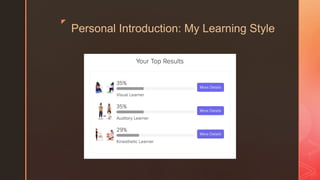
Personal Introduction: My Learning Style
z
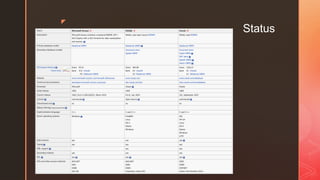
Status
z
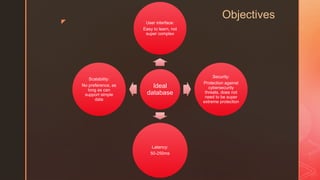
Objectives
Ideal
database
User interface:
Easy to learn, not
super complex
Security:
Protection against
cybersecurity
threats, does not
need to be super
extreme protection
Latency:
50-250ms
Scalability:
No preference, as
long as can
support simple
data
z
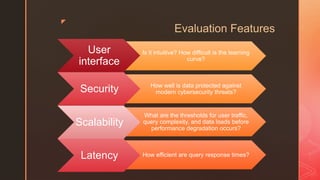
Evaluation Features
Is it intuitive? How difficult is the learning
curve?
How well is data protected against
modern cybersecurity threats?
What are the thresholds for user traffic,
query complexity, and data loads before
performance degradation occurs?
How efficient are query response times?
User
interface
Security
Scalability
Latency
z
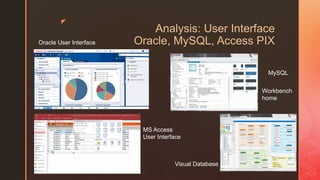
Analysis: User Interface
Oracle, MySQL, Access PIX
Workbench
home
Visual Database
MS Access
User Interface
Oracle User Interface
MySQL
z
Analysis: User Interface
Ranking + Details
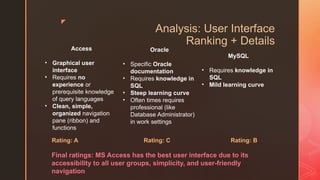
Access
• Graphical user
interface
• Requires no
experience or
prerequisite knowledge
of query languages
• Clean, simple,
organized navigation
pane (ribbon) and
functions
Oracle
• Specific Oracle
documentation
• Requires knowledge in
SQL
• Steep learning curve
• Often times requires
professional (like
Database Administrator)
in work settings
MySQL
• Requires knowledge in
SQL
• Mild learning curve
Final ratings: MS Access has the best user interface due to its
accessibility to all user groups, simplicity, and user-friendly
navigation
Rating: A Rating: C Rating: B
z
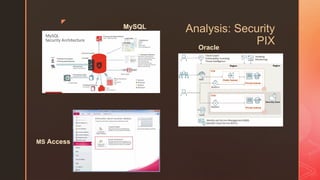
Analysis: Security
PIX
MySQL
MS Access
Oracle
z
Analysis: Security
Ranking + Details
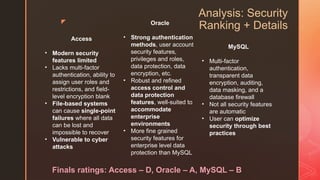
Access
• Modern security
features limited
• Lacks multi-factor
authentication, ability to
assign user roles and
restrictions, and field-
level encryption blank
• File-based systems
can cause single-point
failures where all data
can be lost and
impossible to recover
• Vulnerable to cyber
attacks
Oracle
• Strong authentication
methods, user account
security features,
privileges and roles,
data protection, data
encryption, etc.
• Robust and refined
access control and
data protection
features, well-suited to
accommodate
enterprise
environments
• More fine grained
security features for
enterprise level data
protection than MySQL
MySQL
• Multi-factor
authentication,
transparent data
encryption, auditing,
data masking, and a
database firewall
• Not all security features
are automatic
• User can optimize
security through best
practices
Finals ratings: Access – D, Oracle – A, MySQL – B
z
Analysis: Scalability
Ranking + Details
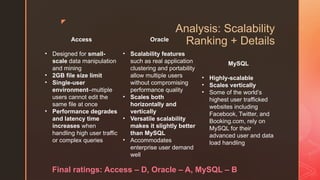
Access
• Designed for small-
scale data manipulation
and mining
• 2GB file size limit
• Single-user
environment–multiple
users cannot edit the
same file at once
• Performance degrades
and latency time
increases when
handling high user traffic
or complex queries
Oracle
• Scalability features
such as real application
clustering and portability
allow multiple users
without compromising
performance quality
• Scales both
horizontally and
vertically
• Versatile scalability
makes it slightly better
than MySQL
• Accommodates
enterprise user demand
well
MySQL
• Highly-scalable
• Scales vertically
• Some of the world’s
highest user trafficked
websites including
Facebook, Twitter, and
Booking.com, rely on
MySQL for their
advanced user and data
load handling
Final ratings: Access – D, Oracle – A, MySQL – B
z Analysis: Latency
Ranking + Details
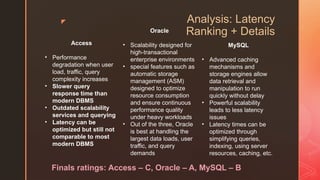
Access
• Performance
degradation when user
load, traffic, query
complexity increases
• Slower query
response time than
modern DBMS
• Outdated scalability
services and querying
• Latency can be
optimized but still not
comparable to most
modern DBMS
Oracle
• Scalability designed for
high-transactional
enterprise environments
• special features such as
automatic storage
management (ASM)
designed to optimize
resource consumption
and ensure continuous
performance quality
under heavy workloads
• Out of the three, Oracle
is best at handling the
largest data loads, user
traffic, and query
demands
MySQL
• Advanced caching
mechanisms and
storage engines allow
data retrieval and
manipulation to run
quickly without delay
• Powerful scalability
leads to less latency
issues
• Latency times can be
optimized through
simplifying queries,
indexing, using server
resources, caching, etc.
Finals ratings: Access – C, Oracle – A, MySQL – B
z
Analysis: Ratings Set Up
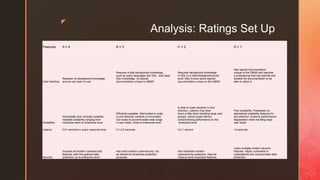
Features A = 4 B = 3 C = 2 D = 1
User interface
Requires no background knowledge,
anyone can learn to use
Requires a little background knowledge;
such as query languages like SQL. Just basic
SQL knowledge, no special
documentation unique to DBMS
Requires background knowledge
in SQL to a intermediate/advanced
level. May involve some special
documentation unique to the DBMS.
Has special documentation
unique to the DBMS and requires
a professional that has learned and
studied the documentation to be
able to utilize it.
Scalability
Horizontally and vertically scalable.
Versatile scalability ranging from
individual users to enterprise level
Efficiently scalable. Well-suited to scale
in one direction (vertical or horizontal).
Can scale to accommodate wide range
in user loads, close to enterprise level.
Is able to scale decently in one
direction. Latency may slow
down a little when handling large user
groups, cannot scale without
compromising performance on the
enterprise level.
Poor scalability. Possesses no
specialized scalability features for
any direction. Extreme performance
degradation when handling large
user loads.
Latency 0.01 seconds in query response time 0.1-0.5 seconds 0.5-1 second >3 seconds
Security
Includes all modern cybersecurity
features, with fine grained data
protection up to enterprise level
Has most modern cybersecurity, not
as refined for enterprise protection
purposes
Has moderate modern
cybersecurity protection. May be
missing some important features.
Lacks multiple modern security
features. Highly vulnerable to
cyberattacks and compromises data
protection
z
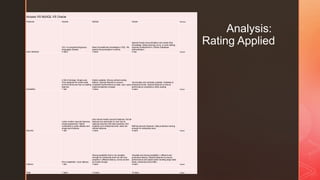
Analysis:
Rating Applied
Access VS MySQL VS Oracle
Features Access MySQL Oracle Winners
User Interface
GUI, no programming/query
languages needed
4 stars
Basic foundational knowledge in SQL. No
special documentation involved.
3 stars
Special Oracle documentation and needs SQL
knowledge. Steep learning curve. In work setting,
requires professional in Oracle (Database
Administrator)
2 star Access
Scalability
2 GB of storage. Single-user.
Only designed for small scale
environments and has no scaling
features
1 star
Highly scalable. Strong vertical scaling
feature. Special features to ensure
consistent performance as data, user, query
loads/complexity increase
3 stars
Horizontally and vertically scalable. Scalable to
enterprise levels. Special features to ensure
performance consistency while scaling.
4 stars Oracle
Security
Lacks modern security features,
except passwords. Highly
vulnerable to cyber attacks and
single point failures.
1 star
Has robust modern security features. Not all
features are automatic so user has to
optimize security with best practices. Not
suitable up to enterprise level, lacks the
refined features.
3 stars
Refined security features. Data protection strong
enough for enterprise level.
4 stars Oracle
Latency
Poor scalability = poor latency
1 star
Strong scalability that is not versatile
enough for enterprise level but still very
powerful = efficient latency, not be as fast
as Oracle though
3 stars
Versatile and strong scalability = efficient and
productive latency. Special features to ensure
performance and speed while handling large data
loads, enterprise-level traffic
4 stars Oracle
Total 7 stars 12 stars 14 stars Oracle
z
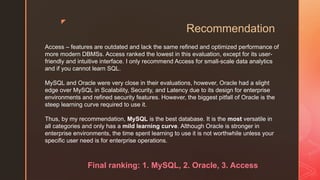
Recommendation
Access – features are outdated and lack the same refined and optimized performance of
more modern DBMSs. Access ranked the lowest in this evaluation, except for its user-
friendly and intuitive interface. I only recommend Access for small-scale data analytics
and if you cannot learn SQL.
MySQL and Oracle were very close in their evaluations, however, Oracle had a slight
edge over MySQL in Scalability, Security, and Latency due to its design for enterprise
environments and refined security features. However, the biggest pitfall of Oracle is the
steep learning curve required to use it.
Thus, by my recommendation, MySQL is the best database. It is the most versatile in
all categories and only has a mild learning curve. Although Oracle is stronger in
enterprise environments, the time spent learning to use it is not worthwhile unless your
specific user need is for enterprise operations.
Final ranking: 1. MySQL, 2. Oracle, 3. Access
z
Bibliography
 "Auto-Sharding in MySQL NDB Cluster." MySQL, www.mysql.com/products/cluster/scalability.html. Accessed 4 May 2025.
 Key Latency Numbers. Medium, medium.com/@AnnanyaPandey/important-latency-numbers-for-programmers-8a8f92df849d. Accessed 4 May 2025.
 "The Logo for Microsoft Access." Wikipedia, Wikimedia Foundation, en.wikipedia.org/wiki/Microsoft_Access. Accessed 4 May 2025.
 "The Logo of Oracle Corporation." Wikipedia, Wikimedia Foundation, en.wikipedia.org/wiki/Oracle_Database. Accessed 4 May 2025.
 "Microsoft Access Database Limitations." The Knowledge Academy, Knowledge Academy, www.theknowledgeacademy.com/blog/microsoft-access-database-limitations/.
Accessed 4 May 2025.
 "Microsoft Access User Interface." Microsoft, www.microsoft.com/en-us/microsoft-365/access. Accessed 4 May 2025.
 "Microsoft Office 2010 New Encryption Technology." iSunshare Blog, iSunshare, 4 Oct. 2015, www.isunshare.com/blog/how-to-set-security-level-in-ms-access-2010/.
Accessed 4 May 2025.
 "MySQL Logo." Wikipedia, Wikimedia Foundation, en.wikipedia.org/wiki/MySQL. Accessed 4 May 2025.
 "MySQL Security Architecture." GBHackers News, 23 Nov. 2023, gbhackers.com/guide-to-mysql-security/. Accessed 4 May 2025.
 "MySQL Workbench Home." MySQL, www.mysql.com/products/workbench/. Accessed 4 May 2025.
 "Scalability and Elasticity in Oracle Cloud Infrastructure." Database Heartbeat, 31 Dec. 2020, database-heartbeat.com/2020/12/31/scalability-and-elasticity-in-oracle-
cloud-infrastructure/. Accessed 4 May 2025.
 "Security Services in Oracle Cloud Infrastructure." Oracle Help Center, Oracle, 23 Apr. 2025,
docs.oracle.com/en-us/iaas/Content/Security/Concepts/security_features.htm. Accessed 4 May 2025.
 "User Interface of Oracle Enterprise Manager Ops Center." Oracle Help Center, Oracle, docs.oracle.com/cd/E59957_01/doc.123/e59967/GUID-27811445-71A3-48FA-
8635-0C84DCFB6E83.htm#OPCCO1103.
 "Visual Database Design." MySQL, www.mysql.com/products/workbench/. Accessed 4 May 2025.
 What Is Latency. AKF Partners, akfpartners.com/growth-blog/what-is-latency. Accessed 19 Apr. 2019.

CIS1 Research Project - Comparing Database Management Systems: Access VS MySQL VS Oracle

  • 1.
    z Database Management Systems:Access, MySQL, and Oracle By Jasmine Liu, CIS101 Spring 2025
  • 2.
    z Personal Introduction: JasmineLiu My name is Jasmine Liu
  • 3.
    z Personal Introduction:FORM M - CIS 1 will allow me to strengthen my understanding on how data-driven systems function, giving me a broader perspective on hardware and software as a programmer. This course provides essential skills that will allow me to grow as a student and extend understanding of technology, accelerating my future career ambitions. F - I am Chinese-American, and have working proficiency in Mandarin Chinese. I also have one younger sister. Occupation - I am a full-time student at Albany High School in my sophomore year. Recreation - I have multiple interests, both academic and recreation. I am very driven by environmental justice, particularly, the intersection of engineering and sustainability. I explore those values through diverse activities such as Model UN, programming, and doing personal projects. My recreational hobbies include playing tennis and listening to music. My favorite styles of music are indie genres!
  • 4.
  • 5.
  • 6.
    z Objectives Ideal database User interface: Easy tolearn, not super complex Security: Protection against cybersecurity threats, does not need to be super extreme protection Latency: 50-250ms Scalability: No preference, as long as can support simple data
  • 7.
    z Evaluation Features Is itintuitive? How difficult is the learning curve? How well is data protected against modern cybersecurity threats? What are the thresholds for user traffic, query complexity, and data loads before performance degradation occurs? How efficient are query response times? User interface Security Scalability Latency
  • 8.
    z Analysis: User Interface Oracle,MySQL, Access PIX Workbench home Visual Database MS Access User Interface Oracle User Interface MySQL
  • 9.
    z Analysis: User Interface Ranking+ Details Access • Graphical user interface • Requires no experience or prerequisite knowledge of query languages • Clean, simple, organized navigation pane (ribbon) and functions Oracle • Specific Oracle documentation • Requires knowledge in SQL • Steep learning curve • Often times requires professional (like Database Administrator) in work settings MySQL • Requires knowledge in SQL • Mild learning curve Final ratings: MS Access has the best user interface due to its accessibility to all user groups, simplicity, and user-friendly navigation Rating: A Rating: C Rating: B
  • 10.
  • 11.
    z Analysis: Security Ranking +Details Access • Modern security features limited • Lacks multi-factor authentication, ability to assign user roles and restrictions, and field- level encryption blank • File-based systems can cause single-point failures where all data can be lost and impossible to recover • Vulnerable to cyber attacks Oracle • Strong authentication methods, user account security features, privileges and roles, data protection, data encryption, etc. • Robust and refined access control and data protection features, well-suited to accommodate enterprise environments • More fine grained security features for enterprise level data protection than MySQL MySQL • Multi-factor authentication, transparent data encryption, auditing, data masking, and a database firewall • Not all security features are automatic • User can optimize security through best practices Finals ratings: Access – D, Oracle – A, MySQL – B
  • 12.
    z Analysis: Scalability Ranking +Details Access • Designed for small- scale data manipulation and mining • 2GB file size limit • Single-user environment–multiple users cannot edit the same file at once • Performance degrades and latency time increases when handling high user traffic or complex queries Oracle • Scalability features such as real application clustering and portability allow multiple users without compromising performance quality • Scales both horizontally and vertically • Versatile scalability makes it slightly better than MySQL • Accommodates enterprise user demand well MySQL • Highly-scalable • Scales vertically • Some of the world’s highest user trafficked websites including Facebook, Twitter, and Booking.com, rely on MySQL for their advanced user and data load handling Final ratings: Access – D, Oracle – A, MySQL – B
  • 13.
    z Analysis: Latency Ranking+ Details Access • Performance degradation when user load, traffic, query complexity increases • Slower query response time than modern DBMS • Outdated scalability services and querying • Latency can be optimized but still not comparable to most modern DBMS Oracle • Scalability designed for high-transactional enterprise environments • special features such as automatic storage management (ASM) designed to optimize resource consumption and ensure continuous performance quality under heavy workloads • Out of the three, Oracle is best at handling the largest data loads, user traffic, and query demands MySQL • Advanced caching mechanisms and storage engines allow data retrieval and manipulation to run quickly without delay • Powerful scalability leads to less latency issues • Latency times can be optimized through simplifying queries, indexing, using server resources, caching, etc. Finals ratings: Access – C, Oracle – A, MySQL – B
  • 14.
    z Analysis: Ratings SetUp Features A = 4 B = 3 C = 2 D = 1 User interface Requires no background knowledge, anyone can learn to use Requires a little background knowledge; such as query languages like SQL. Just basic SQL knowledge, no special documentation unique to DBMS Requires background knowledge in SQL to a intermediate/advanced level. May involve some special documentation unique to the DBMS. Has special documentation unique to the DBMS and requires a professional that has learned and studied the documentation to be able to utilize it. Scalability Horizontally and vertically scalable. Versatile scalability ranging from individual users to enterprise level Efficiently scalable. Well-suited to scale in one direction (vertical or horizontal). Can scale to accommodate wide range in user loads, close to enterprise level. Is able to scale decently in one direction. Latency may slow down a little when handling large user groups, cannot scale without compromising performance on the enterprise level. Poor scalability. Possesses no specialized scalability features for any direction. Extreme performance degradation when handling large user loads. Latency 0.01 seconds in query response time 0.1-0.5 seconds 0.5-1 second >3 seconds Security Includes all modern cybersecurity features, with fine grained data protection up to enterprise level Has most modern cybersecurity, not as refined for enterprise protection purposes Has moderate modern cybersecurity protection. May be missing some important features. Lacks multiple modern security features. Highly vulnerable to cyberattacks and compromises data protection
  • 15.
    z Analysis: Rating Applied Access VSMySQL VS Oracle Features Access MySQL Oracle Winners User Interface GUI, no programming/query languages needed 4 stars Basic foundational knowledge in SQL. No special documentation involved. 3 stars Special Oracle documentation and needs SQL knowledge. Steep learning curve. In work setting, requires professional in Oracle (Database Administrator) 2 star Access Scalability 2 GB of storage. Single-user. Only designed for small scale environments and has no scaling features 1 star Highly scalable. Strong vertical scaling feature. Special features to ensure consistent performance as data, user, query loads/complexity increase 3 stars Horizontally and vertically scalable. Scalable to enterprise levels. Special features to ensure performance consistency while scaling. 4 stars Oracle Security Lacks modern security features, except passwords. Highly vulnerable to cyber attacks and single point failures. 1 star Has robust modern security features. Not all features are automatic so user has to optimize security with best practices. Not suitable up to enterprise level, lacks the refined features. 3 stars Refined security features. Data protection strong enough for enterprise level. 4 stars Oracle Latency Poor scalability = poor latency 1 star Strong scalability that is not versatile enough for enterprise level but still very powerful = efficient latency, not be as fast as Oracle though 3 stars Versatile and strong scalability = efficient and productive latency. Special features to ensure performance and speed while handling large data loads, enterprise-level traffic 4 stars Oracle Total 7 stars 12 stars 14 stars Oracle
  • 16.
    z Recommendation Access – featuresare outdated and lack the same refined and optimized performance of more modern DBMSs. Access ranked the lowest in this evaluation, except for its user- friendly and intuitive interface. I only recommend Access for small-scale data analytics and if you cannot learn SQL. MySQL and Oracle were very close in their evaluations, however, Oracle had a slight edge over MySQL in Scalability, Security, and Latency due to its design for enterprise environments and refined security features. However, the biggest pitfall of Oracle is the steep learning curve required to use it. Thus, by my recommendation, MySQL is the best database. It is the most versatile in all categories and only has a mild learning curve. Although Oracle is stronger in enterprise environments, the time spent learning to use it is not worthwhile unless your specific user need is for enterprise operations. Final ranking: 1. MySQL, 2. Oracle, 3. Access
  • 17.
    z Bibliography  "Auto-Sharding inMySQL NDB Cluster." MySQL, www.mysql.com/products/cluster/scalability.html. Accessed 4 May 2025.  Key Latency Numbers. Medium, medium.com/@AnnanyaPandey/important-latency-numbers-for-programmers-8a8f92df849d. Accessed 4 May 2025.  "The Logo for Microsoft Access." Wikipedia, Wikimedia Foundation, en.wikipedia.org/wiki/Microsoft_Access. Accessed 4 May 2025.  "The Logo of Oracle Corporation." Wikipedia, Wikimedia Foundation, en.wikipedia.org/wiki/Oracle_Database. Accessed 4 May 2025.  "Microsoft Access Database Limitations." The Knowledge Academy, Knowledge Academy, www.theknowledgeacademy.com/blog/microsoft-access-database-limitations/. Accessed 4 May 2025.  "Microsoft Access User Interface." Microsoft, www.microsoft.com/en-us/microsoft-365/access. Accessed 4 May 2025.  "Microsoft Office 2010 New Encryption Technology." iSunshare Blog, iSunshare, 4 Oct. 2015, www.isunshare.com/blog/how-to-set-security-level-in-ms-access-2010/. Accessed 4 May 2025.  "MySQL Logo." Wikipedia, Wikimedia Foundation, en.wikipedia.org/wiki/MySQL. Accessed 4 May 2025.  "MySQL Security Architecture." GBHackers News, 23 Nov. 2023, gbhackers.com/guide-to-mysql-security/. Accessed 4 May 2025.  "MySQL Workbench Home." MySQL, www.mysql.com/products/workbench/. Accessed 4 May 2025.  "Scalability and Elasticity in Oracle Cloud Infrastructure." Database Heartbeat, 31 Dec. 2020, database-heartbeat.com/2020/12/31/scalability-and-elasticity-in-oracle- cloud-infrastructure/. Accessed 4 May 2025.  "Security Services in Oracle Cloud Infrastructure." Oracle Help Center, Oracle, 23 Apr. 2025, docs.oracle.com/en-us/iaas/Content/Security/Concepts/security_features.htm. Accessed 4 May 2025.  "User Interface of Oracle Enterprise Manager Ops Center." Oracle Help Center, Oracle, docs.oracle.com/cd/E59957_01/doc.123/e59967/GUID-27811445-71A3-48FA- 8635-0C84DCFB6E83.htm#OPCCO1103.  "Visual Database Design." MySQL, www.mysql.com/products/workbench/. Accessed 4 May 2025.  What Is Latency. AKF Partners, akfpartners.com/growth-blog/what-is-latency. Accessed 19 Apr. 2019.

Editor's Notes

  • #7 Also like to note, although not in evaluation criteria: the prices for these DBMS. MySQL is open-sourced, and it has a community edition that is commercially free to users, while it has a Enterprise edition that costs money. Access is part of Microsoft 365 Suite so it costs money to use, and theres no free version. Oracle, also proprietary, has some free editions (like Express Edition), but its Enterprise Edition used by large enterprises is very expensive.