venin's theorem
Thé
Introduction:


Thevenin’s theorem is a popular theorem, used often for
analysis of electronic circuits. This theorem states that
a linear circuit containing one or more sources and
other linear elements can be represented by a voltage
source and a resistance. Using this theorem, a model of
the circuit can be developed based on its output
characteristic.
It was discovered in 1883 by
French telegraph engineer Léon Charles Thévenin.
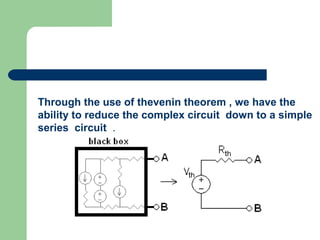
Through the use of thevenin theorem , we have the
ability to reduce the complex circuit down to a simple
series circuit .
The four steps involved are:
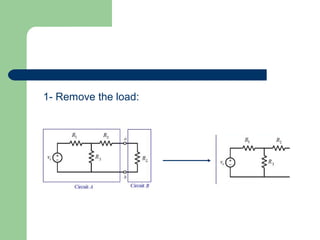
1- First Remove the load.
2- Then determine the voltage seen by the load
(Vth).
3- Then replace the voltage source with a short.
4- At the end determine the resistance seen by
the load (Rth).
1- Remove the load:
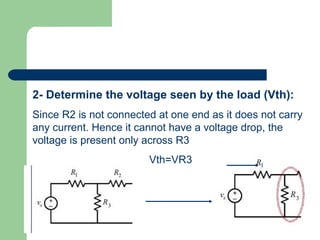
2- Determine the voltage seen by the load (Vth):
Since R2 is not connected at one end as it does not carry
any current. Hence it cannot have a voltage drop, the
voltage is present only across R3
                        Vth=VR3
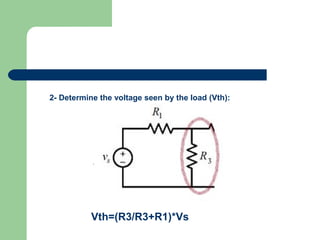
2- Determine the voltage seen by the load (Vth):


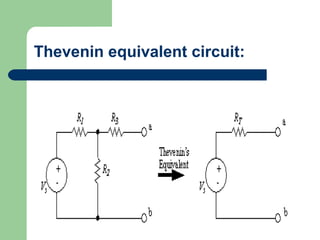
           Vth=(R3/R3+R1)*Vs
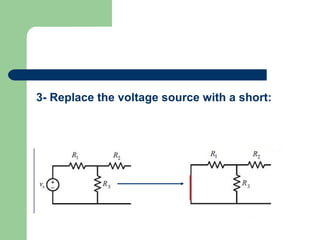
3- Replace the voltage source with a short:
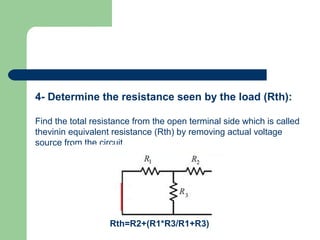
4- Determine the resistance seen by the load (Rth):

Find the total resistance from the open terminal side which is called
thevinin equivalent resistance (Rth) by removing actual voltage
source from the circuit.


                   Rth=R2+(R1*R3/R1+R3)
Thevenin equivalent circuit:
Conclusion:

• Certain circuits can be simplified by using
  Thevenin’s Theorem.
• Equivalent Resistance is essential for the
  calculation of TEC.
• Ohm’s law is useful in this theorem.
• A linear network can be transferred into a
  voltage source.
Circuit Analysis-

Circuit Analysis-

  • 1.
  • 2.
    Introduction: Thevenin’s theorem isa popular theorem, used often for analysis of electronic circuits. This theorem states that a linear circuit containing one or more sources and other linear elements can be represented by a voltage source and a resistance. Using this theorem, a model of the circuit can be developed based on its output characteristic. It was discovered in 1883 by French telegraph engineer Léon Charles Thévenin.
  • 3.
    Through the useof thevenin theorem , we have the ability to reduce the complex circuit down to a simple series circuit .
  • 4.
    The four stepsinvolved are: 1- First Remove the load. 2- Then determine the voltage seen by the load (Vth). 3- Then replace the voltage source with a short. 4- At the end determine the resistance seen by the load (Rth).
  • 5.
  • 6.
    2- Determine thevoltage seen by the load (Vth): Since R2 is not connected at one end as it does not carry any current. Hence it cannot have a voltage drop, the voltage is present only across R3 Vth=VR3
  • 7.
    2- Determine thevoltage seen by the load (Vth): Vth=(R3/R3+R1)*Vs
  • 8.
    3- Replace thevoltage source with a short:
  • 9.
    4- Determine theresistance seen by the load (Rth): Find the total resistance from the open terminal side which is called thevinin equivalent resistance (Rth) by removing actual voltage source from the circuit. Rth=R2+(R1*R3/R1+R3)
  • 10.
  • 11.
    Conclusion: • Certain circuitscan be simplified by using Thevenin’s Theorem. • Equivalent Resistance is essential for the calculation of TEC. • Ohm’s law is useful in this theorem. • A linear network can be transferred into a voltage source.

Editor's Notes

  • #2 Thévenin's theorem Thévenin's theorem